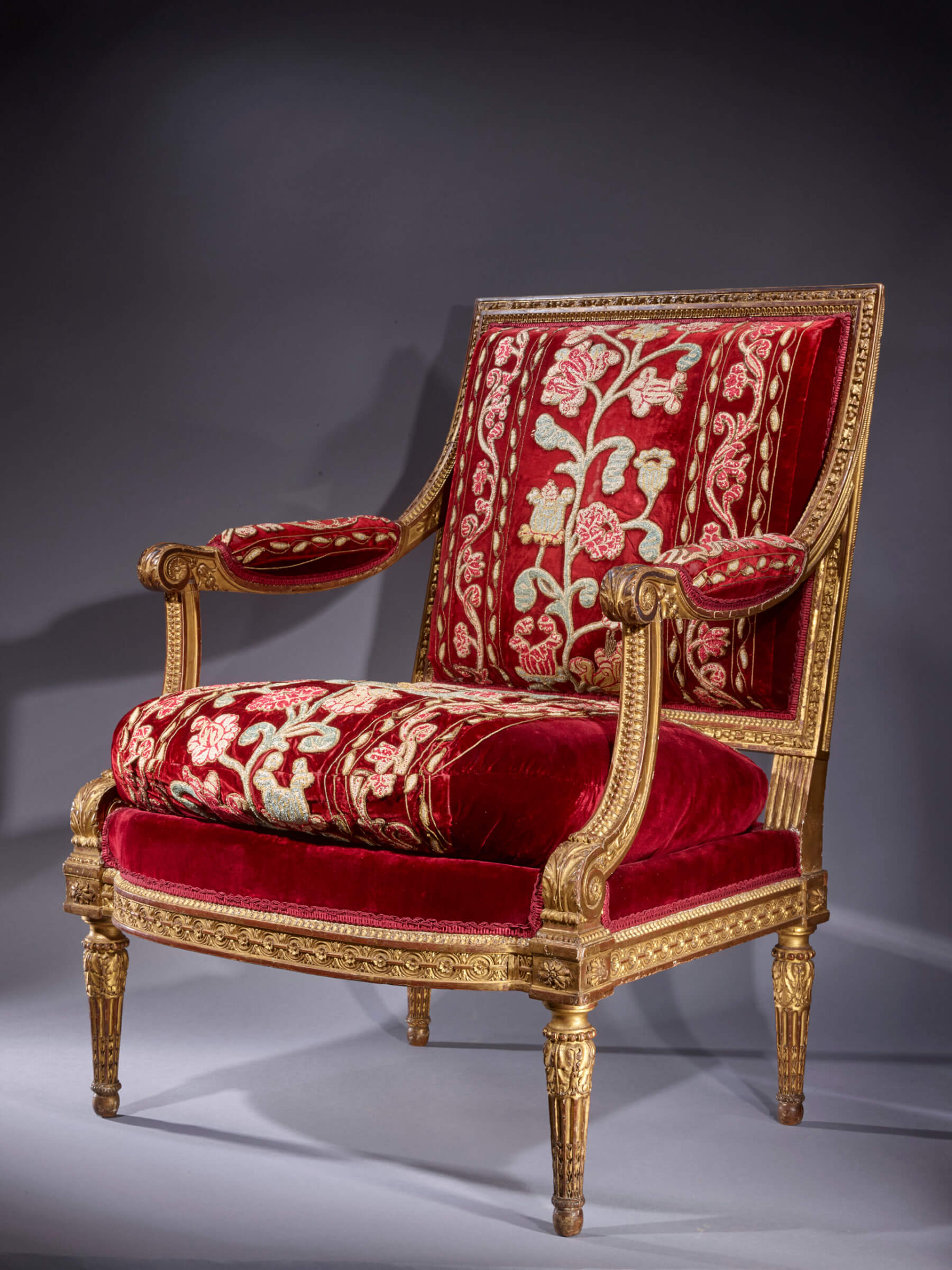
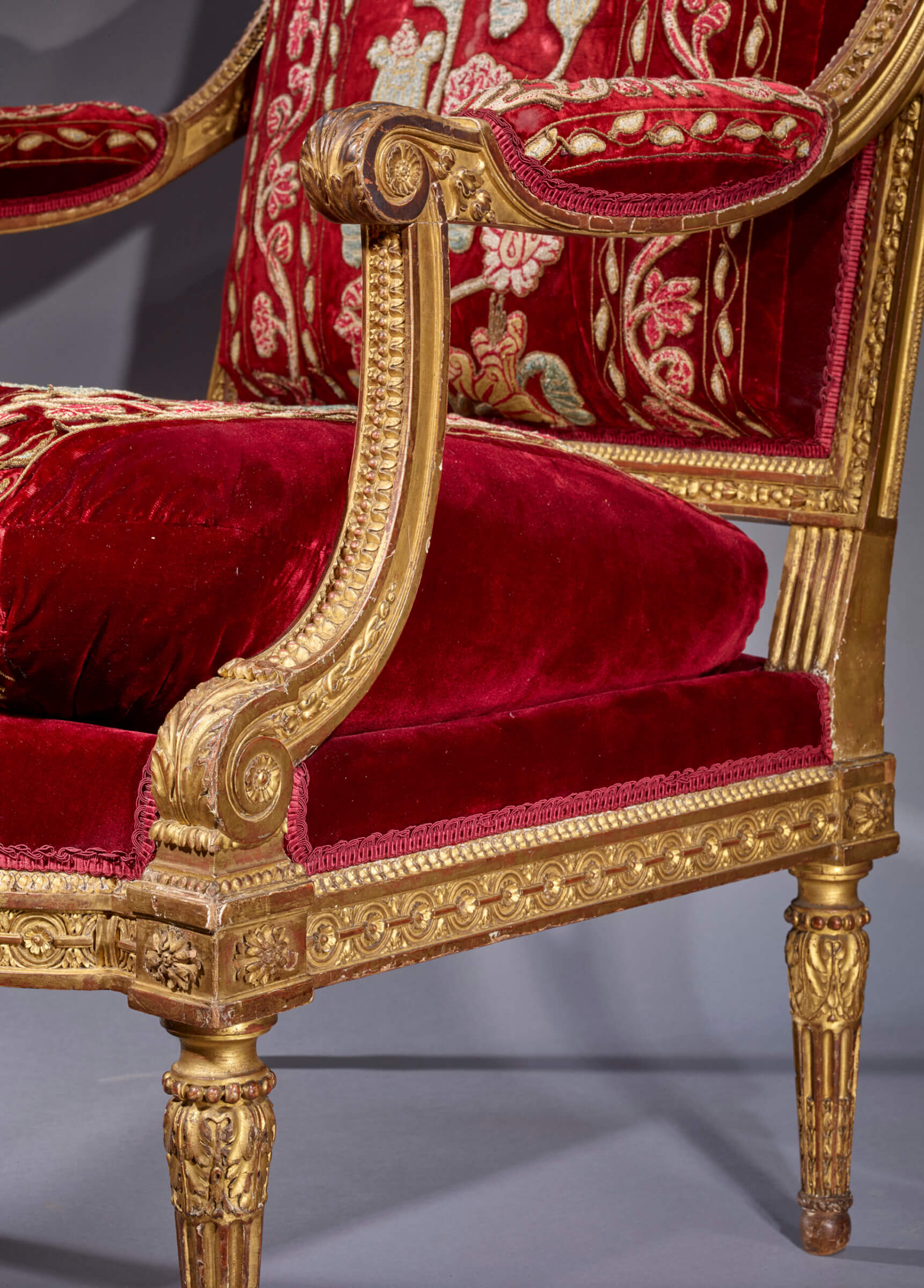
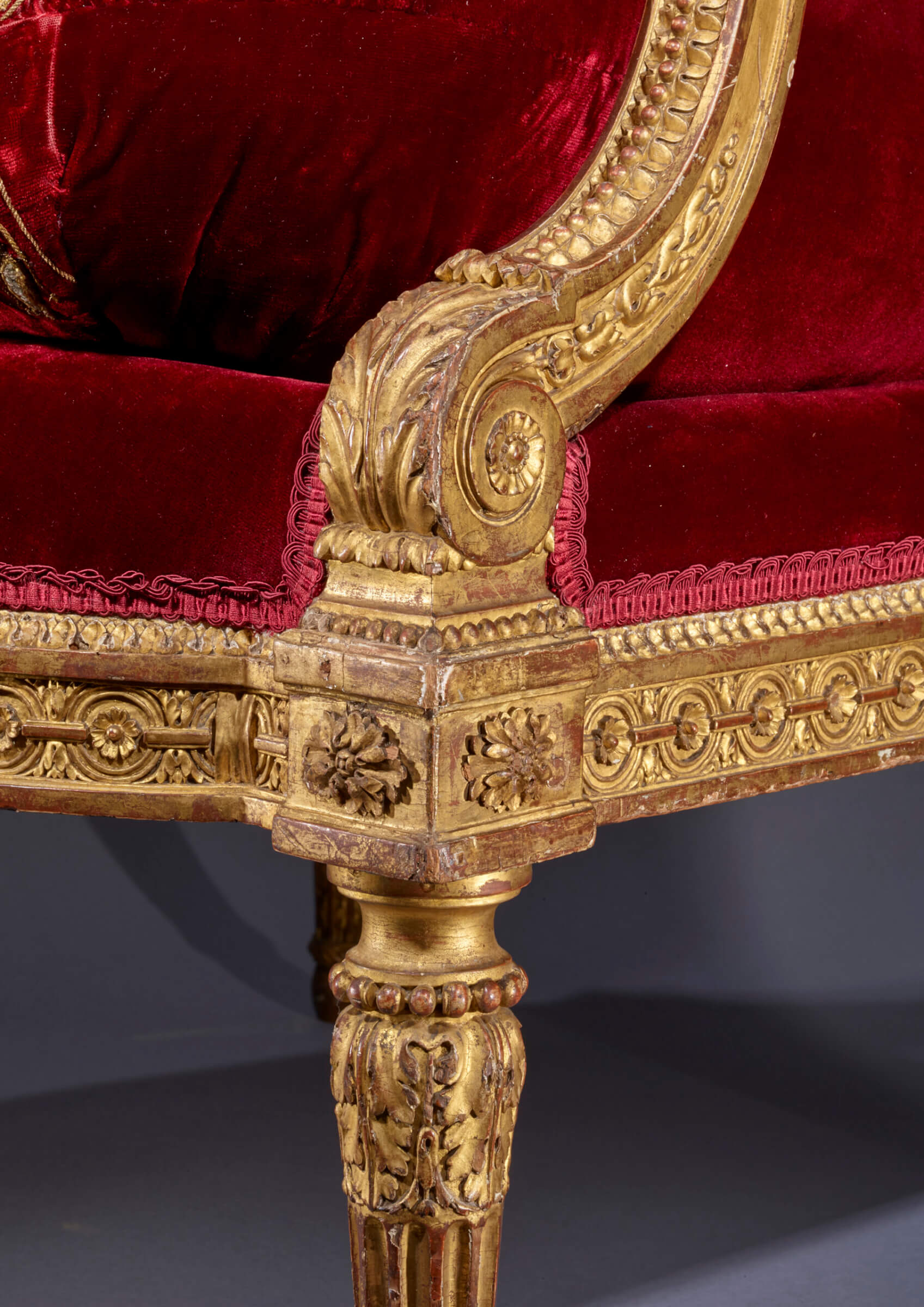
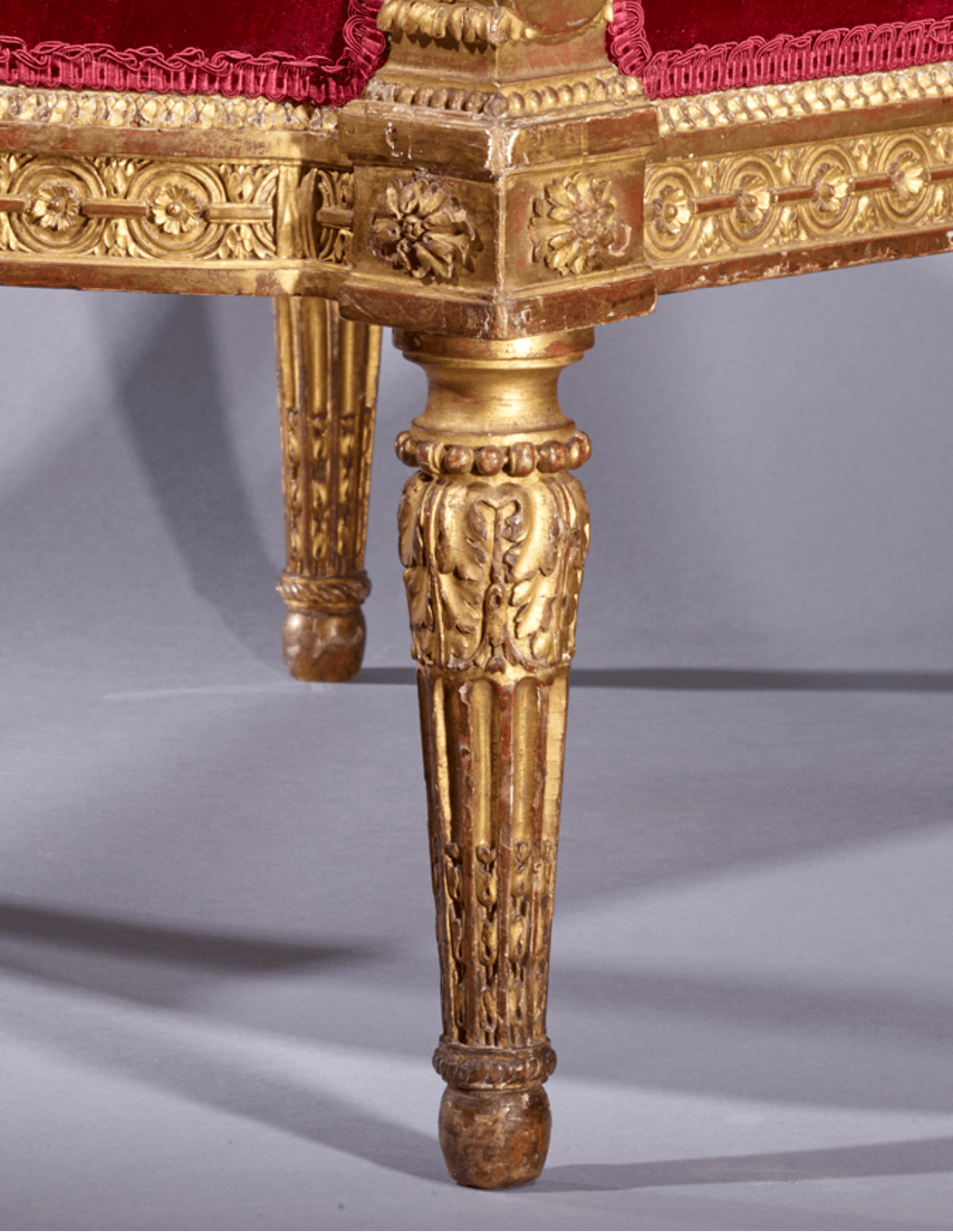
Moulded, carved and gilded walnut; embroidered red velvet.
H. 91 cm. (36 in.); W. 69 cm. (27 ¼ in.); D. 58.5 cm. (23 in.).
STAMP: G. IACOB, visible beneath one of the seat rails.
MARKS AND INSCRIPTIONS: N° 3, handwritten mark in black ink, visible several times on the reverse of the seat, designating armchair n° 3 out of the four of this set delivered by Georges Jacob in 1781; cursive letters T S incised on the reverse of one of the seat rails, this very rare inscription was used to designate the Palais des Tuileries during the Revolution, the Consulat and the Empire, as can also be seen on the equally rare printed labels, affixed to a suite of four giltwood armchairs (originally six) executed by Jacob Frères, initially commissioned for the Palais du Directoire exécutif, today the Palais du Luxembourg, but placed in 1800 at the Palais des Tuileries, in the first salon of Joséphine Bonaparte, on the ground floor of the south wing of the palace; these armchairs are today preserved in the Mobilier national, in Paris (inv. GMT 1445/004) ; E. de Rostchild [sic], handwritten inscription in black pencil, visible beneath one of the seat rails, designating Baron Edouard Alphonse James de Rothschild (1868-1949) ; R.MA., capital letters handwritten in black paint on the reverse of one of the seat rails, signifying Rothschild Marine, an inventory mark used by the Einsatzstab Reichsleiter Rosenberg (Reichsleiter Rosenberg Taskforce), which was responsible for the confiscation of property belonging to Jews and Freemasons in the territories occupied by the Germans.
PROVENANCE: delivered by Georges Jacob in July 1781, as part of a set of three identical armchairs, a sultane, and two chairs, to furnish the boudoir of Marie-Joséphine de Savoie (1753-1810), Countess de Provence, at the Château de Brunoy (Essonne, formerly Seine-et-Oise); seized during the Revolution in 1793; placed in the Palais des Tuileries under the Consulat and/or the Empire, as indicated by the presence of cursive letters T S incised on the reverse of one of the seat rails, which at the time designated the Tuileries; collection of Baron Edouard Alphonse James de Rothschild (1868-1949); confiscated in 1940 by the Einsatzstab Reichsleiter Rosenberg (Reichsleiter Rosenberg Taskforce), responsible for the seizure of property belonging to Jews and Freemasons in German-occupied territories, and sent to the monastery of Buxheim; recovered by the Section des monuments, beaux-arts et archives at the monastery of Buxheim, in Bavaria; retrieved by the Monuments Men and restituted to Baron Edouard de Rothschild; collection of his son, Baron Guy de Rothschild (1909-2007) and his wife, Marie-Hélène (1927-1996), née Van Zuylen Van Nyevelt Van de Haar, at the Hôtel Lambert, in Paris; then descended within the Rothschild family until the present day.
SOURCE: Archives nationales, R5 522, Apanage de Provence, Mémoires arrêtés, non soldés.
LITERATURE: Hector Lefuel, Georges Jacob, ébéniste du XVIIIe siècle, Paris, p. 219-220 ; Claude Frégnac, Belles demeures de Paris 16e – 19e siècle, Paris, 1977.
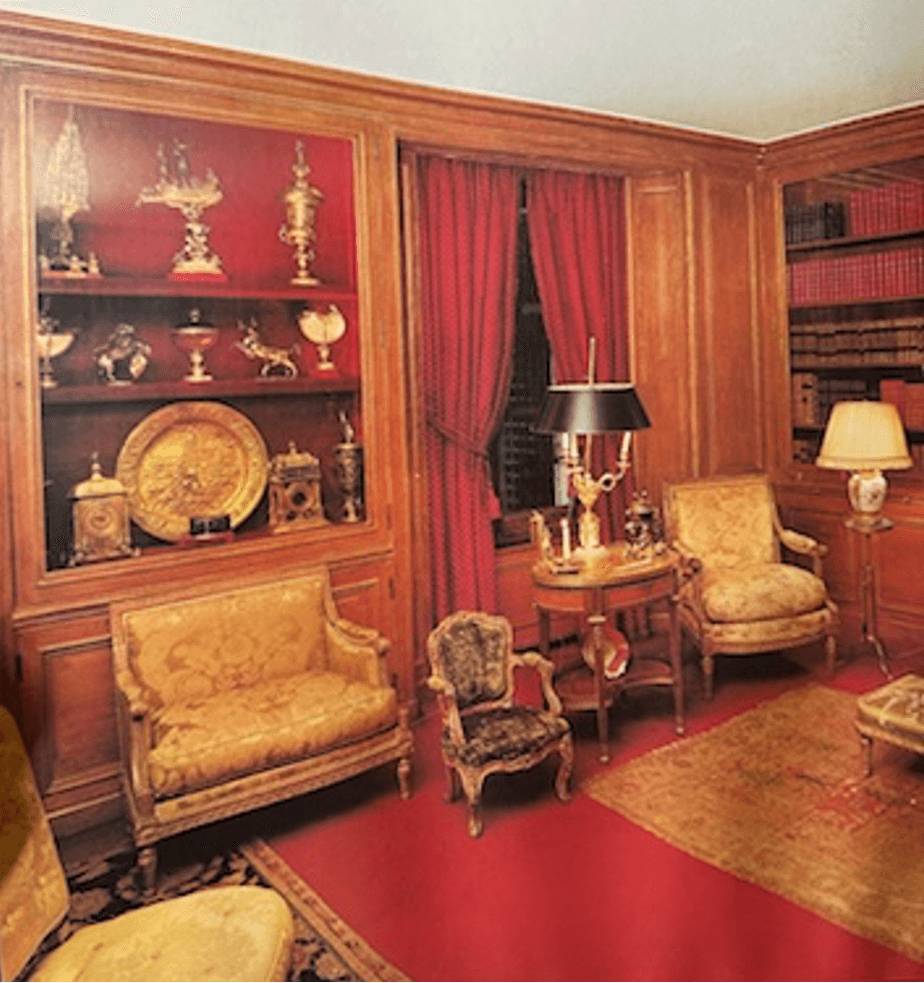
1. View of our armchair decorating the Hôtel Lambert in 1977, reproduced in the work of Claude Frégnac, Belles demeures de Paris 16e – 19e siècle, Paris, 1977.
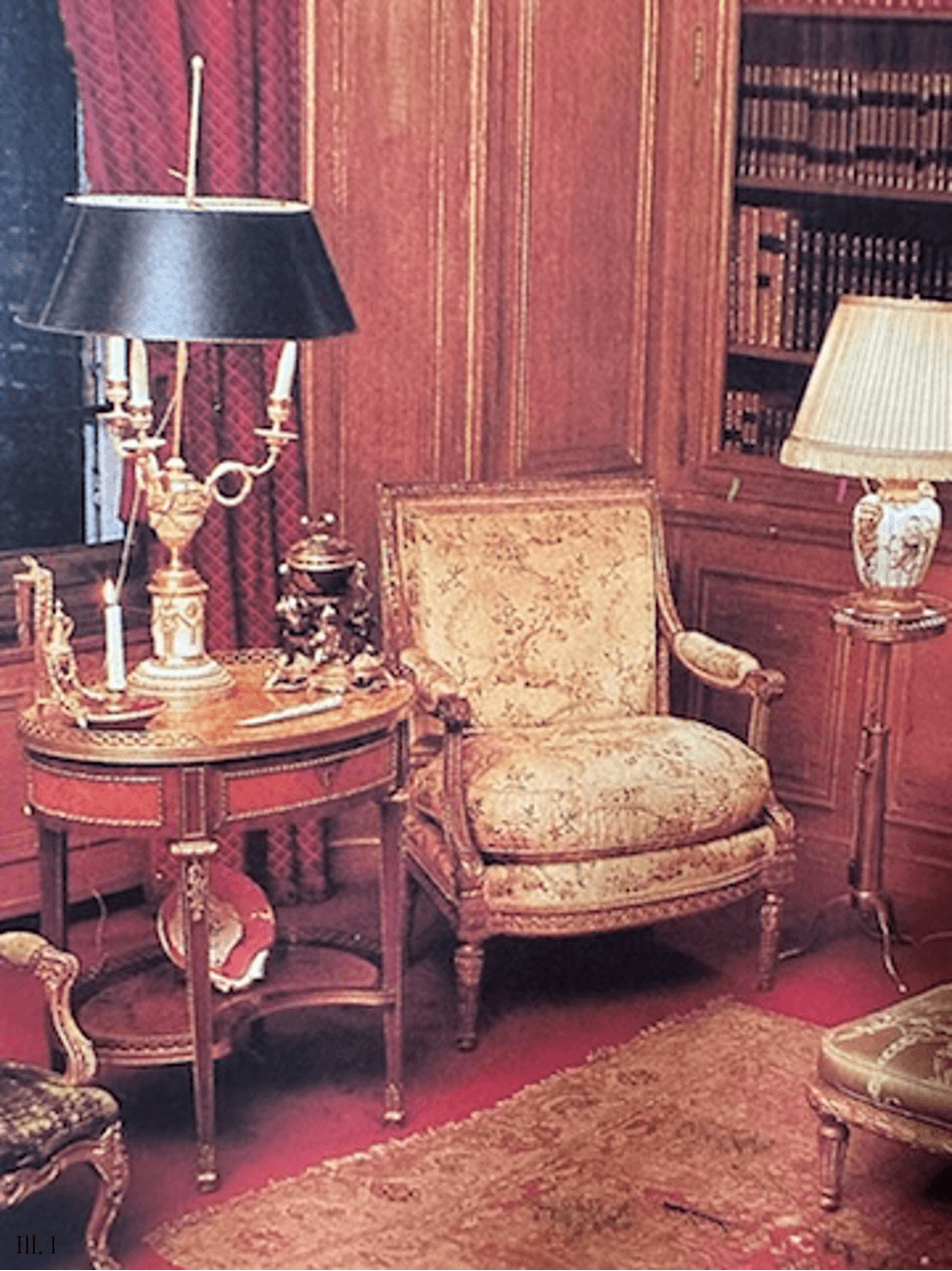
2. View of our armchair decorating the Hôtel Lambert in 1977 (detail), reproduced in the work of Claude Frégnac, Belles demeures de Paris 16e – 19e siècle, Paris, 1977.