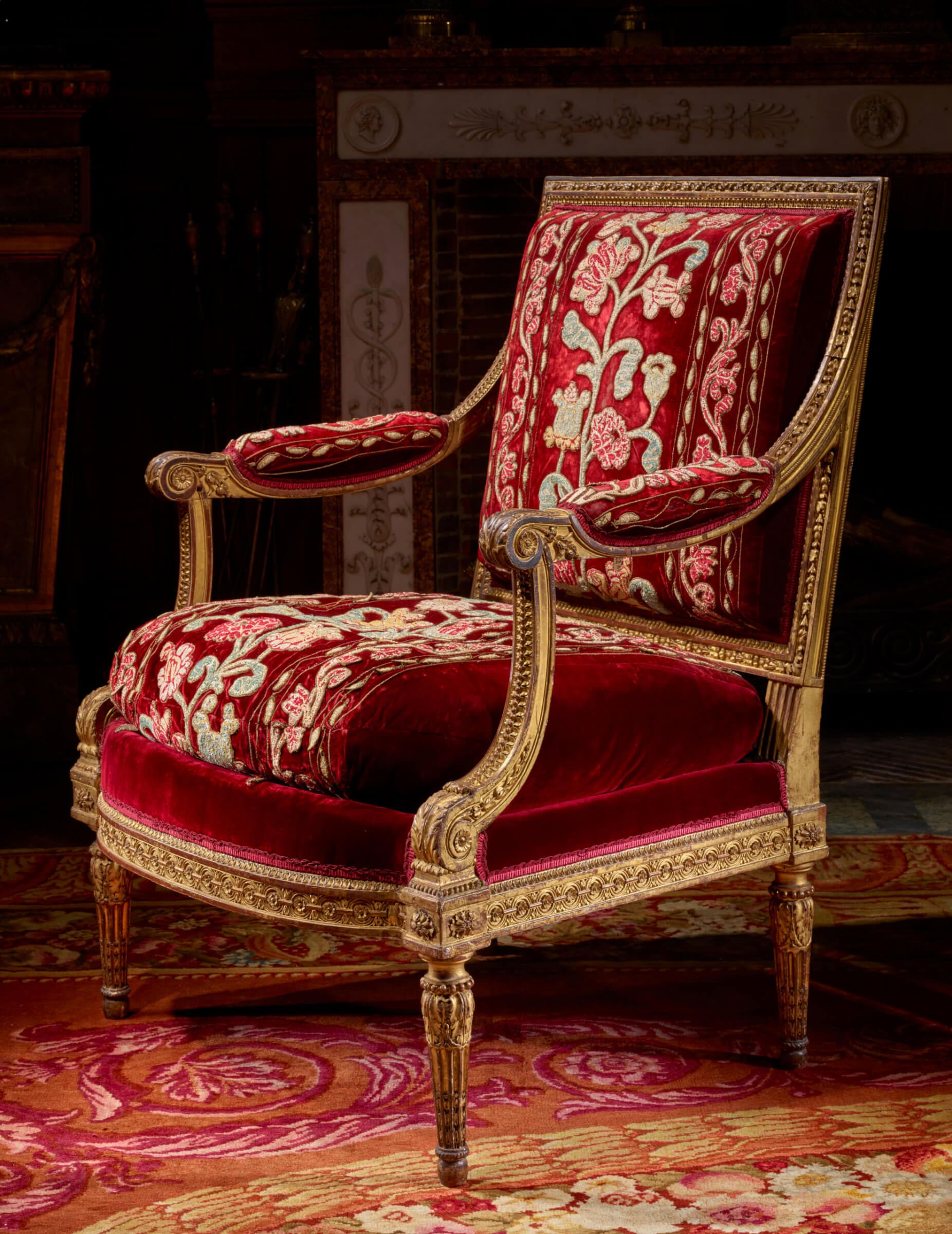
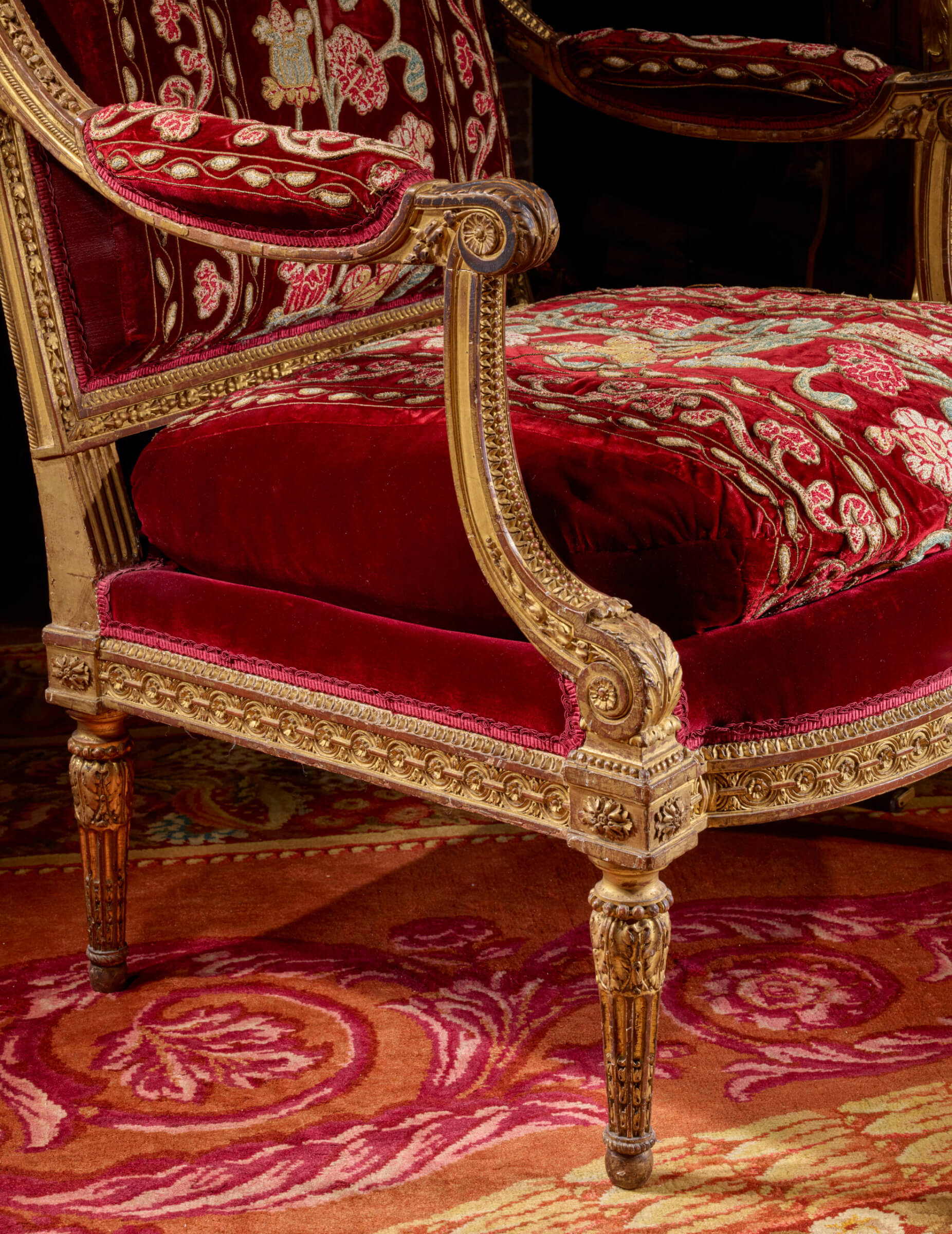
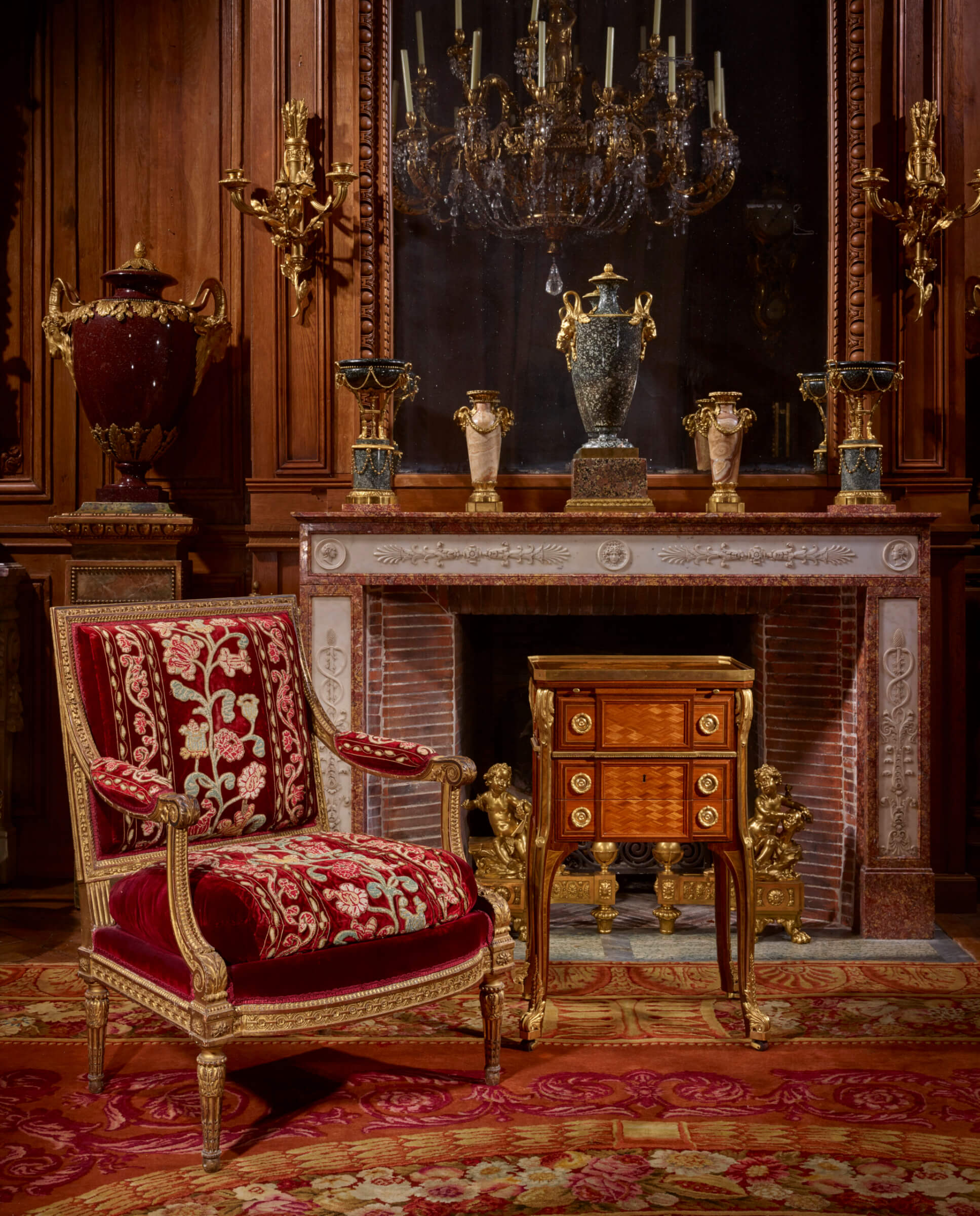
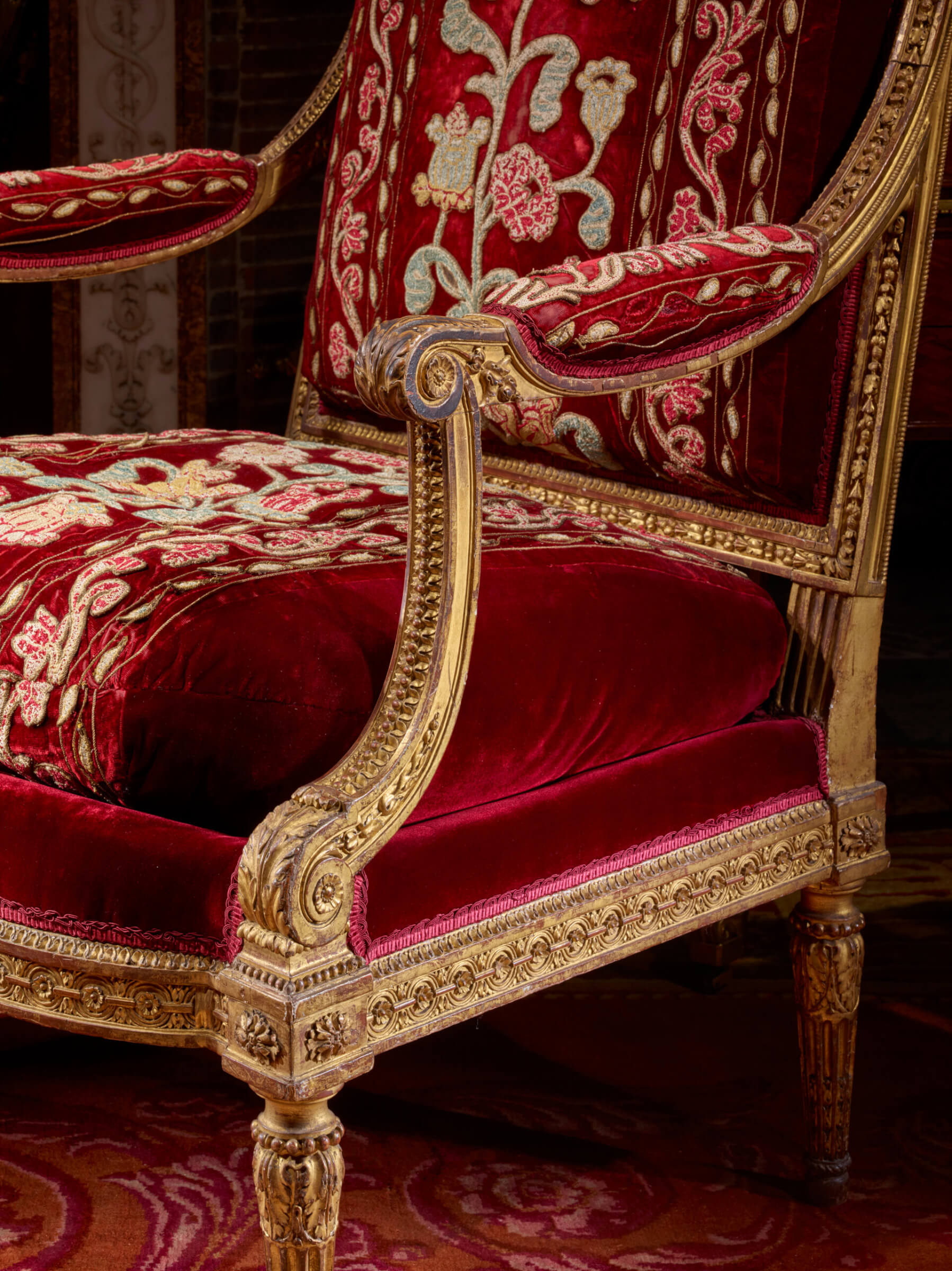
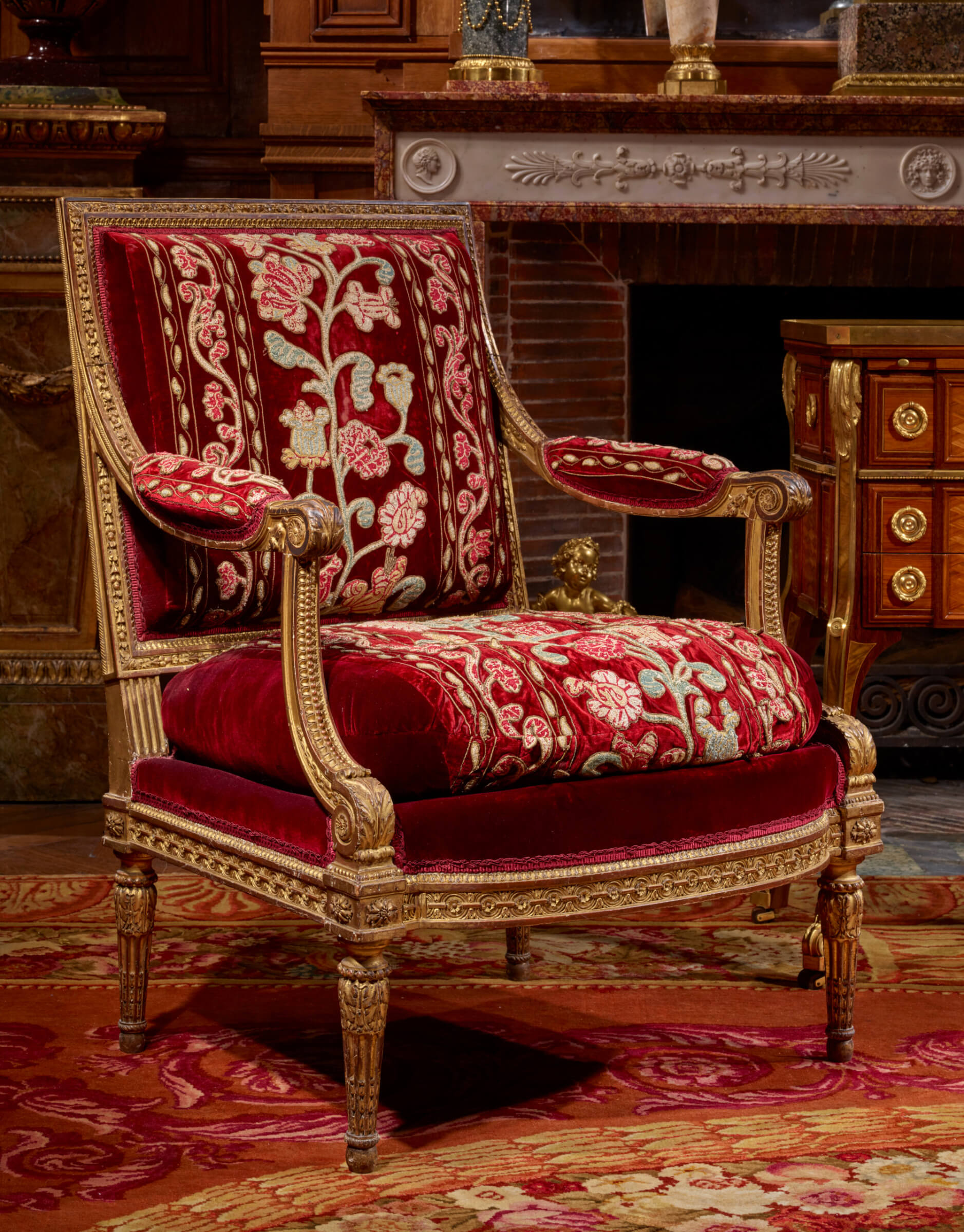
Moulded, carved and gilded walnut; embroidered red velvet.
H. 91 cm. (36 in.); L. 69 cm. (27 ¼ in.); W. 58.5 cm. (23 in.).
STAMP: G. IACOB, visible under one of the cross-rails of the seat frame.
MARKS INSCRIPTIONS: N° 3, handwritten mark in black ink visible several times on the back of the seat cross-rails, designating chair n°. 3 of the four in this ensemble delivered by Georges Jacob on 7th July 1781; cursive letters T S incised on the reverse of one of the seat’s cross-rails; worthy of note is that the abbreviations T S. were, on rare occasions, used to designate the Tuileries Palace during the Revolution, the Consulate and the Empire, as can be seen on printed labels visible on a suite of four gilded wooden armchairs (originally six) executed by Jacob Frères, initially commissioned for the Palace of the Executive Directory, now the Luxembourg Palace, but placed in 1800 in the Tuileries Palace, in Joséphine Bonaparte’s premier salon, on the ground floor of the south wing of the palace; these armchairs are now kept at the Mobilier National in Paris (inv. GMT 1445/004); E. de Rostchild [sic], handwritten inscription in black pencil, visible under one of the seat’s cross-rails, and referring to Baron Edouard Alphonse James de Rothschild (1868-1949); R.MA., handwritten capital letters in black paint, visible on the reverse side of one of the seat cross-rails and standing for Rothschild Marine, an inventory mark most likely referring to the townhouse on Rue Saint-Florentin, next to the hôtel de la Marine, used by the Einsatzstab Reichsleiter Rosenberg (Reichsleiter Rosenberg Taskforce), in charge of confiscating property belonging to Jews and Freemasons in German-occupied territories.
PROVENANCE: delivered by Georges Jacob on 7th July 1781, as part of a suite of three other identical armchairs, a sultane and two chairs, to furnish the boudoir of Marie-Joséphine-Louise of Savoy (1753-1810), Countess of Provence, at the Château de Brunoy (Essonne, formerly Seine-et-Oise); seized during the Revolution in 1792; sold in situ at auction between 9th and 16th June 1794 under the supervision of Mr. Deteure, de Montgeron; collection of Baron Edouard Alphonse James de Rothschild (1868-1949) in his townhouse at 2, rue Saint-Florentin, Paris; confiscated in 1940 by the Einsatzstab Reichsleiter Rosenberg and sent to Buxheim Monastery; recovered by the Monuments Men and returned to Baron Edouard de Rothschild; collection of his son, Baron Guy de Rothschild (1909-2007) and his wife, Marie-Hélène (1927-1996), née Van Zuylen Van Nyevelt Van de Haar, who placed it in the hôtel Lambert in Paris after 1975; then by descent, Rothschild collection to the present day.
SOURCE: Archives nationales, R5 522, Apanage de Provence, Mémoires arrêtés, non soldés.
LITERATURE: Hector Lefuel, Georges Jacob, ébéniste du XVIIIe siècle, Paris, p. 219-220 ; Claude Frégnac, Belles demeures de Paris 16e – 19e siècle, Paris, 1977, p. 256.

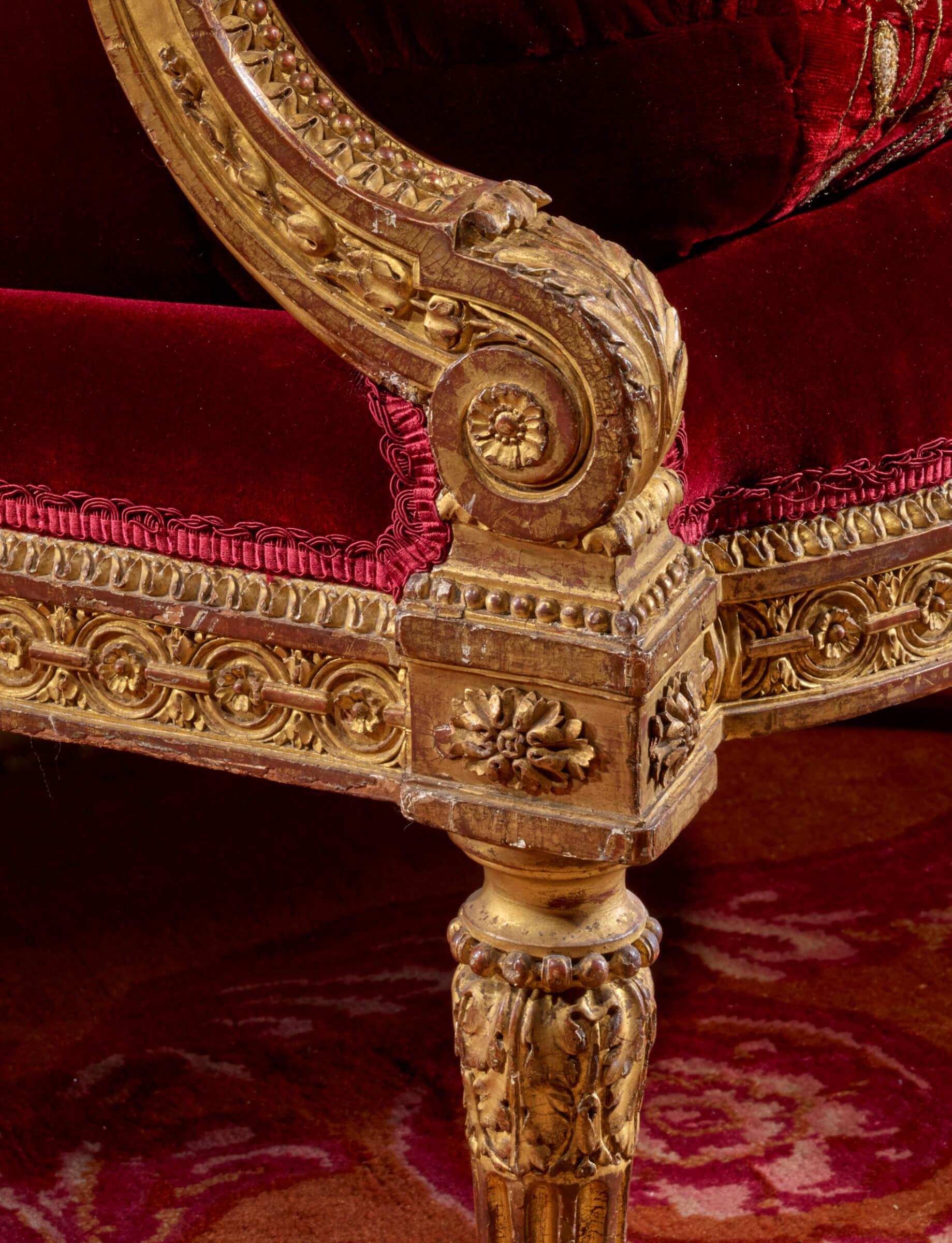
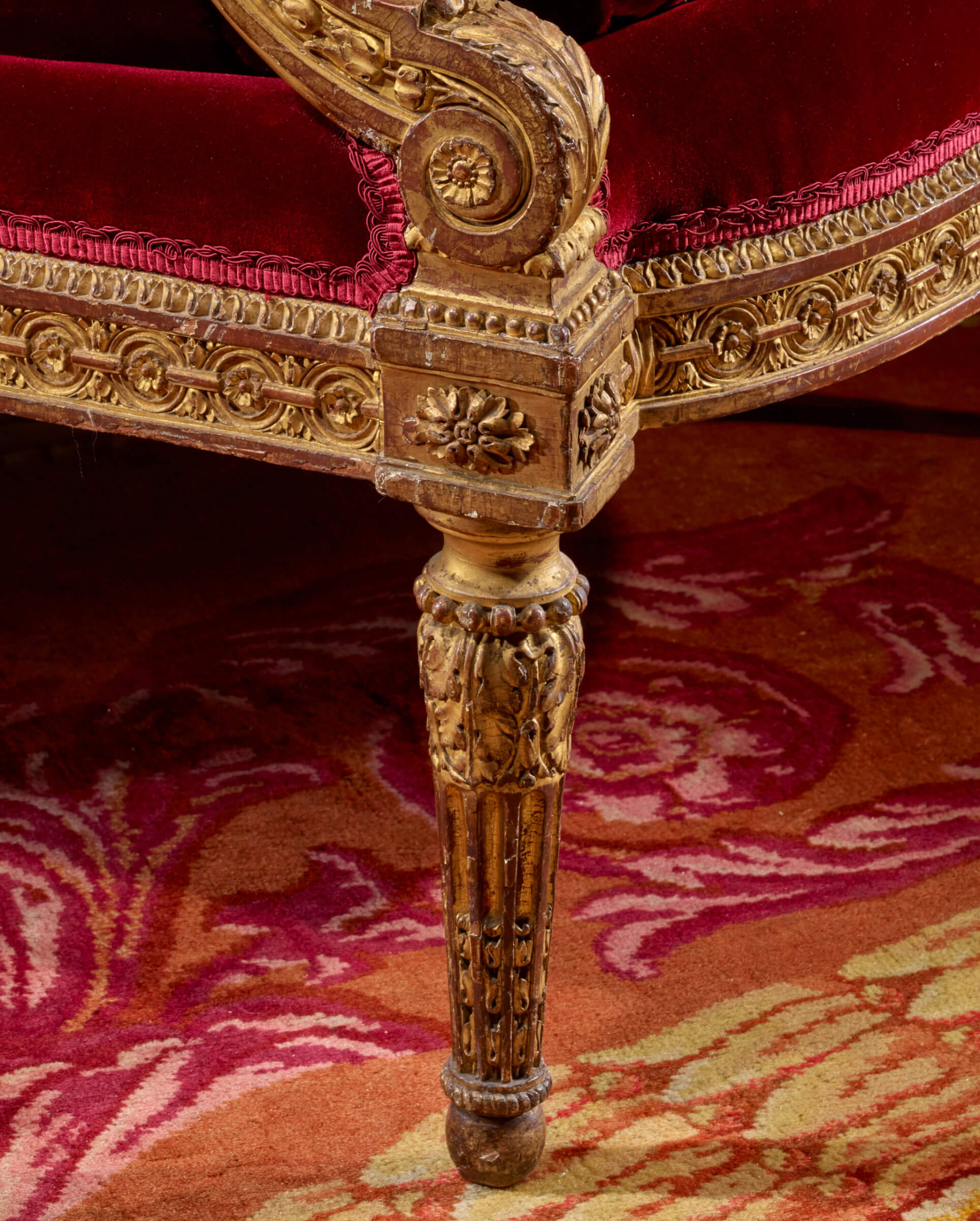
On 7th July 1781, Georges Jacob delivered, to be placed in the boudoir of the Countess of Provence at the Château de Brunoy (ill. 1), under the orders of Claude de Bard, intendant, controller, and general guard of the Garde-Meuble of the Count of Provence: “one sultane with three backs,” four armchairs “à la Reine”, including ours, bearing number 3, written in black ink and visible several times on the back of the cross-rails of its seat frame, and two chairs “of the same shape.” The armchairs were described very precisely as follows in Jacob’s mémoire (record) (ill. 2): “Four armchairs à la Reine; curved in plan view to form a square-on-point shape, and made of walnut wood; the backs are with culots in oak leaves and small shells in oak leaves and acorns, enriched with water leaves and ropes; the joints are interlaced friezes of bands forming the medallion, with flowers on each side; in the aforesaid medallion are wild flowers enriched with water leaves at the edge of the garniture; the consoles are with scrolls from which culots emerge on each side; on the face of the said consoles are acanthus leaves forming reverses, above which are pearls and water leaves on each side; the armrests are with acanthus leaves; and on each side are scrolls with culots; the legs are decorated with pearl toruses and pirouettes; and above are four acanthus leaves with culots between the said leaves; the body of the leg displays fluting with threaded culots and at the bottom are ropes; and in the boxes are rosettes”. Each armchair was priced at 280 Livres each, or 1,120 Livres for all four, to which sum was added the cost of the “burnished gold” gilding, which amounted to 1,200 Livres in total, i.e. 300 Livres per armchair.
The Count of Provence acquired the Marquisate of Brunoy, a fiefdom of the Monmartel family, in 1774 at the age of nineteen, the year his elder brother became King. Some time later, he also became the owner of the neighbouring Grosbois estate. The Brunoy estate comprised two châteaux, known as the “Grand Château” and the “Petit Château”, located on opposite sides of the valley. Very early on, the Count’s preference fell on the “Petit Château”, which was easier to adapt to his tastes, and he commissioned his architect Jean-François Chalgrin (1739-1811) with the task. Chalgrin’s prompt intervention soon enabled the Count to move into the east wing of the residence.


In 1775, the prince had the Faisanderie of Sénart built; the following year, it was the outbuildings of the “Petit Château”; in 1779, the Faisanderie (pheasantry) of Bosserons; and in 1780, he indulged his taste for theatre by having the same architect, Chalgrin, build a theatre and lodgings for actors, close by his own apartments. These works paved the way for the future Théâtre de Monsieur, which would open in 1789 in the Salle des Machines of the Tuileries. Brunoy thus became the “folly” of the Count of Provence, who held numerous parties there, which were attended by all the notable figures of the Court, and even, on several occasions, Louis XVI and Marie Antoinette in person.
An edict published in Versailles in 1777 elevated the seigneury of Brunoy to a duchy-peerage, but this was never enforced. Jules-David Cromot du Bourg (1725-1786), Superintendent of the Finances et Bâtiments of Monsieur, became governor of the château. His son Maxime de Cromot du Bourg succeeded him in this position from 1786 to 1790.
In 1791, after the Count and Countess of Provence succeeded in fleeing from France, reprisals were taken against their possessions, and as such, the Brunoy estate was particularly affected and, for the most part, destroyed. His properties were seized as emigrant property, and seals were placed on both Brunoy and Grosbois on 5th June 1792.
The inventory of movable property was drawn up from 9th May to 10th July of the same year by Jacques Louis Venteclef (1753-1823), the district commissioner but also former syndic of the commune of Brunoy, and former cook to the Marquis de Brunoy. The sole description he made of the contents of the châteaux in Brunoy took up 346 pages.
Two notaries, Mr Favereau de Brunoy and Mr Deteure de Montgeron, shared the task of conducting the public auctions, the former at the “Grand Château” and the latter at the “Petit Château”. The auction was conducted by candlelight — the first bidder would light the candle and the sale continued until it burned out—from 9th to 16th June 1794.
The whole furniture was sold for a total of 141,871 Livres. The main creditors were Bertholiny (6,828 Livres), Bidaut (6,323 Livres), Caubert (4,086 Livres), David (27,966 Livres), Dupox (3,382 Livres), Duchene (5,192 Livres), Humont (10,769 L.), Lemoine (7,984 L.), Métayer (3,159 L.), Paysen (25,165 L.), Quest (6,387 L.) and Vavin (2,473 L.). Citizens Lebrun and Lenglier, art commissioners, managed to secure a number of valuable items from these auctions, for the most part sculptures, vases and marble tables, which were transferred to the dépôt national repository in Versailles. The “Grand Château” was then razed to the ground and the dismantled estate was divided into 206 lots, which were sold separately. Today, only part of the “Petit Château” remains.
Various marks visible on the inner cross-rails of our armchair

STAMP: G. IACOB, visible under one of the seat frame’s cross-rails.

Marks and inscriptions: N° 3, handwritten mark in black ink visible several times on the back of the seat cross-rails, designating armchair n°. 3 of the four in this ensemble delivered by Georges Jacob on 7th July 1781.

R.MA., capital letters painted in black on the reverse of one of the seat cross-rails, signifying Rothschild Marine, a spoliation inventory mark used by the Germans during the war.
Marie-Joséphine-Louise de Savoie (1753-1810), countess of Provence

Marie-Joséphine-Louise of Savoy was born on 2nd September 1753 at the Royal Palace of Turin, the capital city of Piedmont, the third child and second daughter of Victor Amadeus III (1726–1796), King of Sardinia, Prince of Piedmont and Duke of Savoy, and his young wife, Maria Antonia Ferdinanda of Spain (1729–1785), daughter of King Philip V of Spain. She became Countess of Provence through her marriage on 14th May 1771 to Louis-Stanislas-Xavier of France (1755-1824), Count of Provence, brother of the future Louis XVI, and himself the future King Louis XVIII, while her sister Marie-Thérèse of Savoy (1756-1805) became Countess of Artois two years later, upon marrying Charles-Philippe of France (1757-1836), Count of Artois, and future King Charles X.
These marriages cemented France’s policy aimed at forging closer ties with the Kingdom of Sardinia on the wake of the fall of the Duke of Choiseul in 1770, given that King Victor Amadeus III was Louis XV’s first cousin.
This union with the future Louis XVIII remained childless, even though, contrary to the rumours circulating at the time, it was consummated. The Countess of Provence had two confirmed miscarriages. The Count quickly became estranged from her, preferring the company of “people of wit” to that of his wife. In 1774, upon the accession of her brother-in-law Louis XVI, the Countess of Provence became the second lady of France after the Queen and was accordingly given the title of ‘Madame’, in accordance with custom. In 1780, she acquired a pavilion belonging to the Prince of Montbarrey in the Montreuil district of Versailles. Through a series of acquisitions, she turned it into a twelve-hectare estate known as the Pavillon Madame, where she established her main residence, far from the commotion and gossip of the Court. She lived there in increasing isolation and eventually developed a burning passion for her reader, Marguerite de Gourbillon (1737-1817), who was in fact the true love of her life.
In 1789, the Count and Countess of Provence were compelled to follow the royal family to Paris, where they were housed in the Petit Luxembourg, next to the palace that the King had given to his brother at the beginning of his reign. Feeling like captives there, the Count soon began to consider leaving the kingdom, as his younger brother, the Count of Artois, had already done in July 1789. And on 21st June 1791, he left Paris and France with his wife on the same night as the royal family, but unlike Louis XVI and Marie-Antoinette, the couple travelled separately and in point of fact managed to escape. It was alongside Marguerite de Gourbillon that the Countess of Provence succeeded in this undertaking. The two women travelled throughout Europe, particularly the Holy Roman Empire, and subsequently Eastern Europe.
When the Count of Provence declared himself King of France in the wake of the death of the young Louis XVII at the Temple in 1795, the Countess of Provence was likewise regarded by some as the “last Queen of France”. She never returned to France, however, nor did she live to see the Restauration. She died surrounded by her family during the Empire in England, at Hartwell Castle in Buckinghamshire, on 13th November 1810.

Baron Edouard de Rothschild
Born in Paris on 24th February 1868, Edouard de Rothschild was the son of Alphonse de Rothschild and Leonora de Rothschild. In 1905, he married Germaine Halphen (1884-1975), daughter of engineer and banker Émile Halphen and Louise Fould, and niece of composer Fernand Halphen. The couple had four children: Édouard Alphonse Émile Lionel de Rothschild (1906-1911), who died of appendicitis after an emergency operation at the Château de Ferrières; Guy de Rothschild (1909-2007), who was married to Alix Schey de Koromla, then to Marie-Hélène van Zuylen van Nyevelt van de Haar; Jacqueline de Rothschild (1911–2012), married to Robert Calmann-Lévy, then to Gregor Piatigorsky; and Bethsabée de Rothschild (1914–1999), married to Donald Bloomingdale.
At the age of seventeen, Edouard de Rothschild met Blanche de Varennes, also known as Jeanne Sherder, in a Parisian music hall who was to remain faithful to him until her tragic death in 1898.
After making his debut as a banker in 1891, he succeeded his father upon his death in 1905 as head of the Rothschild bank. He also succeeded him as regent of the Bank of France from 1906 to 1936. During the same period, he became chairman of the Compagnie des Chemins de Fer du Nord, where he had been a director and member of the management committee since 1896. He also took over as chairman of the management committee of the Grands Réseaux des Chemins de Fer. He inherited part of the Château Lafite Rothschild vineyard and, most of all, his father’s impressive art collection, which he helped to further enrich thanks to a number of important purchases. Édouard also became the owner of Château de Reux in the Calvados region. President of the Central Jewish Consistory of France from 1911 to 1940, he was made a Commander of the Legion of Honour in 1930.