Chiselled and gilded bronze; lapis lazuli; painting on ivory.
H. 62 cm (24 ½ in.); W. 40 cm (15 ¾ in.); D. 13 cm (5 ¼ in.).
PROVENANCE: private collection.
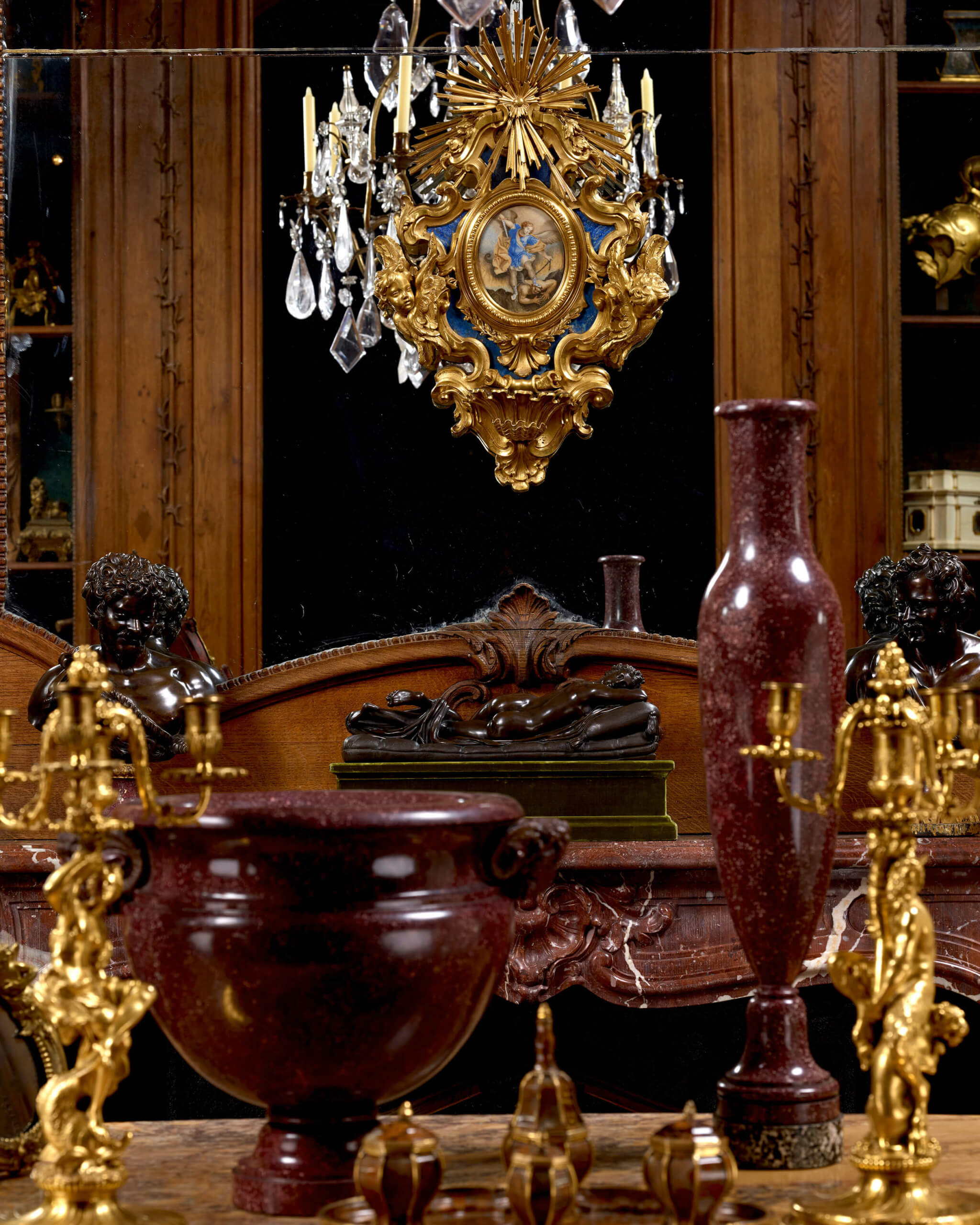
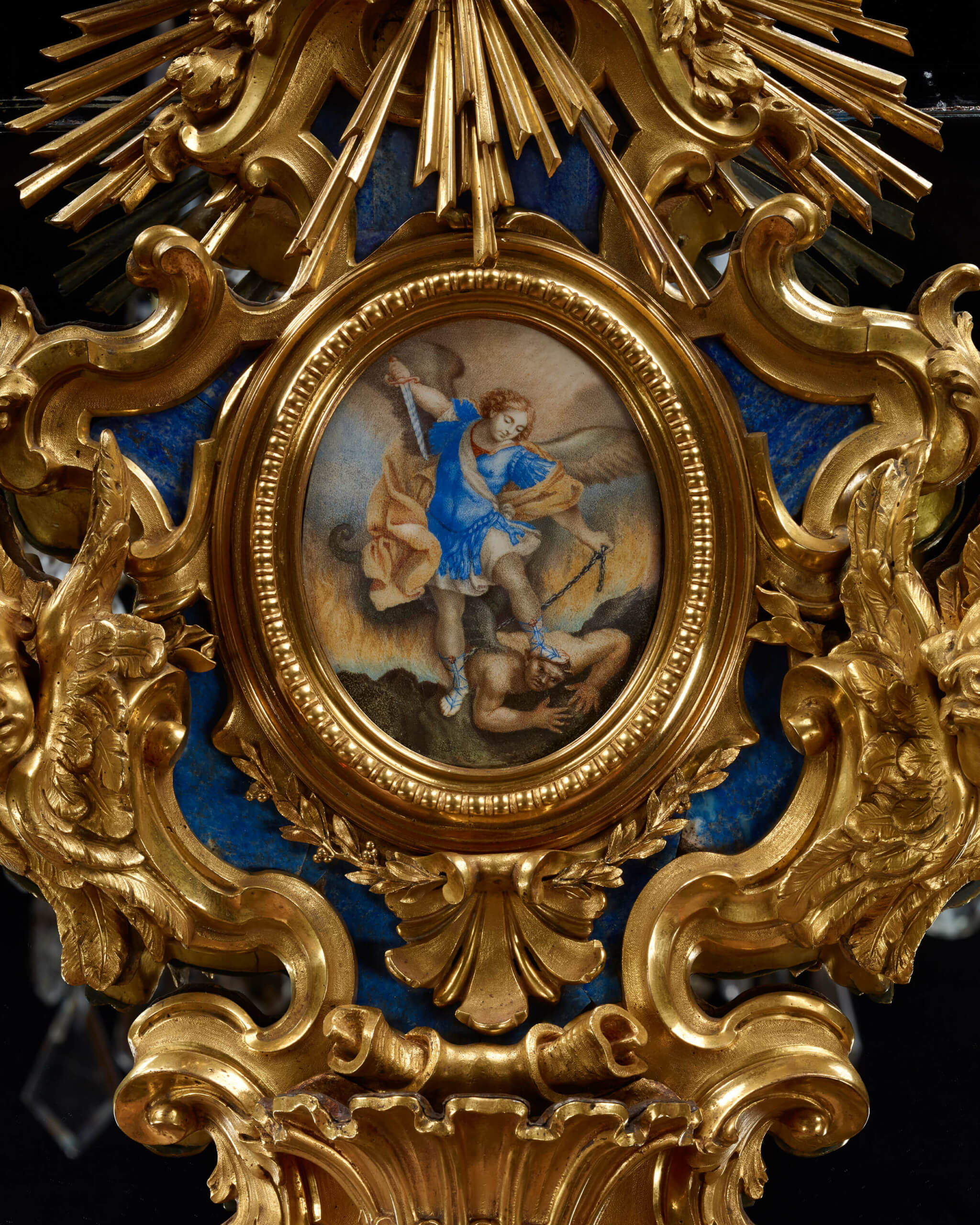
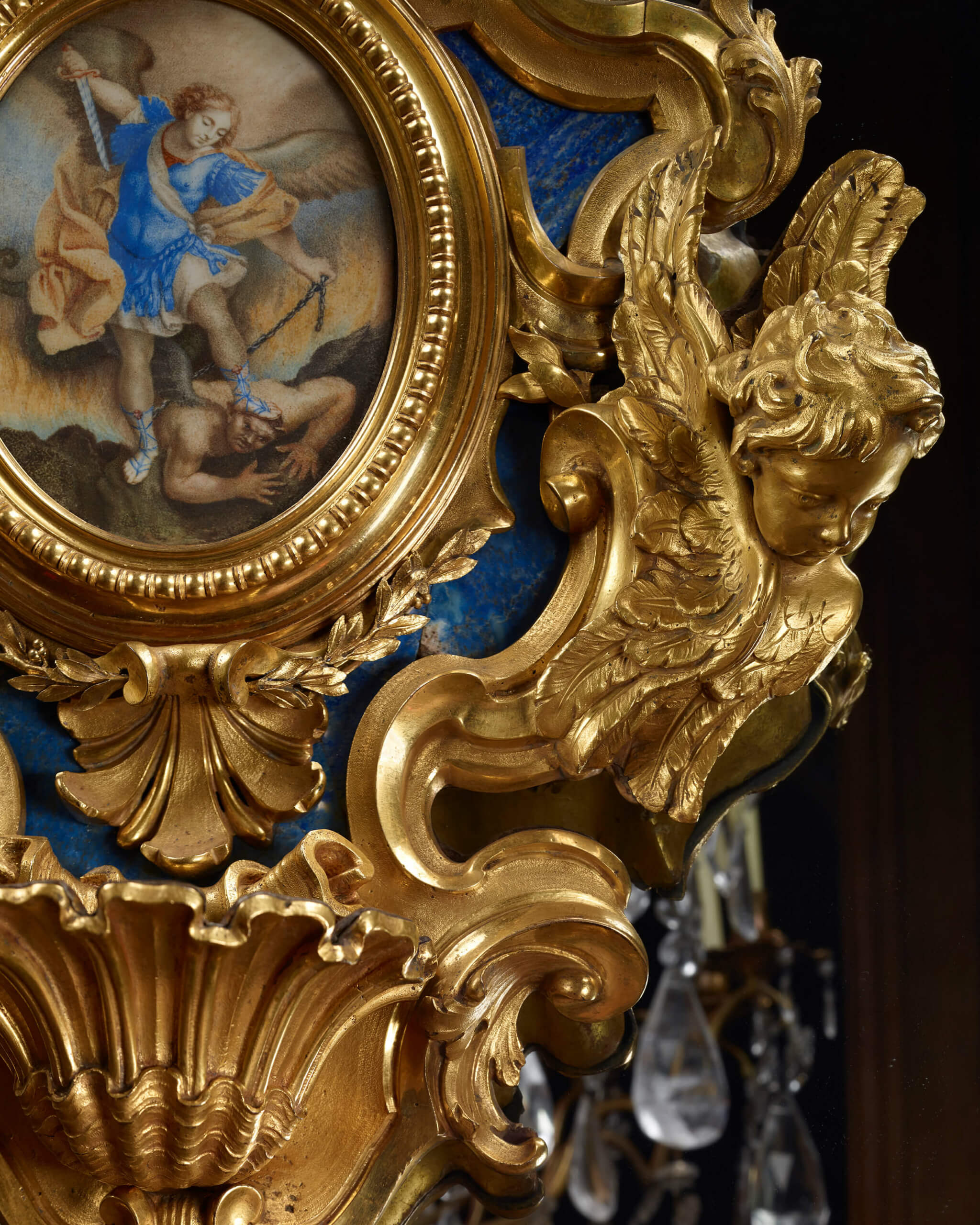
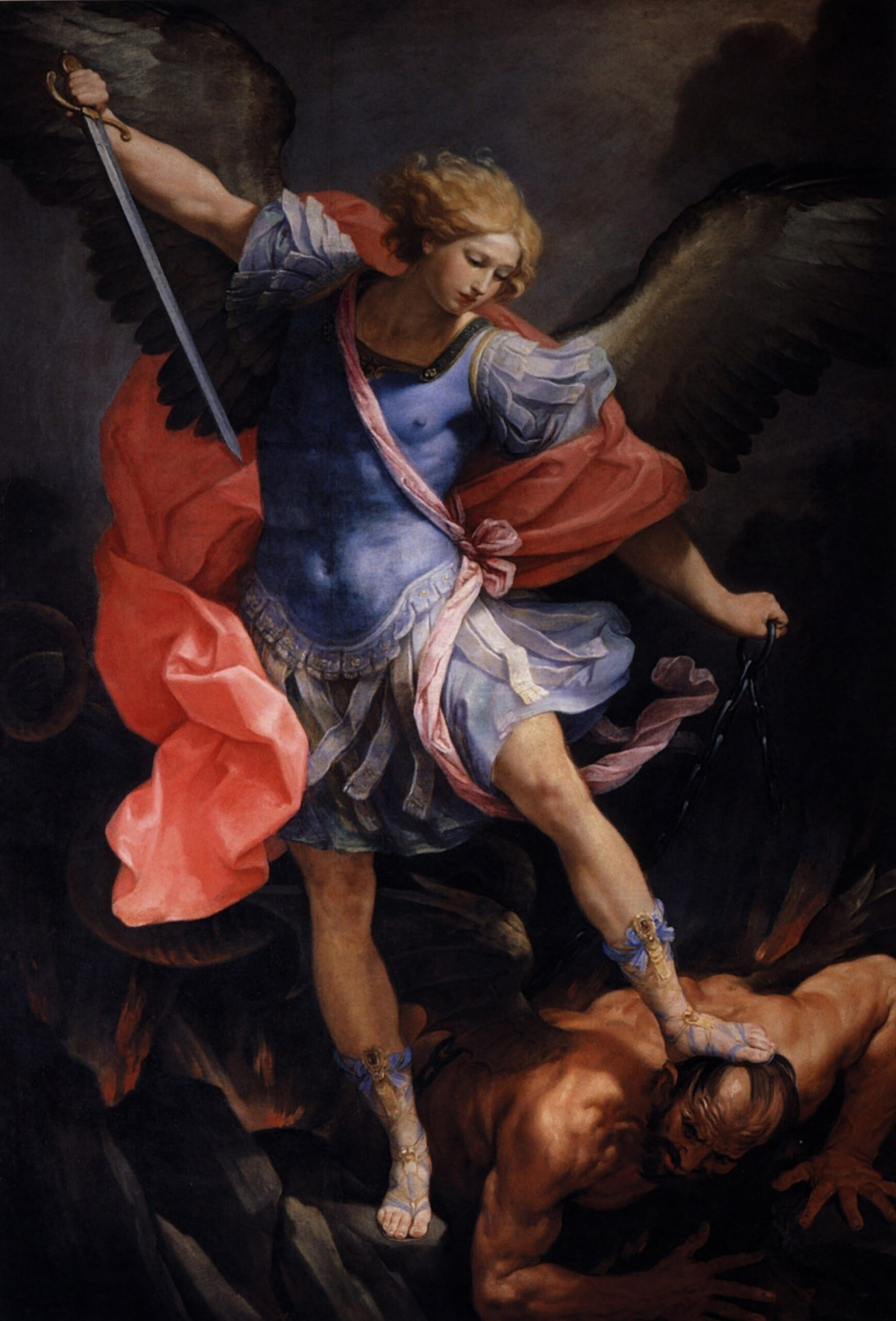
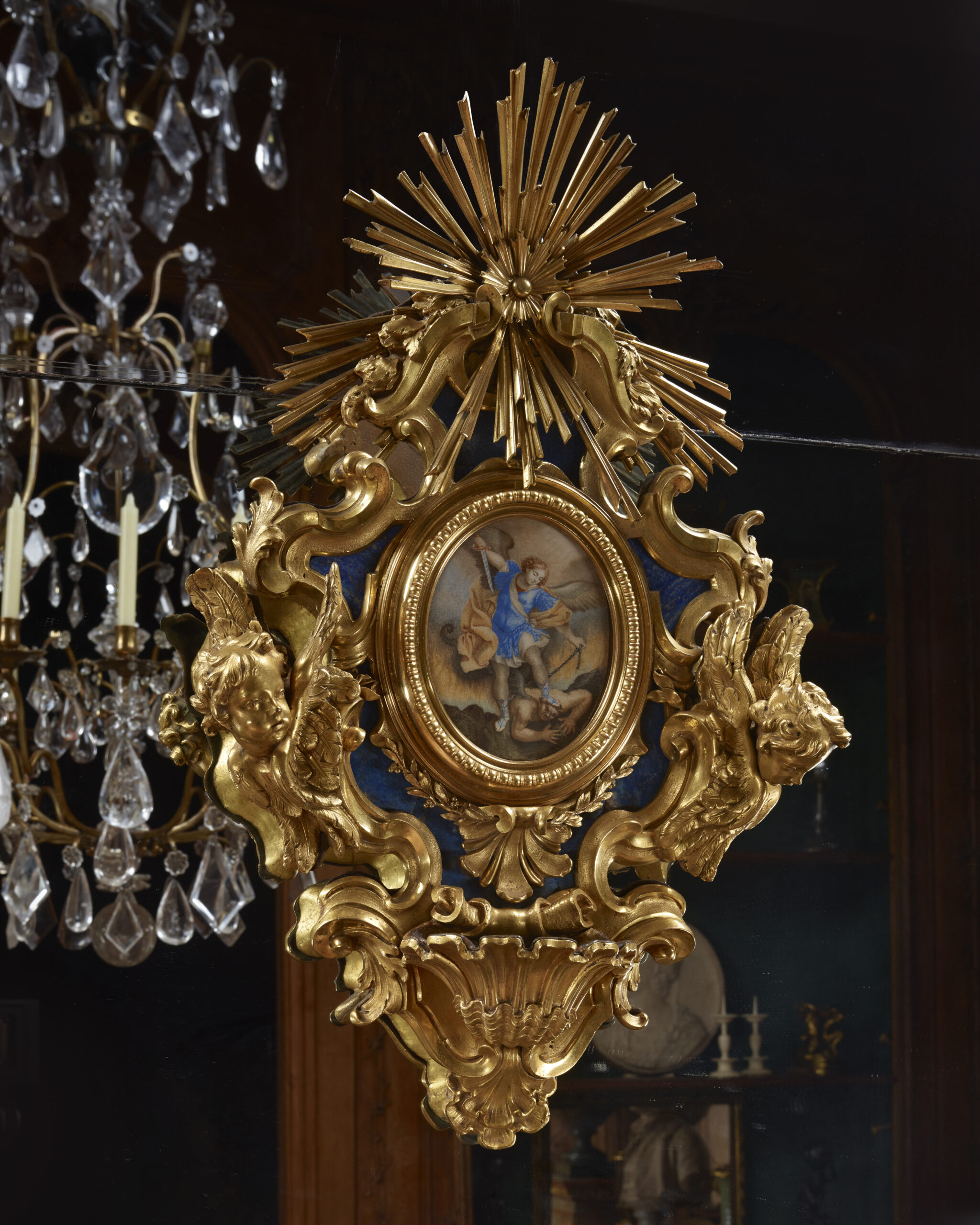
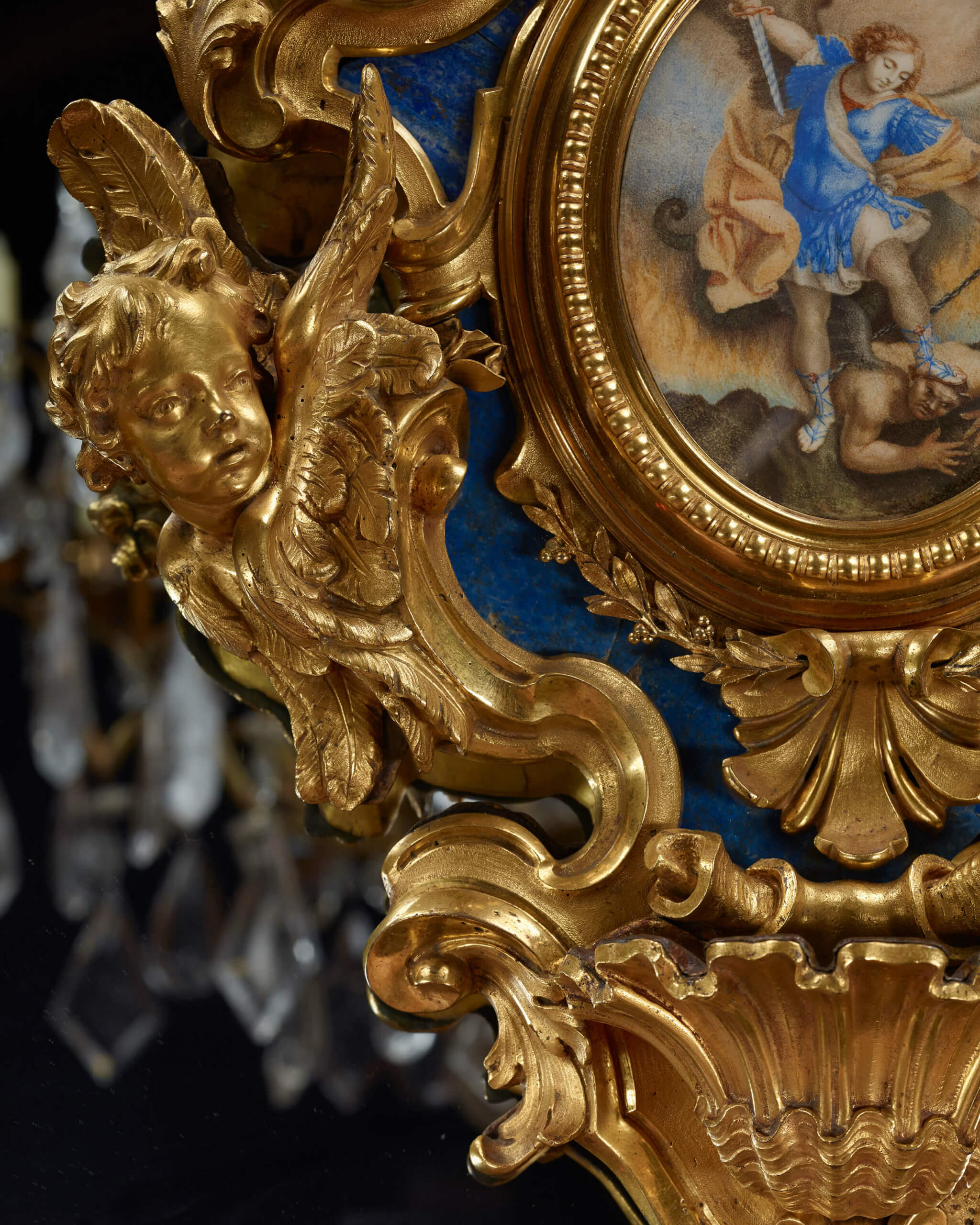
A masterpiece of the art of gilded bronze in the 18th century Rome, this stoup, dated around 1760, is attributed to Luigi Valadier, arguably the most inventive Roman bronze-maker of the second half of the century. It consist of a luxuriant vertical oblong gilt bronze cartouche, with a border formed by a juxtaposition of leafy scrolls of convex and concave acanthus leaves, flanked by two finely chiselled heads of winged cherubs in the round, the one on the left facing inwards and the one on the the right lowered to the ground. An oval painting on ivory occupies the centre of the object and shows the Archangel Saint Michael slaying the dragon, after the famous canvas painted in 1635 by Guido Reni for the altarpiece of one of the chapels of Santa Maria della Concezione dei Cappuccini in Rome, where it is still preserved today.
The iconography of the work is reminiscent of the vision of Saint John the Evangelist described in the Book of Revelation, in which he appeared: “[…] And I saw an angel come down from heaven, having the key to the botomless pit and a great chain in his hand, [who] laid hold of the dragon, that old serpent, which is the devil, and Satan, and bound him […]” (Rev. 20:1–3). This remarkably balanced composition, in which the lapis-blue of the Archangel’s fringed breastplate dominates, finds a direct echo in the precious pieces of lapis lazuli inserted between the painting’s oval gilt bronze frame, which is moulded, enhanced by a frieze of ova and underlined by a palmette flanked by garlands of laurel, and the very edge of the stoup.
Crowned with a curvilinear broken pediment enclosing an imposing corolla of rays symbolizing the Holy Spirit, the lower part of the painting is completed by a large flared shell with a cabled rim forming a receptacle for the holy water, a shell flanked by scrolls, volutes and underlined by a double festoon.
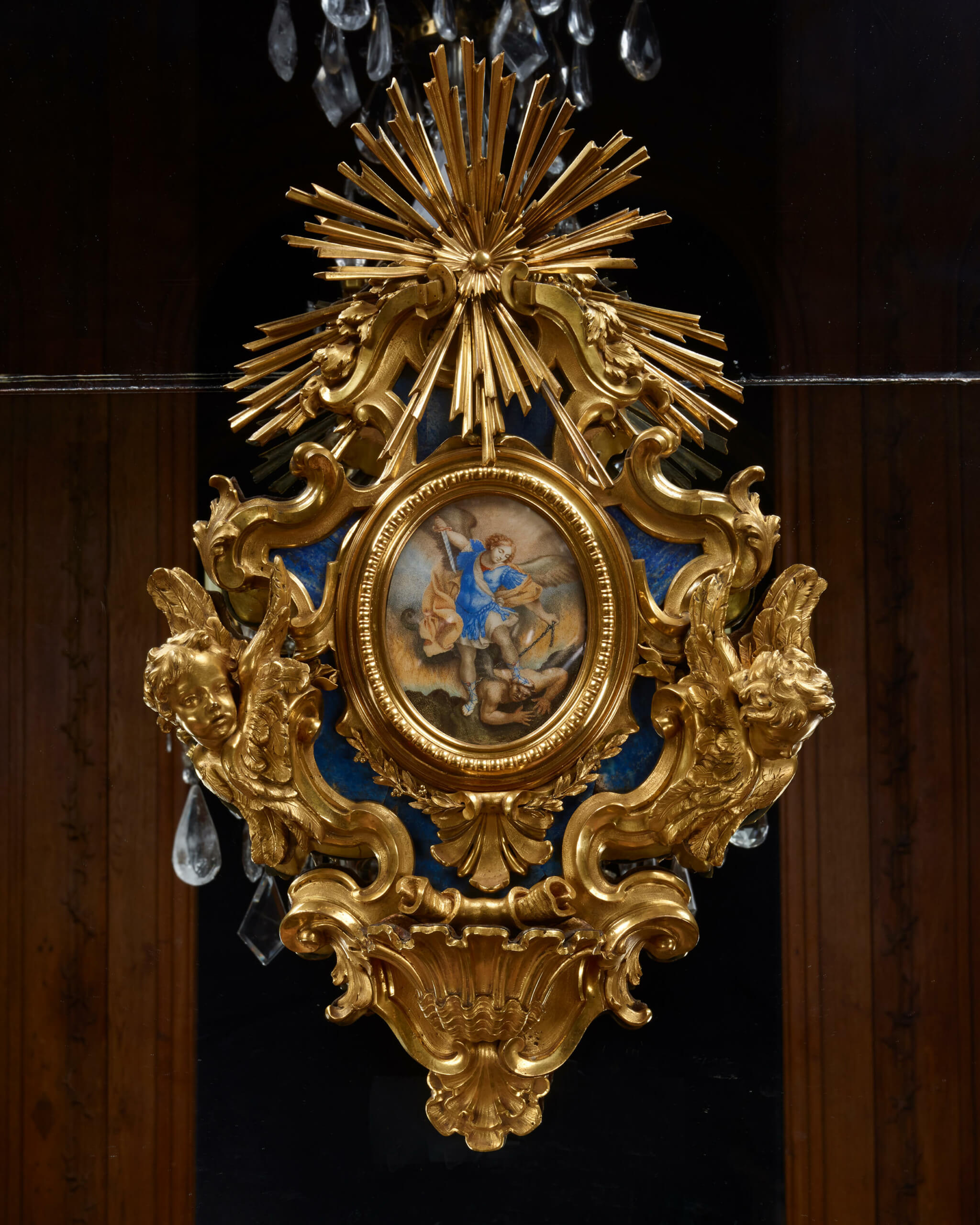
The choice of lapis lazuli is far from being insignificant as it finds its meaning in the symbol of fidelity and faith, blue being one of the two colors generally used to represent Saint Peter, who, without his keys, was nonetheless recognizable by his blue and yellow garment. Blue symbolizes the divinity, fidelity, and faith of the first Pope. It should also be borne in mind that since the 12th and 13th centuries, the “blue revolution”, which originated in theology, had now been firmly rooted in the arts. God being a god of light, he could only manifest himself in two ways, either through divine light (lux) or through earthly light (lumen). So gold was chosen to symbolize the first, and blue the second.
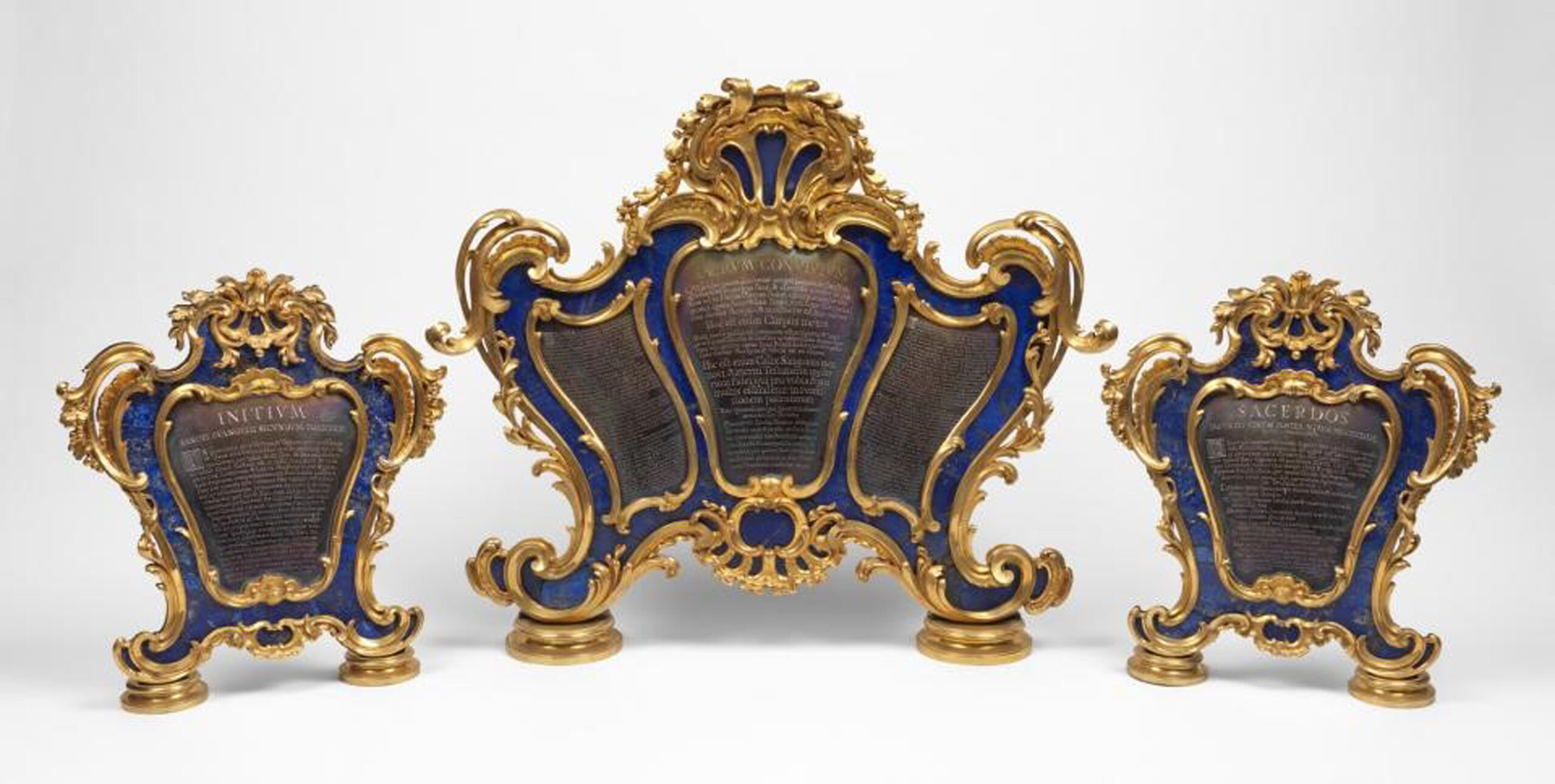
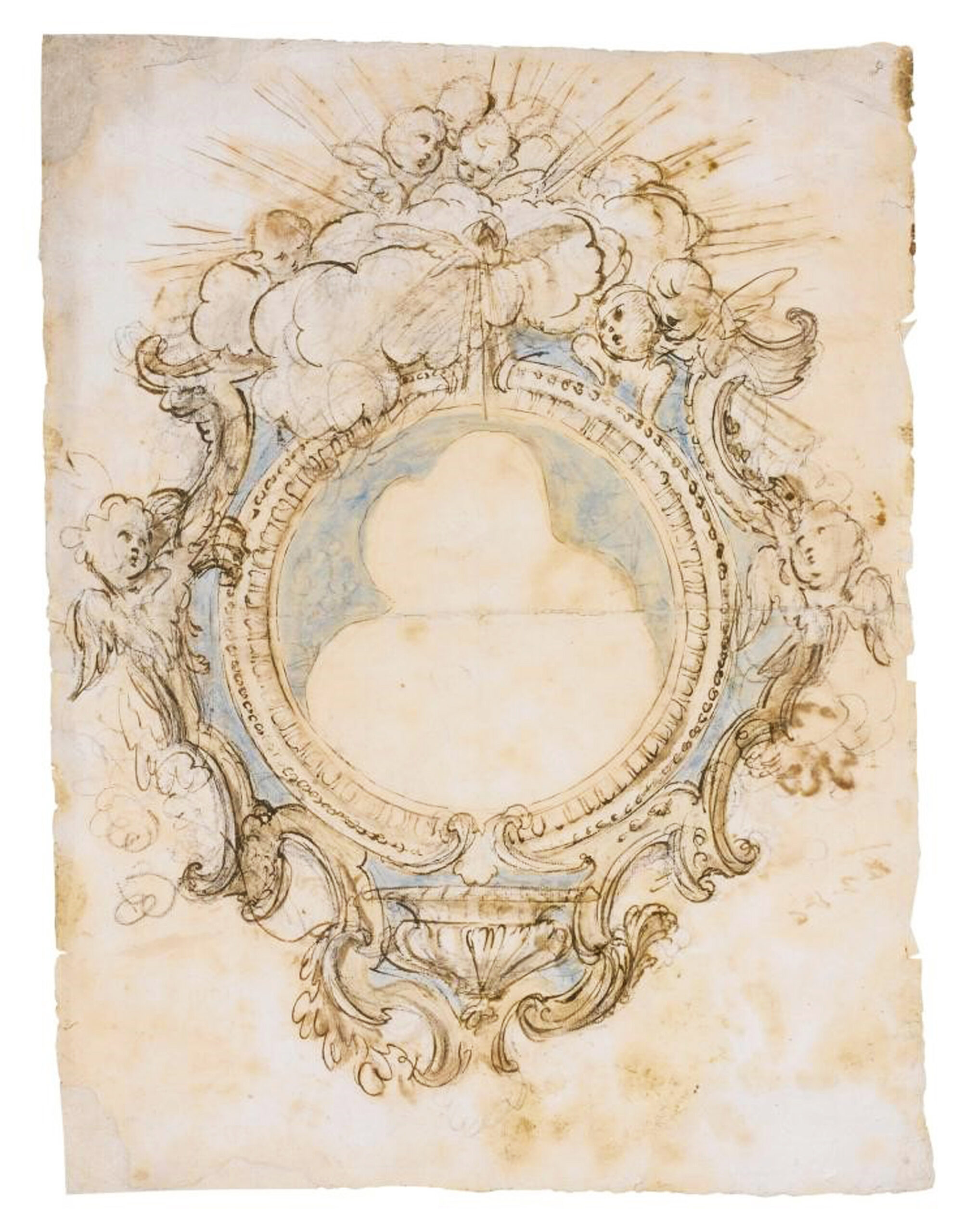
This stoup is a direct echo of a drawing by Luigi Valadier, which was placed on the art market in 2015, showing a project for a similar stoup, gilded and with a lapis lazuli background, haloed with rays and flanked by winged cherub heads. The same display of craftmanship can be seen in the play of volutes with acanthus leaf scrolls, alternating with a remarkable balance of convex and concave shapes. The drawing also features in its center a circular frame adorned with the same moulded bronze border enhanced by a frieze of gadroons and enclosing a religious scene, of which only the silhouettes with a white background suggesting a Virgin and Child are sketched.
The very bold sinuosity of the volutes here is fully in keeping with the Roman rococo of the 1760s and recalls that of the famous suite of cartagloria frames (altar cards) created by Valadier in 1762 for the altar of the Borghese Chapel — the Cappella Paolina — of the Basilica of Santa Maria Maggiore in Rome. We also find this type of volutes enhancing the tintinnabulum preserved in the treasury of the same basilica.
Valadier is here an integral part of the great Roman tradition, which began at the end of the 17th century, of the production of lavish stoups combining gilded bronze, lapis lazuli, and also silver, with only a few rare examples remaining today, most of which were studied by Alvar González-Palacios. Of particular note are the three stoups executed around 1702–1715 by Giovanni Giardini da Forlì (1646–1722), respectively kept in the collections of the Metropolitan Museum of Art, acquired in 1995 thanks to the Wrightsman Fund (inv. 1995.110), within the Schatzkammer of the Munich Residence and in the Minneapolis Institute of Art, acquired for the latter thanks to the Christina N. and Swan J. Turnblad Memorial Fund and the Ethel Morrison Van Derlip Fund (inv. 63.35). Decorated with a silver low-relief depicting Mary the Egyptian, the stoup in the Metropolitan Museum of Art was executed around 1702 for Pope Clement XI (1649–1721), who presented it to Giovanni Battista Borghese, the ambassador of King Philip V of Spain to the Holy See. It later became part of the collection of the Princes of Thurn und Taxis at St.-Emmeram Castle in Regensburg, Germany.
The stoup at the Munich Residence, which is very similar from the previous one, differs from it in its central arrangement, as it is decorated with the silver figures of Justice and Chastity. It houses a relic labelled “De Pallio S. Joseph.” This stoup-reliquary was offered in 1709 by the Pope to Joseph of Habsburg (1678–1711), emperor of the Holy Roman Empire under the name of Joseph I. These two stoups still fully reflect the classicism of the 17th century but the third one, which is kept at the Minneapolis Institute of Art and dated around 1715, shows a design closer to ours, although still very Baroque, and is a good reflection of the models designed around 1714 by Giardini, models that were engraved by Maximilian Joseph Limpach and published in Rome in 1750 in a collection entitled Promptarium artis argentariae […] : invenit ac delineavit Joannes Giardini.
Two other stoups belonging to the same very limited corpus are kept in the treasury of the Abbey of Montecassino (sala del Tesoro no. 2, vetrina 6 and 9). They were executed around 1740, in silver, gilded bronze, and lapis lazuli in Rome, by Filippo Galassi (1685–1757), and both feature an oval low relief in the centre showing a Madonna and Child, inserted in a moulded bronze frame with a frieze of gadroons similar to that of the stoup presented here. They are also surrounded by winged cherub heads but their design is still very architectural, like the stoup crowned with the same corolla of rays as ours, executed by Giovanni Antonio Fornari (1734–1809) and reproduced by Alvar González-Palacios in Il Tempio del Gusto, Volume II, Milan, 1984, p. 141, fig. 315. Preserved in a private collection, this gilt bronze and silver stoup, which is adorned in the centre with a medallion painted on copper attributed to Sebastiano Conca, bears the date 1762. It is reminiscent of a very beautiful anonymous drawing showing two stoup projects, in pen, ink, and lead pencil on white paper, belonging to the Cooper Hewitt, Smithsonian Design Museum in New York (inv. 1911-28-174).
These particularly precious devotional objects were intended for private use or for small, intimate chapels. Their technical perfection, which is so outstanding that they surpass many works in bronze made in Rome during the same period, can be measured by the importance of their commissioners, starting with the Pope himself, as mentioned above. These objects were often used as diplomatic gifts from the Vatican or were mostly made for high-ranking figures of the papal court, as in the case of another stoup of gilt bronze and lapis lazuli made by Fornari and kept at the National Gallery of Art, Washington (inv. 2012.107.1). The stoup was executed around 1765–1775, signed FORNARI ROMA in the centre of a silver medallion representing St. John the Baptist preaching, and was acquired by Luigi Braschi Onesti (1745–1816), Duke of Nemi, nephew and adopted son of Pope Pius VI (1717–1799). An exceptional detail, is that it has kept its original octagonal leather case stamped with the Duke’s coat of arms.