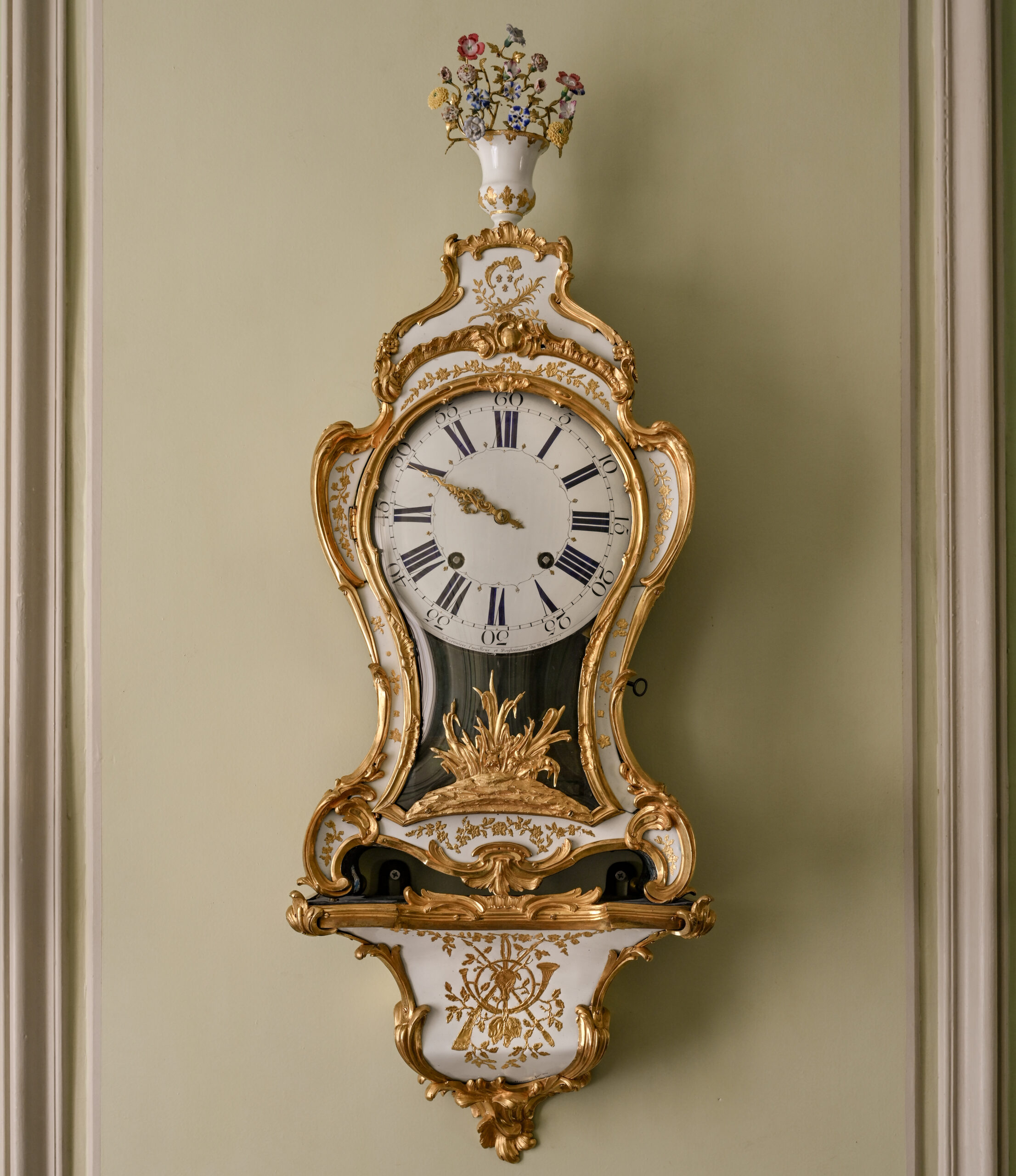
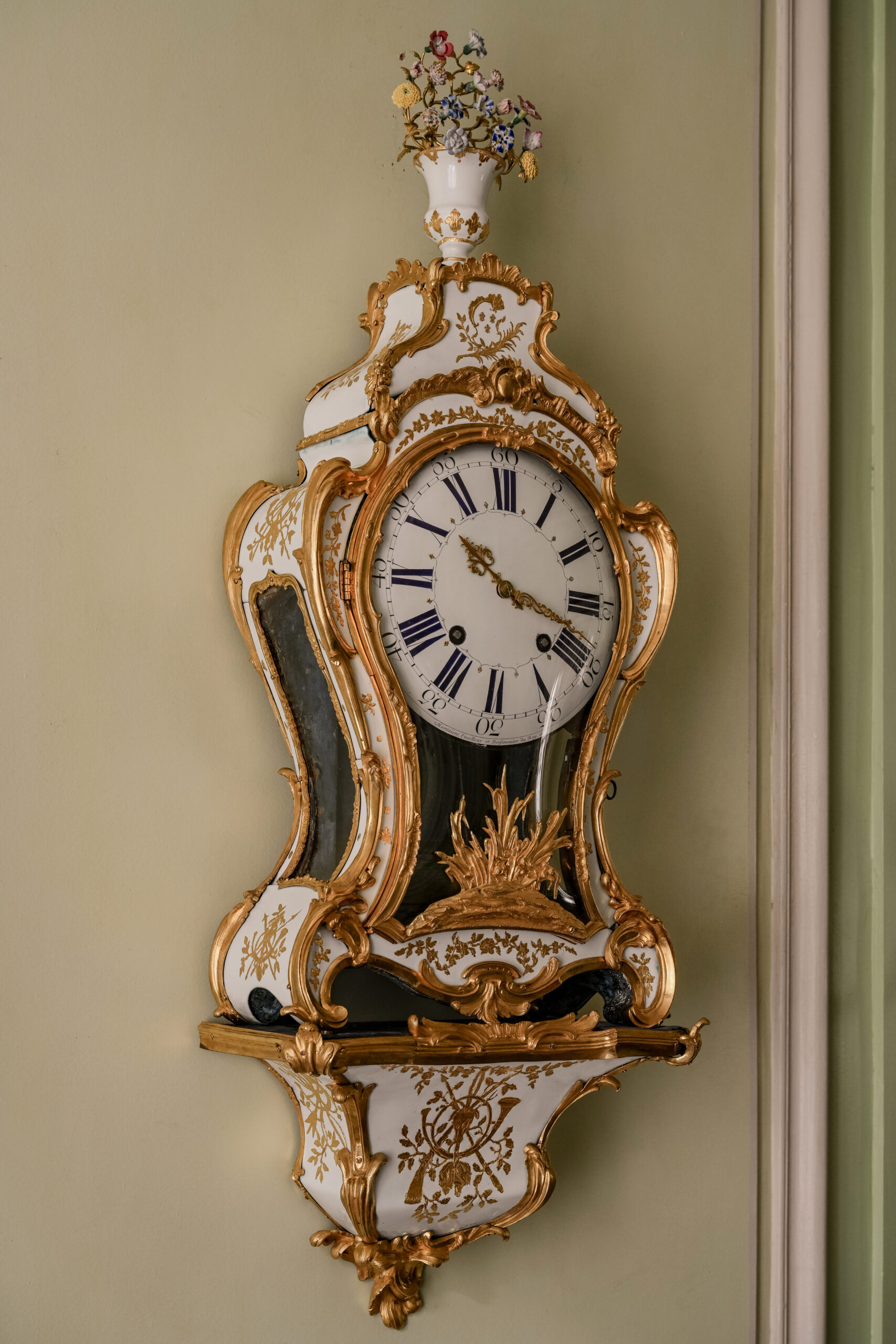
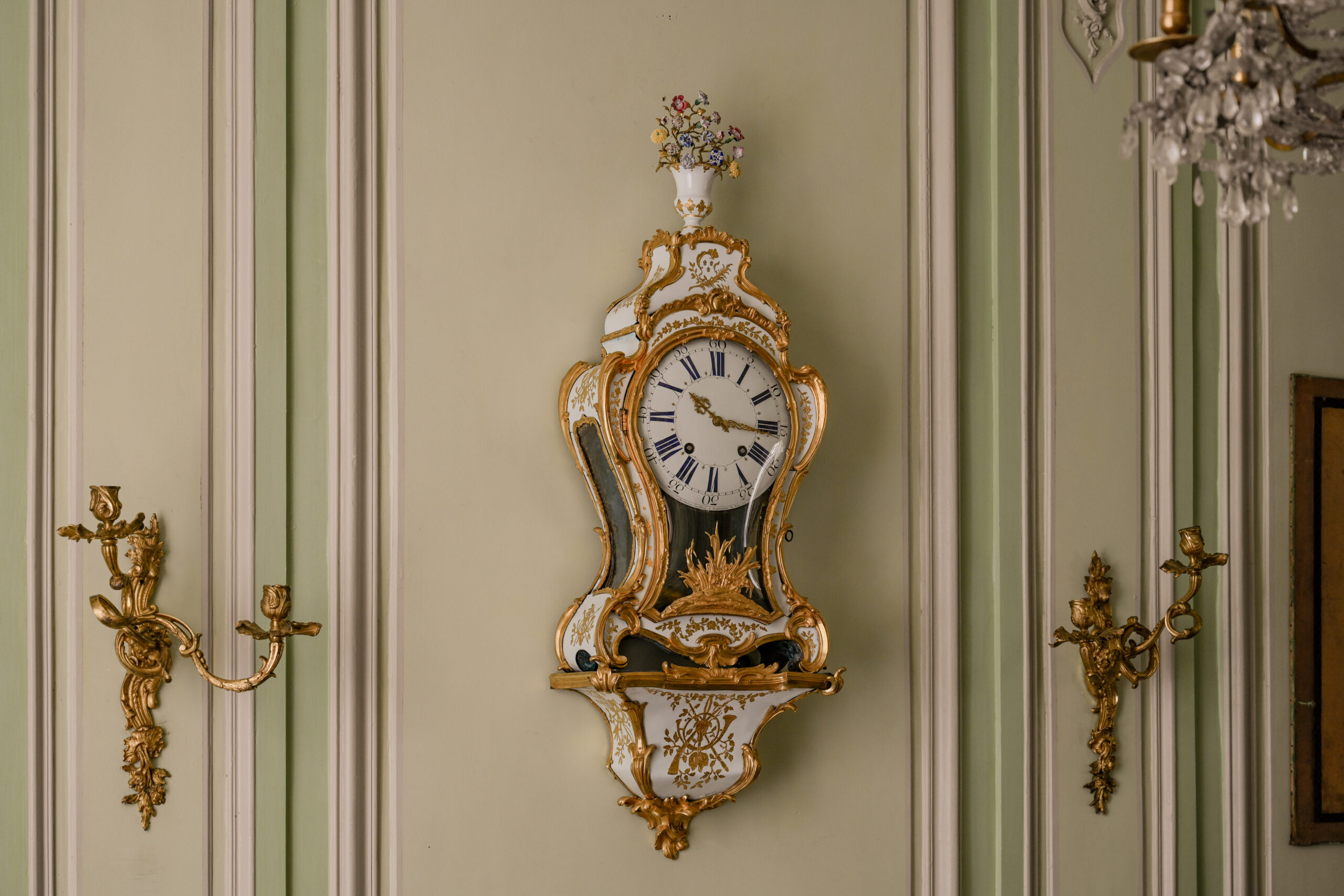
H. 104 cm. (41 in.); W. 37 cm. (14 ½ in.); D. 19 cm. (7 ½ in.).
White enamel on copper with chiselled gold motives; gilt bronze; wood painted lapis blue; metal; glass.
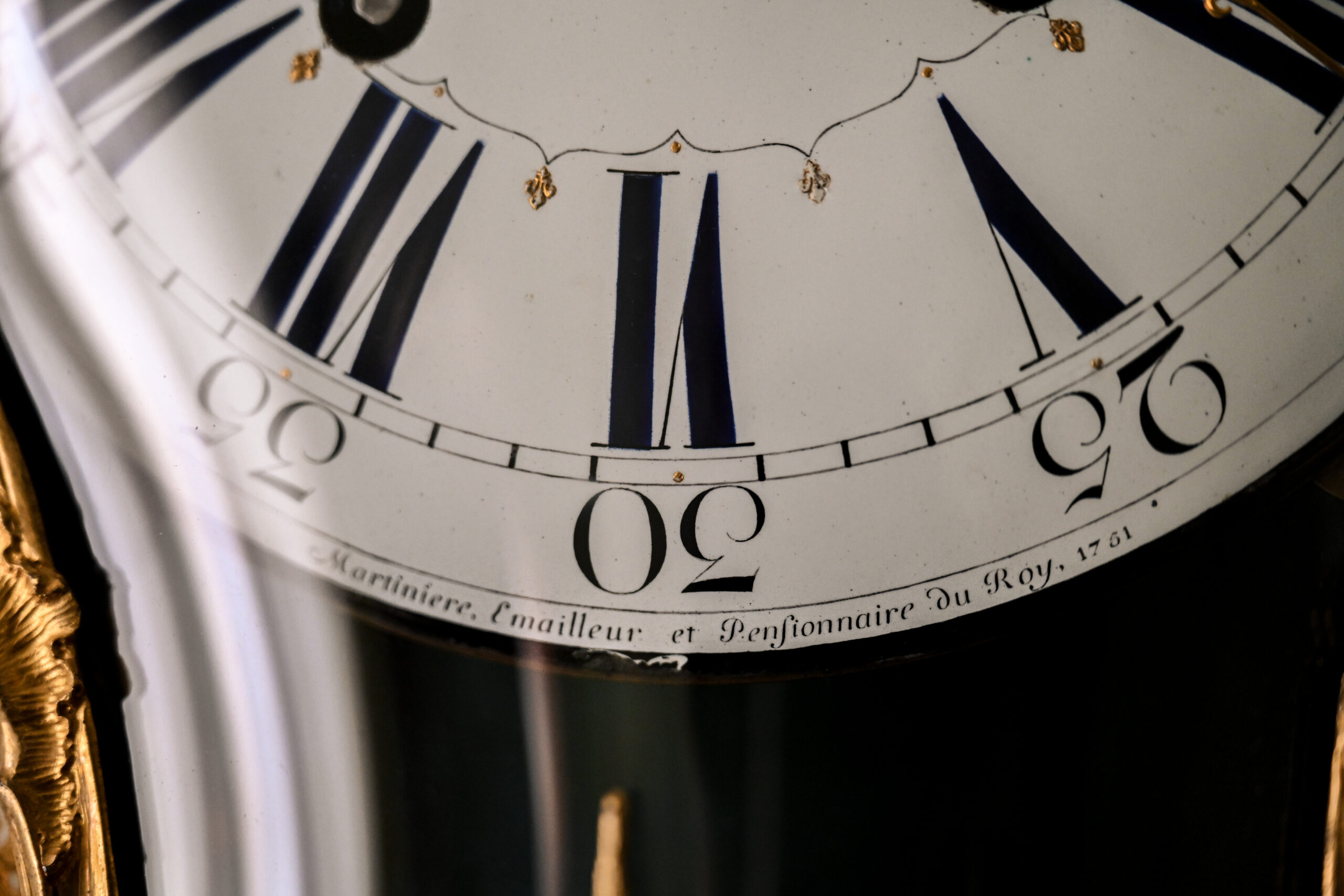
Dial signed and dated in the lower section: Martiniere. Emailleur et Pensionnaire du Roy. 1751.
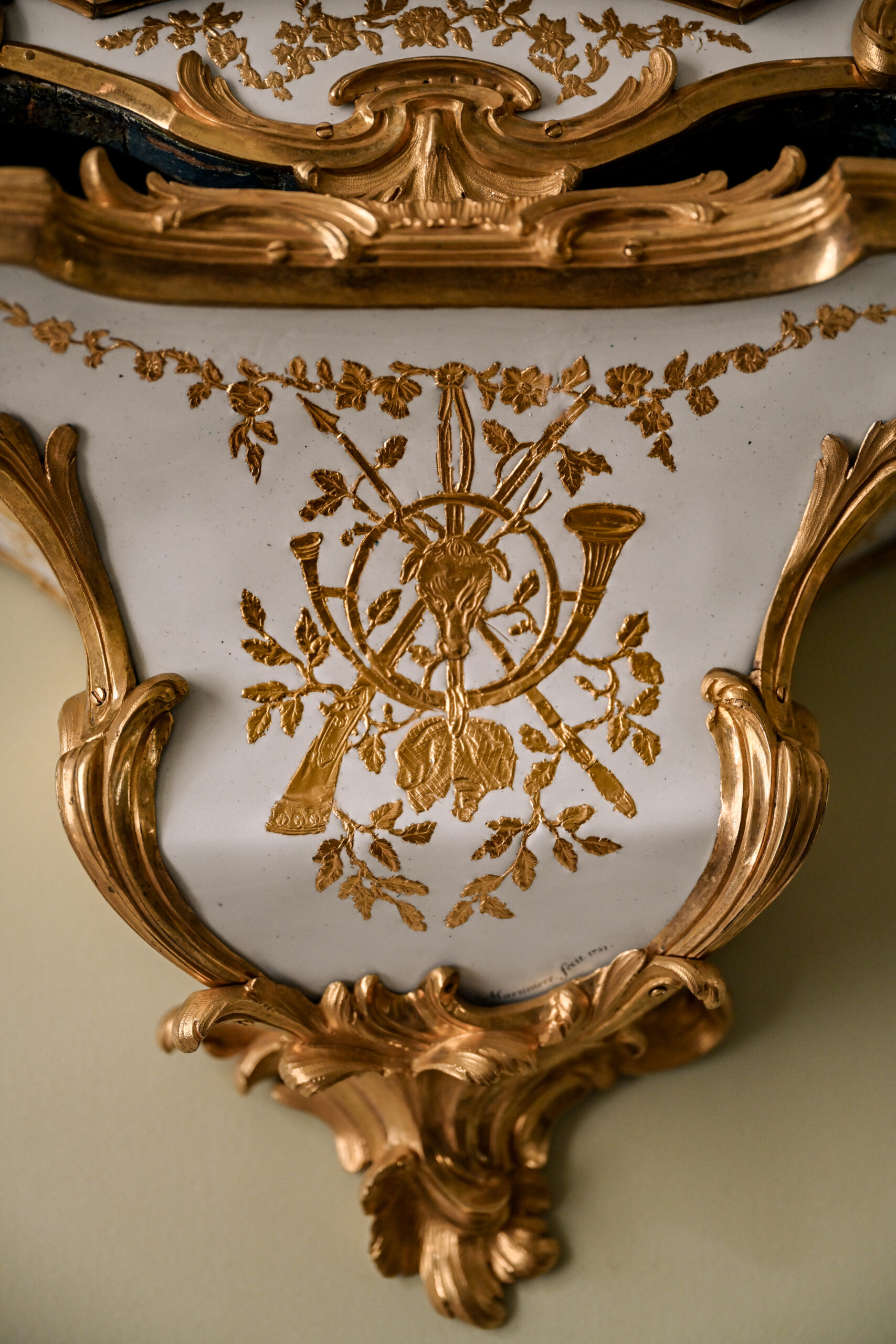
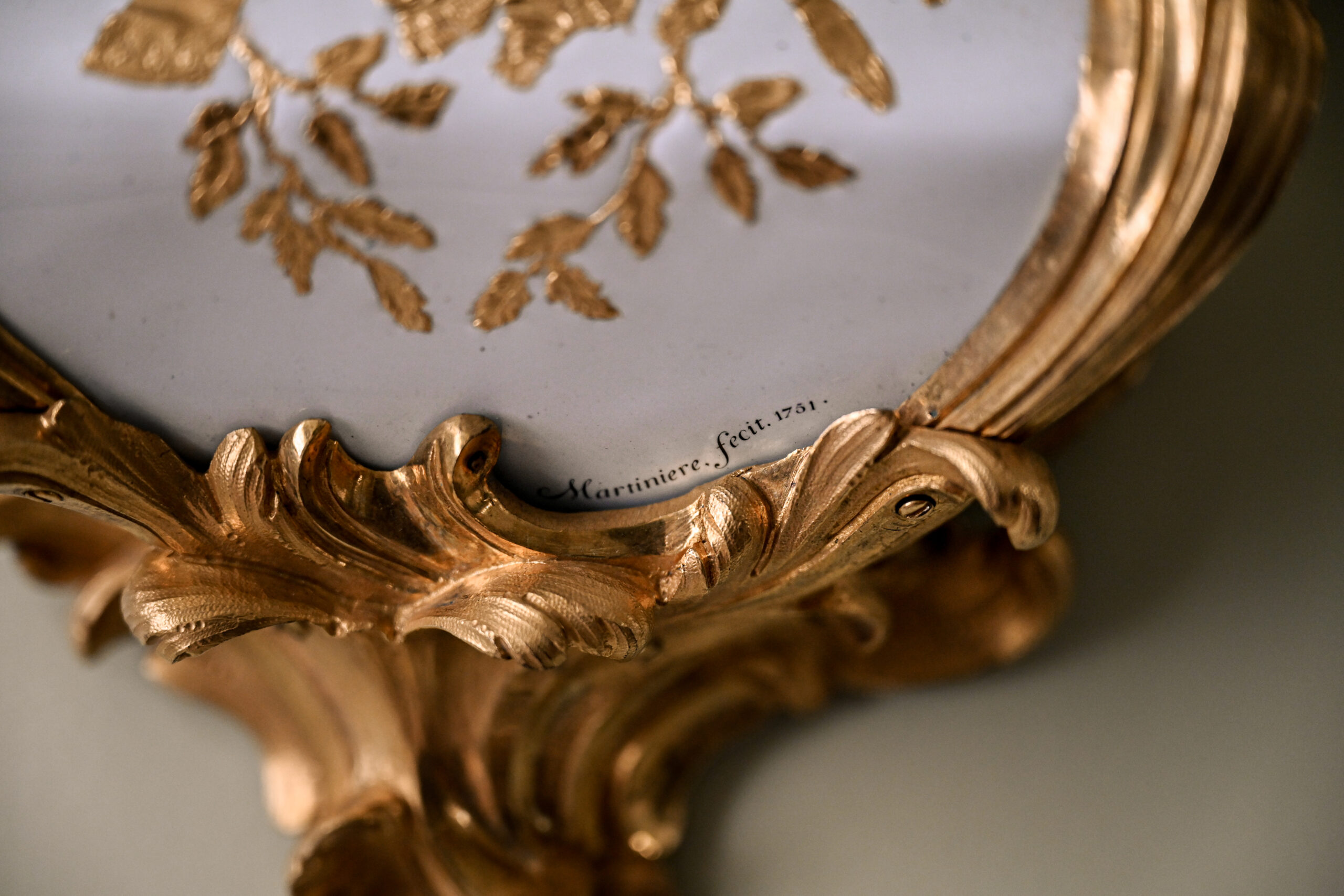
Martiniere, fecit. 1751, visible to the right of the lower part of the enameled plaque, adorning the front of the wall-mounted console supporting the clock.
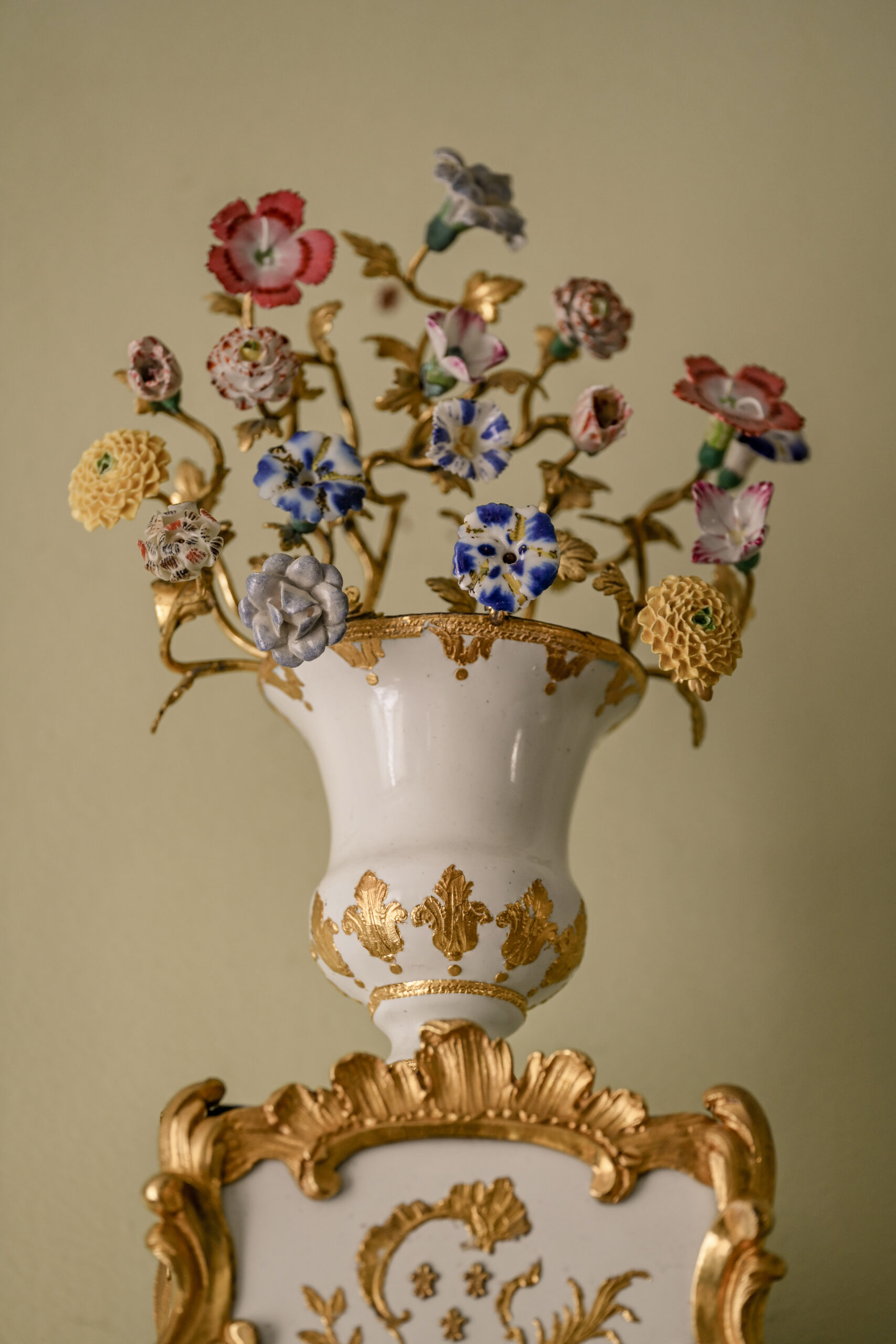
The interior of the vase signed A N Martiniere A. 23 … l … 1751 …Du Roy.
Movement signed Filleul a Versailles.
Other marks and inscriptions appear on the movement: “Moisy le 28 decembre 1751” as well as several interventions from clockmakers in the passing of time and in different countries: those inscriptions are more or less legible and sometimes entirely erased; presence of a small mark depicting a crowned animal (?).
PROVENANCE: private collection.
This extraordinary cartel clock, on its wall console, entirely decorated with gilt enameled copper plaques on a white background, the whole, set in gilt bronze, constitutes a unicum. It is the work of Antoine-Nicolas Martinière (1706-1784), Emailleur et pensionnaire du Roy since 1741, who executed it ten years later, in 1751, a date appearing three times, alongside his signature on the clock and its console.


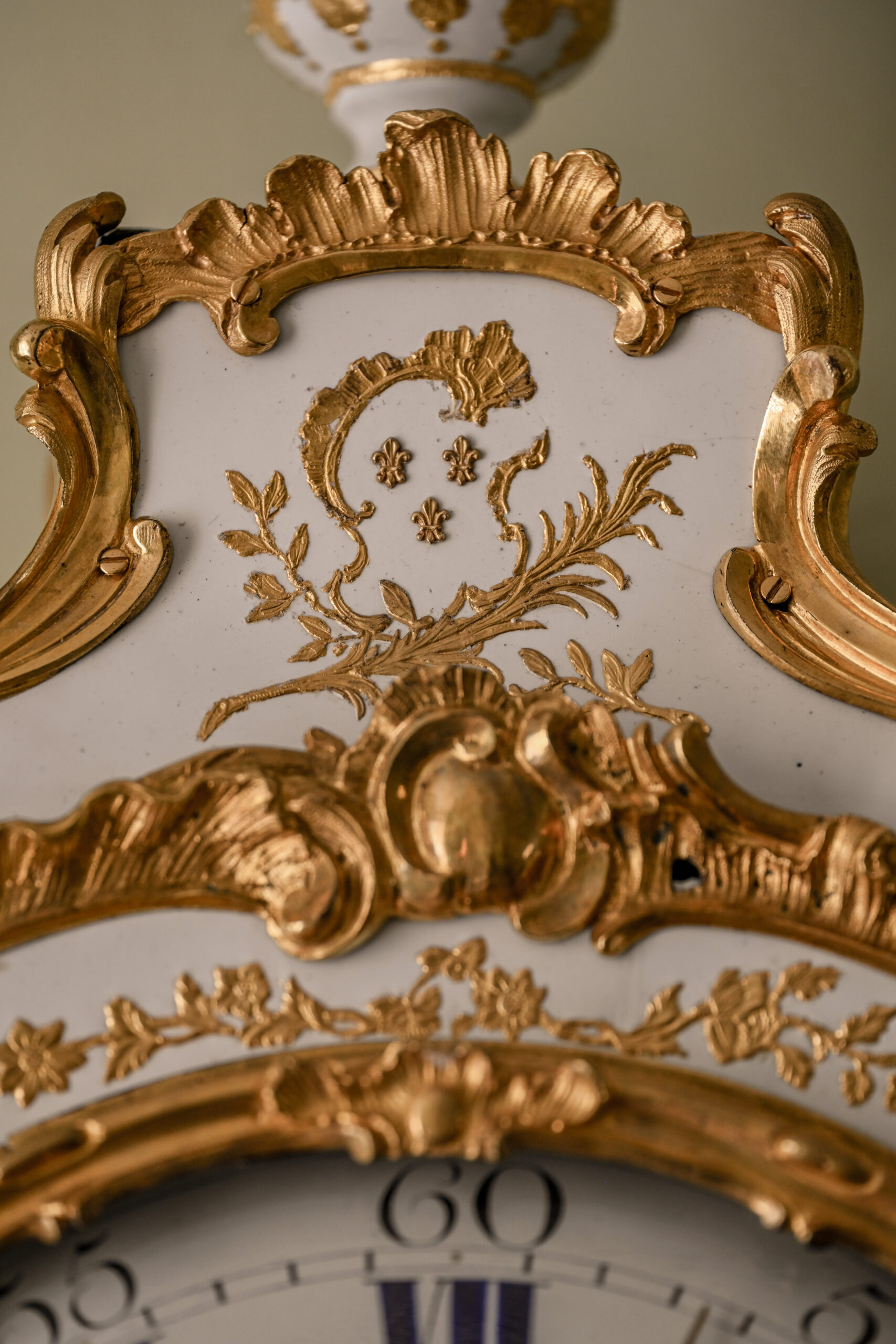
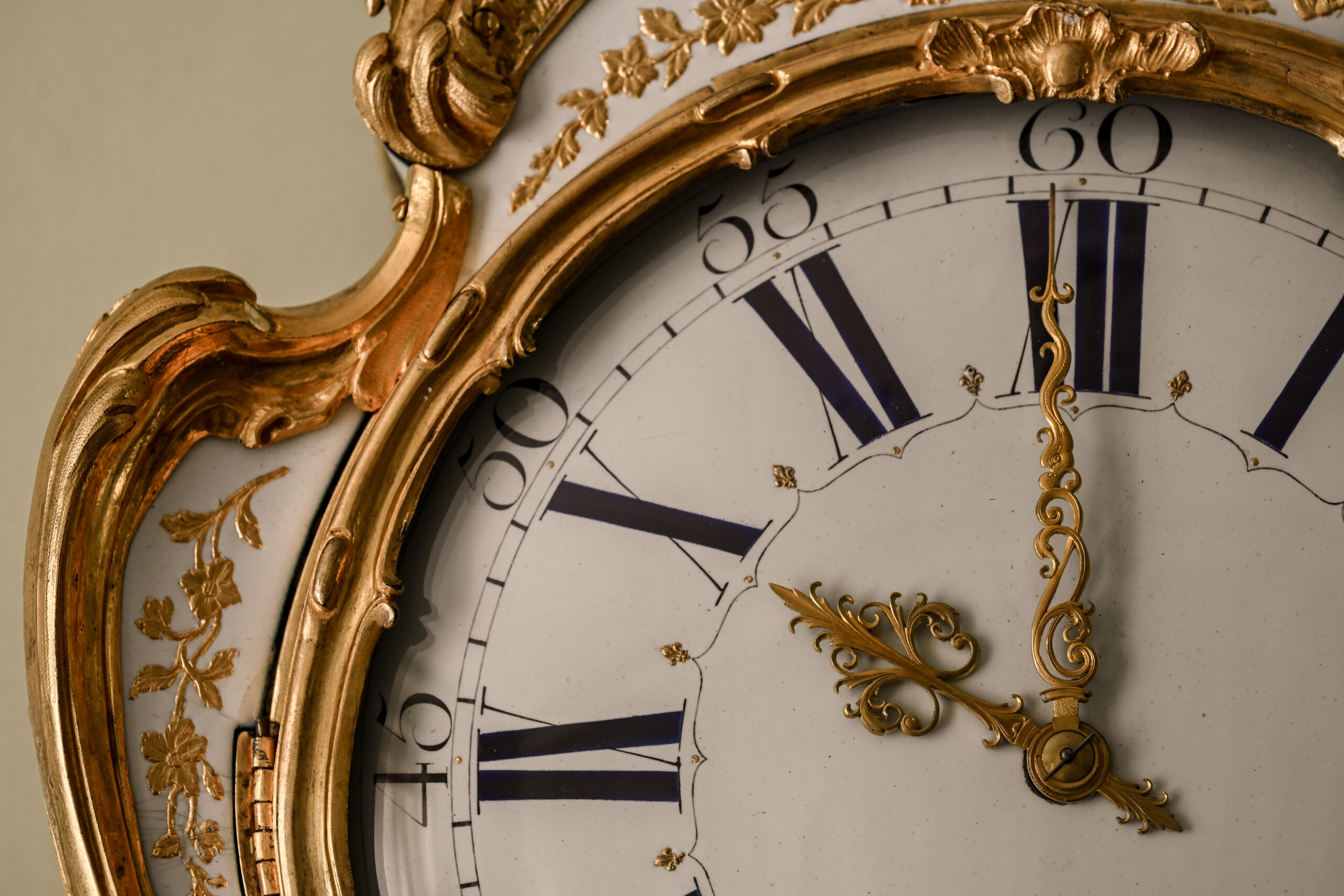
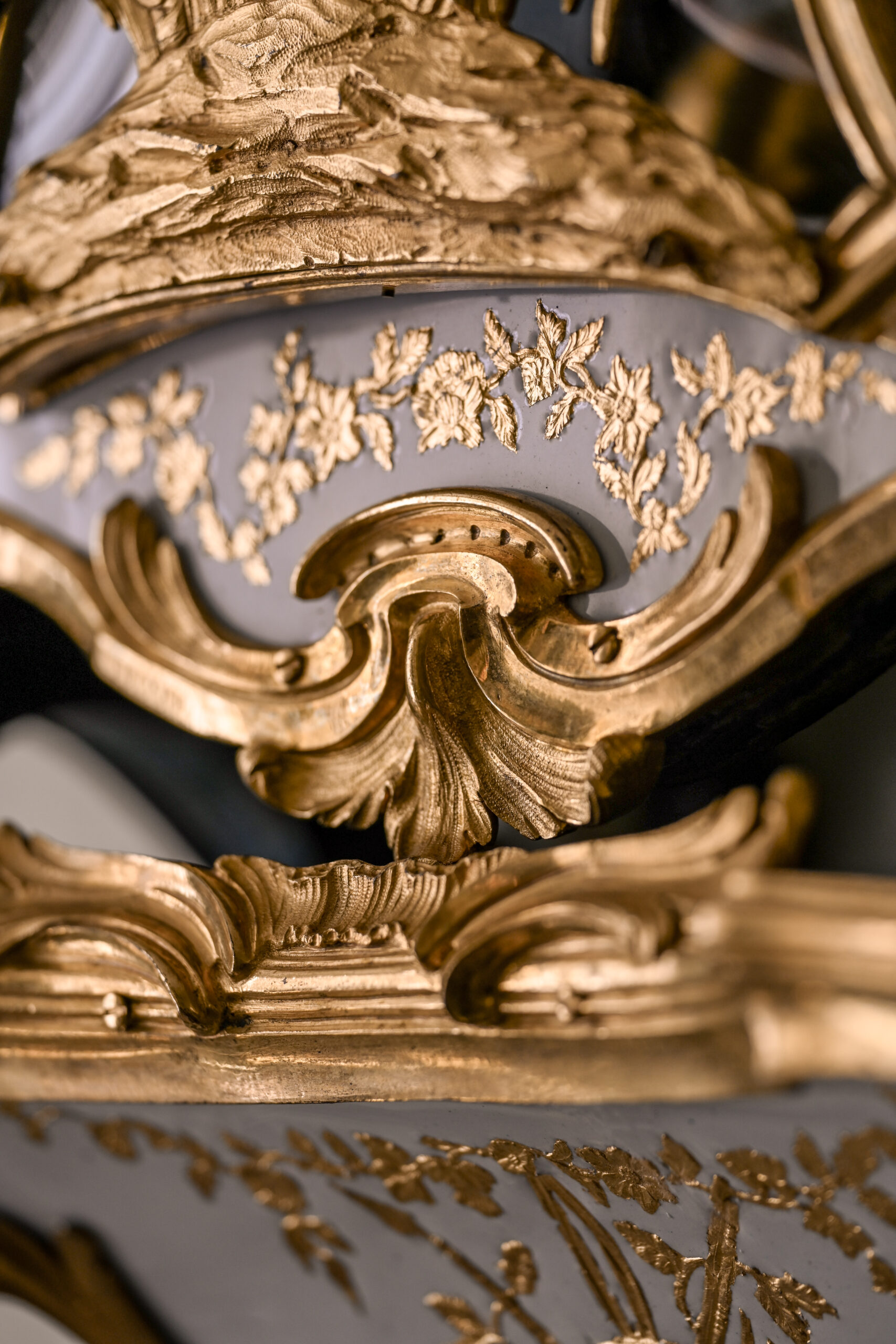
Violin-shaped and very richly decorated with gilt bronze, the clock presents on its enameled plaques a finely executed gilt decoration combining hunting trophies, delicate flower garlands, fleurons and rosettes alternating with fleurs-de-lis, all crowned above the dial by an asymmetrical cartouche adorned with the three fleurs-de-lis of France, framed by festooned scrolls accented with a crossed palm and laurel branch. The rocaille gilt-bronze frames alternate leafy acanthus scrolls, festoons, small flower buds and asymmetrical cartouches and egg motifs. A Medici-shaped vase, enameled in white and gold, highlighted by a corolla of fleurs-de-lis, and containing a bouquet of enameled and polychrome flowers, punctuates the whole. The dial, in Roman numerals for the hours and Arabic numerals for the minutes, is embellished with delicate flourishes accented by small golden fleurs-de-lis and dots, and signed in its lower section: MARTINIERE. EMAILLEUR ET PENSIONNAIRE DU ROY. 1751. Its finely crafted hands, are gilt, and the glass pane of the door that protects it, remarkable for its distinctive convex shape, also covers the entire lower section of the clock, down to a rocaille-style gilt-bronze mound, topped with an opulent arrangement of reeds. Two oblong compartments, also fitted with glass and framed in gilt bronze, occupy the short sides, allowing a partial view of the clock’s wooden case, painted in lapis blue. The reverse, painted the same lapis blue, features a rectangular door whose opening provides access to a movement signed FILLEUL A VERSAILLES.
Supporting the four scroll feet of the clock, the wall-mounted console, with its flared and contoured form, displays on its front a rich gold and white enameled decoration featuring a hunting trophy motif: a dog’s head centered within a hunting horn, behind which cross a rifle and a spear, all accented by delicate leafy branches. Two smaller trophies, also featuring hunting horn motifs, but simpler in design, with crossed bow and arrow, adorn the short sides. The entire piece is richly framed with gilt bronze and rests on a base painted in lapis blue.

Antoine-Nicolas Martinière
Antoine-Nicolas Martinière was likely the most talented and most renowned enameller, during Louis XV’s reign. Born in 1706, he was the son of the enameller Nicolas Martinière († before 1736), master émailleur and patenötrier, and of Marie Dumergue, residing on rue du Harlay in 1701. Two of his brothers, Jacques-Nicolas and Charles-André Martinière, where also enamellers, as well as three of his first-degree cousins: Jacques-Nicolas, Jean et Jacques-Antoine Boullé. Antoine-Nicolas Martinière registered his master’s certificate on 3 July 1720, listed at the time as a Marchand verrier-fayancier-émailleur-patenötrier. He married Geneviève Larsé in September 1736, who was the daughter of Jean-François Larsé, master clockmaker in the Enclos Saint-Denis de la Chartre in 1714, then on rue Pagevin in 1722, and of Louis-Catherine Brézaguez. The couple had at least one son: Jacques Nicolas (born in 1738).
He successively set up shop on rue Neuve Notre Dame in 1736, rue Haute des Ursins in 1738, rue Dauphine in 1740, and finally rue des Cinq Diamants from 1741 until his death. He quickly gained widespread renown, both artistically and scientifically, and received, as previously mentioned, in token of royal recognition, the title of Émailleur et Pensionnaire du Roi in 1741, accompanied by the right to affix this highly coveted title to his works, as well as an annual pension. From 1744 to 1746, he served as a sworn member of his guild.
Martinière was the first to create large-scale enamel objects, a feat praised in the April, 1740 issue of Mercure de France, p. 741-742: “Mr Martiniere, Enameller, on ruë Dauphine, undertook [a clock dial made from a single piece of enamel measuring 14 inches in diameter, or 38 cm.], and succeeded so well in every aspect that he had the honor of presenting it personally to His Majesty, who was pleasantly surprised and expressed his satisfaction with such kindness that he returned to Paris delighted by such a success and determined to pursue further studies to advance as far as possible in his art […]”.
Between 1741 and 1742, he created for Louis XV, at the age of 36 years, an extraordinary Almanach perpétuel et toujours nouveau dédié au Roy, unfolding across four quarterly panels, enameled on a white ground, with richly molded gilt-bronze borders and crowned with the arms of France, today part of the Wallace Collection, in London.

This almanac, which bears the inscription Lorsque la Nouveauté vient Confondre mes Traits. Un Simple Arrangement me Rend Tous mes Attraits, was located in the Tuileries Palace in 1793, very likely brought from
Versailles by Louis XVI. It was sold by the National Garde-Meuble on 2 Vendémiaire, Year 6 (23 September 1797). In 1747, he created in enamel a Vue de la bataille de Fontenoy [11 May 1745], which he also dedicated to the King. Acquired by Louis-Philippe in 1844, it was placed by the Louvre at the Château de Versailles on 2 May 1895. Between 1750 and 1757, Madame de Pompadour paid him 1 200 livres for a commission or a “delivery” related to the Château de Bellevue, that the royal mistress had just had built by her favorite architect, Jean Cailleteau known as “Lassurance”.
Martinière collaborated regularly for his work with great artisans of his time, such as the bronzier Jean-Joseph de Saint-Germain and the clockmakers Julien Le Roy – probably since 1731, Melchior Bonnaventure Balthazar, Louis Jouard, Jean-Baptiste III Albert Baillon, Etienne Le Noir, Gilles l’aîné, Joachim Bailly, Jean-Baptiste Gosselin, Lange de Bourbon – maker of barometers, Jean Moisy and François-Joseph Filleul. After several decades of activity, he died in Paris on 2 September 1784, in a residence at rue Quincampoix, Paroisse Saint-Merry.
François-Joseph Filleul

François-Joseph Filleul (1708-1774) occupied successively the responsibility of Valet de chambre horloger ordinaire de la Dauphine in 1745, and that of Chef du gobelet du Roy pour le quartier d’avril in 1748. Spent entirely in Versailles, his life was marked by discretion. Son of Nicolas Filleul, coachman to the Duchess of Bourgogne, and of Élizabeth Deffebves, in the service of the mother of future Louis XV, he was born in Versailles on 8 November 1708, and baptized two days later at the Notre-Dame church, with his grandmother for godmother and the head chef of the Marquis d’Angot for godfather.
Filleul began by acquiring positions in the service of the Orléans family. Seemingly it was his marriage on 14 November 1733, with Françoise Anne Blouquier, daughter of a musician of the Chapelle du Roi, François Blouquier, which opened the doors in the music world to him, where he exercised his considerable talents, without however neglecting his domestic duties serving both the Duke of Orleans, who provided him with lodging, and Madame, the sister-in-law of Louis XVI, for whom he was valet de chambre horloger.
How he acquired his technical skill still remains unknown, as does his musical training. Starting in April 1757, he also presented the Gazette to the royal family, which, combined with his other duties, allowed him to live in comfortable ease in a home crowded with dozens of paintings and trinkets.
François Joseph Filleul was living on rue de la Paroisse and serving as valet de chambre to the Duke of Chartres when he maried in 1733. Among the witnesses present were Marie Adélaïde de Gramont, Duchess of Gontault, the Bishop of Rennes, master of the Chapelle du Roi, “M. Le Voyer d’Argenson” [it is difficult to determine which member of the family this refers to], the governor of the Duke of Chartres, an officer of the Duke of Orléans, the bride’s brother, who was a clerk in the War Office, and a cousin, Thomas Filleul, concierge of the Château Neuf de Meudon. The ceremony took place at “ten forty-five” at the Notre-Dame church.
Filleul subsequently occupied the post of taille de la Musique du Roi. His name appeared for the first time in the État de la France of 1749. The presence of the master of the Chapelle Musique at his wedding, as well as that of his father-in-law, an influential person in the same Chapel, contributed without a doubt to his rather rapid rise. In 1757, his position as a distributor of the Gazette de France to the King and his family, brought him, according to the Duke of Luynes, 600 livres per year.
On 13 February 1763, Filleul decided to sell for 4 000 livres his position as Valet de chambre horloger ordinaire de la Dauphine to Pierre Daillé de Bonnevaux, valet de chambre horloger of the King of Poland, while retaining his titular status, allowing him to continue receiving his salary. He took part in all the trips to Fontainebleau and Compiègne, unless he was ill or his duties prevented him from accompanying the Dauphine on a specific journey. In exchange, he permanently gave up the privilege of maître horloger in Paris attached to his office, which enabled Daillé to open a workshop in the capital.
He passed away in his residence, on the 2nd floor of the Orléans stables, on rue de la Pompe, on 22 September 1774. Two days earlier, “lying in bed, sick in body”, he had received the notary Raux-Rauland to add a few clauses to his will, originally drafted on 14 July 1771.


In the inventory of his possessions, drawn up by the same notary since 3 October, he was described as valet de chambre horloger de Madame and Porte-manteau du duc d’Orléans. His title as musician to the King appears only at the end of the document. The settlement of his estate, dated 30 September 1775, indicates that he presented the Gazette to the royal family “at a rate of 150 livres for each prince and princess, of which more than 6 000 livres remained unpaid at that date”.