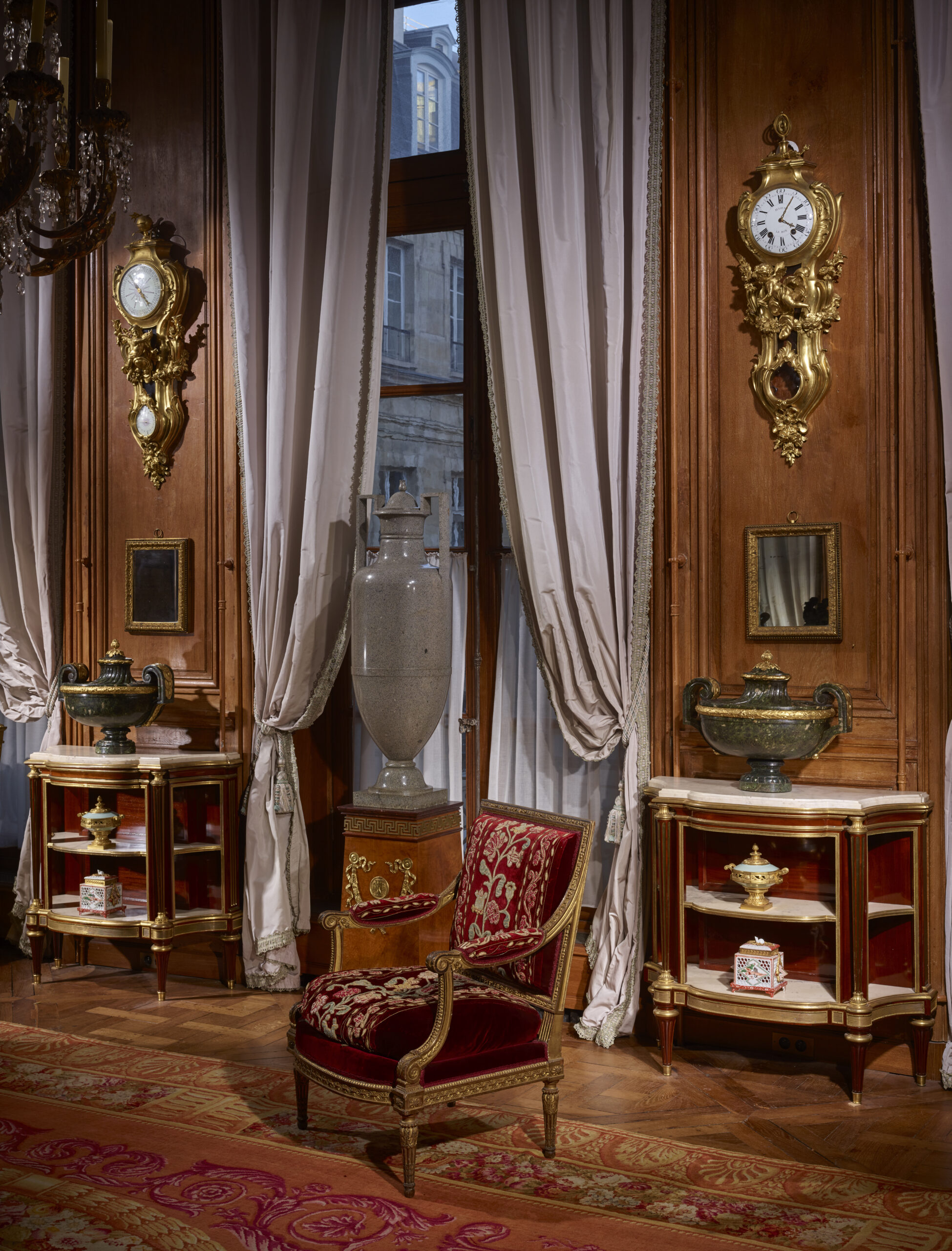
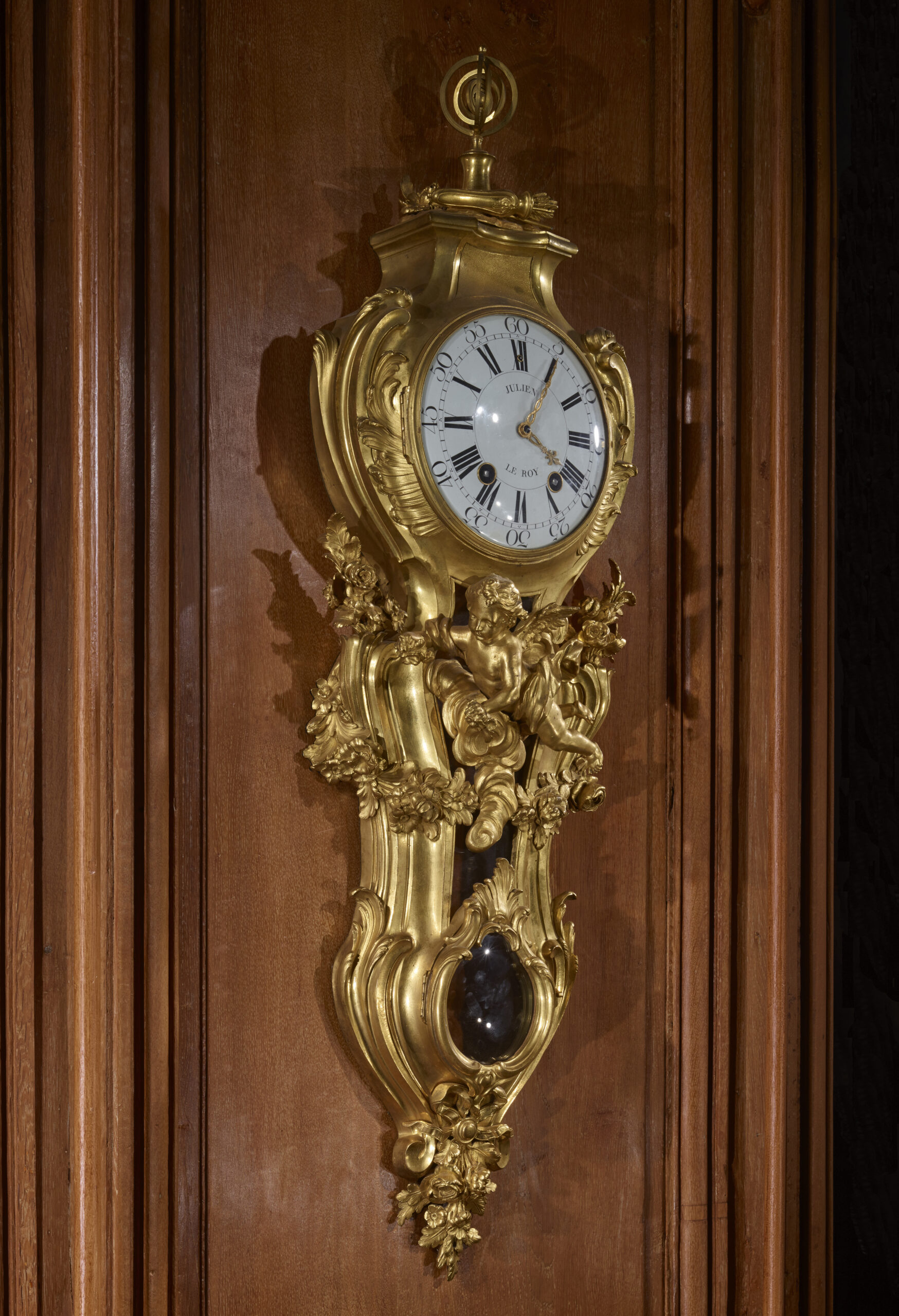
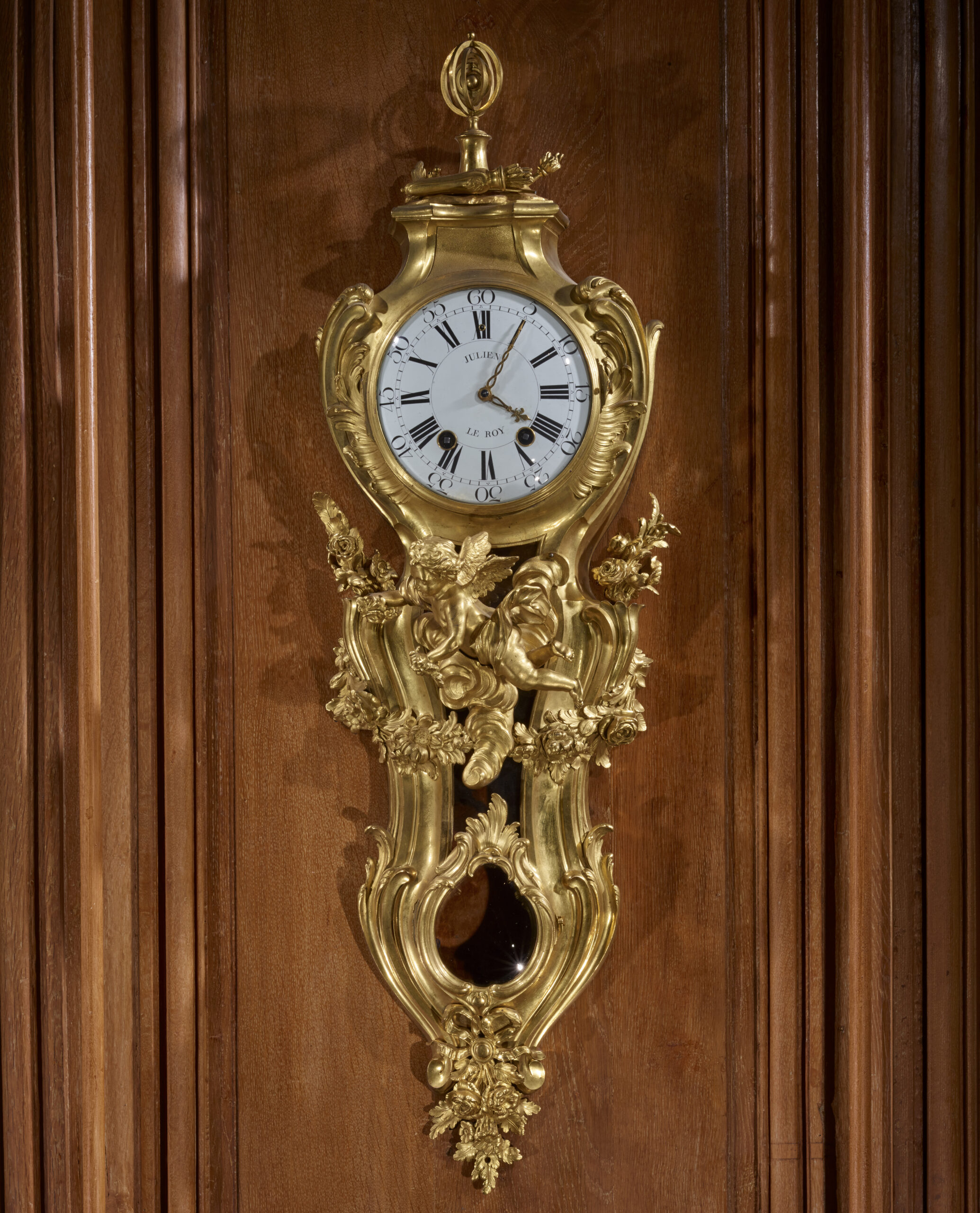
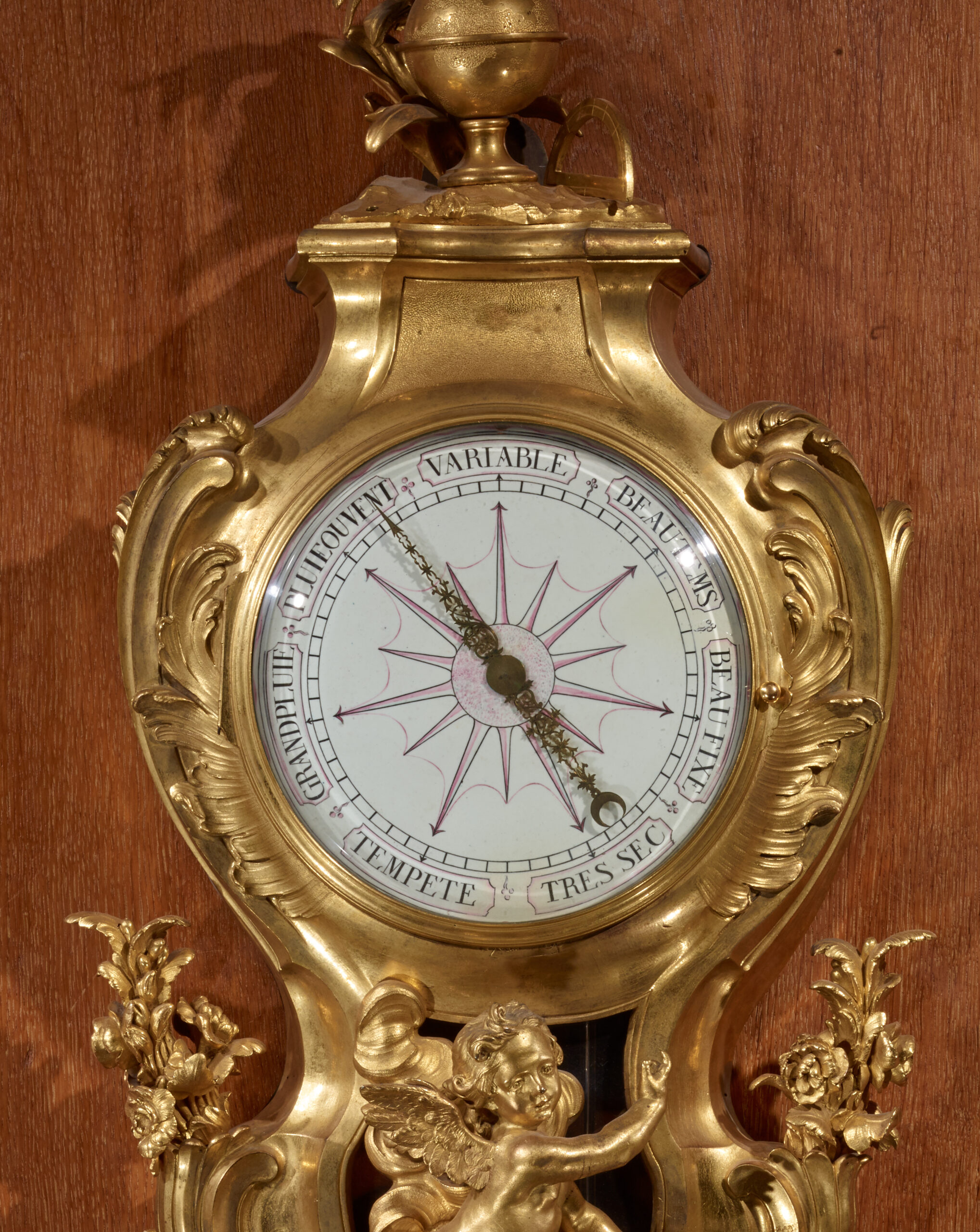
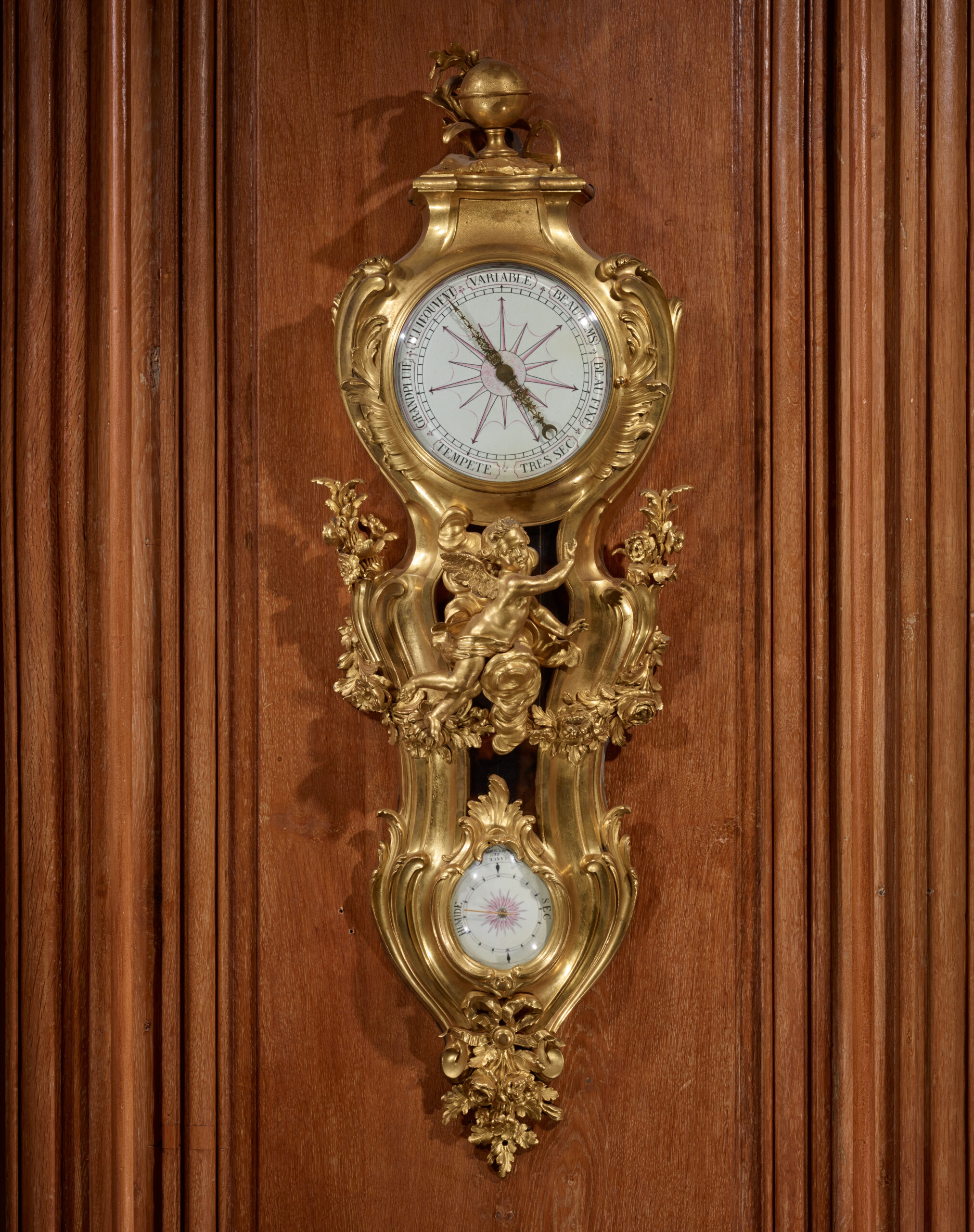
Chiselled and gilt bronze; enamel; metal; glass.
H. 114 cm. (45 in.); Width 37 cm. at the widest section (14 ½ in.); D. 18.5 cm. (7 ¼ in.).
SIGNATURES: JULIEN/LE ROY visible on the dial of the clock; and LANGE DE BOURBON visible on the dial of the hygrometer adorning the lower part of the barometer.
PROVENANCE: collection, during the Directory, of Baron Pieter Nicolaas Van Hoorn Van Vlooswijck (1742-1809), in his apartment located in the hôtel de Vendôme, former residence of the Dukes of Chaulnes, located at 34 Rue d’Enfer, Paris, now part of the buildings of the Ecole des Mines, 60 Boulevard Saint-Michel; its auction in Paris: The late Baron P.N. van Hoorn van Vlooswyck, Member of the Royal Academy of Antiquities of Cassel, of that of Cortona, &c, by Mr Lebrun [Jean-Baptiste-Pierre Lebrun (1748-1813)], on 22nd November 1809 & following days, lot n°.. 81 (sold for 502 Francs); collection of Richard Plantagenet Temple-Nugent-Brydges-Chandos-Grenville (1797-1861), 2nd Duke of Buckingham and Chandos, at Stowe House (Buckinghamshire), adorning the Summer Dining Room; auction of the contents of Stowe House, subsequent to the Duke’s bankruptcy in 1747: Catalogue of the Contents of Stowe House, by Messrs. Christie & Manson, from 15th August to 7th October 1848, lots nos. 2525 and 2526 (sold on Tuesday 28th September 1848, the 33rd day of the sale); acquired for £117 and 12 shillings at auction by Charles Redfern, an art dealer established in Warwick (Warwickshire); resold by the latter to Lord Richard Seymour-Conway (1800-1870), 4th Marquess of Hertford, also known as Lord Hertford; then by will, collection of his secretary and natural son, Sir Richard Wallace (1818-1890), 1st Baronet; collection of his widow and sole heir, Lady Wallace, née Julie Amélie Charlotte Castelnau (1819-1897); collection of Sir John Arthur Edward Murray Scott (1847-1912), 1st Baronet, secretary and confidant of Sir Richard Wallace from 1871 to 1890, then of Lady Wallace until 1897, in his apartment at 5 Connaught Place, London; auctioned in London by Messrs. Christie, Manson & Woods: Catalogue of French Decorative Objects and Furniture Porcelain & Tapestry, The Property of Sir John E. A. Murray Scott, Bart. Deceased; late of 5 Connaught Place, W. Sold by Order of the Court of Chancery, 24-26 June 1913, lot n°. 244; acquired for £441 at auction by Asher Wertheimer (1844-1918), a prominent art dealer who owned a gallery at 158 New Bond Street, London; sold by the latter to Mrs. Eleanor Elkins Widener Rice (1861-1937), successive wife of George Dunton Widener (1861-1912) and of Alexander Hamilton Rice Jr. (1875-1956), at her residence at 901 5th Avenue, New York; collection of Frederick P. Victoria, New York.
LITERATURE: Henry Rumsey Forster, The Stowe Catalogue priced and annotated, Londres, 1848, p. 247, lots nos 2524 and 2526; Peter Hughes, The Wallace Collection, Catalogue of Furniture, III, Londres, 1996, “Appendix VIII/Furniture sold at Christie’s, 24-26 June 1913”, p. 1542 (lot n°. 244); Jean-Dominique Augarde, Les Ouvriers du Temps, La Pendule à Paris de Louis XIV à Napoléon Ier, Antiquorum Editions, 1996, p. 130, fig. 89, and p. 145; Alexandre Pradère, “Baron Van Hoorn: An Amateur of Boulle, Antiquity, and the Middle Ages under the Empire”, Furniture History, Vol. 43 (2007), p. 210-211, fig. 6.


Ill. 1: Auction in Paris of Feu M. le Baron P.N. van Hoorn van Vlooswyck, Membre de l’Académie royale des Antiquités de Cassel, de celle de Cortone, &c, par M. Lebrun (The late Baron P.N. van Hoorn van Vlooswyck, Member of the Royal Academy of Antiquities of Cassel, of that of Cortona, &c, by Mr Lebrun), on 22 November 1809, lot n°. 81.
In the post-mortem inventory of Jacques Caffieri († 23rd November 1755) and his wife, Marie-Anne Rousseau († 30th April 1755), drawn up on 1st December 1755 and reflecting the condition of the workshop on that date—which Jacques had officially shared since 1747 with his eldest son, Philippe, also an ordinary sculptor and chaser to the King, with whom he had entered into a fifty-fifty partnership—were described, under the heading of works completed or nearly completed, under n°. 113: “Item two cases of clocks with cartels, each accompanied by a child, unfinished, valued at eight hundred Livres”. These two “boëttes de pendulles” (literally, boxes – i.e. cases – of clocks), although very succinctly described, might correspond to the cartel clock and barometer presented here. Despite their considerable valuation, by far the highest of the inventory, they do not appear in the list of models established therein, nor in the list drawn up by Jacques Caffieri on 5th February 1747 to be attached to the marriage contract of his son Philippe with his first wife, Suzanne-Edmée Duliège, in which he ceded half of all his models to her, thus sealing their partnership.


Ill. 2: Henry Rumsey Forster, The Stowe Catalogue priced and annotated, London, 1848, p. 247, lots nos 2524 and 2526, where Redfern is specified as the name of the purchaser of our clock and barometer at the sale.
This leads us to believe, on the one hand, that the model for these two “boëttes” was very recent in 1755, suggesting that Philippe Caffieri played a major part in its conception alongside his ageing father, which is fully borne out by the symmetrical and very ‘classical’ design of our objects; and, on the other hand, that these “boëttes” seem to have been produced on only one occasion, perhaps so as to meet the specific needs of an important commissioner. To date, we have not recorded any other pair of cartel clocks and barometers in chiselled and gilt bronze of this model.
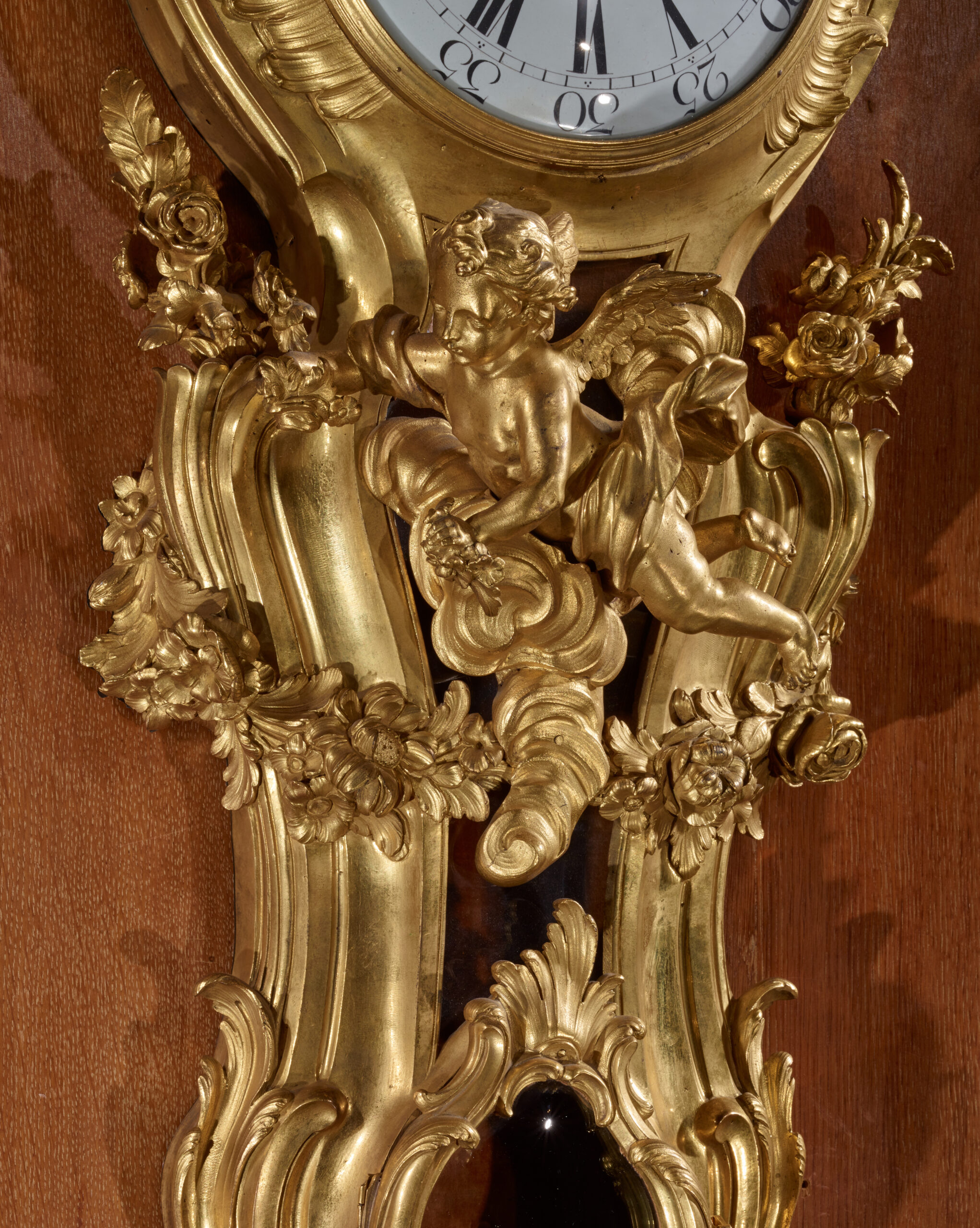
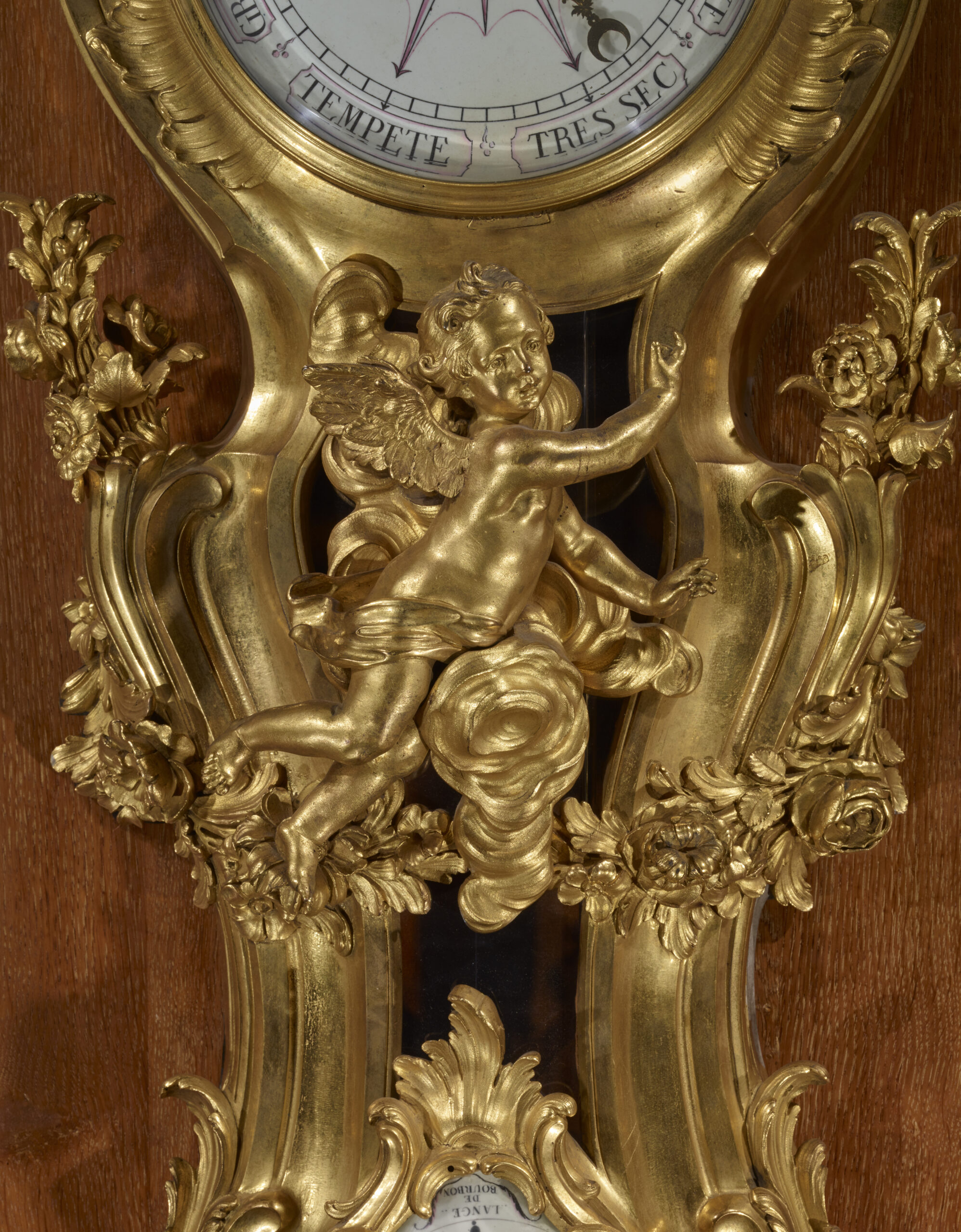
Each case is composed, on the upper part, of a large round dial, protected by a lightly domed glass panel with a thin gilt bronze moulded border, surrounded by an ogee-shaped edge enhanced with acanthus festoons and equally flanked by acanthus scrolls. The crowning element, with its architectural shape, is designed as a flared “abacus” with panels and compartments treated in amati. The terrace, with its moulded borders formed by the latter, hosts, on a small rocky and foliated mound, on the barometer, a terrestrial globe flanked by a graphometer and a book, an allegory of the terrestrial sciences, and, on the cartel, an armillary sphere, a quiver and a torch, an allegory of the celestial and divine sciences. The dial of the latter, with Roman numerals for the hours and Arabic numerals for the minutes, bears the signature of Julien/Le Roy. The barometer’s dial is adorned with a central rosette with pale pink orientation arrows. Their hands are openwork and gilded.
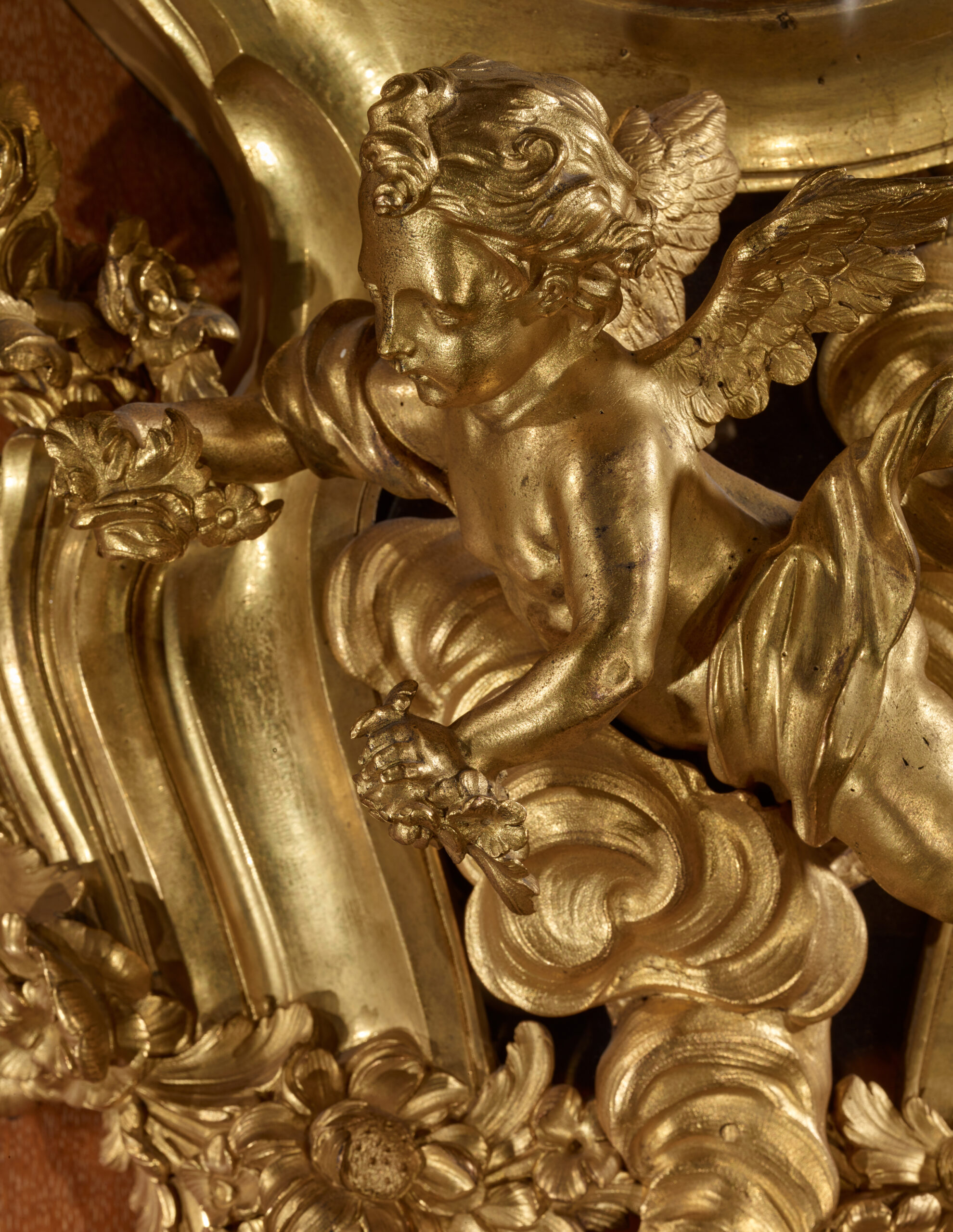
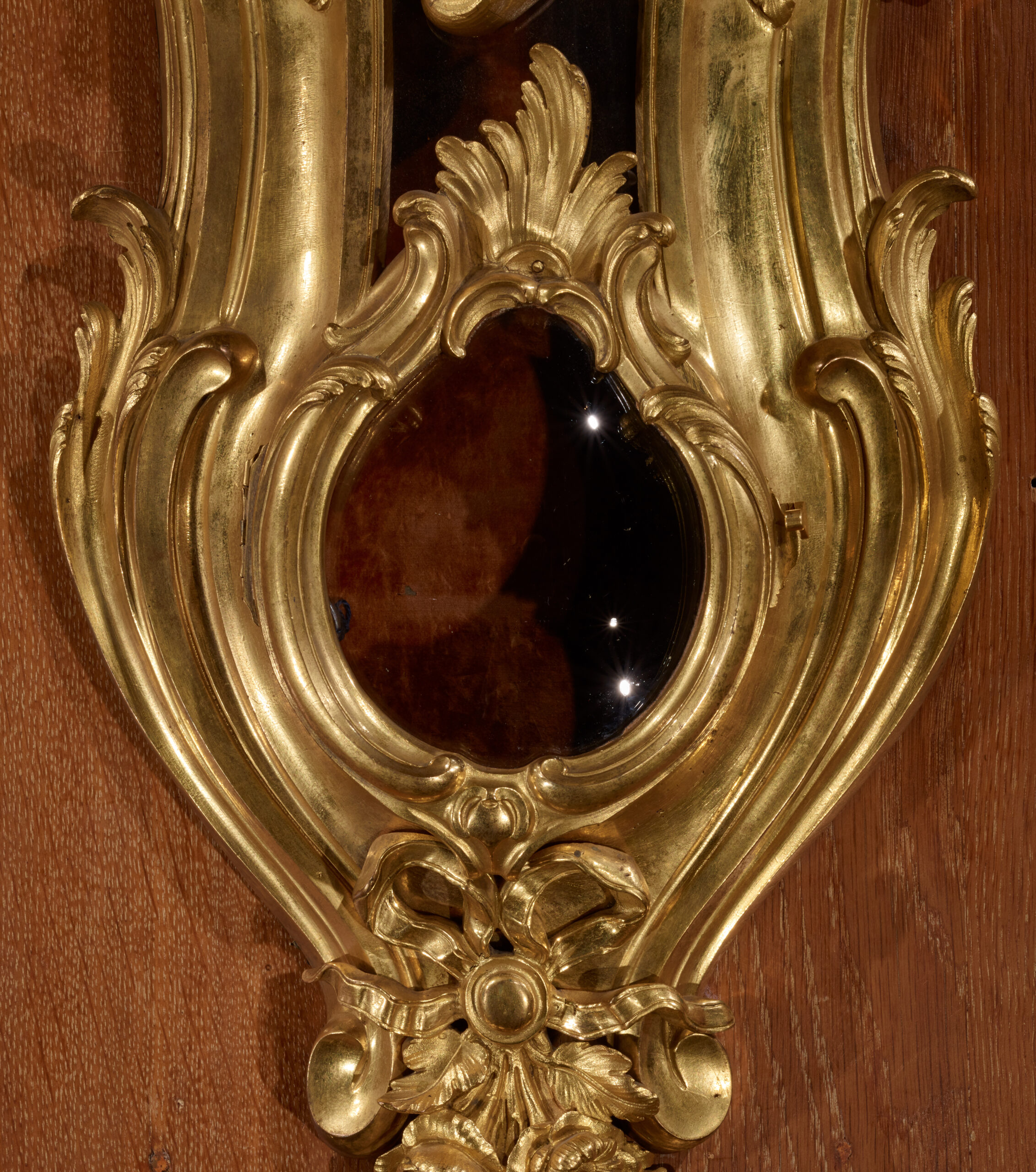
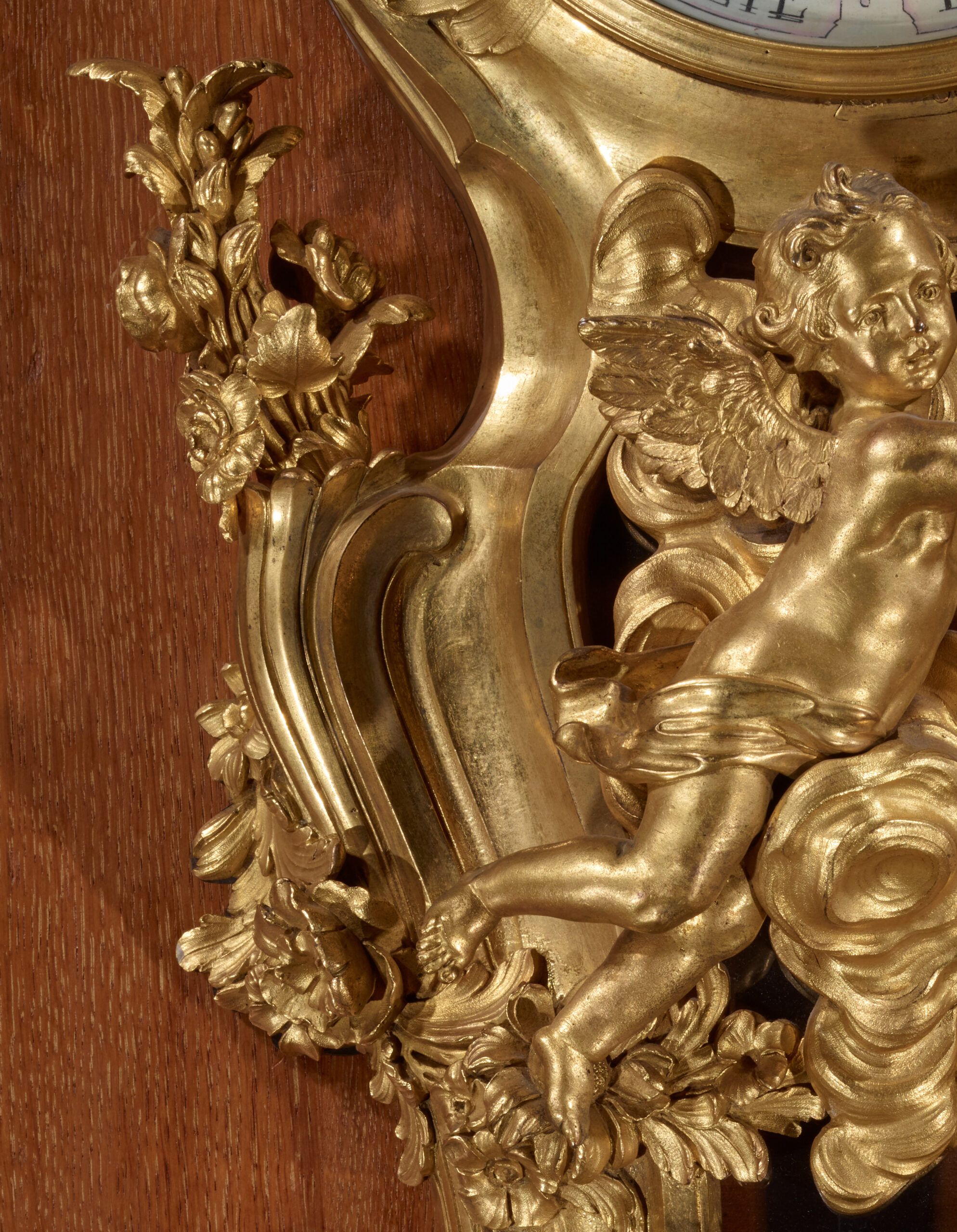
Violin-shaped, the openwork body of the cases is powerfully moulded with ample acanthus scrolls, forming two “shoulders” at midpoint level, each punctuated by a small bouquet foliated with flowers au naturel, from which falls a garland of similarly foliated flowers, joining the two by means of an accolade. The latter accentuates, in the centre, affixed to the openwork and glazed section, just below the main dial, a cloud supporting a flying cupid, sculpted in the round, positioned diagonally, draped at the waist, arms outstretched in front of him. The cupid on the barometer looks to the right, head raised, arms outstretched in a “scissor” position. The one on the cartel returns the gesture, turned to the left but more inclined and looking down, his outstretched arms holding a small bouquet in each hand. The lower, bulging part of the cases forms an openwork, pear-shaped cartouche-panel bordered with acanthus scrolls and terminated by a bow of ribbons, held in place by a button, from which falls a short but opulent bouquet of foliated flowers. The cartouche of the cartel clock allows us to see the lens of its pendulum in the shape of a radiant Apollo mask executed in gilded bronze. The barometer’s cartouche houses a dial with a white background and a pale pink central rosette, with a yellow hand, bearing the indications “Humide” (Humid) and “Sec” (Dry), and the signature, in its upper part and in reverse, of Lange de Bourbon.


These cases are characteristic of the work of Jacques and Philippe Caffieri, and share many similarities with several of their contemporary masterpieces, first and foremost the extraordinary astronomical clock of Louis XV at Versailles, the only one of its kind in the world, whose highly complex mechanism was created in 1749 by the mechanical engineer, optician, astronomer and clockmaker Claude-Siméon Passemant (1702-1769), and the King’s clockmaker Louis Dauthiau (1730-1809).

Approved by the Royal Academy of Sciences on 23rd August 1749, this mechanism was presented to Louis XV at the Château de Choisy on 7th September 1750, but was not provided with its case, entirely executed in bronze by the Caffieri, until 20th August 1753. Installed in the Choisy gallery on 10th October, it was eventually placed in the Salon des Pendules at Versailles on 15th January 1754. This clock very distinctively displays a similar treatment in the ample acanthus scrolls structuring its case; the same luxuriant bouquets foliated with roses and flowers au naturel flanking its uprights just below the main dial, which is similarly bordered with festoons and crowned with the same flared “abacus” motif with faceted panels and compartments treated in amati, forming a moulded-edged terrace hosting here an imposing armillary sphere.
The same observation holds for the two large gilt bronze chandeliers, with twelve and nine lights respectively, in the Wallace Collection in London, both bearing the signature CAFFIERI/A PARIS, accompanied by the date 1751 for the first of them. If we are to go by the comments by Emile Molinier and Peter Hughes, the twelve-light chandelier was most certainly offered by Louis XV to his eldest daughter, Louise-Élisabeth de France (1727-1759), known as Madame Infante, shortly after she and her husband, Philip I (1720-1765), Duke of Parma, took possession of their duchy in 1749, in the wake of the signing of the Treaty of Aix-la-Chapelle (1748).
The second chandelier was most likely taken to Parma by Madame Infante herself on her return from Versailles in September 1753. It was inventoried in Parma in February 1769. Both chandeliers bear the 19th-century inventory marks of the Colorno Palace. The twelve-light chandelier in particular displays, at the level of the upper part of its openwork “baluster” shaft, foliated pendants of roses and flowers identical to ours, and, at the lower level, pear-shaped cartouches with moulded acanthus borders, which are reminiscent of those terminating the cases of our cartels. The openwork “bulb” crowning the second chandelier in the Wallace Collection displays scrolls festooned with acanthus leaves similar to those flanking their dials.


Jacques Caffieri resorted to this ornamental repertoire from 1735 onwards, at the height of the “rocaille” period, as can be evidenced, for example, on the bronze legs of the remarkable desk by Étienne-François (1719-1785), Duke of Choiseul, which is attributed to him along with cabinetmaker Antoine-Robert Gaudreaus. This exceptional piece of furniture was successively part of the collections of Duke Pierre de Courlande (1724-1800), Chancellor of Austria, Clement Wenzel von Metternich (1773-1859), and then his son, Prince Richard Klemens von Metternich (1829-1895), from whose succession it was acquired for 1,200,000 gold francs by Baron Edmond de Rothschild, who placed it in his townhouse on Rue du Faubourg-Saint-Honoré in Paris.
Busts of children as term figures, wielding swords, emerge from the upper part of this desk’s legs. The theme of children or winged cupids flying, treated in the round, with finely chiselled “classicizing” faces, draped at waist level, and often with indications of pupils, was a recurring feature in the work of the Caffieris, adorning, for instance, in addition to Choiseul’s desk, the famous chandelier with the arms of the Marquise de Pompadour, which is also attributed to them, dated circa 1750-1755, and kept at the Bibliothèque Mazarine in Paris. They also adorned many of their clock models, such as the cartel clock, dated circa 1740, with a pair of children playing with a torch, signed on a cartouche: CAFFIERI FECIT, most likely from the Peterhof Palace in Saint Petersburg, now in the Detroit Institute of Arts; the one with the figure of Minerva bearing the signature “Made by Caffieri”, belonging to the collections of the J. Paul Getty Museum in Los Angeles; or the one from the collection of Baron James de Rothschild (1878-1957), bequeathed to Waddesdon Manor in 1957, with a figure of Venus flanked by a cupid flying on clouds, and crowned with an allegorical figure of Aurora, dated 1748-1749, and signed in a small cartouche above the dial: FAIT PAR CAFFIERI A PARIS. The dials of these last two clocks bear, along with that of our cartel clock, the signature of Julien Le Roy. Jacques Caffieri’s 1755 inventory mentions several other models of these clocks with children’s figures, which made up nearly a third of all the models listed that year in the workshop, to which were added a few models of sconces, a writing desk, and a few isolated children: “a large clock on top of which rests a Minerva holding her shield and at the lower part a child showing the time, with palms and oak leaves” (n°. 59); a “small cartel clock next to which is a child representing a genius, with his accompaniments” (n°. 63); a “pendulum clock with a base surmounted by a child holding a telescope, with a small support in front” (n°. 67); a “pedestal clock surmounted by a child holding a sundial, with a small support and its cul-de-lampe” (n°. 68); a “pedestal clock surmounted by a small child holding a lyre, with support” (n°. 69); and a “small pedestal clock surmounted by a small child holding a horizontal quadrant and its support” (n°. 71).
A prestigious provenance
At the end of the 18th century, our cartel clock and barometer were part of the collection of Baron Pieter-Nicolaas Van Hoorn van Vlooswyck (1742–1809), who was originally from Amsterdam but resided in Paris, in a townhouse located at 34 Rue d’Enfer. Before his death, the Baron had drawn up a detailed will stipulating that the posthumous sale of his collection should be entrusted to the expert and art dealer Jean-Baptiste-Pierre Lebrun (1748-1813), that it should be held at his house on Rue d’Enfer and that “no object foreign to his collection whatsoever should be admitted”. The auction took place in accordance with these conditions on 22nd November 1809 and subsequent days, and our cartels formed lot n°. 81 of the sale: “A clock by Julien Leroi; a barometer by l’Ange de Bourbon. All in their cartels in Meyssonnier style, embellished with winged children, garlands & other adornments in gilded bronze. Height 43 in. [116.36 cm.], width 11 [29.77 cm.]”. They were auctioned off for 502 Francs.


Lebrun praised the Van Hoorn collection as “as famous for the magnificence, number & rarity of the objects it contains as for the purity of taste that inspired it; in its various guises, it is one of the most important collections ever known, & is bound to satisfy both antiquarians & art lovers alike”. In point of fact, it seems that very few people ever crossed the threshold of Baron van Hoorn’s house. If we are to go by Alexandre Pradère, he lived like one of Balzac’s characters, in relative solitude and surrounded by treasures. In addition to a very important collection of works by André-Charles Boulle, this collection included 17th and 18th century bronzes, a vast selection of Egyptian and Greco-Roman antiquities, as well as a number of precious vases and marble columns. The Baron’s collector interests extended to the Far East, as represented by Chinese and Indian bronzes, as well as with medieval and Renaissance artworks. He had also assembled a remarkable cabinet of curiosities composed of onyx and semi-precious stone cups and vases, along with a large collection of gold boxes. In a letter addressed to Marquis Jean-Baptiste Meyran de Lagoy (1764–1829), dated 5th May 1807, Count Charles de Clarac (1777–1847), future curator of Antiquities and Modern Sculpture at the Louvre Museum, described a visit to the baron in these terms: “Access is quite difficult, and I was only admitted thanks to the good offices of our dear old abbot. The old Dutchman, who is affected by gout and who, I must point out, is an excellent man and a man of taste, has some difficulty moving around, and at first I feared that we would see but little. But when he realised that we (the Englishman I had come with and myself) were true art lovers, he couldn’t resist getting up from his armchair and showing us everything in minute detail, assuring us all the while that he only did this for the sake of a very few guests. I offered him my arm to help him along. I returned that evening, and I am convinced that he liked my company. In effect, he lent me a book, which in itself was enough to cement our relationship.”
Born on 29th March 1743, Baron Van Hoorn came from a wealthy family originally from Bremen, Germany, who settled in Amsterdam during the second half of the 17th century and built up a fortune by trading with the East. They invested their wealth by setting up a manufactory in the West Indies, a sugar refinery as well as a gunpowder factory. Pieter Nicolaas was the son of Nicolaas Hendrik and his second wife, Anna Muilman, who lived in a house on the Herengracht in Amsterdam with an annual income of 6,000 to 7,000 Guilders. A family biography describes him as “quite different from the rest of the family, with neither an interest in politics nor commerce”. He sold his shares in the gunpowder factory to his elder brother, Quirijn Willem, at that time mayor of Amsterdam, and after a brief career in administration, embarked on a Grand Tour in 1789, during which he spent a considerable amount of time in Italy, developing a real passion for archaeology, and where the illustrious Cardinal Albani, Reffestein’s advisor [i.e. Johann Friedrich Reiffenstein, 1719-1793], Raphael Mengs and Pichler [i.e. Giovanni Pichler, 1734-1791], were his first guides. He assembled a magnificent collection of some eight hundred engraved stones, which were published by the naturalist Eleuthérophile Millin (1759-1818) and the archaeologist Léon Jean Joseph Dubois (1780-1846), and earned him widespread renown in his lifetime.


On his return from Italy, he took up residence in Paris during the Directory, around 1797, renting first an apartment at 668 Rue de Varenne (1803) until 1807, then a second in the Hôtel de Roquelaure on Rue Saint-Dominique. He frequented a small circle of highly knowledgeable connoisseurs of antiquities, among whom were Alexandre Lenoir (1762-1839), the famous founder of the Musée des Monuments Français, and the archaeologist Dubois, already mentioned. From 1807 onwards, Baron Van Hoorn rented an apartment consisting of a series of six main rooms in the hôtel de Vendôme, the former residence of the Dukes of Chaulnes, located at 34 Rue d’Enfer, now part of the buildings of the Ecole des Mines, 60 Boulevard Saint-Michel. He remained there until his death on 5th January 1809. His post-mortem auction, which began on 22nd November 1809, comprised 728 lots, several of which, according to Lebrun, came from the collections of the Duke of Aumont, the Duke of Saint-Aignan, Prince Charles of Lorraine, the late Prince of Conti, and the Bailiff of Breteuil. The sale raised a total of 180,092.82 Francs, making it one of the most substantial sales of the entire period between 1801 and 1810.

Our cartel clock and barometer were later to be part of the collection of Richard Plantagenet Temple-Nugent-Brydges-Chandos-Grenville (1797–1861), 2nd Duke of Buckingham and Chandos, in his emblematic family residence at Stowe House in Buckinghamshire, eighty-six kilometres north-west of London, where they adorned the Summer Dining Room. Born in Stowe, the Duke was the son of Richard Nugent-Temple-Grenville (1776-1839), Earl Temple, who later became the 1st Duke of Buckingham and Chandos, and Lady Anne Brydges (1779-1836), the only surviving child of the 3rd Duke of Chandos. In addition to her title of Duchess of Buckingham and Chandos, Lady Anne also held the title of Lady Kinloss in her own right, and in 1799, Richard Temple-Nugent-Grenville, by royal decree, changed his family name, which already consisted of three parts, to Temple-Nugent-Brydges-Chandos-Grenville in order to include that of his wife. He was also the paternal grandson of George Nugent-Temple-Grenville (1753-1813), 1st Marquess of Buckingham, and the great-grandson of British Prime Minister George Grenville (1712-1770).


Ill. 11 : Jacques et Philippe Caffieri, twelve-light chandelier signed CAFFIERI / A PARIS / 1751, most likely offered by Louis XV to his eldest daughter, Louise-Élisabeth of France (1727-1759), known as Madame Infante, Duchess of Parma. London, The Wallace Collection (inv. F83).
The Duke served as Member of Parliament for Buckinghamshire between 1818 and 1839, when he succeeded his father as Duke and became a member of the House of Lords. Two years later, in September 1841, he was sworn into the Privy Council and appointed Lord Privy Seal by Sir Robert Peel, a position he held until February 1842. He was made a Knight Grand Cross of the Royal Hanoverian Order in 1835, a member of the Society of Antiquaries in 1840, and a Knight of the Order of the Garter in 1842. In 1819, he married Lady Mary Campbell († 1862), daughter of Lieutenant-General John Campbell (1762-1834), 4th Earl of Breadalbane, who later became Marquess of Breadalbane. They had a son, Richard (1823–1889), 3rd Duke of Buckingham and Chandos, and a daughter, Lady Anna, but divorced in 1850 after the Duke lost his inheritance.
In 1847, eight years after succeeding his father as Duke of Buckingham and Chandos, the 2nd Duke was declared bankrupt, his debts exceeding £1 million. This situation led to the sale of his estate at Keynsham in Somerset in 1841, that of Avington Park in 1847 and, ultimately, the auction of the entire contents of Stowe House by Messrs. Christie & Manson, from 15th August to 7th October 1848, which was one of the largest sales of furniture from an English country house in the 19th century, and remains to this day the largest and longest auction ever conducted by Christie’s. Our cartel clock and barometer were sold on Tuesday 28th September 1848, the 33rd day of the sale, forming lots nos. 2525 and 2526: “2525 A clock, by Le Roi, in a case of or-moulu, with a cupid and festoons of flowers—in fine old French taste/2526 A barometer, in a similar case”.
The financial ruin of such a prominent member of the aristocracy, who had inherited an income of over £70,000, a considerable fortune at the time, caused a nationwide sensation. The Duke was to die much later, on 29th July 1861, at the Great Western Hotel in Paddington, London, aged 64, and his only son then succeeded him as Duke. His wife died less than a year later, in June 1862, aged 66.

Acquired for £117 and 12 shillings at auction by Charles Redfern, an art dealer established in Warwick (Warwickshire), the cartel clock and barometer were resold by the latter to Lord Richard Seymour-Conway (1800–1870), 4th Marquess of Hertford, also known as Lord Hertford, for whom he was one of the principal supplier.[1] Son of Francis Seymour-Conway (1777-1842), 3rd Marquess of Hertford, and Maria Seymour-Conway (1771-1856), née Fagnani, Lord Hertford lived mainly in Paris, at 2 Rue Laffitte and, from 1848 onwards, at the Château de Bagatelle in the Bois de Boulogne. The art critic Théophile Thoré (1807-1869), known as William Bürger, described him in the periodical Paris Guide in 1867 as follows: “The greatest collector in Europe is unquestionably Lord Hertford. He kindly granted me the privilege of visiting his London home, Manchester House, in Manchester Square […] Yet I have not even seen his other palaces and castles in London and the country […] In Paris […] Overlooking the boulevard, the bedroom lies at the far end of the apartment. To reach the gallery occupying the other end, one must cross the rotunda forming the corner of the boulevard and Rue Laffitte, the library, the dining room and a series of salons, where all the furniture and ornaments are works of art of incalculable value”.
He died a bachelor with no direct descendants on 24th August 1870 in Neuilly-sur-Seine and the title and fiefdom of Lord Hertford were passed, under English law, on to his closest relative, Francis Seymour (1812-1884), 5th Marquess of Hertford, while his fortune and all his collections, including our cartels, were handed down by will to his secretary and natural son, Sir Richard Wallace (1818-1890), 1st Baronet, who prevented the new title holder from recovering a variety of legal documents, paintings, tableware and linen from the Hertfords’ London home in Manchester Square, which he claimed as family possessions: three successive lawsuits ensued, the last of which was won by Wallace.
Upon his death on 20th July 1890, the collection went to his widow and sole heir, Lady Wallace, née Julie Amélie Charlotte Castelnau (1819–1897), who continued to divide her time between Paris and London, and although she did not speak English, was accepted as a Lady by high society, regardless of her humble French origins, on account of her immense fortune. In 1894, on the recommendation of John Arthur Edward Murray Scott (1847-1912), a doctor, secretary and confidant of her husband from 1871 to 1890, who subsequently became her own, and after presenting a few gifts to friends, Lady Wallace’s will bequeathed Hertford House and its 5,500
objects, housed in twenty-five galleries, to the British nation, under the conditions that “nothing should neither be added nor sold” and that the collection would be named after her late husband. She died on 16th February 1897. Scott, who had inherited the lease on Hertford House, saw to it that the will was respected. He sold the residence to the British government to house the Wallace Collection, and in recognition of all his services, he was knighted, receiving the title of 1st Baronet from the hands of Queen Victoria. The museum opened its doors to the public in 1900, a year after Scott was elected chairman of its Board of Trustees.
Lady Wallace had left him the sum of one million pounds sterling to maintain the estates of Sudbourn Hall and Lisburn in Ireland, as well as the Wallaces’ properties in France: the Bagatelle estate, which was purchased by the city of Paris in 1904–1905, and the building at 2 Rue Laffitte, which still held many of the furnishings and objets d’art left by Wallace in 1872. Scott took a few pieces from the Wallace collection for himself or his heirs, including our cartel clock and barometer, which he transferred to his London residence at 5 Connaught Place. When this extremely wealthy bachelor died of a heart attack in 1912, in the thick of a meeting at Hertford House, his mistress, Victoria Sackville-West (1862-1936), the natural daughter of Lionel (1827-1908), 2nd Lord Sackville, and wife of his cousin, 3rd Lord Sackville, inherited a large part of his possessions, as well as the sum of £150,000. It was she who sold the art collection at the townhouse on Rue Laffitte to the Parisian art dealer Jacques Seligmann for £270,000.


The contents of the residence at 5 Connaught Place were auctioned in London the following year, by order of the Court of Chancery, by Messrs. Christie, Manson & Woods: Catalogue of French Decorative Objects and Furniture Porcelain & Tapestry, The Property of Sir John E. A. Murray Scott, Bart. Deceased; late of 5 Connaught Place, W. Sold by Order of the Court of Chancery, on 24th and 26th June 1913. Our cartel clocks formed lot no. 244 of the sale: “A clock and barometer – 43 in. high/The movement of the clock by Julien Leroy, in or-moulu cartel-case of Louis XV. Design, chased with Cupids and festoons of flowers, and surmounted by trophies”.


They were acquired for £441 at the auction by Asher Wertheimer (1844-1918), a prominent art dealer who at the time owned a gallery at 158 New Bond Street in London. He resold them to Mrs. Eleanor Elkins Widener Rice (1861-1937), a wealthy heiress, socialite, philanthropist and American adventuress, daughter of the wealthy businessman William Lukens Elkins (1832-1903). A survivor of the Titanic, she had married George Dunton Widener (1861-1912), who perished with their son, Harry, in the terrible shipwreck. She remarried a few years later to Professor Alexander Hamilton Rice Jr. (1875-1956), a famous doctor, geographer and explorer. The couple commissioned architect Horace Trumbauer (1868-1938) to build a sumptuous residence at 901 Fifth Avenue in New York, whose construction was completed in 1923-1924. It was in its entrance hall that our cartel clock and barometer were placed, as evidenced by a photograph dated circa 1937 from the Carlhian collection.