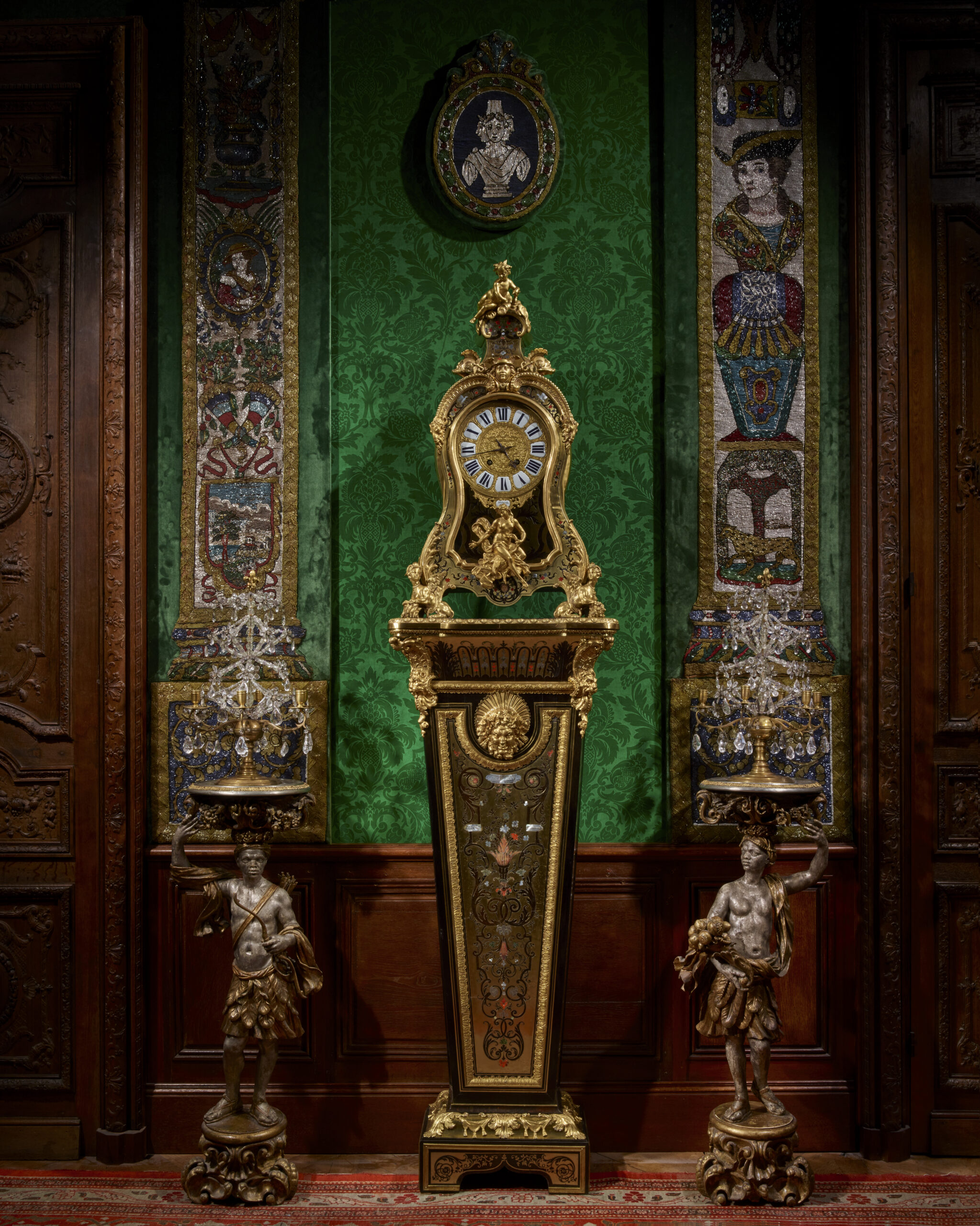
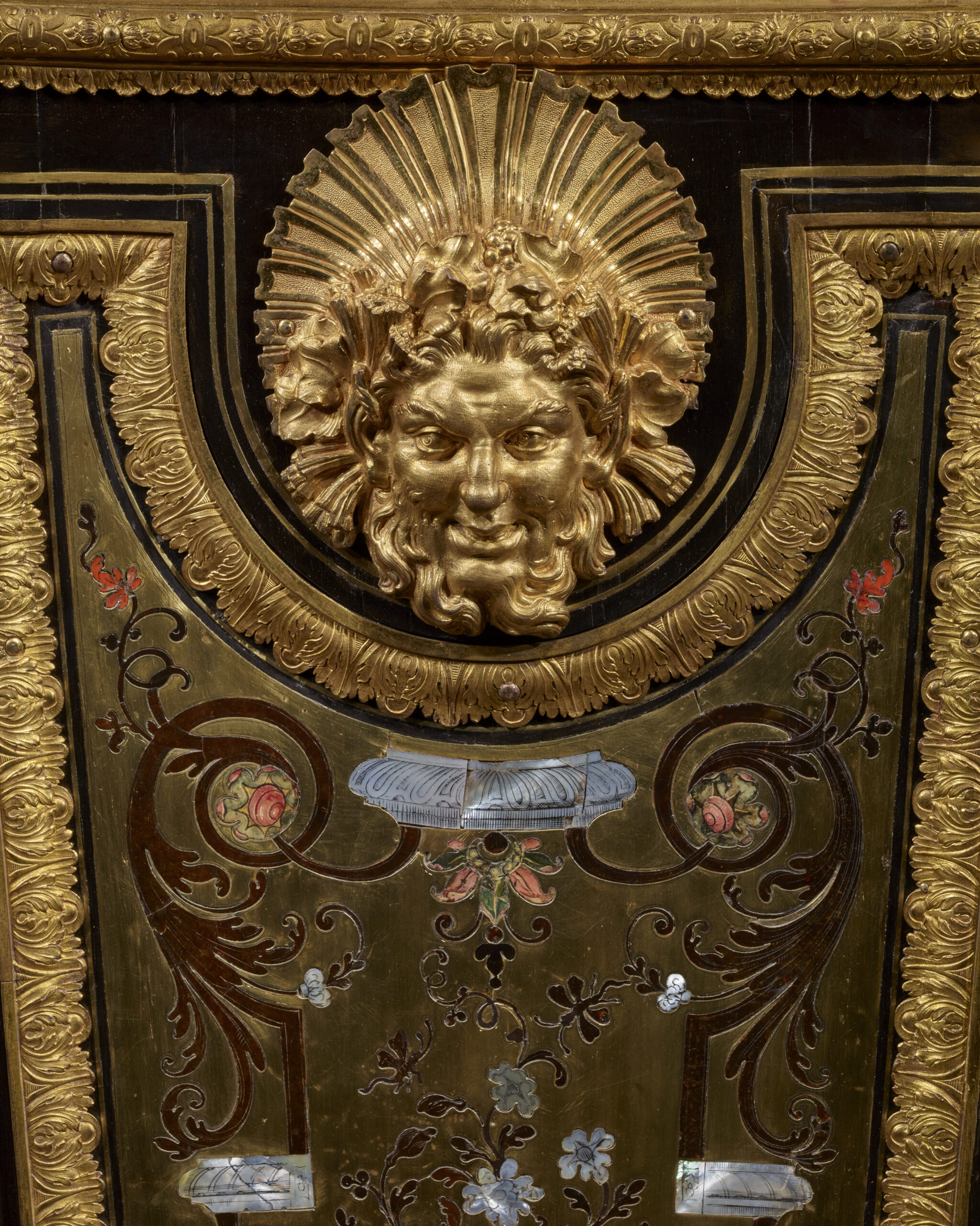
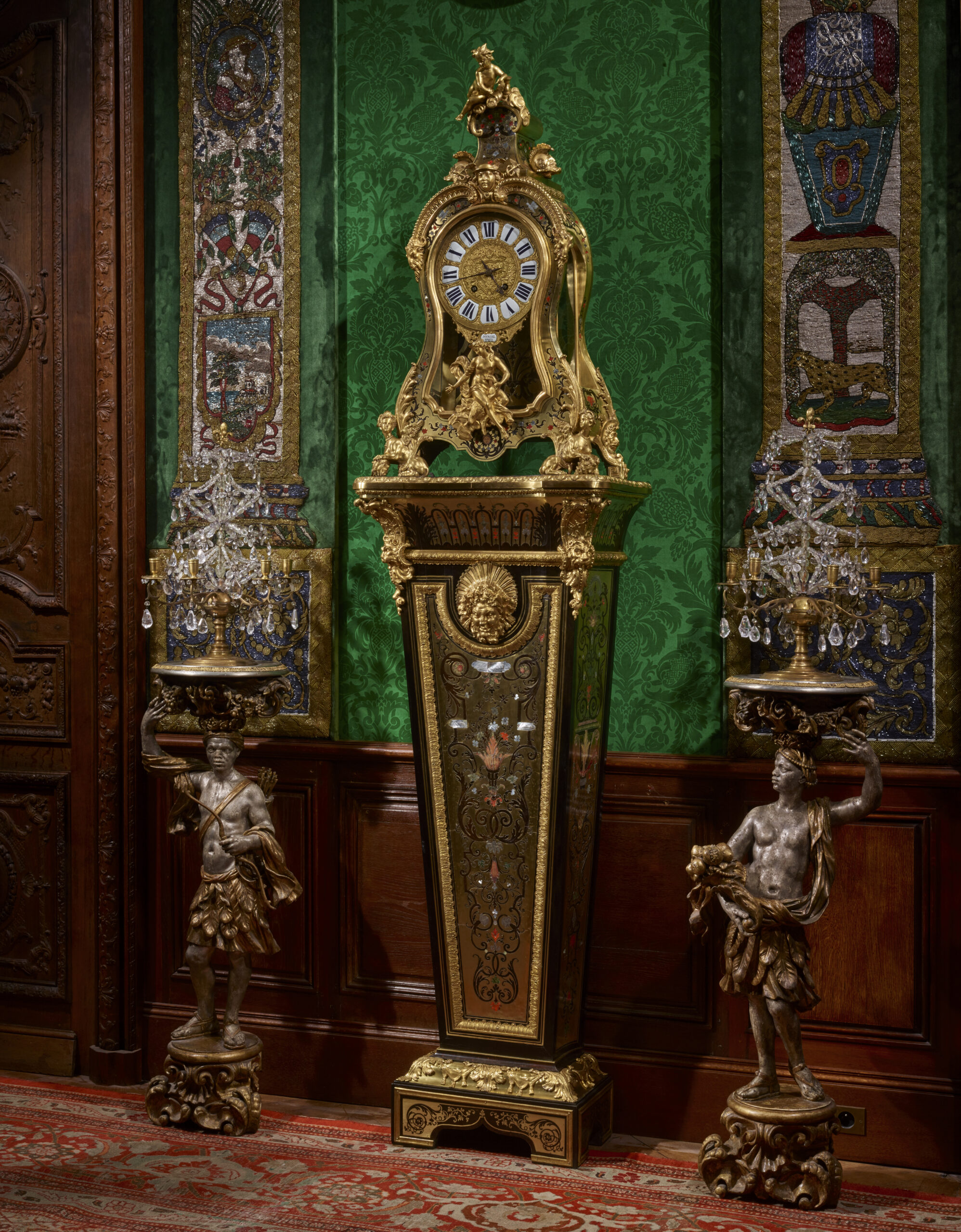
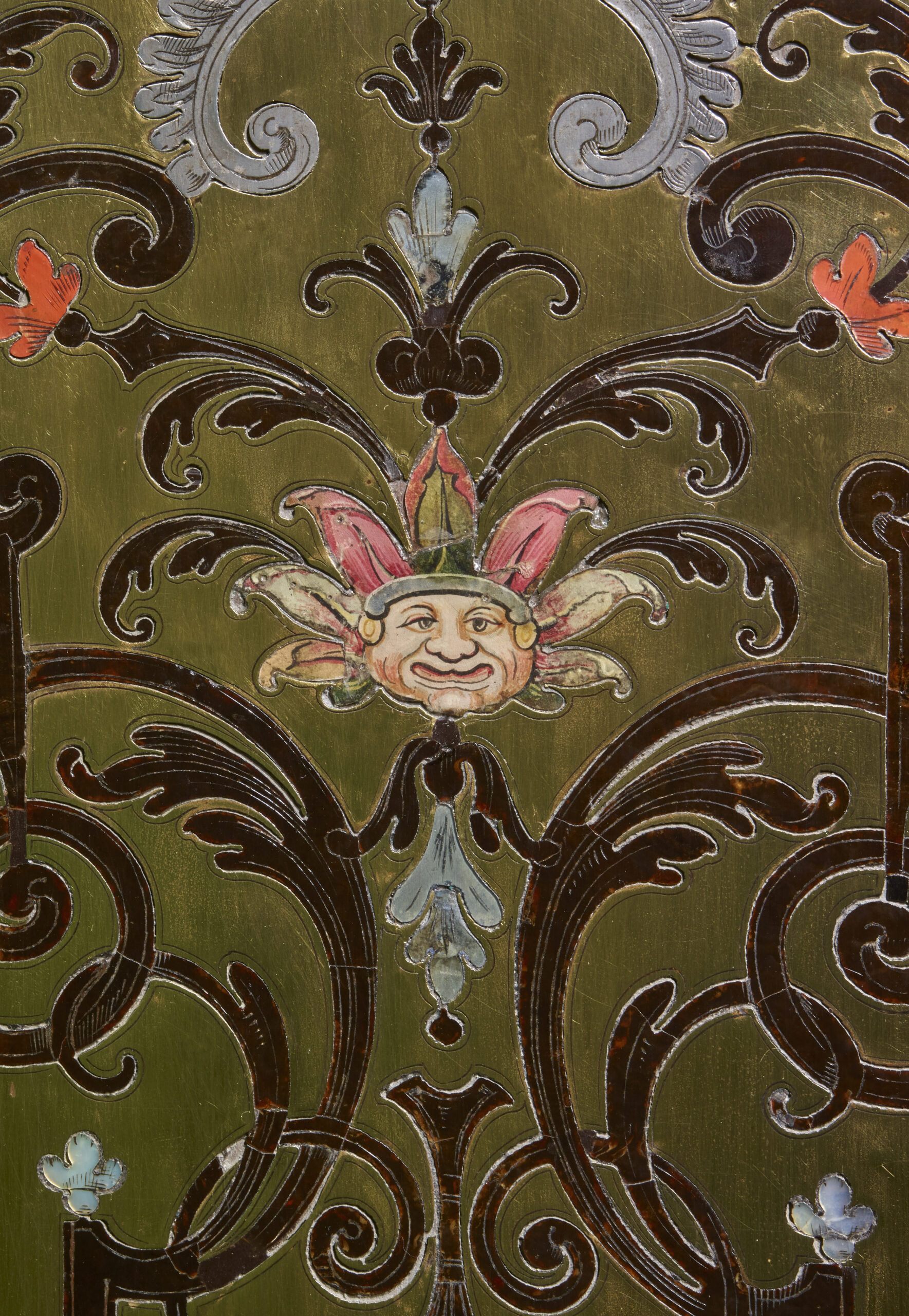
Contrepartie marquetry in brown tortoiseshell, mother-of-pearl, pewter, brass and very finely painted polychrome paper, predominantly red, blue and green, fixed under horn; frames veneered with ebony; gilt bronze; enamel; metal.
Total H.: 258 cm. (8 ft 5 ½ in.).
CLOCK: H. 100.5 cm. (39 ½ in.); W. 55 cm. (21 ¾ in.); D. 23 cm. (9 in.).
PEDESTAL: H. 157.5 cm. (62 in.); W. 61 cm. (24 in.); D. 34 cm. (13 ½ in.).
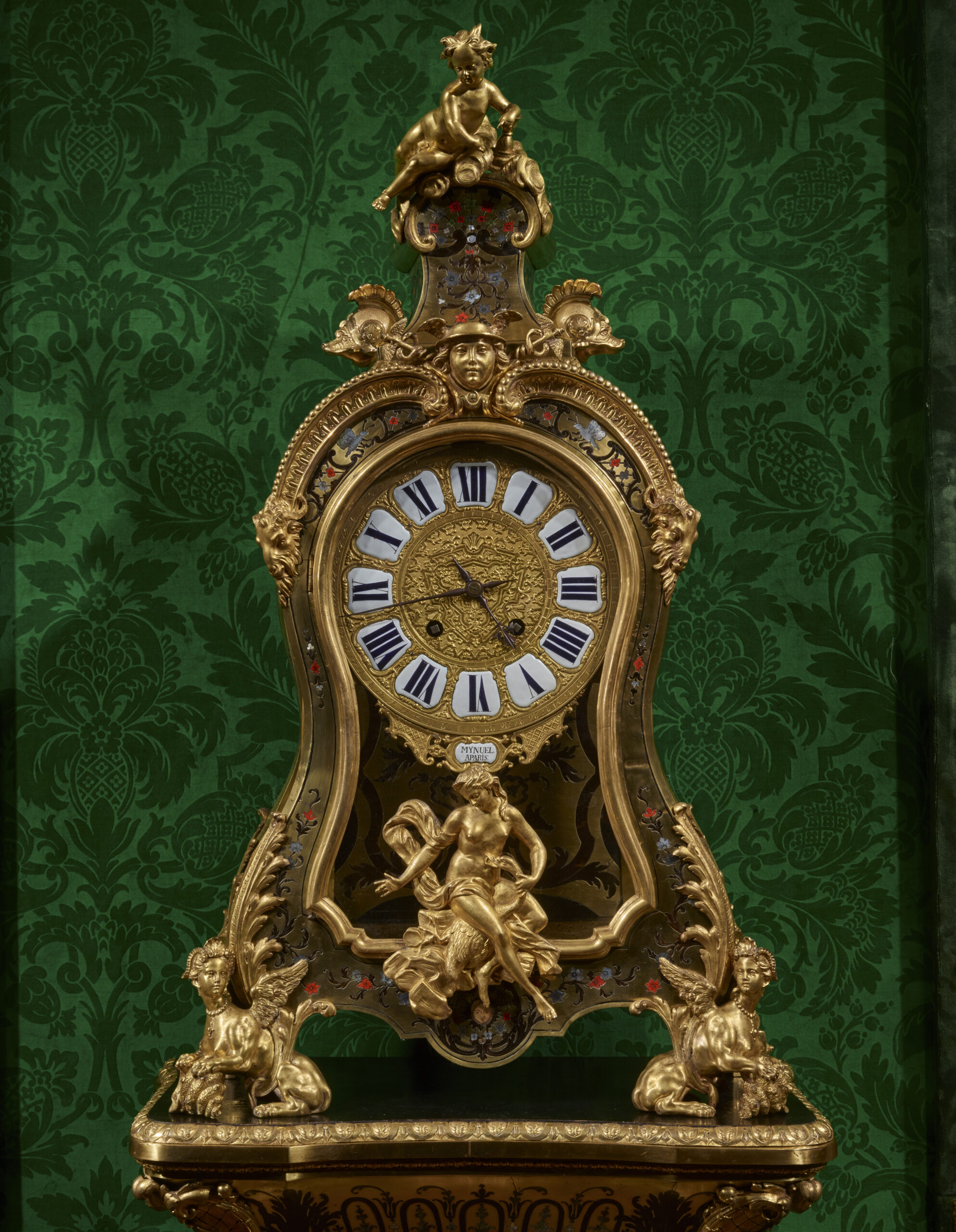
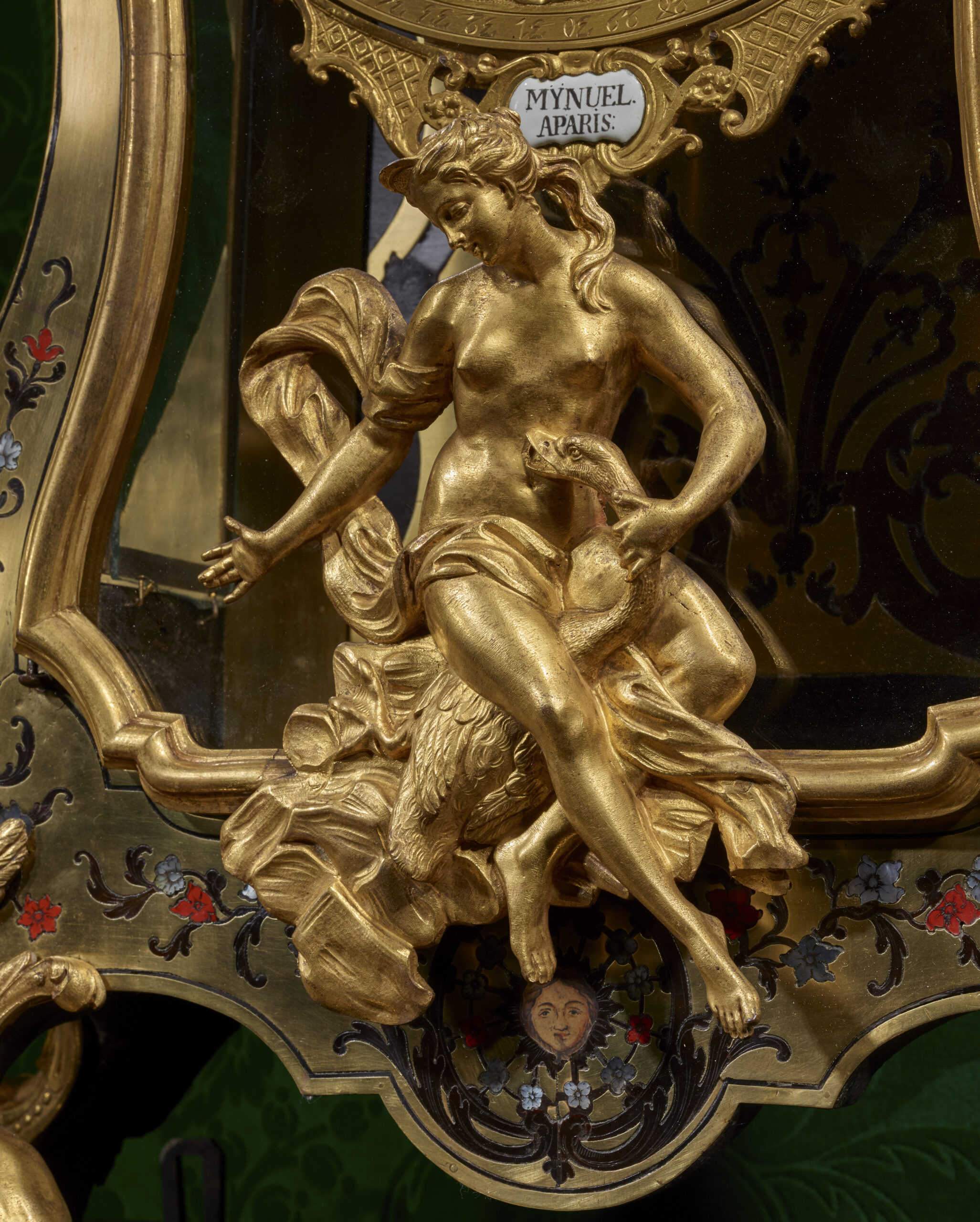
SIGNATURE: MYNUEL A PARIS,, visible on an enamelled cartouche inserted under the dial, and engraved on the reverse side of the movement.
PROVENANCE: Collection of the Borghese princes in the Red Room of the Grand Apartment on the first floor of the Palazzo Borghese in Rome until 1892; collection of His Excellency Prince Paolo Borghese (1845-1920), 9th Prince of Sulmona, his auction in situ in Rome: Catalogue des Objets d’Art et d’Ameublement qui garnissent le Grand Appartement au premier étage du Palais du Prince Borghese à Rome, under the supervision of Messrs. Giacomini & Capobianchi, 28th March to 9th April 1892, lot n°. 366, repr.; collection of Giuseppe Volpi (1877-1947), Count of Misurata, Governor of Tripolitania (1922), Minister of Finance and Treasury of the Kingdom of Italy (1925), President of Confindustria (1934), and founder of the Mostra (1932), in the Palazzo Volpi, Sestiere di S. Marco, 3944, on the Grand Canal, Venice.
COMPARATIVE LITERATURE: André Boutemy, “Une pendule au Metropolitan Museum”, B.S.H.A.F. (1971), 1972, p. 103-104; Jean-Dominique Augarde, “Charles Cressent et Jacques Confesseur”, L’Estampille, n°. 195, Septembre 1986, p. 54; Jean-Dominique Augarde, Les ouvriers du temps. La pendule à Paris de Louis XIV à Napoléon Ier, Geneva, Antiquorum, 1996, p. 34, fig. 18; Alexandre Pradère, Charles Cressent, sculpteur, ébéniste du Régent, Dijon, 2003, p. 189, 191 et 300, cat. n°. 237; Calin Demetrescu, Les ébéniste de la Couronne sous le règne de Louis XIV, Lausanne, 2021, p. 369-370.


The model of this “Leda” clock was designed by Charles Cressent around 1720. There are only three such clocks listed to date, of which only one is placed on a pedestal, i.e. the one in the collection of the Borghese princes presented here, all three with dials and movements signed Mynuel in Paris, to which a fourth has to be added, with a movement signed Guiot in Paris, having lost its figure of Leda, which was later replaced by a winged rocaille cartouche with motifs of shells and horns of plenty.As regards the other two clocks mentioned above, one was part of the collection of Baron Maurice de Rothschild at the Château of Prégny in Switzerland, and was sold in Paris as part of the collection of “Madame X” at the Galerie Charpentier on 6th April 1957, lot n°. 6. It was acquired by the antique dealer Marcel Bissey in Paris, who sold it in 1961 to the Metropolitan Museum of Art, New York, thanks to the Fletcher Fund (inv. 61.69). The second, which is placed on a bracket, appeared on the Paris art market some years ago and was mentioned by Calin Demetrescu. With the exception of the marquetry visible inside the casing, which may have been changed, the latter displays a marquetry decor corresponding exactly to ours but executed in première partie brass and tortoiseshell.
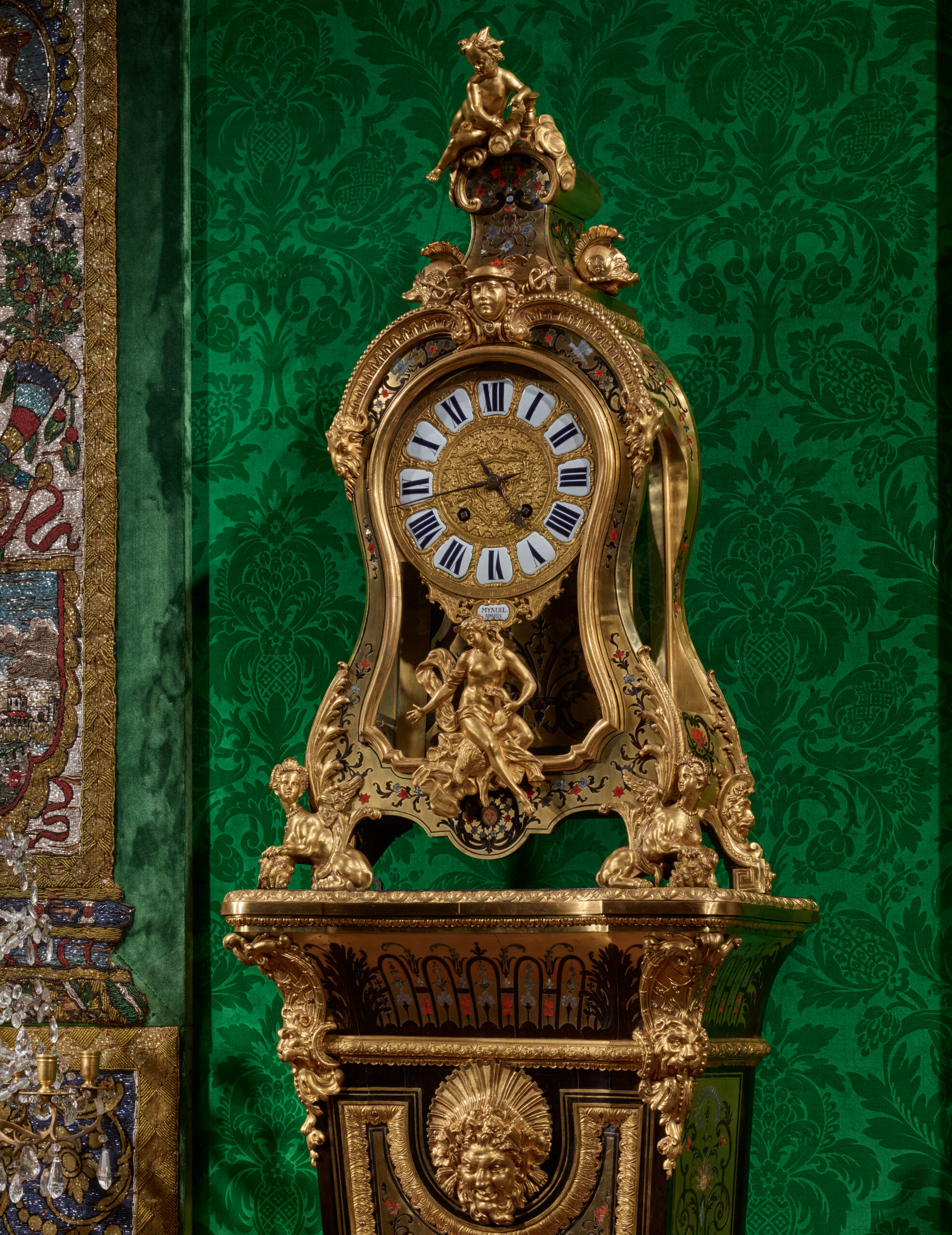
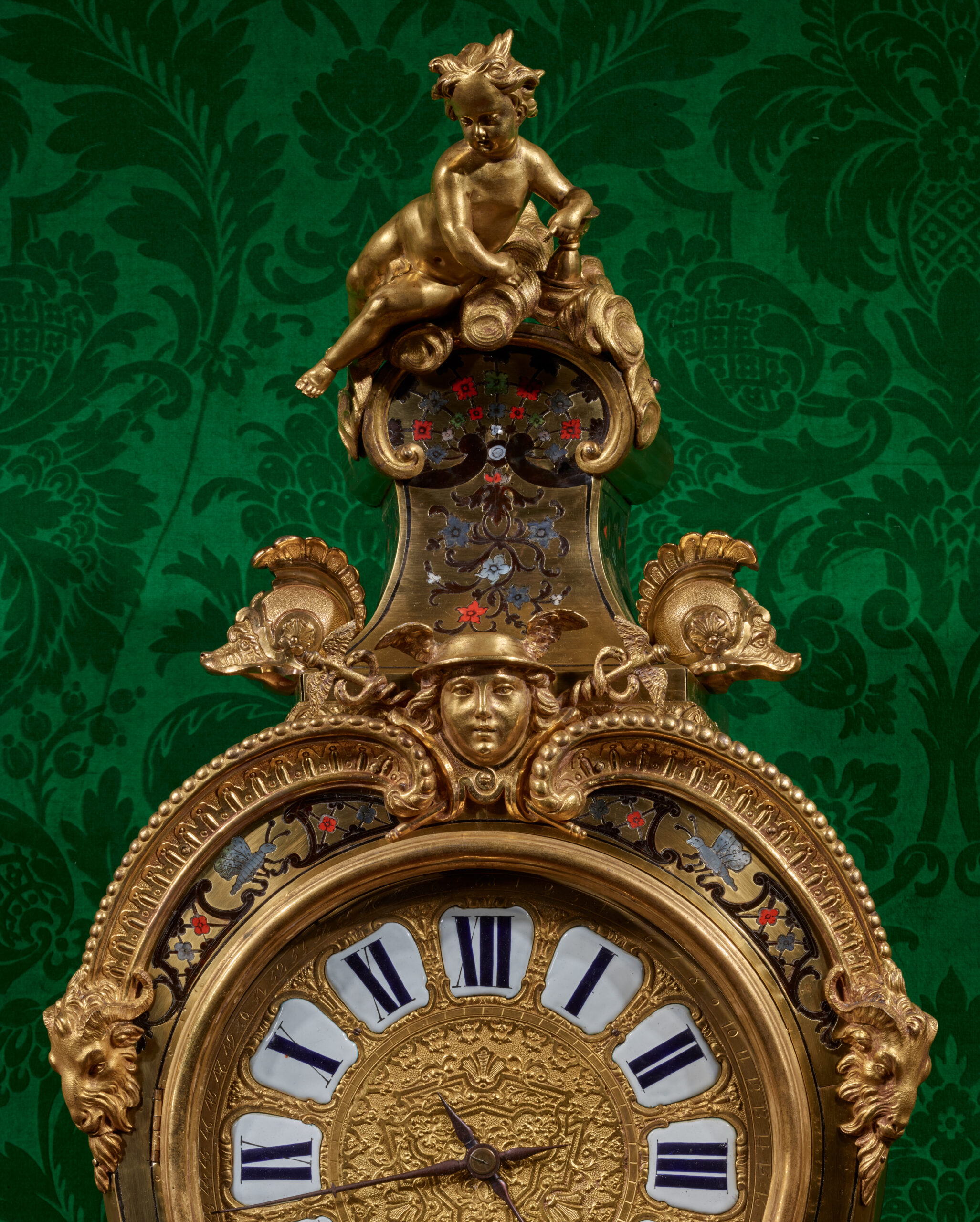
The extremely elaborate casing of these clocks displays a violin-shaped form with a glass front door, girdled by an impressive bronze moulded border, on the base of which rests, also in bronze, an imposing figure of Leda, daughter of Thestios, King of Aetolia, and wife of Tyndare, King of Sparta, abducted through the clouds by Jupiter metamorphosed into a swan. Above the group, a finely chiselled copper dial with a set of motifs of bands, palmettes and fleurons, is surrounded by twelve enamel cabochons indicating the hours in Roman numerals; an additional enamel cartouche, visible below the dial, bears the signature Mynuel à Paris.
A mask of Mercury, wearing a winged helmet and flanked by caducei, towers over the dial, which is framed by two powerful bronze scrolls with a frieze of flutes and gadroons, placed on the shoulders of the casing, each ending in a goat’s head positioned halfway up the dial. A narrow pedestal crowns the clock, with a concave face and upper part with a curved overhang, flanked on either side by two helmets with “antique” crests, punctuated by the figure of a naked child holding an hourglass and lying on clouds, symbolising The Passing of Time.
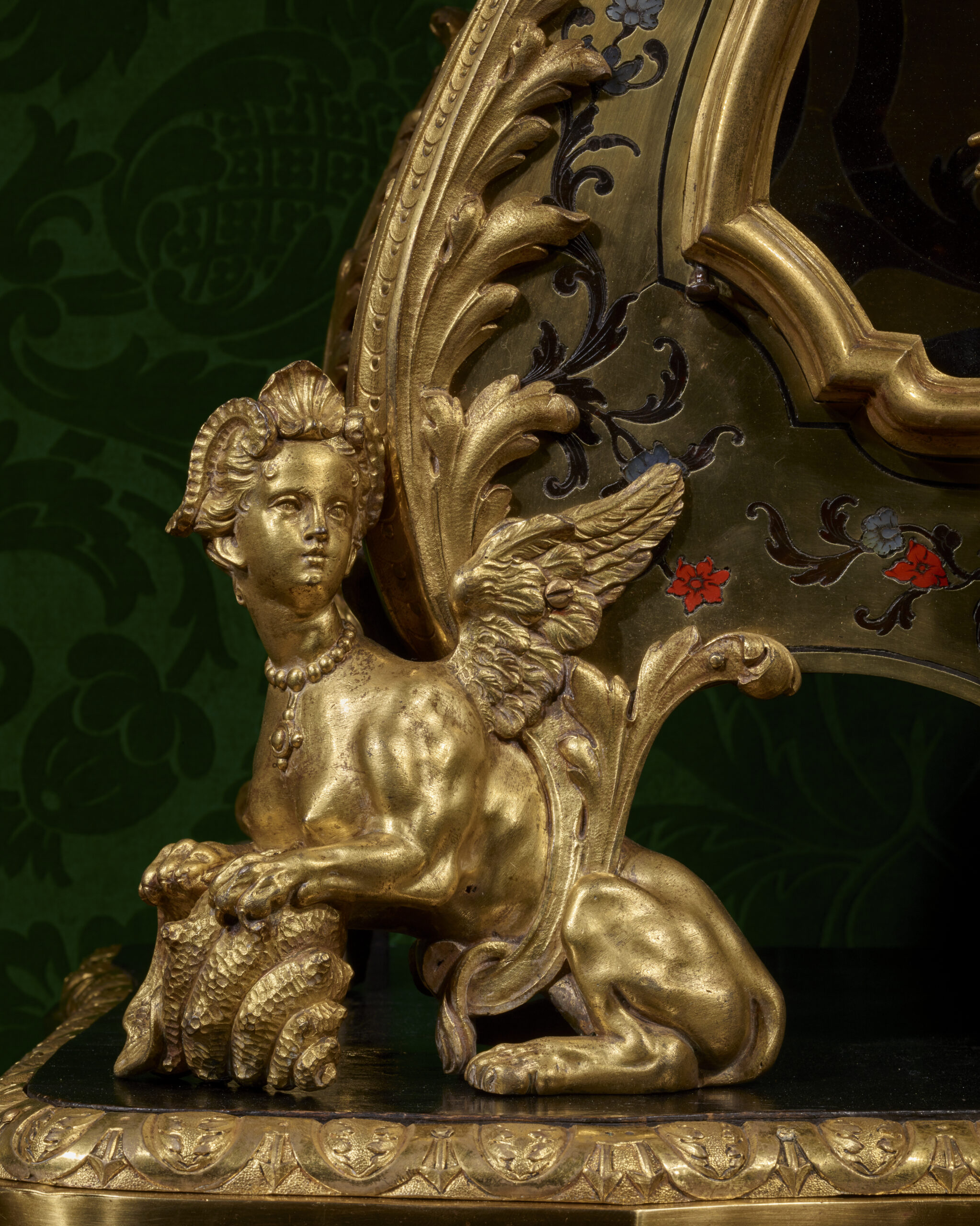
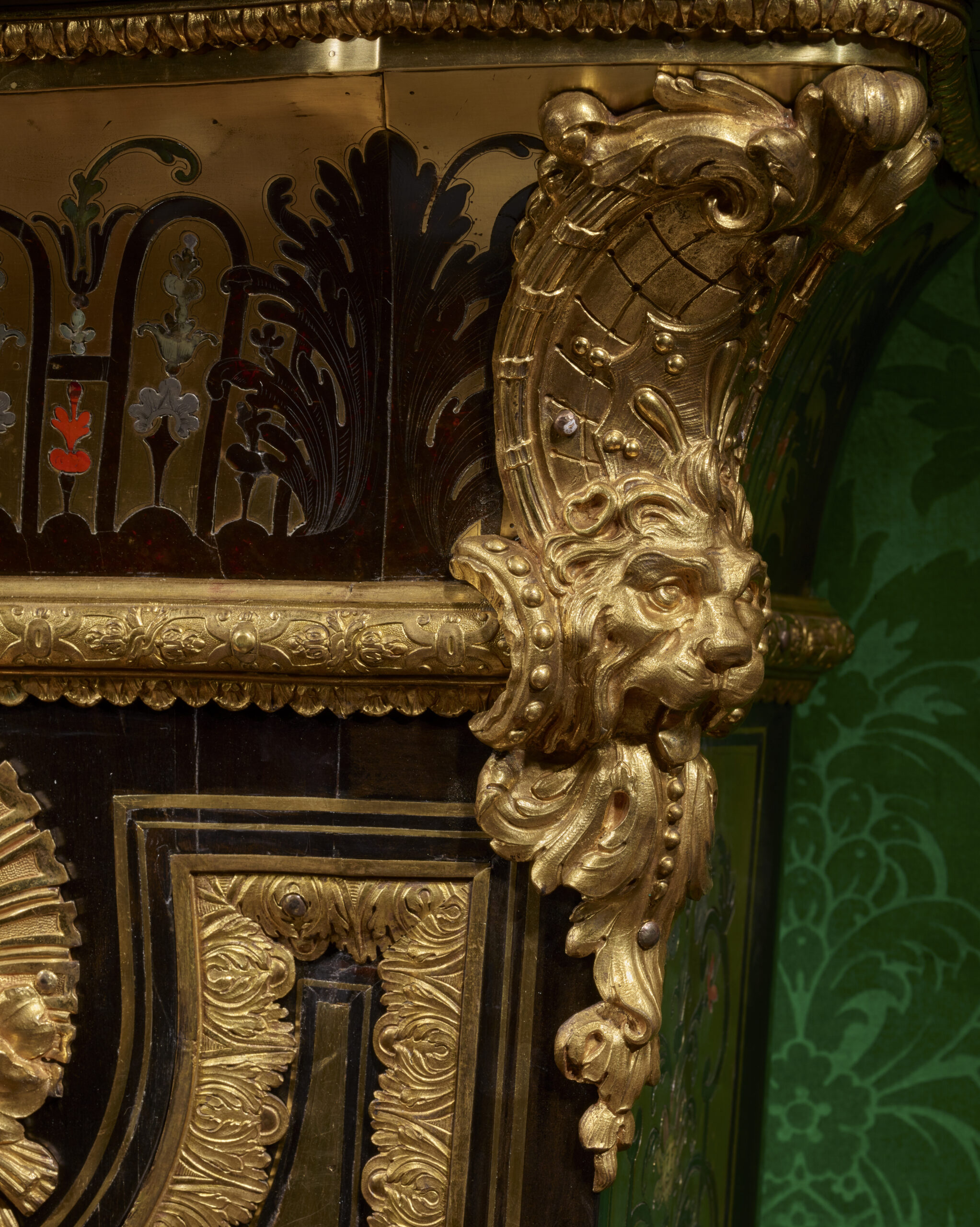
The clock, whose short sides display oblong glazed compartments surmounted by a small bronze trophy with the attributes of Love, rests on an opulent gilt-bronze base with front feet composed of two winged sphinxes each resting on a shell, and back feet formed by a lion’s mask emerging from volutes—inspired by models designed by François Antoine Vassé (1681-1736) circa 1712—and resting on a Greek key shaped die. Each of these feet is surmounted by a wide acanthus scroll with a piaster pendant that “embraces” the curves of the lower part of the casing.

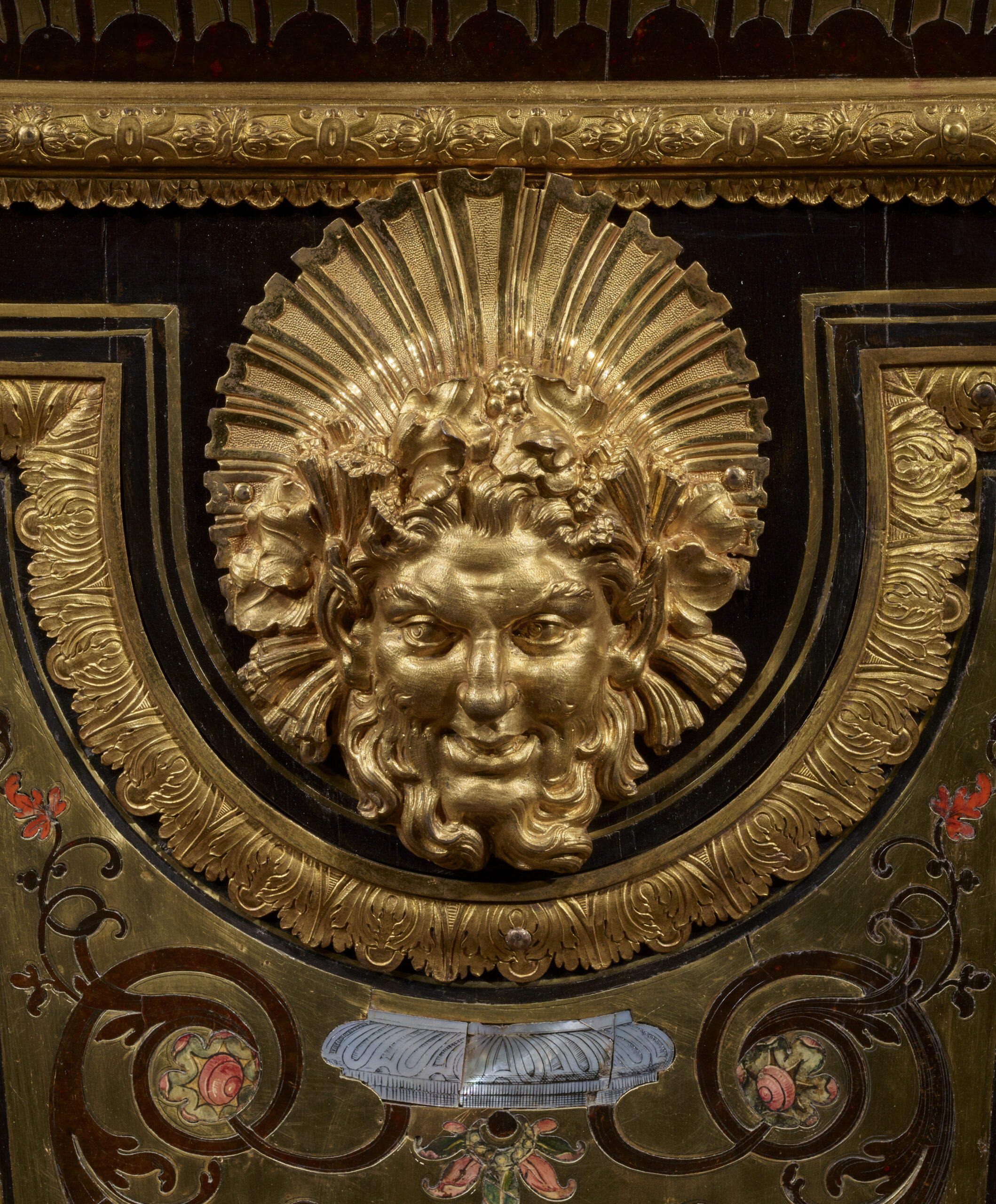
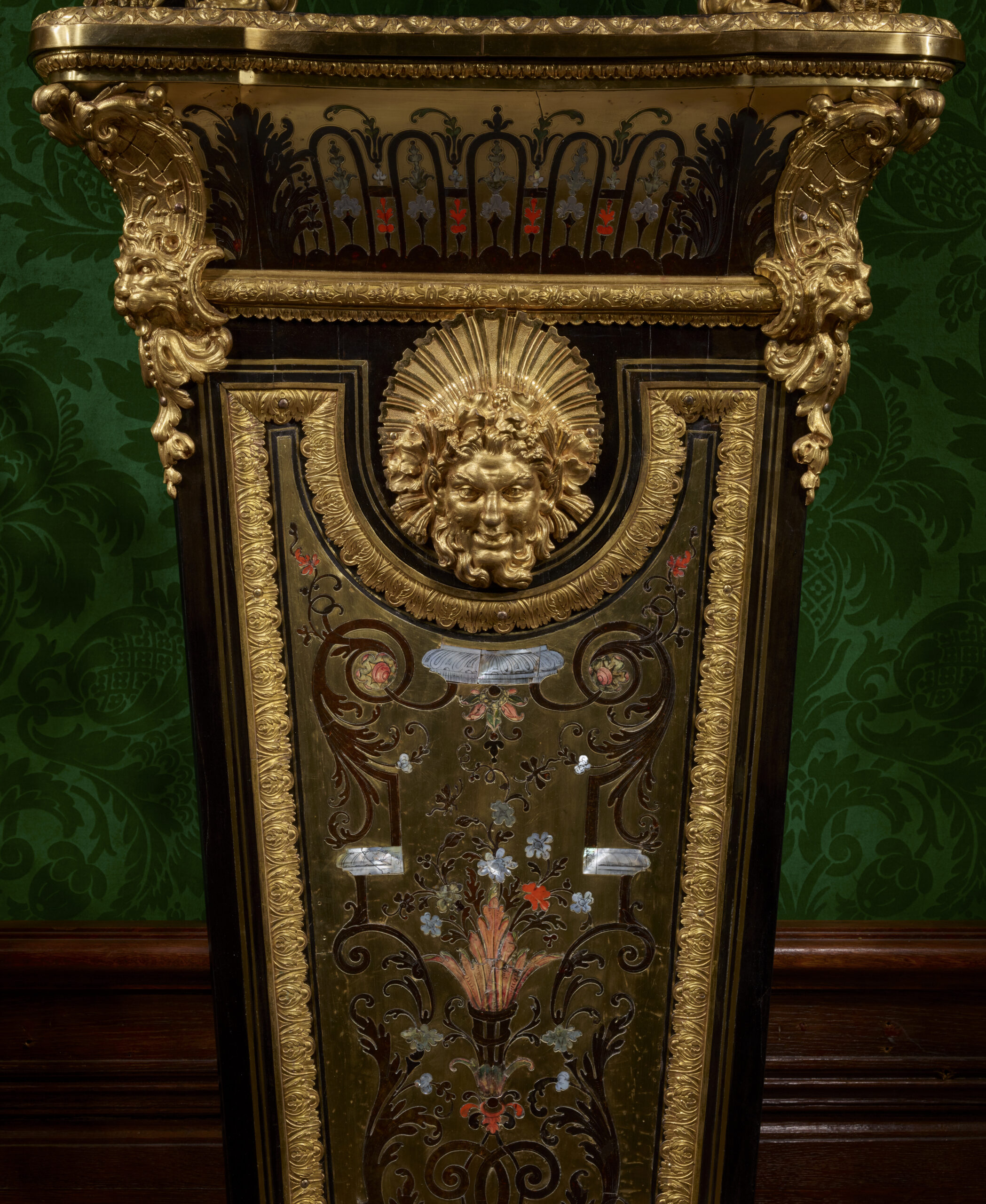
Whereas the clock in the Metropolitan Museum of Art and the one mentioned by Calin Demetrescu both display a première partie décor of copper marquetry against a brown tortoiseshell background, with the whole set in frames veneered in ebony, the contre-partie décor of the clock of the Borghese princes seems by contrast much more lavish, enhanced by inlays of mother-of-pearl notably displaying butterflies, pewter and very finely painted polychrome paper, predominantly red, blue and green, fixed under horn.


This décor can also be seen on the flared pedestal of the clock, the shape of which is reminiscent of that depicted in a very rare drawing in black ink and wash on paper, executed to size, dated circa 1710-1715 and attributed to Alexandre-Jean Oppenordt (1639-1715), which was almost certainly executed for Frederick-Augustus I of Saxony (1670-1733), known as “Augustus the Strong”, Prince-Elector of Saxony and King of Poland, and is kept in the Kupferstichkabinett in Dresden (inv. C 6724). This pedestal, like the clock it supports, boasts a lavish bronze decoration, which includes a mask of a smiling faun or satyr, crowned with a stylised palmette with fluted motifs, typical of the models by André-Charles Boulle—It can be found in the centre of the short sides of several of the master’s flat desks, such as the one commissioned in 1715 by Louis IV Henri de Bourbon-Condé (1692-1740), 7th Prince of Condé, for his Château of Chantilly, now kept at the Château of Versailles (in. VMB 960). The pendants with lion masks surmounted by a mosaicked cartouche flanked by ribboned fascicles and enhanced by a gadrooned “bat’s wing” palmette are exactly the same as those adorning the pedestal of the “Apollo chariot clock”, also executed before 1715 for the Princes of Condé at the Château of Chantilly, which was for many years attributed to Boulle and his sons but has since been reattributed by Calin Demetrescu to Alexandre-Jean Oppenordt. This extraordinary clock, with a movement signed as here Mynuel in Paris, now belongs to the collections of the Château of Fontainebleau (inv. F 829c). The use of these bronzes, which are characteristic of the work of Boulle and his sons, seems to attest to a collaboration between their workshop and that of Cressent. And although the model of the pendants on our pedestal may be attributed to Oppenordt, who died in 1715, it is quite possible that it continued to be used by Boulle fils, then by Cressent, since the collaboration between André-Charles Boulle and Alexandre-Jean Openordt was, to borrow the term used by Calin Demetrescu, undeniable.

All the bronzes on our clock, however, belong to Cressent’s own models. They were described in 1723 as part of an expert’s report on items seized from Cressent as a result of a lawsuit that pitted him against the bronze founders’ guild, a lawsuit that would continue until 1724: “Plus two figures in the same manner, representing Leda, which are to be placed under dials, which figures are repaired […]. Plus another figure of a woman, emerging from the cast, representing Leda […]. Plus two heads of Mercury emerging from the cast, equally imperfect […]. Plus two sphinxes resting on a shell of rocailles, adorned with their wings and scrolls of fine gold leaves, which sphinxes are finished and chiselled, one of the aforesaid sphinxes being a model […].” At Cressent’s request, and in the course of the same case, a number of statements from bronziers working for him attested to the fact that the disputed bronzes seized from his premises had in fact been executed by master foundrymen, as specified in the corporate regulations of the time. Among the latter, a young master foundryman aged twenty-three and a half, Guillaume Lombard (c. 1700–after 1751) stated that “he repaired and chiselled for the said Cressent […] four pendulum trimmings with Leda and the feet carried by two sphinxes […]”. This valuable information undoubtedly attests that the clocks of our model were indeed assembled by Cressent in his workshop around 1720-1723; but as he never actually used Boulle marquetry in his work, other than for a few of his clocks, Calin Demetrescu has put forward the hypothesis that the casings for these clocks, as well as their associated consoles and pedestals with this type of decoration, were actually executed before May 1719 in the workshop of Joseph Poitou (c. 1680-1719). Poitou, who practised copper and tortoiseshell marquetry, had become Cressent’s main collaborator in cabinetmaking during that period. The two men had grown particularly close to each other, to the extent that Cressent, on the death of his loyal collaborator, became the guardian of his only child, Marguerite-Joseph Poitou, who was then a minor, and in September of the same year married his widow, Claude Poitou, née Chevanne.


Ill. 8: Commode with two rows of drawers attributed to Joseph Poitou, Paris, before 1719, with an inlaid décor on its short sides identical but in première partie to that adorning the inside of the back panel of our clock. Auction in Paris, Drouot, Rive-Gauche, under the supervision of Mr. Oger, 26th November 1979, lot n°. 64; then Hubert de Givenchy collection, Christie’s auction in Monaco, 4th December 1993, lot n°. 78; and Christie’s auction in Paris, Hubert de Givenchy – Collectionneur: Chefs-d’œuvre, 14th June 2022, lot n°. 37. Reproduced in Calin Demetrescu, Les ébénistes de la Couronne sous le règne de Louis XIV, Lausanne, 2021, p. 372, fig. 374.


This hypothesis is fully confirmed by the inlaid contre-partie panel adorning the inside of the rear panel of our clock, with borders in the shape of a set of poly-lobed bands, punctuated by a haloed Bacchiac mask and terminating at the level of the lower scrolls with striking wolf’s or dog’s heads, between which rise two leafy branches au naturel flanking a pendant of fleurons. The panel corresponds exactly to those executed in première partie marquetry which adorn the short sides of a commode with two rows of drawers unanimously attributed to Joseph Poitou from the Hubert de Givenchy collection (1927-2018). A variant of this commode model, but veneered in amaranth, is kept in New York at the Metropolitan Museum of Art, and was sold to the museum in 1925 by Seligmann, Rey & Co (inv. 25.160). The inlaid decoration with a brass background, including inlays of mother-of-pearl, pewter and polychrome horn on our clock and its pedastal, is to date the only known example of this type of polychrome “contrepartie” decoration in Joseph Poitou’s production.


All the clocks of our model—except for the fourth one mentioned above, sold by Sotheby’s London on 6th July 1984, lot n°. 11—were fitted with movements by Louis Mynuel, who was undoubtedly one of the most prominent watchmakers of the early 18th century and particularly renowned for the excellence of his movements.
Mynuel worked for a highly prestigious clientele, which included the Princes of Condé, Clément-Auguste of Bavaria, Archbishop-Elector of Cologne, Stanislas Leszczinski, King of Poland, the Dukes of Mortemart, Luynes and Villars, the Cardinal de Gesvres, the Count of Hoym, Minister to Augustus II of Saxony, Messrs. Titon de Coigny and Moreau de Verneuil, not to mention the courts of Parma and Sweden. The son of Jacques, a marchand orfèvre, and Jacquette Du Ventre, Mynuel worked on several occasions with Cressent, but also with Boulle and his sons, Bernard I Van Risamburgh, the Sieur Barbier, Louis Chéron, Paul Consenne, Jean Hahn, known as Le Coq, P. Cagnet, François Goyer, and Jean-Joseph de Saint-Germain. Born in Dieppe around 1675-1680, he was a journeyman watchmaker when he arrived in Paris. Established on rue de Harlay, he married Marie-Madeleine Martin, the daughter of a barber and wigmaker, on 10th February 1705, and on 19th May of the same year was granted the title of Marchand-horloger Privilégié du Roi suivant la Cour (Privileged Merchant Clockmaker to the King’s Court), a position he held until his death on 23rd May 1742, when his widow took over the workshop until 1747.
“A large Clock in boule marquetry, with its pedestal likewise, the bronzes of which are gilded with ormolu. It is about seven feet high, & was made by Minuel, Clockmaker in Paris”, whose description might correspond to ours, except for its smaller height—seven feet corresponding to 227.36 cm.—It was sold at auction in Paris on 10th December 1764, at the hôtel d’Aligre, rue Saint-Honoré. It was acquired at the auction by the art dealer Neveu for the substantial sum of 3060 livres, which gives us a concrete illustration of the considerable value, at the very least, of such a clock and its pedestal at the end of the reign of Louis XV.

Paolo Borghese, 9th Prince of Sulmona
Paolo Borghese was born in Rome on 13th September 1845, the son of Marcantonio V Borghese (1814-1886), 8th Prince of Sulmona, and his second wife, Duchess Thérèse of La Rochefoucauld (1823-1894). On his father’s death in 1886, he succeeded him in his titles and the administration of the family estate. On 2nd December 1866, in Oponice, Hungary, he married Countess Ilona Apponyi of Nagy-Appony (1848-1914), daughter of the Austrian diplomat Rudolf Apponyi of Nagy-Appony and his wife, Countess Anna von Beckendorff.
When it came to his personal affairs, he was less fortunate. As a result of his involvement in property speculation in Rome at the end of the 19th century, along with his brother-in-law Prince Rodolfo Boncompagni Ludovisi, he was forced to sell off a large part of the assets that made up the family fortune.

The Palazzo Borghese in Rome was sold, and his collections were dispersed at auction. A first anonymous sale of works of art and furnishings took place in Paris, at the Galerie Georges Petit, under the supervision of Mr. Paul Chevallier, from 2nd to 3rd July 1891. A second auction took place in Rome on the following year, from 28th March to 9th April, dispersing the furniture and objets d’art, including our clock and its pedestal, which furnished the large appartment on the first floor of the Palazzo Borghese (ill. 12, 13&15).


This was followed, from 16th May to 7th June of the same year, by the sale of the Prince’s library. Several further sales took place in 1893 and 1894, thus completing the dispersal of what had been one of the most important private collections in Italy. The Villa Borghese, including the splendid park, was purchased by the Italian state in 1901, along with the very important family art collections already present in the palace, which had been transferred to the Villa to form the Borghese Gallery.
The park was then transferred from the State to the Municipality of Rome in 1903. During the same period, the entire Borghese archives were acquired by Pope Leo XIII. After these dramatic events, Prince Paolo Borghese left his native city for Venice, where he died on 18th November 1920, aged seventy-five.