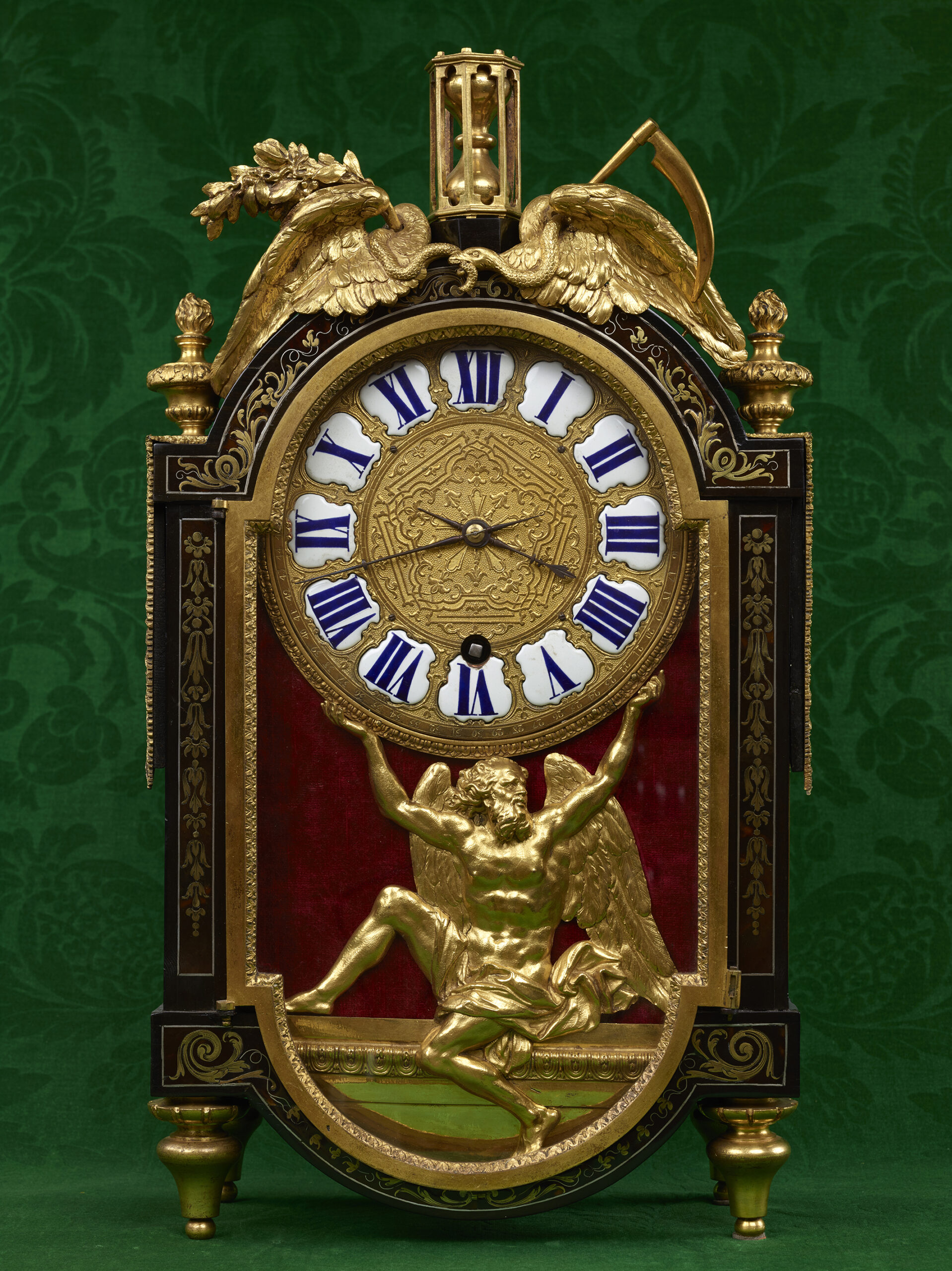
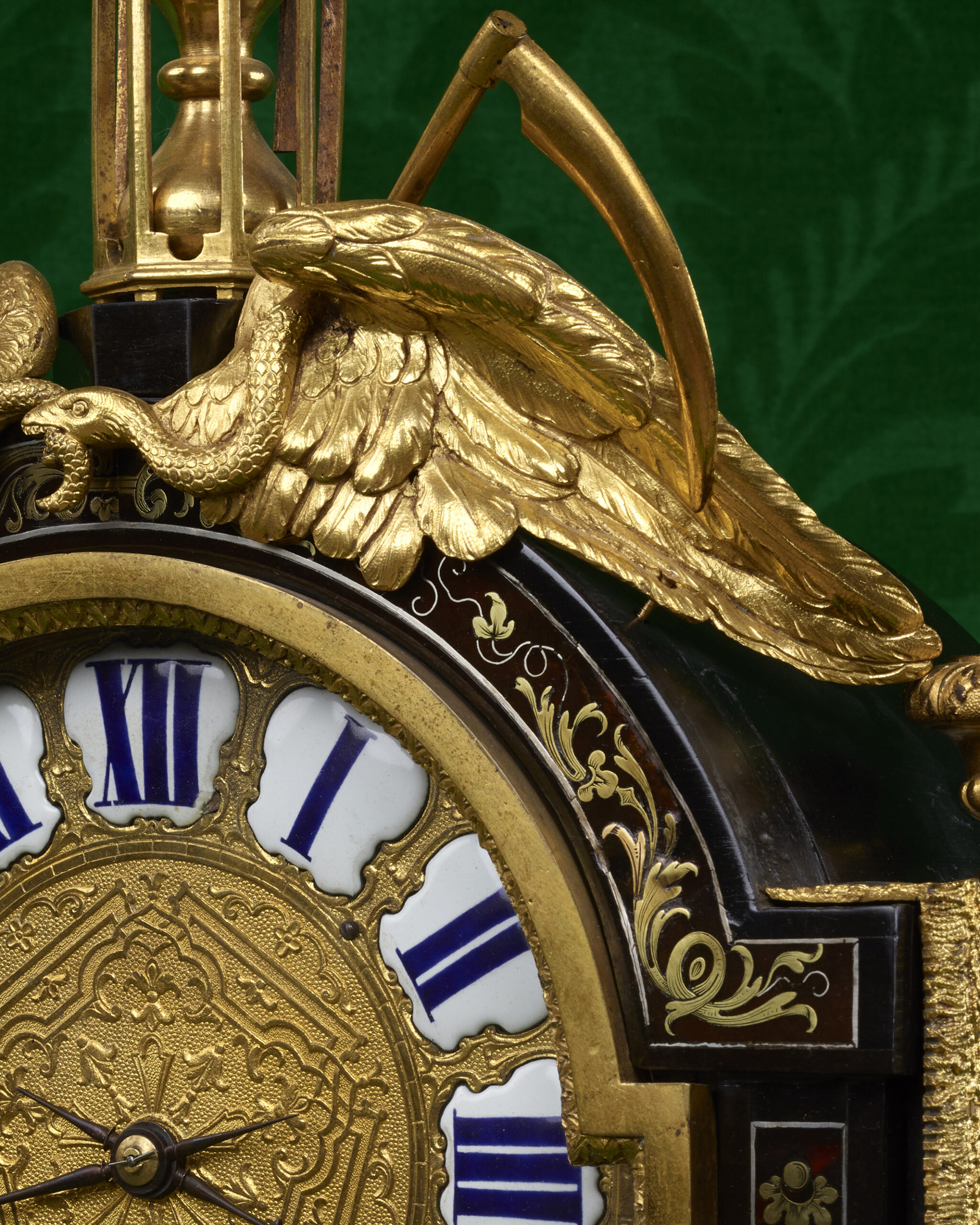
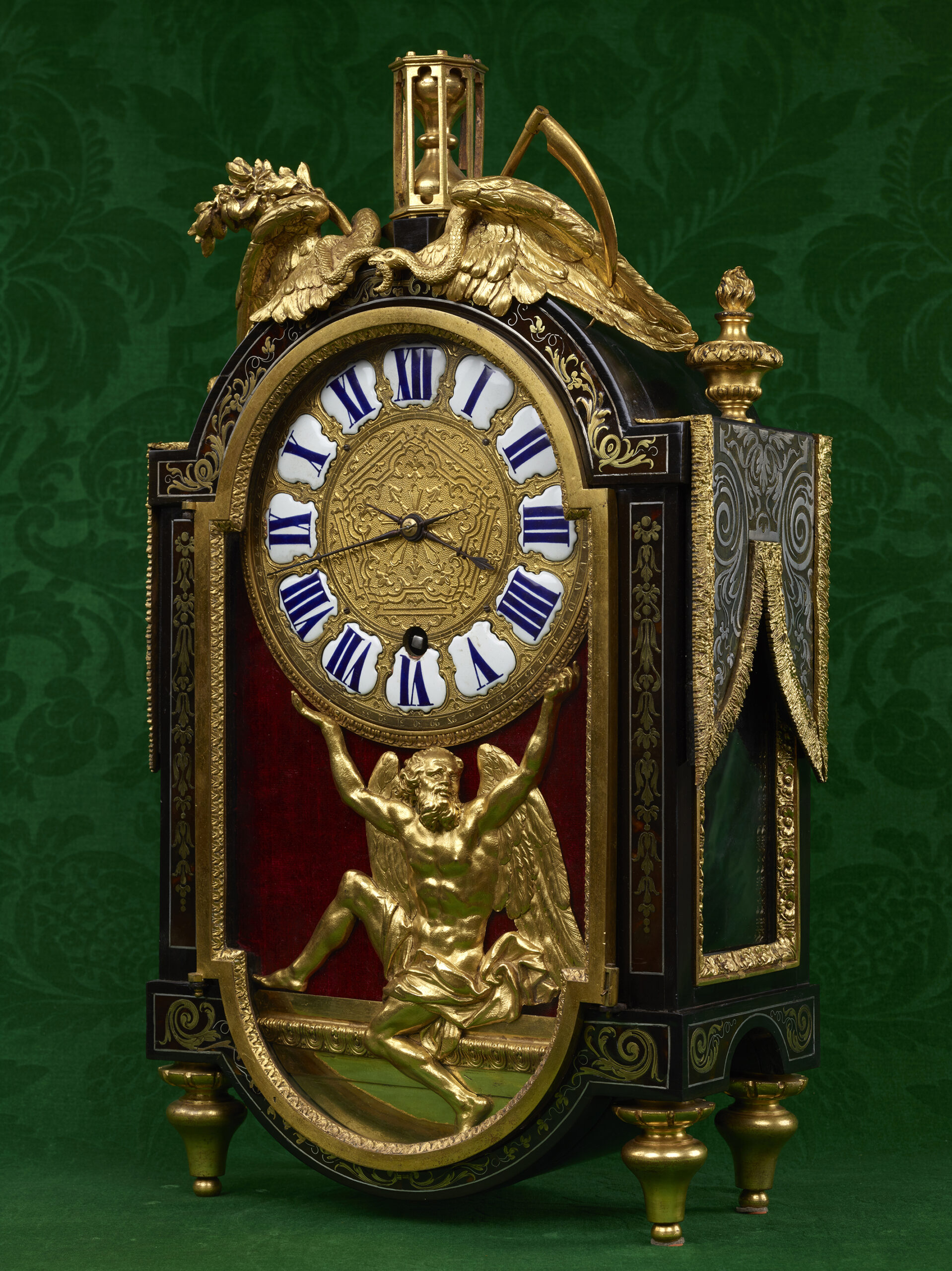
Ebony veneer ; première partie marquetry with brass and pewter on a tortoiseshell and ebony ground ; tinted blue horn ; gilded bronze ; enamel.
H. 52 cm. (20 ½ in.); W. 32 cm. (12 5/8 in.); D. 14 cm. (5 ½ in.).
PROVENANCE: private collection.

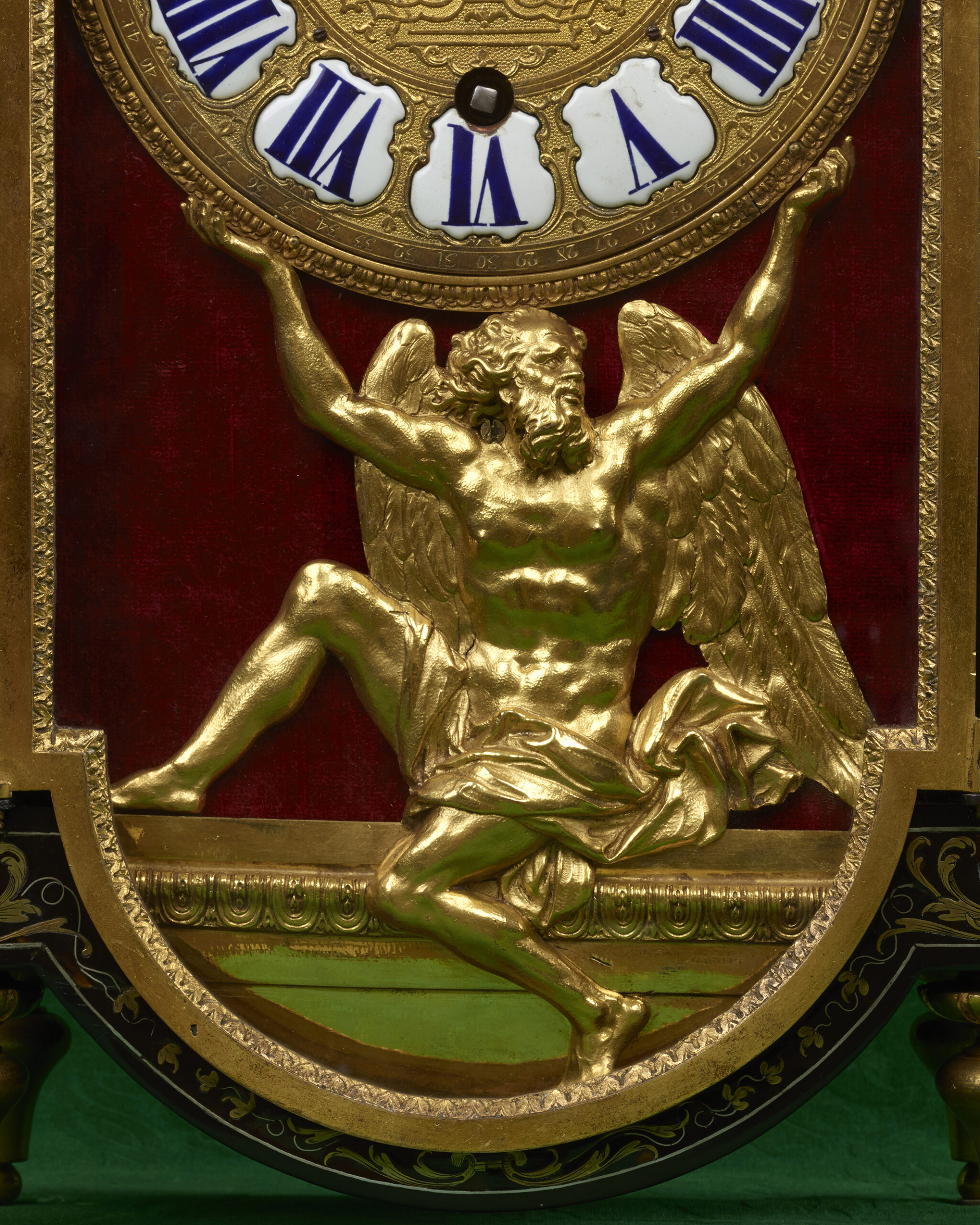
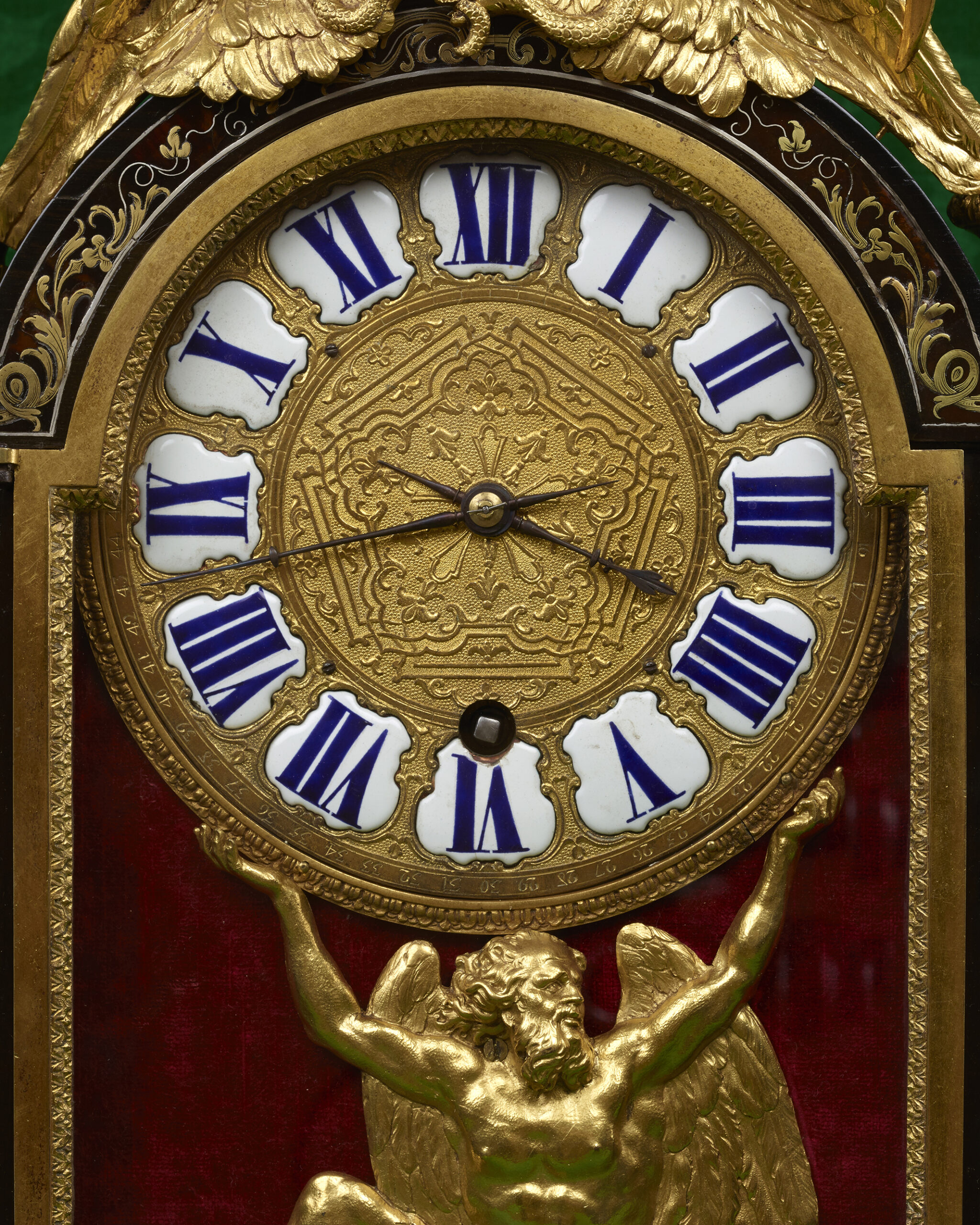
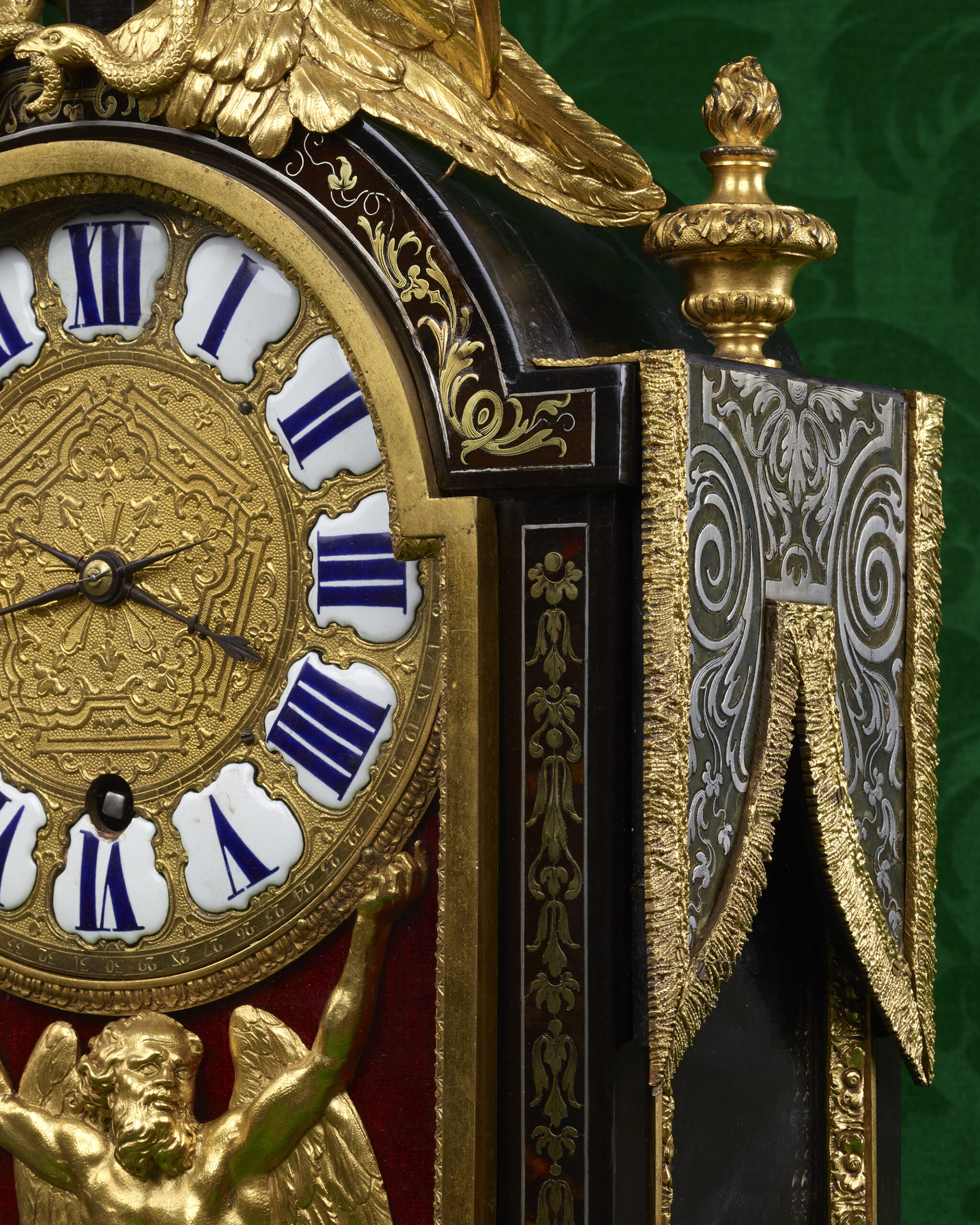
This rare model of Boulle marquetry quadrangular clock, enhanced with inlays of copper and gilded bronze, standing on four toupie feet and crowned with a gilded bronze hourglass, is the work of the renowned cabinetmaker André Charles Boulle (1642-1732). The whole piece is veneered with tortoiseshell tinted in black or dark red, enriched with thin lines of brass and bordered with gilt bronze rods adorned with interlacing friezes. The central part of the clock is equipped with a large enameled dial supported by the figure of a winged Chronos seating on the lower sleeper of the case. On each side, the clock is flanked by a tablier motif adorned with foliate scrolls topped with a burning cassolette and completed with simulated fringes. The pediment is adorned in its center by two chimeras, half-eagle, half-snake, facing each other, one holding the tail of the other in its mouth. Each chimera holds an attribute between its wings : one is holding a scythe – the symbolic attribute of Chronos used to cut the thread of life, the other is holding a laurel branch. Inside the case, the movement is signed by Pierre Fardoil, clockmaker of the Grand Conseil de Sa Majesté.

Several decorative items of our clock can be found on the Plate 2 of the book published by Boulle in collaboration with Pierre Mariette in 1707, entitled Nouveaux Deisseins de Meubles et Ouvrages de Bronze et de Marqueterie : the small hourglass at the top of the “Small Cabinet Clock”, the position of the legs of the sitting Chronos from the “Bronze figure on its pedestal” and the general shape of the “Clock meant for a bedroom” similar to ours. One can also notice the small hourglass crowning the Day and Night Clock, another clock by André-Charles Boulle, of which one example is reproduced below, adorned with a movement by Lepaute and coming from the collection of the Prince de Condé, now kept at the Hôtel de Soubise in Paris.

As for other large models of clocks by Boulle, l’Amour vainqueur du Temps, also known as the Temps couché after François Girardon, and the Day and Night after Michelangelo, the main theme of our clock is Time, a subject which was appreciated in the 17th century as proved by the numerous pictorial representations of Vanitas, an ancient allegorical subject which became a genre of its own around 1620, firstly in Leiden in Holland, then spreading to Europe, particularly in Flanders and France.


Detail of the top of a model known as “Day and Night clock” by André-Charles Boulle, the dial and the movement are here signed Gilbert /A Paris ; former collection of Etienne Perrinet de Jars (1670-1762).
Private collection.


Astronomical clock with several dials designed for the Grand Dauphin in 1710 by Pierre Fardoil, clockmaker in Paris. Besides the hours and the minutes, the clock shows the days, the date, the moon phases, and the length of the day and night. Under the dials, an allegory of the four seasons signed Antoine Coypel was casted by Jacques Caffieri, like the other gilded bronze decorations. Listed as Historical Monument on October 22d, 1909.
Collection of the Observatory Museum, Paris.

Pierre Fardoil (? – après 1725)
The Fardoil were a dynasty or renowned clockmakers. Pierre Fardoil was one of the sons of Pierre Fardoil the father, seigneur of Blois, deceased in 1669 and of his wife Françoise Bouillon. Pierre Fardoil the son became master clockmaker in 1684. He married Marie Darnault on the 29th of October 1685 at the Saint-Honoré Church in Blois. He was a Huguenot who fled France to work in London under the name Peter Fardoil, following the religious persecutions which happened as a consequence of the Edict of Nantes in 1685. Around 1700, Fardoil came back to France and settled his workshop at Place Dauphine in Paris as « maître horloger du Grand Conseil du Roy ».
A great mechanical and technical engineer, Fardoil invented an ingenious machine allowing to cut the teeth of the wheels from the pieces of clockmaking. This machine is now kept by the Museum of Arts and Crafts in Paris. The search for precision in measuring time required pieces as finely made as possible. This machine was described in detail in several works such as Traité d’Horlogerie by Antoine Thiout and Encyclopédie ou Dictionnaire raisonné des Sciences, des Arts et des Métiers by Diderot and d’Alembert. In 1710, Fardoil also created and astronomical clock with several dials for Louis Dauphin de France (1661-1711), also known as Le Grand Dauphin. The case of this clock was conceived by Philippe Caffieri (1634-1716). This astronomical clock has been preserved and is part of the collection of the Observatory Museum in Paris. Pierre Fardoil was also known as the first clockmaker to create dials that were entirely enamelled.