

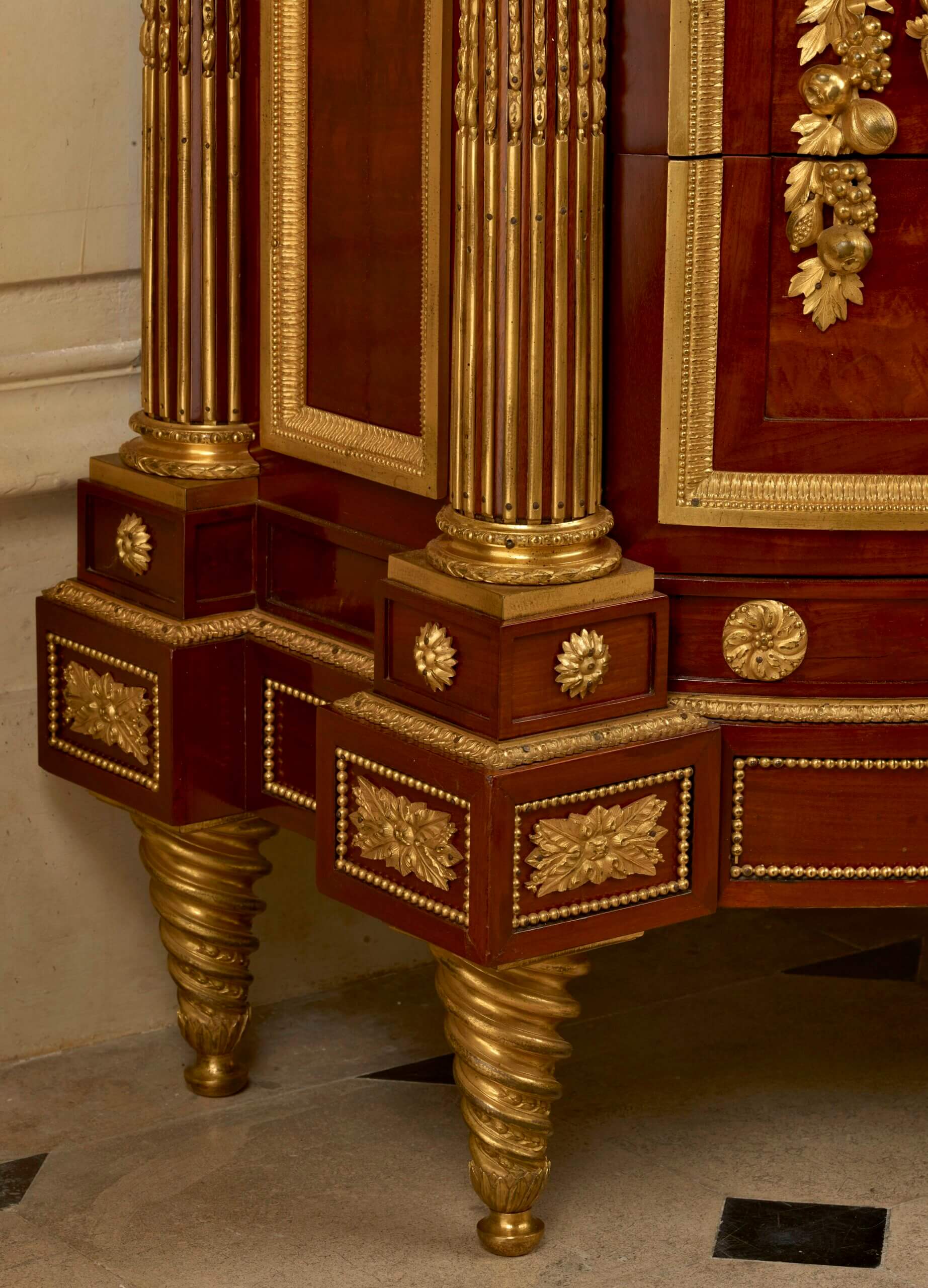

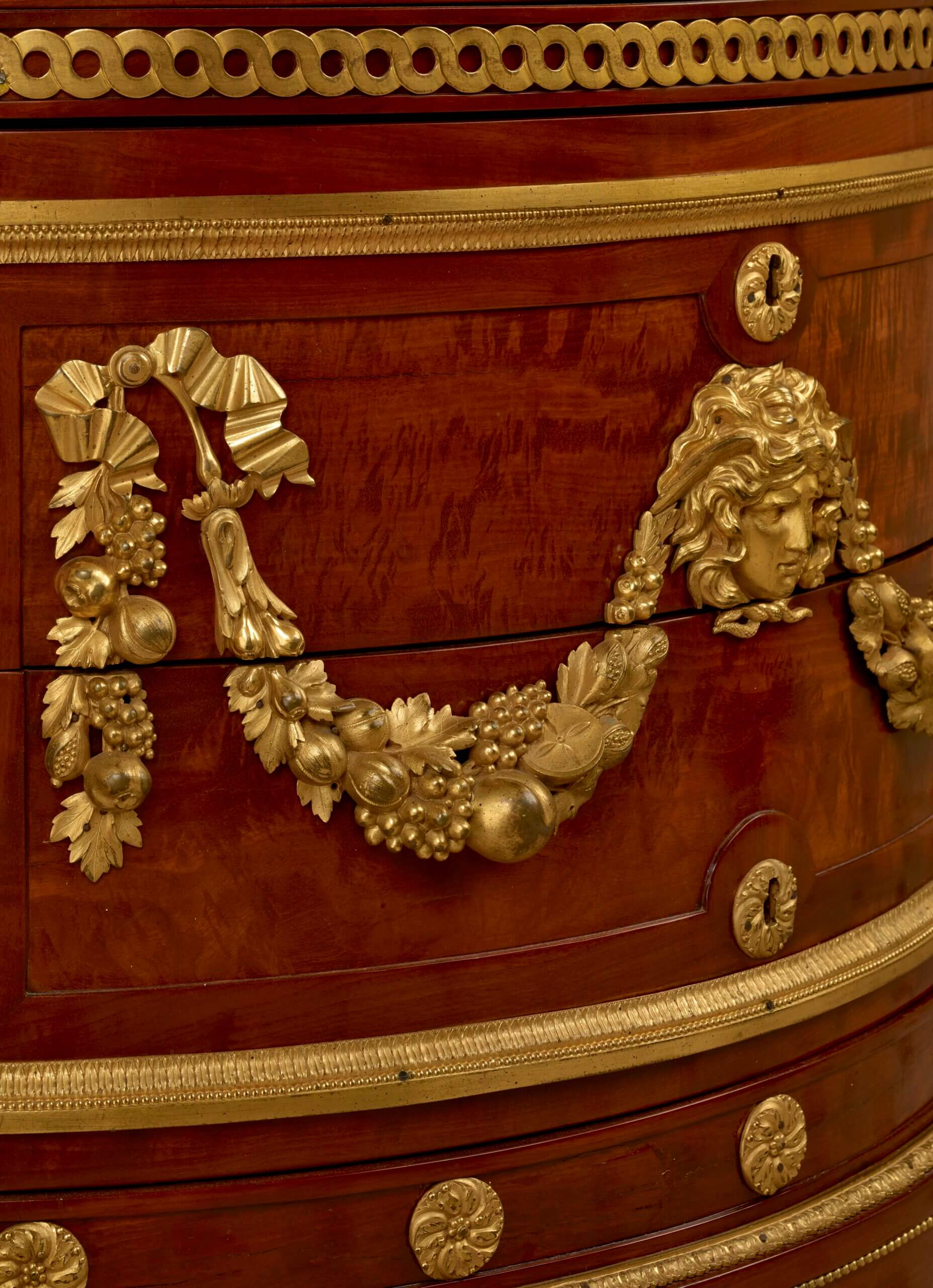
Saint-Domingue mahogany and mahogany veneer, figured and moiré; chased and gilt bronze; white marble with grey veining.
H. 102.5 cm. (40 ¼ in.); W. 99 cm. (39 in.); D. 60 cm. (23 ¾ in.).
STAMP: P. GARNIER, visible beneath the rear rail of the top.
PROVENANCE: Sotheby’s sale, Monaco, 23–24 June 1985, lot 902; collection of Hubert de Givenchy, Hôtel d’Orrouer, 87 rue de Grenelle, Paris.
LITERATURE: Christophe Huchet de Quénetain, Pierre Garnier, Paris, 2003, p. 82, cat. 226.
Inspired by the antique, the façade of this commode is divided into three drawers framed by pilasters surmounted by capitals and terminating in spinning-top–shaped feet. Each drawer is richly decorated: the upper drawer is adorned with a frieze of interlacing foliage, while the second and third drawers feature a mask of Mercury supporting a garland of fruit.
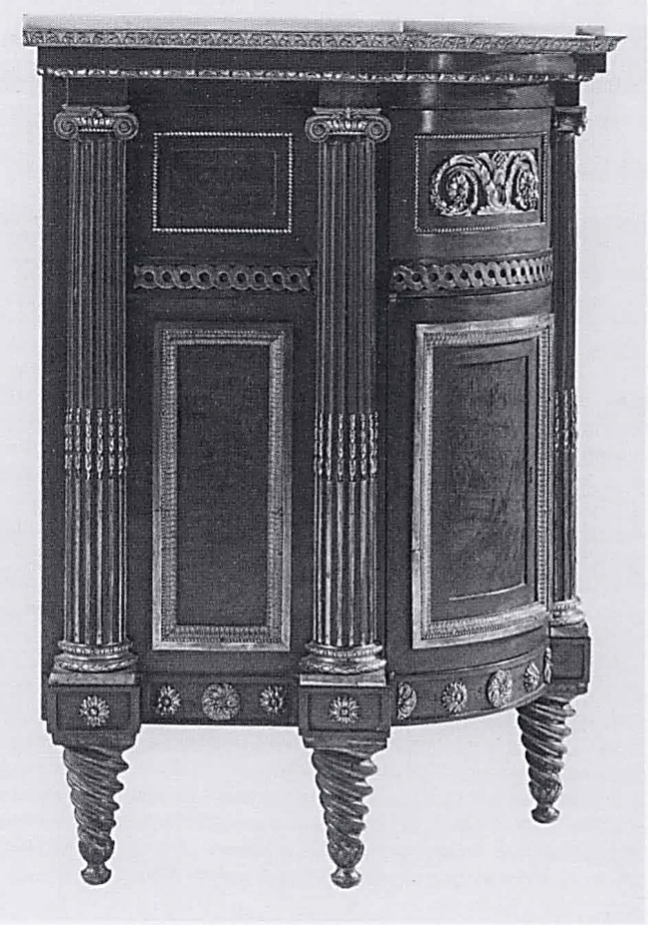
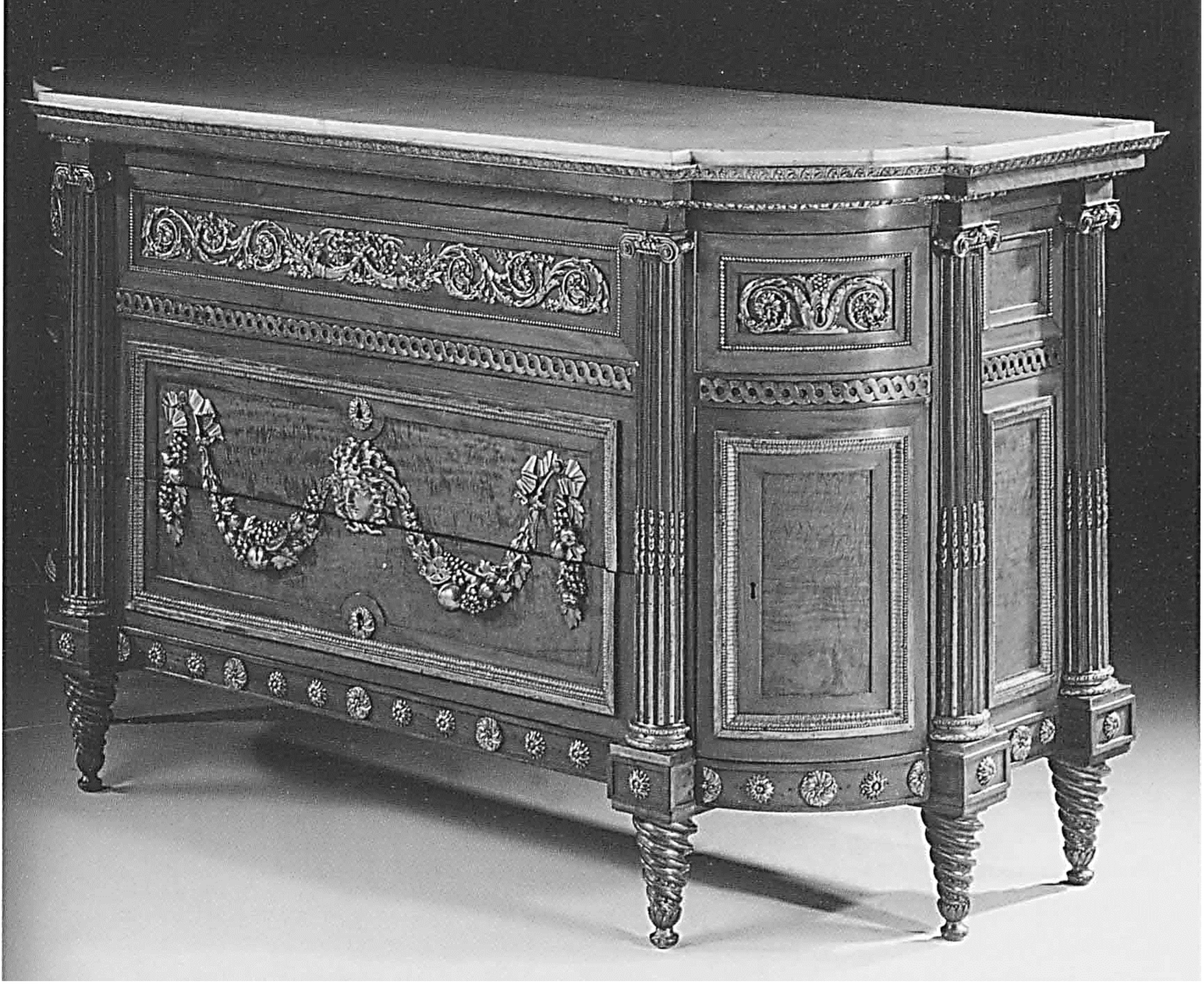
Pierre Garnier, commode stamped en suite with ours, formerly from the collection of the Consul General of Sweden Karl Bergsten (d. 1953).
Sale at Christie’s, London, 23 June 1999, lot n° 50.
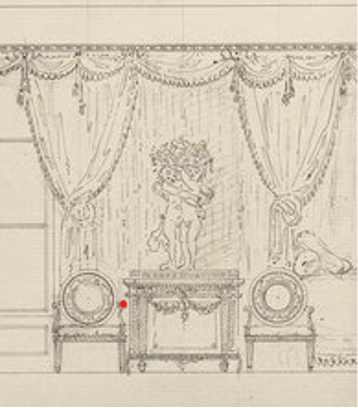
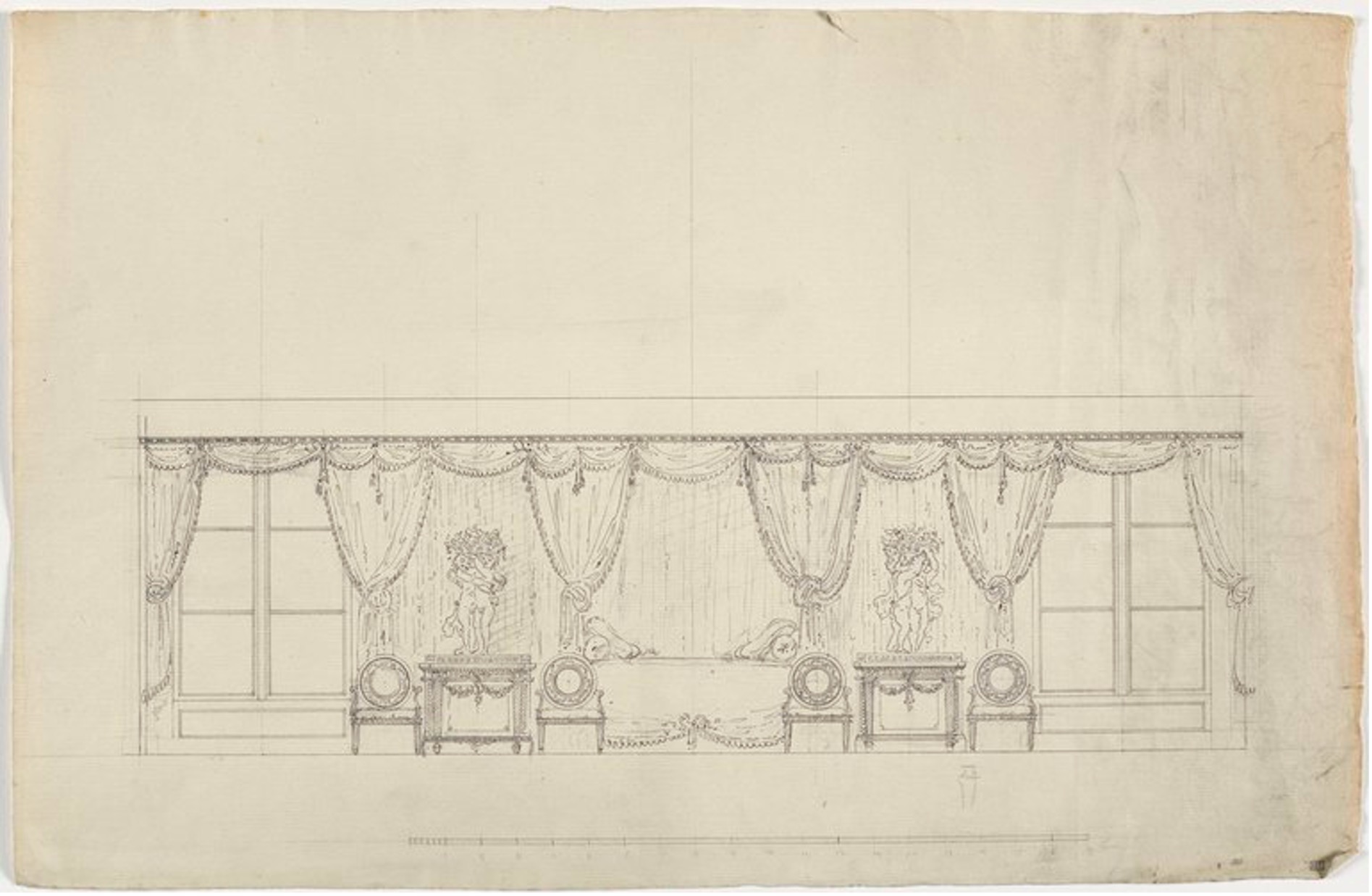
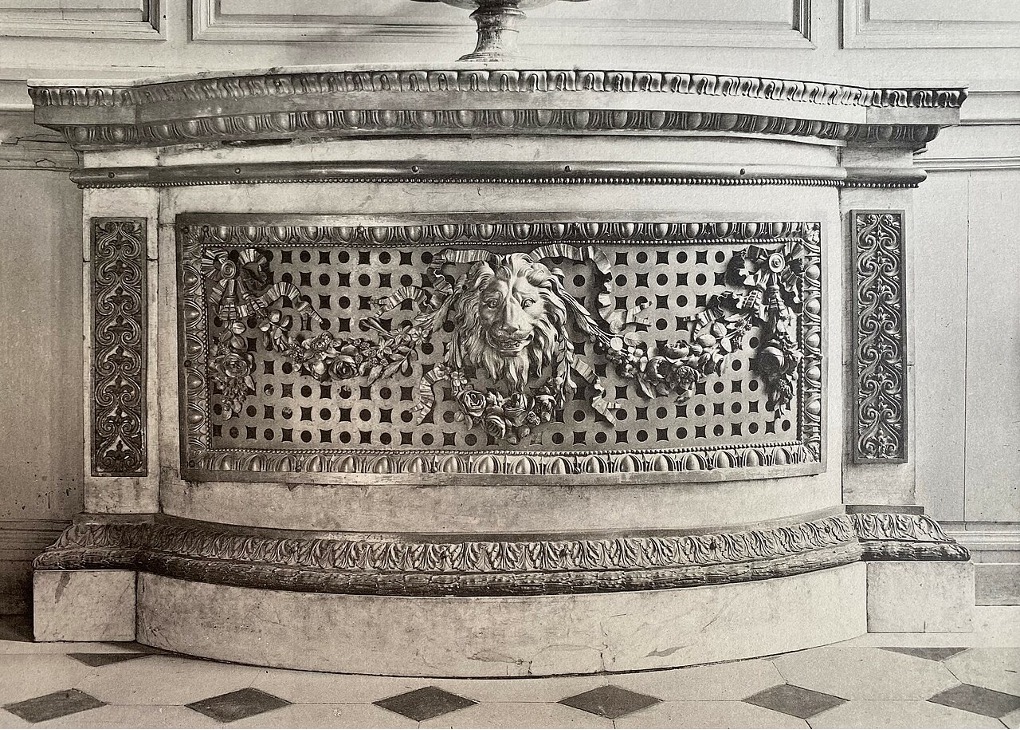
Alexandre Théodore Brongniart (Paris, 1739–1813), View of an architecturally conceived commode very similar to ours, placed in the small bedroom; developed elevation, in the hôtel Taillepied de Bondy, rue de Richelieu, Paris, 18th century.
Paris, Musée du Louvre (inv. RF50221-recto).
Pierre Garnier, a Precursor of the ‘à la grecque’ Style
Born at the end of 1726 or the beginning of 1727, probably in Paris, Pierre Garnier was the son of François Garnier, master cabinetmaker established in the Faubourg Saint-Antoine. He became master on 31 December 1742, at which point he left his native district to set up in Paris’s prominent financial quarter, on the rue Neuve-des-Petits-Champs, “opposite the Royal Treasury.” His success is documented in the Almanach général des marchands.
Between 1766 and 1778, he actively contributed to furnishing the numerous residences of the Marquis de Marigny, brother of Madame de Pompadour and Superintendent of the King’s Buildings, including in Paris his hôtel on the Place du Louvre, the Hôtel de Massiac on the Place des Victoires, as well as his Pavillon du Pâté-Bercy. Around 1775, Garnier furnished the Château de Montgeoffroy in Maine-et-Loire for Louis-Georges-Erasme, Maréchal de Contades (1704–1795). Prior to 1781, he delivered furniture commissioned by Louise-Jeanne de Durfort de Duras, Duchess of Mazarin, and between 1784 and 1789, supplied Germain Baron, Receiver General of Finances. For several years, he was also one of the appointed suppliers to the House of Orléans, and among his clientele was Prince Charles of Sweden, the future King Charles XIII, for whom he executed the celebrated pair of à la grecque commodes now preserved at the Château de Gripsholm. He became a major supplier to Madame du Barry, the official mistress of Louis XV, and also delivered furniture to Françoise-Émilie de Pérusse d’Escars, Marquise de Brunoy; the Comtesse de Coigny; Cardinal Louis-René-Édouard de Rohan-Guéménée; Pierre-Charles-Antoine Maignart, Marquis de La Vaupalière; the Duke of Talleyrand-Périgord; and Louis-Sophie Le Tellier, Marquis de Louvois.
Pierre Garnier remained professionally active until the period of the Directoire (1795–1799) and died on 25 Floréal, Year XIV (15 May 1806), at No. 4 Rue de l’Arbre Sec, where he had moved in 1800.Top of FormBottom of Form