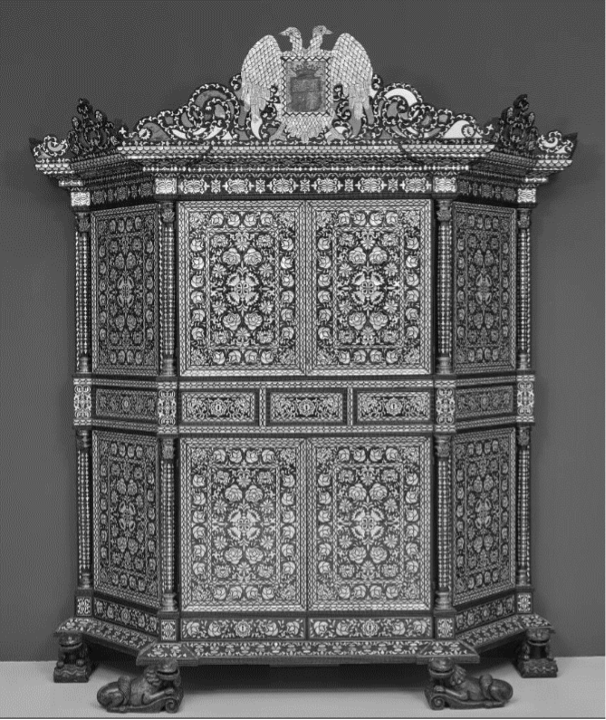
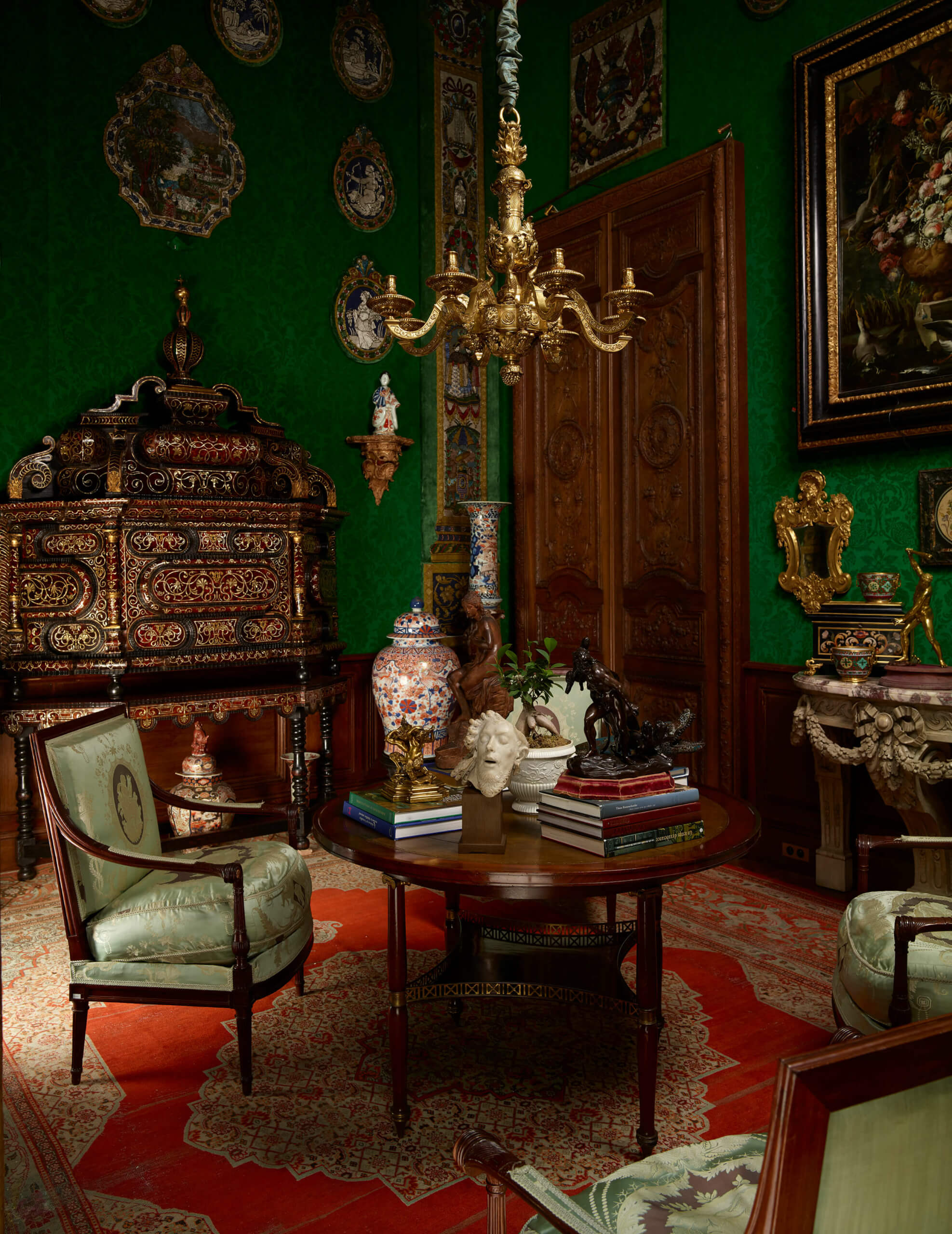
Very certainly on behalf of a high dignitary of one of the two main administrative districts founded by the crown of Castille in its overseas dominions: the viceroyalty of Peru created by Charles V in 1542 or the viceroyalty of new Spain in Mexico established in 1535.
Exotic woods; ebony and blackened wood, inlaid with mother of pearl and red-coloured tortoiseshell; gilt copper.
H. 280 cm. (110 ¼ in.) ; W. 176 cm. (69 ¼ in.); D. 48 cm. (19 in.).
PROVENANCE: private collection.
COMPARATIVE LITERATURE: María Campos Carlés de Peña, Un legado que pervive en Hispanoamérica, El mobiliario del Virreinato del Perú de los siglos XVII y XVIII, Madrid, 2013, p. 241-287.
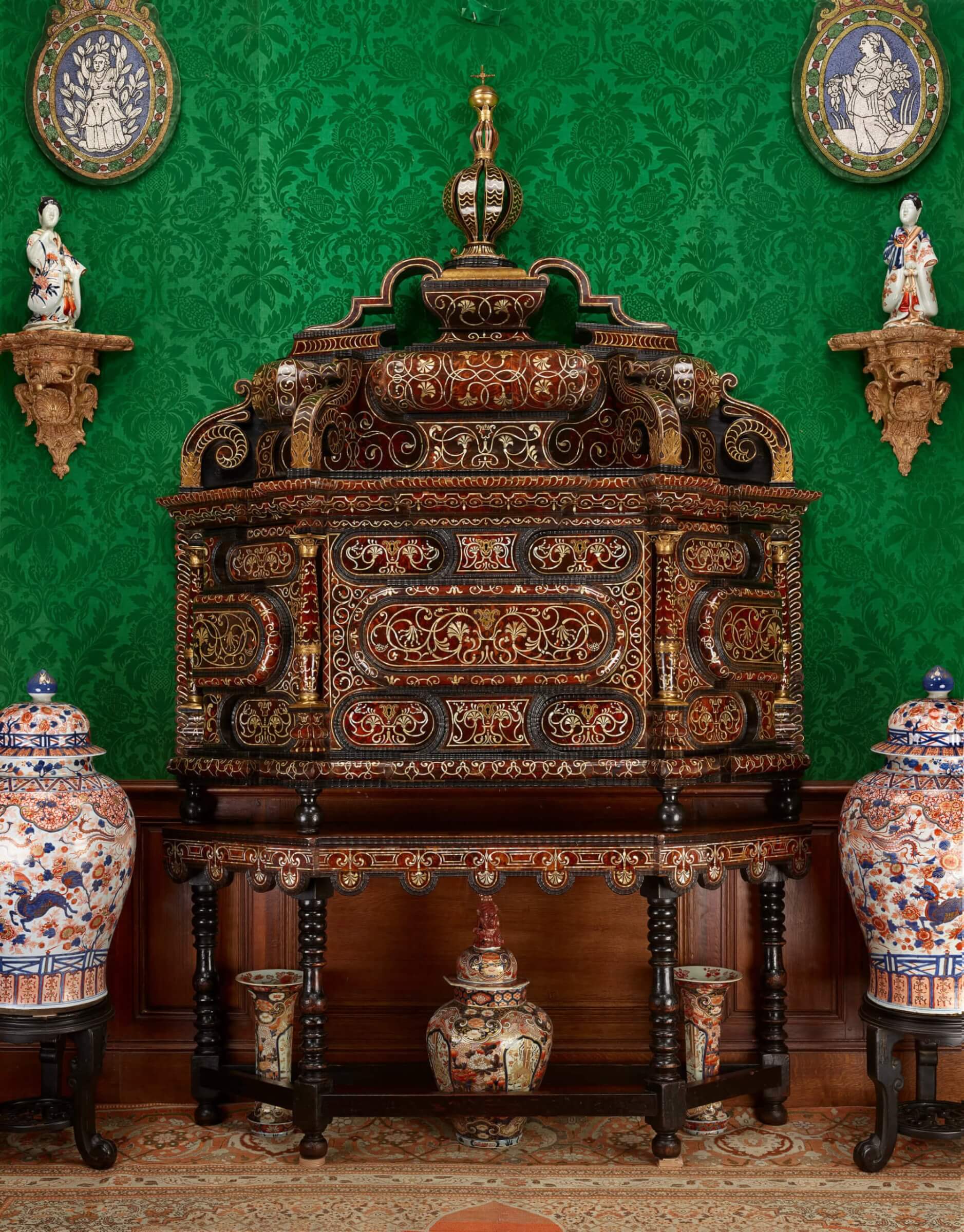
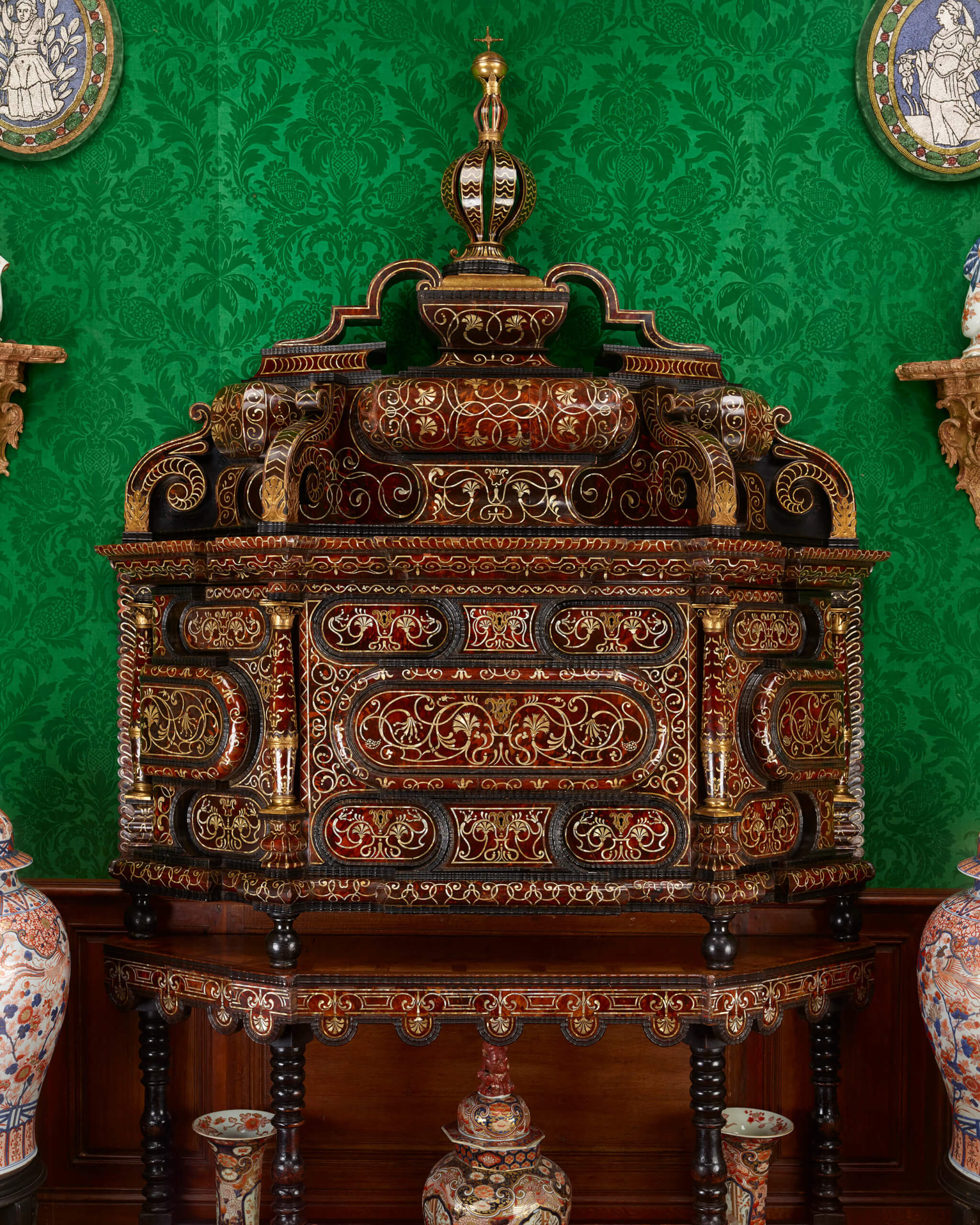
This ‘baroque’ ceremonial cabinet, called a gavetero by the Spaniards, is a rare testimony of all the sophistication of Spanish colonial decorative arts during the 17th and 18th centuries, especially in Lima, a city founded on 18th January 1535 by the Conquistador Francisco Pizarro under the name of “la Ciudad de los Reyes” (the City of Kings) and in Mexico, the capital of the Viceroyalty of New Spain. It was most likely executed for a high dignitary established in one of these two main administrative districts created by Spain to govern its immense possessions in Central and South America, and displays a carcass made of indigenous woods—the most commonly used being mahogany, walnut and Nicaraguan cedar—very richly adorned with inlays of mother-of-pearl inlays and red-coloured tortoiseshell inserted into festooned borders of ebony and blackened wood, the whole enhanced by gilt copper ornaments.
It features a tripartite division with cut sides, in the centre of which can be seen a cabinet resting on four ‘ball’ feet in darkened wood enclosing seven oblong drawers in front—one large central drawer and six smaller drawers—all of which are fitted with key locks and flanked by lateral compartments en encoignures and with doors, the latter with a distinctive prominent central oblong projection, the whole punctuated by columns with moulded bases, indented collerettes and gilded copper capitals.
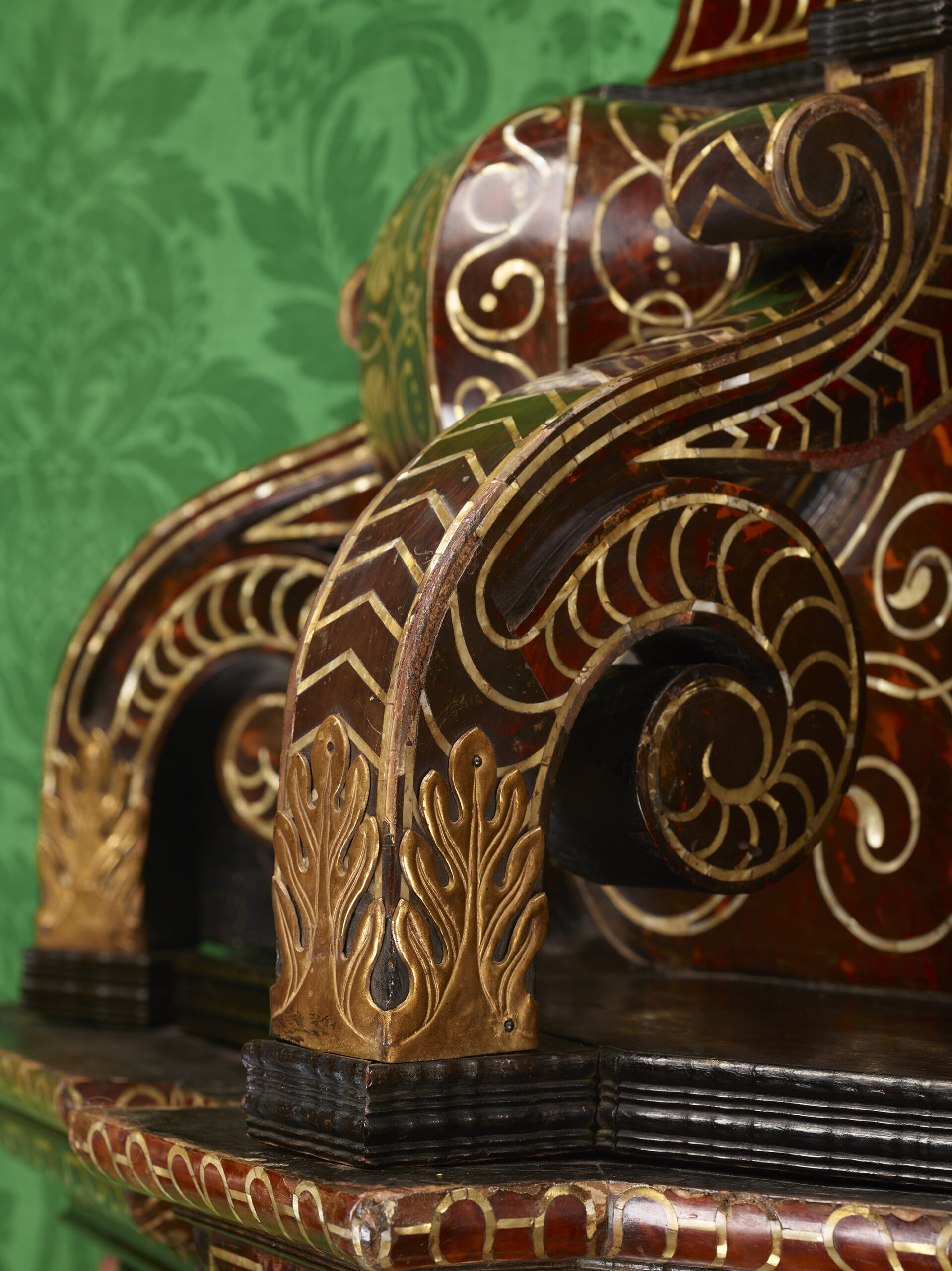
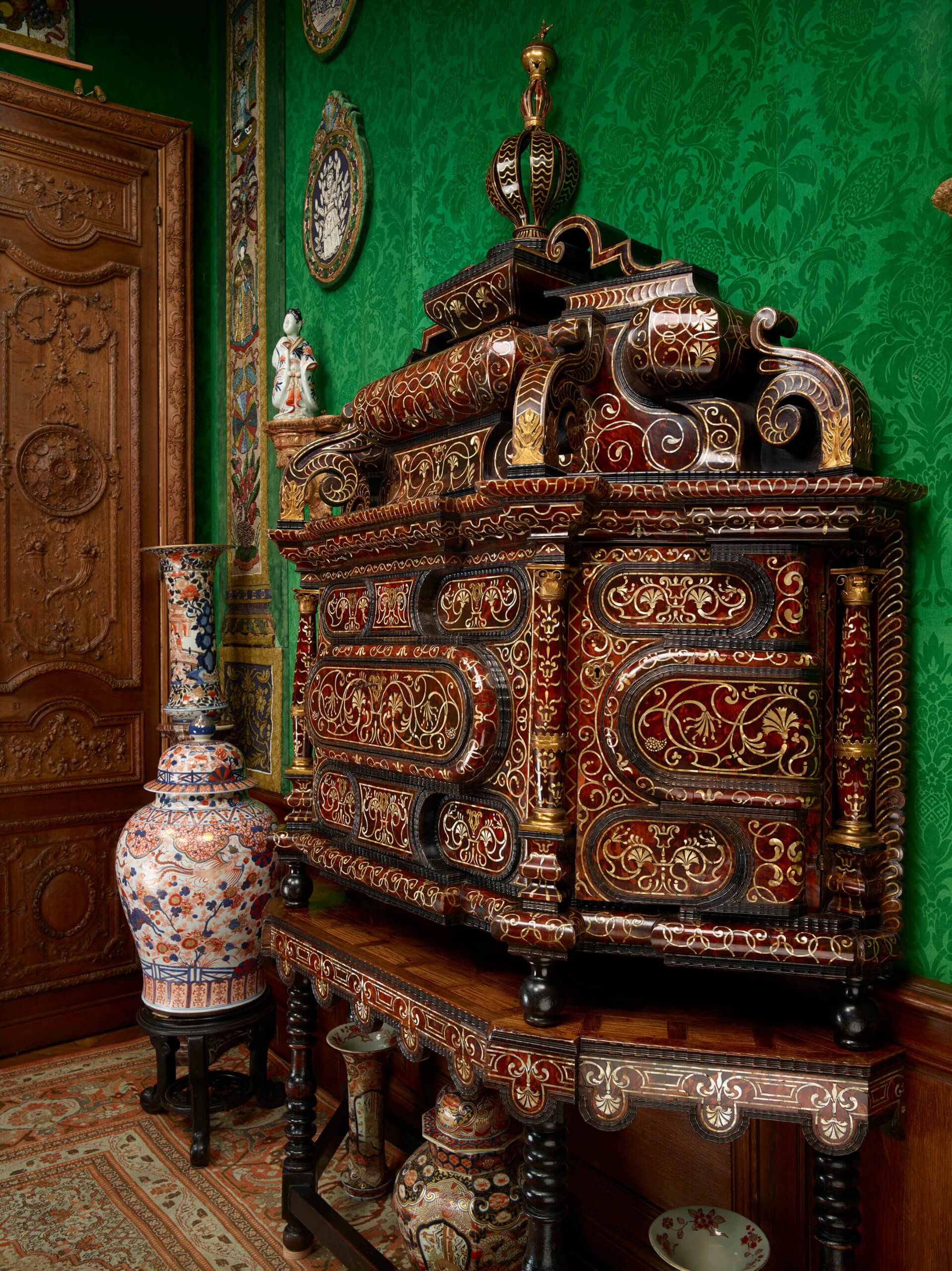
The upper “domed” part of the gavatero displays an extraordinary design of both convex and concave shapes reminiscent of some contemporary pulpits in the Baroque churches of Lima, flanked by four powerful scrolled consoles enhanced at the base by a corolla of stylised gilded copper palmettes. The whole is crowned in the centre by a curvilinear pedestal, flanked by two consoles with scalloped edges, surmounted by two spheres with openwork ribs punctuated by a gilded copper cruciform orb, i.e. a sphere surmounted by a cross—a Christian symbol par excellence, recalling Christ’s temporal, and not only spiritual domination over the World and underlining here the great religious devotion of its original owners and of all contemporary Spanish society at large.
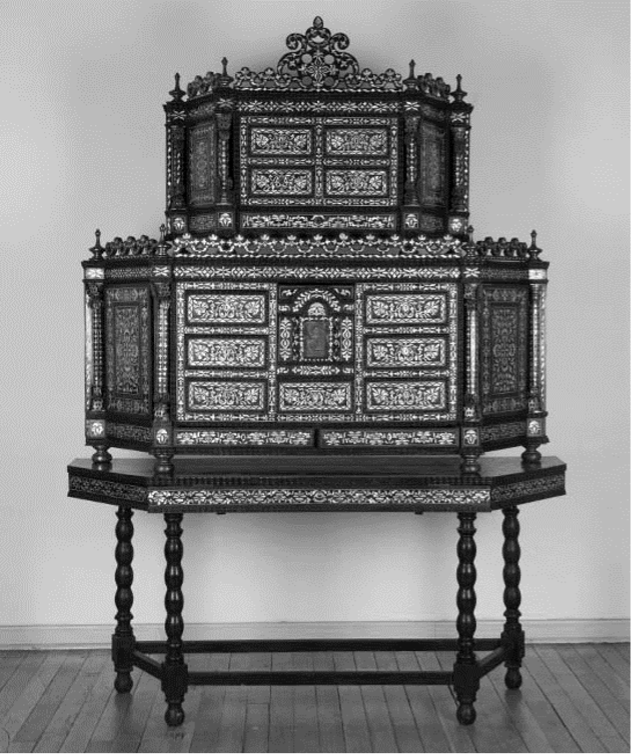
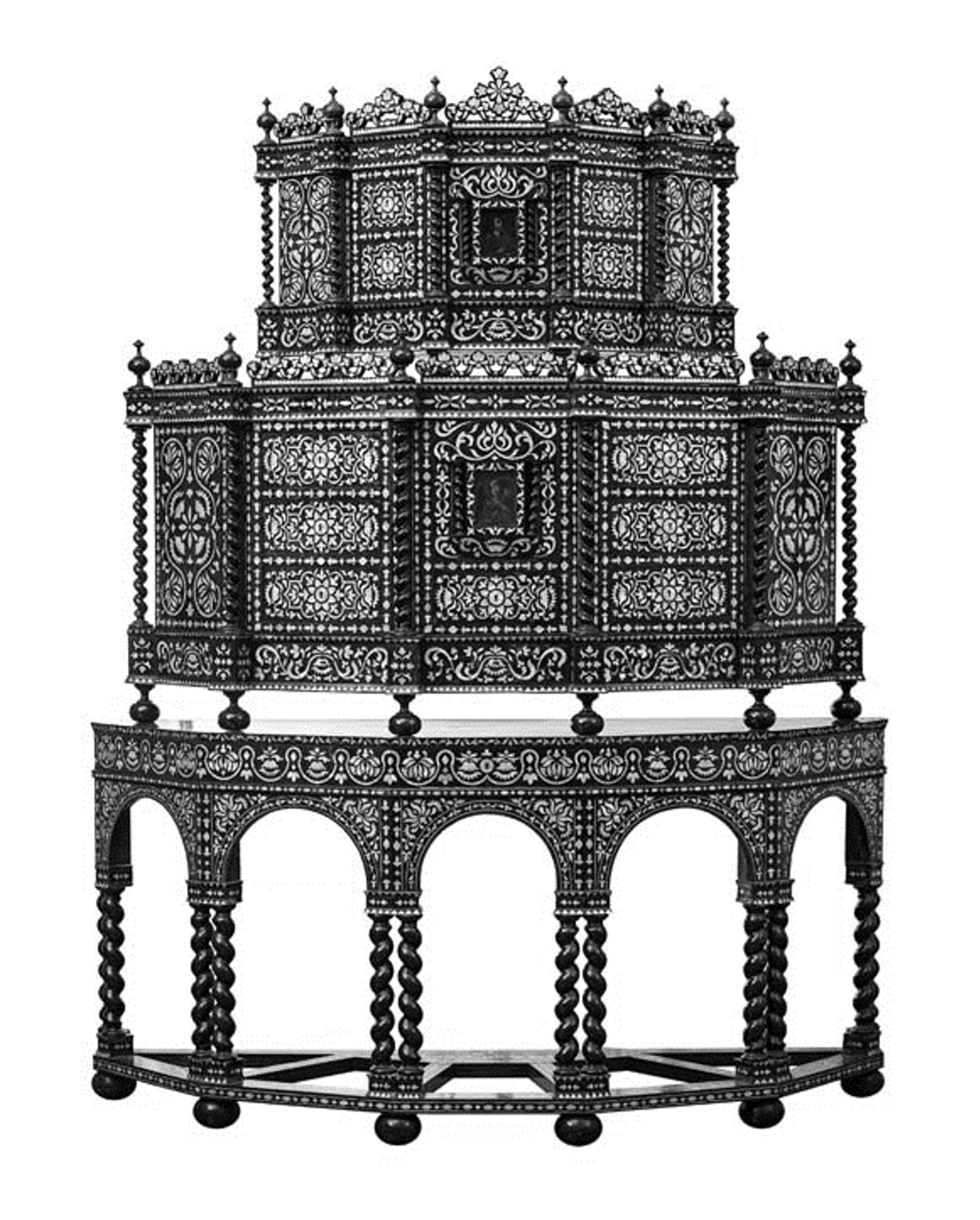
The cabinet rests on an equally sumptuous console with cut sides and with geometrical compartments in light wood at the level of the top and rail with lower cut-outs punctuated by semi-circles, richly adorned with mother-of-pearl and tortoiseshell inlays inserted into festooned ebony borders. Four high, blackened wood legs turned with balusters and ‘rosary’-shaped rings support the whole, joined at the bottom by rectilinear crosspieces and ending in ball feet. The general design of the piece is reminiscent of the cabinets made in Europe, but the mother-of-pearl and tortoiseshell decoration with symmetrical patterns of fine leafy scrolls combining interlacing and stylised kantutas—the sacred flower of the Incas and the national emblem of Peru—combines decorative styles inspired by Islamic (Mudéjar art), Korean and Japanese (Namban lacquers) arts.
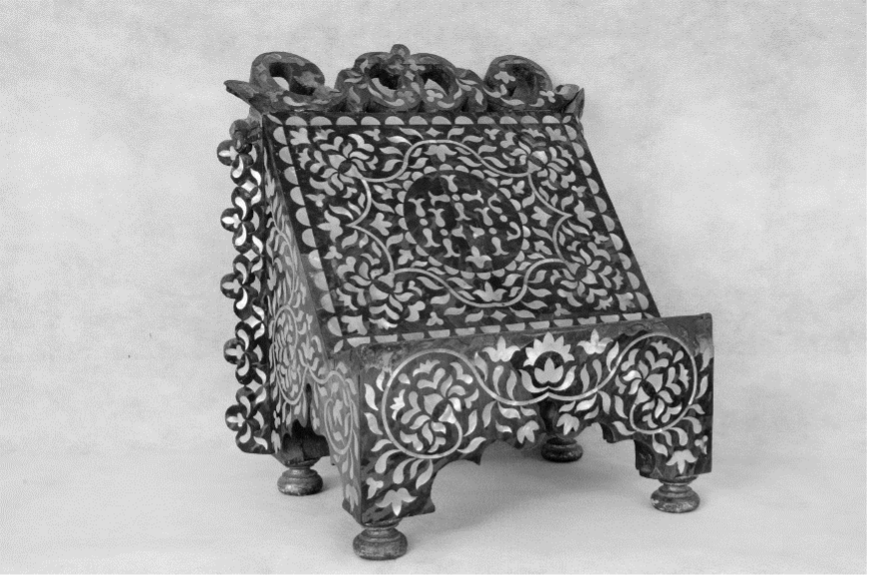
This lavish decoration can be seen everywhere on this piece of furniture conveying the feeling of being confronted with the “horror of emptiness”. This type of cabinet-making, which also includes cupboards, tables, chests, boxes, seats, lecterns and desks, was very popular among the Spanish colonial elites, both civil and religious. It developed from the end of the 17th century and throughout the 18th century—the golden age of this technique—essentially in Lima and Mexico City, where there were workshops specialising in this highly luxurious production. Some of the precious and expensive materials, such as the mother of pearl that characterises it, were imported from Asia by galleons sailing from Manila, a strategic crossroads between India, China, Japan and the New World; the Philippine archipelago had been colonised by Spain in 1571.
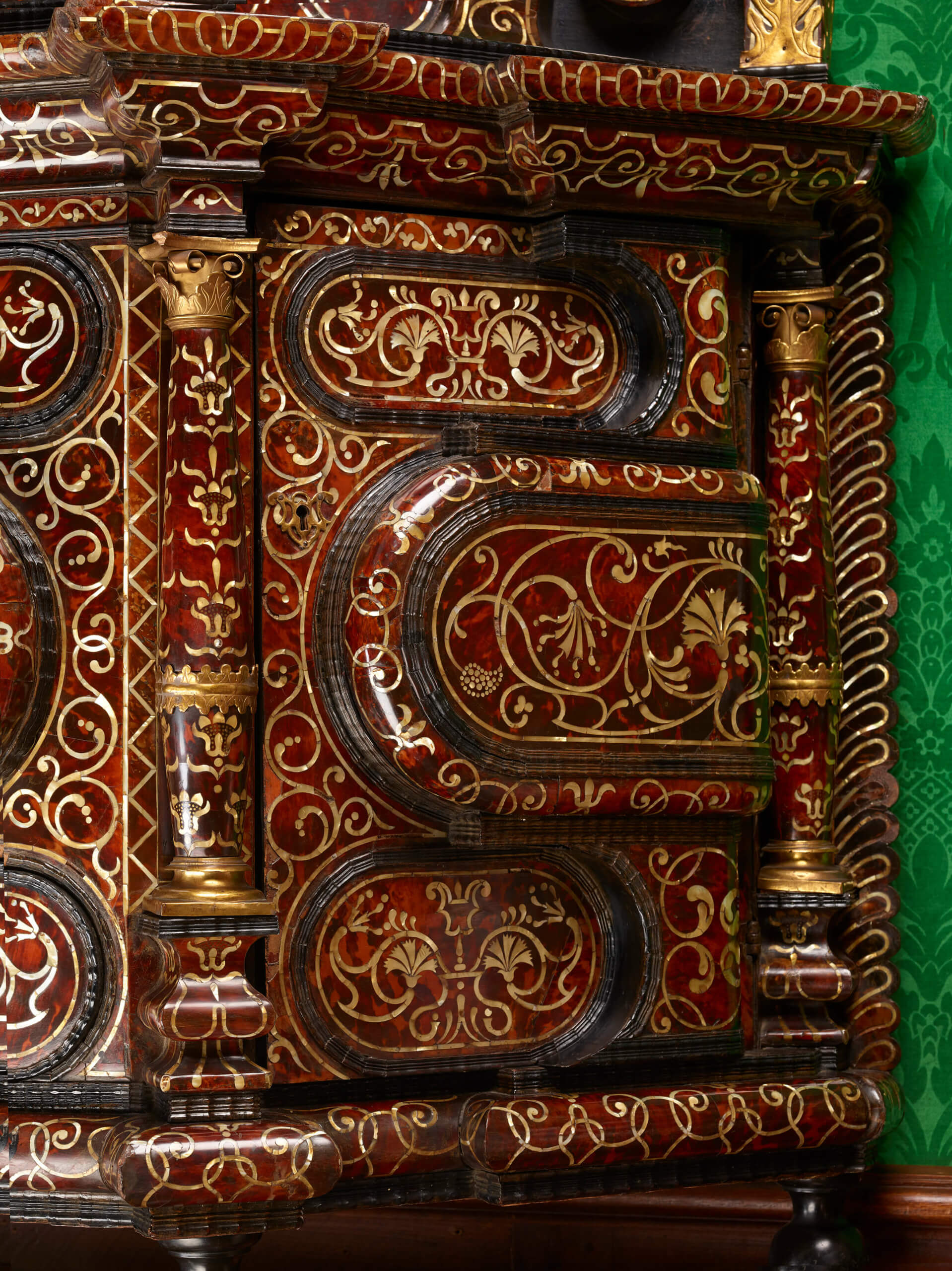
These ships sailed from the late 16th century across the Pacific to the coastal city of Lima, and Spanish colonial, indigenous and Asian craftsmen quickly and skilfully exploited these Asian-inspired techniques to create the luxurious local furniture known as enconchados, i.e. mother-of-pearl inlays on tortoiseshell. Tortoiseshell was locally available in abundance, mainly from large turtles, such as the Charapa (Podocnemis expansa) or the Motelo (Geochelone denticulata), two varieties with large shells that live in large numbers on the South American coast.
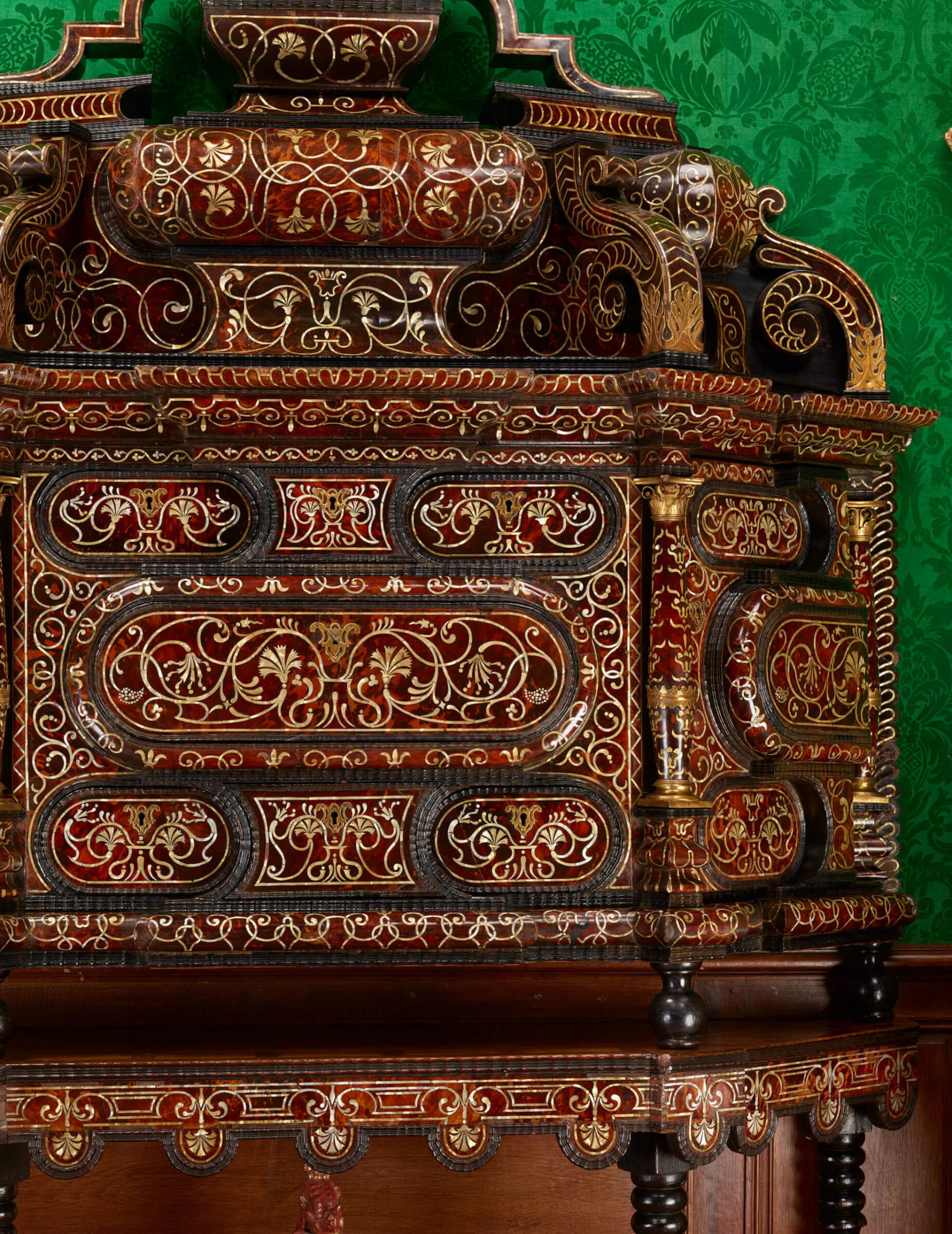
From the middle of the 17th century and throughout the colonial period, local workshops benefited from a constant influx of Filipino, Chinese, Japanese and other Asian craftsmen who had come to settle in the rich American colonies of the kingdom of Castile. They formed a workforce with a wealth of ancestral know-how, mastering to perfection cabinet-making, inlay techniques and Namban lacquer, and actively participated, through transmission, in the emancipation of this Spanish colonial art, brilliantly combining Asian, Islamic and Latin American artistic traditions; a luxurious and refined art, very influenced typologically by Hispano-Mudéjar baroque models, which quickly spread from Peru to New Granada, now Ecuador, and the Pacific coast as far afield as Mexico and even Europe.
The cabinet presented here is one of the richest instances—and certainly the most exuberant in design—of the costly “gaveteros a enconchados” produced in Lima or in Mexico City—bearing testimony to the splendour of Spanish colonial arts between the late seventeenth century and throughout the eighteenth. Highly prized in New Spain, these large pieces of furniture were considered to be true works of art intended to adorn the reception rooms of the great residences of Lima’s or Mexico City’s aristocratic and religious high society. Very few examples remain to this day.
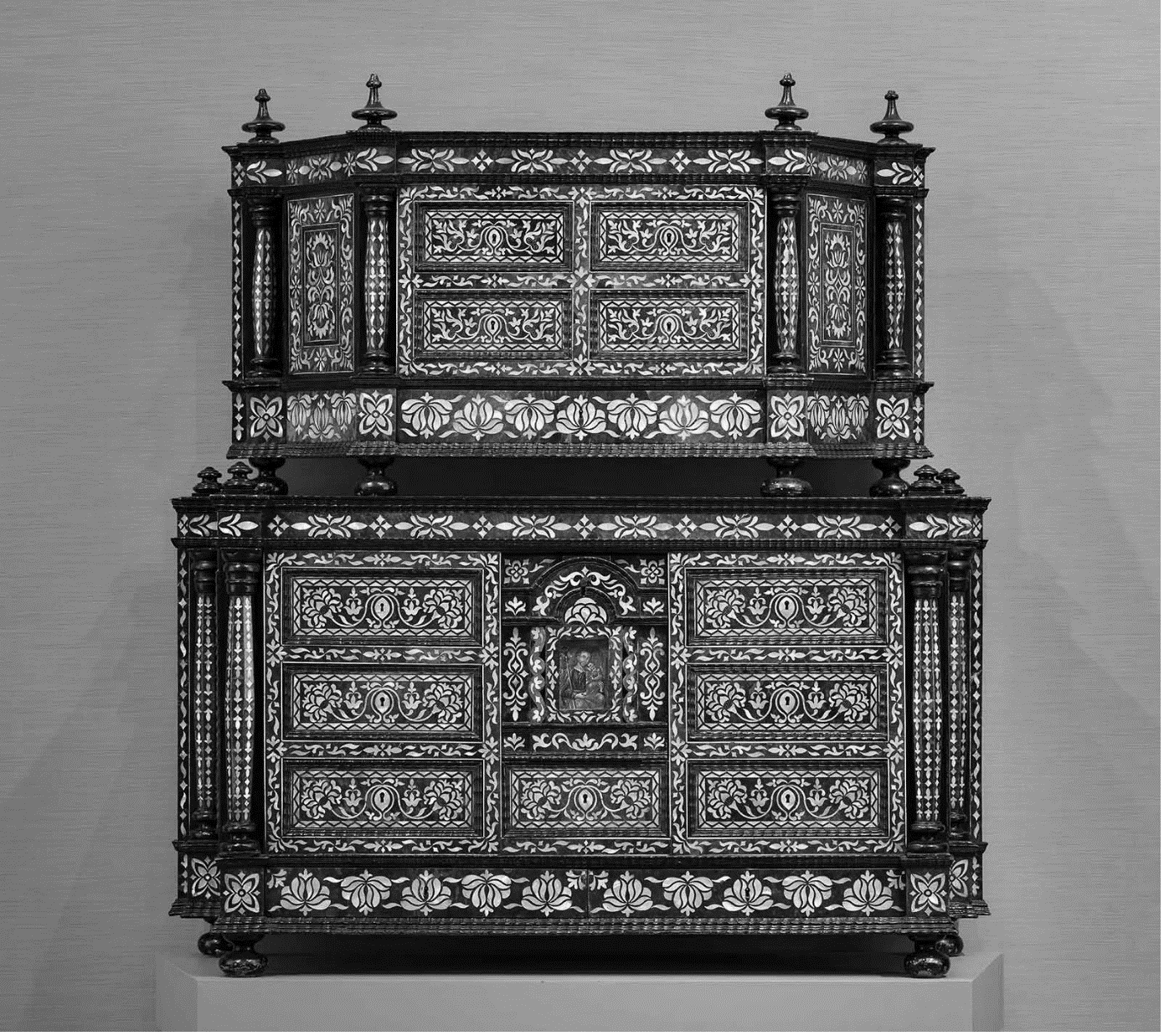
These include the cabinet kept in the Museo Pedro de Osma in Lima, originating from the collection of Don Felipe Pardo y Aliaga (1806-1868) or those of the important Prado Heudebert, Don Juan Luis de Aliaga and Doña Marita de la Peña Prado collections, as well as that of the Casa Goyeneche, the current headquarters of the Banco de Crédito del Perú, also in Lima; as regards this small corpus, mention should also be made of the cabinets kept in the Museo de Artes Decorativas (MHD) in Santiago de Chile, the Museo de Historia Mexicana in Monterrey, Mexico, and the Museum of Fine Arts in Boston, USA; not to mention the extraordinary piece in the Dallas Museum of Art, Dallas, decorated with the coat of arms of Don Melchor Portocarrero, 3rd Count of Monclova, who became Viceroy of New Spain from 1686 to 1688, before being appointed Viceroy of Peru from 1689 to 1715.