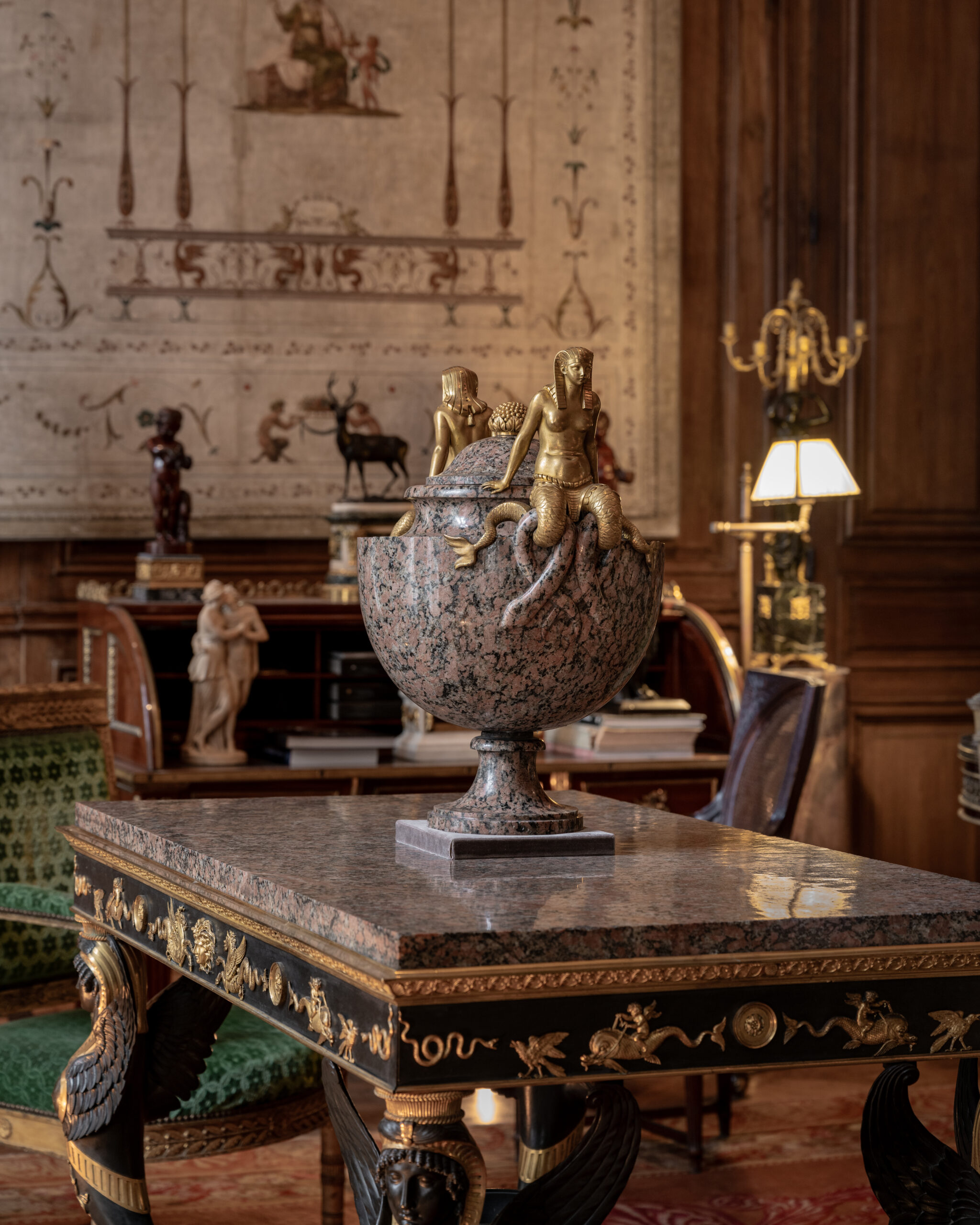
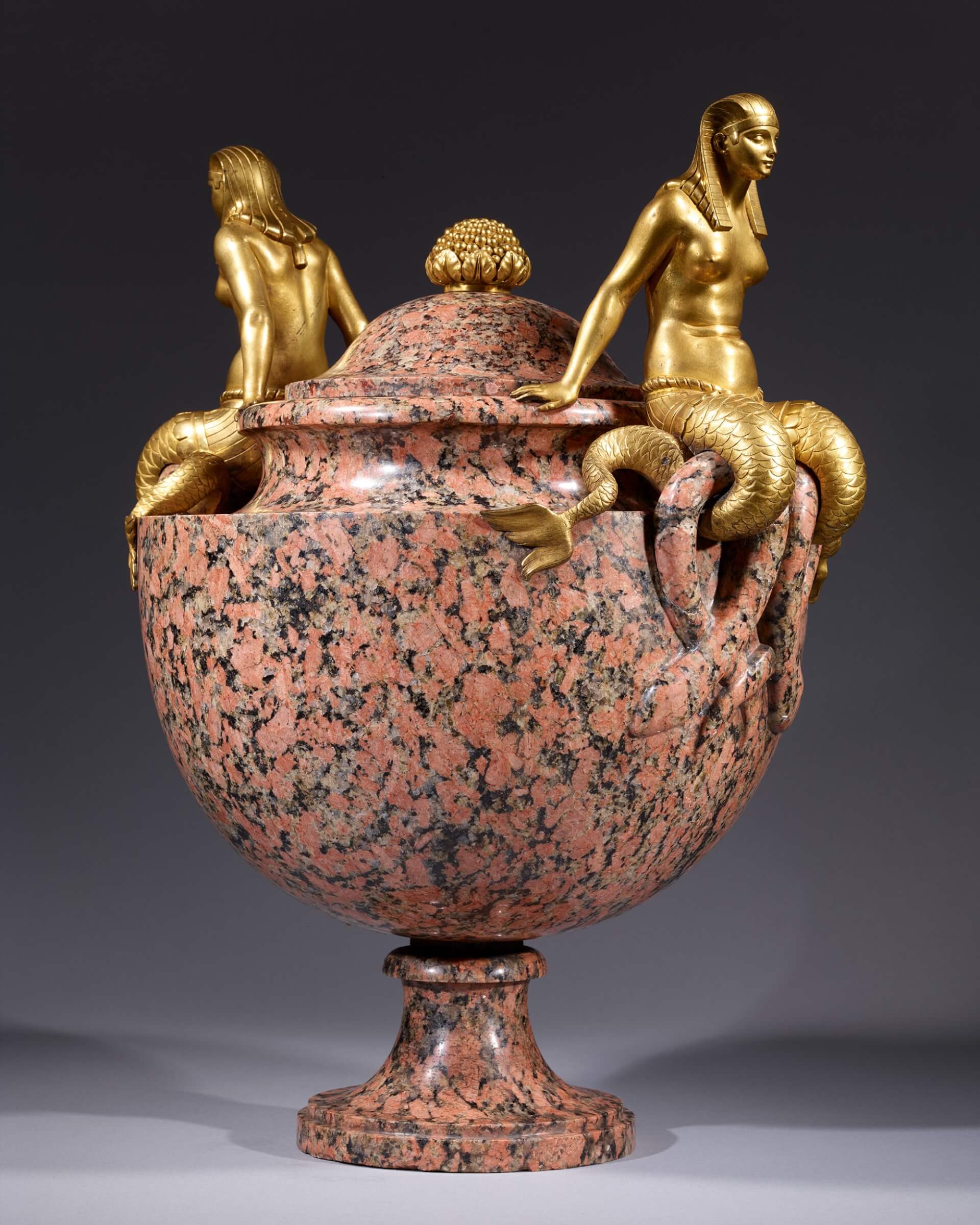
Saint Petersburg, early 19th century, circa 1805.
Ural pink granite, carved at the Imperial Lapidary Manufactory in Yekaterinburg, Ural, Western Siberia.
Chiselled and gilt bronze: Saint Petersburg Imperial Bronze Foundry
H. 56 cm. (22 in.).
PROVENANCE: collection of Count Alexander Sergeyevich Stroganov (1733-1811), at the Stroganov Palace in Saint Petersbourg, then descendants; Sammlung Stroganoff, Leningrad, auction of the Stroganov collection, in Berlin, Rudolph Lepke’s Kunst-Auctions-Haus, 13th May 1931, lot n° 14; anonymous auction in Paris, Hôtel Drouot, Beaussant Lefèvre auction house, 25th April 2003, lot n° 133; Hubert Guerrand-Hermès collection; Galerie Steinitz collection in Paris.
LITERATURE on the Stroganov collection: Louis Réau, “L’art français du XVIIIe siècle dans la collection Stroganov”, Bulletin de la Société de l’Histoire de l’Art Français, 1931, fasc. 1, p. 62-68; Penelope Hunter-Stiebel, Stroganoff, the palace and collections of a Russian noble family, New York, 2000; I. Sychev, Russian Bronze, Moscow, 2003.
EXHIBITION ON THE STROGANOV COLLECTION: Les Stroganoff, une dynastie de mécènes, catalogue of the exhibition held at the Musée Carnavalet, Paris, from 8th March to 2nd June 2002.
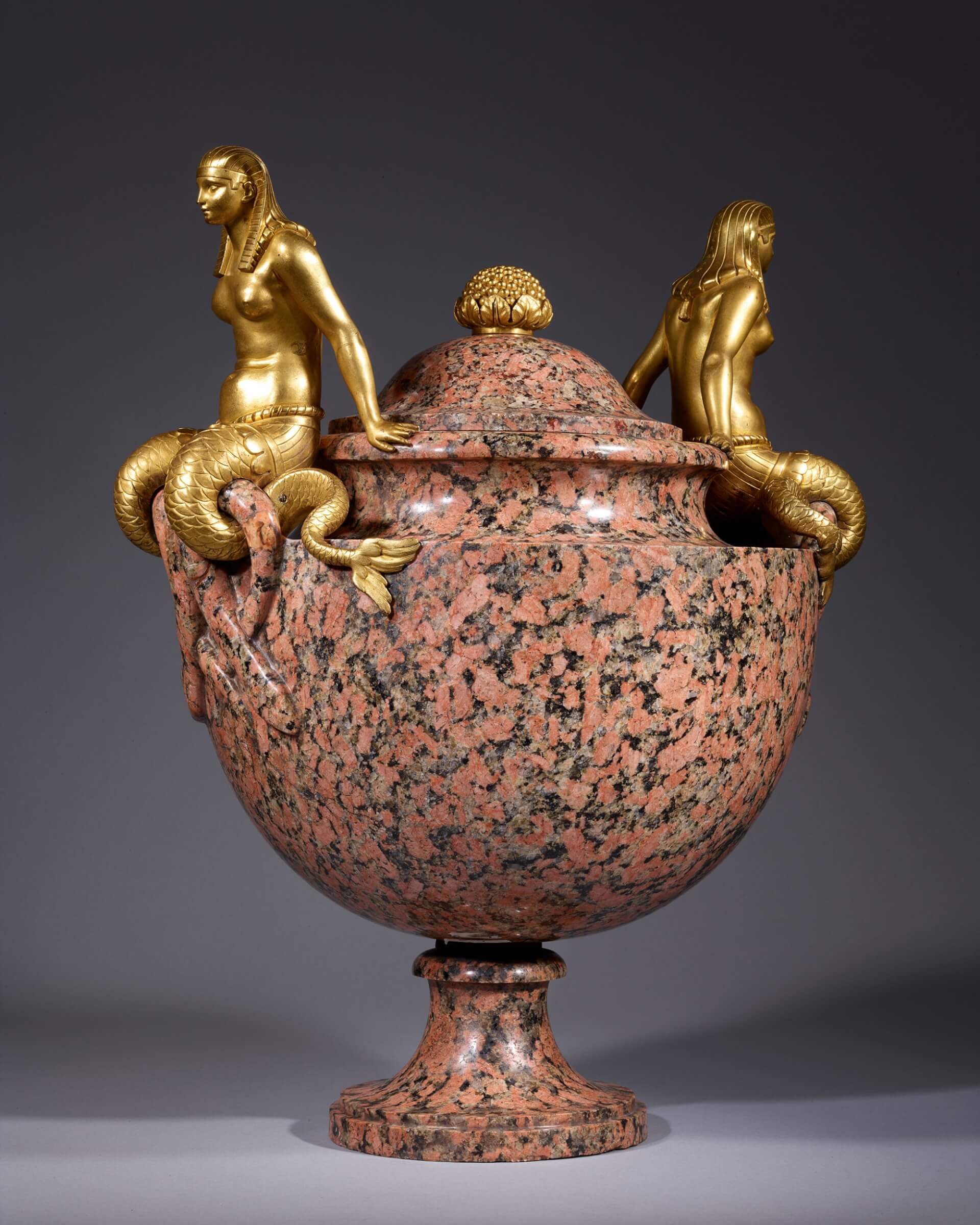
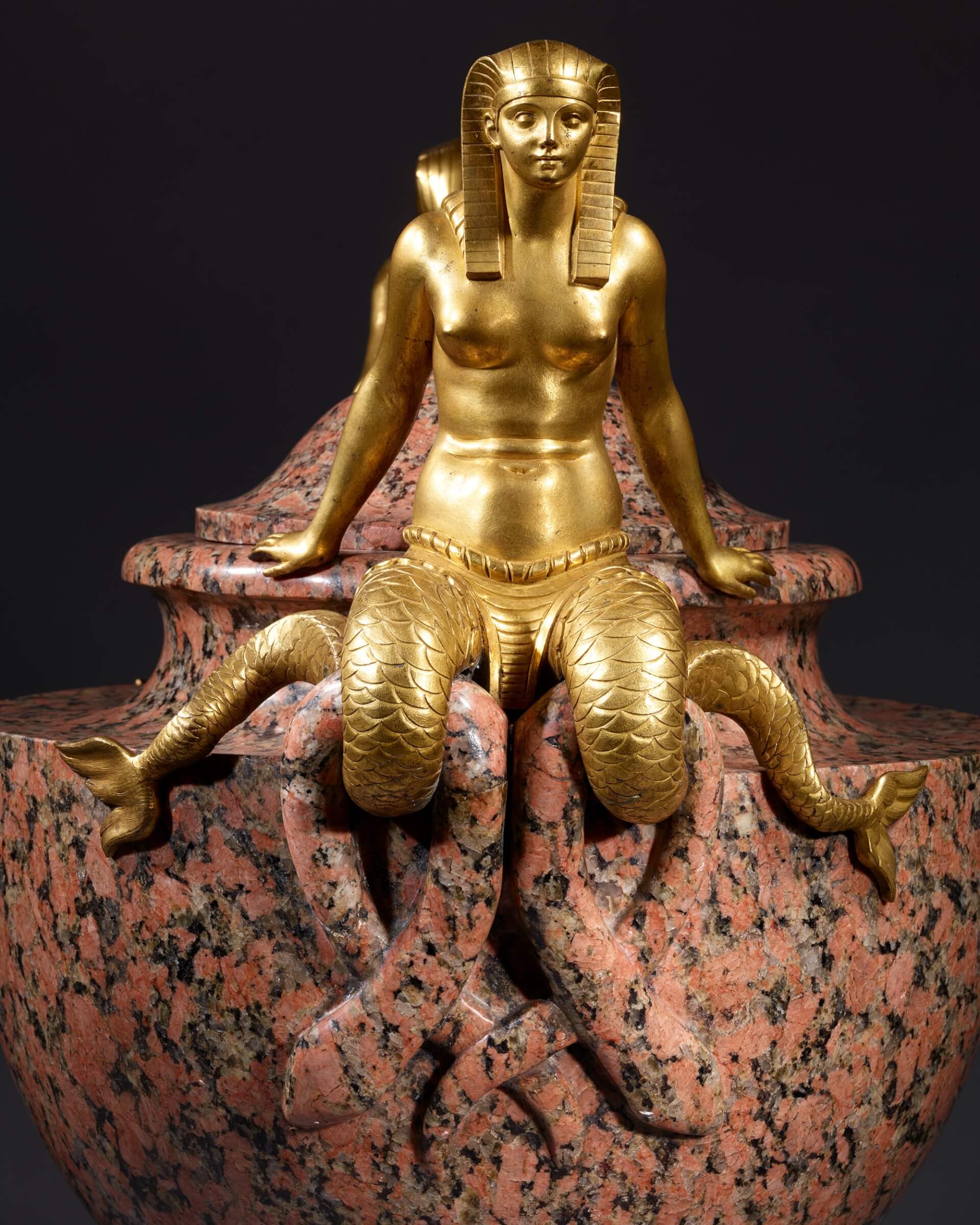
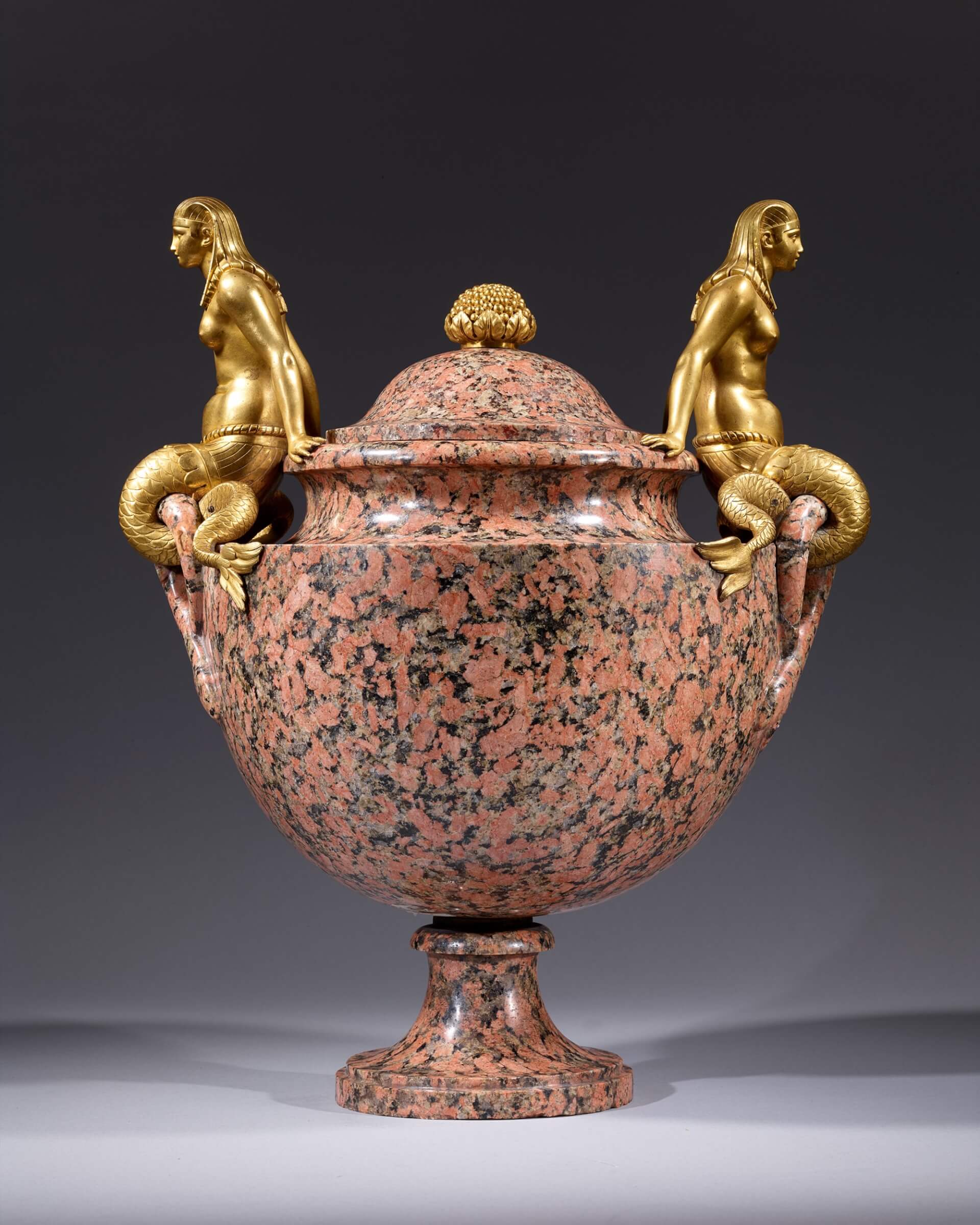
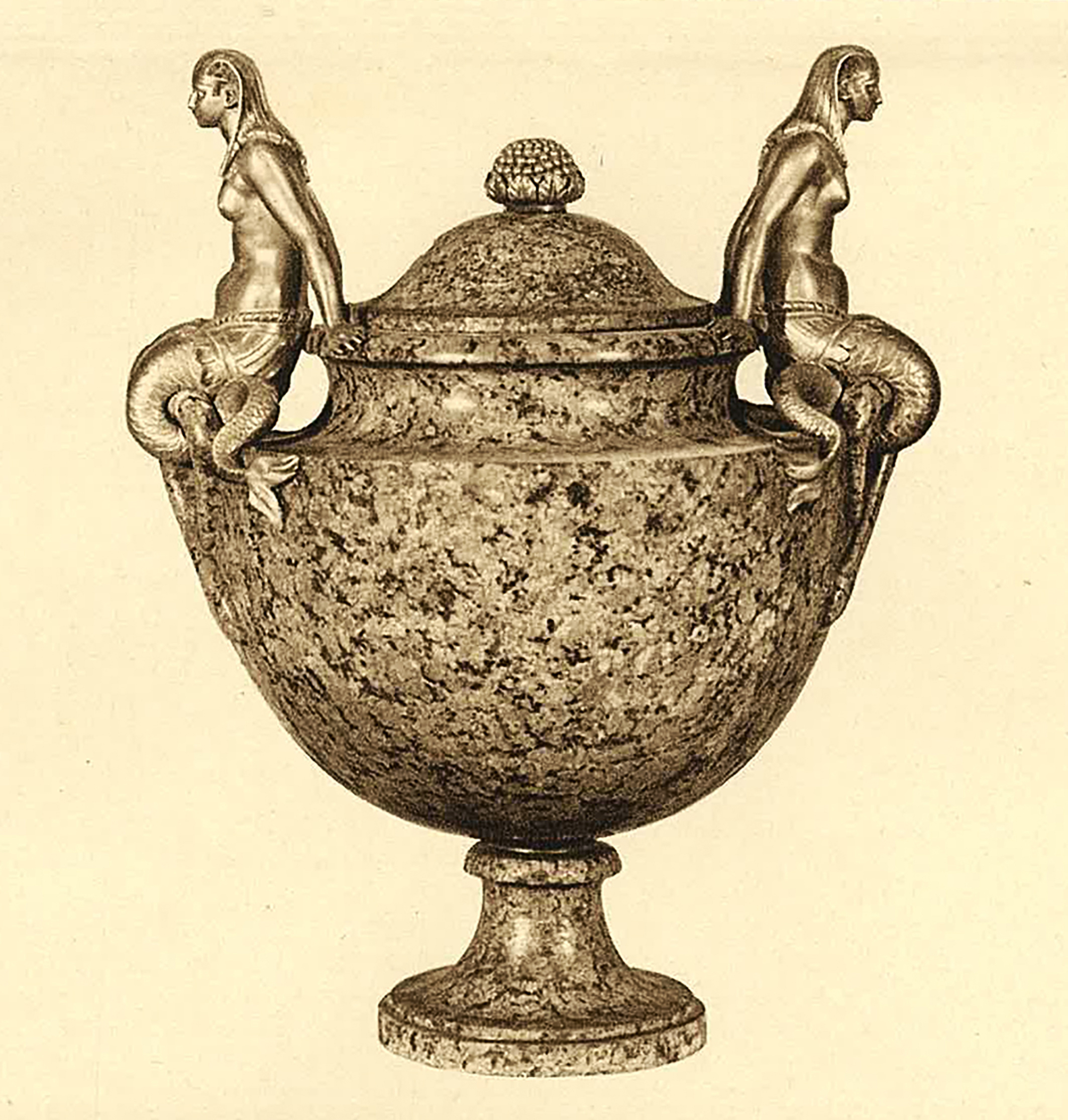
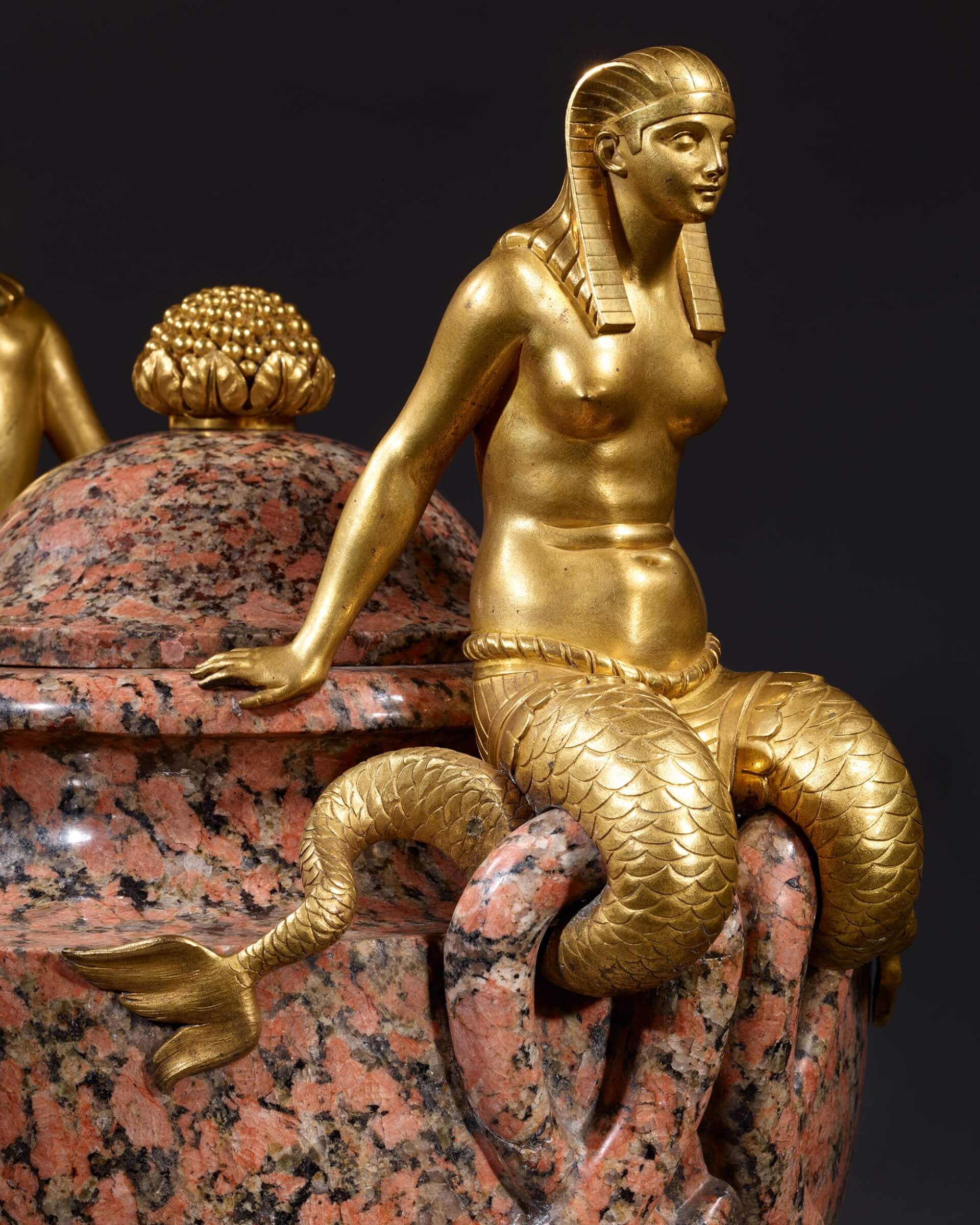
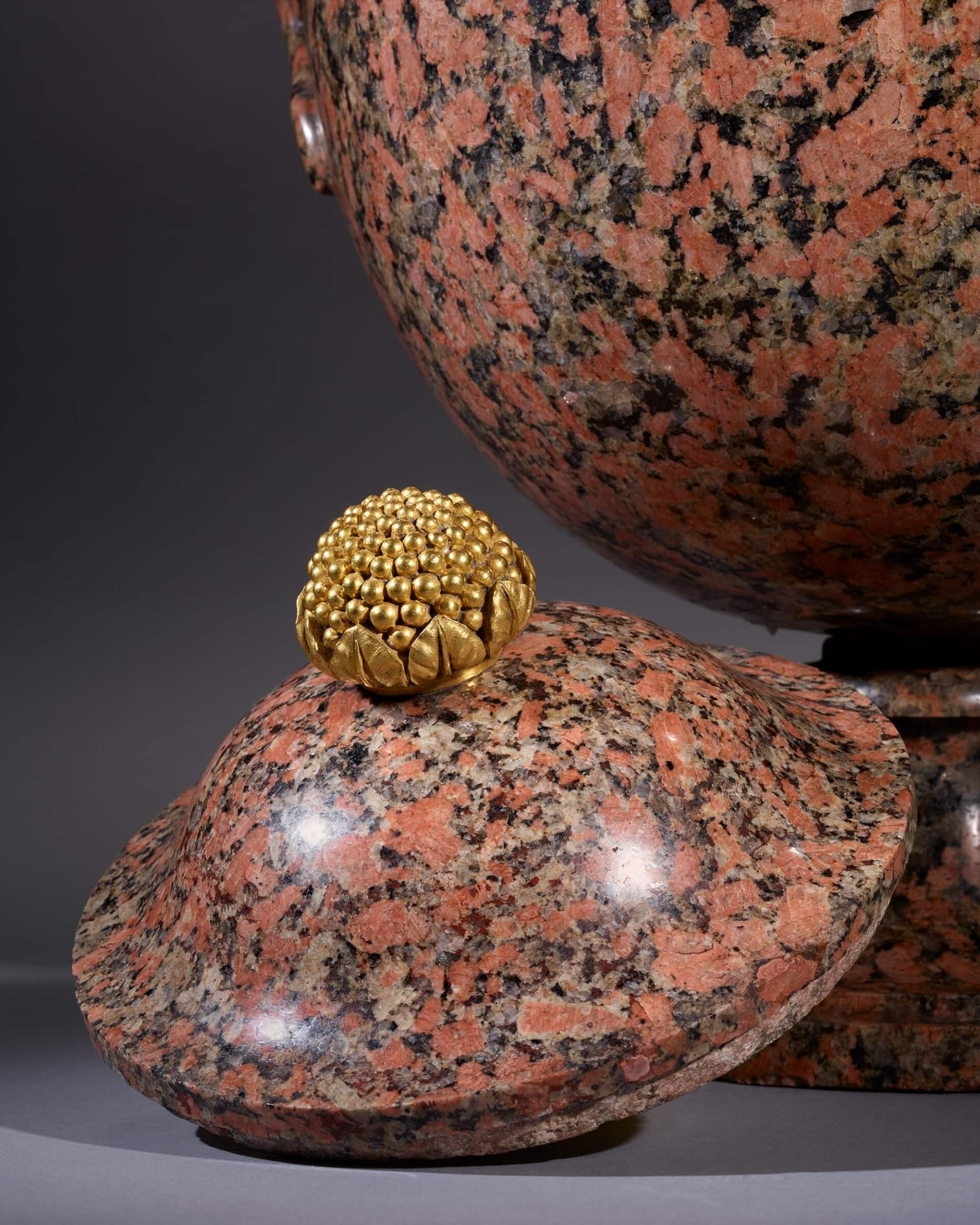
This imposing covered vase, carved in pink granite from the Urals and adorned with two imposing figures of mermaids wearing Egyptian nemes headdresses and a shendyt (loincloth) around their waists, is emblematic of the collection of Count Alexander Sergeyevich Stroganov (1733-1811), who took over the administrative management of the three Russian imperial lapidary manufactories—those at Peterhof, Yekaterinburg and Kolyvan—in 1800. Designed by a major figure of Russian Neoclassicism, Andrei Nikiforovich Voronikhin (1759-1814), the protégé architect of the Count who launched his career, and probably his natural son, the vase was carved circa 1805 at the Imperial Lapidary Manufactory in Yekaterinburg, which is located in the Urals, in western Siberia, and then mounted in gilded bronze in the Imperial Bronze Foundry of Saint Petersburg, founded in 1805 on the instigation of Count Stroganov on Vasilyevsky Island, in a building belonging to the Imperial Academy of Fine Arts.
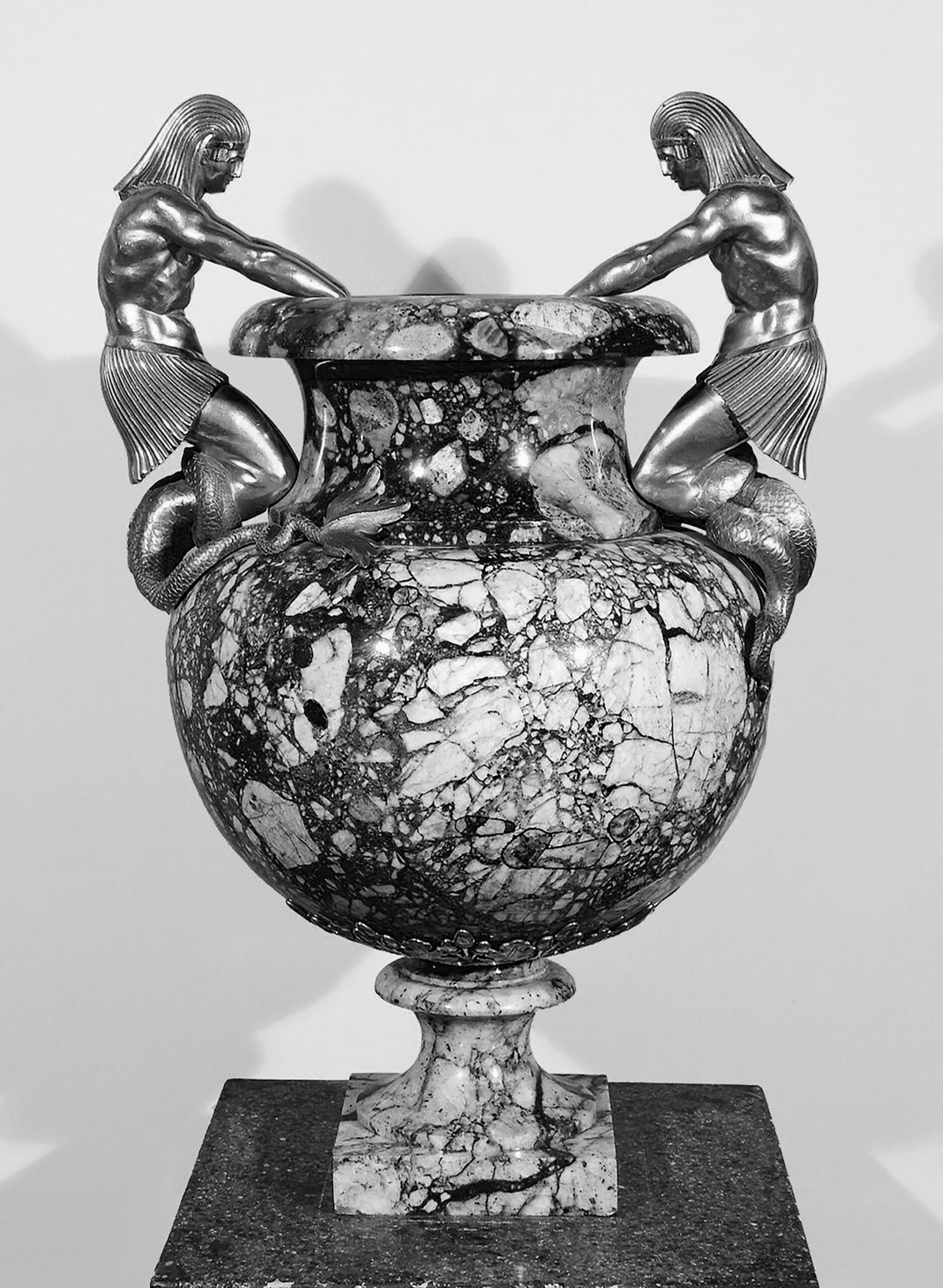
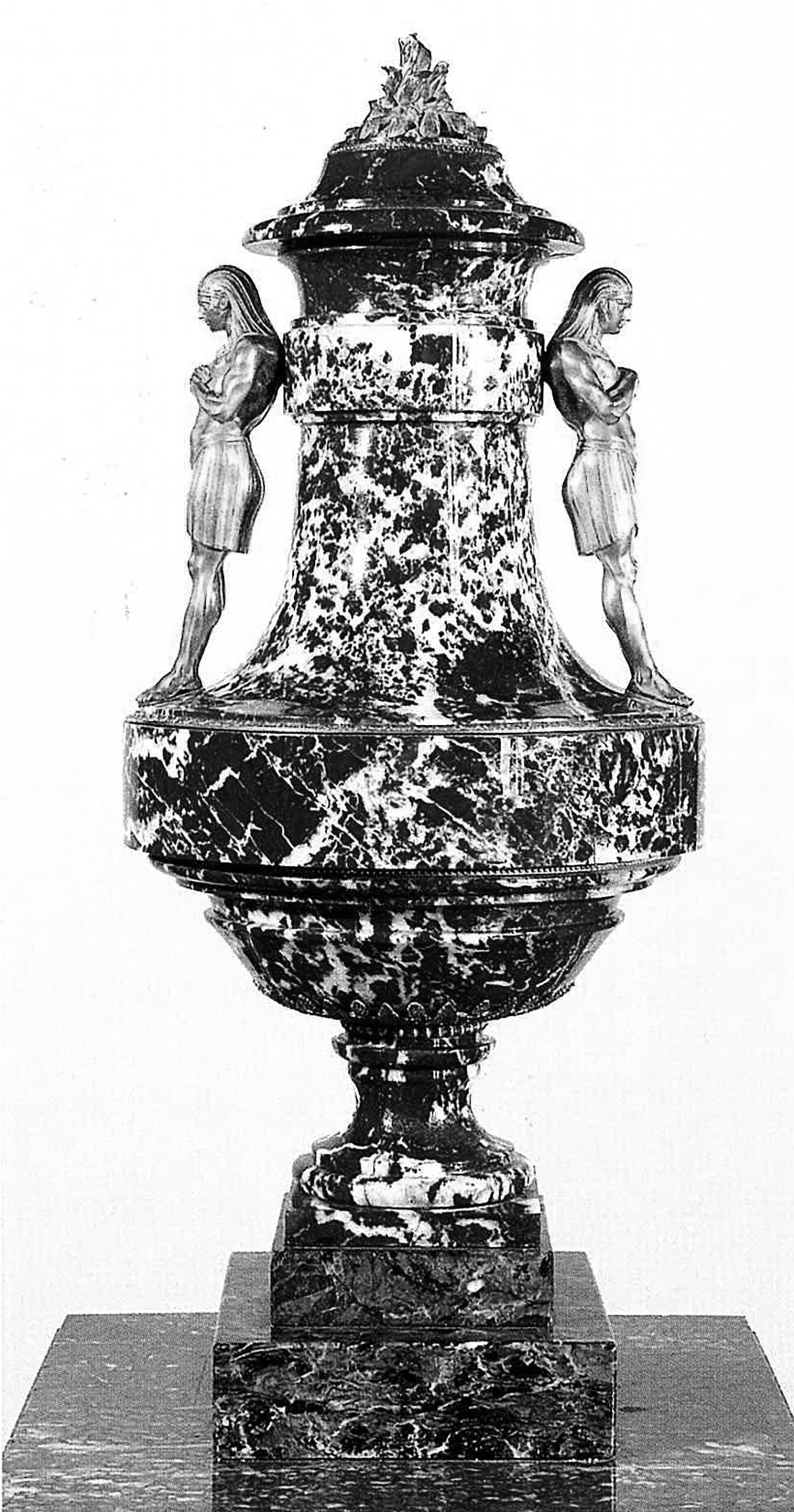
It is reminiscent of several mounted vases, all designed by Voronikhin, now in the collections of the Hermitage Museum in Saint Petersburg, most notably a pair of breccia marble vases with a reddish-brown ground, adorned with two Egyptian figures with triton tails kneeling on either side of the collar and holding the neck with their outstretched arms.
Dated circa 1801, the size of these vases has been definitively attributed, in the same way as the vase presented here, to the Yekaterinburg manufactory by E. M. Efimova, I. M. Shakinko and V. B. Semenov. In addition to this very small body of work, worthy of note is a pair of vases of similar shape, dated circa 1802, carved in milky white quartz with inclusions of black tourmaline crystals, and decorated with handles in the form of gilt bronze mascarons.
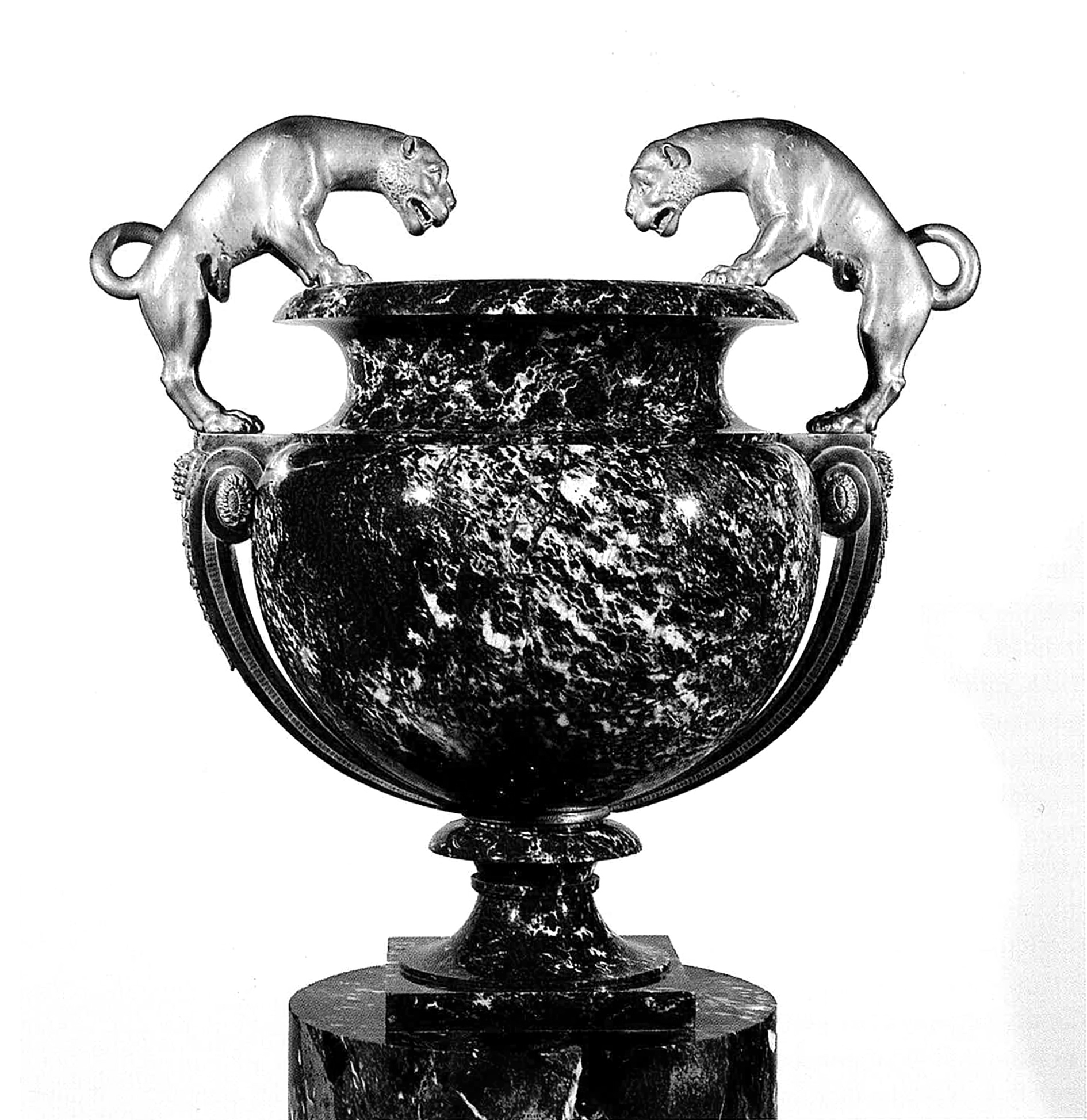
According to the inventory by I. Lukin, the vases, brought to the Hermitage on 10th September 1803, were presented and offered by Count Stroganov to Emperor Alexander I (1777-1825). Mention should also be made of a pair of Uraz jasper vases, each characterised by two imposing gilt-bronze panthers resting on the neck and supported by scrolled consoles; and a baluster-shaped jasper vase, dated circa 1805, with a high neck flanked by two standing, leaning gilt-bronze Egyptian figures.
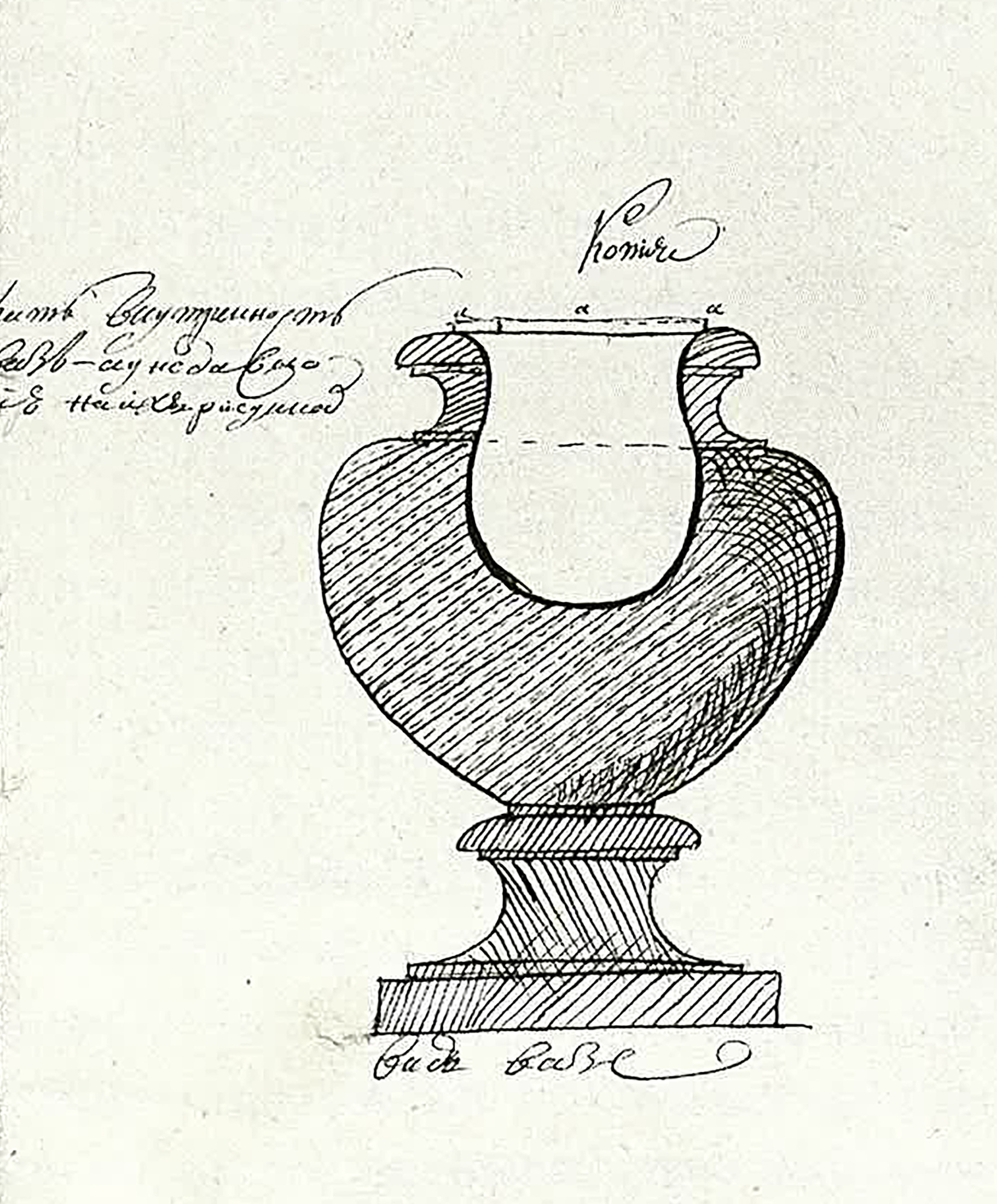
A drawing kept in the Hermitage archives, dated 1803, shows the cross-section of a vase of our model partially hollowed out, accompanied by a handwritten note stating the following wish of Count Stroganov: “I consider it necessary to suggest that from now on, when executing the vases, the interior, as indicated in the drawings, should be removed, both to lighten the heaviness thereof and to preserve their beauty […]”.
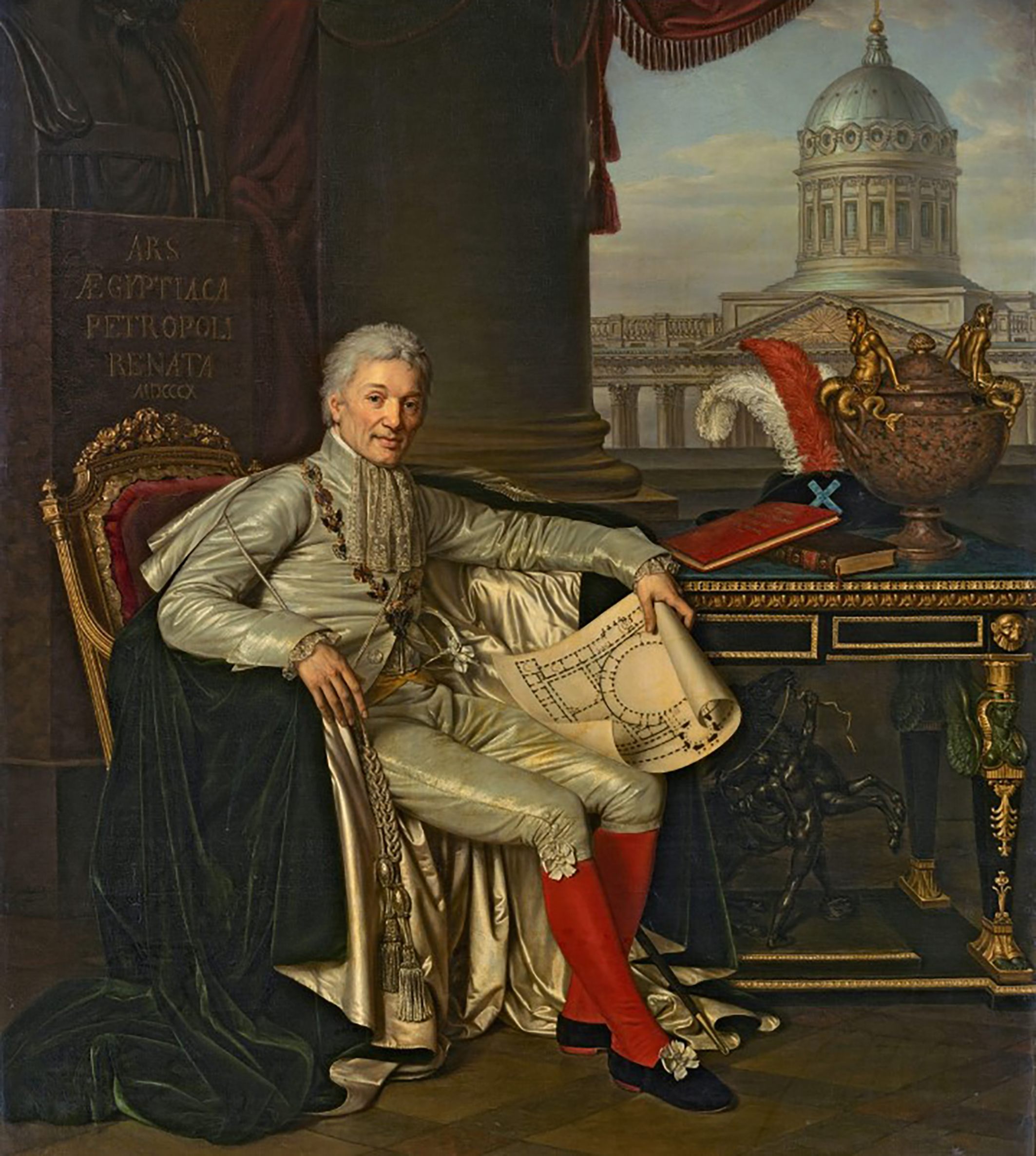
Our vase makes a masterly appearance in a posthumous and highly symbolic portrait of Count Stroganov, painted in 1814 by Alexander Grigorievich Varnek (1782-1843), based on the 1804 painting executed by the French painter Jean-Laurent Mosnier (1743-1808), showing the Count now wearing the robes of President of the Imperial Academy of Fine Arts in Saint Petersburg.
Varnek’s painting leaves nothing to chance, and is a remarkable illustration of the importance of Egyptian iconography, emanating in the first place from the power of the vase, in Count Stroganov’s Freemasonic world. On the right-hand side of the composition, the vase is placed on the lapis lazuli top of the Count’s study in the palace bearing his name, built in 1753 by the architect Rastrelli on the corner of Nevsky Prospekt and the Moika embankment, and appears at the same height as the face of its patron, seated opposite in a sumptuous Louis XVI-style armchair in gilded wood covered with red velvet. The Count wears the habit of a member of the Imperial Order of Saint Andrew the Apostle the First-Called (“Орден Святого апостола Андрея Первозванного”), the first Russian honorary order, founded on 30th August 1698 by Peter the Great, and reserved for the most important figures of the state, both civil and military.
Resting on the desk, itself characterised by an “Egyptian” decorative repertoire inspired by French models—busts of term-shaped winged sphinxes and Egyptian lion’s heads—behind the vase is the owner’s cavalry hat, whose white and red feathers highlight the pediment and the dome of the Cathedral of Our Lady of Kazan, which occupies the entire background. Built between 1801 and 1811 by Voronikhin on the orders of Paul I (1754-1801), the building was financed by Count Stroganov, who, at the Emperor’s request, chaired the commission set up for its construction, which is the main reason why the Count in Varnek’s painting is holding the plans of the building in his hand. This construction site became his main occupation for the last ten years of his life.
Behind the Count’s chair, on a rectilinear pedestal in red Finnish granite supporting a term-shaped bust of the god Zeus Amun, executed for Stroganov in 1810, in grey Serdobol granite, by the sculptor Samson Sukhanov, the author of the remarkable columns of the Kazan and Saint-Isaac cathedrals, this Latin inscription, engraved in gilded capitals, appears: ARS ÆGYPTIACA PETROPOLI RENATA / MDCCCX [“Egyptian art in St Petersburg renewed/1810”].
Lastly, adorning the crosspiece of the desk is a bronze reduction of Guillaume Coustou’s (1677-1746) masterpiece, The Horse Held by a Groom, a marble statue executed in 1745 for the watering trough at the Château de Marly, now kept in the Louvre Museum.
For Count Stroganov, the Egyptian style was not so much an aesthetic preference as proof of spiritual unity in conjunction with the enlightened part of humanity. He was the first to introduce sphinxes to Saint Petersburg, in the semblance of the ones that adorned the terraces of his dacha, built by Antonio Rinaldi and restored by Voronikhin, on the Chornaya Rechka, one of the tributaries of the Great Neva. Voronikhin was also the author of the ‘Egyptian’ décor in the Count’s study described above, a room which, according to Sergei Olegovich Kuznetsov, also housed an alchemy laboratory and a Masonic lodge. During his stay in Paris in 1756, Count Stroganoff studied chemistry, physics and metallurgy. He also frequented Masonic and Martinist lodges, where he was most notably to make the acquaintance of Voltaire! Alongside Count Andrey Petrovich Shuvaloff, the Count became one of the leaders of the Russian Voltairians.
He was also a member of the Templar Chapter of the Strict Observance, established in Russia as early as 1765, and it is hardly a coincidence that, on Varnek’s painting, the face of one of the two Egyptian mermaids in our vase seems to stare intently at the Freemasonic “Luminous Delta” symbolising the Great Architect of the Universe, which can be seen on the pediment of the Cathedral of Our Lady of Kazan. The “Egyptian” Masonic rites, an ancestral theme from the mysteries of ancient Egypt and its temples, formed a set of Masonic rites from the end of the 18th century onwards, which would become even more pronounced after the Egyptian Campaign conducted by General Bonaparte in 1798.
In Russia, the appeal of the Egyptian style was fostered not only by the development of scientific theories, knowledge of archaeological discoveries and a growing interest in the history of faraway lands, but also by a marked desire for exoticism, particularly in its Oriental forms, coupled with a fervent passion for Freemasonry, which saw a proliferation of supporters of occult teachings, fascinated by the study of mysterious symbols and “secret knowledge”, in perfect keeping with the Egyptomania that was in vogue at the time.
A Freemason and Martinist, Count Stroganov held high positions in the most influential international Masonic circles. He also grew a passion for alchemy, whose cradle was in point of fact Egypt, and Evgeny Petrovich Karnovich (1823-1885), in his book Калиостро в Петербурге (Kaliostro v Peterburge), tells us of the stay in Saint Petersburg of Count Cagliostro, who believed in the possibility of transforming metal into gold: “In addition to Elagin, Cagliostro found other credulous people, and amongst them was Count Alexander Sergeyevich Stroganov”.
It was in that very particular context that Voronikhin, who was also a Freemason just like his mentor, made countless references to Egypt, both in his decorations and his creations, and particularly so in his vase models.
Our vase remained in the Count Stroganov family until the early 20th century. Owned by Count Sergei Alexandrovich Stroganoff (1852-1923), the last representative of the dynasty, it was confiscated by the Bolsheviks, along with most of the palace’s precious collections, when they occupied the building in the wake of the 1917 Revolution. In one of the first decrees it issued, the new Soviet government naturalised the palace to the effect that it would be considered an annexe of the Hermitage Museum, thus depriving the Stroganoffs of all their property rights at the stroke of a pen.
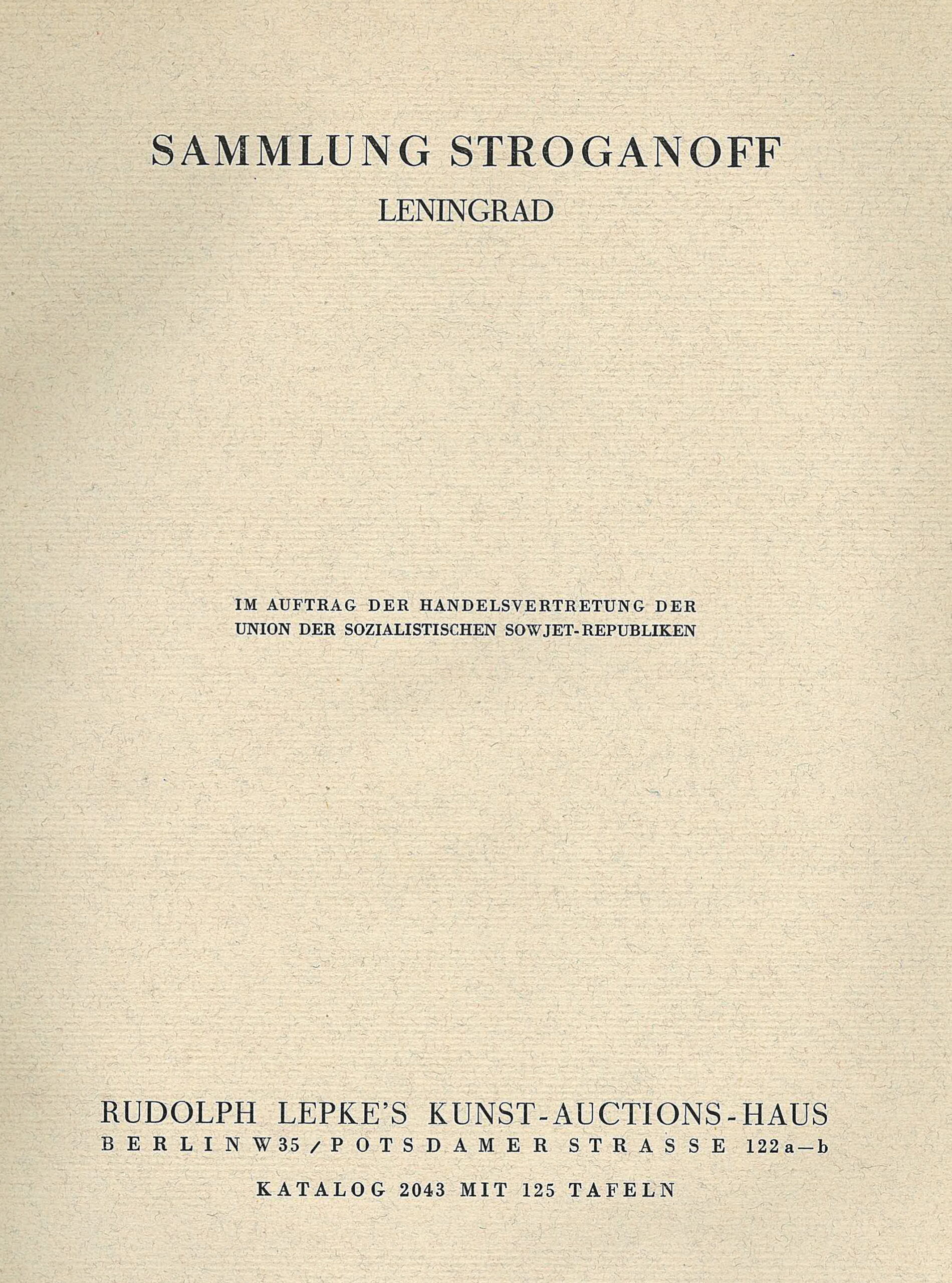
But the most tragic event of all took place in 1929, when the Soviets decided to disperse the collections in their entirety. Extremely valuable sets of works of art and minerals, as well as the contents of the library, were divided between several museums and some of the collections even disappeared without a trace. Another part, including our vase, a large number of paintings and the very best of the French decorative arts, was sold at Rudolph Lepke’s Kunst-Auctions-Haus in Berlin on 12th and 13th May 1931.
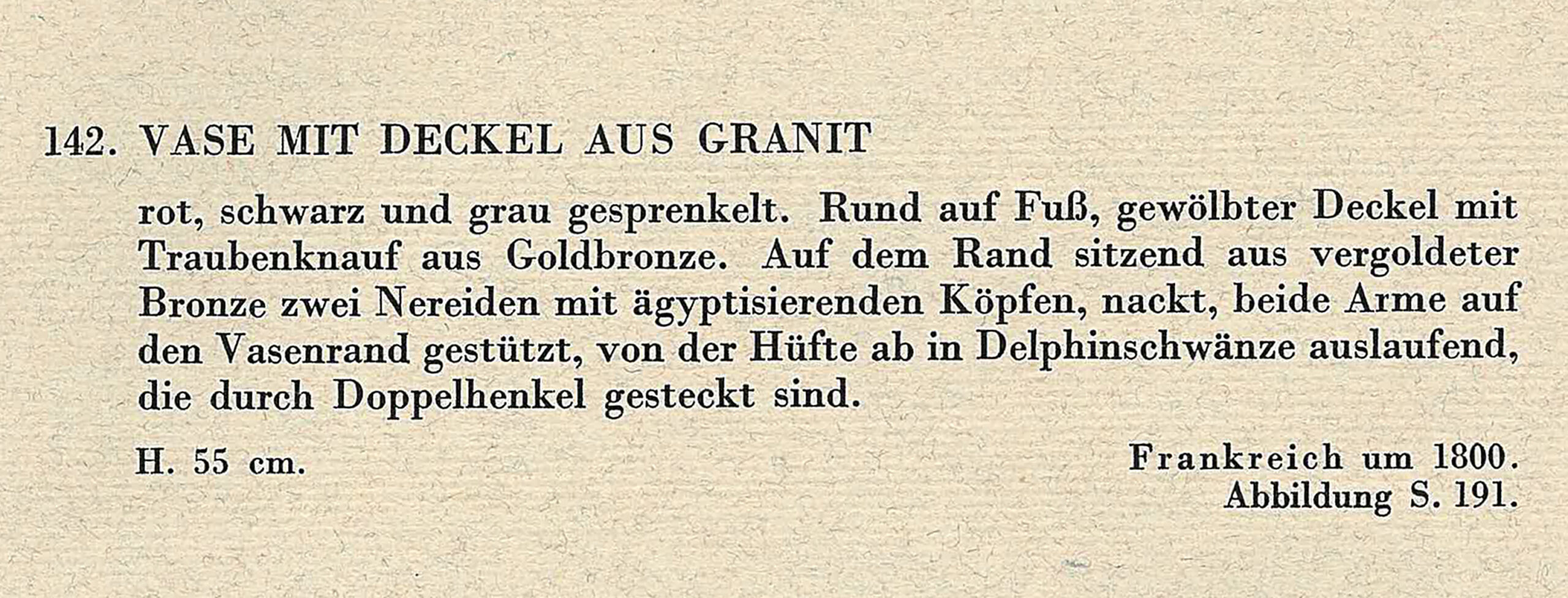
The sale generated a great deal of publicity and attracted a great many art dealers and collectors from all over the world, including Jacques Seligmann, Guy Stein, Ben Simon, K. Stern, Sabin & David of London, and J. and S. Goldschmidt. Forming lot n°. 142 of the auction, our vase, which was reproduced in the catalogue, was sold for DM 1,700 on 13th May 1931.