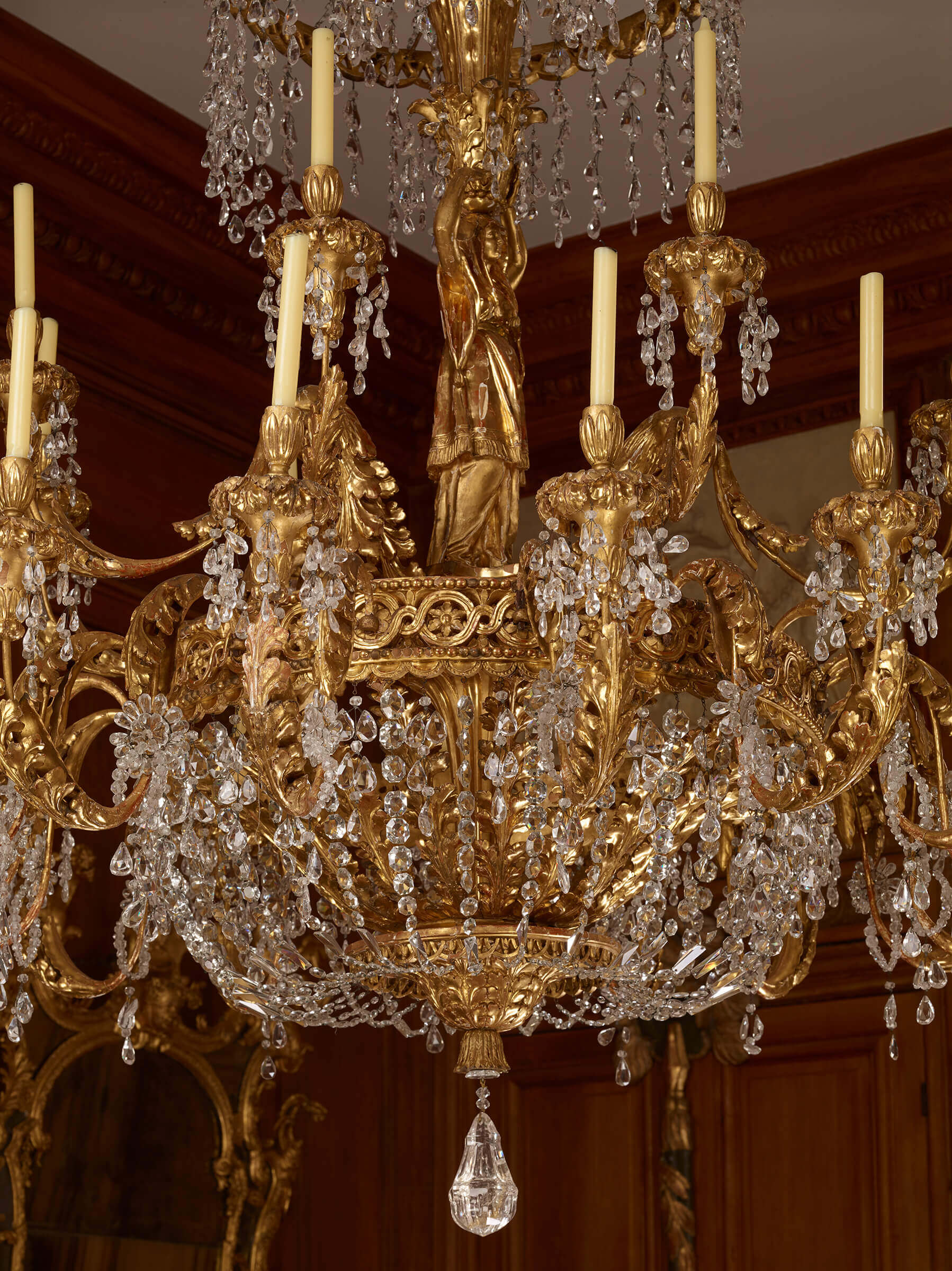
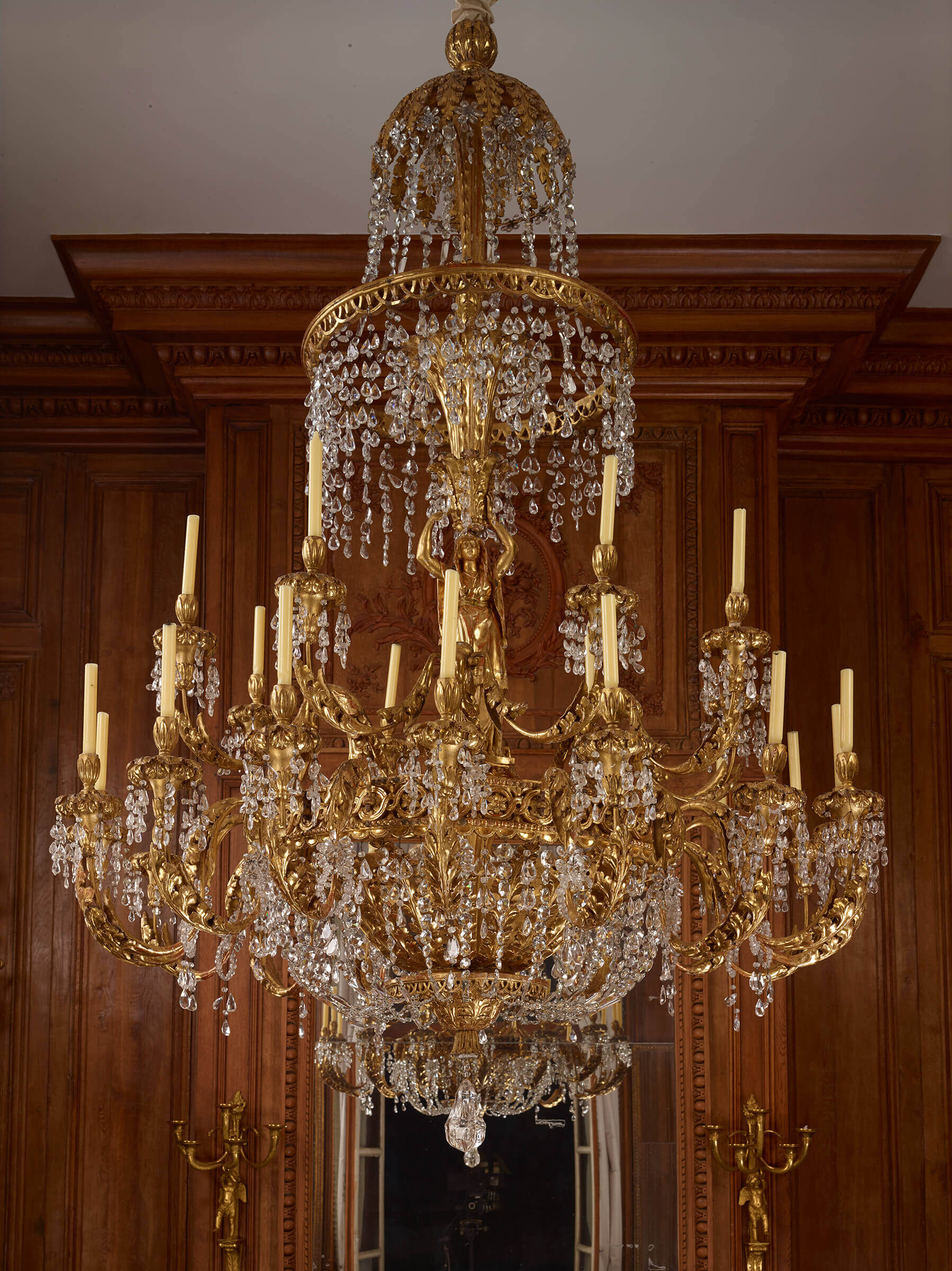
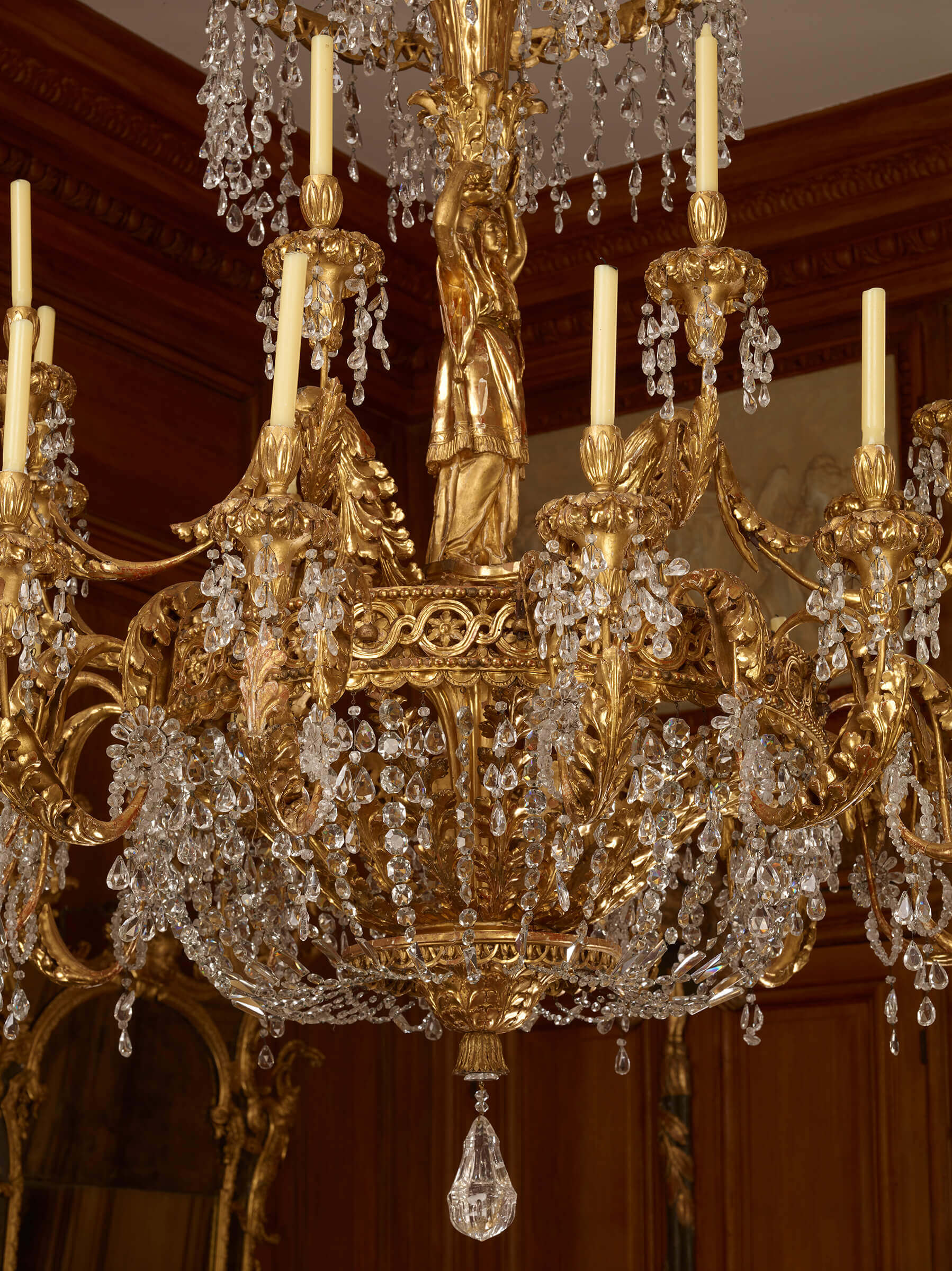
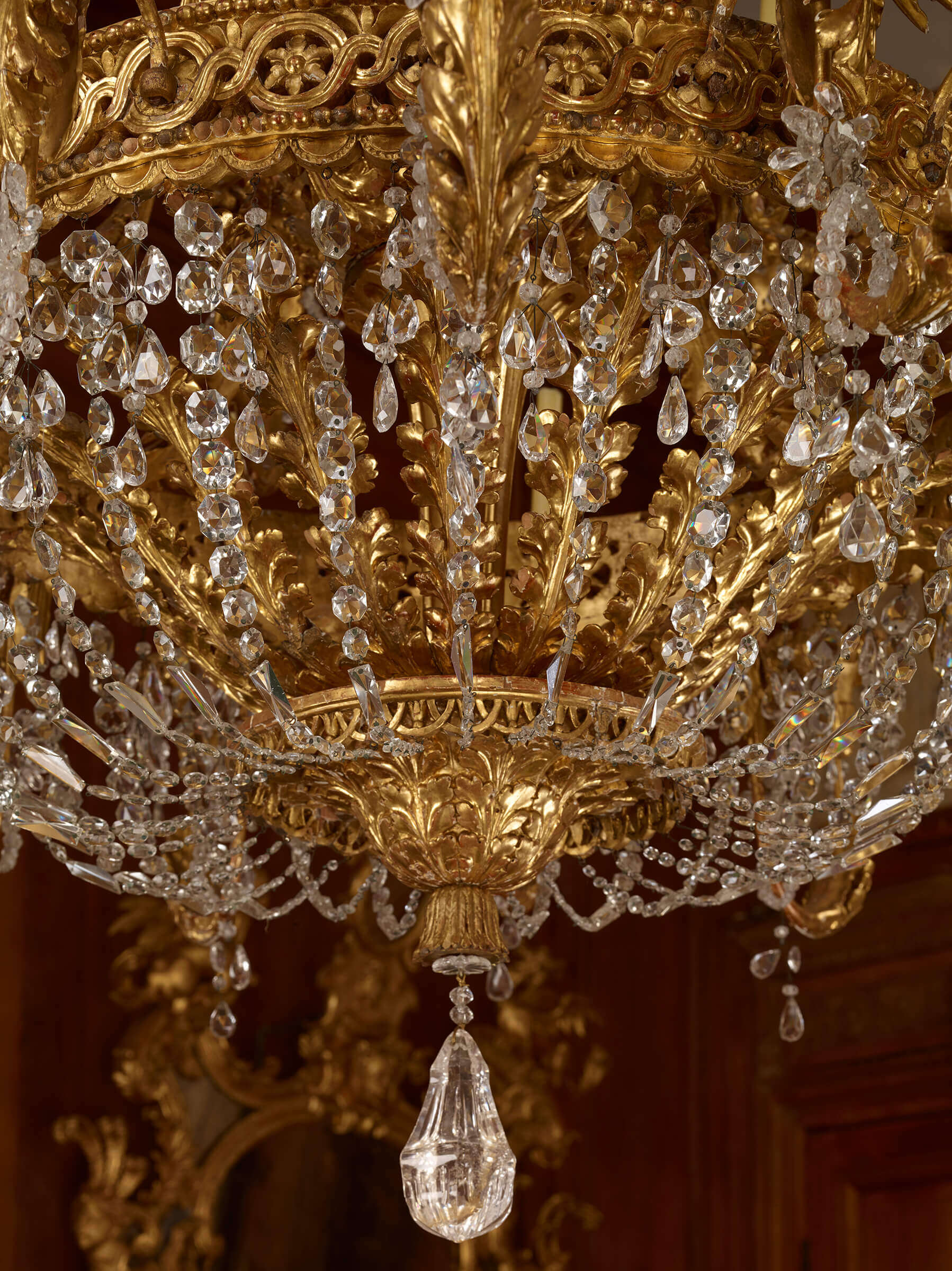
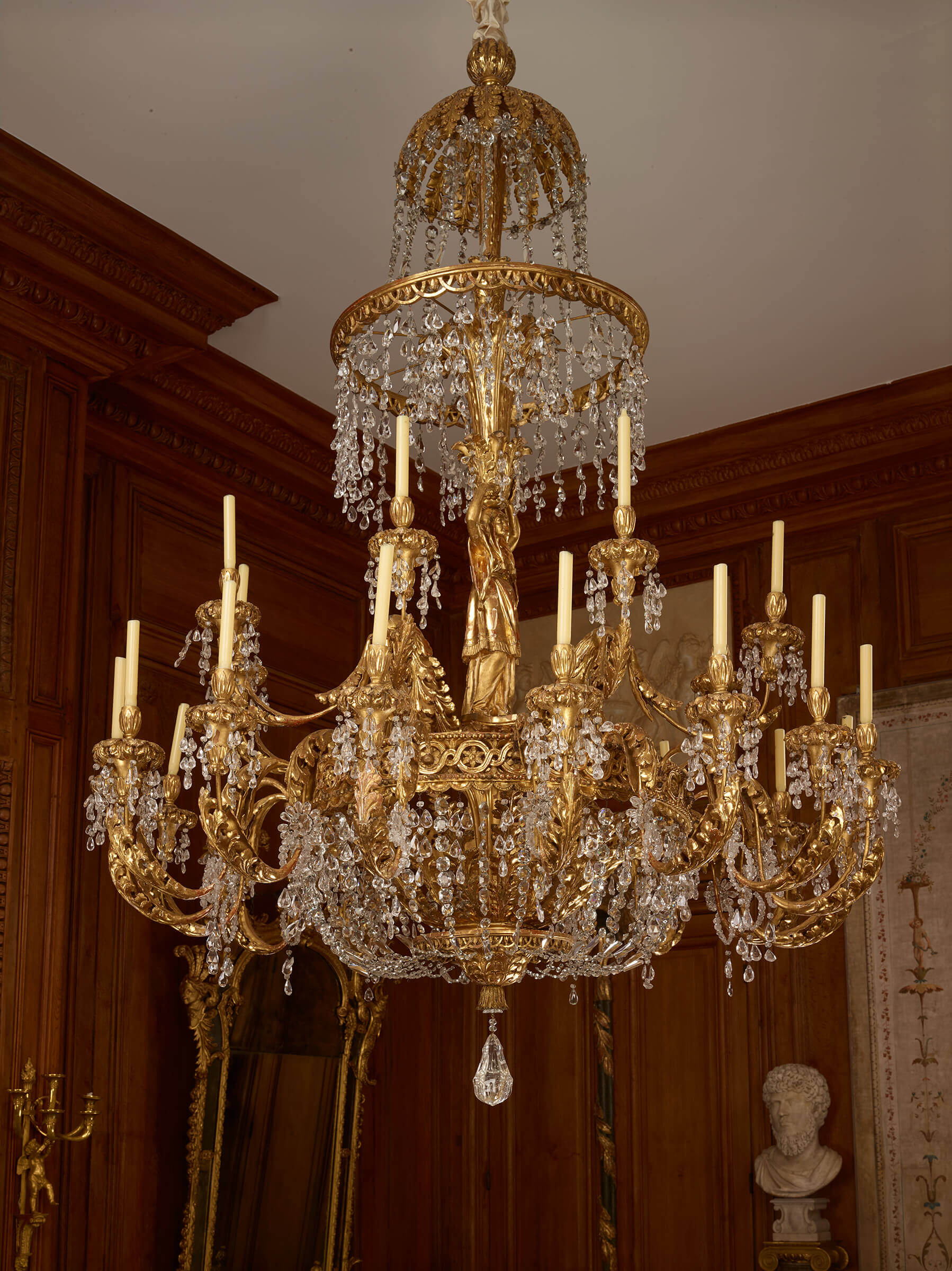
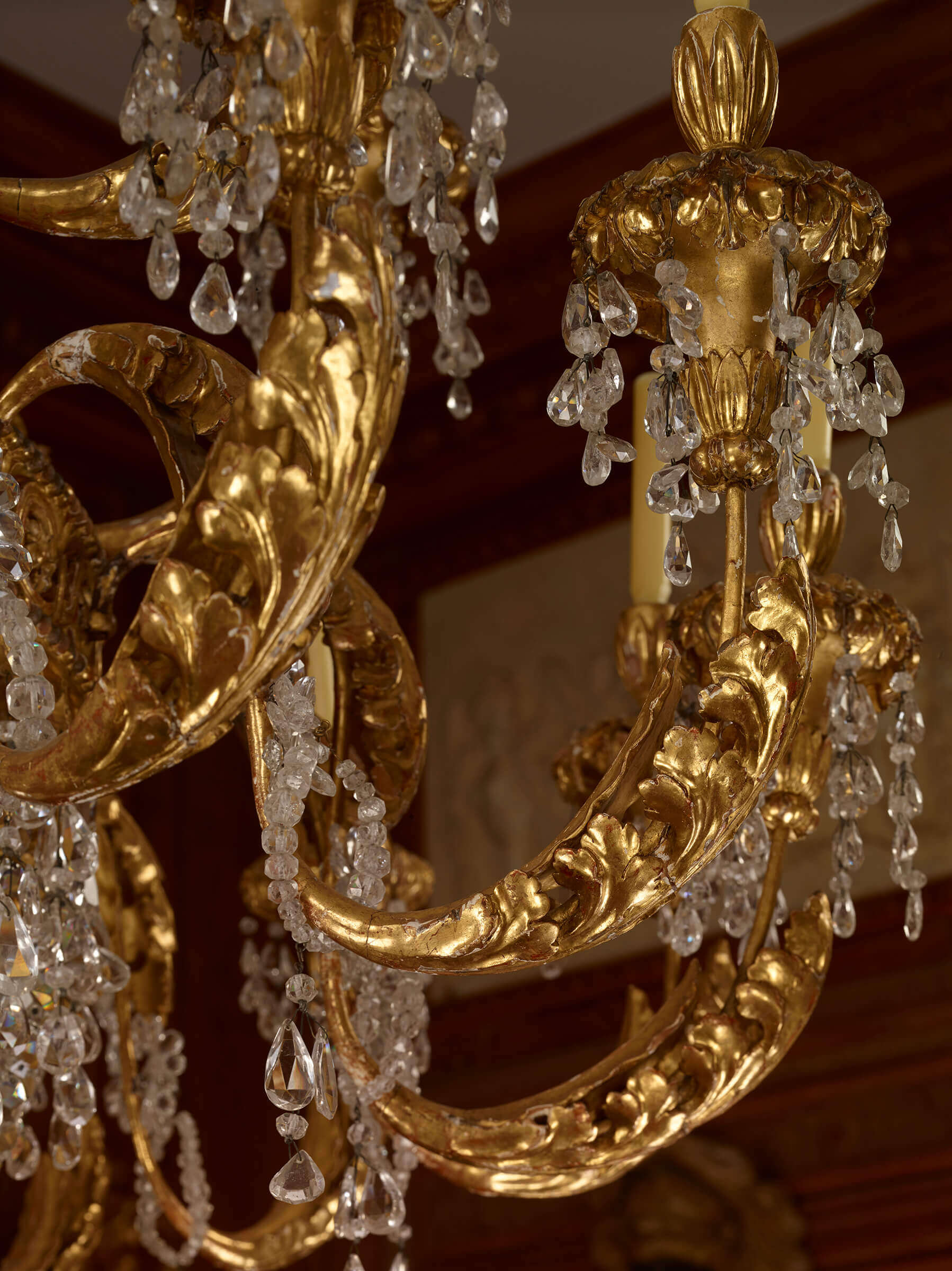
Sculpted and gilded wood, gilded metal, crystal and cut rock crystal.
H. 215 cm. (84 ¾ in.); D. 155 cm. (61 in.).
PROVENANCE: private collection, Italy
LITERATURE: Giuseppe Beretti, Un lampadario su disegno di Giocondo Albertolli, Milan, 2014, fig. 1.
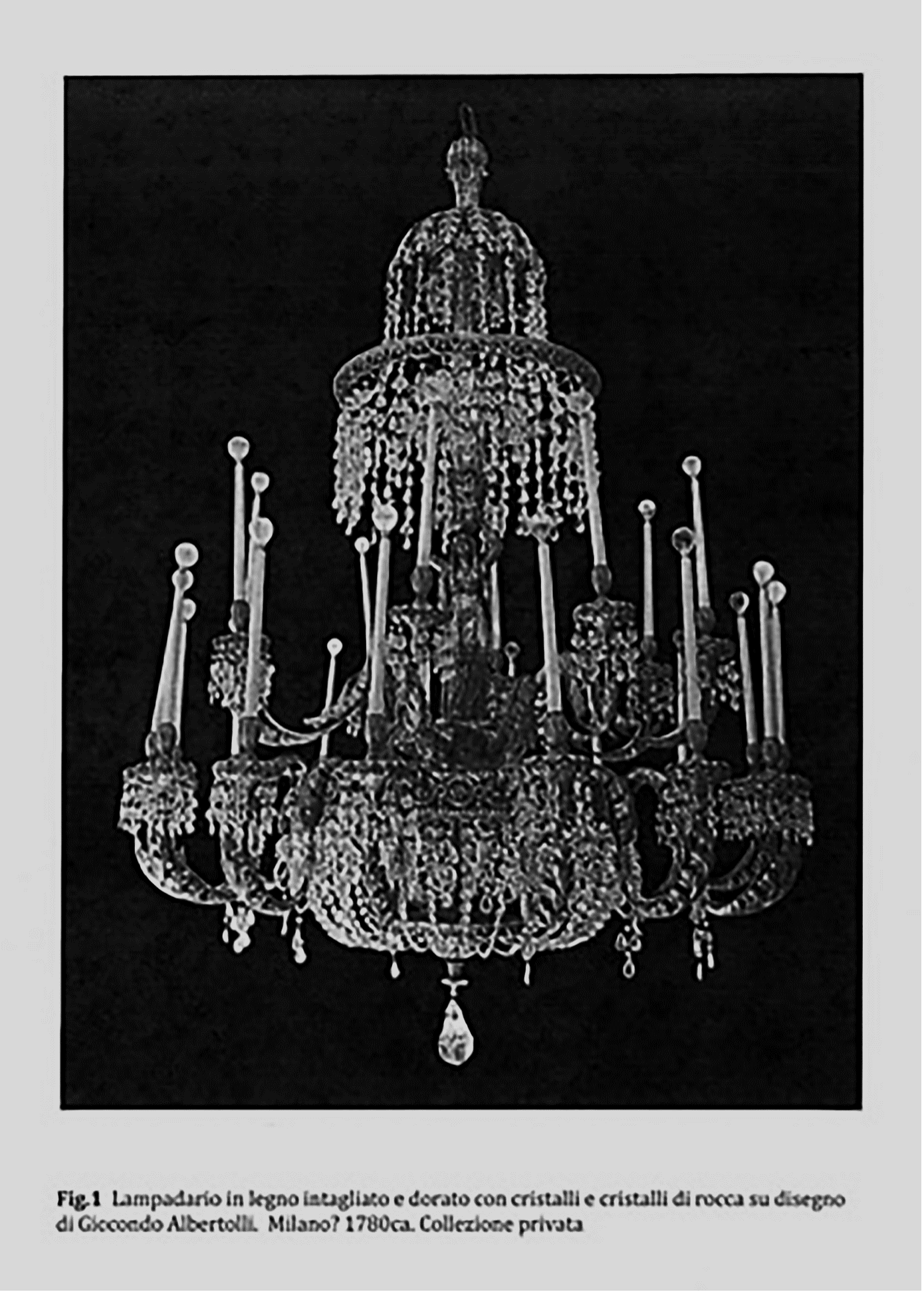
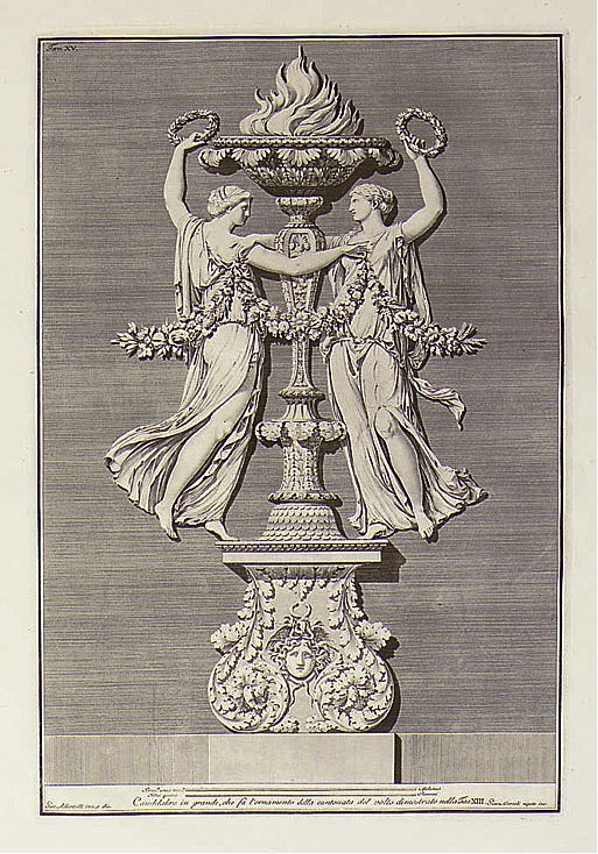
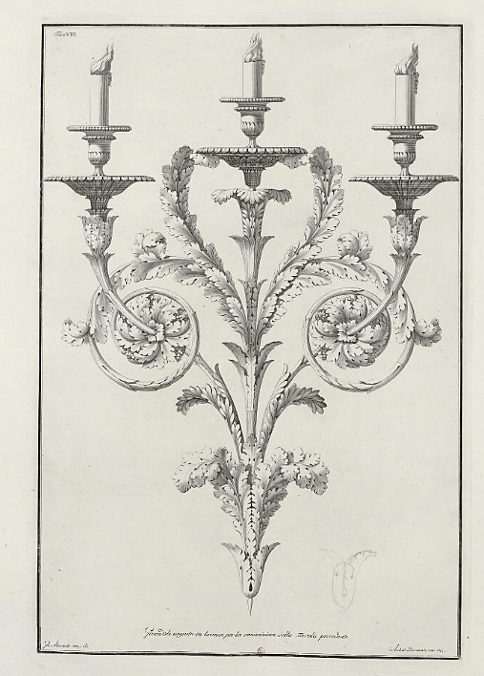
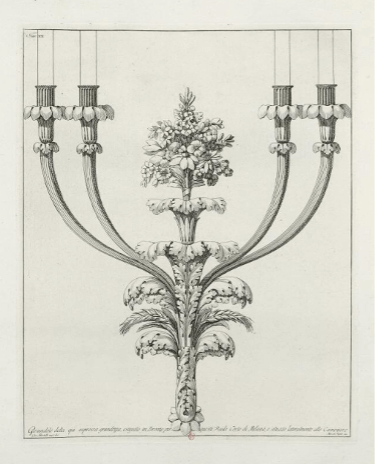
This extraordinary neoclassical chandelier, very richly sculpted in gilded wood and metal and highlighted by rock crystal and cut crystal garlands, was executed circa 1780, very certainly in Milan, after drawings by the reknowned architect of Swiss origin Giocondo Albertolli (1742-1839), who published in Milan, betweeen 1778 and 1782 a book entitled Ornamenti Diversi. Inventati, disegnati ed eseguiti da … Albertolli [ — Alcune decorazioni di nobili sale ed altri ornamenti — Miscellanea per i giovani studiosi del disegno ] who influenced many of his contemporaries.
This chandelier stands out due to its central shaft adorned with the figure of a vestal virgin, richly wraped into an Antique-like drapery and holding onto her head, with her arms up, a foliated cap supporting a succession of flared corolla forming the upper part of the chandelier. This last part is formed by a bell beaker dome composed of giltwood palmettes and crystal garlands joining a large wood and gilded metal disk with half knotwork.
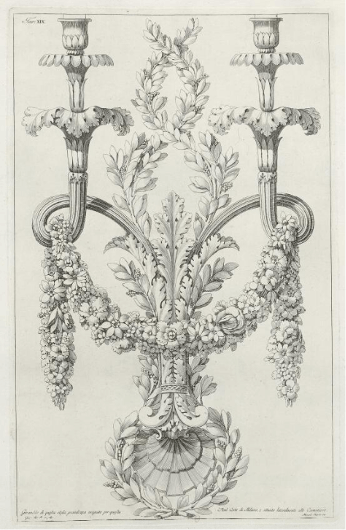
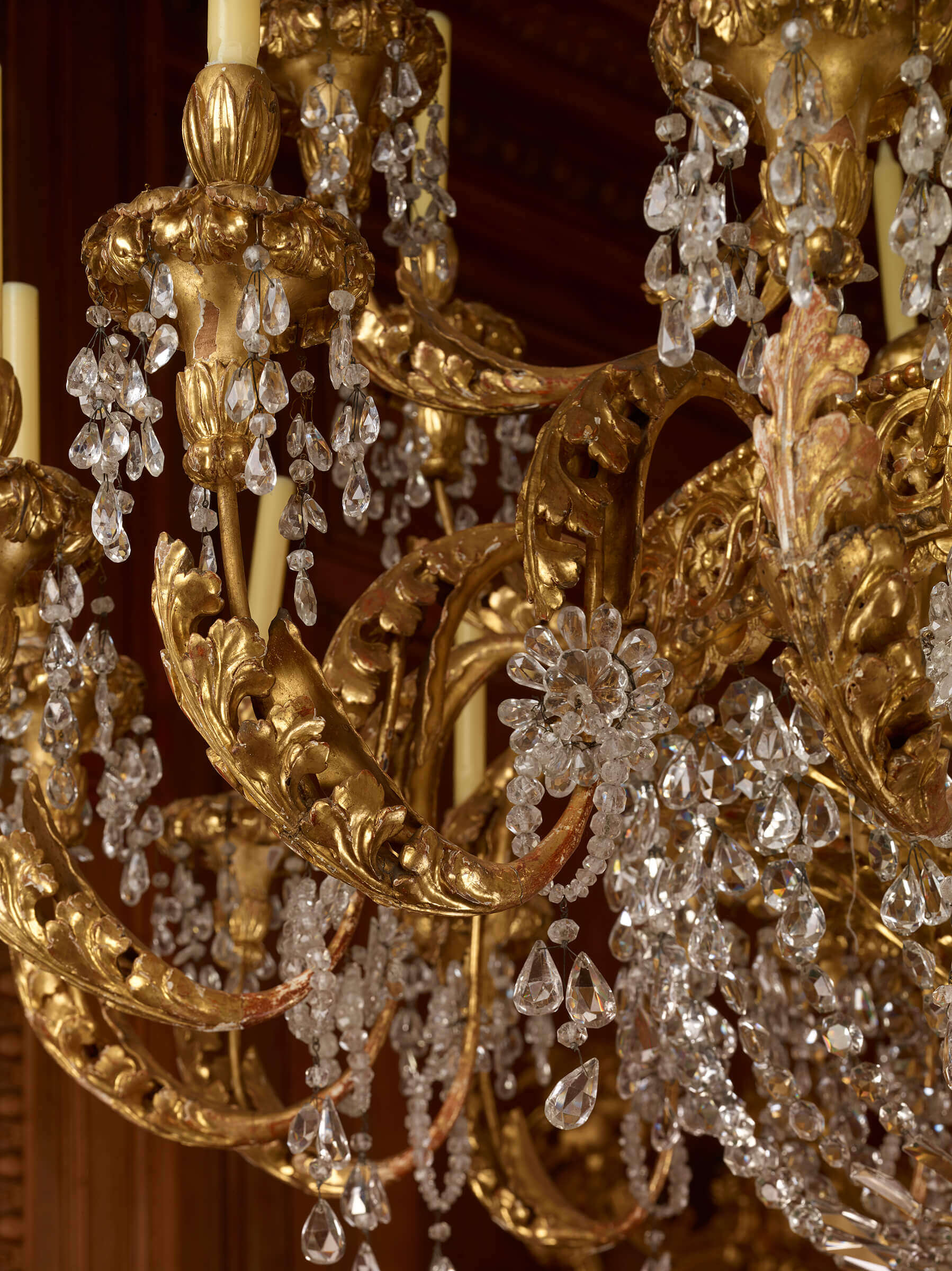
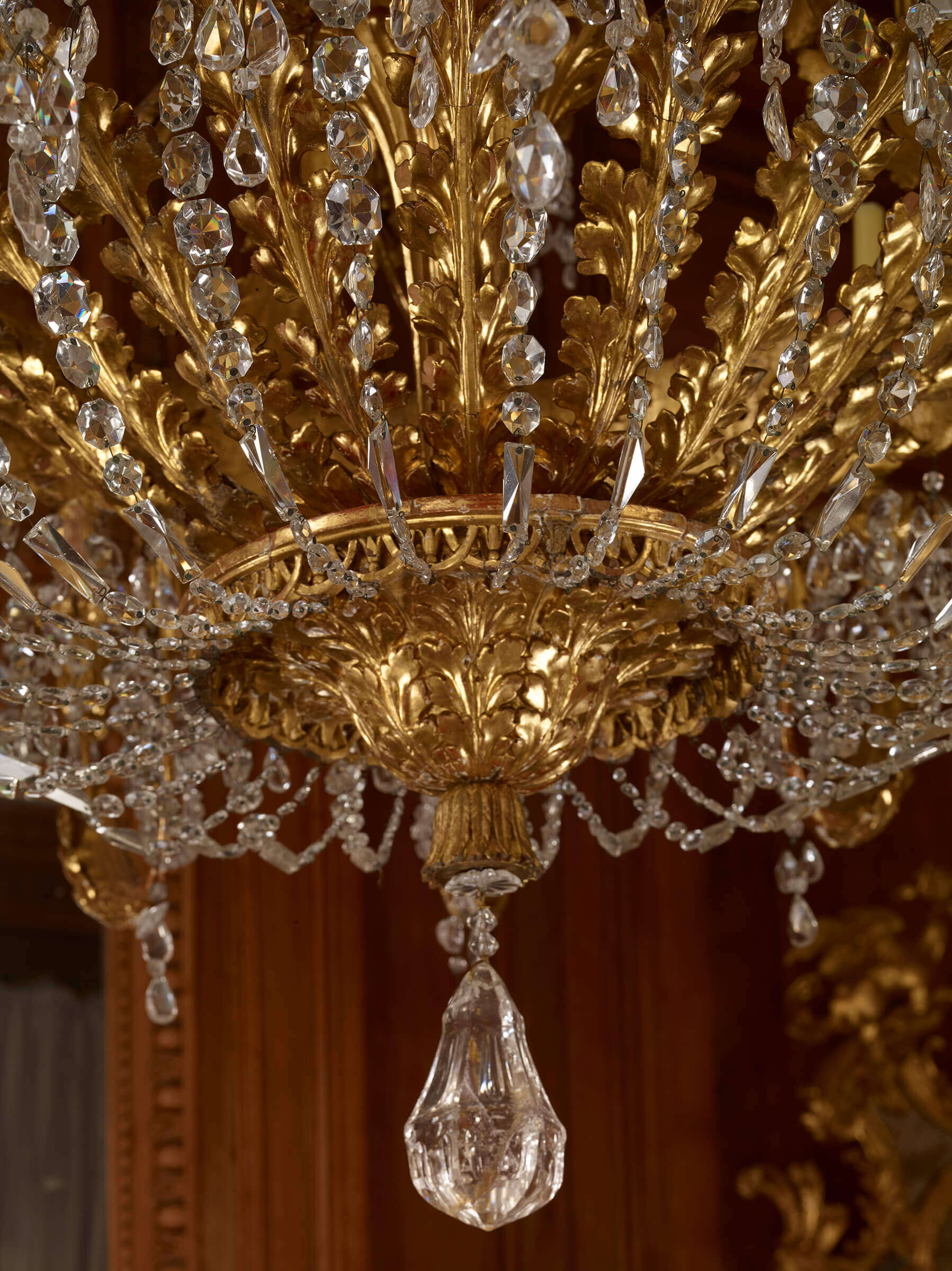
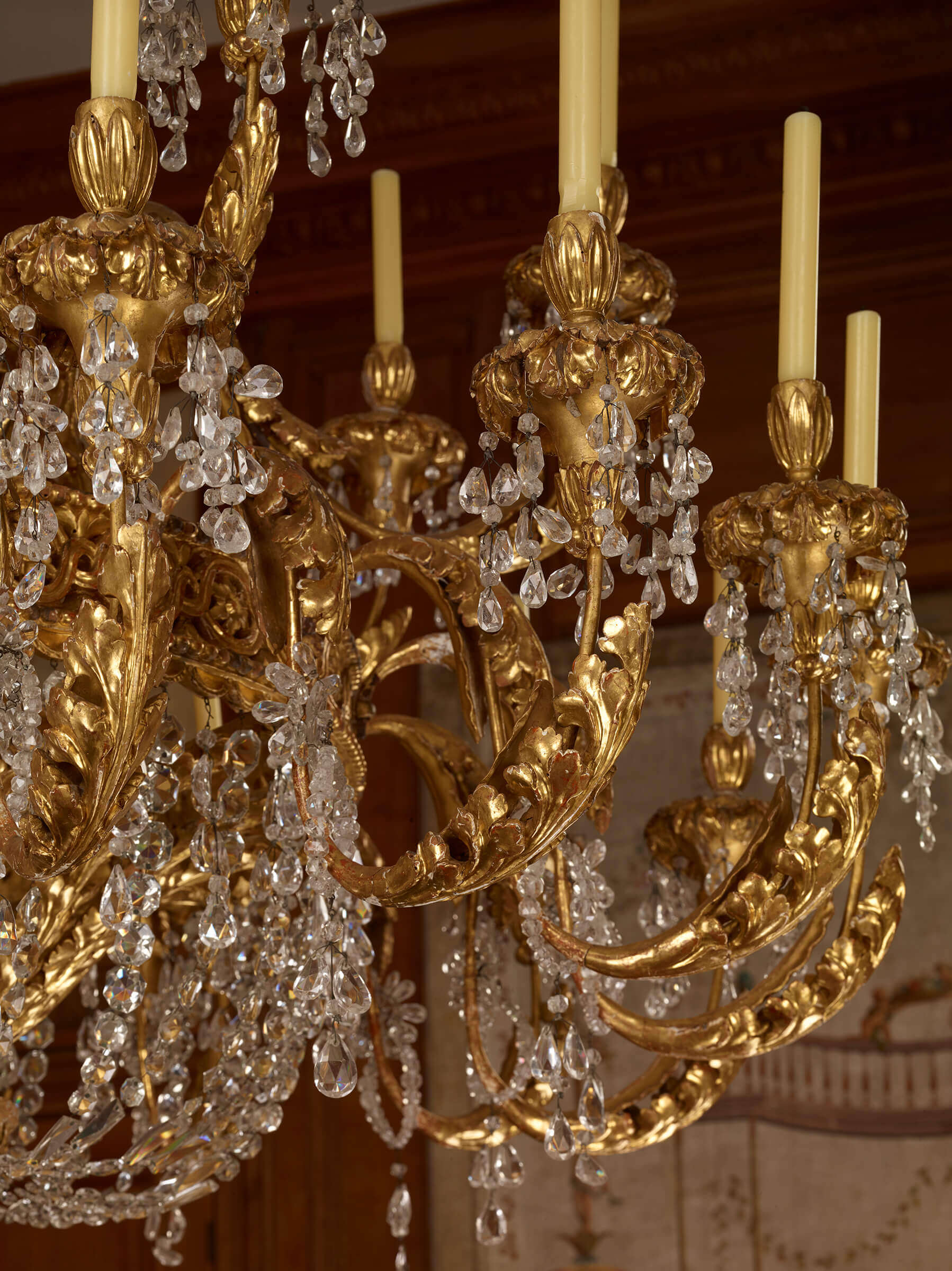
In the lower part, the belt of the chandelier is sculpted with a luxuriant frieze with knotwork and rosettes motives from which stem 16 console-shaped lights, each highlighted by a large acanthus leave and terminated by a flared bobèche évasée crowned with a foliated bulbous. A second row is formed by 8 additional lights and leans on the terrace supporting the vestal figure. The basket terminating the chandelier is composed, as is the pavillion, of an openwork corolla with scalopped palmettes and acanthus leaves joining a foliated cap from which falls a facetted rock crystal pear.
Giocondo Albertolli
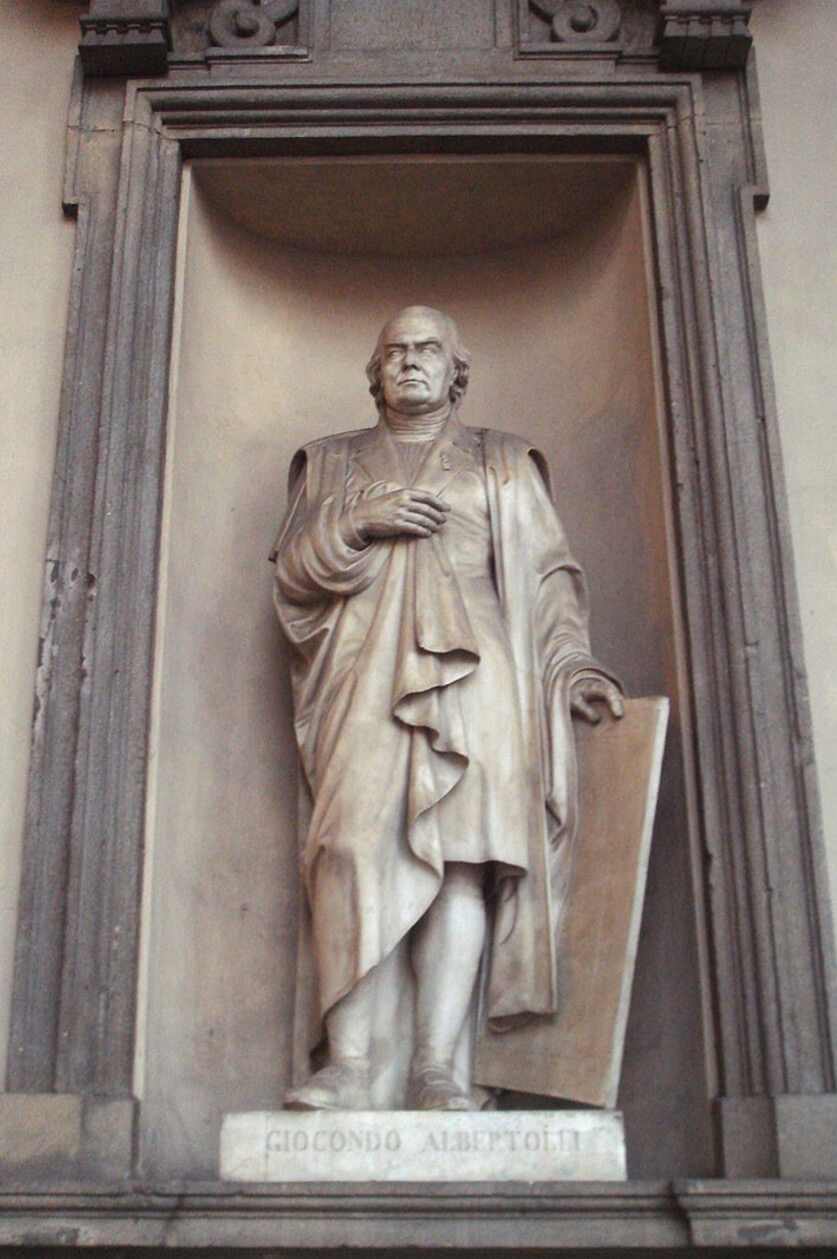
The son of Francesco Saverio, architect in Aosta, and of Margherita De Giorgi, Giocondo Albertolli was born in Switzerland, in Bedano, not far from Lugano in the Canton of Tessin, on July 24th, 1742. He became a famous architect, sculptor, decorator and painter, renowned in Italy, and more particularly in Milan, between the end of the 18th century and the beginning of the 19th century.
Albertolli trained at the Academy of Parma where he won prizes in 1766 and 1768. Throughout these years, he worked on the decoration of various churches in Parma and of the Triumphal Arch of the wedding of Duke Ferdinand (1769). Between 1770 and 1772, he worked in Florence where Pietro Leopoldo commissioned him the stuccos of the grand-ducal apartments of Poggio Imperiale, while in Parma, he decorated the Palazzo Grillo and executed the stucco of the saints Peter and Paul for the cathedral of Casalmaggiore. In 1772-1774, he went to Rome, then to Naples, where Carlo Vanvitelli commissioned him to create some of the capitals for SS. Annunziata (maybe under the direction of Giuseppe Piermarini).
In 1774, Piermarini called him to Milan to decorate the interiors of the Royal Palace. The fruitful Piermarini-Albertolli collaboration continued with the Villa Reale of Monza, the Teatro della Scala and numerous patrician palaces of Milan: Belgiojoso, Greppi or Casnedi. In the meantime, Albertolli’s commitments in Florence regarded the renovation of the rooms of the Pitti palace, of the room of the Poggio Imperiale and of the Sala della Niobe at the Uffizi. In 1779, he executed the adornments of the gallery of the ducal palace (now ‘Reale’) of Mantua. In Milan, where he decorated the Palazzo Busca-Arconati in 1789, he became a professor of ornamentation at the Academy of Brera from 1776 to 1812: the precious printed albums document his teaching activities; in 1807, he entered the Commission of Public Ornamentation.
In 1805, for the first time, Albertolli undertook a complete architectural project, renovating the palazzo of Gaetano Melzi in Milan. He conceived the Napoleonic column in Lodi (1809) and for Francesco Melzi D’Eril, vice-president of the Cisalpine Republic, he built the villa de Bellagio and the adjoining oratory. He was also commissioned by the Church to create the altar of San Marco in Milan (1810) as well as numerous tapestries and liturgic furniture for the le diocese of Ambroise. Finally, he was responsible for the transportation and the rebuilding of the small temple of San Francisco de Lugano, dating from the 16th century, in the villa Andreani in Moncucco di Brugherio, near Monza (1833).He received many distinctions: Chevalier de la Couronne de Fer (1809); member of the Academies of Florence (1783), Verona (1802), S. Luca in Rome (1815), Carrare (1818), and Vienna (1836).
The influence of his training (the restrained classicism of Petitot) can still be seen with the stuccos of the Palazzo Grillo in Parma and those of the Poggio Imperiale in Florence. Albertolli was, with Piermarini, the inventor of a very Italian taste for neoclassicism, made of sobriety, formal rectitude and didactic intention. This orientation matched the attitude of the Habsburg-Lorraine towards the Enlightenment and could easily be developed in the Milan of the Theresian period at the end of the 18th century. Even the late florentine works, such as the decorations of Palazzo Pitti, draw their inspiration from the Palazzo Reale of Milan. Through his cycles of decorative stuccos, his academic teachings and the clear plates of his albums, Albertolli became the instigator of a full maturation of Italian adorning, where architecture, decoration and furnishings interlocked. Albertolli responded with brio to the French archeological and eclectic taste, with a restrospective take on the tradition of the 16th century, seen as an alternative to the classical world.
In this way, he constituted a selective répertoire in which the Antiquity, the Renaissance and nature could be integrated. His architecture was also in the Lombardic style : the Villa Melzi in Bellagio, a building with a balanced character and similar to a park, holds a great independence towards a more pompous neoclassicism. Through his academic teachings, Albertolli completely influenced the Italian taste until the beginning of the 19th century, shaping an entire generation of artists via his innovative chair of ornamentation: from architects to cabinet-makers, by way of goldsmiths and embroiders.
Works: Bellagio, Villa Melzi; Florence, Palazzo Pitti; Florence, Poggio Imperiale; Florence, Uffizi; Milan, Palazzo Belgiojoso; Milan, Palazzo Busca-Arconati; Milan, Palazzo Casnedi; Milan, Palazzo Greppi; Milan, Palazzo Reale; Monza, Villa Reale; Parme, Palazzo Grillo, today Marchi.