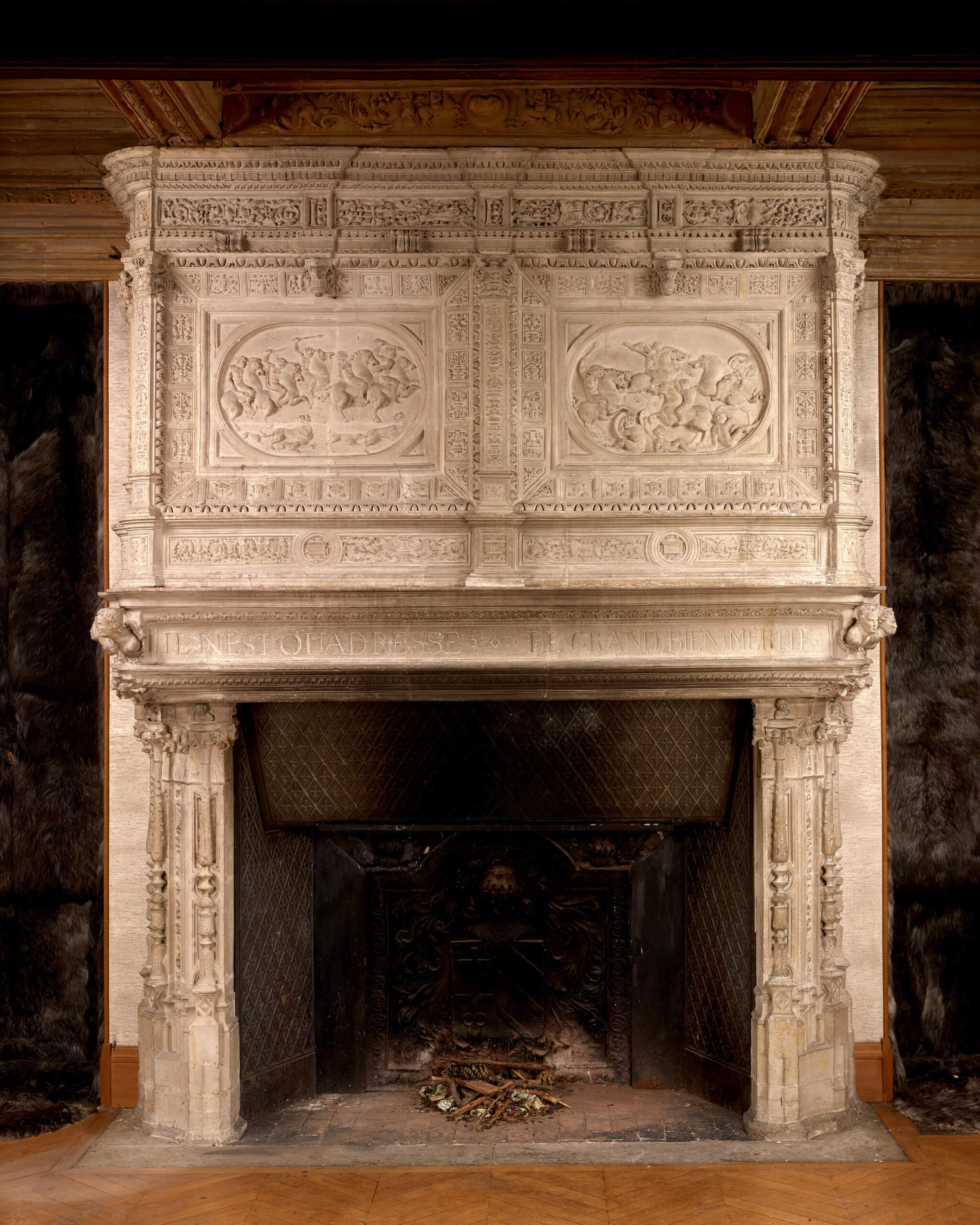
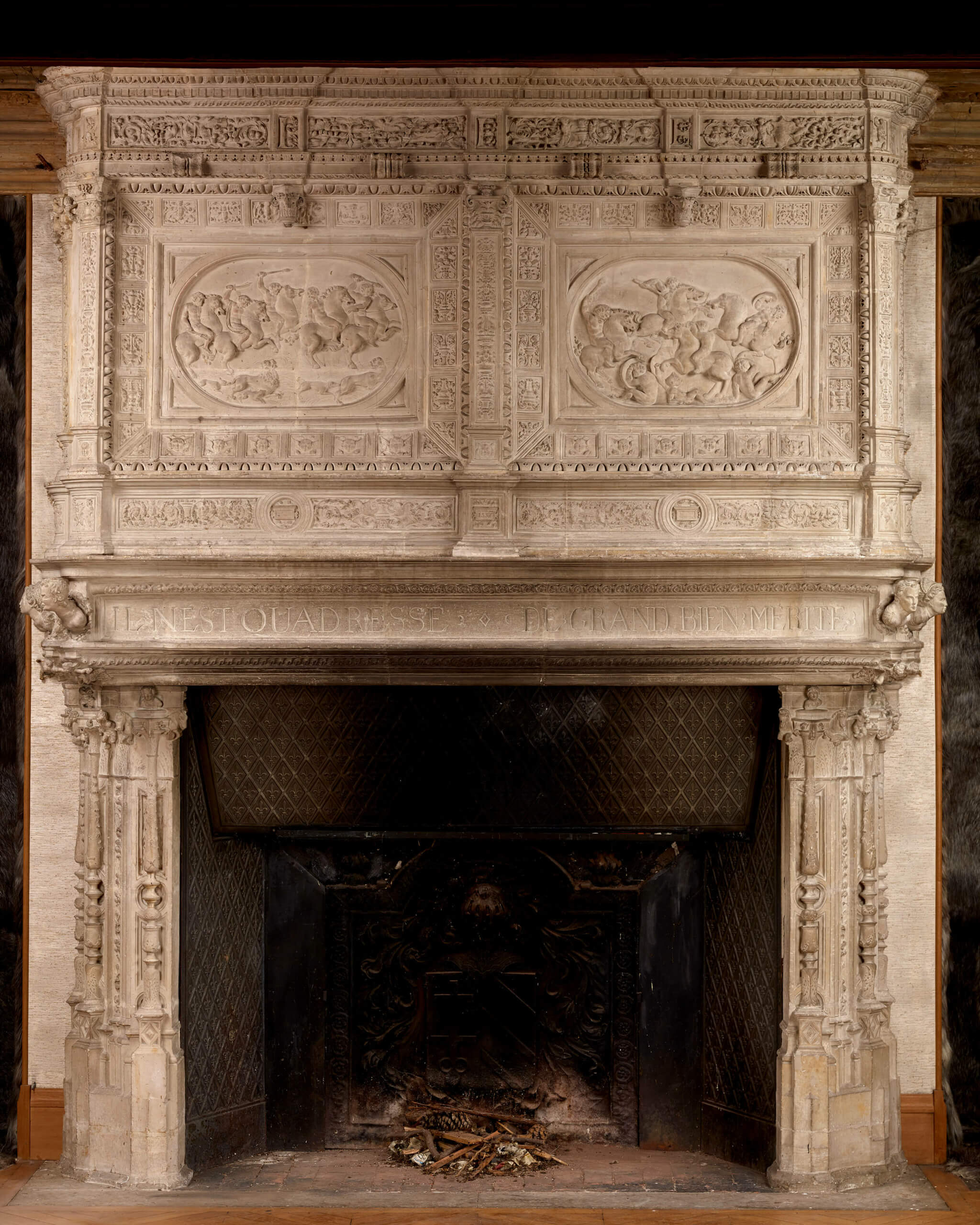
Sculpted from Tonnerre stone (Yonne).
Overall H.: 4.20 m (13 ¾ ft.); W. at the cornice: 3.75 m (12 ¼ ft.); D.: 92 cm (36 ¼ in.).
H. to lintel: 2.45 m (8 ft.); W. of lintel: 3.55 m (11 ¾ ft.).
Firebox dimensions: H. 1.90 m (6 ¼ ft.); W. 2.15 m (7 ft.).

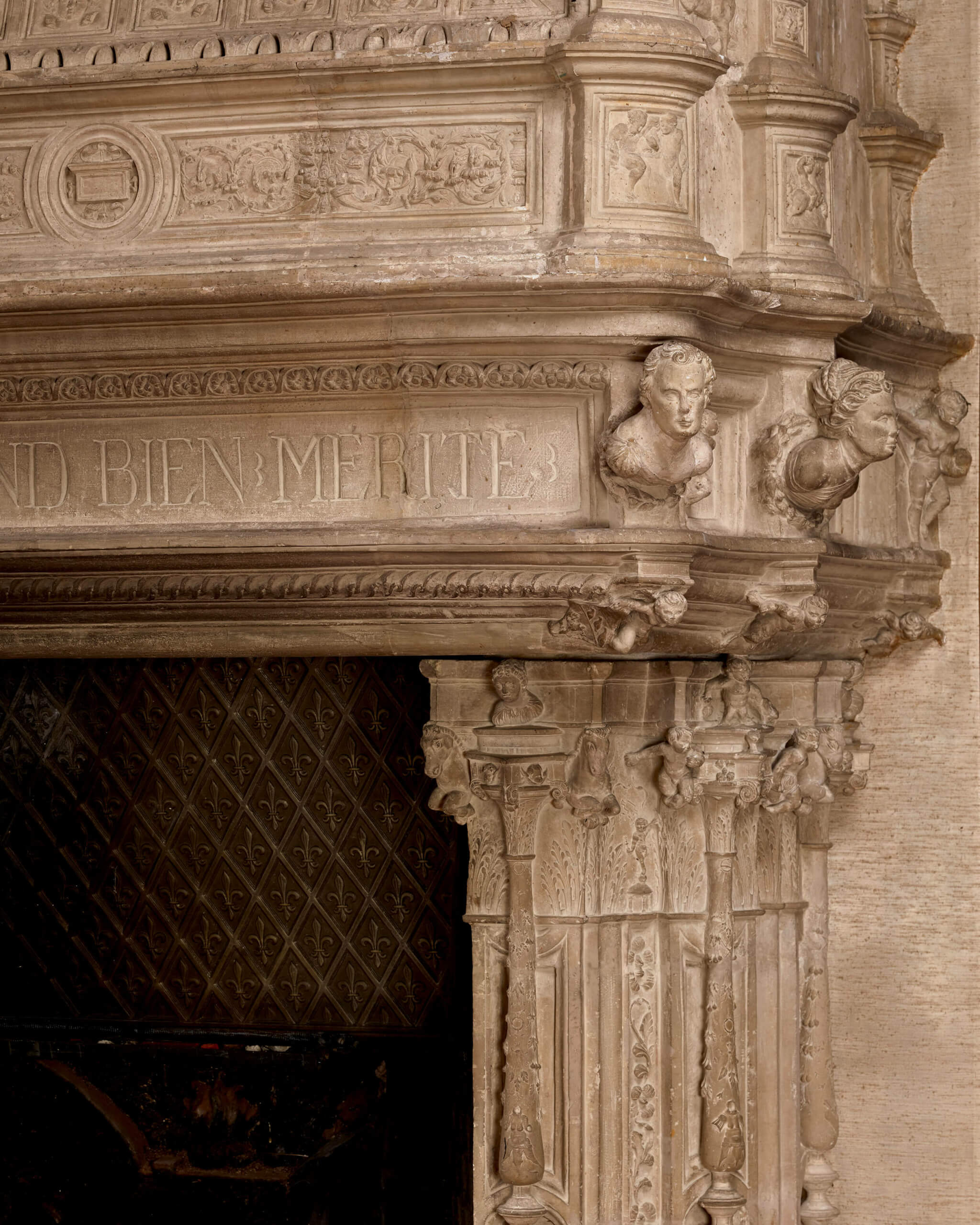
MARKS AND INSCRIPTIONS: 1534, engraved within a raised panel at the centre of the base of the fireplace hood; Merlan family blazons: “Gules, a lion Or holding in its dexter a crescent Argent surmounted by a mullet of the same; on a chief Azure three martlets Sable,” visible on either side of the frieze beneath the fireplace cornice; THERE IS NO SKILL BUT IN THE GREATEST MERIT, the Merlan family motto, engraved on the lintel.


View of our fireplace in situ at the château of Arnay-le-Duc, drawn, engraved, and reproduced by Claude Sauvageot, Palais, châteaux, hôtels et maisons de France, du XVe au XVIIIe siècle, vol. IV (4 vols.), Paris, 1867–1870, pl. XXXV / pl. 1.


PROVENANCE: Executed in 1534 for Philippe Merlan (1503–1546), Baron of Montpont and lord of Jully-lez-Arnay-le-Duc, Controller and General of Finances in Burgundy and Bresse under François I, for his château at Arnay-le-Duc, Côte-d’Or, Burgundy-Franche-Comté; later owned by his son, Gabriel Merlan (1528–1562), Baron of Montpont and lord of Jully-lez-Arnay-le-Duc like his father, Treasurer of France and General of Finances in Burgundy and Bresse; after 1562, part of the collection of the Chabot-Charny family; sold in 1634 by Françoise Bernarde de Montessus, Countess of Charroux and widow of Charles de Chabot, Marquis of Mirebeau, to Henri II de Bourbon-Condé, First Prince of the Blood, Peer of France, and Grand Huntsman of France; held until 1675 by his son, Louis II de Bourbon-Condé, famed victor of Rocroi (1643); returned in 1675 to the Chabot family, who retained it until 1778. During this period, the lands of Arnay passed from the Chabots to the Rohans and then, through marriage, to the Brionne family; sold in 1778 by Marie-Louise-Julie-Constance de Rohan, Countess of Brionne, to the royal house of the Dames de Saint-Cyr which remained in the château until the Revolution; serving as the seat of the municipality, it was sold in 1792 as national property. It then passed through several owners until it was purchased in the mid-1860s by Jean-François-Henri Bouruet (1801–1870), one of the wealthy proprietors of the famous Parisian stores “Au Gagne-Petit.” He undertook the removal of much of its woodwork, sculptures, and eight fireplaces, including the one presented here. This fireplace was reinstalled after that date in one of the rooms of the neo-Renaissance Château de Villemenon in Servon, Seine-et-Marne, which Jean-François-Henri Bouruet had built during the same period; it has remained there to the present day. After M. Bouruet’s death in 1870, the château of Villemenon was successively owned by M. Jeanson (1870–1875), M. Boutet (1875–1911), M. Drouin, M. Méhu, a banker in Paris, and finally by Hélène Martini (1924–2017), the renowned director of theaters, cabarets, and performance halls, nicknamed the “queen of Parisian nightlife.”


LITERATURE: Claude Sauvageot, Palais, châteaux, hôtels et maisons de France, du XVe au XVIIIe siècle, t. I (4 vol.), Paris, 1867-1870, p. 57-72 et pl. XXXV / pl. 1 à XXXVII ; V. -F. Maisonneufve, « Arnay-le-Duc », Musée universel : revue illustrée hebdomadaire, Paris, 1874, 1er trimestre, Éditeur : A. Ballue, p. 193-194 ; Georges Tubeuf, Traité d’architecture théorique et pratique, tome III, Types de constructions diverses. Habitations particulières, Paris, 1890-1898, p. 267, fig. 425 ; Georges Tubeuf, La décoration à travers les âges, Paris, 1903, pl. IV ; Maurice Pignard-Péguet, Histoire générale illustrée des départements […], Seine-et-Marne : histoire des communes, guerres, seigneuries, anciens monuments, églises, châteaux […], A. Gout (Orléans), 1911, p. 217 ; Didier Godard, Les Châteaux du canton d’Arnay-le-Duc, éditions d’Arnay, 2009, p. 6-11 ; Les Itinéraires, Côte-d’Or, édition projection, p. 305 ; Françoise Vignier, Guide des châteaux de France, (21) Côte-d’Or, Hermé, 1985, p. 21-24 ; Arnay-le-Duc et son canton à travers les cartes postales anciennes. Les Amis du pays d’Arnay, Fuchey SA, 1980, p. 24 à 27.


A masterpiece of the early French Renaissance, this monumental fireplace carved from Tonnerre stone (Yonne) was executed in 1534 under the reign of François I for Philippe Merlan[1] (1503–1546), Baron of Montpont, Lord of Jully-lez-Arnay-le-Duc, and Controller-General of Finance in Burgundy and Bresse. It was designed to adorn, on the first floor, one of the principal rooms of his château in Arnay-le-Duc, Côte-d’Or, in the Bourgogne-Franche-Comté region.

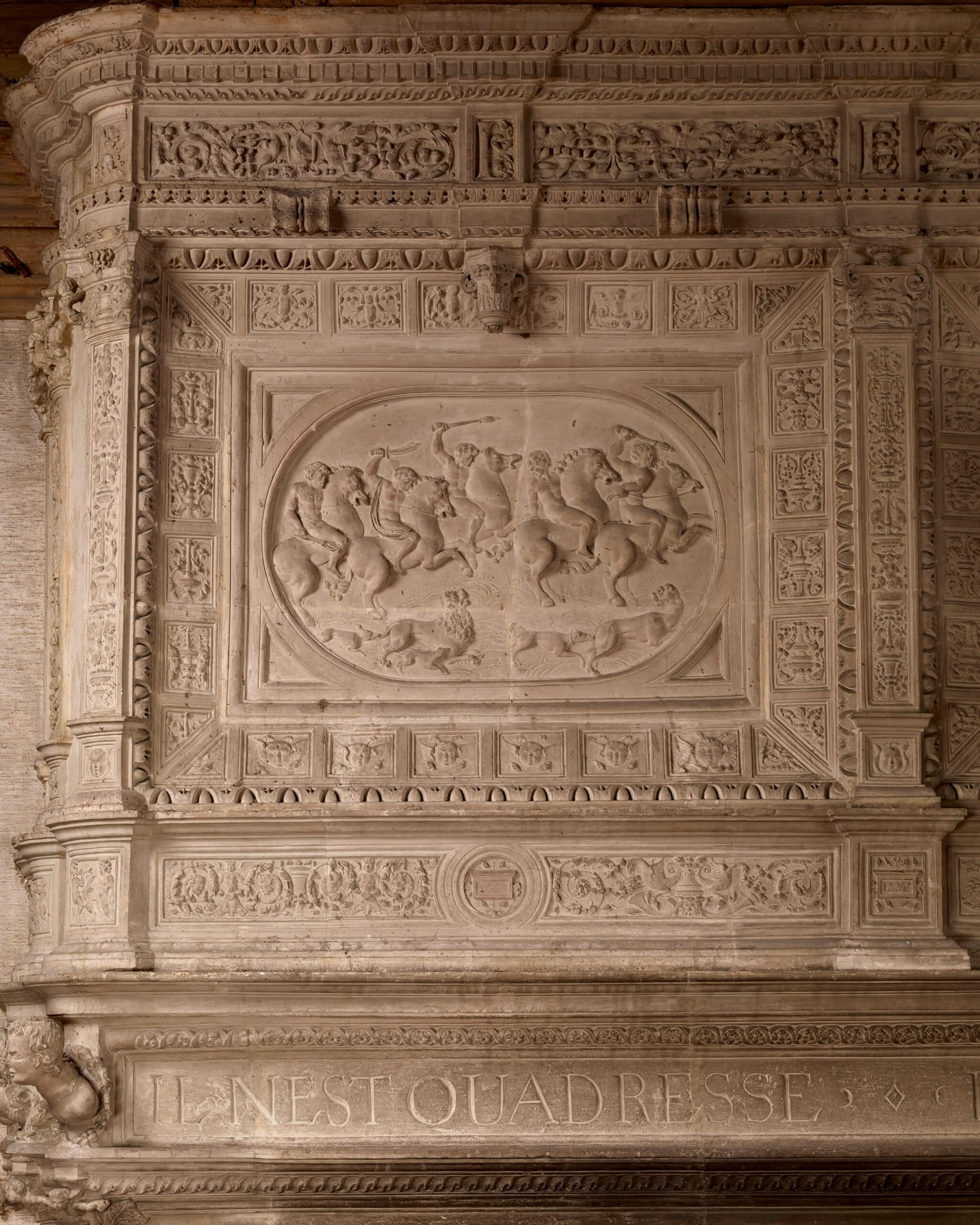
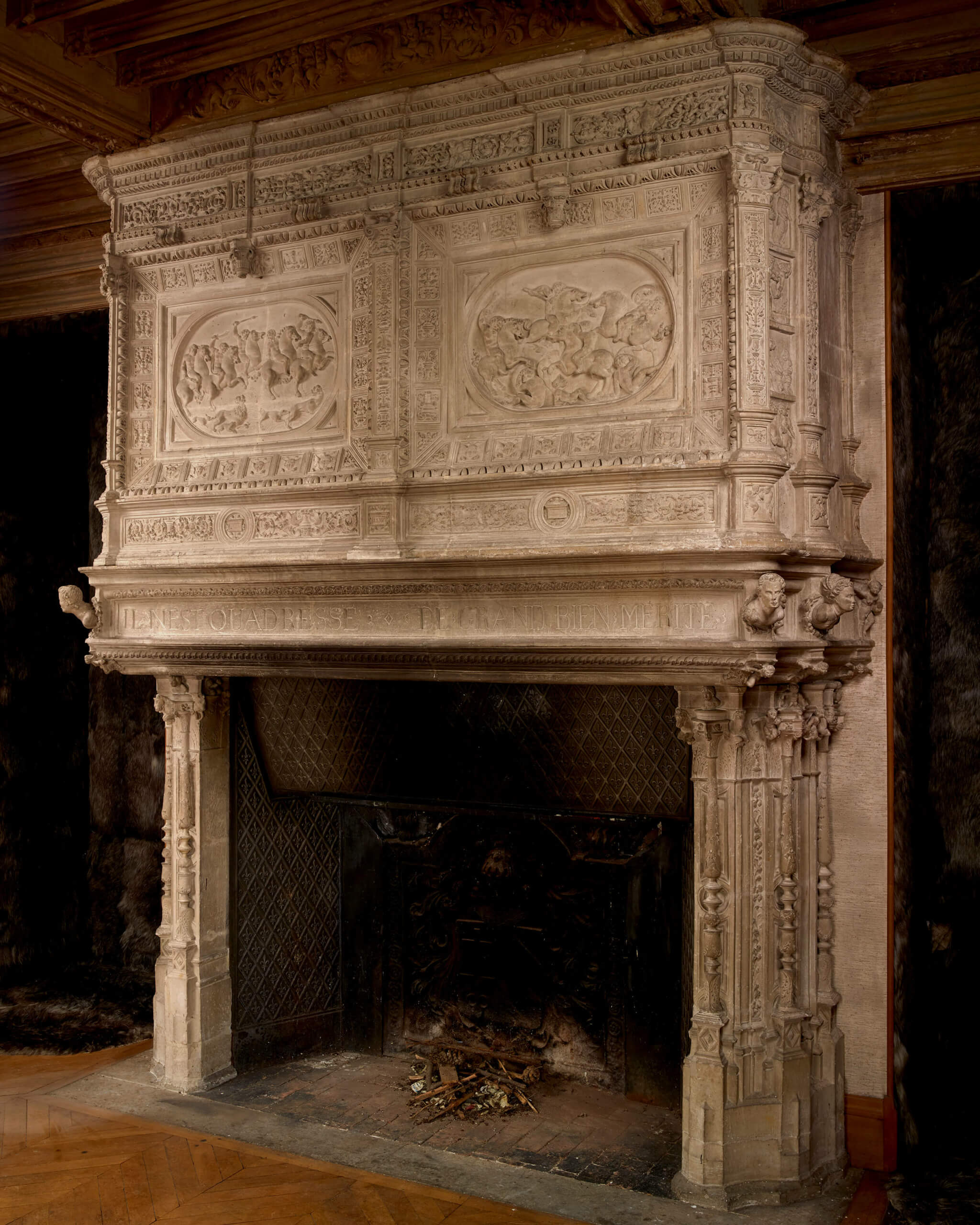
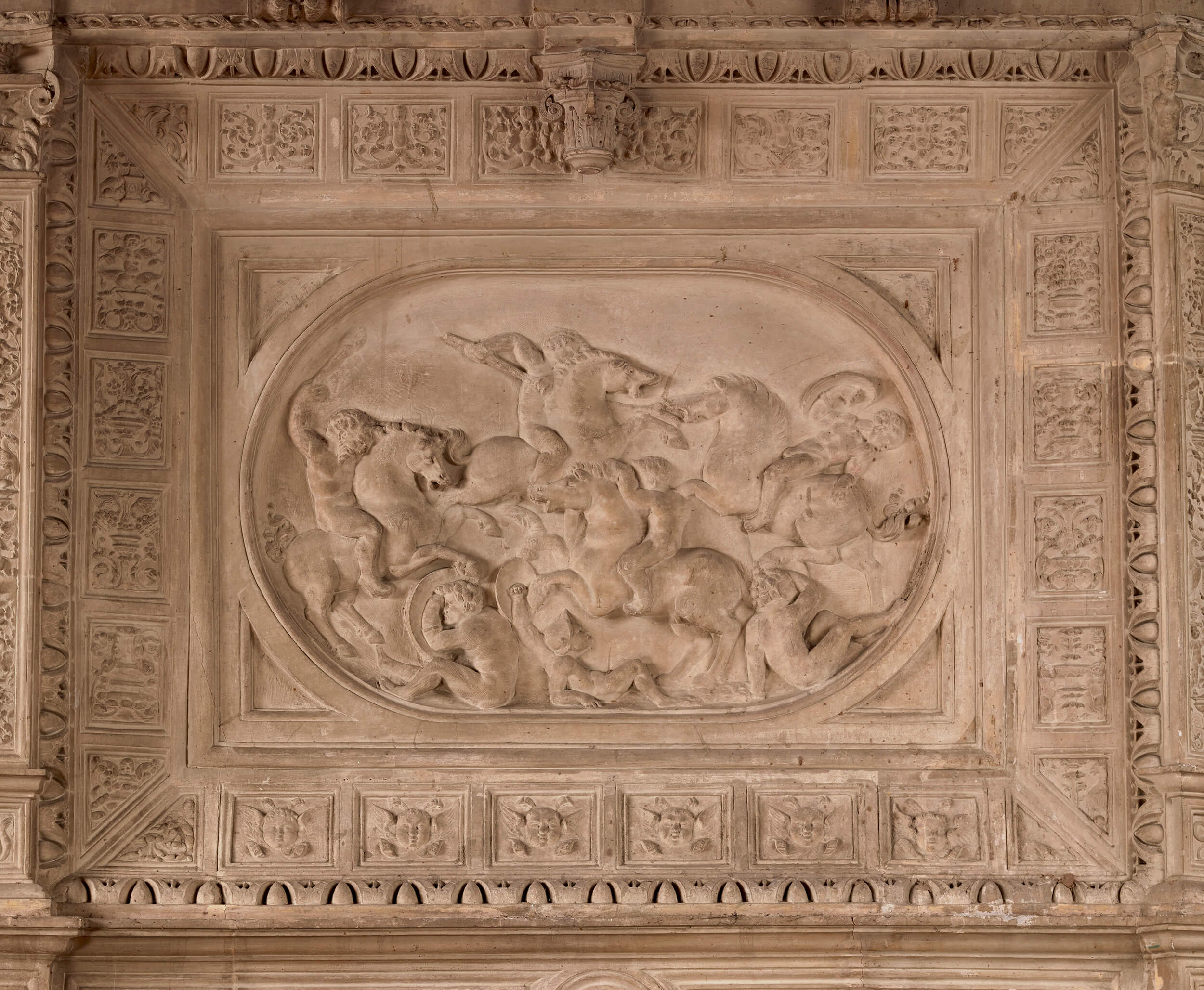
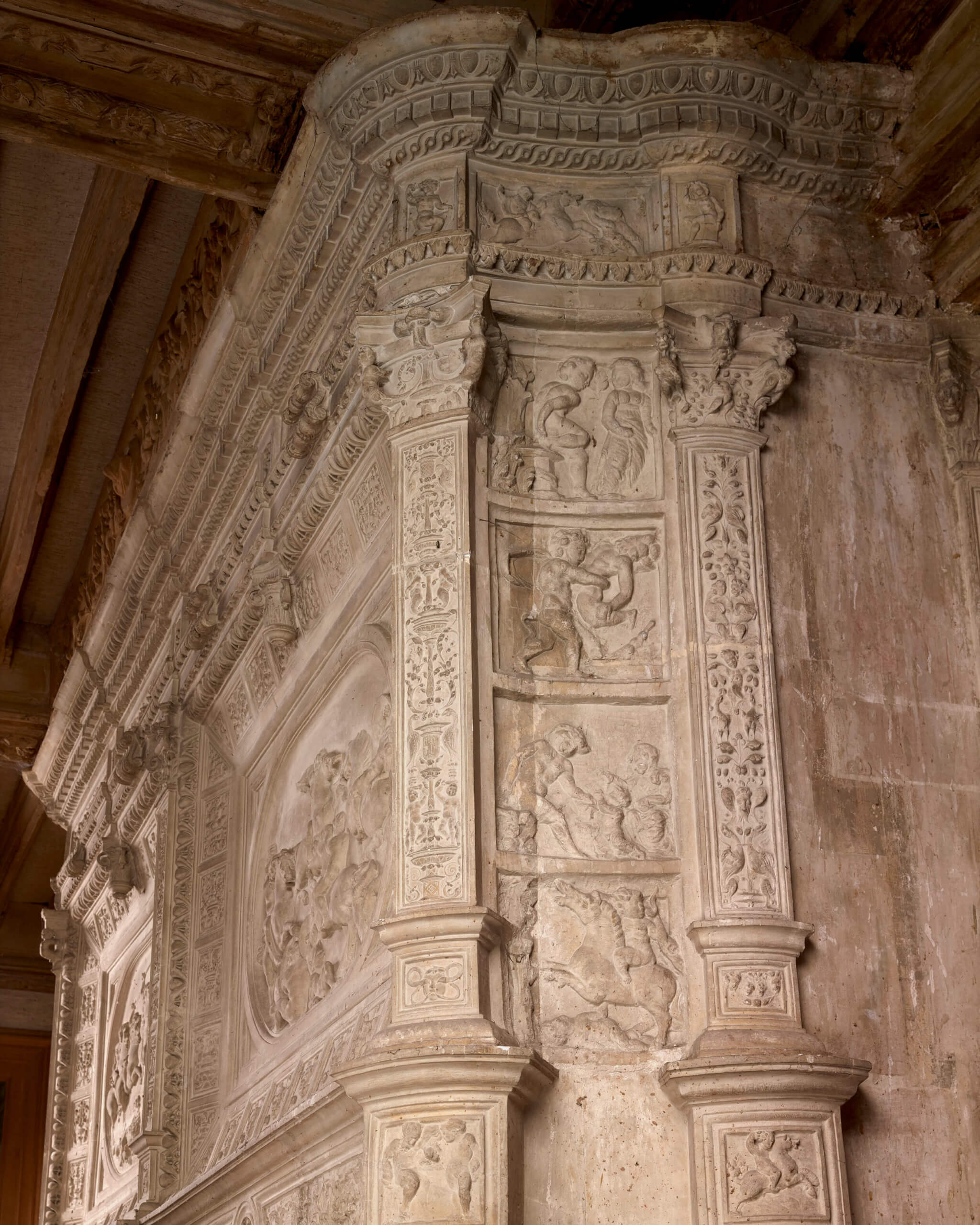
The fireplace features an exceptionally rich sculptural decoration, dominated on the front of its upright hood by two large oblong bas-reliefs: one on the left showing nude horsemen participating in a lion hunt, the other on the right depicting combatants, allegories of Hunting and War. These are flanked by bevelled borders with square compartments lavishly decorated with winged cherub heads and leafy vases, doubled with ovolo friezes, all punctuated by pilasters with capitals and intricate arabesque motifs. The base of the hood, adorned with medallions and acanthus scrolls, bears the engraved date 1534 at its center. A prominent entablature cornice punctuated with projections, double consoles, and corbels, carved with scrolls, ovolos, ribbons, and dentils, crowns the composition. The sculpted frieze beneath it is highlighted by the Merlan family coat of arms: “Gules, a lion Or holding in its dexter a crescent Argent surmounted by a mullet of the same; on a chief Azure three martlets Sable.”
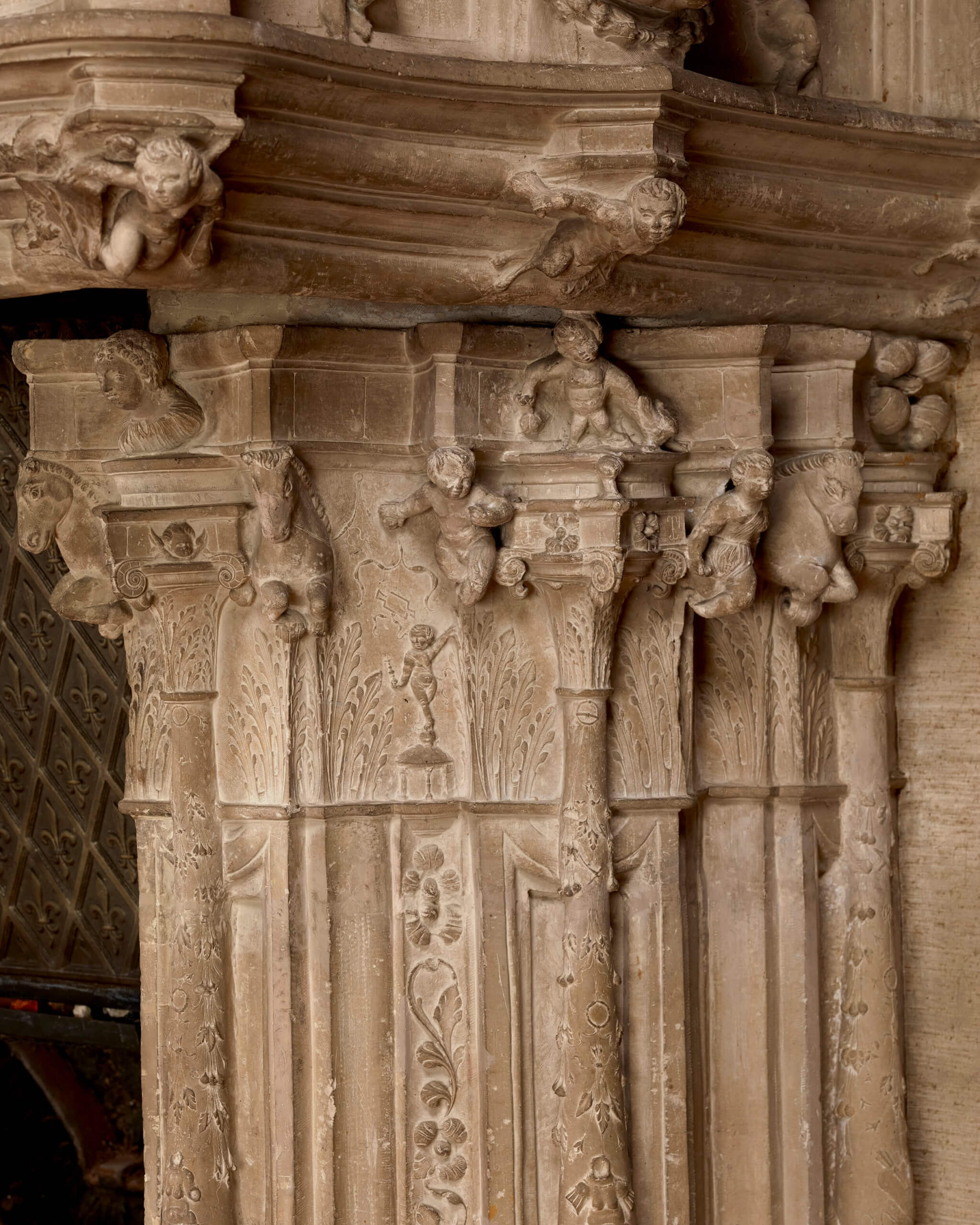
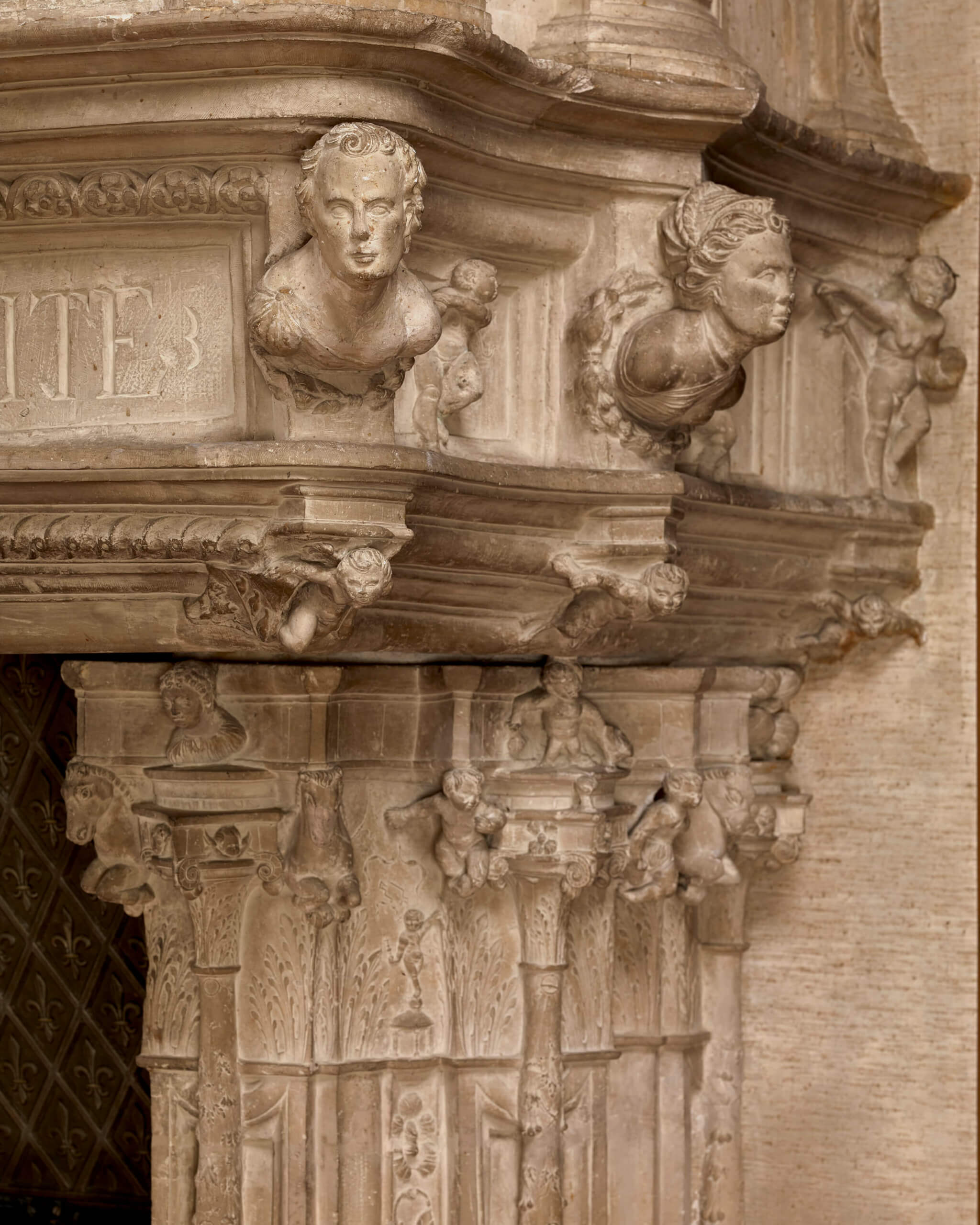
Flanked by decorative medallions featuring high-relief busts of men and women emerging from flowering crowns and fruit, the fireplace lintel, with molded borders and interlaced friezes, bears along its full length the Merlan family motto: IL N’EST QU’ADRESSE – DE GRAND BIEN MERITE (THERE IS NO SKILL BUT IN THE GREATEST MERIT). It rests on richly articulated angular jambs, convex and concave, with slender “beaded” colonnettes and pilasters featuring rectangular, round, and diamond-shaped compartments adorned with arabesque motifs, and capitals supporting acanthus-leaf entablatures. A luxuriant sculptural program of busts, child figures, and horse protomes decorates the sides of the lintel and the upper sections of the jambs, accentuating the multiple figurative corbels that rhythm these elements.
The Italian influence here is very prominent, and the fireplace remarkably illustrates, in André Chastel’s words, France’s role as a “privileged relay of Italianism” at the beginning of the 16th century. Its decorative repertoire draws on motifs from northern Italy, particularly Lombard art, whose first manifestations in France appeared in the circles of the Beaujeu family, Marshal de Gié, and Cardinal Georges d’Amboise. They were among the first to recruit Italian decorators within the kingdom and to commission French artisans to reproduce transalpine models, dominated, as here, by arabesque “candelabra” motifs, medallions, acanthus scrolls, and reliefs “in the antique style.” These new ornaments coexist here with schemes still rooted in Flamboyant Gothic, as seen on the narrow sides of the lintel, scattered with figurative corbels, and especially on the two angular jambs with their multiple colonnettes. French artisans long combined Gothic decoration with the new “antique” motifs imported from Italy. Few comparable fireplaces survive today, including the limestone example depicting the story of the Santa Casa of Loreto, preserved at the Musée national de la Renaissance in Écouen (inv. ECL18726). Dated circa 1520–1530, it comes from the collections of the Musée de Cluny, which acquired it in 1880 along with several other elements during the demolition of the house where it had been installed on Rue Croix-de-Fer in Rouen. Other notable examples include the fireplace from the Hôtel de Chapelaines in Troyes, built after 1524 and donated to the Musée des Arts Décoratifs de Troyes by Monsieur Paillot-Lemuet in 1848, and the fine fireplace from the Château du Bosquet in Saint-Martin-d’Ardèche, dated to the same period and given to France by the Philadelphia Museum of Art in 1997.


In the mid-1860s, Claude Sauvageot (1832–1885), a French architect and engraver and brother of Louis Sauvageot, studied the château of Arnay-le-Duc while preparing his monumental four-volume work Palais, châteaux, hôtels et maisons de France, du XVe au XVIIIe siècle, published in Paris between 1867 and 1870. In anticipation of the illustrated chapter he devoted in the first volume to this “graceful and once magnificent château, imbued in all its parts with the elegant and gentle genius characteristic of the Renaissance,” he drew the two finest of the château’s eight fireplaces in their original settings, including the one presented here, both decorating the main first-floor rooms. It was by simply seeing Sauvageot’s drawings, “even before they were engraved”, that M. Bouruet [Jean-François-Henri Bouruet (1801–1870), one of the wealthy owners of the famous Parisian stores “Au Gagne-Petit”, a great admirer of Renaissance art and, furthermore, a man of considerable fortune, sent one of his representatives to see and acquire the château of Arnay-le-Duc. In a state of considerable disrepair, it had recently been occupied by a file factory called PMT (Proutat-Michot-Thomeret). “The sale was concluded on the first day; and a few months later, demolition was ordered. The fireplaces, dormer windows, woodwork, and other significant elements were then carefully transferred to the Château de Villemenon, an imposing neo-Renaissance residence that Jean-François-Henri Bouruet was having built at Servon, in Seine-et-Marne. Our fireplace had remained there to the present day.”


Philippe and Gabriel Merlan
Born in 1503, Philippe Merlan, Baron of Montpont, was the son of Charles Merlan du Chatelet, born in Chaudenay in 1480, himself the son of Pierre II du Chatelet, Lord of Merlan. Heir to the estates of the last Baron of Mello, Charles Merlan became Lord of Jully-lez-Arnay-le-Duc. Ironmaster at Précy-sous-Thil and Le Creusot, he amassed considerable wealth. His family had acquired the tithe of Châteauneuf in 1485 and associated holdings at Cussy-le-Châtel the following year. Philippe himself purchased Jully (Magnien) in 1502 from Raoul de La Trémouille, the barony of Thil-en-Auxois in 1529, and the lordship of Clomot. He married Jehanne Foisset, with whom he had two children, Philippe and Pierrette Merlan du Chatelet. He died in 1550 at the château of Arnay-le-Duc at the age of 70.
Recorded as a “marchand” in Arnay-le-Duc in a letter dated February 1529, his son, Philippe Merlan, almost certainly abandoned this occupation when, sixteen years later, he became Controller-General of Finance in Burgundy and Bresse, a position he assumed following the death of Clugny Thunot on 6 February 1546, and which he held until his own death in 1551. Like his father, he was lord of Jully-lez-Arnay-le-Duc, Gissey-le-Vieux, Creuzot, and Thorey, and he reclaimed the fief of Montpont in 1549. His wife, Marie de Grandrye (†1608), who married in a second marriage Claude de Beaumont, esquire, had borne him a son, Gabriel (1528–1562), who succeeded him in office. Philippe Merlan died in 1551 at the age of only 48.
A knight, Baron of Montpont and Lord of Jully-lez-Arnay-le-Duc like his father, Gabriel Merlan was appointed in 1551 as successor to the office of Controller-General of Finance, and in the same year was named Treasurer of France following the royal edict establishing, in each general treasury of the Kingdom, two offices, one of Controller-General of Finance and one of Treasurer of France, to be held by the same officer. An edict of August 1557 separated the two offices, and Gabriel Merlan chose to retain that of Treasurer, being succeeded in the office of Controller-General of Finance by Philibert Robert. Gabriel Merlan married Charlotte de Beaumont (†1561), the daughter of his stepfather, and died at Arnay-le-Duc in 1562.
The Merlan Château at Arnay-le-Duc
The construction of the château of the lords of Jully at Arnay-le-Duc was undertaken by Philippe Merlan around 1534, the date inscribed on our fireplace. These works were only completed under the direction of his son, Gabriel Merlan, at the time of his marriage to Charlotte de Beaumont. Thanks to the work of Claude Sauvageot and a few other sources, some details are known about the château’s richly ornamented interior: a grand entrance portal, eight stone fireplaces, most elaborately carved, woodwork, ceilings, and dormer windows.
After financial difficulties and the death of Gabriel Merlan in 1562, the château was ceded to the Chabot-Charny family to settle debts. In 1570, Henri de Navarre (1553–1610), the future King Henri IV, was hosted there during the Battle of Arnay-le-Duc on 27 June, when a Protestant force of 4,000 men commanded by Gaspard II de Coligny faced a royal army of 12,000 under Marshal Artus de Cossé-Brissac; the battle ended in a decisive victory for the Protestants. Until the early 17th century, the lordship of Arnay remained in the Chabot-Charny family’s possession—Arnay-le-Duc had been attached to the County of Charny in the previous century by Duke Philip the Good of Burgundy (1419–1467). In 1634, it was sold by Françoise Bernarde de Montessus, Countess of Charroux and widow of Charles de Chabot, Marquis of Mirebeau, during the minority of Jacques de Chabot-Charny. The château was then acquired by Henri II de Bourbon-Condé (1588–1646), First Prince of the Blood, Peer of France, and Grand Huntsman of France, who was also Governor of Burgundy and Berry. The prince greatly appreciated the château, frequently visiting for hunting, and had it restored and furnished in the style of his time.


It later passed to his son, Louis II de Bourbon-Condé (1621–1686), known as the Grand Condé and famous victor of Rocroi (1643), who never visited it but retained ownership until 1675. This is why the château is still often called today the “Château of the Princes of Condé.”


In 1675, the entire estate was returned to the Chabot family “by virtue of the substitution of Philiberte de Luxembourg, Princess of Orange, to Charles de Lorraine, Duke of Elboeuf, and to Henri de Lorraine, Count of Harcourt, as children of Marguerite Chabot, granddaughter of Admiral [Philippe Chabot (1492–1543), known as the Admiral of Brion, Admiral of France, Lord of Brion and Aspremont]—his famous tomb is preserved at the Louvre.” The château remained with this family until 1778, even serving as a prison in 1747 for a Dutch infantry regiment. During this transitional period, the lands of Arnay passed from the Chabot family to the Rohans, then from the Rohans to the Brionnes through marriage. Upon the death of Charles-Louis de Lorraine, Count of Brionne, in 1761—he had authorized the transfer of the town hall to the Merlan château as early as 1752—his widow, Marie-Louise-Julie-Constance de Rohan, inherited the barony. She sold it, along with the château, to the royal House of the Ladies of Saint-Cyr in 1778, who retained the estate until the Revolution. The château housed the municipal offices until 1792, when it was finally sold as national property. It then changed hands several times until its repurchase, as previously mentioned, by Jean-François-Henri Bouruet, whose family had acquired the Château de Maulny in Limoges-Fourches, Seine-et-Marne, in 1838 (destroyed around 1900). Emptied of its sumptuous interiors, the Merlan château, or at least what remained of it, survived to the present day, occupied from 1865 to 1957 by the file manufactory Proutat-Michot-Thomeret, which had won several awards at the Paris and London World’s Fairs. From 1958 to 1967, the commune renovated the château and demolished unnecessary buildings, and starting in 1967 it housed the Pierre-Meunier Educational and Professional Center (CPE) as a boarding facility. This center relocated in 2019, returning the château lease to the commune, which promptly decided to sell it to a private owner. The château of Arnay-le-Duc has been listed in the inventory of historic monuments since 26 May 1926.
The château de Villemenon
Built after 1857 on the site of an earlier château demolished around 1840 by Jules-Vincent-Hubert Descours, who had acquired it two years earlier, the present Château de Villemenon was erected in the neo-Renaissance style for Jean-François-Henri Bouruet. At his death in Paris on 19 February 1870, the residence was completed but not yet furnished. Indeed, when his heirs sold it that same year, they included the following note: “In the middle of the park, a recently built Renaissance-style château, not yet furnished inside […] with the reservation of two stone fireplaces dating from 1534, both of which, along with the monumental gate erected in the park, come from the château of Arnay-le-Duc.” Apart from these two fireplaces and the elaborate entrance portal, the six other fireplaces and all the valuable decorative elements, including woodwork from the Merlan château, were then dispersed worldwide. One of the fireplaces, the second, which had been drawn and published by Claude Sauvageot in 1867–1870, was acquired by the millionaire entrepreneur Cornelius Vanderbilt II (1843–1899) to be installed in the library of his villa The Breakers in Newport, Rhode Island, built around 1890, where it remains today. A fragment of woodwork or liturgical furniture, almost certainly originating from the château, is now preserved at the Musée du Louvre.
The Villemenon estate was acquired by a certain M. Jeanson, who owned it from 1870 to 1875, and subsequently passed through the hands of M. Boutet (1875–1911), M. Drouin, and M. Méhu, a banker in Paris, who added significant embellishments. The last recorded owner of the château and our fireplace was Hélène Martini, née de Creyssac (1924–2017), the famous director of theatres, cabarets, and performance venues, nicknamed the “queen of Parisian nightlife.” She furnished Villemenon with striking décor inlaid with shells, mother-of-pearl, and horn, created by the Russian-born designer and jeweler Romain de Tirtoff, known as Erté (1892–1990).