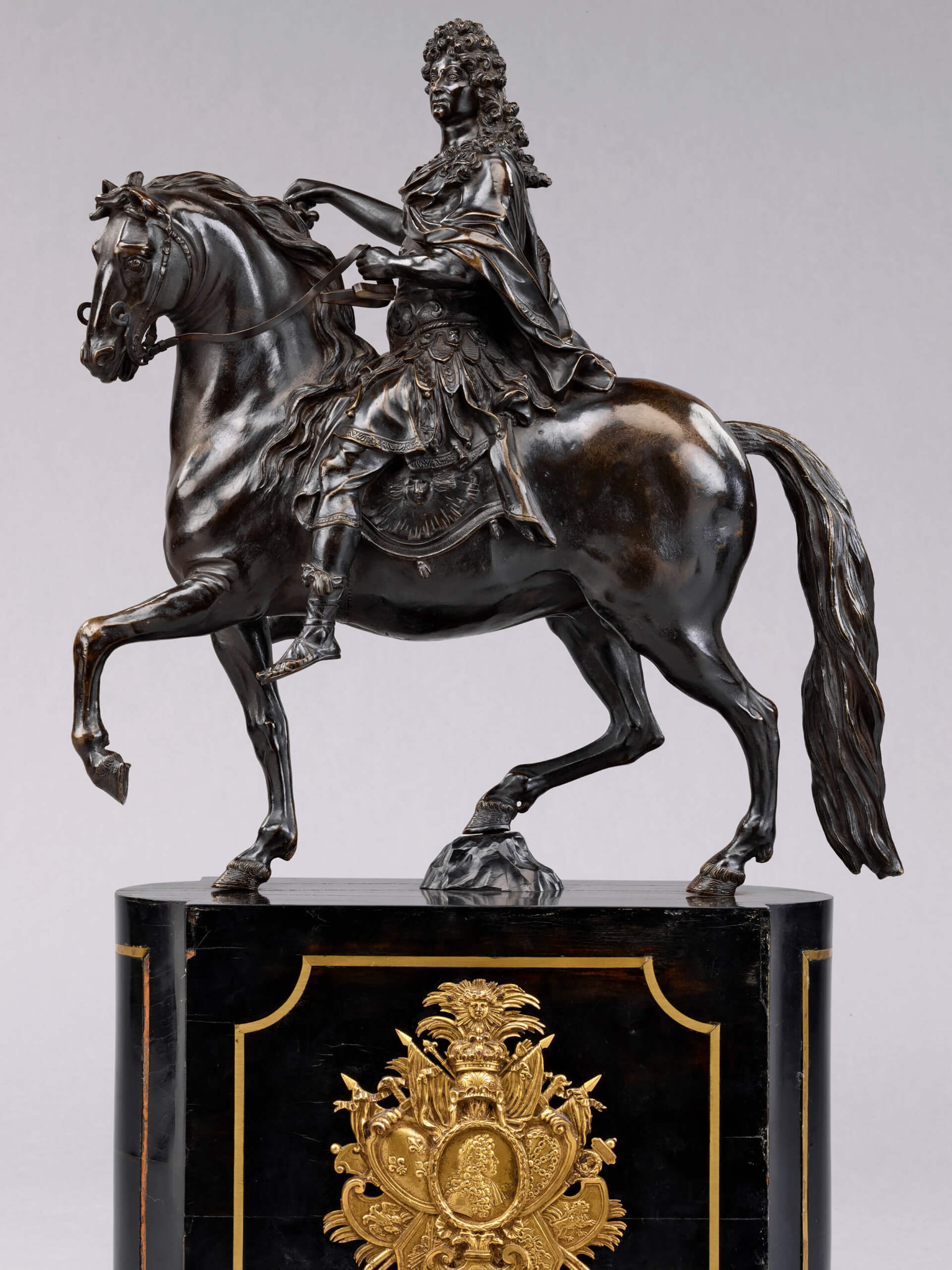
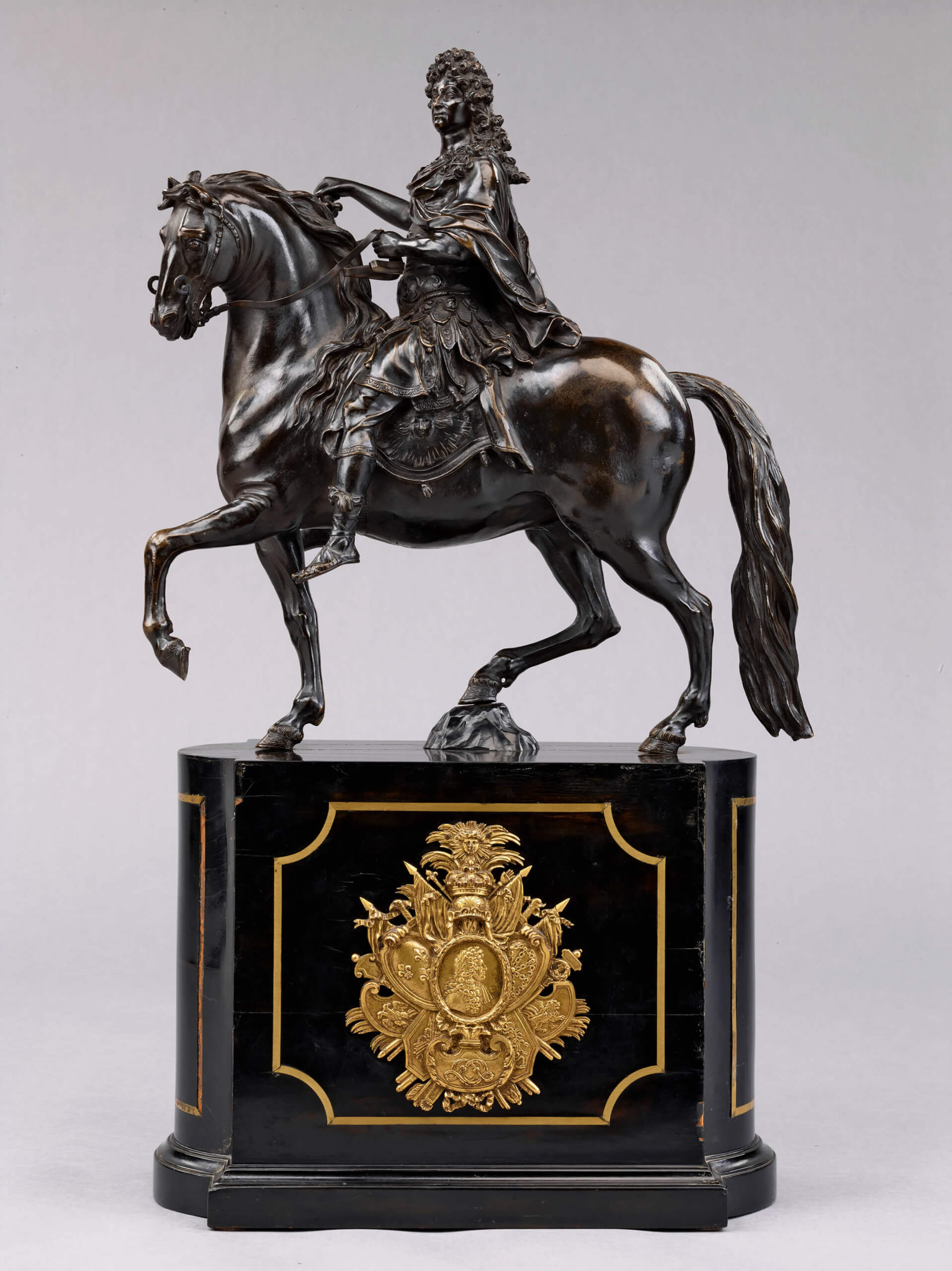
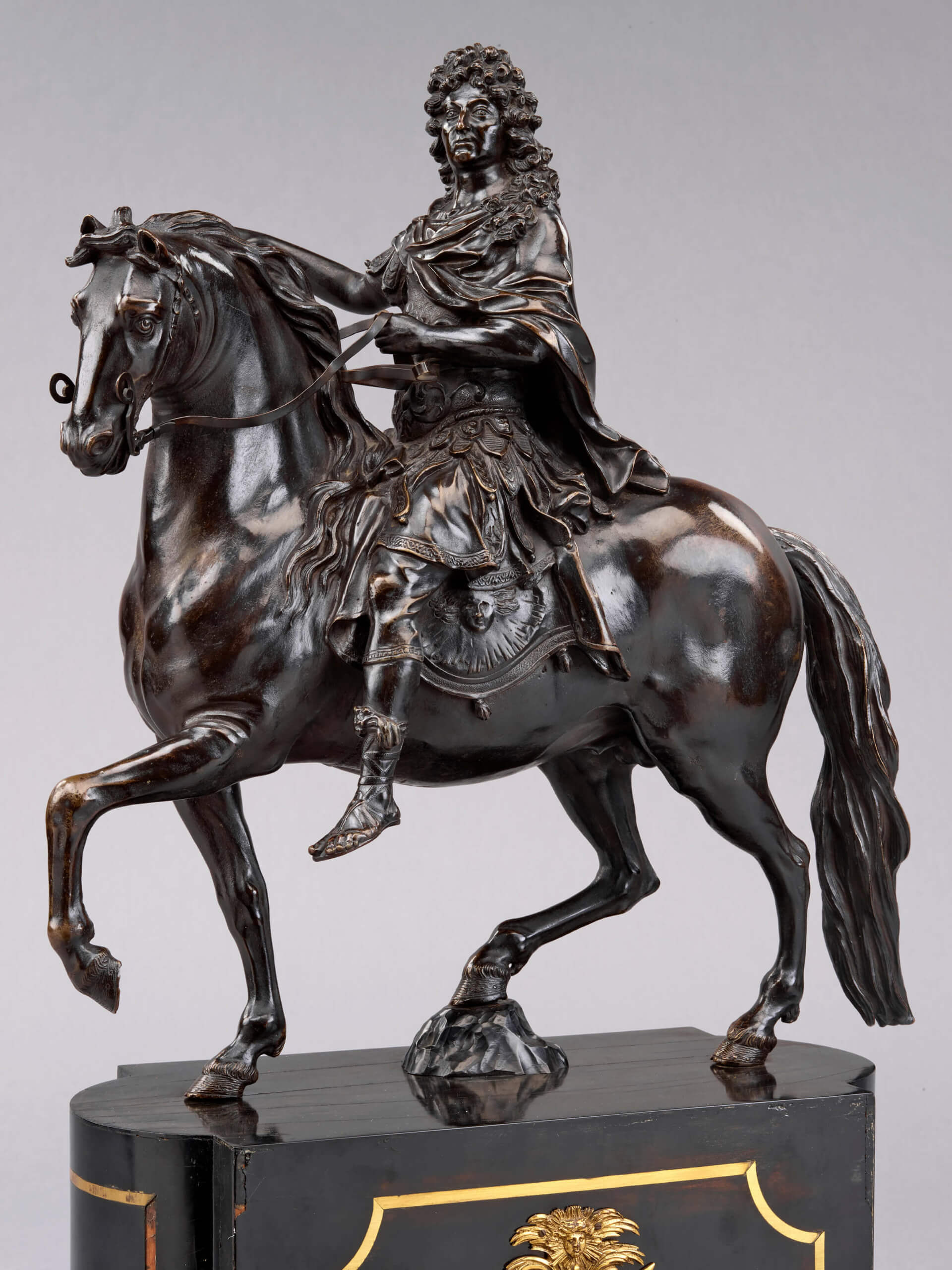
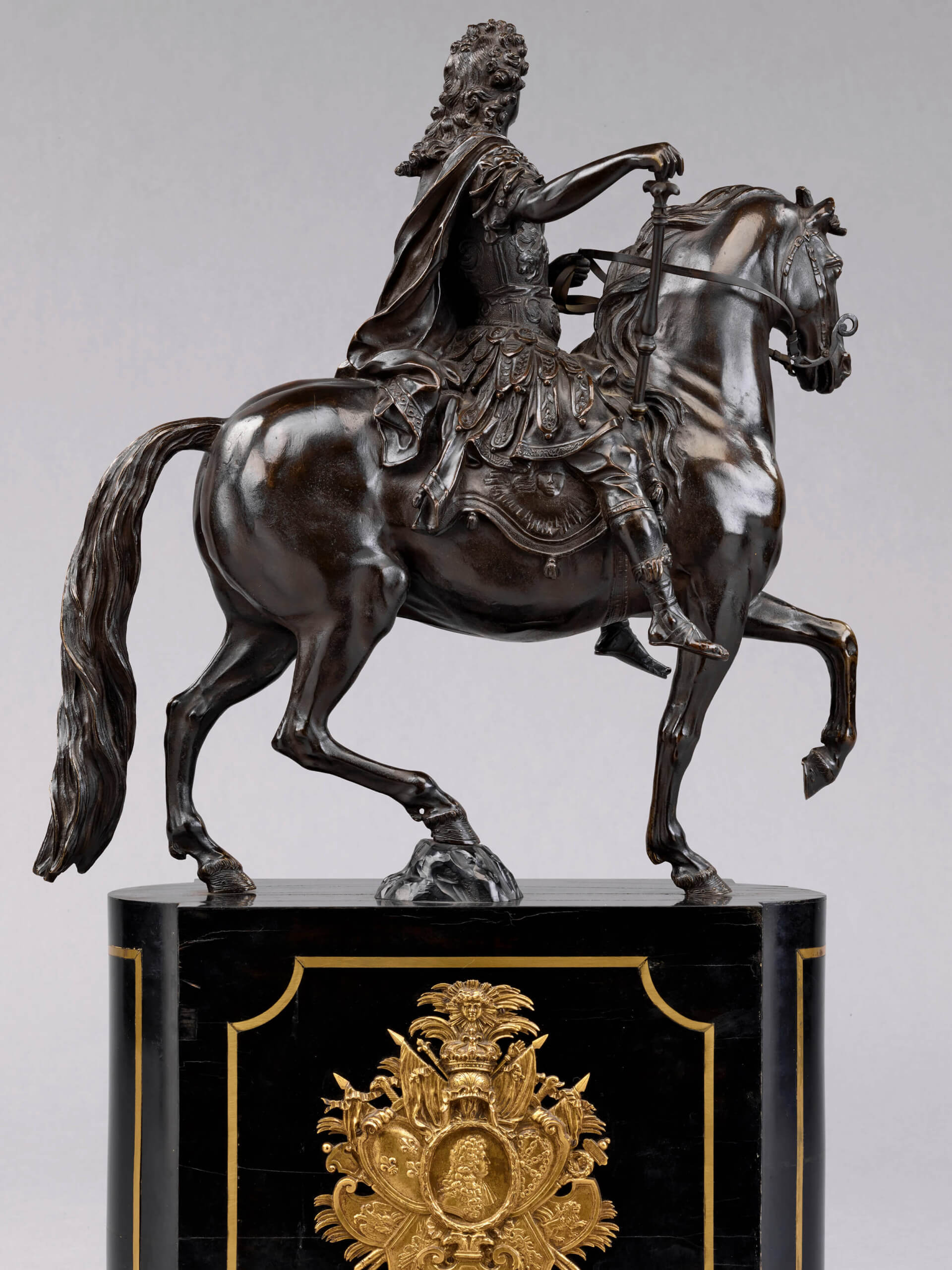
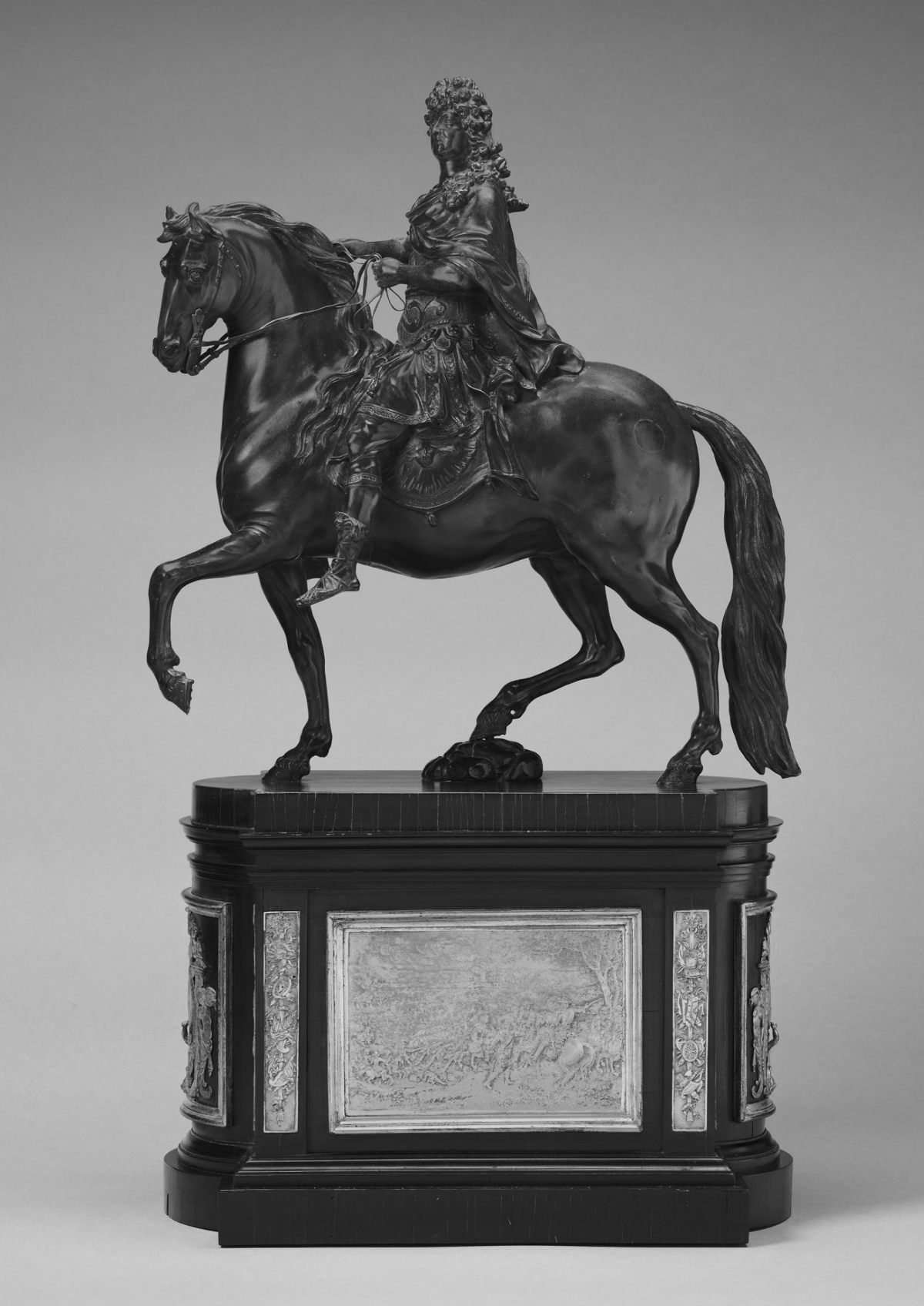
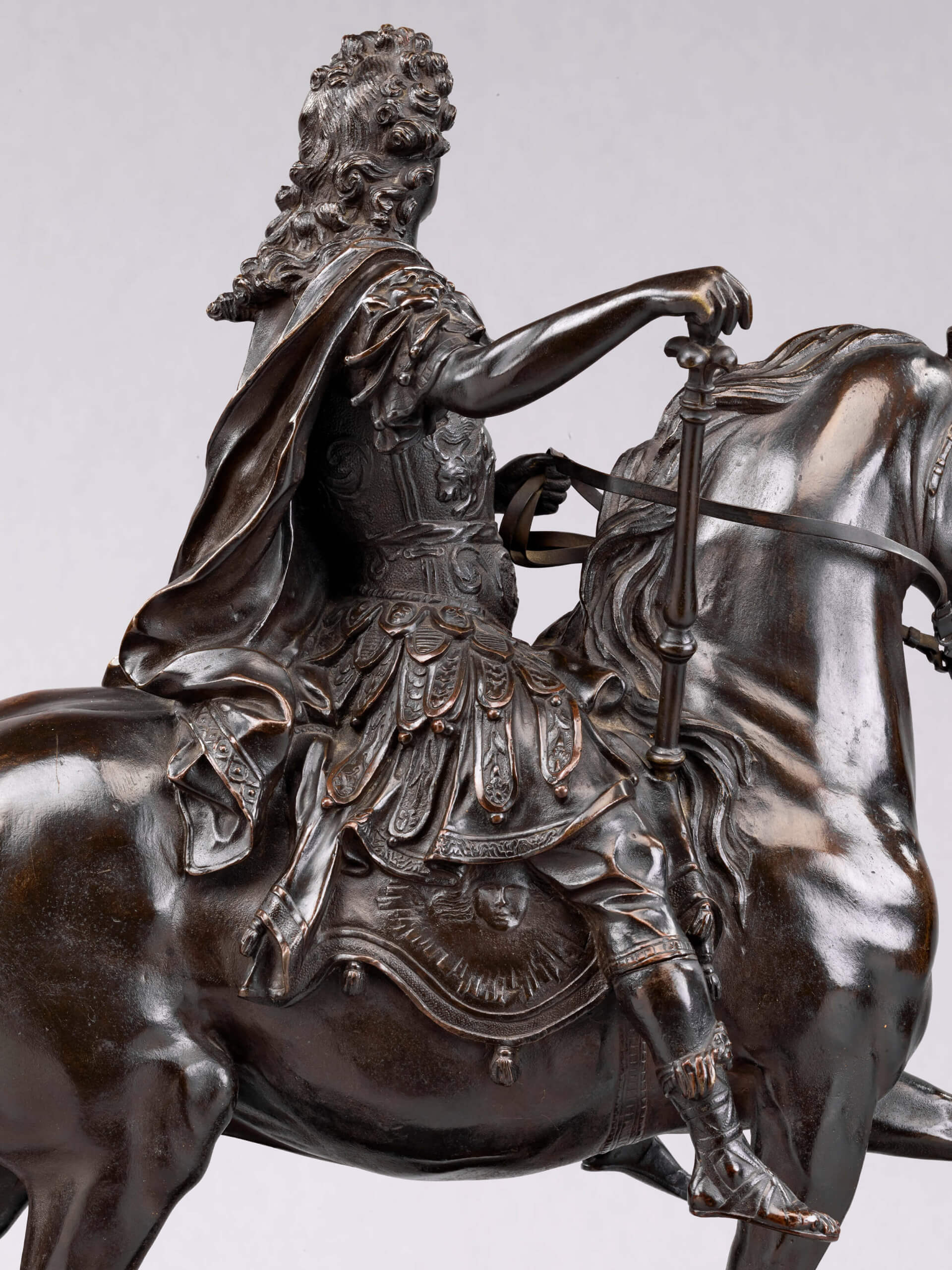
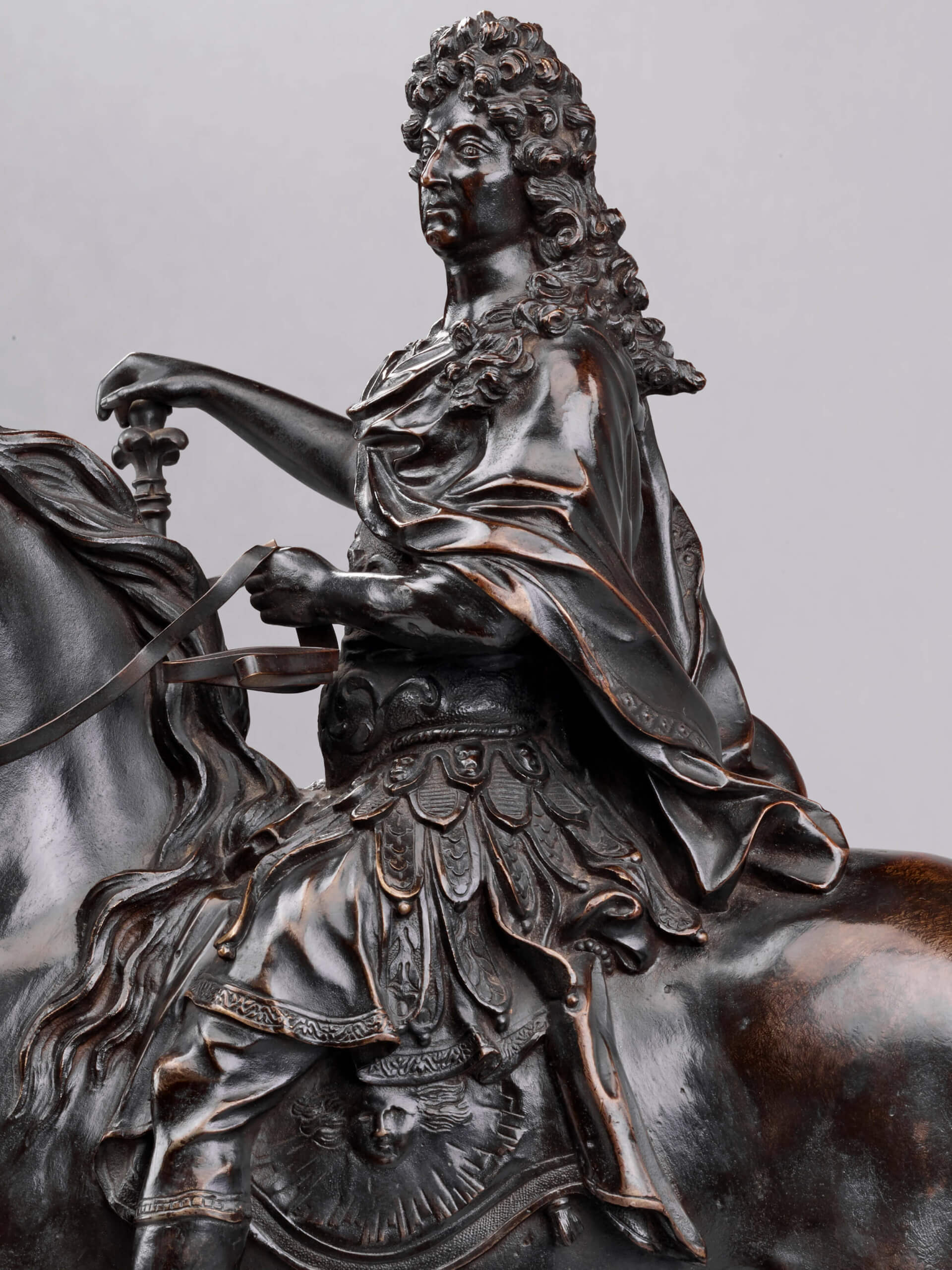
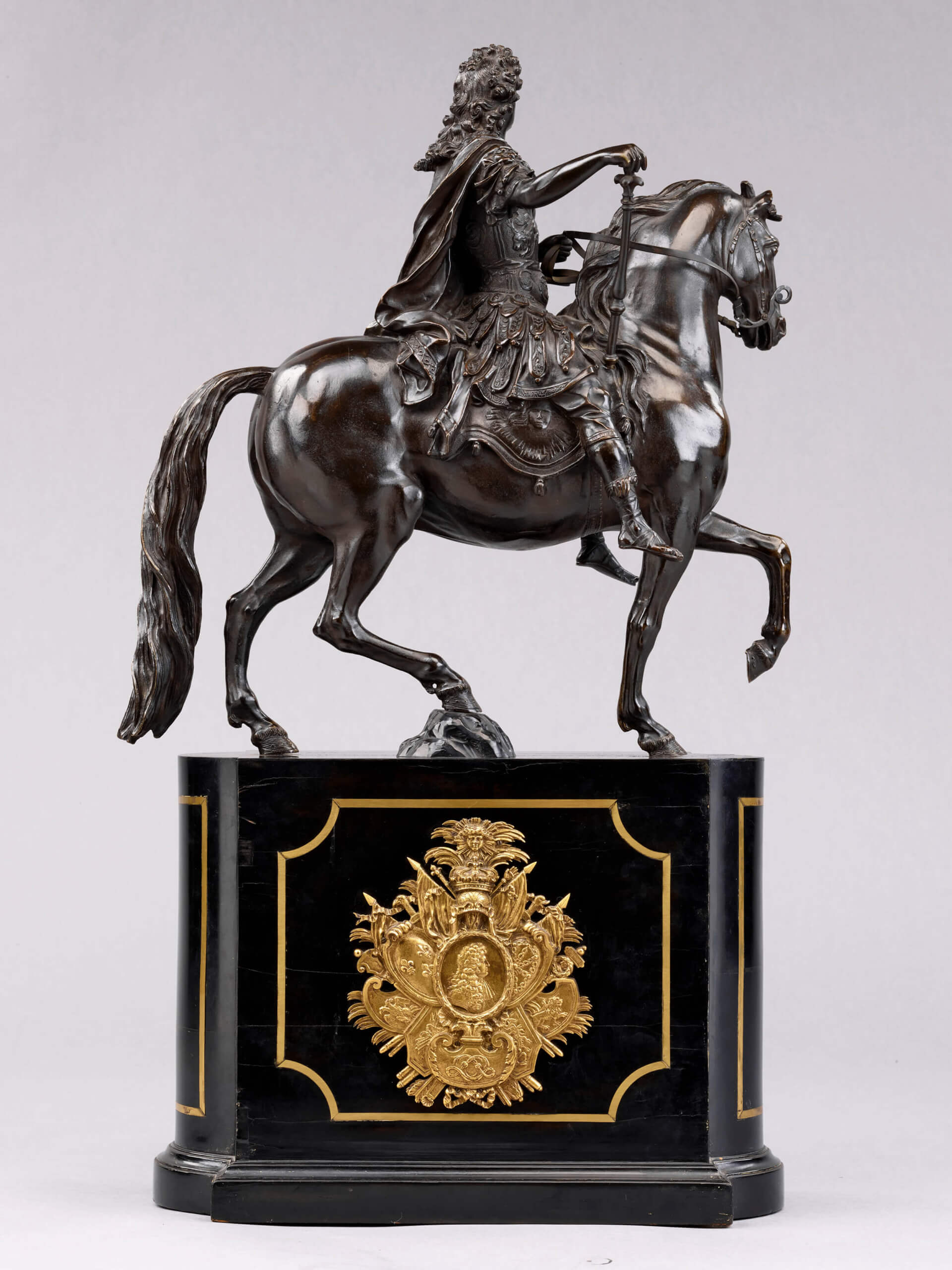
Bronze with a brown patina.
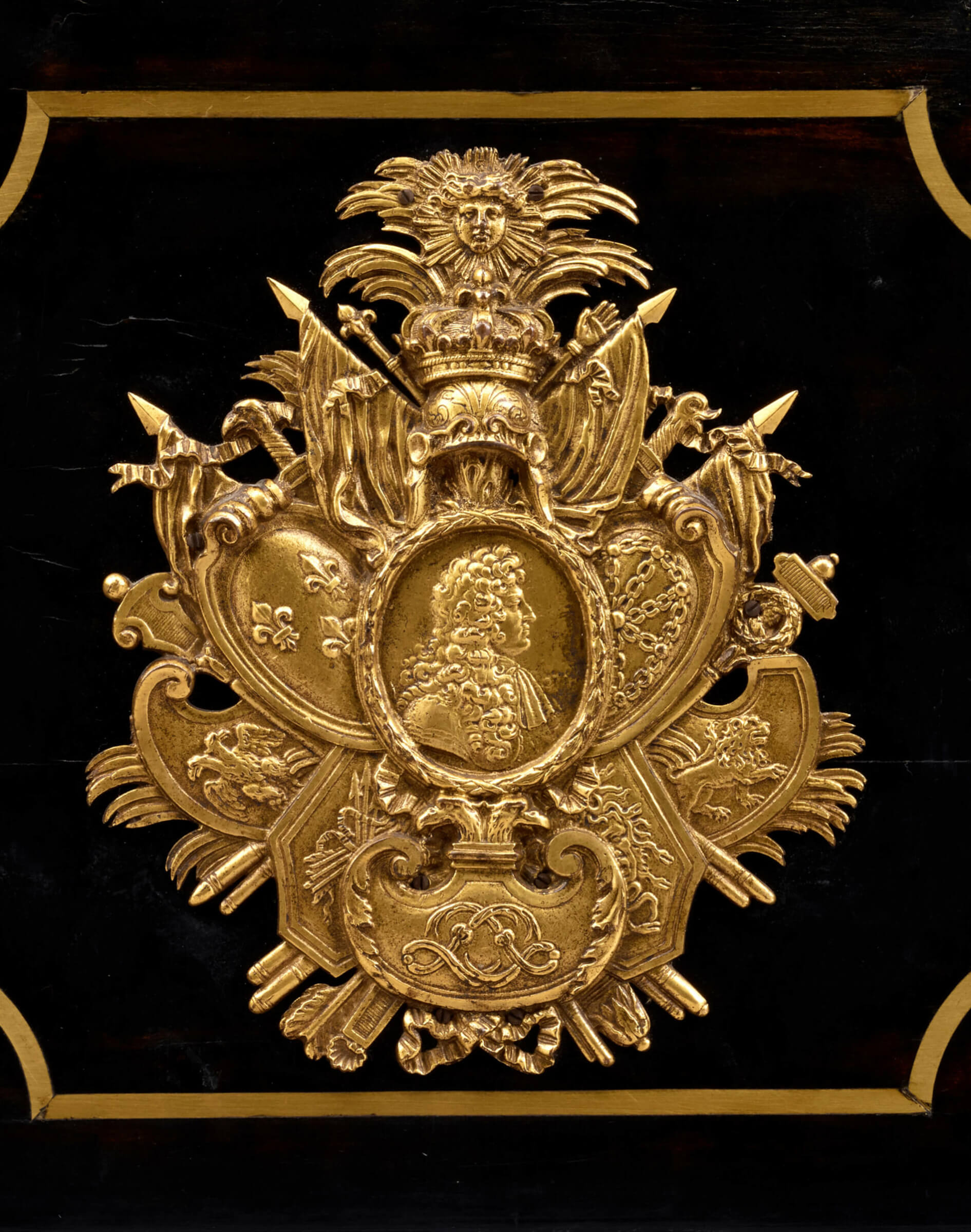
Ebonized wood base adorned with chiselled and gilded bronze trophies with the arms of France and Navarre, each presenting in its center a medallion with a profile portrait of Louis XIV.
H. 44 cm. (17 ½ in.); Total H. with the base 71 cm. (28 in.).
PROVENANCE: collection of Edmond Rostand (1868-1918) ; collection of Jules Strauss (1861-1943), auction in Paris, galerie Charpentier, Me Etienne Ader, 27 May 1949, lot n° 83.
EXHIBITION: Europäische Barockplastik am Niederrhein : Grupello und seine Zeit, [authors : Else Rümmler, Christian Theurekauff,…, prefaced by Wend von Kalnein], Düsseldorf, Kunstmuseum (now Museum Kunstpalast), 1971, cat. n° 327.
LITERATURE: Stéphane Faniel, Le Dix-septième siècle français, Collection Connaissance des Arts, Paris, 1958, p. 163, repr.; Hélène Demoriane, « L’importance du socle, Tout objet d’art gagne en valeur décorative s’il est bien soclé », Connaissance des Arts, n° 108, février 1961, p. 70, fig. 15; Lorenz Seelig, Studien zu Martin van den Bogaert gen. Desjardins (1637-1694), typewritten doctoral thesis, Munich, Ludwig-Maximilian University, 1980, p. 537, cat. n° LIV/24G ; M. Martin, Les Monuments équestres de Louis XIV. Une grande entreprise de propagande monarchique, Paris, 1986, p. 143, fig. 79-80, repr.; François Souchal, French Sculptors of the 17th and 18th centuries, The reign of Louis XIV, Volume * , A-F, London, 1977, p. 258-259, cat. n° 47, and Supplementary Volume ****, A-Z, London, 1993, p. 74-76, cat. n° 47 (Additions); Geneviève Bresc-Bautier, Guilhem Scherf, Bronzes français de la Renaissance au Siècle des Lumières, exhibition catalogue, Paris, 2008, p. 318-321.
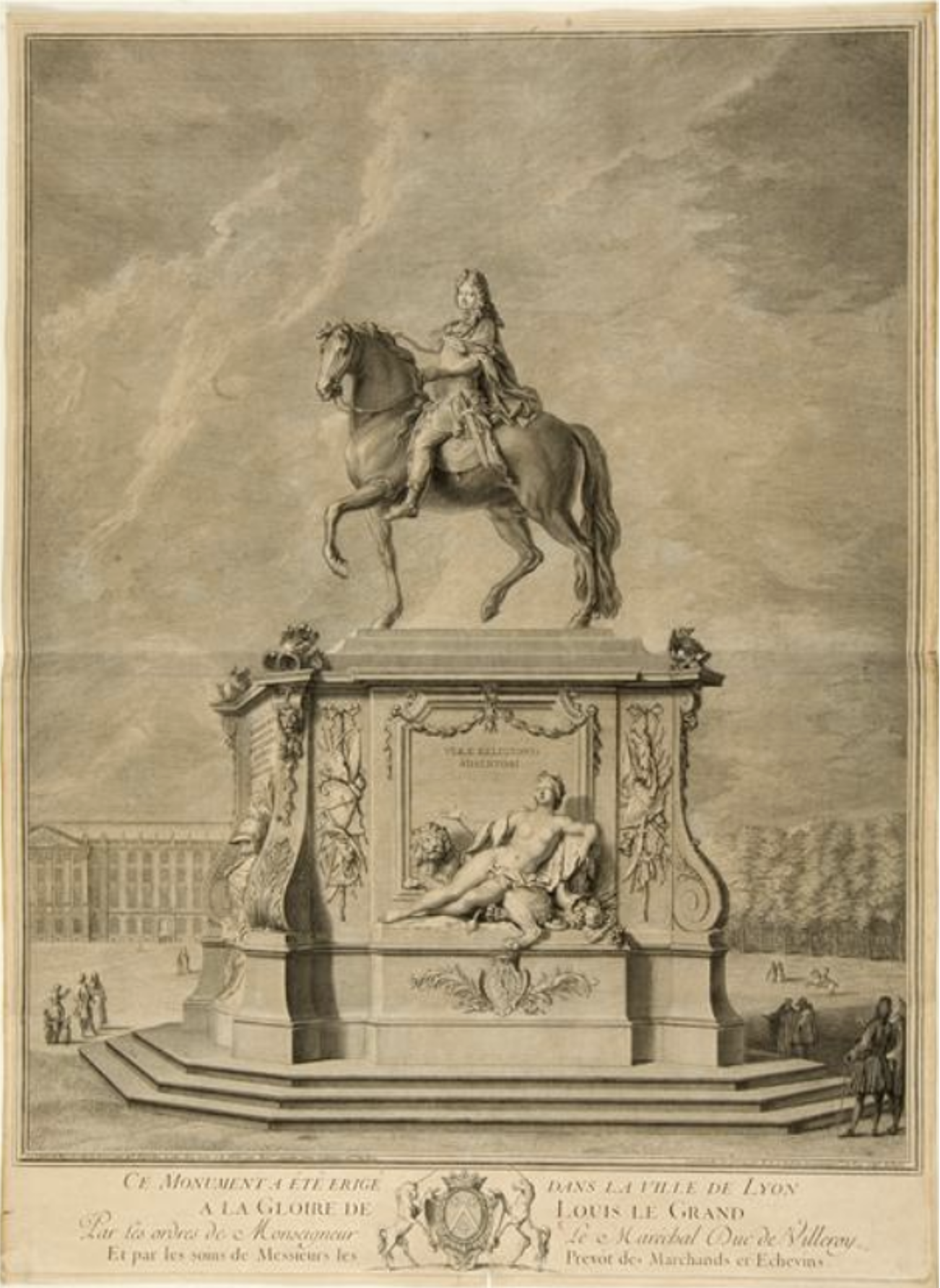
In 1685, representatives from the city of Lyon wished to commission a statue of the King for the center of the new Louis-le-Grand Square – nowadays Bellecour Square –, located on the peninsula of Lyon. Therefore, they submitted a request to the Maréchal de Villeroy, governor of the Lyon area, that was answered positively on the following year. Jules Hardouin-Mansart, Intendant général des Bâtiments du Roi and the sculptor Martin Desjardins, author of the pedestrian statue of Louis XIV erected place des Victoires in Paris, were then solicited to create a “statue en bronze représentant le Roy Louis le Grand […] monté sur un cheval de bataille, le tout eslevé sur un pied d’Estail de mesme metal et accompagné des ornemens et représentations convenables aux actions et à la gloire d’un si grand monarque” (“a bronze statue presenting the King Louis the Great […] riding a battle horse, on a base made of the same metal and accompanied with adornments and appropriate depictions of the actions and glory of such a great monarch”). On the 28th of May 1688, Martin Desjardins made a deal with Maréchal de Villeroy through which he committed to create the sculpture under the control of Mansart for the sum of 90.000 livres. A first project was proposed as a result of this collaboration between the architect and the sculptor : it showed the King clad as a Roman soldier, riding a walking horse, and supported by a very rich high and quadrangular pedestal flanked at the corners with four standing chained and bearded captives inspired by the celebrated antiques of the Palazzo Farnese in Rome. Allegories of the rivers adorned the two larger sides and trophies occupied the two smaller ones. If modifications were brought to the pedestal, the equestrian sculpture of the King remained unchanged. After the completion of a large plaster model by Jean Robert in 1691, the bronze version was executed between March 1693 and May 1694 at the Keller foundry in Paris, under the direction of Roger Schabol (Brussels, ? – Paris, 1727), a renowned art caster and a friend and close partner of Desjardins. Due to the death of Desjardins in 1694, the shipping of the statue to Lyon was delayed. It only arrived there in 1700, received by the architect Robert de Cotte, brother-in-law of Mansart and who was going to succeed him in 1708. De Cotte supervised the installation of the work at Bellecour Square until his unveiling on the 28th of December 1713.
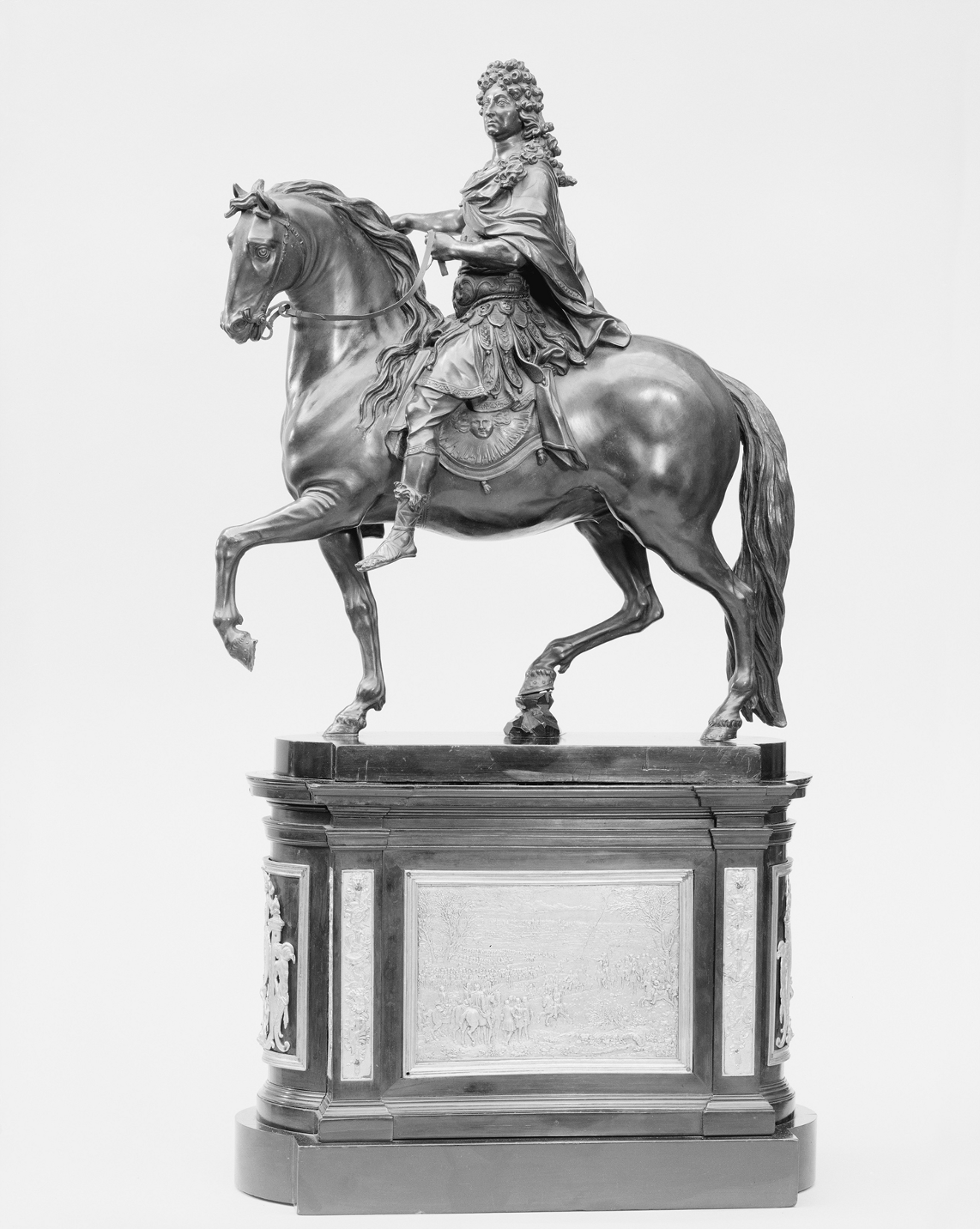
It is under the direction of De Cotte that the initial pedestal was modified: the works on the marble and bronze started in 1714. Its proportions were enlarged and the “Farnese” prisoners were remplaced by impressive volutes. The idea of the allegories of the rivers was retained and the Coustou brothers were entrusted their creation : William created The Rhône and Nicolas, The Saône. There were installed in 1721. The ensemble was engraved in 1723 by Benoît (1661-1721) and Jean Audran (1664-1756) and the city of Lyon also commissioned a medal engraved by Duvivier.
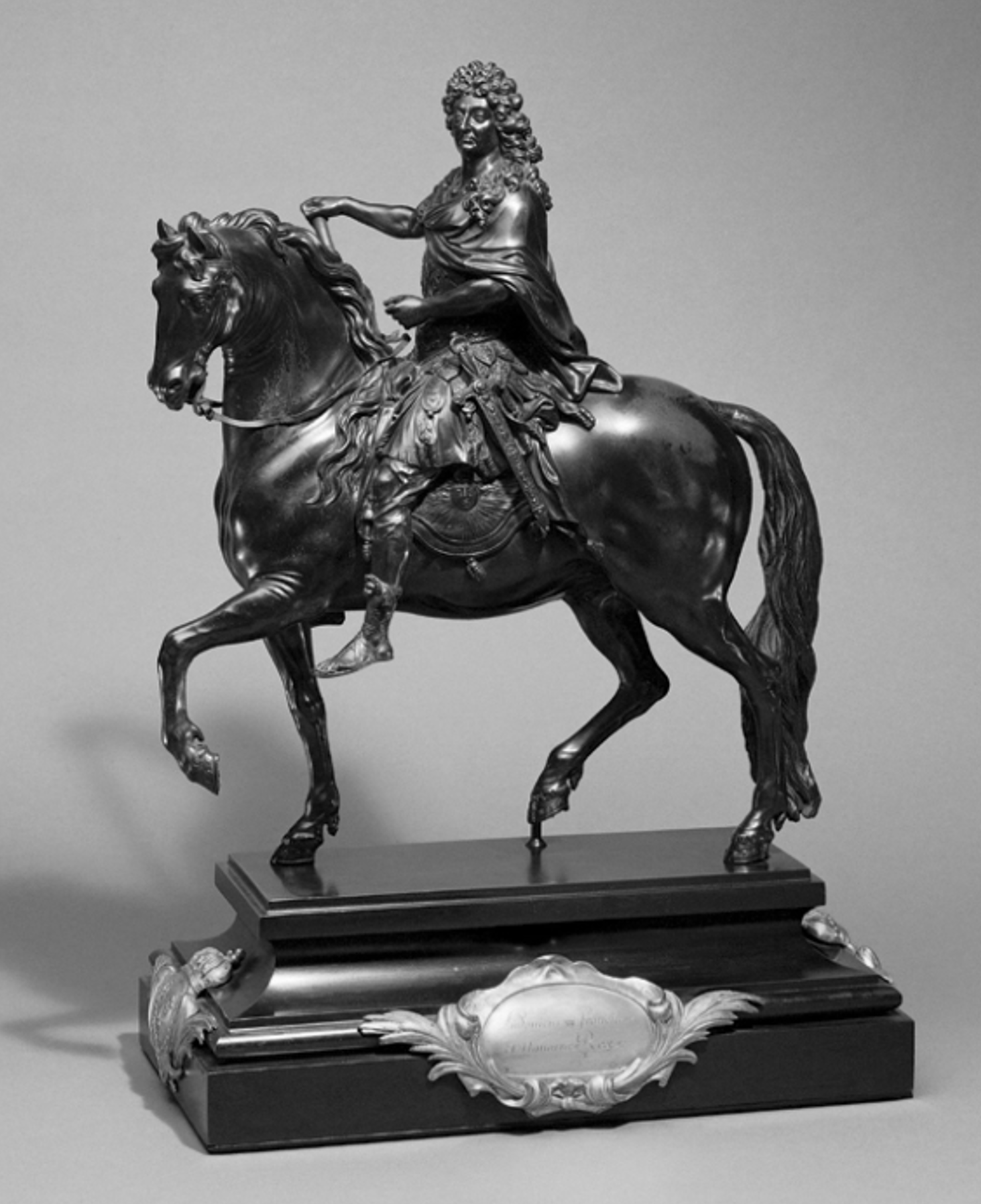
The equestrian statue of the King from Bellecour Square in Lyon was destroyed during the French Revolution in 1792. Only one of the King’s feet – now kept at the Historical Museum of Lyon – and the pedestal were saved. The 1723 engraving by the Audran provides us with precise information on the original monument. Bronze reductions similar to ours, that were for some of them executed during the completion of the original project, constitute even better sources to precisely comprehend Desjardin’s masterpiece. Only one of these reductions still keeps its original pedestal. Coming from the collection of Beauchamp-Proctor, baronet of Langley (Norfolk, England), this bronze signed by the Nicolas Delacolonge of Lyon and dated 1726 is presently held at the Museum of Decorative Arts of Lyon.
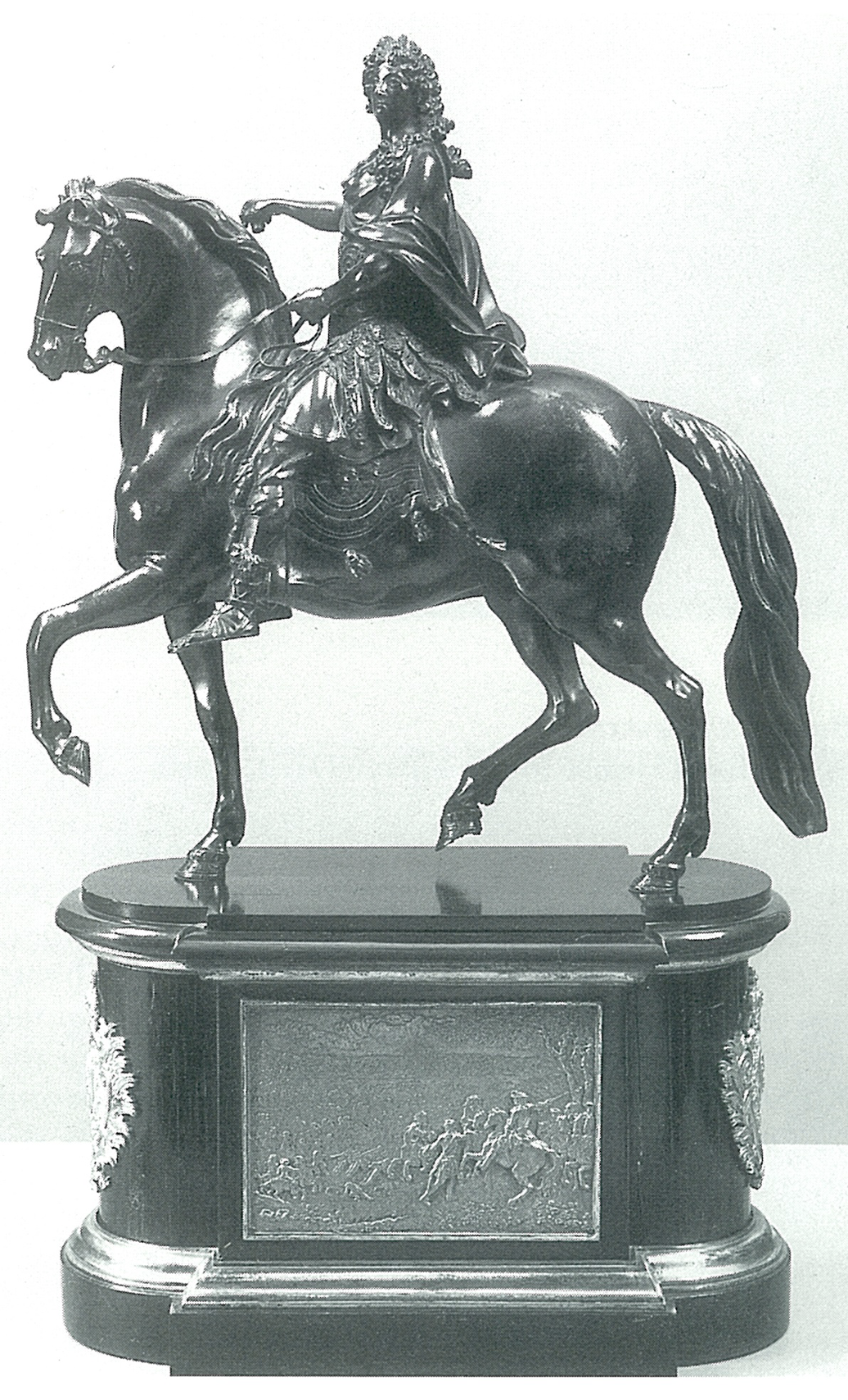
The other inventoried reproductions, mounted on pedestals differing in terms of adornments and richness according to the importance of the commissioner, have been carefully catalogued by Lorenz Seelig in his unpublished doctoral thesis Studien zu Martin van den Bogaert gen. Desjardins (1637-1694), defended at Ludwig-Maximilian University, Munich, in 1980.
The first owners of these bronzes in the XVIIIth century were unquestionably prominent figures working for the King, to whom these bronzes were perhaps donated as gifts. The Germanisches Nationalmuseum, in Nuremberg, houses one of these precious statuettes, signed by Schabol and dated 1699, a singular example since the features of Louis XIV have been replaced by those of Prince Max Emanuel of Bavaria, with his coat of arms adorning the pedestal. This signed example is strictly identical – except for the facial features – to the Louis XIV of the Wallace Collection in London, attributed to the same founder, and which was acquired by Richard Seymour-Conway, 4th Marquess of Hertford, in June 1869.
Several of these bronzes can be found in the French sales catalogues of the XVIIIth century, such as the one of Nicolas-Auguste Chupin, advisor of the King and trésorier du Marc d’Or. The catalogue presenting the bronzes and marbles of his estate, redacted by C. F. Julliot fils on the occasion of the sale of his collection in Paris on the 17th of August 1756, thus mentions under lot n° 43: « […] Une Statüe Equestre de Louis XIV. en Bronze, de 21 pouces de haut avec son pied de Marqueterie garni de bronze en couleur » (the equestrian statue with a marquetry and bronze pedestal). M. Mouchard, Receiver General of the Finances, owned a « Louis XIV à cheval; ce Prince est vêtue à la Romaine, & tient son bâton de commandement; sur un socle de bois noirci » (with an ebonized wood base) that was sold in Paris on the 6th of December 1782. Another « Louis XIV, Figure Equestre ; hauteur totale 16 pouces : sur un pied de bois noirci, de 11 pouces, orné d’un Bas-relief & d’Attributs Militaires de Bronze doré.» (with an ebonized wood and chiseled bronze base) coming from the collection of the architect Pierre Boscry can be quoted and was sold in Paris on the 13th of March 1781.
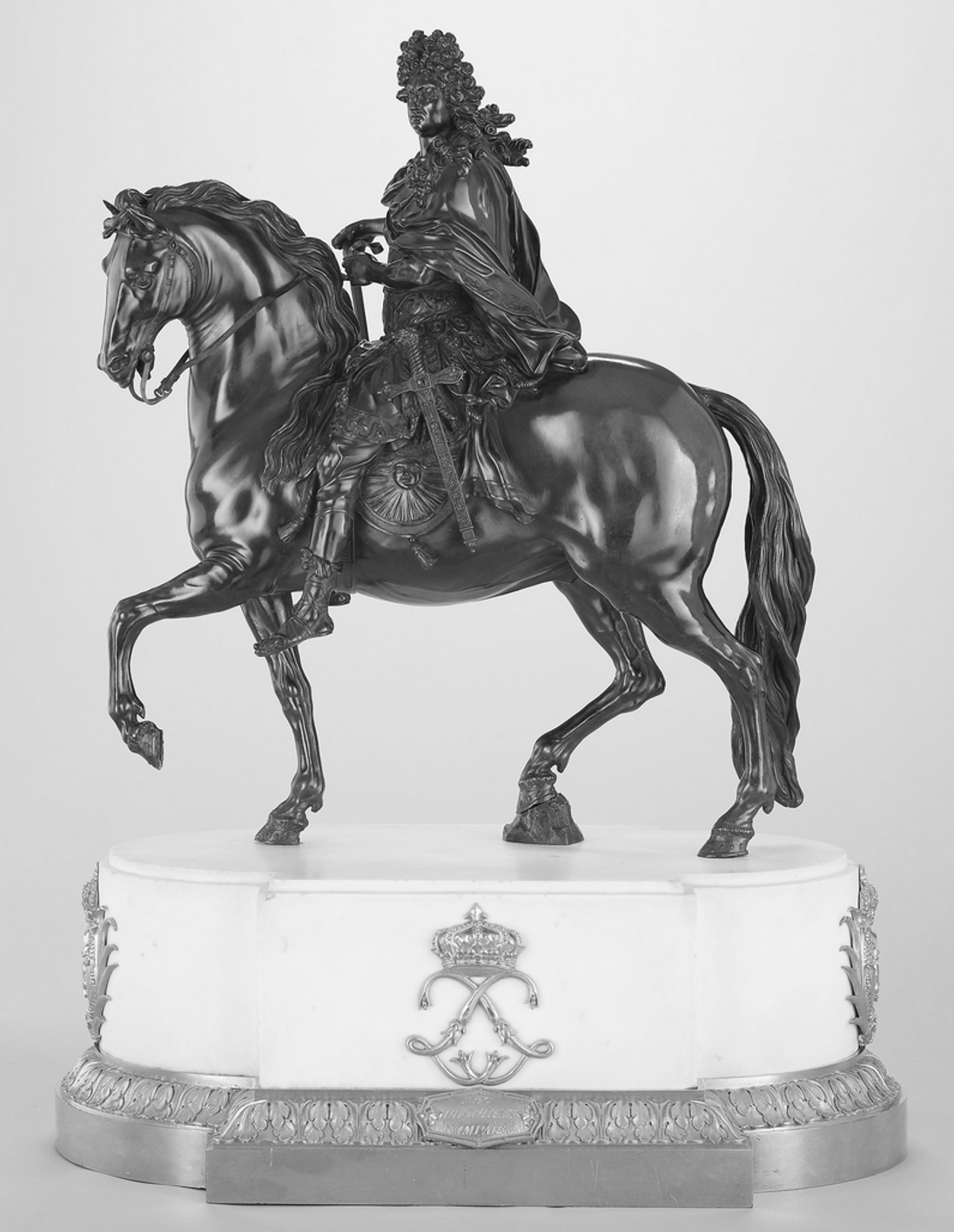
Among the prestigious casts identified in addition to ours, there is the one coming from the collections of H.M. the Queen Elizabeth II, and that was probably created directly in the workshop of Desjardins (maybe by his nephew Jacques, a distinguished art caster), according to Seelig. It features the King with a moustache, a detail that would not appear anymore after 1700.
Acquired by George IV, this cast stands on a white marble base and is adorned with the crowned Royal Cipher with interlaced « L » and framed fleur-de-lis added by Vulliamy in 1820. It has been signaled for the first time in Carlton House on the 1st of May of the same year. It was transferred to Windsor Castle on the 28th of November 1828. George IV had already acquired a first cast of the equestrian statue of Louis XIV after the model of Desjardins in Paris in July 1814, through the intermediary of François Benoist. Standing on an ebony and gilded bronze pedestal, this model was also housed in Carlton House before being sent to Windsor in 1828. Another cast attributed to Roger Schabol is kept at the National Gallery of Washington and was acquired by the Andrew W. Mellon foundation in 1971. Another incredible cast was bought 1000 livres from the sculptor Jean-Baptiste Lemoyne by Count Ditlev Reventlow, Special Envoy from the Court of Denmark to Paris, on behalf of the Swedish Crown. Unchiseled and still equipped with its sprues and vents, this bronze had been acquired as is in the aim of helping to set up the sprues and vents required for the completion of the equestrian statue of Frederick V of Denmark by the sculptor Jacques Saly. Today, it is held at the Statens Museum for Kunst in Copenhagen.
The equestrian portrait of Louis XIV presented here successively figured in two important collections : the collection of the writer Edmond Rostand (1868-1918), author of the famours Cyrano of Bergerac, then the one of the banker and great art lover Jules Strauss (1861-1943).
It belongs to a very small group of sculptures standing on a similar oblong ebonized base with small curvilinear sides, enriched with variants of chiseled and gilded bronze adornments : trophies with the arms of France and Navarre, medallion profiles of the King, monogram of the King with the interlaced “L” visible under a closed crown, or low-reliefs illustrating the military campaigns of the King after Van der Meulen.
One of them belonged to the collections of the Princes of Arenberg ; a second one, coming from the Lippmann collections was acquired in 1911 by the Metropolitan Museum of Art, in New York, thanks to the financing of Frederick C. Hewitt ; and a third one, coming from the collection Jack J. Emery, is held at the Fogg Art Museum in Cambridge
Martin Van Den Bogaert, dit Desjardins
Originally from Breda, where he was born in 1637, Martin Den Bogaert, who would Frenchify his name as Desjardins, trained with Peter Verbruggen in Antwerp during several years. Aged 20, he left to Paris where he was warmly welcomed by the community of sculptors of the capital. Major orders rapidly flew in, from private individuals as much as religious establishments and the consecration of Desjardins came when he was elected at the Royal Academy of Painting and Sculpture in 1671. He may be considered as one of the best sculptors of the Bâtiments du Roi, and distingued himself through works as exceptionally spirited as they were masterful, like his statue of Diane, an allegory of the evening that he created for the Great Commission of 1674 in Versailles.
In addition to his work on numerous tombstones, the last fifteen years of his particularly rich career were employed to answer other very prestigious orders with representation of sovereigns, standing or riding: a marble statue of the King commissioned by La Feuillade (1679); an important order of bronzes for the Place des Victoires (1682-1685) in Paris, comprising, in addition to the low-reliefs and the statues of captives, the central group of the standing sovereign crowned by the Fame (a groupe destroyed by the revolutionaries); and finally two equestrian monuments of the King: the one in Aix-en-Provence (1687-94) on a reared up horse, whose model was completed at the time of the death of the sculptor, but that could not be translated into bronze; and the one of the Bellecour Square in Lyon (1688-1691), the subject of our study. The countless reductions of these monuments, recreated at every opportunity and commissioned by foreign sovereign who had the effigy of Louis XIV replaced by their own, are evidences of their great success.
Edmond Rostand
Edmond Rostand was certainly the most idolized author of the French literature at the turn of the century. Born in 1868 in a family of traders from Marseilles, he studied there at the Collège Stanislas. After leaving to Paris in order to study law, eventually, he chose to become a poet and delivered his first literary essays. He also outlined several pieces who would never come to light. Those first literary attempts passed unnoticed.
In 1888, he coordinated in a vaudeville entitled The Red Glove. The play achieved some success that was not followed up. During seven years, he had several plays published with little success. It was not until 1894 that he started to get noticed, with the publication of a fantaisie entitled Les Romanesques that inverted the plot of Romeo and Juliet. He then had two poetic dramas played by Sarah Bernhardt, The Princess Far-Away (1895), that drew upon a medieval legend, and The Samaritain (1897), inspired by a religious theme.
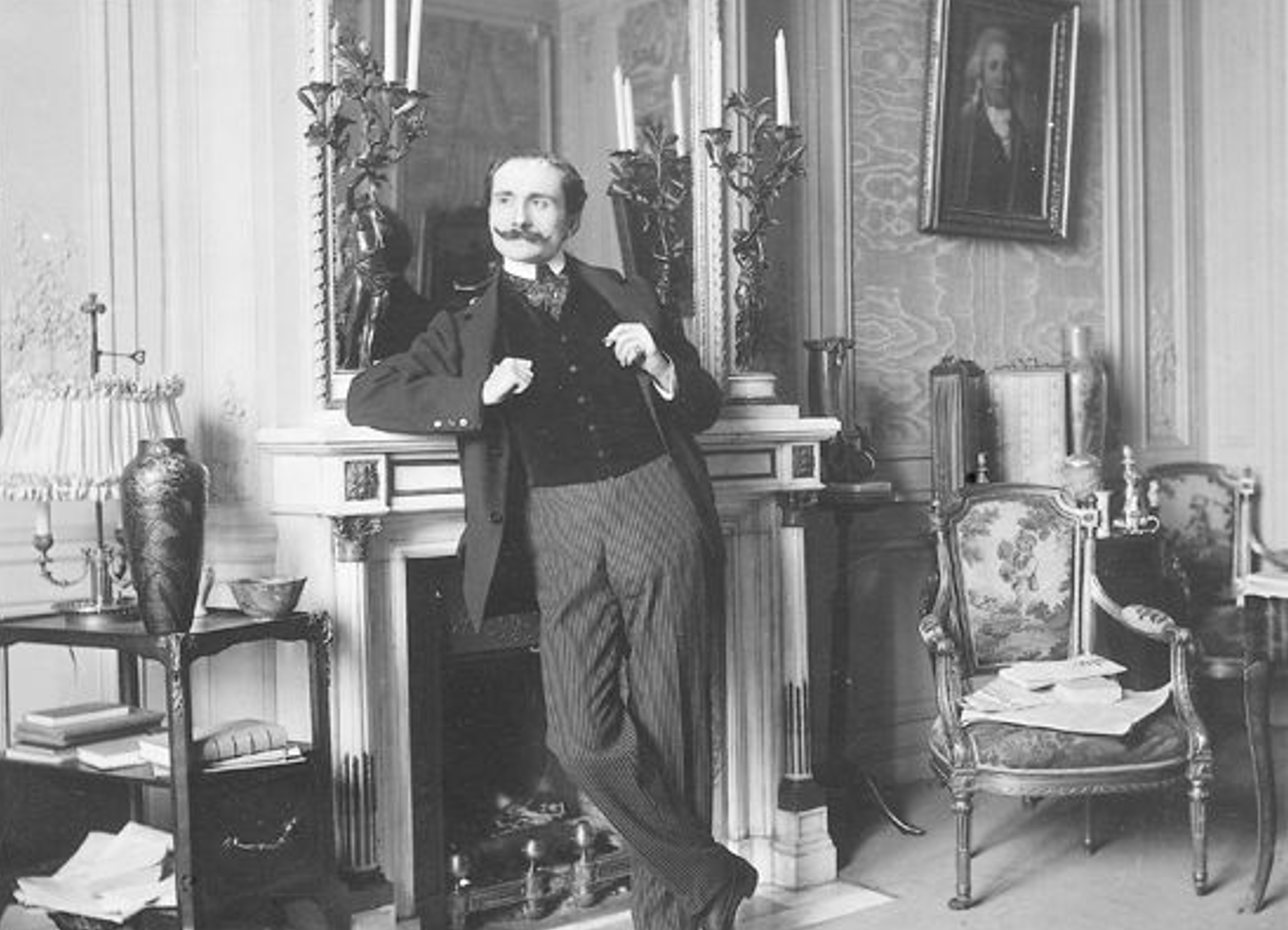
Fame came with Cyrano de Bergerac in 1897, a play probably inspired by the work of P.A. Brun published in 1893, Savinien de Cyrano de Bergerac, sa vie et ses oeuvres. Edmond Rostand actually set himself a challenge : not only his play was costly to put on, but also the first people to see it seemed worried about the boldness of the author, his ridiculous hero and his disconcerting dialogs. Yet, the first Parisian show was a triumphe and the name of Edmond Rostand stayed attached to this play forever.
Elected at the French Academy in 1910, he died in Paris from the Spanish Influenza on the 2d of December 1918. Charmed by the Basque Country, he had acquired some land in Cambo-les-Bains were he had a residence built. It is nowadays a museum honouring his memory : the villa Arnaga.
Jules Strauss
Originally from Frankfurt then naturalized French, Jules Strauss was a financier and started at the Stock Exchange under the supervision of the great art collector Albert Lehmann. Fortune quickly favoured him and he embarked on collecting in his turn. A particularly discreet man with a slender silhouette – he looked like Léon Blum – he first took an interest in impressionism and became close to the famous art dealer Durand-Ruel. Very intuitively, he acquired a great number of masterpieces including La Route by Cézanne from the Doria Sale, and La Pensée by Renoir, that would later enter the Goldschmidt collection. Thus, in twelve years, he gathered together 71 paintings of a remarkable quality, that he would later sell at Hôtel Drouot on the 3rd of May 1902. This auction, whose catalogue was prefaced by the famous art critic Arsène Alexandre, made him famous within the hushed-up milieu of the great Parisian and international collectors. During more than forty years, he was a key figure of the art world. The golden period of this collector’s life was lead within a lavish apartment on avenue Foch between 1904 and 1940, an apartment that was described as a “real museum” by André de Fouquières who had the opportunity to discover it while he was invited there for dinner. Paintings aligned on two or three ranks. Precious pieces of furniture laden with boxes, bronzes and ornaments. Nicolas Landau would say about him: “In my eyes, Jules Strauss remains the model collector, the very image of the most confident and refined taste of his era”. The same way Napoleon had his “napoléonides”, Strauss had left behind countless followers and devotees, well known or unnamed. I am one of them. And as many others, I still use his name and pride myself on the title of disciple. How couldn’t I ? Strauss is this ideal amateur reconciling the dogmatism of the scholar and the nose of a born antique dealer, this honnête homme filled with humor and charm who made antiques pleasant and cheerful to anybody who approached. The heir of a lineage of “curious people” himself, he acted as a guide not only for his friends and the dealers he visited but also for many strangers who lived in his trail without having ever met him, illustrating at all times this marvelous definition of the perfect amateur given by a Greek philosopher in the Vth century: “Those who, free from want, know how to “see”, walk on the earth like Gods”.
Jules passed away in 1943, very afflicted by the death of his son and by the war. His paintings, furniture and works of art were scattered through several auctions, including one held at the Galerie Charpentier on the 27th of May 1949. It is during this sale that our equestrian portrait of Louis XIV was sold as lot 83.