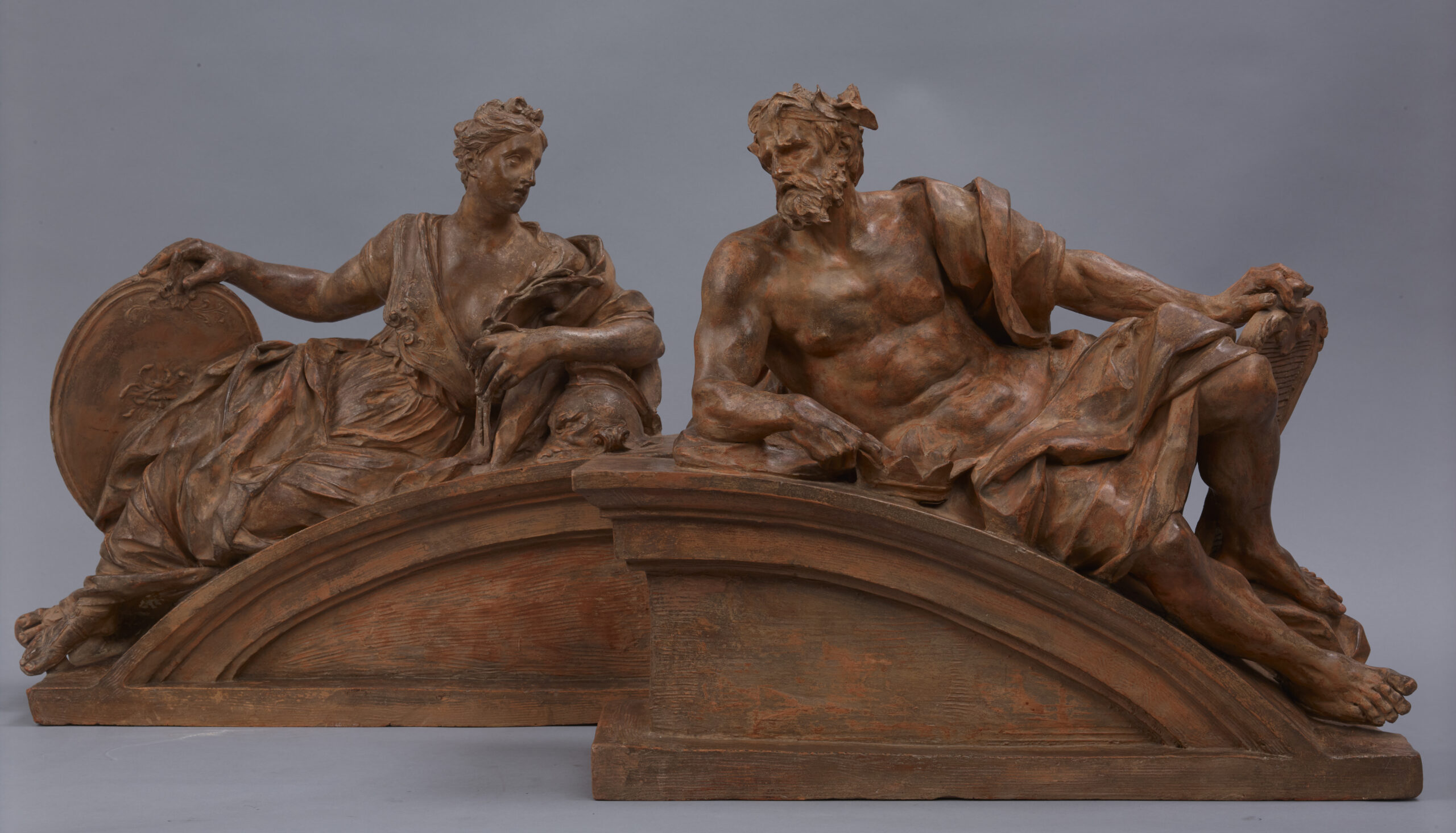
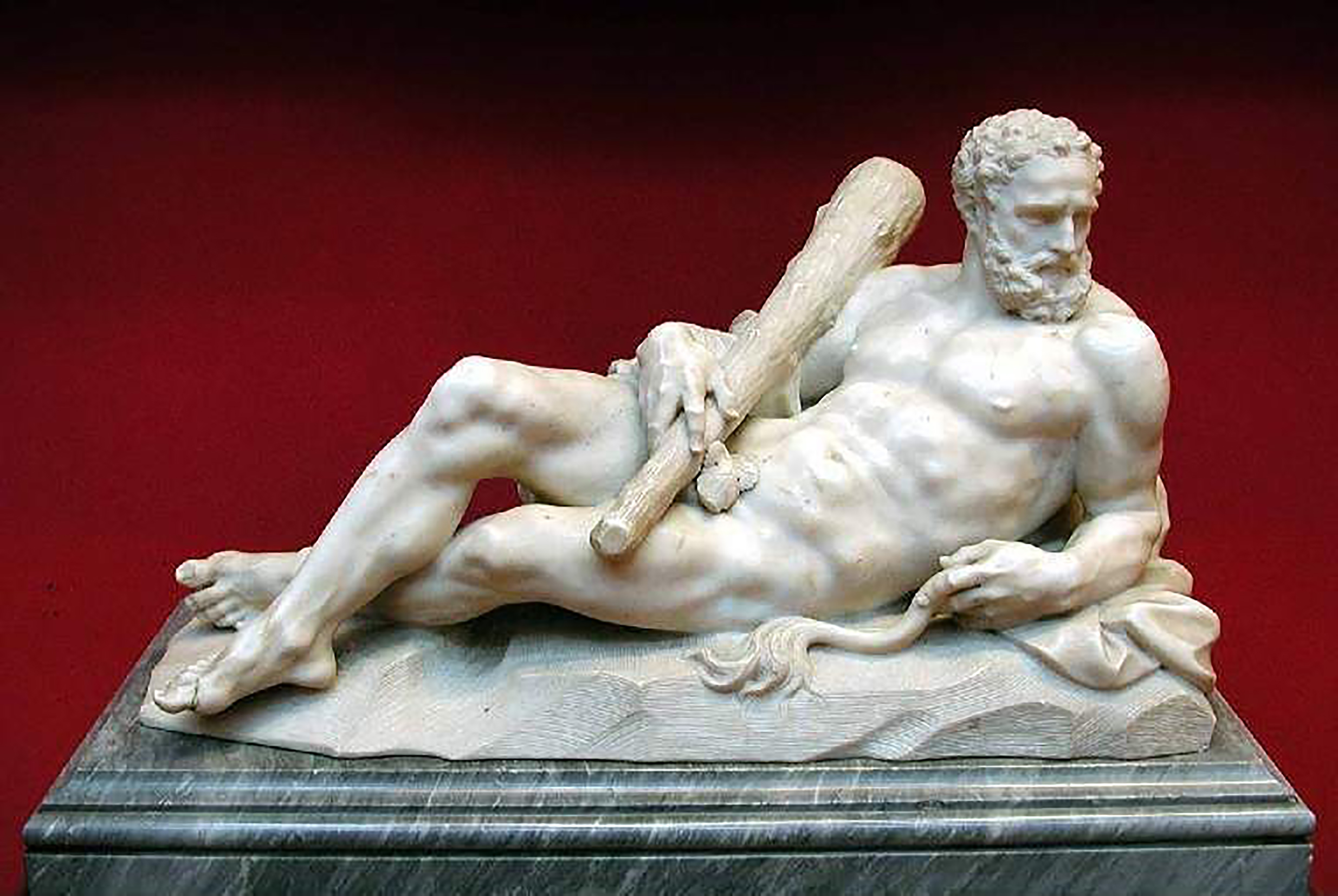
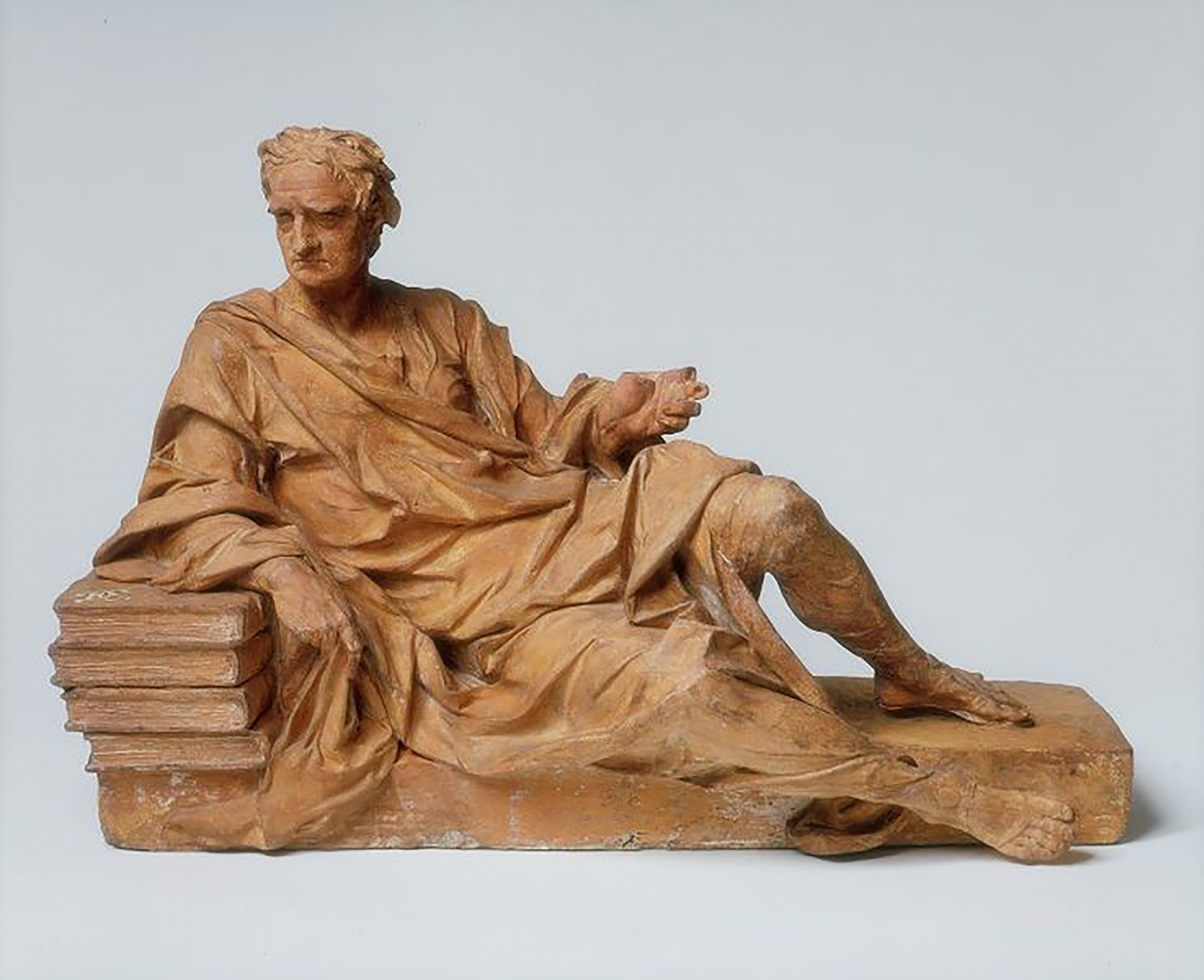
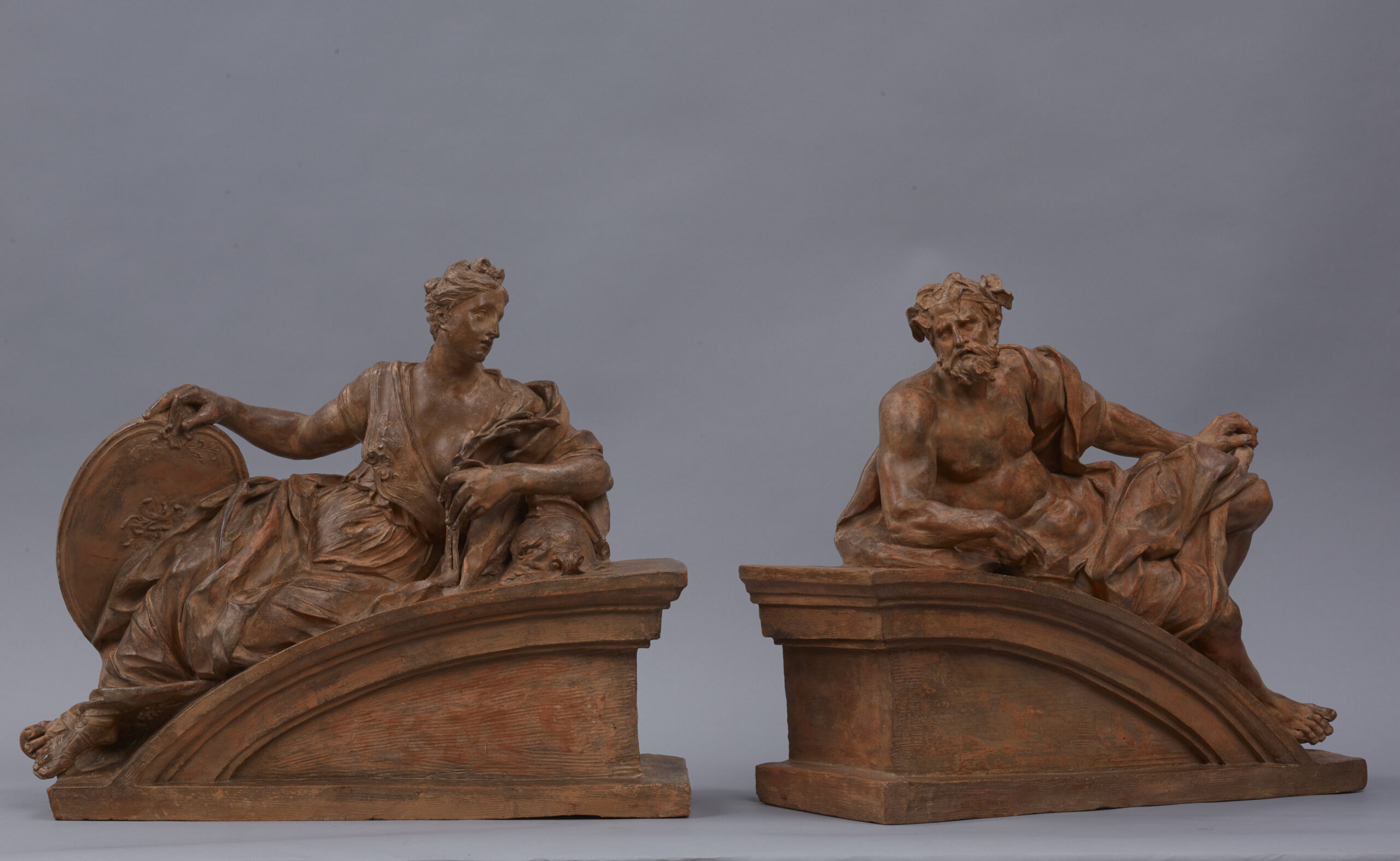
Executed for Robert Walpole, 1st Earl of Orford (1676-1748) to be transposed into stone and adorn the pediment of the Great Door, the main entrance in the middle of the ‘east’ façade of his residence at Houghton Hall, Norfolk, England.
Terracotta.
Ogee bases with moulded and tinted wood; one of them bears an old and incomplete label from the transporter André Chenue on which the address of the Maison can still be read: “5 rue de la Terrasse, Paris”.
Britannia: H. 50 cm. (19 ¾ in.); W. 61 cm. (24 in.); D. 29 cm. (11 ½ in.).
Neptune: H. 52 cm. (20 ½ in.); W. 61 cm. (24 in.); D. 31 cm. (12 ¼ in.).
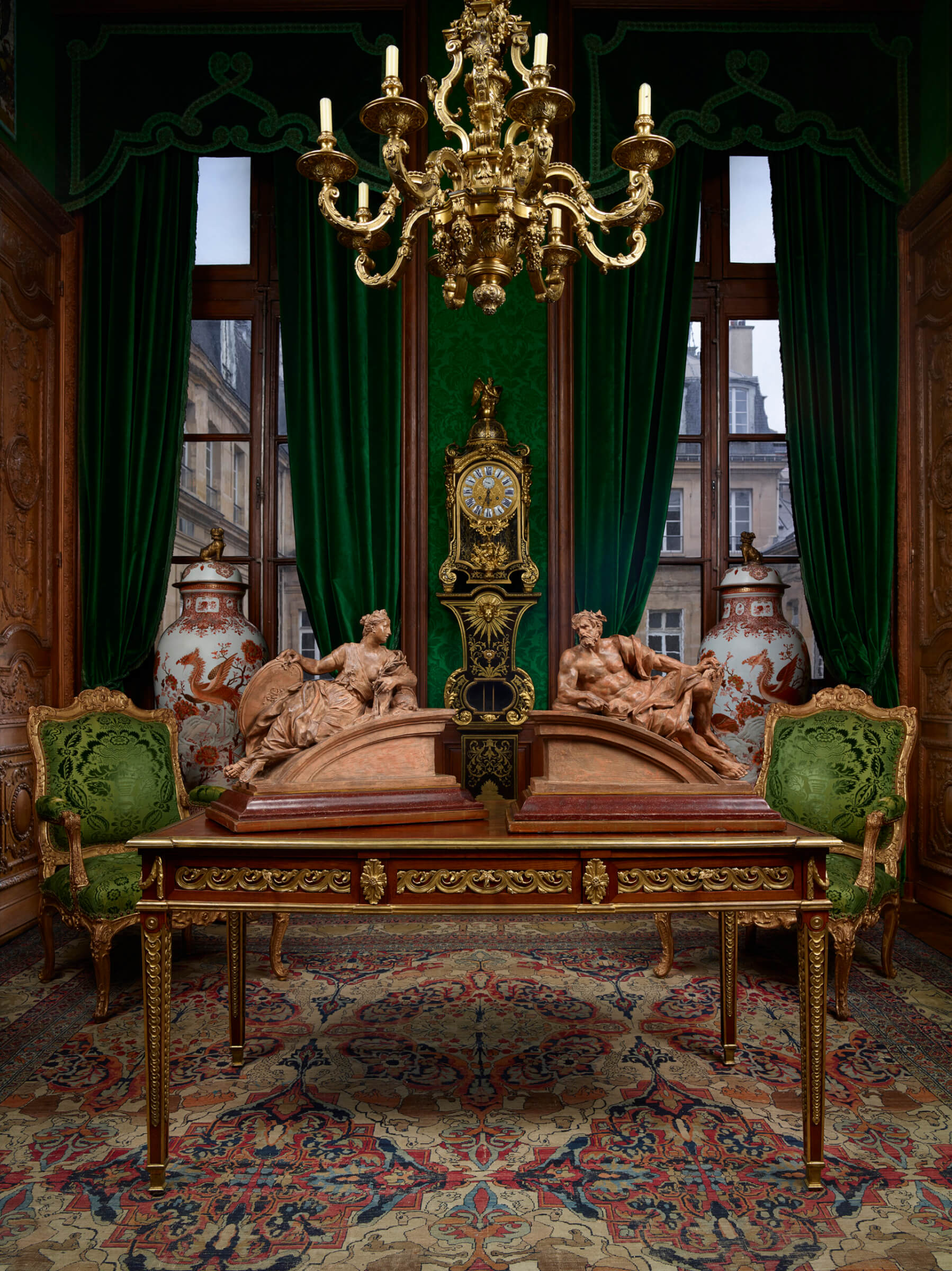
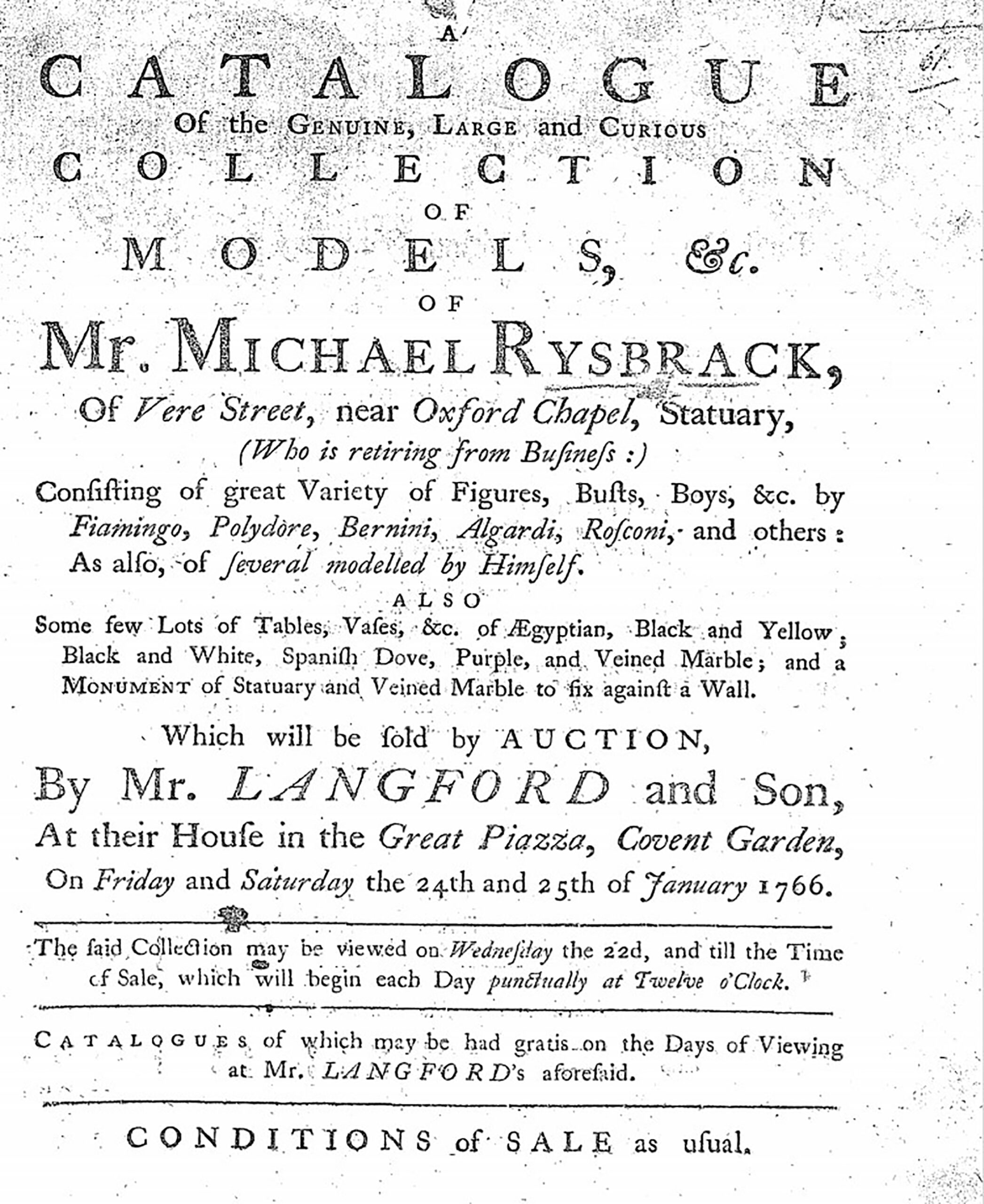
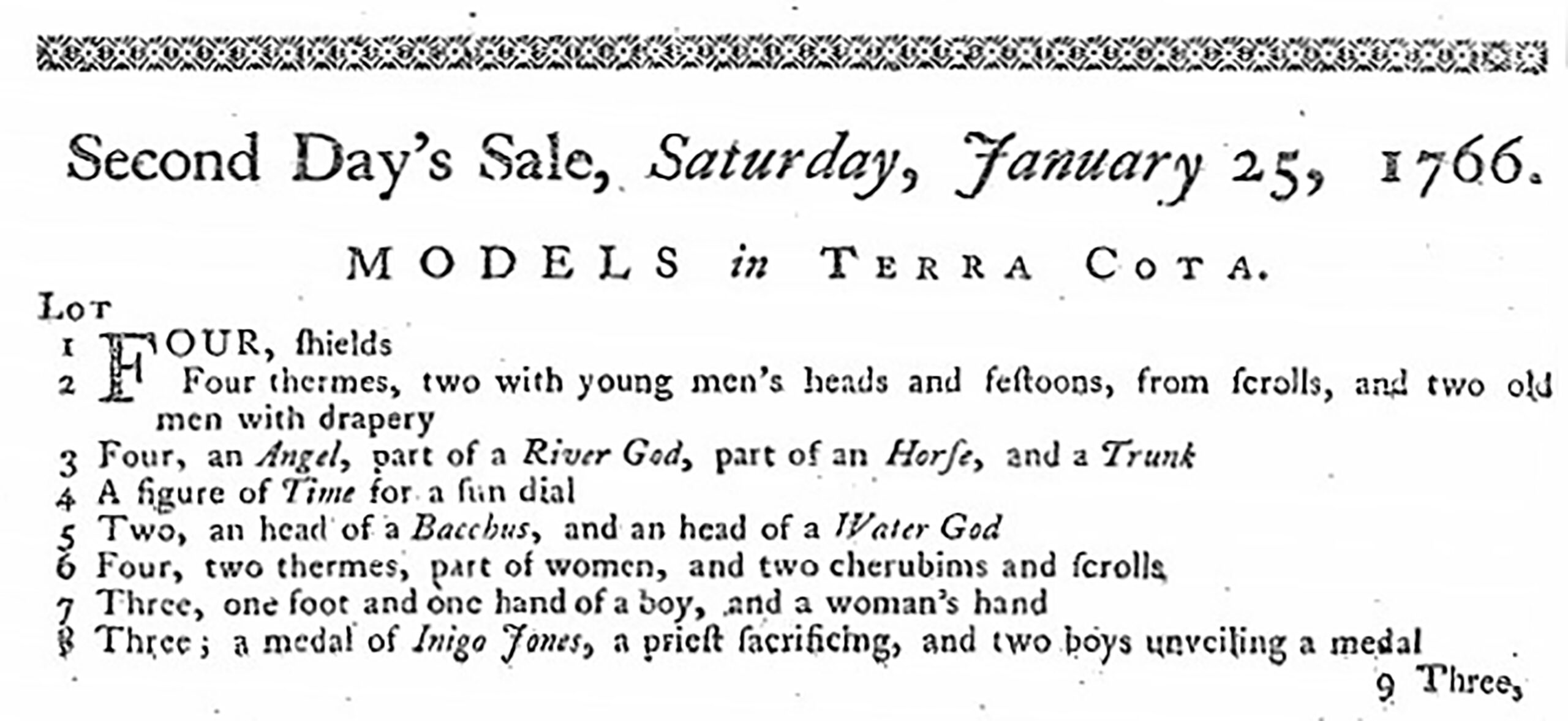
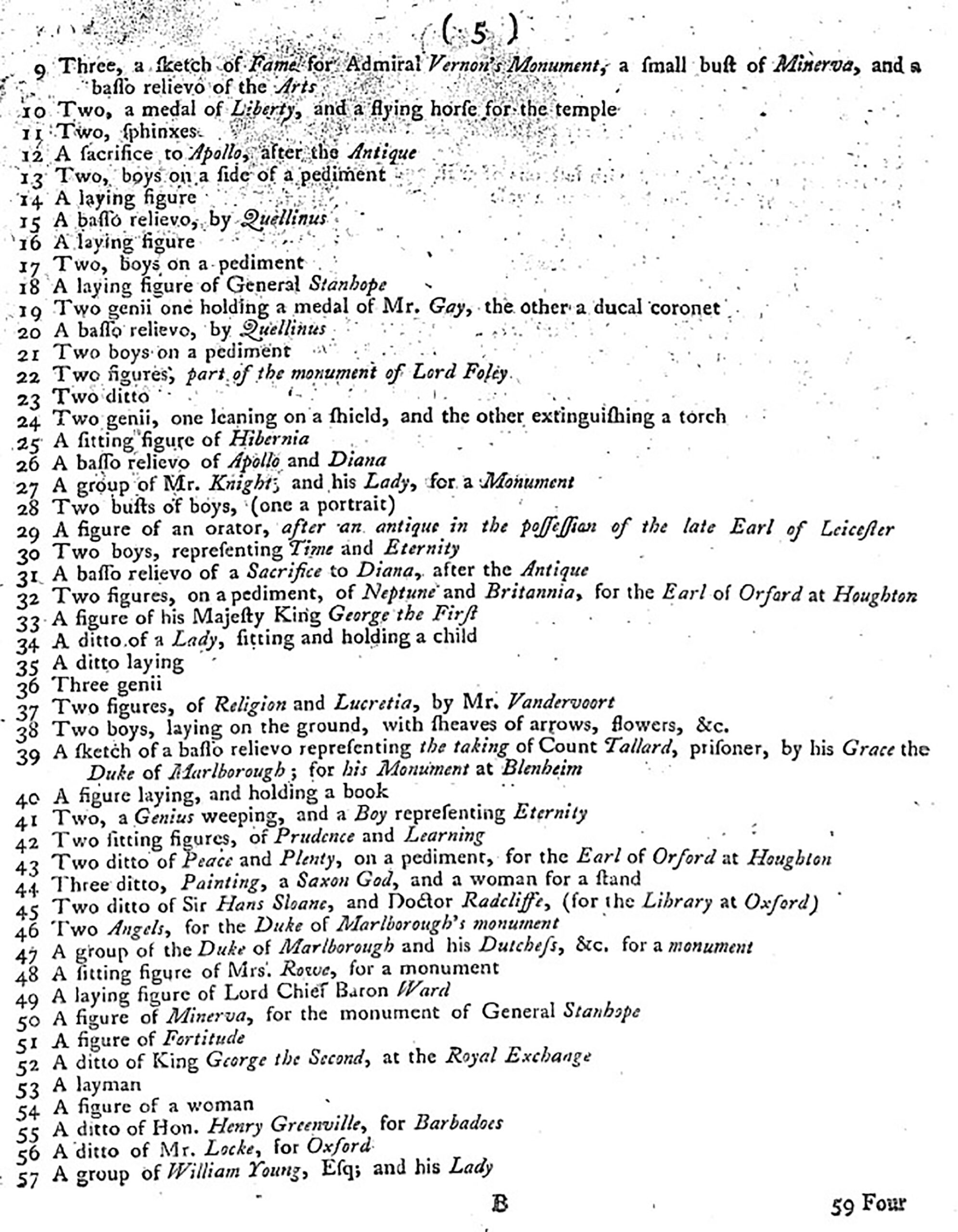
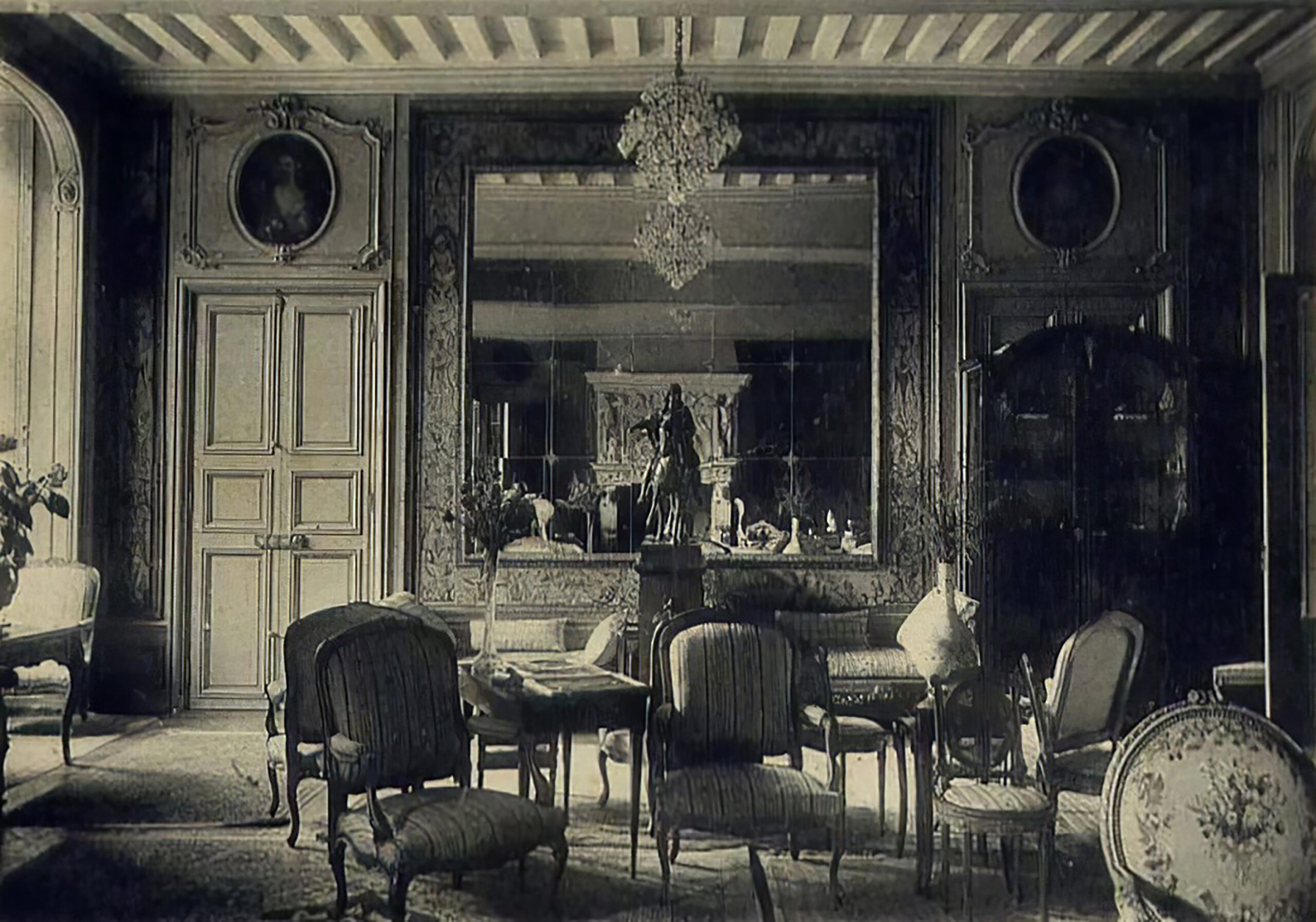
PROVENANCE: executed circa 1730 for Robert Walpole (1676-1745), 1st Earl of Orford, at Houghton Hall, Norfolk, England; personal collection of John Michael Rysbrack (1694-1770); its auction in London, 24th-25th January 1766 by Langford and Son, Great Piazza, Covent Garden, lot No. 32 [25th January] in the section “Models in Terra Cota”: “Two figures, on a pediment, of Neptune and Britannia, for the Earl of Orford [Robert Walpole] at Houghton”; collection of Count Robert Le Coat de Kerveguen (1875-1934) at the Château de Vigny, Val-d’Oise, then collection of his son, Yves Le Coat de Kervéguen (1925-2007); auction in Paris, Drouot-Richelieu, “Provenance du château de… [Vigny]”, Million & Robert, 20th March 1992, lot n° 56, repr.; acquired at the auction by Bernard Steinitz; then private collection.
LITERATURE: Horace Walpole, A description of Houghton-Hall; A sermon on painting: preached before the Earl of Orford, at Houghton, 1742, London, 17(?), p. 263; Marjorie Isabel Webb, Michael Rysbrack, Sculptor, Country Life, 1954, p. 127-128; John Harris, “The Architecture of the House”, in Andrew Moore, Houghton Hall: The Prime Minister, the Empress and the Heritage, London, Philip Wilson Publishers,1996, p. 23;Adam Sharr (ed.), Reading Architecture and Culture: Researching Buildings, Spaces and Documents, Routledge, 2012, p. 82-83; Jonathan Hill, A Landscape of Architecture, History and Fiction, Routledge, 2016, p. 23-32.
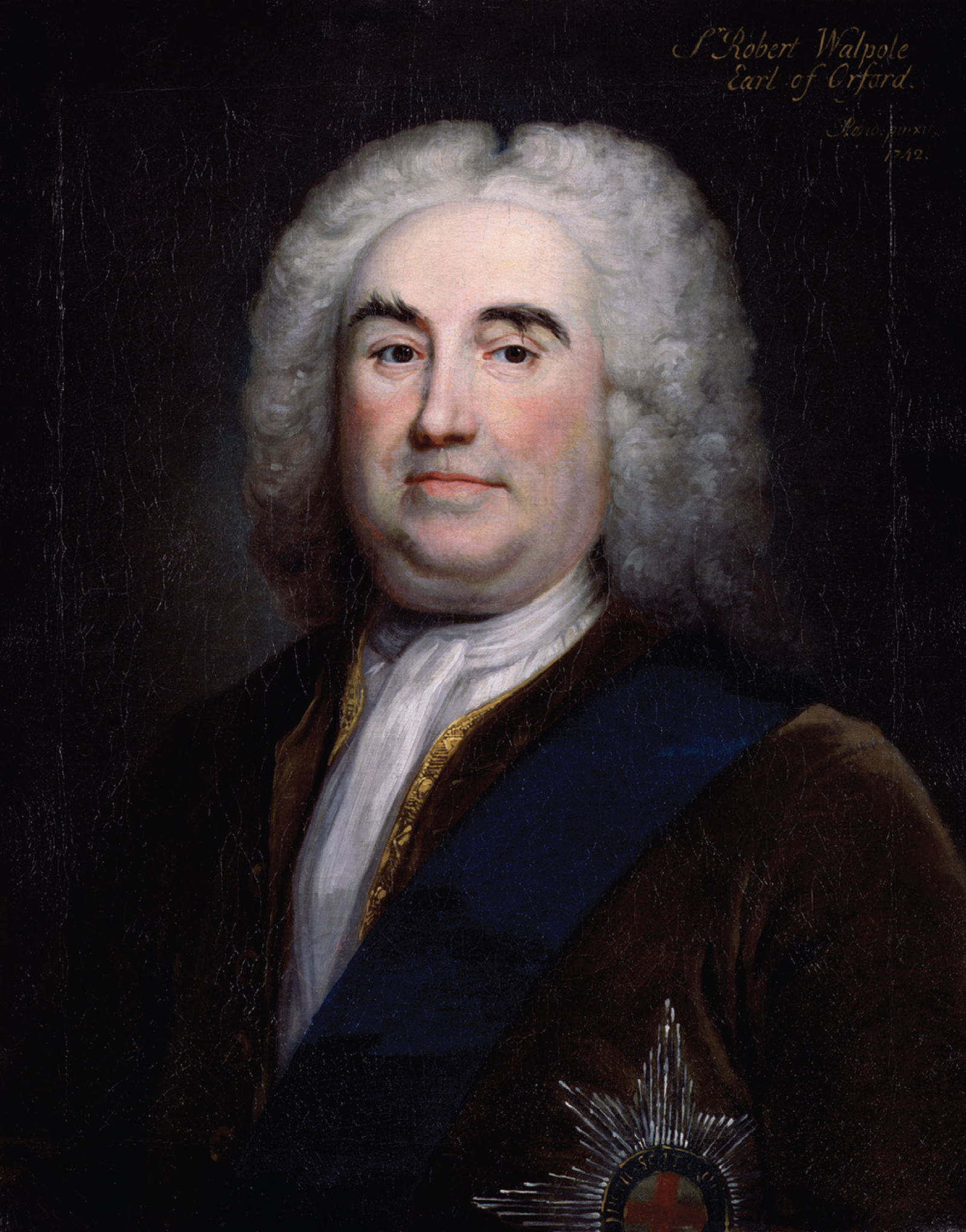
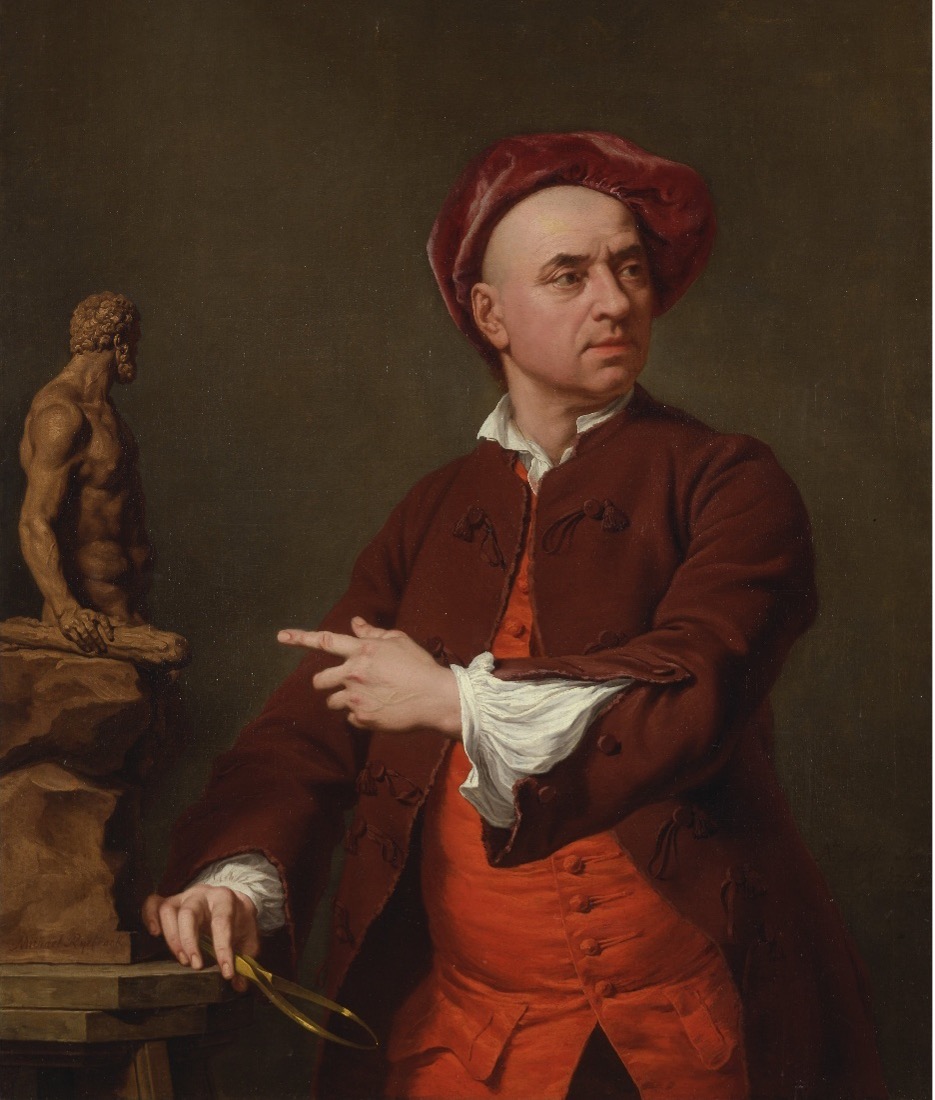
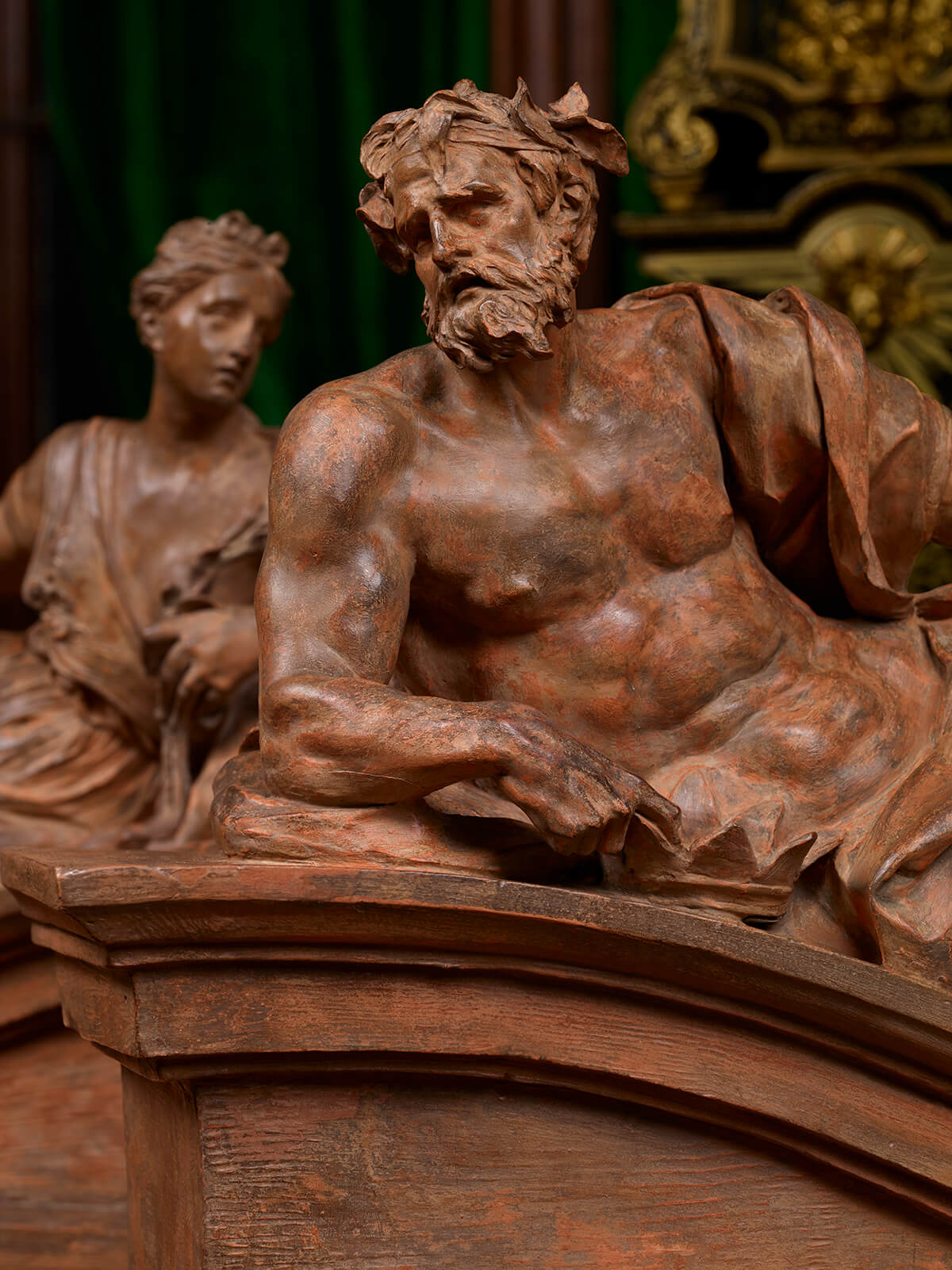
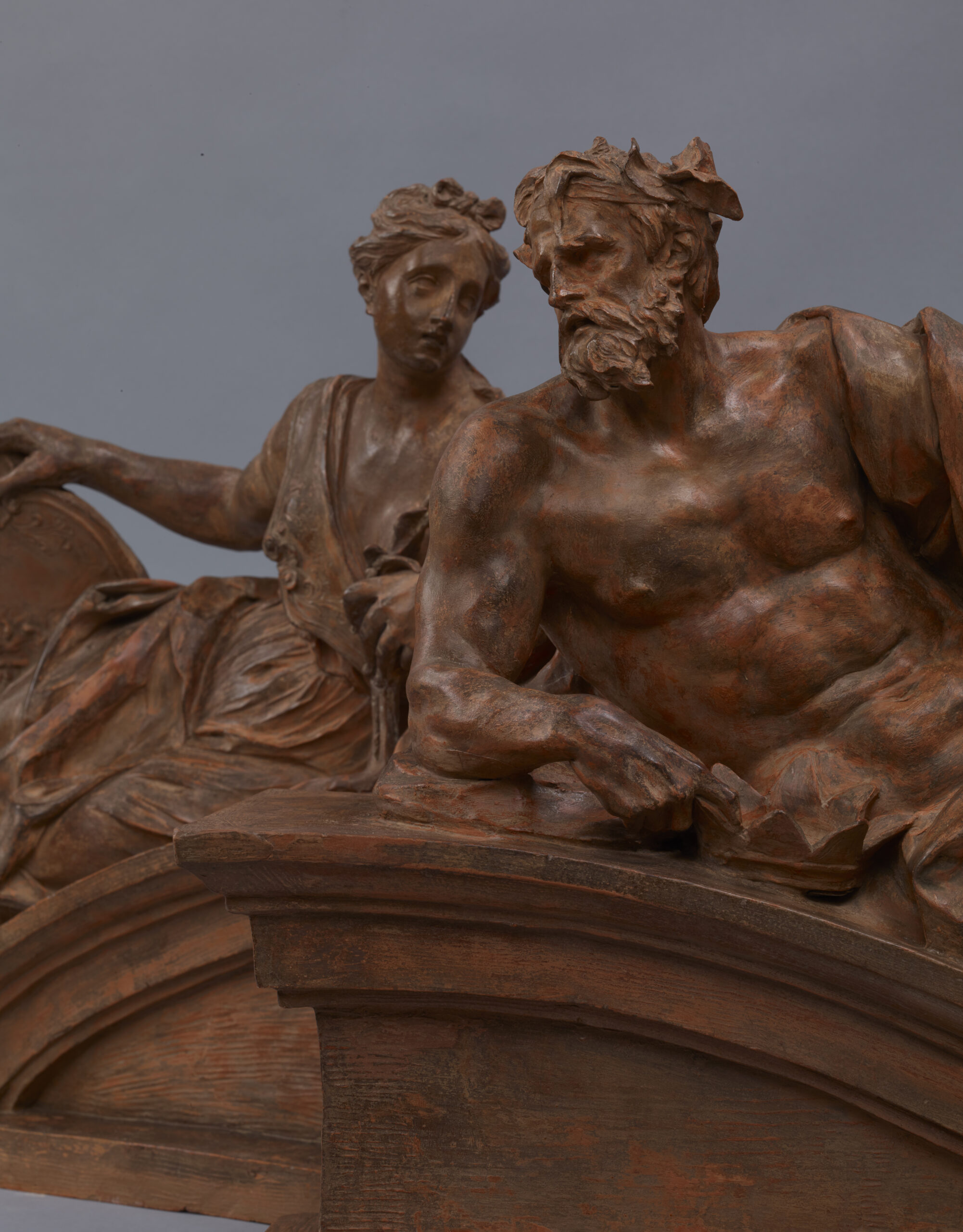
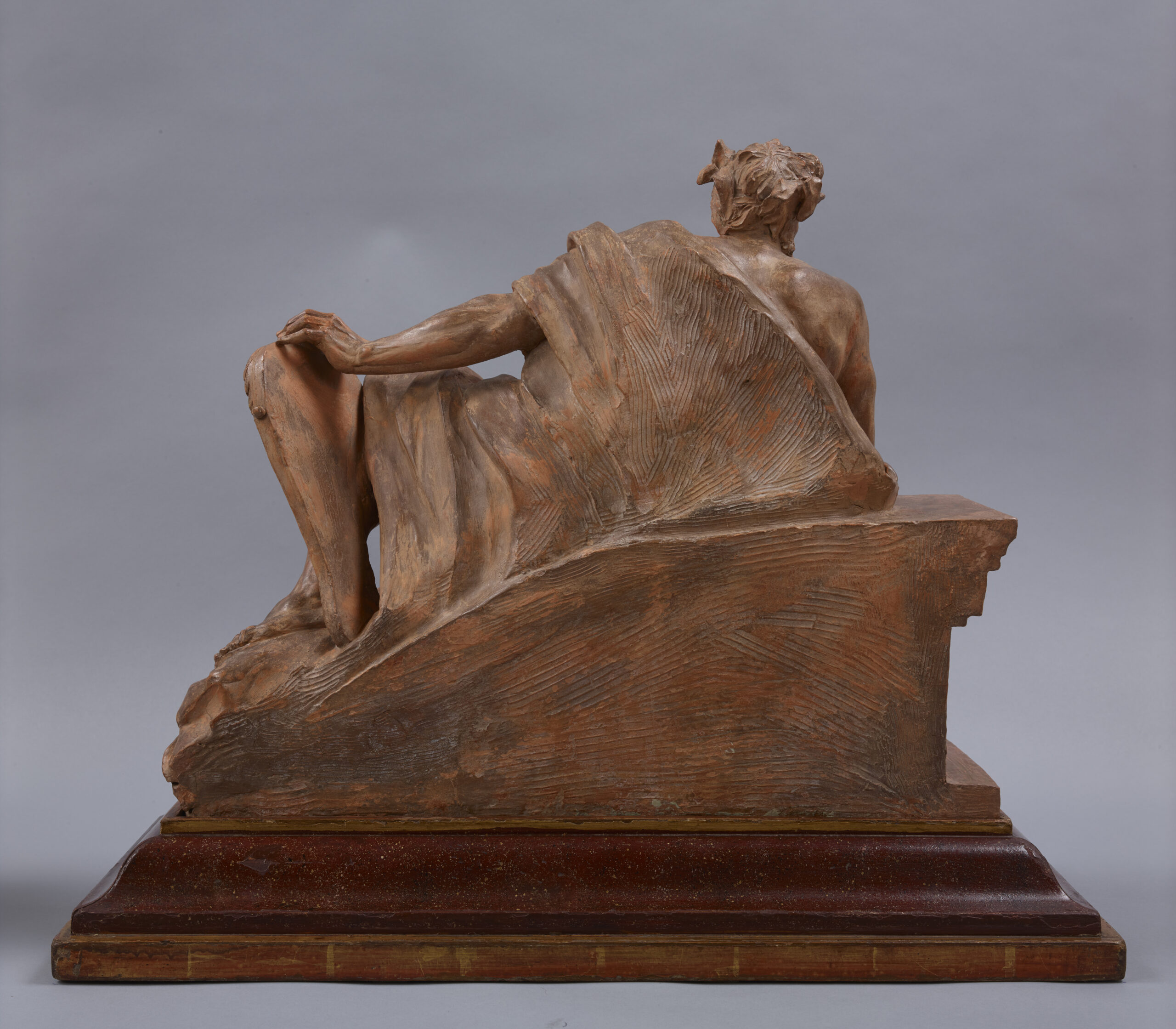
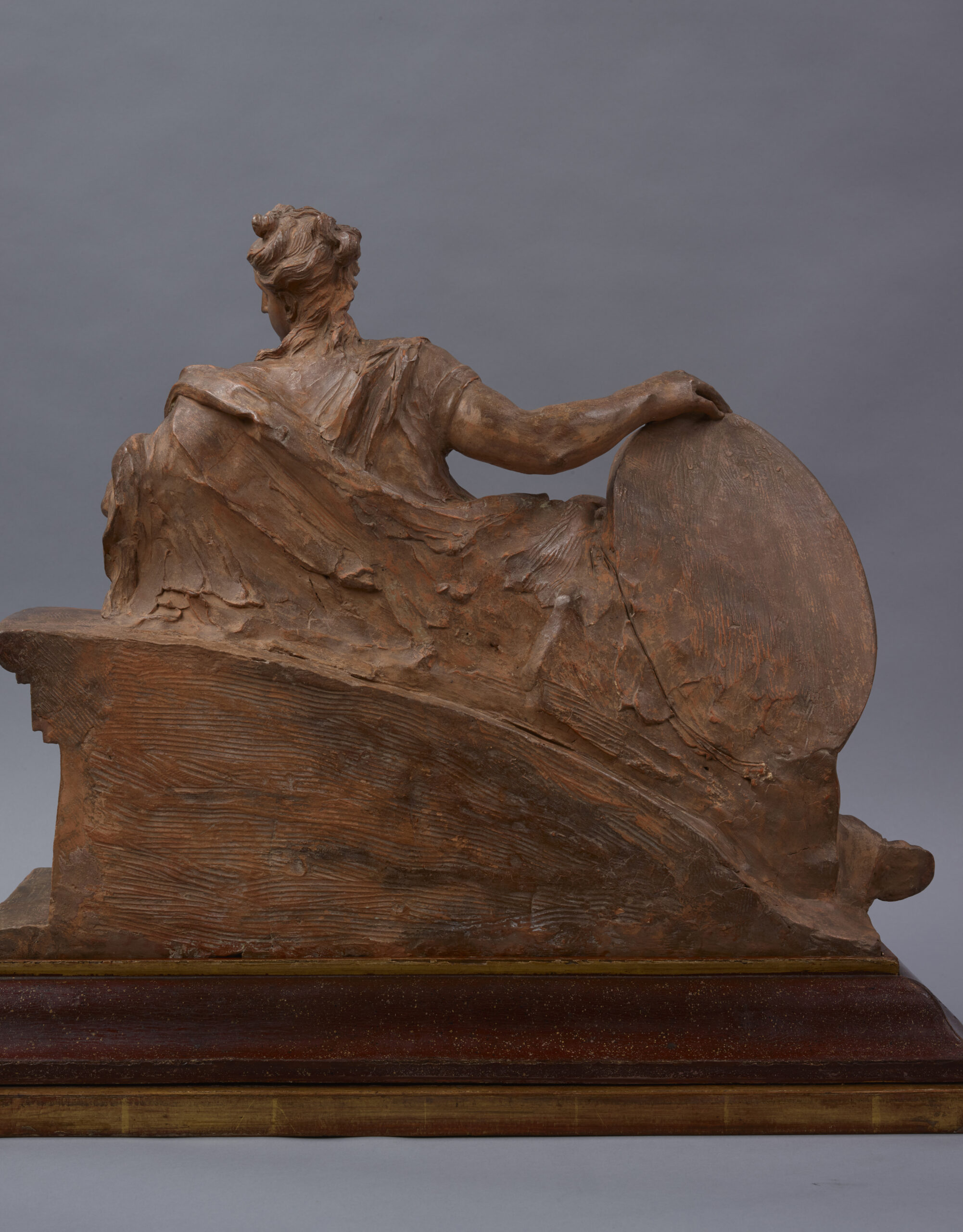
These exceptional terracotta pendant groups, the allegories of Britannia and Neptune, i.e. the personification of Great Britain together with the personification of her maritime power then unequalled in Europe and across the world, have been the subject of in-depth research which has led to the identification of their author as well as the identification of their prestigious acquirer. Both of these imposing terracotta works by John Michael Rysbrack (1694-1770), who was regarded by his contemporaries as one of the finest artists of his time, were executed circa 1730 after drawings by William Kent (1685-1748) for Sir Robert Walpole (1676-1745), the 1st Earl of Orford and now recognised as the first true “Prime Minister” of Great Britain. Although the term did not exist at the time, he can be said to have assumed this de facto role between 1721 and 1742, considering the power he exerted within the government. These works, which are endowed with considerable political significance and symbolise the omnipotence of a man then at the height of his power, are not modelli but very elaborate, well-finished sculptures that were executed at a very advanced stage of the design process. They were most certainly shown by William Kent and the sculptor to Robert Walpole and approved by him before being transposed into stone and on a larger scale by Rysbrack for placement on the curvilinear pediment of the Great Door located in the centre of the first floor of the ‘east’ façade of Houghton Hall, the sumptuous country house which was then being built by the 1st Earl of Orford in County Norfolk.
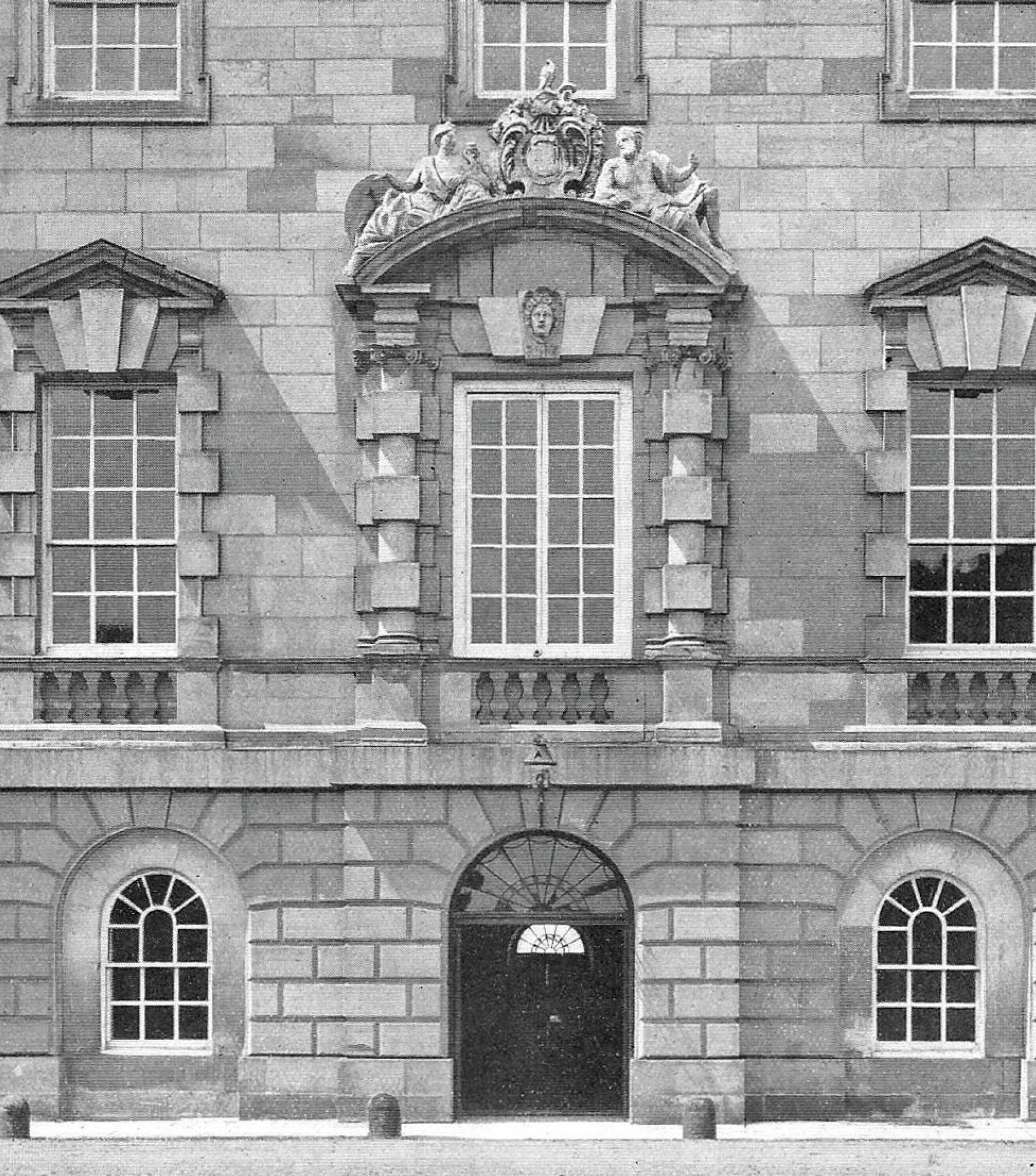
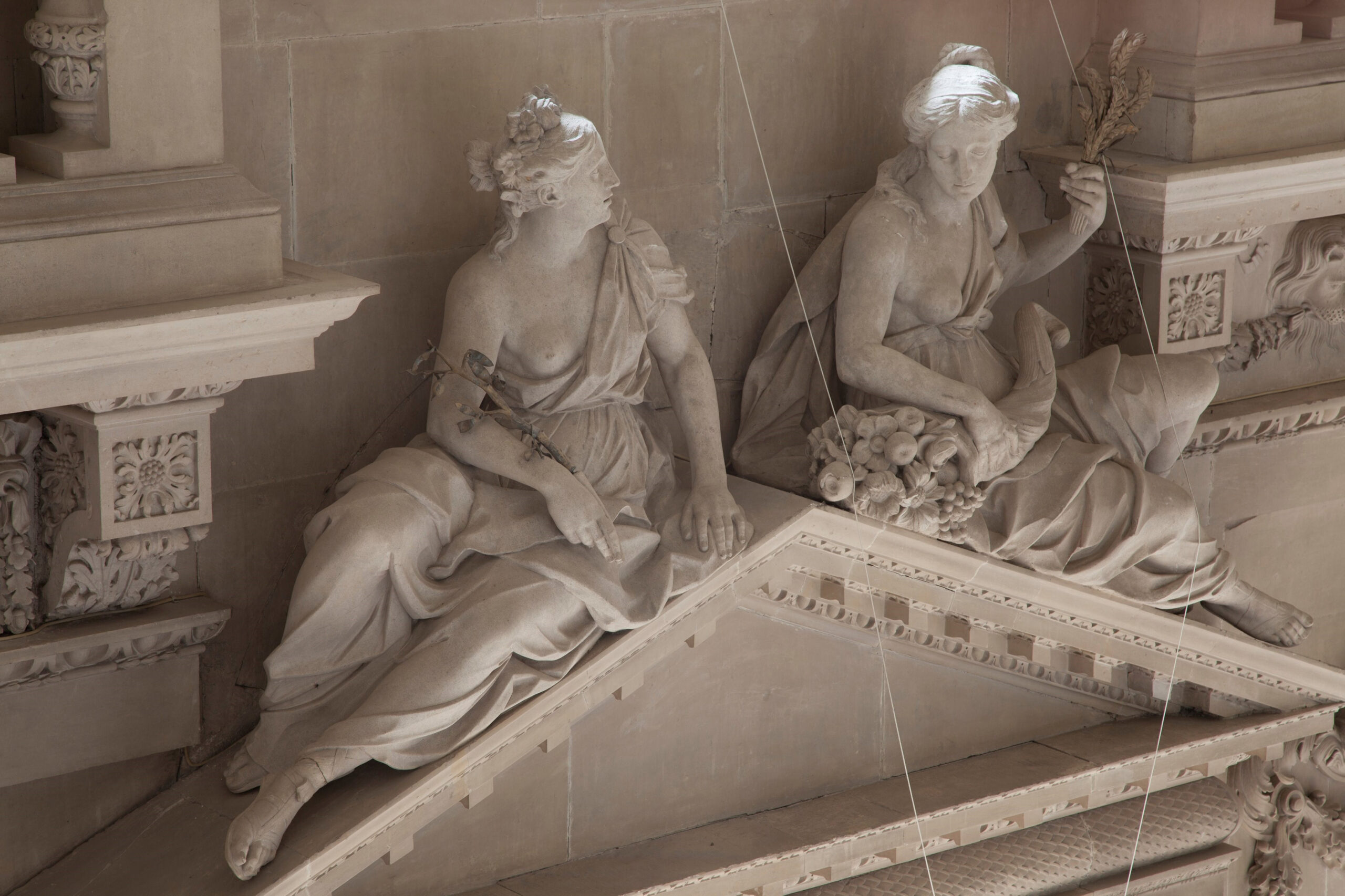
These terracottas match their final stone versions very precisely. They had been placed on either side of Sir Robert Walpole’s coat of arms, flanked by the Collar of the Order of the Garter. They are still in place today and perfectly identifiable despite the deteriorations of time on the pediment of this window, which originally formed the main entrance to the residence. The staircase that gave access to it has disappeared today. These Rysbrack stone sculptures, which were mentioned by the famous writer Horace Walpole (1717-1797), Robert’s youngest son, in his book A Description of Houghton-Hall, of which he became the owner in 1791, have made possible a formal and indisputable identification of our pieces.
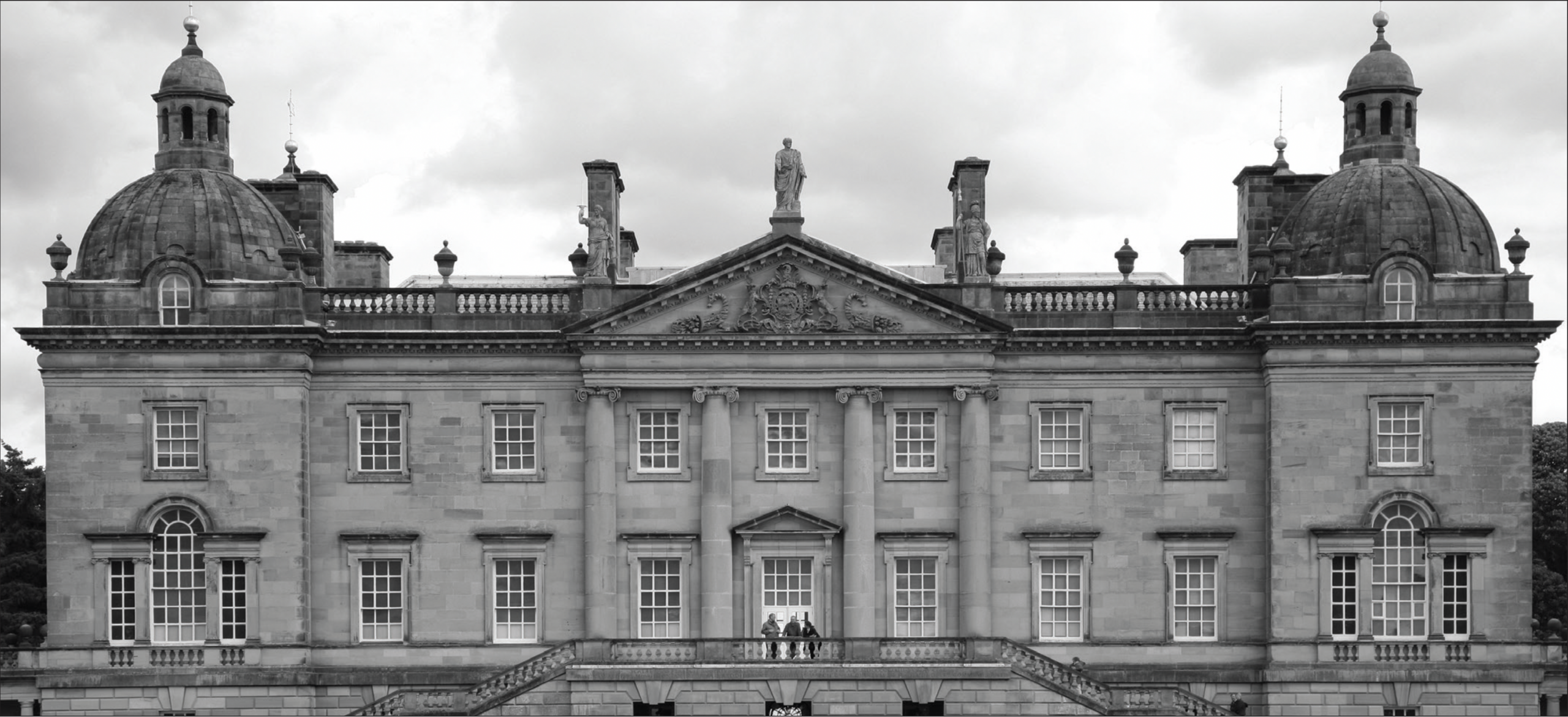
Houghton Hall
Commissioned by Sir Robert Walpole in 1722, Houghton Hall is a defining landmark in the history of Palladian architecture in England. Sir Walpole had inherited the nearly 17,000 acres (6,900 ha.) estate in 1700. After requesting certain improvements to the existing building, he finally decided to build a completely new mansion. The work, whose chronology and dates of intervention of the various protagonists remain a complex matter—many archival documents having disappeared—began in 1722 under the supervision of Thomas Ripley (1682-1758), a friend of the owner, and after the drawings of the Scottish architect Colen Campbell (1676-1729), considered to be the founder of Georgian architecture and the author of the Vitruvius Britannicus […], a major work on architecture in England that was published in three volumes between 1715 and 1725. Houghton Hall was completed in 1735, after alterations to its angle towers were carried out in 1725-1729 by James Gibbs (1682-1754), one of the most influential architects of his time. The interior decoration of the piano nobile celebrating the magnificence of the master of the house, was entrusted to William Kent (1685-1748) who designed it between 1726 and 1731.
Kent had drawn Sir Robert Walpole’s attention to himself three years earlier, thanks to the fame he had acquired after decorating several rooms at Kensington Palace for King George I of England (1660-1727). At Houghton Hall, he also worked on the exterior sculpted decoration, designing the Great Door as well as the large sculpted pediment on the west façade, also bearing the coat of arms of Sir Robert Walpole. The design of this pediment shows the Earl of Orford’s coat of arms flanked by the motto Honi Soit. Qui. Mal. Y. Pense et Fasi. Quae. Sen. Triat and bearing on the reverse side the initials of William Kent with the words for y Pediment/at Houghton in Norfolk/WK, is kept in a private collection.
The total cost of Houghton Hall was exorbitant and exceeded £200,000, according to Walpole himself, who admitted to burning most of the receipts after stating that he was unable to verify the project timeline. More than four hundred paintings by renowned masters adorned this exceptional place, including works by Van Dyck, Poussin, Rubens, Rembrandt and Velázquez, as well as a very important set of ancient busts. A large part of Sir Robert Walpole’s fabulous collection was sold in 1779 by his grandson, George Walpole (1730-1791), the 3rd Earl of Orford, to Empress Catherine II of Russia, in order to pay off the estate’s huge accumulated debts. Houghton Hall today is largely intact, having been preserved from any alteration, particularly during the Victorian era, as the heirs resided mainly at Cholmondeley Castle in Cheshire for most of the 19th century. The estate is now owned by David George Philip (born 1960), the 7th Marquess of Cholmondeley.
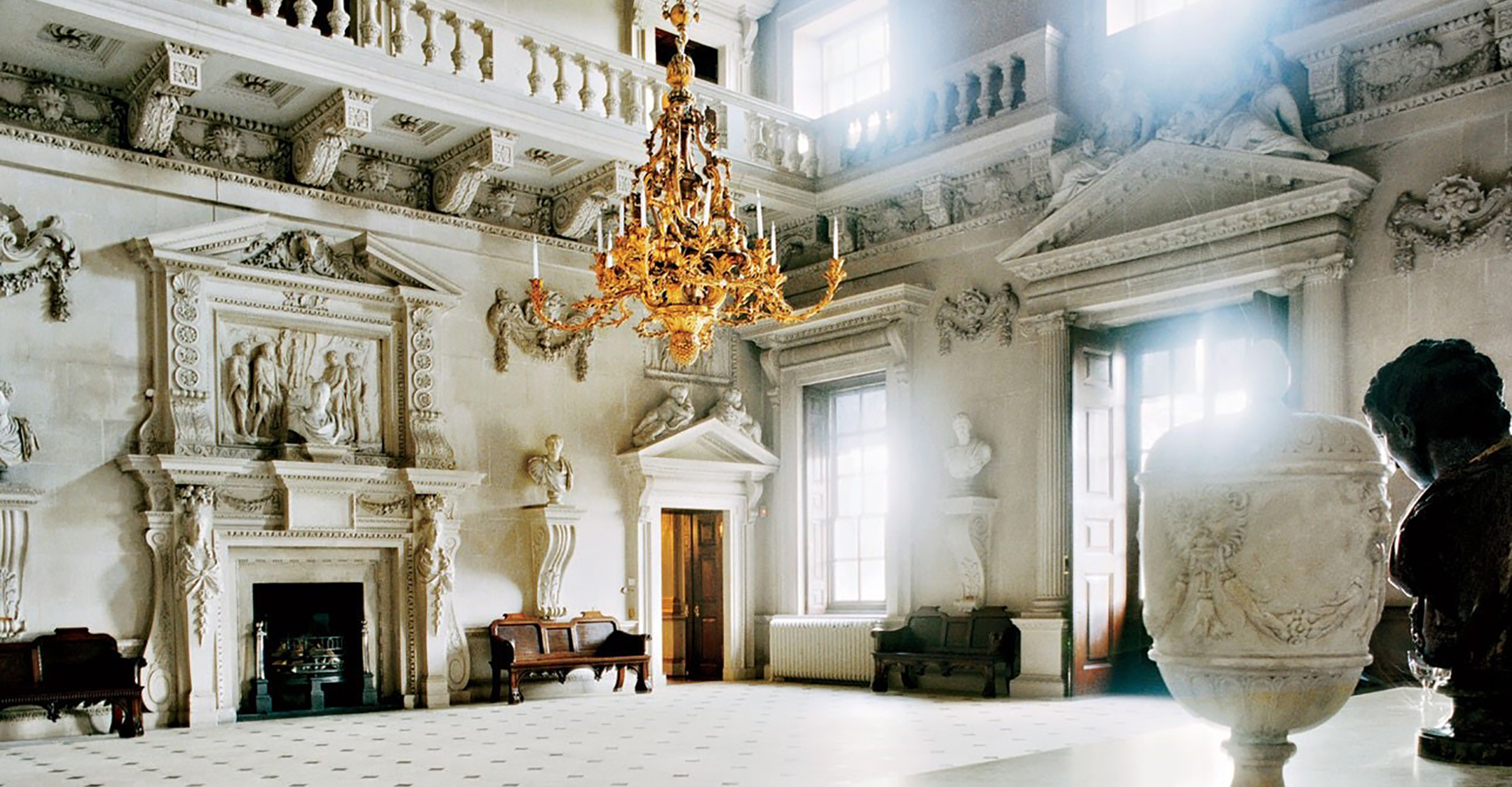
The main entrance to the residence in Sir Robert Walpole’s time was the ‘Great Door’, which was accessed by a curved double-ramped staircase, now destroyed, and had been designed by Kent between 1725 and 1730. It was flanked by two engaged columns with cubic bossage set in an Ionic bay surmounted by an entablature and a curved pediment on which Rysbrack sculpted our two allegorical groups in stone.
It opened onto the Stone Hall, an extraordinary two-storey hall which is still extant today and was designed to welcome visitors to the Earl of Orford in an lavish display of the mineral wealth that had arisen from the close collaboration between Kent and Rysbrack.
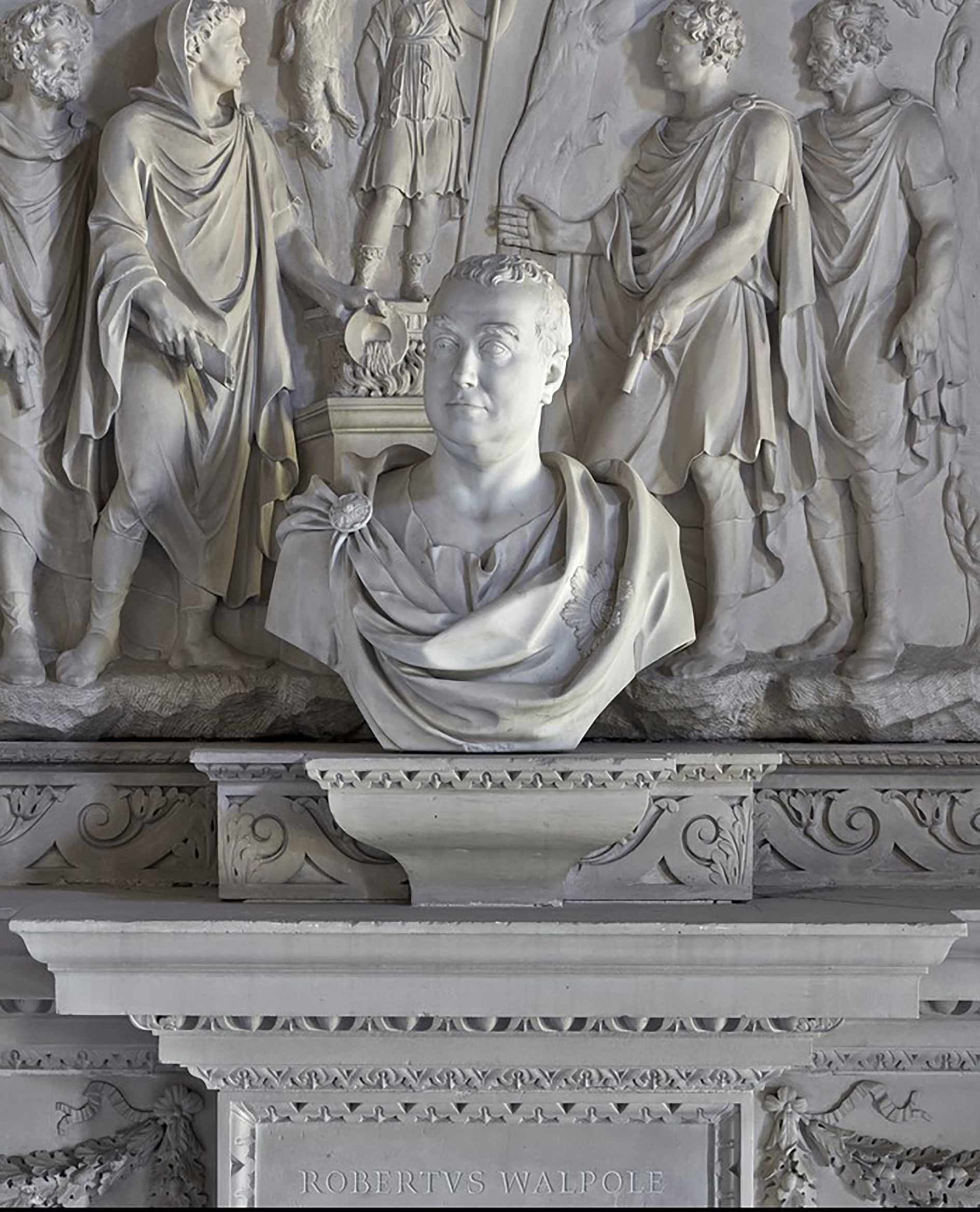
After passing under the figures of Britannia and Neptune flanking their host’s coat of arms, visitors discovered their pendants inside, enhancing the pediment on the reverse side of the Great Door—the allegorical figures of Peace and Plenty, the symbols of a prosperous maritime trade, sculpted by Rysbrack and whose terracotta groups were also sold at his 1766 London auction, forming lot n° 43 of the catalogue: “Two ditto of Peace and Plenty, on a pediment, for the Earl of Orford at Houghton”. Visitors could then admire, on their right, the spectacular Kent Fireplace adorning the north wall of the room, with the bust of Robert Walpole towering above all the other busts of Roman emperors arranged around the hall. This white marble bust, sculpted by Rysbrack in 1726, represents the “Prime Minister” draped in a toga and wearing the Order of the Garter, the highest of the British Orders of Chivalry to which he had been promoted in that year. Kent made repeated references to ancient Rome in his decoration. With very little furniture and difficult to provide with heating because of its unusual size, the Stone Hall was a large room that was considered primarily as the link between the exterior and the interior flats, a place designed to literally ‘capture’ visitors and remind them of the importance of their host, then the most powerful man in England after the King, a fact that was underlined by the Latin motto on the base of his bust, which translates: “Robert Walpole, Prince of the British Senate, who established, dwelt in and made famous this house”.
The completion of the construction work at Houghton Hall was celebrated with the publication in London in 1735 of Isaac Ware’s famous compendium The Plans, Elevations and Sections; Chimney-pieces and Cielings[sic] of Houghton in Norfolk, richly illustrated with engravings by Paul Fourdrinier after drawings by Kent, which was the first architectural work on a private house ever published in England.
Britannia et Neptune
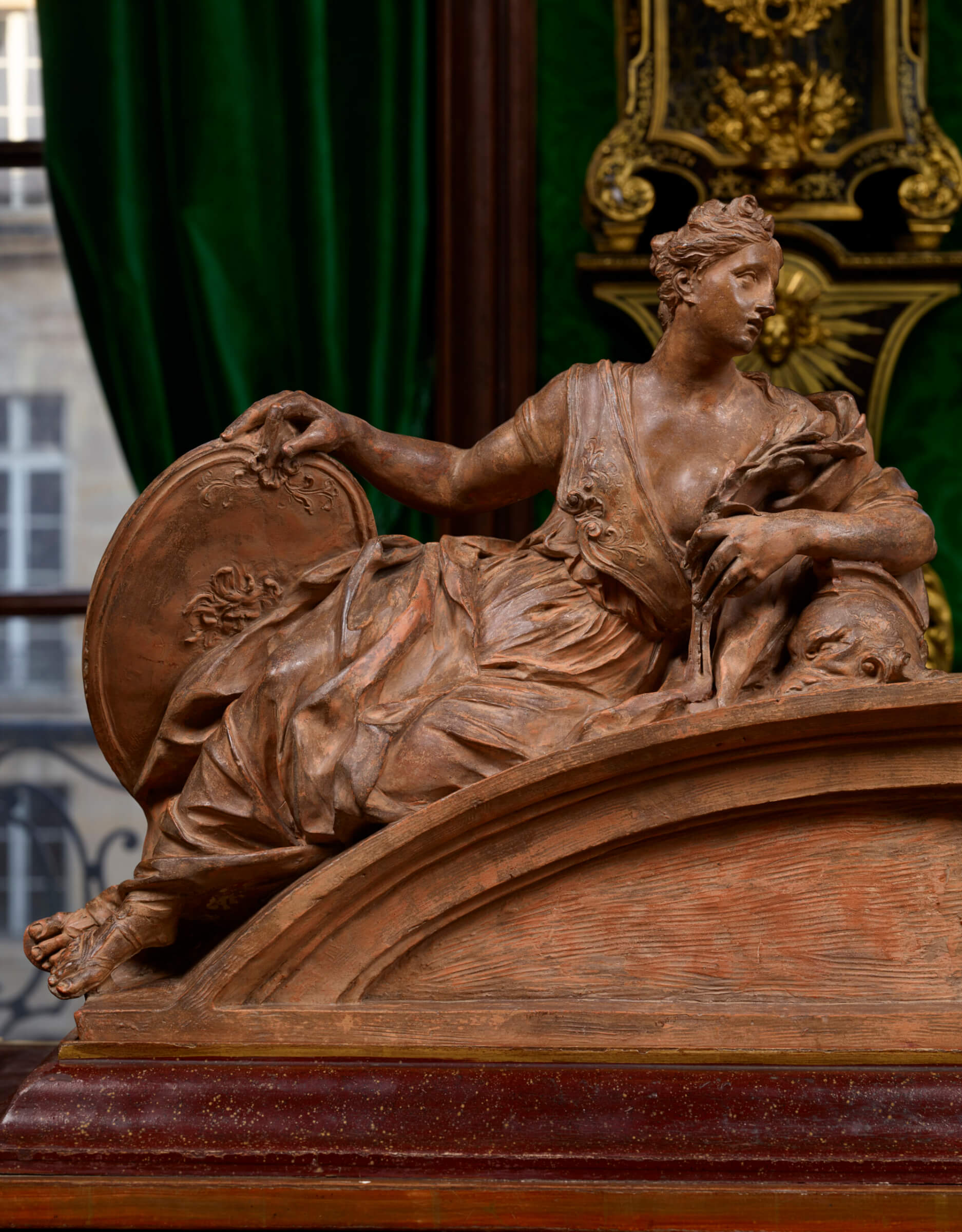
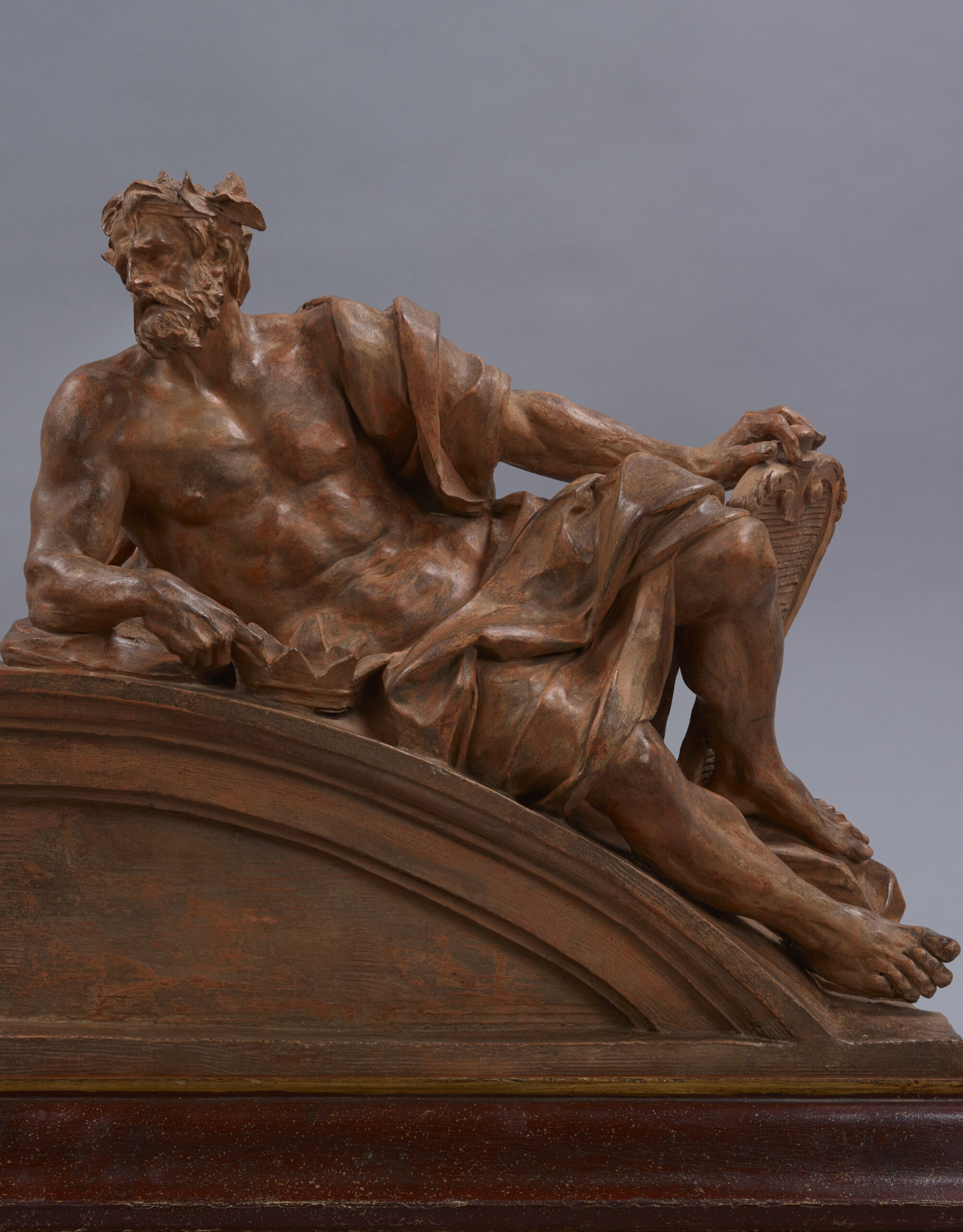
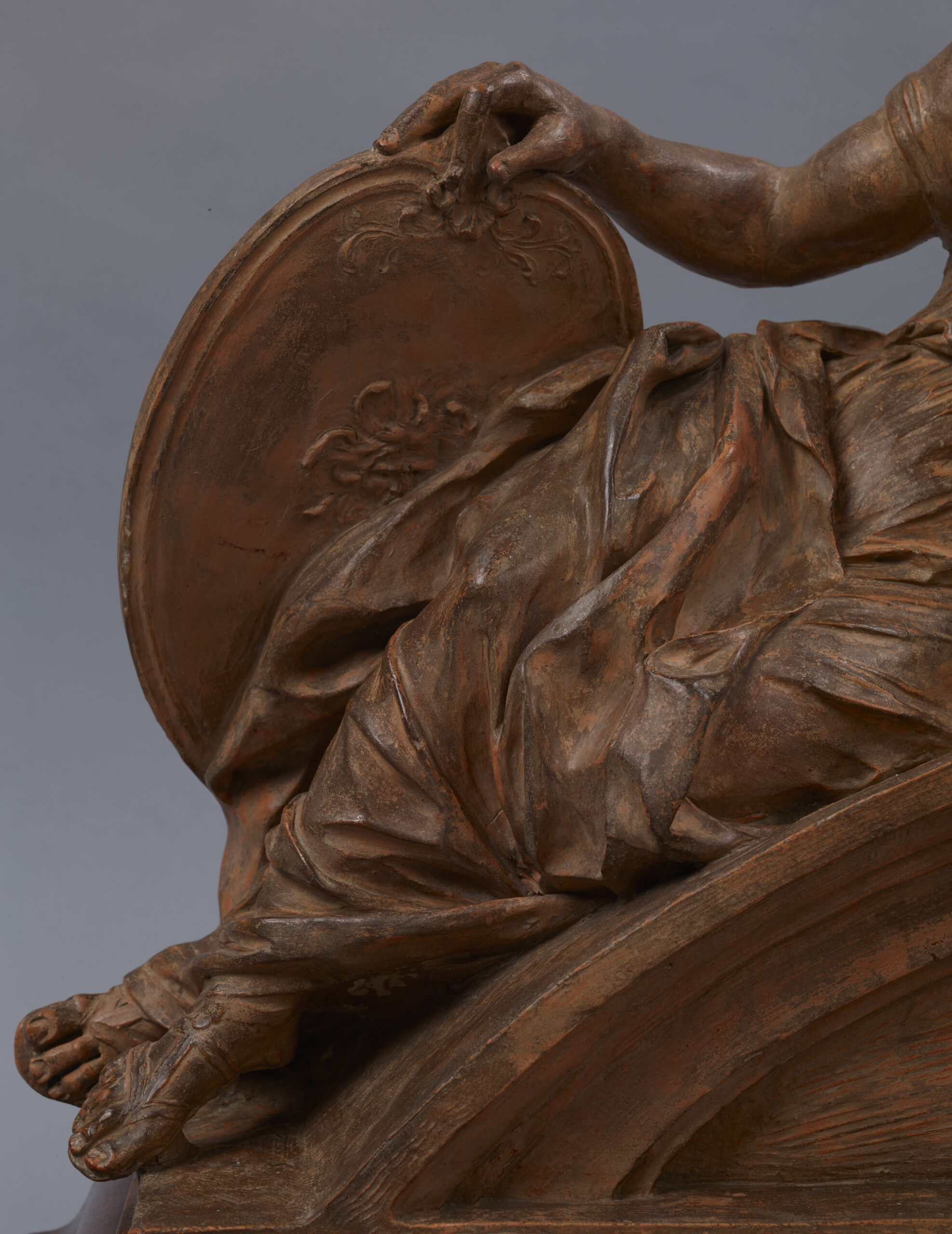
Rysbrack was at the height of his fame when he executed these terracotta groups, brilliantly using a very innovative combination of Baroque naturalism and classical idealisation, which was quite new in England at the time. In the early 1730’s he was thus laying down the formal principles of British sculpture that were to prevail throughout the 18th century. Reminiscent of the tombs of Giuliano and Lorenzo de’ Medici sculpted in Florence by Michelangelo, each of the allegories, Britannia on the left and Neptune on the right, lies on a broken curvilinear pediment, their torso straightened and their heads facing each other in order to show their close imbrication. Britannia leans on her left forearm resting on a helmet and holding a palm covering her bare left breast. She has an elaborate hairstyle consisting of a large knot above her forehead, lined with a bun that enabled her to bring her hair back to her left shoulder.
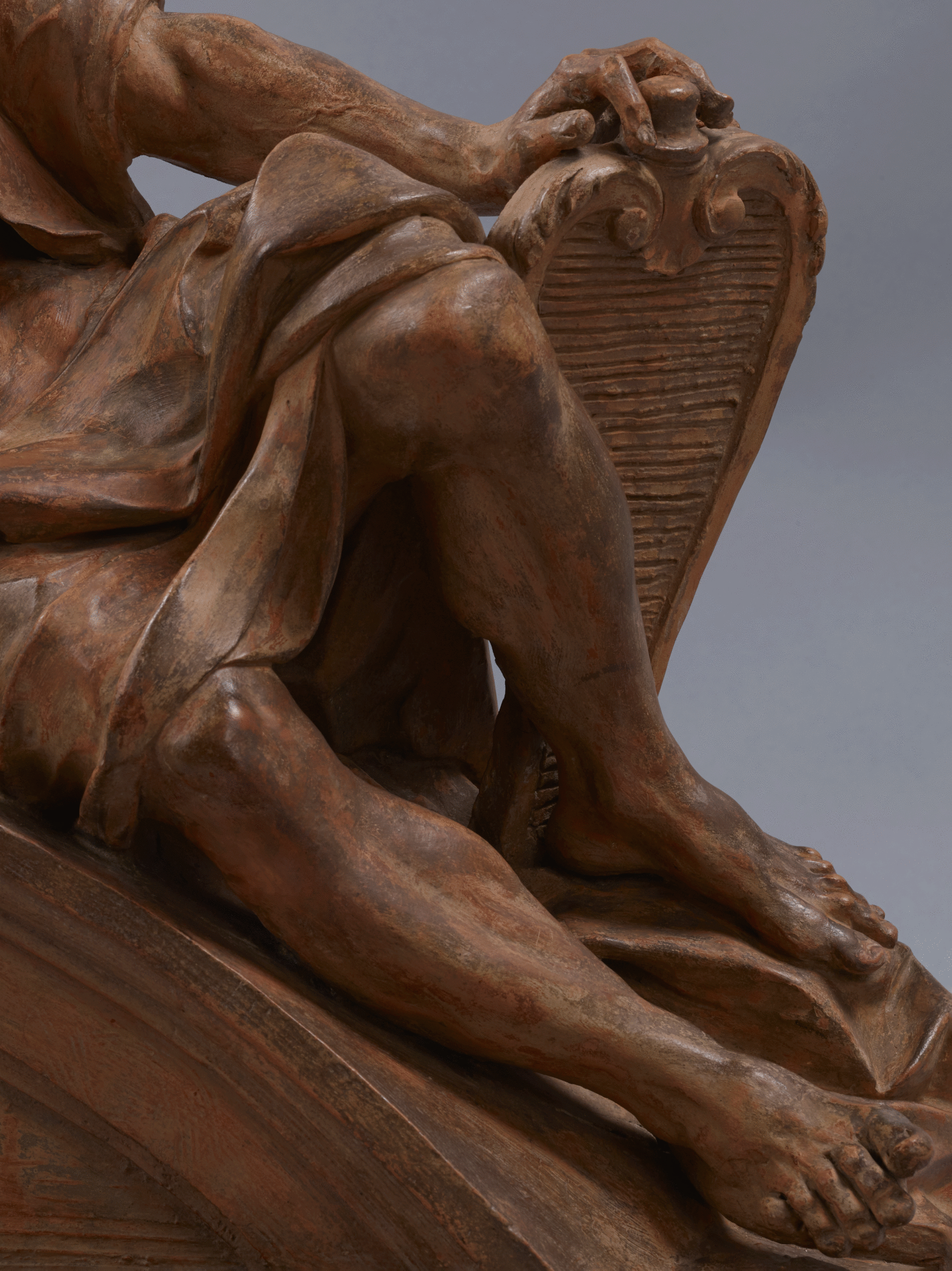
She is dressed in the antique manner with a tunic lined with a stola covering her left shoulder and draped up to her crossed feet shod in sandals, and is wearing a wrought breastplate partially covering her chest diagonally. With her right hand she holds an oblong shield adorned with the head of Medusa and resting behind her legs on the pediment. In a similar posture, Neptune displays a bare torso revealing a very ‘Michelangelesque’ musculature. A large draped cloth covers his waist up to the knees, enveloping his back and pulled back over his left forearm. Like Britannia, he holds up a shield with serpentine contours and a striated surface, placed on the pediment. He has a beautiful face with powerful, emaciated features expressing both great strength and an equally intense passion for the woman he is looking at. His beard and reed-crowned hair are very finely wrought. His right forearm rests on a fold of his cloth, and he holds his crown placed next to him with his fingertips. His barefooted legs are powerful, the right one stretched out along the pediment and the left one raised and leaning on the bottom of the drapery.
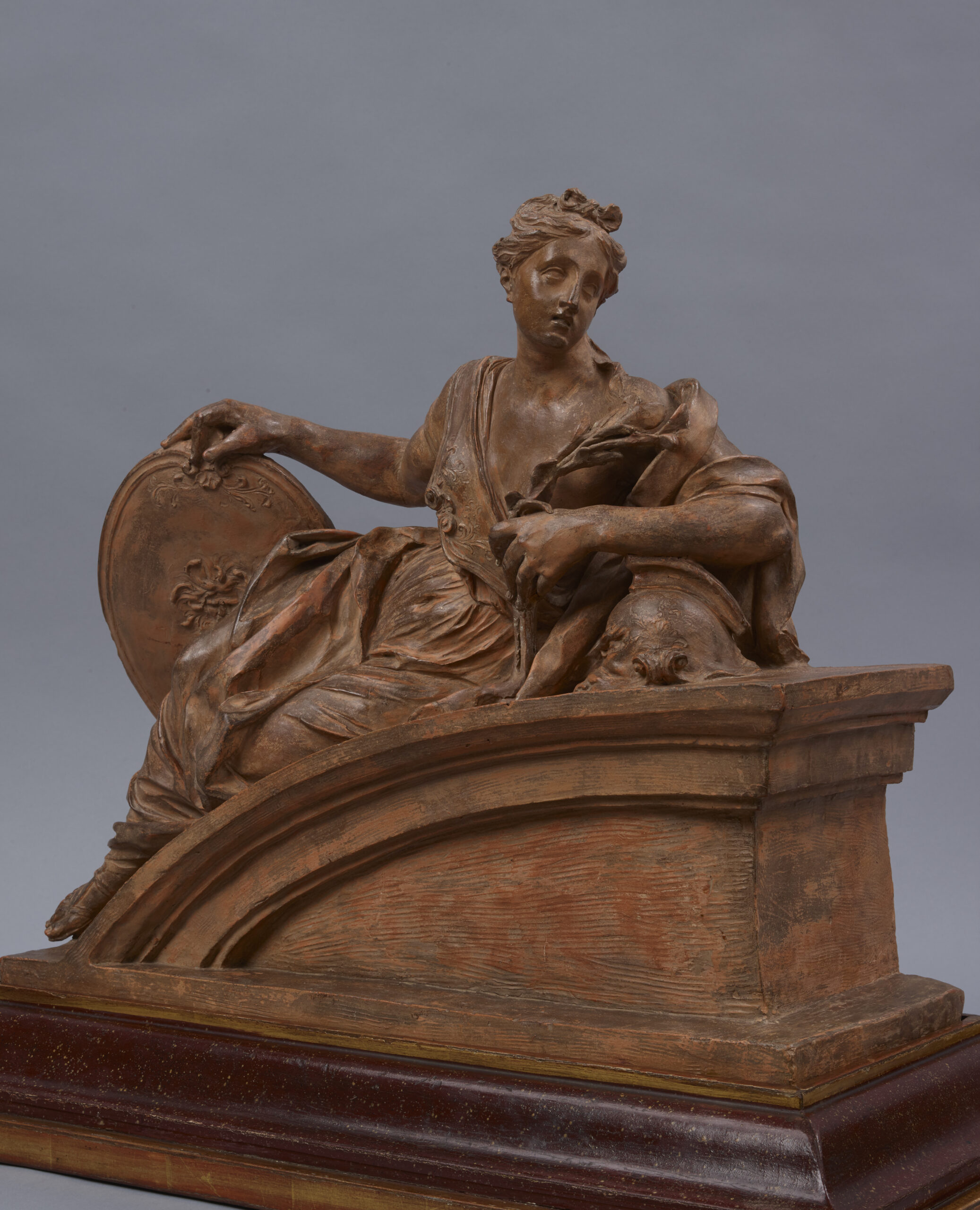
The image of Britannia, which Rysbrack chose after Kent for Robert Walpole and which he had already used before 1729 in a bas-relief showing Britannia receiving the riches of the East, which was intended for the decoration of the mantelpiece of the Council Chamber of the East India Office, in Whitehall, London, had begun to replace the other English national emblems—St George and his cross, the royal coat of arms, the Crown, etc. —in the early 17th century. That is to say, when James Stuart (1566-1725), King of Scotland since 1667 under the name of James VI, acceded to the English throne in 1603 under the name of James I of England on 24th March 1603, thus sealing the union of England and Scotland. That selfsame year also saw the unification of the English and Scottish national flags, the first of which—the red cross of St George against a white background—was superimposed on the second—the white cross of St Andrew against a blue background—to create the red, white and blue of the first version of the Union Jack.
It was also during this period that British naval supremacy began to assert itself throughout Europe, and the image of Neptune was regularly associated with that of Britannia. From the second half of the 17th century onwards, the shield she carried regularly bore the coat of arms of the new flag, but Rysbrack preferred to opt here for a head of Medusa, a direct evocation of the shield of Athena, who had placed there the terrifying image of this Gorgon capable of petrifying her opponents, ever since Perseus had offered it to her.
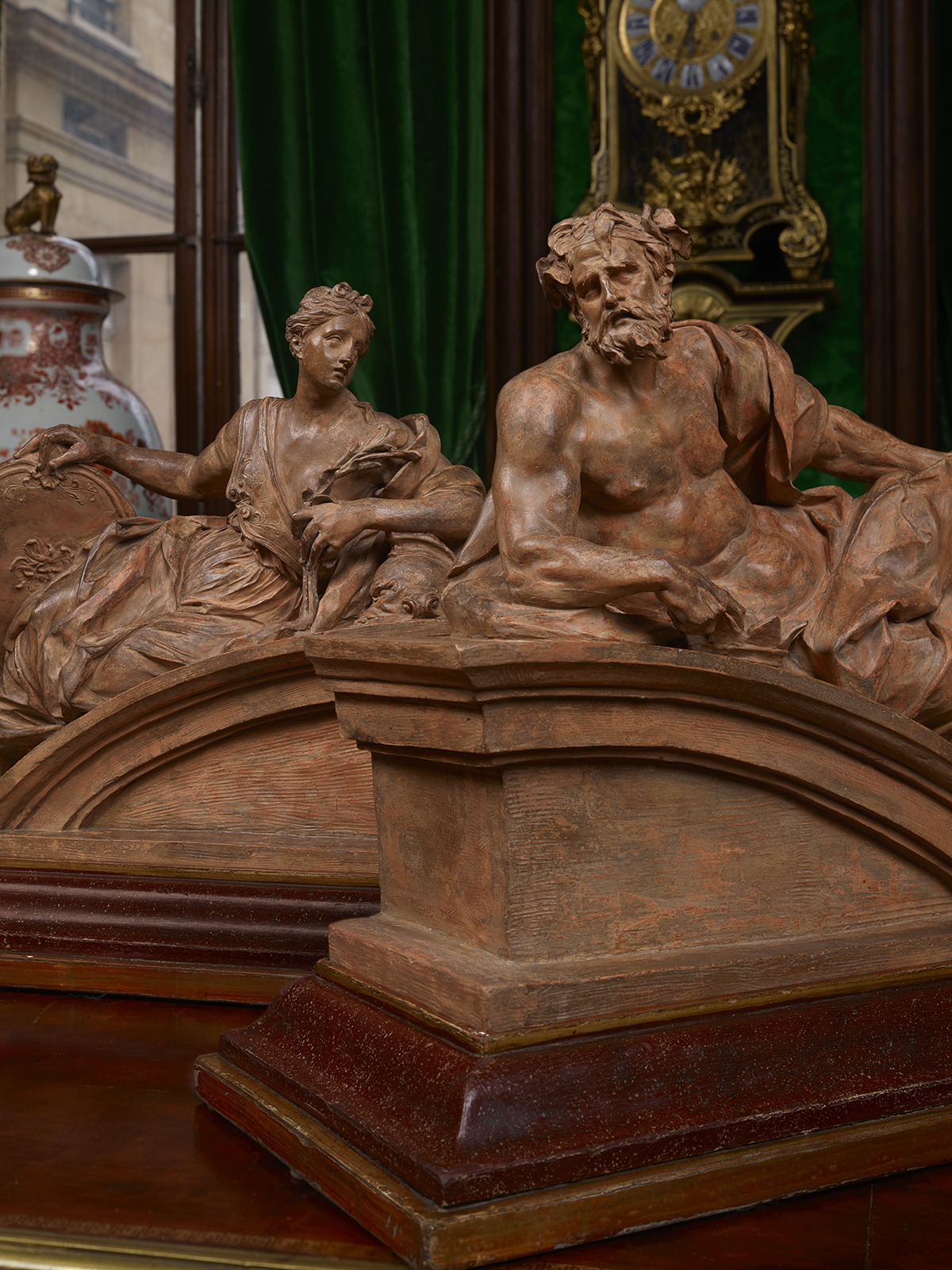
Although the image of Britannia dates back to Roman times, when it appears on coins from the first century AD, it was then the symbol of Rome’s imperial power established in England. It wasn’t until the 17th century that it really became, associated with Neptune, the national symbol that would turn it into the true iconography of the rising British imperial ambitions, an iconography that William Kent and Rysbrack were able to magnify dramatically, a few decades later, on the pediment of the main entrance to Houghton Hall.
John Michael Rysbrack
Despite his Antwerp origins, John Michael Rysbrack executed most of his works in London. He was baptised in Antwerp on 27th June 1694 and was the son of the landscape painter Peter Rysbrack, who had been active in England under Charles II (1630-1685) before returning to Flanders, and had two brothers who, like their father, became still-life and landscape painters. The background in which the young Rysbrack grew up was open to all influences, something that was reinforced by his training in his home town with the sculptor Michael Vervoort or Van der Woort (1667-1737).
Rysbrack moved to London in 1720, where he soon became the most renowned sculptor of his time, receiving major commissions including the Roman Wedding, a bas-relief for Kensington Palace in 1723, and in the same year, the Funerary Monument to Matthew Prior for Westminster Abbey in London. He also established himself as a great portrait painter, still in 1723 executing the bust of the Earl of Nottingham, now in the collection of George Somerset Finch at Ayston Hall. This was followed by some of the most famous men of their time—Alexander Pope, Sir Robert Walpole, Sir Hans Sloane, the architect James Gibbs, Martin Folkes, Ben Johnson, to name but a few.
The next decade saw him definitively make a name for himself when, in association with William Kent and James Gibbs, with whom he had just worked closely at Houghton Hall, he executed the Newton and Stanhope memorials at Westminster Abbey, completed in 1731 and 1733 respectively, and the Duke of Marlborough memorial, completed in 1732 and housed in the chapel at Blenheim Palace.
Closely associated with the circle of Richard Boyle (1694-1753), the 3rd Earl of Burlington, a great patron of the arts known as the “Earl Architect” and the “Apollo of the Arts”, for whom he executed the busts of Inigo Jones and Andrea Palladio still kept at Chiswick House, Rysbrack did not confine himself to portraits and funerary sculpture. In 1735 he executed the bronze equestrian statue of King William III adorning Queen Square in Bristol, for which he was preferred to the sculptor Peter-Gaspard Scheemakers (1691-1781). He also sculpted decorative bas-reliefs inspired by the ancient world, such as the one showing the Sacrifice to Diana adorning the fireplace in Houghton Hall’s Stone Hall, or the one depicting Britannia receiving the riches of the East, which has already been mentioned.
With the arrival in London of the French sculptor Louis François Roubiliac (1695-1762) and the success of Scheemakers, Rysbrack was less in demand after the 1740’s, but during this latter part of his career he created statuettes and terracottas of great virtuosity. A skilful draughtsman, he also made hundreds of very careful drawings in bistre, inspired by the Italian style. He produced most of his works in vast workshops located in Vere Street, near Oxford Chapel.
Rysbrack had also collected with great enthusiasm an important collection of works of art, in which drawings played a major role. At the age of over 70, when he decided to cease his activities, he decided to part with all his collections as well as his own drawings and models, and organised several auctions in his lifetime:
– From 15th February 1764 and over the next nine evenings, he sold his “whole collection” of prints, drawings and books of engravings at Langford and Son, Great Piazza, Covent Garden, London. The very summarily written catalogue praised the quality and rarity of the pieces with a special mention for the works of Poussin in three volumes and those of Maratti in one volume. Each of the auctions comprised about 80 items.
– On 20th April 1765, still at Langford, he put up for sale 77 lots consisting of sculptures, vases, models and bronzes for a total amount of £991 and 10 s.
– On 24th and 25th January 1766, Rysbrack continued the auction of his collections and especially of his “Models in Terra Cota” at Langford. Several of his models made for Houghton Hall were included in the sale on 25th January—in addition to our figures and those of Peace and Plenty already mentioned, forming lots n° 32 and 43 respectively, were also put up for sale lots n° 13: “Two, boys on a fide of a pediment”, n° 17: “Two, boys on a pediment” and n° 21: “Two boys on a pediment”; lot n° 30: “Two boys, representing Time and Eternity”; and lot n° 31: “A basso relievo of a Sacrifice to Diana, after the Antique” corresponding to the marble bas-relief decorating William Kent’s mantelpiece.
– On 18th April 1767, a sale of 89 lots was held at the artist’s home, including some of his own works, such as a proof of the equestrian figure of William III made for the city of Bristol, and a large number of works by other sculptors, in particular Michelangelo, Giambologna, Fiamingo, Girardon, Roubillac and Scheemakers.
– John Thomas Smith, in volume II of his work devoted to Nollekens and his times, first published in London in 1828, mentions on page 116 two other auctions that took place after the sculptor’s death—one on 12th March 1770, and the second on 28th of the same month “in which there were not fewer than three hundred drawings by him, chiefly washed in bistre”.
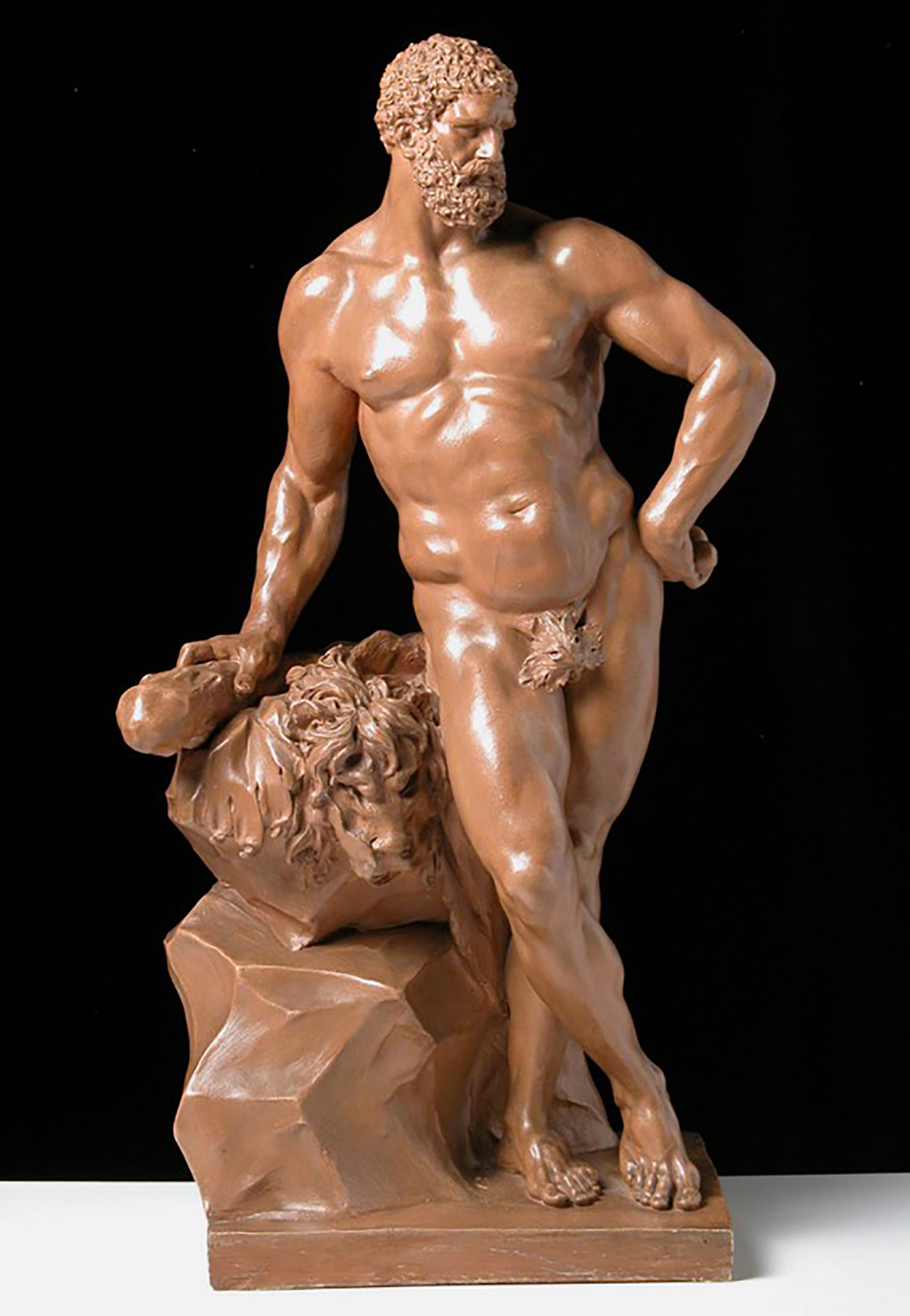
Rysbrack died in London on 8th January 1770 and was buried in Marylebone Cemetery. Several portraits remain of him, including one painted by John Vanderbank (1694-1739) in 1728, which was drawn by J. Richardson Sr. and engraved by Faber; and a second one painted in 1753 by Andrea Soldi (1703-1771) showing him modelling the terracotta of his statue of Hercules, a canvas now in the Yale Center for British Art, Yale University, New Haven, Connecticut, USA. Mention should also be made of Gawen Hamilton (1698-1737) who represented him in 1734 among an assembly of artists in his famous “A club of Artists”, kept at the National Portrait Gallery in London.
Robert Walpole, 1er compte d’Orford
Born into the Norfolk gentry, Robert Walpole, the 1st Earl of Orford, was born on 26th August, 1676. A Member of Parliament in 1702, he remained loyal to the Whig “party” throughout his political life. He was several times a minister before 1717 and truly dominated English political life from 1721 onwards, a seamless domination that was further strengthened after the resignation of Charles Townshend in 1730 and continued until his political retirement in 1742. His views were very much in his favour at a time when the young Hanoverian dynasty feared Jacobitism more than anything else and distrusted the Tories. He also enjoyed valuable friendships at court, particularly under the reign of George II (1727-1760), during which he was very close to Queen Caroline of Brandenburg-Ansbach (1683-1737).
Sir Robert Walpole was the sometimes disputed leader of his party but secured easy majorities in Parliament by unscrupulously using all forms of corruption. At a time when sovereigns were often disinterested in English affairs, he was able to give the cabinet a real existence and, with no other title than that of Chancellor of the Exchequer, assume the role of a true “Prime Minister”.
However, in 1741 he still denied deserving this title, even though it was generally recognised as such in practice. At home, he firmly defended the achievements of the ‘Glorious Revolution’ and opposed the political reforms sought by the opposition, such as the shortening of the life of Parliament, which had been set at seven years since 1717. Concerned about the economic prosperity of Great Britain, he sought to secure it through a foreign policy of peace and reconciliation with France, and his pacifist views opportunely echoed those of Cardinal de Fleury and the young Louis XV.He nonetheless came under increasing criticism on this matter, and a warmongering party, led by Pitt the Elder, forced him to declare war on Spain in 1739. Weakened by the Queen’s death in 1737, and despite the unfailing support of George II, Sir Robert Walpole finally bowed to a parliamentary vote in 1742 and eventually resigned. He was then made the 1st Earl of Orford. His government has remained, to this day, the longest in British history.
Comte Robert Le Coat de Kerveguen
Count Robert Le Coat de Kerveguen was a very prominent French landowner and industrialist. Born on 16th September 1875 in Paris, he was the son of Denis-André Le Coat de Kerveguen (1833-1908) and the grandson of Gabriel Le Coat de Kerveguen, a wealthy settler who in the 19th century made a fortune on the Reunion island, in the south-western Indian Ocean. At the turn of the 20th century, he became the main heir of this powerful family, which notably flourished during the Second Empire to the point overshadowing the Rothschilds.
Emma Le Coat de Kerveguen (1835-1916), sister of Denis-André, became lady-in-waiting to Empress Eugénie. One of their nephews, François Mahy (1870-1906), known as the “Great Creole”, was a member of parliament for Réunion from 1870 to 1906, and minister of the Third Republic between 1883 and 1888. Managing an immense fortune, Count Robert Le Coat de Kerveguen was the first to import an automobile to Reunion Island in the 1900’s. He married Augustine de Villèle (1892-1978) on Reunion Island in 1917, and acquired the Château de Vigny in the Val-d’Oise in 1922. He died in Paris on 26th April 1934.
Le château de Vigny
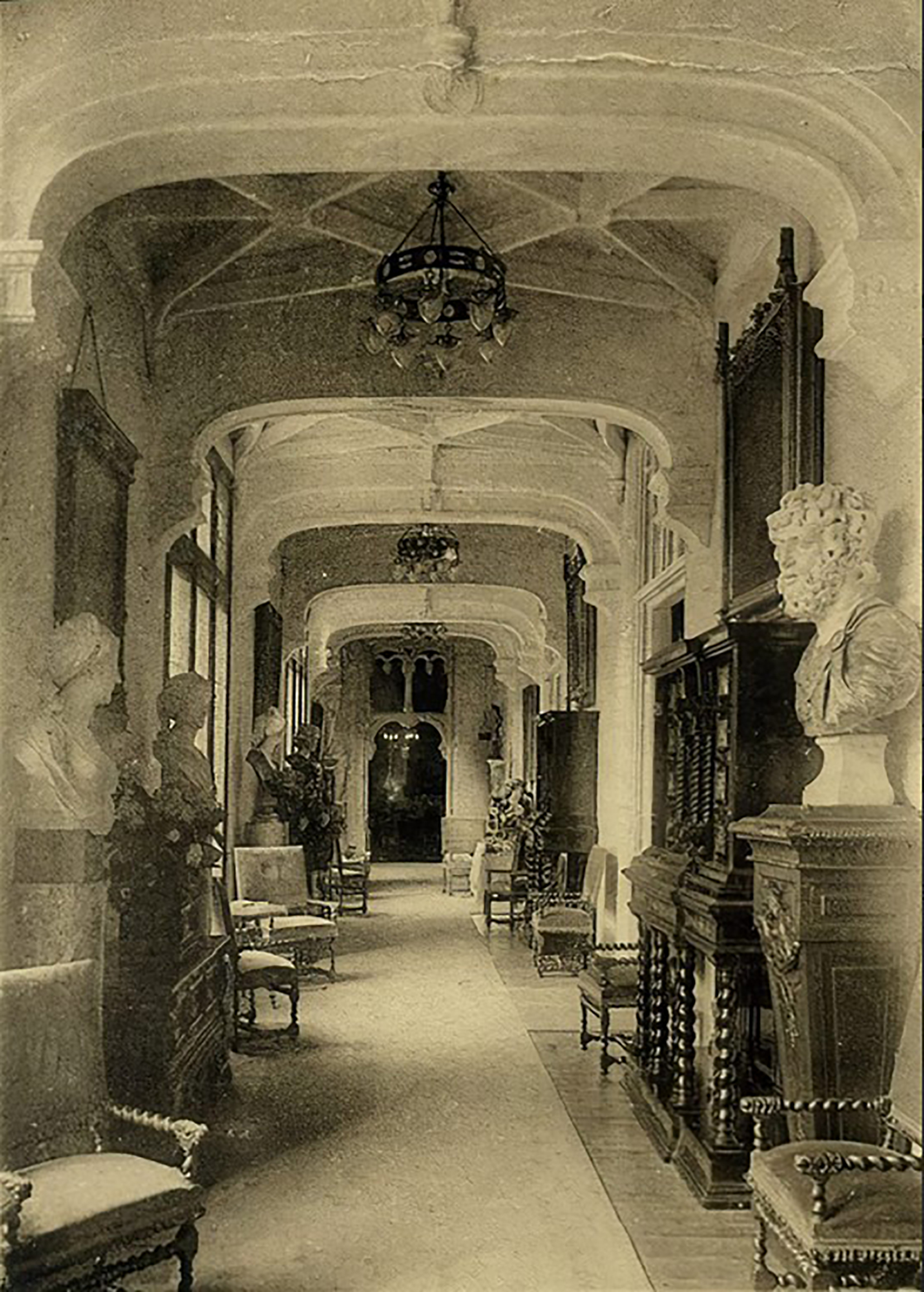
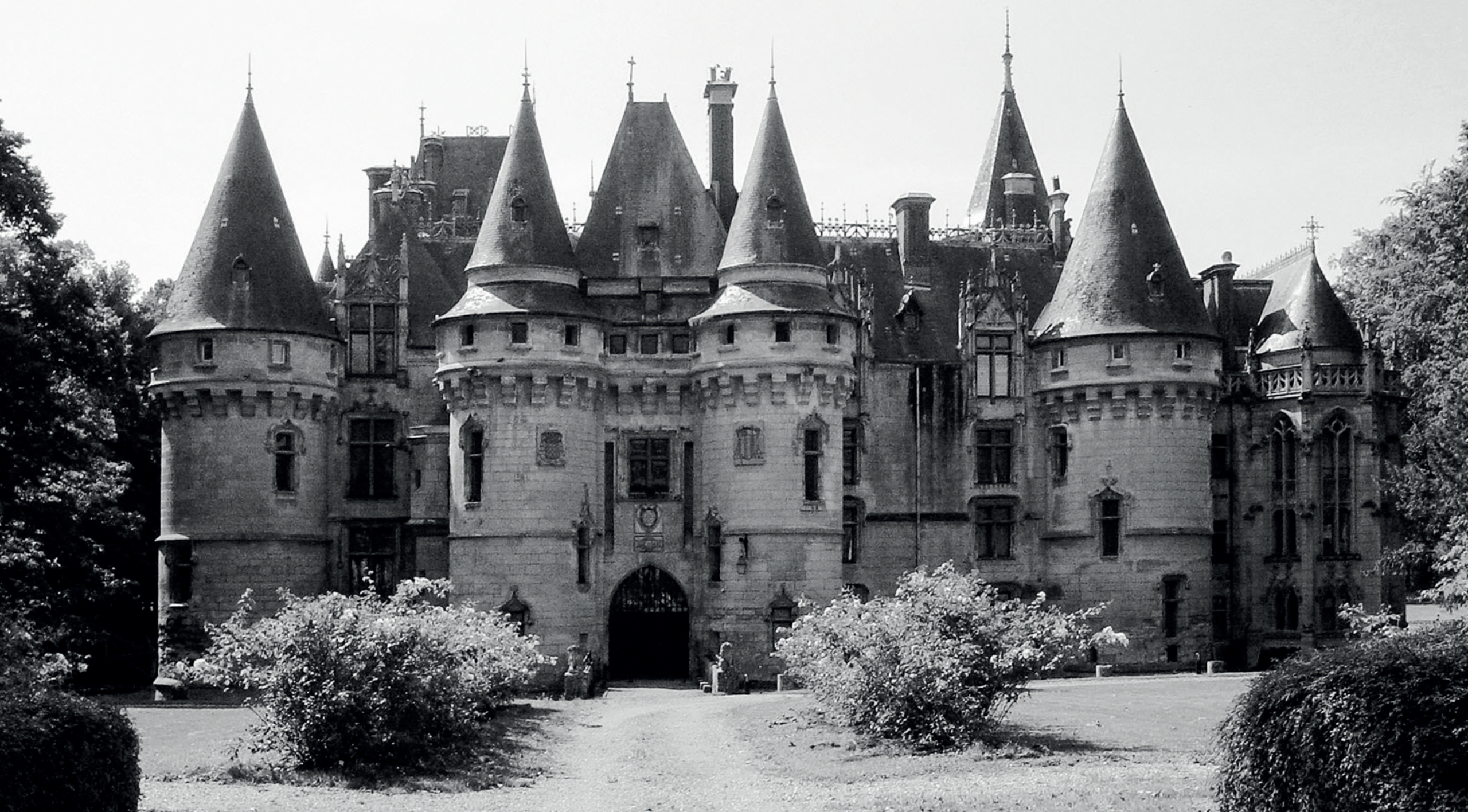
In the Middle Ages, the seigneury of Vigny belonged to the de Marbury family, who kept it until 1501 and sold it to Louis de Hédouville, sieur de Sandricourt, and Françoise de Rouvroy de Saint Simon, his wife. When she became a widow in 1504, she sold Vigny to Cardinal Georges d’Amboise, Archbishop of Rouen, who ordered a new château to be built on the site of the former seigneurial manor house. After the cardinal’s death in 1510, his nephew and successor Georges II d’Amboise, who also was archbishop of Rouen, continued his work. He stayed frequently at Vigny, where he died in 1550.
In 1555, the powerful constable Anne de Montmorency bought the seigneury and the château from the d’Amboise family. Above a third-point arched gate flanked by two towers, his coat of arms and the motto of the Montmorency family, Aplanos, can still be seen today.
When he died in 1567, the estate passed to his widow, Madeleine de Savoie, who died in 1586, and then to their son, Charles de Montmorency-Damville, who died without descendants in 1612. Vigny was then passed to his nephew Henri II de Montmorency, governor of Languedoc, who died in 1632, also childless, and then to his sister Marguerite de Montmorency, the widow of Anne de Lévis, the 2nd Duke of Ventadour. When she died in 1660, she was succeeded in the château of Vigny by her grandson, Louis Charles de Lévis, the 5th Duke of Ventadour, who died in 1717, and his widow, Charlotte de La Mothe Houdancourt, who died in 1744.
Their successor at Vigny was their grandson, Charles de Rohan, Duke of Rohan-Rohan, Duke of Ventadour, Prince of Soubise and Marshal of France, who died in 1787.
The House of Rohan kept the Château de Vigny until 1822. It was bought from Mr Declerq in 1829 by a grandson of the Marshal of Soubise, Louis Victor Mériadec Benjamin de Rohan, Duke of Montbazon, who sold it in 1844 to Madame Caffin, the widow of Legrand de Pontoise, who died in the Château de Vigny in 1853.
The estate was passed on to her daughter, Victoire Touchard, née Legrand, and was acquired in 1855 by Paul Poictevin, a banker in Paris, then sold on 8th November 1867 to Count Philippe Spiridion Vitali, Prince of Sant’Eusebio.
The latter bought a house in a poor state of repair, which he undertook to have restored from 1888 onwards by the architect Charles Henri Cazaux in the idealising neo-gothic style of Viollet-le-Duc. Count Vitali also had the south wing enlarged and the large square keep and the chapel built, still by the architect Charles Henri Cazaux.
In the state resulting from those last alterations, the château consists mainly of two main buildings arranged in an “L” shape. One of the branches of this “L” is extended by a chapel, on the right of the entrance, the other, opposite, by a large square tower. The whole is built on an earthen platform surrounded by a water moat within a landscaped park. In 1922, the Château de Vigny was acquired by Count Robert Le Coat de Kerveguen, the owner of our terracottas. His descendants sold the château to Mr and Mrs Dewavrin in 1992, and its collections, including our sculptures, to the Hôtel Drouot in the same year.