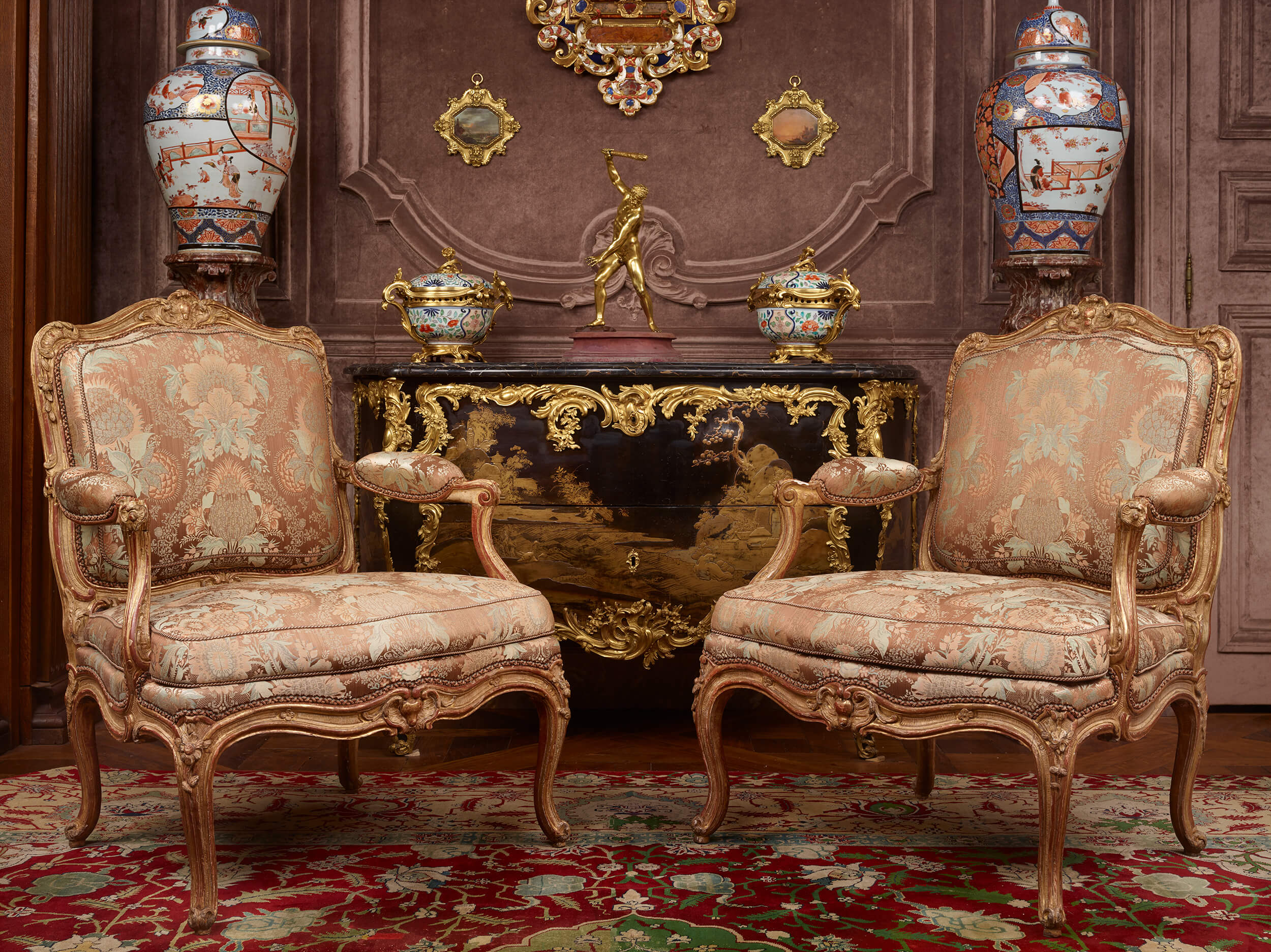
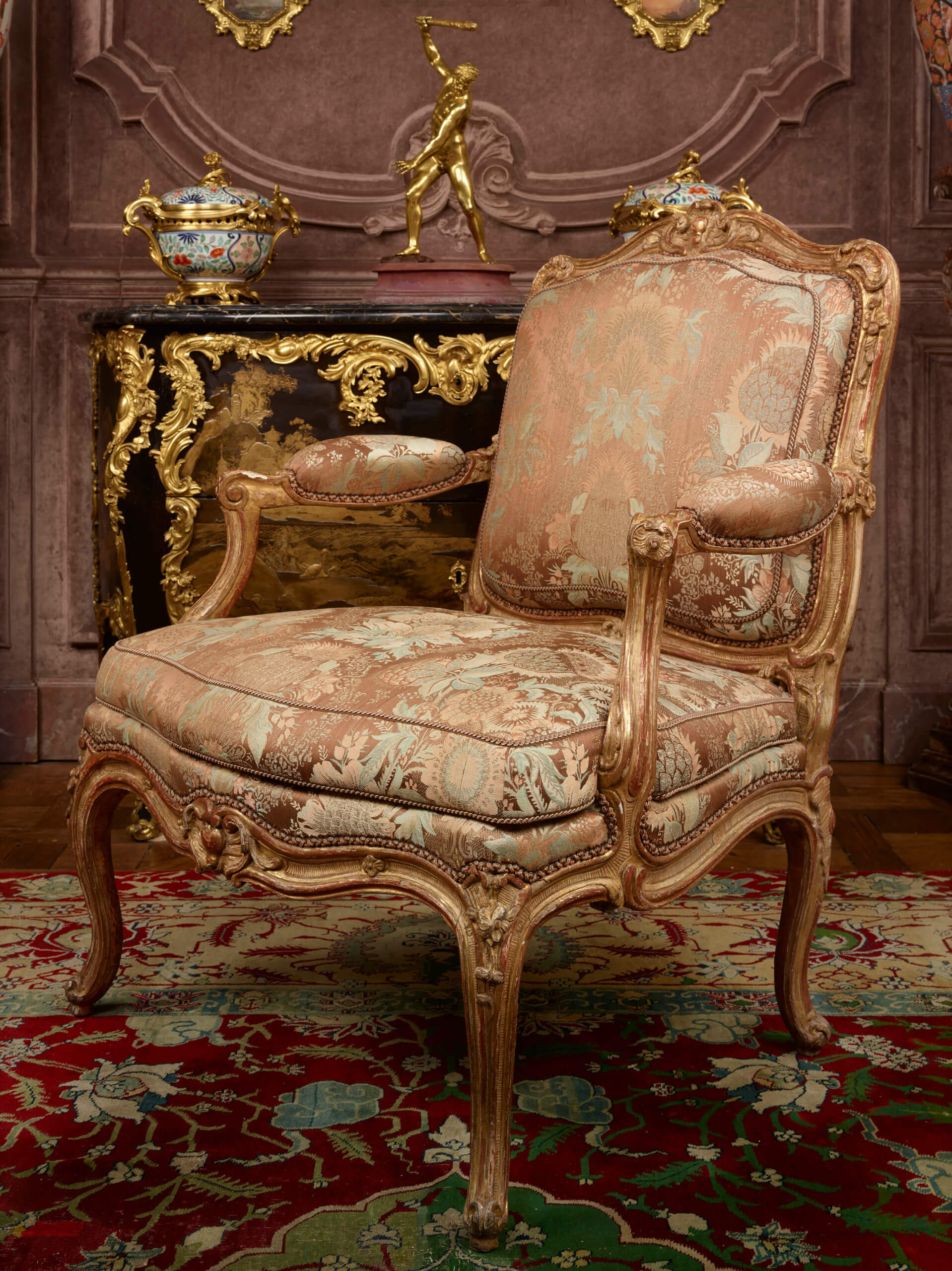
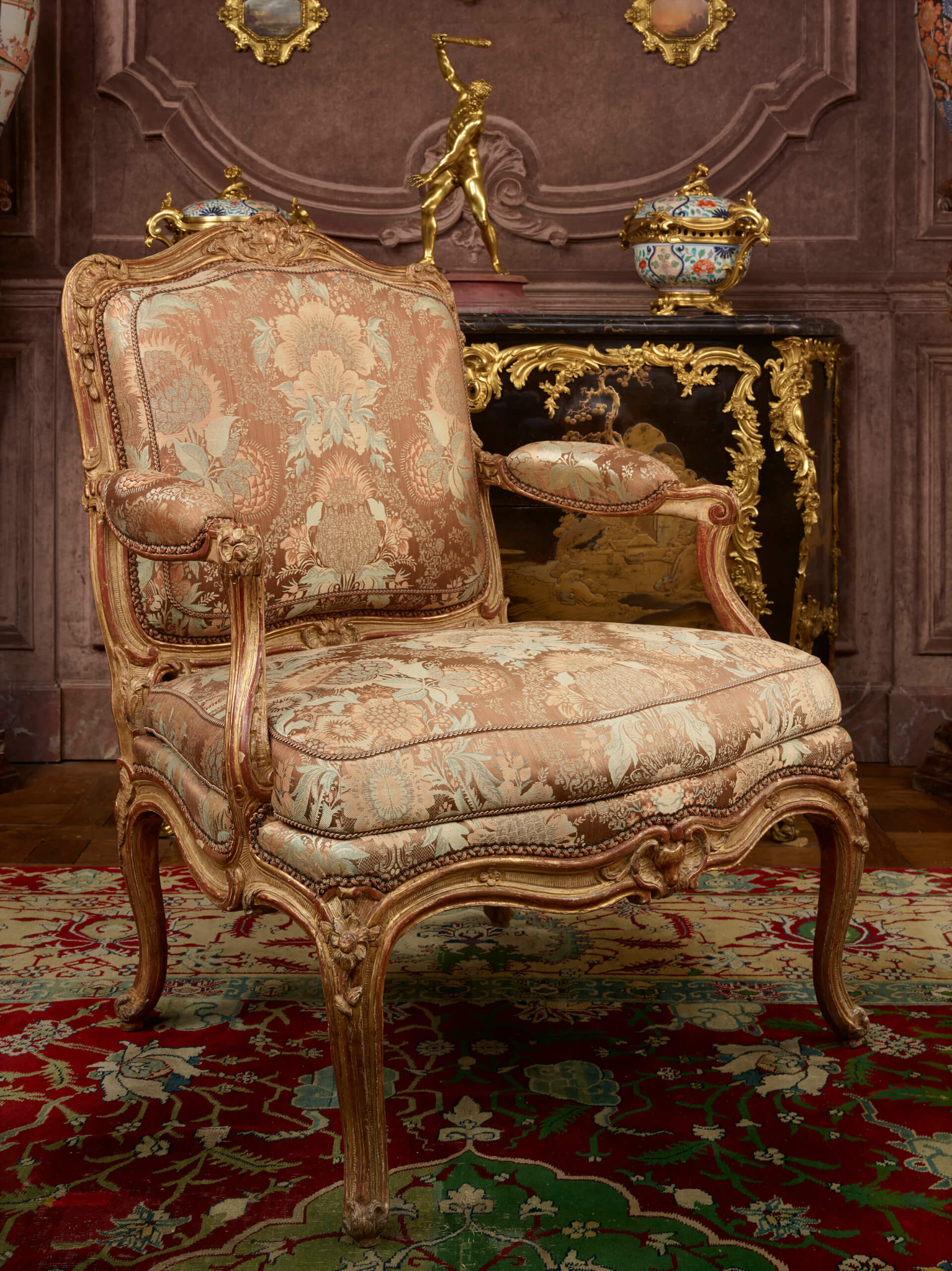
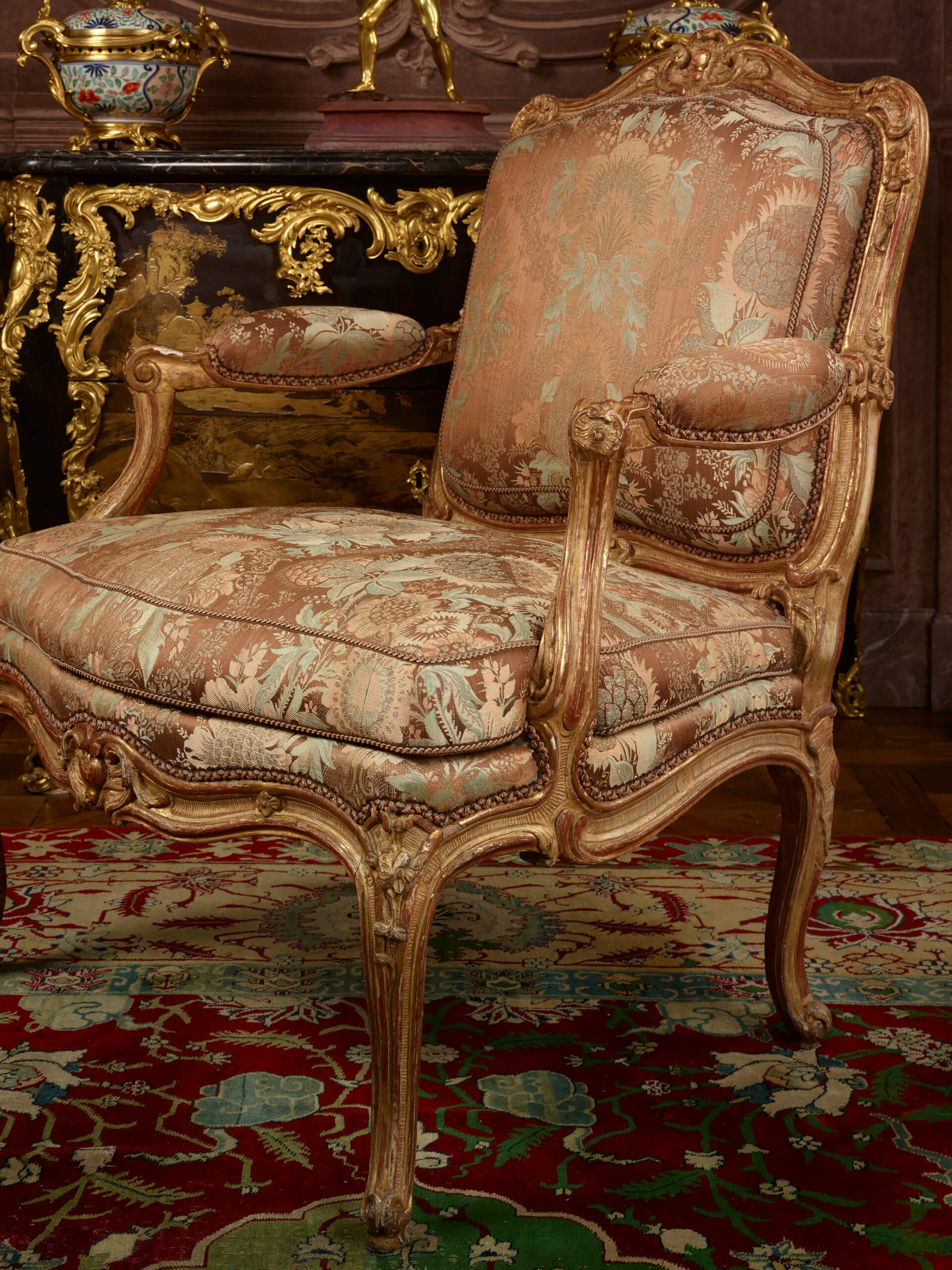
Carved and gilded wood.
H. 101 cm. (40 in.); W. 78 cm. (30 ¾ in.); D. 64 cm. (25 ¼ in.).
PROVENANCE: Etienne Lévy collection in Paris ; Luigi Anton Laura collection, sale in Paris, Sotheby’s / Poulain Le Fur, June 27, 2001, lot n° 50.
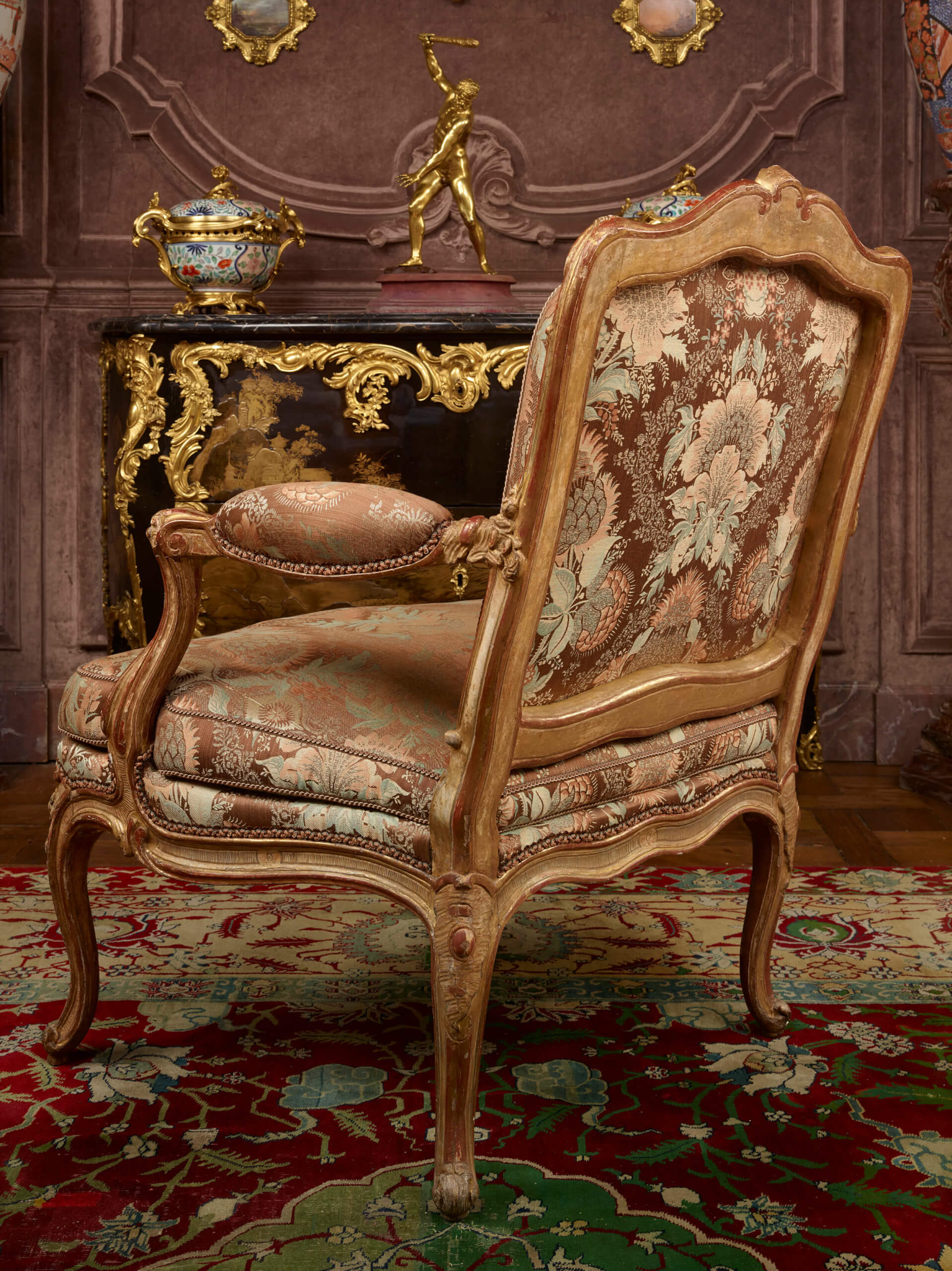
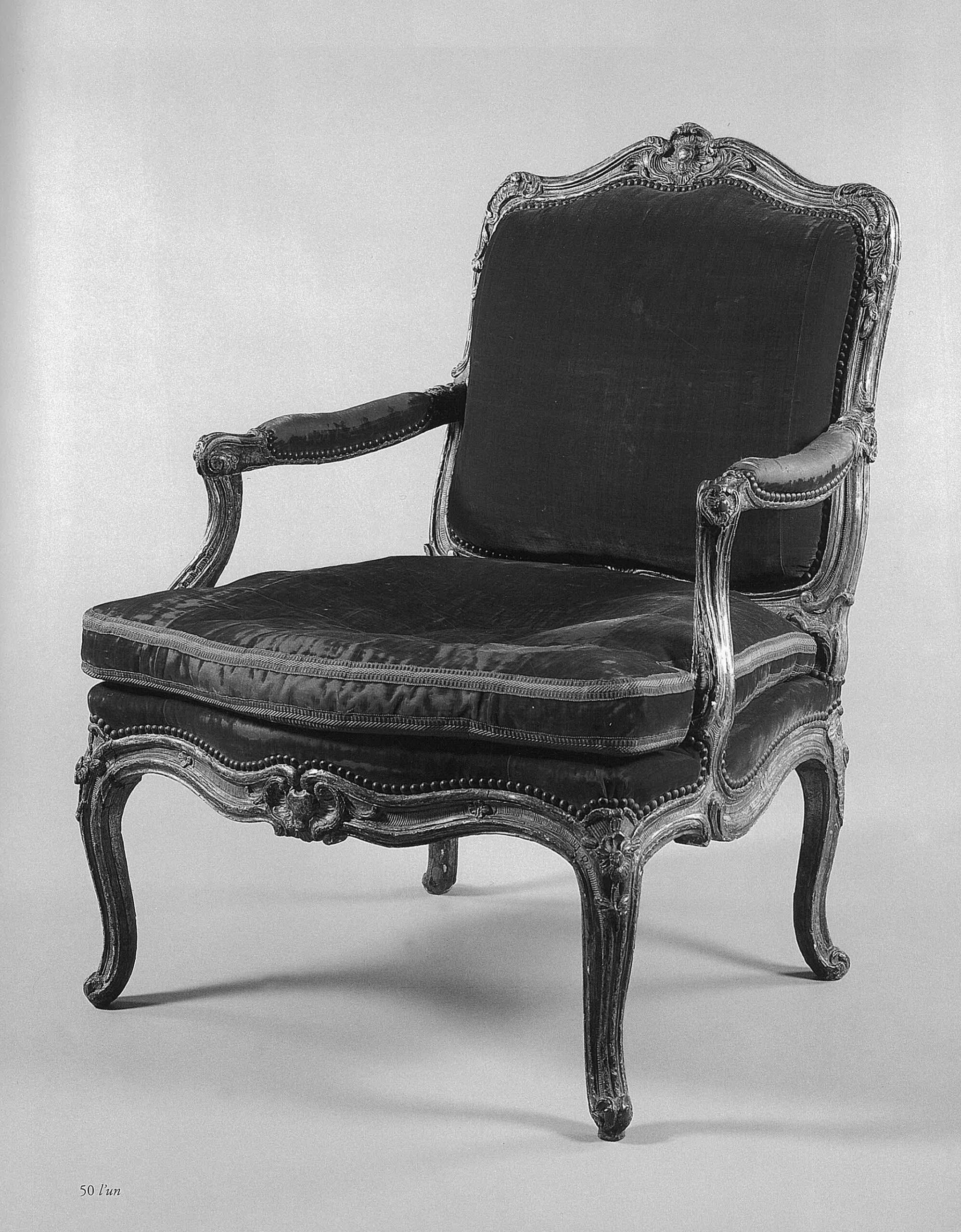
A quintessential example of the art of chairmaking in Paris in the middle of the reign of Louis XV, this large pair of armchairs ‘à la reine’, is typical of the work of Jean-Baptiste I Tilliard (1686-1766, maître menuisier in 1717), a leading member of one of the most important and oldest dynasties of Parisian chair carpenters, known since the late 16th century.
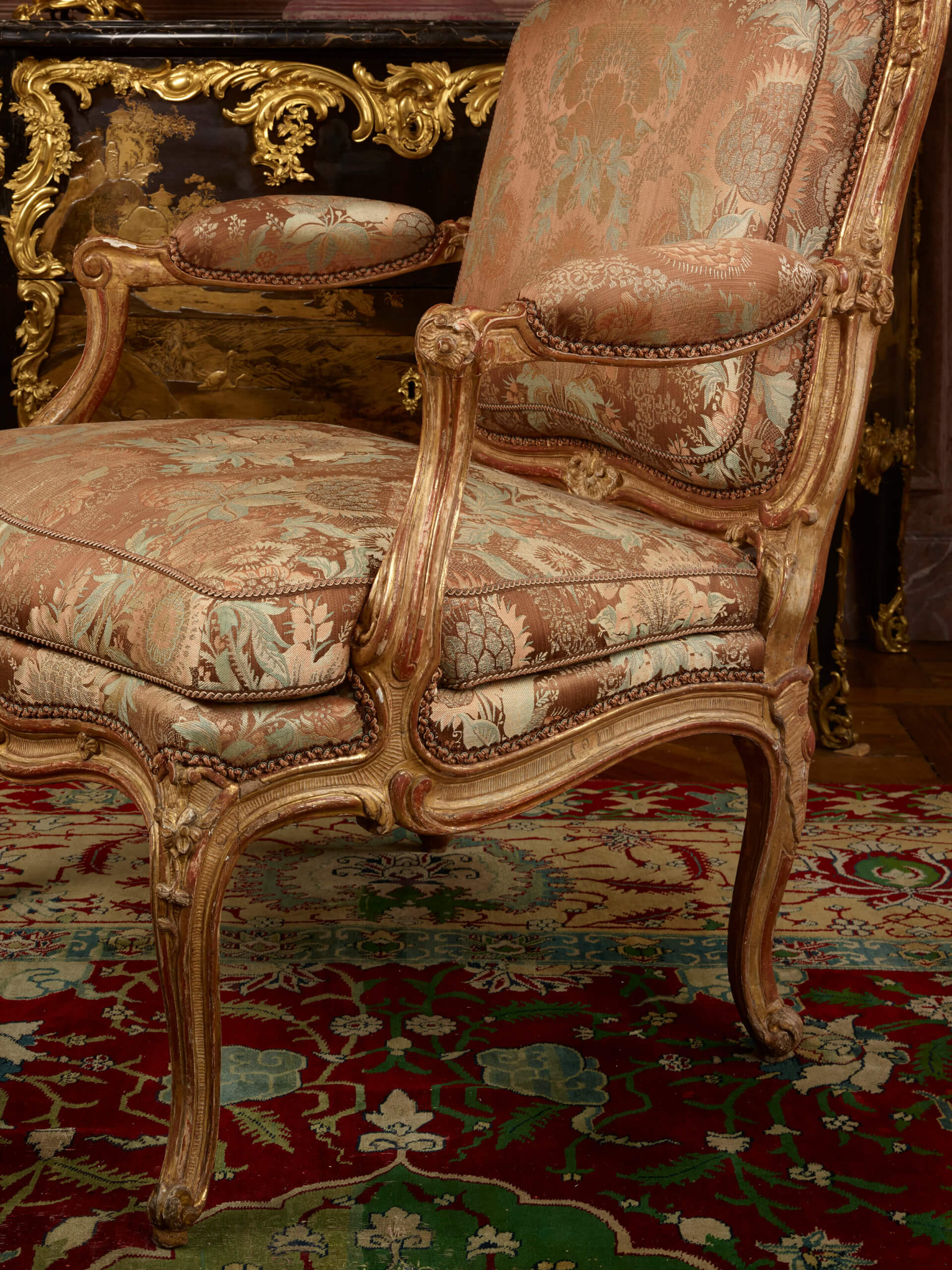
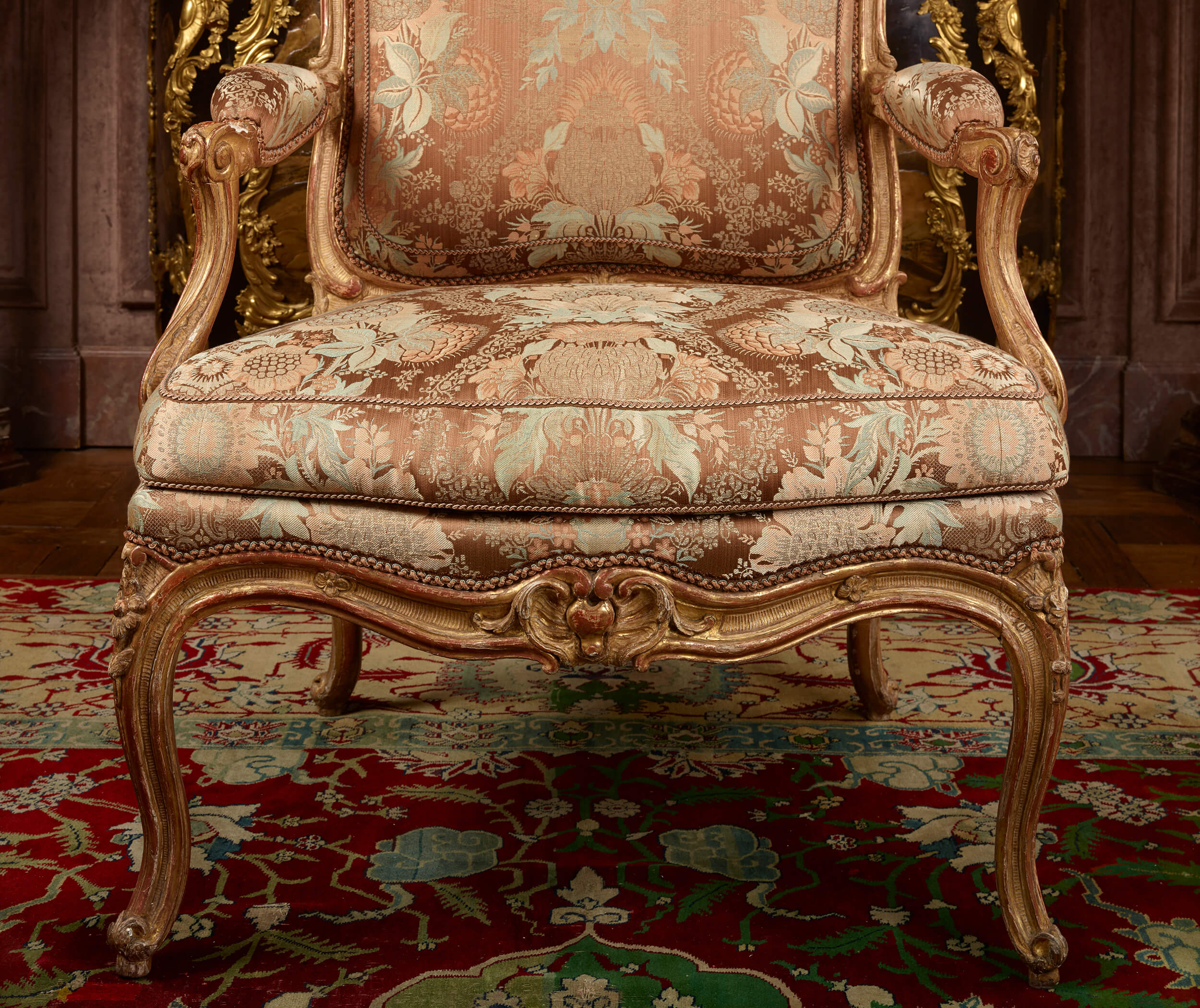
Each armchair features a wide seat with a scalloped waistband and molded edges with retworked compartments punctuated by discs and rosettes, forming a continuous line with the four diagonally arranged console legs, each finished with a short hoof with foliate scrolls. The front feet are crowned with a stylized flower branch set against a Breton background, and the back feet with a wide, flared, scalloped cartouche punctuated with ovals. A heart-shaped cartouche surmounted by two scrolls and flanked by two scalloped, acanthus-embellished ‘winged’ brackets, often considered a signature ornament of Jean-Baptiste Tilliard’s work, adorns the center of the seat belt on the front, and is repeated in the same place on the crossbow-shaped top rail of the back. The slightly sloping backrest features a subtly curved contour, enriched at the shoulders with foliate, fluted festoons and, at the center of the lower crosspiece, distinct from that of the seat, with a similarly foliate, festooned cartouche.
Short scrolls and acanthus leaves enrich the dies connecting the backrest to the seat, as well as the start of the armrests on each armchair, punctuated by a small asymmetrical cartouche with knobs and scallops forming a body with richly molded and scalloped S-shaped armrest supports. In a magnificent torus movement, these armrest supports join the two sides of the seat belt, marked at this point by two opposing leafy braces.
These armchairs are an invaluable testimony to the beauty of Louis XV seating in the mid-eighteenth century, characterized by perfect mastery of design, purity of line and curves, and precision of carving, coupled with the finesse of the ornamentation.
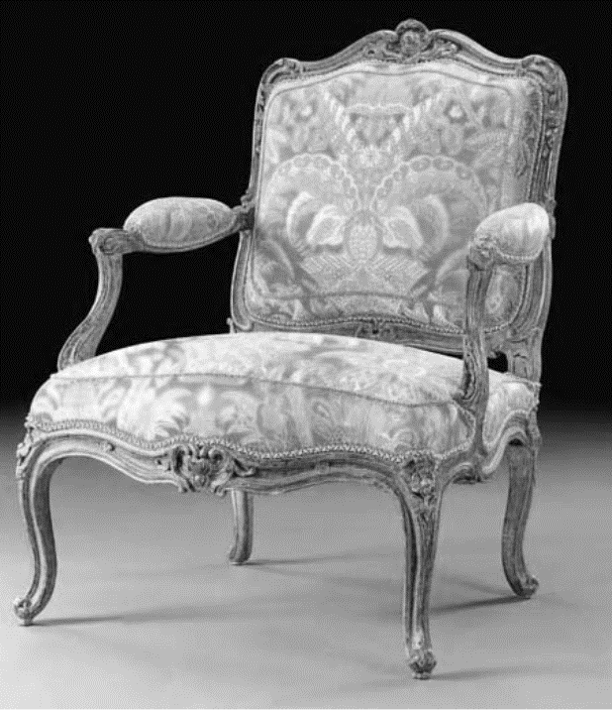
An armchair ‘à la reine’ en suite with ours, reproduced above and bearing the number 202 on the rear crosspiece of its seat, was part of the collection of the New-England Museum, Boston.
Jean-Baptiste I Tilliard
Born in 1686, Jean-Baptiste Tilliard, known as Jean-Baptiste I, was the son of Jean Tillard and Angélique Mathelin. He was awarded the title of maître menuisier in 1717. The same year, he married Marie-Anne Barthélémy and had 7 children including Jacques-Jean-Baptiste, a future carpenter. He established himself on rue de Cléry under the name « aux Armes de France », situated between the workshops of the carpenters Nicolas Foliot and Louis Cresson. After the death of his first wife, he remarried Jeanne Jourdain, with whom he had no descendants. Additionally, he served as a churchwarden and commissioner for charitable deeds in his parish.
He had a very important workshop, owning eleven workbenches and producing mainly to order. He worked with the sculptors Portebois, Damien Quintel and Nicolas Heurtaut, as well as François Roumier and Toussaint Foliot through the Crown. He had commercial and subcontracting relationships with the carpenters Pierre Berluy, Jacques Desaitres, Alexis Gauthier, Jean Mercier, Nicolas Heurtaut and, above all, with his brother Nicolas Tilliard and François Foliot, all three carpenters of the Maison du Roi.
He marketed his products through the tapestry merchants Jean-Baptiste Guichard, Robert Legrand, probably the famous Sallior, and marchand-mercier Julien-Etienne Olivier.
It was certainly after his father’s death in 1728 that he acquired the title of maître menuisier du Garde-Meuble du Roi and subsequently regularly delivered to the Crown. But he also worked for a select clientele: the Prince of Soubise, the Dukes of Aiguillon Antin, Noirmoutier and Sully, the Duchesses of Mazarin and Parma Louis-Elisabeth, the Count of Evreux, M. d’Argenson, Mme de la Vrillière, Le Lorrain, Fontaine de Cramayel… Jean-Baptiste I Tilliard died in Paris in 1766.