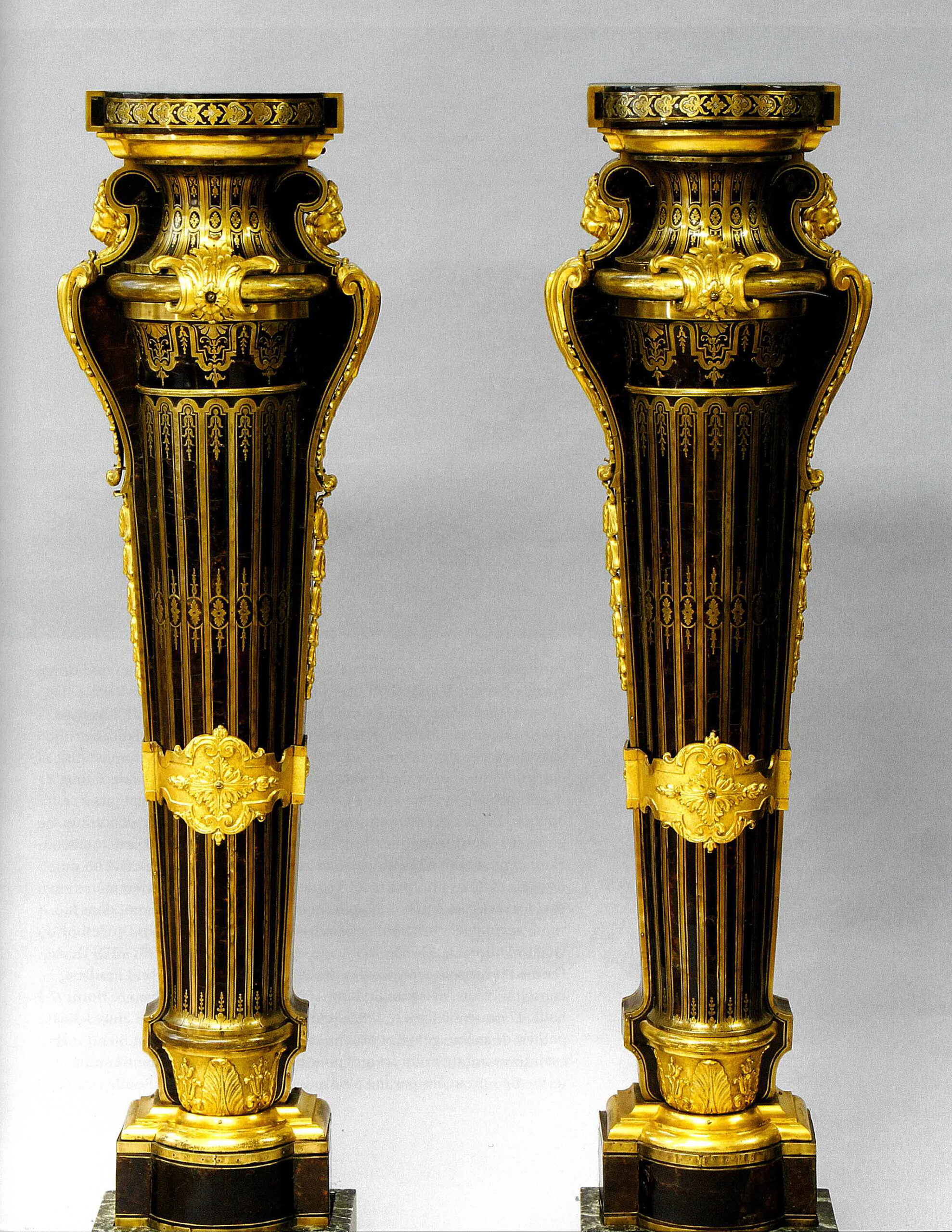
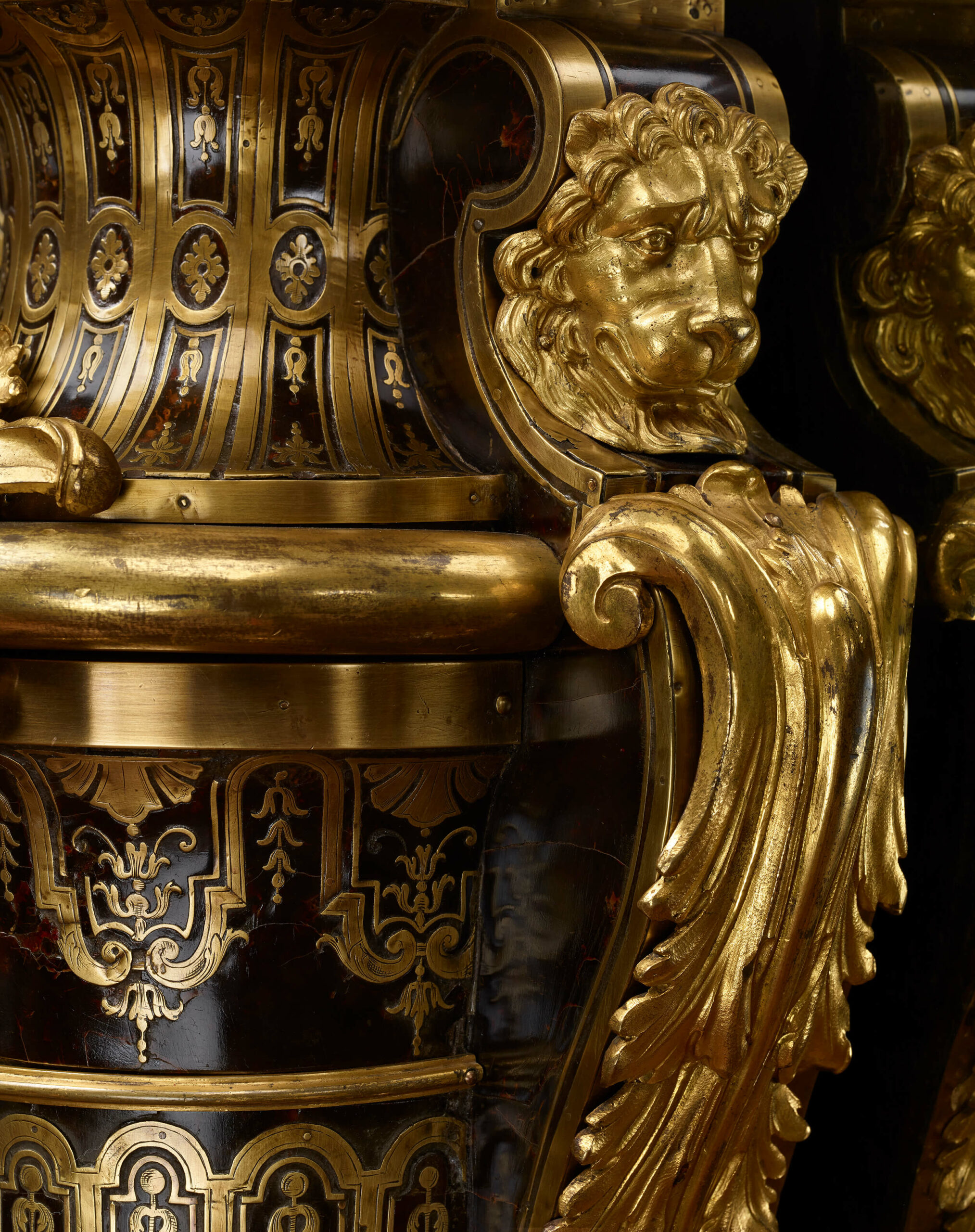
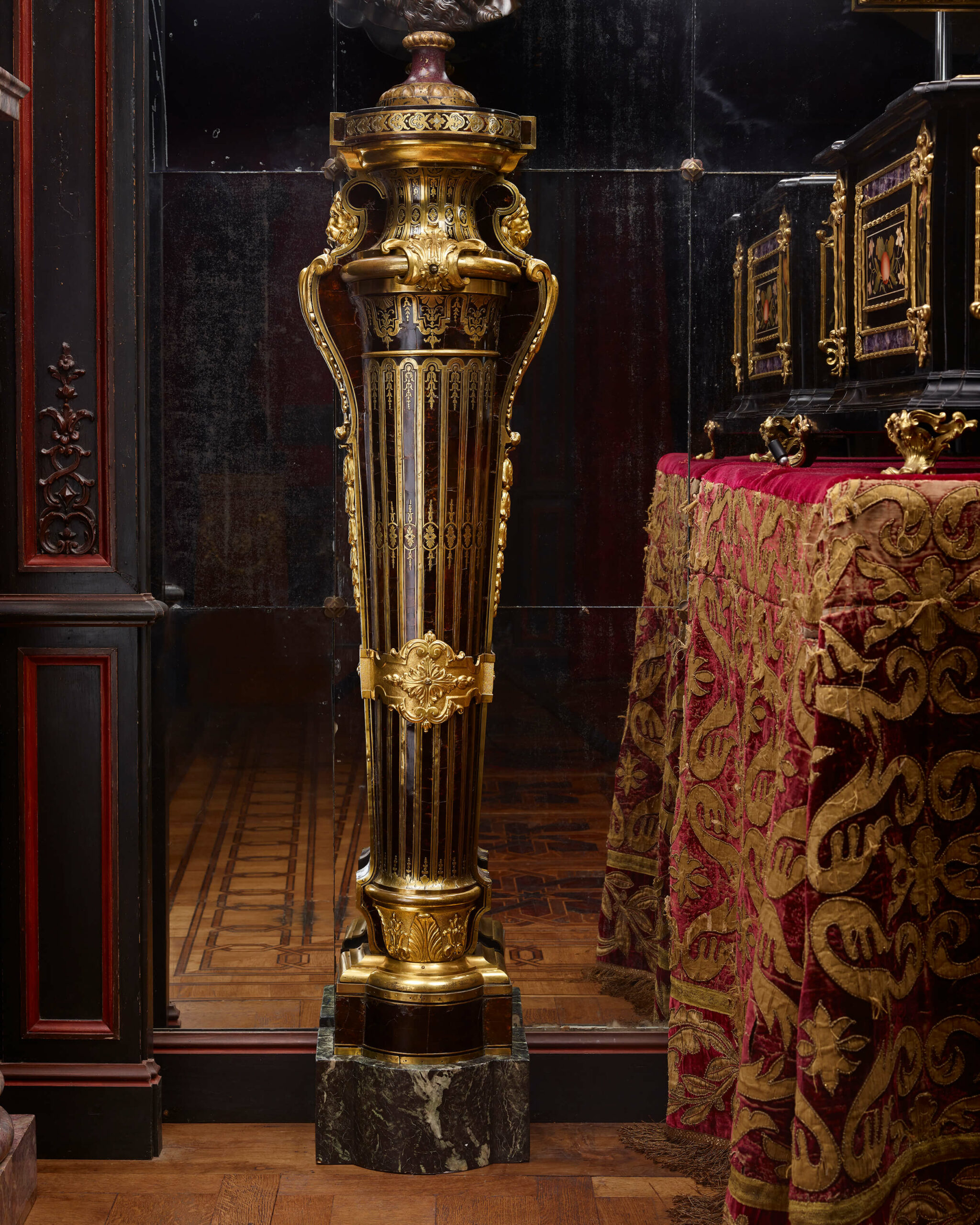
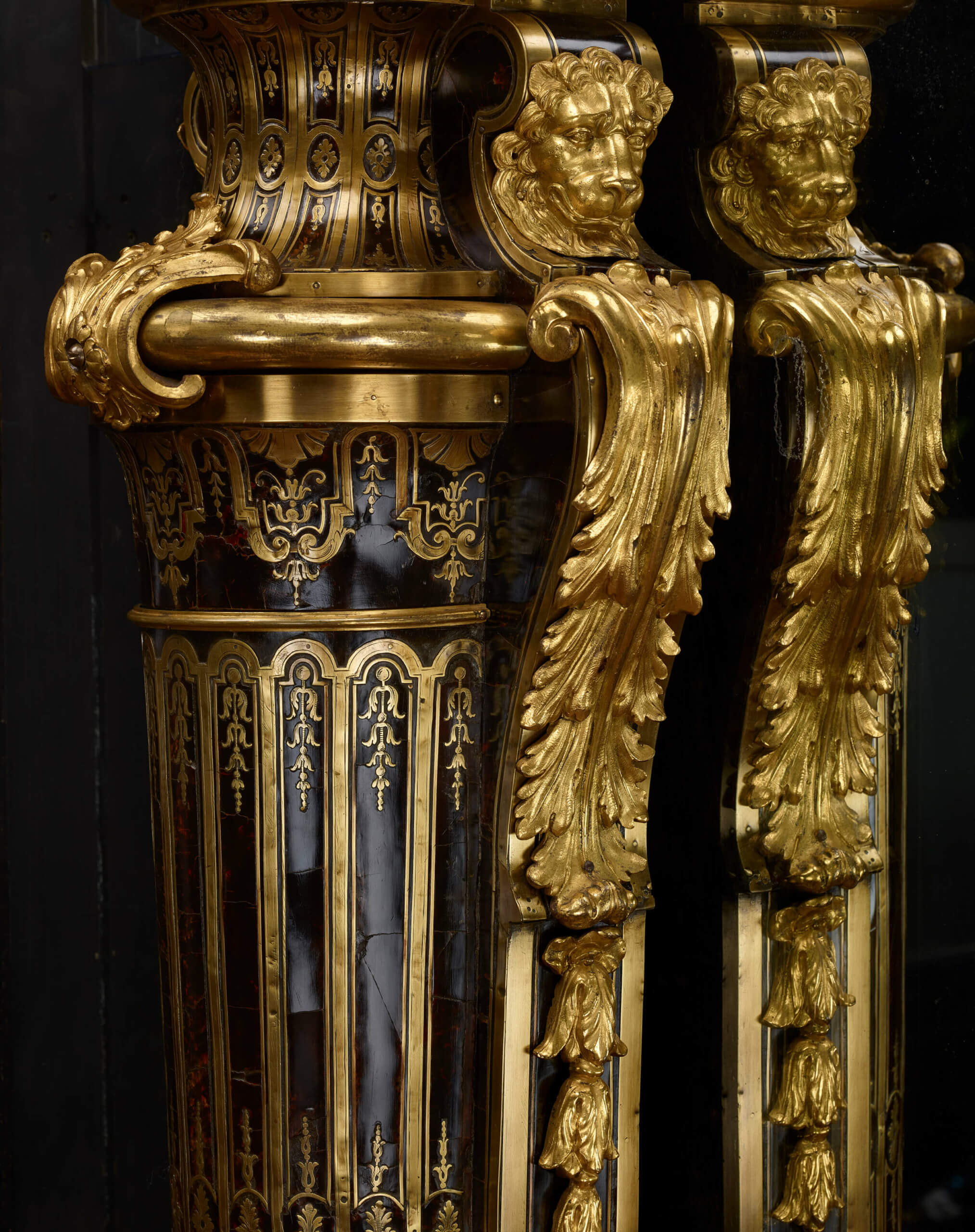
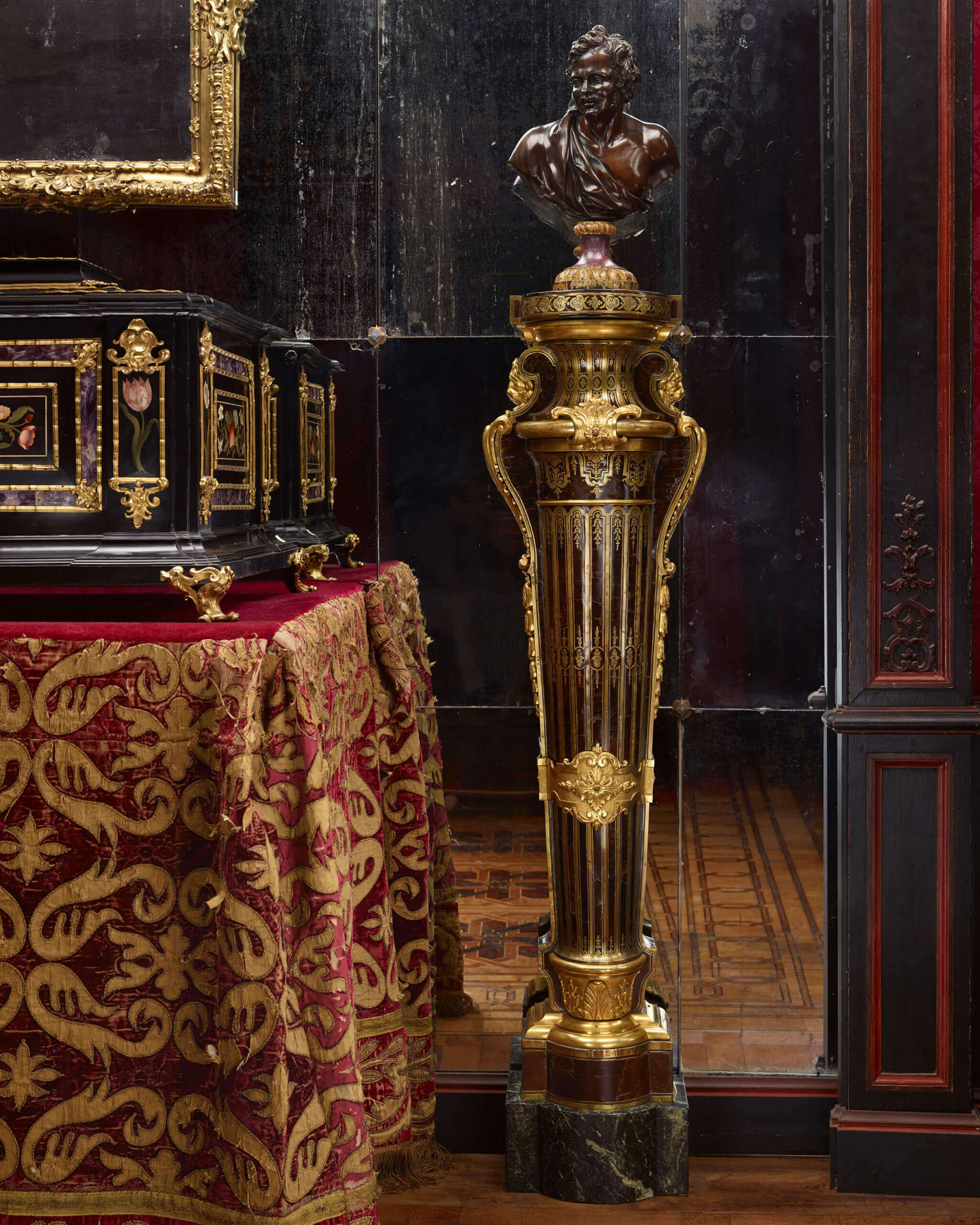
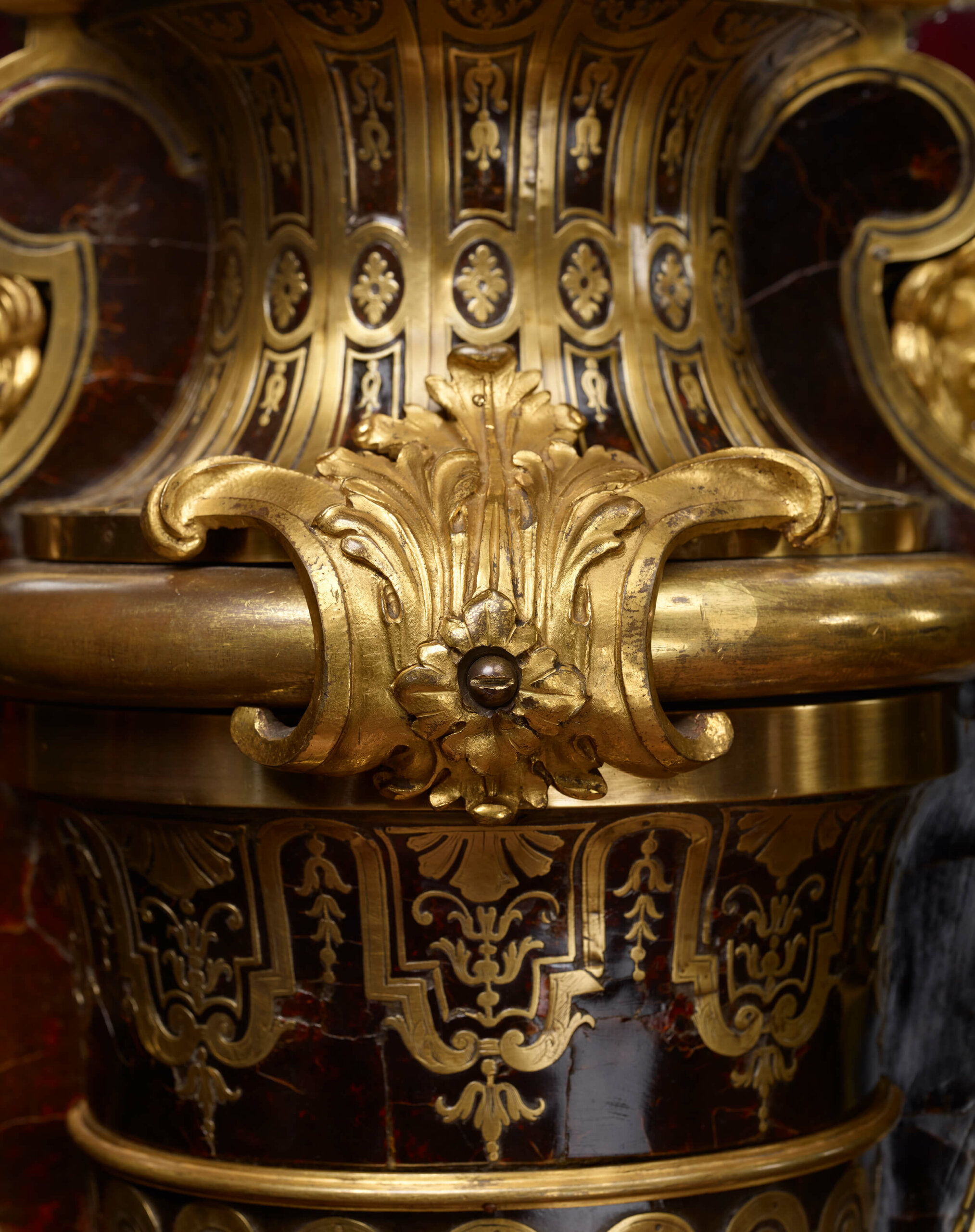
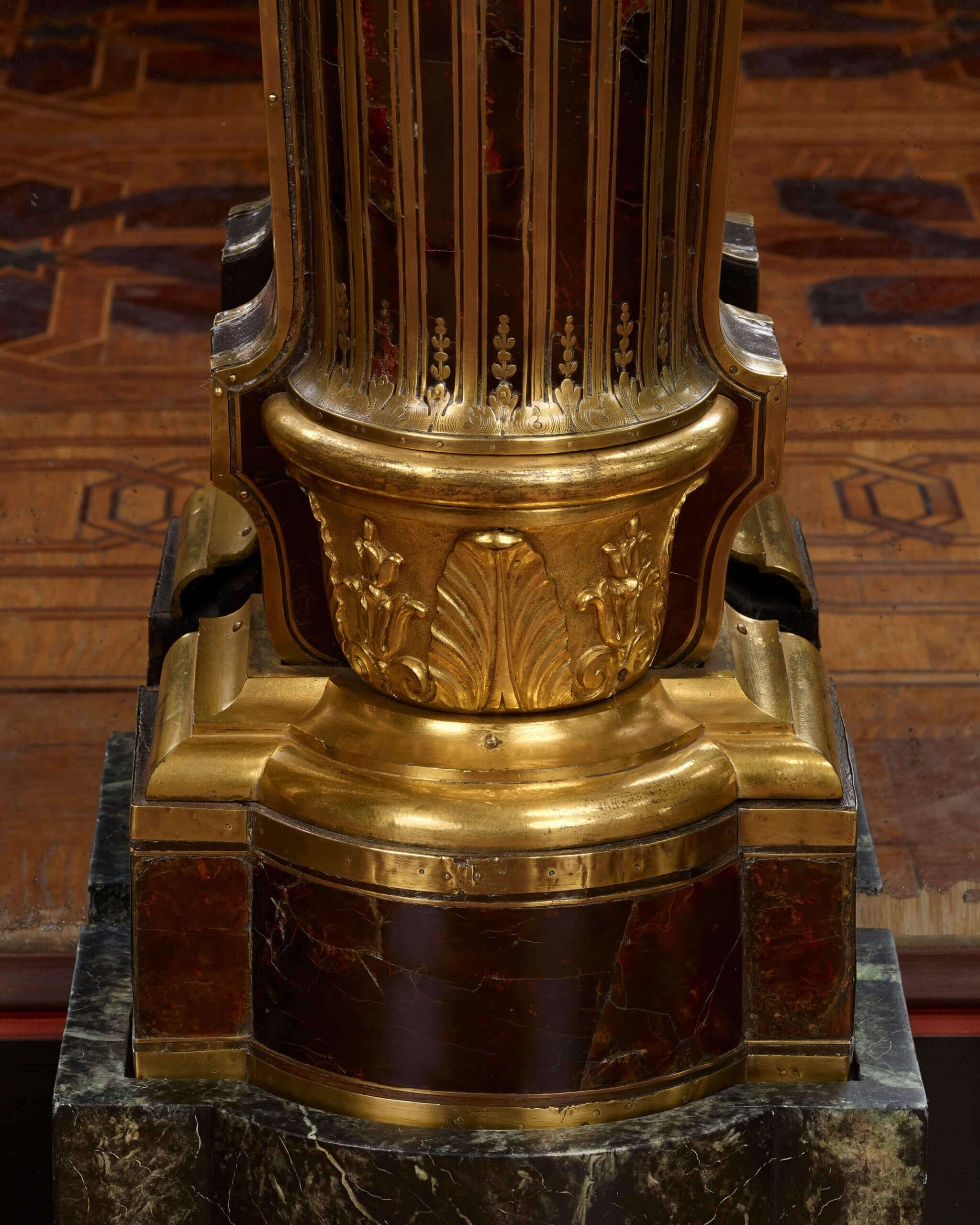
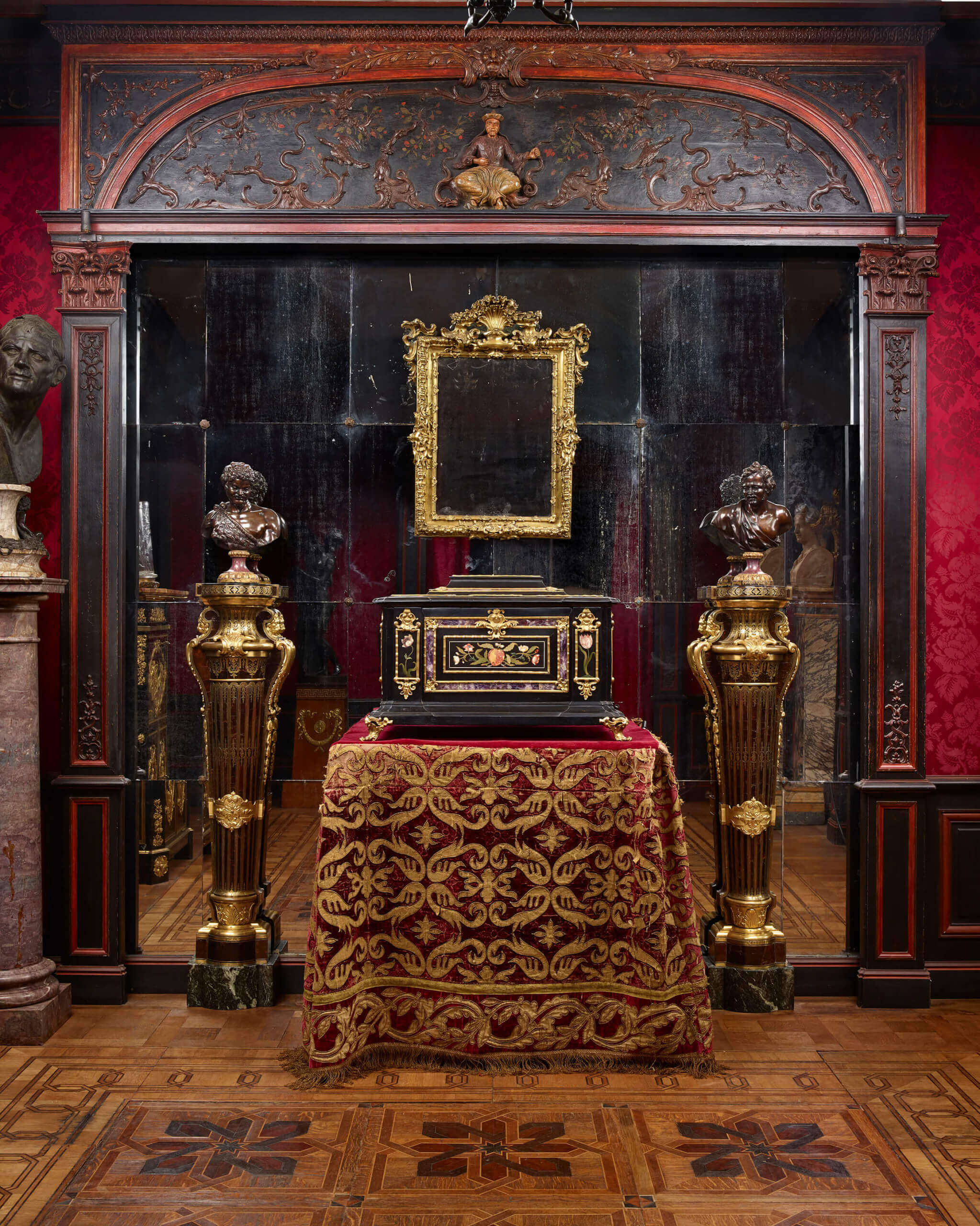
‘Boulle’ marquetry of loggerhead (Caouane) tortoiseshell, copper and pewter and blackened oak, ornamentation of chiselled and gilded bronze.
Total H.: 129 cm. ( 50 ¾ in.); L. 27 cm. ( 10 ½ in.) ; D. 17 cm. ( 7 in.)
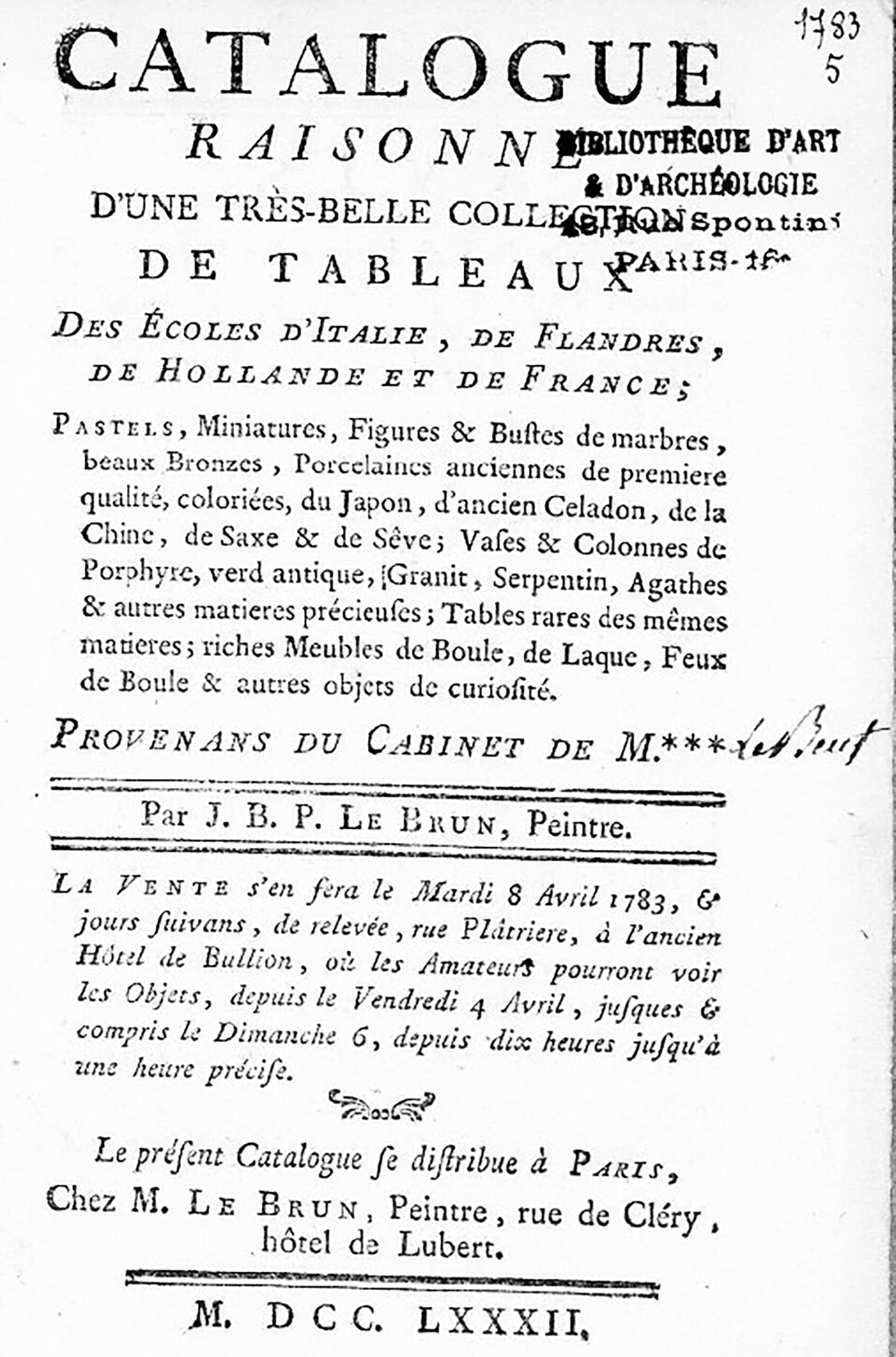
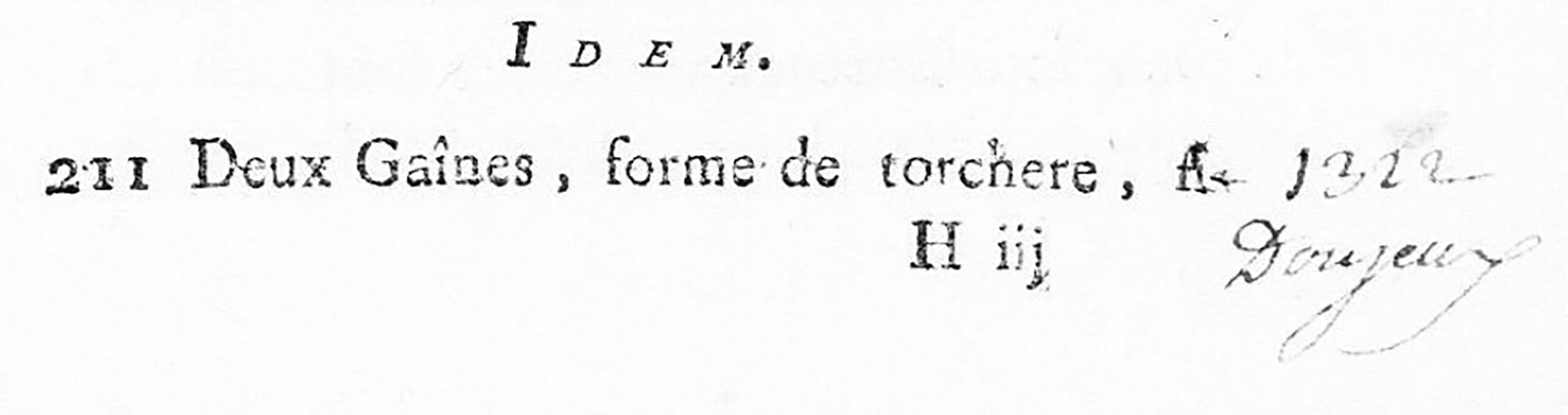
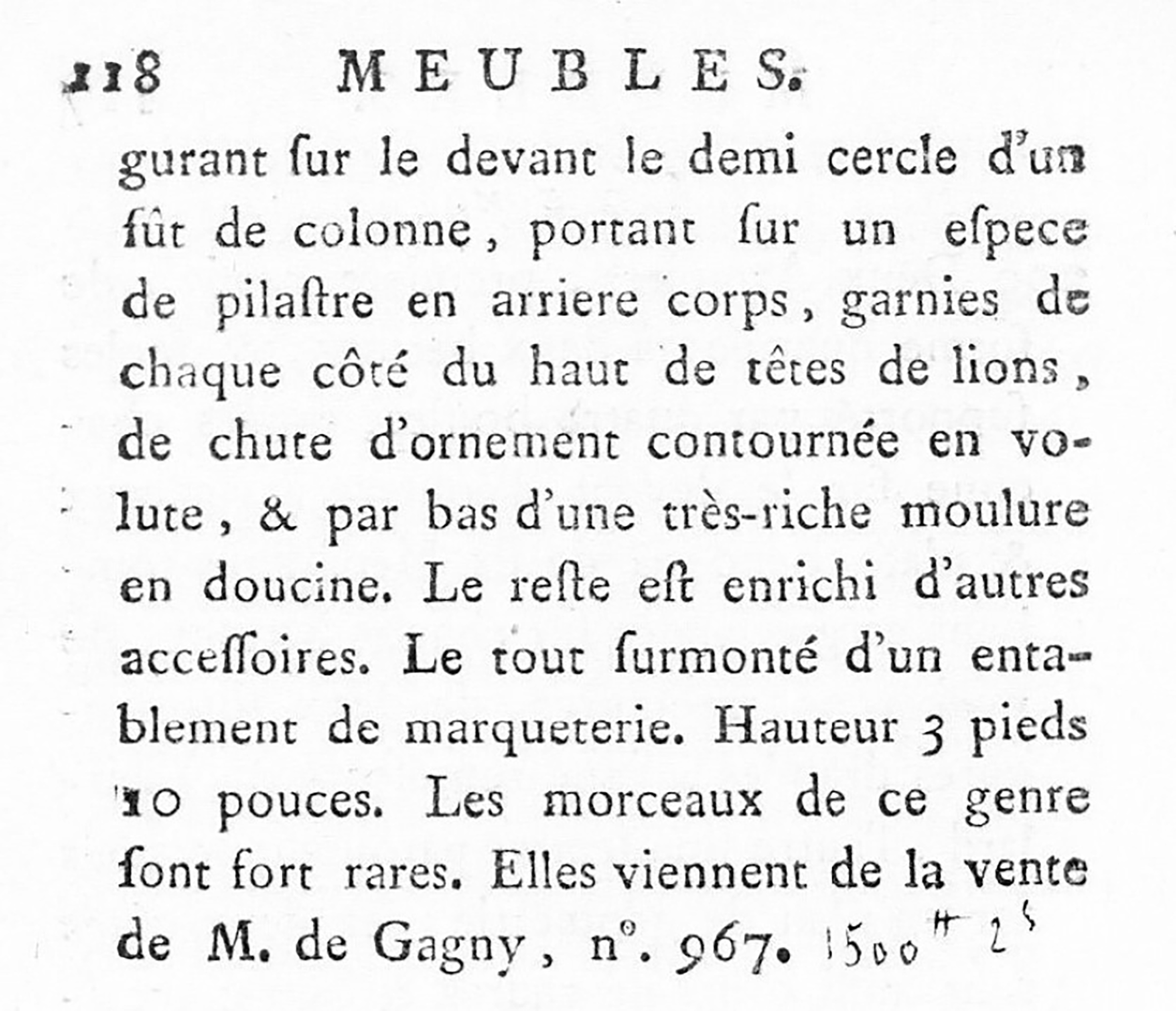
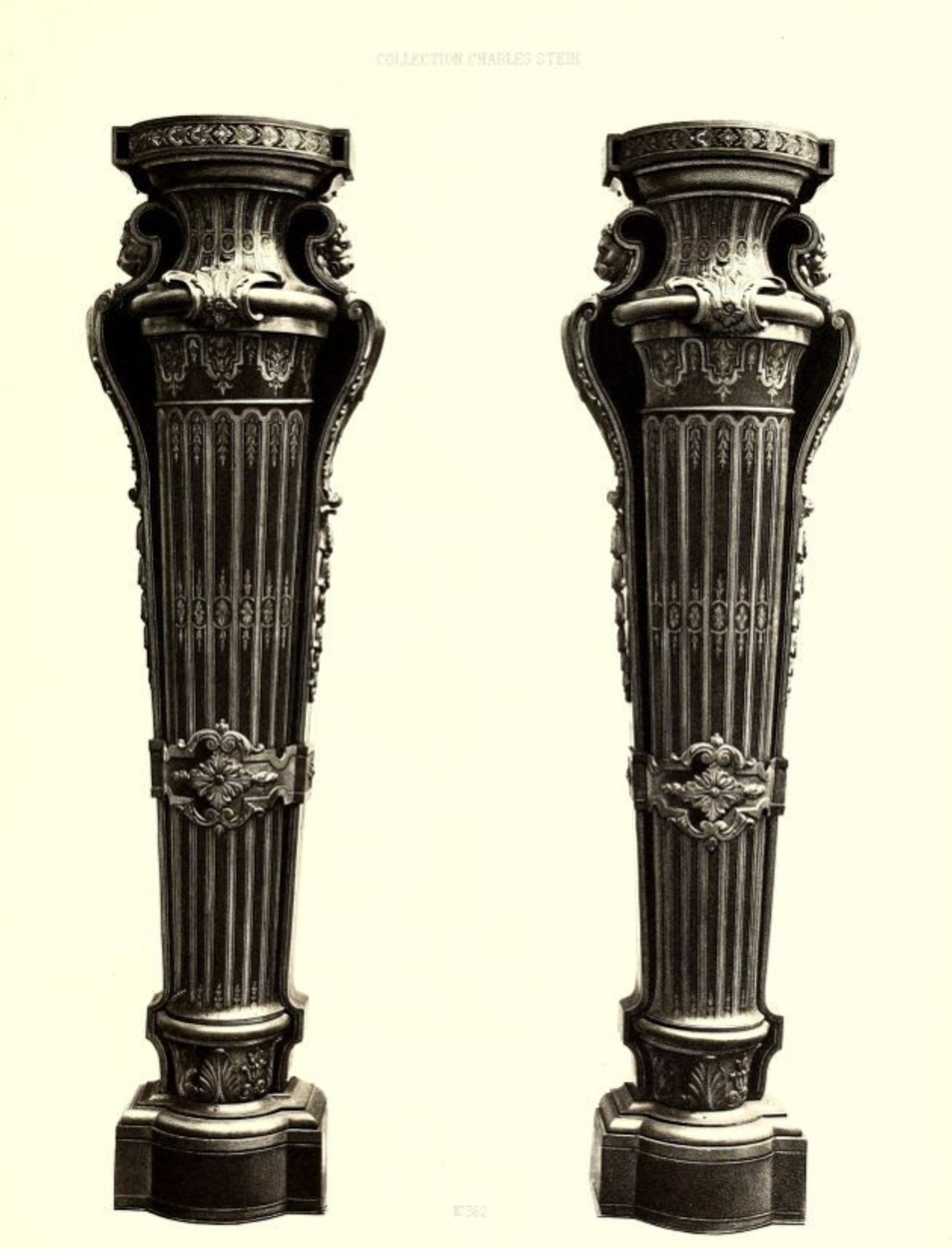
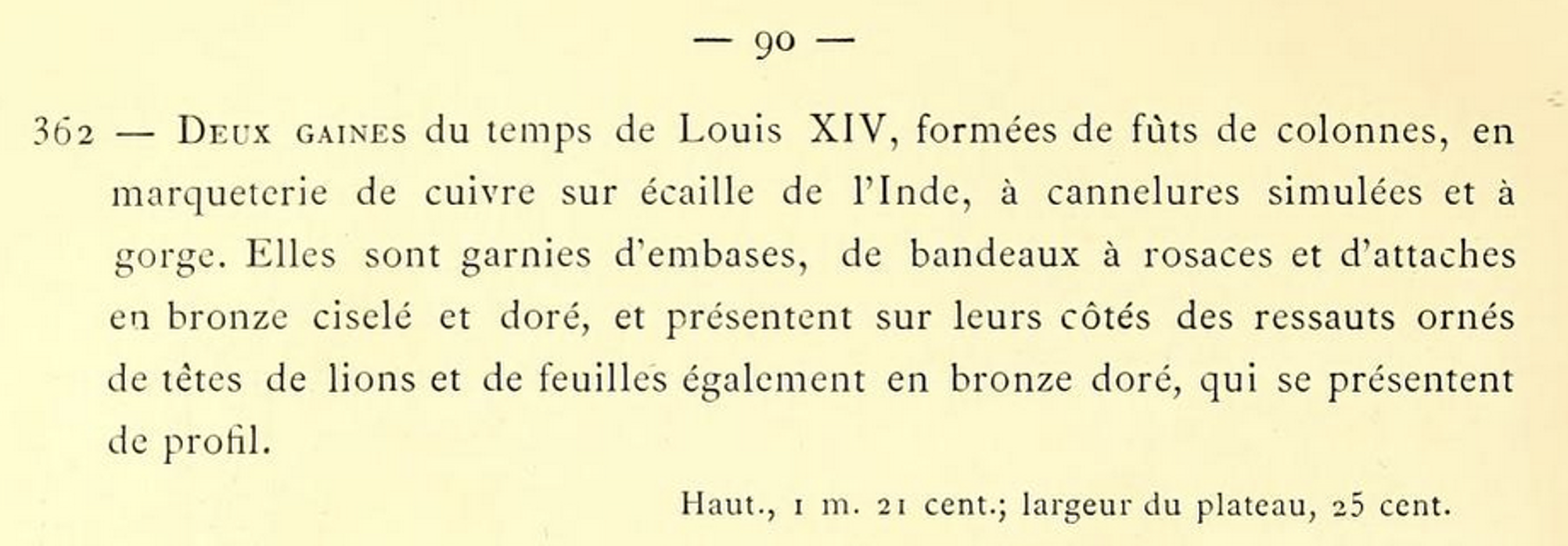
PROVENANCE: Auction of Augustin Bondel de Gagny, 10th December 1776, n° 967; auction of the Count du Luc, 22nd December 1777, n° 43; acquired for 1301 livres by painter, expert, and art dealer, Jean-Baptiste-Pierre Lebrun (1748-1813); LeBœuf auction, 8th April 1783, n° 211; acquired for 1322 livres by the famous collector and art dealer Vincent Donjeux († 1793); probably Lamure auction, 19thApril 1791, n° 209; probably Duclos-Dufresnoy auction, 18th August 1795, n° 179; Charles Stein auction, Paris, 10th May 1886, n° 362 (height 121 cm.); collection of Boniface de Castellane (bought circa 1895-1898); Louis Guiraud auction, Paris, Me Ader, 10th December 1971, n° 117; Juan de Beistegui Collection, auction on 10th September 2018, n° 60.
EXHIBITION : Louis XIV, Fastes et Décors, Musée des Arts décoratifs, Paris, May-October 1960, n° 151-152 (then property of Mme Louis Guiraud); André Charles Boulle, Catalog of the exhibition presented at the Château de Chantilly, from June 8 to October 6, 2024, Saint-Rémy-en-l’Eau, pp. 256-265, cat. no. 35.
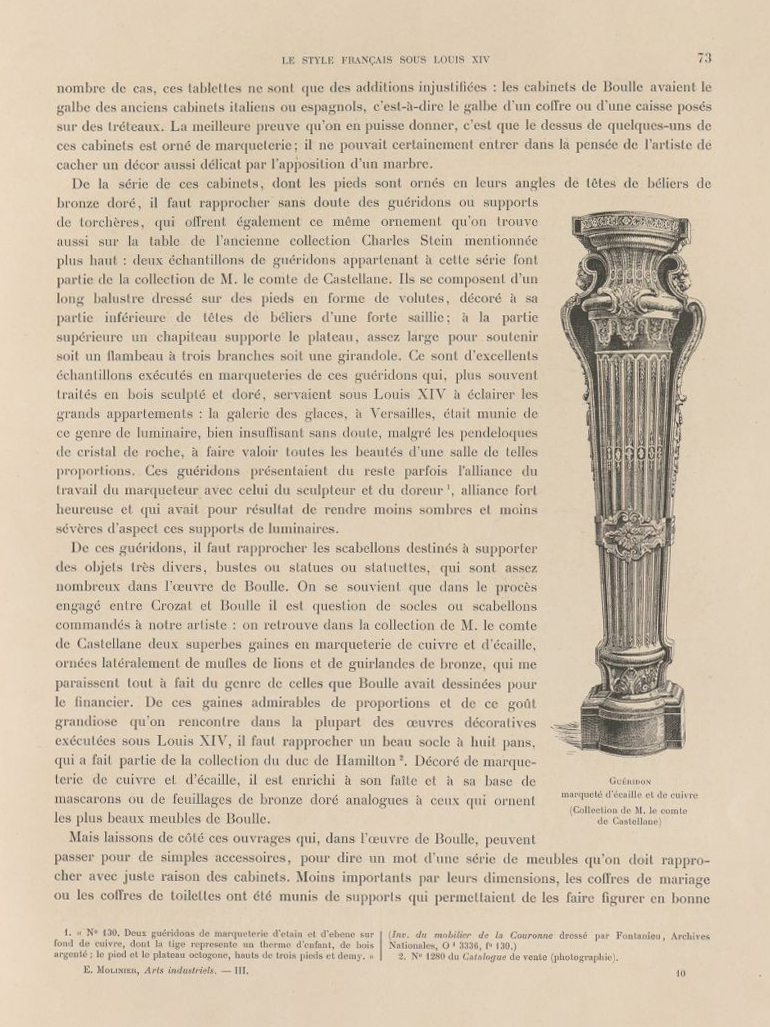
LITERATURE: Emile Molinier, Histoire Générale des Arts Appliqués à l’Industrie du Ve à la fin du XVIIIe siècle, Paris, undated (1898), 6 vol.; vol. III: Le Mobilier au XVIIe et au XVIIIe siècle, p.73 (illustrated in engraved form; then collection of Count Boniface de Castellane).
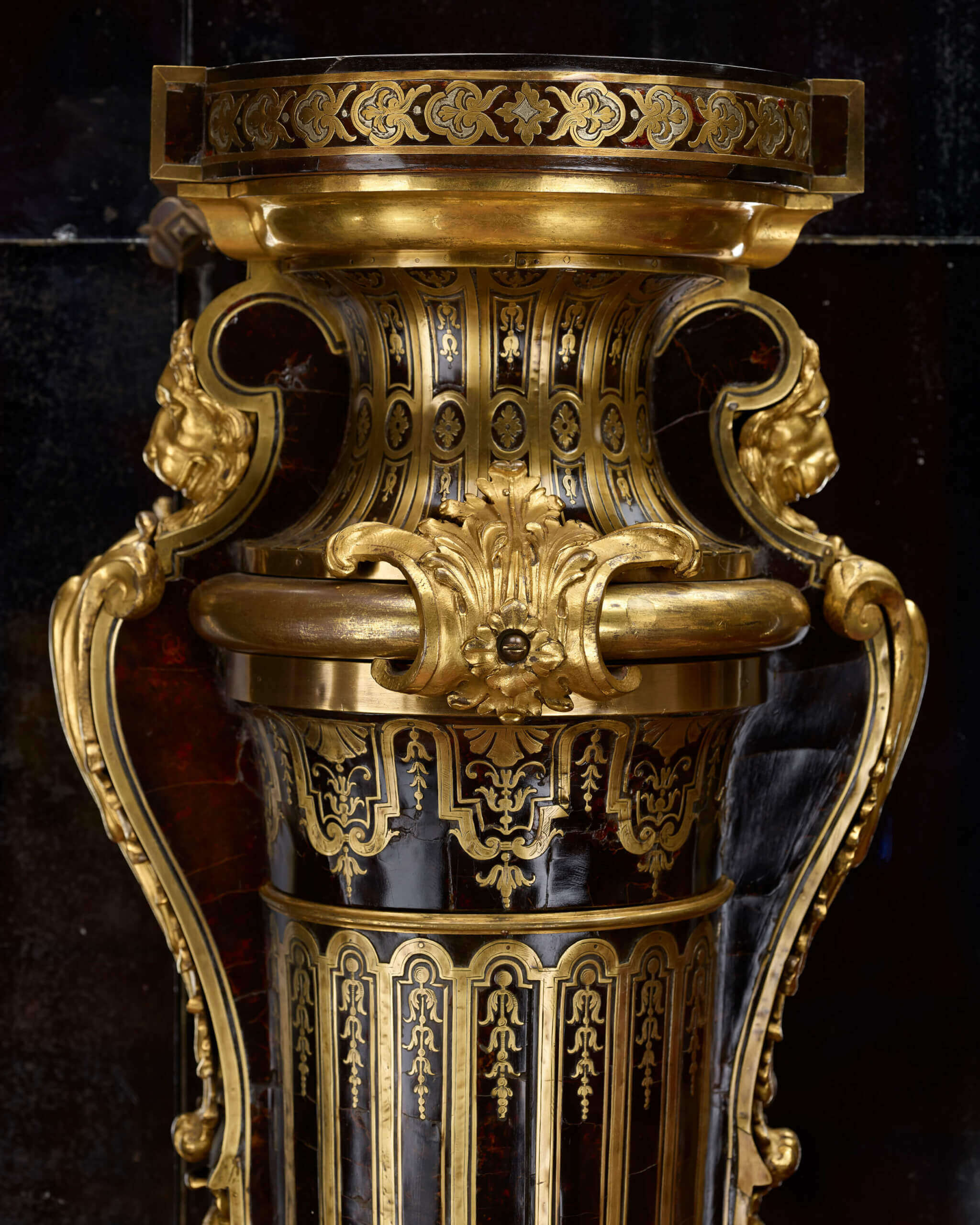
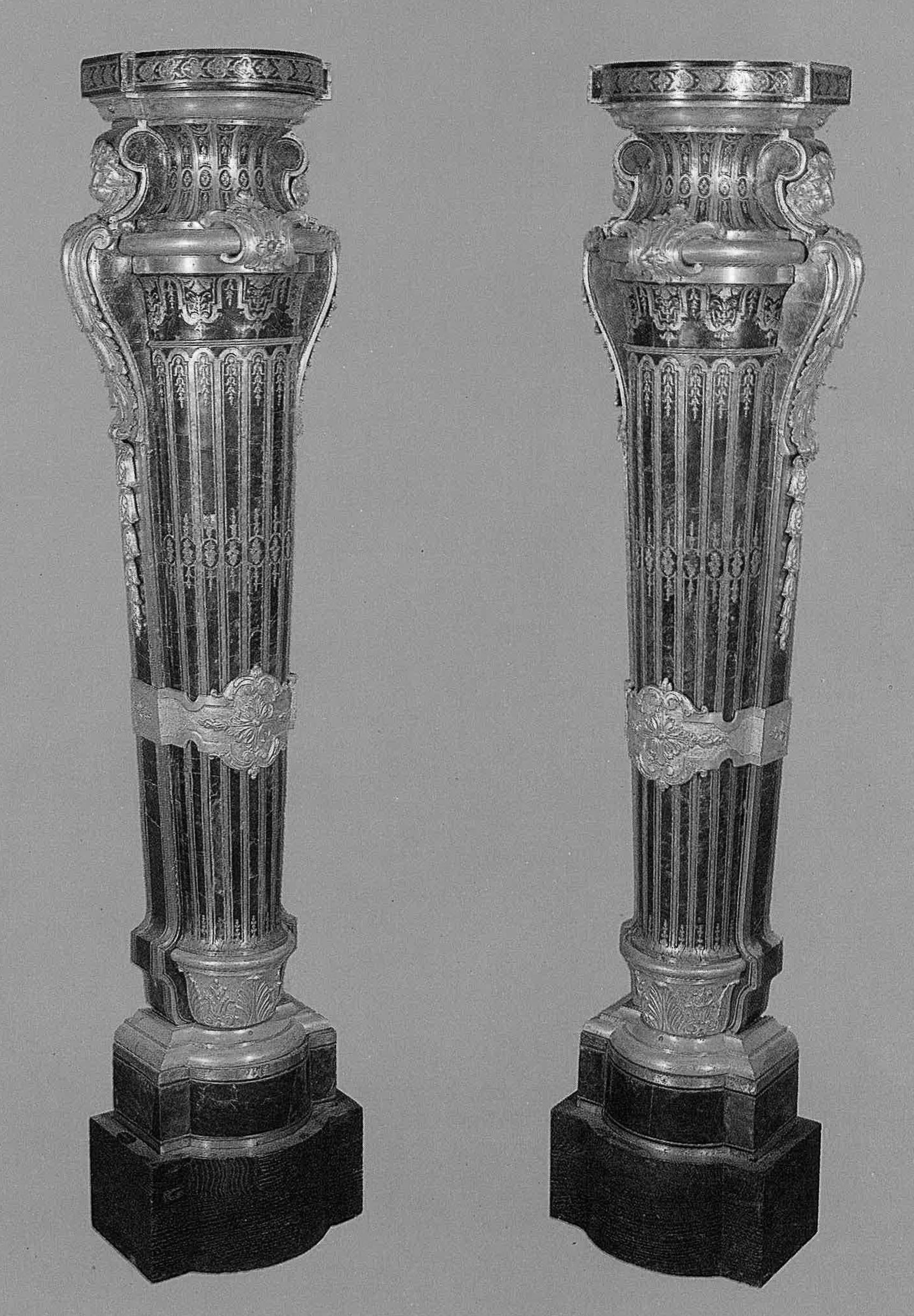
This rare model of a semi-circular quiver-shaped gaine (pedestal) is known from four other pairs, including an identical pair at Chatsworth and three smaller pairs:
– The one kept at Chatsworth, collection of the Duke of Devonshire (height 47’= 119cm), forming the contre-partie pendants of those above.
– The one in contre-partie, former coll. of the Count of Essex, Cassiobury Park, Christie’s London auction, 12th May 1893 n° 104; then Hubert de Saint-Senoch, pavillon de Bidaine, Sotheby’s Monaco auction, 4th December 1983, n° 219, then Christie’s New York auction, 4th November 1992, n° 226. This pair is clearly smaller than the previous ones (height 102 cm.), despite the obviously added counter-socles.
– The one in première-partie, former coll. Lady Baillie, Sotheby’s auction, 13th December 1974, n° 162. This pair, smaller than the first two pairs (height 102 cm.) has the same shaft as the previous one, but without the lion masks and rests on a square neoclassical base.
– The one in contre-partie, former collection of Baroness Von Zuylen, Avenue Foch, Paris, whose marquetry design differs from all the others; Christie’s Paris auction, 3rd May 2016, n° 173.
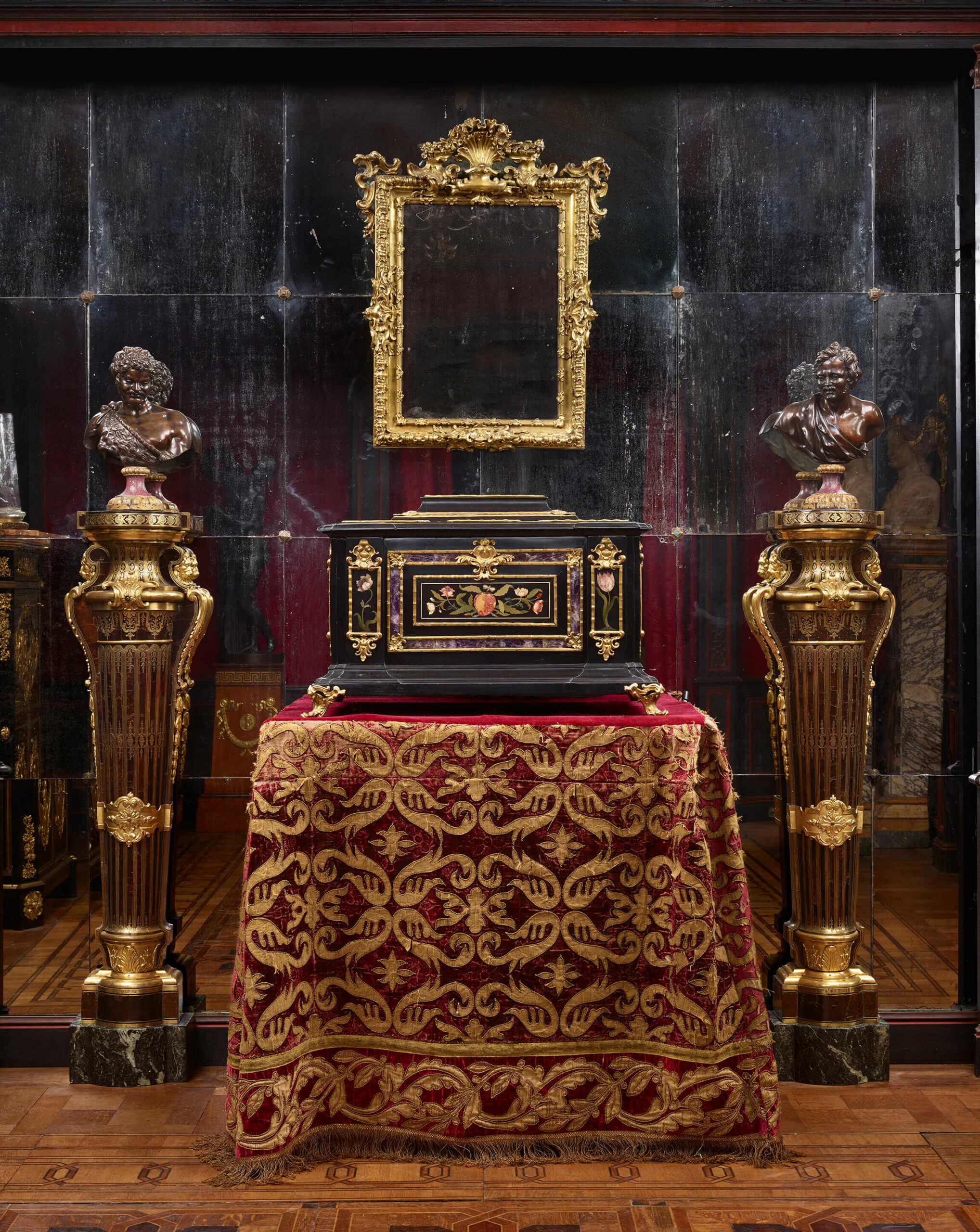
Several quiver-shaped gaines of this model are mentioned as works executed by Boulle in 18th century auctions. Their descriptions indicate two models of different sizes, one varying from 116 to 129 cm (depending on the presence or not of the blackened wooden counter-socle which elevates them), the second model 1 metre high like the last three pairs listed above.
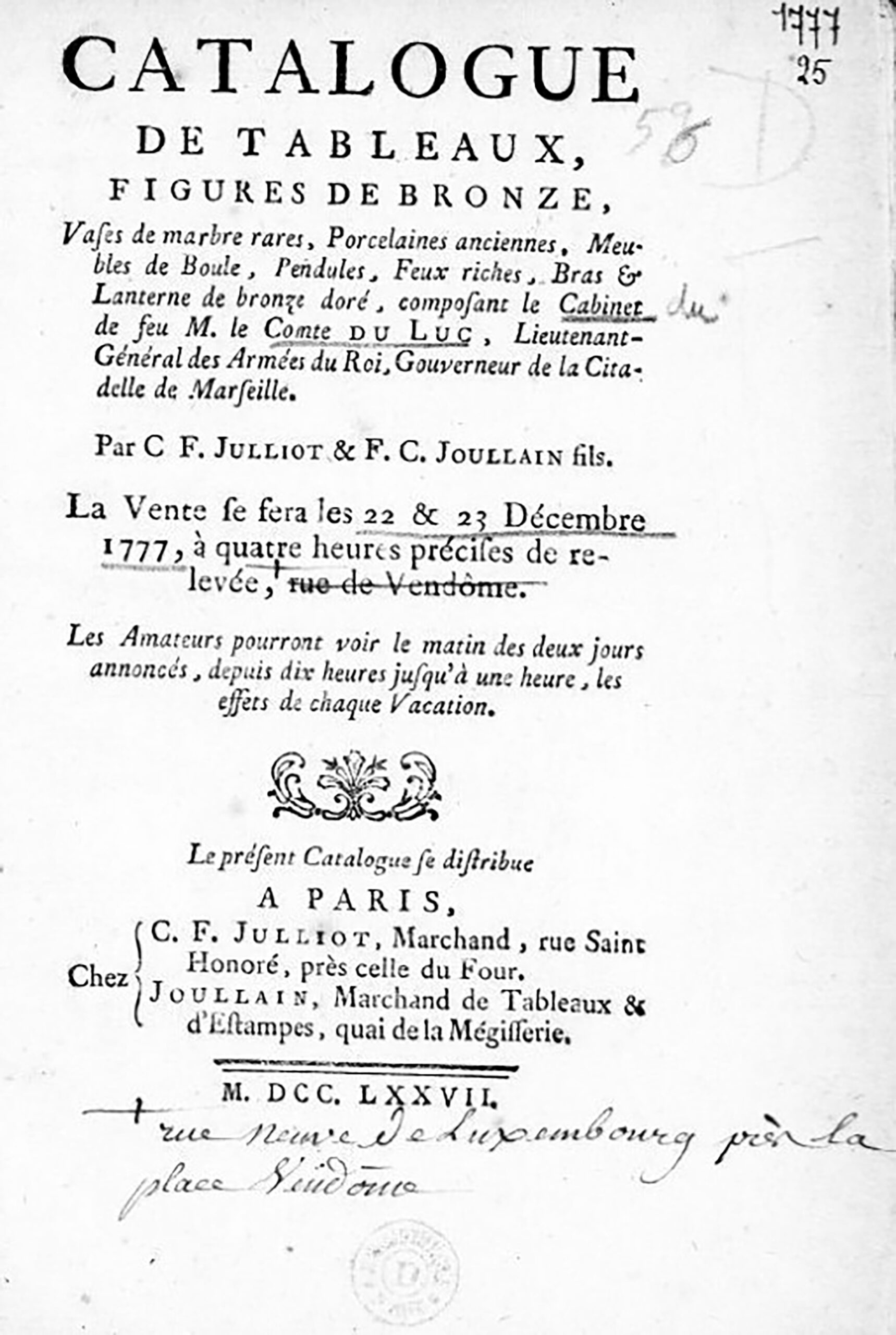
The earliest mention in the 18th century auction catalogues refers to the pair from the Blondel de Gagny auction in 1777, also in première partie (it seems*) and with the same dimensions as the one presented here. The Blondel de Gagny pair was sold again in the auction of the Count du Luc in 1777 (height 126 cm.), then in the Le Beuf auction in 1783.
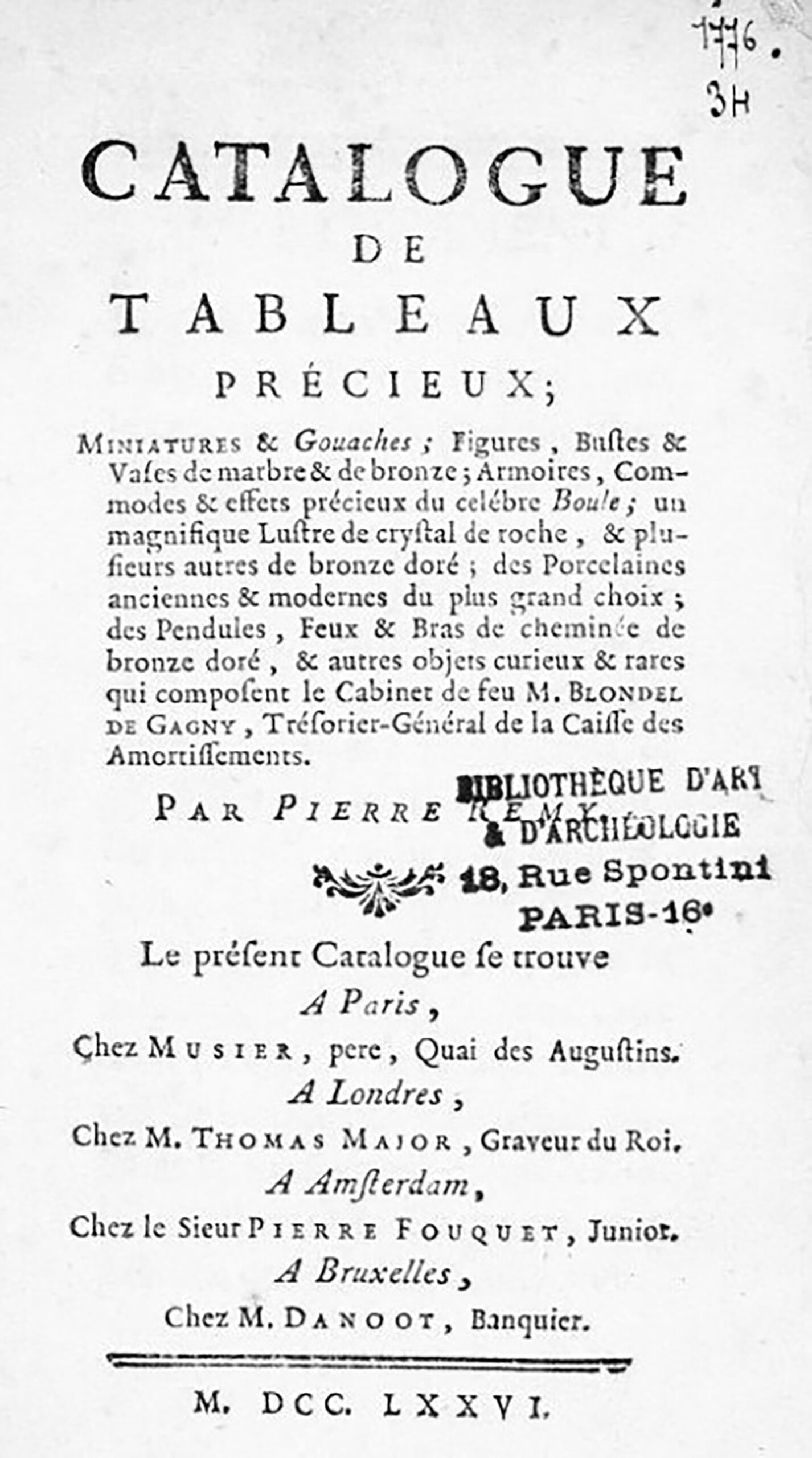
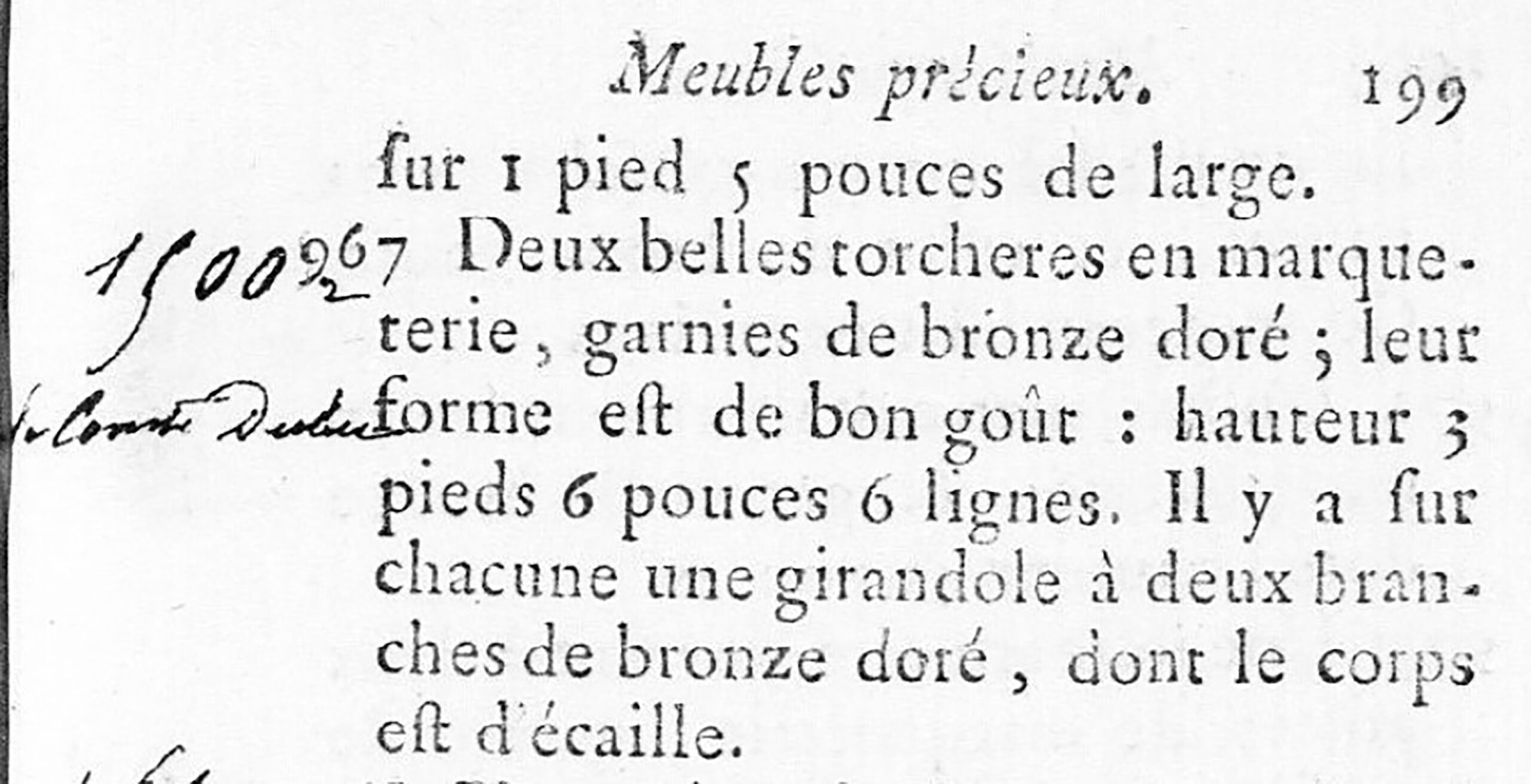
Blondel de Gagny auction, 10th December 1776
Catalogue of precious paintings…figures, busts and marble & bronze vases; cupboards, commodes & precious effects by the famous Boule; a magnificent rock crystal chandelier and several others of gilt bronze; ancient & modern porcelains of the greatest variety; gilt bronze clocks, andirons & bras de cheminée (wall sconces); and other curious and rare objects which make up the cabinet of the late M. Blondel de Gagny, treasurer of the Caisse des amortissements. By Remy, Auction on 10th-24th December 1776 and 8th-22nd January 1777 [Lugt 2616].
“967. Two beautiful marquetry torchères, adorned with gilt bronze; their shape is in good taste: height 3 feet 6 inches 6 lines (1m15). On each of them stands a two-branched gilt bronze girandole, the body of which is of tortoiseshell… 1 500L. the Count of Durfort”
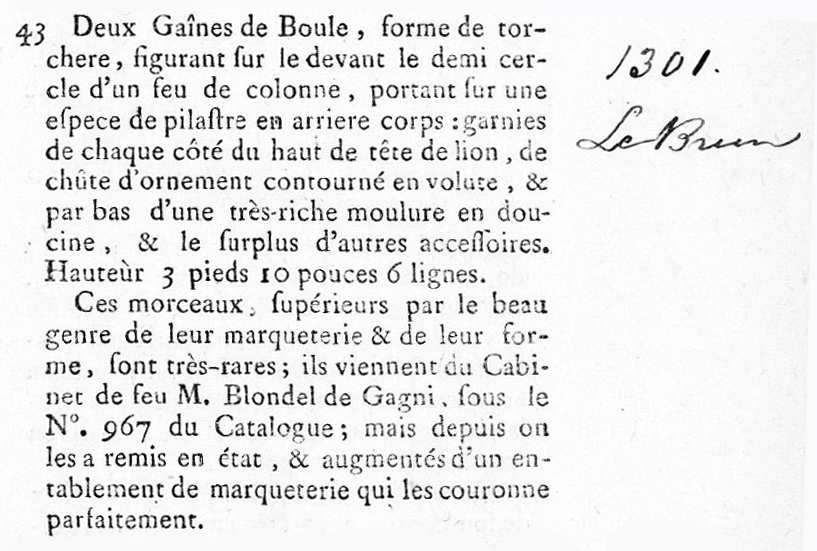
This brief description was supplemented by a more precise one at an auction a year later. Although the Blondel catalogue lists the Comte de Durfort as the successful bidder, the following year these sheaths were sold again in the auction of the Comte du Luc, on 22nd December 1777, with the addition of an ‘entablature’ and heightened by approximately 8 to 9 cm overall. The description in the du Luc auction allows us to precisely identify this model of semi-circular gaine:
“43. Two gaines by Boule, in the shape of a torchère, figuring on the front the semicircle of a feu [sic] de colonne, bearing on a kind of pilaster in the rear body; furnished on each upper side with a lion’s head, with a scrolled ornamental pendant & below with a lavish doucine moulding, & the remainder with other accessories. Height 3 feet 10 inches 6 lines (126 cm). These pieces, superior by the beauty of their marquetry and their form, are very rare: they come from the cabinet of the late M. Blondel de Gagni, under n°967 of the catalogue. But since then they have been restored & supplemented with a marquetry entablature which crowns them perfectly … 1301 L, Lebrun”
They were sold again in the Leboeuf auction on 8th April 1783, lot n° 211 with the same description and dimensions. Subsequently, this pair seems to correspond to the one in the auction of M. de Lamure on 19th April 1791, with a description almost identical to the previous one but the same height as in the Blondel de Gagny auction, accompanied by a second pair of the smaller model:
“209. Two gaines, in the shape of a torchère, figuring on the front, the semicircle of a column shaft, bearing on a kind of pilaster at the back; furnished on each side with lion muzzles, scrolled ornamental pendants, mascarons & other accessories, with profiled grooved front pedestals. Height 43 inches (116 cm). These pieces by Boulle, are very seldom repeated, & vary in form in the cabinet of a connoisseur.
210. Two medium-sized torchères, with the same adornments. Height 3 feet [97 cm.]
The same two pairs were offered for sale again with a more concise description in the Duclos-Dufresnoy auction on 18th August 1795. This time, the height listed is that of the du Luc auction:
“179. Two console gaines, quiver-shaped, première partie with tortoiseshell background à consoles, collets, lion masks and other gilt bronze adornments; height 47 inches 6 lines [127 cm.]. 180. Two smaller ones of the same kind, ornaments; height 37 inches 6 lines [100 cm.].”
It is worth noting here that all of these gaines are heightened by means of blackened wood counter-socles which seem to have been fitted in the 18th century and by similar marquetry edged tops (except for the Chatsworth and Van Zuylen pieces).
Augustin Blondel de Gagny (1697-1776)
Treasurer of the Caisse des Amortissements and, from 1752, Intendant of the King’s Menus-Plaisirs, he assembled between 1740 and 1770, in his mansion on Place Vendôme (now the Ritz Hotel), one of the most important collections of paintings and works of art in Paris.
The sale of his collection during the winter of 1777 was undoubtedly—after that of Randon de Boisset—one of the most celebrated auctions of the 18th century. On the first floor on Place Vendôme and in the three cabinets of the wing flat, the cymas of crimson or green damask were covered with paintings by the greatest masters hanging in three rows.
They were so many that they were also hung on the panelling, the mantelpieces, the doors and the tapestries. Underneath, hundreds of pieces of Chinese or Japanese porcelain, precious marble vases and bronzes covered the Boulle furniture or the lacquered furniture from the Far East, sometimes piling up on the floor between the legs of the furniture.
The presence of some fifty vases in porphyry, granite or antique marbles clearly testifies to our collector’s passion for precious marbles, some of which had been mounted in gilded bronze by the greatest bronziers of the time, Gallien, Saint-Germain, Vassou and Auguste.
Most of the furniture had been commissioned from great contemporary cabinetmakers, such as Cressent, Bernard II Van Risamburgh and Joseph Baumhauer, but Blondel de Gagny had a predilection for furniture by Boulle, of which he owned about twenty pieces—notably a medal cabinet with Aspasia and Socrates; a pair of arched commodes modelled on the one in the Louvre; a pair of three-legged consoles with rams’ heads and another console with four doe’s feet; three large low bookcases with glazed sides; a commode; a barometer-thermometer modelled on the one in the Jones Collection and the small two-body cupboard also in the Jones Collection; and everywhere could be seen gaines and pedestals in Boulle marquetry. The pair of quiver-shaped gaines studied here was placed in a room called la salle à manger (dining room), which was in fact the first of the three salons in a row on Place Vendôme.
Hébert’s Guide in 1766 describes them as follows:
“Between the windows, Hercules as a child strangling the snakes, in white marble, by Girardon, mounted on a gilded and painted marble base, between two marquetry pedestal tables bearing gilt copper girandoles by Boule.”
Although the post-mortem inventory of Blondel de Gagny does not locate the objects in the mansion, it does mention the gaines among all the objects and paintings that had been described by Hébert in the same dining room:
“51. Two torchères in Boulle marquetry and two gilt bronze girandoles, 300L”.
In 1776, the marble Hercules had disappeared, replaced between the windows by the marble statue recently acquired by the Louvre, Saly’s Cupid (described under the previous number in the inventory). The statue was placed between the windows, illuminated by the girandoles placed on the Boulle gaines, in front of a mirror overmantel which reflected it at the back. The salon contained other furniture by Boulle, including a cupboard with the figures of Aspasia and Socrates, a table with hind legs and a commode in veneer, pieces of furniture that were covered with baroque bronzes, marble vases and porcelains.
In old inventories or auction catalogues, Boulle marquetry furniture is simply referred to as “marqueterie” or sometimes “marqueterie d’écaille”, this simple term seeming to designate the works in première-partie, whereas those in contre-partie are designated as such or under the term “en seconde partie”. Other wood marquetry was then referred to as “en fleurs” or “en fleurs de bois de rapport”, with geometric marquetry being referred to as “en mosaïques”.
Alexandre Pradère
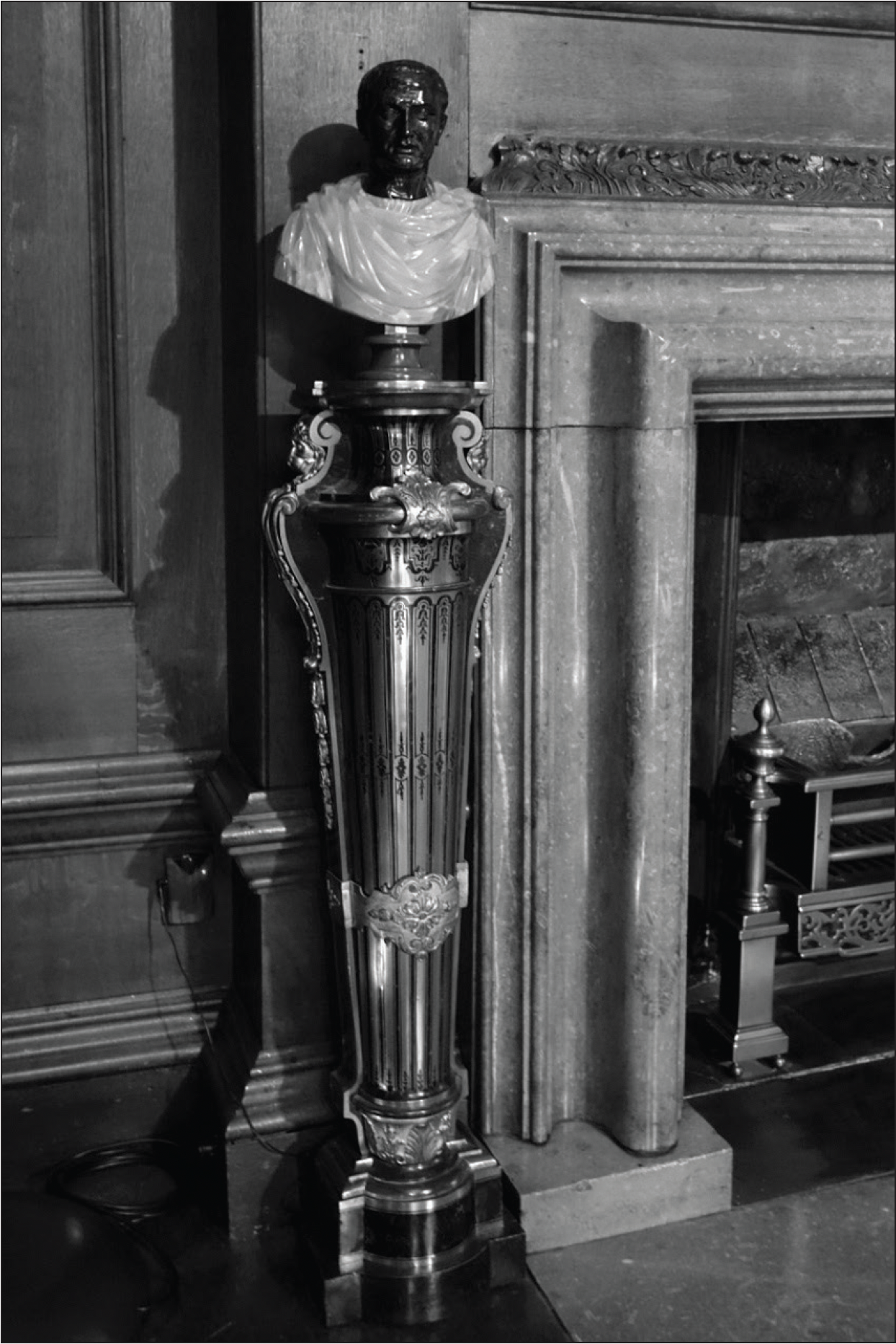
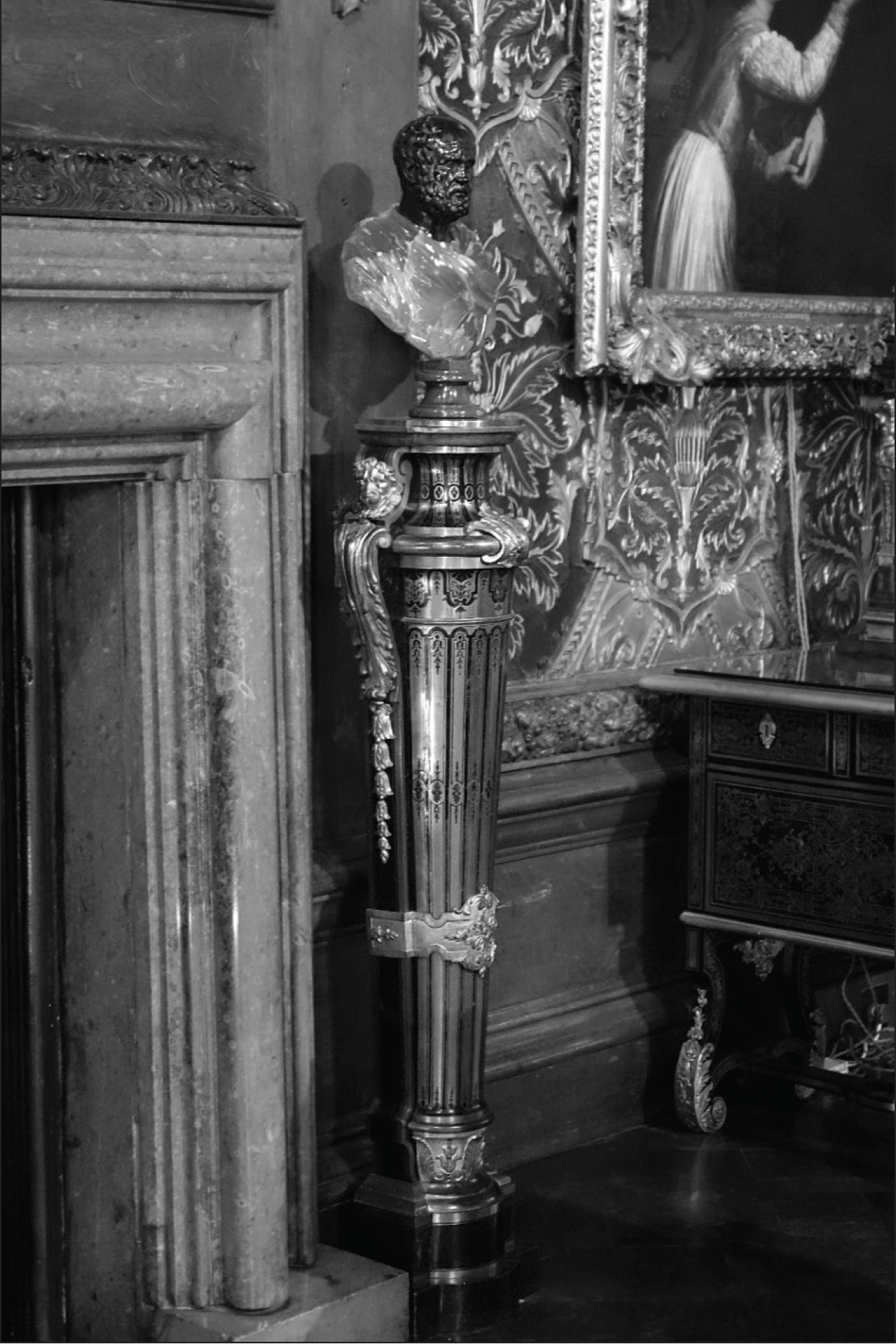
View of the pair of gaines by André-Charles Boulle forming the pendant in contre-partie to our gaines in the State Dining Room of the Dukes of Devonshire at Chatsworth House.
Augustin Blondel de Gagny (1695-1776), one of the greatest collectors of the 18th century
“The cabinet of M. Blondel de Gagny, on Place Louis le Grand, commonly known as Vendôme, is one of the first and most curious in Paris, both for the choice of paintings, sculptures & drawings, and for other extremely beautiful works, such as cabinets, and other pieces of cabinetmaking by the famous Boul [. …], a very large quantity of bronzes, old porcelains of the most perfect kind, & almost all of the kind called première sorte, whose mounts seem to compete in price with the pieces they accompany”, Dictionnaire pittoresque et historique de Hébert, published in Paris in 1766.
His extensive collection of master paintings, objects of art and valuable furniture was dispersed at his death in 1776 at a highly publicised auction.
The auction, which brought in a total of 1,249,692 livres, was widely attended by professionals and connoisseurs, including King Louis XVI. Blondel de Gagny’s son, Barthélémy-Augustin Blondel d’Azaincourt, repurchased some of the works from his father’s collection; they were to appear in his own post-mortem auction in 1783.
A part of Blondel de Gagny’s paintings, sculptures, furniture and objects of art are now held in the collections of the greatest European museums, such as the Louvre Museum in Paris and the Wallace Collection in London.