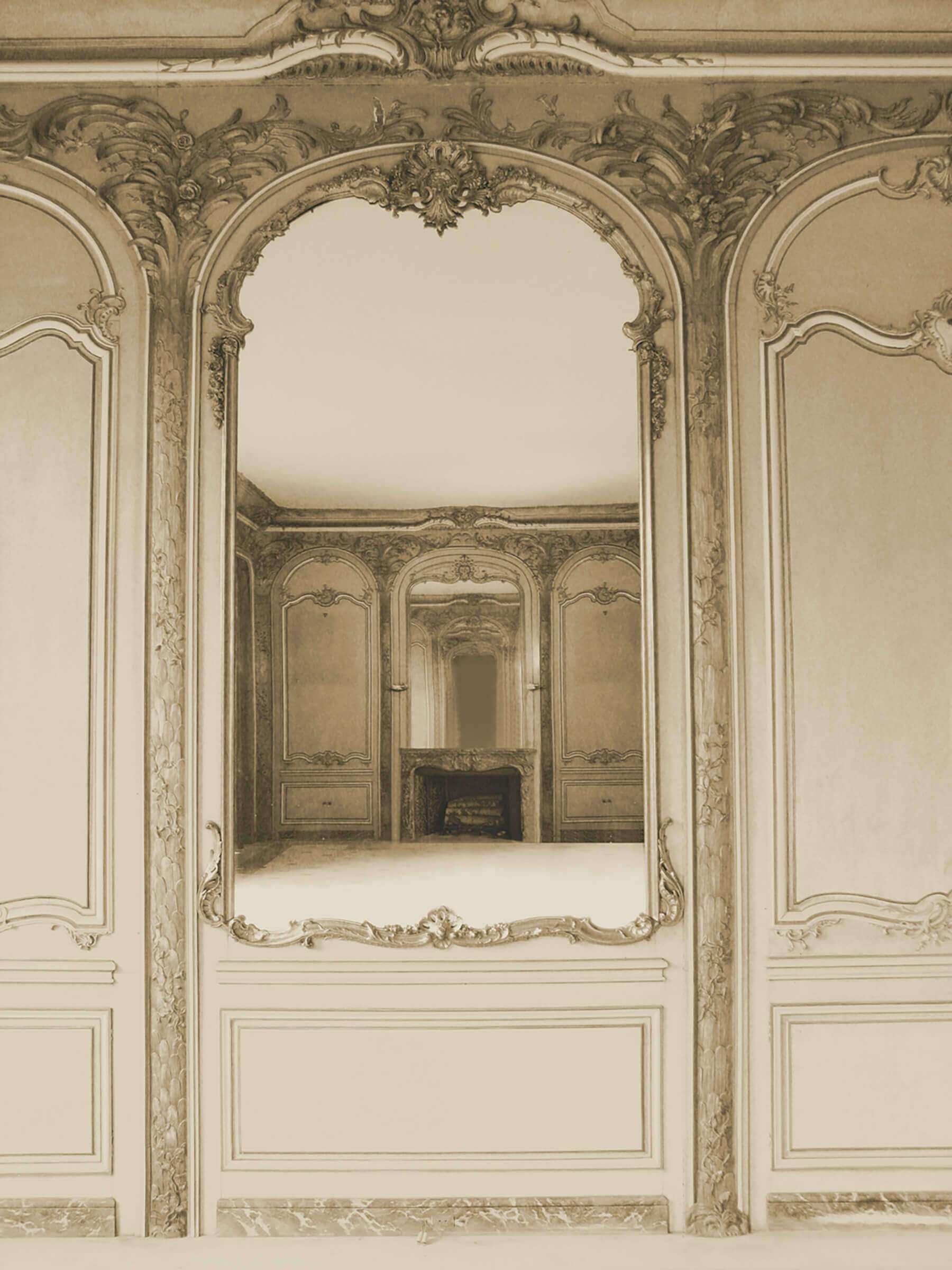
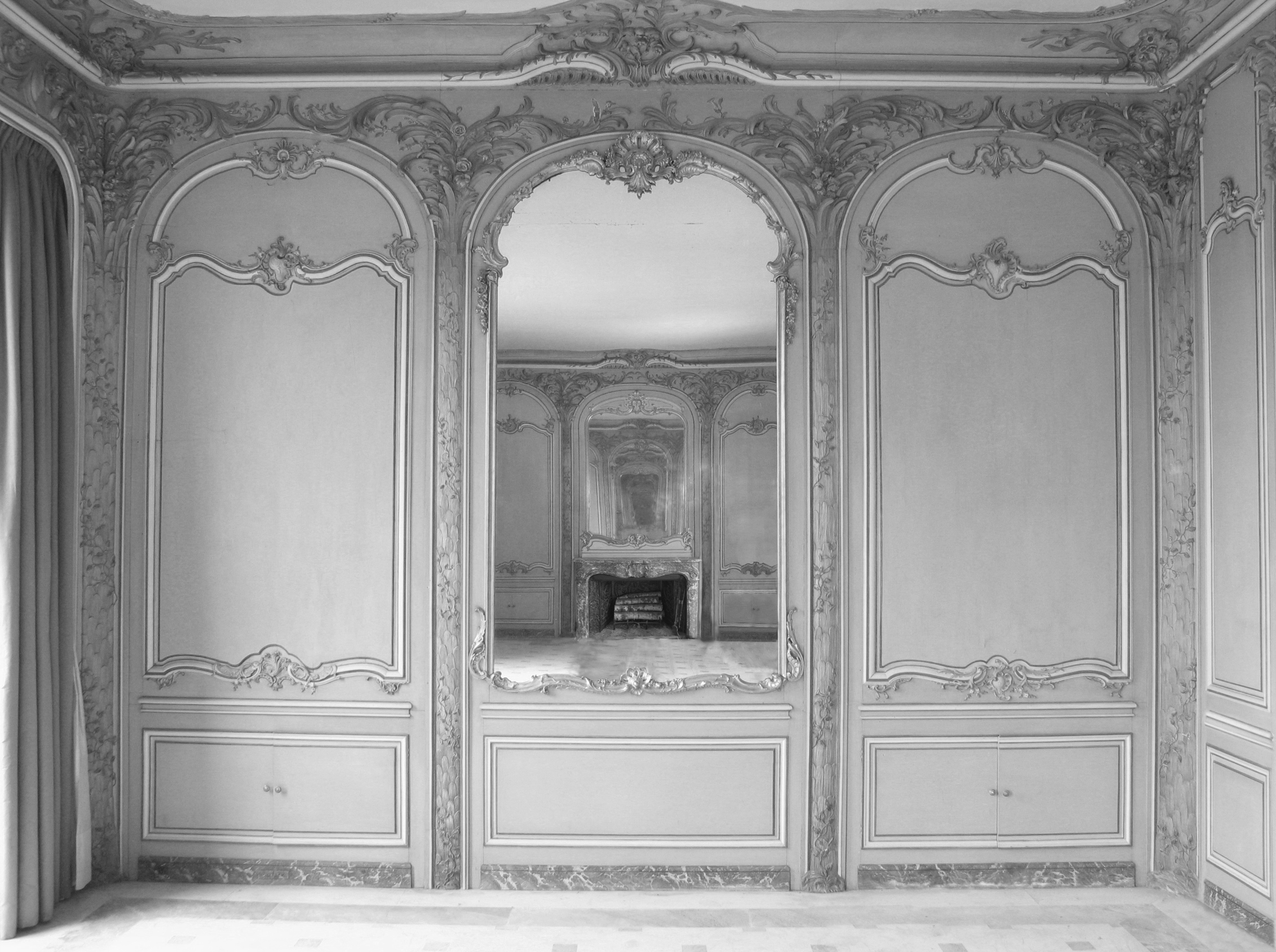
Sculpted and painted wood.
PROVENANCE: private collection.
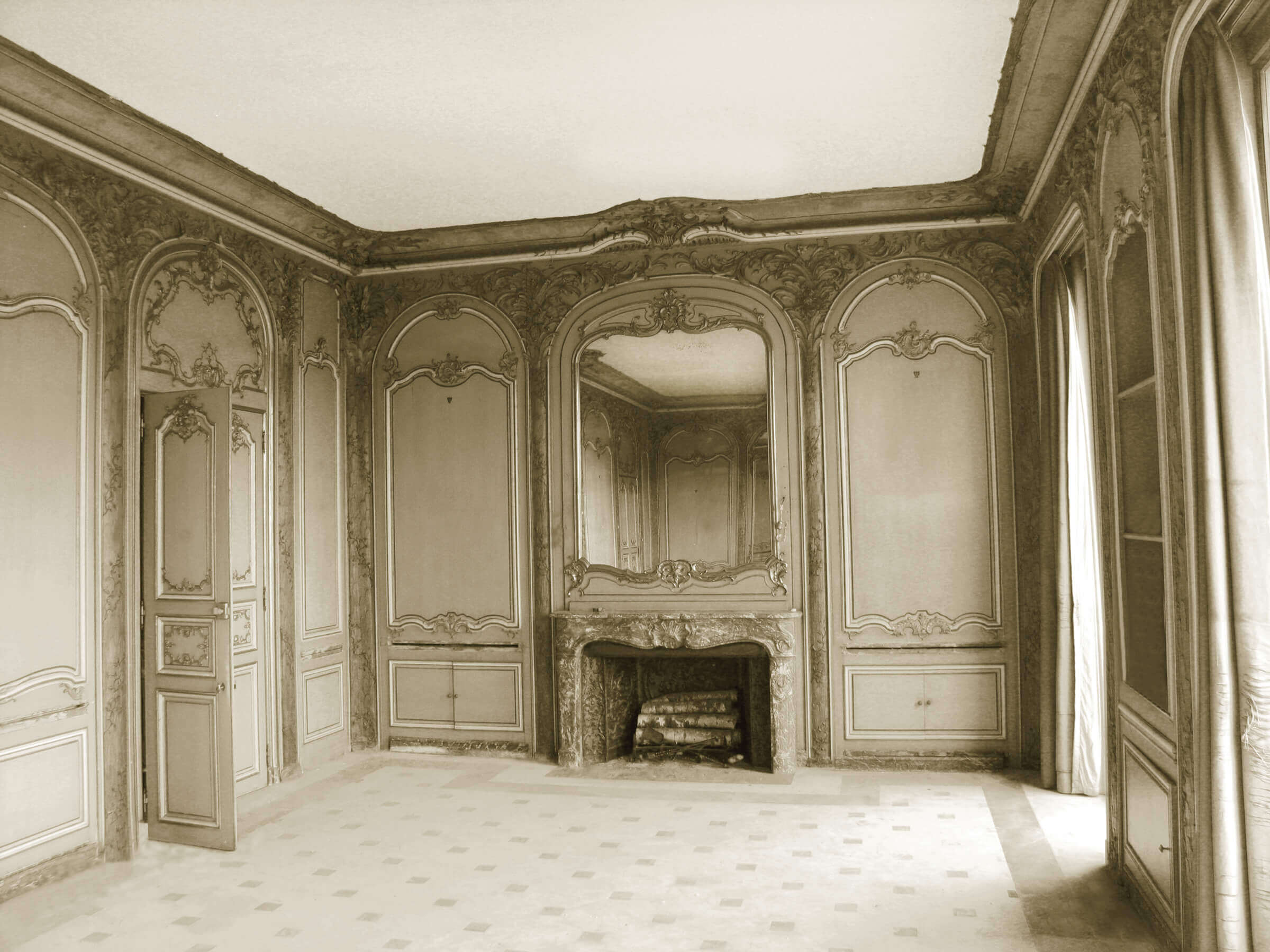
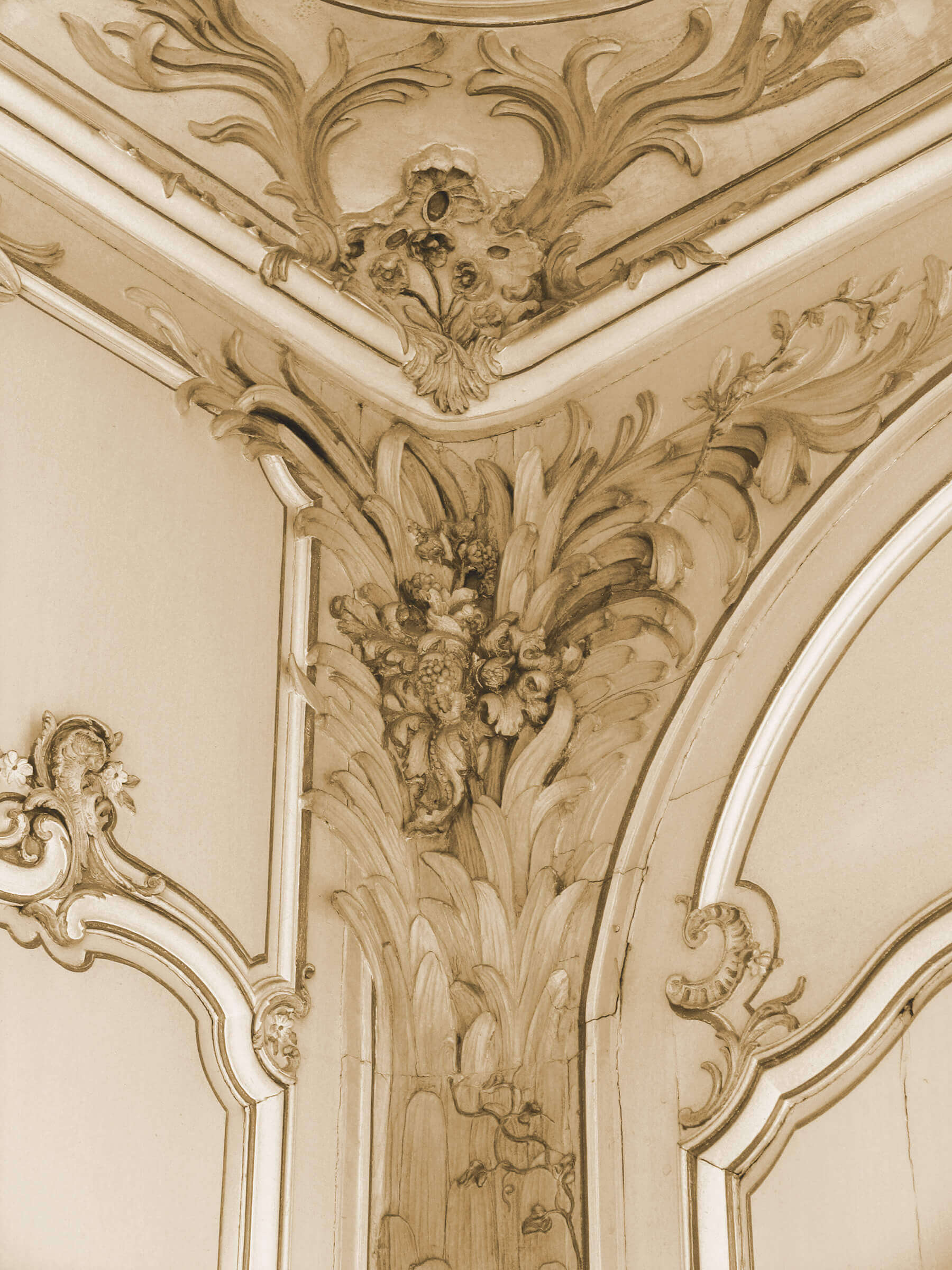
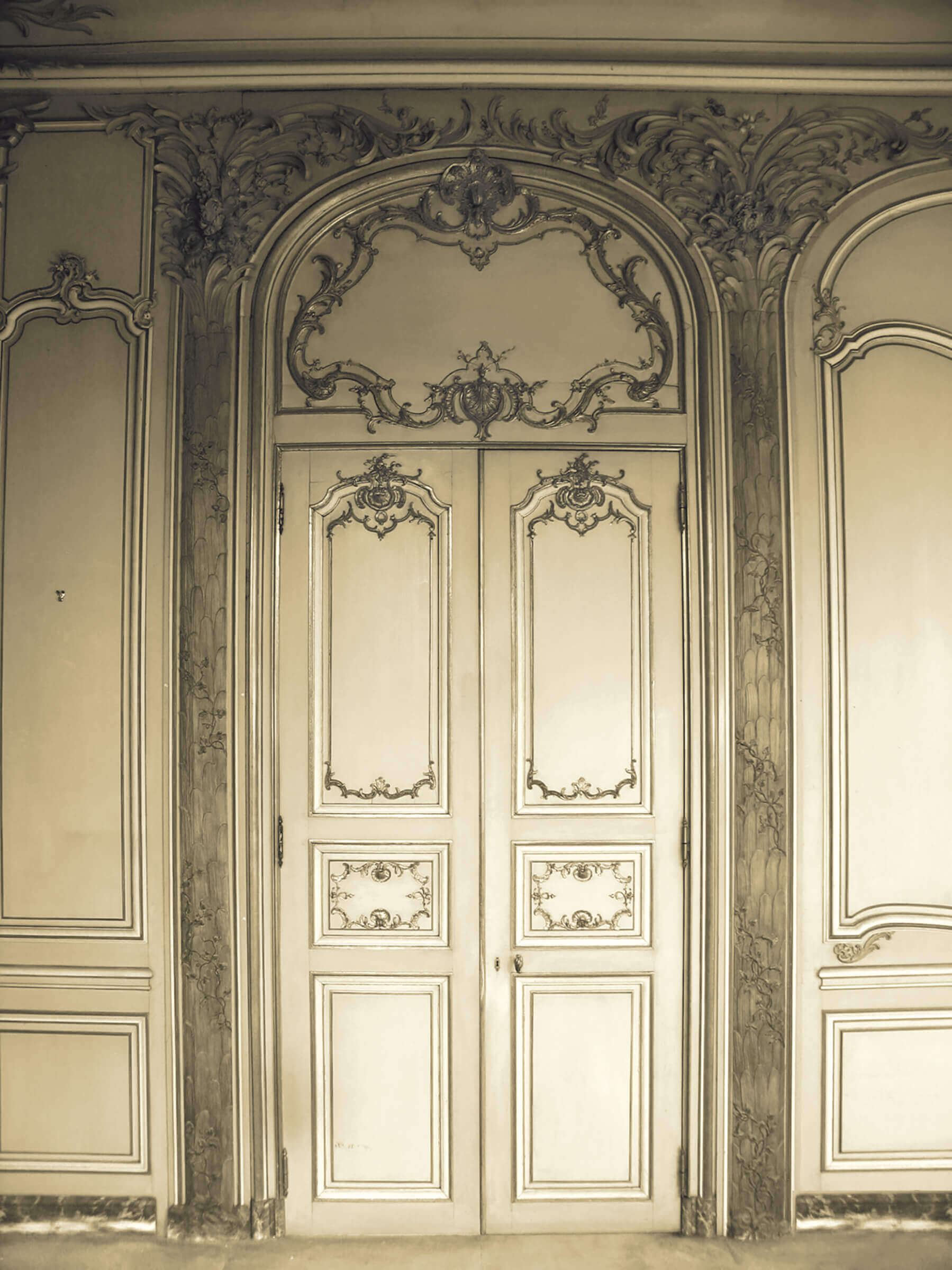
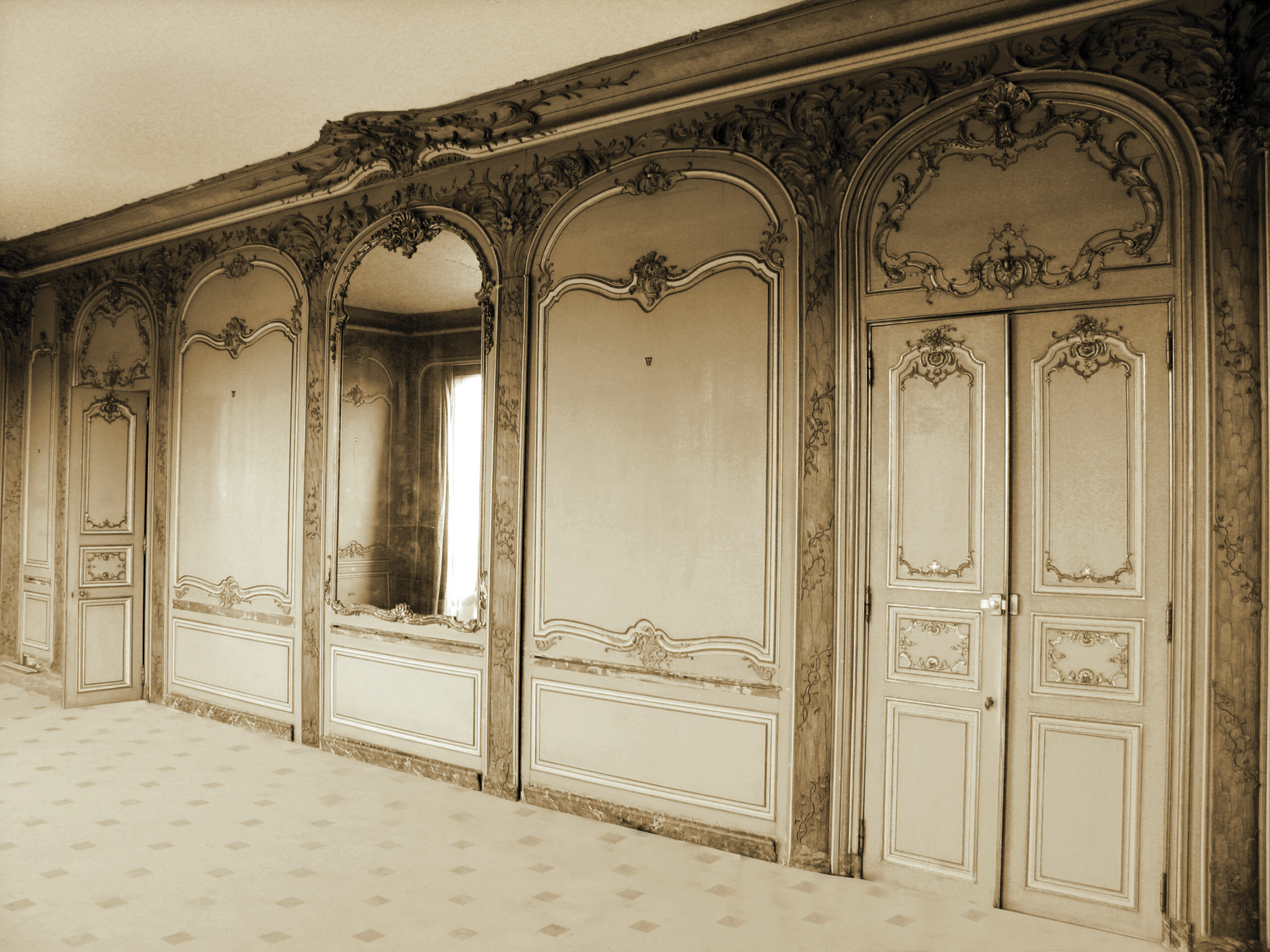
Roughly dating back to 1730-40, this sumptuous and decidedly exotic rocaille décor is framed by a series of arches that alternate with narrow beading, and include sculpted palm tree trunks and branches that fill the corners of each panel. Resting on a low cyma with simple compartments with plain backgrounds, the scene is painted in vert d’eau, with royal blue, blue-grey and pale yellow lines that highlight the molds, apart from the gilt borders of the mirror trumeaux and double doors. The palm trees are painted “au naturel”. Each large trumeau, with chamfered upper and lower cross members, is interspersed with asymmetrical rocaille keystones. Richly sculpted violin-shaped rocaille cartouches with gilt palm patterns can be seen above the doors.

In 1737 in Paris, Charles-Nicolas Cochin le Fils engraved a series of four prints done by Claude Duflos after the artist François Boucher, who was published that year by Larmessin. On one of them, the exceptionally powerful Rocaille, the composition was based entirely on the diagonal axis, represented by the trunk of a palm tree, and inspired by the paintings that illustrated La fuite en Egypte or by the sculpture installed by Le Bernin near his allegory of the Nile in the fountains in Rome’s Place Navone (fig. 1). Boucher brought together a collection composed of disparate and asymmetrical forms, in which “delicately depicted cones and corals, twists, shellfish and tuns are crowned by a glorious plume of sea. The overall effect lacks coherence and is completed by an immense shell leading to what appears to be the outlet basin of a fountain, whose edge is barely perceptible.”
This engraving, with its asymmetrical, fragmented and fanciful composition is today considered to be the very essence of rocaille art as it includes its every character. The palm tree and the palm feature prominently amongst the ornaments depicted that had a certain impact on the interiors of the time.
In Paris, the earliest and most accomplished rocaille art was exhibited in residences where artists and craftsmen illustrated maritime or exotic themes, such as in the homes of the Admiral of France, the Count of Toulouse or the famous collector and lover of curios Joseph Bonnier de La Mosson (1702-1744). The latter’s exceptionally large cabinet—comprised of seven successive rooms—in his Hôtel du Lude in the Rue Saint-Dominique, was made up in part of spacious shelves supported by pillars shaped like palm trees, similar to our own, but sculpted in the round.
Bonnier de La Mosson started with a cabinet of physics and mechanics, before adding chemical and pharmacy collections and a collection relating to natural history. He paid very close attention to the presentation of his collections, commissioning Lajoüe to create extraordinary decors for his cabinets and shelves, which were interspersed with large palm trees molded in the round in the three biggest rooms of his cabinet.
The elevations of this incredible cabinet were precisely drawn by the architect Jean-Baptiste Courtonne le Jeune, who was close to the painter-decorator, in a series of 1/14th Chinese ink and wash drawings, numbered 2 to 9, acquired by Jacques Doucet, and currently in the collections of Paris’ Institut national d’Histoire de l’Art (National Institute of Art History) (fig. 2).

In France, rocaille forms started to emerge at the start of the 18th century, naturally appearing around fountains and ponds, but also in interiors. The famous Société pour les Bâtiments du Roi (responsible for buildings for the King), comprising Jules Degoullons, André Legoupil, Pierre Taupin, Marin Bellan and Robert de Lalande, sculpted palm tree patterns on the flanks of the organ case in the new royal chapel at Versailles from 1710 (fig. 3). These timid appearances became more daring in 1727-1728 in Parisian decors, and had become universal by around 1735. This date corresponds almost exactly to a series of significant prints in the history of rocaille art by Lajoüe (1734), Mondon (1736), Boucher (1737), Huquier (1737), plus Pineau, Meissonnier, Babel, Chedel and Cuvilliés (1738).

Most of these great ornamentalists, who significantly influenced their contemporaries through their drawings and prints, were also plastic artists, including architects, sculptors, goldsmiths, metal smiths and carvers. Interior decoration played an active role in this emancipation of rocaille forms through the widespread use of large wood panels, whose edges and beadings lent themselves perfectly to this rich repertoire of asymmetrical patterns of palms, acanthus leaves, shells and cartouches (fig. 4). The trumeau between the windows in the Queen’s bedroom in Versailles, sculpted in 1730 by Jules Degoullons, Mathieu Legoupil, and Jacques Verberckt (fig. 5) is flanked by large palms, which also surround the alcove of the “Cabinet de la Chaise du Roi”, produced under the supervision of Robert de Cotte from the same period.
Another example is the extraordinary mirror trumeau from the gallery of the Hôtel de Villars in Paris, drawn in 1731 by Nicolas Pineau and sculpted by Charles Bernard, and currently at Waddesdon Manor (fig. 6).

As we have seen, the origin of rocaille was drawing, which gave birth to some extraordinary creations, whose excellence is demonstrated today by our wood panels.
While the drawings may appear to be facile and light, rocaille art was in fact a repertoire that was difficult to conceive, did not tolerate mediocrity and demanded the greatest dexterity from the artists and craftsmen who practiced it. This exceptional phenomenon in the history of art was created by these same artists and craftsmen, outside any genuine and major intellectual school of thought. And it was this phenomenon, which closely connected the inventors and creators that could explain the level of excellence reached in Paris in 1730-1740, of which our wood panels are a remarkable example.