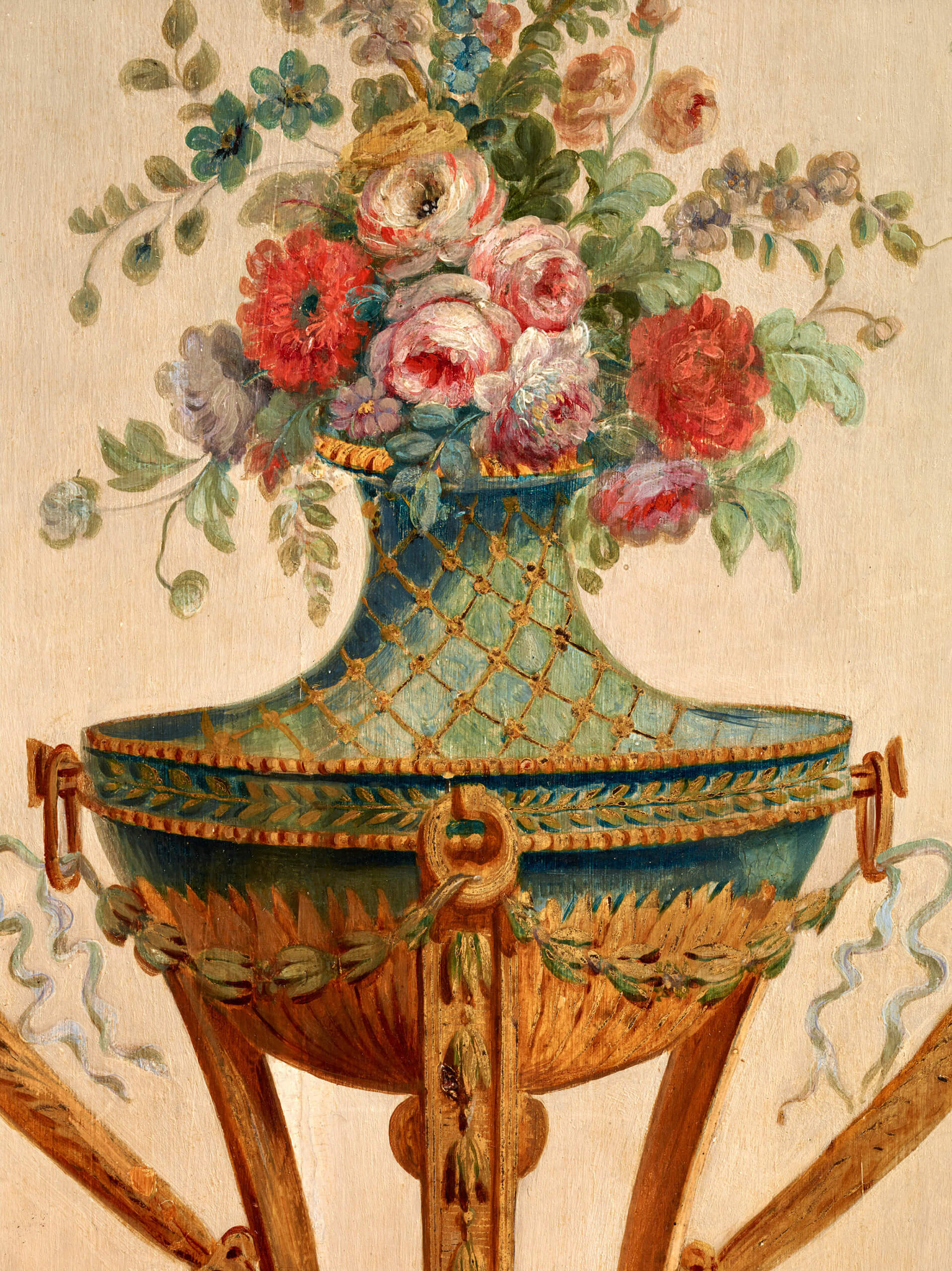
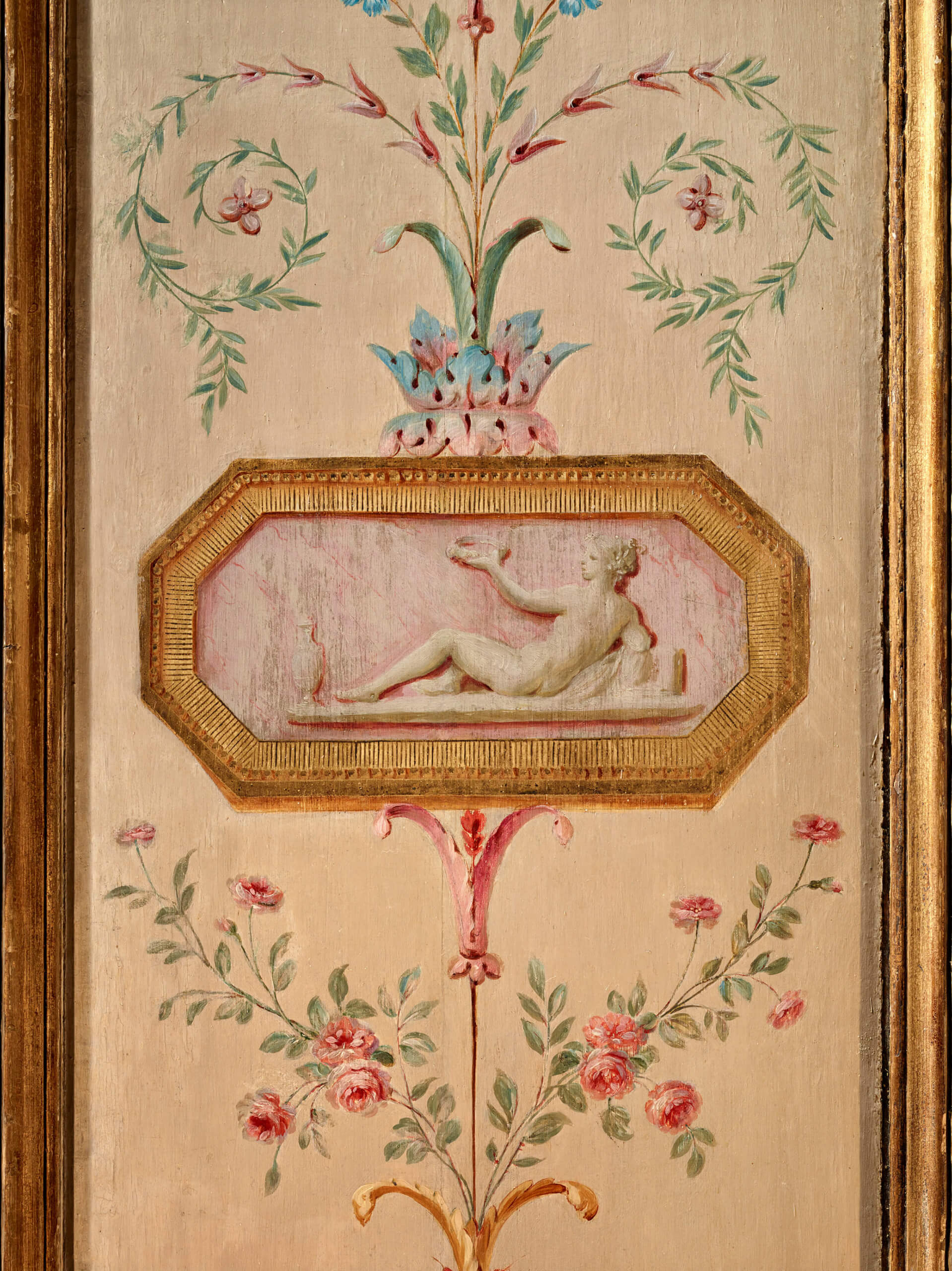
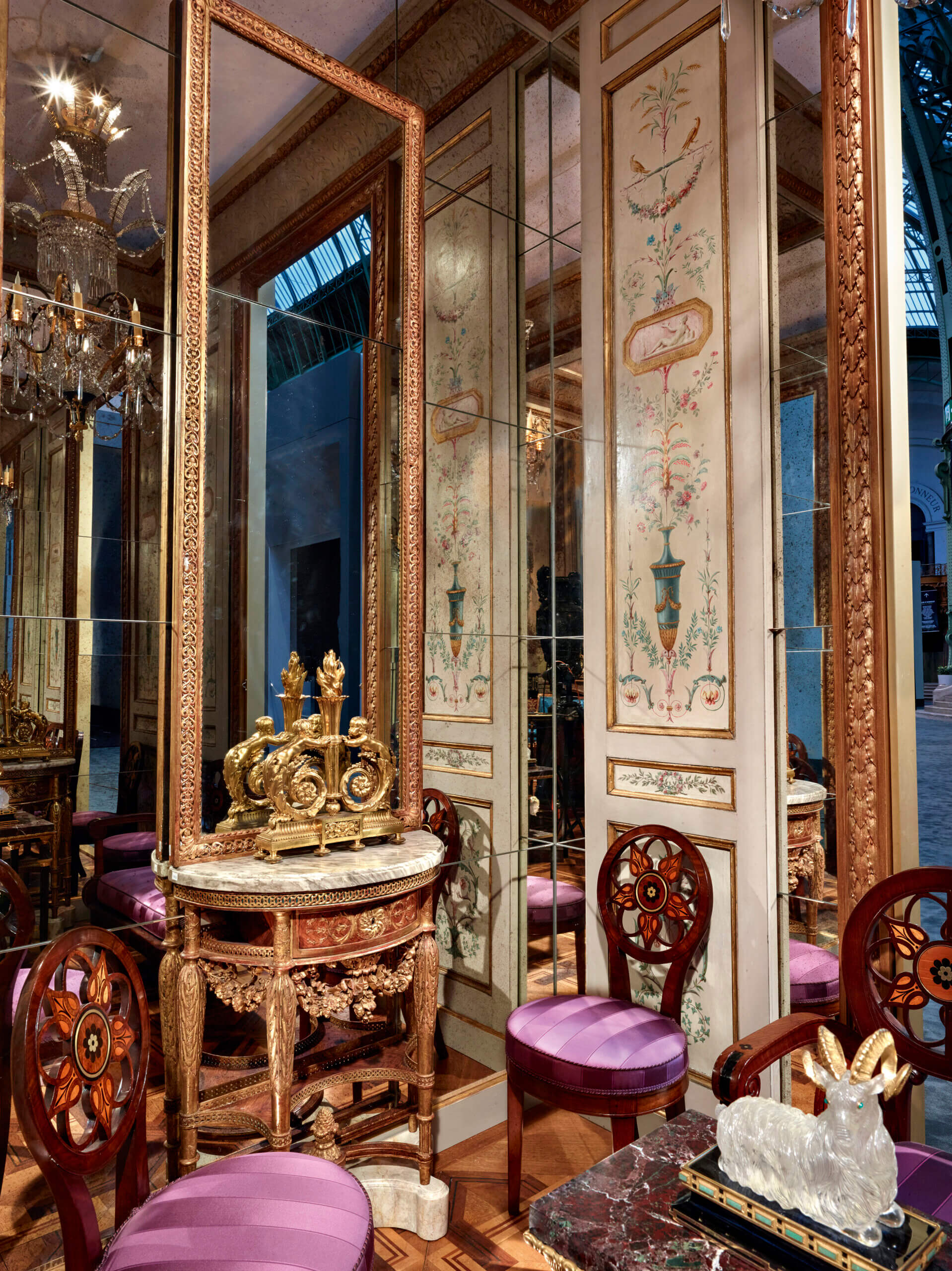
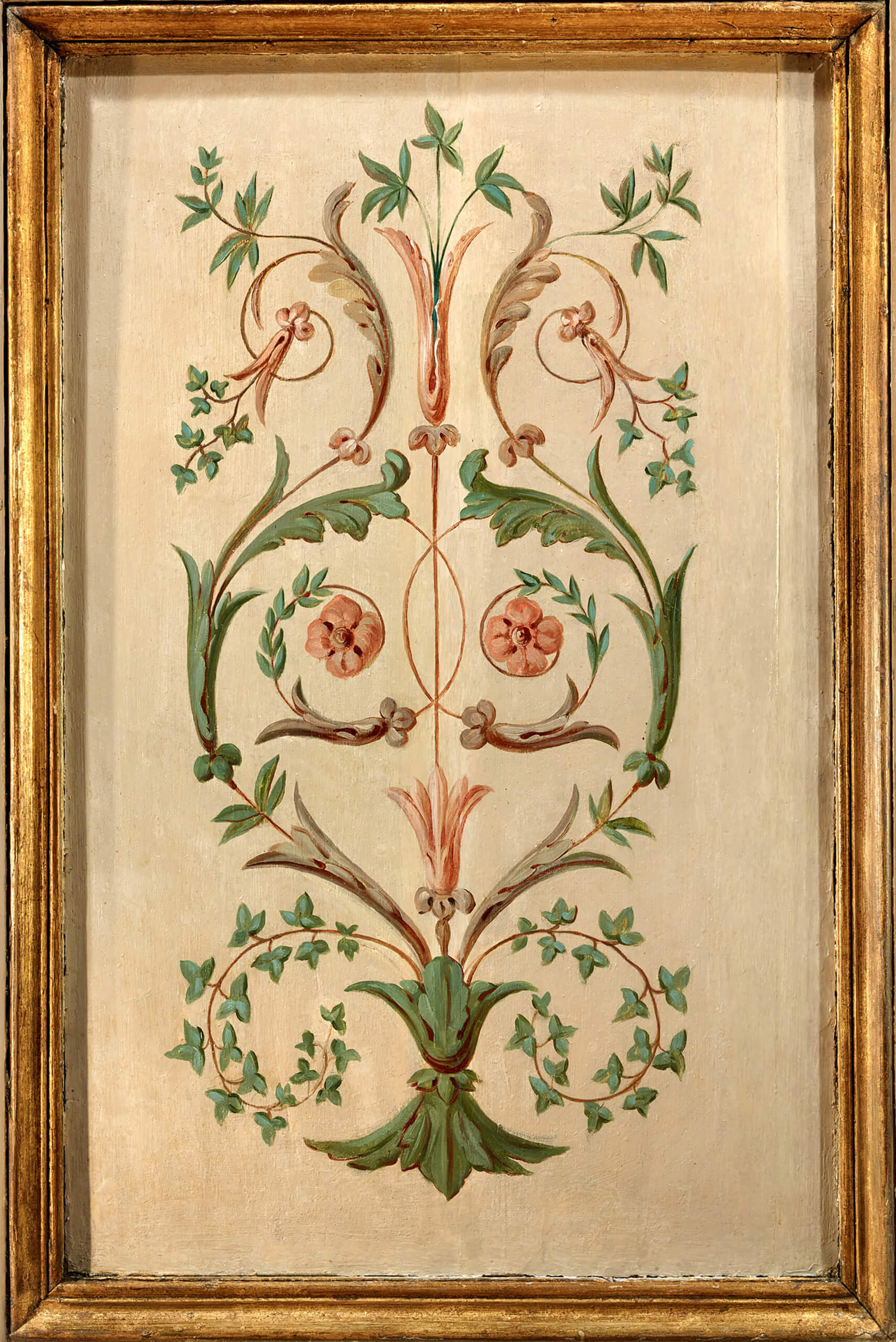
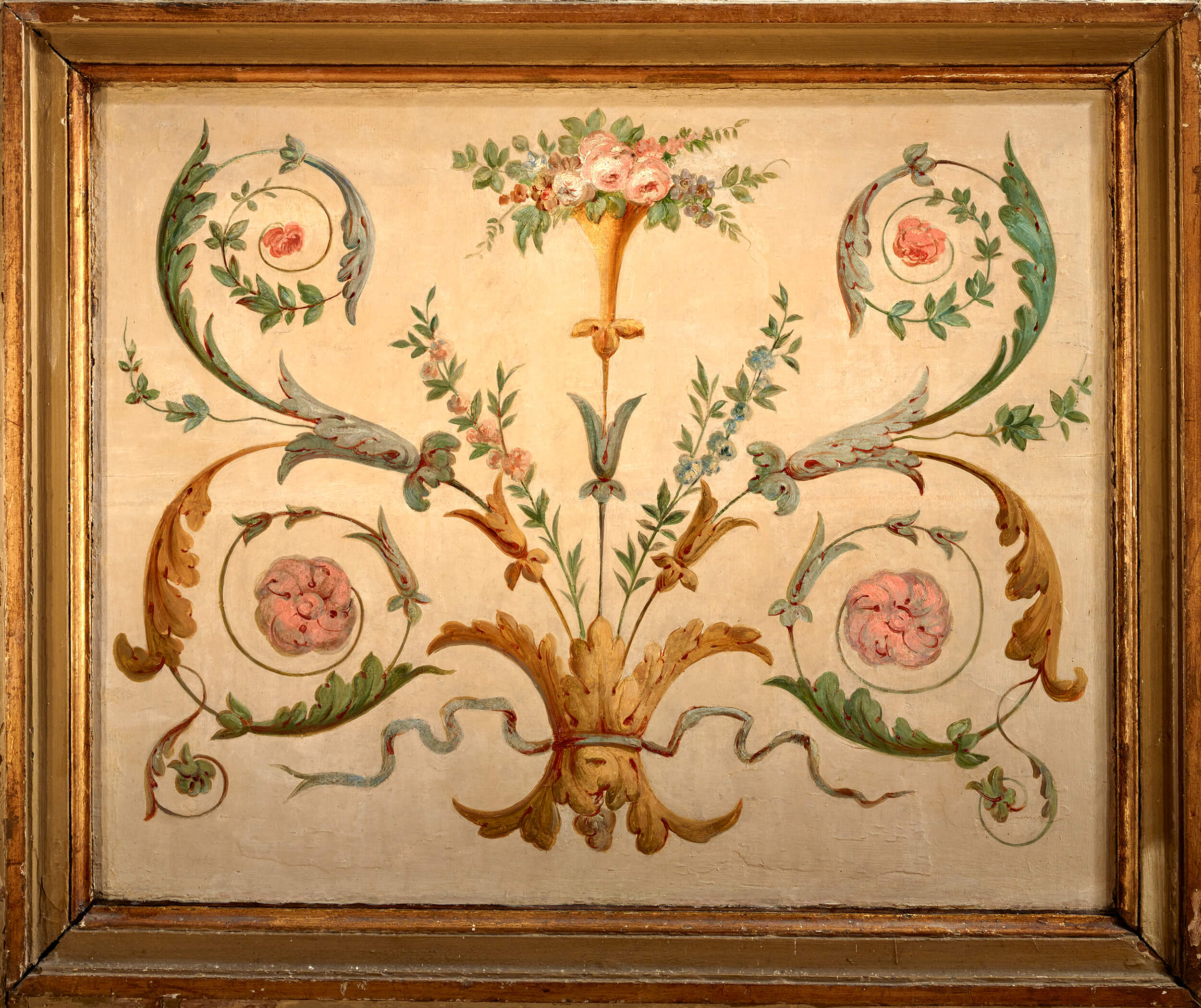
Molded oak, painted and gilded.
“I have Mr. de Beaujon’s house, minus the garden, but with the gallery overlooking the little church at the corner of the street. In my staircase there is a door that opens into the church. A turn of the key, and I am at Mass.” Balzac to Victor Hugo.
HISTORY: Executed around 1781 under the direction of the architect Nicolas-Claude Girardin (1749–1786), probably by the painter Étienne de La Vallée-Poussin (1733–1793), for the bath apartment of the financier Nicolas Beaujon (1718–1786) at the “Folie Beaujon” in the Faubourg du Roule, Paris; acquired on 28 September 1846, together with the house at No. 12 rue Fortunée (now No. 22 rue Balzac), by Honoré de Balzac (1799–1850); then in the collection of his widow, Madame Hanska, until 1882; acquired on 19 January 1882, together with the Hôtel Balzac, by Baroness Salomon de Rothschild.
PROVENANCE: Former collection of Baroness Salomon de Rothschild (1843–1922), born Adèle de Rothschild, daughter of Baron Mayer-Carl de Rothschild, son of the founder of the Neapolitan branch, and wife, in 1862, of Salomon de Rothschild, third son of James de Rothschild, founder of the French branch.

LITERATURE: Paul Jarry, Cénacles et vieux logis parisiens, Paris, n.d.; Paul Jarry, Le dernier logis de Balzac, Paris, 1924; René Dupuis, “La chartreuse et le quartier Beaujon,” Bulletin de la Société de l’Histoire de Paris et de l’Île-de-France, 62nd year, Paris, 1935, pp. 97–132; Alexandre Gady, “Folie Beaujon et chapelle Saint-Nicolas,” Rue du Faubourg-Saint-Honoré, Paris et son Patrimoine, edited by Béatrice de Andia, Paris, 1994, pp. 354–362; Thierry Claeys, “Nicolas Beaujon,” Rue du Faubourg-Saint-Honoré, Paris et son Patrimoine, edited by Béatrice de Andia, Paris, 1994, p. 363; Anne Panchout, “Maison de Balzac,” Rue du Faubourg-Saint-Honoré, Paris et son Patrimoine, edited by Béatrice de Andia, Paris, 1994, pp. 364–366; Pauline Prévost-Marcilhacy, “Hôtel Salomon de Rothschild,” Rue du Faubourg-Saint-Honoré, Paris et son Patrimoine, edited by Béatrice de Andia, Paris, 1994, pp. 367–371; Bruno Pons, Grands décors français, 1650–1800, Dijon, 1995, pp. 40–46; Michel Steve, “Les intérieurs,” La villa Ephrussi de Rothschild, Paris, 2002, pp. 106–107.
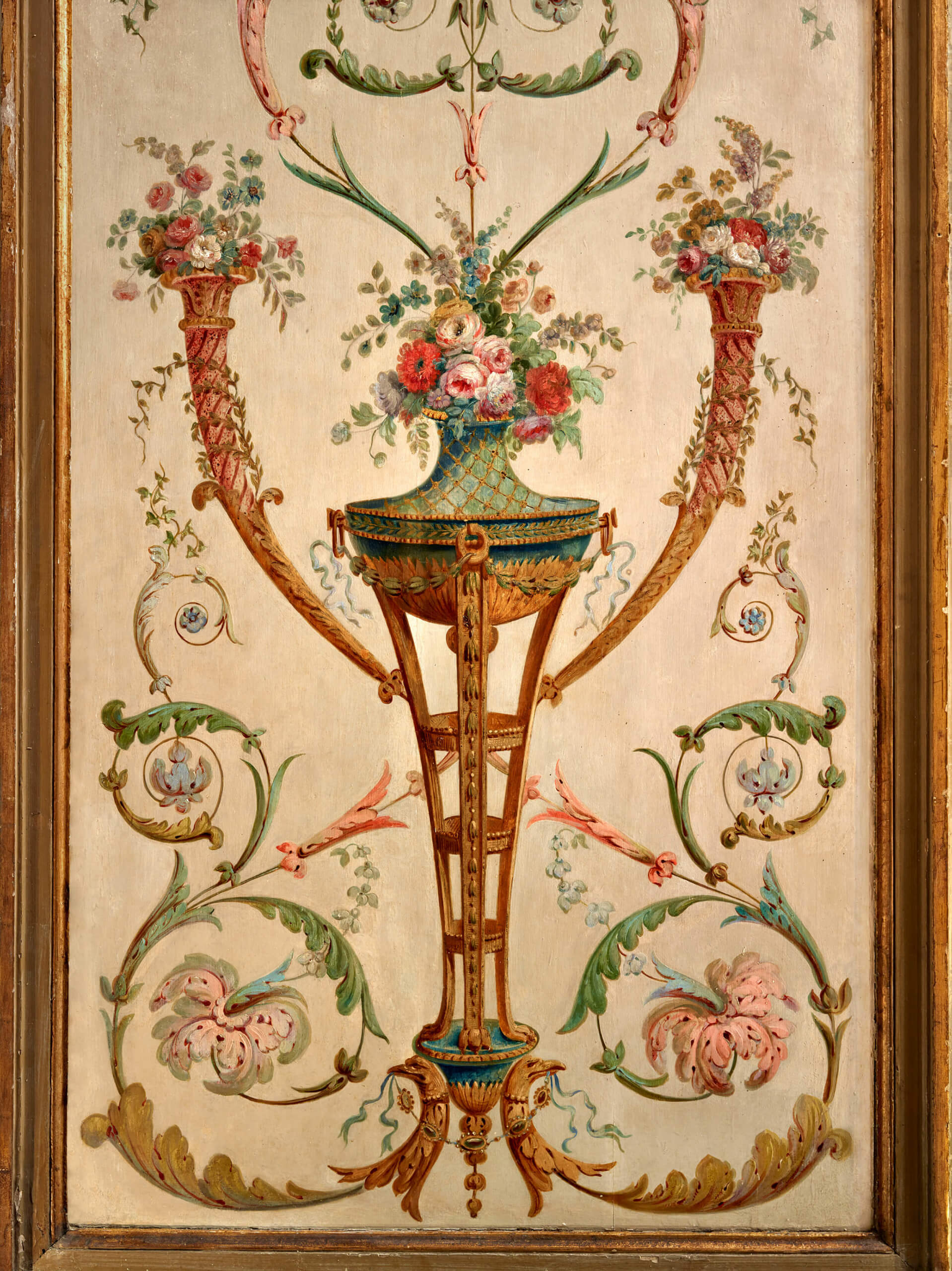
Sumptuous examples of the “arabesque” style developed under Louis XVI in the 1780s, the remarkable painted decoration of this set of wood panels has been attributed to Étienne de La Vallée-Poussin (1733–1793), painter, who, alongside Charles-Louis Clérisseau, worked on the “arabesque” decoration of the grand salon of the Hôtel Grimod de la Reynière in Paris, and who, in 1787, published the Nouvelle collection d’arabesques propres à la décoration des appartements, a famous collection of ornaments in ten portfolios that was reissued in 1806.
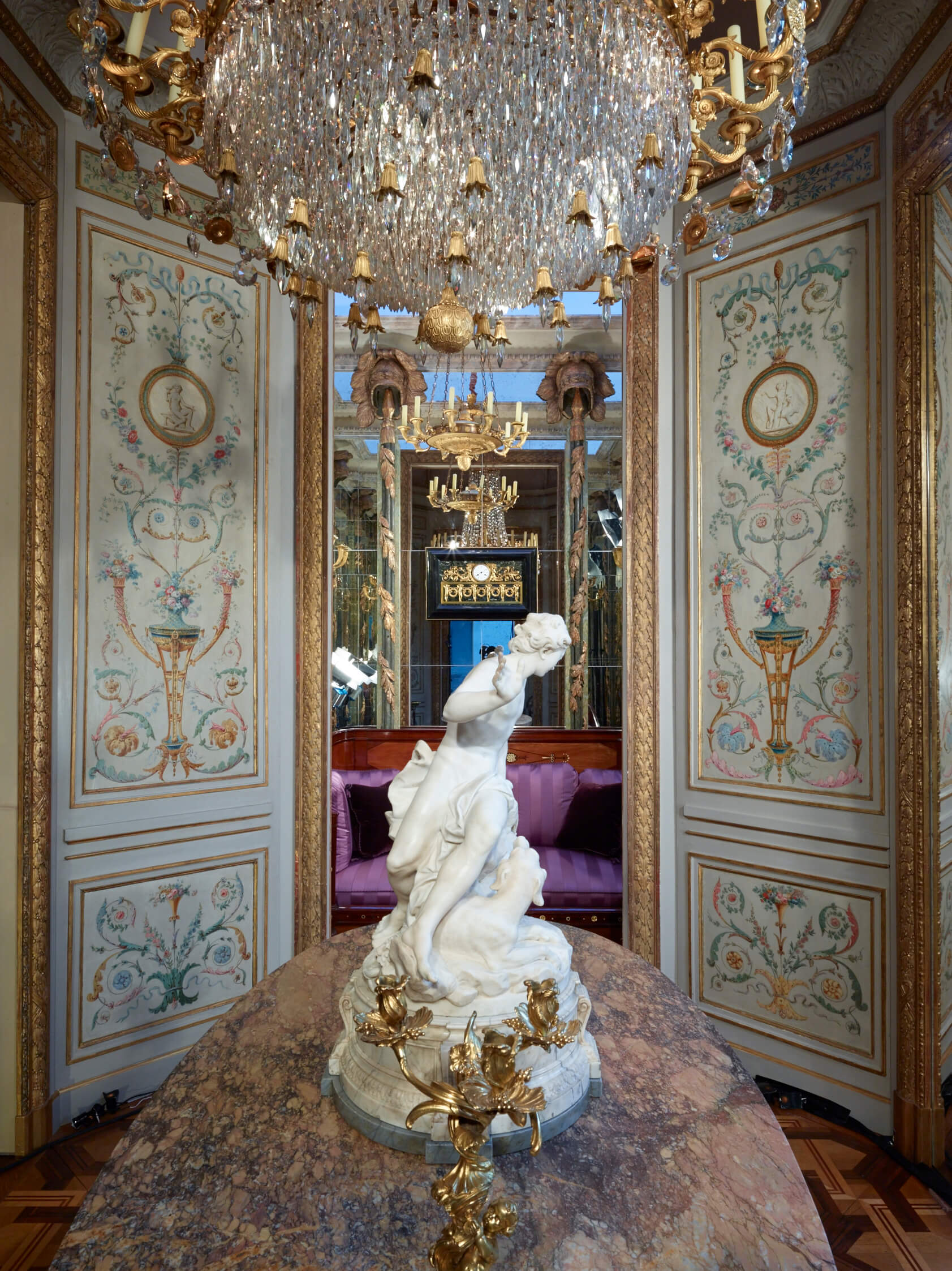
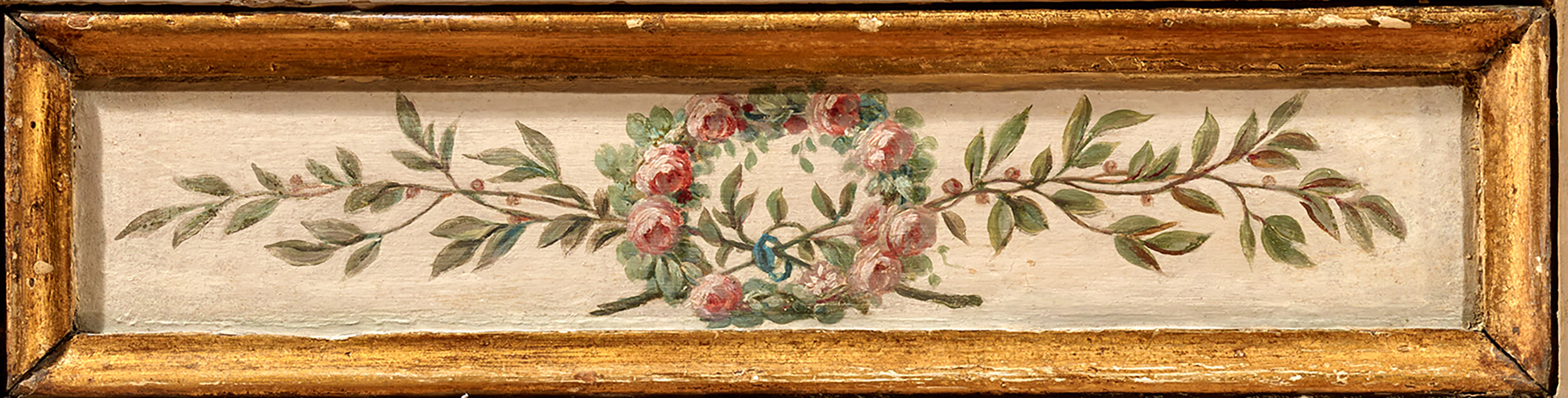
Each panel is composed of a large vertical compartment with molded borders, resting on a square wainscot compartment with similarly molded borders, each topped by a narrow horizontal band compartment.

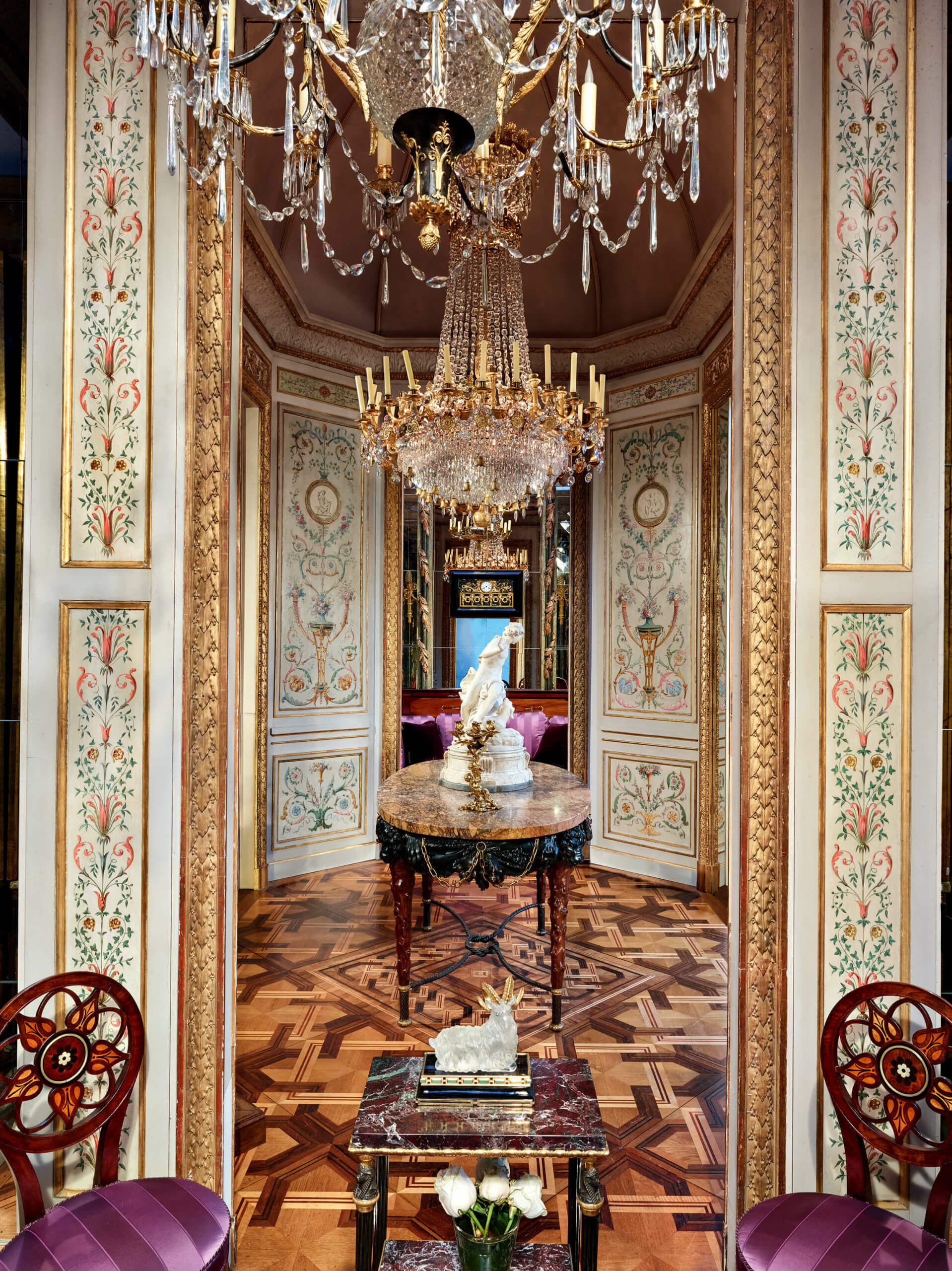
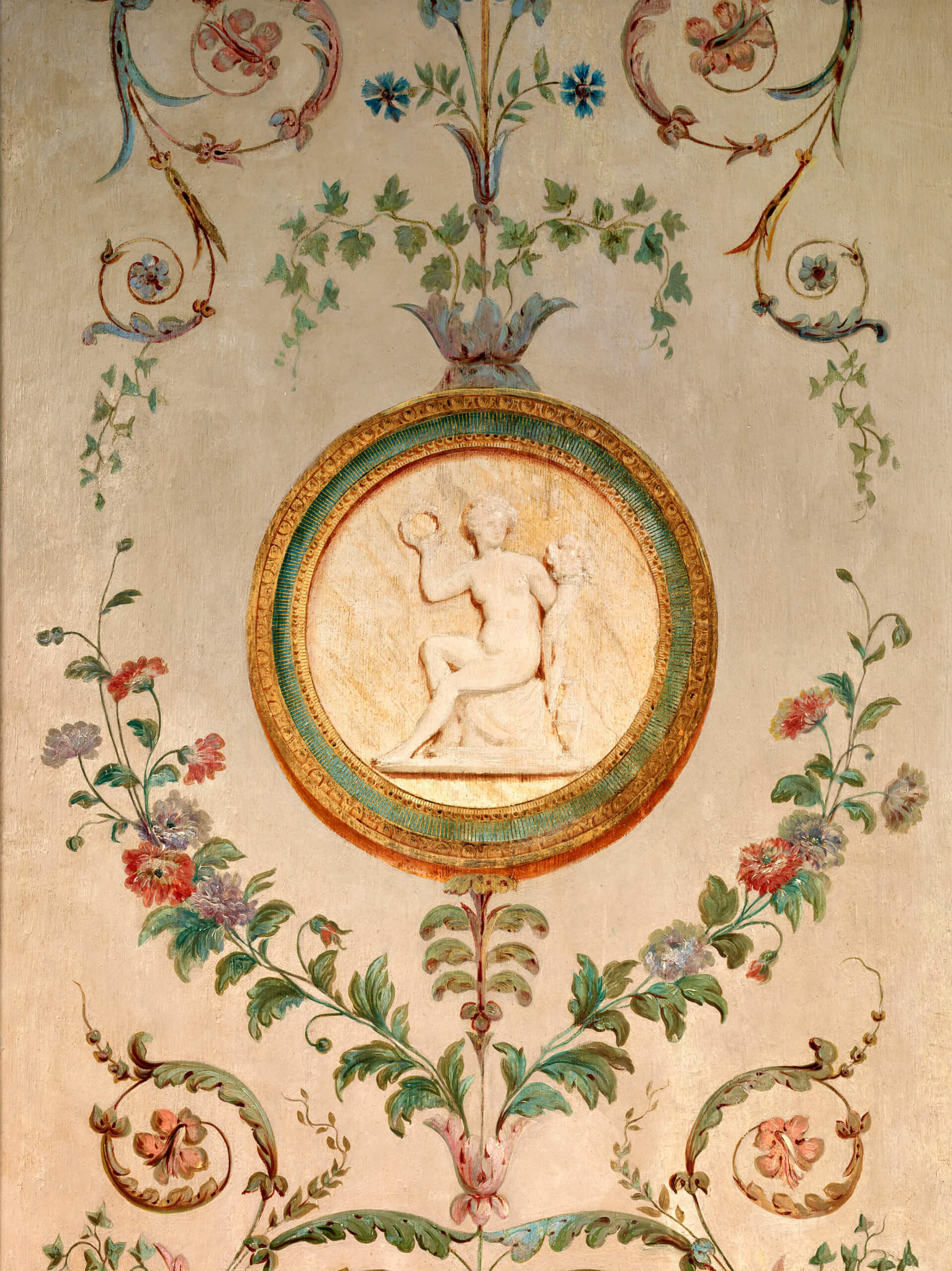
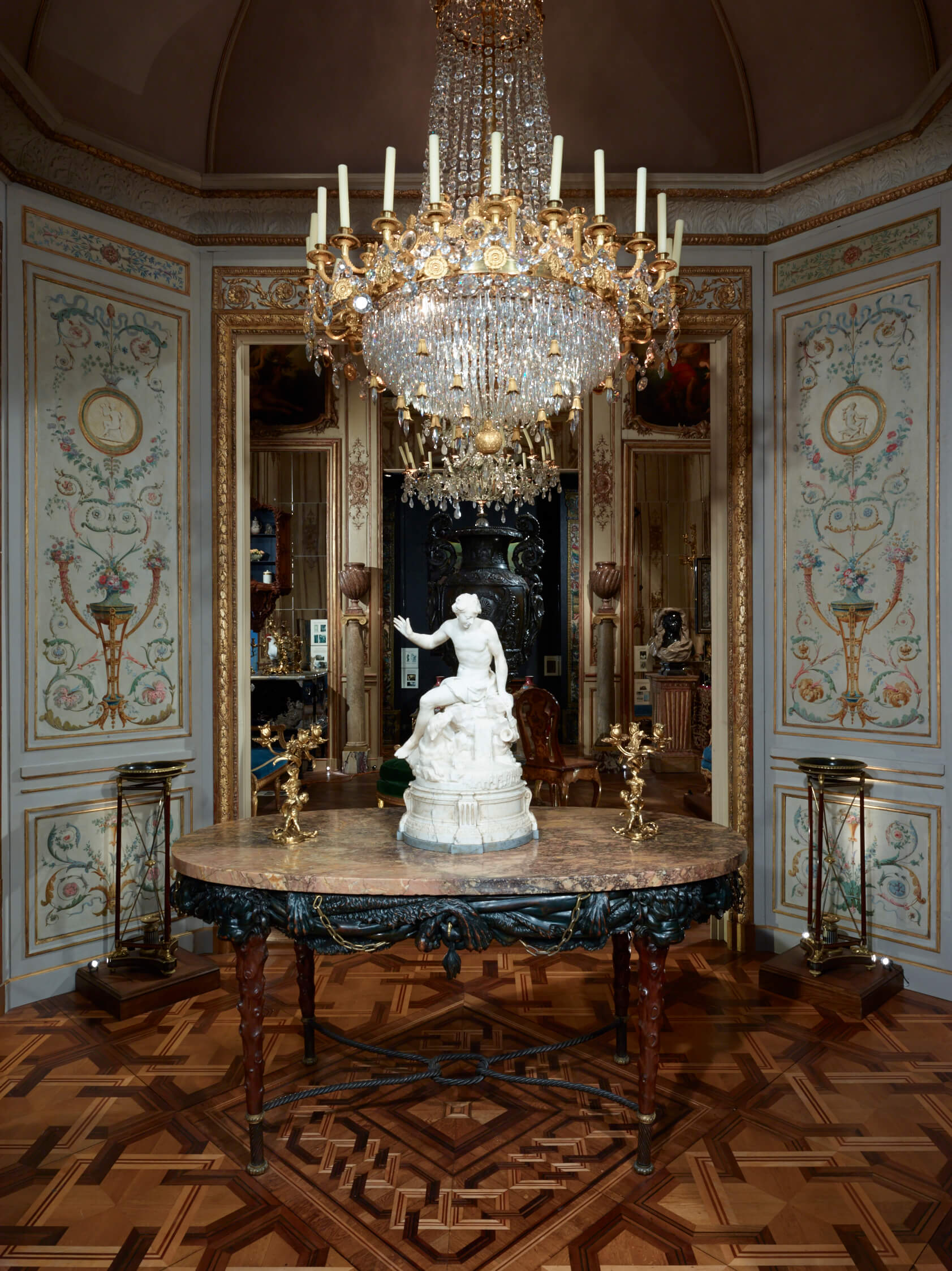
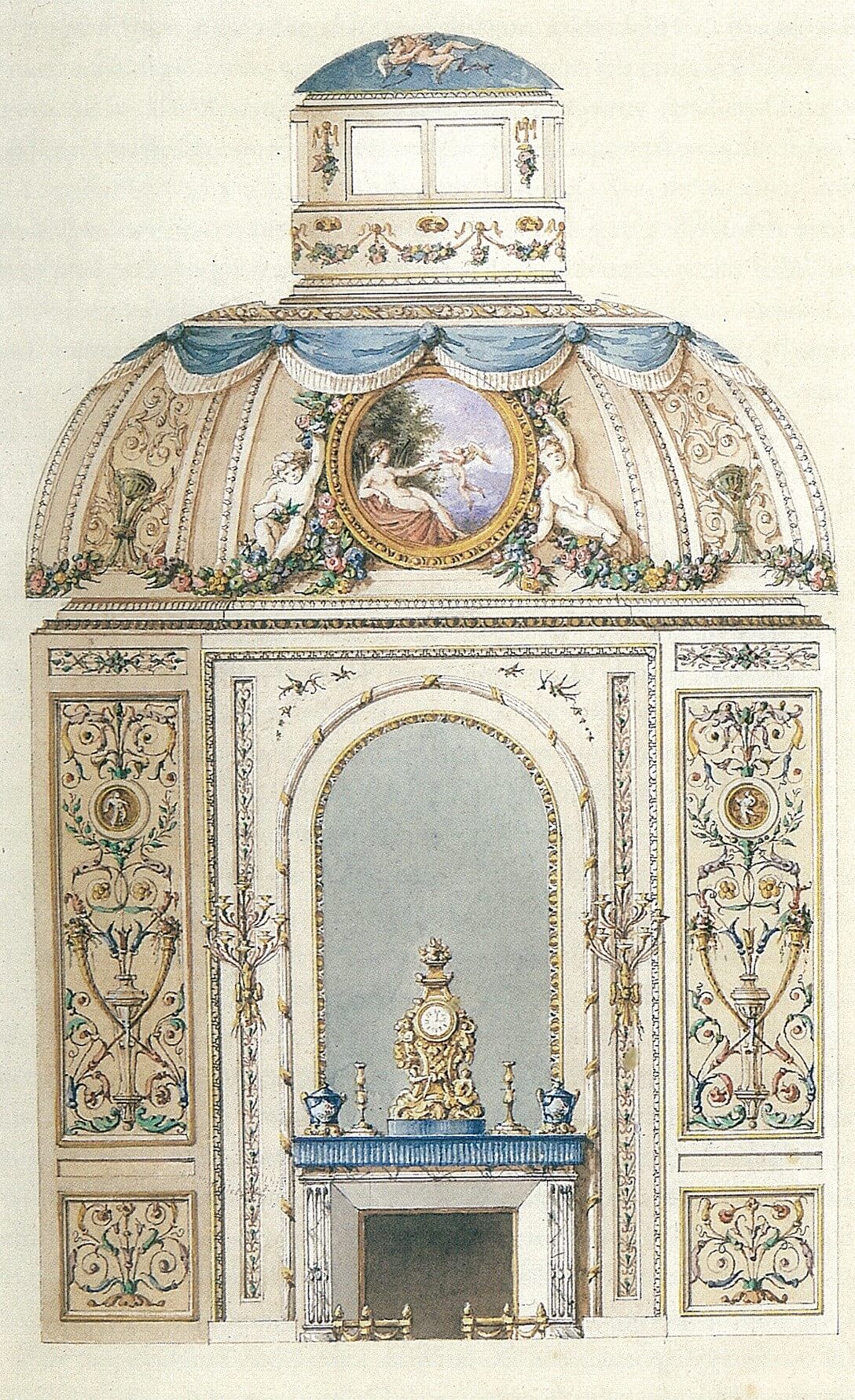
Tripod cassolettes, supported by a small leafy base and flanked by intertwined cornucopias, all gilded, form the base of the polychrome “arabesque” decoration of the large compartments, each punctuated by a medallion enclosing a putto surrounded, around a central axis, by slender acanthus scrolls, floral motifs, and laurel branches, rendered in green, pale pink, blue, and gold. Similar scrolls, without medallions, fill the remaining compartments.

These historic panels come from the former bath pavilion built around 1781 by the famous financier Nicolas Beaujon (1718–1786), within a “pastoral” ensemble called the “Folie Beaujon,” created from 1781 on a vast twelve-hectare site by the architect Nicolas-Claude Girardin (1749–1786), a collaborator of Étienne-Louis Boullée, who also built the Saint-Nicolas-du-Roule chapel and the Hospice Beaujon in 1784.
The building, now demolished, was located at No. 12 rue Fortunée, now No. 22 rue Balzac. In February 1840, it passed into the hands of a speculator named Jean-Raphaël Bleuart, who resold it to a certain Pierre-Adolphe Pelletreau, who in turn sold it to Honoré de Balzac on 28 September 1846. At that time, Balzac was eager to provide a suitable residence for Madame Hanska, whom he would eventually marry on 14 March 1850, shortly before his death. According to the writer, the price was reasonable: 50,000 francs, of which 18,000 francs “not included in the contract” were to be paid by hand, and 32,000 francs payable with 5% interest on 28 September 1849, a sum ultimately settled by Madame Hanska after Balzac’s death.

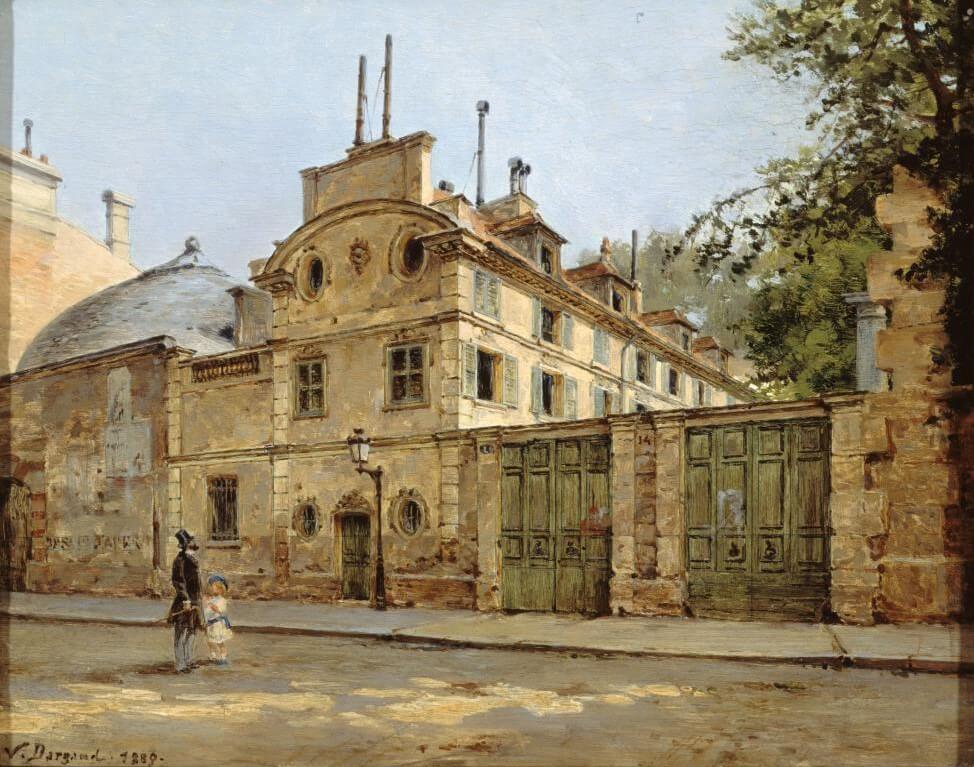
The house was in a very dilapidated state—it had previously served as a laundress’s workshop—and included direct access to the gallery of the adjoining Saint-Nicolas chapel, which thrilled Balzac. He quickly carried out several exterior modifications, clearly visible in an oil on wood by Paul Joseph Victor Dargaud (1850–1913), now held at the Musée Balzac in Paris: the construction of a new tympanum with two oculus windows, installation of three zinc marquises and exterior sculptures, the addition of two carriage doors copied from those of the Protestant temple on rue Chauchat, paving of the courtyard, and a bitumen sidewalk-path.


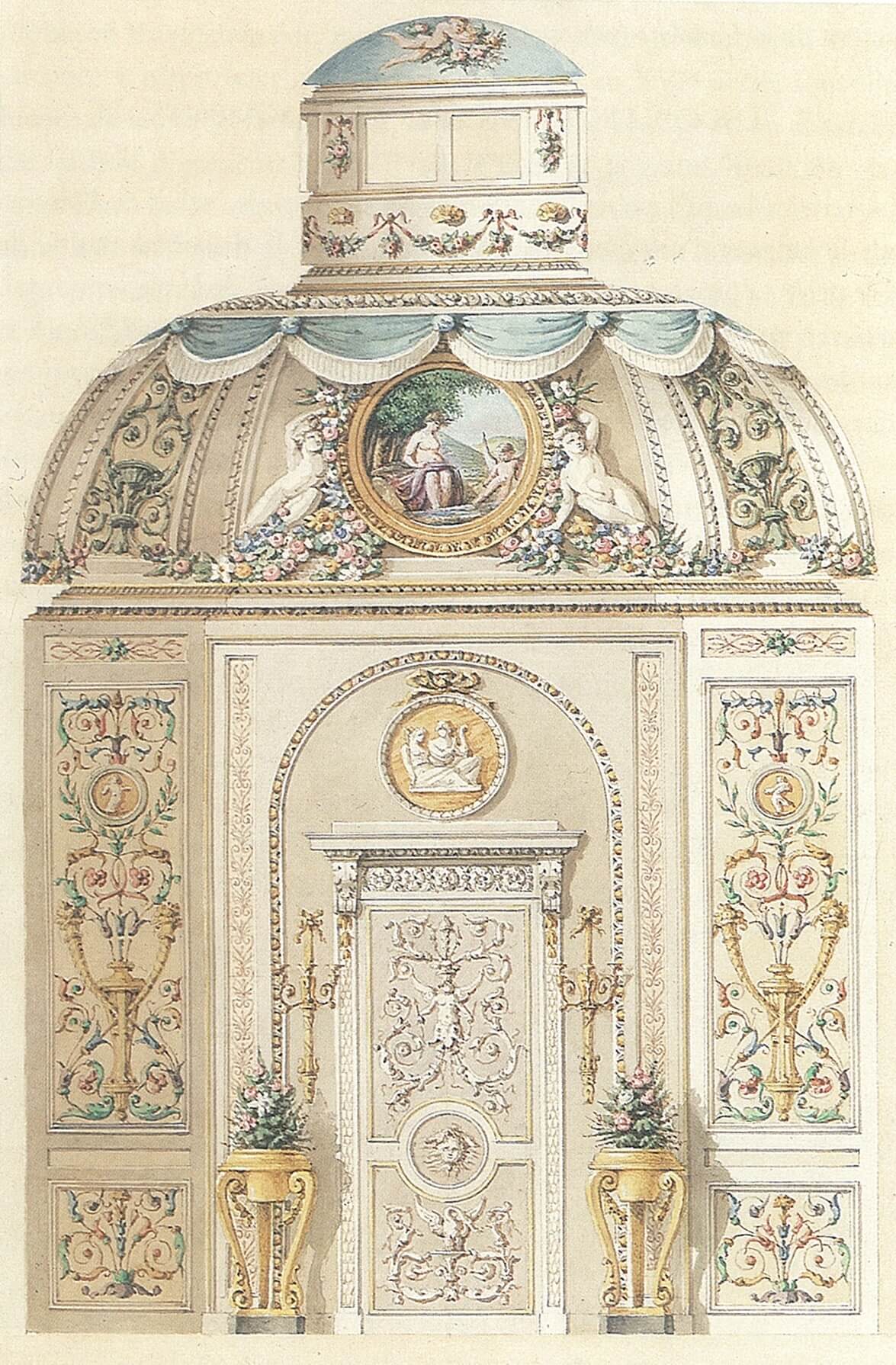
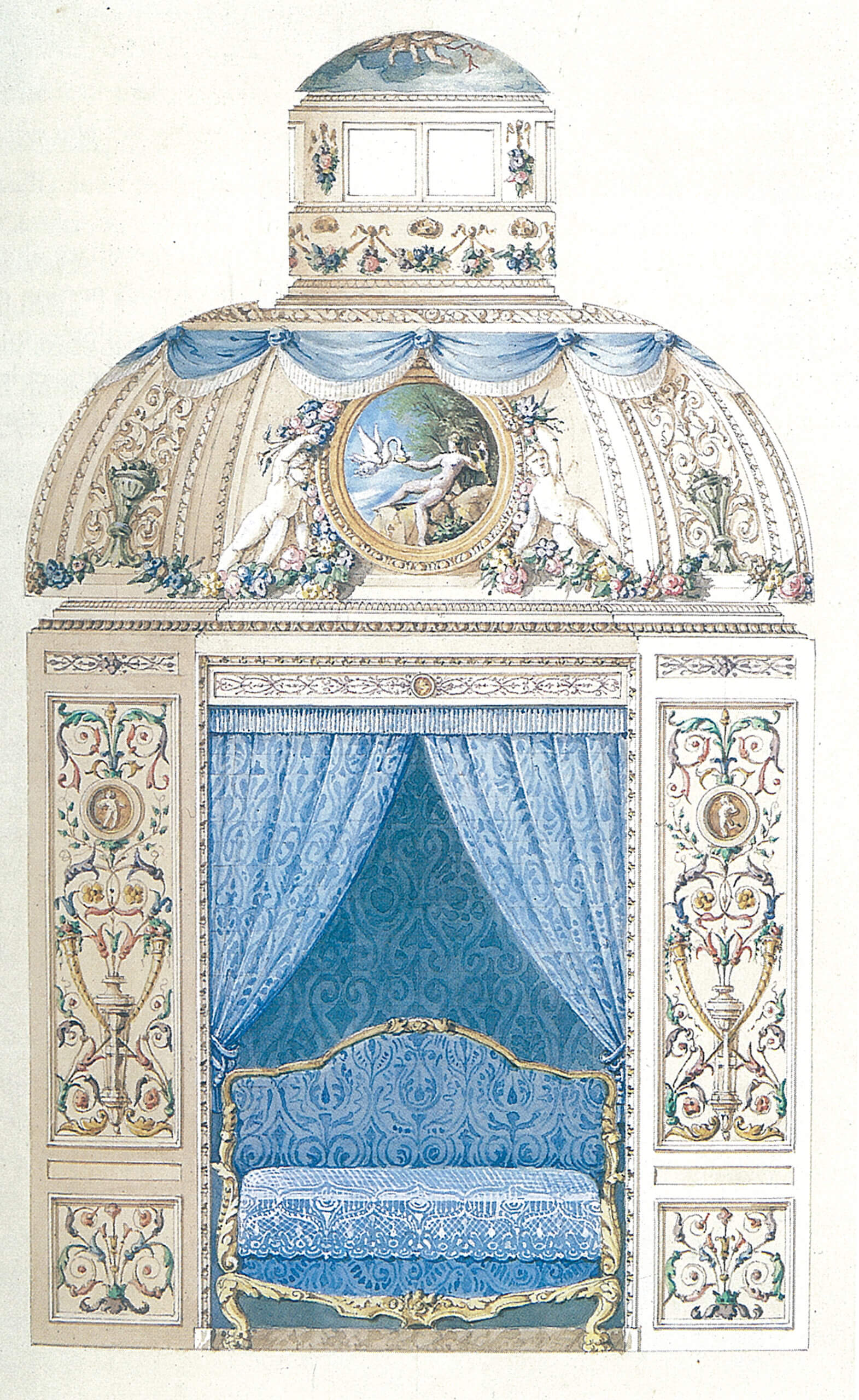
Balzac, who had a passion for carved wood, took particular care with the interior layout of the house, notably with the restoration of the painted panels and vaults from Nicolas Beaujon’s former bath apartment, which were still in place. His architect, Santi, who attributed these decorations to the work of La Vallée-Poussin, drew up plans and elevations of them in 1847. These decorations were located on the ground floor of the house and formed the panelling and vaulted ceilings of two rooms: a salon and a domed bedroom. Balzac initially wanted them restored by the painter Théodore Chassériau (1819–1856): “This morning, I received the illustrious unknown painter Chassériau, whom I tasked with examining the paintings of the dome and the Beaujon bedroom, and having them restored”. Chassériau recommended the painter Edmond Hédouin (1820–1889), a student of Delaroche, also an engraver and illustrator, who ultimately undertook the restoration in collaboration with the painter Jules Buisson, whom Balzac, at his request, thanked with a copy of La Comédie Humaine.
After Balzac’s death at his residence on Rue Fortunée on 18 August 1850, his widow continued to live in the house, preserving all of the writer’s belongings and forbidding anyone from entering his bedroom and library. Between 1872 and 1874, her son-in-law, Count Georges Mniszech, acquired two neighboring plots of land, as well as the famous Saint-Nicolas Chapel so dear to Balzac, which then belonged to the Assistance publique. The Count commissioned the architect Monnier to construct a new residence that would encompass both the Balzac house and the chapel, intended as a memorial to celebrate the memory of the illustrious writer. Madame de Balzac and her son-in-law planned to transform the chapel’s rotunda into a circular atrium with a central fountain, around which a gallery would be decorated with statues and busts. A statue of the writer was to be erected in the courtyard, adorned with the chapel’s columns, beneath the branches of the tree he had planted on the occasion of his marriage.

The street-facing façade was also to be enhanced, with the central pavilion featuring a bas-relief depicting the apotheosis of Balzac, crowned by Fame, and adorned with a statue in a niche. The project was only partially executed. Indeed, the Count fell into madness in 1877 and died in 1881, while Madame de Balzac suffered financial setbacks—particularly due to her daughter’s extravagant spending—which brought the completion of the works to a halt.

Harassed by creditors, she ultimately decided to sell her hôtel with usufruct reserved. On January 19, 1882, the Baroness de Rothschild, already the owner of the neighboring grounds, purchased the Hôtel Balzac for 500,000 francs. She did not have to wait long to take possession, as Madame de Balzac passed away shortly afterward, on April 10. In November 1882, the Baroness also acquired the neighboring Hôtel Mniszech. She had both buildings demolished shortly thereafter to enlarge her gardens, and the superb Nicolas Beaujon wood paneling that remained—perfectly identifiable thanks to Santi’s surveys—was then dispersed among various members of the Rothschild family. A door from one of the two cabinets of Nicolas Beaujon’s former bathing apartment was thus reused by Baroness Ephrussi de Rothschild in her villa on the French Riviera.
This door, along with our panels, now forms a remarkable historical reminder of one of the most emblematic “folies” of 18th-century Paris, its illustrious owner, and equally, of the author of La Comédie humaine.

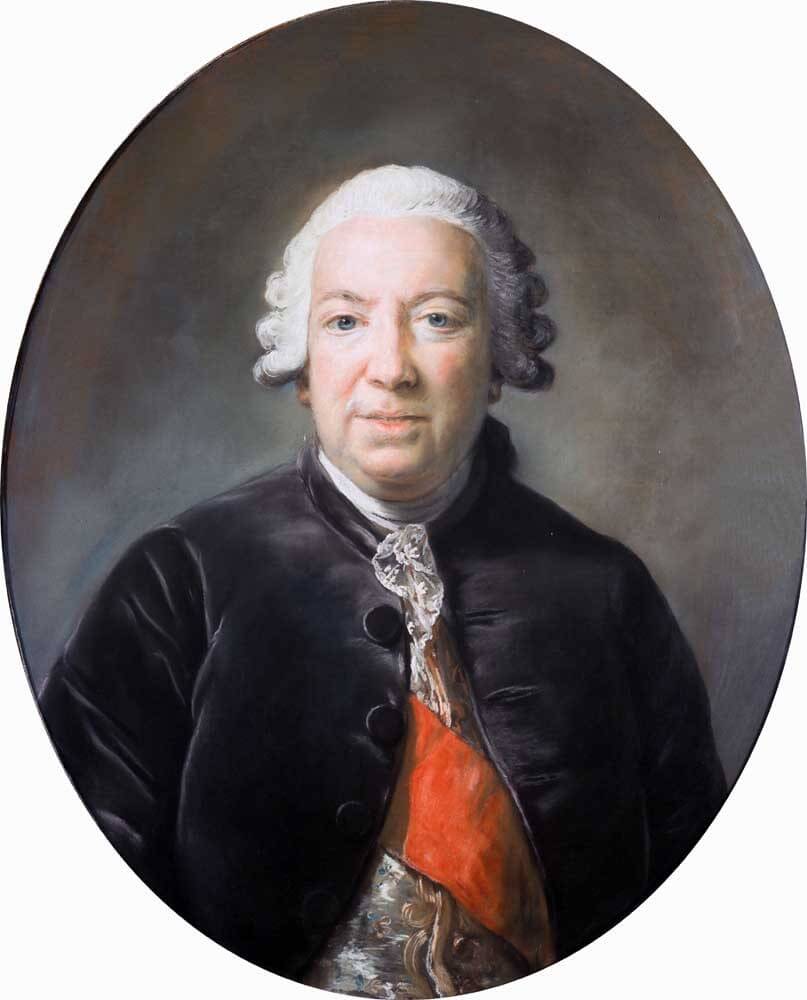
Nicolas Beaujon
Originating from a family of grain and wine merchants, Nicolas Beaujon was born in Bordeaux on February 28, 1718. He successfully succeeded his father as a grain merchant and quickly prospered internationally, becoming a supplier of food and munitions to Canada between 1746 and 1748. In the early 1750s, he partnered with Pierre-François Goossens, a naval timber merchant, under the company name Beaujon, Goossens & Co., also referred to as Goossens & Co. Also in 1750, he became one of the six Directors of Commerce of Guyenne, then in 1751–1752 became one of the two judges, consuls of Bordeaux.
General Receiver of Finances of La Rochelle from 1756, a post he held until 1780, he gradually withdrew from his international trading activities, which ceased definitively in 1760. His partner Goossens became Treasurer General of War in Madrid, and it was Jean-Baptiste Vandenyver, their cashier, who took over their banking affairs.
In 1753, Nicolas Beaujon married Louise-Elisabeth Bontemps, daughter of Louis Bontemps, one of the King’s First Valets of the Chamber and governor of the Palais des Tuileries. Among the signatories to the marriage contract were the Marquise de Pompadour, Ange-Laurent Lalive de Jully, first cousin of the bride and introducer of ambassadors, and the Keeper of the Seals and Controller-General of Finances, Machault d’Arnouville.

When Abbé Joseph Marie Terray became Controller-General of Finances from 1769 until the death of Louis XV in 1774, Nicolas Beaujon became banker to the Court, a position he held for about ten years. During this period, he also became the private banker of Madame Du Barry, honorary Treasurer-General of the Royal and Military Order of Saint-Louis in 1771, and Receiver General of Finances in Rouen from 1771 to 1786. In 1780, he was counted among the twelve Receivers General of Finances of the Kingdom appointed by Necker. To these various offices were also added those of Councillor of State from 1756 to 1786, Secretary to the King of the Grand Chancery of France from 1766 to 1786, and Lieutenant of Varenne at the Louvre from 1773 onward.
In 1783, he acquired the Hôtel d’Évreux, today the Palais de l’Élysée, after selling his country house in Issy-les-Moulineaux, now occupied by the town hall. He had the hôtel transformed by his personal architect, Étienne-Louis Boullée.
He resold it for 1,100,000 livres on August 12, 1786, shortly before his death, to Joseph Duruey, Receiver General of Finances and banker to the Court. Among his other properties, he also owned land in the Faubourg du Roule, on which he had the famous “Folie Beaujon” built, from which our panels originate. At the end of his life, his fortune was colossal, amounting, after deduction of debts, to 7,254,175 livres. He died without heirs in his Hôtel d’Évreux on December 20, 1786.