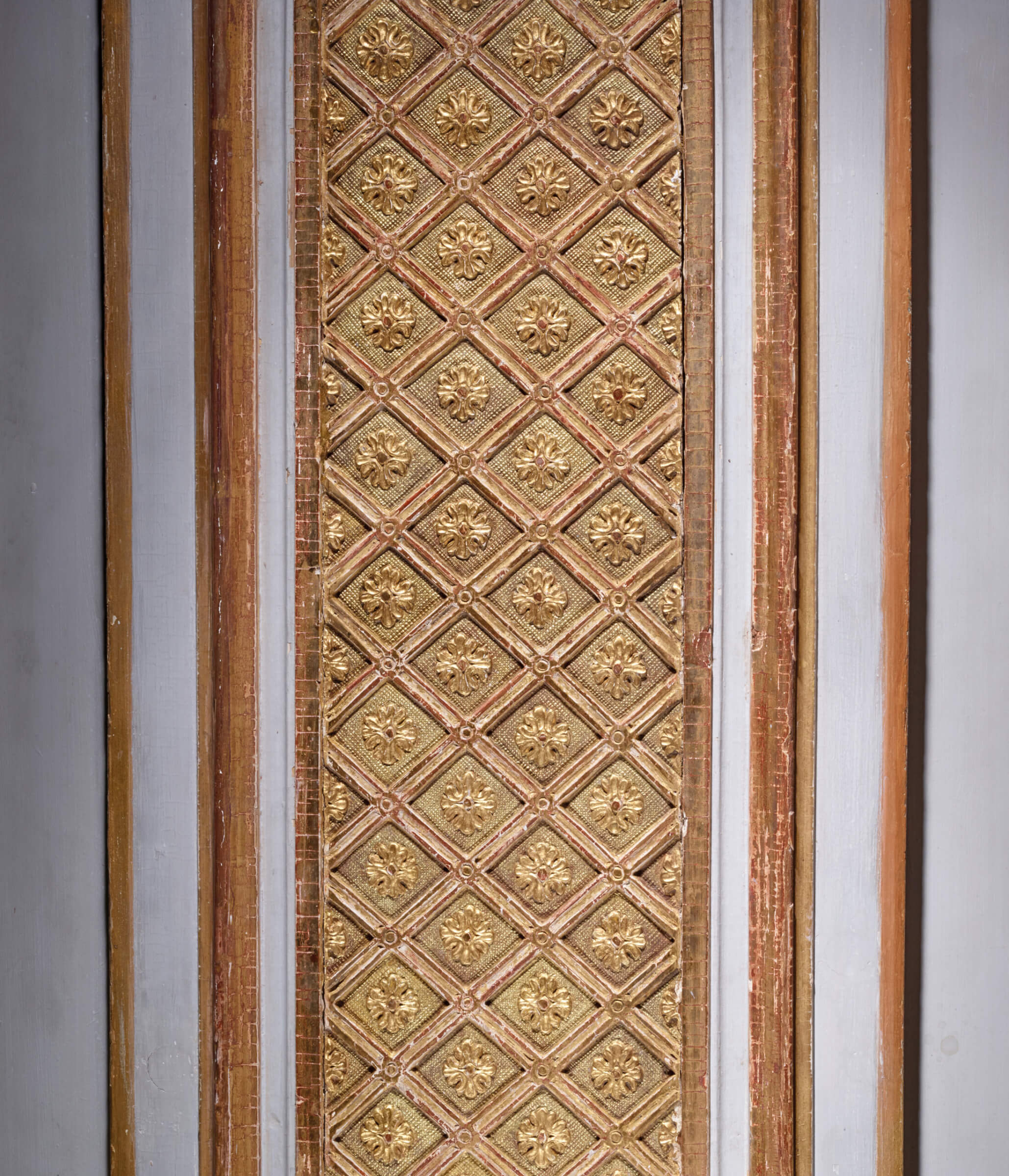
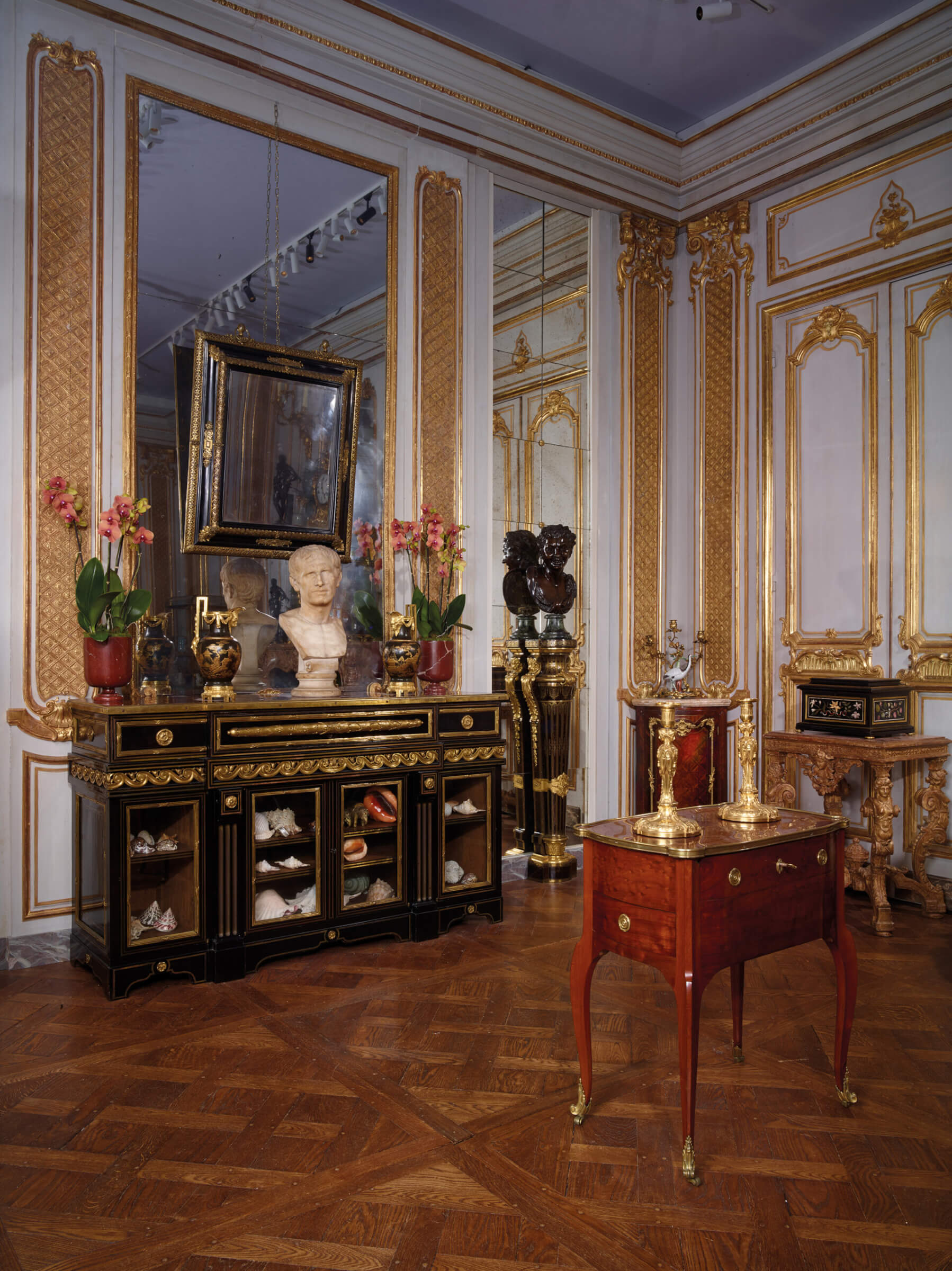
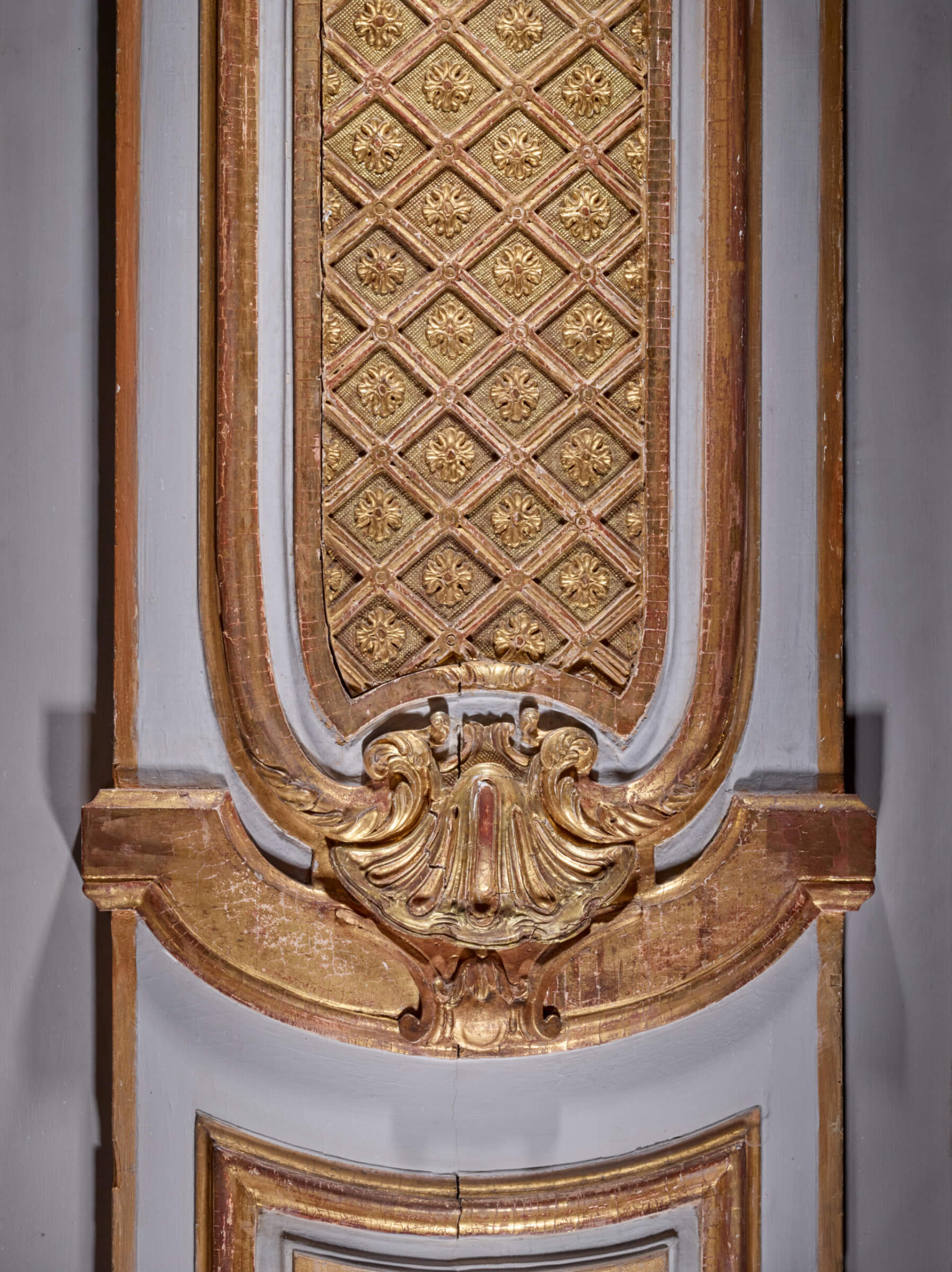
Moulded, painted and gilt oak.
PROVENANCE: private collection.
LITERATURE: Gady Bénédicte, Edwards Turner, Gilles François (ed.), Nicolas Pineau (1684-1754), un sculpteur rocaille entre Paris et Saint-Pétersbourg, Paris, Les Arts décoratifs – Le Passage, 2025.
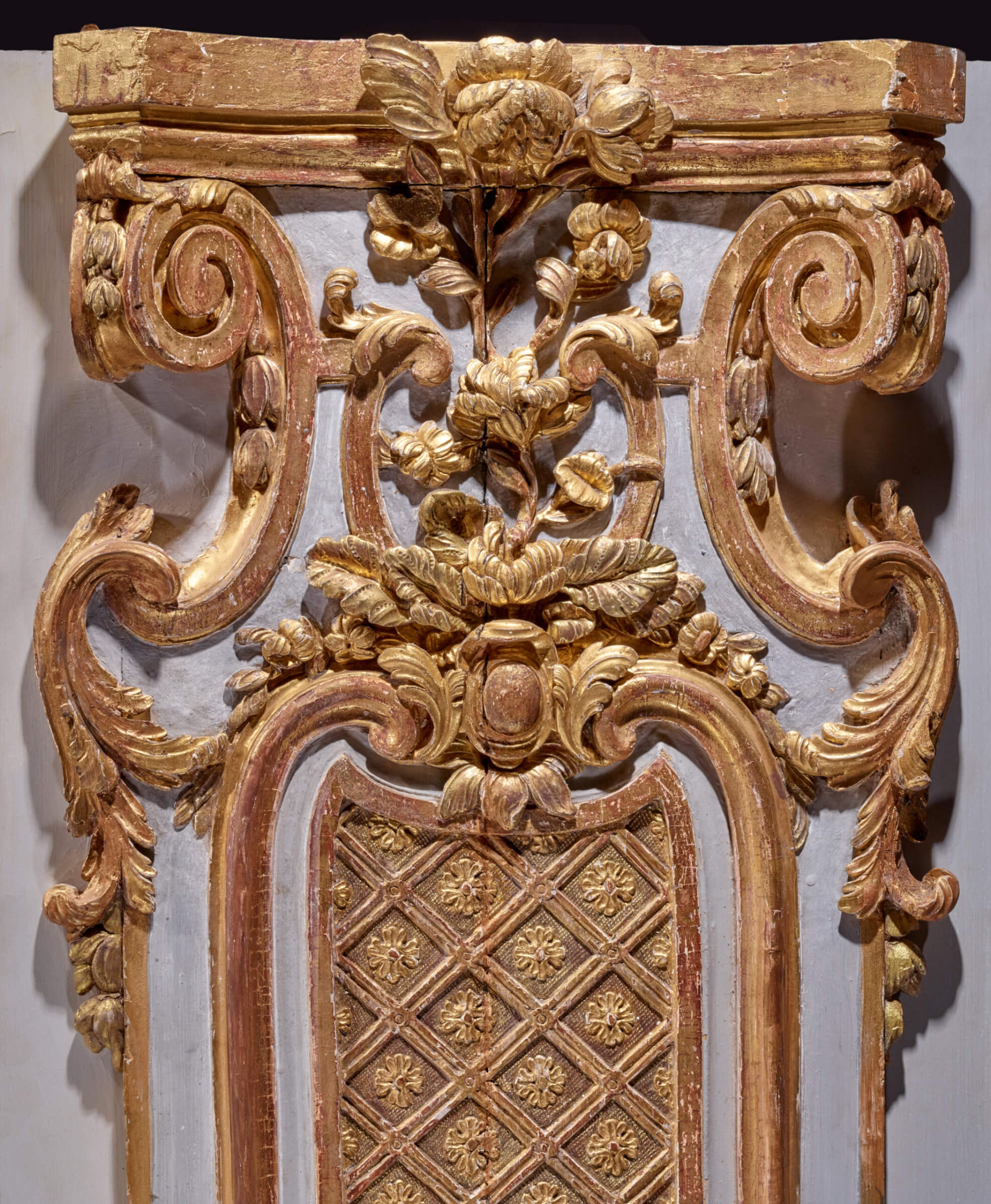
The author of this set of wood panelling is none other than the famous ornamental sculptor Nicolas Pineau. Confirmation of this authorship was made possible by the extensive study that was recently devoted to thissculptor.The Musée des Arts Décoratifs in Paris (MAD) has a sheet from his descendants that corresponds to this decorative project (inv. CD 1713). Even if it proves particularly conclusive in identifying the author of the panelling, right down to the detail of the sunflower-shaped fleuron, the connection with this drawing raises a number of questions notwithstanding. The sheet in the MAD is an execution drawing, since it was transferred to a stencil and cut along the axis, which is used to transfer the drawing onto the structural mass of the material to be carved; the drawing does not, however, correspond exactly to the panelling. There are a few centimetres’ discrepancy between the two, so that they are not quite the same size. Furthermore, details vary—the profile of the mouldings is more complex in the panelling, and its ornamentation is more elaborate. The drawing accordingly does not correspond to the execution of the panelling but to the execution of another, yet quite similar element. In comparison with the other drawings in the Pineau collection, preserved in the MAD and the Hermitage Museum, the sobriety of the treatment of the ornamentation leads us to understand that the drawing inv. CD 1713 was actually intended for stone cutting. In point of fact, at a constant scale, stone sculpture does not allow for the same precision and freedom as wood sculpture. This technical constraint can be made out in the drawing, where ornamentation has been pared down.

Before the connection was made with our panelling, a late dating had been assigned to the drawing. It had even been excluded from the corpus of Nicolas Pineau’s works and attributed to Dominique Pineau, his son. The erroneous dating and attribution were based on the idea that the drawing was too neoclassical in spirit to have been authored by Nicolas. Rococo art, however, never abandoned the use of architectural orders, particularly in stone sculpture—for instance for vestibules or staircases. The drawing at execution scale for the salons of the Prince of Isenghien in Suresnes dated 1743 (inv. 8545.60) proves that Nicolas Pineau was able to treat the architectural orders with a certain lightness.
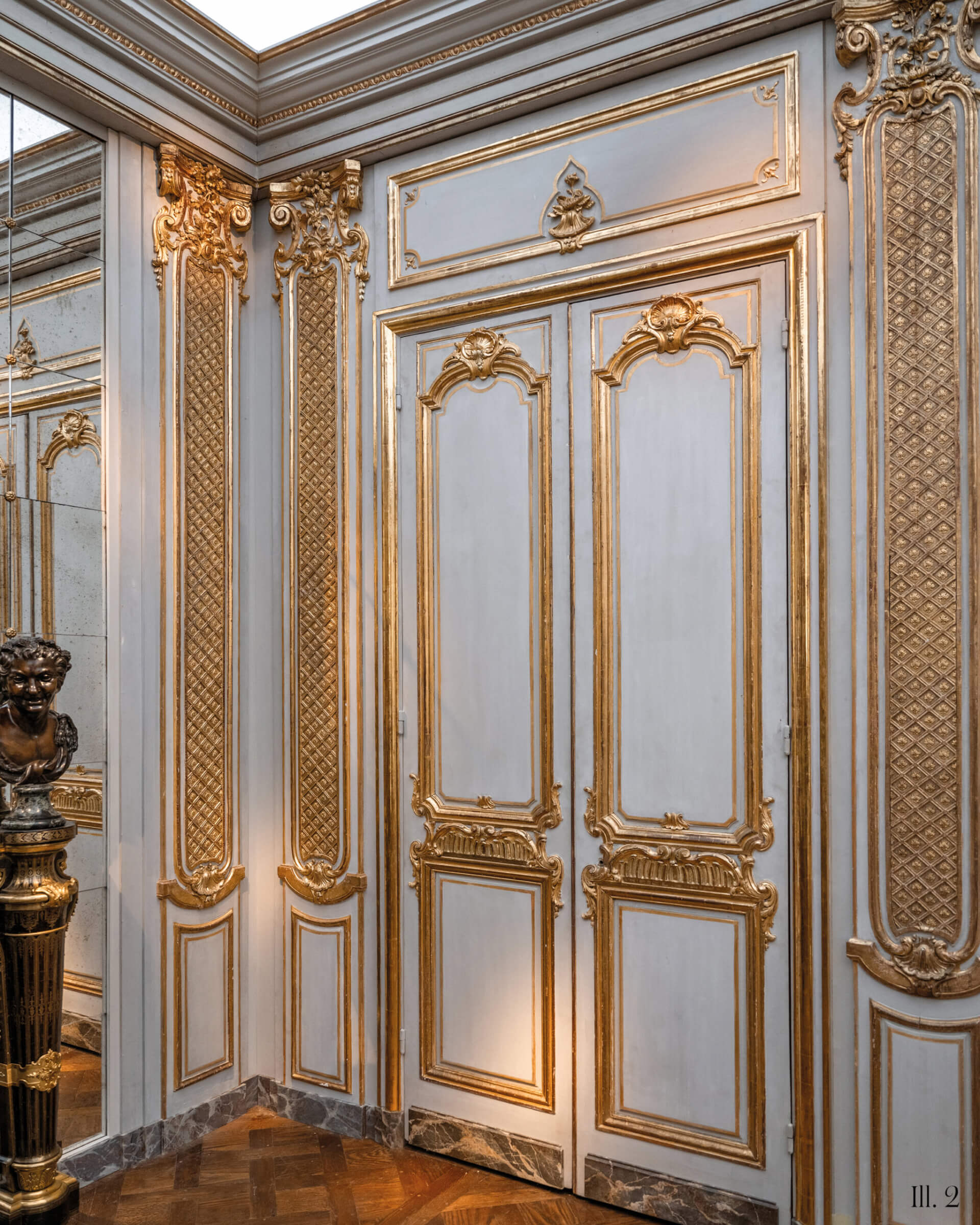
In the project related to our panelling, Pineau goes much further and decomposes the Ionic order: the prolongation of the volutes is a pretext for arching the upper part of the pilasters, which regain their initial width in an acanthus scroll. The oves disappear, but only the fusarole band is preserved in the narrowest area of the arching, as if to hold it back. Rather than falling, the laurels rise towards the sunflower-shaped fleuron, which is a reminiscence of the Corinthian order. The sculpture of the pilasters of our panelling, which is more flexible and free than the stone pilasters studied by drawing CD 1713, proves that this design is in fact not neoclassical at all. Pineau succeeded in blending the ornamental vocabulary of the Corinthian and Ionic orders, while combining their proportions, in a particularly skilful and original composition.

The freedom and fluidity with which the Ionic order is treated is reminiscent of the bold pilasters that Pineau sketched for the Château of Croix-Fontaine in 1744 (inv. 29187 B): the Corinthian fleuron is retained, but also the idea of using the movement of the acanthus to dilate the pilaster. It is just as thought-provoking to note that the mouldings framing the table meet in a fleuron in exactly the same way in the pilaster of Croix-Fontaine, drawing CD 1713 and in our panelling. At Croix-Fontaine, the Ionic order is treated with such freedom and audacity that it is impossible to view it classical-inspired in any way. This sketch definitively undermines the idea that drawing CD 1713 is the brainchild of neoclassical thinking.
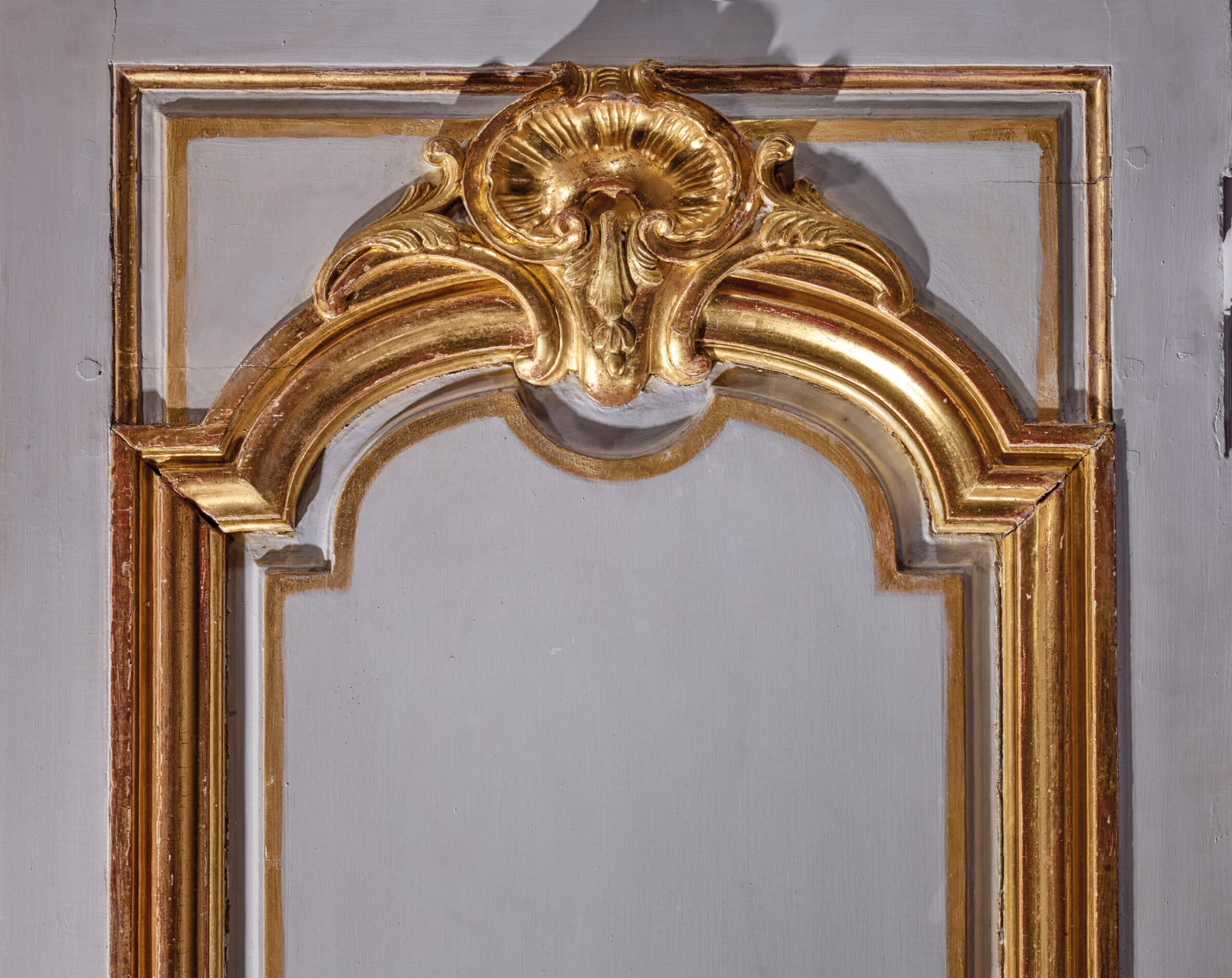
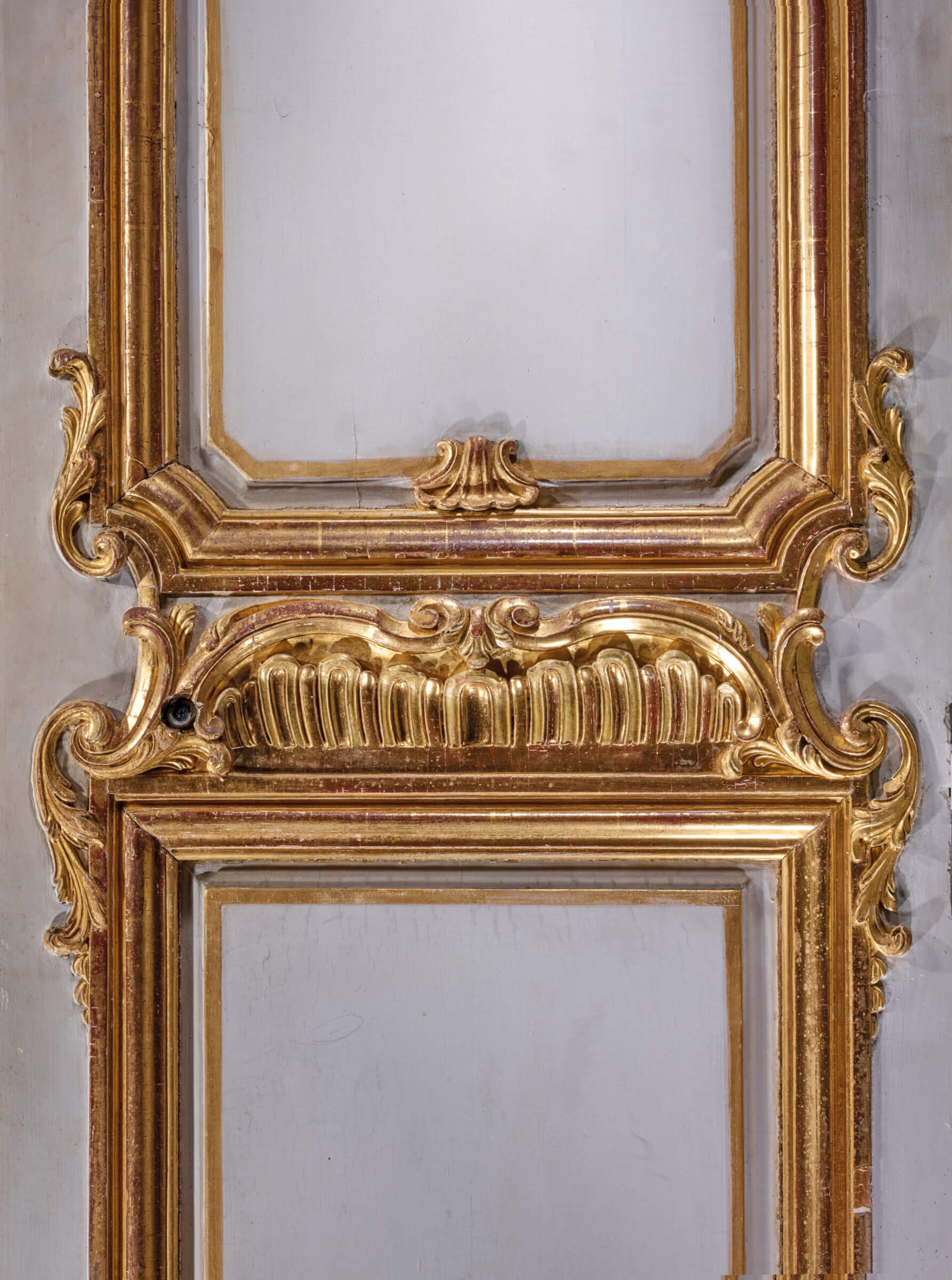
Another disturbing similarity: the kinds of upright gadroons appearing as overdoors on the sketch for Croix-Fontaine are to be found on the doors that match our pilaster set. The evidence is too thin, however, to come to the conclusion that the panelling elements could originate from the Château of Croix-Fontaine, but they indisputably show that Pineau was capable of such a composition in the years 1745. Drawing CD 1713 and our set of wood panelling ought therefore to be dated from those years. From 1747 onwards, Pineau’s hand began to tremble. The drawing related to our panelling does not evidence such trembling, and therefore cannot be dated beyond 1747.

Considering that there is a drawing of a stone pilaster at the execution scale, transferred to a stencil, and a set of panelling with almost exactly the same motif, it is all the more reasonable to deduce that we are dealing with one and the same project, in which the same type of pilaster was used according to the materials at hand, and therefore according to the different room types. The drawing probably relates to a vestibule, and the panelling to a reception room or a gallery, i.e. a room requiring a more architectural decoration.
Be that as it may, the utterly exceptional nature of this decoration, which displays a very distinctive composition in its remarkably well-preserved original gilding, cannot be overstated. This décor is all the more exceptional given that its author, Nicolas Pineau, was a prolific sculptor, but the bulk of his wood carvings has all but disappeared. If only because of their rarity, this set of wood panelling is therefore a particularly valuable testimony to Nicolas Pineau’s art in that medium.
François Gilles,
Art historian and ornamental sculptor