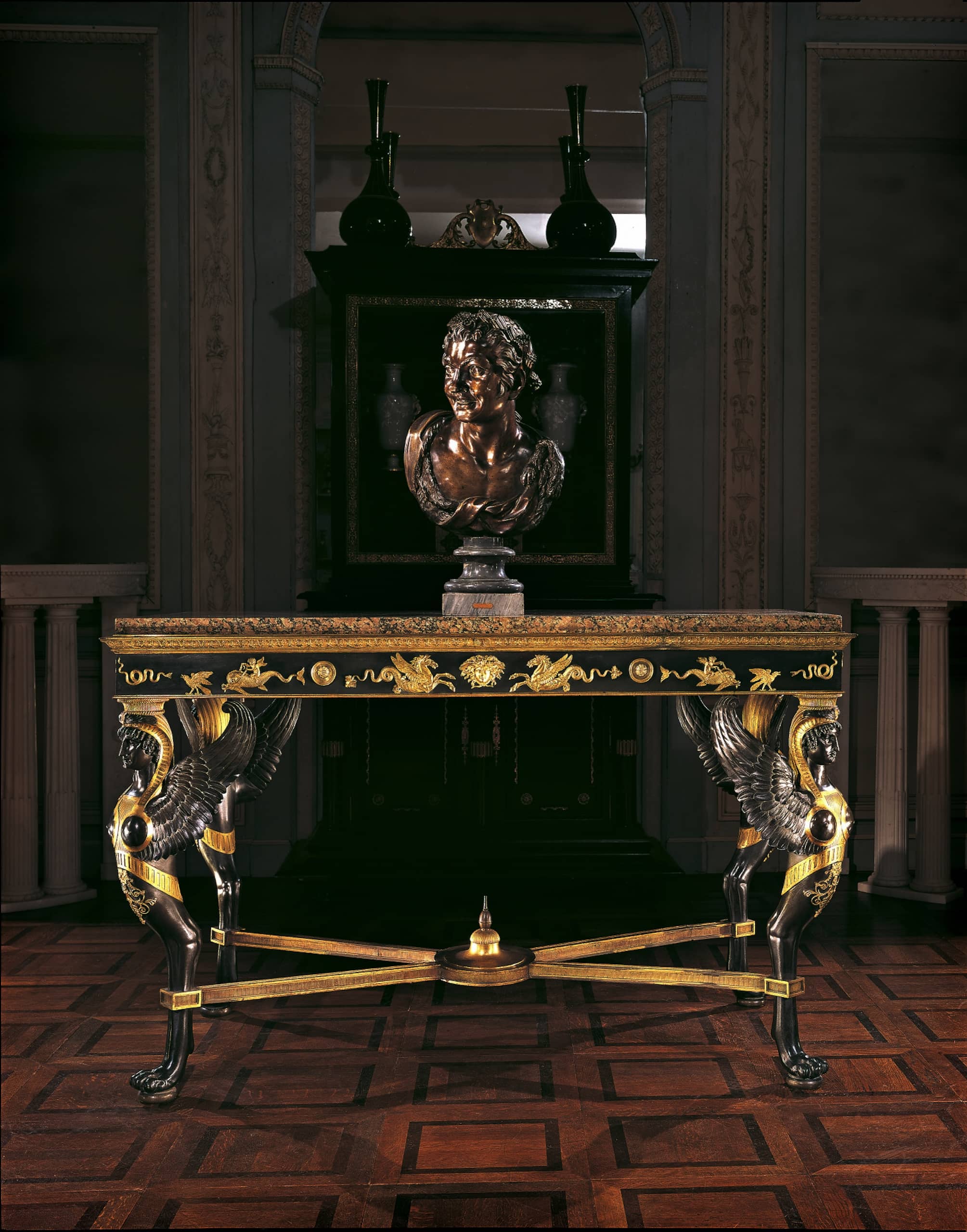
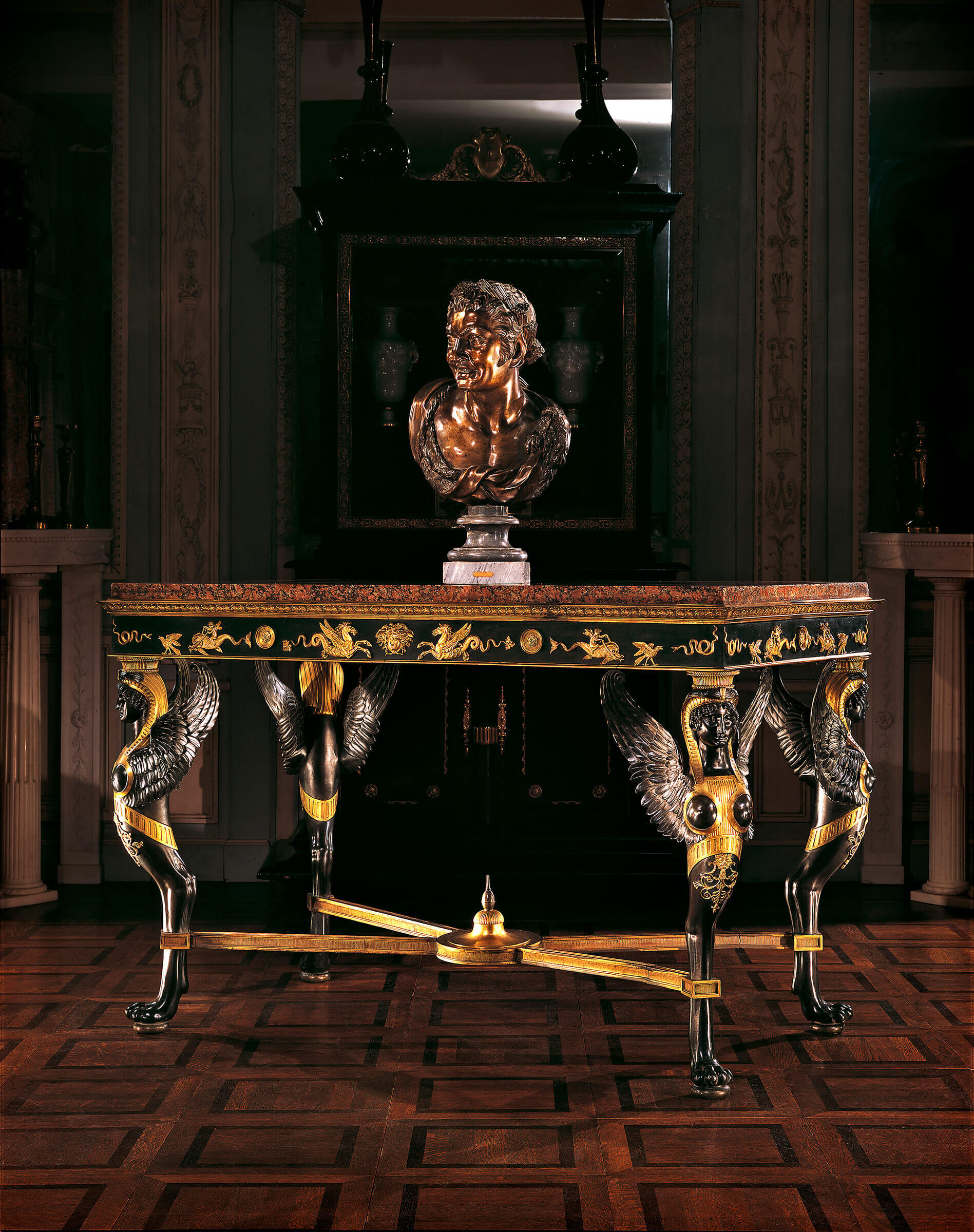
Chased patinated gilt bronze; pink granite.
H. 90 cm. (35 ½ in.); W. 137 cm. (54 in.); D. 77 cm. (30 ½ in.).
PROVENANCE: formerly in the collection of the Baron and the Baronne Eugène Charles Joachim Fould-Springer, then collection of Nathaniel de Rothschild, in Palais Abbatial of Royaumont (Val-d’Oise, France).
COMPARATIVE LITERATURE: Denis Roche, Le Mobilier français en Russie, meubles des XVIIe et XVIIIe siècles et du commencement du XIXe conservés dans les palais et les musées impériaux et dans les collections privées, Paris, 1912-1913, vol. 2, pl. XCVII and XCVIII; Ernest Dumonthier, Mobilier national de France. Les Tables. Styles Louis XVI et Empire, Paris, 1924, pl. 38; Hedvig Szabolcsi, “M. E. Lignereux, ébéniste illustre sous le Consulat (un meuble signé de Ligneureux au musée des Arts décoratifs de Budapest)”, Acta Historiae Artium, Academiae Scientiarum Hungaricae”, Tomus VIII, Fasciculi 3-4, Budapest, 1962, p. 279-298; Patricia Lemonnier, Weisweiler, Paris, 1984, p. 138; Iouna Zek, Catalogue de l’exposition des œuvres de Thomire au Musée de l’Ermitage, Leningrad, 1984, cat. No. 21; Iouna Zek, “Bronze d’ameublement et meubles français achetés par Paul 1er pour le château Saint-Michel de Saint Petersburg en 1798-1799″, Bulletin de la Société de l’Histoire de l’Art Français, year 1994, Paris, 1995, p. 142-157; Jean-Pierre Samoyault, Mobilier français Consulat et Empire, Paris, 2009, p. 105-108; Pierre Arizzoli-Clémentel and Jean-Pierre Samoyault, Le mobilier de Versailles, chefs-d’œuvre du XIXe siècle, Dijon, 2009, pp. 108-109, cat. No. 14, and pp. 128-131, cat. No. 26.
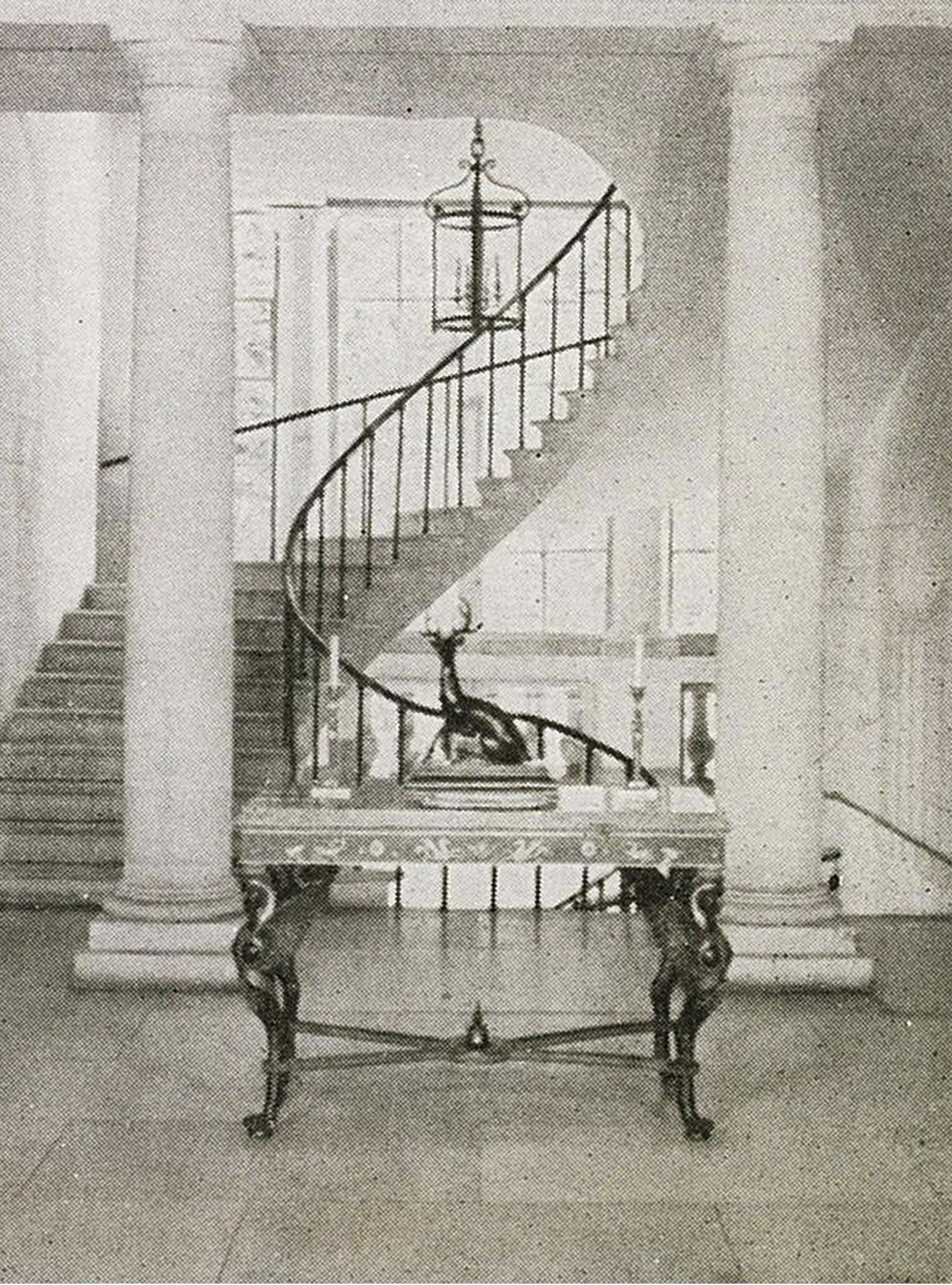
A masterpiece in the collection of Baron and Baronne Eugène Fould-Springer, then of Nathaniel de Rothschild, at the abbey palace of Royaumont in the Val-d’Oise, this centre table constitutes one of the most remarkable landmarks in the history of French furniture produced during the Directory: a particularly fertile period when the “Etruscan” and antique styles, together with the pronounced taste for Egyptomania, all forerunners of the Consulate style, went from strength to strength under the impetus of great designers. These included the architects Percier and Fontaine and illustrious companies specialising in luxury trade, the most famous uncontestably being those of the Jacob Frères and Martin-Eloi Lignereux, the latter working in partnership with the famous founder-finisher Pierre-Philippe Thomire.
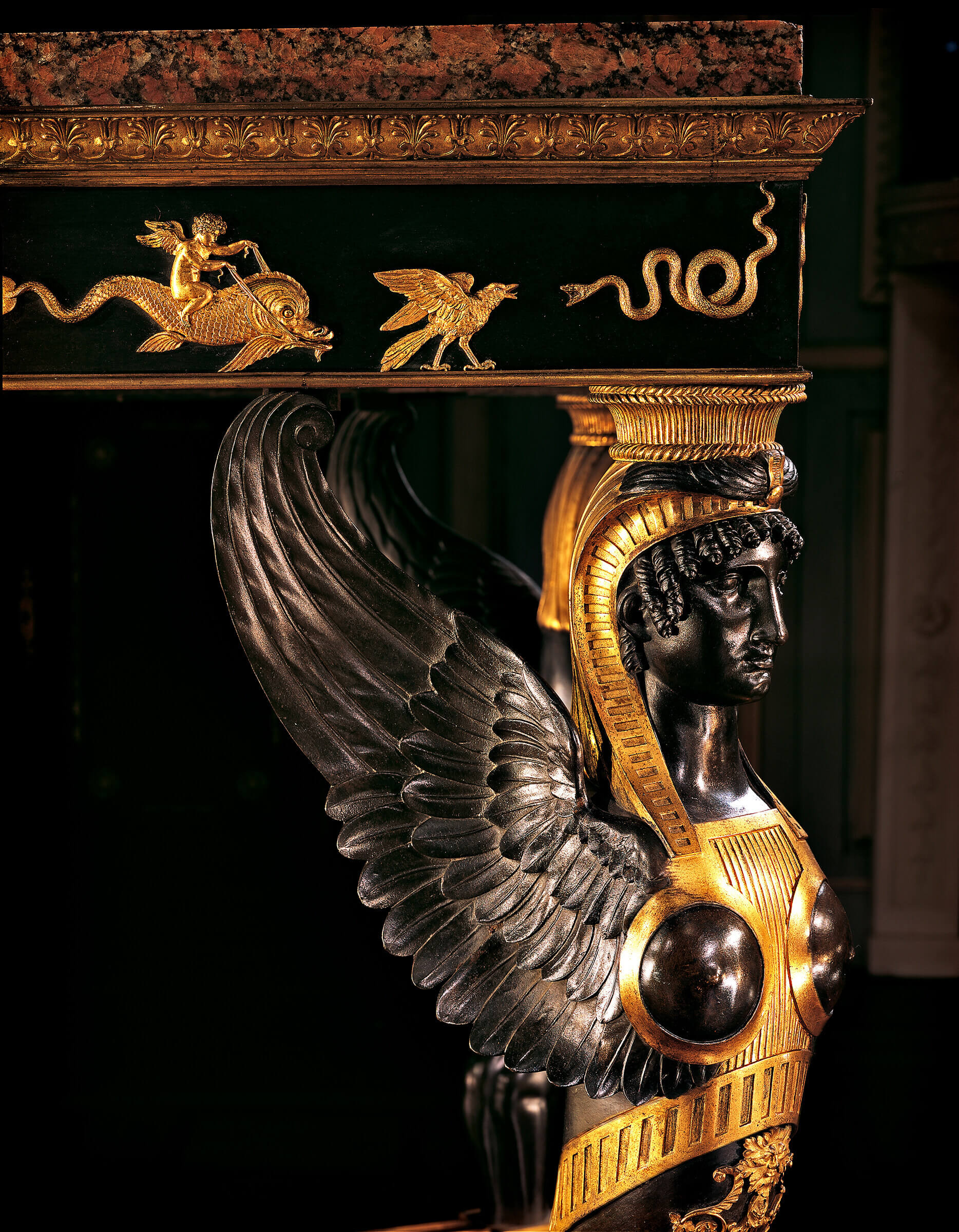
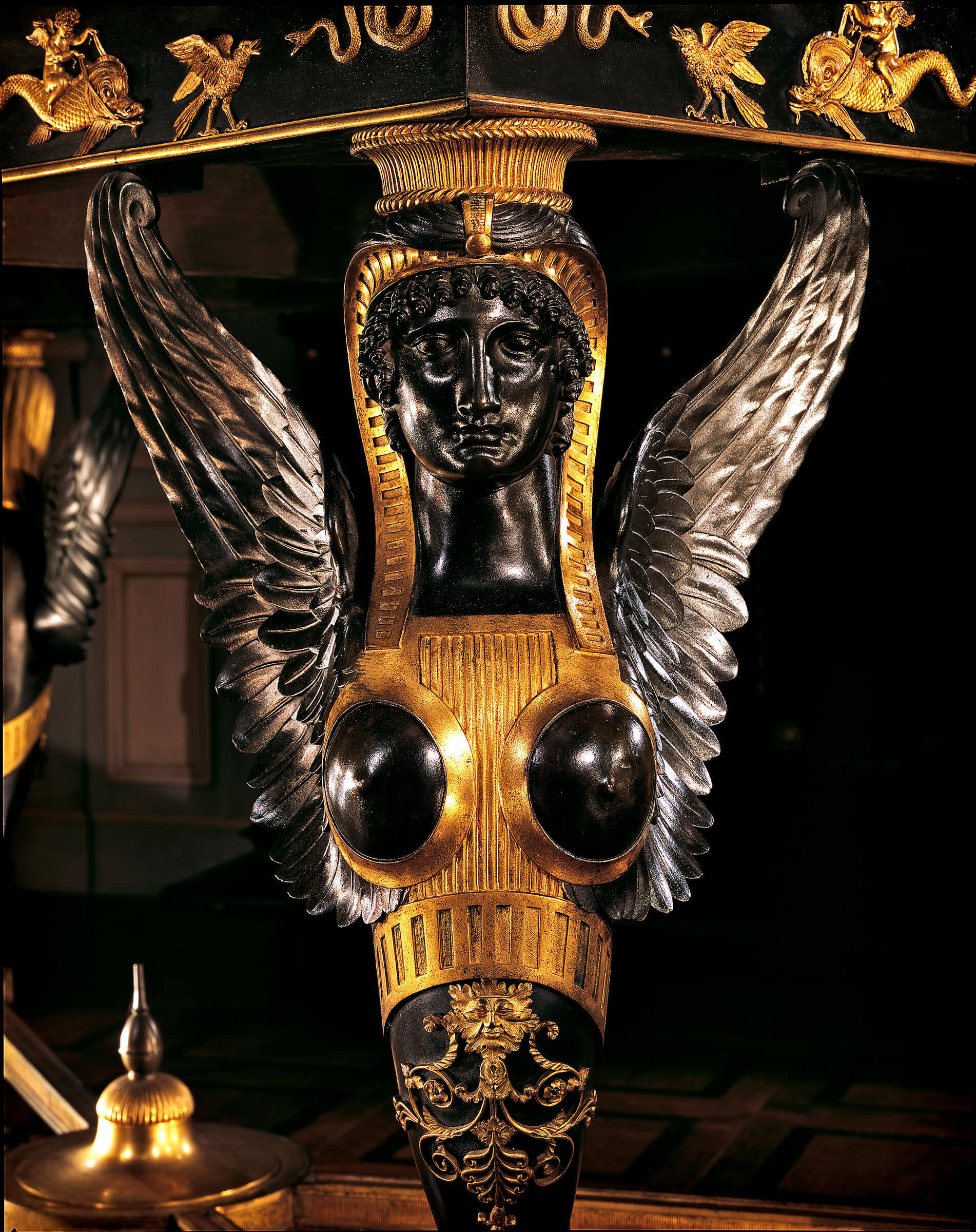
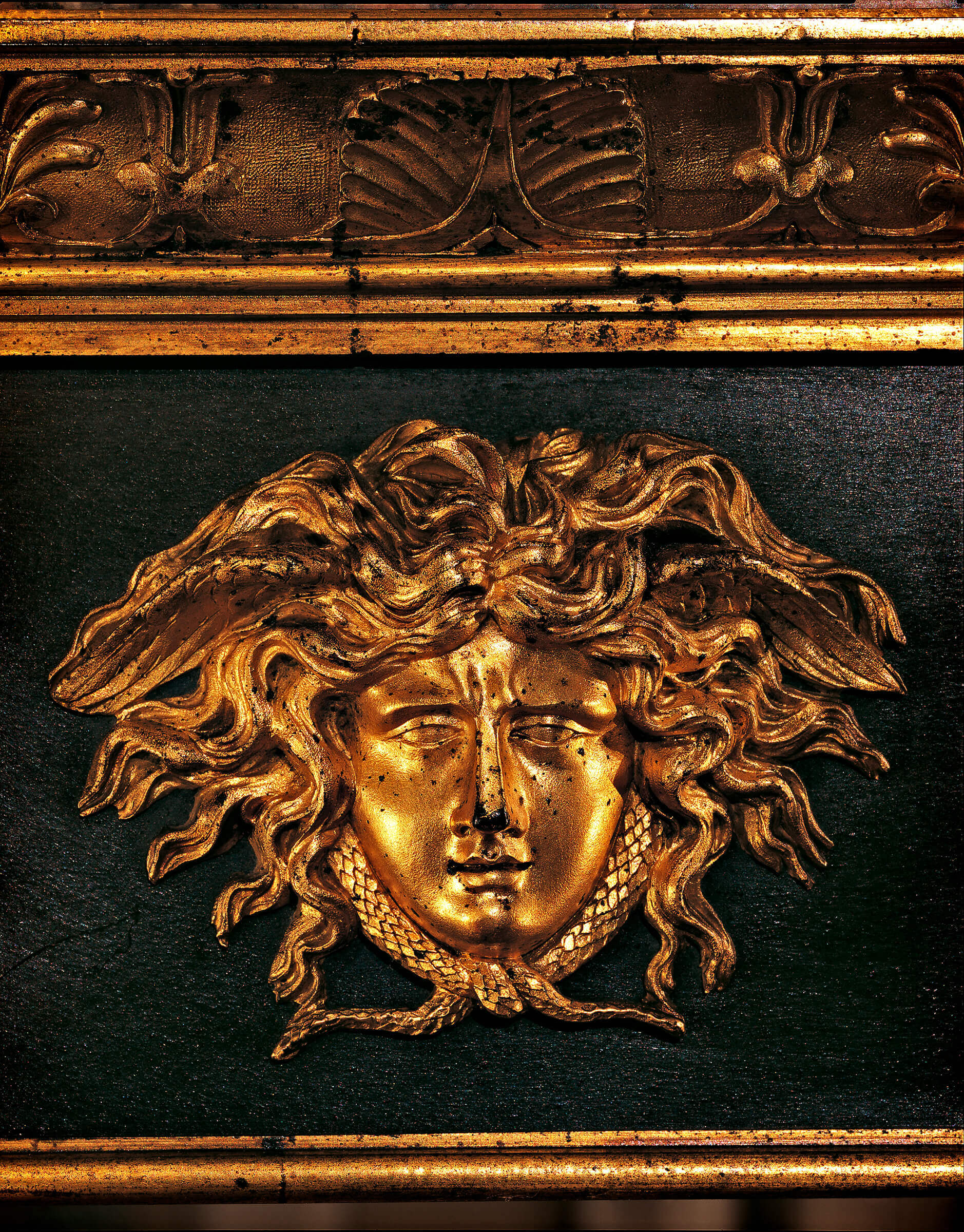
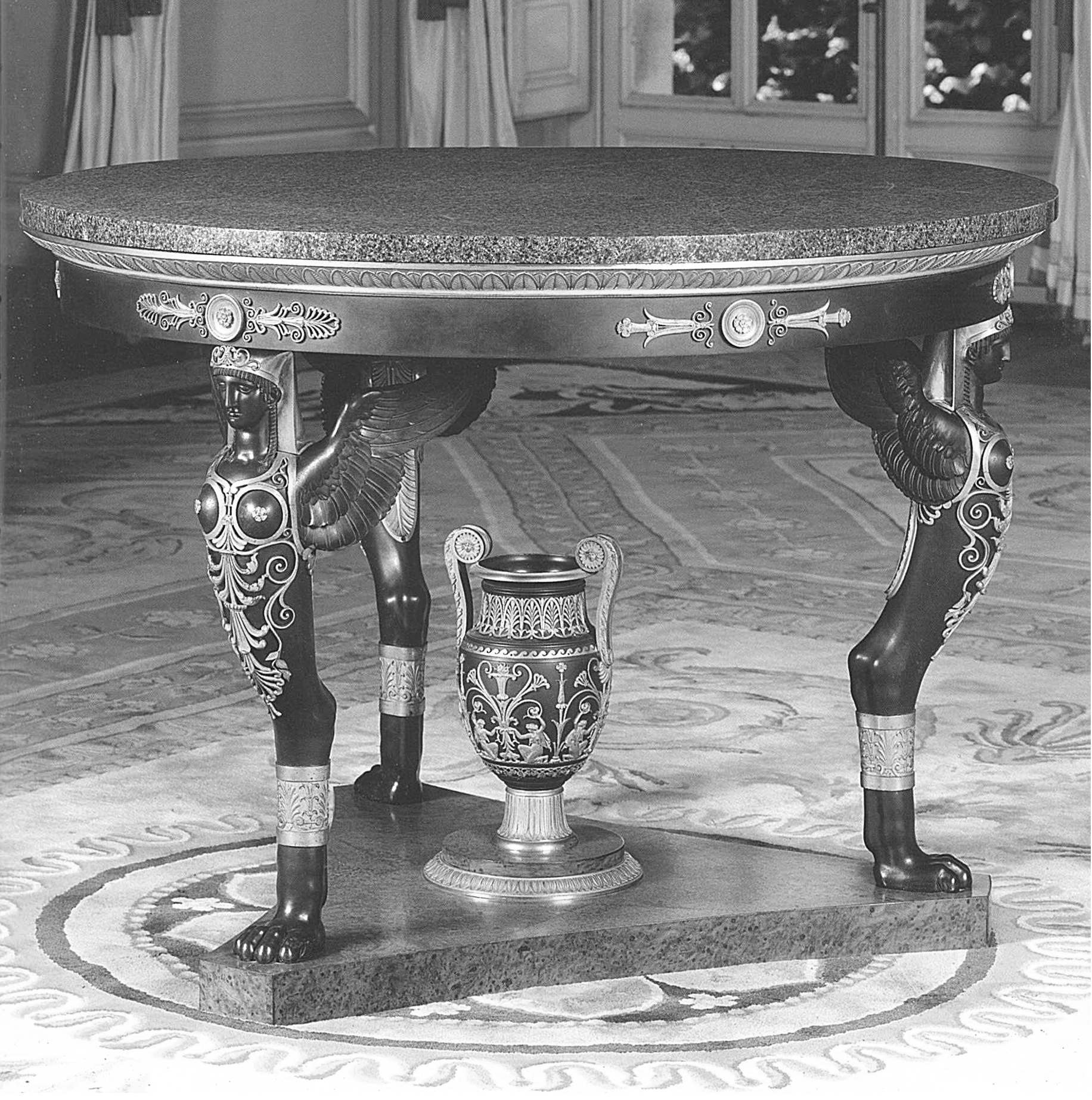
Of a remarkable quality of execution, the table features a base entirely in patinated gilt bronze with a rectangular apron richly ornamented with reliefs of Mercury masks, winged sea horses, and disks, punctuated with rosettes, putti riding dolphins, eagles [Orion] and snakes, the whole emphasised with a gilt bronze fillet and surmounted with a doucine cornice chased with a frieze of stylised palmettes and flowerets. The latter forms the border of a magnificent straight top in pink granite.
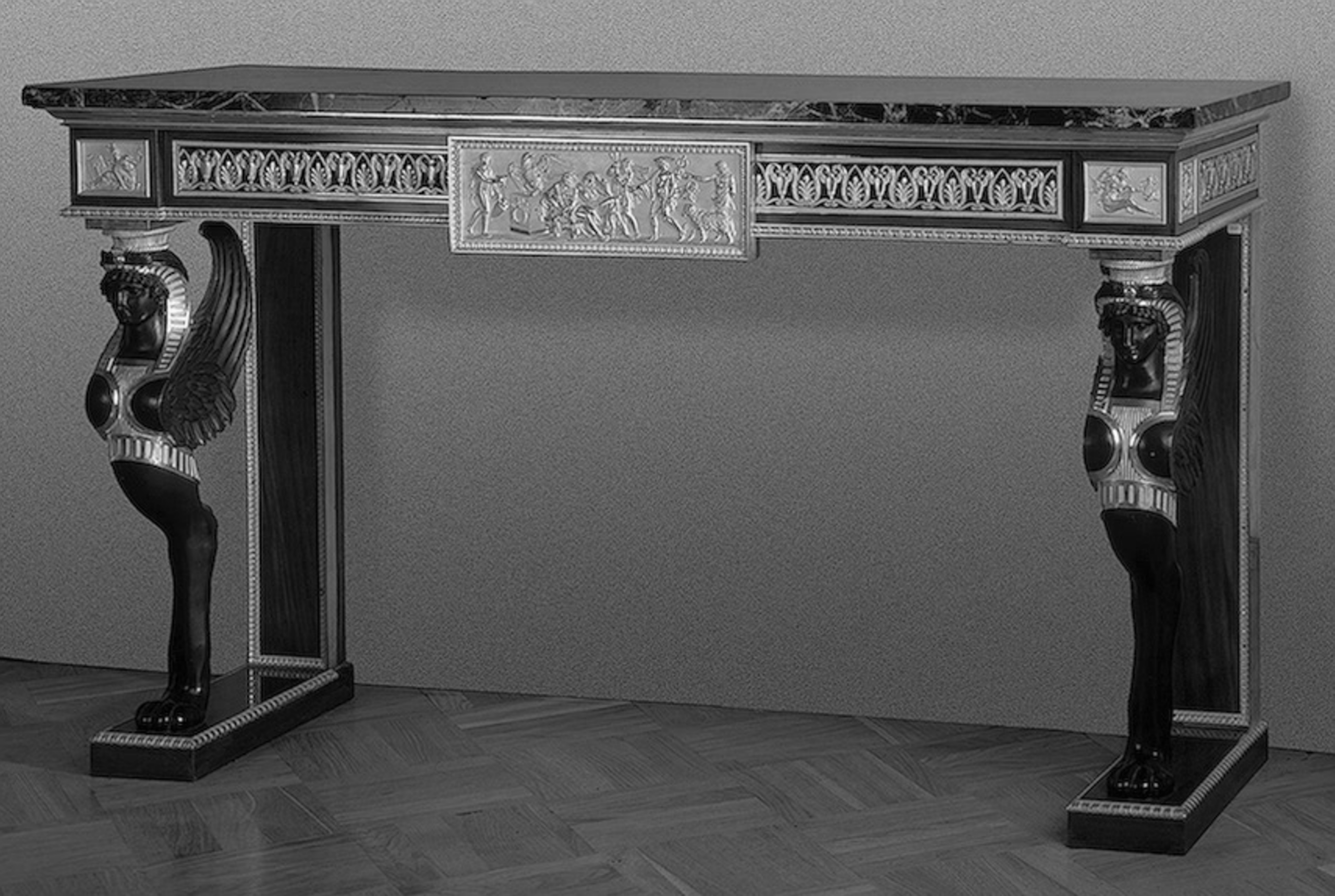
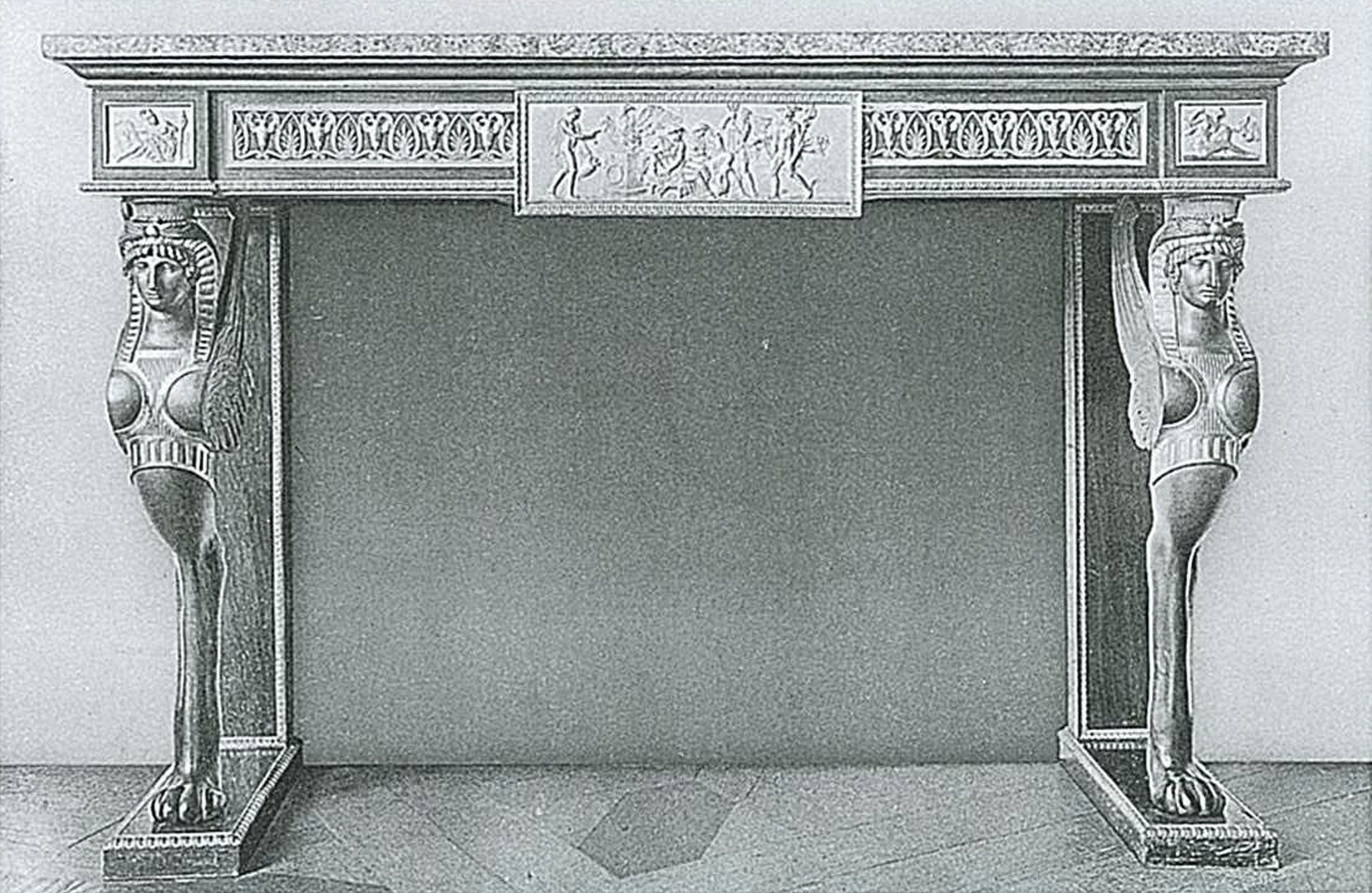
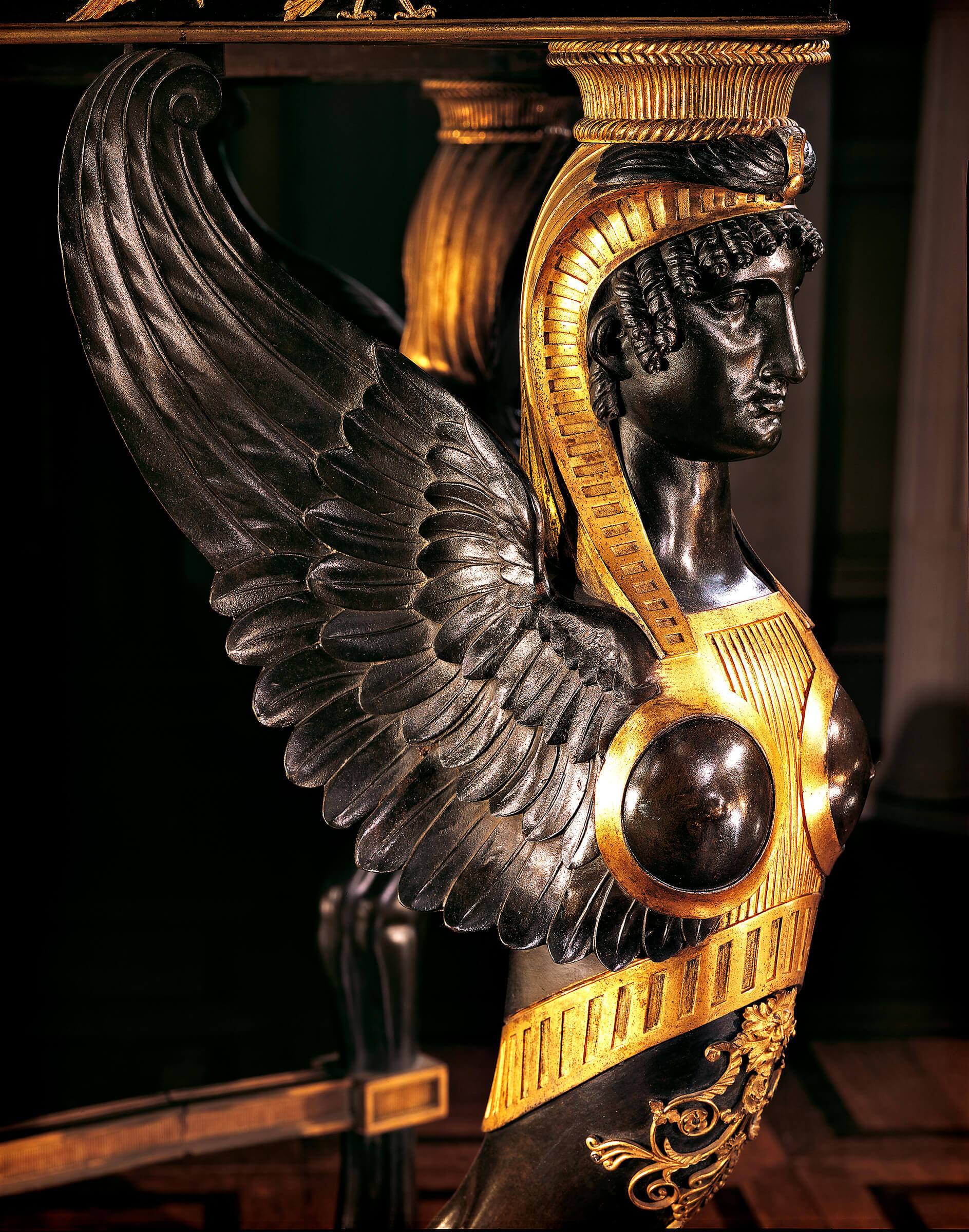
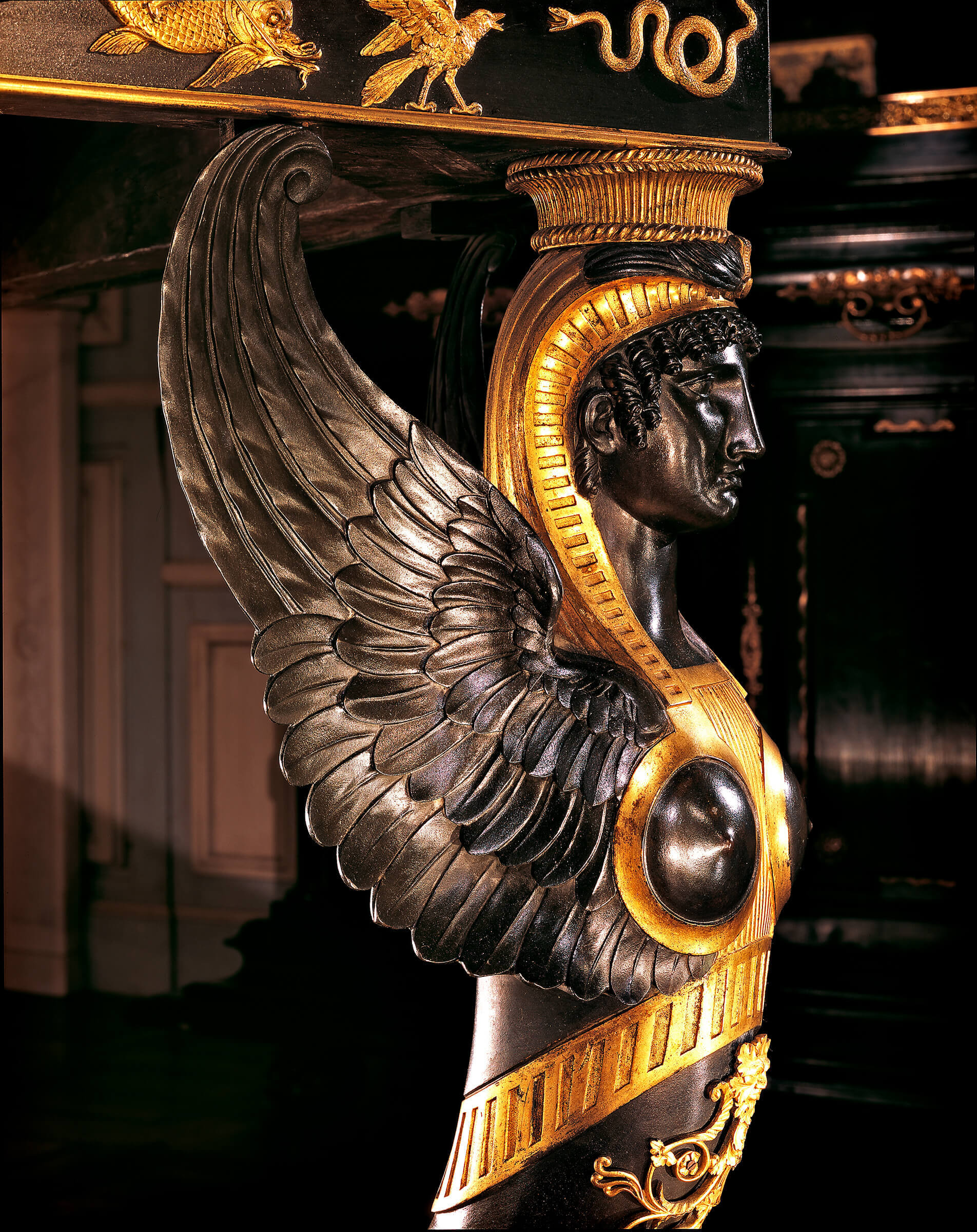
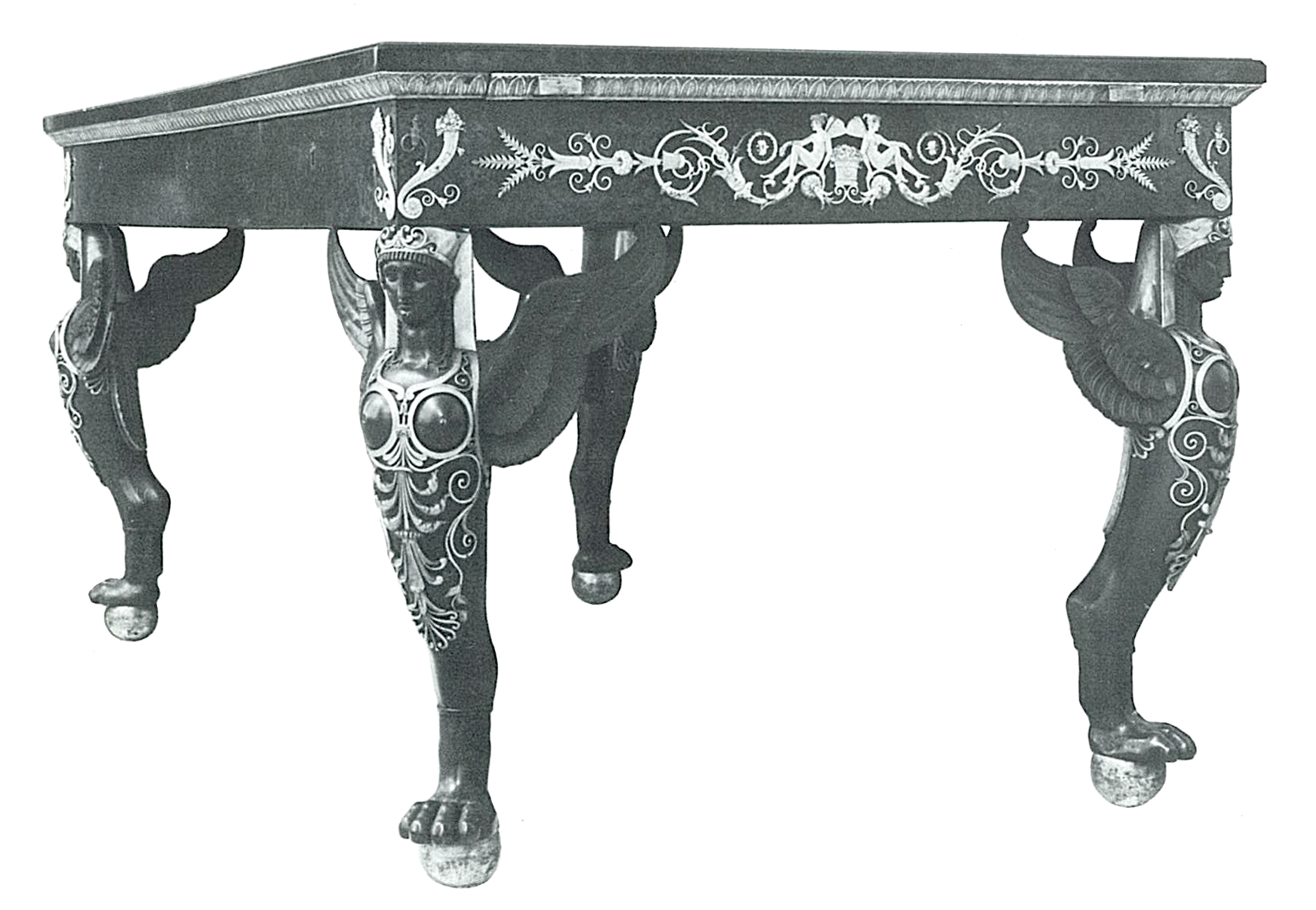
The table stands on four Egyptian monopod figures with spread wings, called “large winged chimeras in the Dupasquier model, with claws and basket capital” in the inventory of Pierre-Philippe Thomire, in patinated gilt bronze, terminating in claws, and with heads of curls under a striped Egyptian nemes surmounted with acobra-uraeus, the whole supporting a narrow ‘basket’ with a striated border enriched by bands with a herringbone or cord pattern. Each “chimera” wears a gilt bronze bodice with plain bands and striated compartments encircling its breasts above a powerful belt punctuated with fluting, itself emphasised by an arabesque agraffe with a palmette, scrolls and flowerets. A square X-shaped stretcher with moulded borders and a matt background ornamented in the centre with a circular central terrace with a doucine, surmounted by a small dome with a corolla of lanceolate leaves, with a pine cone in the form of a ‘top’, joins the four feet by means of ‘dice’ clasping the legs of each “chimera”. The claws in which the latter terminate each rest on a small disk forming a ‘sabot’.
This table features exactly the same monopod “chimeras” – apart from the arabesque motif agraffes beneath their busts – as those ornamenting a very small group of consoles attributed to Martin-Eloi Lignereux and Pierre-Philippe Thomire.
Three of these consoles were delivered in around 1798-1799 for Tsar Paul I of Russia to Saint Michael’s Castle in Saint Petersburg. They feature the same heads of “chimeras” with opulent curls (these became shorter and more stylised during the Consulate) wearing the same striped nemes ornamented with the cobra-uraeus, surmounted with a drape and a narrow capital in ‘basket’ form, also striated. These monopod “chimeras” terminating in claws are decorated with a strictly identical gilt bodice with plain bands and striated compartments, emphasised by a belt with a frieze of rectangular fluting.
Emperor of Russia from 1796 to 1801, Paul I, who loathed the Winter Palace built by the Italian architect Francesco Bartolomeo Rastrelli for his mother Catherine II, had commissioned his architect, Vincenzo Brenna, to build a new castle on the banks of the Moyka River, near the Summer Garden. For this palace, called Saint Michael’s Castle, the Tsar wished for an interior design worthy of a French palace, and with this in mind, issued a special decree dated 22 February 1798 enabling furnishing bronzes bought directly in Paris to be imported duty-free into Russia. More than five hundred bronzes – candelabra, clocks, candlesticks, chandeliers and lamps – were thus delivered between June 1798 and October 1799 via six principal dealers: Xavier-François Labensky, André Cholzen, Barthélémy Defarge (or de Farge), Jean Mazeau (who had been established in the Russian capital for several years), Jean Fabre and Guillaume Culot.
Vincenzo Brenna was particularly demanding with these dealers as to the quality of the furniture and objects supplied. Twenty-two items of ceremonial furniture were acquired during this period for Saint Michael’s Castle: nine consoles, five “rich” commodes, three desks, a work table and four occasional tables. Guillaume Culot sold a lavish console signed by Thomire with gilt bronze caryatids, and in October 1799, a pair of consoles – which are of particular interest here – “in mahogany wood from selected roots” ornamented with bas-reliefs in gilt bronze “representing the Gods of Fable” – probably executed after an engraving of a Roman bas-relief published by Bernard de Montfaucon in his famous Antiquité expliquée […] – standing on two back feet with monopod chimeras in patinated gilt bronze identical to the ones in this table. A third console, in the same model, had already been delivered a few months before, in February 1799, by the dealer Defarge. All this furniture, now in the Hermitage Museum in Saint Petersburg, features the same rigorous quality of execution attributed to Thomire in the bronzes.
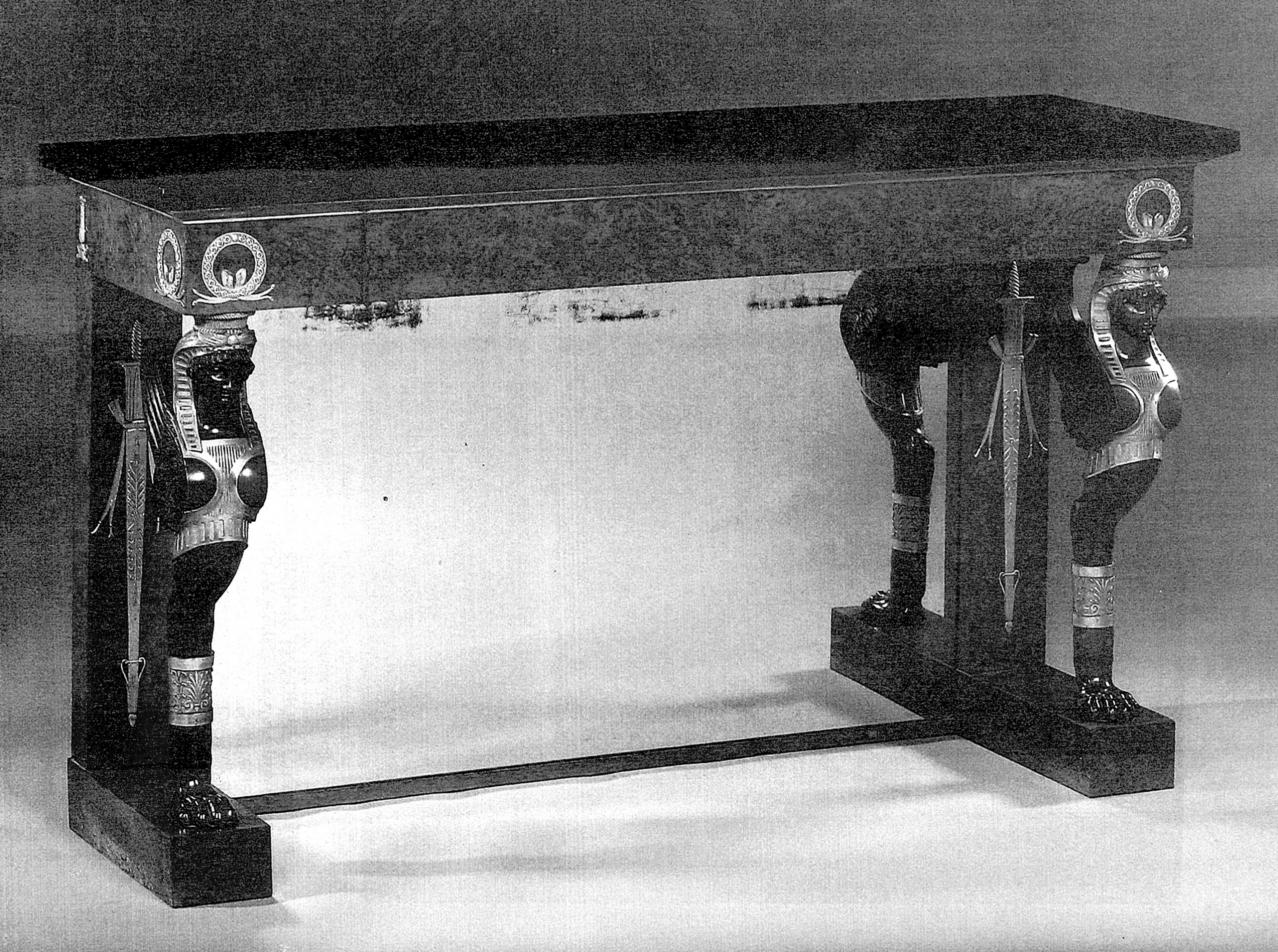
A fourth console of the same type is now in the National Museum of Stockholm, ornamented with a different central bas-relief of the Apotheosis of Virgil after John Flaxman, a bronze copy of a Wedgewood plaque dated c. 1785. Another was executed in Russia by Yvan Bruch after the French model for Count Cheremetiev at Ostankino Castle, a famous estate near Moscow.
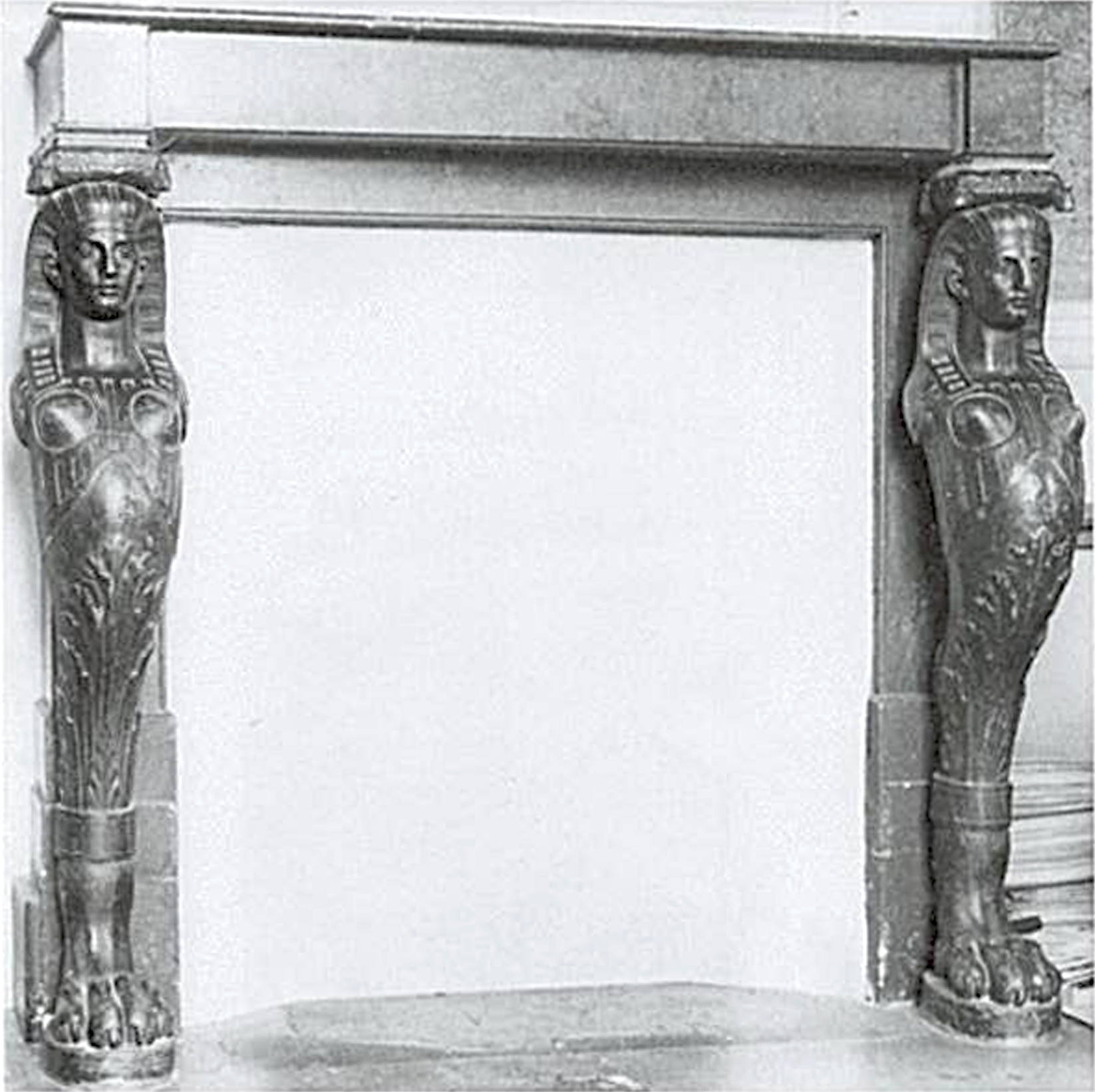
The model of the “chimera” ornamenting the table here and this small group of consoles derives directly from that of the “chimeras” adorning the mantelpiece in the François I gallery at the Château de Fontainebleau, which were cast in lead by Thomire in 1787. This model was “re-updated” during the Directory, in order to be transformed into a table and console leg. The first use of the “Dupasquier chimera”, named after its sculptor, Antoine-Nicolas Dupasquier (c. 1748-1831), was executed by François Rémond c. 1797-1798. The “Dupasquier chimera” model was also employed at the same period by Thomire, very probably in partnership with Lignereux. The latter’s participation appears all the more plausible in that, as well as the fact that the two men already knew each other well at the time, a console in yew root, simpler than the previous ones but ornamented with the same model of “chimeras”, was sold on 11 June 1803 by Lignereux to Thomas Bruce (1766-1841), 7th Earl of Elgin, the British ambassador in Constantinople from 1799 to 1803.
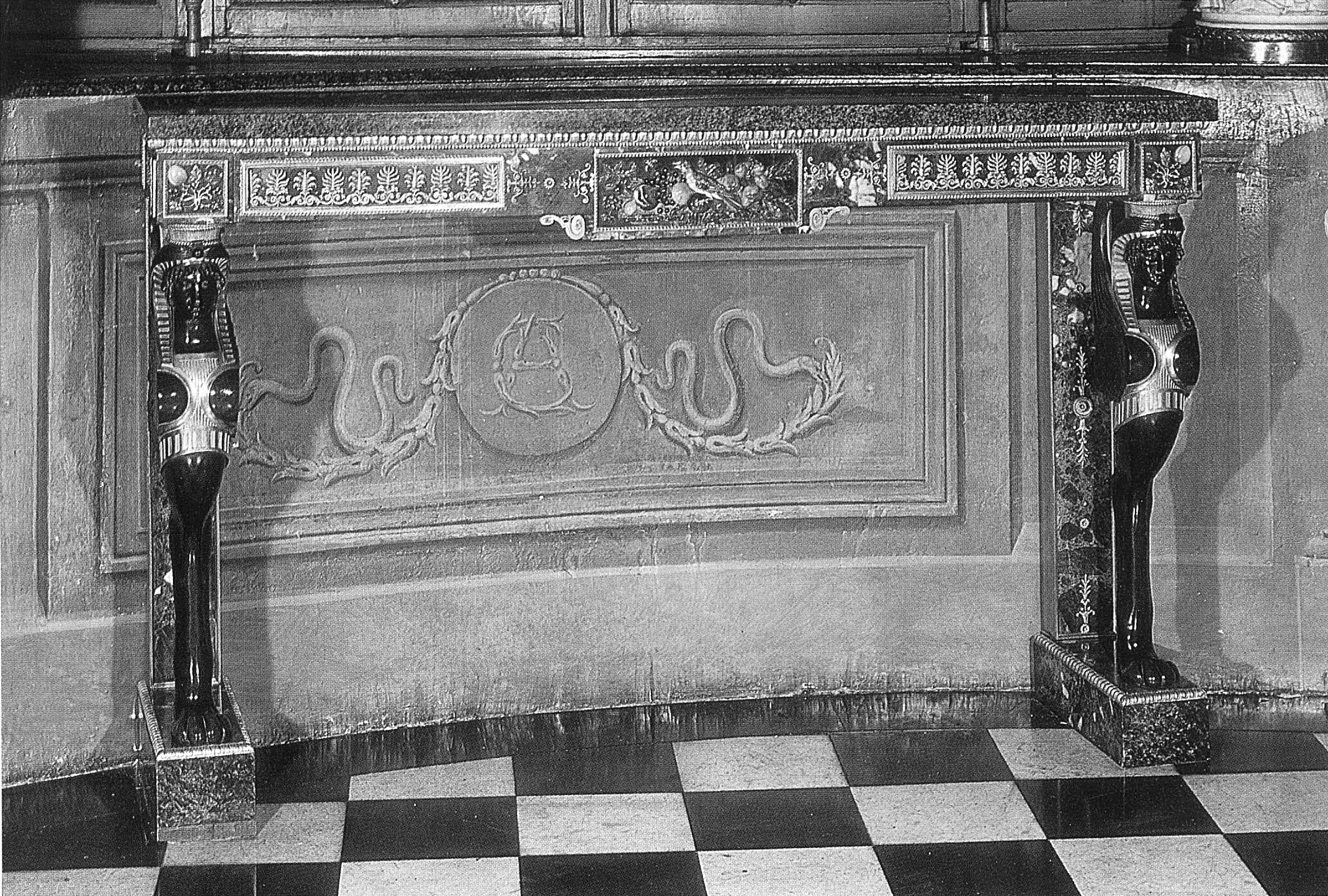
On 2 April 1798 the following was listed: “a large console with a top in green granite, with base, pilasters and apron in Egyptian green marble, ornamented on the crosspiece with a frieze of palmettes in gilt bronze and with bas-reliefs in pietra dura, in the centre and at the ends”, decorated with the same “chimeras”. This was placed in the large so-called “Seasons” drawing room in the private mansion of the financier Marc-Antoine Delannoÿ, in Rue Cerutti. In 1804, he sold his residence, entirely furnished, to Louis Bonaparte, the brother of Napoleon I and later King of Holland, and his wife, Hortense, daughter of the Empress Josephine. Later, this magnificent formed part of the collections of Baron de Redé at the Hôtel Lambert in Paris, and was sold by Sotheby’s in Monaco on 26 May 1975, as lot No. 266 of the sale.
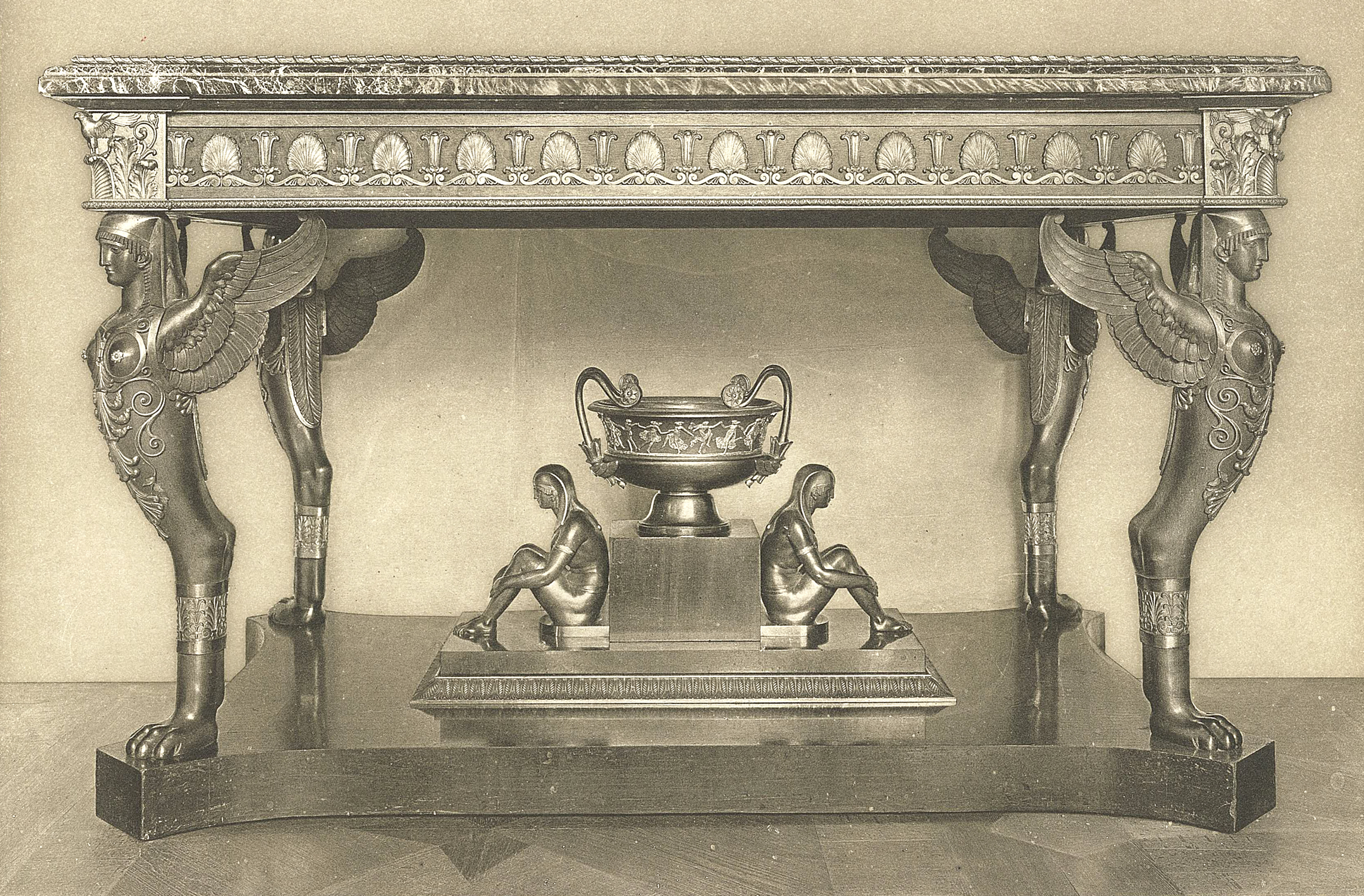
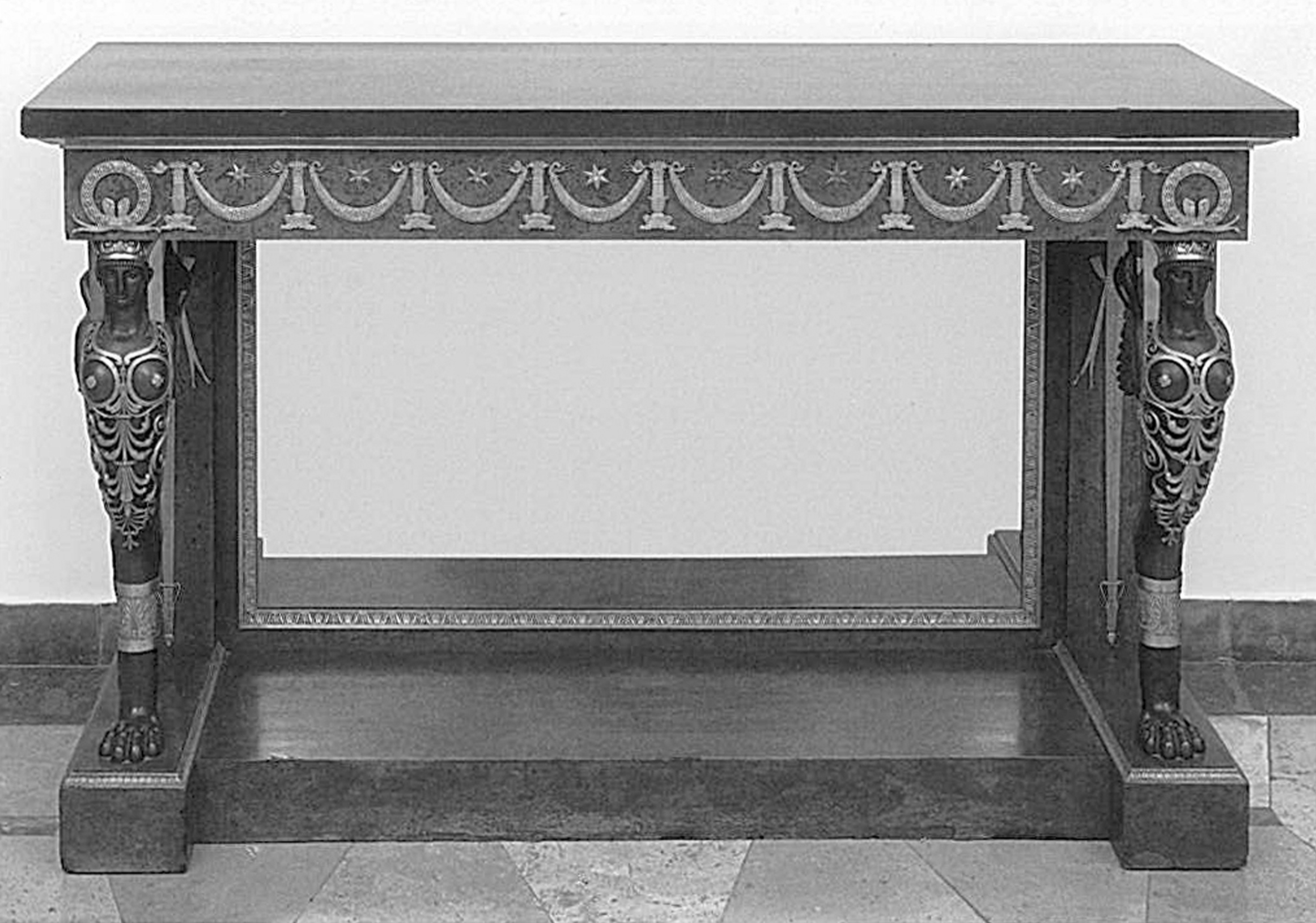
At the beginning of the Consulate, Lignereux also distributed a variant of this “chimera”, with a more hieratic face, and shorter, more regular and stylised curls, ornamented with a smooth nemes with no stripes or cobra-uraeus, and presenting variants in the bodice and the arabesque motifs enhancing it. The few known items of furniture with this model include a noteworthy centre table similar to this one, with lavish gilt bronze capitals, a frieze of palmettes and sorbels and a group composed of a vase flanked by Egyptians in the centre of the stretcher. Probably bought in Paris by Tsar Paul I before 1801, this table is now in the Hermitage Museum in Saint Petersburg.
A console now in the Decorative Arts Museum in Budapest, also with chimeras in this model, and once part of the Esterhazy collection, still carries Lignereux’s label. It features a frieze in gilt bronze alternating “baluster” torches and garlands, identical to the one ornamenting the apron of a console deposited in 1807 by Thomire as a pledge for a loan, finally transferred to the Garde-Meuble Impérial in 1812.
This console is now in the Musée du Louvre. Two pairs of consoles, belonging to the same group, were delivered, probably in around 1802, for Madame Bonaparte’s main drawing room at Saint-Cloud. They are now in the collections of the Mobilier National and the Grand Trianon at Versailles. To this group can also be added a centre table similar to the one in the Hermitage, also deposited by Thomire in 1807 and transferred to the State in 1812 – stamped by Adam Weisweiler, this is now in the royal palace in Naples – and two guéridons, one now in the Correr Museum in Venice, not stamped but identical to the second, which is stamped by Adam Weisweiler, and is now in the collections of the Grand Trianon at Versailles.
The guéridon of the Correr Museum was executed via Lignereux by an express order from the Minister of the Interior, who had asked him to replace the now unfashionable Louis XVI base of this guéridon, with its remarkable top in Sèvres biscuit porcelain showing the story of Telemachus, by a new, fashionable support, so that the First Consul could make a gift of it to Louis I de Bourbon, King of Etruria (who went on a visit to Paris in May and June 1801 under the name of the Count of Livorno). A memorandum by Lignereux dated 17 vendémiaire Year 10 (9 October 1801) mentions not only this new guéridon but also the restoration of a large Sèvres vase intended for the same prince (the vase is now in the Palazzo Pitti in Florence). Thanks to the correspondence between the Minister of the Interior, the administrator of the Sèvres factory and Lignereux himself, we know that the latter had entrusted the restoration of the vase to Thomire, the official porcelain mounter for the Sèvres factory. Logic would suggest that Lignereux also asked Thomire for the new base of the guéridon.
But in a claim concerning the payment of his invoice dated 10 messidor year 10 (29 June 1802), Lignereux clearly differentiates the two operations. Firstly he asserts that he paid Thomire a long time before for the work carried out on the vase, and secondly, he states that the table was made for his own use, though without citing Thomire’s name.
A guéridon similar to the latter, stamped A. WEISWEILER, in patinated gilt bronze, yew root and green Vosges granite, was transferred to the government in 1812 by Feuchère for 3,000 francs, after being deposited in 1807 in exchange for a loan accorded by the Minister of the Interior. Placed in the ministry of the Maison du Roi in 1818, it was sent in 1822 to the Palais de Saint-Cloud for the Duchesse de Berry’s use. It appeared in the Grand Trianon as from 1855. In his memorandum, Feuchère calls the three lion’s leg and claw monopod Egyptian figures “feet in the form of chimeras ornamented with arabesque bodices and garters with matt gilding”. It is very likely that this guéridon had been acquired by Feuchère from Thomire or received as payment for supplies. This second “chimera” model, marketed by Lignereux, was also taken up later by Thomas Hope, who published it on his own behalf in 1807 in his famous Household Furniture and Interior Decoration (pl. VI and XIV; fig. 59).
Martin-Eloi Lignereux
Born in 1752 in Cuvilly, in the Valois region, Martin-Eloi Lignereux joined forces under Louis XVI with Dominique Daguerre (c. 1740-1796), the celebrated marchand mercier and silversmith established in the Rue Saint-Honoré, with whom he delivered a number of items to the Mobilier de la Couronne. After Daguerre retired in around 1793, Lignereux kept on the store at the Rue Saint-Honoré for a while, then decided to set up shop at No. 2, Rue Christine, “near the one, formerly Rue Dauphine, where he still continued the same trade in furniture and bronzes of all kinds. In his shop one could find a collection of the most sought-after furniture, such as chests of drawers, secretaries, consoles, desks, tea tables and other items in a new taste, ornamented with porcelain and cameos, and richly decorated with unpolished bronzes“. He then ran a shop at 44 Rue Vivienne, opposite the Rue Colbert, selling bronzes executed by Thomire, crystal, porcelain and furniture created by himself, and subsequently moved to 41 de la Rue Taitbout in September 1803. He married Anne-Henriette Demilliville and had a daughter, Adélaïde-Anne, who on 14 March 1798 married the younger of the Frères Jacob, François-Honoré-Georges (1770-1841). During the Directory and the Consulate, Lignereux constantly competed with his son-in-law in the production of precious furniture.
At the Exhibition of Industry Products in year IX [1800], the jury were unable to choose between him and the Frères Jacob for the gold medal, and so decided to award this prestigious prize to both of them. Lignereux seems never to have stamped his furniture, which he only produced in very small quantities – furniture that was always extremely lavish and sold at very high prices. On 22 November 1804, he finally sold his business to Thomire and Duterme, undertaking to leave them all his merchandise. He died in Paris on 31 January 1809.
Pierre-Philippe Thomire
The son of a Parisian chaser, Thomire underwent very comprehensive training. He studied sculpture at the Academy of Saint Luke in Rome with Pajou and Houdon. The latter wanted him to become a founder, but Thomire decided to specialise in chasing, and entered Gouthière’s workshop. With Gouthière, he rapidly acquired in-depth knowledge of the secrets of the trade, particularly matt gilding, his master’s crowning glory. In 1776, he set up on his own, and after Gouthière went bankrupt, became the most celebrated chaser of his time. Highly attracted to neoclassicism, he specialised in subjects drawn from the Antique repertory, and collaborated actively with cabinetmakers like Guillaume Beneman.
His talents are shown to their very best in the brass mouldings he executed for large Sèvres vases, after he succeeded Duplessis as the official bronze maker at the manufacture (factory). Some of the works he executed before the Revolution – including the Candelabra of Independence or the celebrated jewellery cabinet of Marie-Antoinette, both in the Château de Versailles – would have been enough to ensure his reputation, but he became even more famous during the Empire.