Carved and painted wood.
H. 316 cm. (124 ½ in.).
PROVENANCE: private collection.
REFERENCE LITERATURE: Alastair Laing & Martin Meade, Drawings for Architecture, Design and Ornament, Volume II, The James A. de Rothschild Bequest at Waddesdon Manor, Cambridge, The National Trust, 2006, pp. 424–464.


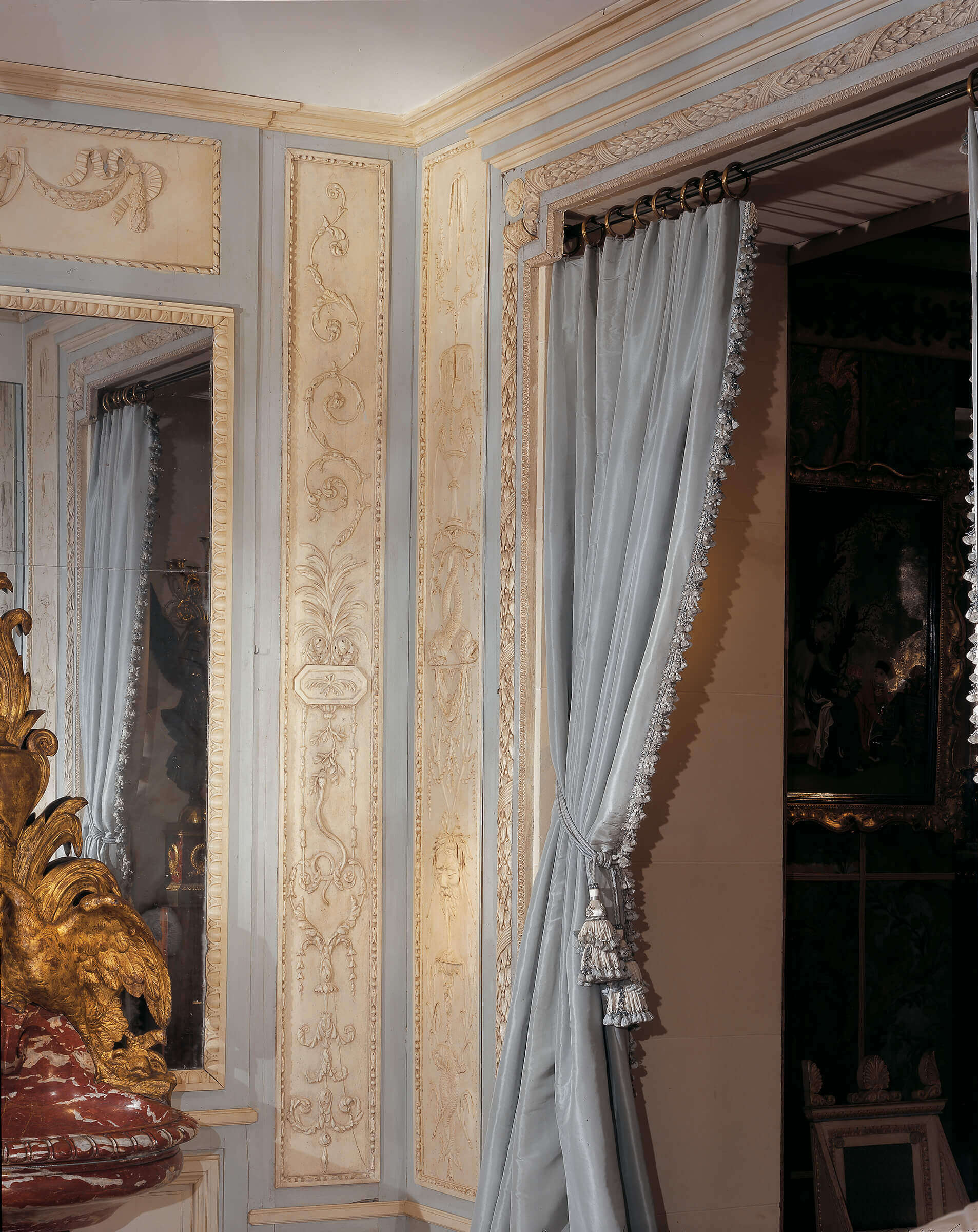
Structured by a series of pilasters and narrow glazing moldings, finely carved with arabesque motifs painted white and set within pastel blue frames, this woodwork alternates rectangular mirror panels with egg-and-dart borders, topped by straight panels decorated with vases and laurel garlands tied with ribbons, or with intertwined laurel crowns and palms; arched mirror panels with interlace and quatrefoil borders, their spandrels enriched with laurel branches; doorway frames, either straight with ribboned laurel borders or as basket handles with egg-and-dart borders and delicate floral garlands; and overdoor panels decorated with medallions flanked by vases and acanthus scrolls. The ensemble is accented by simple compartmented cornices with molded borders.
This refined decoration finds numerous parallels in the Cahiers de Sujets Arabesques published in Paris in the 1780s by the ornamentalist Jean-Louis Prieur, known as l’Aîné (Paris, circa 1725 – after 1785), “ornamental sculptor, modeller, and chaser,” who worked notably from 1766 to 1768 for the King of Poland, Stanislas II Poniatowski, and provided numerous designs for the decorations of the Château de Varsovie. Seventy-seven of his elevation and ornament drawings, the largest collection recorded to date, ahead of the University Library of Warsaw (fifty-nine drawings), are now preserved at Waddesdon Manor, most of them acquired by Baron Edmond de Rothschild in May 1878.
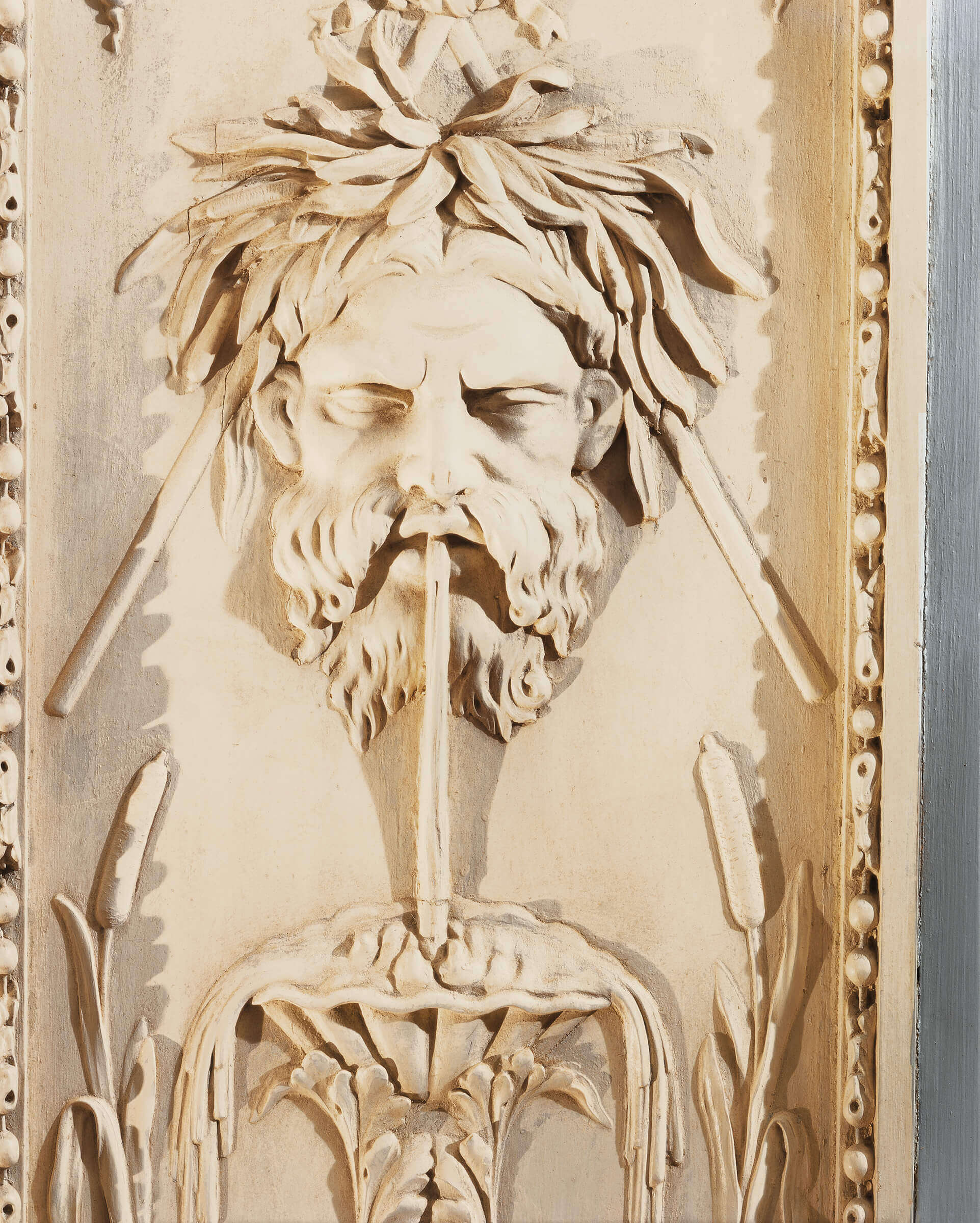
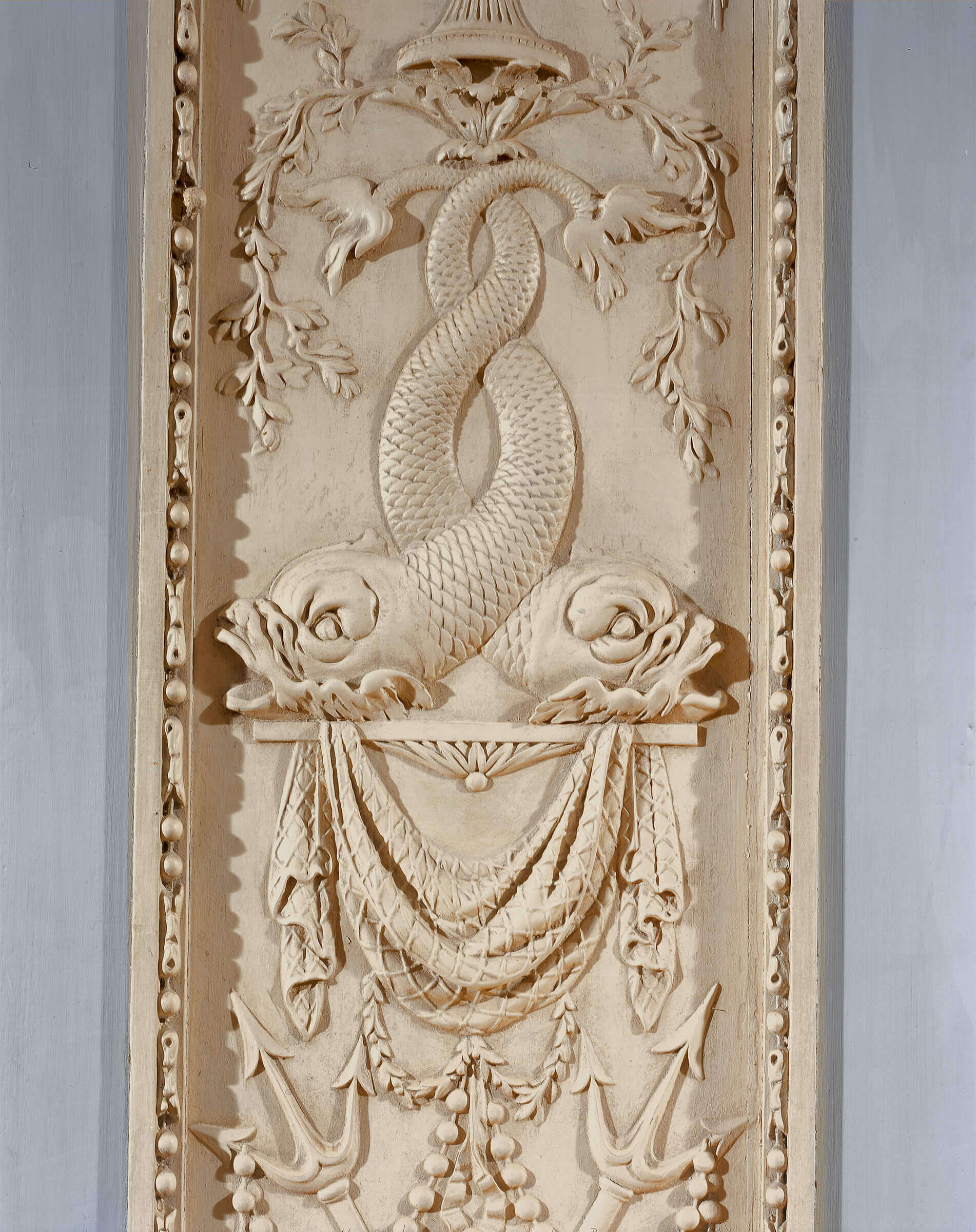
Twelve of these drawings by Prieur, closely related to those reproduced in his XIIIe and XXIIIe Cahiers, show narrow, vertical arabesque compositions intended for decorative mouldings, within which the entire aquatic ornamental repertoire of our panels is precisely developed: bearded male heads, intertwined dolphins, reeds, acanthus florets supporting vases with cascading water, pearl garlands, and draperies.
Another drawing, illustrating a design for a rectangular mirror panel, shows, on either side of the mirror, narrow parcloses adorned with the same leafy motifs as ours: interlacing thin leafy branches or the sinuous path of a single branch running the full height of the parclose.

Many of these drawings incorporate molded-border medallions, reminiscent of those decorating our overdoor panels or mirror panels. A design elevation for a drawing room also presents mirror frames and overdoor or over-mirror panels with motifs of leafy crowns or vases flanked by laurel garlands, echoing the designs of our panels. Our decoration likewise recalls the oval cabinet from a townhouse on the Cours d’Albret in Bordeaux, now reinstalled at the Metropolitan Museum of Art


Jean-Louis Prieur, known as l’Aîné (Paris, circa 1725 – after 1785), Modèle d’arabesques pour une parclose, Paris, circa 1780. Watercolor on light blue paper, 32.5 × 9.8 cm.
Waddesdon Manor, James A. de Rothschild Collection (inv. no. 585/22 – Acc. no. 1435).
Jean-Louis Prieur played a major role in the emergence of Neoclassicism in France around 1765–1770. Master sculptor and member of the Académie de Saint-Luc in 1765, Prieur participated the following year in the renovation of the Royal Palace in Warsaw under the authority of architect Victor Louis. On that occasion, he provided numerous arabesque-themed drawings for woodwork, frames, furniture, and bronzes, executed respectively by joiner Jadot, sculptor Honoré Guibert, chairmaker Louis Delanois, and founder Philippe Caffiéri. In 1769, he became master founder in clay and sand, and one year later delivered for the Grand Cabinet of the Dauphin at Versailles, future Louis XVI, a bronze monument entitled Allégorie de la Paix et de l’Abondance, a clock executed from a design by François Boucher, with a movement by Antoine Pelletier and Charles-Athanase Pinon.
Once king, Louis XVI had it installed in his bedroom; it is now preserved in the collections of the Pushkin Museum. In 1774, Prieur also provided the ornamental bronzes for the royal carriage used at the sovereign’s coronation. Established on rue du Faubourg Saint-Denis in 1776, he later moved to the Enclos du Temple. The 1777 Almanac refers to him as “ornamental sculptor, modeller, and chaser,” though in 1783 he styled himself “sculptor, chaser, and gilder to the King.”