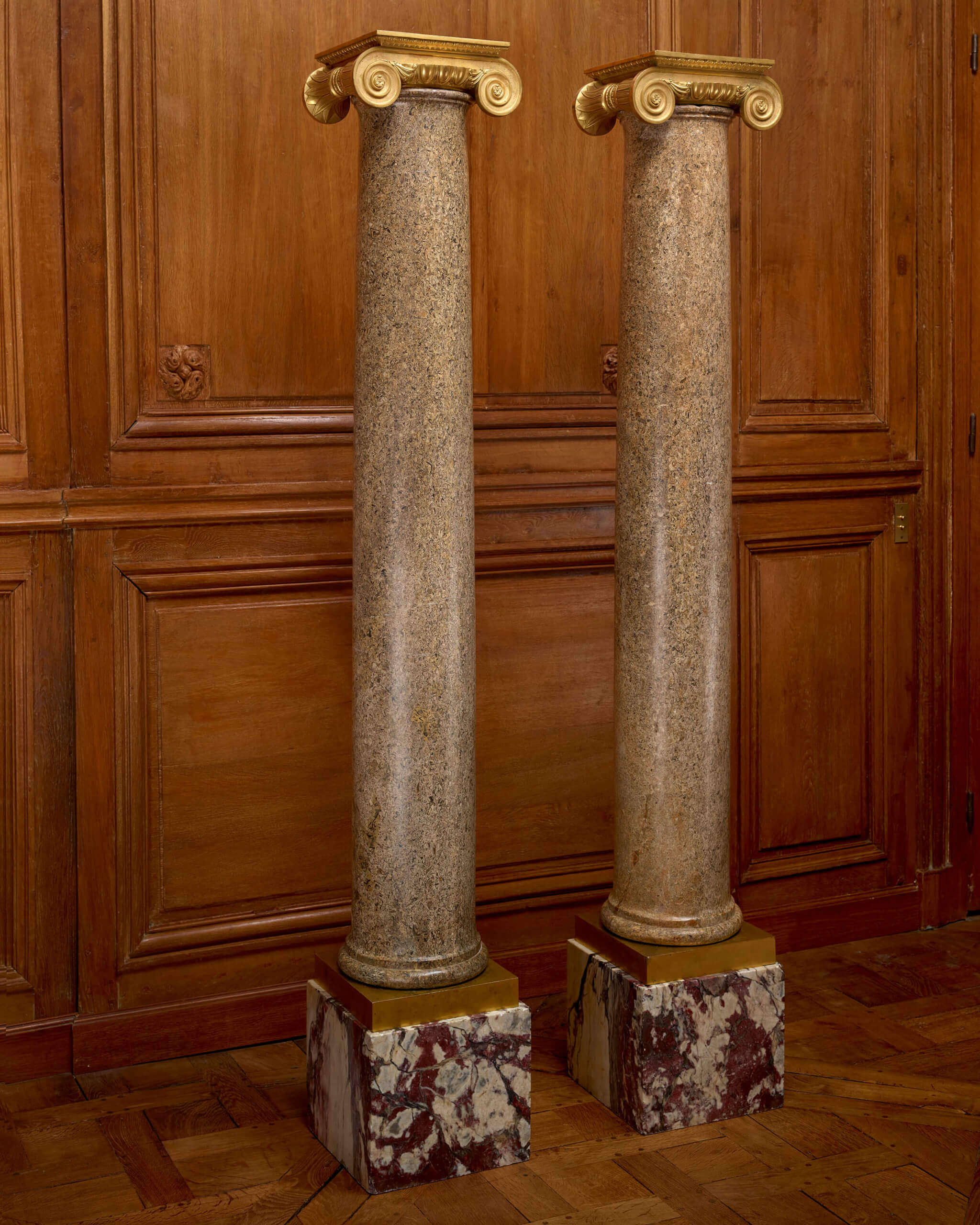
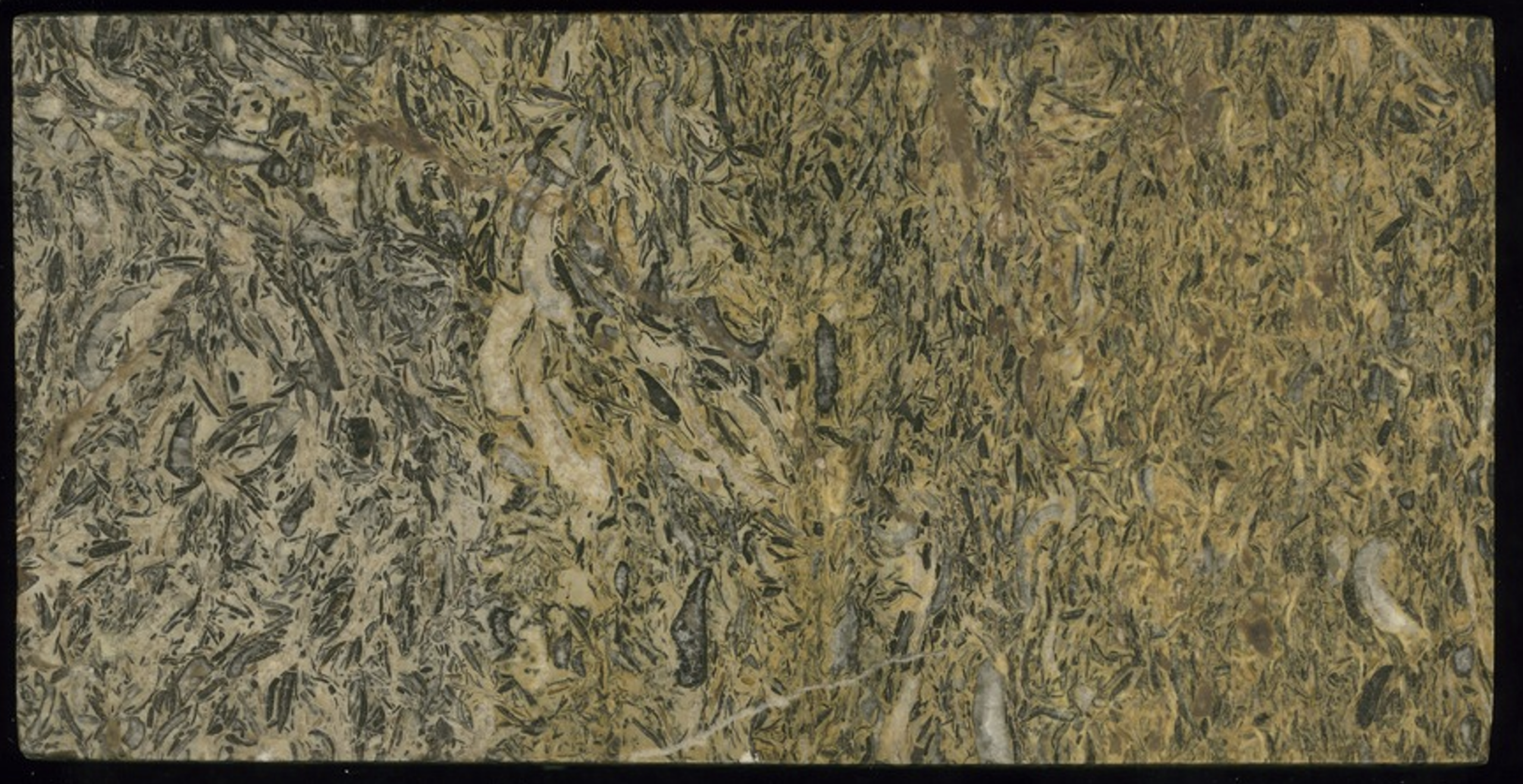
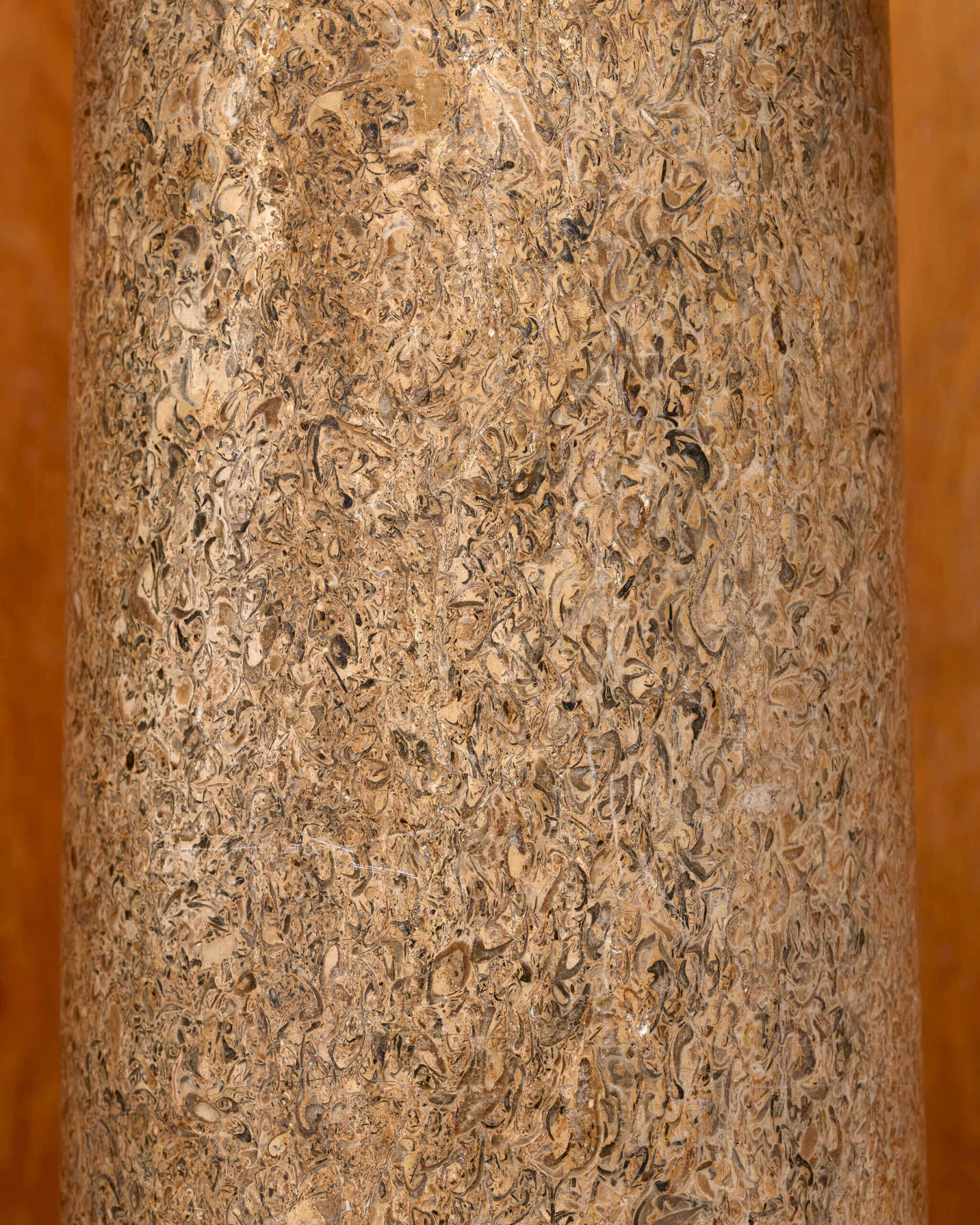
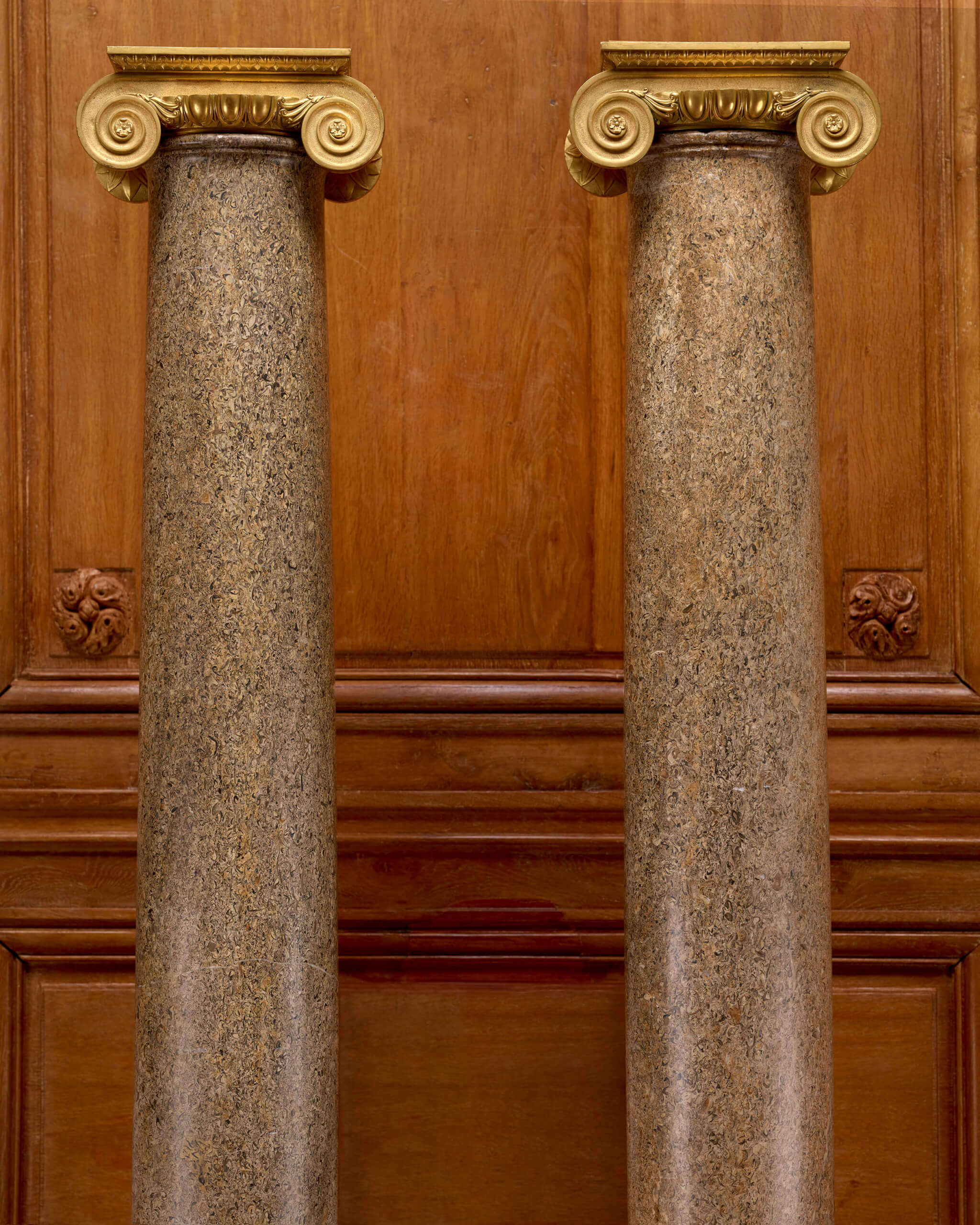
Colonnes : Lumachella orientale, également appelé lumachella antica ou lumachella minuta d’Egitto, carrière de Henchir Kasbat (ancienne Thuburbo Maius), en Tunisie. Ce calcaire mésozoïque, très rare, fut particulièrement prisé des scalpellini (tailleurs de pierre) de Rome,
Rome, époque de l’antiquité romaine (très certainement repolies à l’époque de la Renaissance).
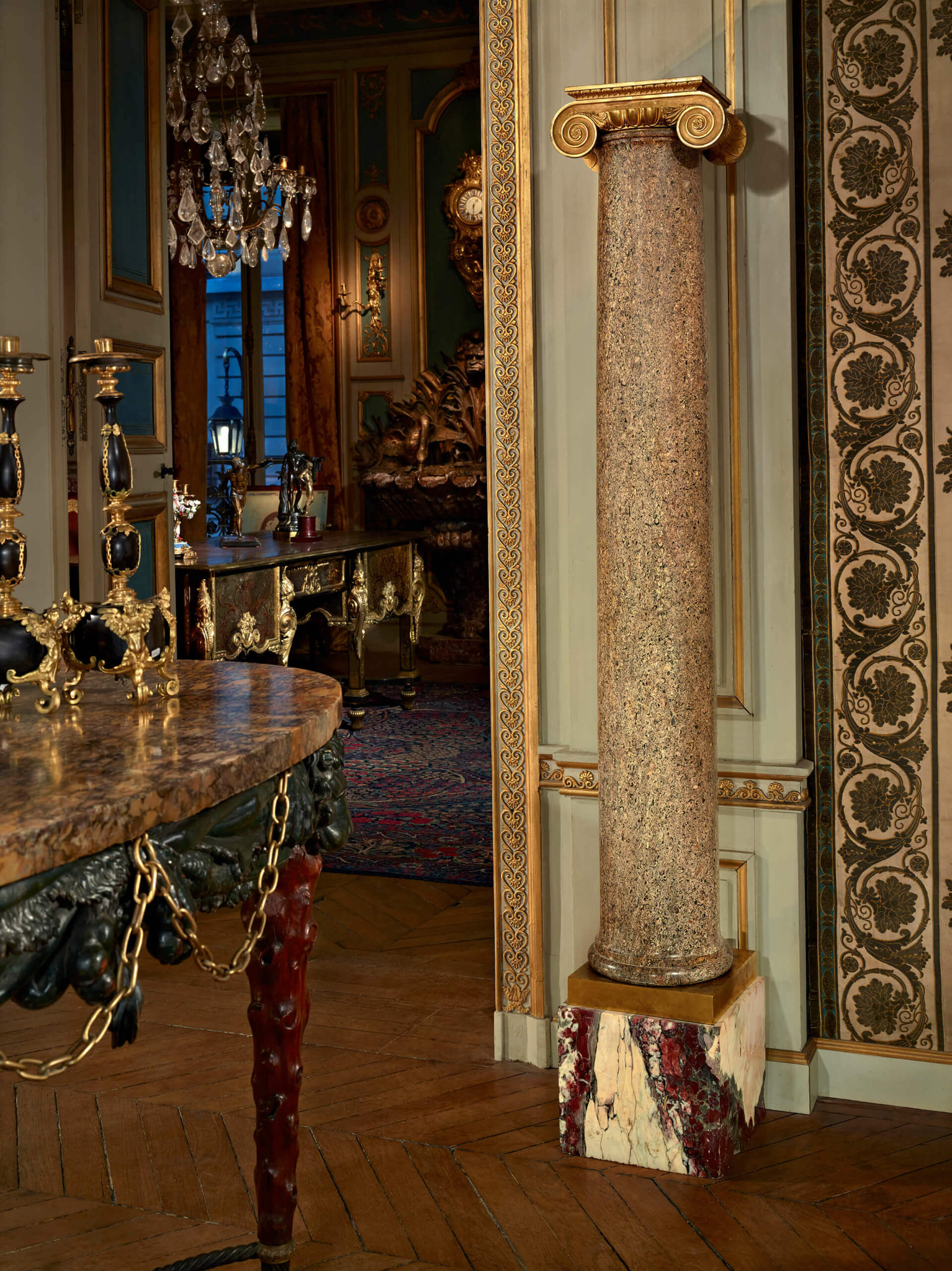
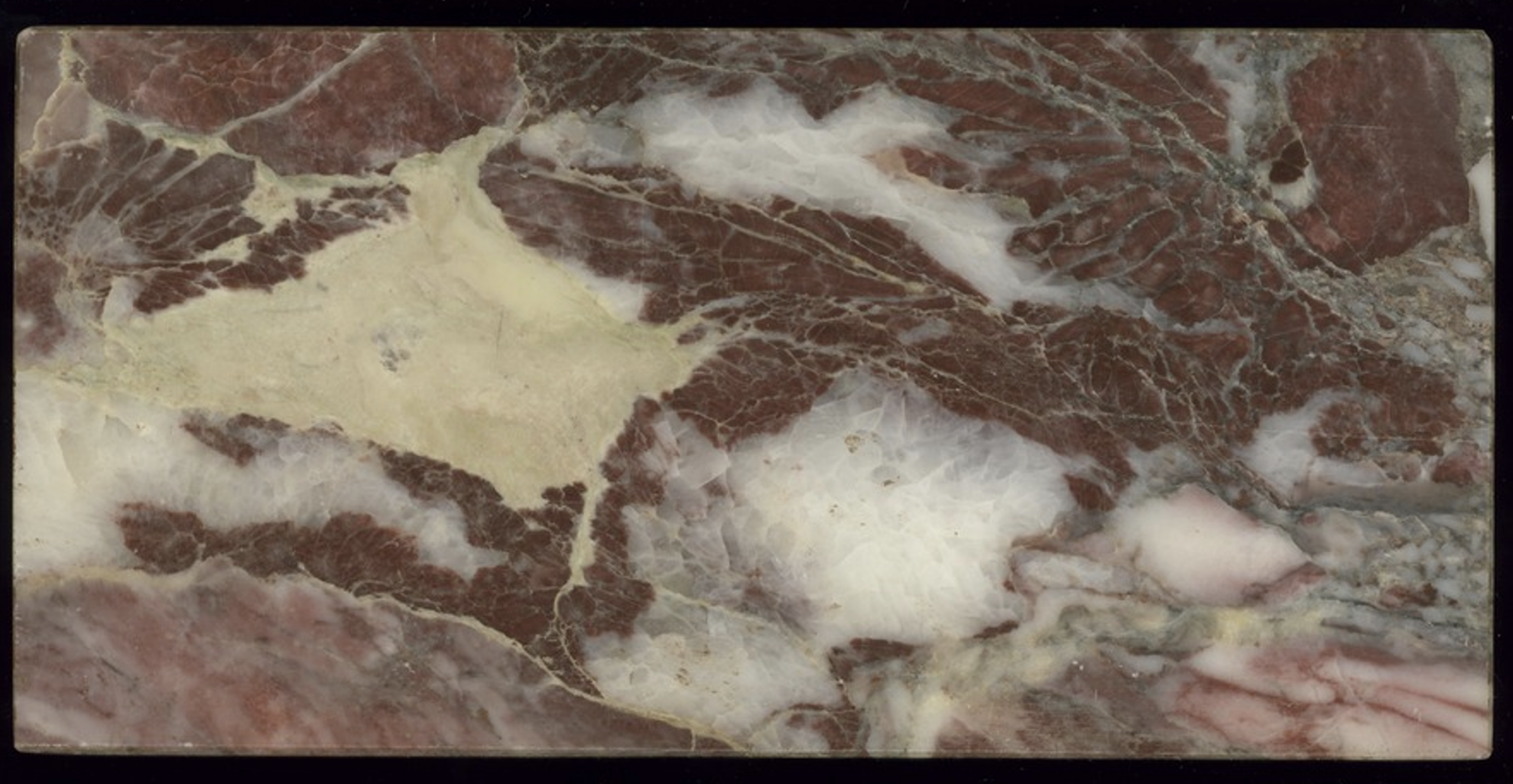
Base en bronze doré, plinthe en marbre Fior di pesco Apuano, en provenance des carrières de Toscane, et chapiteaux en bronze doré : France, époque néoclassique.
H. des colonnes antiques en lumachelle : 142.5 cm. (56 1/8 in.).
H. totale avec chapiteau : 155 cm. (61 in.).
Terrasse des chapiteaux en bronze doré : 23.7 x 23.7 cm. (9 3/8 x 9 3/8 in.).
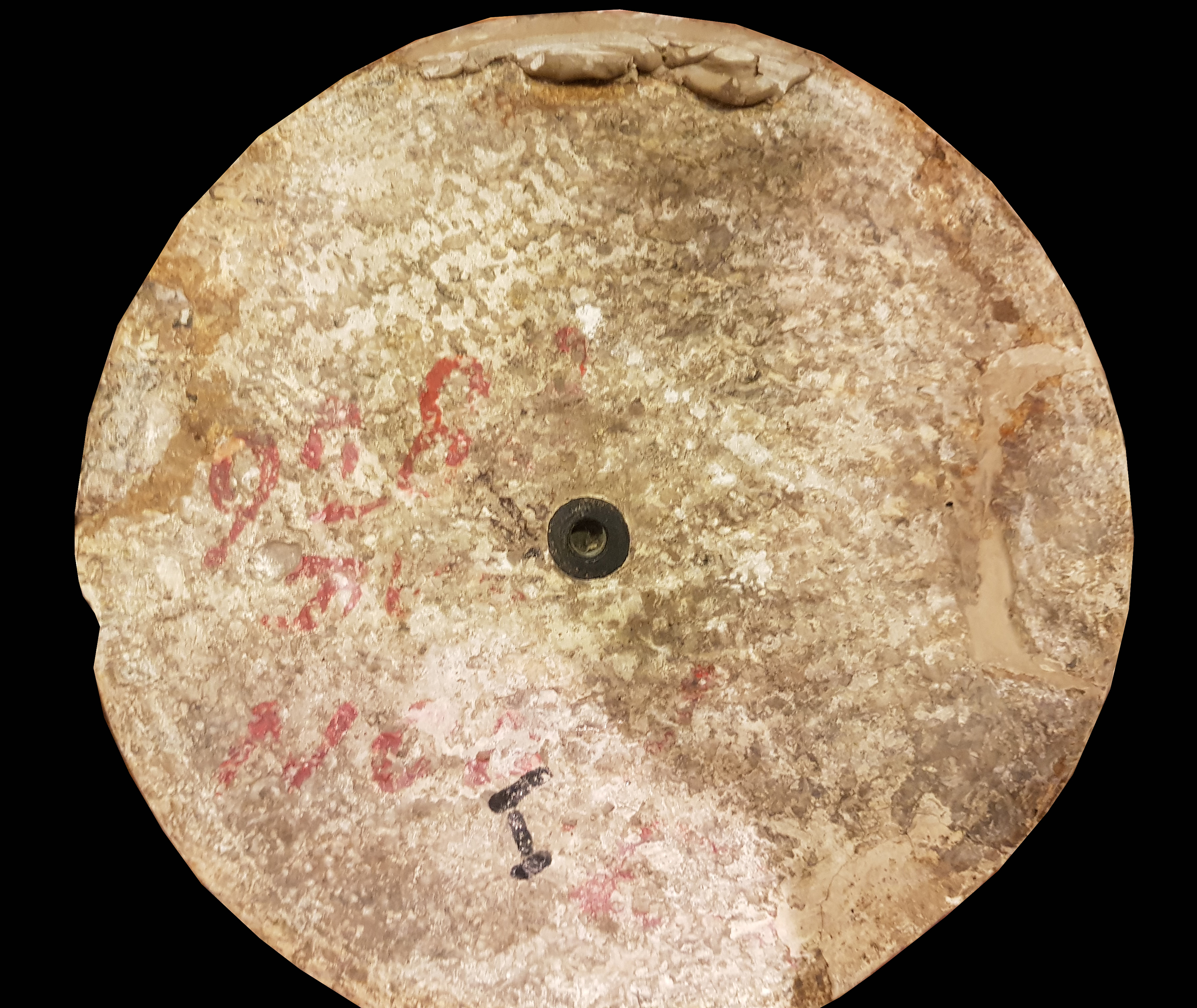
MARQUES ET INSCRIPTIONS : 928(?) / DE(?) / N(?), marques d’inventaire peintes en rouge sous le fût de l’une des deux colonnes ; I peint en noir au côté de la marque précédente.
PROVENANCE : collection privée.
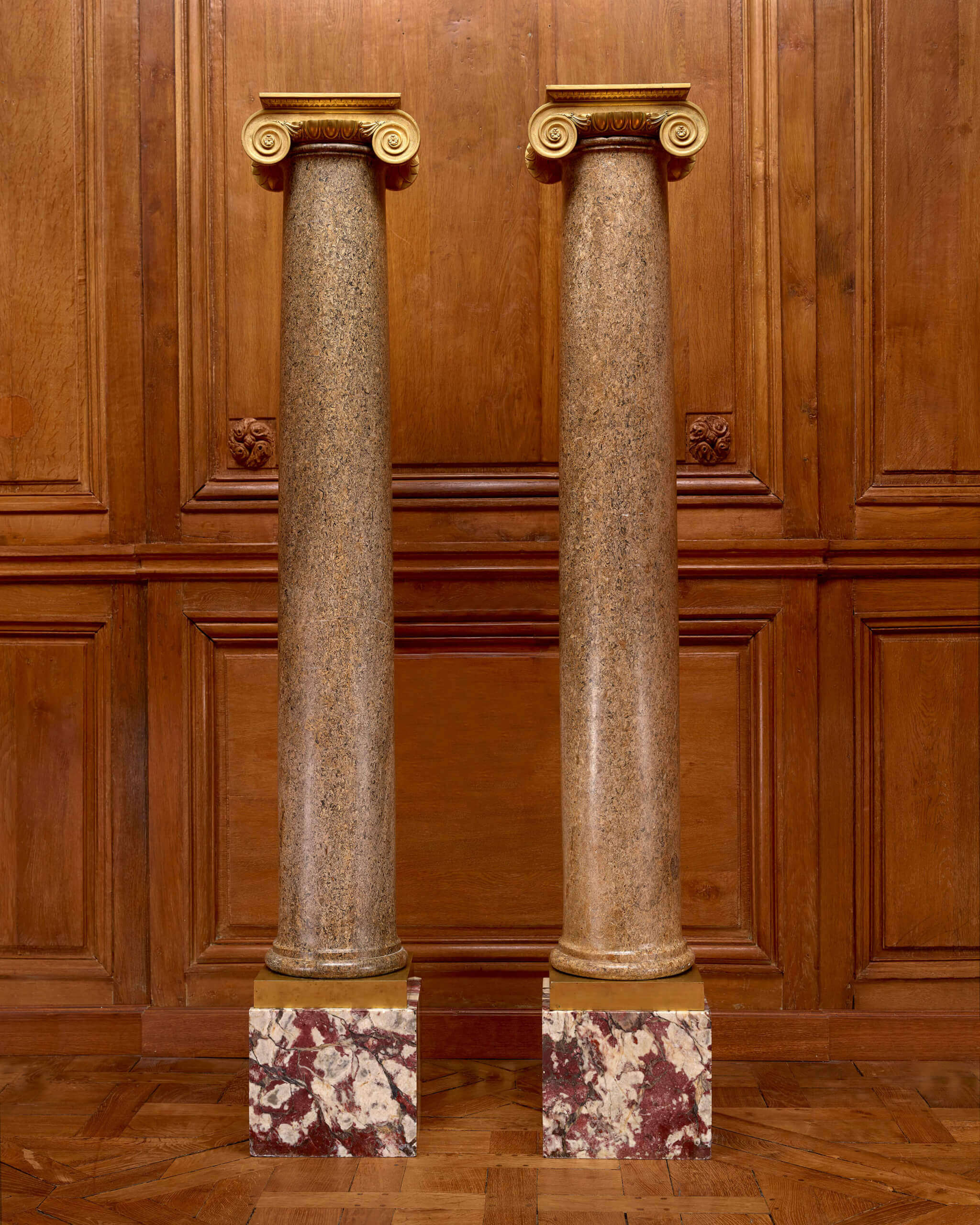
« Si le marbre lumachelle était plus rare, il serait certainement une des plus extraordinaires curiosités qu’il y ait au monde. Qu’on se figure une pâte de marbre pétrie avec des coquilles brisées et toutes sortes de débris d’animaux marins, habitants de l’ancien monde : le fonds de la pâte est noir, rougeâtre ou de couleur foncée ; et, sur ce fonds, se détachent en blanc les innombrables fragments de ces êtres primitifs, tranchés dans tous les sens par la scie, et se montrant bizarrement sous toutes leurs faces […] De là le nom de lumachelle, venant du nom italien lumaca, qui signifie limaçon. Les animaux dont on voit là les restes ne sont cependant pas des limaçons, mais des animaux marins d’espèces très variées, qui ne se retrouvent plus vivants dans le monde actuel, et dont nous ne possédons plus que les analogues […] Il existe un grand nombre de variétés de marbre lumachelle, différant les unes des autres, soit par le nombre et l’entassement des coquilles, soit par leur forme. Le marbre lumachelle antique, dont les carrières sont malheureusement perdues, est le plus beau », Le magasin pittoresque, vol. 6, 1838, p. 226.
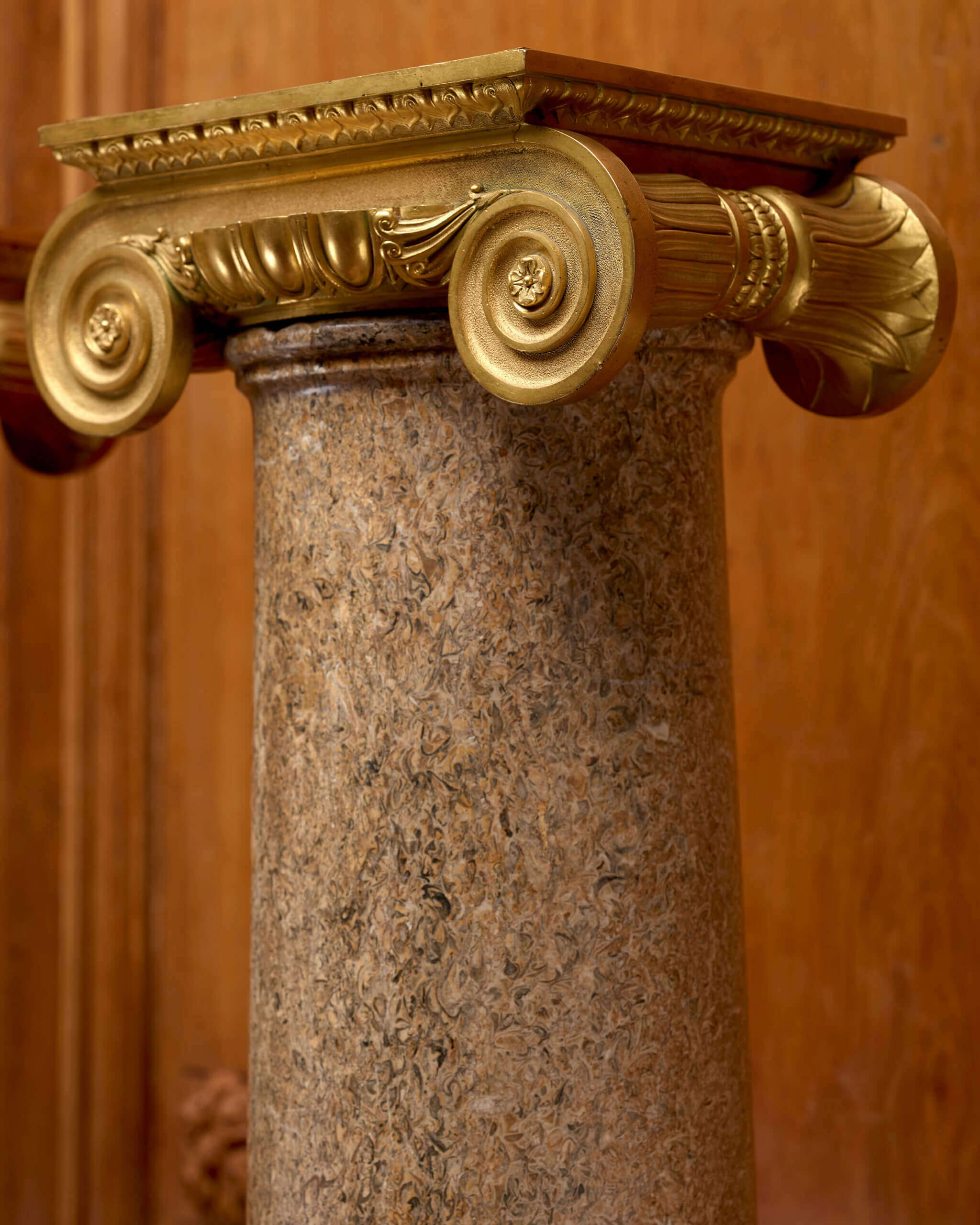
Chacune des colonnes présentée ici est composée d’un précieux fût très légèrement fuselée de 142.5 cm. de hauteur, à terminaisons moulurées sculptées dans la masse, en lumachella orientale, également appelé lumachella antica ou lumachella minuta d’Egitto, un calcaire mésozoïque, très rare et très prisé des scalpellini (tailleurs de pierre) de Rome, et dont les carrières situées sur le célèbre site d’Henchir Kasbat – ancienne Thuburbo Maius – en Tunisie, fermées aujourd’hui, furent exploitées sous l’antiquité romaine.
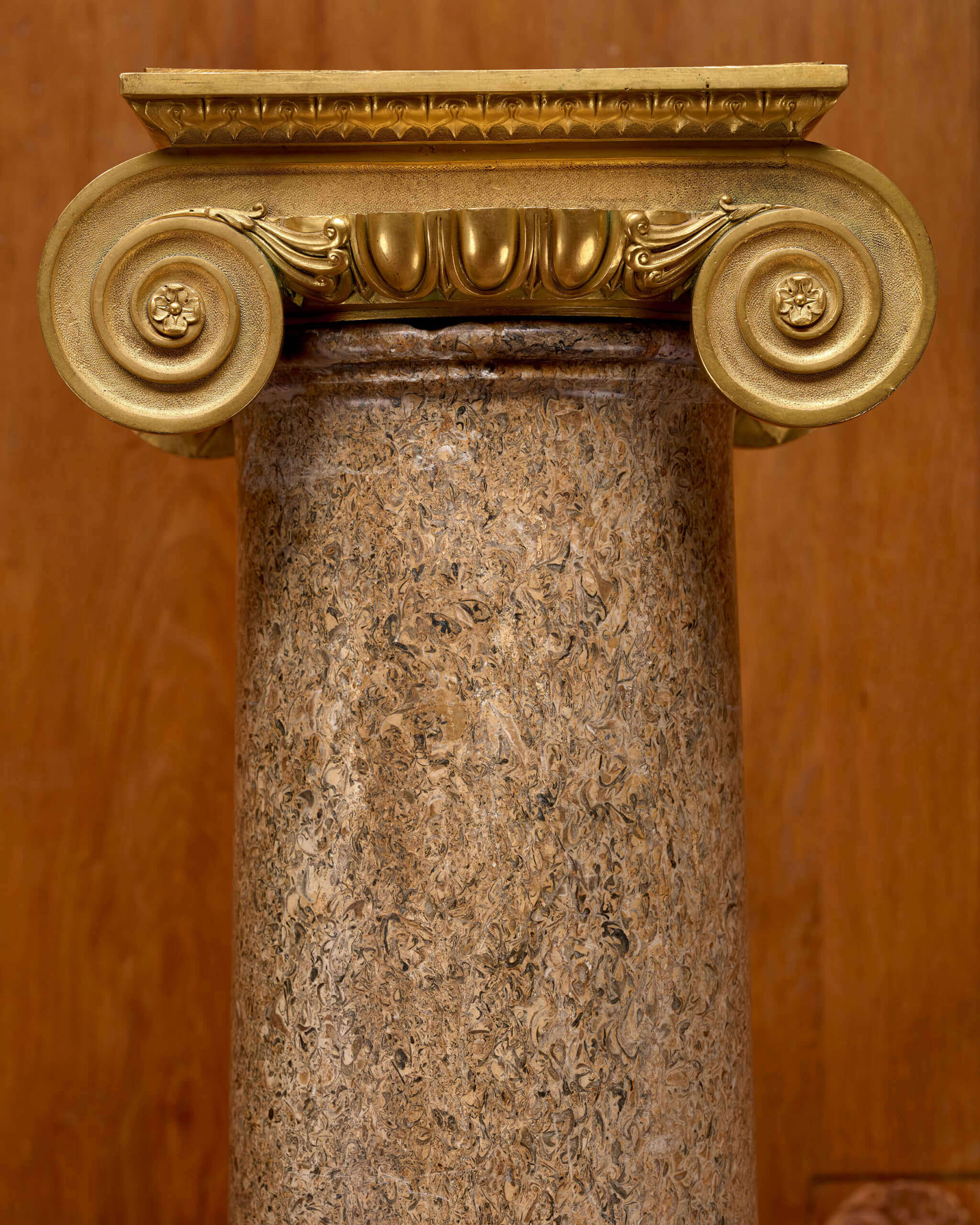
Ces colonnes antiques ont été montées en Italie à l’époque néoclassique, Elles reposent sur une base unie de section carrée en bronze doré, elle-même supportée par une plinthe carrée de vingt-cinq centimètres de hauteur en marbre Fior di pesco Apuano, en provenance des carrières de Toscane. Un imposant chapiteau ionique de bronze doré couronne chacune d’entre-elle. L’ensemble mesurant une hauteur totale de cent quatre-vingt centimètres.
De très rares exemples de colonnes similaires aux nôtres, figurèrent dans les collections Borghese à Rome. Une paire de ces colonnes fit partie des célèbres achats Borghese par Napoléon en 1807 : « Deux colonnes de lumaquelle orientale hautes 9 palmes = 6 pieds et demi avec bases et chapiteaux ioniques 3 000 ». Une deuxième paire, plus haute (14 palmes), bien que décrite, ne fut finalement pas acquise.
Les archives de cette célèbre acquisition, publiées dans le volume 1 de Les antiques Borghèse au musée Napoléon par Madame Marie-Louise Fabréga-Dubert, montrent en effet que :
– Dans le portique au rez-de-chaussée du casino de la villa Borghèse, se trouvaient deux paires de colonnes en lumachelle de tailles différentes.
– Visconti, qui avait été chargé par Dominique-Vivant Denon d’estimer la collection en vue de son acquisition par l’Empereur, en fixa respectivement les prix à 3 000 et 6 000 F.
La localisation de ces colonnes, légèrement plus grandes que les nôtres (environ 2 mètres, le grand palme romain mesurant 22.5 centimètres) – est aujourd’hui méconnue.
En effet lors de la mise en caisse à Rome des objets acquis, l’architecte Pierre-Adrien Pâris (1745-1819), nommé commissaire français par Emmanuel Crétet (1747-1809), ministre de l’Intérieur en charge des Beaux-Arts, pour enlever, mettre en caisse et expédier les objets acquis, dressa un état appelé « Etat des caisses ». C’est grâce à cet état, où chaque antique effectivement acquis se retrouva, que l’on peut aujourd’hui s’assurer de l’expédition effective de ces derniers. Croisé avec les multiples états de réception des caisses au musée du Louvre, il permet de suivre précisément ces précieux antiques jusqu’à leur arrivée. Mais il faut savoir que, les caisses ayant pour la plus grande majorité d’entre elles été stockées sans être ouvertes avant que les salles du musée soient vidées par les restitutions de 1815 (hormis les antiques les plus beaux bien entendu), c’est cet état des caisses qui servit tel quel à l’établissement de l’inventaire de 1815, lequel ne s’appuya donc pas réellement sur des antiques présents et fut donc par conséquent à la source d’un certain nombre de confusions.

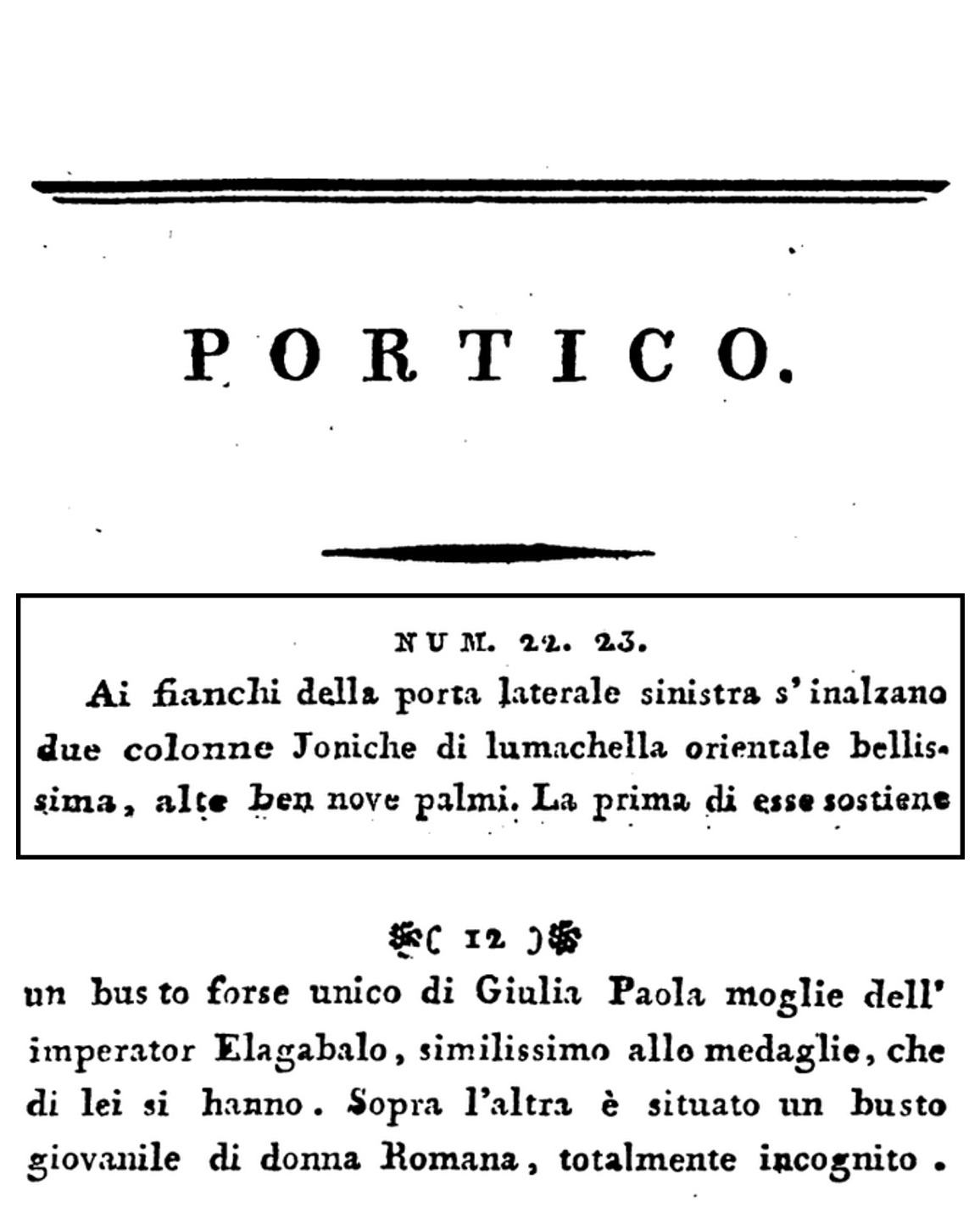
Or dans cet état des caisses ayant servi à Madame Marie-Louise Fabréga-Dubert à établir le catalogue des objets acquis (voir le volume 2 de son ouvrage susmentionné Les antiques Borghèse au musée Napoléon qui comprend 695 numéros), on ne retrouve aucune colonne de lumachelle. On peut imaginer sans peine la confusion qui dut régner sur place, à Rome, où étaient fabriquées les caisses devant servir aux antiques déposées sans doute un peu partout… Et selon toute vraisemblance, les deux colonnes de neuf palmes de haut ont été considérées comme restant sur place. Ce qui pose bien sûr la question de savoir ce qu’elles sont devenues.
Après la vente à Napoléon, le prince Camille Borghèse, en mémoire de son père, restaura la villa et reconstitua une nouvelle collection qu’il fit réinstaller dans les salles selon un parcours tout à fait semblable à celui du décor néoclassique. Cette nouvelle collection se composait de tout ce que les Français n’avaient pas acquis (notamment dans le décor des façades et du parc), d’antiques récupérés dans les diverses propriétés familiales ou récemment mis au jour dans de nouvelles fouilles, ainsi que d’acquisitions. Mais il semble qu’il ne réinstalla pas les colonnes en lumachelle dans le portique du casino.
L’histoire italienne de la fin du XIXe siècle finit par ruiner les grandes familles aristocratiques du pays, et les Borghèse n’échappèrent malheureusement pas à la règle : le parc fut vidé de tout ce qu’il renfermait encore par un antiquaire, et une grande vente fut organisée en 1893 au Pavillon de l’Horloge (ancien petit musée consacré aux antiques de Gabies se trouvant dans le parc de la villa) où du 13 au 24 mars fut mis aux enchères tout ce que possédait encore la famille à l’exception de ce qui constituait le décor intérieur de la villa qui avait été fort heureusement juridiquement protégé.
Ce catalogue de vente mentionne un seul numéro qui pourrait correspondre aux deux colonnes de lumachelle évoquées plus haut :

Nous pouvons remarquer que la mention bigio lumachellato ne semble pas incompatible avec la couleur de nos colonnes, mais que dire alors des dimensions ? …au vu de la très grande rareté des colonnes en lumachelle, la question mérite ici tout de même d’être posée, à savoir s’il n’existerait pas malgré tout un lien entre nos deux colonnes ici et celles des Borghese…