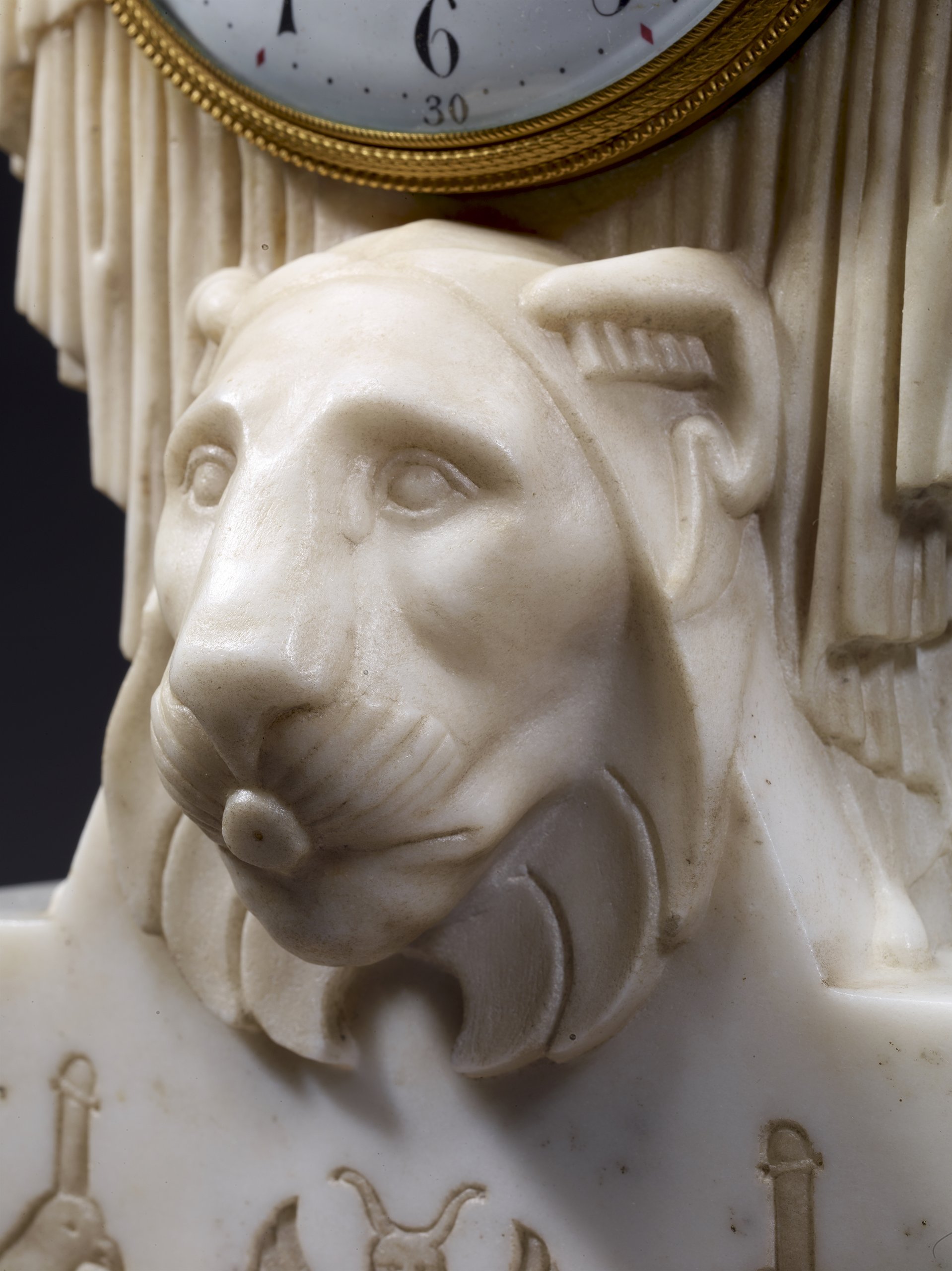
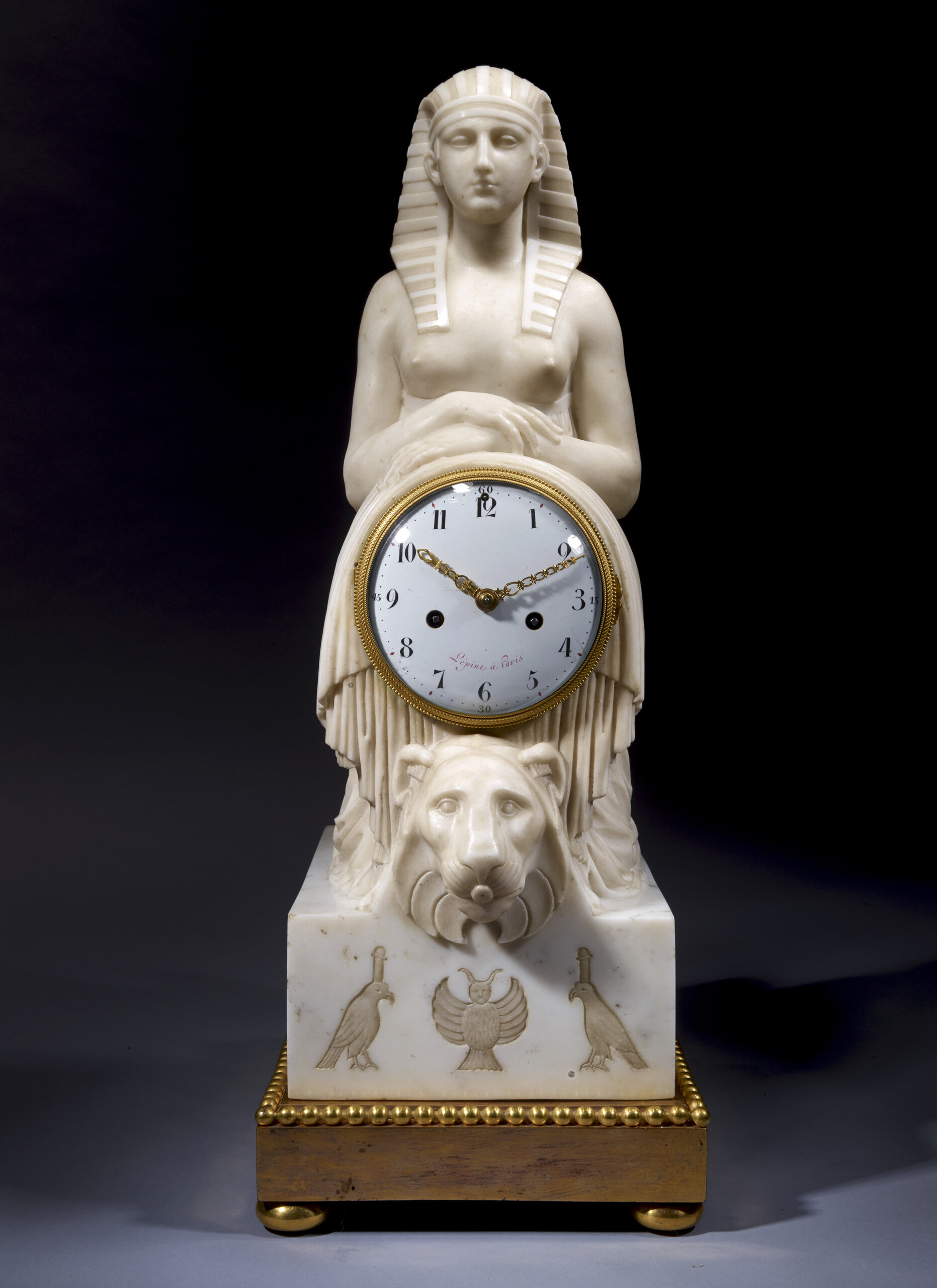
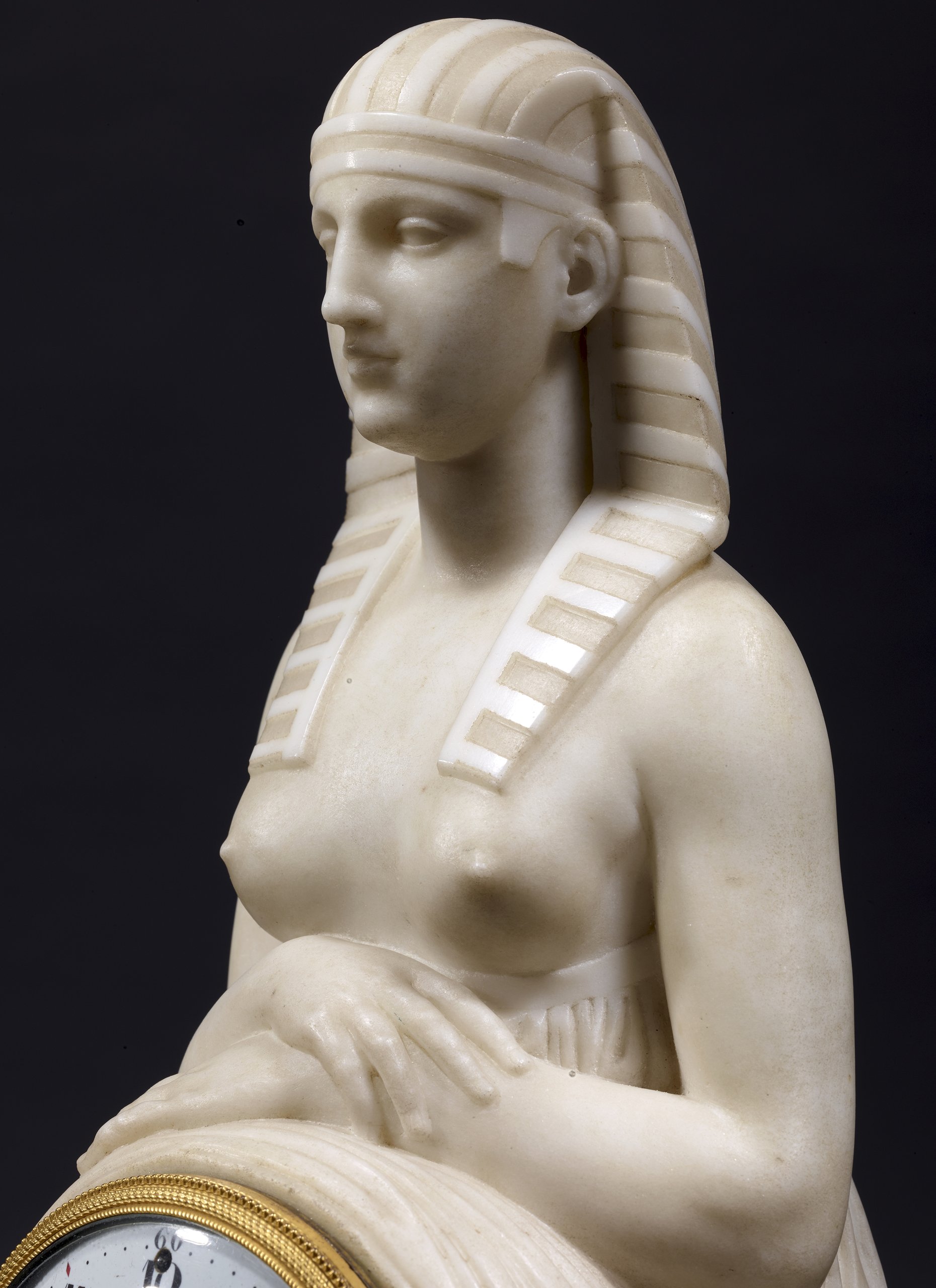
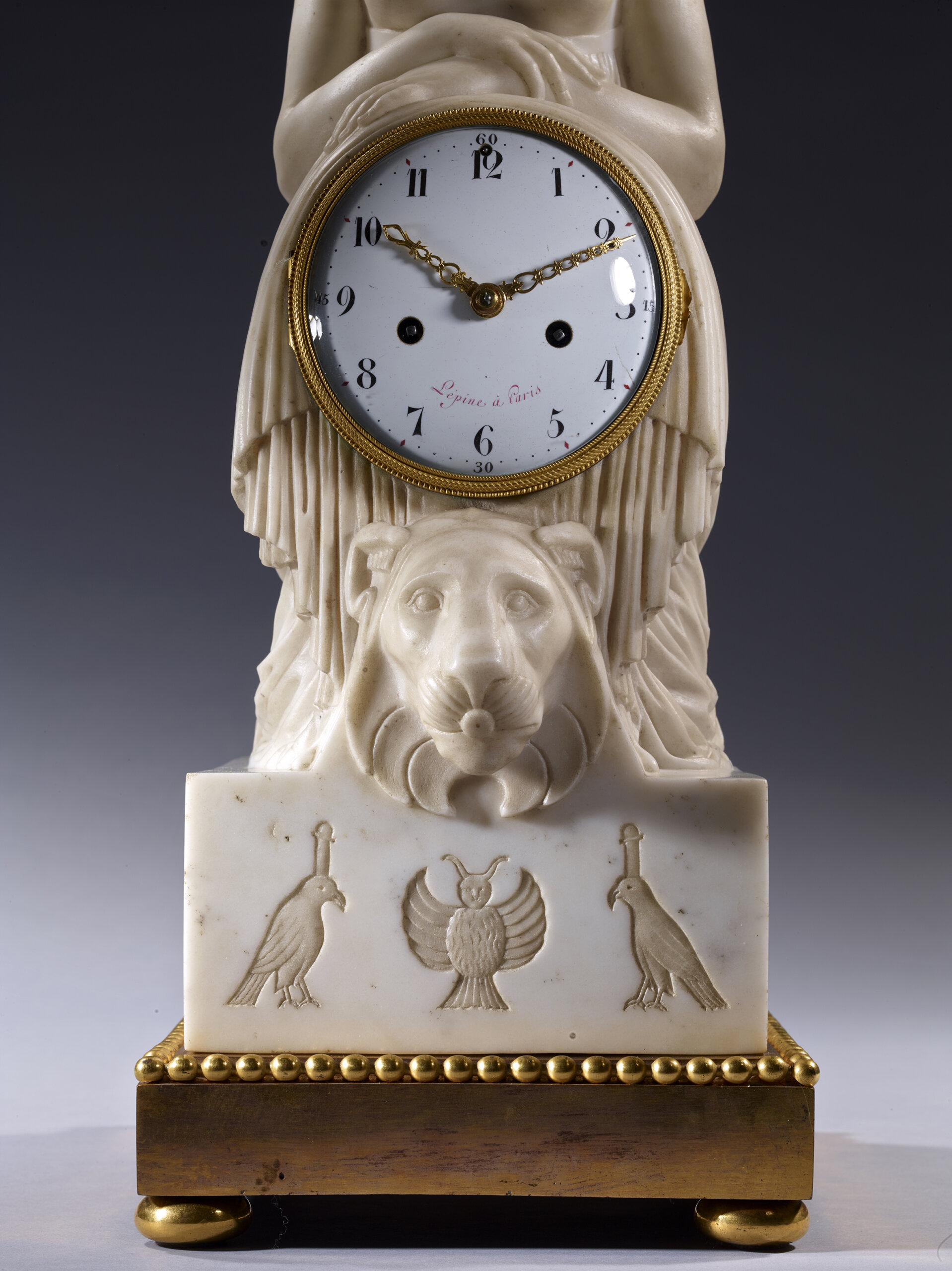
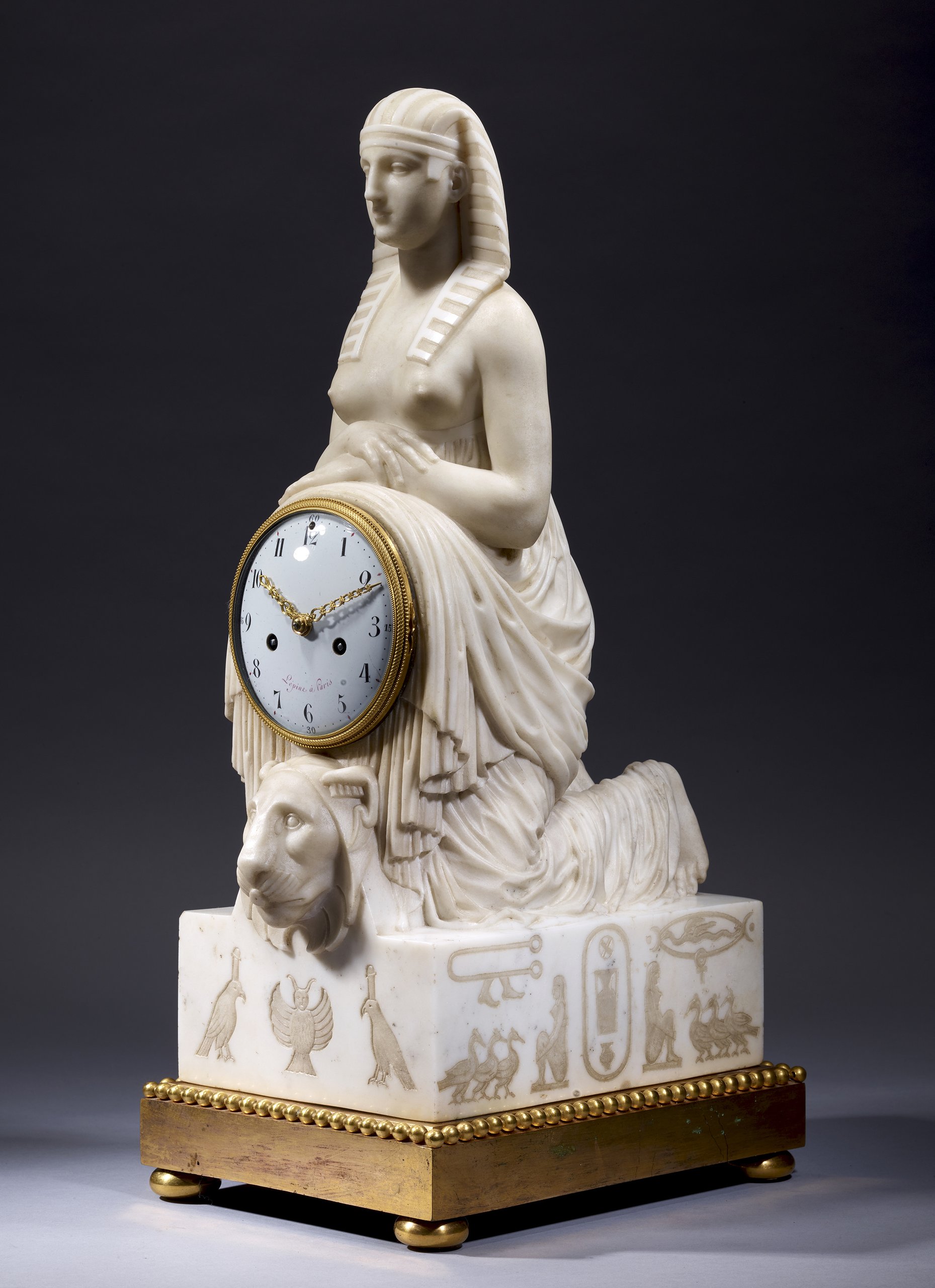
White marble; gilt bronze; enamel; metal; glass.
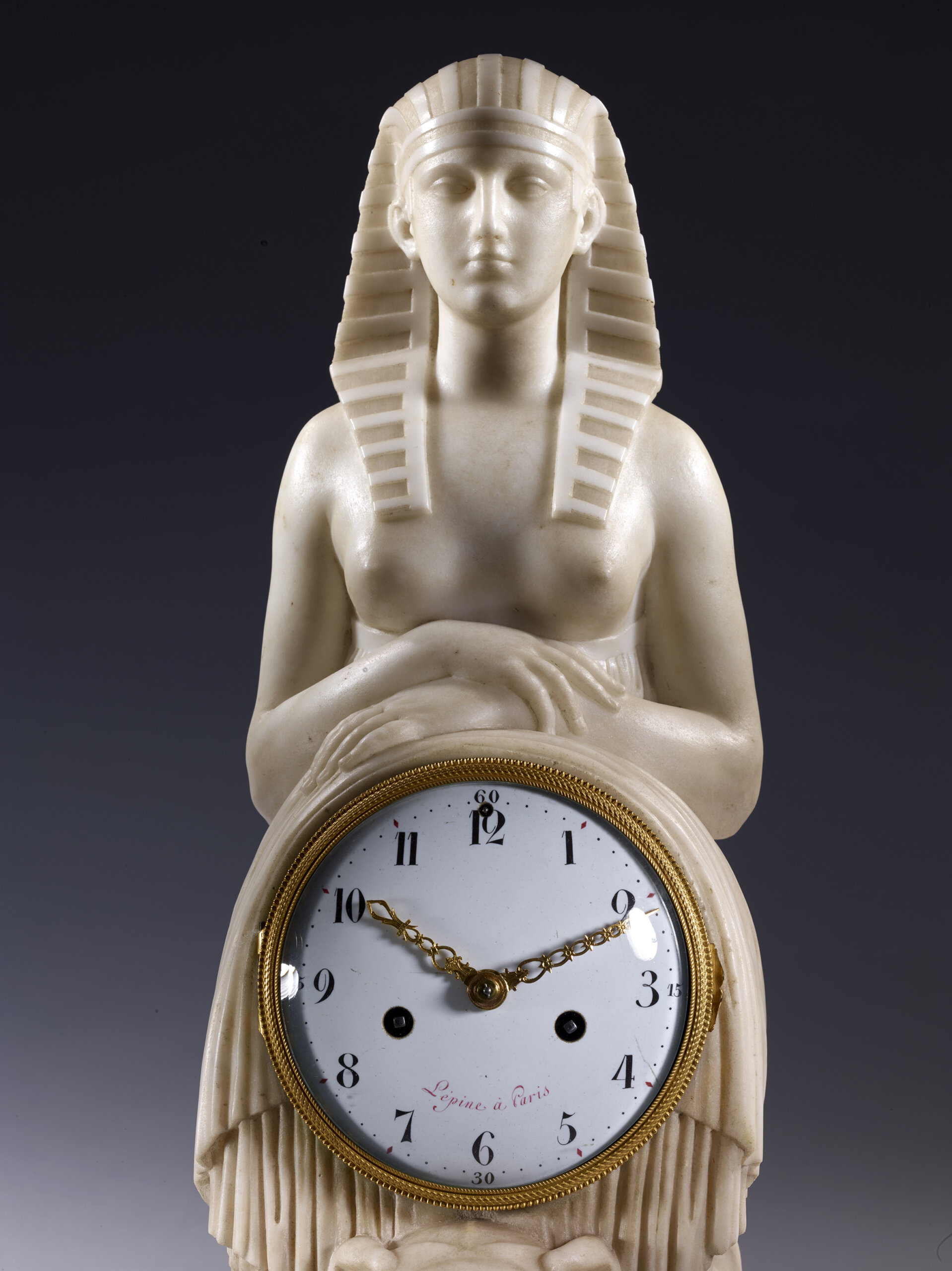
SIGNATURE: LEPINE A PARIS inscribed on the dial.
20 ½ in. high (52 cm.); 7 ½ in. wide (19 cm.); 10 ¼ in. deep (26 cm.).
PROVENANCE: private collection.
Jean-Antoine Lépine, born Jean-Antoine Depigny, was one of the greatest watchmakers of all time. He contributed inventions which are still crucial to watchmaking today and was amongst the finest French watchmakers, who were contemporary world leaders in the field.
From an early age, the clockmaker showed a keen interest in mechanics. He began his career in horology and quickly advanced, notably under the guidance of M. Decroze, a watchmaker based in Saconnex, on the outskirts of Geneva, Switzerland.
He settled in Paris in 1744 at the age of 24 and became an apprentice to André-Charles Caron (1698–1775), at that time clockmaker to Louis XV. In 1756 he married Caron’s daughter and entered into partnership with him, under the name “Caron et Lépine”, from 1756 to1769. No watch signed “Caron et Lépine”, or bearing an equivalent signature, is known to date; it seems that Lépine retained a degree of independence. As the earliest watches were not numbered, it is difficult to establish when Lépine began signing the movements “Lépine à Paris” and, occasionally, the dials “L’Epine à Paris”.
On 12 March 1762 he became maître horloger (master watchmaker). It was probably from that same year that he began teaching horology to Abraham-Louis Breguet, with whom he maintained business relations for many years. Breguet’s archives record numerous watches supplied by Lépine.
In 1765 or 1766 (the exact date is unknown) he was appointed Horloger du Roi (Clockmaker to the King). In 1766 he succeeded Caron and appeared in that year’s directory of Parisian clockmakers under the name Jean-Antoine Lépine, “Hger du Roy”, rue Saint Denis, place Saint Eustache. Ten years later, in 1772, he moved to place Dauphine, and then, in 1778-1779, to quai de l’Horloge du Palais. In 1781, he established himself at rue des Fossés-Saint-Germain-l’Auxerrois, near the Louvre, before moving to 12 place des Victoires in 1789. In 1782, his daughter Pauline married one of his workers, Claude-Pierre Raguet (1753–1810), with whom Lépine entered into partnership in 1792.
For a time, he was also associated with the philosopher Voltaire, at his watchmaking manufactory founded at Ferney in 1770. Lépine’s exact role in the manufactory is unknown; he may have been its technical director and/or one of its partners. However, most ébauches for his watches were produced there, at least between 1778 and 1782. An anonymous memoir dating from 1784 states that Lépine spent eighteen months at Ferney, where he had watch movements manufactured to a value of 90,000 livres per year.
It is hardly surprising that Lépine, clockmaker to Louis XV, Louis XVI and Napoleon Bonaparte, enjoyed great renown.
In 1793–1794, as his failing eyesight no longer allowed him to work, Lépine transferred the “Maison Lépine” to his son-in-law, Claude-Pierre Raguet, who had been a partner in the business since 1792. Following Raguet’s death in 1810, his son Alexandre Raguet-Lépine took over the business. Jean-Antoine Lépine remained active in the firm until his death in 1814, at his home on rue Sainte-Anne in Paris.
The firm was sold to Jean-Paul Chapuy in 1815. He employed Jacques Lépine, Jean-Antoine’s nephew, who worked for the firm from 1814 to 1825 and had been appointed clockmaker to the King of Westphalia, in Germany, in 1809. In 1827, the firm was sold to Deschamps, who was succeeded by Fabre (Favre) in 1832. It then passed to Boulay in 1853, and to Roux, Boulay’s son-in-law, in 1885. Ferdinand Verger acquired it in 1901. The final acquisition took place in 1914, after which the remaining stock was bought by Louis Leroy in 1919. The firm nevertheless continued to operate under the name Lépine.
Several of Lépine’s clocks and watches are now on display in European museums and palaces. His creations rank among the most remarkable in the history of horology.