PROVENANCE: Collection of Edward George Villiers Stanley (1865-1948), 17th Earl of Derby, and his wife, Alice Maud Olivia Montagu (1862-1957), Countess of Derby, daughter of the 7th Duke of Manchester, and Lady of the Bedchamber to Queen Alexandra of Denmark (1844-1925), consort of King Edouard VII of England (1841-1910) from 1901 to 1910, in their residence at Coworth Park, Sunningdale, near Ascot, in the Royal County of Berkshire, close to Windsor Castle, southwest of London; Sold in the postmortem auction of the Countess of Derby: Catalogue of the contents of Coworth Park, Sunningdale, Berks., sold by order of the beneficiaries of the late Alice, Countess of Derby, including old pictures and engravings, English and French 18th century furniture, decorative China and dinner services, a fine Savonnerie carpet, eastern rugs and carpets, and the household furnishings and appointments, Christie, Manson & Woods, in London, on 14th and 15th October 1957, lot n° 127.
Collection of Lady Rosemary Margaret d’Avigdor-Goldsmid (1910-1997), née Nicholl, wife of Sir Henry Joseph d’Avigdor-Goldsmid (1909-1976), 2nd Baronet; sold at Sotheby’s in London, on 10th July 1998, lot n° 11, acquired at the auction by Ann et Gordon Getty.
Collection of the renowned philanthropist, publisher and paleoanthropologist Ann Getty (1941-2020), née Gilbert, and her husband, American oil magnate américain Gordon Peter Getty (born 1933), in New York.Gilbert, et de son époux, le magnat américain du pétrole Gordon Peter Getty (né en 1933), à New York.
COMPARATIVE LITERATURE: Peter Ward-Jackson, English furniture designs of the eighteenth century, London, 1958, p. 39, fig. 48; Christopher Gilbert, Furniture at Temple Newsam House and Lotherton Hall, 2 vols., 1978, vol. II, p. 353-356, cat. n°. 446; The Treasure houses of Britain: five hundred years of private patronage and art collecting, exhibition catalogue, Washington, 1985, p. 234, cat. n°. 155 (entry by Gervase Jackson-Stops); Geoffrey Beard and Judith Goodison, English Furniture 1500-1840, London, 1987, p. 100, fig. 3; Lanto Synge, Mallett’s Great English Furniture, London, 1991, p. 91, fig. 98.; Peter Thornton, “Soane’s Kent Tables”, Furniture History, vol. XXIX, 1993, p. 59-65.

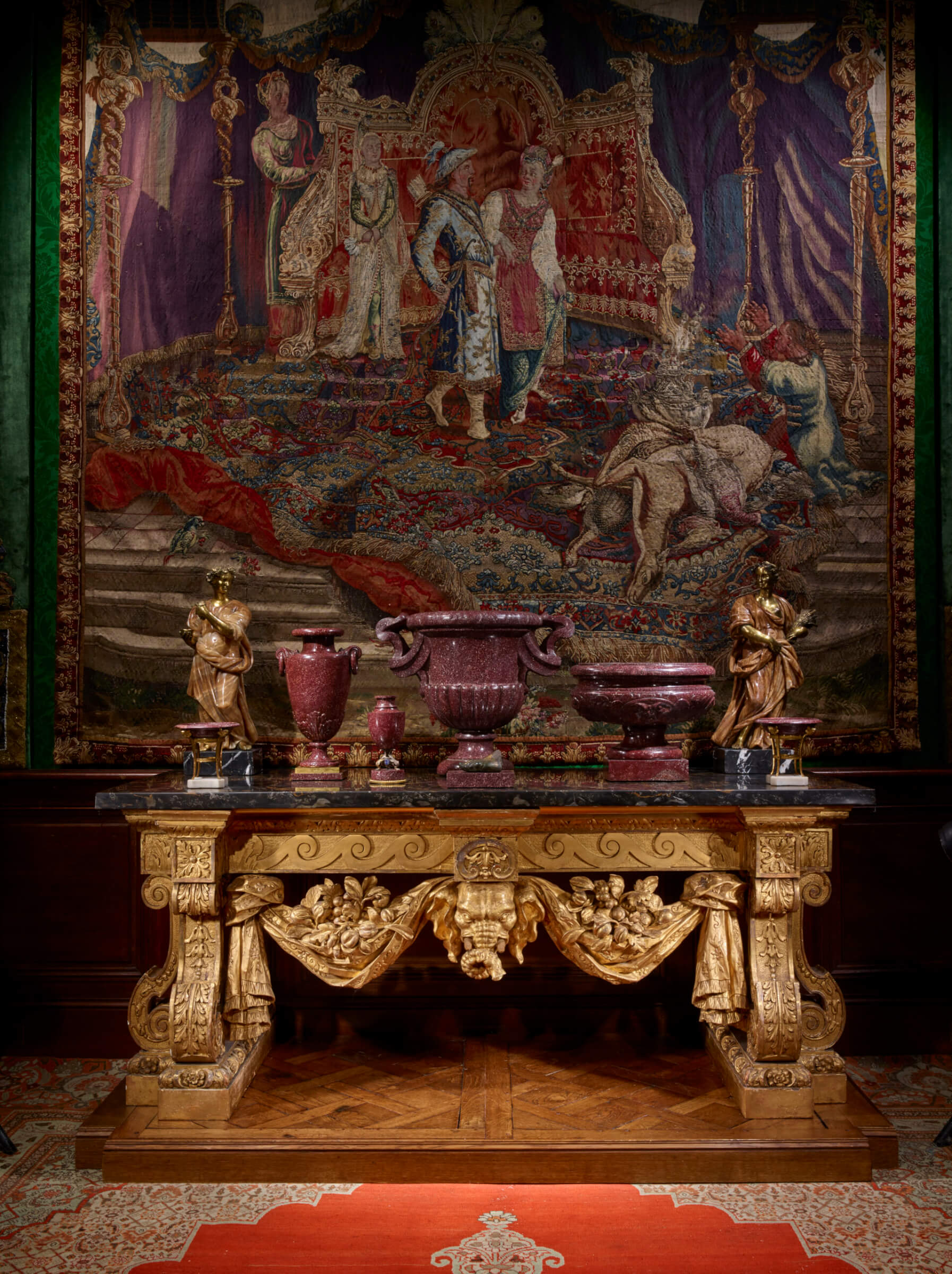
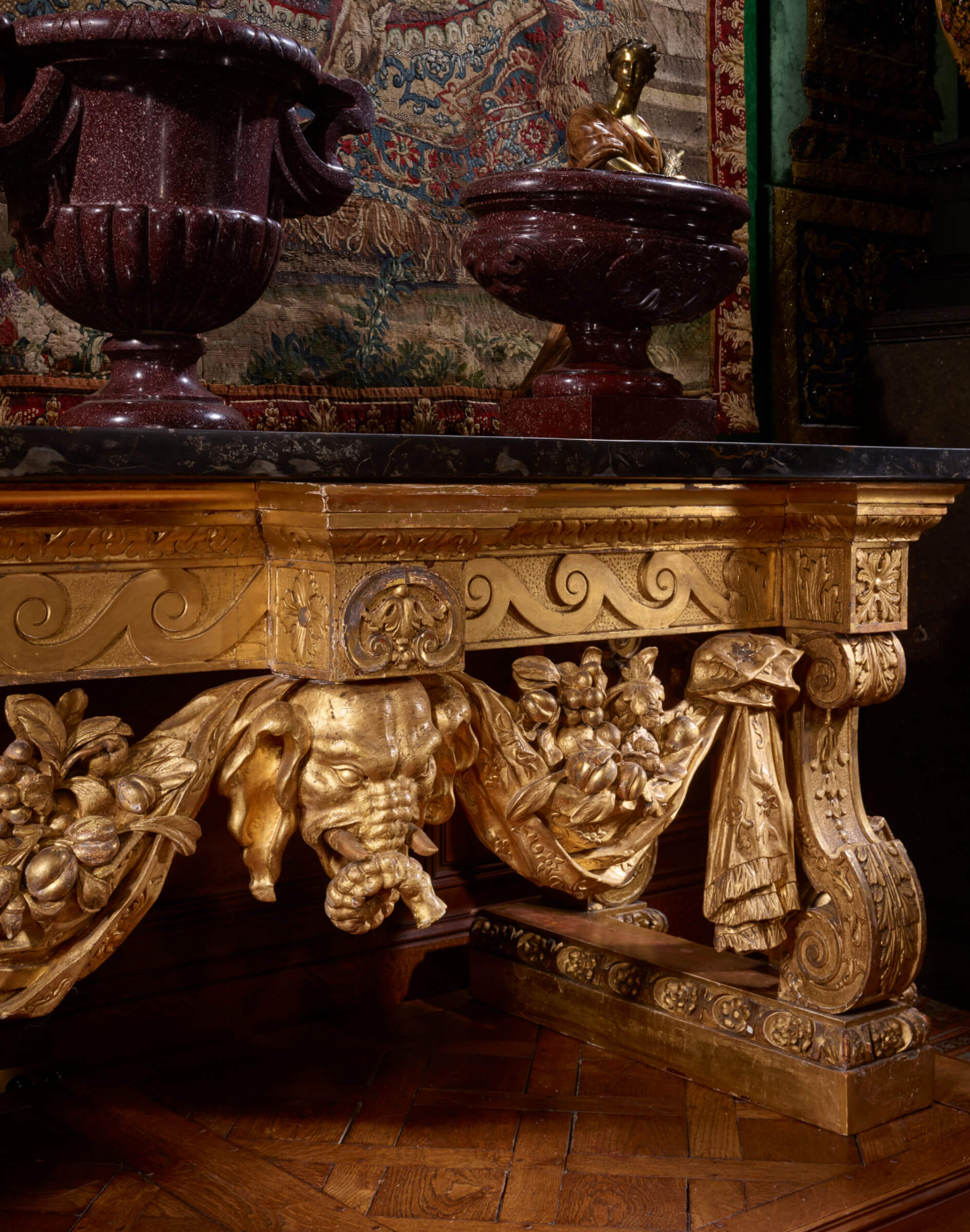
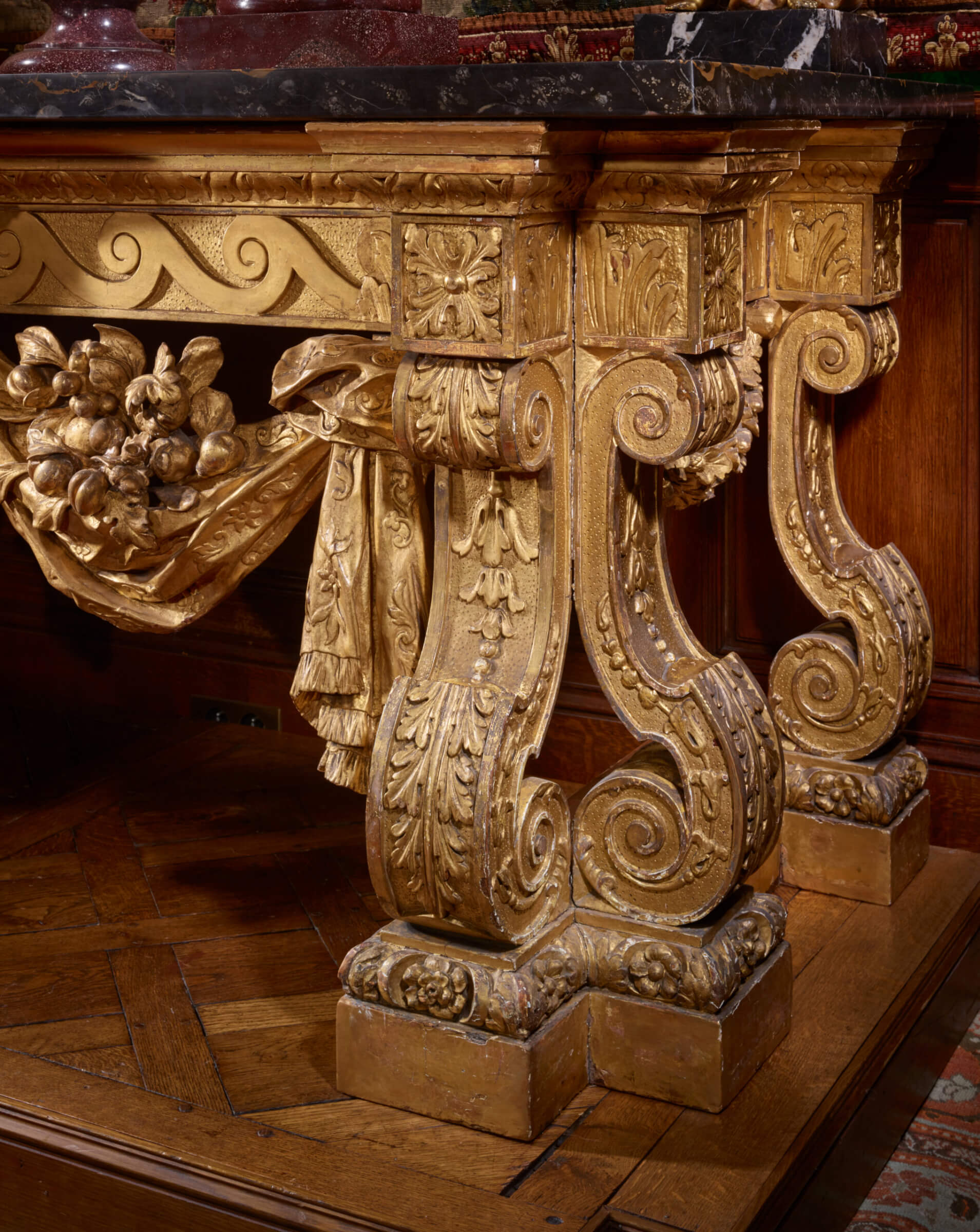
This console table in moulded, carved and oil-gilded pine, with impressive proportions and a highly architectural design, was made around 1740 by the renowned London cabinet-maker, sculptor and designer Matthias Lock (circa 1710–1765), from designs by the architect Henry Flitcroft (1697-1769), a major figure of Neo-Palladianism in England during the first half of the 18th century, who was noted for his talent as a draughtsman by Richard Boyle, 3rd Earl of Burlington, known as the “Architect Earl” and the “Apollo of the Arts”, who appointed him to his service and ensured his training.
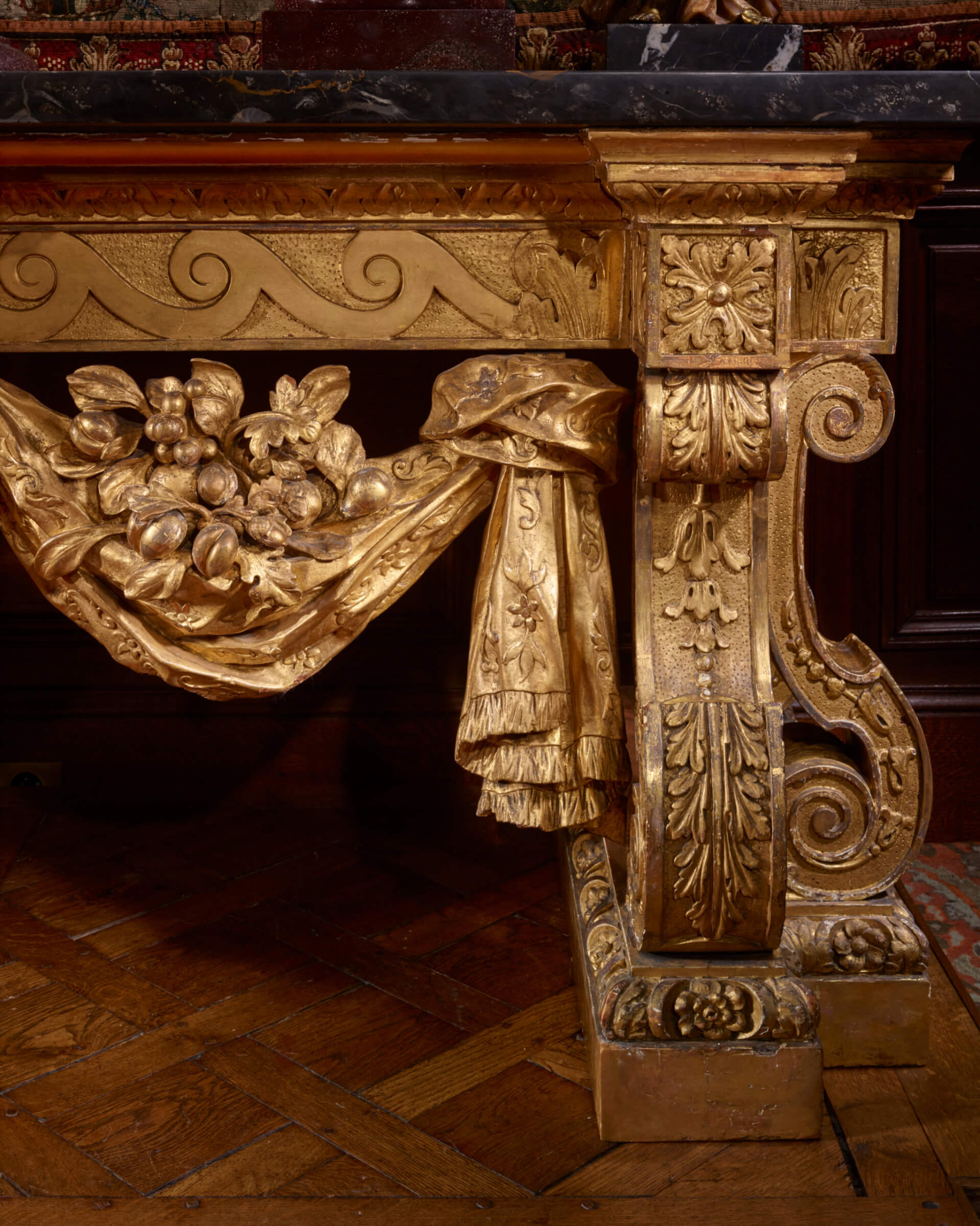
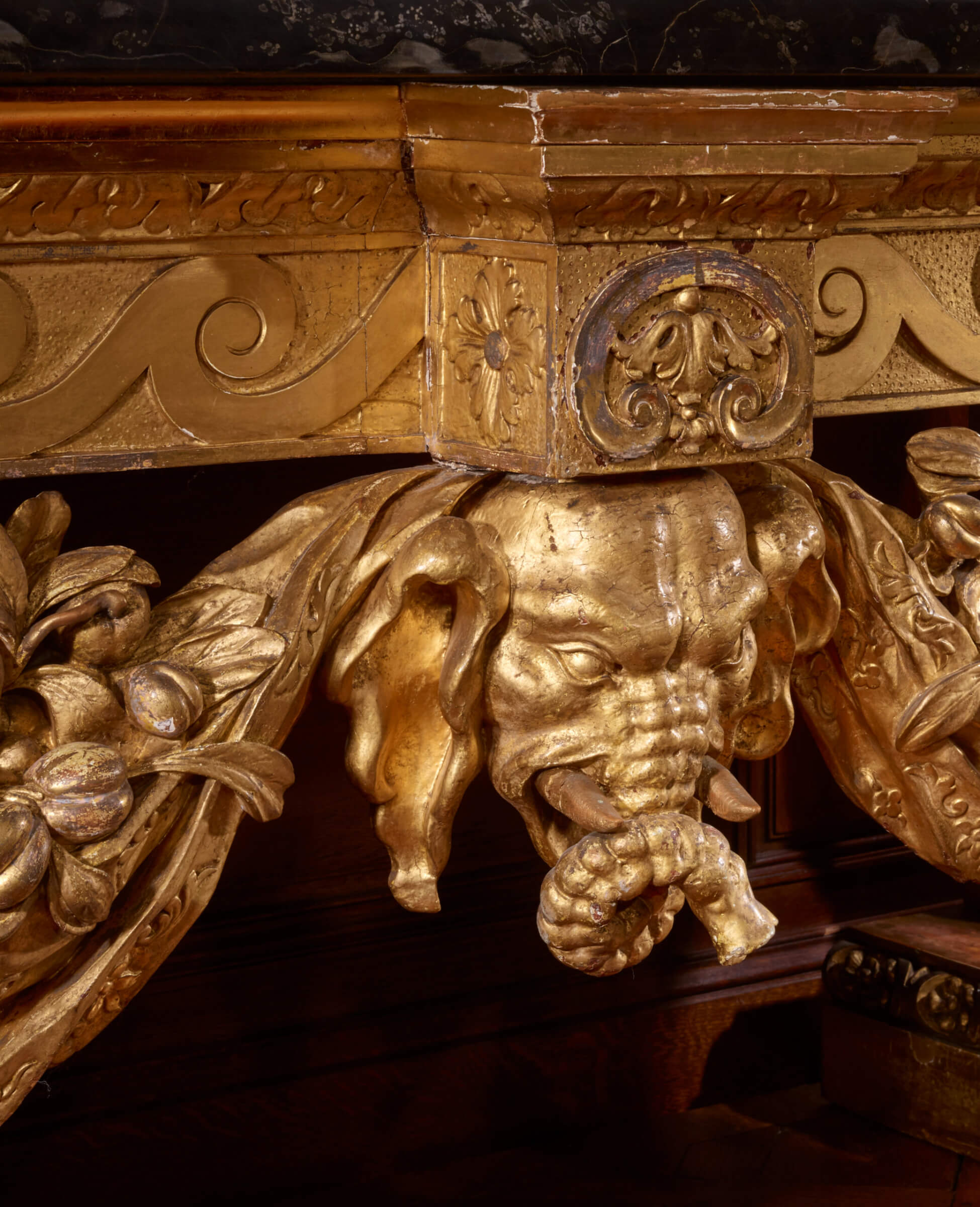
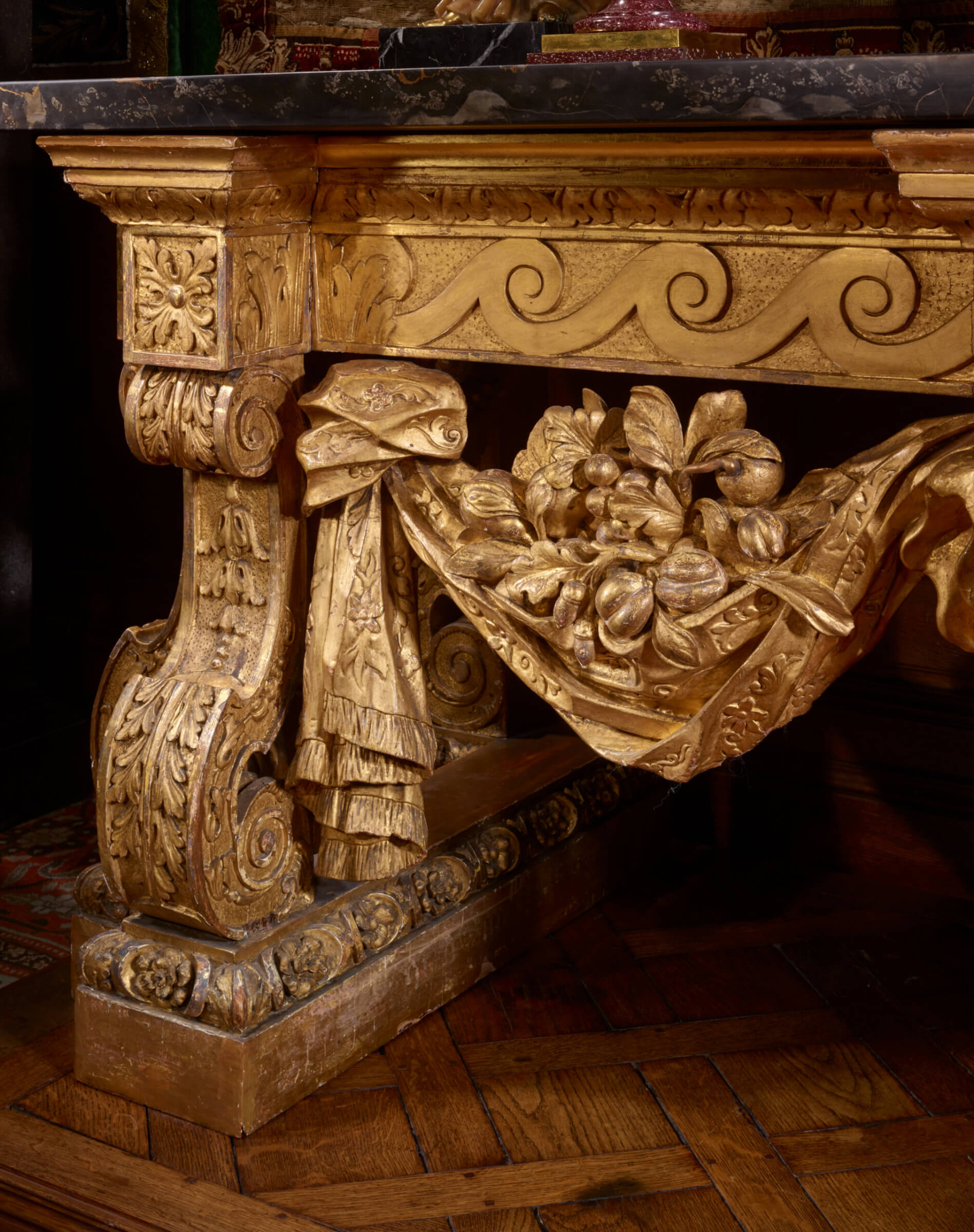
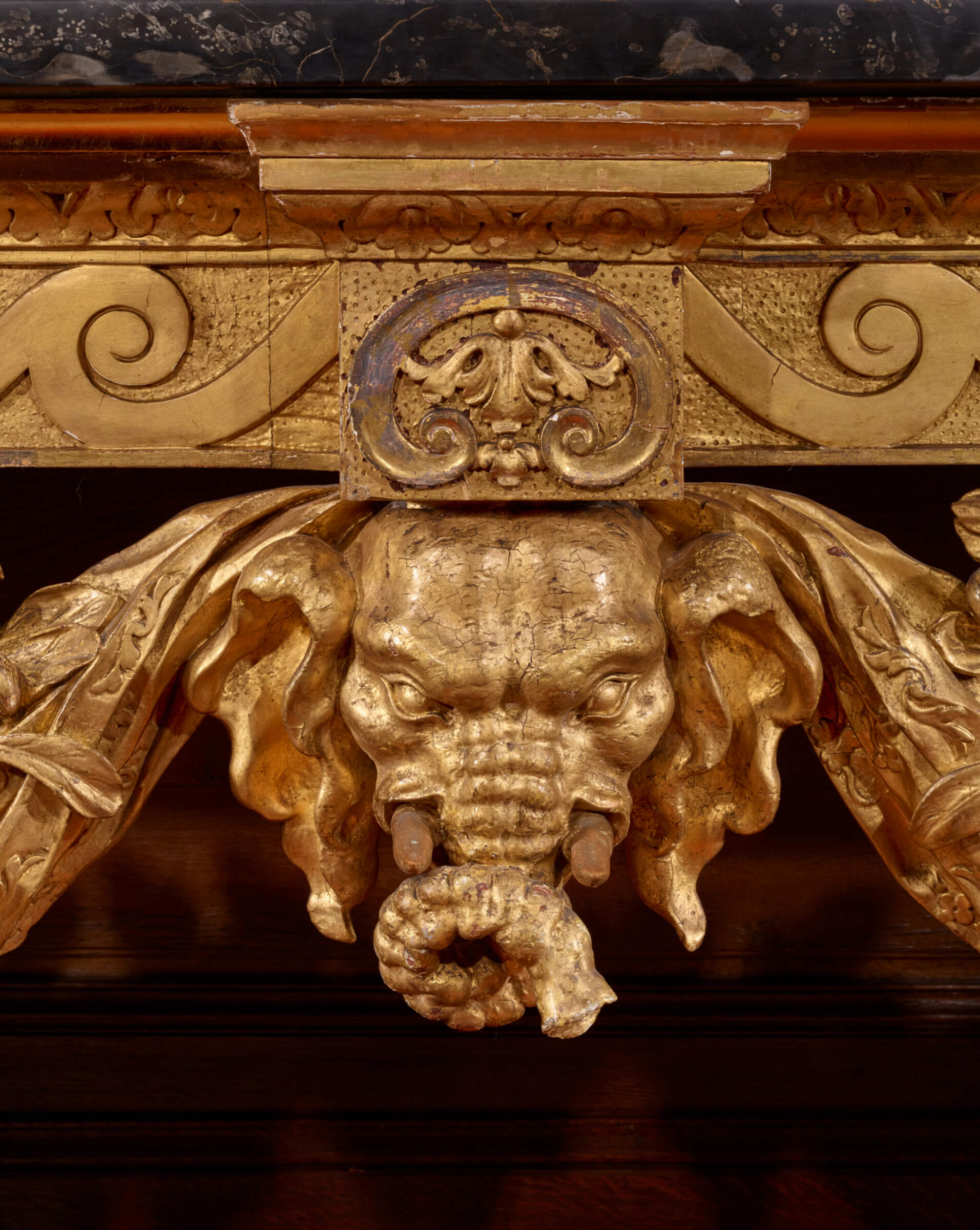
Rectangular in shape, it displays a powerful moulded rail, adorned with ample flat wave-scrolled friezes contrasting against dotted backgrounds, surmounted by a moulded cornice forming a wide overhang, with an ogee-shaped edge which is carved around its entire contour with a short acanthus frieze, the whole punctuated on the front by three bold projections enhanced with quatrefoils and acanthus leaves. The wider, central projection is distinguished by a circular, scroll-shaped cartouche motif in the form of an inverted pelta, enclosing an acanthus fleuron. An extraordinary elephant’s head, treated au naturel and carved in the round, emphasises the latter, flanked by two powerful accolades composed of rich drapery with floral motifs and fringed borders, each accolade containing a luxuriant composition of fruit and leafy branches, all held together by two lavish knots fixed to the front legs of the console’s base.

Six in number, two at the front and two on each short side, these “console” feet, with double scrolls accentuated at the bottom by a recess and adorned with reliefs of fleurons and large acanthus leaves set against a dotted background, rest on either side of the piece of furniture on a plinth with projections topped by a quarter-round frieze of flower buds and acanthus leaves.
A rectangular Portor marble top completes the ensemble. This console belongs to a very small corpus of neo-Palladian tables and chairs, all dating from circa 1740, displaying this extremely rare and highly unusual emblem of an elephant’s head, in addition to a decorative repertoire similar to ours, in particular the rails with moulded edges and wave-scrolled friezes set against a contrasting amatis background. A pair of sofas and a pair of stools with these characteristics were executed on behalf of Hugh Fortescue (1696-1751), 14th Baron Clinton, future 1st Earl of Clinton and 1st Baron Fortescue, at Castle Hill, near Filleigh, in the county of Devon; (ill. 3) The stools later became part of the collection of Claus von Bulow (1926-2019) and his wife Martha Sharp Crawford (1932-2008), known as ‘Mrs. Sunny’, at Clarendon Court in Newport, Rhode Island. Each adorned with a modern marble top that converted them into small tables, they were sold by Sotheby’s in New York on 28th and 29th October 1988, lot no°. 475, and purchased by Mallett & Son Antiques in London, who resold them in 1989 to Ann and Gordon Getty. (ill. 2)

Belonging to the same corpus, a stool similar to those from Castle Hill reproduced above, with a few variations, particularly in the garland held by the elephant’s trunk, and converted into a small table during the 20th century (with a modern plinth and porphyry top), was part of an entire set of furniture and seats with elephant heads delivered on behalf of John Poulett (circa 1668-1743), 1st Earl Poulett, to Hinton House in Somerset. (ill. 4) Remaining in his descendants’ possession, this “table” was sold by Sotheby’s in London on 1st November 1968, lot n°. 66. It subsequently entered the collection of S. Jon Gerstenfeld.
Of particular note here is that on 14th April 1702, John Poulett married Bridget Bertie, granddaughter of Montagu Bertie (1608–1666), 2nd Earl of Lindsey, with whom he had several children. In other words, a member of one branch of the Montagu family married into another branch of the same family, that of the Earls and later Dukes of Manchester, from which was descended Alice Maud Olivia Montagu (1862-1957), wife of the 17th Earl of Derby, the owners of our console table in their Coworth Park estate.
The Victoria and Albert Museum in London houses a drawing by Matthias Lock dated circa 1740 showing a console design similar to ours, (ill. 1) except for the elephant head, which is replaced here by a mask of Hercules “crowned” with the remains of the Nemean lion. The rail with wave-scrolled friezes and the arrangement of the console-shaped legs adorned with fleurons and acanthus leaves and resting on a plinth are, however, identical.

This pencil drawing on paper forms plate n°. 98 of an album of drawings entitled “Original Designs by Matts Lock, Carver 1740-1765”. It is this valuable iconographic document that has made it possible to attribute with certainty not only our console and the stools or “small tables” with elephant heads mentioned above, but also the small corpus of console tables similar to ours but with Hercules masks. Among the latter are the pair of consoles executed on behalf of George Lee, 2nd Earl of Lichfield (1690-1743), at Ditchley Park, Oxfordshire, now belonging to the collections of the Leeds Museum, in Temple Newsam House, Leeds, Yorkshire; the console table in gilded and painted wood in imitation of antique bronze belonging to the Dukes of Hamilton, at Hamilton Palace, Scotland, now in the Metropolitan Museum of Art, New York; the console commissioned for Philip Yorke (1690–1764), 1st Earl of Hardwicke, at Wimpole Hall, where it can still be found today; the pair of consoles executed for the Earl of Lichfield, at Shugborough Hall, Staffordshire, where they are also still to be found; and the pair of narrower consoles with a central shell motif, preserved in the collections of the Sir John Soane’s Museum.

Matthias Lock’s album was acquired by the Victoria and Albert Museum from a direct descendant of the artist, George Lock, who had taken the initiative to present it at the Great London Exhibition in 1862. It would appear to have been compiled after Lock’s death in 1765 as it comprises a number of ephemeral documents from his workshop, as well as drawings by Chippendale and neoclassical drawings described as being by Matthias Lock but which seem to be later in date, which were probably executed by his son. The presence of drawings by Thomas Chippendale (1718-1779) contributed to fuel the idea of a professional collaboration between the two men, but it now seems more likely that Lock only executed individual pieces for Chippendale’s more important projects.

The relationship between Matthias Lock and architect Henry Flitcroft, on the other hand, was much more profound. Documents preserved in the archives at Ditchley Park, where, as seen previously, Lock worked on behalf of the 2nd Earl of Lichfield, carving the two consoles based on his designs which are kept at Temple Newsam House, indicate that the architect had been specifically tasked with the interior design and furnishing of the residence. Circa 1740-1741, he provided designs for five tables, including those at Temple Newsam House, all of which were carved by Lock. Since console tables of the same design are still preserved at Wentworth Woodhouse in Yorkshire and at Wimpole Hall, already mentioned and reproduced below—two residences in which Flitcroft also had a hand during the same decade—it is therefore highly likely that the creation of the model, which was produced in several variations of our consoles, was indeed the work of Flitcroft, who collaborated with Lock on their execution.
We also know that it was the latter who took part in the execution of the furnishings for John Poulett (circa 1668–1743), 1st Earl Poulett, at Hinton House, executing the “small table” (ill. 4)—most likely a stool originally—with an elephant’s head similar to our console, as well as a mirror, a console and two candlesticks, now in the Victoria & Albert Museum and a private collection respectively.


Coworth Park
Located in Sunningdale, near Ascot, in the Royal County of Berkshire, near Windsor Castle, Coworth Park, also known as Coworth House, dates back to 1776 in its oldest form and was built on behalf of William Shepheard, a prosperous East India merchant with offices in London. Its name comes from the surrounding hamlet of Coworth, which was part of the parish and manor of Old Windsor until 1894 (ill. 9).
Upon Shepheard’s death around 1810, Coworth House came into the possession of his son, also called William. His executors sold it before 1836 to George Arbuthnot (1772–1843), a Scottish colonel who served in Madras. A census conducted in 1841 reveals that Arbuthnot shared the residence with his nephew and son-in-law, John Alves Arbuthnot (1802-1875), a director of the London Assurance Company and the London and Colonial Bank. The son of Sir William Arbuthnot, 1st Baronet, the latter married his cousin, Mary (1812-1859), with whom he had eleven children. He was the founding partner of the firm of Messrs, Arbuthnot Latham & Co., and was High Sheriff of Berkshire in 1873. He inherited Coworth Park on the death of his uncle and died there on 20th August 1875, aged seventy-three, leaving his descendants a personal estate of nearly £400,000. Coworth Park first passed to his daughters, “as long as more than two shall remain unmarried”, then to his eldest son, William Arbuthnot (1833-1896), who, at the time of his father’s death, was living with his family at Park Lodge.

William Arbuthnot spent his formative years in India, where, in 1858, he married Adolphine, the second daughter of Édouard Lecot, the French consul in Madras, who died in the very year of her marriage. Seven years later, William married Margaret Rosa, the eldest daughter of John Campbell of Kilberry (1780-1838), co. Argyll, with whom he had three daughters: Mary, Alice and Rosa, but no sons.
He disposed of Coworth Park in 1883, and sold it to William, subsequently Sir William Farmer (1832–1908), Chairman of Messrs. Farmer & Co. Ltd., Australian merchants established at 48 Aldermanbury, in the City of London. Farmer, who was Sheriff of London from 1890 to 1891, and High Sheriff of Berkshire in 1895, became Master of the Gardeners’ Company in 1898 and eventually sold Coworth Park in 1899 to Edward George Villers Stanley in 1899.
Coworth Park remained the property of Lord Derby until his death in 1948. It then passed to his widow, the Countess of Derby. Lady Derby lived there until her death on 23rd July 1957, at the age of ninety-four. A month later, the auction of the estate was advertised in The Times, and the sale of all its contents, including our console table, took place at Christie’s, Manson & Woods in London on 14th and 15th October 1957. The property was afterwards converted into a Roman Catholic convent school. The entrepreneur Harold Bamberg, director of the travel agency Sir Henry Simpson Lunn Limited – which later became Lunn Poly Travel, then a subsidiary of Thomson Holidays – and chairman of British Eagle Airways, set up multi-ccupational offices there. In the 1970s, James and Veronica Welch trained thoroughbreds from the rented Victorian stables.
In the mid-1980s, Coworth Park was acquired by Galen Weston, owner of Selfridges and Fortnum & Mason, who built the first polo field there before it was purchased by the Dorchester Collection, owned by the Brunei Investment Agency (BIA), in 2001. The property has since been converted into a luxury hotel complex by Prince Azim of Brunei (1982-2020).