

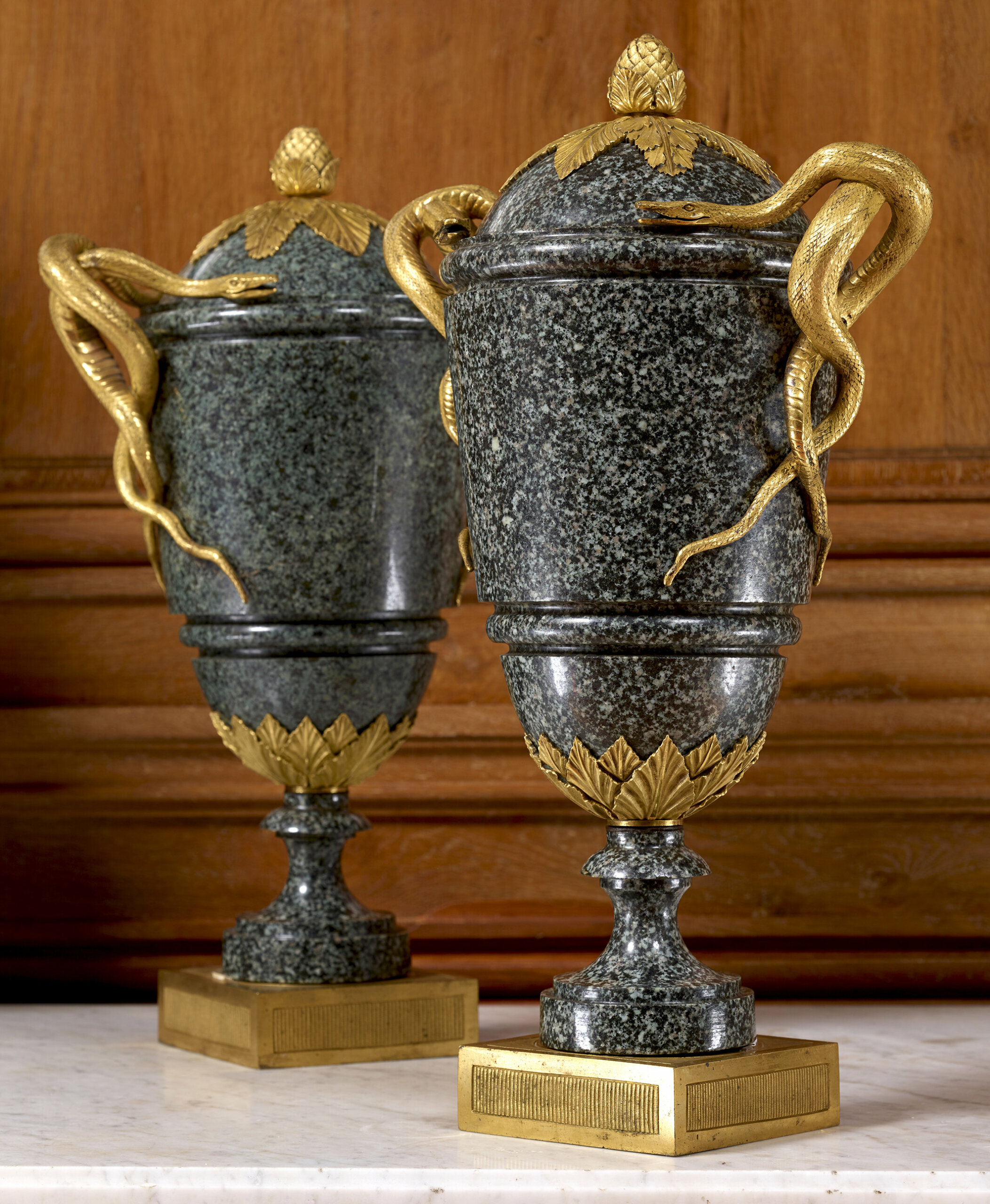
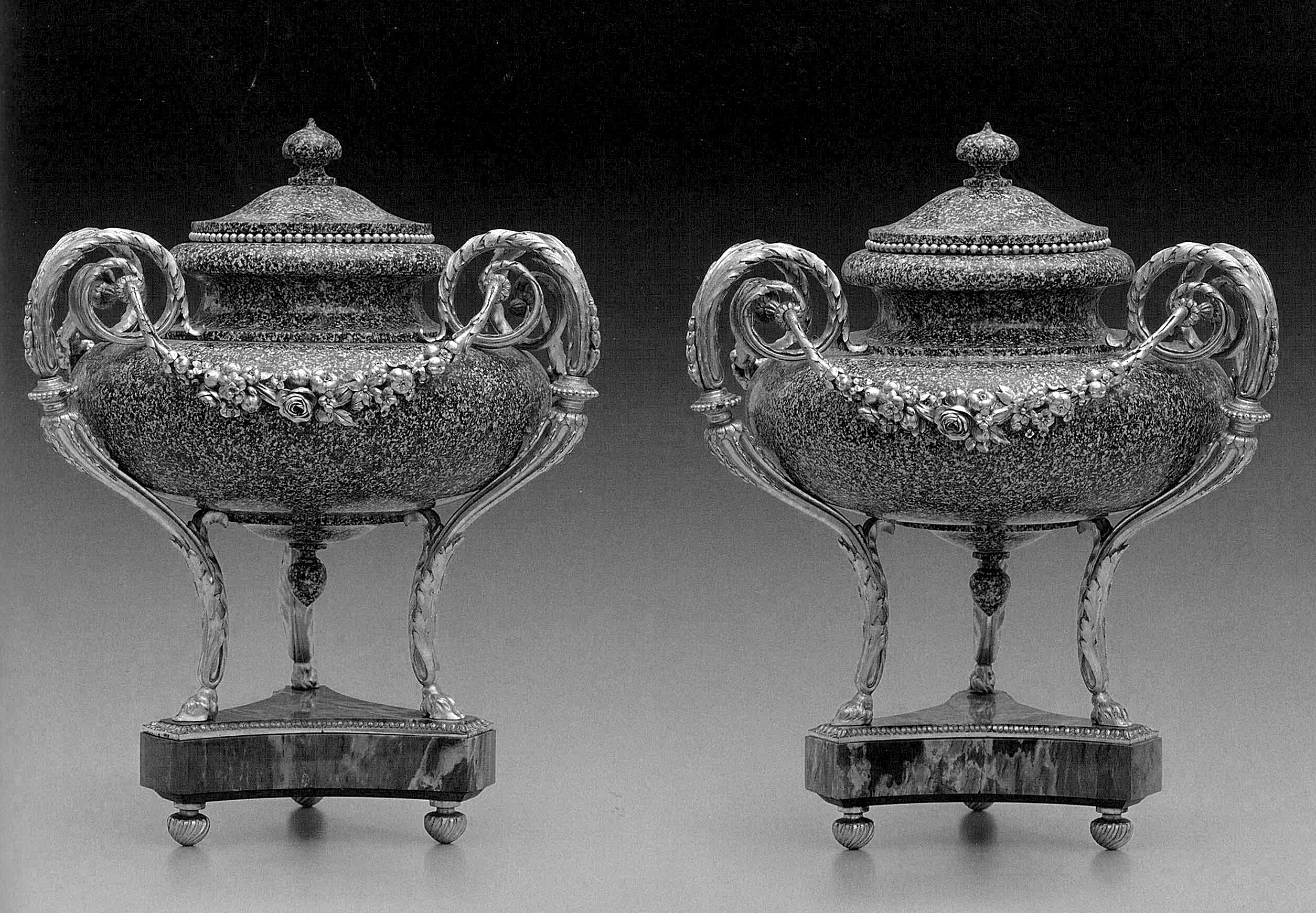
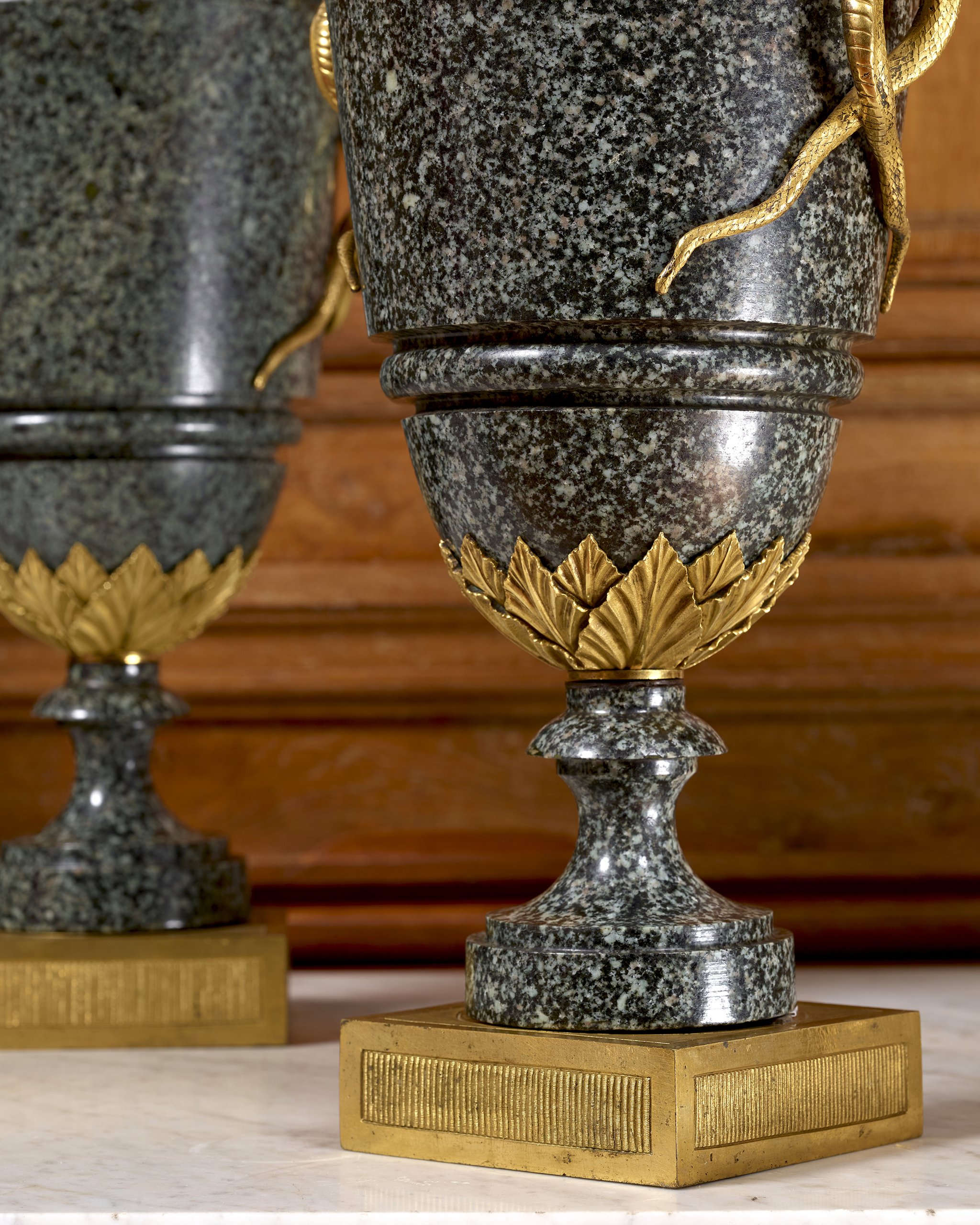
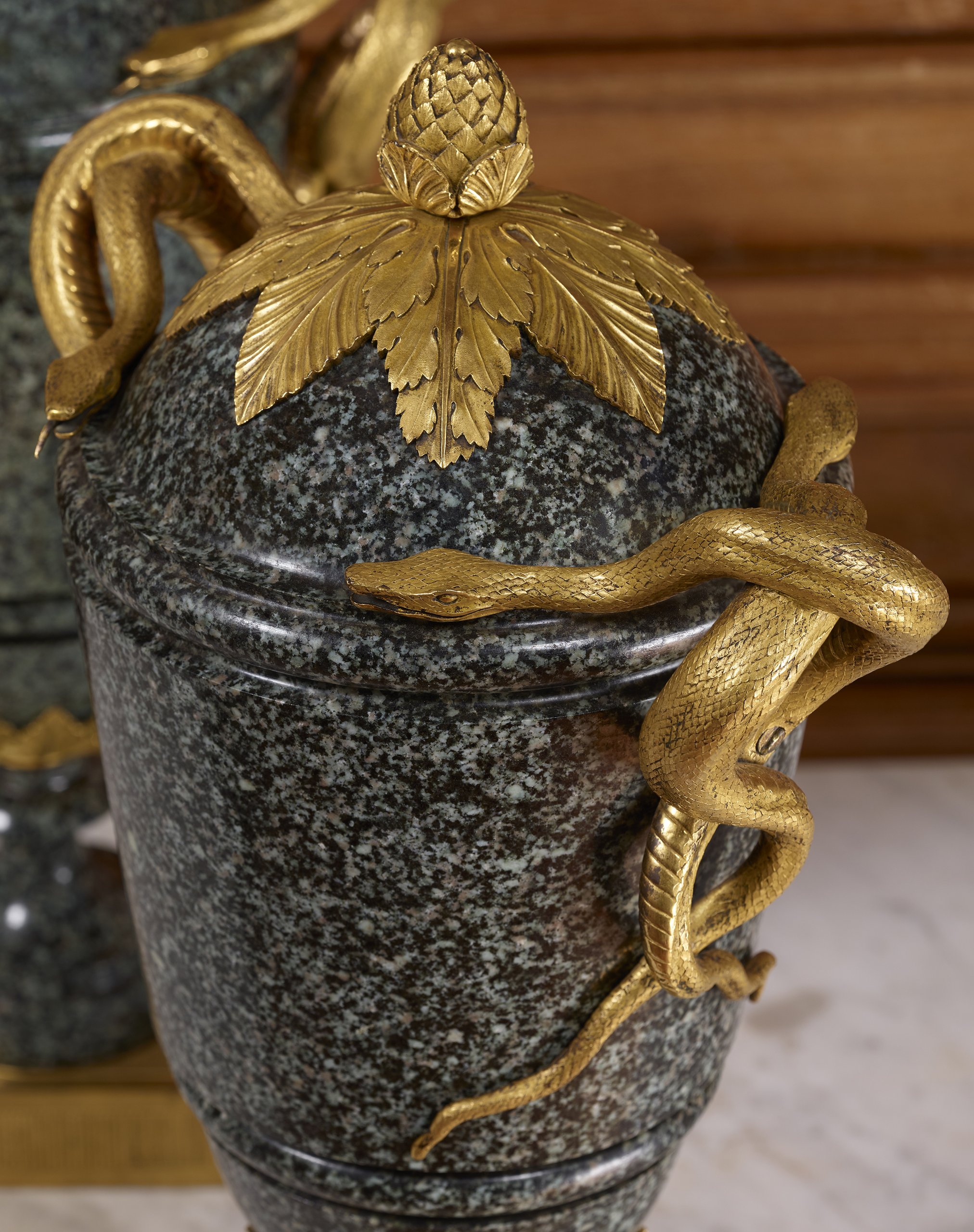
Green porphyry from the quarries of Giromagny, département of the Belfort Territory, in the Bourgogne-Franche-Comté region; mounts in chiselled and gilt bronze.
H. 54 cm. (21 ¼ in.); L. 32 cm. (12 ¾ in.); Depth. 20 cm. (7 ¾ in.).
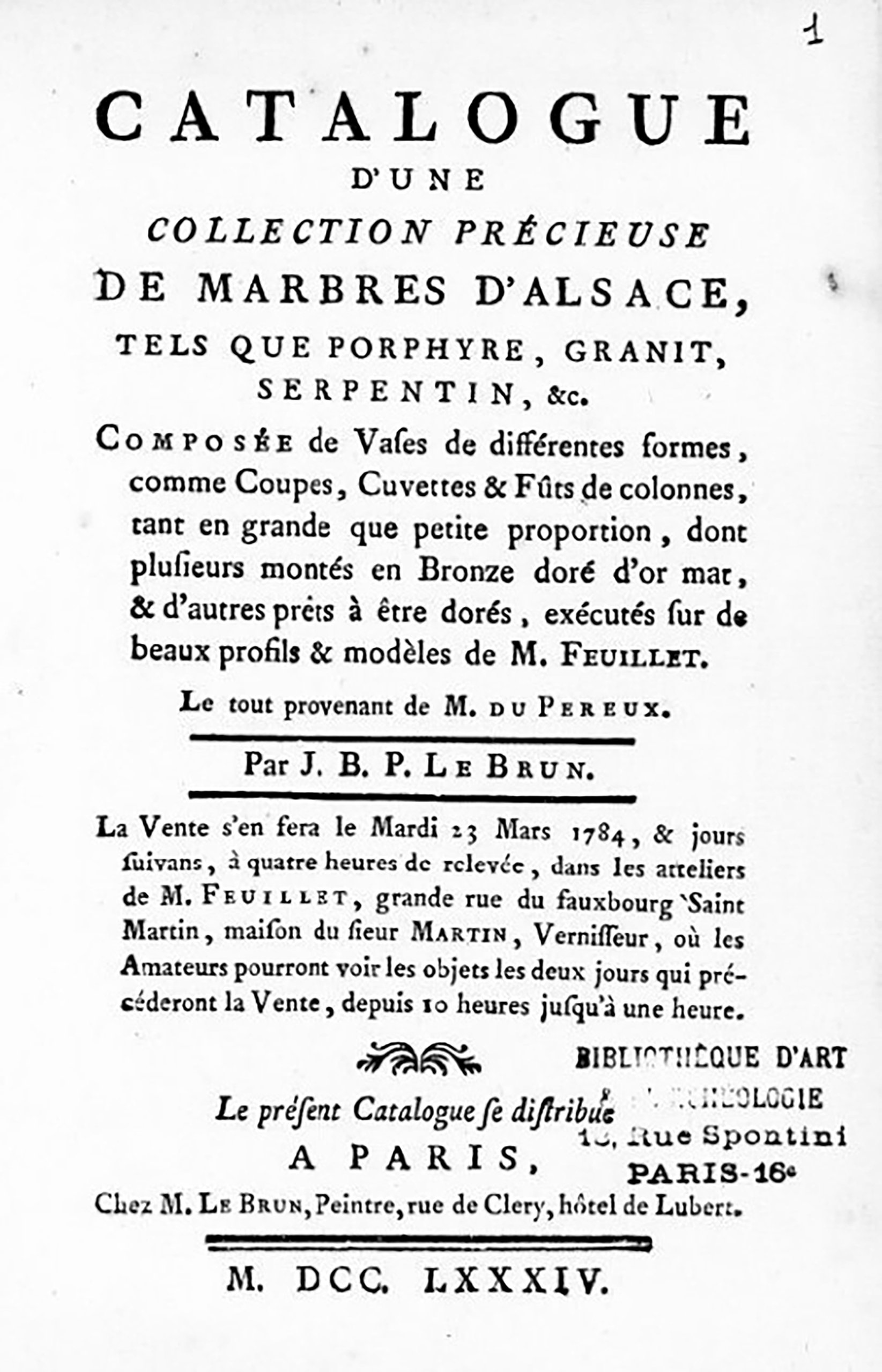
PROVENANCE: collection of Jérôme-Robert Millin du Perreux (1733-1794), financier and administrator of the Royal lottery of France; its auction in Paris was “held in the workshops of M. Feuillet, grande rue du fauxbourg Saint Martin” under the supervision of Jean-Baptiste-Pierre Lebrun, on 23rd March 1784, lot n° 9.
REFERENCE LITERATURE: Christian Baulez, “Le marquis de Marigny, le comte d’Angiviller et le goût des amateurs de porphyre à Paris au XVIIIe siècle”, in the catalogue of the exhibition Porphyre, La pierre pourpre des Ptolémées aux Bonaparte (organised in the Louvre Museum from 17th November 2003 to 16th February 2004), Paris, 2003, p. 152-162; Christian Baulez, Pierre Gouthière, ciseleur-doreur du roi, New York, The Frick Collection, 2016, p. 44-45, p. 70, p. 172, p. 344 and p. 378-379.
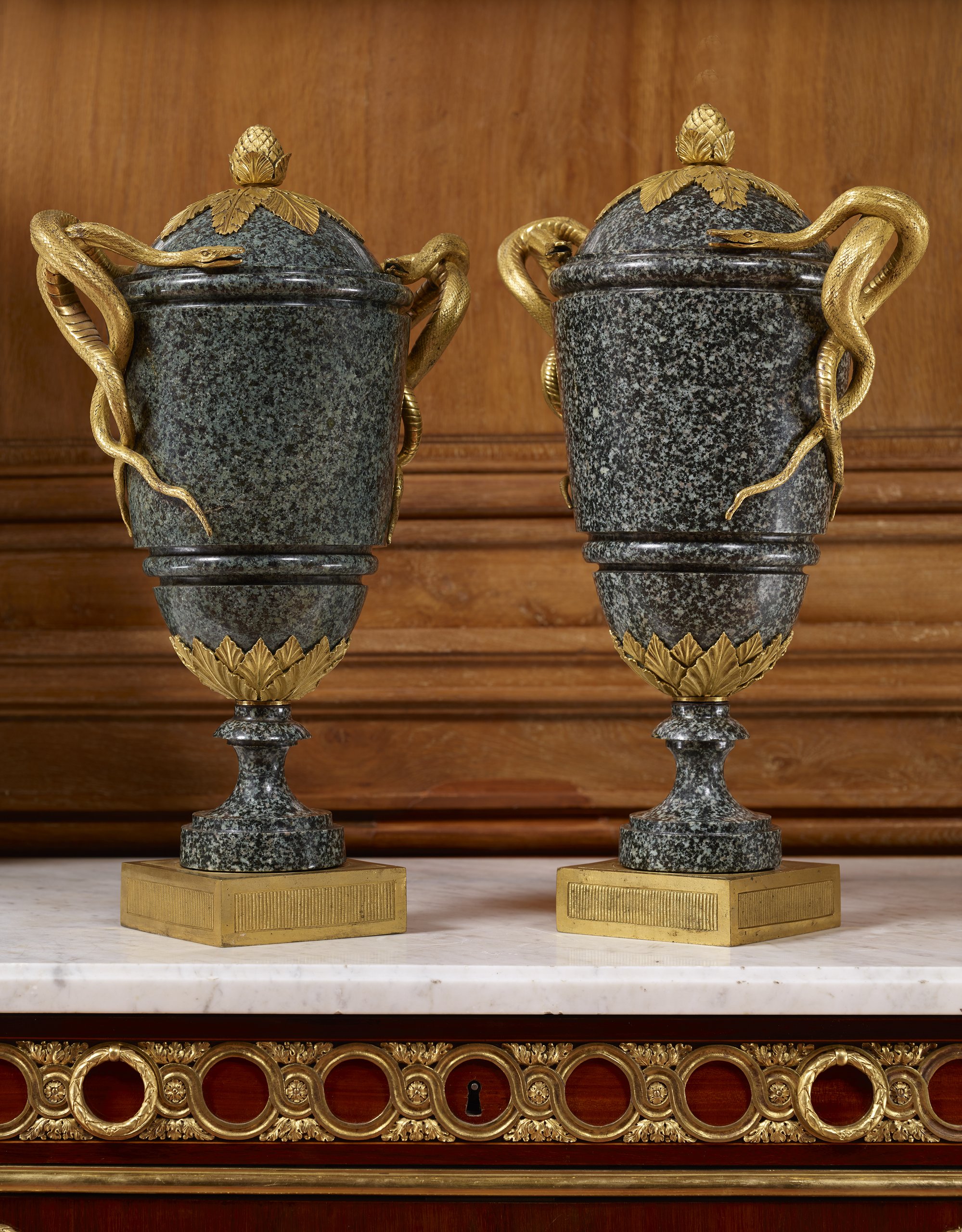
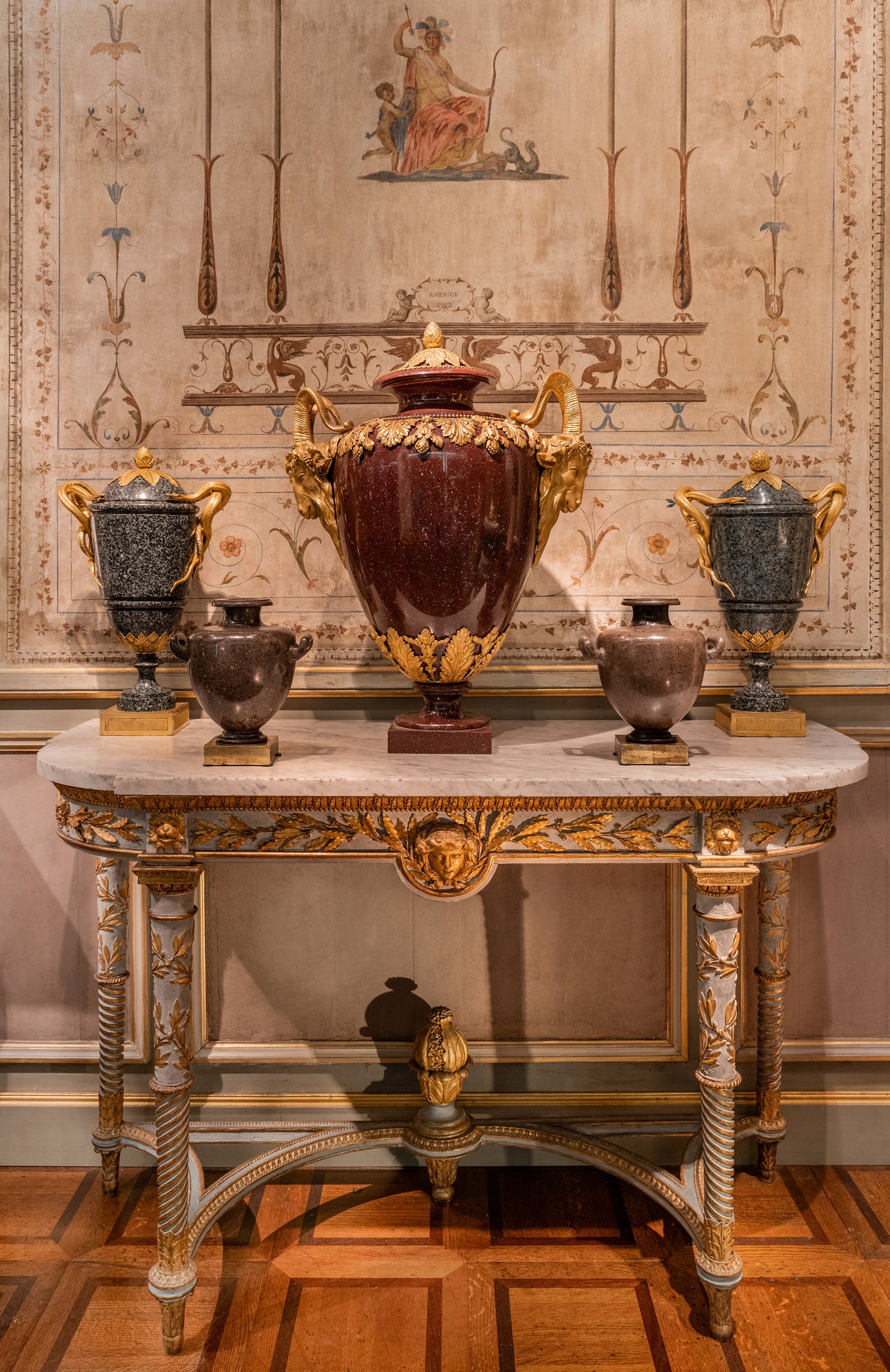
A sumptuous testimony to the immoderate taste for mounted pieces in porphyry, granite, onyx and other kinds of hard stone which culminated in France under Louis XVI, these vases were sculpted in a block of green Alsatian porphyry by Jean-Baptiste Feuillet († in 1806), former director of the Académie de Saint-Luc, on behalf of Jérôme Robert Millin du Perreux (1733-1794), equerry, former general receiver of finances of the généralité of Rouen and former administrator of the Royal Lottery of France. The two men knew each other well, connected as they had been since at least 1773 by a “treaty” for “the exploitation of a marble manufactory” located in Giromagny in the départment of the Belfort Territory, on lands belonging to Louise-Jeanne de Durfort de Duras (1735-1781), Duchess of Mazarin, Mayenne and of La Meilleraye, the daughter-in-law of the Duke d’Aumont (1709-1782), one of the greatest collectors of the 18th century. Beyond the national interest in the “green Alsatian porphyries”, underlining the predominant role played in France by the administration of the Menus-Plaisirs (various pleasures) under the impetus of the Duke of Aumont in the years 1765-1775, our vases constitute a formidable testimony of a fruitful and proven collaboration, which was revealed by Christian Baulez, between a sculptor and model creator, Jean-Baptiste Feuillet, and one of the most renowned chisellers and gilders of his time, Pierre Gouthière (1732-1813), allowing us to attribute the mounts of our vases to the latter. Feuillet collaborated on several occasions with Gouthière, notably through the intermediary of the greatest architects of the time, Claude-Nicolas Ledoux and François-Joseph Bélanger. These vases were part of the auction of the collection of Jérôme Robert Millin du Perreux in Paris that was organized “in the workshops of Mr. Feuillet, Grande Rue du Fauxbourg Saint Martin” under the supervision of Jean-Baptiste-Pierre Lebrun, on 23rd March 23, 1784, forming lot n° 9 of the sale.
The deposits of this particularly coveted green porphyry – also called green or ashen granite from the Vosges region or Vosges green serpentine – were discovered around 1765 and exploited by royal manufactories such as that of Remiremont, a Manufacture privilégiée du Roi, which were supported by the administration of the Menus-Plaisirs with the aim of limiting the importation of stones from abroad and especially from Italy. Stores or warehouses were opened in Paris to present the stones cut in “the purest forms, inspired by the ancient models” so as to be mounted afterwards.
Jean-Baptiste Feuillet played an important role in this context. On 7th February 1774, as he was the director of the Académie de Saint-Luc, he presented to the Academy of Architecture “samples of hard marbles of different qualities, found in open mines at Giromagny near Befort [Belfort], in Haute-Alsace: these samples were presented along with a price list and an instructive memoir”. Two years later, he published an eight-page advertising leaflet about his “New factory and stores for columns, supports, slabs, vases and other curiosities of French Porphyry”. This document was amply relayed by the laudatory comments published during the same year 1776 by Jacques-François-Dieudonné Lebrun in his Almanach Historique et raisonné des architectes, peintres, sculpteurs, graveurs et ciseleurs:
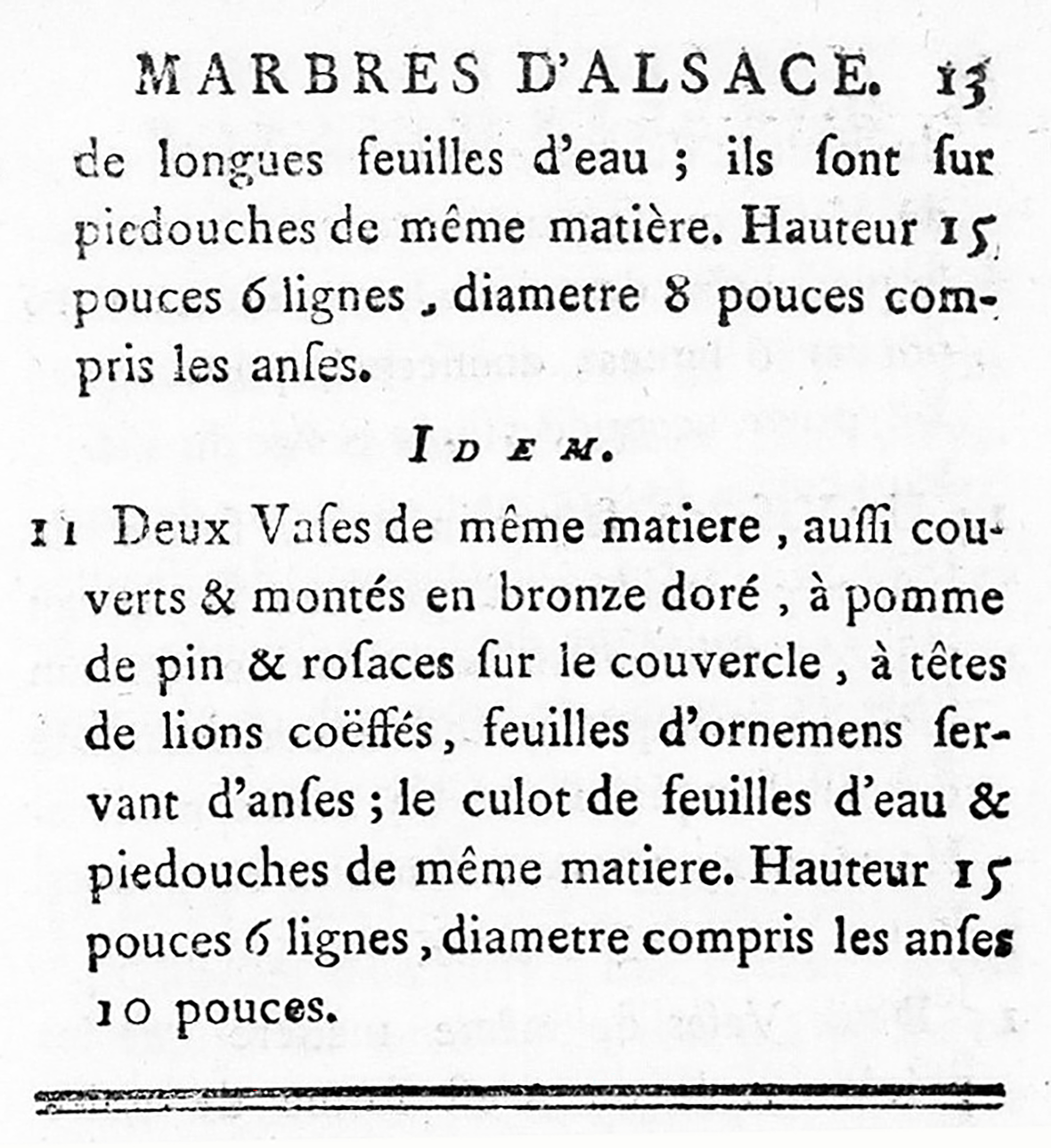
“Works of porphiries, jaspers, granites, serpentines of various colours, in the workshop of Sieur Feuillet, Sculptor, fauxbourg Saint Martin. The studies that Sieur Feuillet made so as to confer to these materials, in spite of their extreme hardness, the elegance, taste & cleanliness they may reveal, enabled him to execute works of all shapes and forms for the decoration of buildings & apartments. Correspondences in Alsace & Germany, where can be found the mines of precious materials & less expensive techniques in the art of polishing them, allow this Artist to deliver all the works that will be commissioned from him, based on whatever drawings will be submitted to him and at a much lower price than in the past. We owe praise to Mr. Feuillet for the great care he takes in working these precious materials, and in imparting to them, as the Greeks and the Egyptians did in the past, the shapes and proportions that one may desire—for he is able to deliver works in one piece [like our vases!], ranging from one foot long to forty. We invite the Curious minds & the Art lovers to go and see the works executed in his workshop, & they will undoubtedly be convinced of the truth of our announcement”.
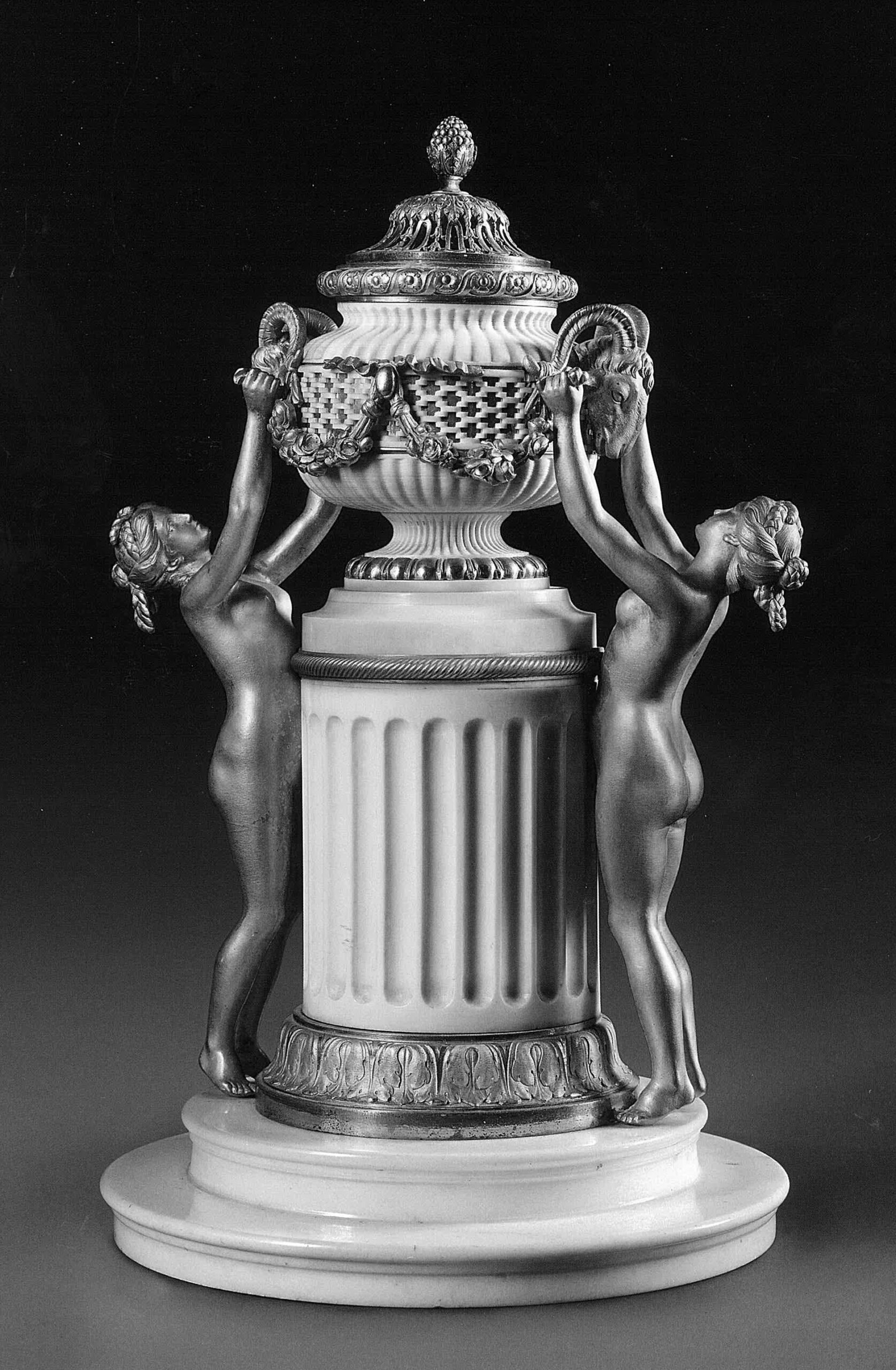
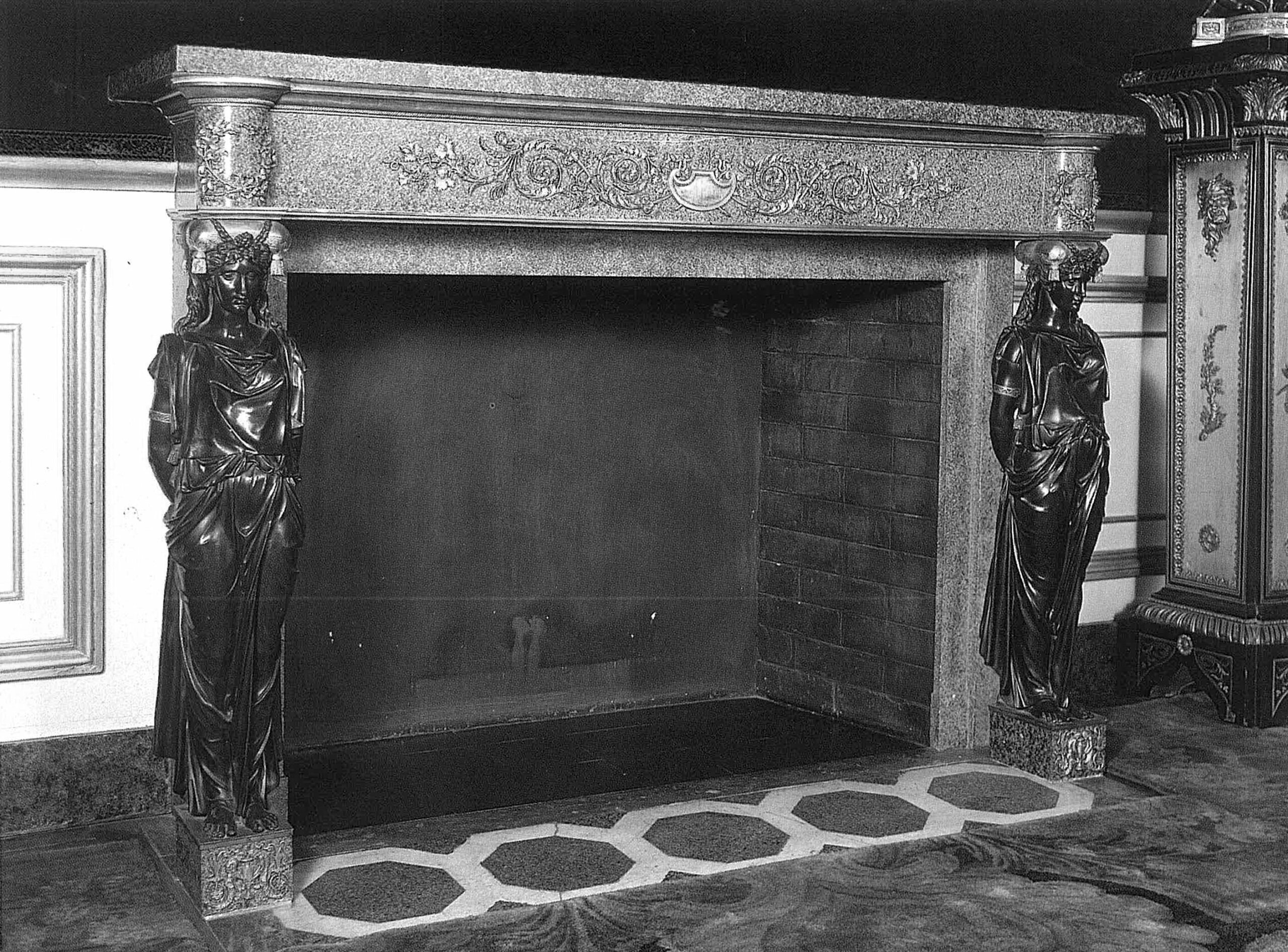
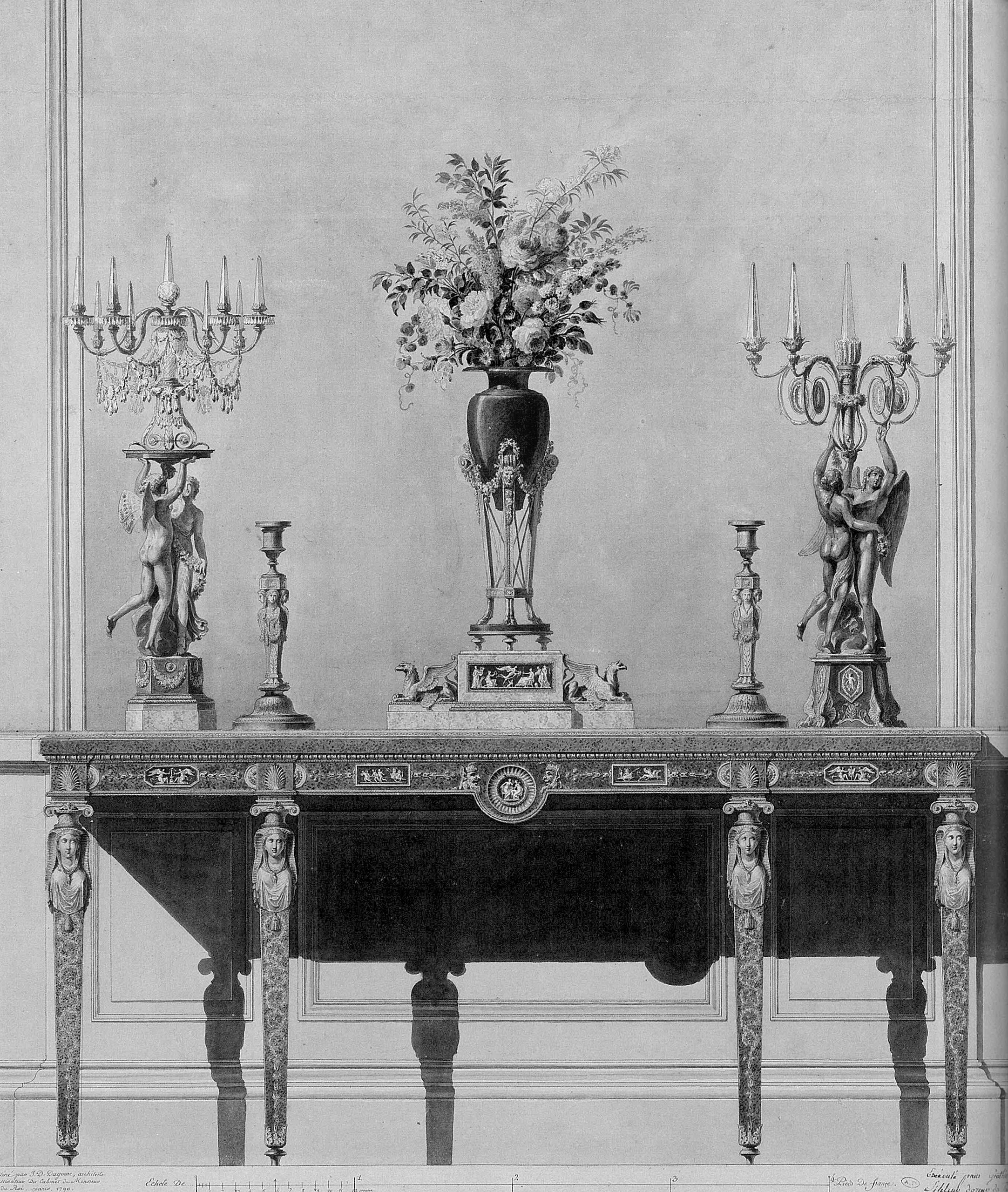
As a sculptor-marbler, Jean-Baptiste Feuillet not only designed and sculpted his own models, he also designed wax models for bronze mounts obviously intended for his own production, but also for those that were part of collaborations with great architects such as Ledoux or Bélanger. To this end he collaborated, and on several occasions, with Pierre Gouthière. For instance, Feuillet executed the model of the wax bronzes, intended for Gouthière, for a mantelpiece designed by Ledoux for the mansion of the famous opera singer Marie-Madeleine Guimard (1743-1816), at the Chaussée d’Antin.[1] He also intervened on behalf of the Countess Du Barry (1743-1793) and executed, with the sculptor Joseph Métivier, the models of the bronze decorations composed of flower garlands with falls on the rear parts of the fluted bases intended to support the four large torchères by Augustin Pajou, Félix Lecomte and Martin-Claude Monnot, which were ordered for the dining room of the Château of Louveciennes. There too, Gouthière had been commissioned to execute in gilded bronze the ornamental models of these pedestals supplied by Feuillet and Métivier, but he was unable to carry out this work because of the tragic death of the Countess in 1793. Among the many models of Feuillet in the Du Perreux collection auctioned on 23rd March 1784, was an imposing “antique monument” consisting of a “vase of red porphyry […] enriched with four satyr heads”, “carried on an altar-shaped foot of black and white granite”, “accompanied by two Bacchantes, 12 inches in proportion, attaching garlands to the horns of Satyrs”. This model was a resounding success and was reissued several times, including one in ivory and bronzes which was part of the collections of Marie-Thérèse Rodet Geoffrin (1699-1777), the famous “Madame Geoffrin” who kept one of the most famous “salons” in Paris. She described in one of her notebooks this “small antique monument of ivory, marble and gilded bronze made by Gouthière, 600 livres“. Feuillet also executed the model for the gilded bronze ornaments of our vases, as he did for all his vases and mounted objects that were included in the Du Perreux auction on 23rd March 1784: “several mounted in Bronze gilded with matt gold, & others ready to be gilded, executed on beautiful profiles & models by M. Feuillet”.
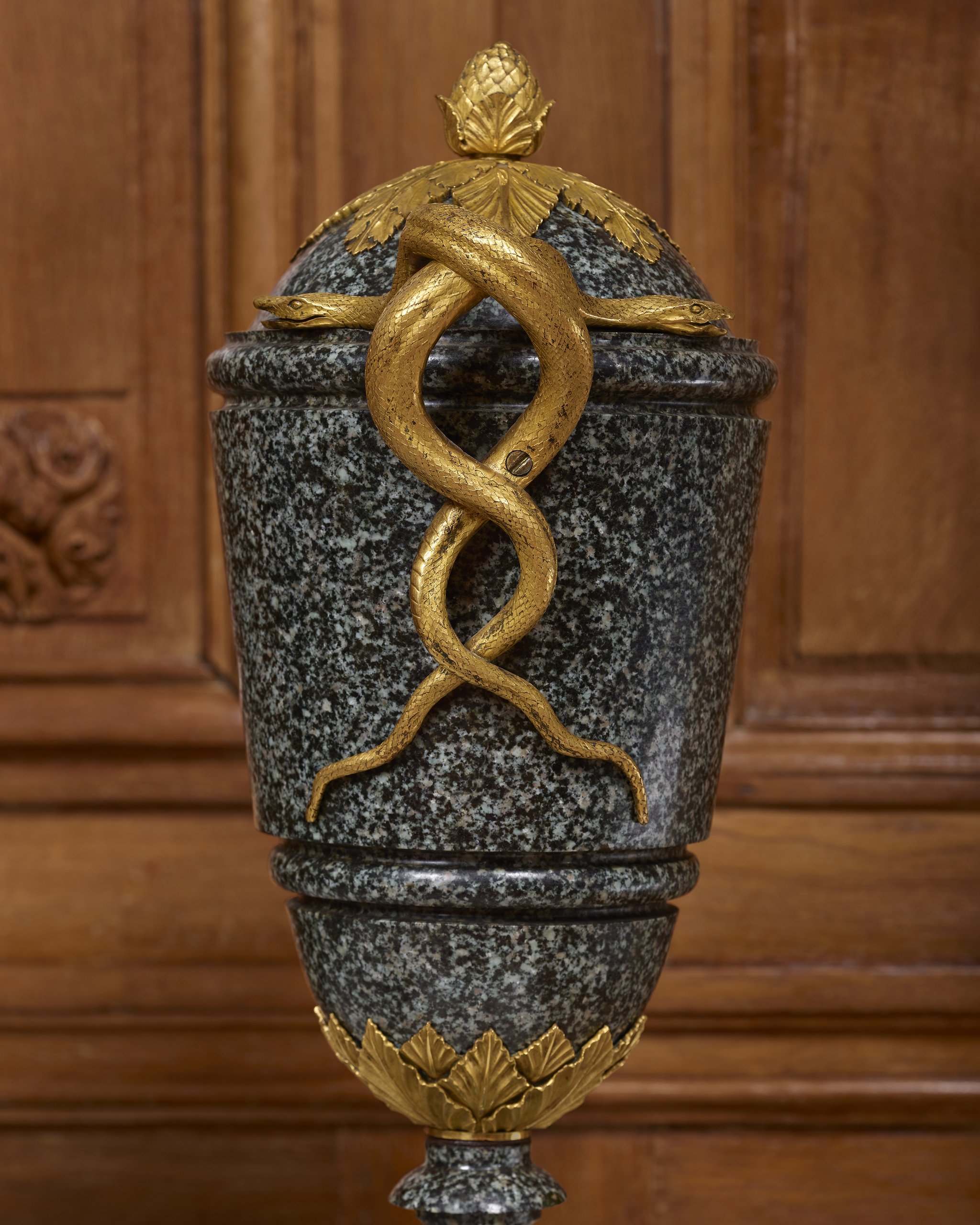
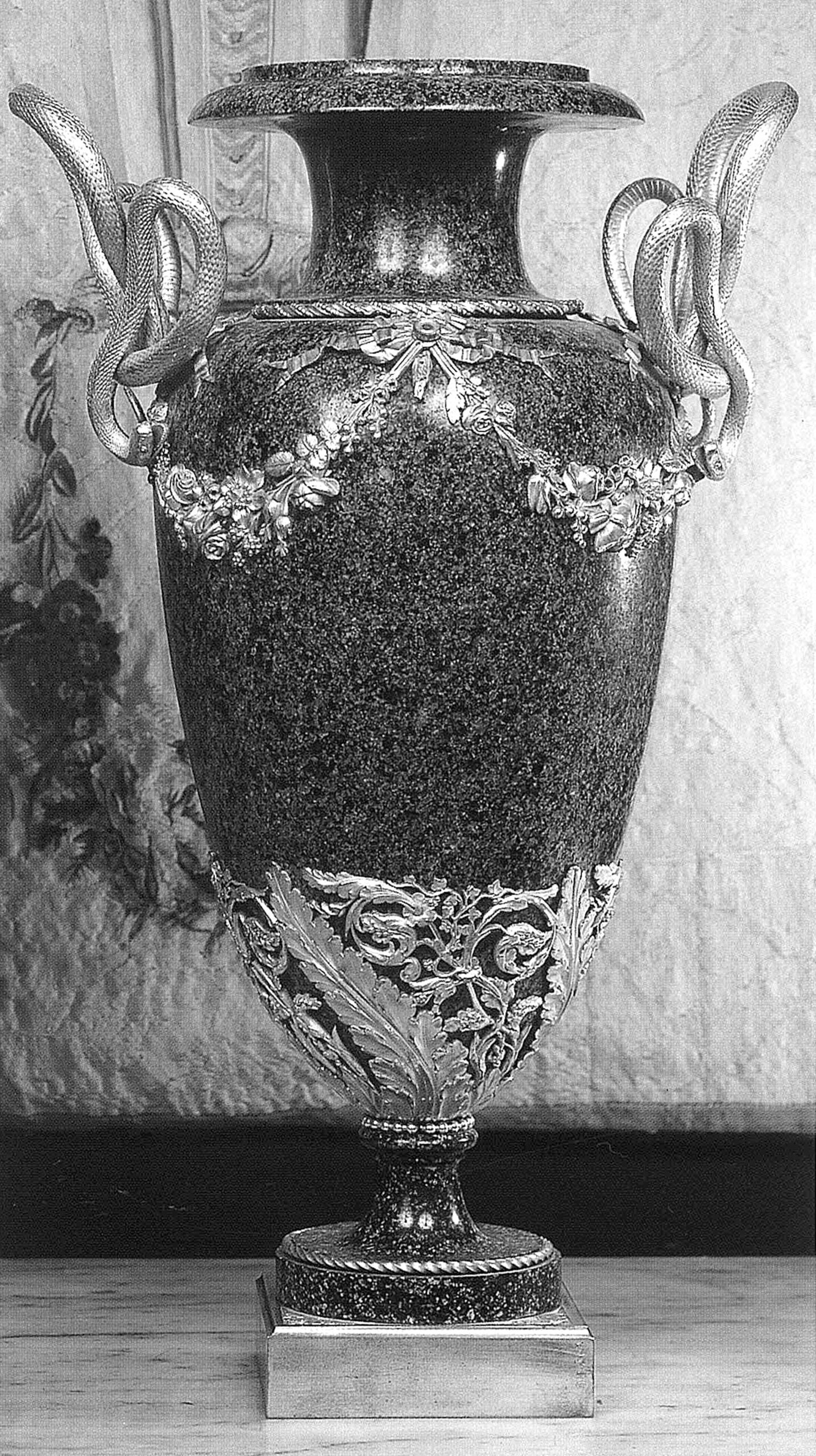
His proven collaboration with Gouthière leads us to believe that he naturally turned to the latter for the execution of these bronzes, an attribution here amply confirmed by the quality and extreme precision of the rendering of the intertwined snakes forming the handles of our vases, not to mention the leafy terrace with alternating large acanthus leaves and festooned leaves enhancing their ‘lid’ punctuated by a pine-cone shaped knob, and the bronze foliated corolla adorning their belly.
Feuillet began his career in 1750 as an apprentice with Jacques-François Martin (Master in 1732). He was received Master in 1760 and married for the first time the following year, and for the second time, five years later, the daughter of the sculptor Dominique Pineau (1718-1786). Initially established on rue Poissonnière, in premises rented from Louis Trouard (1700-1763), marbler to the Bâtiments du Roi, he moved in 1772 to rue du Faubourg Saint-Martin, in the Saint-Laurent parish, as a tenant in a building belonging to Jean-Alexandre Martin (1743 – after 1795), one of the painters-varnishers to the King, where shortly afterwards he became a neighbour of the sculptor-founder Pierre-Philippe Thomire (1751-1843).
Feuillet’s success and renown were unquestionably linked to the exploitation of the mines and quarries of Giromagny, which belonged to the Duchess of Mazarin, and which he was able to exploit by creating a first company located around this deposit in 1765, then thanks to a concession granted on 25th March 1773 by the Duchess to a union of creditors led by Jérôme Robert Millin du Perreux, he became the partner of a certain Antoine-Henri Patu des Hautschamps. As just seen, he presented samples to the Academy of Architecture on 7th February 1774, the year in which he was held the office of Director of the Academy of Saint-Luc. On 11th December, 1775, Feuillet signed a private ‘treaty’ with Millin du Perreux and the aforementioned creditors’ union “for the operation of a marble manufactory in Alsace, the said Feuillet being charged with providing all drawings, plans, etc. relating to various works that it would be necessary to carry out in the said manufactory”.
The warehouse of these precious porphyries and granites was located in his home in Paris where he took good care “to adorn and decorate them”. In 1776 Lebrun spoke highly of Feuillet’s ability to produce with “the greatest care” “these precious materials”, of his studies to make them and his drawings that could be executed and adapted in accordance with the wishes of his clients. Among the latter were, as we have seen, the architects Claude-Nicolas Ledoux, with whom his collaboration was attested as early as 1773, and François-Joseph Bélanger, for whom he intervened as early as 1772, working through their intermediary for the most prestigious clientele of the time. He also had among his clients the architects Jacques Cellerier (1743-1814) and François-Victor Perard de Montreuil.
To his talents as a sculptor and model creator, Feuillet also added the activities of an expert and merchant, acquiring works at major auctions or selling his own. He opened an office in the rue du Coq, near the rue Saint-Honoré, the heart of the luxury trade in Paris, an office he kept until 1784.
The year 1784 was a turning point in Feuillet’s life and career. Three years earlier, he was the victim of the cancellation of the treaty concluded between the Duchess of Mazarin, Antoine-Henri Patu des Hautschamps and Jérôme-Robert Millin du Perreux, which, by an act on 19th February 1781 and following, i.e. less than a month before the death of the Duchess, henceforth granted the concession of the mines of Rosemont [Giromagny] in Alsace to Pierre Maneglier, a bourgeois from Paris residing in rue Neuve-des-Petits-Champs, in the parish of Saint-Eustache, under the security of Mr Millin du Perreux and Mr Patu des Hautschamps”. If we are to go by the comments of the Baron of Dietrich, the decision was undoubtedly prompted by the fact that the creditors’ union of Millin du Perreux, “having consumed most of its funds in the implementation of a mill for polishing porphyry and granite was forced to abandon the works which Mr. Broelmann, the director at the time, had put back under way; nine galleries were pursued at once to put the former works in the dry. This cessation, made at a time when the mines provided the most hope, allowed the Duke of Valentinois, now in the right of the House of Mazarin, to take possession of all the buildings constructed by this company; one of the clauses of the concession having expressly stated that the buildings would return to the seigneur, should the concessionaires abandon the exploitation”.
This reversal of fortune prompted Jérôme-Robert Millin du Perreux to sell, on 23rd March 1784, “in the workshops of M. Feuillet, grande rue du fauxbourg Saint Martin”, his precious collection of Alsatian marbles, including our vases, all catalogued by Le Brun, and on 6th April of the same year Jean-Baptiste Feuillet was in his turn forced to sell his whole workshop: “Catalogue of a beautiful collection of marbles, such as statues, busts, vases, vats & other objects in white marble, stone vases of Conflans, of Tonnerre, sphinx and others, plaster groups, figures & low reliefs, busts, a number of parts moulded from nature, utensils, such as workbenches, clamps, saddles of different kinds and species, crates & others, scissors, rasps, trepans, sledgehammers, spatulas, braces and bits & other tools suitable for sculpting, all of which are from M. Feuillet”. Le Brun, in his preface to the auction on 23rd March, bitterly regretted the dissolution of the company: “In the same spirit as the Greeks & Romans, like them eager for glory, & intent upon forcing posterity to speak of our triumphs, our works & our arts, we would have protected such an enterprise, we would have supported the efforts of those who directed it, and we would not have suffered that Foreigners might either take it away from us, or reproach us for having abandoned it. It is especially at this time and hour that we must perforce regret its dissolution […] We hope that those who are curious and eager to compare the ancient with the so-called modern matter will not miss an opportunity like this one; the opportunity is all the more favourable as it is hard to envisage when we shall ever see the like of it again”.
After the closure of his warehouses and stores, Feuillet left Paris and moved to Versailles where he now held the position of bailiff to the Chamber of the Count of Artois and the Duke of Berry. At the time of the Revolution, he retired to Provins definitely.
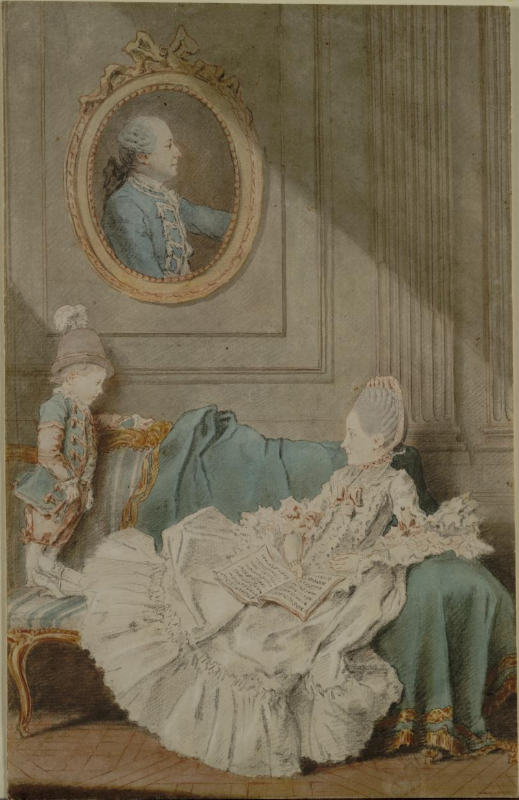
The second character related to our vases was their owner, Jérôme Robert Millin, “seigneur du Perreux, la Queue de Brie, etc.”. Born on 7th February 1733 in Nevers, in the department of Nièvre, Millin Du Perreux was the son of Robert Millin, “equerry, secretary to the King, House and Crown of France, and Receiver General to the domains of the Duke of Orleans”. He held the office of Receiver General of Finances of the Generalité of Rouen, and became administrator of the Royal Lottery of France. He lived in Paris, rue Vivienne, in the parish of Saint-Eustache. He married Sophie Le grand in 1763 and the couple was portrayed at least twice by Louis Carrogis (1717-1806), known as Carmontel – a portrait of Mr and Mrs Millin du Perreux, watercolour, gouache, lead pencil and sanguine on paper, dated shortly after their marriage, is today kept at the Château of Chantilly, in the collection of the Musée Condé, and a second one at a later date, showing Madame Millin du Perreux lying on a couch and reading a score, accompanied by her first son standing at her feet on the seat with above them the portrait of Monsieur du Perreux, a bequest from Muriel Butkin to the Cleveland Museum of Art, Cleveland. The couple had two sons: Alexandre-Louis-Robert (1764-1843), who took over his father’s position as an administrator of the Royal Lottery and became a painter, and Georges-Marie-Jérôme (1766-1852) who, on 2nd July 1815, held the position of inspecteur aux revues (military inspector), became a military intendant and then a member of Parliament for the Bas-Rhin.
He was a Knight of Saint-Louis and was made a hereditary baron by letters patent on 10th June 1828. He married Louise-Dorothée Stauch in 1795 and died in Strasbourg on 3rd February 1852. Jérôme Robert Millin du Perreux was also, as just seen, a financier who was interested in more ways than one in the quarries exploiting “precious stones” in Alsace. He had also invested in a “paper manufactory established in Essonne, on the Etampes river”, whose shares he sold on 14th April 1783.
He became the owner of the château bearing his name in Nogent-sur-Marne, an estate acquired in 1760 by his father, Robert Millin, who had it entirely rebuilt the following year, using one of the most innovative architects of his time—Etienne-Louis Boullée (1728-1799). This château and its outbuildings were unfortunately destroyed in 1910 with the exception of one wing of the outhouses, which was destroyed in 1930, and its southern avant-corps, which remains today. Its park began to be subdivided in 1857.
The Revolution proved fatal to Jérôme Robert Millin du Perreux. He was one of the countless victims of Fouquier-Tinville. He was accused by the Surveillance Committee of Nogent of calling the Sans-culottes “Brigands” on the evening of 10th August 1792; he was tried and executed on 13th Prairial year II (1st June 1794), while his own son, Alexandre Millin, was fighting for the armies of the Republic as a Lieutenant General. The latter and his brother had the estate of Château Du Perreux, which was in a sorry state under the Directoire, restored to them and they soon sold it.

