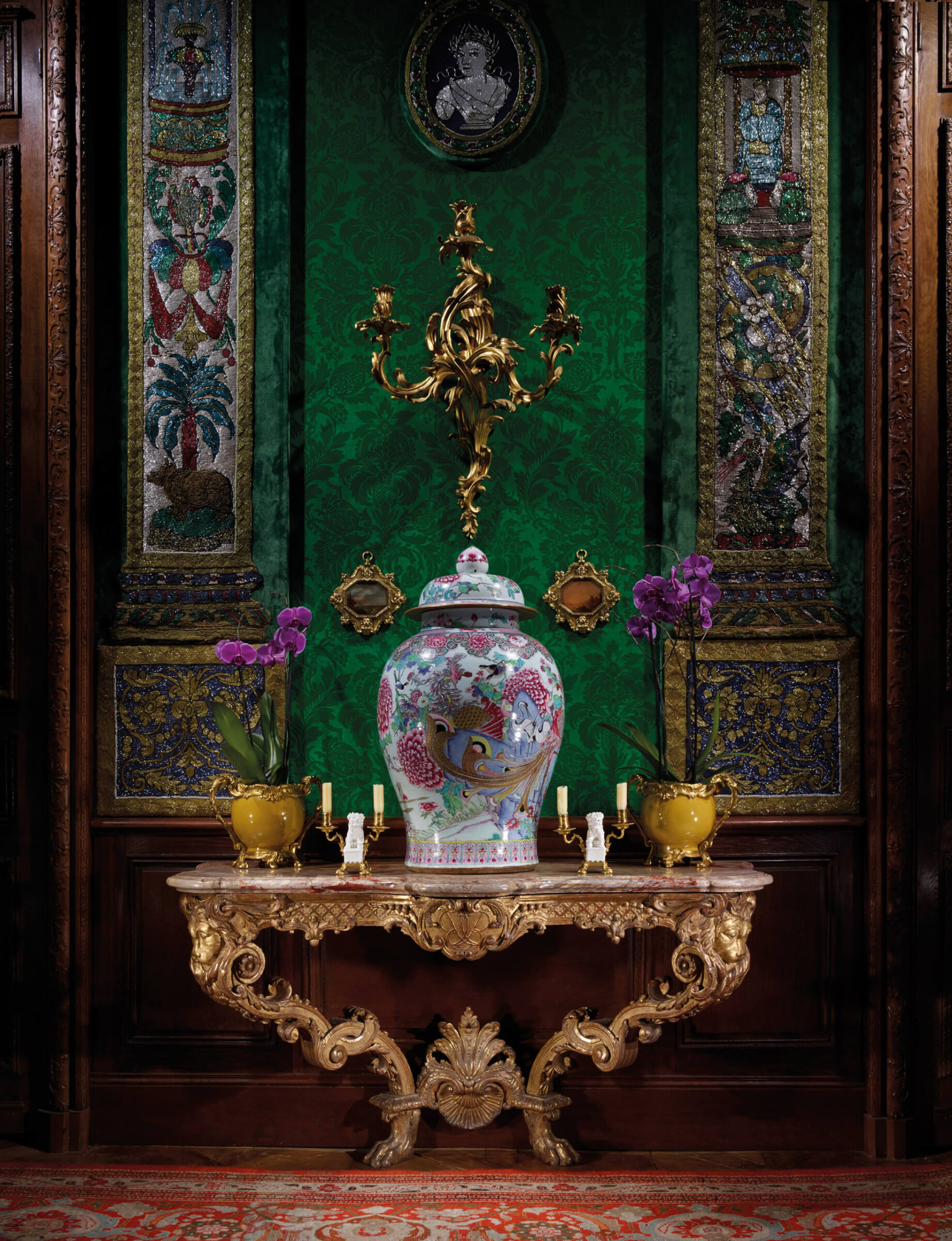
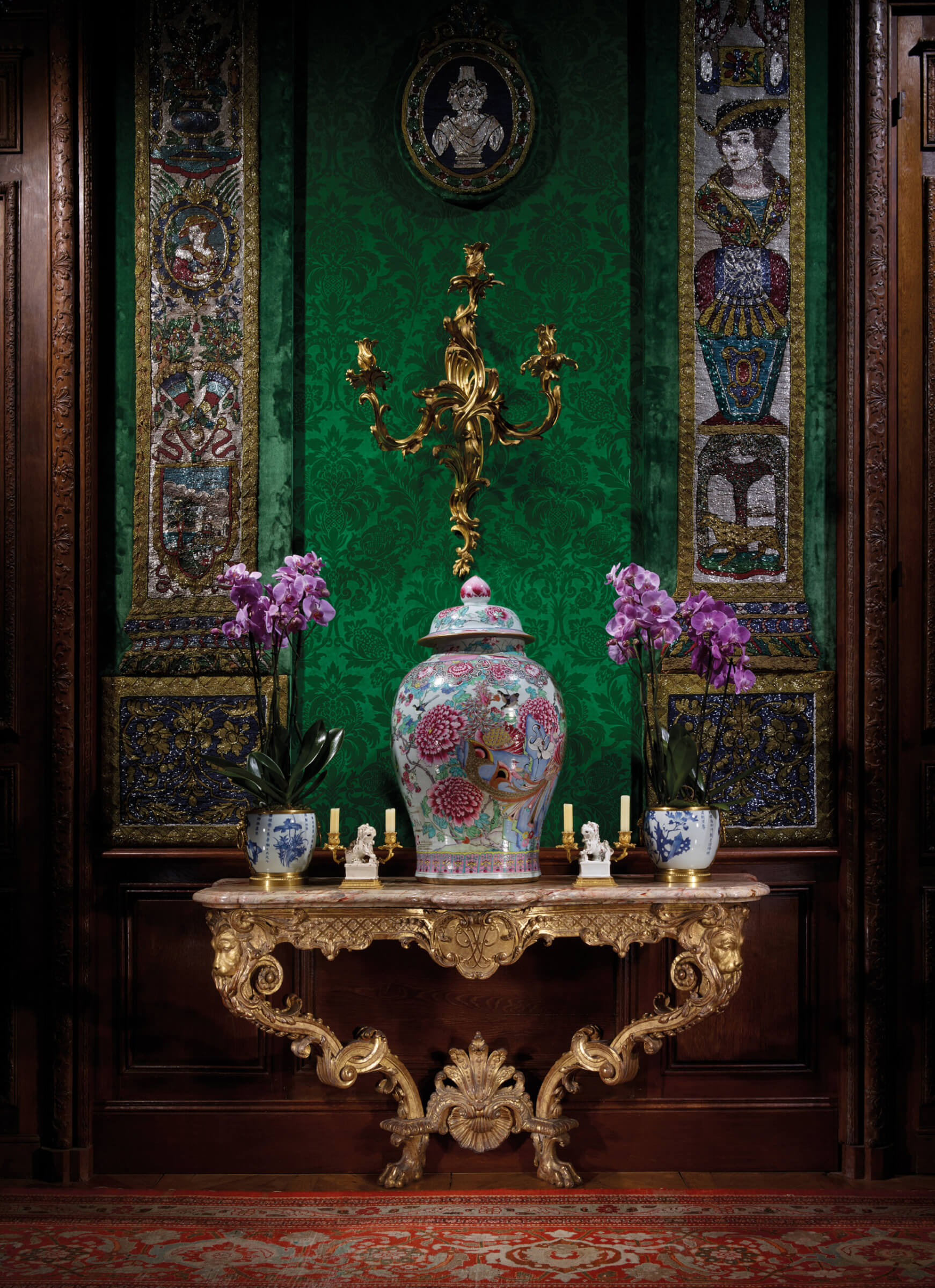
Carved and gilded oak; Sarrancolin marble.
H. 78 cm. (30 ¾ in.) ; W. 164 cm. (64 ½ in.); D. 62 cm. (24 ½ in.).
PROVENANCE: most certainly executed for the court of Charles III Philip (born 4th November 1661 in Neuburg, died 31st December 1742 in Mannheim), of the House of Wittelsbach, Elector Palatine, Count Palatine of Neuburg, Duke of Juliers and Duke of Berg from 1716 to 1742 and Count of Megen from 1716 to 1728; collection of the jeweller Miran Eknayan (1892-1985), Paris.
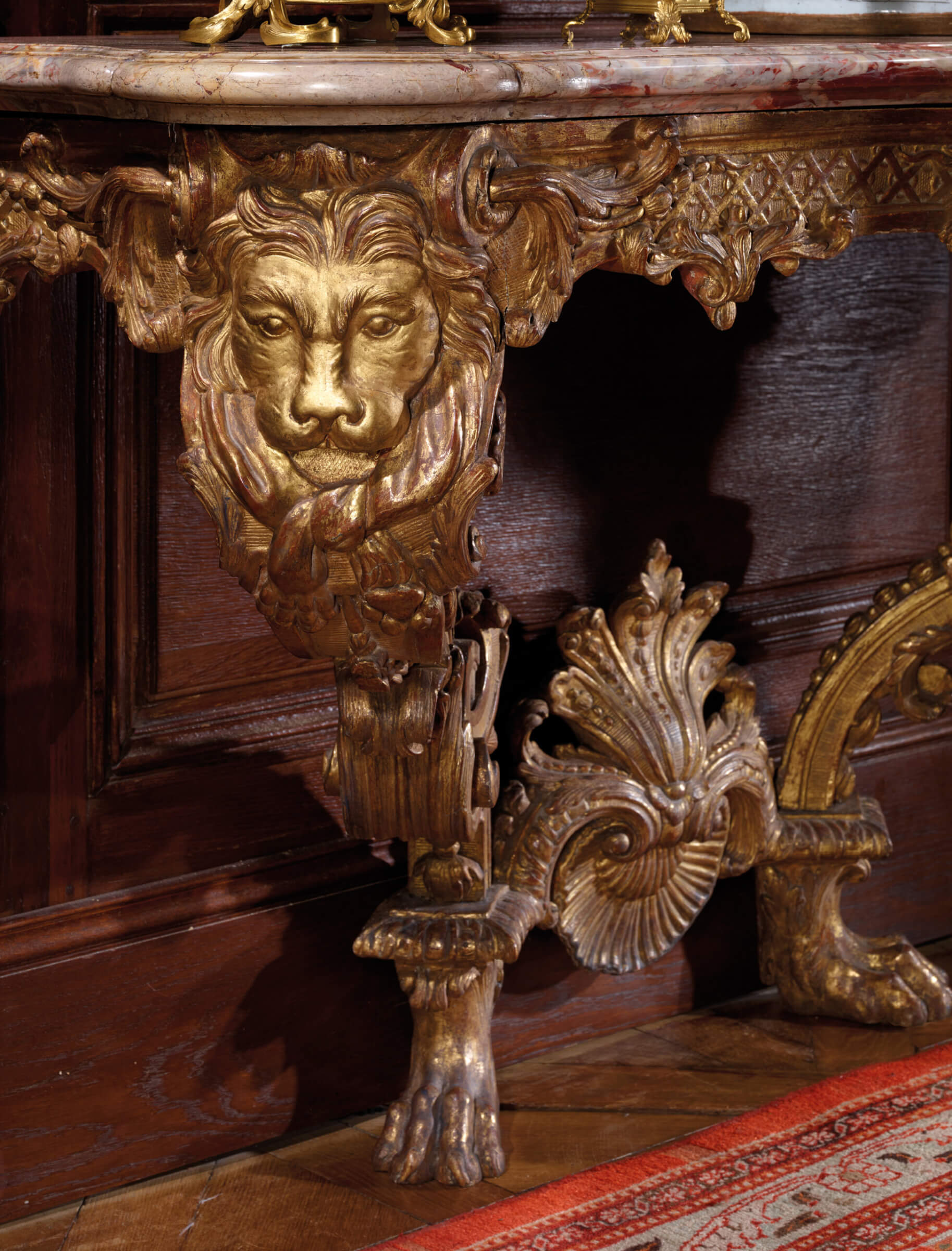
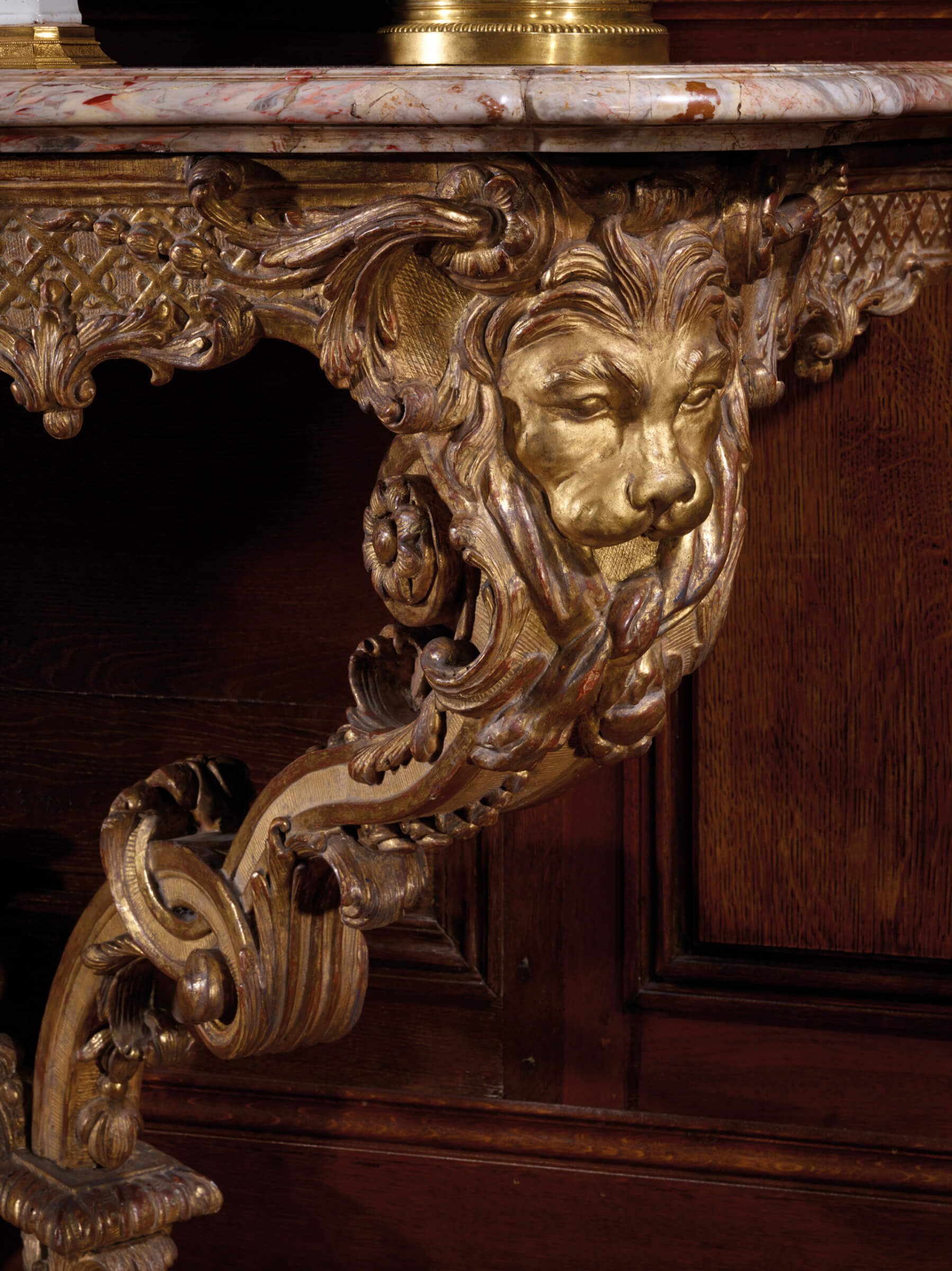
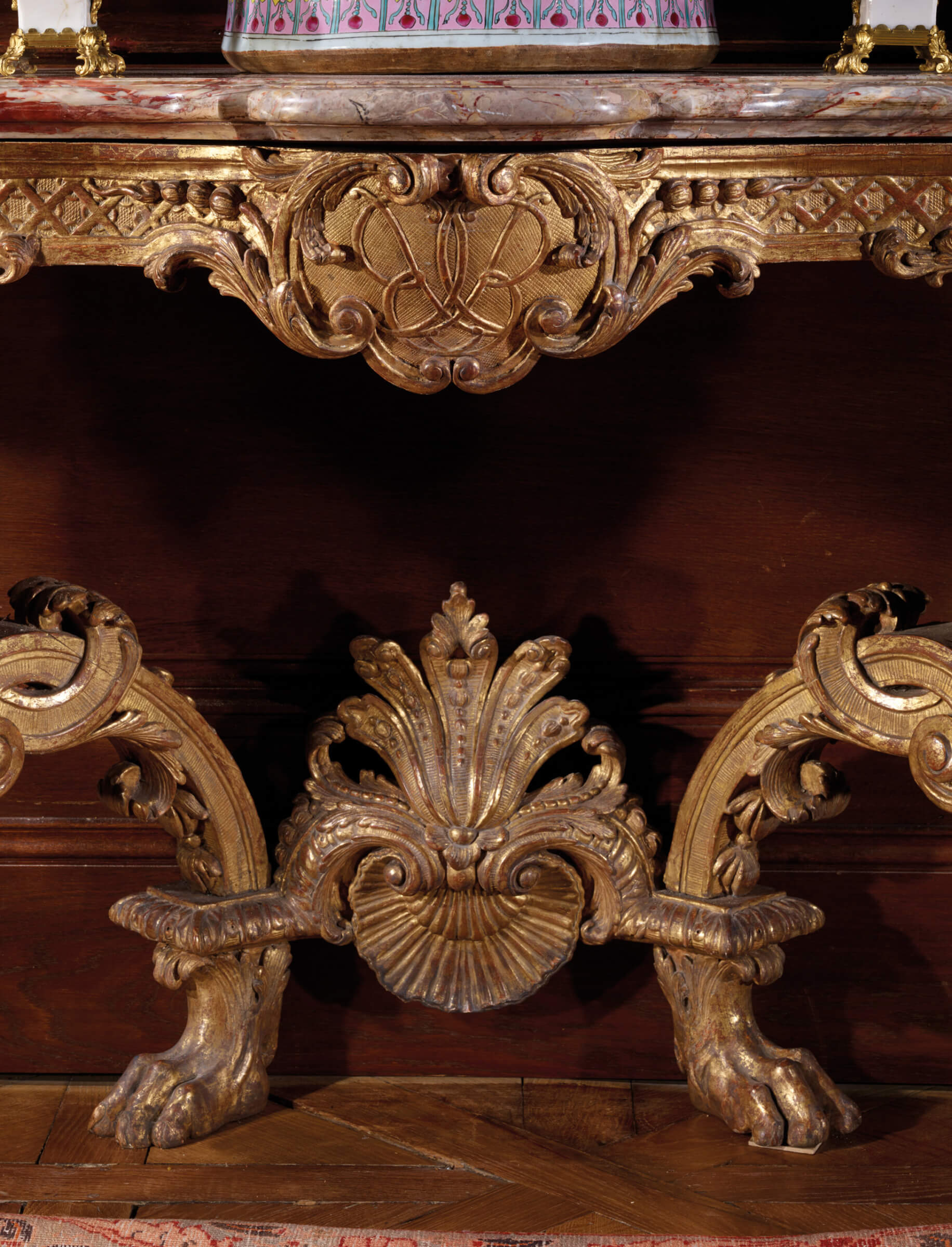
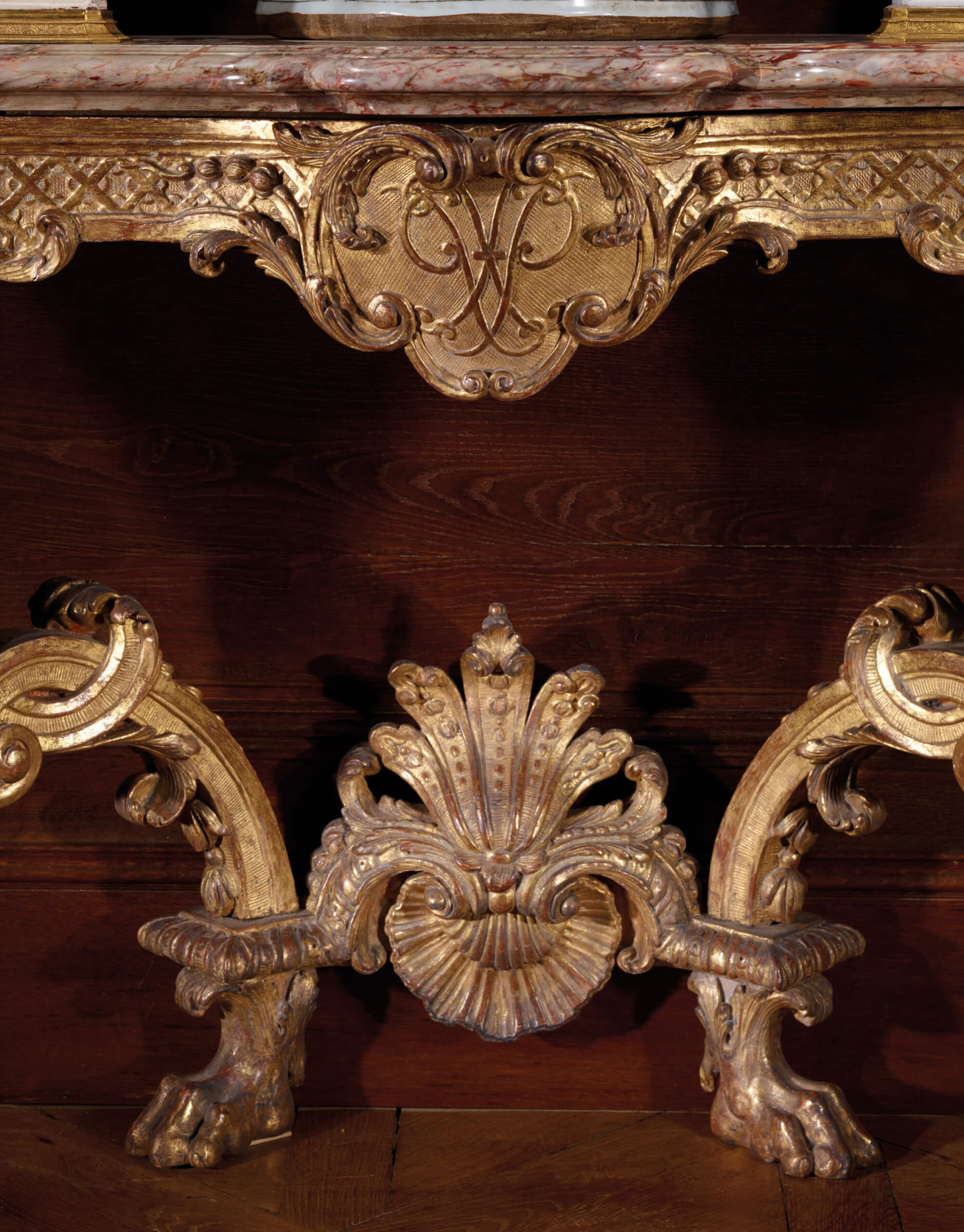
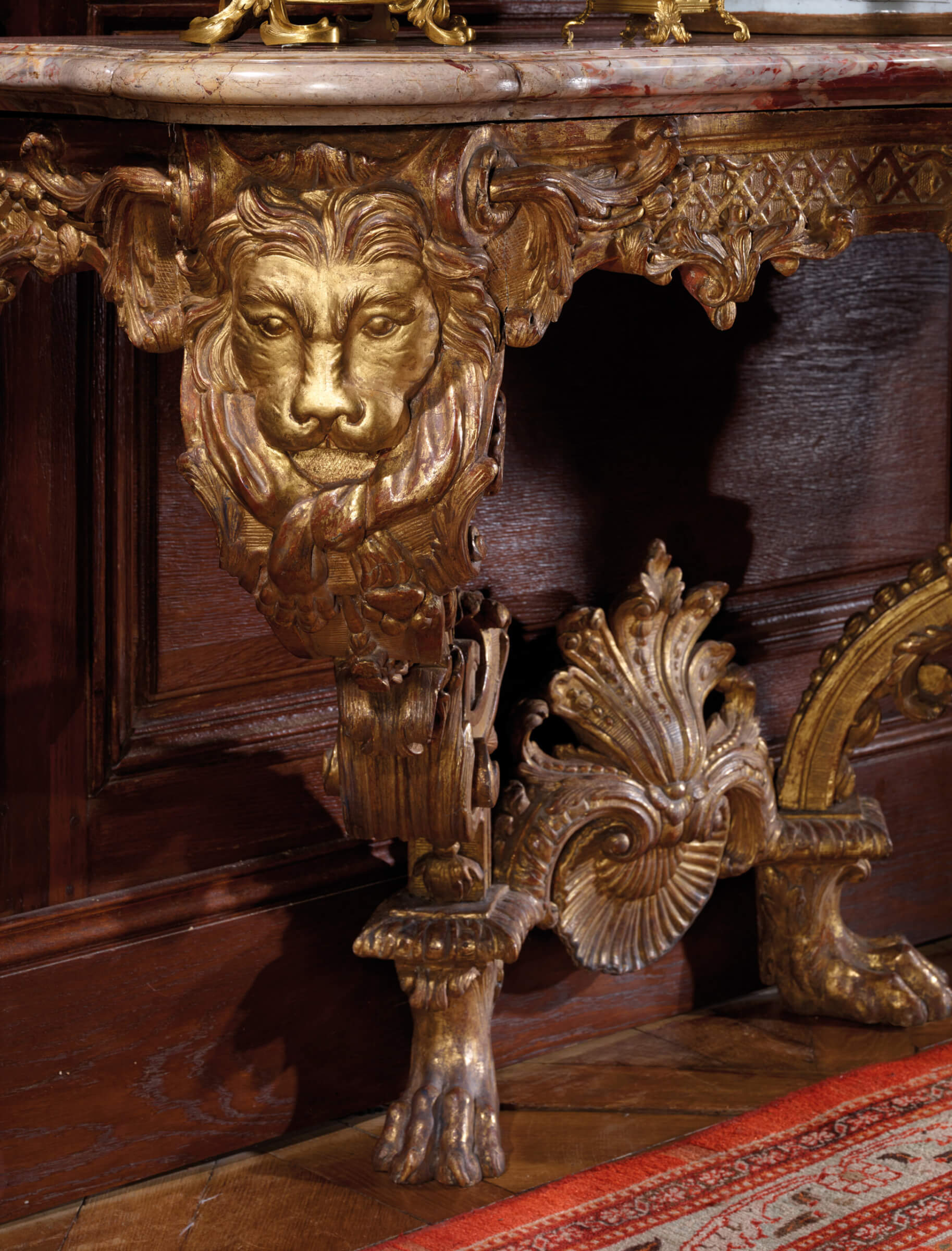
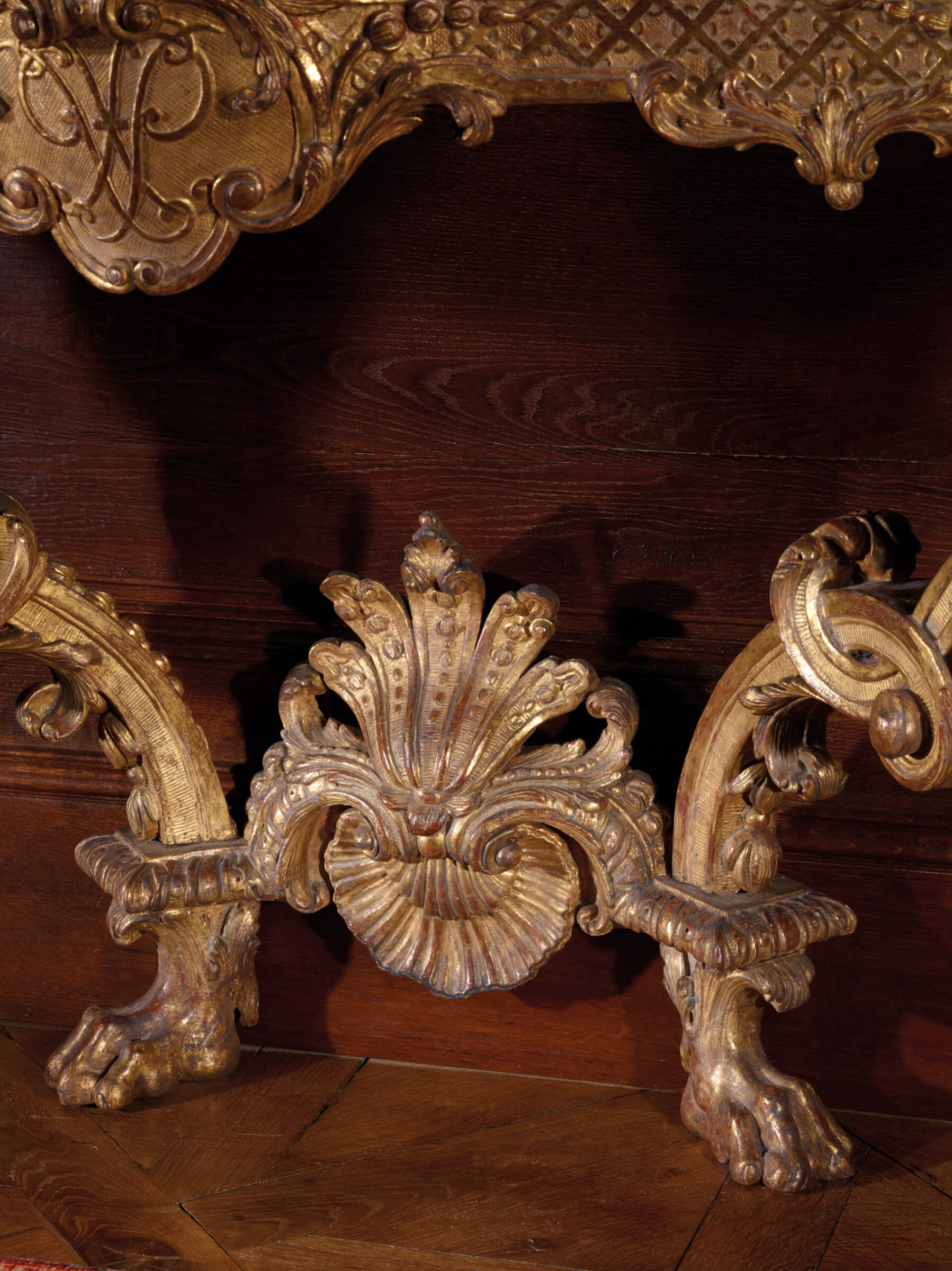
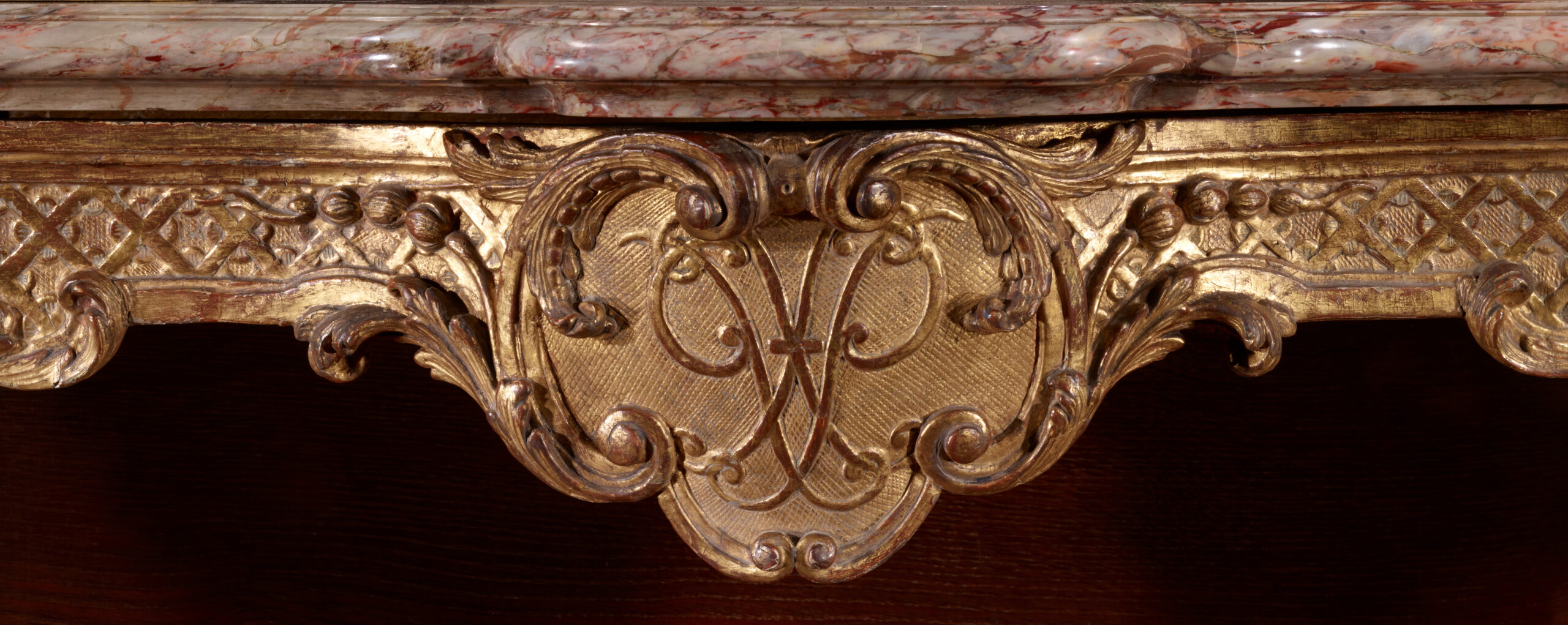
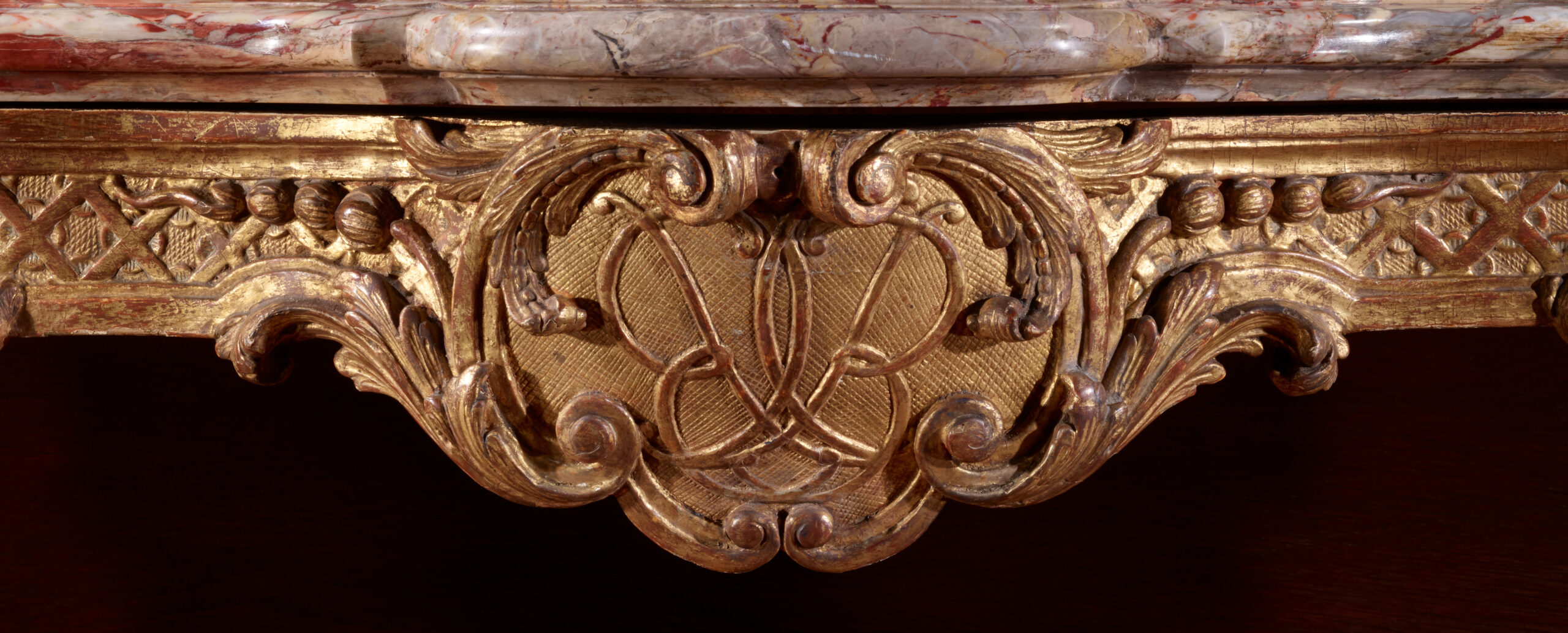
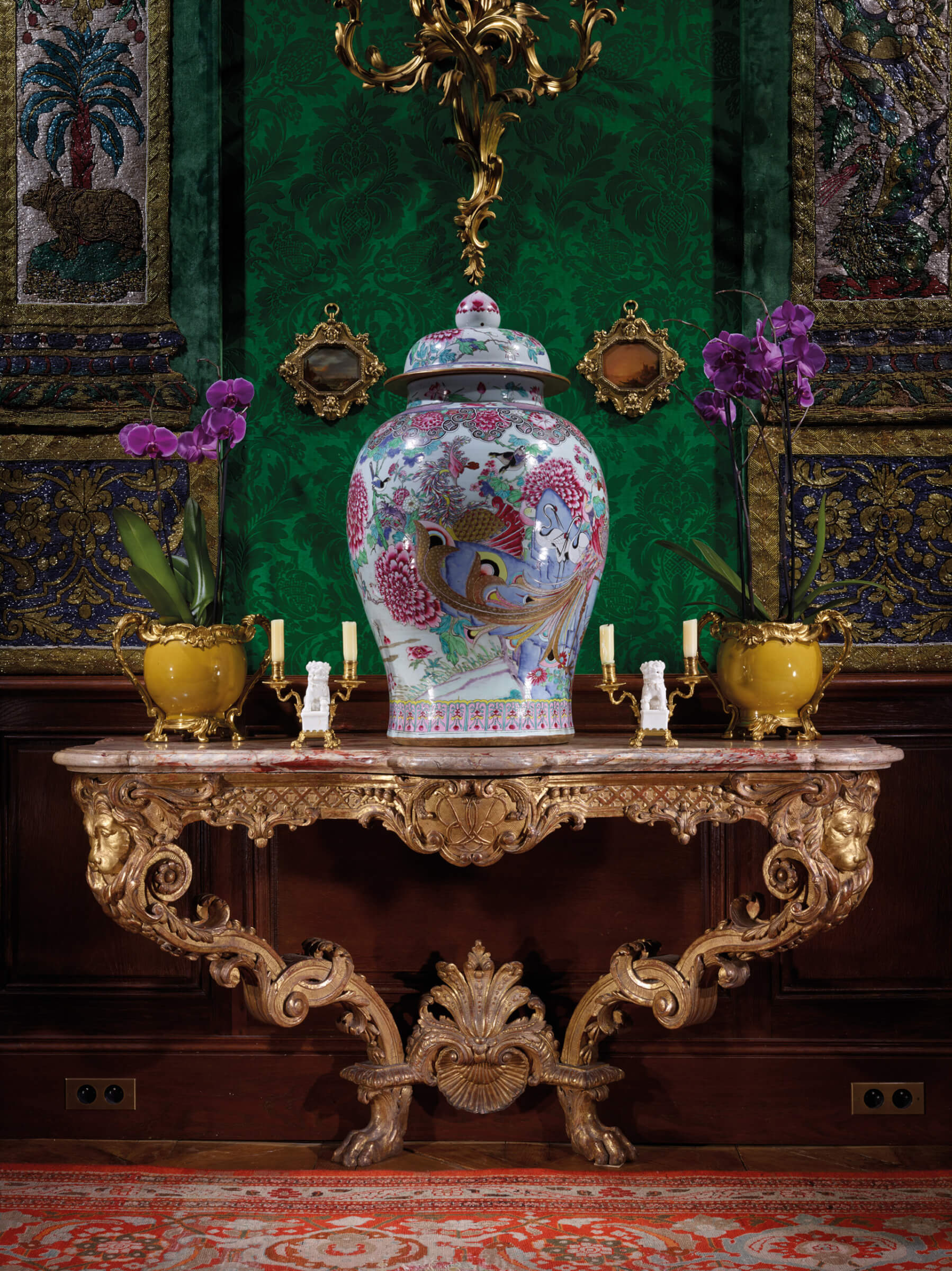
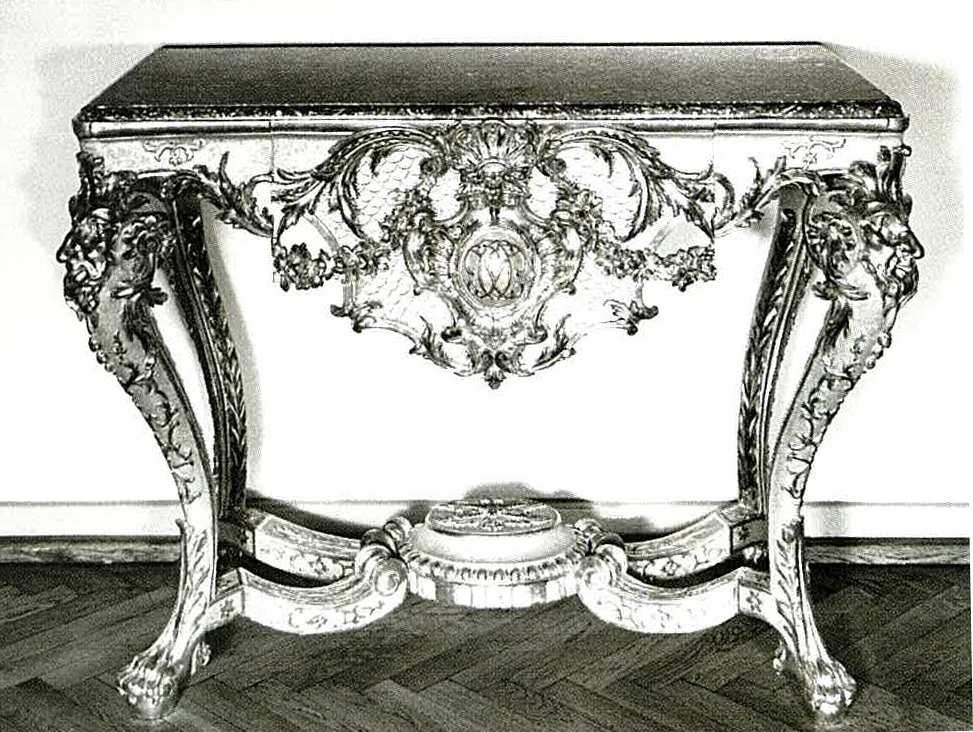
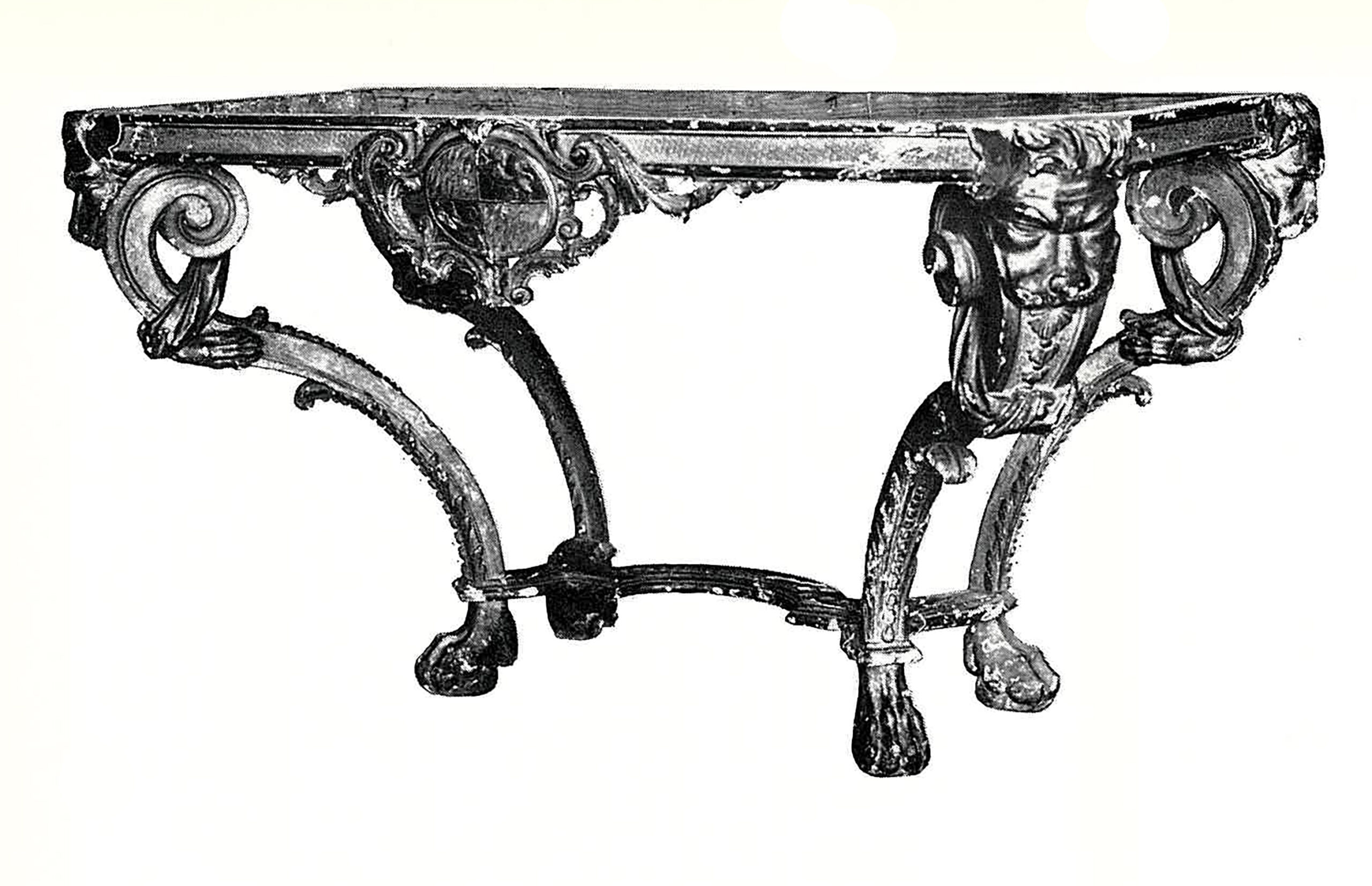
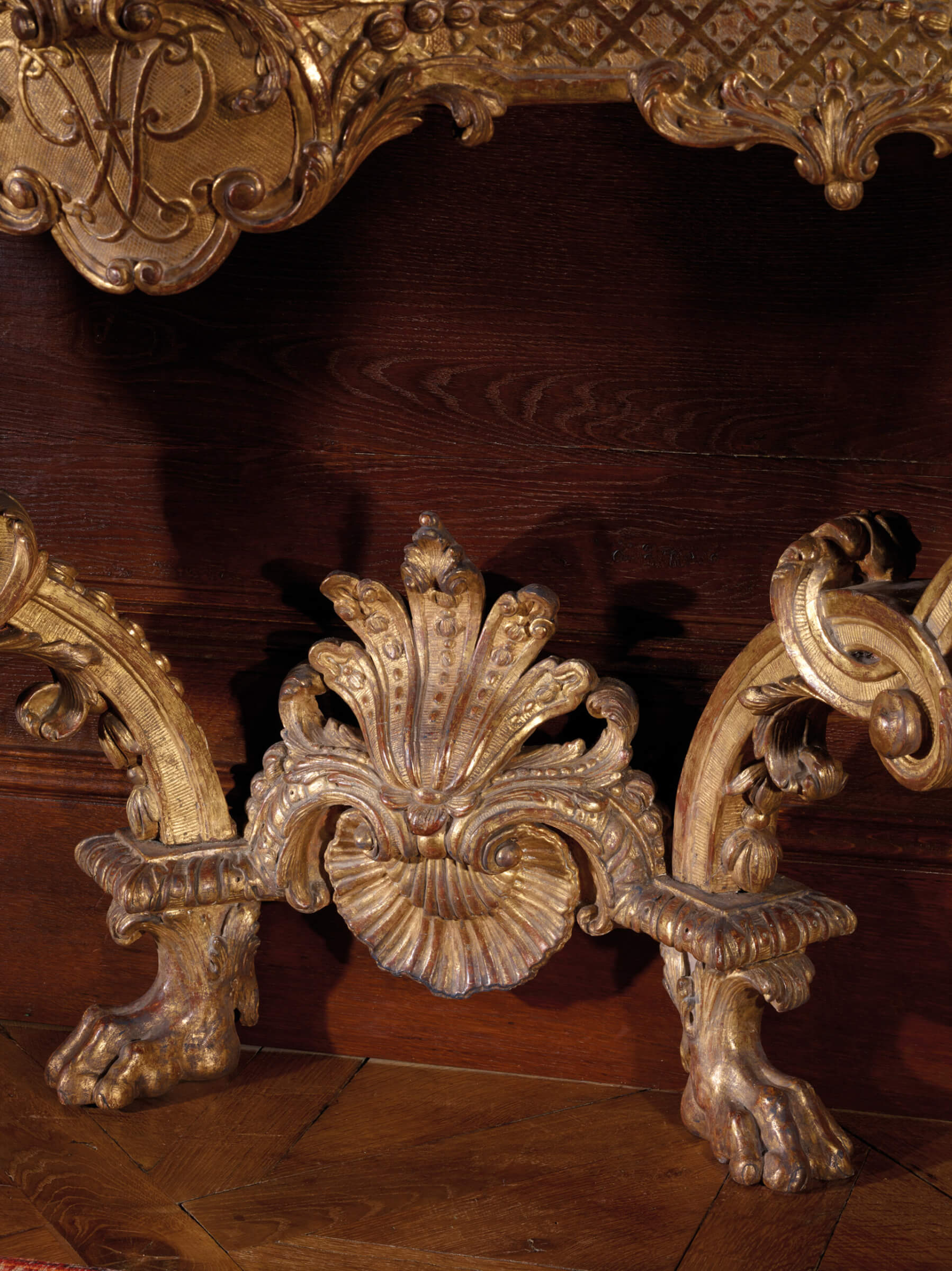
This extraordinary pair of carved and gilded oak consoles was most certainly executed for the Palatine Court of Charles III Philip (1661-1742), Count Palatine of Neuburg and Elector Palatine from 1716 to 1742, and his third wife, Violente Theresia of Thurn and Taxis (1683-1734), whom he married in 1728. They are each adorned with a cipher, which can be seen in a cartouche with a fretted background adorning the centre of their rails, and are monograms that might correspond to those of a couple; they display numerous similarities with the monograms then used by the Prince-Electors of the Palatinate and Bavaria, most notably featuring, in cursive letters, two E’s facing each other, usually standing in French—the then official language spoken in all the courts of Europe—for the word “Electeur”. This is complemented by the imposing lion’s muzzles carved at the corners of the two consoles, as well as the lion’s claws forming their feet, symbols of the Palatinate lion—Pfälzer Löwe—the heraldic emblem of the Palatinate, also belonging to the family coat of arms of the House of Wittelsbach.
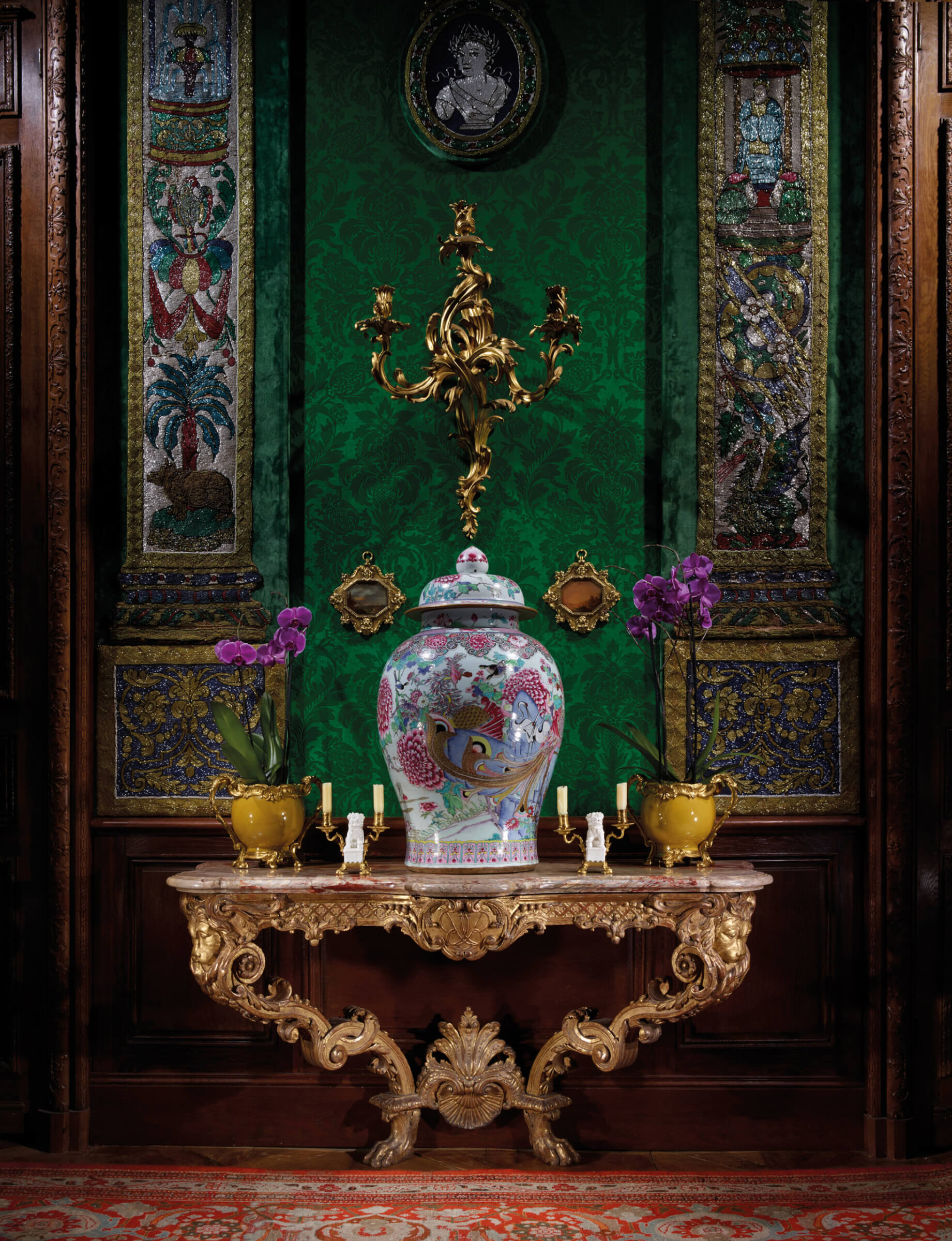
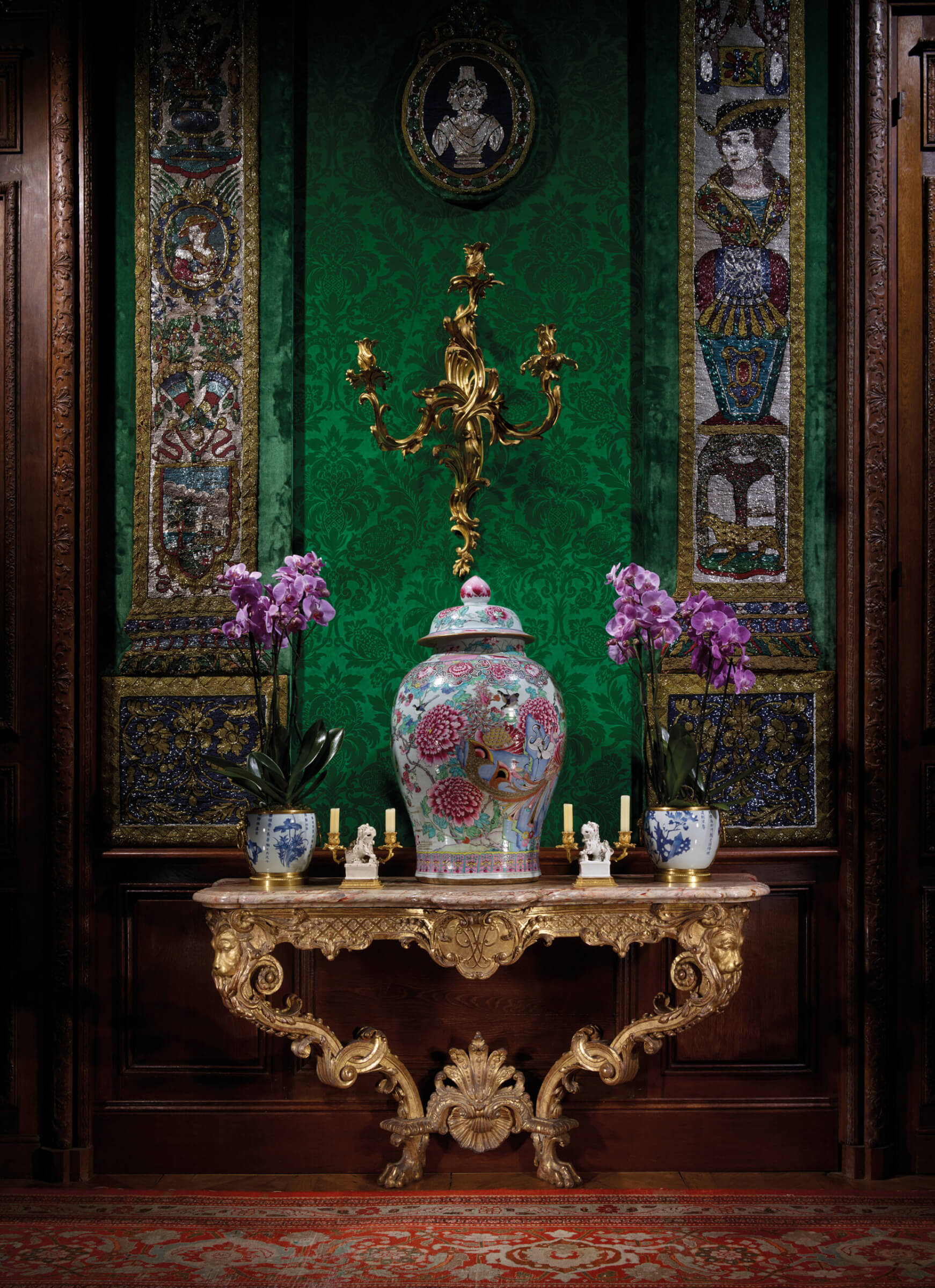
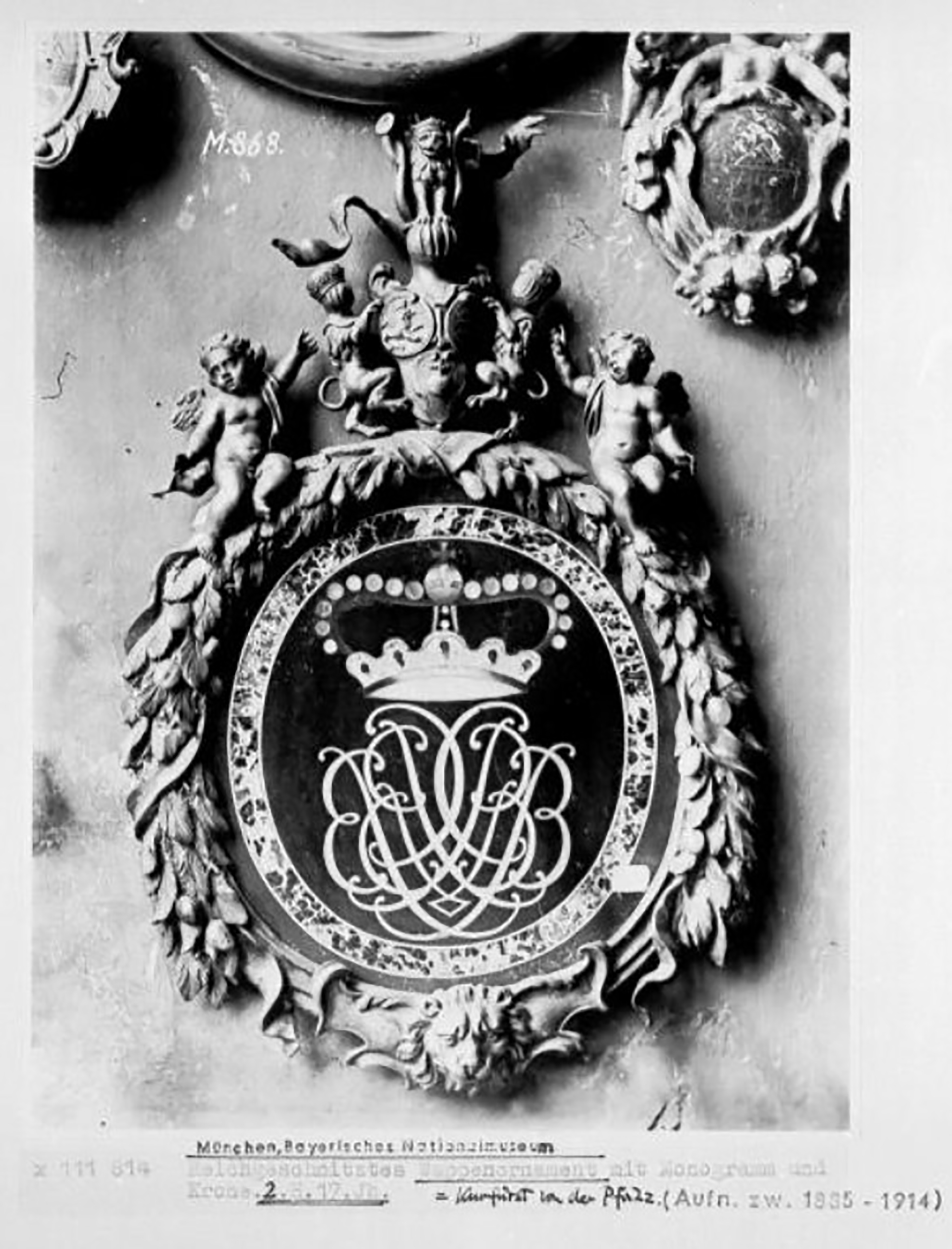
Each console displays a narrow, slightly curved rail, very finely carved with mosaics and rosettes, and a serpentine lower section enhanced with agraffes of acanthus motifs. The large monogrammed central cartouche mentioned above, flanked by acanthus scrolls, is echoed by the two imposing lion’s muzzles that can be seen in the corners. The latter, arranged diagonally, “capped” with acanthus scrolls and fleurons and enhanced with knotted lion paws, crown two console feet, with square-shaped moulded sections, interlocking curves and counter-curves, which are embellished with large acanthus leaves and fleuron pendants. The feet are joined, just above the acanthus-leafed claw feet supporting the console, by means of a crosspiece, carved with foliate frieze motifs, forming a central arch enhanced by an opulent festooned shell and surmounted by a wide palmette with flowers and pearls. A moulded Sarrancolin marble top with a “corbin beak” crowns the whole.
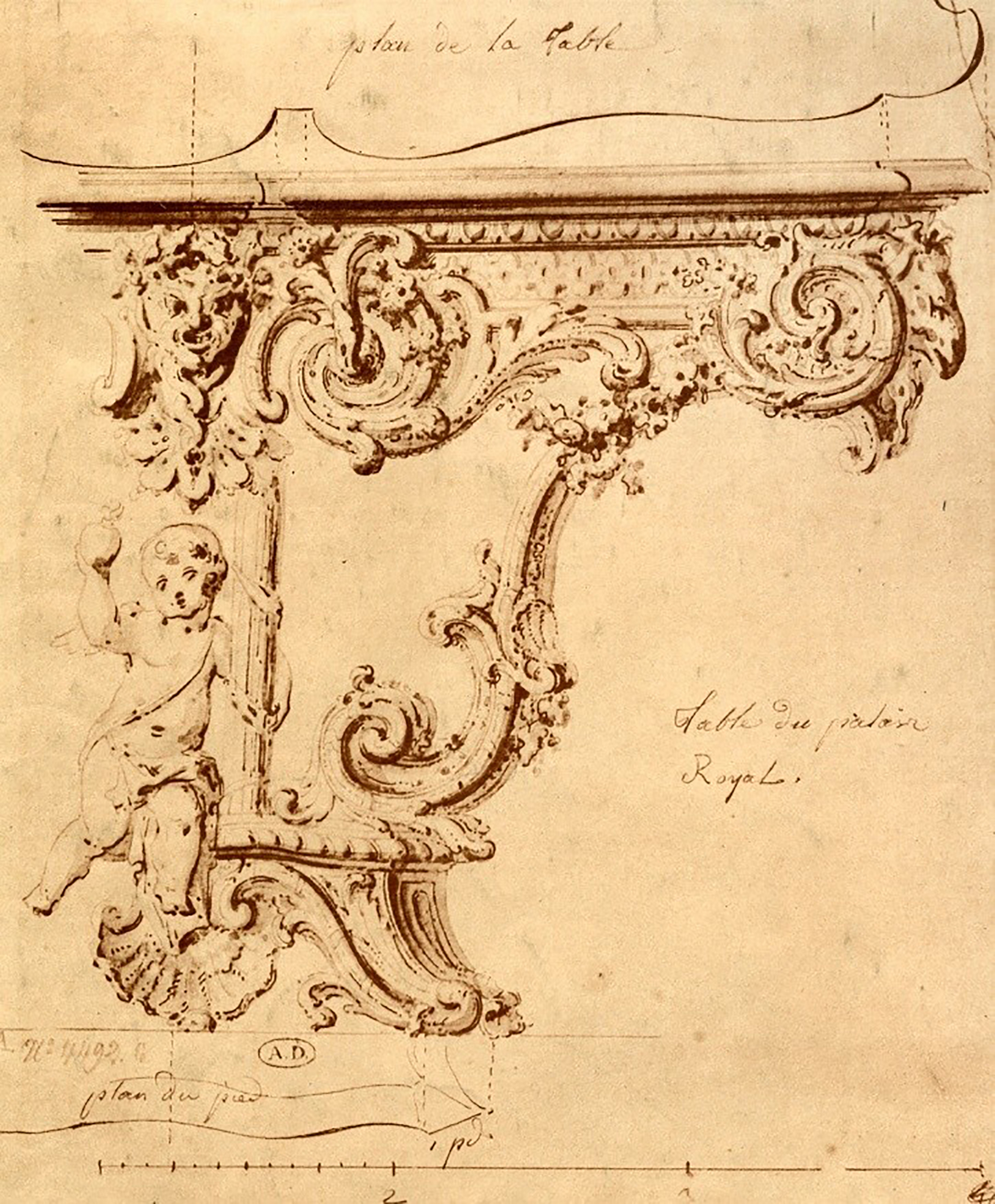
These console tables feature many similarities with French models from the Régence period. Their general design is not unlike that of the console, now in the Louvre, from the Grand Cabinet on the ground floor of the Château of Bercy, which was carved around 1713 by Jules Degoullons and associates for Charles-Henri II of Malon de Bercy (1678-1742). This console is also characterised by a narrow rail with a mosaic background adorned with fleurons —an ornament very much in vogue in France from the end of the 17th century onwards—and a very elaborate lower contour, which is also to be seen, for instance, on the table legs designed during the same period by François Roumier. These models, which are still distinguishable by their rigorous symmetry, were deemed a genuine innovation at the time and met with immediate success among Parisian craftsmen, who were instrumental in their promotion, particularly among the Principalities of Southern Germany.
From 1716, the date of his elevation to the electoral dignity as successor to his brother, Charles III Philip had his full-length portrait executed on several occasions, posing next to a console adorned, just like ours, with the muzzles and claws of the Palatine lion. One such portrait, painted circa 1730 by Pierre Louis Goudreaux (1694-1731), a French painter and pupil of Nicolas de Largillierre and Hyacinthe Rigaud, who entered the service of the Palatine Court before 1722, now decorates the Rittersaal (Knights’ Hall) at Mannheim Palace, the Elector’s main residence. The portrait shows him in armour, wearing the red ermine-lined coat of the Elector on his shoulders, with his crown resting on a carreau (square-shaped cushion) of blue velvet with gold braiding, itself placed on the top of the leonine console. A similar portrait, equally by Goudreaux, is now in the Stadtmuseum, Dusseldorf, (inv. SMD.B 35); and a painting by Johann Philipp von der Schlichten (1681-1745), this time showing him in black velvet civil dress, with his coat, crown and sceptre placed directly on the console, can be found in Heidelberg, in the collections of the Kurpfälzisches Museum der Stadt Heidelberg.
Charles III Philip, Count Palatine of Neubourg and Elector Palatine
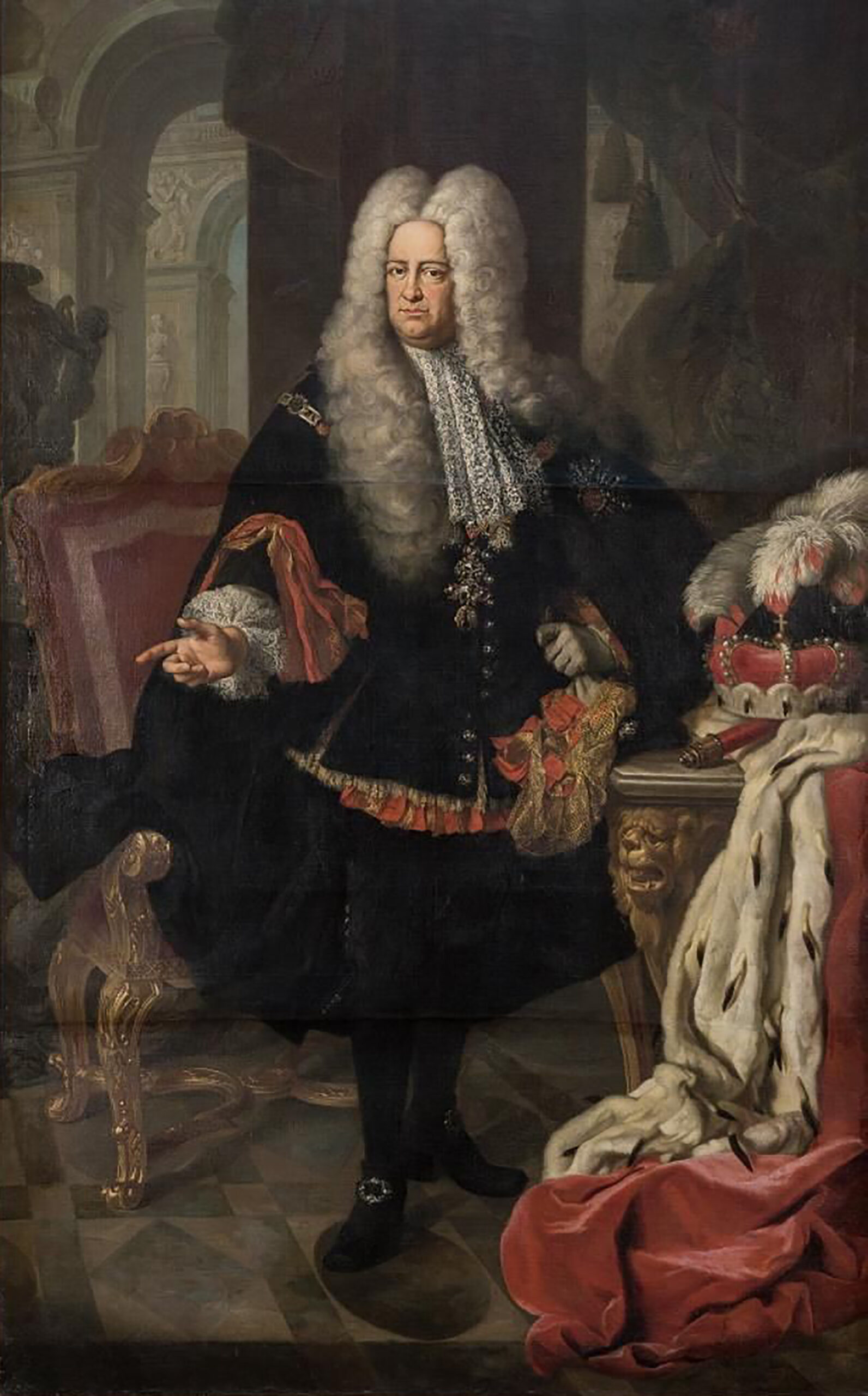
A member of the Palatine line of the House of Wittelsbach, Charles III Philip—Karl III. Philipp von der Pfalz in German—was born on 4th November 1661 in Neubourg an der Donau, Bavaria. He was the seventh of the seventeen children of Philip William of Neuburg (1615-1690), Count Palatine (1653) then Duke of Neuburg (1666), Elector Palatine from 1685 to 1690, and Elisabeth Amalie of Hesse-Darmstadt (1635-1709). As a younger brother, he was predestined for an ecclesiastical career from early on. With no religious orders, he became a canon in Cologne at the age of 14, before moving to Salzburg with the same status in 1677 and Mainz in 1679, the year in which he was also made a Knight of the Order of Malta. Having received military training at the same time, he decided to put an end to his career in the orders in 1684 and entered the service of the Holy Roman Emperor. Two of these Emperors, Joseph I of Habsburg (1678-1711), Emperor in 1705, who was succeeded by Charles VI of Habsburg (1685-1740), were none other than his nephews, sons of his sister Eleonore Magdalene of Pfalz-Neuburg (1655-1720). Charles III Philip was also brother-in-law to the Kings of Spain and Portugal. He had a very active military career, taking part in several campaigns against the Ottomans from 1691 to 1694, which earned him the title of Generalfeldmarschall and a knighthood in the Order of the Golden Fleece. In 1705, Joseph I appointed him to Innsbruck as Governor of the lands of Upper Austria and Further Austria, an office that had been vacant since the death of Charles V Leopold of Lorraine in 1690. With remarkable zeal, he displayed a wealth of organisational abilities in Innsbruck, contributing most notably to the strengthening of its defences during the War of the Spanish Succession.
Upon the death of his elder brother, Johann Georg von Neuburg-Wittelsbach (1658-1716) in June 1716, Charles III Philip succeeded him and became Prince-Elector of the Palatinate and Duke of Pfalz-Neuburg, as well as of Jülich and Berg, but he remained in Innsbruck until 1717. He then moved to Heidelberg in 1718, after residing for another year in Neuburg an der Donau. The new Elector held Düsseldorf, his brother’s residence, in contempt claiming that the provincial states of that city had refused to provide him with the funds he demanded. In order to settle the enormous debts he had inherited, Charles III Philip took drastic cost-cutting measures at court at the inception of his reign. He was also soon confronted with a variety of political conflicts, which he gradually managed to resolve at the cost of substantial sacrifices.
One of the most important of those was the dispute surrounding the honorary title of Arch-Treasurer of the Holy Roman Empire, which was a source of discord between the electoral Palatinate and the new electorate of Hanover headed by George I (1660-1727), Duke of Brunswick-Lüneburg, who became King of England in 1714. This crisis paralysed the Imperial Diet between 1717 and 1719, and it was not until 1741 that a definitive contractual agreement was eventually adopted. A man of strong Catholic faith, the Prince Elector also came into conflict with the Reformed Church Council, which, in a quest for absolutism, he wanted to turn into a structure under his authority. He tried to ban the Heidelberg Catechism and to do away with the simultaneum which was then in force in the city’s Church of the Holy Spirit, thus seeking to turn it into a solely Catholic place of worship and a burial ground dedicated to the Wittelsbachs. Compelled to give in under the pressure of the Protestant states and the Emperor himself, he decided to transfer the residence of the Electoral Palatinate from Heidelberg to Mannheim in 1720.
In the same year, he had the foundation stone laid for Mannheim Palace and began construction of the Jesuit College, which was attached to his new residence. In 1733, he also initiated the construction of the city’s Jesuit church, which is considered to be one of the most prominent religious buildings of the Counter-Reformation in Germany and one of the largest Baroque churches in Southern Germany. Charles III Philip, however, in the interests of tolerance, did not pursue his brother’s policy of re-Catholicisation. He continued to undertake major architectural projects instead and in 1737 launched the construction of the Mannheim opera house, from plans devised by architect Alessandro Galli da Bibiena (1686-1748).
Towards 1725, he was faced with the thorny issue of the succession to the Duchy of Juliers-Berg. With the help of the Emperor, at first he succeeded in imposing the succession of the Wittelsbachs on that of Brandenburg-Prussia. However, Charles VI’s rapprochement with the Prussian King Frederick William I (1688-1740) in 1726 induced him to form an alliance with France, against which he had until then been regularly opposed due to a dispute over the Alsatian titles of the Palatines; the treaty that was signed on that occasion was to prove its worth to the full in 1734, during the War of Succession to the Polish throne that saw Charles III Philip display a stance of benevolent neutrality towards France, which in return knowingly spared his territories. In 1741, a treaty was eventually signed with Prussia and Saxony, putting an end to the succession dispute mentioned above. The fight for Silesia had now become far more momentous for Frederick II of Prussia (1712-1786) and his allies than their former claims on the Lower Rhine.
When Emperor Charles VI died suddenly in October 1740, the Prince-Electors Charles III Philip and Charles Albert of Bavaria (1697-1745), the future Emperor Charles VII, announced on 30th October 1740 that they were taking over the Imperial Vicariate, which sparked a fierce protest from the Protestant States of the Empire; the Treaty of the House of Wittelsbach of 1724 had not been recognised by the Emperor or the Imperial States. It was not until the two Wittelsbach Princes reached an agreement on 18th January 1741 with the Prince-Elector of Saxony, Frederick-Augustus II (1696-1763), who insisted on his rightful participation in the Imperial Vicariate, that these quarrels could eventually be brought to an end.
By dint of reciprocal succession and union agreements with the other branches of the Wittelsbach family, Charles-Philip unceasingly strove to further strengthen this illustrious House. The culmination of this ambitious policy was the double marriage he brokered on 17th January 1742 between his granddaughter Elisabeth-Auguste of Palatinate-Sulzbach (1721-1794) and his designated successor, Charles-Theodore of Palatinate-Neuburg-Sulzbach (1724-1799), and between her sister Marie-Anne of Palatinate-Sulzbach (1722-1790) to Duke Clement-Francis of Bavaria (1722-1770). The marriages were celebrated by the Archbishop-Elector of Cologne, Clemens-August of Bavaria (1700-1761). Charles Albert of Bavaria, which has already been mentioned, and Johann Theodor of Bavaria (1703-1763), Bishop of Regensburg and the future Prince-Bishop of Liège, were also present. A few days later, on 24th January 1742, Charles III Philip supported the imperial election of Charles Albert by voting for the latter. Although he had been a close relative of the Habsburgs and an important ally of Vienna at the start of his ascension, by the end of his life he had become a fervent advocate of the anti-Austrian camp of the Bavarian Wittelsbachs. It was in the context of such a political farsightedness that his granddaughter Maria Francisca Dorothea of Palatinate- Sulzbach (1724-1794) married Frederick Michael of Zweibrüchen-Birkenfeld (1724-1767) on 6th February 1746, who would be the parents of the future King Maximilian I of Bavaria (1756-1825) and, by descent, of all the Kings of Bavaria until 1918. Charles III Philip is accordingly regarded today as the most important Wittelsbach politician of the first half of the 18th century. He died at his residence in Mannheim on 31st December 1742 and was buried in the Palace chapel.