Moulded, carved and gilded walnut; Breche Violette marble.
H. 86 cm. (34 in.); W. 155 cm. (61 in.); D. 63.5 cm. (25 in.).
PROVENANCE: collection of Pierre-Louis-Bernard d’Harcourt (1842-1914), 5th Marquis of Harcourt-Olonde, and his wife, née Marguerite de Gontaut-Biron, (1850-1953), at the Château de Saint-Eusoge, Rogny-les-Sept-Écluses (Yonne, France); collection of their son, Etienne d’Harcourt (1884-1970), 6th Marquis of Harcourt-Olonde, at the Château de Saint-Eusoge; collection of his son Amaury d’Harcourt (1925-2018), Viscount of Harcourt, at the Château de Saint-Eusoge; collection of his daughter Diane d’Harcourt (born 1954), at the Château de Plainval, near Saint-Just-en-Chaussée (Oise, France).
COMPARATIVE LITERATURE: Bruno Pons, De Paris à Versailles, 1699-1736, Les sculpteurs ornemanistes parisiens et l’art décoratif des Bâtiments du roi,Strasbourg, 1986, p. 174 and note 517, fig. nos 497 and 498.
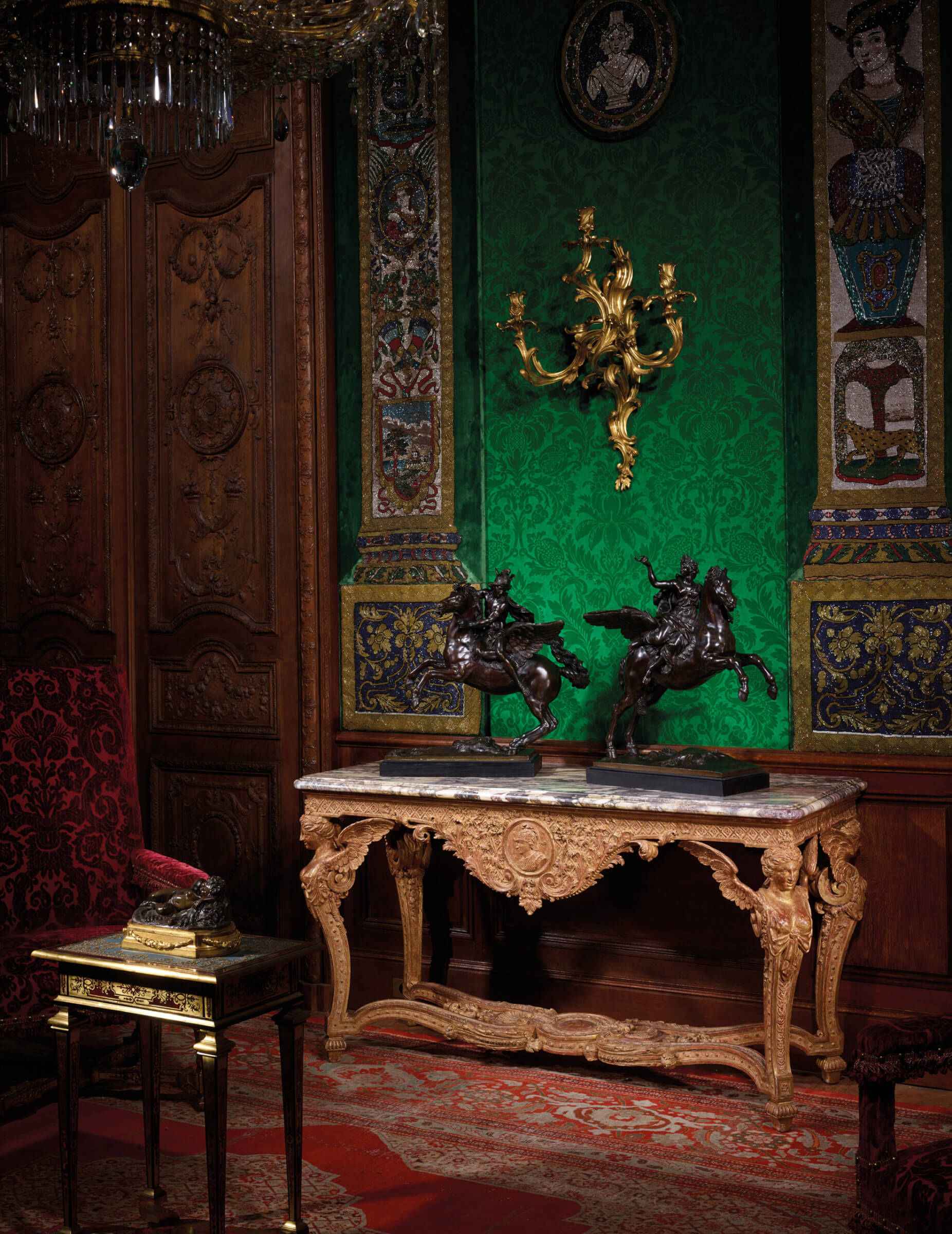
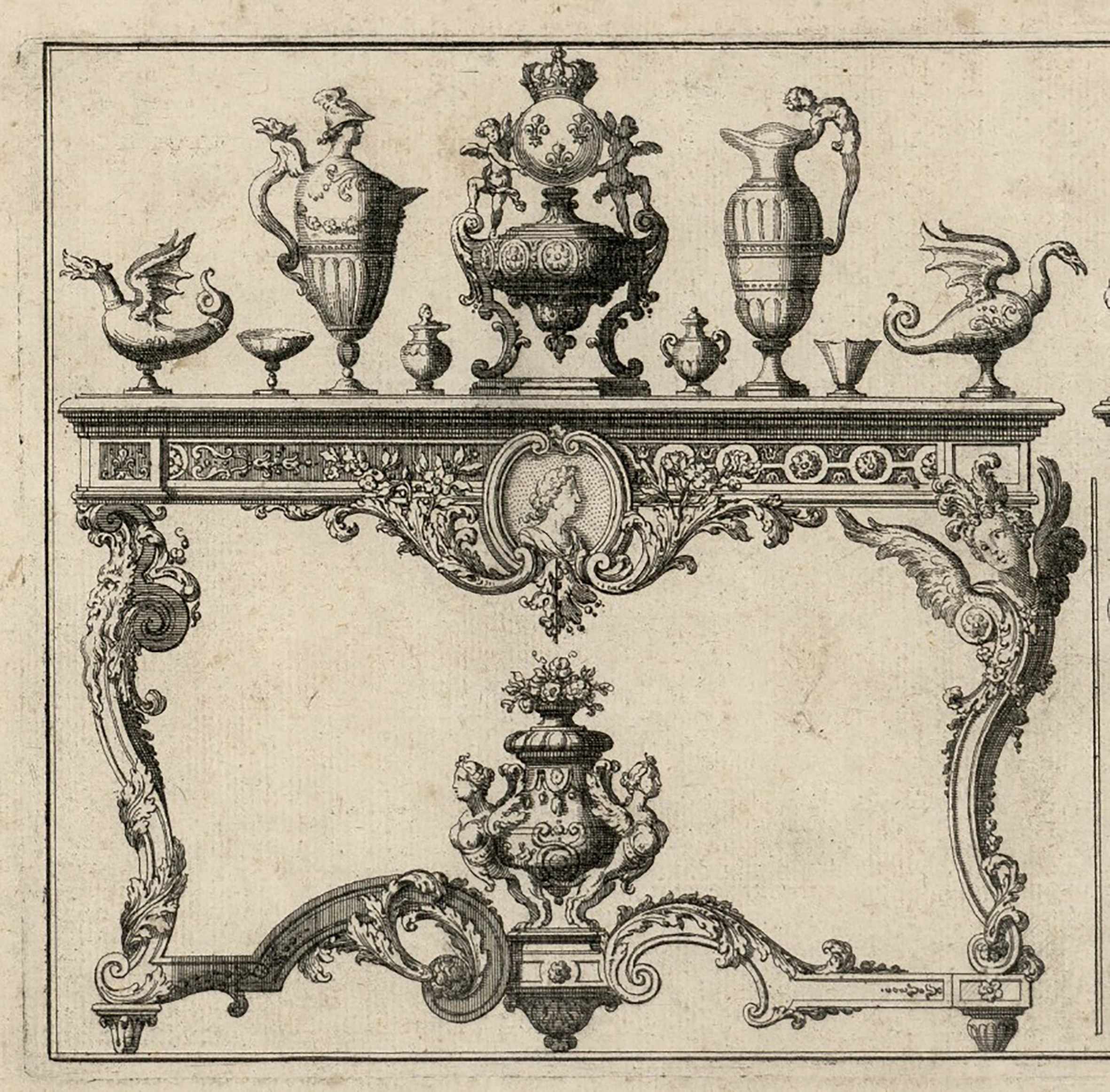
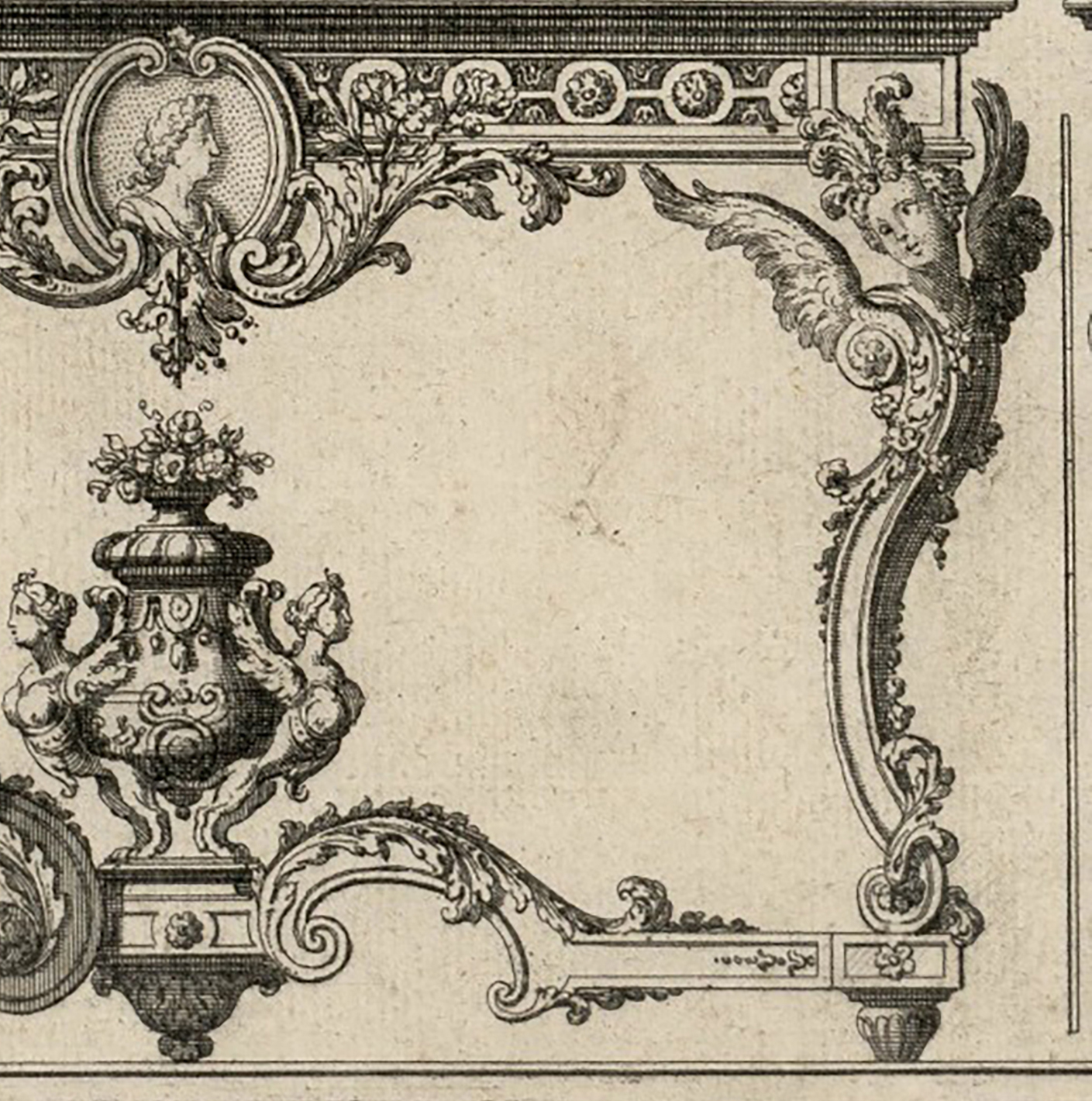
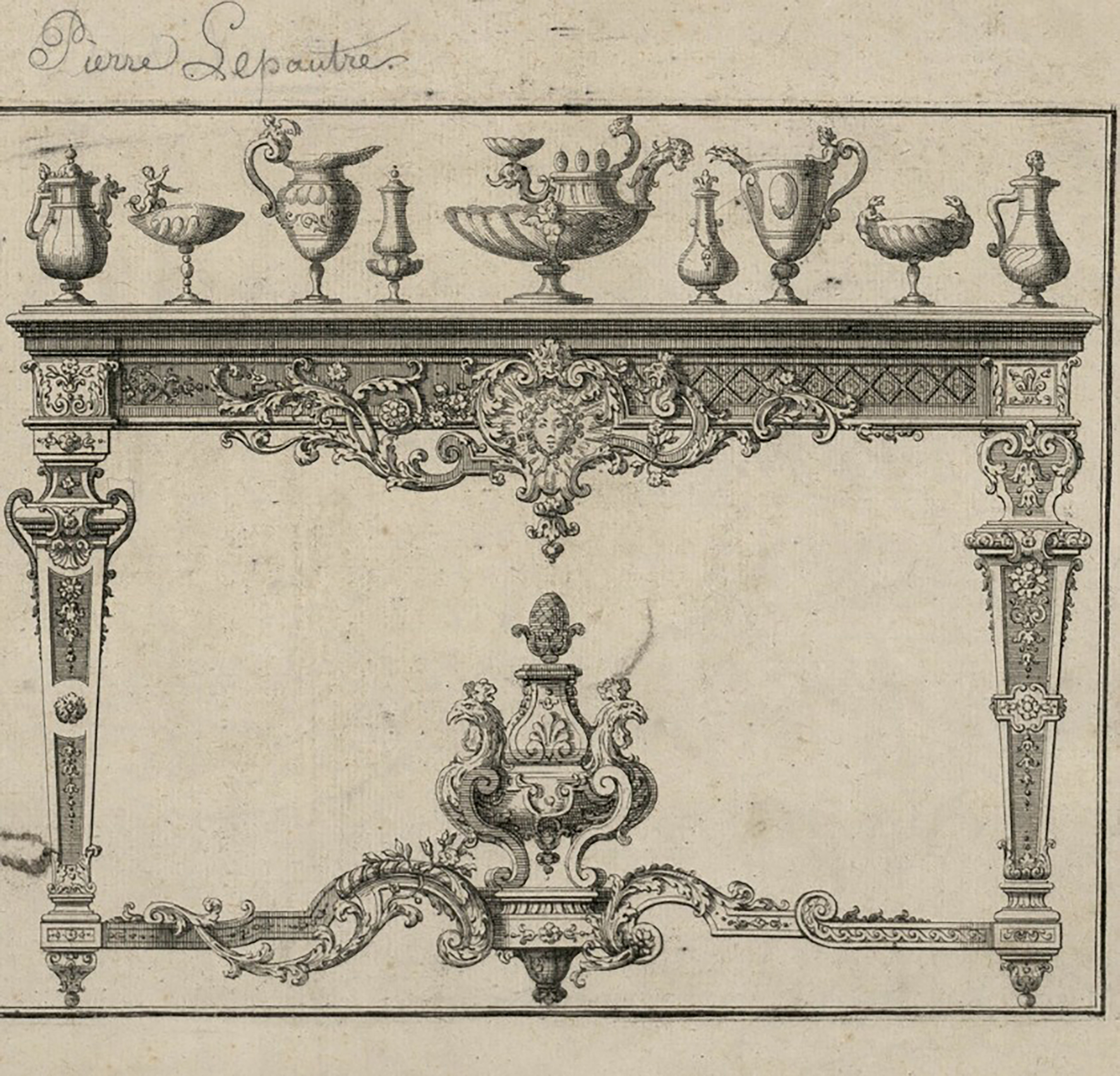
The console, from the collection of the Marquis of Harcourt-Olonde, is derived, without much modification, from a table engraved circa 1700 by Pierre Lepautre (c. 1652-1716), architect, engraver and ornamentalist, appointed in 1699 draughtsman of the Bâtiments du Roi, from his Livre de Tables qui sont dans les Apartemens du Roy sur lesquelles sont posée des Bijoux du Cabinet des Médailles. Dessiné et gravé par P. Le Pautre Graveur du Roy. Se Vend Chez Daigremont Rue Aubriboucher [Rue Aubry-le-Boucher in the 4th arrondissement in Paris] a l’image Ste. Genevève.
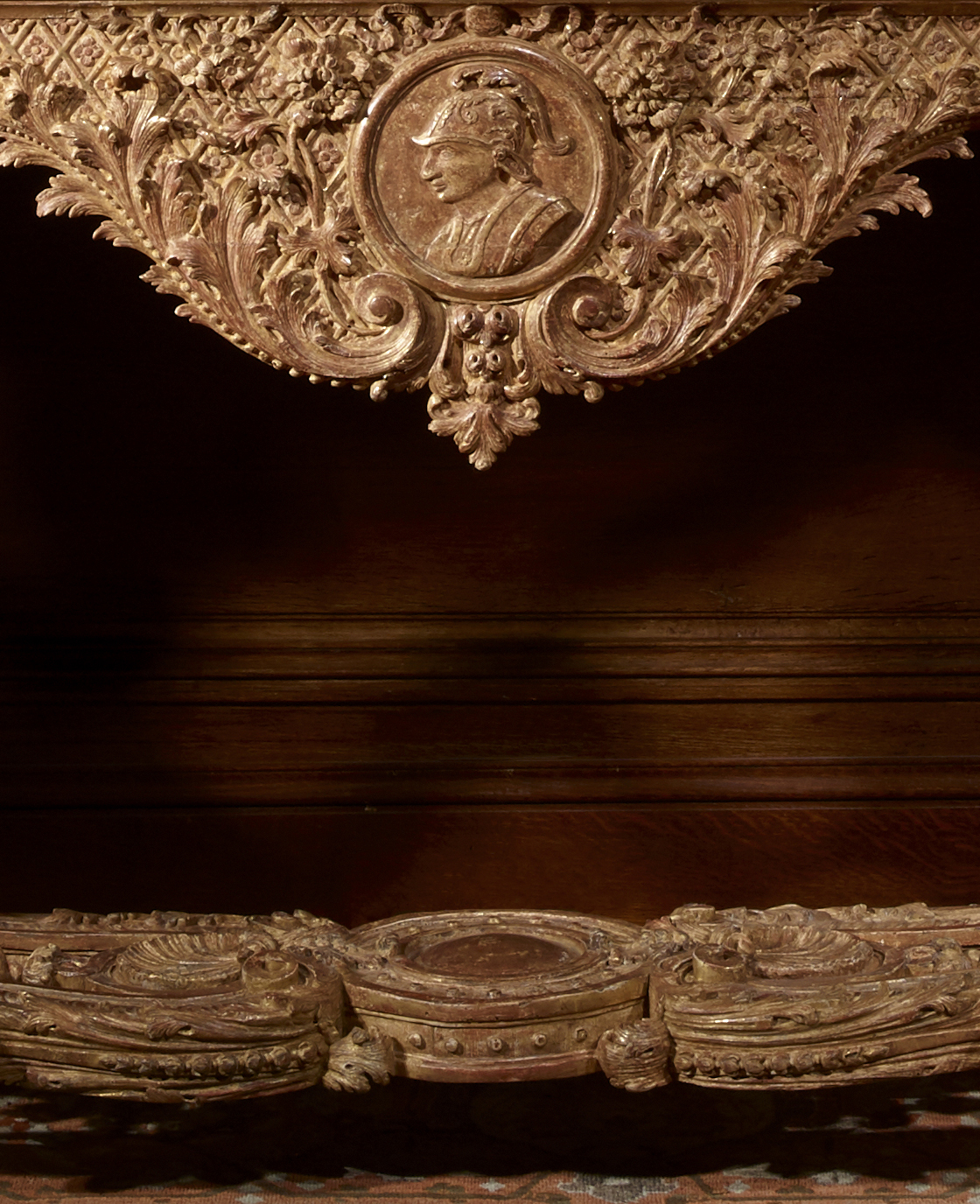
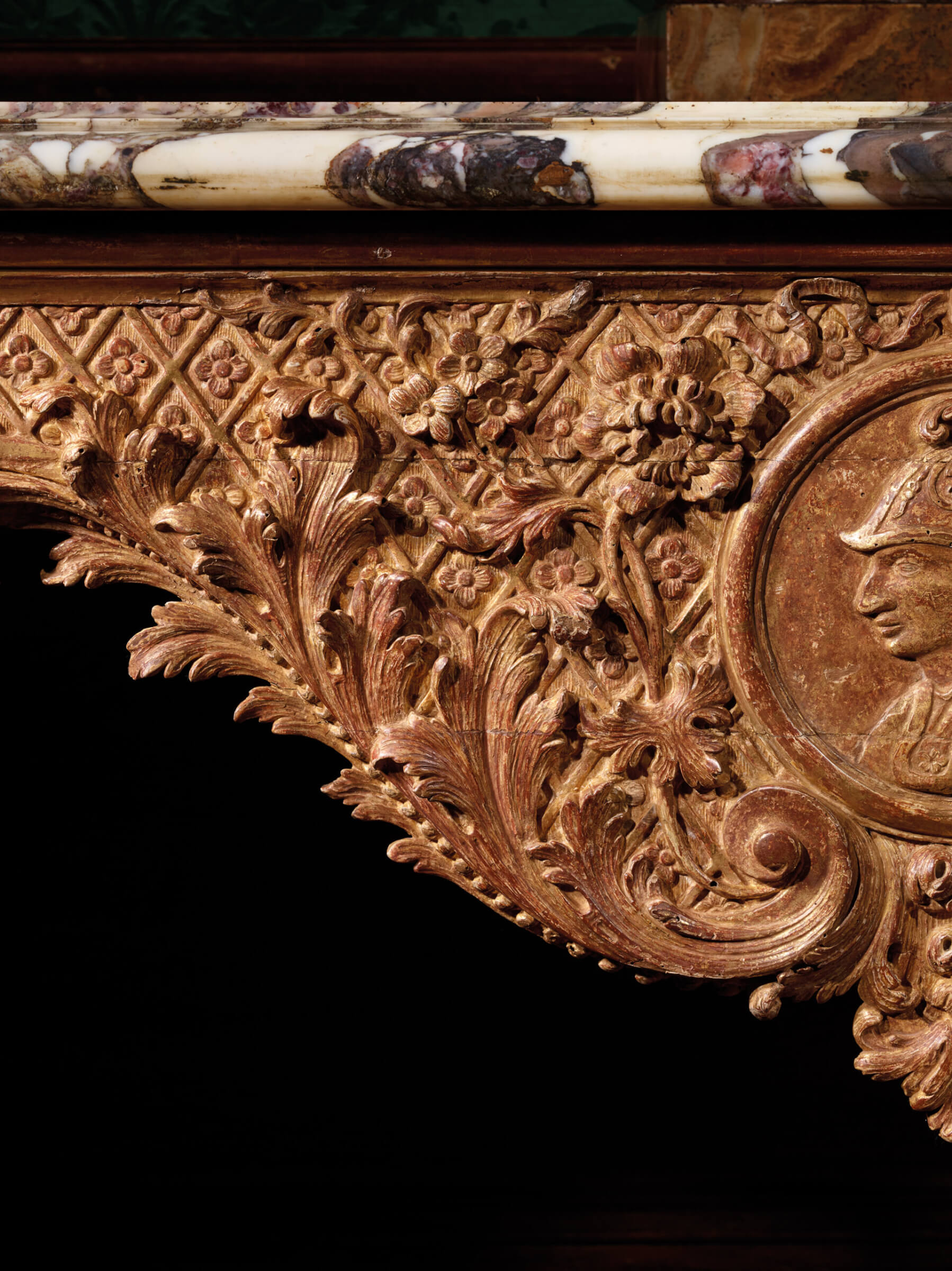
Just like the King’s table, it is characterised by a large central medallion, ribboned and forming a projection, adorned with the profile of a male bust in the ‘antique style’, in the case at hand facing to the left and helmeted.
The medallion is underlined by a small foliage motif flanked by two lavish acanthus beaded scrolls, forming a “crossbow-shaped” lower section in this central part of the console, from which can be seen to emerge sinuous intertwined stems of foliage and flowers, partially covering, all around the medallion, the carved “mosaic and fleuron” décor of the rail. Although this frieze “with mosaic and fleurons” does not appear on the table by Lepautre that is of interest for us here, it does, however, feature in identical fashion, arranged in the same way on a single row around the edge of the rail, on two other tables in the Livre of the ornamentalist.
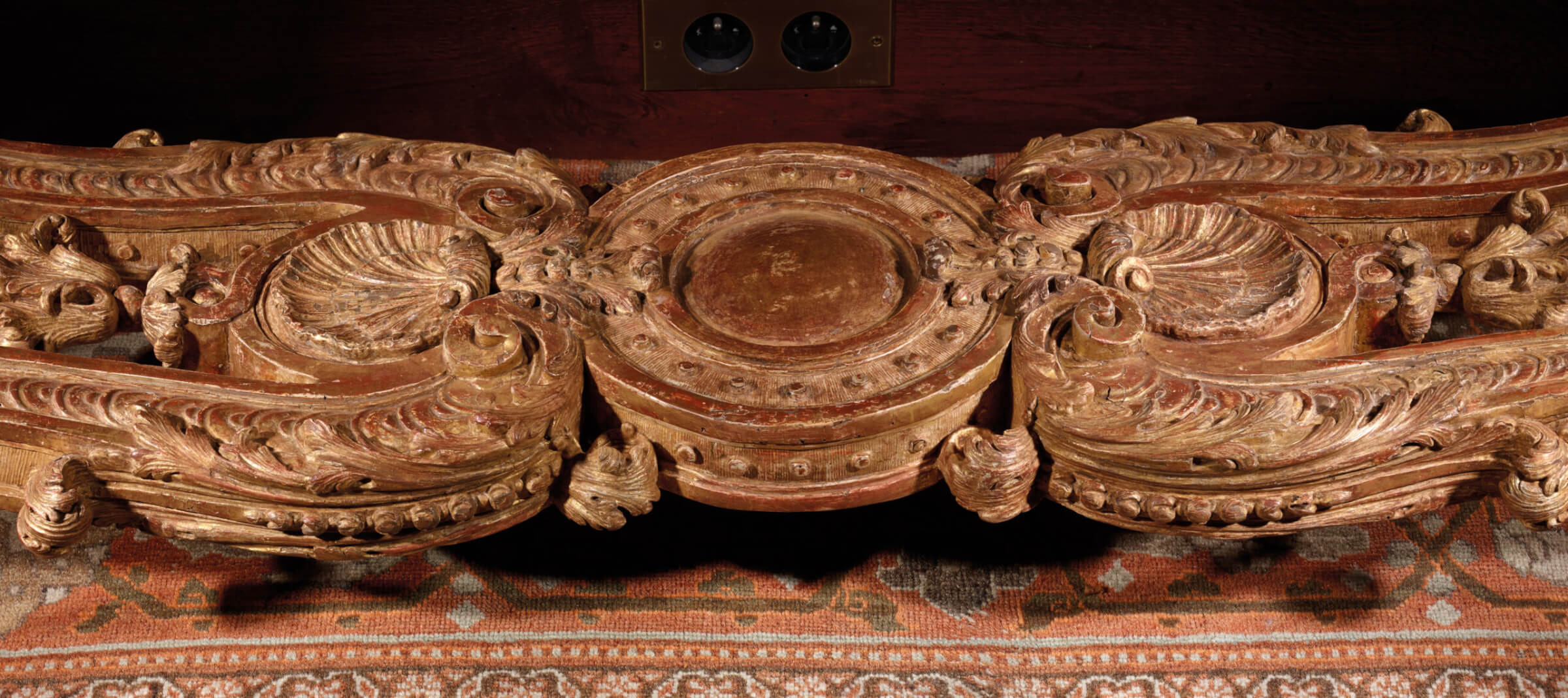
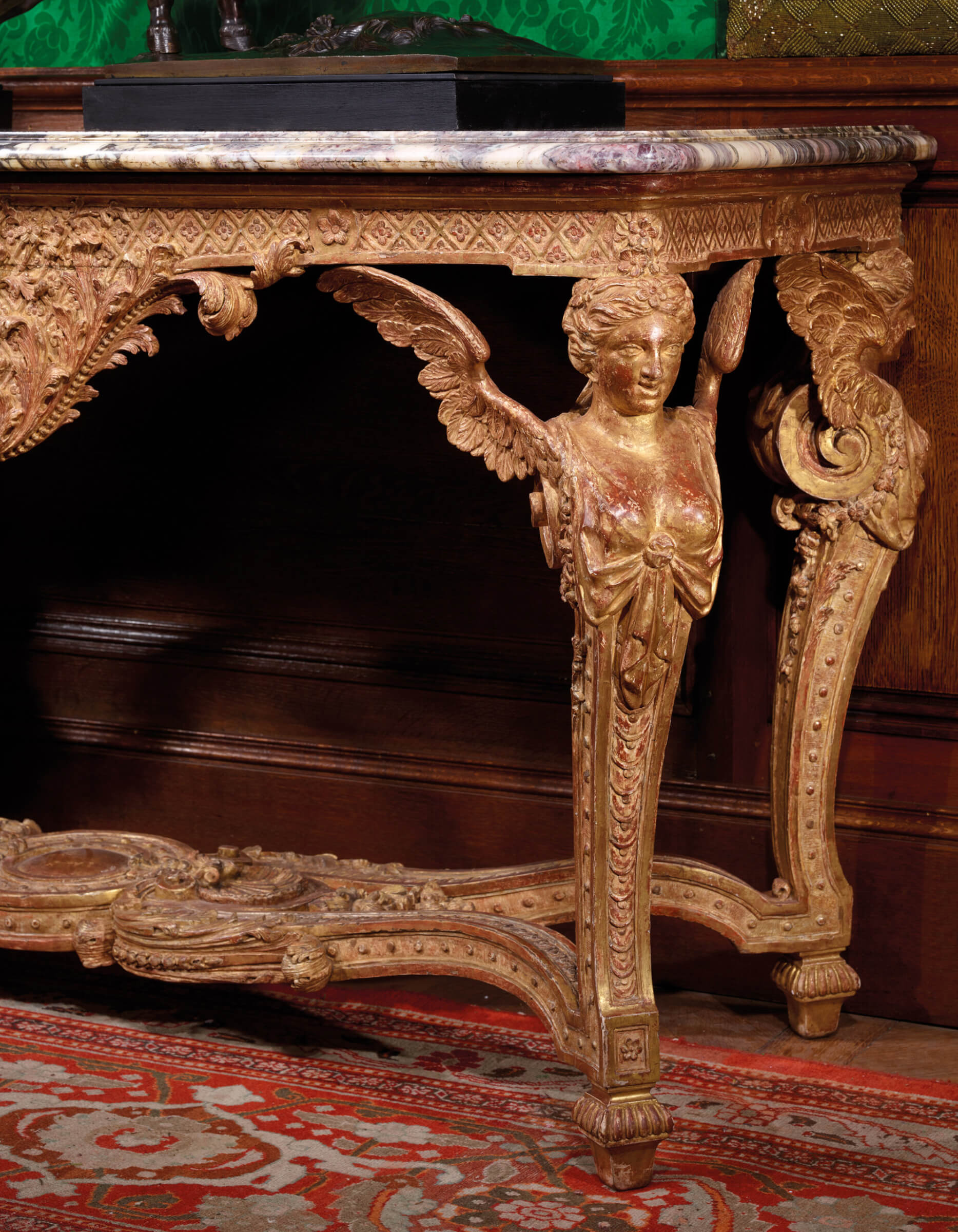
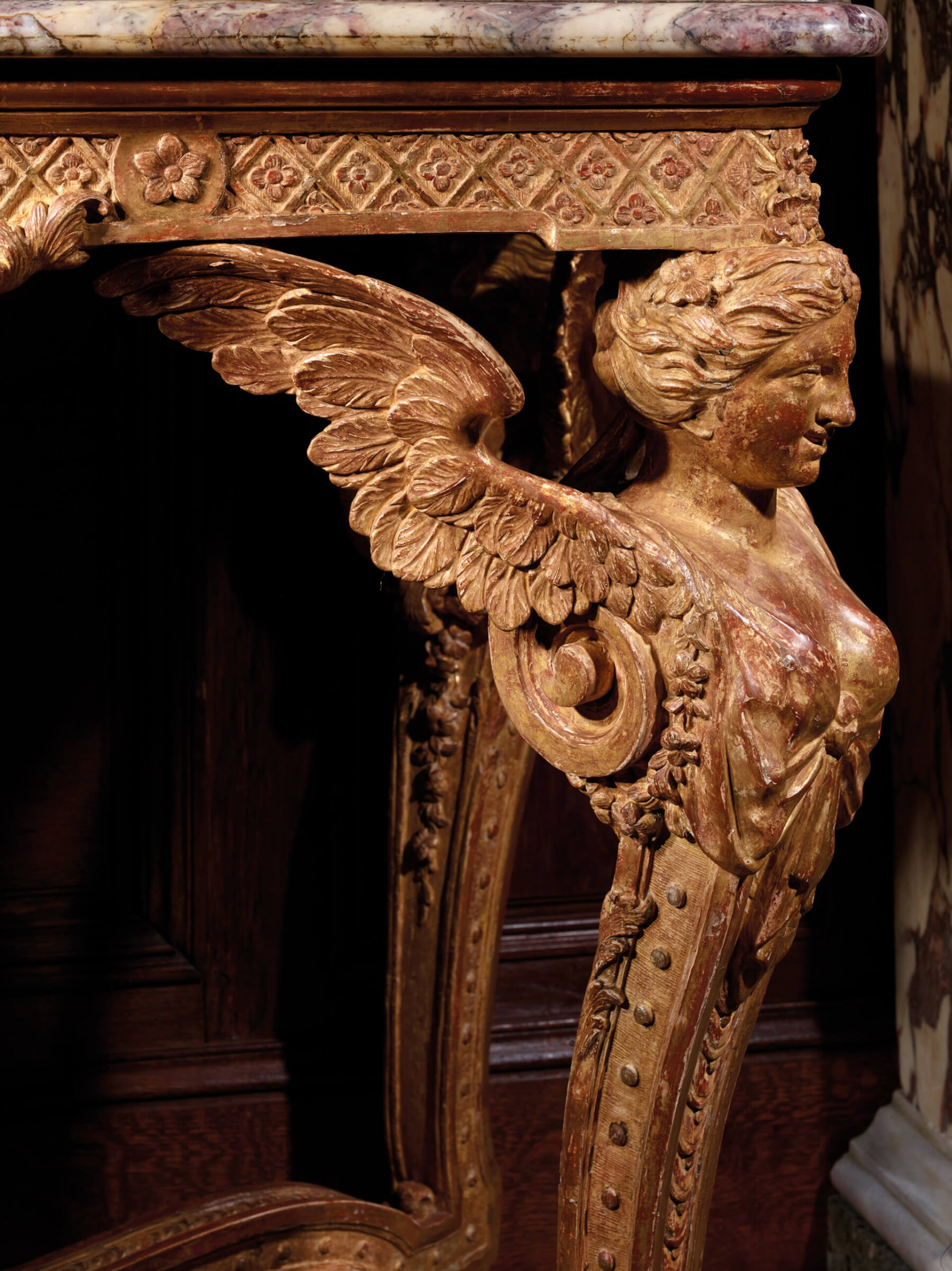
The console rests on four diagonally-set curvy legs adorned with scrolls, punctuated by draped busts of winged women, and supported by square-section jambs, moulded and embellished on the front with a fall of piasters and dotted friezes contrasting against striated backgrounds on the lateral parts. They are terminated by small conical and foliated hooves, joined by a very richly-carved scalloped crosspiece decorated with piasters, dots, acanthus leaves, fleurons and a pair of shells flanking a plain and slightly curved central ‘round’, encircled by a dotted frieze. A sumptuous rectilinear top with a moulded rim in Breche Violette marble crowns the whole.
This console belongs to a very small corpus of similar consoles, dated to the end of the reign of Louis XIV or to the very beginning of the Régence period, circa 1700-1720. One of them, narrower and corresponding to a cabinet leg, from the collection of Rodolphe Kann auctioned in 1907, was attributed to Simon Hourliez by Bruno Pons, referring to an estimate by the master sculptor who, before 1720, delivered to the Palais Mazarin, on behalf of Paul-Jules de La Porte (1666-1731), 2nd Duke of Mazarin, a lacquer cabinet leg corresponding to the one in the Kann collection. A console of roughly similar dimensions to the one shown here, also ornamented with a medallion in the shape of a helmeted man, and supporting a Languedoc red marble top, was auctioned in Paris in 1986. Another, narrower, showing a medallion with a woman’s profile facing to the right, suggesting here the notion of a ‘pendant’ but with busts of non-winged women, adorned with a royal red marble top, appeared on the Paris art market in 1977. A third one, with a single rail and no central medallion, was part of the Bensimon collection. Despite some variations in the detail of their sculptural repertoires, all these consoles unquestionably derive from Lepautre’s model and show that it enjoyed undeniable success for more than twenty years, a success that is highly revealing of the attachment of certain ornamentalists, cabinet-makers and sculptors of the Régence period to tried and tested approaches dating back to the 1700s, as opposed to other, more ‘avant-garde’ styles developing at the same time and foreshadowing the ‘rocaille’ period to come. In that regard, the console from the collection of Jacques Doucet (1853-1929), forming lot n°. 305 of its auction in Paris in June 1912, provides some interesting evidence of the later interest sparked by our console’s model—while the upper part of the Doucet console is similar to that of the other consoles examined above, the lower part underwent a more “Louis XV” transformation, since it features legs with acanthus scrolls and no longer the presence of a crosspiece.
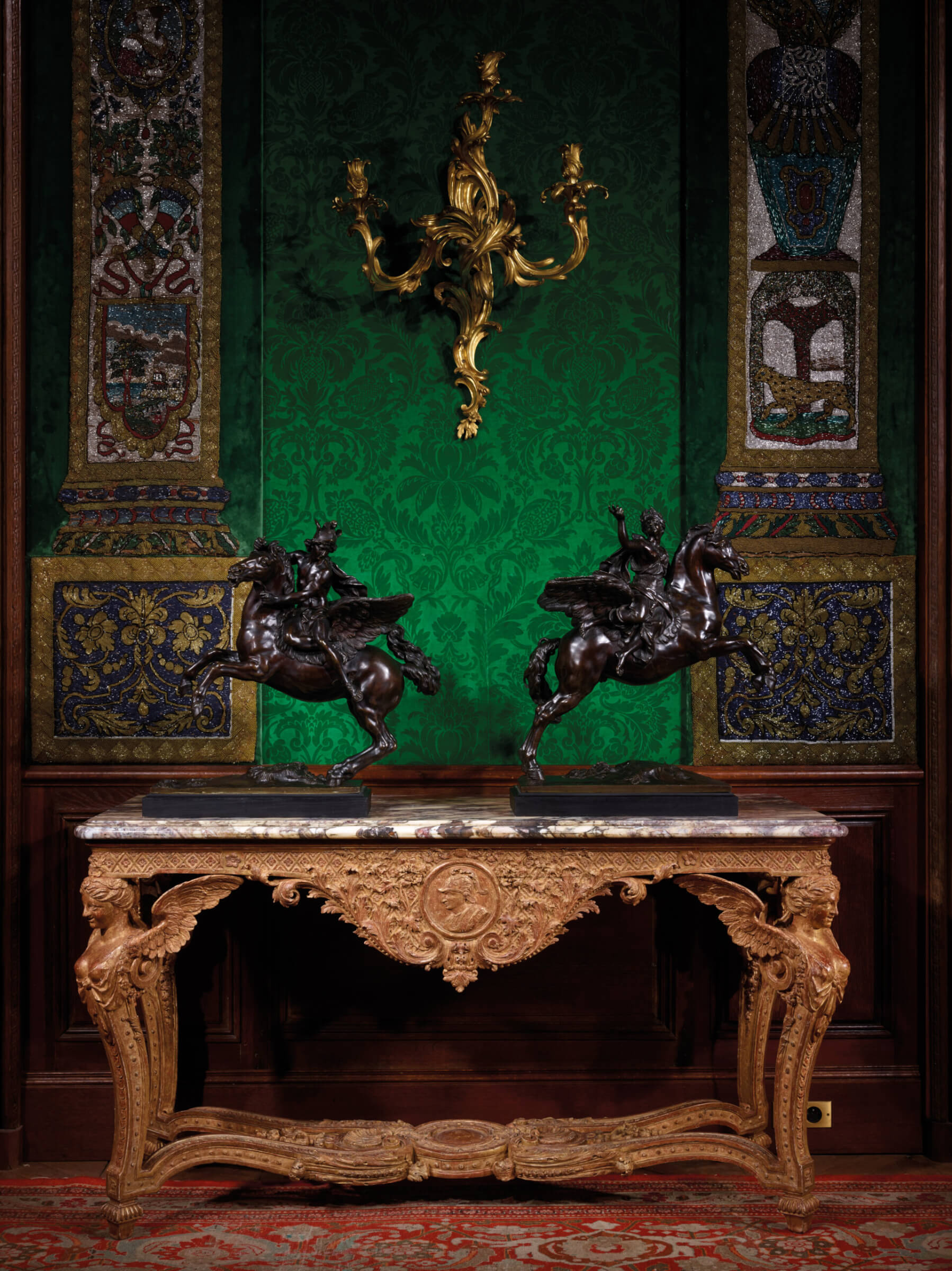
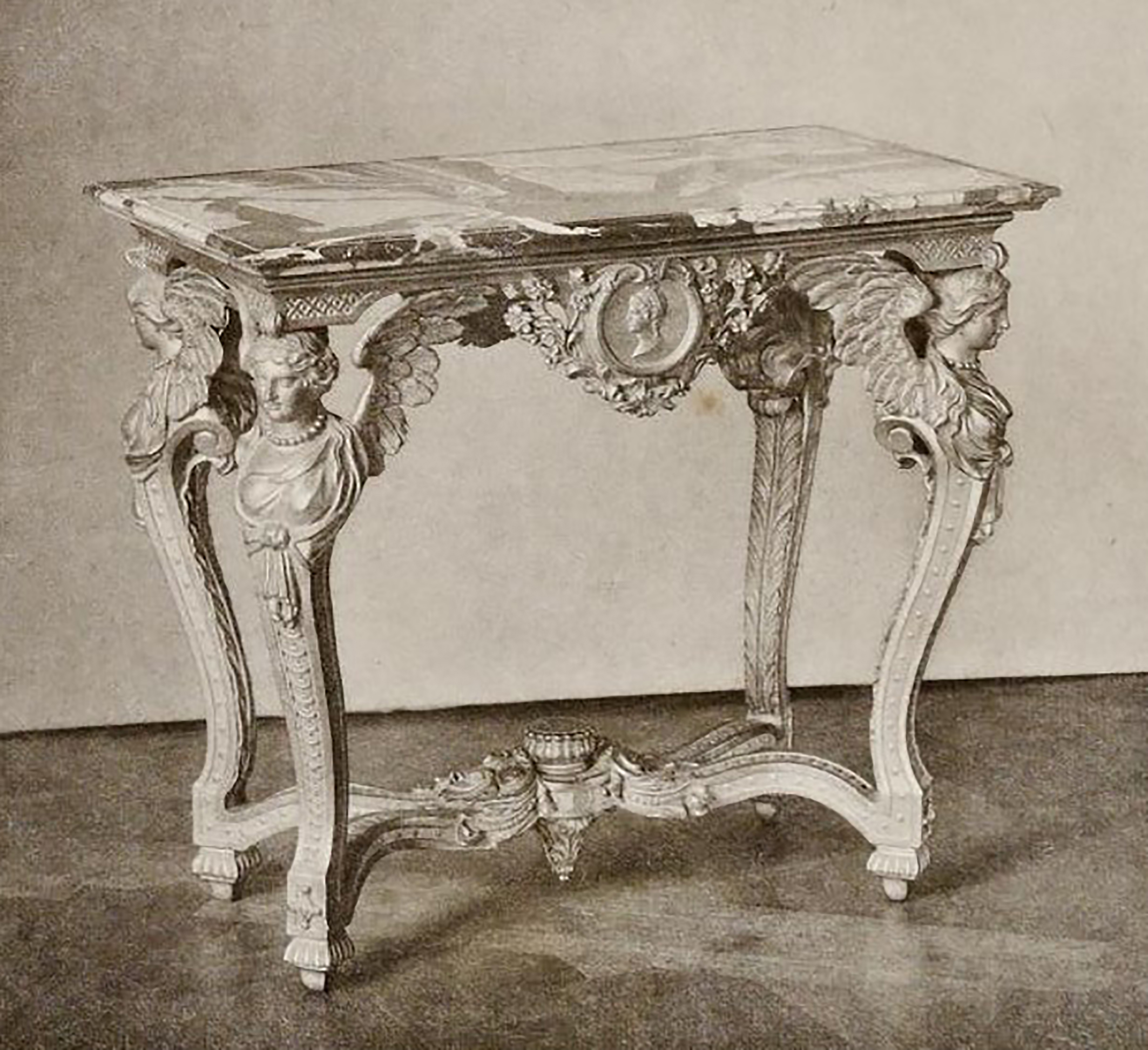
Table console attribuée par Bruno Pons au maître sculpteur Simon Hourliez, actif à Paris entre 1700 et 1720 et reproduite dans son ouvrage De Paris à Versailles. Elle correspond en effet à un pied de table décrit dans un mémoire de Hourliez et que celui-ci livra avant 1720 au palais Mazarin, pour le compte de Paul-Jules de La Porte (1666-1731), duc de Mazarin, de Mayenne et de La Meilleraye, afin de supporter un cabinet de laque (vente R. Kahn 1907).
The model also became widely known abroad in the decade 1720-1730, particularly at the Francophile court of Bavaria. The Rijksmuseum in Amsterdam holds a large (176 cm) gilded limewood console from the collection of Dr. Fritz Mannheimer (1890-1939) before 1933, which was executed in Munich and dated circa 1725-1730. It is a true interpretation of our model, attributed to the workshop of Johann Adam Pichler (c. 1716/1717-1761), probably after a design by Joseph Effner (1687-1745). With the exception of the central motif on the rail, adorned with a large flowered palmette contrasting against a plain background, a motif usually used by Effner or Cuvilliés known as the Elder (1695-1768), two architects trained in France on the initiative of Prince-Elector Maximilian II Emanuel of Bavaria (1662-1726), the frame of the German console replicates Lepautre’s design identically, once again demonstrating the success and influence that the latter achieved during the period.
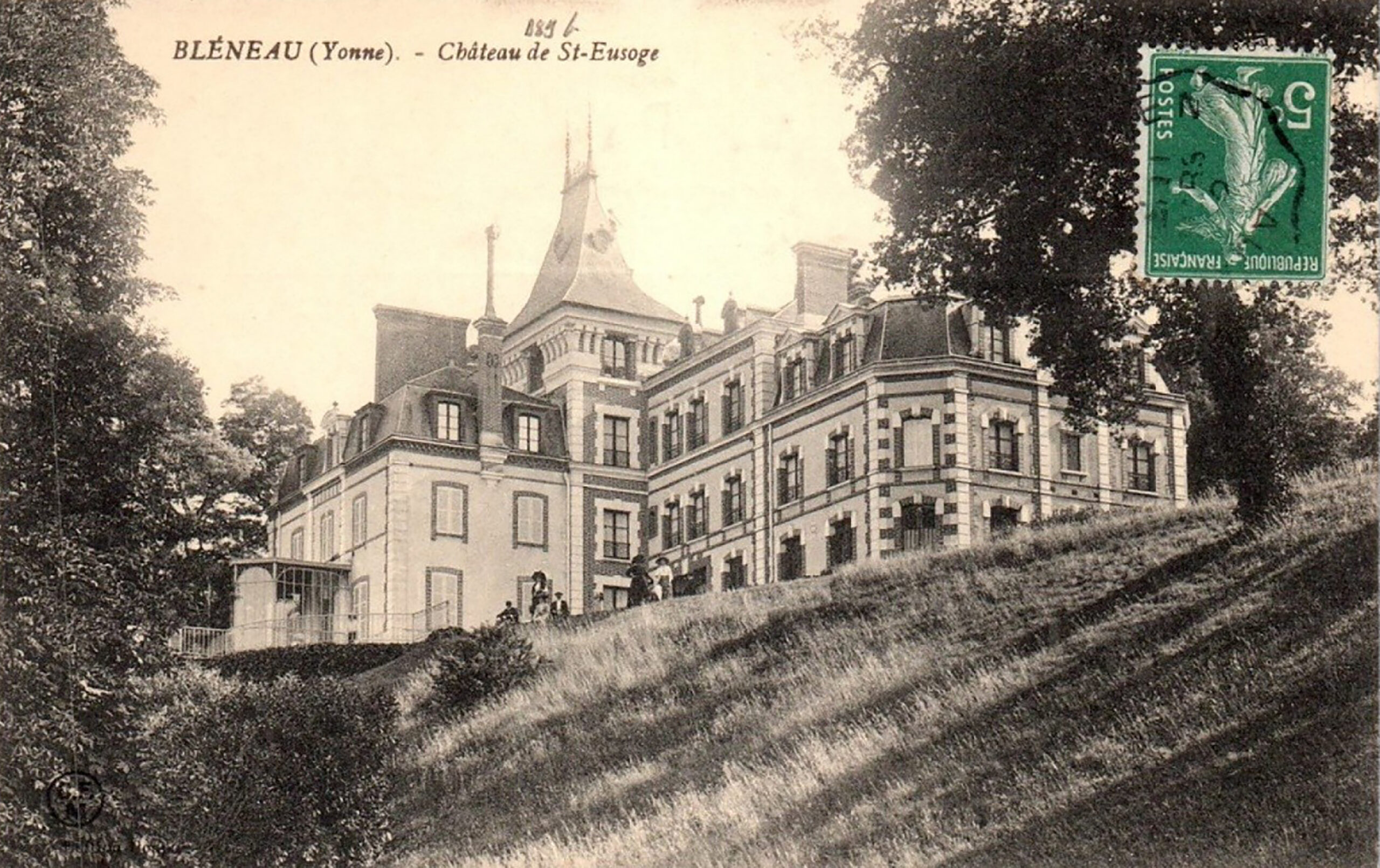
Our console comes from the collection of the Marquis of Harcourt-Olonde, one of the most powerful and illustrious Houses of France, of feudal extraction, originating in Normandy, and having produced a number of statesmen, governors, marshals of France, ambassadors and prelates. Its lineage has been proven and traced since 1094, with Robert I of Harcourt, known as the Strong († before 1118), perhaps the brother or nephew of Errand d’Harcourt, whom he is thought to have succeeded, making it one of the oldest French families. Towards 1100, this family formed two lines which were perpetuated separately, one in France and the second in England. The French line notably produced the branch of the seigneurs of Bonnétable, which split in 1407 into two branches, the only ones to remain today: the elder branch of Olonde, whose head bears the title of Marquis of Harcourt-Olonde since the appointment in 1817 of Charles-Louis-Hector (1743-1820) as hereditary Marquis-Pair of France by Louis XVIII, and the younger branch of Beuvron, whose head has held the title of Duke of Harcourt since Henri d’Harcourt (1654-1718), appointed 1st Duke of Harcourt by Louis XIV in 1700, who became Marshal of France in 1703, Marquis of Beuvron in 1705, and Peer in 1709.