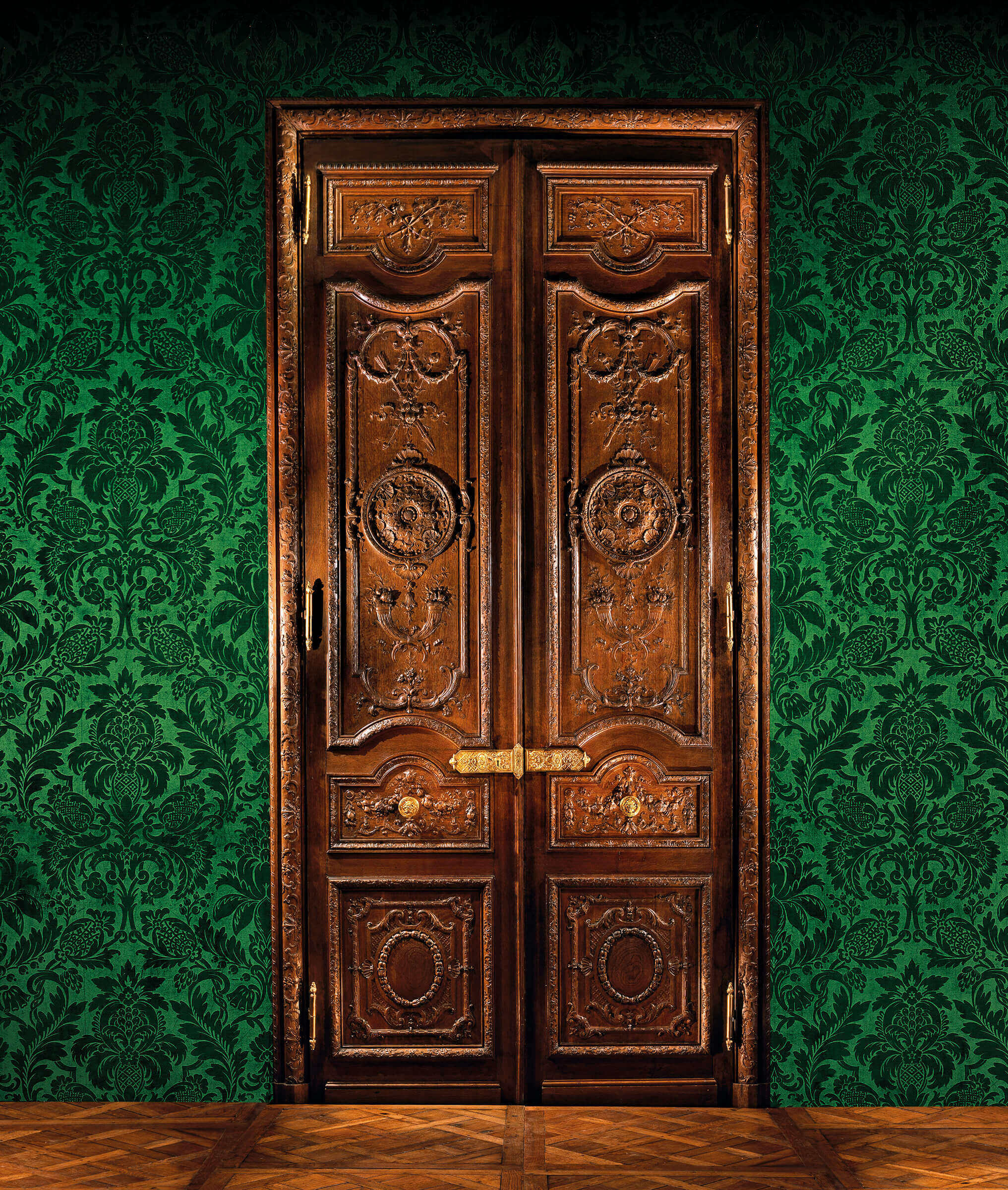
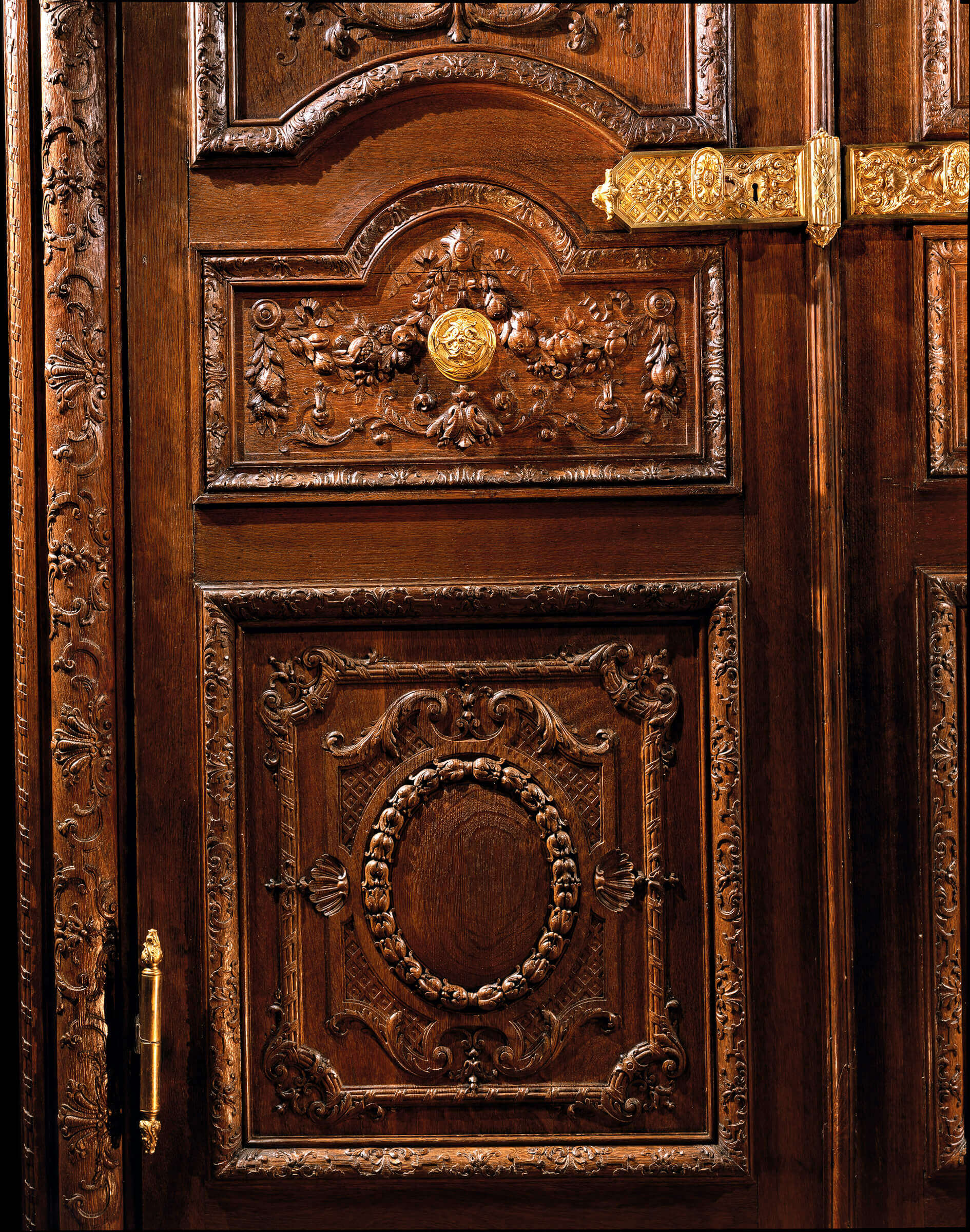
Executed under the direction of Alfred-Philibert Aldrophe (Paris, 1834–1895).
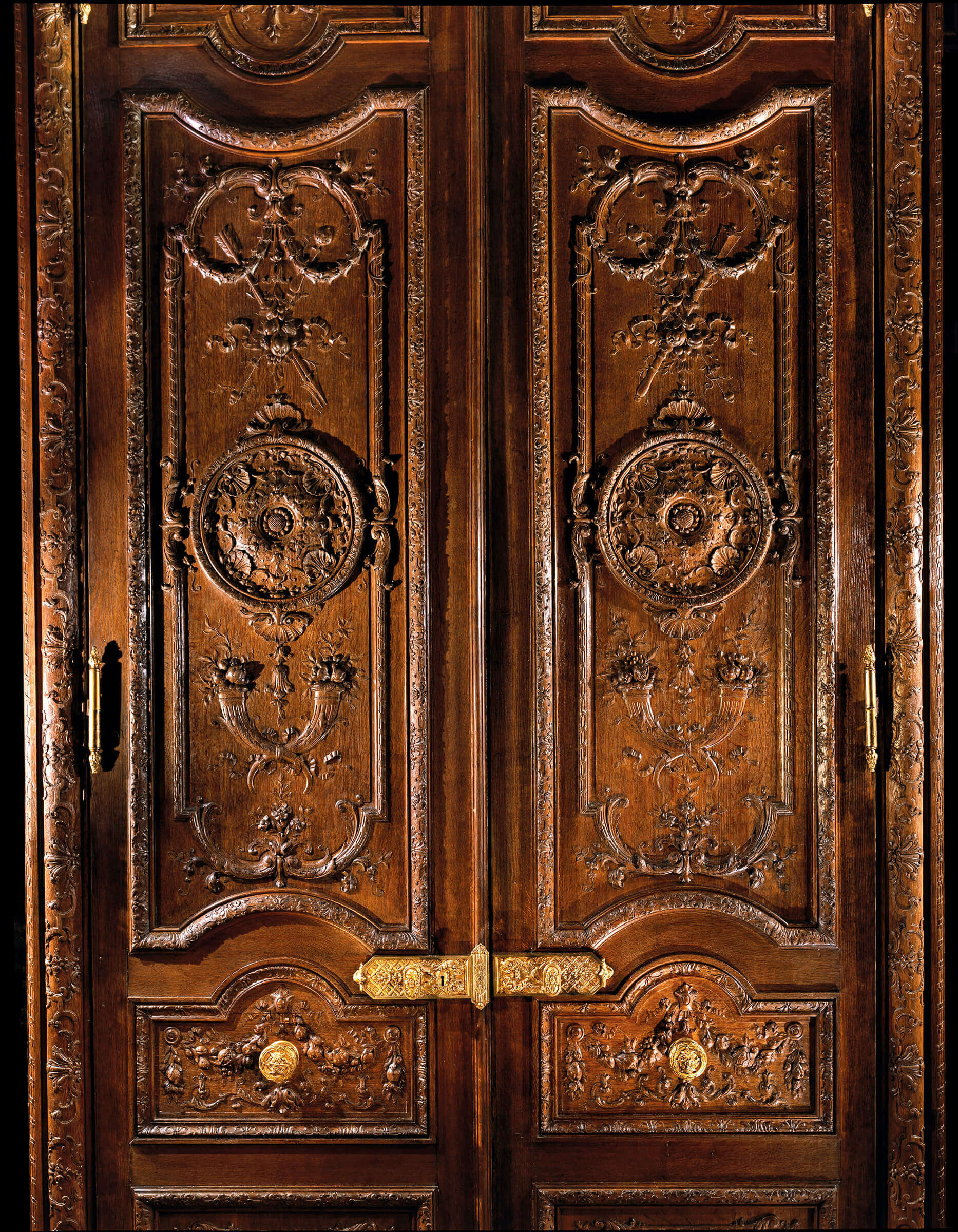
Carved oak; gilt bronze.
Dimensions of each panel: H. 328 cm. (129 1/8 in.); W. 75 cm. (29 ½ in.).
Frame: W. 13 cm. (5 1/8 in.).
PROVENANCE: former Rothschild collection.
LITERATURE: Daniel Alcouffe, Anne Dion, Pierre Ennès, Un âge d’or des arts décoratifs, Galeries nationales du Grand Palais, Paris, 10 Oct.–30 Dec. 1991, p. 519; Pauline Prévost-Marcilhacy, “Hôtel Gustave de Rothschild, dit de Marigny,” in Rue du Faubourg Saint-Honoré, edited by Béatrice de Andia, Délégation à l’Action Artistique de la Ville de Paris, 1994, pp. 253–260; Bernard Chevallier, Alexandre Serebiakoff, portraitiste d’intérieur, Musée national des châteaux de Malmaison et Bois-Préau, 1994; Pauline Prévost-Marcilhacy, “Les Rothschild et la commande architecturale: collaboration ou maîtrise d’œuvre,” in Architectes et commanditaires: cas particuliers du XVIe au XXe siècle, edited by Tarek Berrada, Paris, 2006, pp. 108–126; Florence Austin-Montenay, Saint-Cloud: une vie de château, Geneva, 2005.

From the Rothschild collection, this exceptional set of four capucine doors offers a valuable insight into the Rothschild taste for interior decoration.
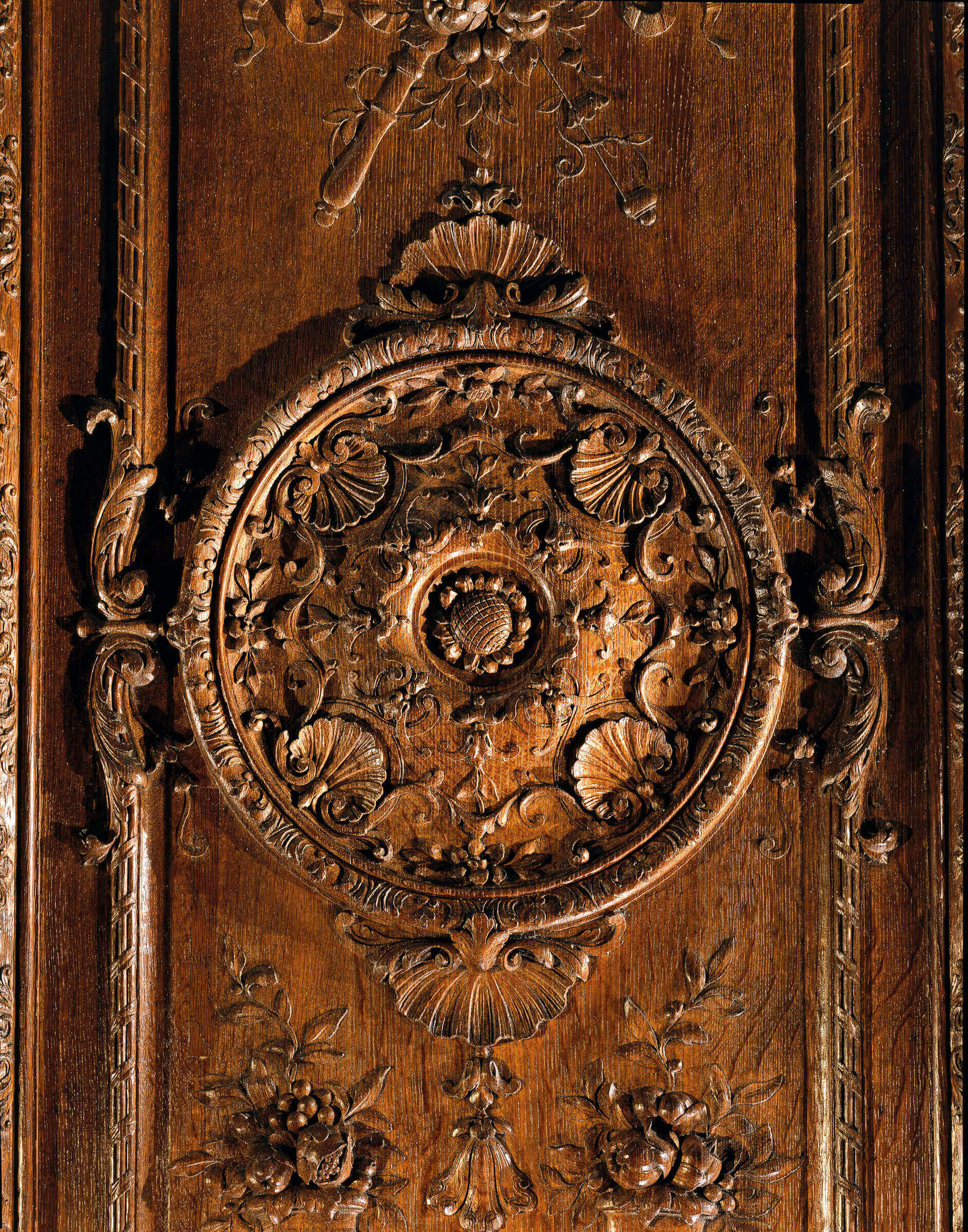
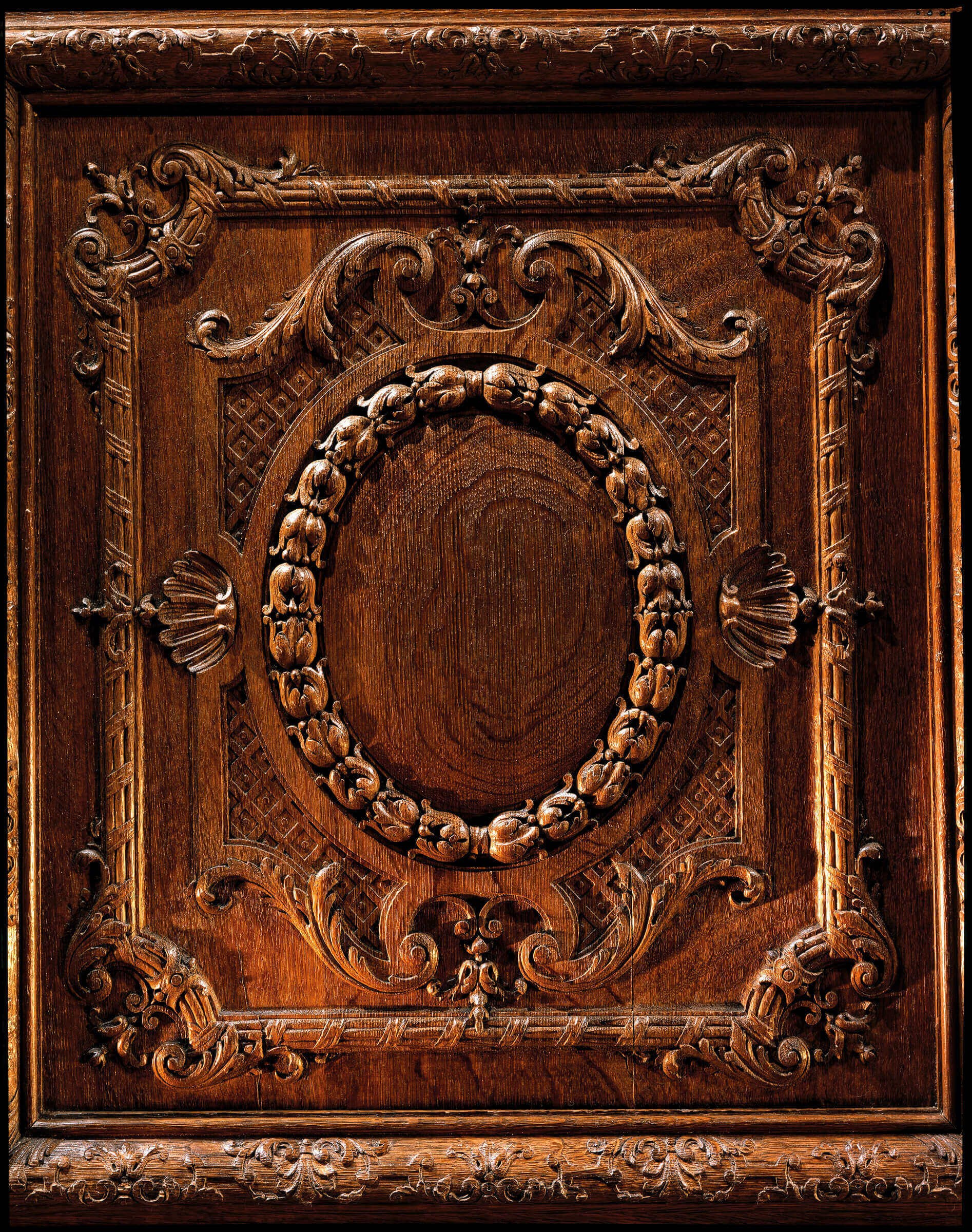
Each door, divided into four panels, features a large central panel with concave sides, flanked by two smaller panels with convex sides, above a medallion panel, all carved in high relief with Louis XIV–style motifs. The design of these doors is directly derived from those made around 1670 for the Salon de Vénus at Versailles, which James and his family frequented. They also closely echo the doors of the Hôtel de Villars in Paris, later reinstalled for the Rothschilds at Waddesdon Manor.
Various members of the Rothschild family, especially those of the French and English branches, frequently employed this style, which was particularly suited to their ambition and remarkable success.
James de Rothschild was likely the first to grasp the familial, social, and political implications involved in constructing a residence or selecting an architect. In 1855, he commissioned Armand Berthelin to build a French-style château at Boulogne — modeled on the Château de Clagny for its overall silhouette and on the Cour de Versailles for its central section.
During the second half of the 19th century, the continuity of models from one generation to the next is clearly evident, as seen in the work of Alfred-Philibert Aldrophe (1834-1895), who became the appointed architect for Gustave de Rothschild (1829-1911) from 1872 onward. Until that date, Aldrophe had undertaken only a limited number of projects, mostly in administrative roles: appointed Chief Architect of the City of Paris in 1871, he simultaneously became architect of the Consistory, for which he built the Grand Synagogue on Rue de la Victoire between 1865 and 1874, and in 1876, the Consistorial House on Rue Saint-Georges.

It was likely through this avenue that he gained access to the Rothschild family’s commissions. From 1872 onward, Gustave de Rothschild entrusted him with the construction and decoration of his town house, known as the “de Marigny,” as well as the château at Laversine, in Saint-Maximin, near the Chantilly racecourses and the game-rich forests of the Oise region.


The major construction and decorative works carried out in these two buildings spanned roughly ten years. They were executed by the finest craftsmen of the period in the late 17th-century French classical style. However, rather than placing the commission solely in the hands of a single sculptor, the architect chose to call upon a host of artists who had previously worked for the Rothschild family.

The carpentry work at the Hôtel de Marigny was entrusted to Bonhomme; the marblework to Drouet Langlois; gilding to Wandenberg; bronze work to Cornu; wood carving to Cruchet and Caccia; plasterwork sculpture to Huber; and tapestry to Roudillon. Similarly, the decorative painting was assigned to seven artists, the best-known being Henri Levy and Eugène Lami, who had previously worked for the Rothschilds—most notably at the Château de Ferrières.

The Château de Laversine, whose style is very loosely inspired by that of François Mansart (1598–1666), was built from stone quarried at Saint-Maximin, on the edge of the plateau before the rock face, overlooking the expansive landscape of the Oise Valley. According to Pauline Prévost-Marcilhacy, the woodwork at Laversine was likely executed by Michel-Victor Cruchet in collaboration with Hamel & Kulikowsky, sculptor-decorators
The stylistic similarities between our doors and those of the residences mentioned above, particularly the doors of the two Louis XIV salons at the Hôtel de Marigny, allow us to attribute them to the same decorative team: Michel-Victor Cruchet (sculptor), under the direction of architect Alfred-Philibert Aldrophe.
The joint involvement of the same architect and sculptor at the Château de Laversine, shortly after the Parisian works, even supports the hypothesis that our doors originated from one of the salons at Laversine.
Upon the death of Baron Gustave de Rothschild, his youngest son, Robert de Rothschild (1880–1946), inherited the château and introduced several modifications—most notably in the dining room. This space was entirely redesigned to accommodate four large decorative canvases acquired in 1920 from the Spanish painter José-Maria Sert. Between the two world wars, the estate was largely reserved for fox hunting and polo matches attended by the Rothschild family’s relatives and friends. From 1940 to 1944, it served as the headquarters for German units in charge of constructing V1 rockets in the nearby quarries; the château was ransacked upon the Libération and subsequently abandoned. All usable decorative elements were then dismantled and stored.
Upon the death of Robert de Rothschild, the Château de Laversine was entrusted to a foundation responsible for housing and educating children orphaned by the Holocaust.

Michel Victor Cruchet (Paris, 1815 – after 1877)
A renowned sculptor and ornamentalist, Cruchet headed a major workshop, which by 1849 included a studio for stamping, modeling, and carving, as well as an exhibition hall. He was successively established at 5 Rue Lafayette in 1836 and then at 5 Rue Notre-Dame-de-Lorette in 1844, collaborating with cabinetmakers Ringuet-Leprince, Thuillier, Maigret, and Roncier. He served as a supplier to the Duke of Nemours during the Second Empire and to Empress Eugénie. One of his most significant commissions was the decoration of the Emperor’s small salon in the Orangery at Saint-Cloud. He received awards at the Expositions des produits de l’Industrie in 1839 and 1849, as well as at the Universal Exhibition in London in 1851 and in Paris in 1855. The Victoria & Albert Museum preserves two woodwork elements from this period. His son succeeded him around 1869.