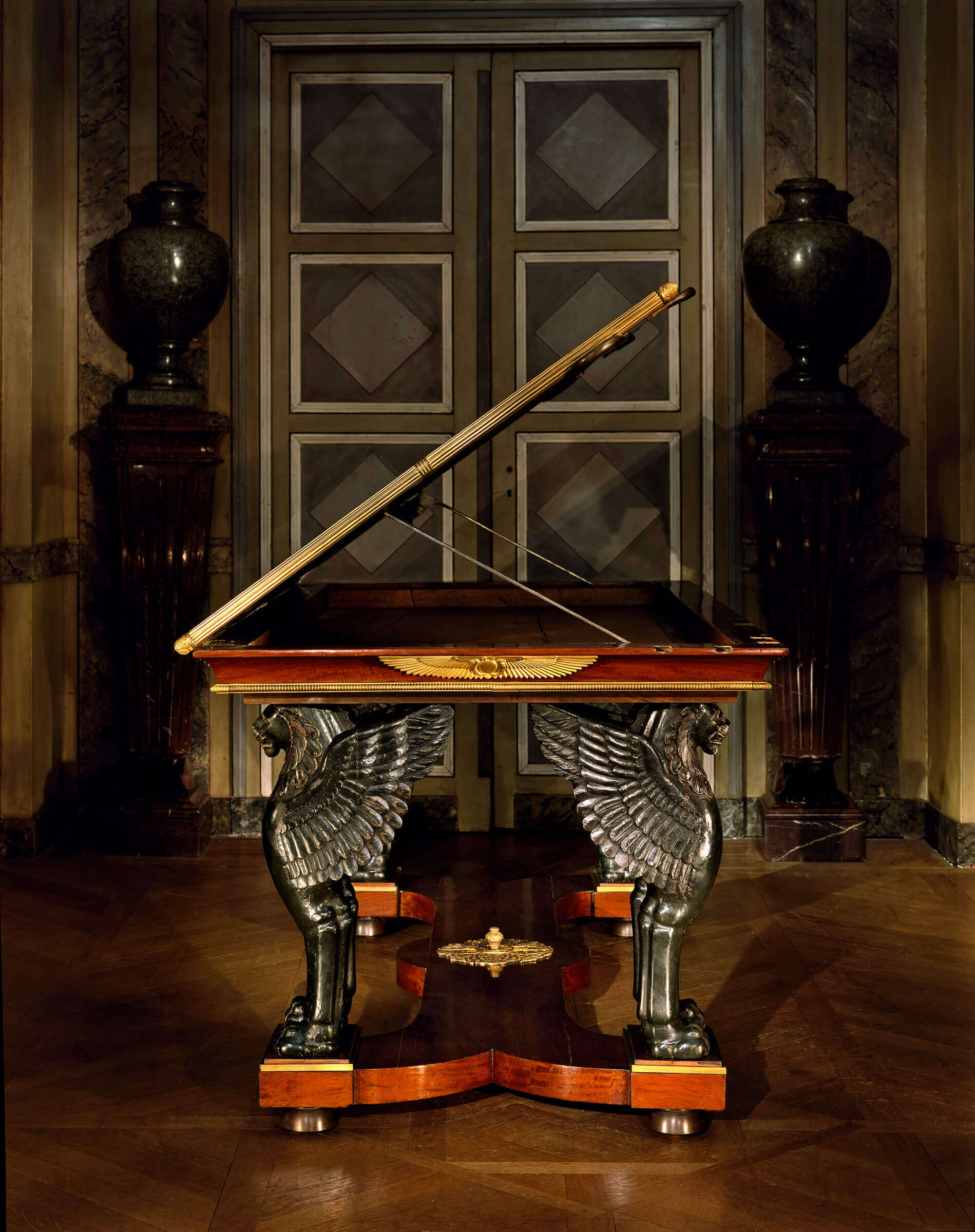
Oak frame; mahogany veneering; bronzed wood; gilt bronze, metal; leather, blue velvet with gold border.
H. 85 cm. (33 ½ in.); W. 204 cm. (80 ½ in.); D. 101 cm. (39 ¾ in.).
PROVENANCE: former collection of Cecil Blumenthal, known as Blunt, and Anna Laetitia Pecci-Blunt (1885-1971), Count and Countess Pecci-Blunt, at the “Villa Reale” in Marlia (Tuscany).
LITERATURE: Eveline Schlumberger, “Un palais décoré par Elisa Bonaparte”, Connaissance des Arts, August 1957, No. 66, pp. 48-53, ill. p.50.
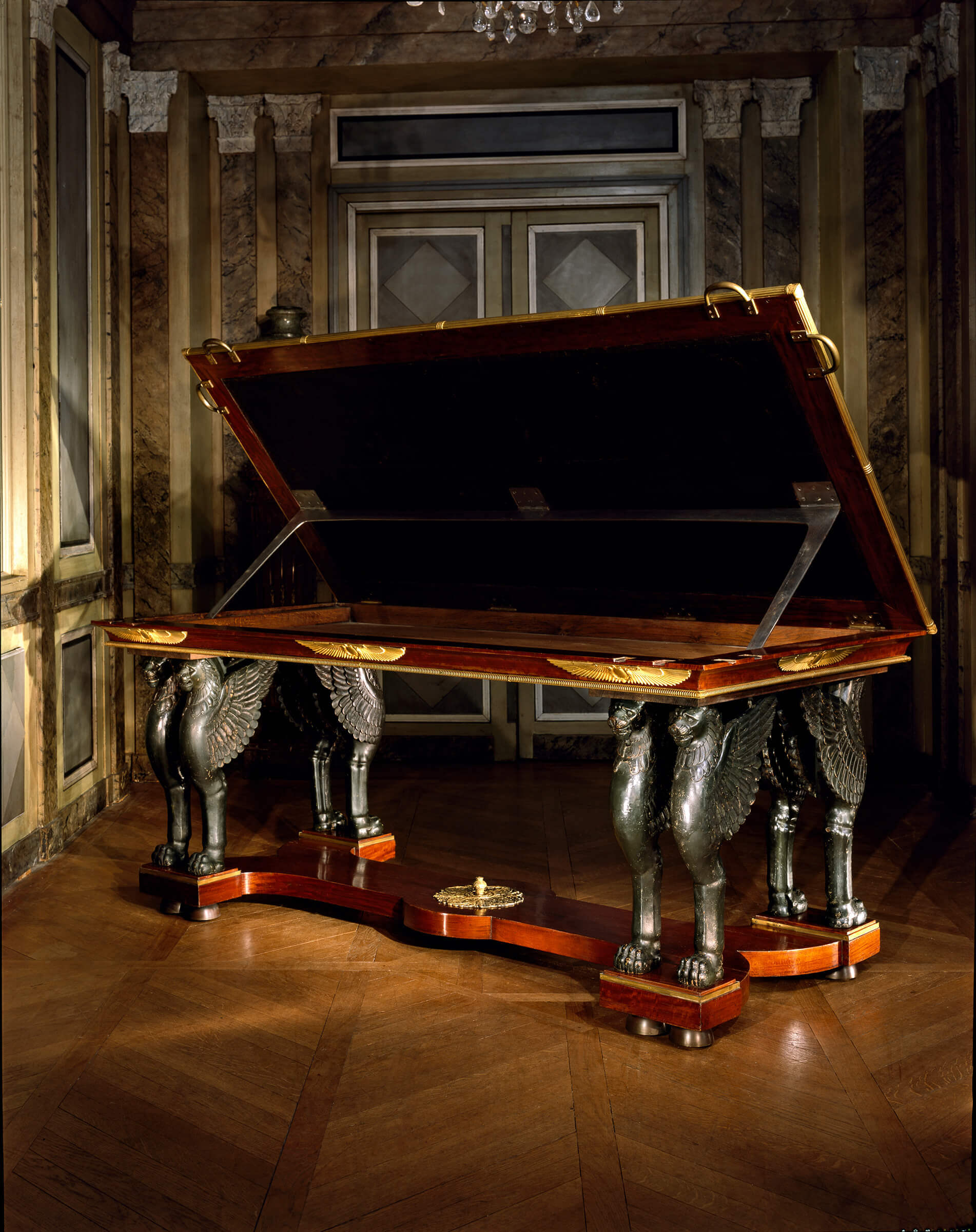
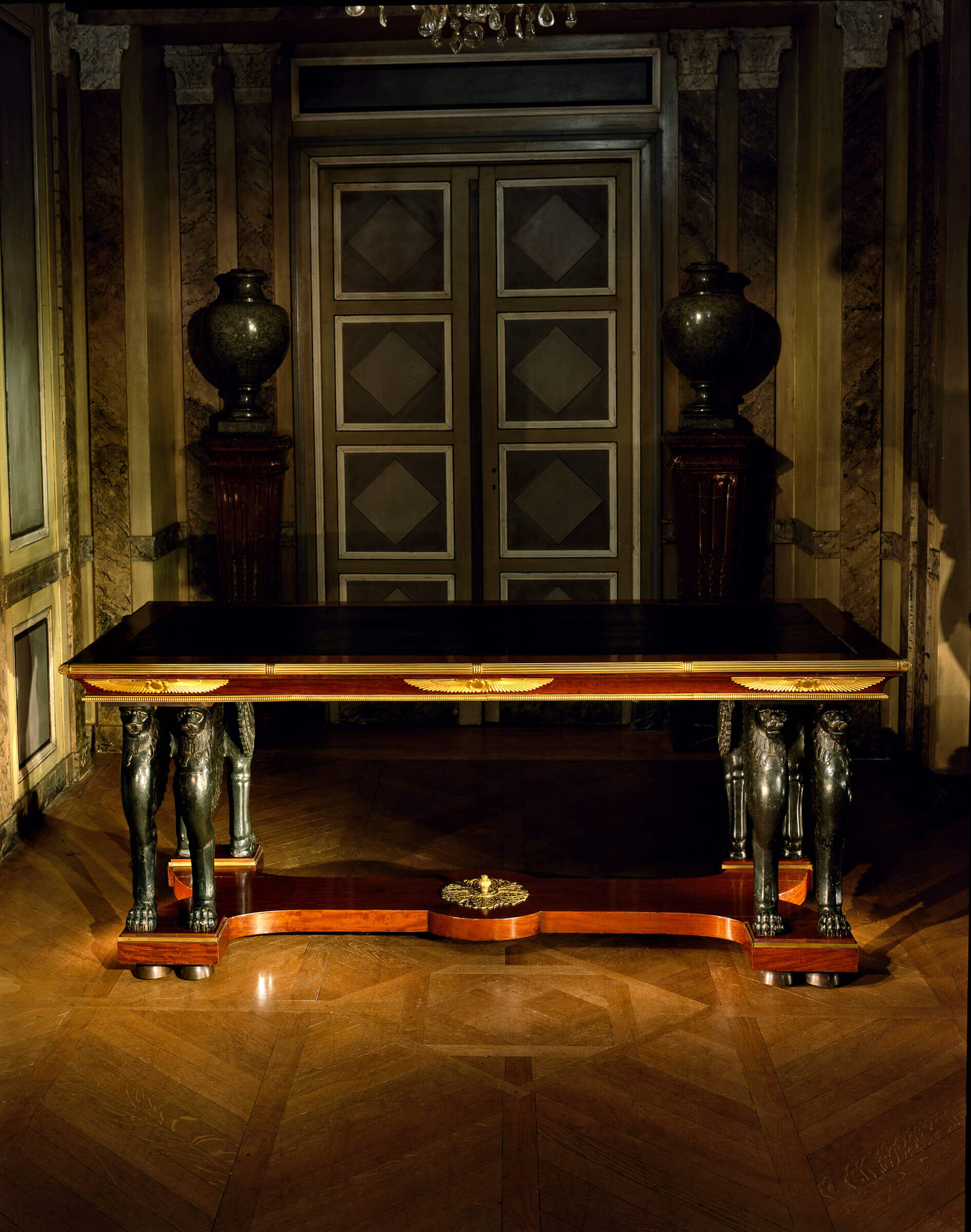
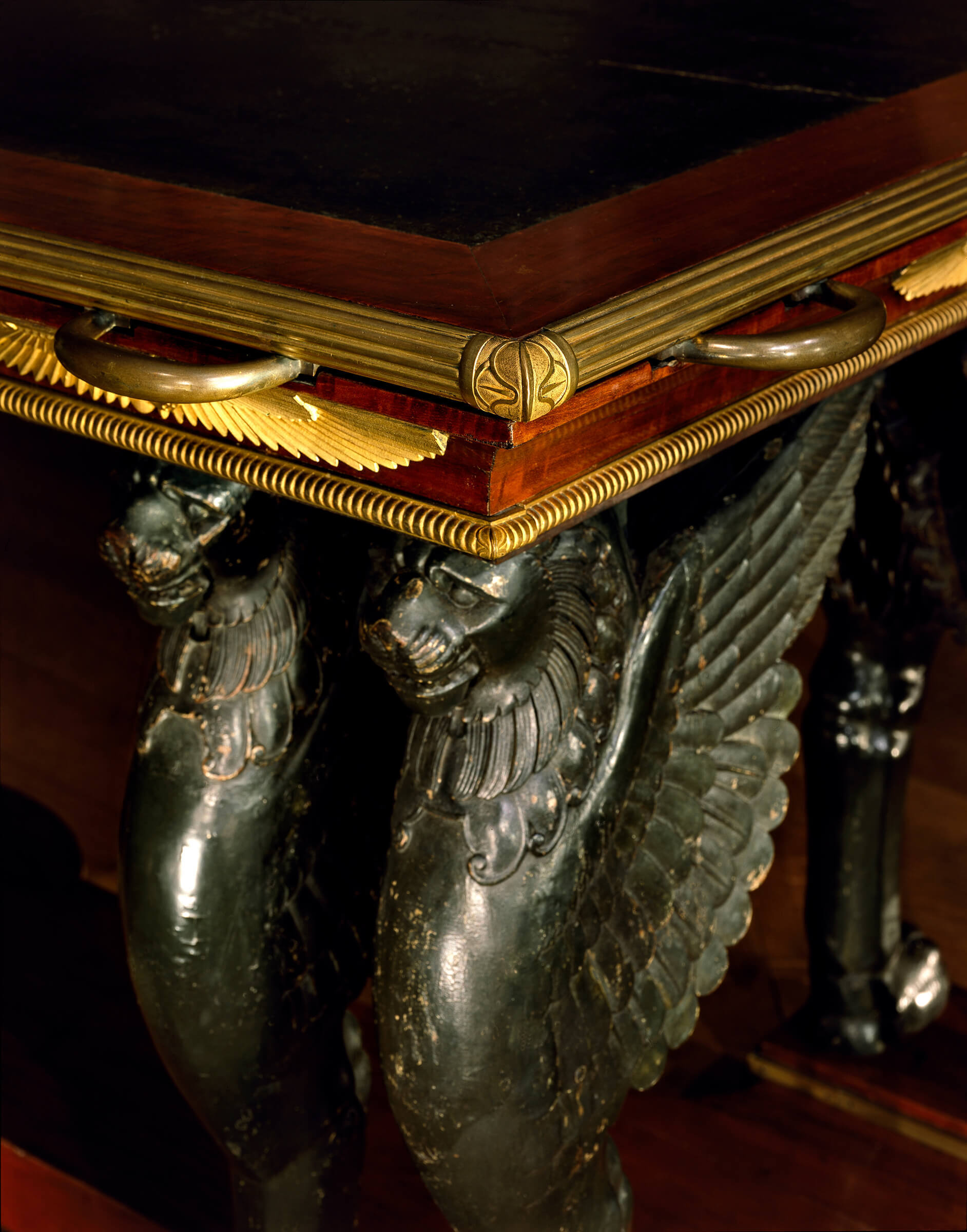
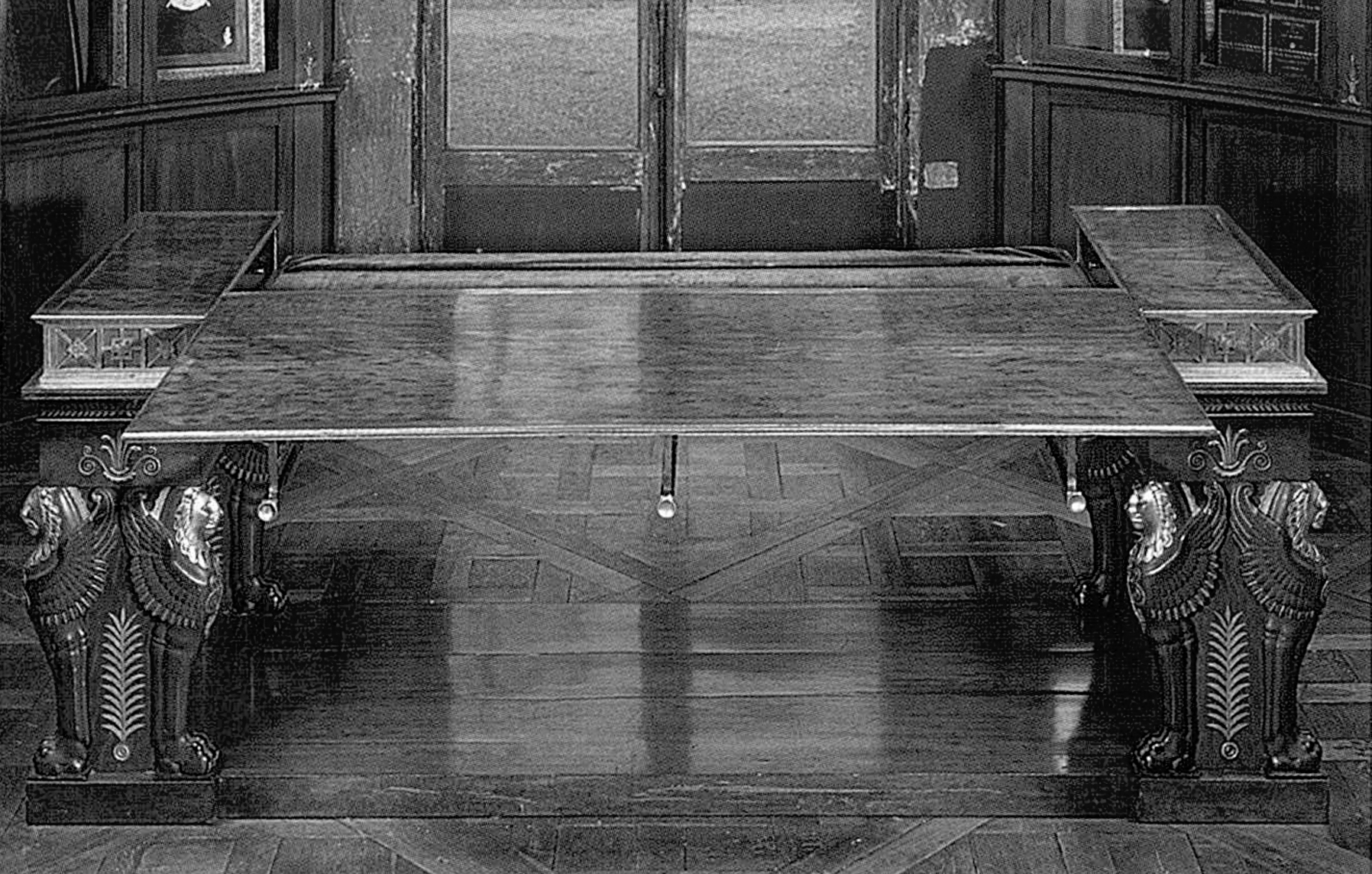
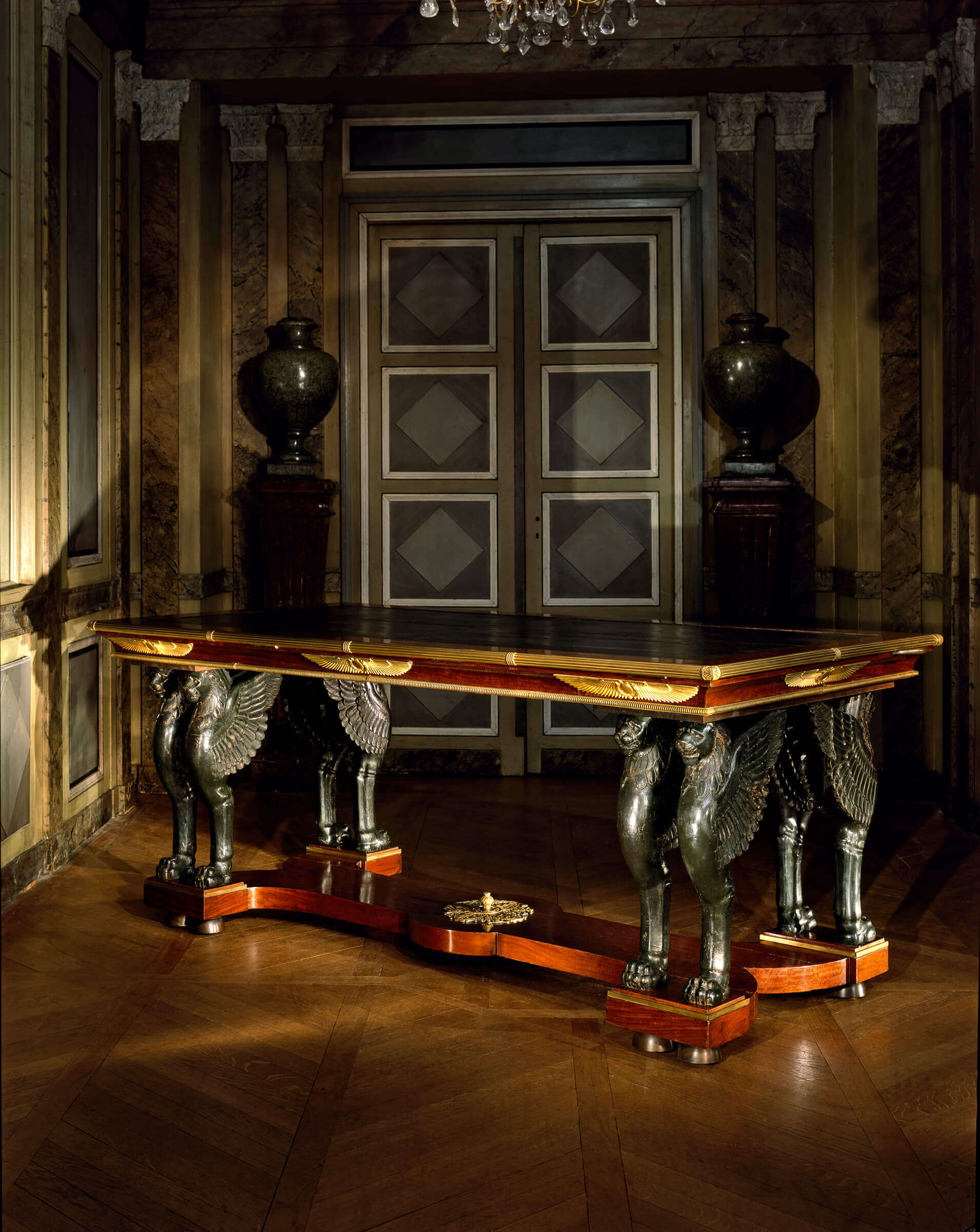
Its great originality, imposing size and bronze decoration brilliantly illustrating the Egyptian taste in vogue in Paris at the very start of the 19th century, make this table an extraordinary item. Of rectangular format, it has a top covered in green morocco with a mahogany frame and a half-cylinder border with a ray pattern in gilt bronze, the latter punctuated at intervals with moulded rings and chased reinforced corners with lotus leaf motifs. This top stands on a narrow mahogany apron in the form of an inversed doucine, emphasised at the base with an bronze cylindrical fillet edge with ring motifs, and enriched on the façades with a gilt bronze ornament in the form of the winged solar disc, symbol of Ra, the god of the solar disc in the Ancient Egyptian pantheon, protected by two uraei or erect female cobras. Tree of these appear on the main façades of the table, and one in the centre of its shorter sides.
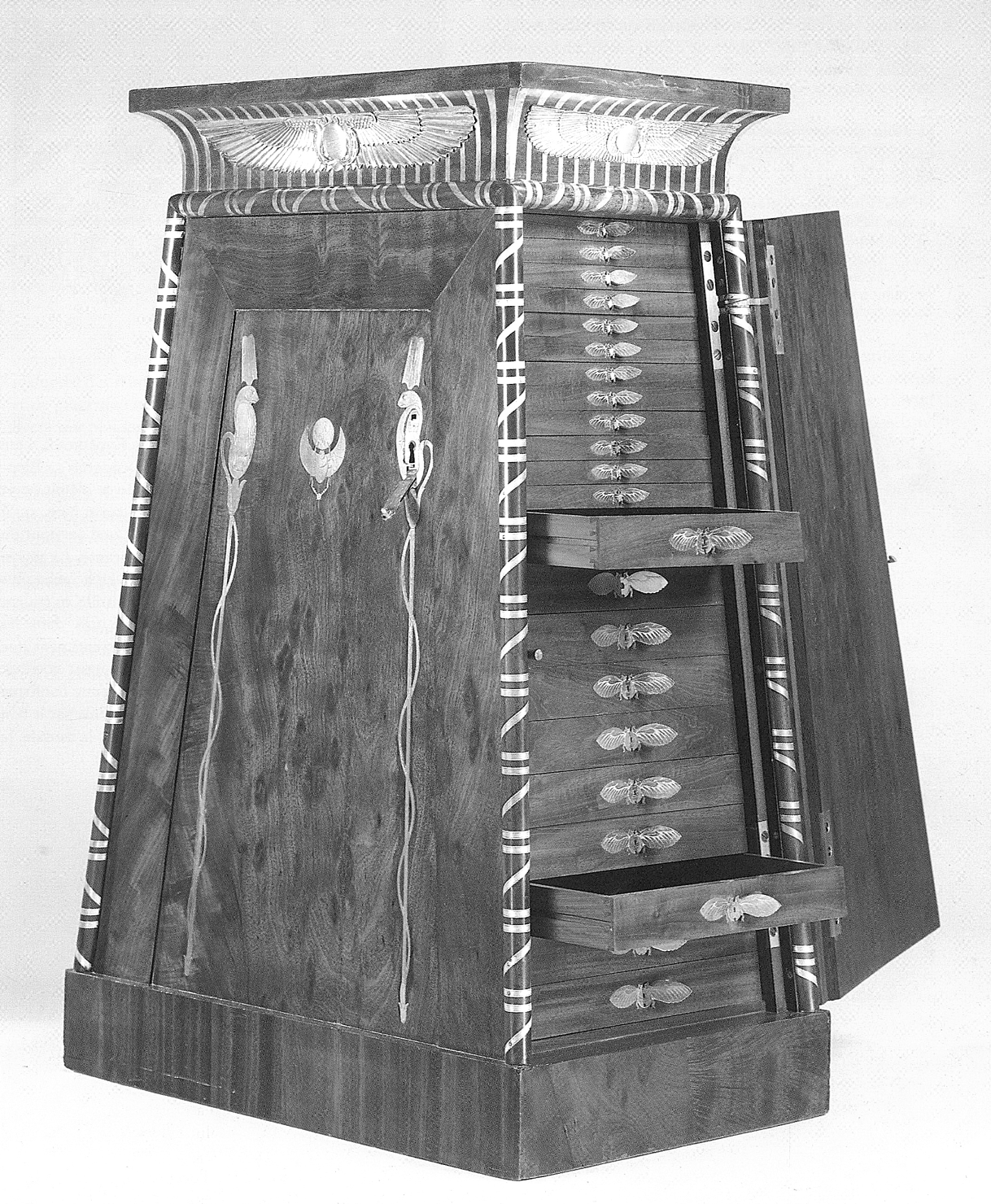
This same motif was executed in silver by Martin-Guillaume Biennais on a remarkable medallion cabinet produced in 1809 by Jacob-Desmalter Desmalter, after a drawing by the architect Charles Percier, for Baron Dominique-Vivant Denon (1747-1825), director of the Musée Napoléon and the celebrated author of Voyage dans la Basse et la Haute Egypte, published in two volumes in 1802. This cabinet is now in the collections of the Metropolitan Museum of Art, in New York.
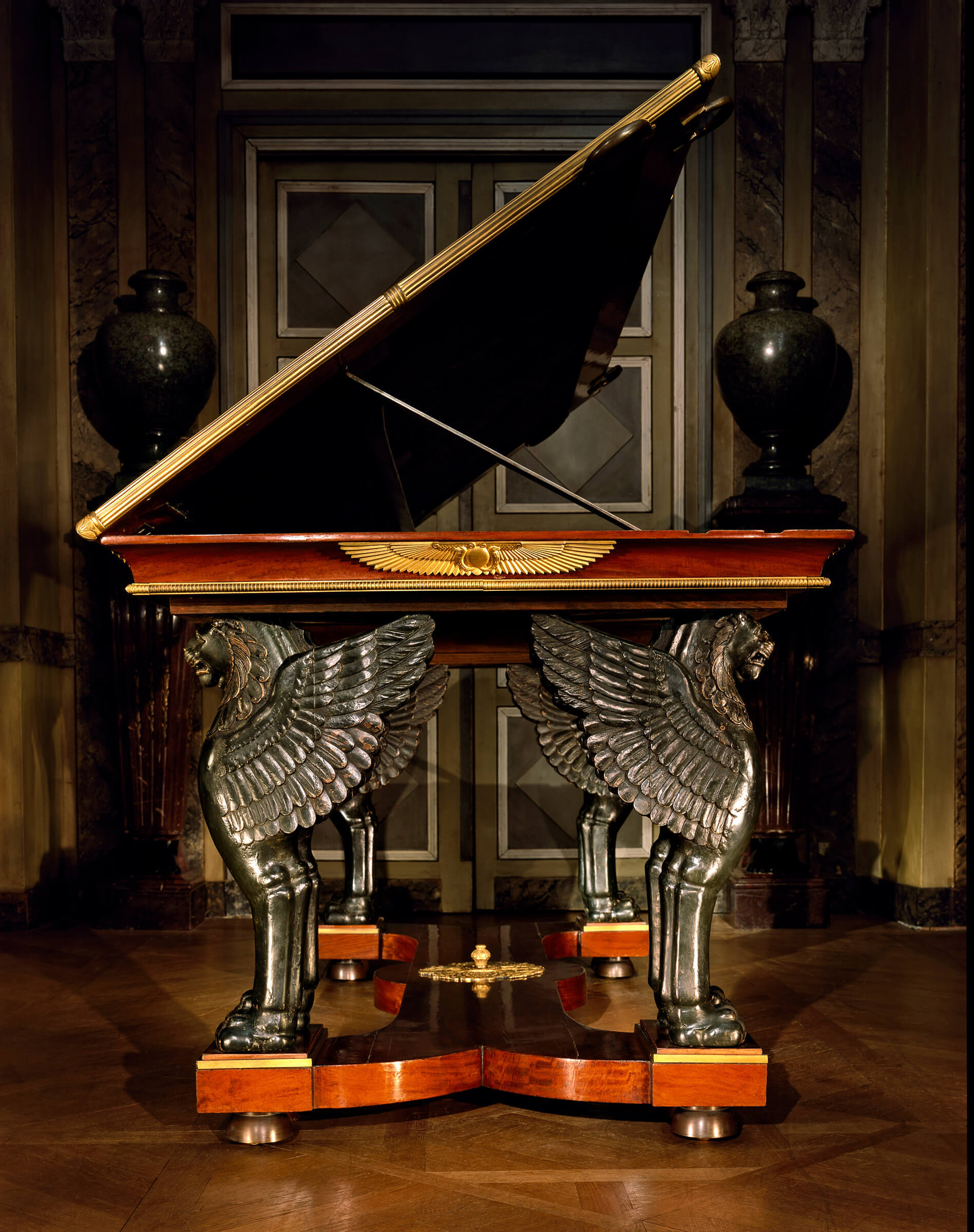
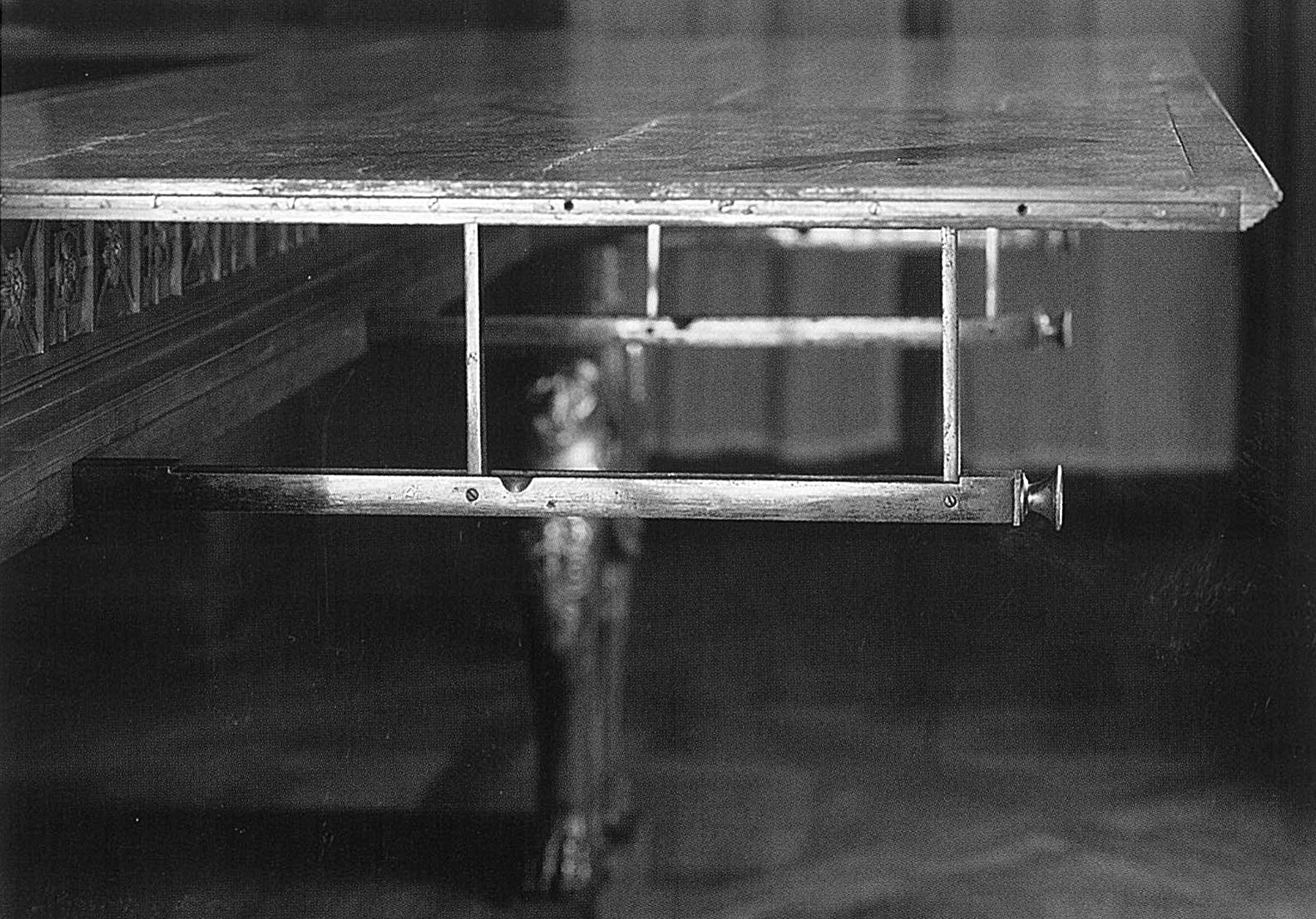
Two curved handles flanking either side of the front corners enable the top to be opened. This is mounted with hinges and can be adjusted by means of two flat steel rods in the form of a mobile “U” fixed to the first third of the blue velvet-covered, gold-edged underside. These rods are supported by two gilt bronze racks with pinions along the shorter sides of a very large coffer concealed in the thickness of the table apron, which then becomes a huge desk suitable for reading ordenance survey maps.
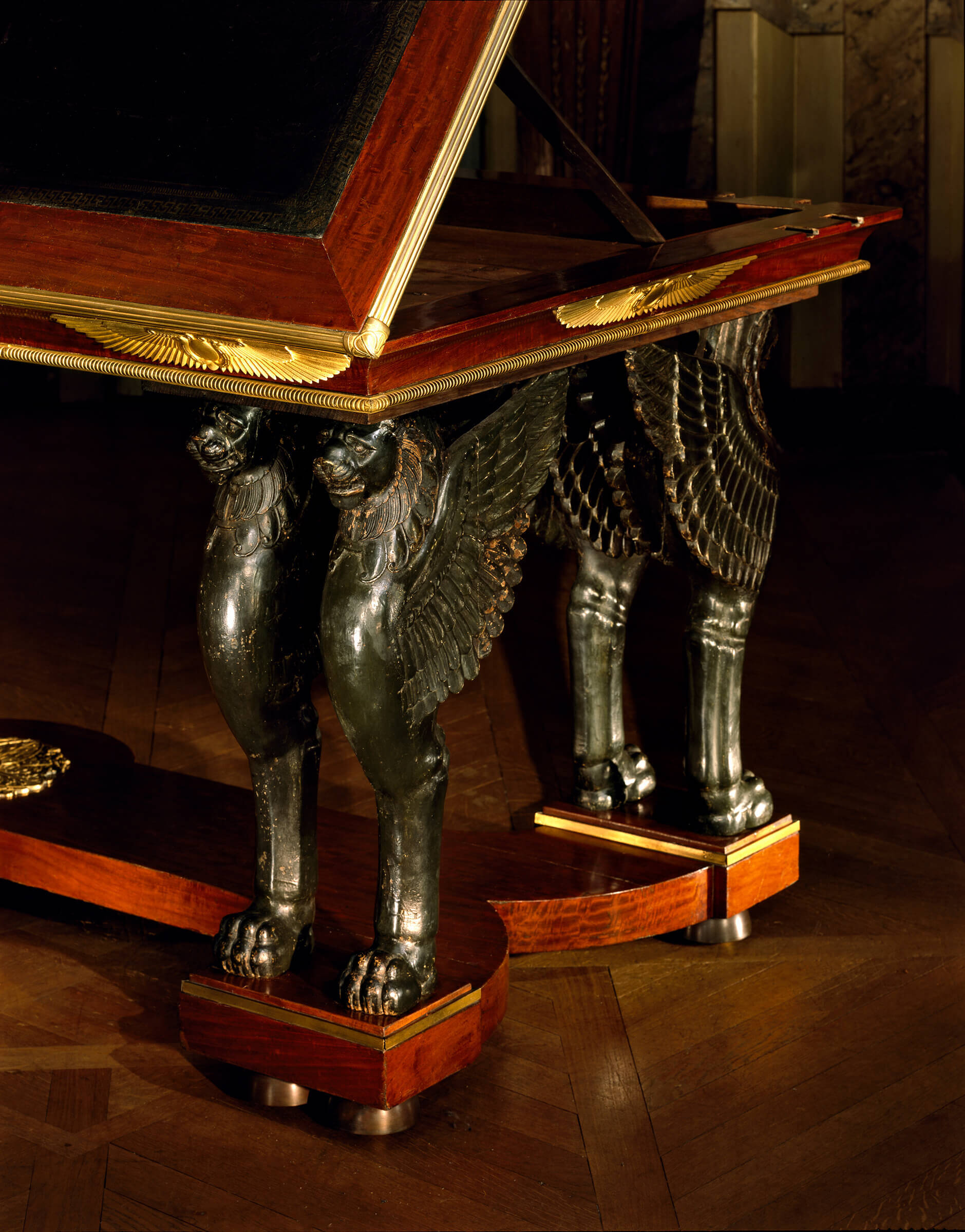
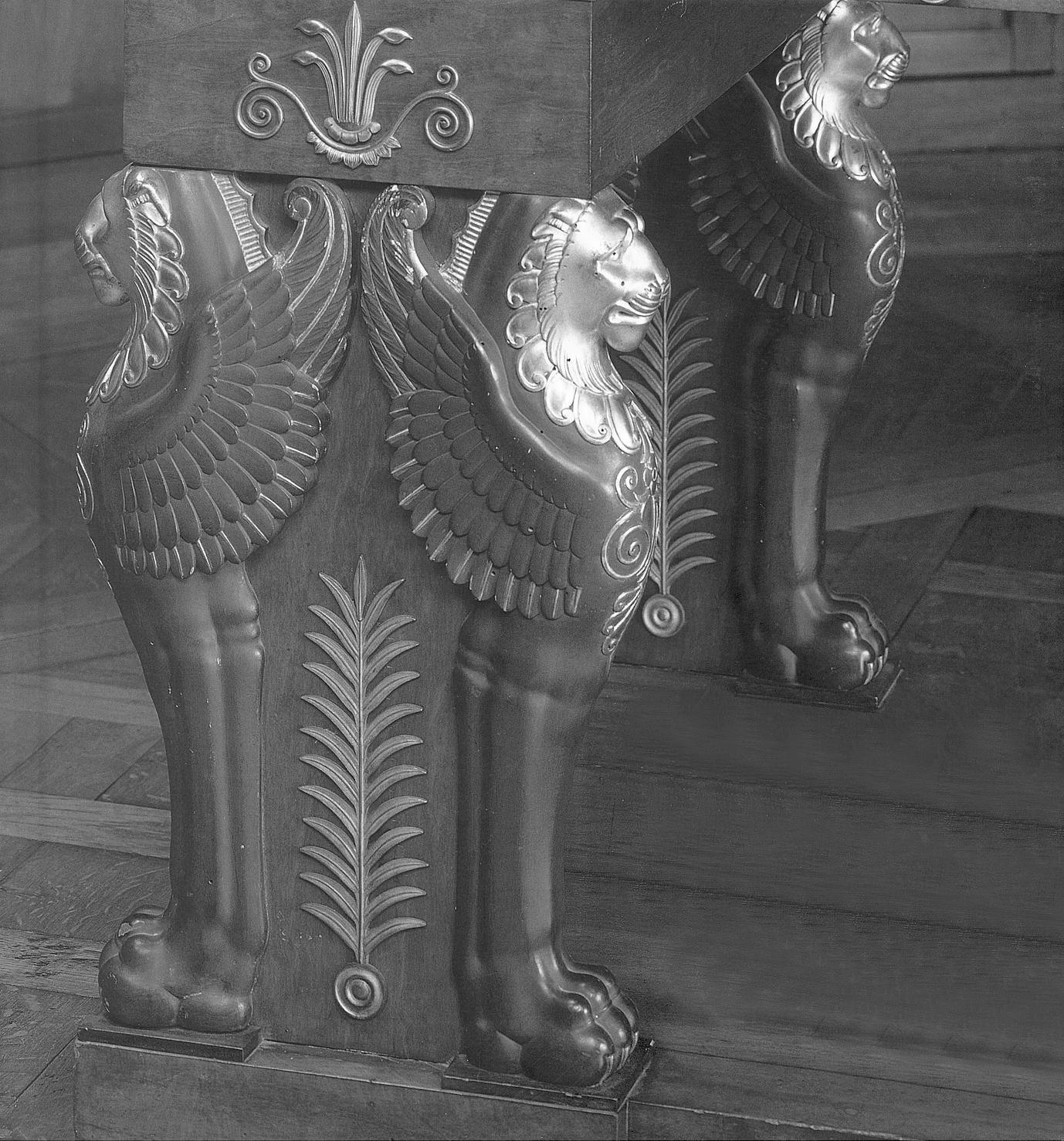
The table stands on eight zoomorphic feet in the form of winged lion’s legs, twinned in pairs, executed in bronzed wood, monopod angled uprights terminating in a lion’s muzzle, resting on a large claw.
This model of legs was created during the Convention (1792-1795) by Georges Jacob after a sketch by the architect Charles Percier (1764-1838), inspired by the Antique marble table support known as trapezophoron, several examples of which – with lion’s or griffin’s heads – are preserved in Pompeii. Georges Jacob used it, as we can see from Percier’s drawing, to form the back feet of a large desk chair, several examples of which are now at the Château de Malmaison and in private collections, bearing either his stamp or that of Jacob-Frères/Rue Meslée , employed by his two sons as from 1796.
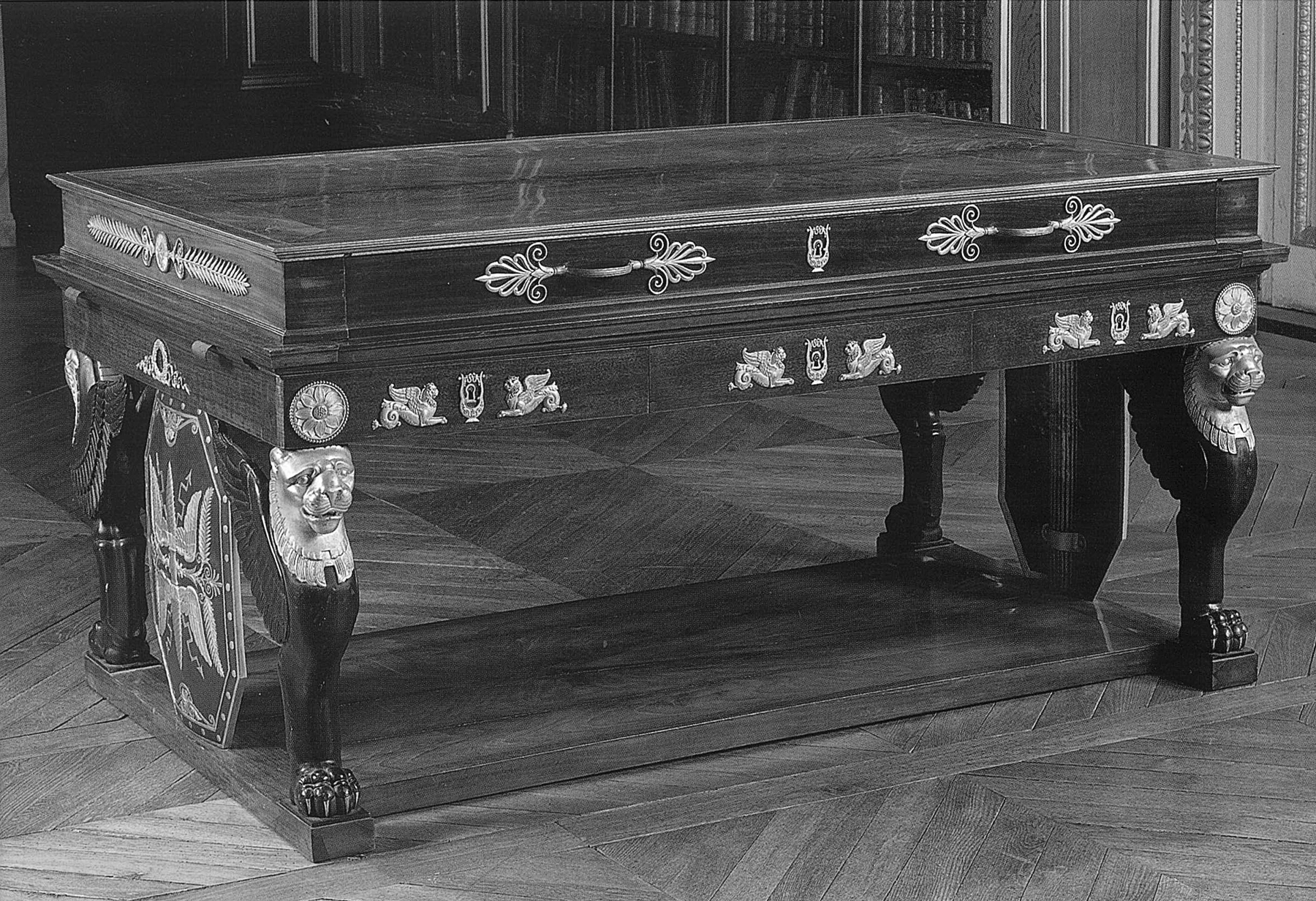
The eight legs of the table stand on an imposing X-shaped mahogany stretcher with rectangular projecting sections surrounded in gilt bronze, supporting each pair of monopod winged lions, and a broad central openwork rosette, also in bronze. The whole item stands on eight small spherical feet. This piece of furniture is directly related to the series of large bureaux plats with comparable supports in the form of lions or winged tigers supporting a storage cabinet with mechanical fittings developed by Jacob Frères at the beginning of the Consulate. One of the most famous examples is the desk of the First Consul at the Tuileries, now preserved at the Château de Malmaison.
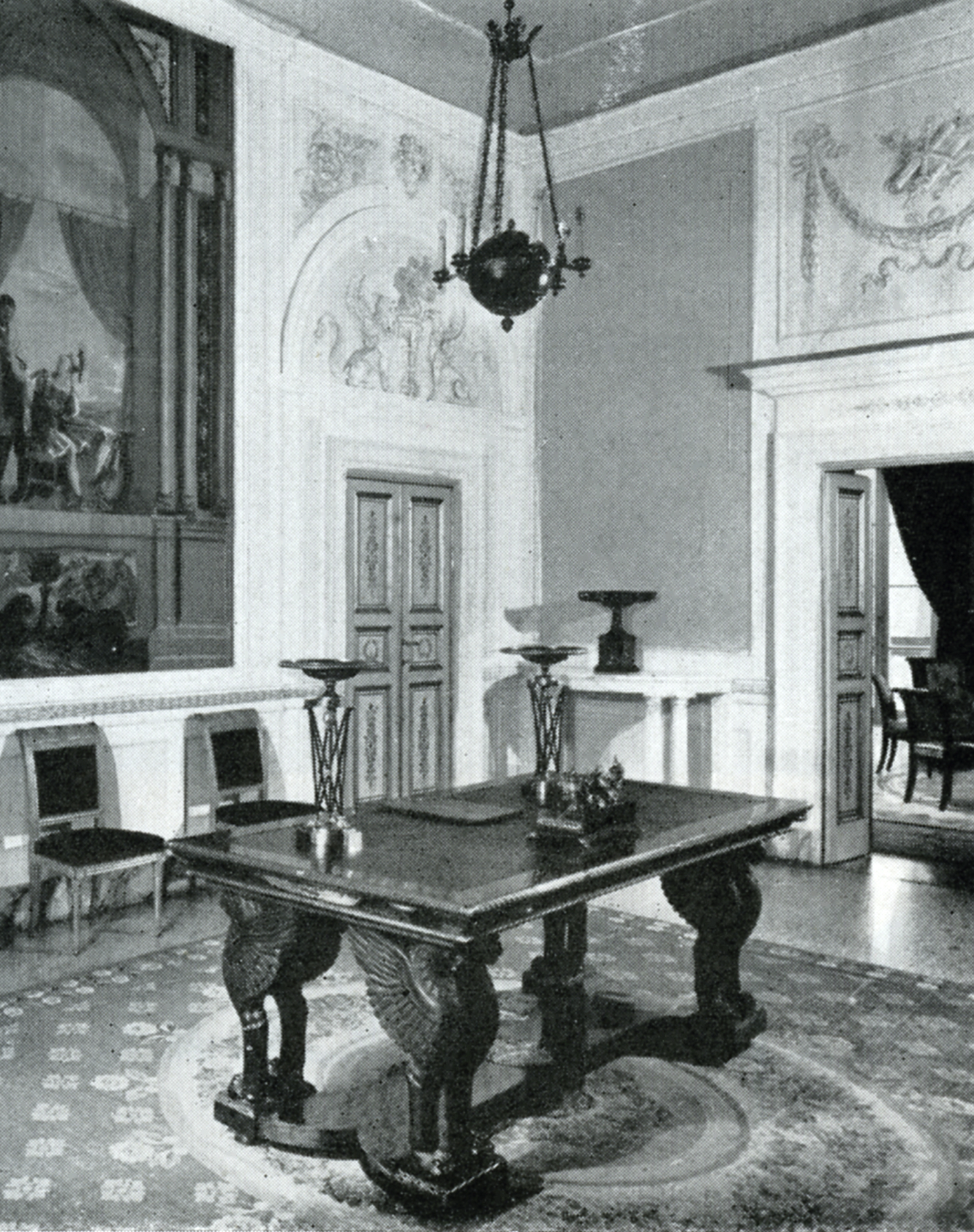
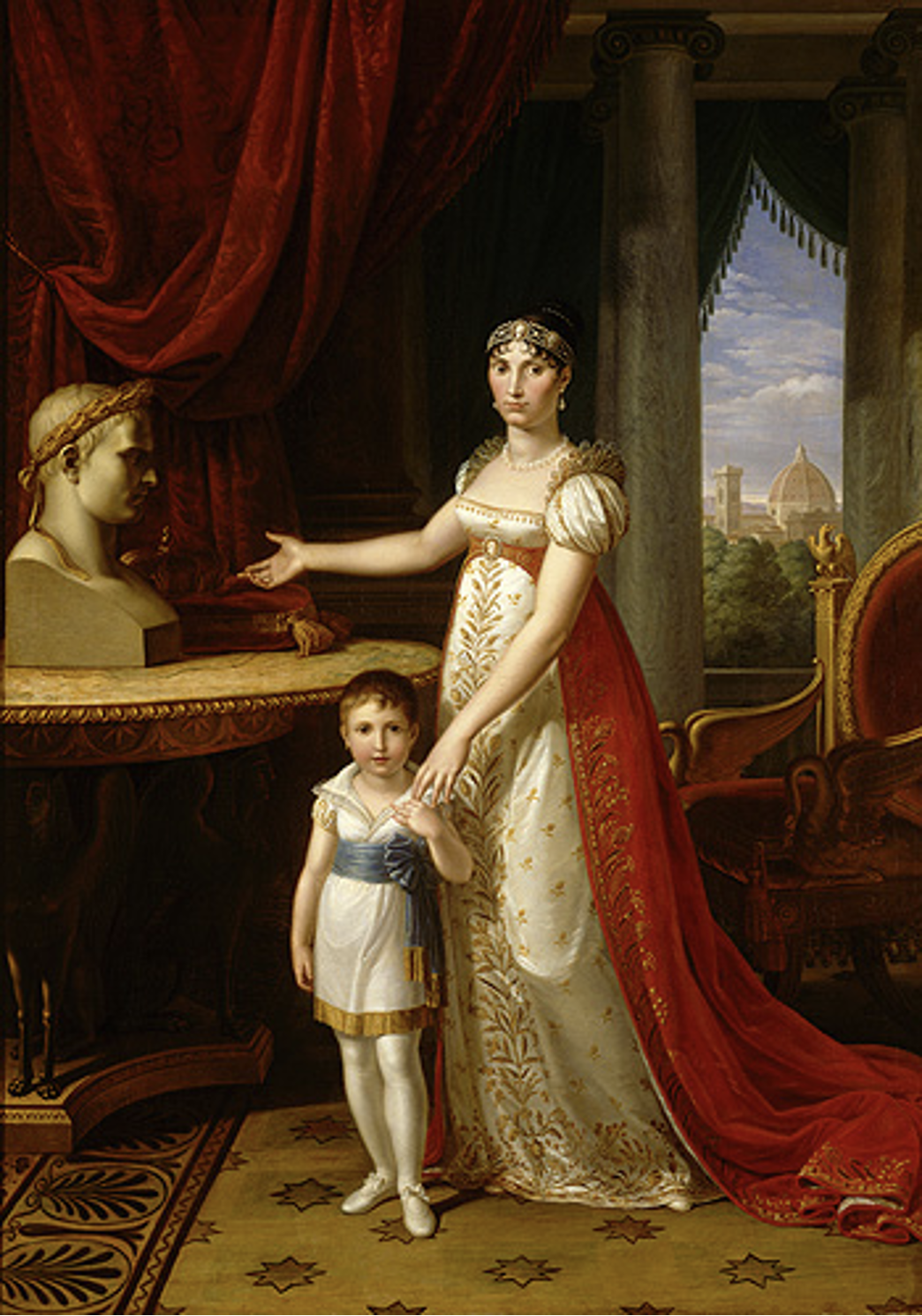
Reputed to be Napoleon’s “actual map table”, which went with him on all his campaigns, this remarkable item of furniture was part of the collection of the Count and Countess Pecci-Blunt, who placed it in the middle of the antechamber on the first floor of the “Villa Reale” in Marlia, Tuscany, the former residence of Elisa Baciocchi, Napoleon I’s sister, Princess of Lucca and Piombino and Grand Duchess of Tuscany under the Empire, a mansion they had acquired in 1923. Keen collectors and patrons, Count and Countess Pecci-Blunt took steps to restore the Villa to its former glory, buying large numbers of paintings, furniture and objets d’art in addition to the partially preserved decoration introduced by Elisa under the Empire, including mural frescoes, wallpapers, sculptures, mantelpieces and consoles executed in Carrara marble. Countess Anna Laetitia Pecci-Blunt (Rome, 1885 – Marlia, 1971), known as Mimi, was the great-niece of Pope Leo XIII, of the Pecci family (1803-1903). She married Cecil Blumenthal, known as Blunt, an extremely rich Jewish-American who had received the papal title of Count Pecci-Blunt.
The “Villa Reale” à Marlia
The “Villa Reale” in Marlia has always been the residence of noble families and great patrons. As from 1805, Elisa created a grandiose complex bringing together the Villa Orsetti – built during the 16th century for a powerful family of Lucca – and the surrounding land, which already contained another palace dating from the 17th century: the former residence of the bishops of Lucca. Elisa had the former palace of the Orsetti counts and its loggia refittedin the Empire style, while preserving the splendid 17th century gardens, their marvellous green “theatre”, peschiera, “camellia walkway” and “grotto”, which have come down to us intact.
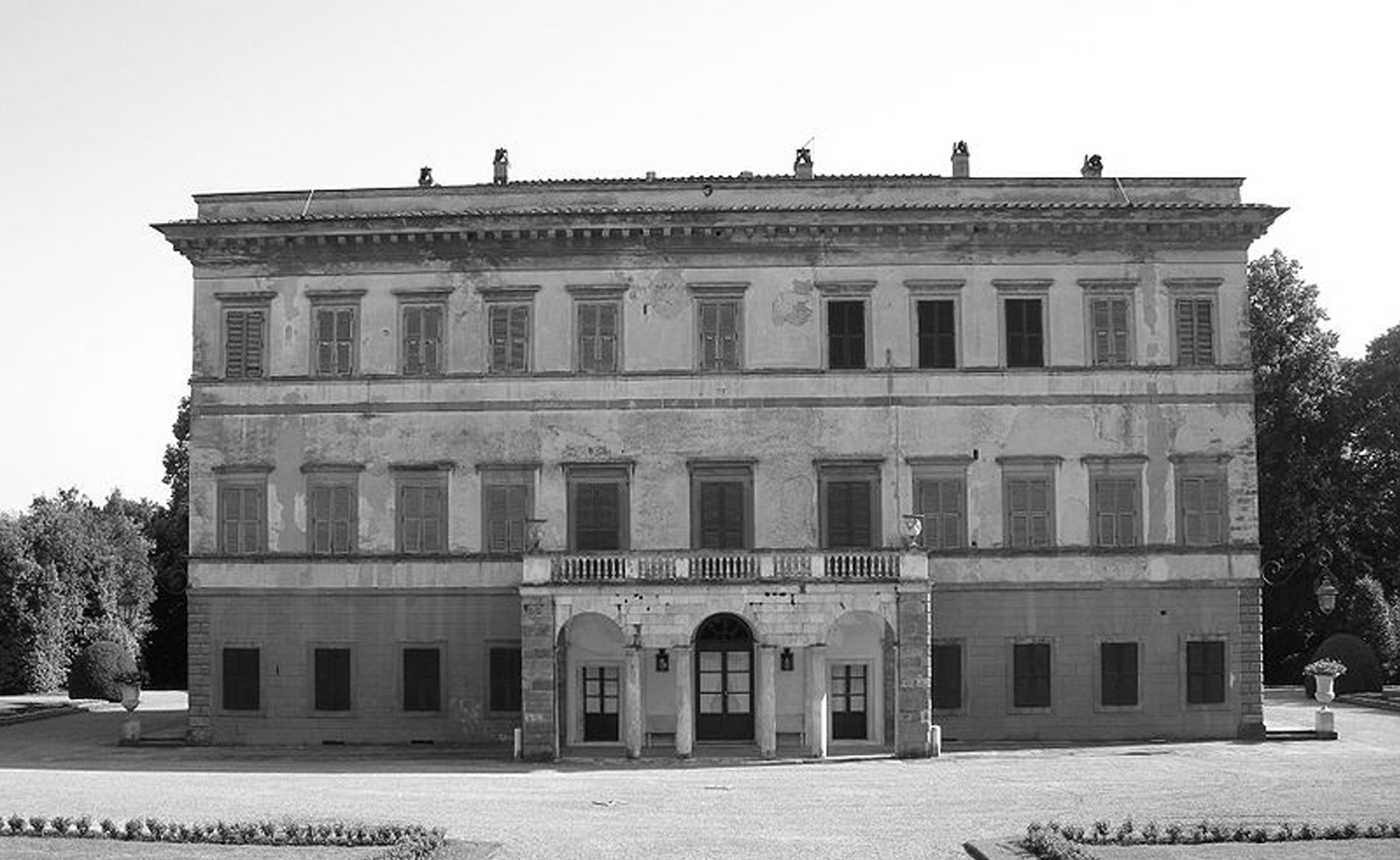
After the fall of Napoleon, the Dukes of Parma and then the Grand Dukes of Tuscany came into possession of the Villa, which subsequently, when Italy was unified, became the property of Victor-Emmanuel II of Savoy (1820-1878), the first King of Italy as from 1861. The latter transferred it to Prince Carlo-Ferdinando of Bourbon-Sicily (1811-1862), Prince of Capua and brother of the last King of Two Sicilies, who had been disinherited after the scandal caused by his marriage with an Irish commoner, Penelope Smyth of Ballynatray (1815-1882). This romantic but impoverished couple spent the rest of their lives in the Villa and were buried in the chapel in the park. Their son and heir, famous for his religious mania and eccentric behaviour, was nicknamed the “mad prince”. After his death in 1918, the Villa was sold to pay off his debts, numerous movable goods were auctioned, and a large number of trees were cut down for firewood.
In 1923, the Count and Countess Pecci-Blunt bought the property just in time to stop the complete destruction of the park. To restore the gardens, they brought in Jacques Greber, the celebrated French architect, who also created the “Spanish” garden, and introduced woods, streams and a lake, which now form a harmonious and romantic addition to the classical Italian gardens going back to the time of the Orsetti.
The illustrious guests who stayed at the Villa Reale included the violinist Paganini, representatives of all the royal houses of Europe, and the American artist John Singer Sargent, who painted a number of watercolours there.
The Maison Jacob: an extraordinary firm from the late 18th century to the Empire
The Jacobs were one of the most celebrated families of Parisian cabinetmakers, who successfully maintained the reputation of their company in the top rank throughout three active generations, from the last third of the 18th century to the end of the first half of the 19th.
Georges Jacob, the father of the dynasty, was born at Cheny in Burgundy, on 6 July 1739. He lost his parents when he was very young. When he was sixteen, he decided to settle in Paris and learn wood sculpture. He initially worked as an apprentice with the joiner Louis Delanois, who was a considerable influence on him, and then specialised in making chairs. With support from his master, he was rapidly elected master craftsman, being registered as such on 4 September 1765, and was then able to set up on his own without inheriting a business from another master – a relatively rare occurrence at the time.
In 1767, he married Jeanne-Germaine Loyer, aged sixteen, like him also living in the Rue Beauregard in Paris.
The couple settled shortly afterwards on Rue de Cléry, then in 1775 permanently on Rue Meslée. They had five children: three sons and two daughters. The eldest son, Georges II (1768-1803) and the second son, François-Honoré-Georges (1770-1841) both became joiners and cabinetmakers and assisted their father brilliantly in his enterprise. The youngest son, Louis, chose a route diametrically opposed to theirs and made a number of voyages.
From 1773 to the Revolution, Georges Jacob worked constantly for the Garde-Meuble de la Couronne, supplying the main royal residences. As from 1781, he occupied a number of different positions in his joiners/cabinetmakers’ guild. In 1788, he became deputy syndic, and was due to become syndic the following year. As the principal supplier of the Court and the princes, he was in a dangerous position during the revolutionary period. But although denounced on several occasions to the Committee of Public Safety, he benefited from the protection of the painter Jacques-Louis David with whom he actively collaborated, producing furniture based on the latter’s designs.
On 13 August 1796 at the age of fifty-seven, he transferred his business to his two sons, who then created the company name JACOB FRERES. Their father rented his workshops out to them and continued to advise them. But after the premature death of his eldest son, Georges II, on 23 October 1803, he decided to form a new association with his second son François-Honoré-Georges: an association that lasted for nine years, and went under the name of Jacob-Desmalter et Cie.
The name Desmalter had been added to that of Jacob during the Directoire (1795-1799) in memory of family lands, “Les Malterres”, owned by one of their ancestors at Cheny in Burgundy.
Under the First Empire, Jacob-Desmalter became joiner/cabinetmaker/producer of furniture and bronzes to the L.L.M.M.I.I. and R.R. (Their Imperial and Royal Majesties), as the Emperor and Empress were also King and Queen of Italy as from 1805.
Throughout the reign of Napoleon I, the company was the principal supplier of the Mobilier Impérial, outstripping its competitors by a long way. This also applied to its private trade. In the study by Hector Lefuel, we find that the Jacob workshops, which employed up to 332 craftsmen in around 1808, delivered furniture to the value of nearly ten million francs between 1796 and 1813. Only one-fifth of this colossal sum concerned supplies to the public sector; one-third consisted of exports, and the rest was accounted for by the purchases of private individuals.
Jacob-Desmalter went into liquidation on 15 January 1813. This situation was largely brought about by the State, its principal customer, which failed to honour the numerous bills it owed to the Maison Jacob. The wife of François-Honoré-Georges, who enjoyed separate property rights, was briefly able to manage the company until Jacob-Desmalter was able to take his place at the head of the company once more, after his creditors acknowledged, at the beginning of the Restoration, that he had been solely the victim of political events.