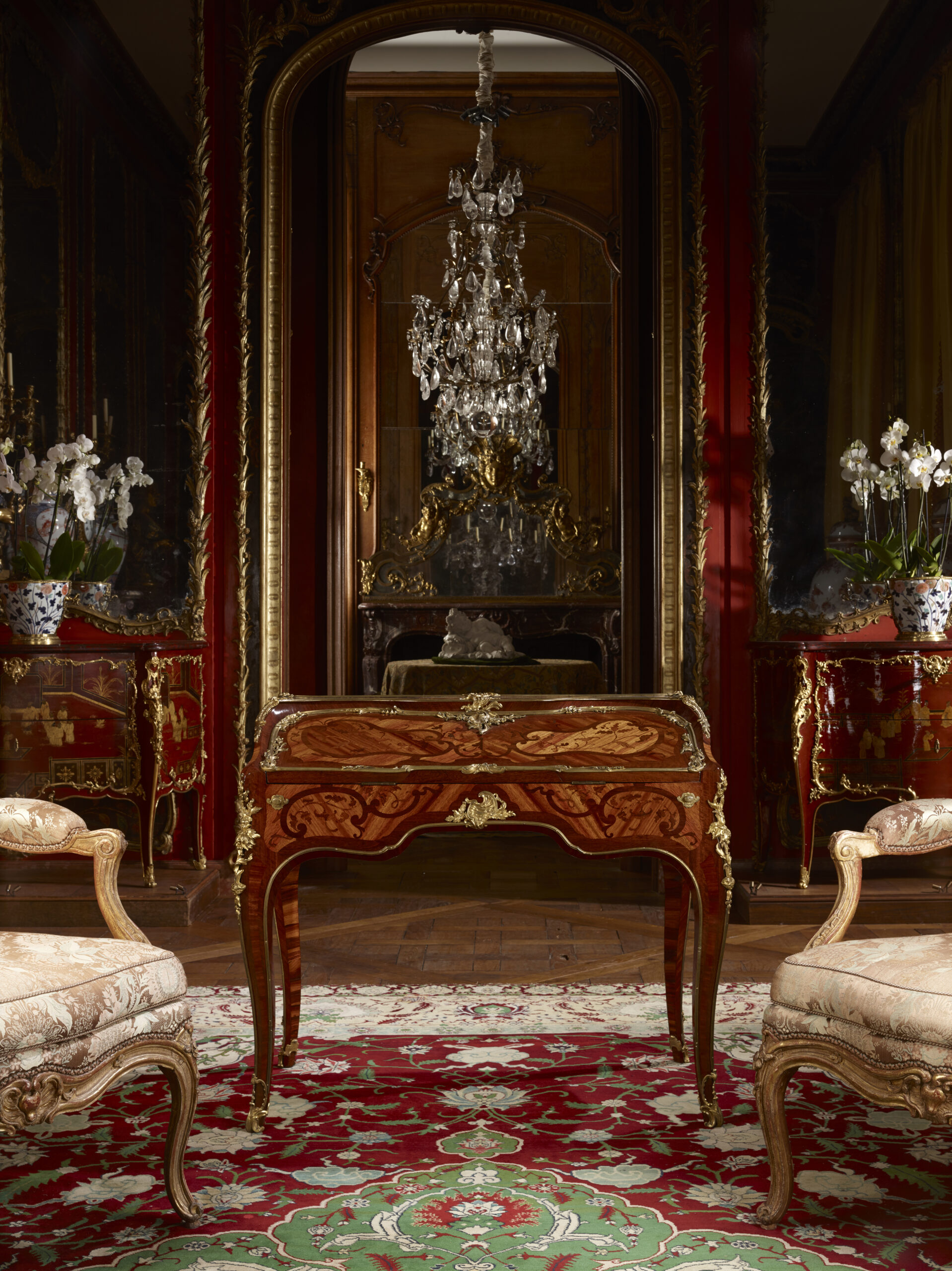
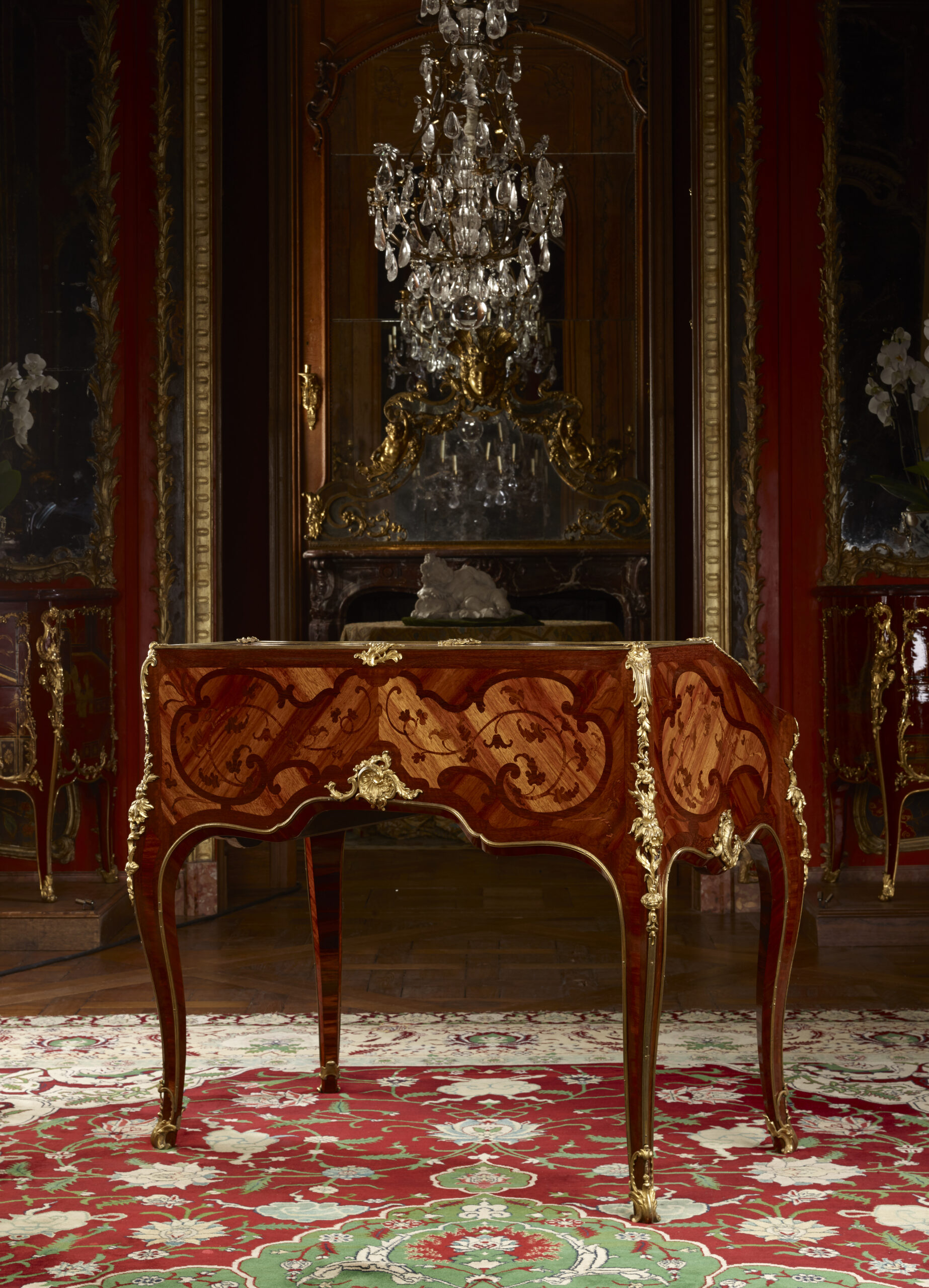
Oak carcass; satinwood and amaranth veneer; violet wood bois de bout marquetry; gilt bronze; leather.
H. 86 cm. (34 in.); W. 100.5 cm. (39 ½ in.); D. 57.5 cm. (22 ¾ in.).
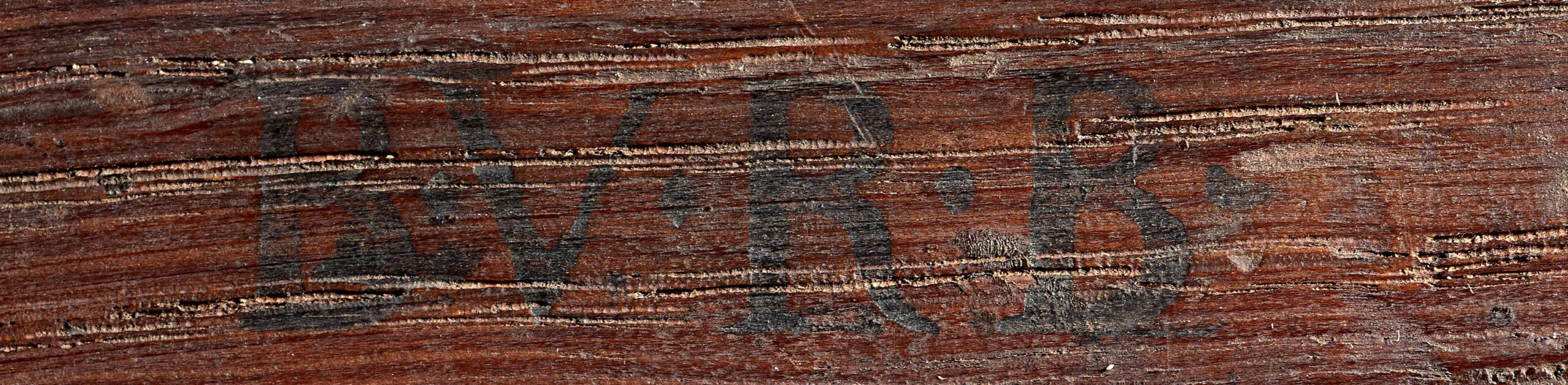
STAMP: B.V.R.B. visible under the top and B… under the lower rail of the desk. Marked with a crowned “C”, visible on the bronzes and denoting a tax on metals decreed by the Paris parliament in February 1745; the tax was very unpopular and was abolished in February 1749.
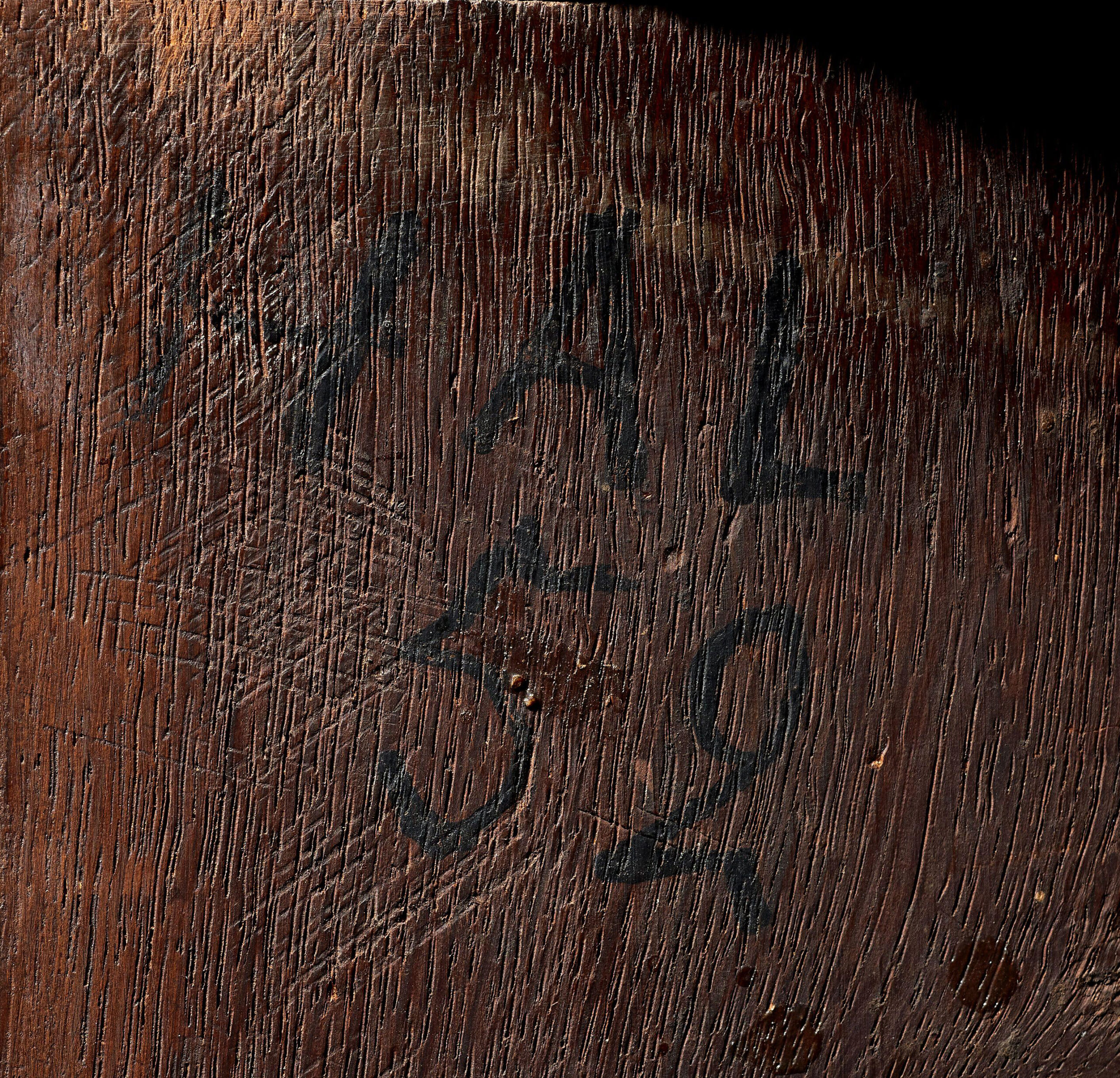
MARKS AND INSCRIPTIONS: HAL 52, inventory number in black ink used by the Einsatzstab Reichsleiter Rosenberg (ERR) to designate the Halphen family, whose property was spoliated by the Germans during the Second World War; trace of a partially faded label on which the word ORANGERIE appears, in reference to the exhibition of restituted works that was held at the Musée de l’Orangerie in Paris in 1946, in the course of which the desk was presented under number 246 (sources: United States, National Archives and Records Administration (NARA), RG 260 M1943 Reel 8 NARA; Berlin, German Federal Archives (Bundesarchiv), B323/271, B323/304; RV 103, MAEE, Paris, France).
PROVENANCE: collection of the banker Émile Halphen (1857-1913) and his wife Louise Fould (1862-1945), daughter of Paul Fould, maître des requêtes at the Conseil d’État, and Baroness Ève Mathilde de Günzburg (1862-1945), in their private mansion at 18, avenue Henri Martin, Paris (destroyed); seized in 1940 by Colonel Kurt von Behr’s Einsatzstab Reichsleiter Rosenberg (ERR) in Paris, the department in charge of spoliations during the Occupation; the desk was stored during the summer of 1940 at the German Embassy in Paris, which had been housed in the Hôtel de Beauharnais at n°. 78, rue de Lille since 1862; it was sent to Neuschwanstein in Bavaria on 27th October 1944; recovered by the Monument Men in 1945, repatriated to Paris on 18th October 1945 and returned to the Halphen family; collection of Alice Halphen (1887-1968), second daughter of Emile Halphen and Louise Fould, who became Marquise de Bremond d’Ars after marrying Maurice de Bremond d’Ars (1881-1955); collection of Madame de Fontenay.
LITERATURE: “Jean-Pierre Baroli, Le mystérieux B.V.R.B enfin identifié”, Connaissance des Arts, n° 61, March 1957, p. 61, repr.
EXHIBITION: Les Chefs-D’œuvre des Collections Françaises retrouvés en Allemagne par la commission de récupération artistique et les services alliés, exhibition held in the musée de l’Orangerie in Paris, in the months of June, July and August 1946, lot n°. 243.
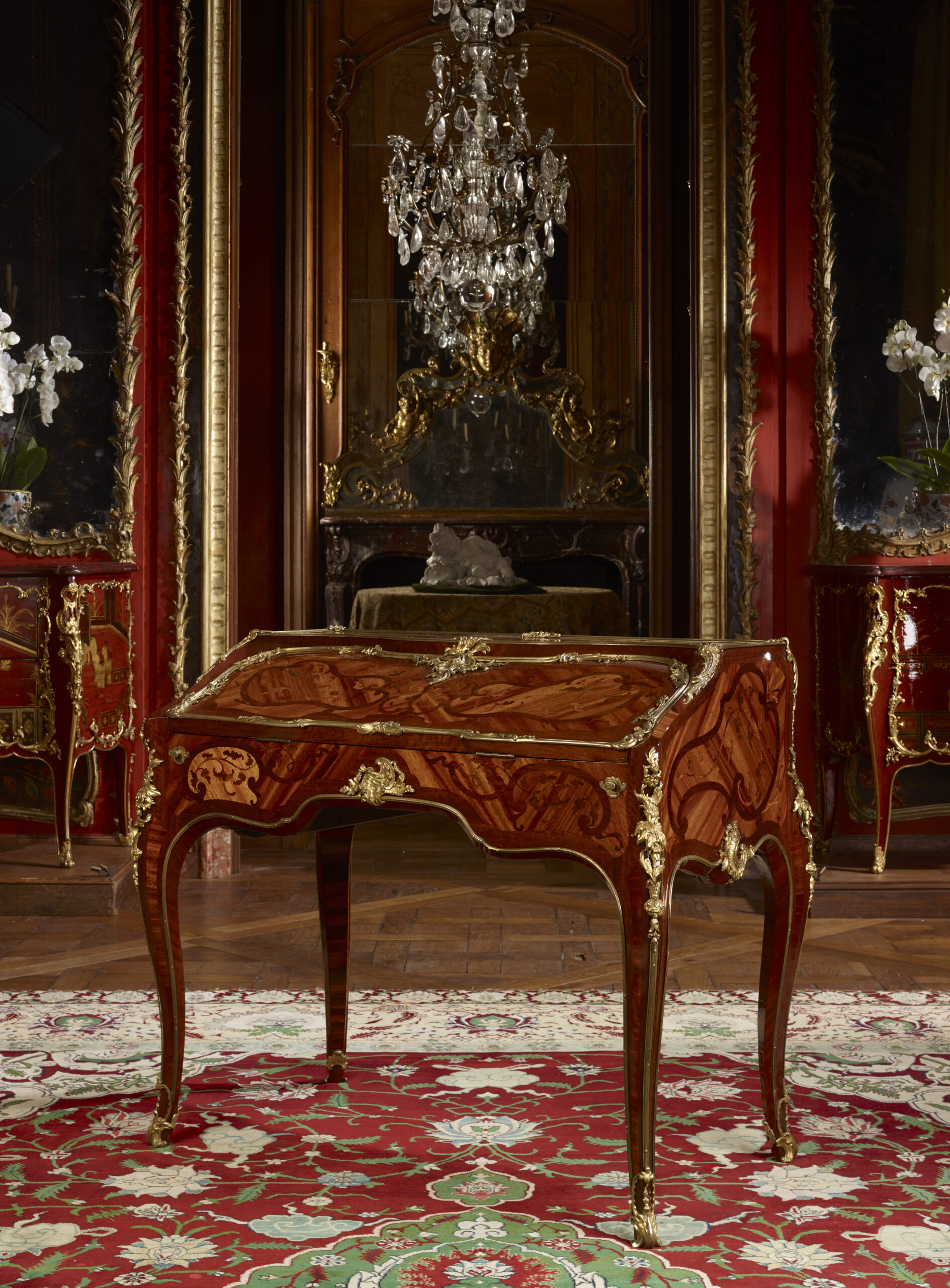
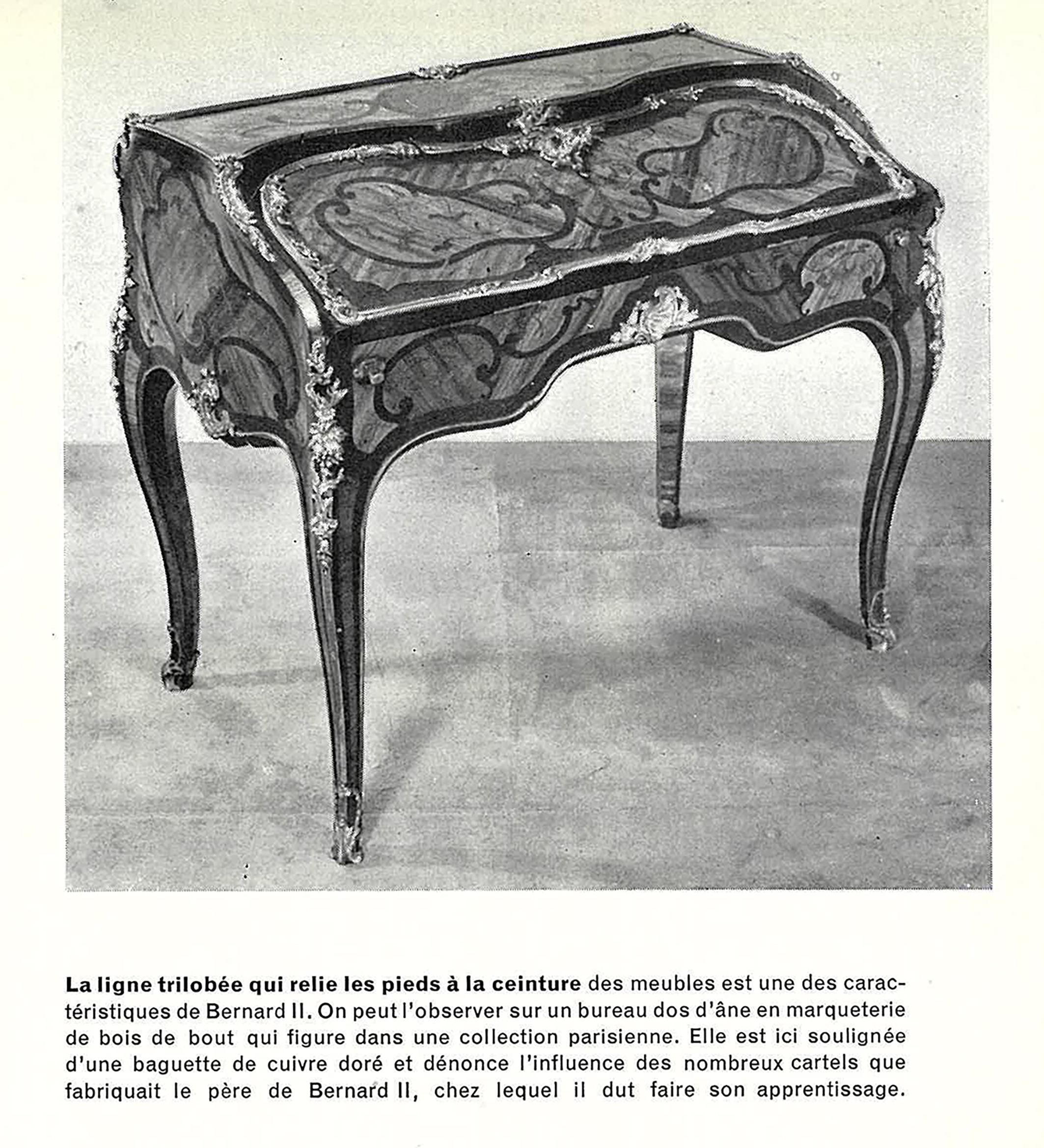
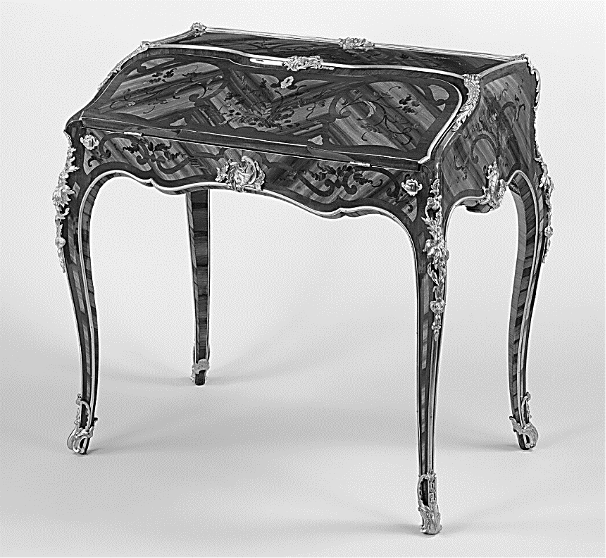
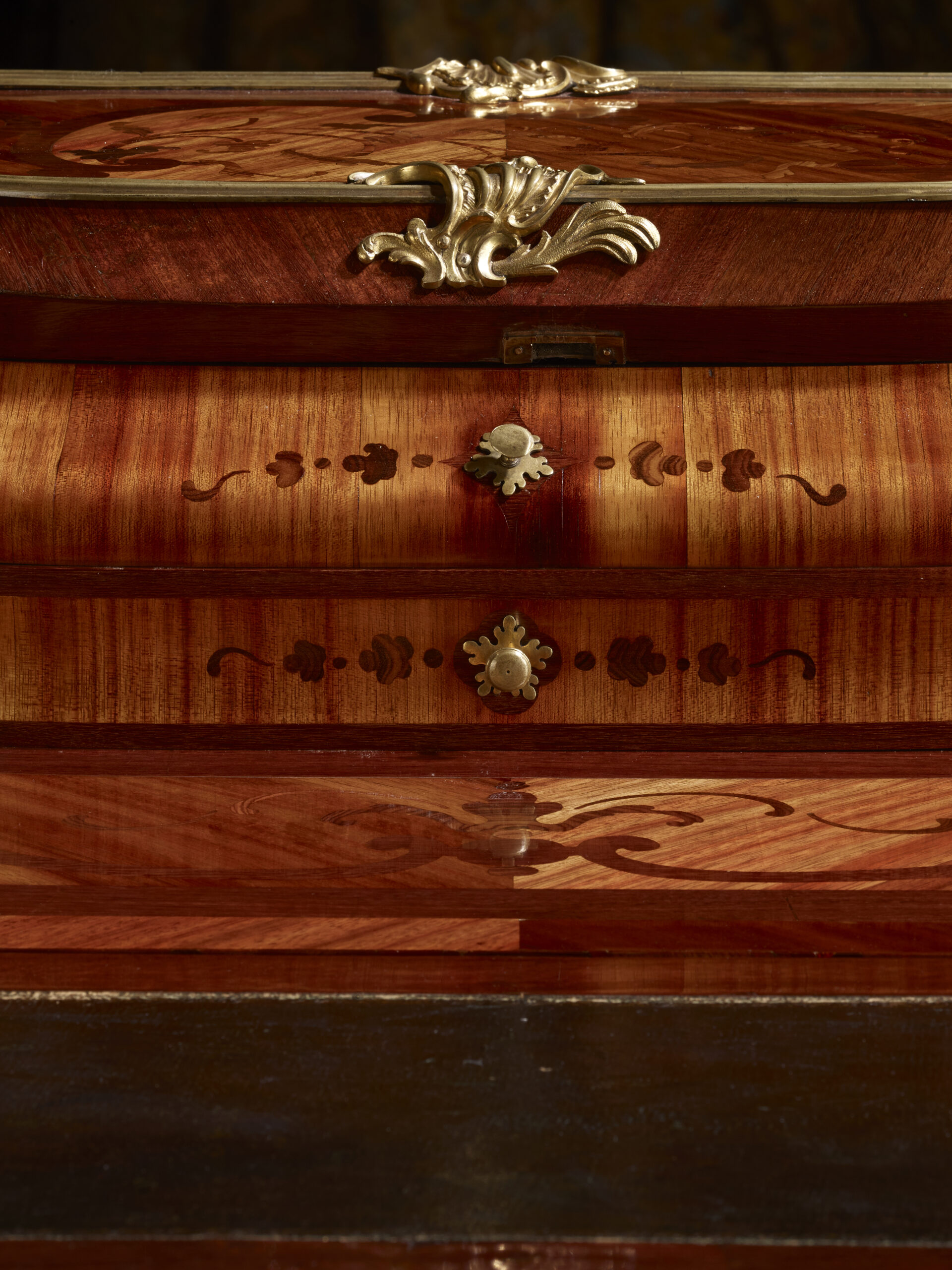
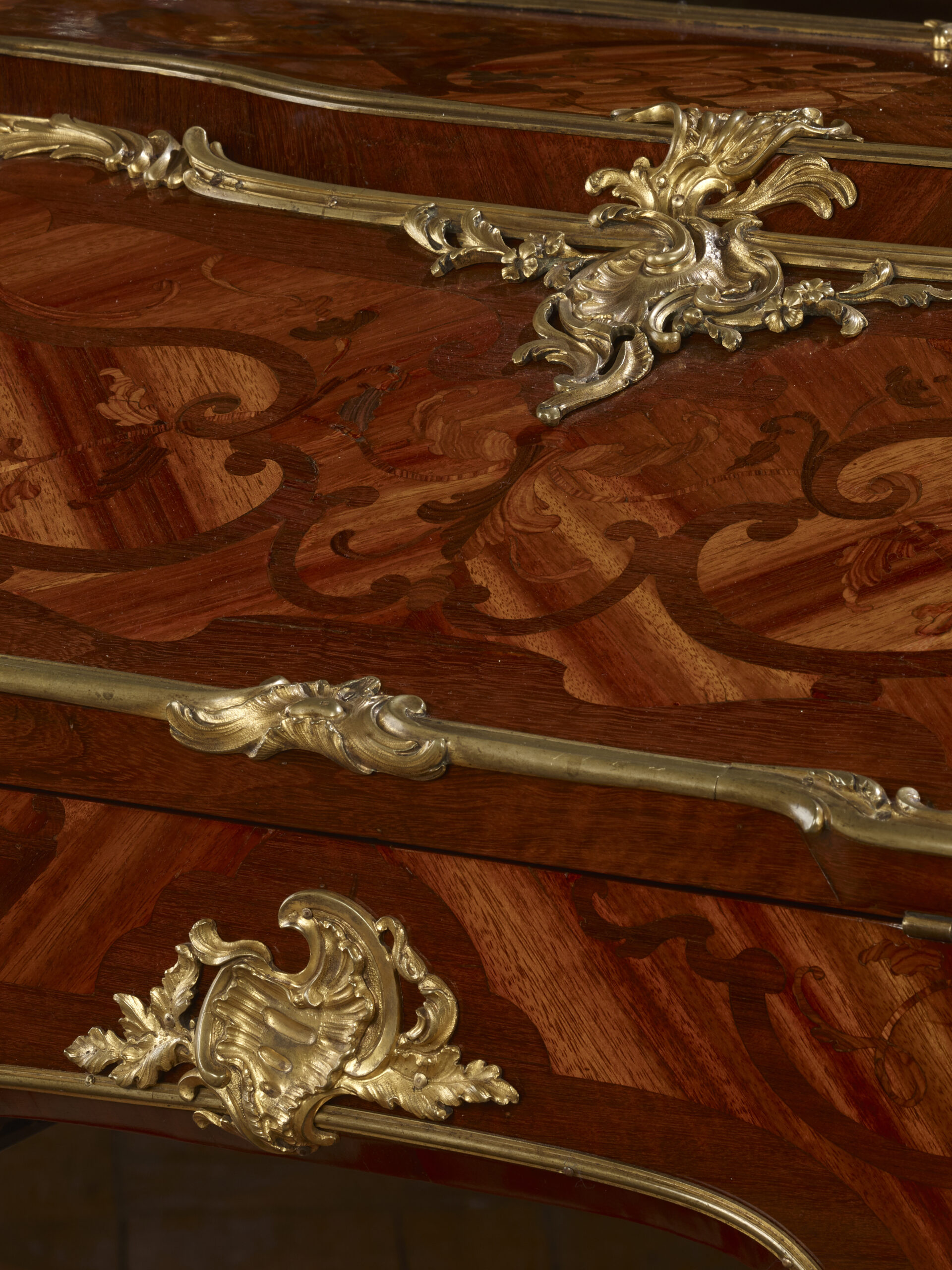
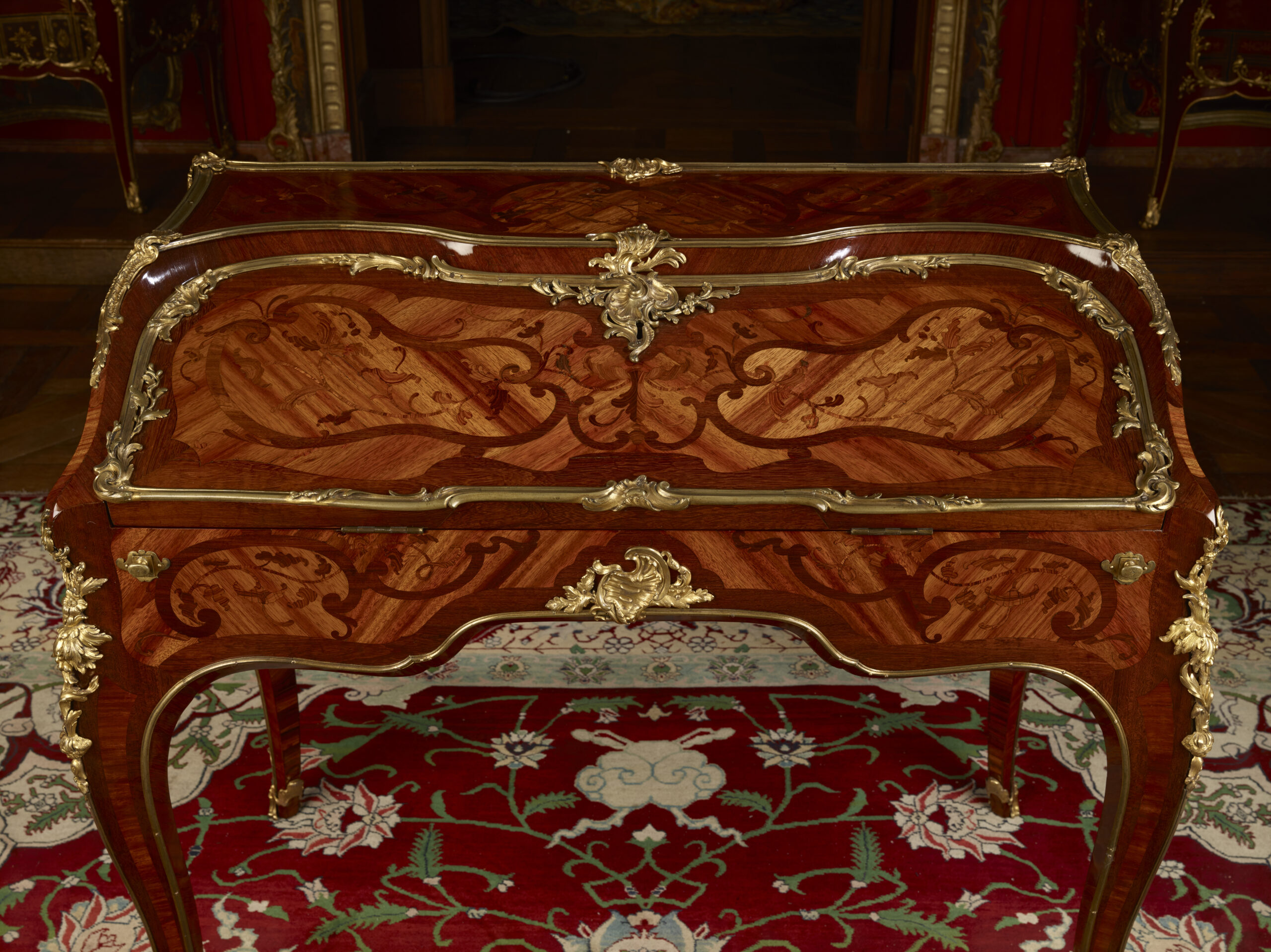
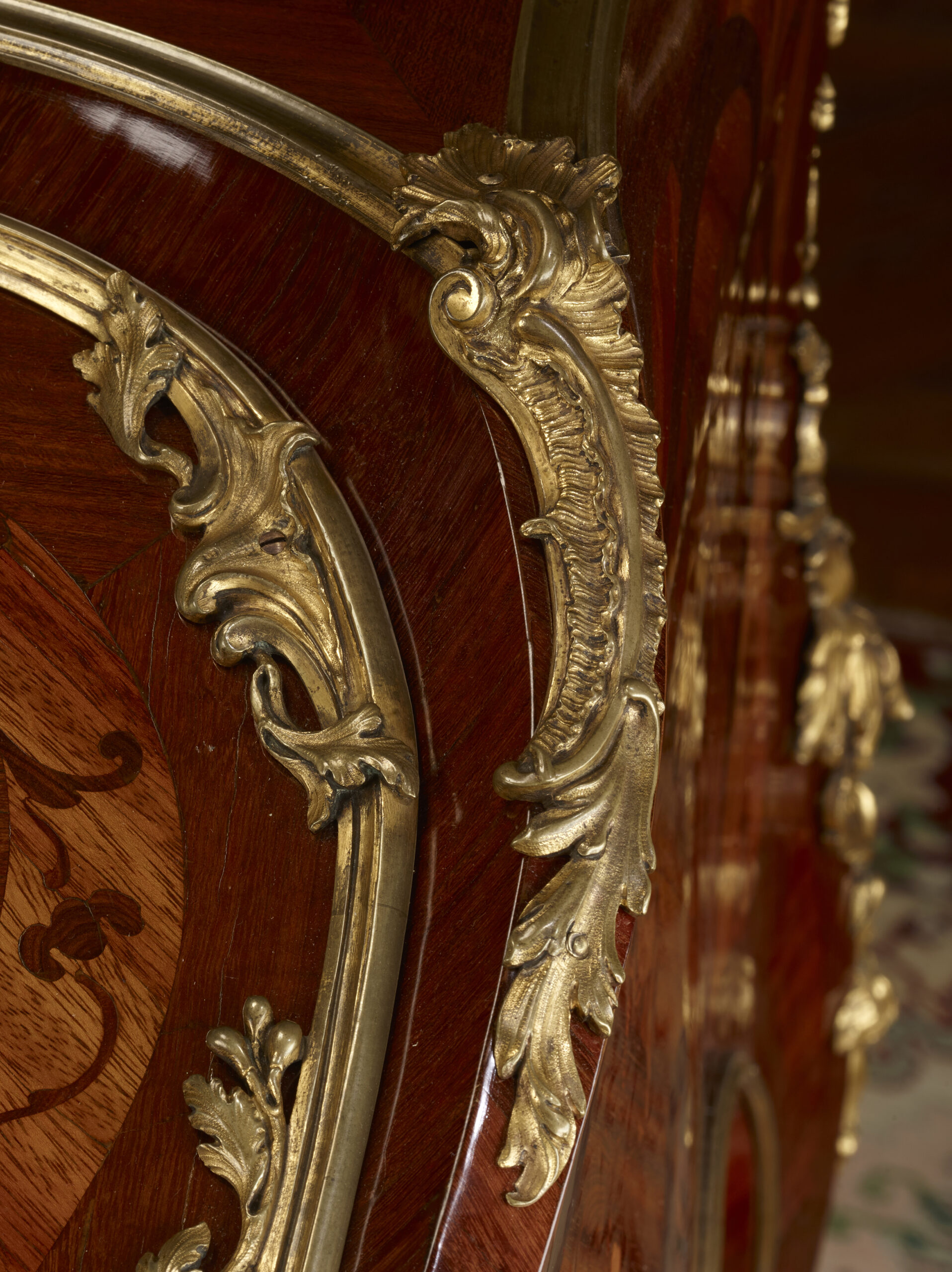
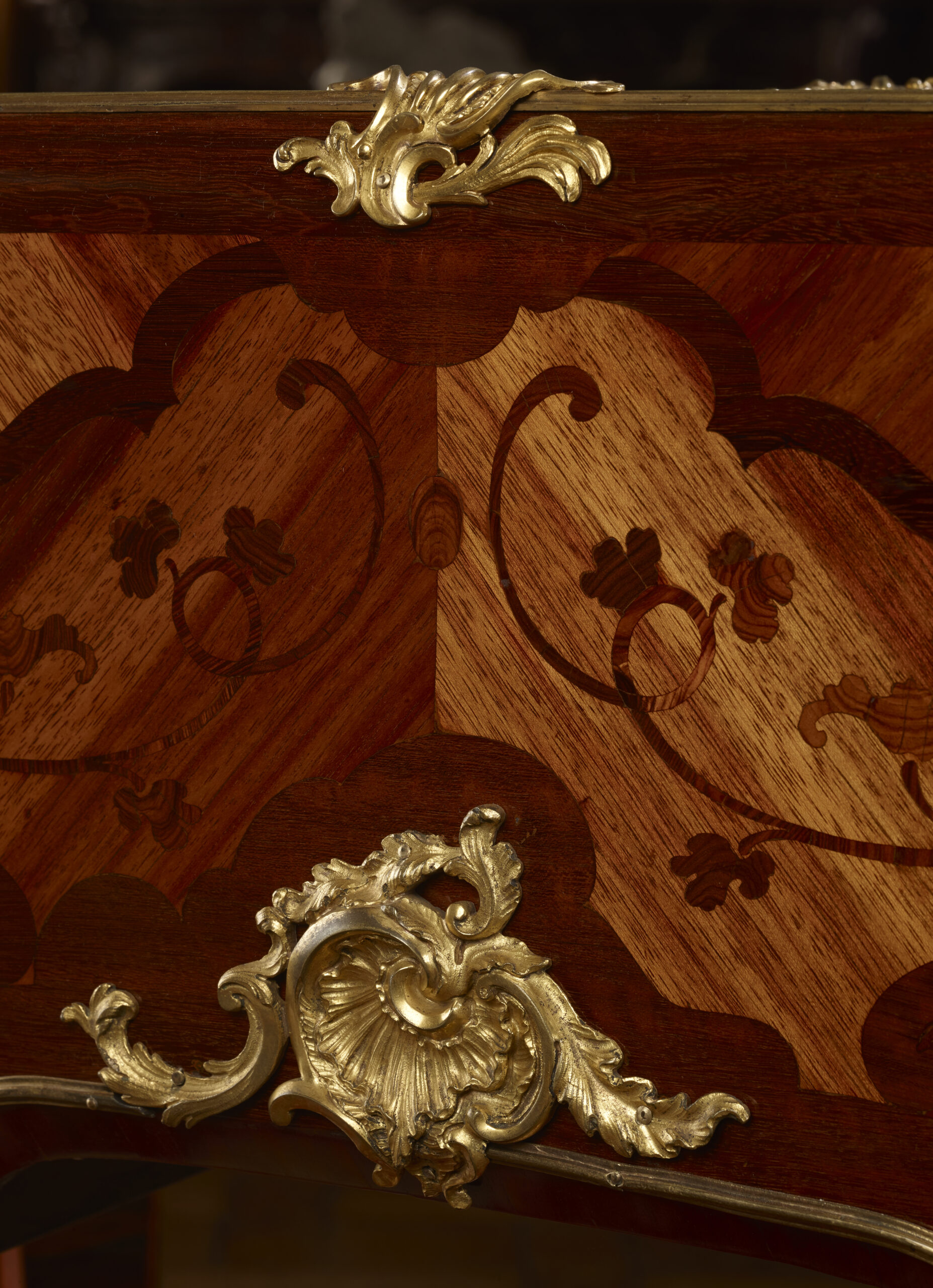
This bureau de pente, which is characteristic of the work of Bernard II Vanrisamburgh, is as remarkable for its craftsmanship as it is distinguished by the perfect mastery of its proportions and its decoration in bois de bout marquetry, the lavish use of chiselled and gilt bronzes, and the great precision with which its frame is assembled. Curved on all sides, it rests on four high, tapering console-shaped legs, set diagonally and forming a continuous line with the serpentine lower contour with a well-marked central recess (‘à retrait central’) of the rail; the whole is enhanced by moulded gilt bronze fillets punctuated in the centre of the four sides of the desk by rocaille agraffes with asymmetrical chiselled cartouches adorned with festooned and foliate scrolls, with shells on the reverse.
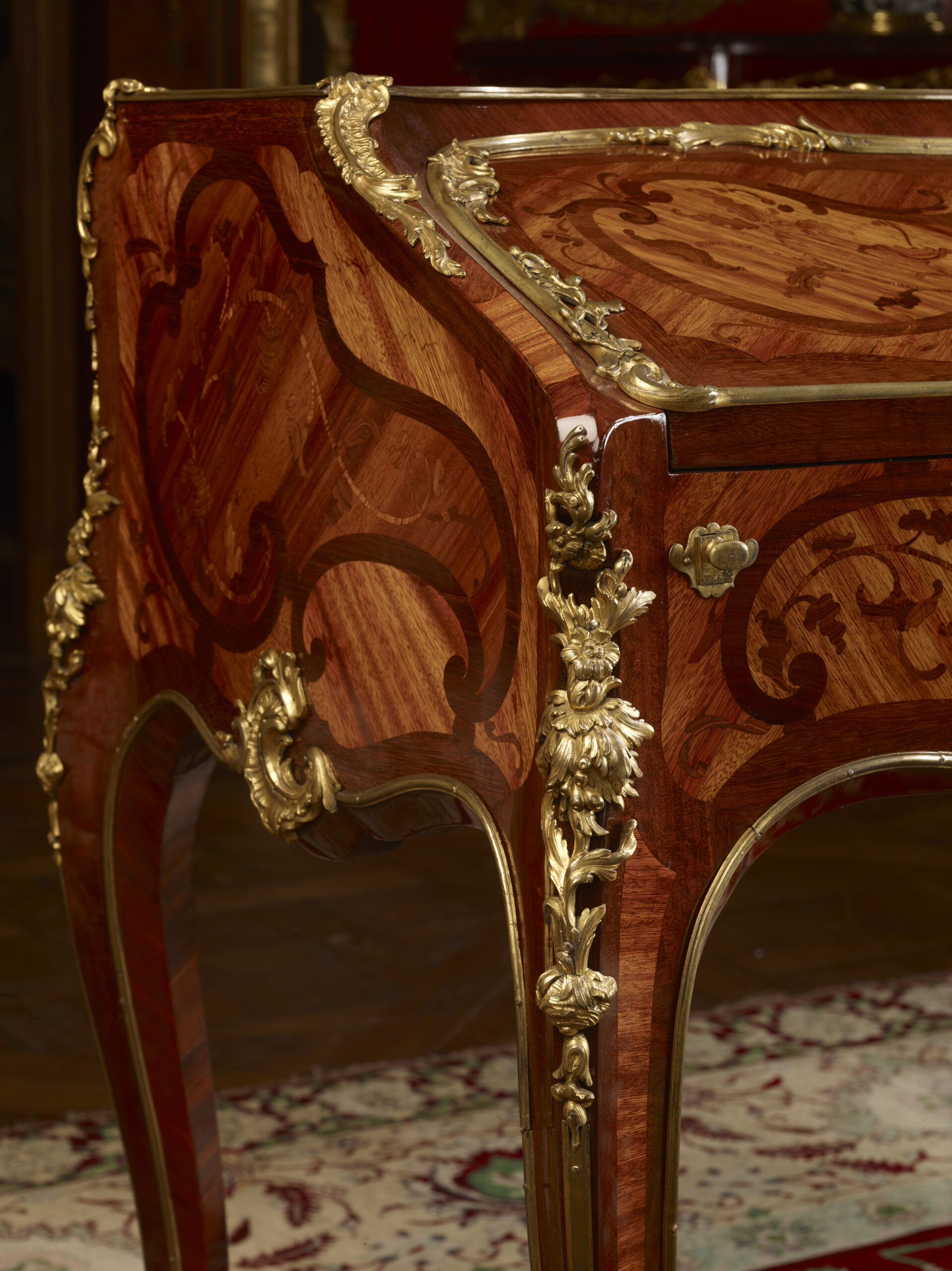
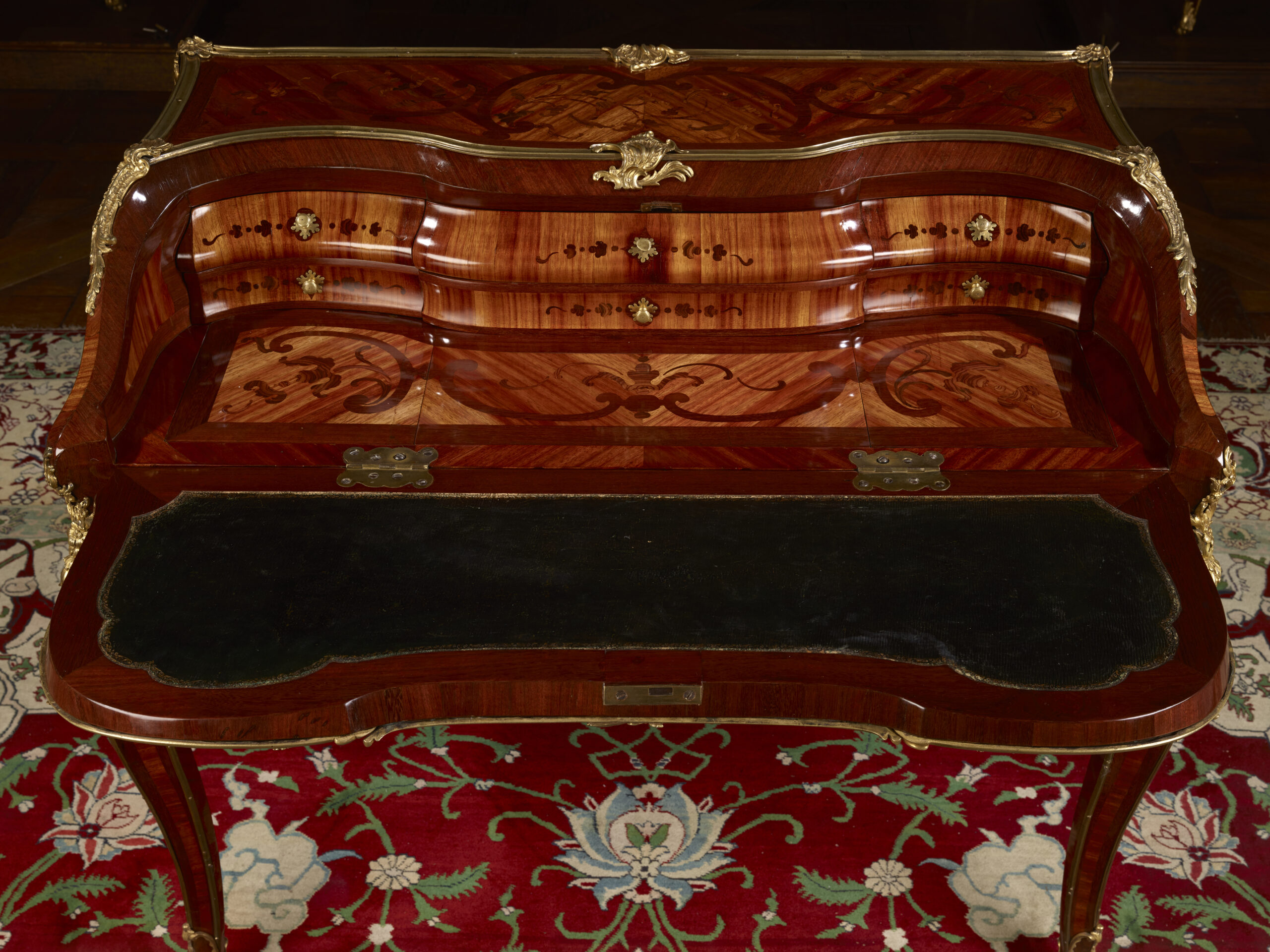
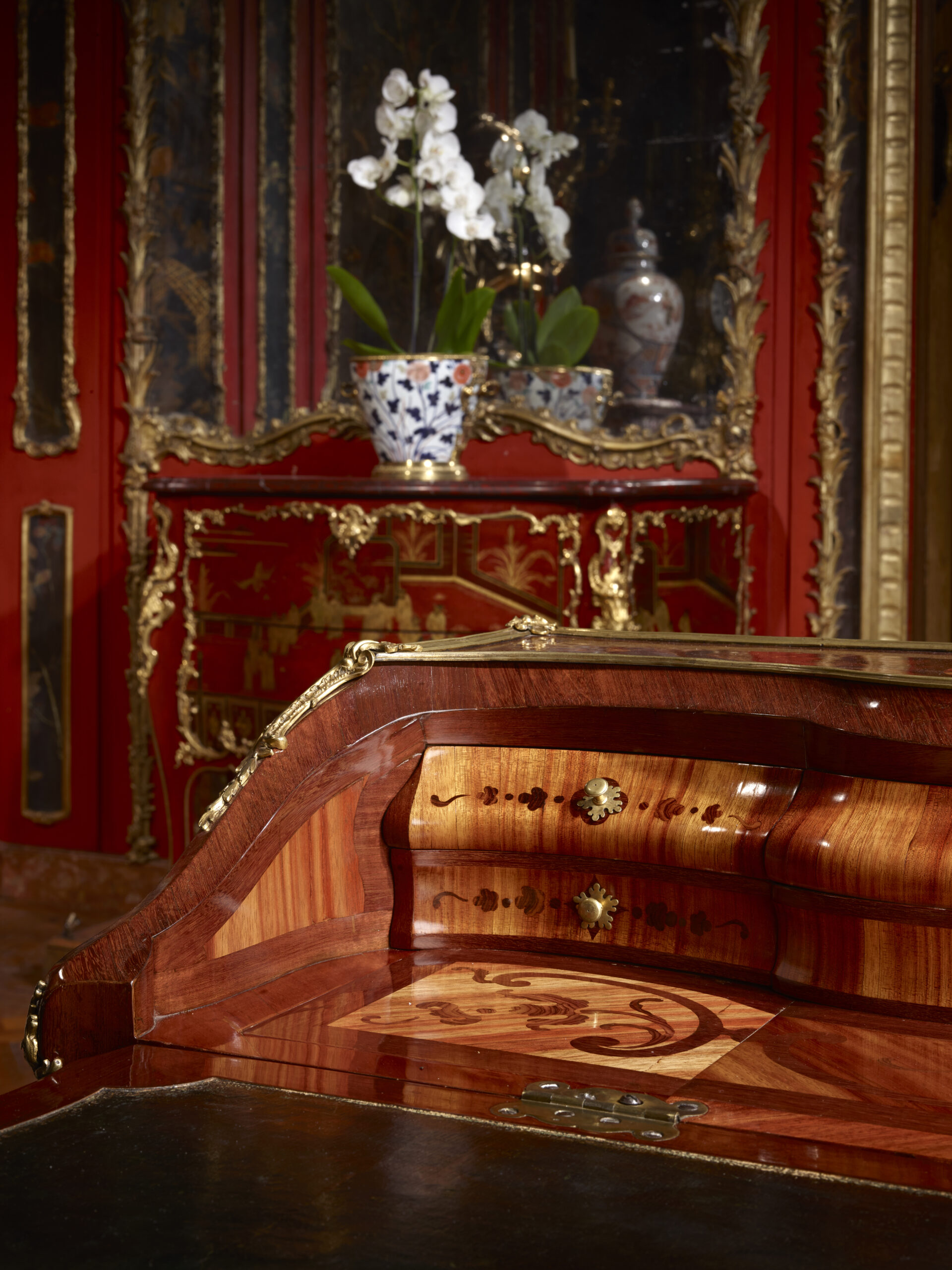
Four luxuriant pendants, with motifs of bouquets of flowers, fleurons and acanthus, are each joined by a moulded bronze fillet to a sabot in the same material with scrolls of openwork volutes and acanthus. Fine gilt bronze foliate pendants also adorn the upper part of the desk, enhancing the four corners of a terrace whose sinuous outline is also underlined by gilt bronze fillets and enhanced in the centre by ‘rocaille’ agraffes, the one on the front adjoining the very elaborate one on the fall front flanked by short foliate branches. The curved edge of the fall front is enhanced by a moulded gilt bronze border strewn with acanthus leaf agraffes and fine serpentine branches with buds. To open the fall front, which is fitted with a lock and trimmed on the reverse with dark green leather with gilded edging, two tigettes with gripping knobs in gilded bronze positioned at the top corners of the rail around the front of the desk need to be pulled in order to support the weight of the fall front.
The latter gives access to two serpentine rows with three drawers each, one of which is wider in the centre, with remarkably rounded fronts and gilded bronze pull knobs, and to a sliding “secret” in the centre, which opens by simultaneously pressing two small buttons concealed in the hinges of the fall front, giving access to a large central compartment flanked by two small side drawers. The entire desk is completely veneered in satinwood and amaranth and displays a remarkable décor, visible on both the outside and inside, of stylised and foliate branches in bois de bout violet wood, with those on the outside of the desk arranged within scrolled brackets forming cartouches, also in bois de bout.
A similar bureau de pente, also stamped B.V.R.B., was delivered by the marchand mercier Thomas-Joachim Hébert to the Garde-Meuble de la Couronne on 23rd January 1745, under number 1344, to be placed in the Interior Cabinet of the dauphine Marie-Thérèse Antoinette Raphaëlle de Bourbon (1726-1746), Infanta of Spain, at Versailles. Transferred to the château on 18th February of the same year, it was placed two years later, in 1747, in the apartment of the second Dauphine, Maria Josepha of Saxony (1731-1767), where it remained until her death in 1767. The desk was acquired on the Paris art market in 1987 and has now been returned to its original location in the Cabinet de Retraite in the Dauphine’s apartment in the château. Embellished with the same bronze adornments as the piece shown here, this desk has a slightly different frame, in particular the less pronounced lower contour in the rail, and its dimensions are significantly smaller (H. 62 cm; L. 87.8 cm; W. 53.7 cm).
In the 1740s, Bernard II Vanrisamburgh was instrumental in reviving flower marquetry, which had been out of fashion in France since 1700. He perfected an inlaid decoration of violet wood, treated as bois de bout, forming foliate branches and stylised flowers contrasting against a light-coloured wood background. In the early days of that production, he used satinwood for his grounds, which were more often than not, as can be seen on the desk, set in amaranth frames. During that period, he delivered several prestigious pieces of furniture adorned with this type of marquetry to the Garde Meuble de la Couronne, still through the intermediary of Hébert, of whom he was one of the main suppliers: in addition to the Dauphine’s bureau de pente described above, mention ought to be made, for instance, of the bureau plat (writing desk) in the Grand Cabinet of the Dauphin, son of Louis XV, in Versailles, which was delivered by Hébert in February 1745 and is still on display at the château. Subsequently, B.V.R.B. was more inclined to use rosewood for his marquetry backgrounds than satinwood. We also know that he had his own bronze models. The author of furniture of exceptional quality, he worked for the most important Parisian marchands merciers of his time: Hébert, between 1737 and 1750, then Lazare Duvaux, who supplied many of his pieces to the Marquise de Pompadour, not to mention François Darnault, Simon-Philippe Poirier or Henri Lebrun. In addition to the King and the court, the cabinetmaker’s most important clients included Jean-Baptiste de Machault d’Arnouville (1701-1794), Minister of State and Contrôleur général des Finances, and his father, Louis-Charles de Machault (1667-1750), whose collections of furniture and objets d’art are now well known.
Bernard II Vanrisamburgh
Born in Paris before 1705, Bernard II Vanrisamburg died in the same city in 1766. He was the son of Bernard I, a renowned cabinetmaker from Groningen in Holland, whose several masterpieces in copper and tortoiseshell marquetry are still listed today. Shortly before 1737, he adopted the abbreviated stamp B.V.R.B. for Van Risen Burgh, curiously his father’s signature rather than his own, which he spelt ‘Vanrisamburgh’.
He was admitted as a Master before 22nd October 1730, the date of his marriage contract with Geneviève Lavoye, the daughter of a stocking manufacturer, in which his title of Master is duly mentioned. This union produced at least seven children, including Bernard III, who was destined to become a cabinetmaker like his father. Bernard II spent his entire life in the Faubourg Saint-Antoine in Paris, working for the great Parisian marchands merciers, first in the Grande Rue du Faubourg Saint-Antoine (1730), then in Rue de Reuilly (1738), Rue de Saint-Nicolas (1756) and finally Rue de Charenton (1764). In particular, he specialised in the execution of bureaux de pente, which he presented with variations and different degrees of richness, and met with considerable success with this production. The J. Paul Getty Museum holds an imposing bureau à double pente (double-sided writing desk) with bois de bout decoration similar to that of the desk shown here, which almost certainly came from the collections of François Balthazar Dangé du Fay (1696-1777) in his Hôtel de Villemaré on Place Louis le Grand (now Place Vendôme) in Paris.
Emile Halphen
The desk became part of the collection of Emile Halphen (1857-1913) and his wife née Louise Fould (1862-1945) at the end of the 19th century, and from 1908 onwards it furnished their private mansion at 18, Avenue Henri-Martin in the 16th arrondissement of Paris (destroyed). It remained in the family throughout the twentieth century by descent.
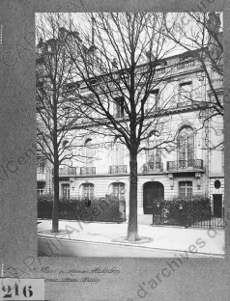
The son of Georges Halphen (1832-1906), a banker, diamond merchant and director of the Compagnie des chemins de fer du Nord, and Henriette Stern (1836-1905), daughter of Antoine Jacob Stern (1805-1886), Emile Halphen was born in Chatou on 22nd January 1857. Like his father, he became a banker, and his sisters and brothers were: Louise Halphen (1856-1914), who married Émile Deutsch de la Meurthe (1847-1924), Commander of the Legion of Honour; Marguerite Halphen (1861-1929), who married Raphaël-Georges Lévy (1853-1933); and Fernand Halphen (1872-1917), a renowned composer and military officer, Grand Prix de Rome in 1896, who married Alice de Koenigswarter (1878-1963).
On 5 June 1883, Emile Halphen married Louise Fould, the daughter of Paul Fould (1837-1917), maître des requêtes at the Conseil d’État, and Baroness Ève Mathilde de Günzburg (1844-1894). The couple settled in the luxurious private mansion on avenue Henri-Martin that they had commissioned in 1908 from René Sergent (1865-1927), the architect in 1911-1914 of the mansion of Count Moïse de Camondo (1860-1935), at 63, Rue de Monceau, now the Musée Nissim-de-Camondo in Paris. He had two daughters: Germaine Alice Halphen (1884-1975), a philanthropist who became the wife of Baron Edouard de Rothschild (1868-1949), and Alice Halphen (1887-1968), who inherited the bureau de pente after the war and became Marquise de Bremond d’Ars after marrying Maurice de Bremond d’Ars (1881-1955).
It is worth noting that in 1870, Emile Halphen’s mother, née Henriette Stern, became the owner of the château known as “du Monastère” in Ville d’Avray, in the Yvelines (destroyed around 1950).
Named the “Monastère” after the former Celestine priory located in the same street, this château belonged to Marc-Antoine Thierry (1732-1792), Baron of Ville-d’Avray and Intendant of the Garde-Meuble de la Couronne, at the end of the 18th century. It was completely rebuilt by Pierre Bourlon (1801-1873), a director of the Compagnie du Chemin de Fer d’Orléans and a member of the Corps Législatif under the Second Empire, and purchased in 1862 by Antoine-Jacob Stern, the father of Madame Halphen, who followed in his footsteps and became a great benefactor of Ville-d’Avray at the end of the 19th century. Antoine-Jacob Stern’s purchase comprised all the château’s furniture as well as all its ornaments such as clocks, mirrors, vases, paintings, etc.
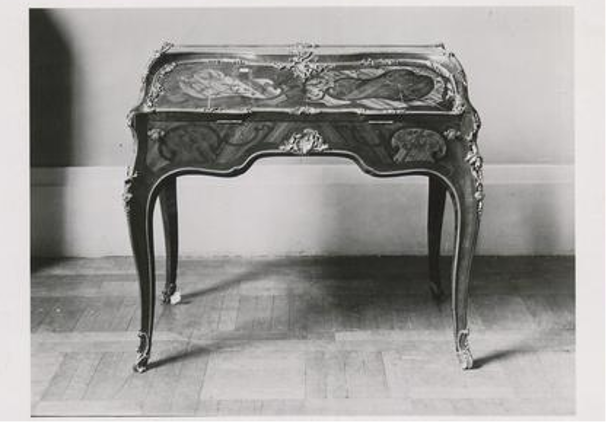
The desk was confiscated in 1940 from the private mansion on avenue Henri-Martin, where it was still located, by Colonel Kurt von Behr’s Einsatzstab Reichsleiter Rosenberg (ERR), the department in charge of spoliations during the Occupation, and listed under inventory number HAL 52. These three letters designating the Halphen family were used by the Germans for all the family’s possessions, namely those belonging to Louise Halphen, wife of Emile, who died in 1913, as well as their children, nephews and nieces. All the items looted under the patronymic “HAL” were seized from three Parisian locations that had belonged to Emile Halphen and his brother, Fernand, between July 1940 and February 1941.
In August 1940, the bureau de pente was stored at the German Embassy in Paris, which had been housed in the Hôtel de Beauharnais at n°. 78, rue de Lille since 1862 and was headed at the time by the very Francophile Otto Abetz (1903-1958). It was brought there alongside other works of art spoliated from the Jews, in particular works from the Rothschild collection taken from the Château de Ferrières, including paintings by Horace Vernet and the so-called Metternich desk, despite the desire of the German authorities of the time, for purely diplomatic reasons, not to have such seizures on display at the embassy.
It was transferred to the Louvre in November 1940. From the beginning of the previous month, the museum had had to make three rooms available to the occupying forces to allow the circulation of spoliated works of art. But this space, which overlooked the Cour Carrée, was soon to become too small, and by the end of the month, Colonel Kurt von Behr had set his sights on the Musée du Jeu de Paume in the Tuileries gardens, which housed contemporary works by foreign schools from the national collections before they were evacuated.
This place, which had already been converted into a museum, offered several advantages for the Colonel, including its geographical location in the heart of the capital, coupled with the isolation and accordingly a very advantageous discretion within the grounds of the Tuileries Gardens. Easy access for vehicles and the short distance from the administration of the national museums were two additional assets. Jacques Jaujard, the Director of the National Museums, had no other choice but to grant permission, but negotiated the presence of a member of the curatorial team on the premises, in the person of Rose Valland. The latter took invaluable clandestine notes that were to lead to the restitution of many works of art in the wake of the war.
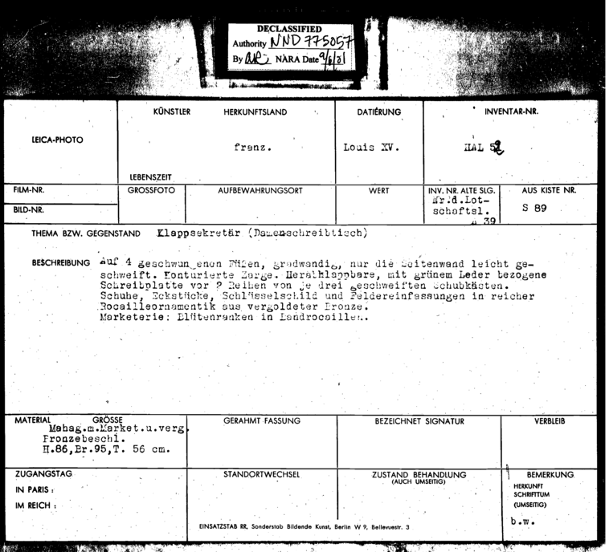
It should be noted that high Nazi dignitaries visited the Jeu de Paume on several occasions, as it had become a transit point for works of art before they departed for Germany, selecting those they wished to keep, either for a museum or for themselves. One of the most important of these was Field Marshal Hermann Goering, who went there about twenty times between November 1940 and November 1942 and also arranged for the ERR to be placed under his authority. Many photographs were taken at that time by the German staff of the ERR, perhaps by Rudolph Scholz or Heinz Simokrat, both photographers at the Jeu de Paume, and make it possible today to identify the works with the greatest precision, as can be observed in the photograph taken in July 1940 of the office reproduced here.
On 27th October 1944, it was shipped to Neuschwanstein in Bavaria. Recovered by the Monument Men in 1945, it was repatriated to Paris on 18th October 1945 and restituted to Alice Halphen, Marquise de Bremond d’Ars, the second daughter of Emile Halphen.
It formed lot n°. 243 of the catalogue for the exhibition Les Chefs-d’oeuvre des collections françaises retrouvés en Allemagne par la Commission de récupération artistique et les services alliés (Masterpieces from the French collections recovered in Germany by the Artistic Recovery Commission and the Allied services), which took place at the Musée de l’Orangerie in Paris in June, July and August 1946. It was also reproduced a few years later by Jean-Pierre Baroli, who in March 1957, in a seminal article, revealed the hitherto unknown identity of Bernard II Vanrisamburgh in March 1957 in a seminal article entitled: “Le mystérieux B.V.R.B enfin identifié” [The mysterious B.V.R.B. identified at last], Connaissance des Arts, n°. 61, March 1957, p. 61.