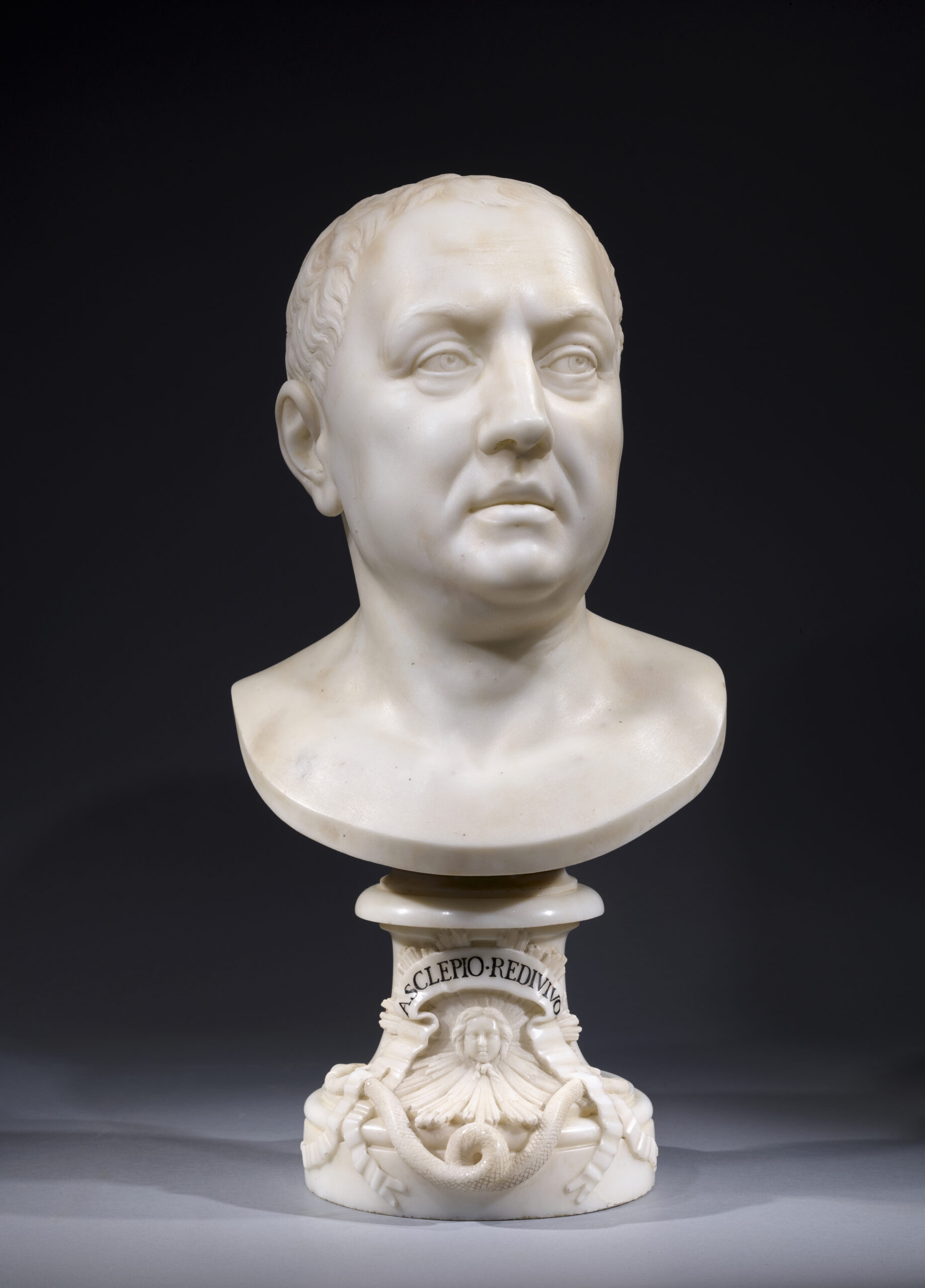
White Carrara marble.
H. with pedestal: 59 cm. (23 ¼ in.); L. 31 cm. (12 ¼ in.); W. 28 cm. (11 in.).
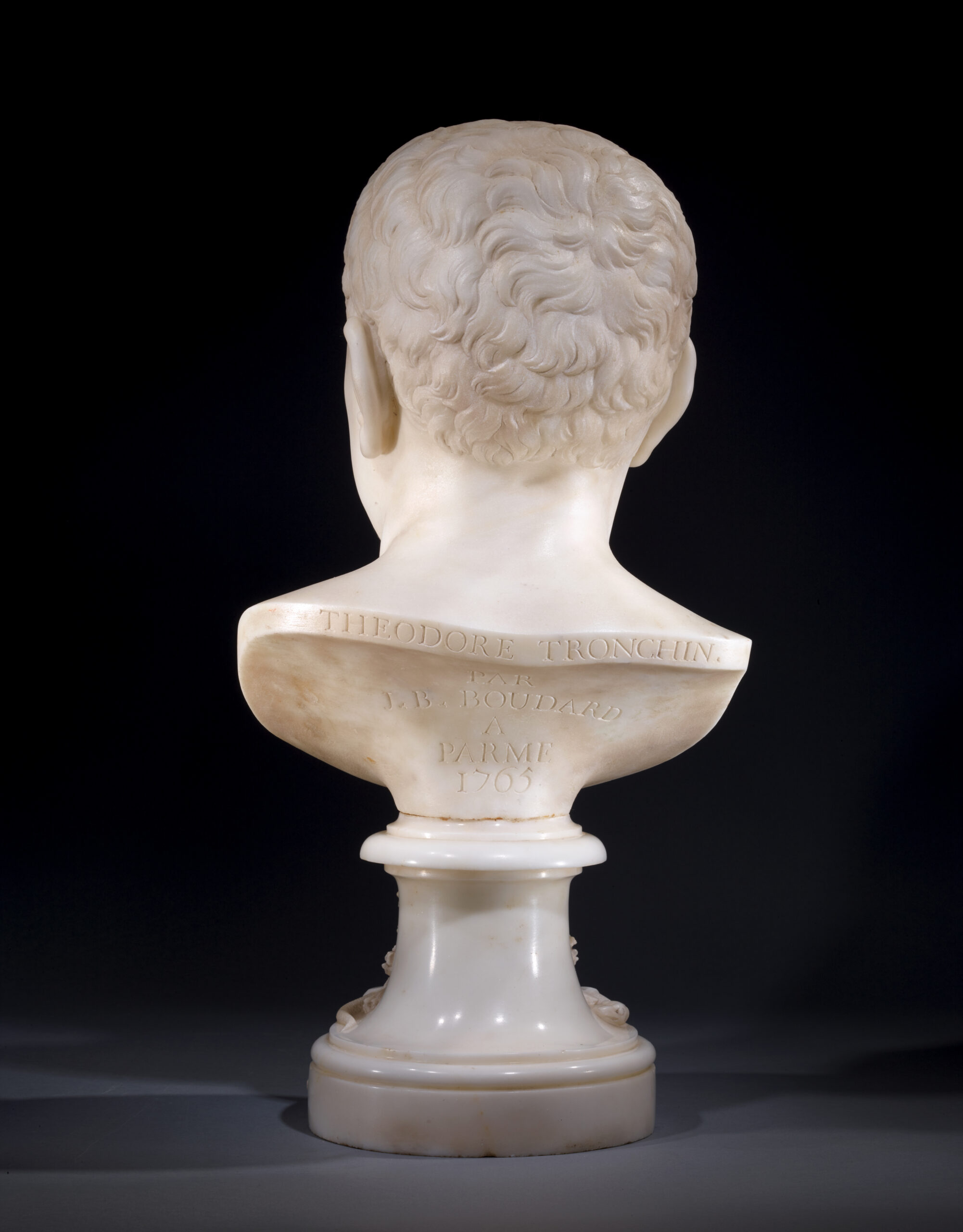
SIGNED AND DATED: THEODORE TRONCHIN/PAR J. B. BOUDARD A PARME 1765, engraved on the reverse side of the bust.
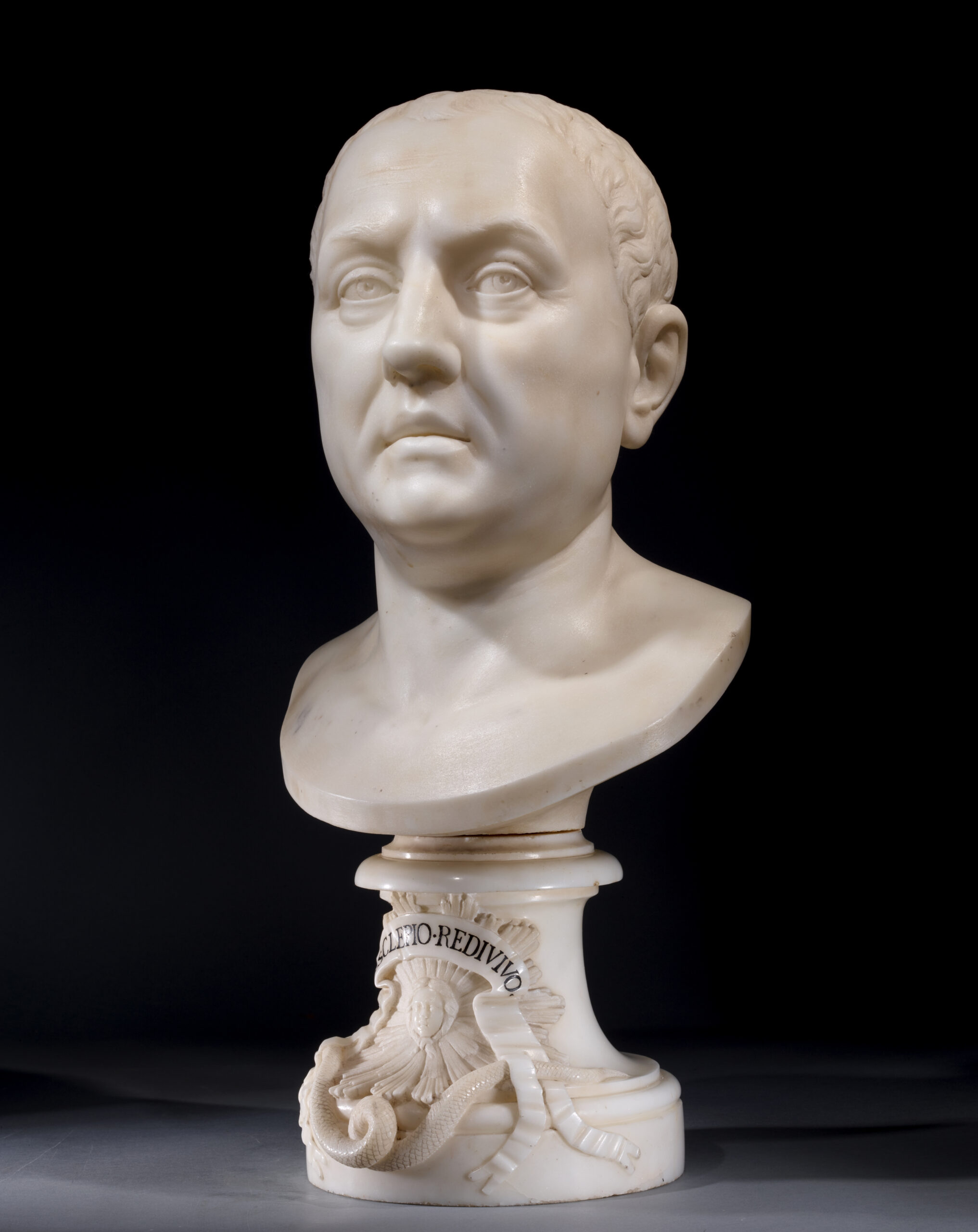
INSCRIPTION: ASCLEPIO REDIVIVO [Asclepius resurrected], visible in black capital letters on the ribbon crowning the radiant mask of Apollo sculpted on the pedestal.
PROVENANCE: executed in 1765 by the sculptor Jean-Baptiste Boudard on behalf of Doctor Théodore Tronchin, who brought it back with him to Geneva on his return from Parma at the end of the year 1765; collection of Dr. Tronchin in Geneva; then collection of his daughter, Marie-Élisabeth Tronchin (1747–1807), who married her cousin Jean, Count Diodati (1732–1807), Count of the Empire, Knight of the Royal Order of Dannebrog, and Minister to Duke Adolph Frederick IV of Mecklenburg-Strelitz (1738-1794); by descent, collection of Théodora-Hélène-Élisabeth (1767-1820), one of the two daughters of Jacob Tronchin (1717–1801), who acquired the Tronchin estate in Bessinge, between Cologny and Vandœuvres, near Geneva, in 1774, and married her cousin Jean-Louis-Robert Tronchin (1763–1838) in 1787; collection of their son, Henri-Armand-Louis-Jacob Tronchin (1794-1865), federal lieutenant-colonel of artillery, who built the current Tronchin maison de maître (manor house) in Bessinge in 1840, to which he transferred the bust; collection of his son, Louis-Rémy-Nosky Tronchin (1825–1873); then of his grandson, the collector Henri Tronchin (1853-1924); collection of Robert Tronchin (1883-1938), son of Henri, last direct male descendant of the Tronchin family; acquired in 1938 from the heirs of Robert Tronchin by the industrialist Xavier Givaudan (1867-1966), a chemist from Lyon and pioneer of synthetic perfumery, along with the Tronchin estate in Bessinge, which included a large part of their collections; then passed down to his descendants to the present day.
LITERATURE: Charles Nisard, Guillaume Du Tillot, Un valet ministre et secrétaire d’Etat, Paris, 1887, p. 28-52; Jules Crosnier, “Bessinge. Nos Anciens et leurs Œuvres”, Recueil genevois d’Art, Geneva, 1908, p. 59; Marco Pelligri, G.B. Boudard, statuario francese alla Real Corte di Parma, Parma, 1976, p. 41, 132-133 and 204-205.
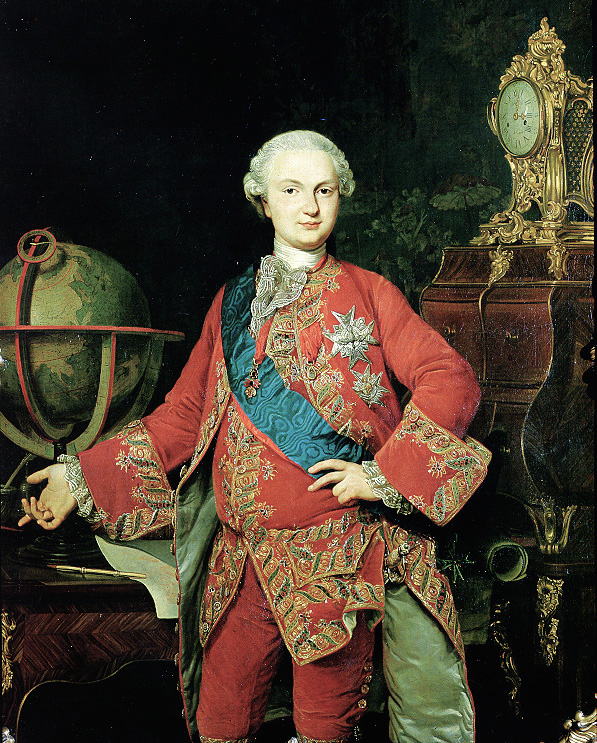
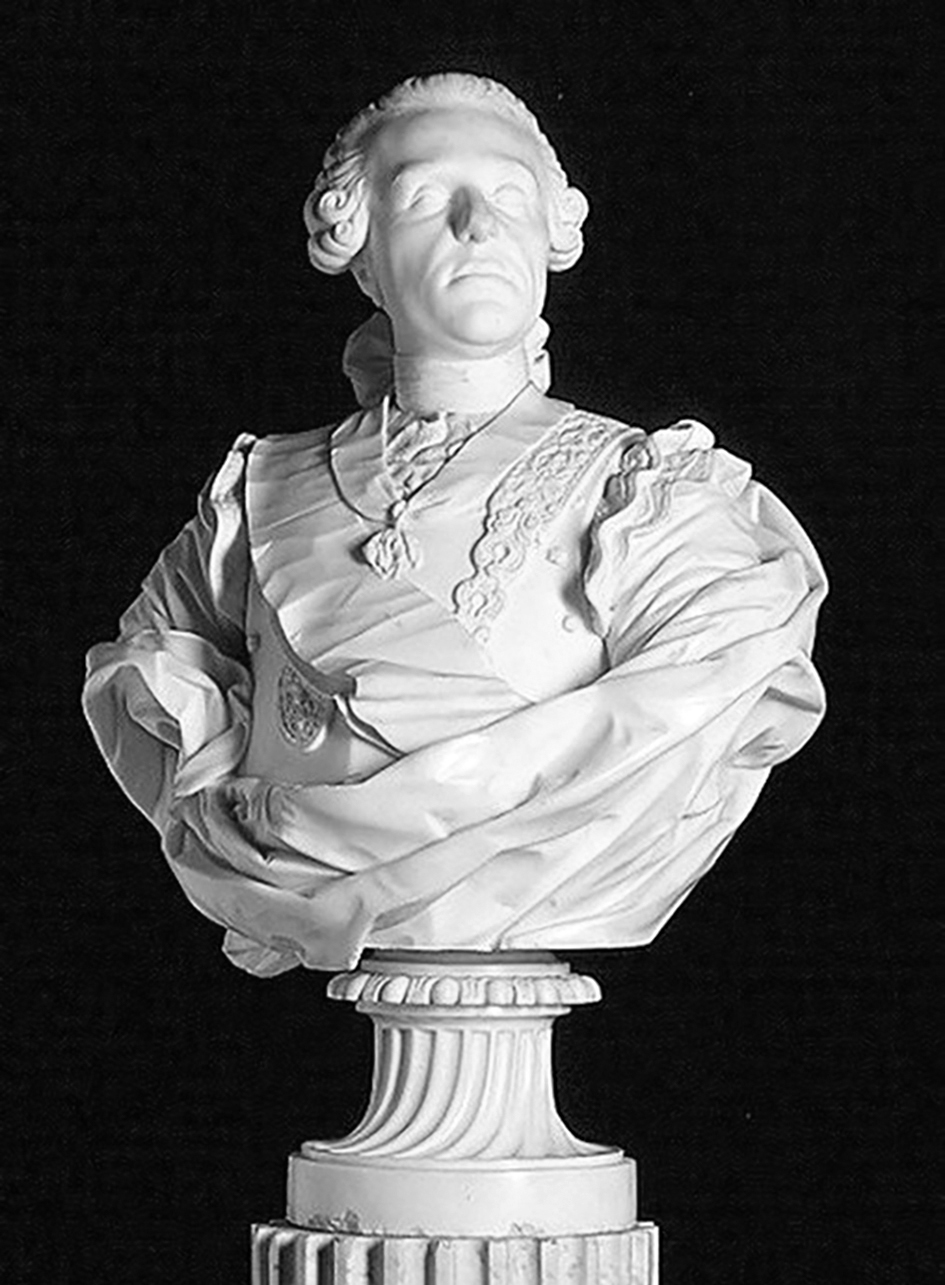
The bust in the “antique style” of Doctor Théodore Tronchin was commissioned in November 1764 by the Anzianato or Council of Elders of the city of Parma, of which Count Aurelio Bernieri was then the Decurion, at the same time as a gold medal, voted on the 2nd of the same month, in order to celebrate what was then considered a resounding achievement for the doctor: the successful voluntary variolation i.e. inoculation of smallpox on the young Prince Ferdinand of Bourbon-Parma (1751-1802) (ill.2), son of Philip I (1720-1765), Duke of Parma, and Louise-Élisabeth of France (1727-1759), known as Madame Infante, the eldest daughter of Louis XV and Marie Leszczyńska, who had died five years earlier. Intended to adorn the assembly hall in the municipal palace, located at the south-east corner of what is now Garibaldi Square, this bust, described as an “erma-ritratto”, was sent by the Council, along with the medal, to Jean-Baptiste Boudard, a French artist who had held the position of Sculptor to His Royal Highness since 1749, after coming to the attention of the banker Claude Bonnet, financial advisor to the Duke, and being appointed to the court on 1st December 1748 by Guillaume du Tillot (1711-1774), Intendant General of the royal house of Bourbon-Parma.
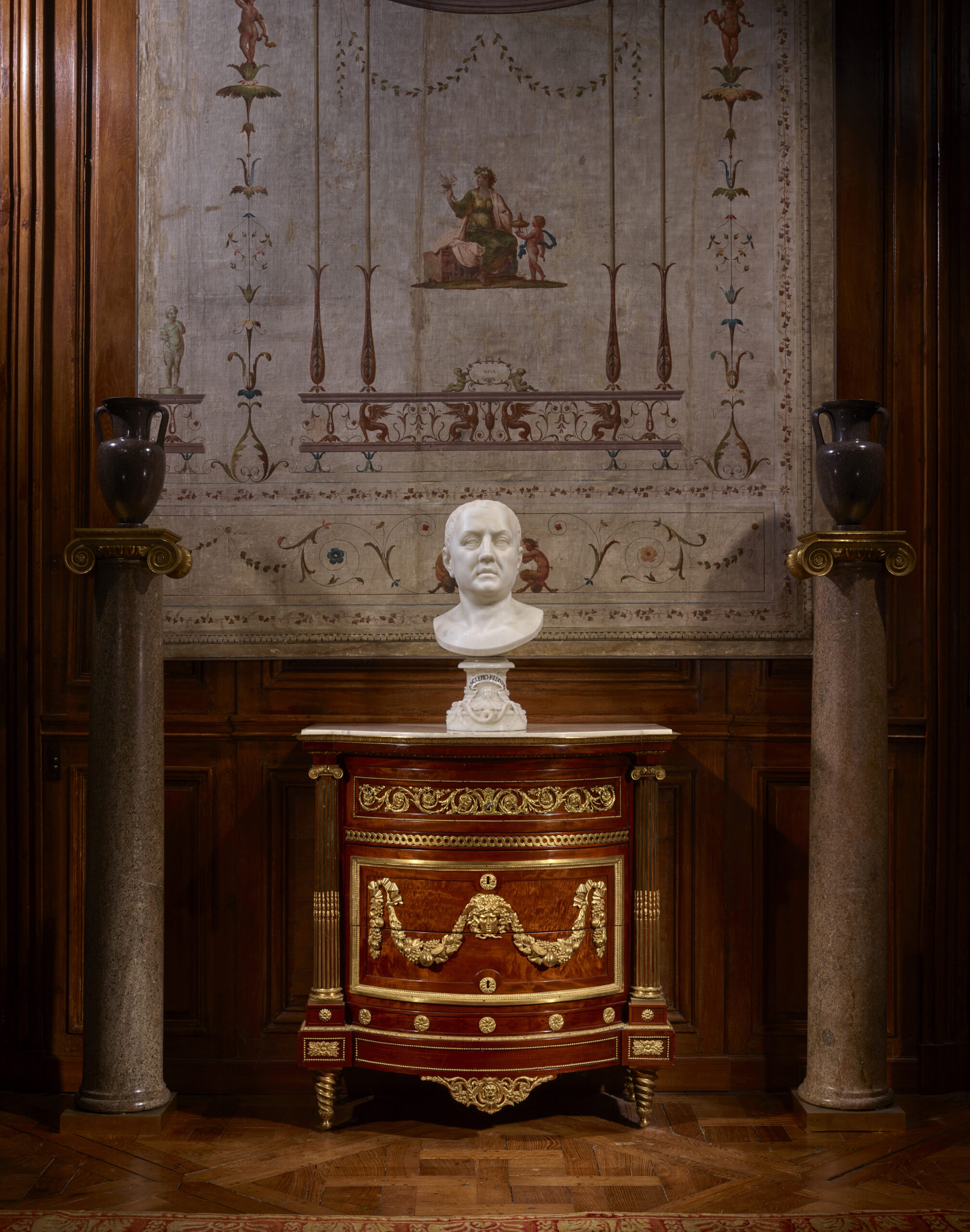
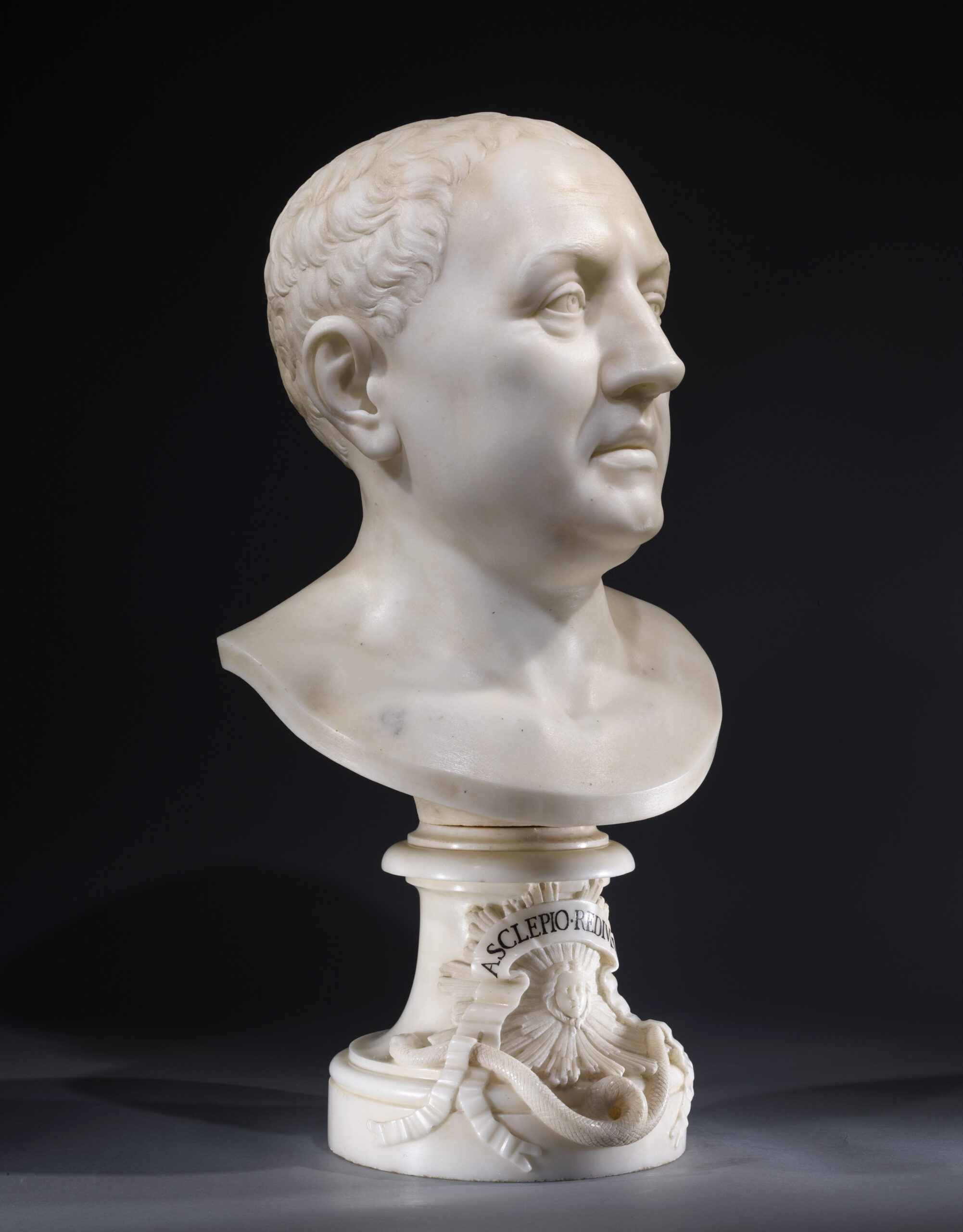
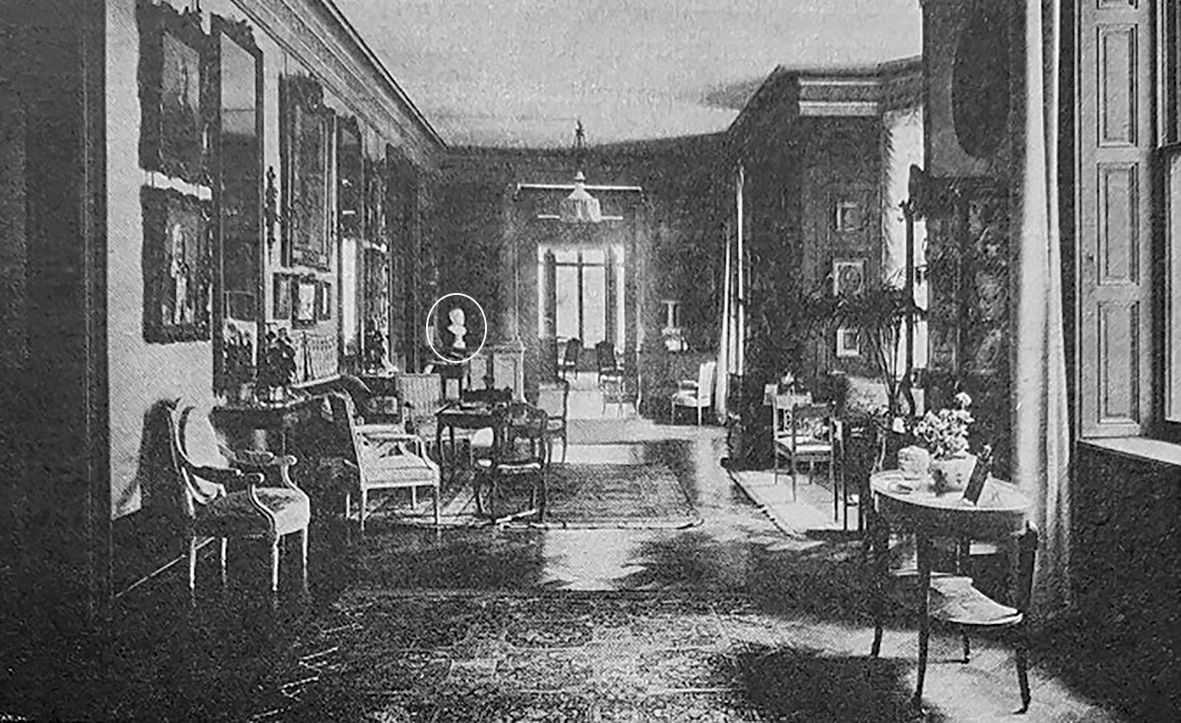
According to Marco Pellegri, the bust from the municipal palace of Parma disappeared without a trace, but citing a handwritten list drawn up by the sculptor himself and enumerating the works he produced in the workshop he occupied in the Rocchetta building, located in the west wing of the Palazzo della Pilotta, it appears that Boudard executed two busts of Doctor Tronchin: “22 marble statues, including the Silenus Group; 17 pieces in plaster or terracotta; 7 marble mantelpieces; 13 pedestals and 3 columns with busts; the tomb of the Prince of Armstadt; the 2 busts of Mr Tronchin; ‘and my book’”. The bust presented here, signed and dated on the reverse THEODORE TRONCHIN/PAR J. B. BOUDARD A PARME 1765, is one of these two busts and has been completely unknown to date. It is the copy Dr. Tronchin kept for himself; the one he took with him to Geneva and which remained there, even after he settled permanently in Paris in 1766, when he accepted the position of first physician to Duke Louis-Philippe d’Orléans (1725-1785), the father of Philippe Égalité (1747-1793). The bust was to became part of his inheritance and descendancy in Switzerland, adorning to this day the gallery of the Tronchin family estate in Bessinge, between Cologny and Vandœuvres, north-east of Geneva.
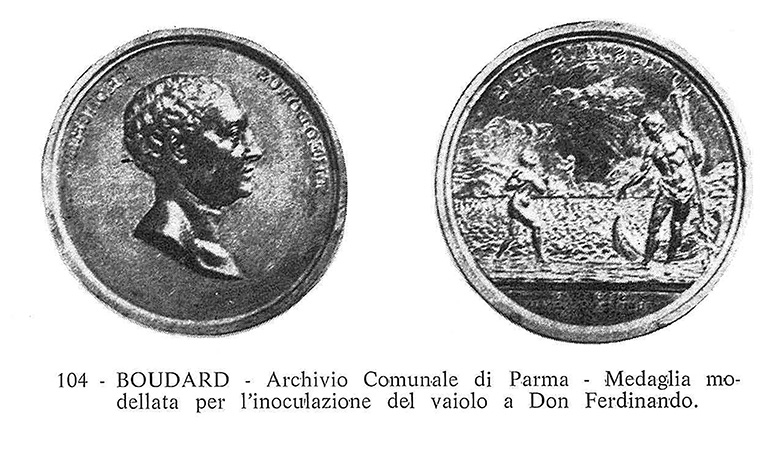
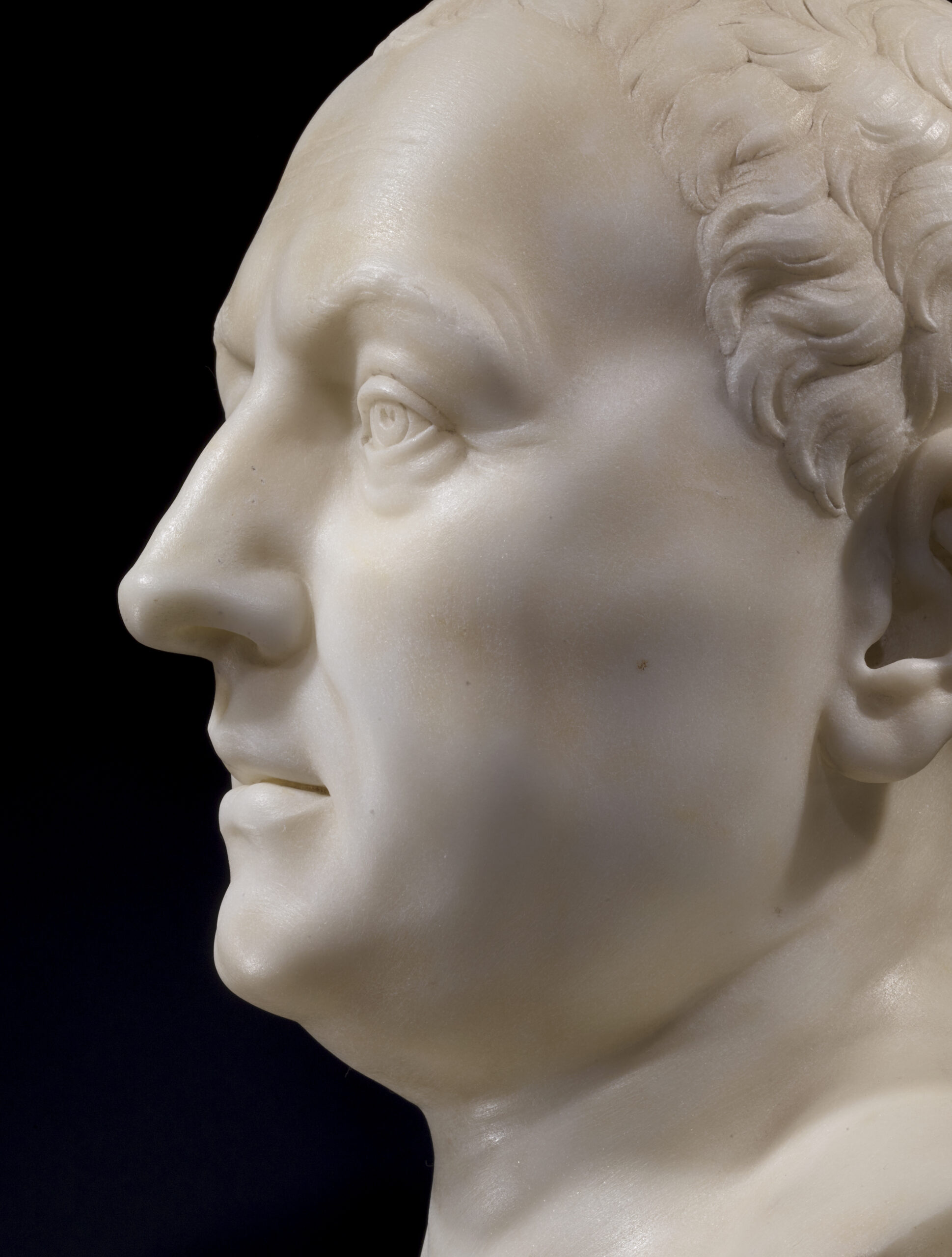
Boudard portrayed Dr. Tronchin in the antique style, i.e. without the wig that was prevalent at the time, which he also did for the profile of the doctor that he sculpted on the wax medal project preserved in the Municipal Archives of Parma (ill. 1). This choice was apparently settled by Dr. Tronchin himself, after the sculptor had consulted him on the advice of du Tillot: “The question was put to the Ancients as to how Tronchin’s head, which was to occupy one of the reverse sides [of the medal], should be arranged. It is unlikely that among these gentlemen there was a wigmaker; but it was decided that, had there been someone of that profession in the Council, he would not have hesitated to propose that the doctor should be represented wearing a wig.
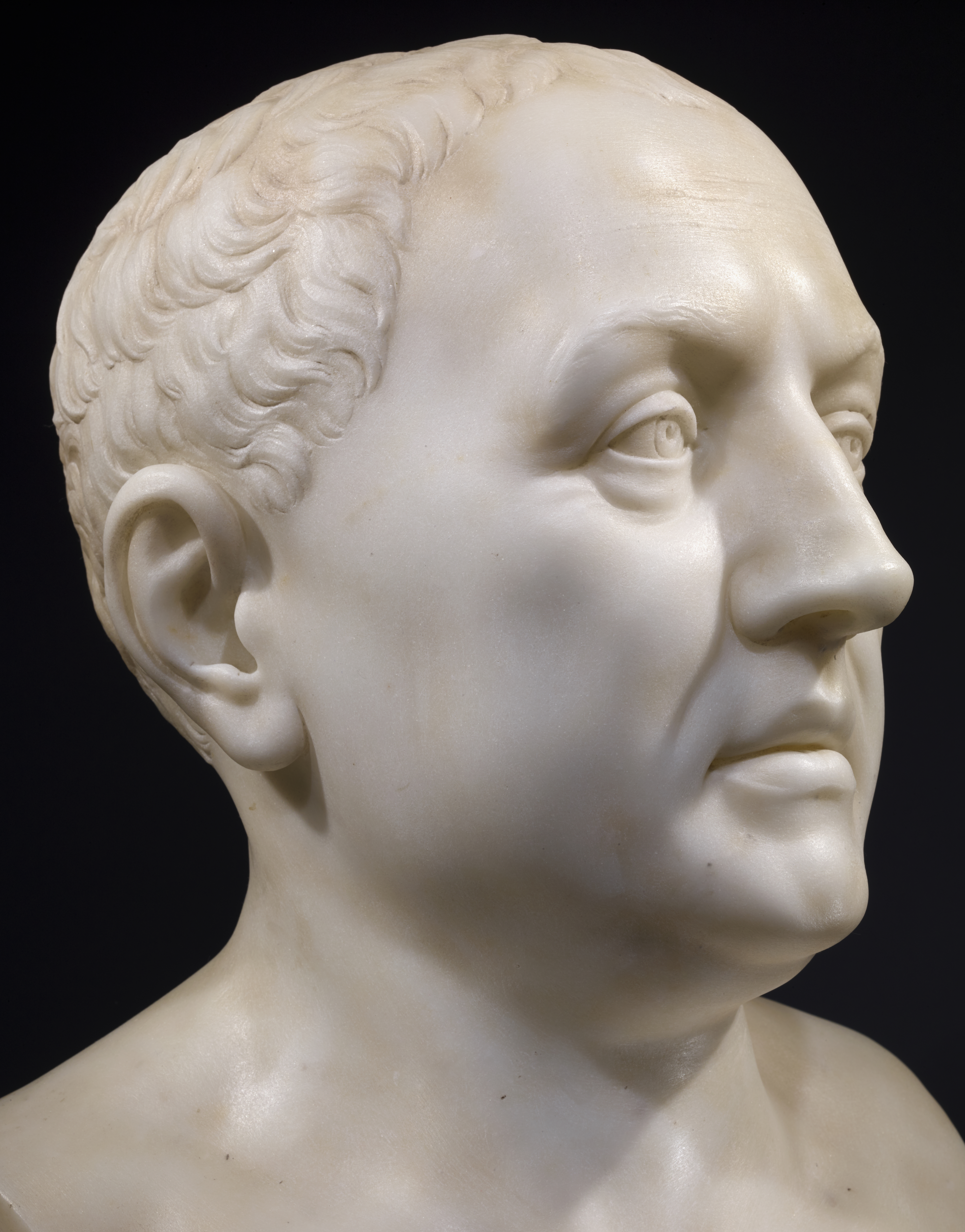
“I do not know,” observed du Tillot modestly [in a letter dated 6th November 1764], “whether it would not be better to imbue the medal with an antique flavour. Mr Tronchin is a man of taste; he has seen a great many medals. Tell Boudard to discuss the matter with him; he will no doubt come up with some good ideas.” Du Tillot’s scruples were well-founded; Tronchin justified them by opting for an antique hairstyle, and Boudard complied with Tronchin’s wishes.
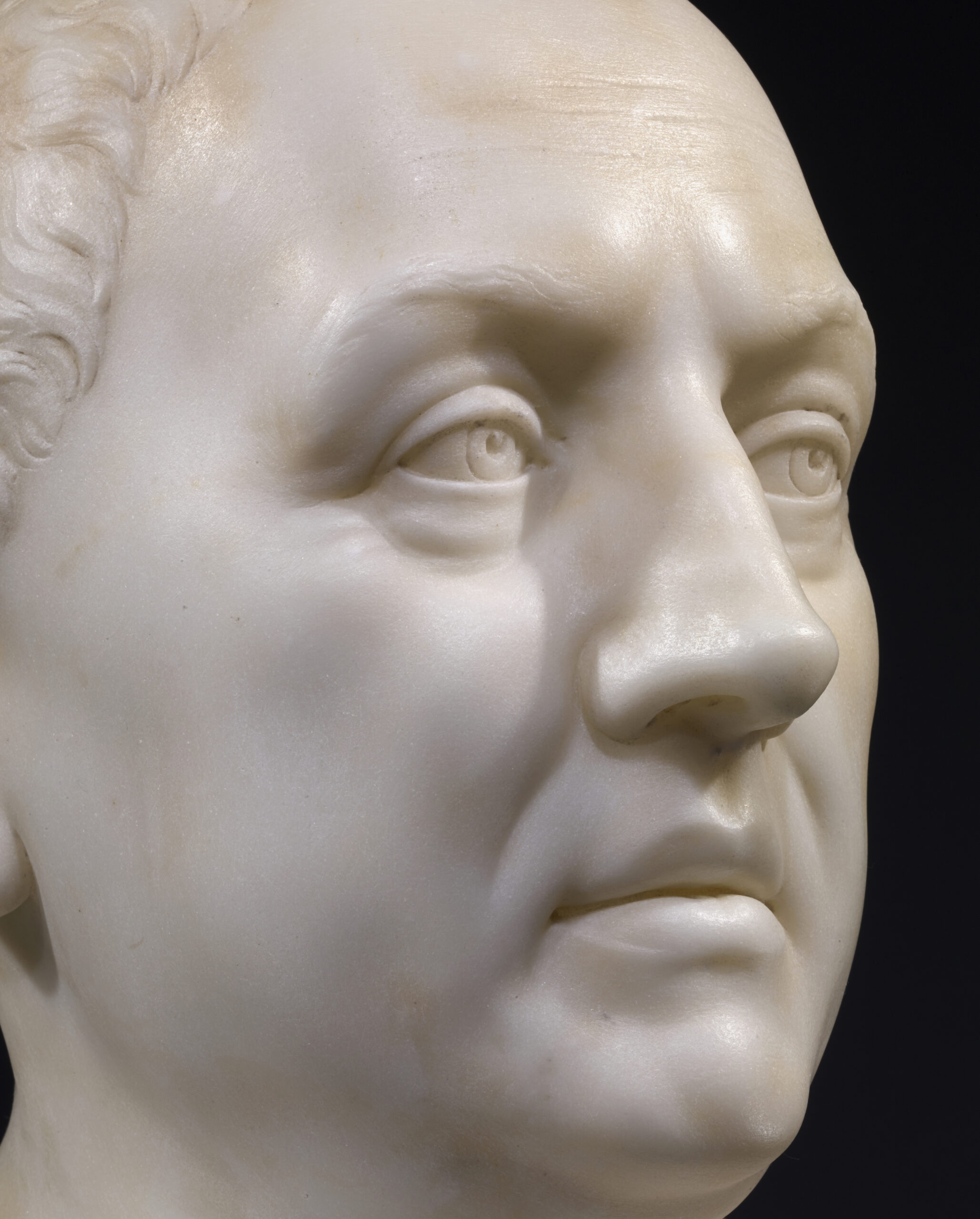
With his short, “Roman-style” hair, his head turned slightly to the left, a look full of confidence and far-reaching gaze, a striking modelling of the face, the whole appearing on a bust without arms and rounded towards the lower part, the doctor, then aged fifty-five in 1764, clearly bears witness to Boudard’s remarkable skill with a chisel and the complete mastery of his craft. This portrait literally lives up to his reputation, which was celebrated throughout Europe at the time. It radiates tremendous strength, but a strength imbued with serenity and wisdom, which is particularly reassuring for the viewer, in this case almost likened to a “patient”. The poet and academician Antoine Léonard Thomas (1734-1785) summed up this feeling admirably in a poignant eulogy dedicated to the doctor in a letter he wrote to Suzanne Necker (1737-1794) on 18th January 1782: “He would do good in silence, always helpful, always calm, indifferent to both admiration and envy, never flaunting his words or his actions, confiding the secret of his virtues only to misfortune, and revealing his genius to the public solely through his good deeds”.
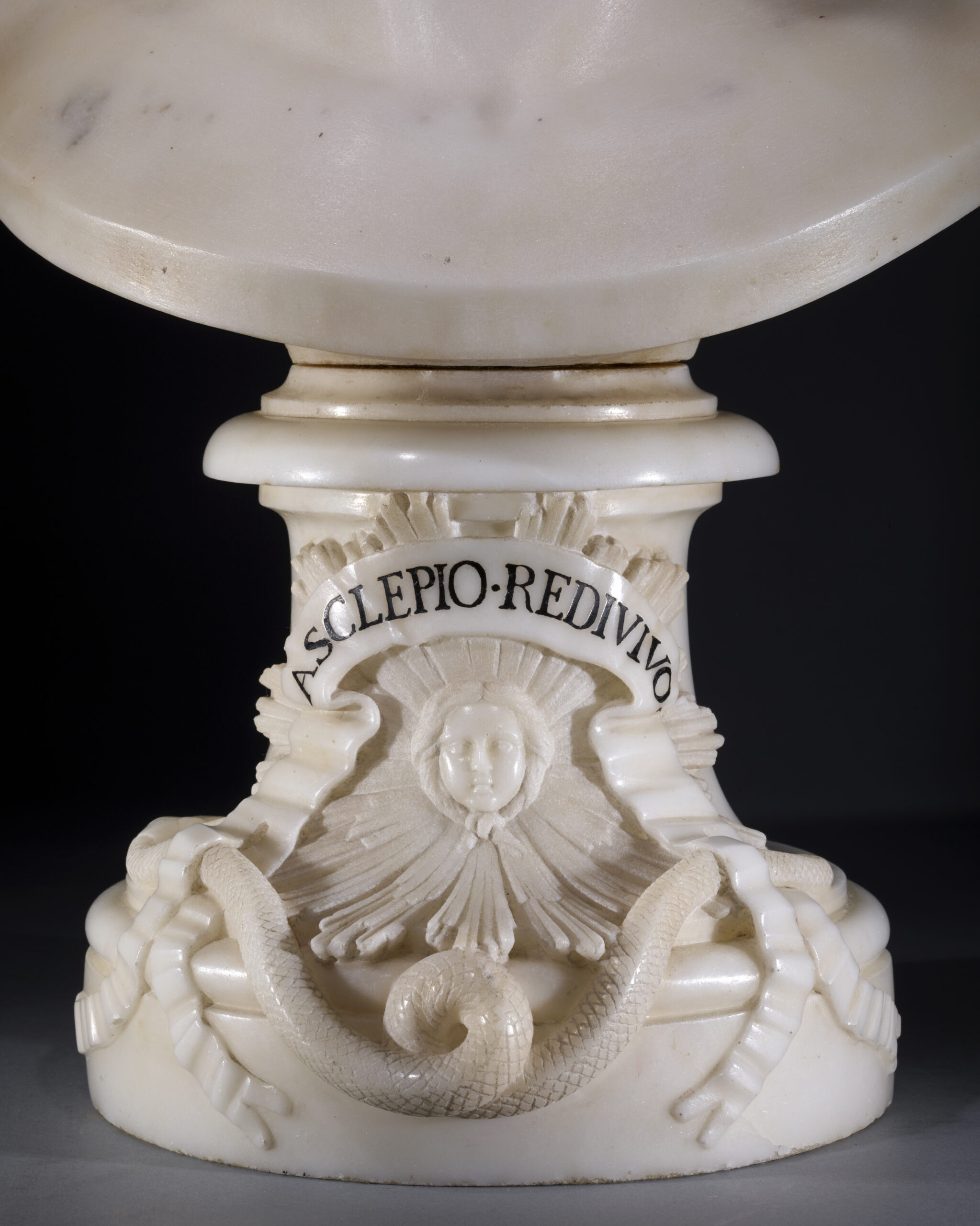
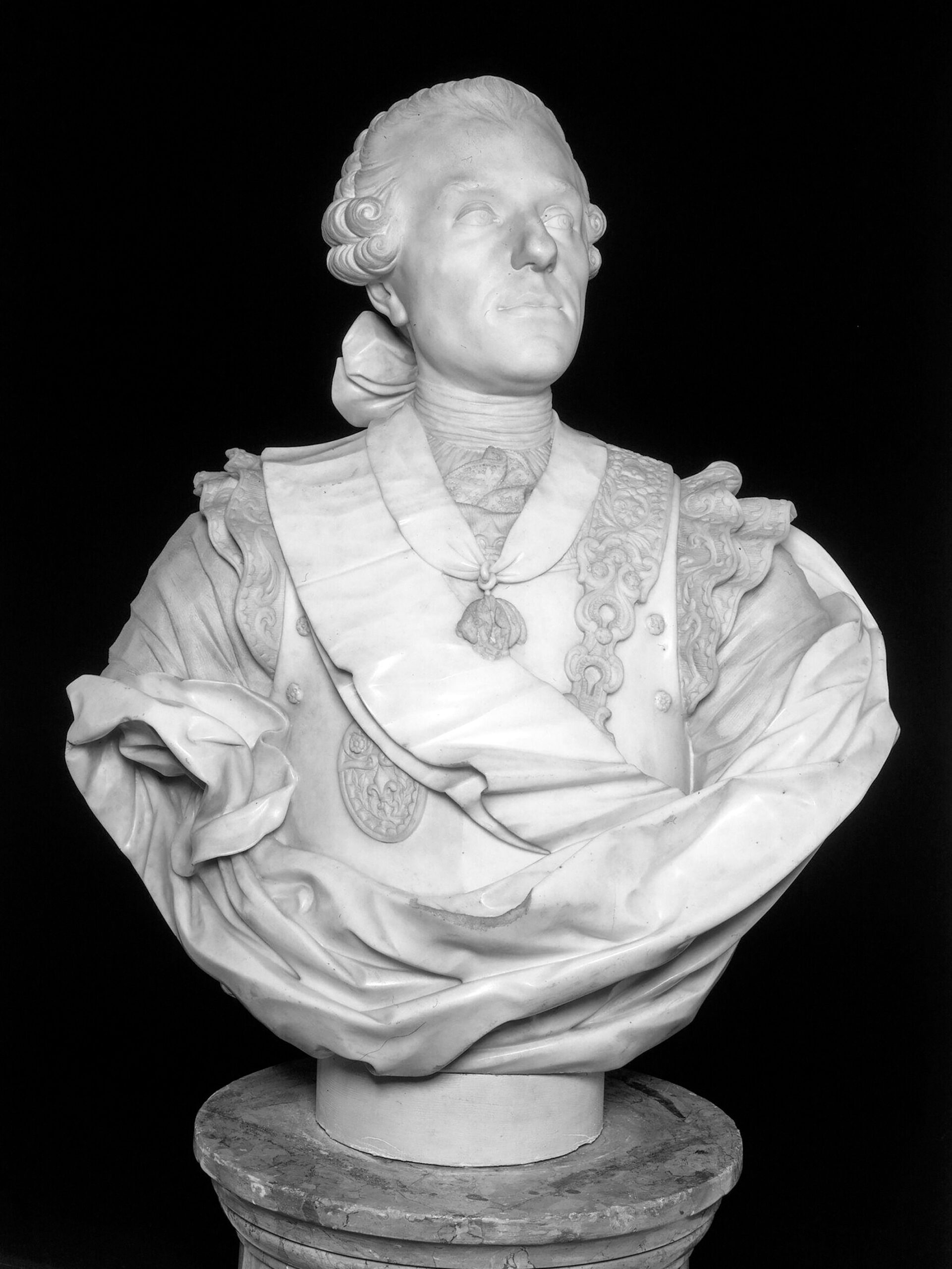
The sophistication of the design of the moulded, circular pedestal on which Dr Tronchin’s bust rests creates a deliberate contrast, beyond all the symbolism reminiscent of the medical profession, with the sober, “antique” purity sought by the sculptor in this portrait. The pedestal displays on its front a radiant mask of Apollo, highlighted by the serpent of Asclepius, the Greco-Roman god of medicine and son of Apollo, who was struck down by Zeus for resurrecting the dead, before being elevated to the heavens in the form of the constellation Ophiuchus (Greek for “serpent-bearer”). This tragedy from Greek mythology is transcribed here in the phrase ASCLEPIO REDIVIVO [Asclepius resurrected] which is visible in black capital letters on a festooned ribbon crowning the mask of Apollo in the shape of an accolade and cascading down on either side, splitting into two parts, onto the body of the snake. Asclepius is the mythical ancestor of the Asclepiads, a dynasty of physicians who practised in Cos and Cnidus, of whom Hippocrates was the most illustrious member.
When Dr Tronchin died in the apartment he had been granted in the Palais-Royal in Paris, at the age of seventy-three, on 30th November 1781, the bust was in Geneva, as recorded in his post-mortem inventory drawn up on 22nd December 1781. It remained in his succession and descendants.
On 31st July 1740, in Amsterdam, the doctor married Hélène de Witt (circa 1716-1767), granddaughter of Jean de Witt, Grand Pensionary of Holland, with whom he had three children who inherited all of their father’s property, each receiving one third: Jean-Robert Tronchin (1741-1799), deputy fermier–général, squire and counsellor to the Duke of Orléans, who married Marguerite-Suzanne Loriol (1760-1828) in 1785, and lived at the Hôtel des Treize Cantons on Rue Traversière-Saint-Honoré in Paris but usually resided in Aix-en-Provence; François-Louis Tronchin (1743–1784), squire, treasurer of the Marc d’Or, and secrétaire des Commandements to the Duke of Orléans, residing on Rue de Richelieu in Paris; and Marie-Élisabeth Tronchin (1747–1807), who married her cousin Jean, Count Diodati (1732–1807) in 1770—her mother’s name was Anne Tronchin—Count of the Empire, Knight of the Royal Order of Dannebrog, and Minister of Duke Adolph Frederick IV of Mecklenburg-Strelitz (1738–1794) to the King of France in Paris, residing on Rue de La Michodière.
The elder branch of the Tronchin family from Geneva, to which belonged Théodore Tronchin, who made his fortune in trade and banking in France before going bankrupt with the collapse of Law’s system in 1720, and which also counted among its members representatives who settled in Prussia as officers, died out during the 19th century.
Only the younger branch, a very ramified and generally very wealthy one, descended from Louis Tronchin (1629-1705), professor of theology and then rector of the Academy of Geneva, has survived to this day. His eldest son, Antoine Tronchin (1664-1730), was the first in the family to join the Petit Conseil (Small Council) of the city (1704). Among the latter’s sons were Pierre Tronchin (1694-1769), auditor and purchaser of an estate in Lavigny, where he was granted the status of burgher (1739), Jean-Robert Tronchin (1702–1788), a merchant and banker in Lyon, fermier-général and correspondent of Voltaire, and François Tronchin des Délices (1704–1798), State Councillor in Geneva and collector of paintings by Dutch, Flemish and Italian artists, which he sold in 1770 to Empress Catherine II of Russia.
Jean Armand Tronchin (1736–1813), son of Pierre, a diplomat and minister of Geneva in Paris, where he resided from 1787 to 1792, is the originator of the line that comprises, in direct descent: Jean-Louis-Robert Tronchin (1763–1838); Colonel Henri-Armand-Louis-Jacob Tronchin (1794-1865); Louis-Rémy-Nosky Tronchin (1825–1873); Henri-Charles-Auguste Tronchin (1853–1924); and Robert Tronchin (1883–1938), who was the last male representative of the family in the direct line.
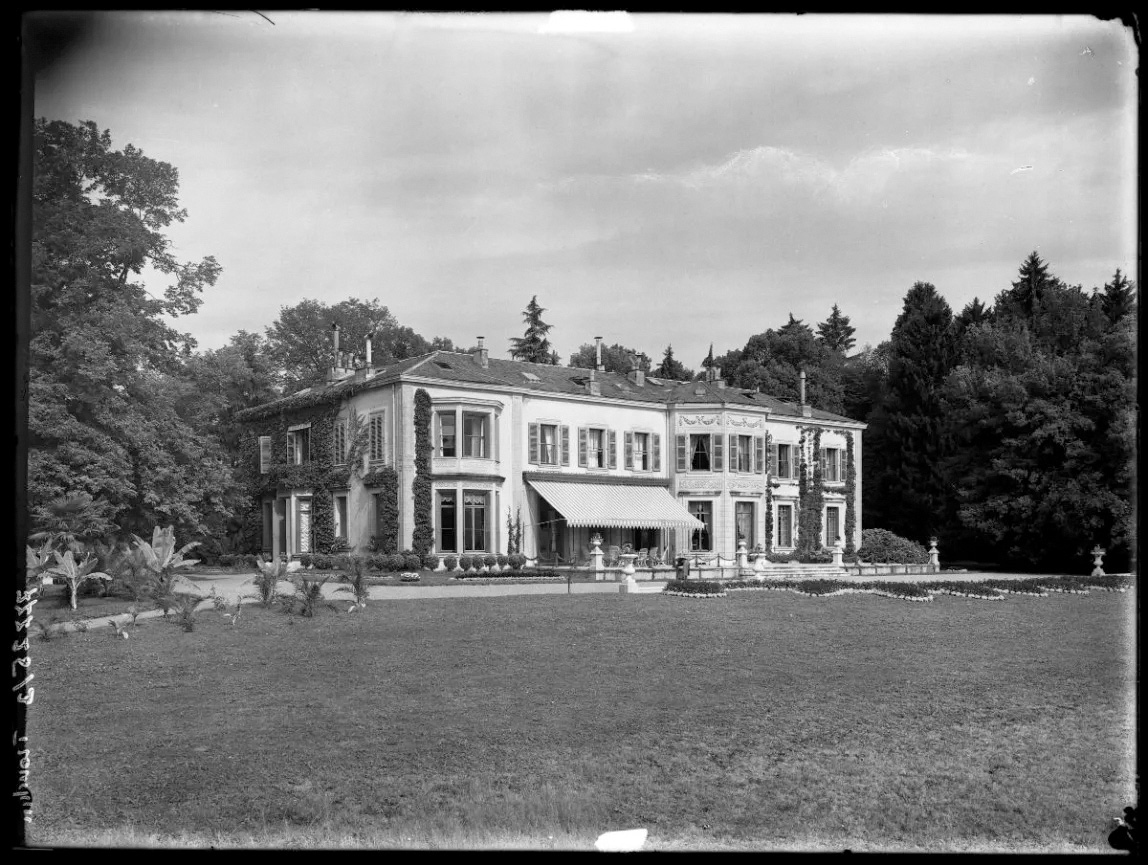
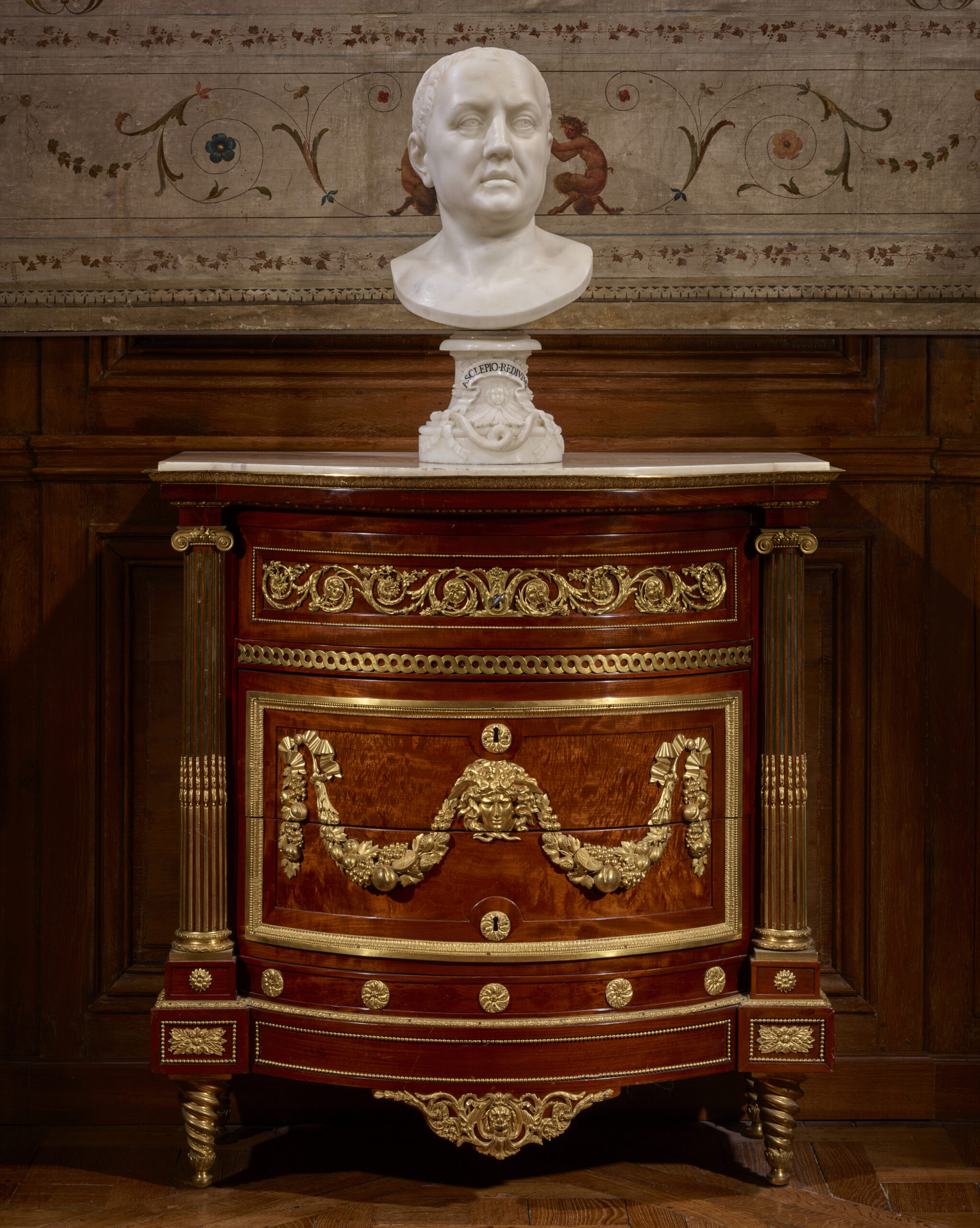
It was this line that inherited our bust, which was placed in the mid-19th century in the gallery of the manor house (ill. 6) owned by the Tronchin family in Bessinge, between Cologny and Vandœuvres, north of Geneva, on the eastern shore of Lake Geneva (ill. 5). The estate was acquired in 1774 by Jacob Tronchin (1717–1801), a State Councillor in Geneva and brother of Anne Tronchin, the mother of Jean, Count Diodati, who, as previously seen, married Marie-Élisabeth Tronchin, the daughter of our physician. It was she who kept her father’s bust by Boudard after the death of her two brothers in 1784 and 1799. Marie-Élisabeth died in 1807, the same year as her husband, without any offspring. Théodora-Hélène-Élisabeth (1767–1820), one of Jacob’s two daughters, subsequently inherited it. The latter had married her cousin Jean-Louis-Robert Tronchin (1763-1838), already mentioned, in 1787, and it was their son, Henri-Armand-Louis-Jacob Tronchin (1794-1865), federal lieutenant-colonel of artillery, also previously mentioned, who undertook to build, in 1840, the manor house referred to above. He transferred there not only our bust, but also all the family collections, as well as nearly three centuries of archives and memorabilia.
The residence and its collections later became the property of his son, Louis-Rémy-Nosky Tronchin (1825–1873) and then of his grandson, the collector Henri Tronchin (1853–1924), who published in 1906, with Plon in Paris and Kündig in Geneva, a work entitled: Un médecin du XVIIIe siècle: Théodore Tronchin (1709-1781), d’après des documents inédits (An 18th-century physician: Théodore Tronchin (1709-1781), from unpublished documents). Particularly rich in information about his illustrious ancestor, this book was the first to draw upon the Tronchin manuscripts preserved in Bessinge, a truly remarkable collection that has since been transferred to the Department of Manuscripts and Private Archives at the Bibliothèque de Genève.
Henri’s son, Robert Tronchin (1883-1938), the last direct male descendant of the family who inherited the entire collection, leased the Bessinge estate for several years to the industrialist Xavier Givaudan (1867-1966), a chemist from Lyon and pioneer of synthetic perfumery, who, together with his brother Léon (1875-1936), founded the Givaudan company in 1895, as well as the Givaudan-Lavirotte establishments in Lyon. In 1917, Xavier Givaudan settled permanently in Geneva, where he acquired a townhouse located at 23 Quai du Mont-Blanc, at the corner of Rue de la Cloche. In the aftermath of Robert Tronchin’s death in Geneva on 2nd August 1938, Xavier Givaudan acquired the Bessinge estate from his heirs, along with a large part of its collections, including our bust. When he died on 16th July 1966, at the age of 99, his descendants chose to sell the estate, but kept the Tronchin collection and the bust, which still remain in their possession today.
Le docteur Théodore Tronchin
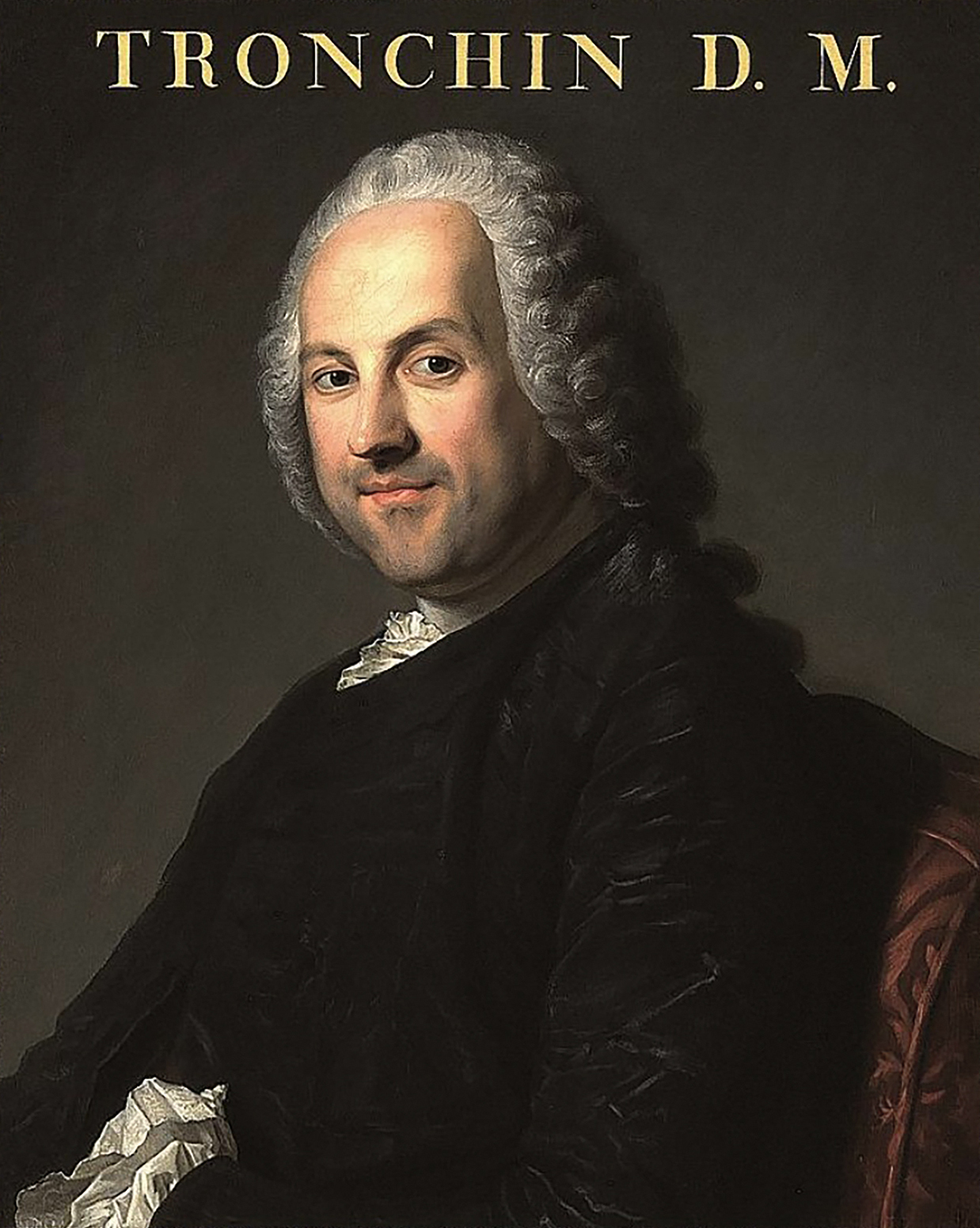
Born in Geneva on 24th May 1709, Théodore Tronchin (ill. 7) was the son of Jean-Robert Tronchin (1670–1730), one of the wealthiest bankers in Lyon and Geneva, who was also active in Paris and a member of the Conseil des Deux-Cents, and Angélique Calandrini (1692–1715), of Italian descent, who died at a young age in 1715. Austere and strict, his father was determined to make his son into a clergyman, but the young man, while quite diligent in his studies, showed early signs of passions that were hardly compatible with the study of theology, even the Reformed variety, particularly a passion for dancing, for which he did not shy away from walking several leagues at night to attend balls completely unbeknownst to his parents.
His father’s bankruptcy, as a result of the collapse of Law’s system in 1720, was to precipitate his destiny. At the age of sixteen, Tronchin was sent to England, where he joined Lord Bolingbroke, his relative, who was then in disgrace.
The latter nevertheless made it a point of honour to supervise his studies and set about introducing him to several scholars who encouraged him to pursue a career in medicine. He went on to study at Cambridge University, where his first teacher was Dr Richard Mead (1673-1754), physician to King George II, known for his work on communicable diseases. He then continued his studies at the University of Leiden under the guidance of the Dutch botanist, physician and chemist Herman Boerhaave (1668-1738), whose works he had read with unrestrained passion. An amusing anecdote, which he may have recollected in 1764 when he asked Boudard to portray him without a wig and in the “antique style”, occurred during this period—one day, he learned that his master had said that the care he took of his hair must cause him to waste a great deal of time. Deeply offended, Tronchin cut his hair on the spot and did not hesitate to appear the very next day in this state at the doctor’s lecture, who was taken aback at the sight of such a sacrifice. It was also in Leiden that Tronchin befriended Louis de Jaucourt (1704-1780), who would become known as the Chevalier de Jaucourt, a prolific contributor to Diderot and D’Alembert’s Encyclopédie.
After obtaining his doctorate in 1730 for work in a field that would now be called gynaecology, Tronchin decided to settle in Amsterdam, where he was appointed president of the college of medicine and inspector of hospitals, and where he met Hélène de Witt, whom he married in 1740. His reputation was soon established throughout Europe, and William IV of Orange-Nassau (1711-1751), stadtholder of Holland, offered him the position of his personal physician. However, at the request of his compatriots, he eventually resolved to return to Geneva in 1750. In 1754, the Conseil d’État granted him the title of honorary professor of medicine at the Academy. He began teaching anatomy and devoted himself first and foremost to combating the prejudices that plagued the medicine of his time, inspiring his students to take a healthy sceptical view towards traditional theories.
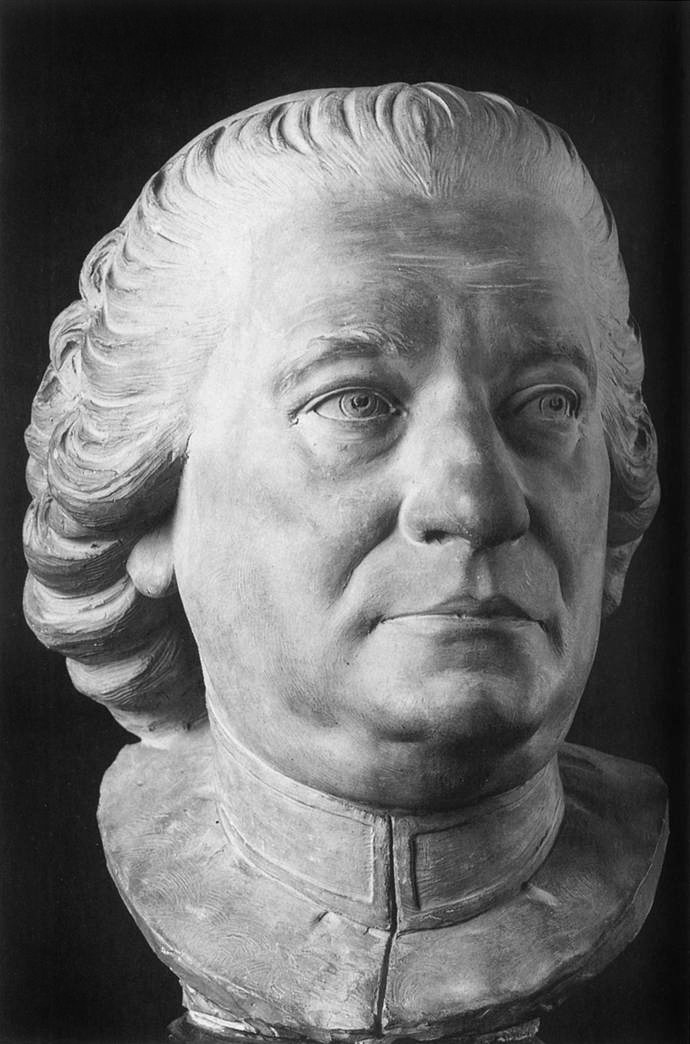
But Tronchin’s greatest service to mankind was his practice of variolation, i.e. the inoculation of smallpox. Just like his colleague in Geneva, Gaspard Vieusseux (1746-1814), he distinguished himself through his zeal in the fight against smallpox, becoming one of the most ardent advocates of the first vaccinations against this disease. He introduced variolation to France and wrote two major articles on “inoculation” in Diderot and d’Alembert’s Encyclopédie, vehemently denouncing superstitions and even the State, which he believed was paralysing any progress in medicine and the health of the King’s subjects. After setting a beneficial example in his own family, he left no stone unturned in propagating it throughout France and Europe. “Inoculation,” he said, borrowing an aphorism from another of its fervent defenders, Charles Marie de La Condamine (1701-1774), “only brings the human race to fruition, whereas natural smallpox decimates it”. The sovereigns of the main courts of Europe vied for the advantage of his presence in their states.
Empress Catherine II of Russia made him offers; in 1756, he was called to Paris to inoculate the children of the Duke of Orleans and, in 1764, as seen above, the Duke of Parma entrusted him with his son Ferdinand. Although the latter appointed him as his chief physician, and the Council of Elders of the city of Parma granted him, in addition to his bust and medal by Boudard, a patent of patrician citizenship of the city, Tronchin made it known that he was expected in Geneva for his academic work and his patients and returned there at the end of 1765. He stayed at the Hôtel Gallatin, at 22 Rue de la Cité in Geneva, named after the man who built it in 1708: Pastor Abraham Gallatin (1650-1722).
Consulted by the whole of Europe, he eventually relented the following year to the repeated requests of the Duke of Orleans to accept the position of his chief physician. He settled permanently in Paris, where he was granted accommodation in the Palais-Royal. Alien to any kind of dogmatic thinking, Tronchin constantly strove to promote simple and natural hygiene. Women and children were the focus of his particular care. He also did away with the absurd method of confining patients in a foul-smelling atmosphere, depriving them of all communication with the outside air, and perfected the process of inoculation, substituting vesicatories for incisions, which were always somewhat painful and, above all, frightening for children. A sensitive and benevolent man by nature, he regularly devoted two hours a day to receiving the poor. His noble and gracious manners, his eagerness to relieve all ills, the extreme diversity of his knowledge, and the charm of his conversation caused a sensation in the capital, and Dr. Tronchin became a man of the world much sought after by all those who were not in need of him as a physician. His friends and acquaintances comprised the most illustrious men in the fields of philosophy and literature, such as Voltaire, his compatriot Jean-Jacques Rousseau, Diderot, among others. He was bound by genuine friendship to Madame d’Epinay and Grimm. Suzanne Necker and the poet Antoine Léonard Thomas, already mentioned, held him in high regard. Tronchin also exerted a profound influence on the physician Louis Odier, a fellow Genevan like himself. When he died in Paris on 30th November 1781, the physician Lorry, who was at his side in his final moments, is reported to have said: “Ah! If only this great man could hear us, he would be in a position to cure himself!” Antoine Louis (1723-1792) and Nicolas de Condorcet (1743-1794) delivered his eulogies, the former at the Academy of Surgery and the latter at the Academy of Sciences.
Jean-Baptiste Boudard, sculptor of HRH the duke of Parma
Jean-Baptiste Boudard was born in Paris during the reign of Louis XIV, in 1710. His father, Philippe Boudard, held the position of directeur des poinçons des Monnaies. The young Boudard displayed promising artistic talent in sculpture from an early age, winning the Prix de Rome as early as 1732. A resident of the French Academy in Rome, at the Palazzo Mancini, he obtained his sculptor’s certificate in 1736 and remained in the Eternal City until 1740, studying the ancient works of the Capitol and the Vatican, and comparing his experiences with his colleagues Jean-Baptiste Pigalle, Jean-Baptiste Lemoyne and Edme Bouchardon.
Protected by the Duke of Saint-Aignan, Paul-Hippolyte de Beauvilliers (1684-1776), ambassador extraordinary to Rome since 1731, he executed several works, among them the statue of Saint Gregory for the balustrade of the Archbasilica of Saint John Lateran, and that of the prophet Hosea for the Church of Santissimo Nome di Maria. In 1741, he travelled to Naples to visit Paul-François de Galluccio (1697-1767), Marquis de L’Hôpital, French ambassador to Naples, and in 1746 he returned to France where, under the supervision of the architect Jacques-Germain Soufflot, he crafted adornments for the Church of Saint-Bruno des Chartreux in Lyon, as well as statues for the Convent of the Dames de Saint-Pierre, now the Museum of Fine Arts of Lyon.
Having caught the attention of Claude Bonnet, who had made a name for himself as a discoverer of new talent, he was, as previously mentioned, taken on by Guillaume du Tillot, Intendant General of the Royal House of Bourbon-Parma, on 1st December 1748, the year Philippe de Bourbon, youngest son of King Philip V of Spain and Elisabeth Farnese, and grandson of Louis XIV, became Duke of Parma, Piacenza and Guastalla as a result of the War of the Austrian Succession, thanks to the support of his half-brother Ferdinand VI, King of Spain, and his father-in-law, Louis XV.
At that time, the Duke of Parma resided in Chambéry; he did not take possession of his duchy and enter Parma until 1st July 1749.
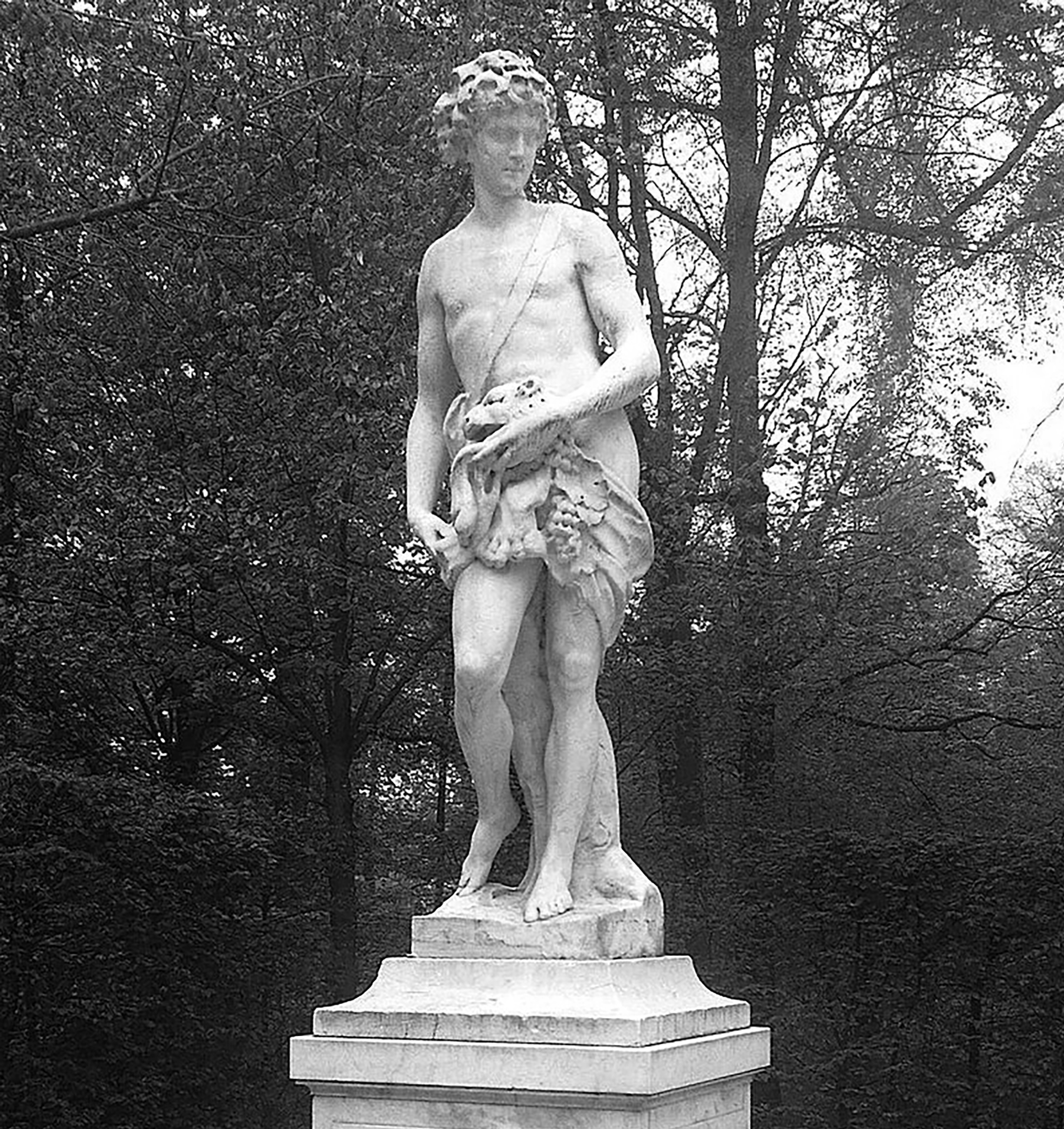
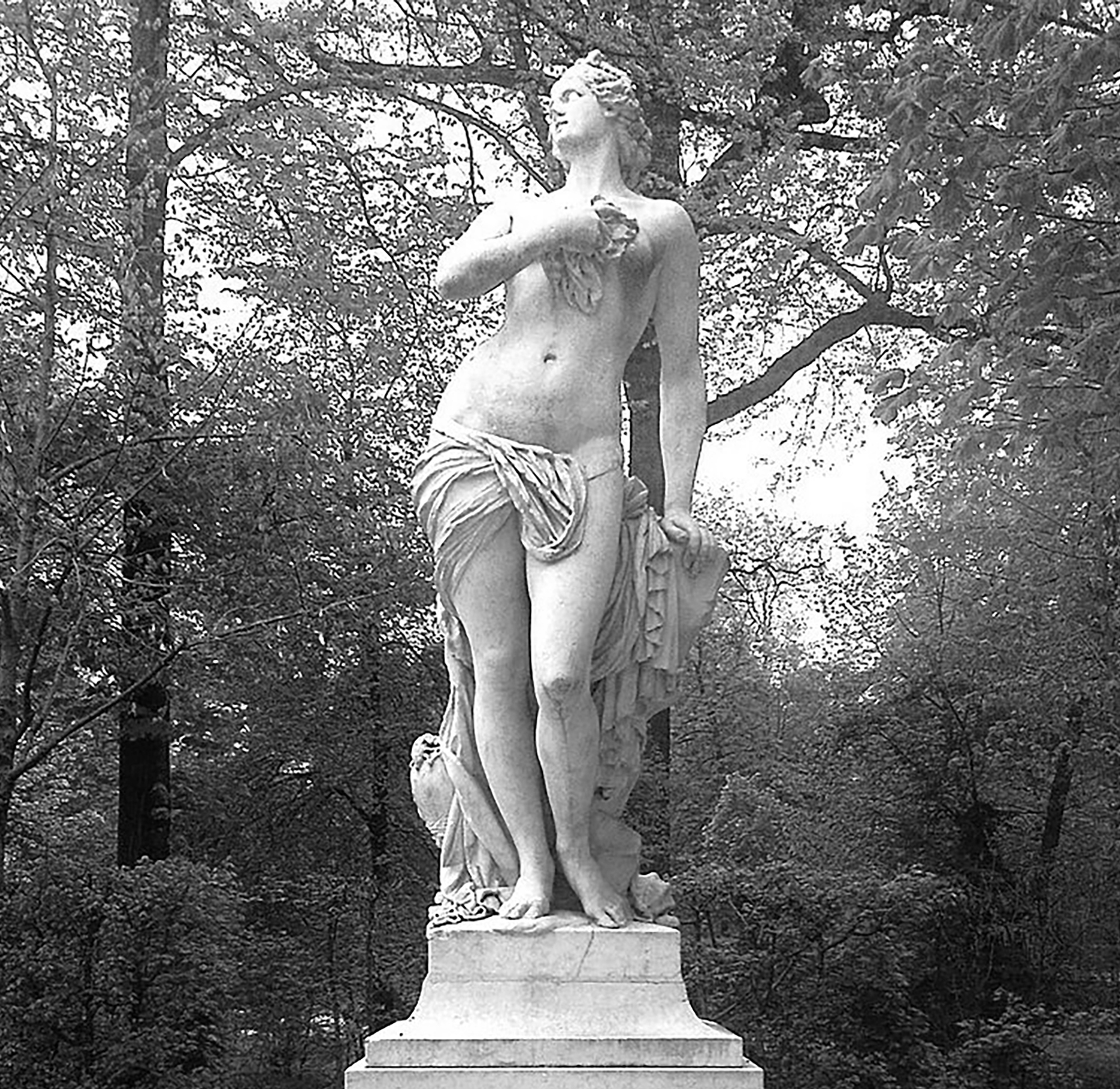
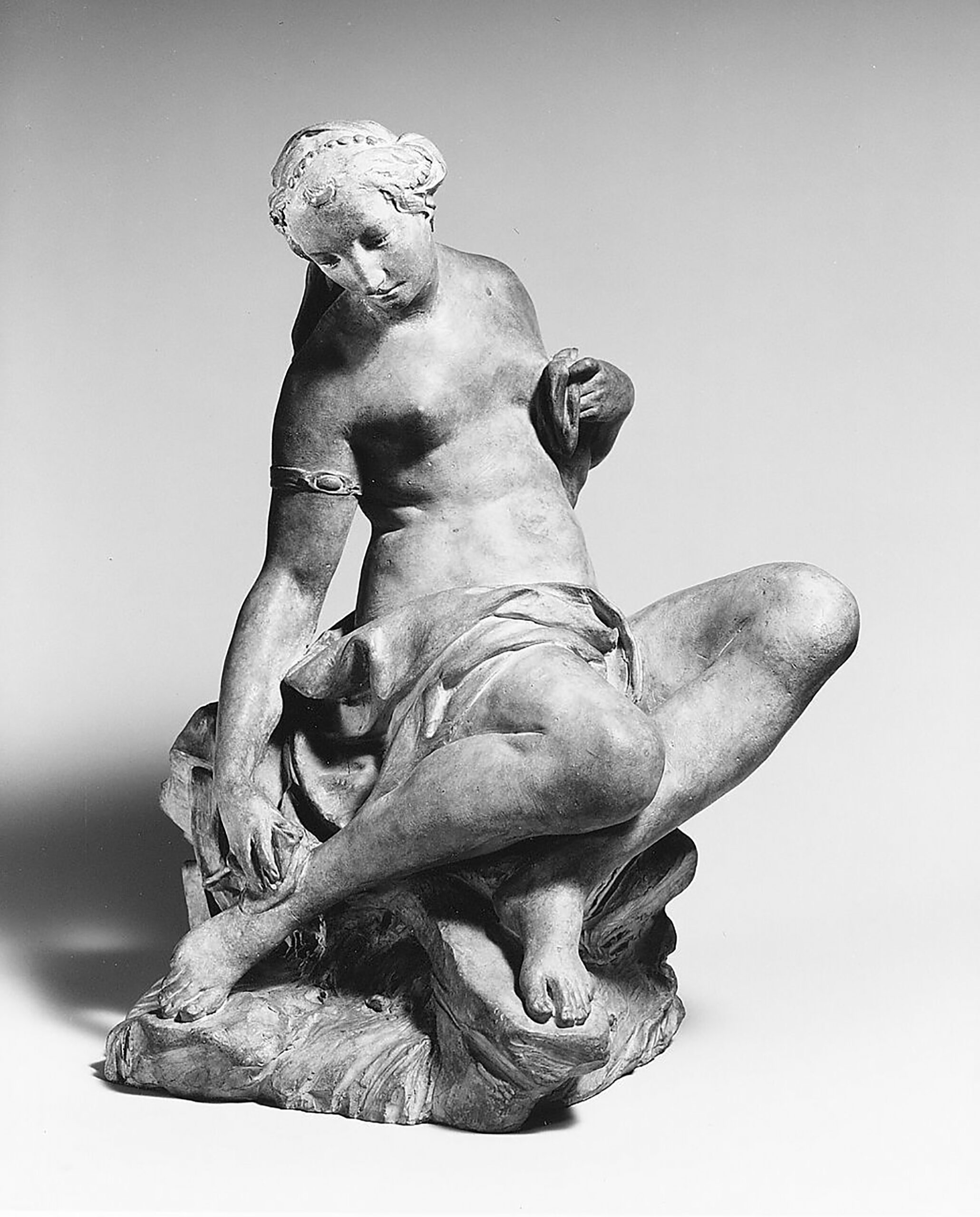
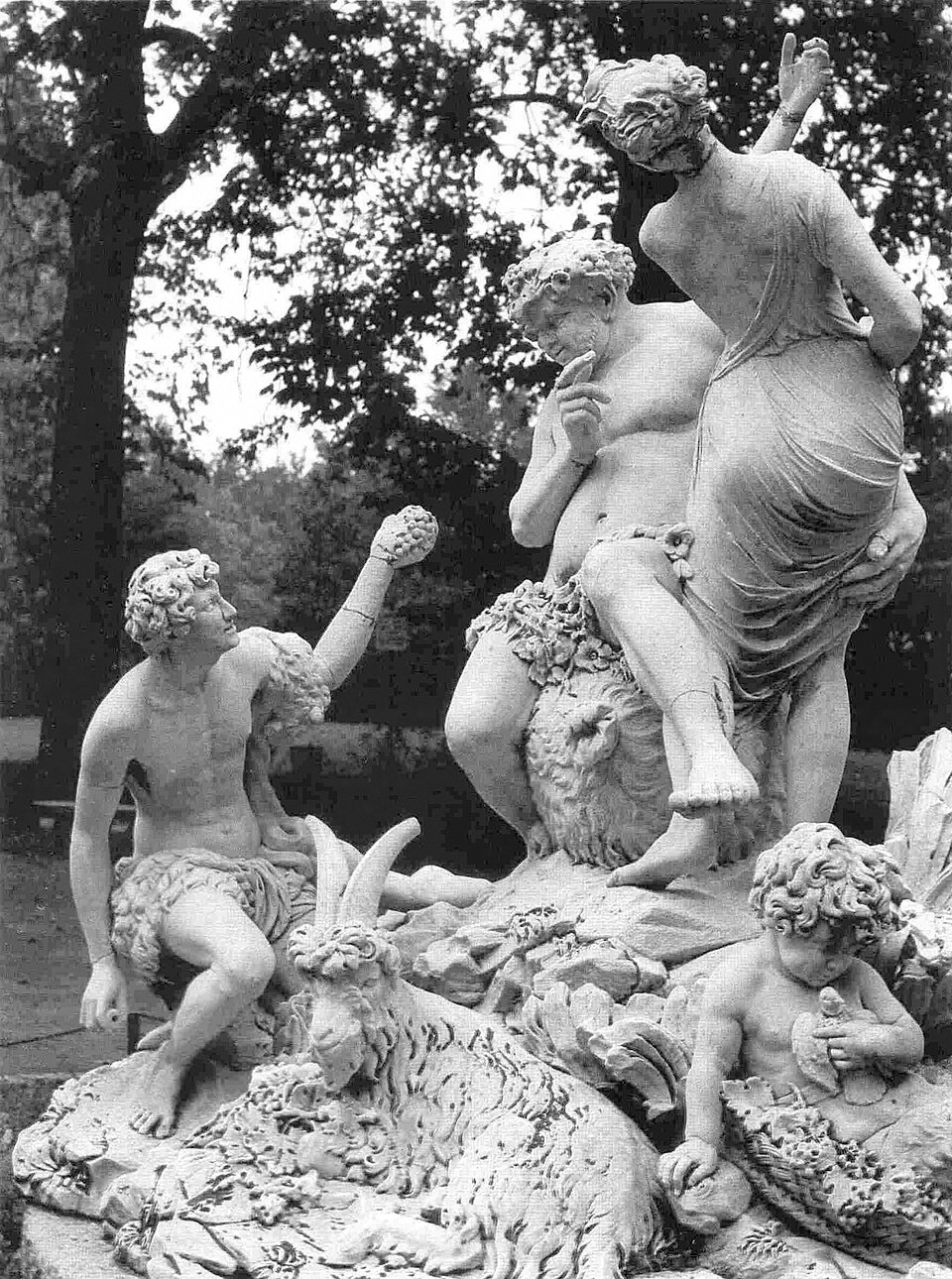
Appointed sculptor to HRH the Duke of Parma, Boudard was granted a workshop at the Rocchetta and, in the 1750s, took part in the ambitious programme of sculptures intended to embellish the ducal gardens under the supervision of the French architect Pierre Contant d’Ivry (1698-1777). In 1753, he delivered his first works: the full-length statues of Bacchus, Ariadne, Zephyr and Flora; in 1754, he completed those of Apollo and Venus (ill. 11-12-13).
In the following years, he executed another naiad abducted by a satyr, the statue of Pales, the Roman goddess of shepherds, that of Triptolemus (1756), the Eleusinian hero associated with the myth of Demeter, as well as the group of Vertumnus and Pomona (1757). The project was then supplemented by a large group of statues including a Silenus, the nymph Aegle, one of the three Hesperides, and the shepherds Chromis and Mnasylus (1766), inspired from Virgil’s Bucolics or Eclogues. In addition to this extensive programme, Boudard was also commissioned to execute a sumptuous collection of white marble vases from designs provided by the architect Ennemond Alexandre Petitot (1727–1801), who had arrived in Parma in June 1753 with the title of chief architect to the court and instructor at the newly created Academy of Fine Arts.
The collaboration with Petitot was continued with the renovation of the ducal palace in Colorno, which the duke wanted to remodel in the image of Versailles.
The result was particularly remarkable in terms of the decoration of the Grande Salle (1755-1756), sculpted by Boudard, who tempered the exuberance of the Rococo style with a classical syntax learned from Soufflot.
In 1759, the sculptor published a three-volume work in Parma entitled Iconologie tirée de divers auteurs. Ouvrage Utile aux Gens de Lettres, aux Poëtes, aux Artistes, & généralement à tous les Amateurs des Beaux Arts, dédié à S.A.R. L’Infant D. Philippe, comprising more than 630 engravings accompanied by captions in French and Italian and preceded by a long introduction.
He executed many portraits of the ducal family, as well as funerary monuments, notably that of Leopold of Hesse-Darmstadt (1708-1764), son of the governor of Mantua, Philip of Hesse-Darmstadt, and second husband of Henriette d’Este (1702-1777), of the House of Este, who became Duchess of Parma through her first marriage to Antonio Farnese (1679-1731). This monument is located in the Capuchin church in Fidenza (1765). In 1766, at the request of the Dominicans in charge of the basilica in Bologna, he put the finishing touch to the monument dedicated to Saint Dominic, to which Nicola Pisano and Michelangelo had contributed.
He is also credited with the scene depicting the scene of the interment of Saint Dominic, which he completed in 1768.
On 1st April 1768, he was appointed Chief Sculptor to the Court, but as he was suffering from dropsy, Boudard was forced to seek treatment in Sala Baganza, where he died between 22nd and 23rd October. He was buried in the parish church of this small town in the province of Parma.