Carcass of oak and fir; polychrome wood marquetry; main background of the marquetry on the front in pear wood; some backgrounds in rosewood; end-grain yew and wood stained green (sides); chiselled bronzes and gilded with original ormolu; Flanders Royal red marble (Belgian red-grey).
H. 102 cm. (40 ¼ in.): L. 137.5 cm. (54 ¼ in.); W. 65 cm. (25 ½ in.).
PROVENANCE: Executed for the apartments of King Stanislas Leszczynski (1677–1766) at the Château of Lunéville; collection of Baron Jean Germain Léon Cassel Van Doorn (1882–1952) and Baroness Marij Vincentia Cassel van Doorn (1911–2006); Collection de la Baronne Cassel van Doorn, auction in Paris, Galerie Charpentier, under the supervision of Mr. Etienne Ader, 30th May 1956, lot n°. 121, repr. pl. LXI.
LITERATURE on the Château of Lunéville: Pierre Boye, Les châteaux du roi Stanislas en Lorraine, preface by Pierre Marot, Paris and Marseille, 1980, p. 112; Jean-Pierre Carciofi, « La Salle des Trophées” (The Trophy Room), Lunéville, Fastes du Versailles lorrain, Volume 2, Décors intérieurs, Mobilier, Objets d’art, Paris, 2006, p. 168–171.
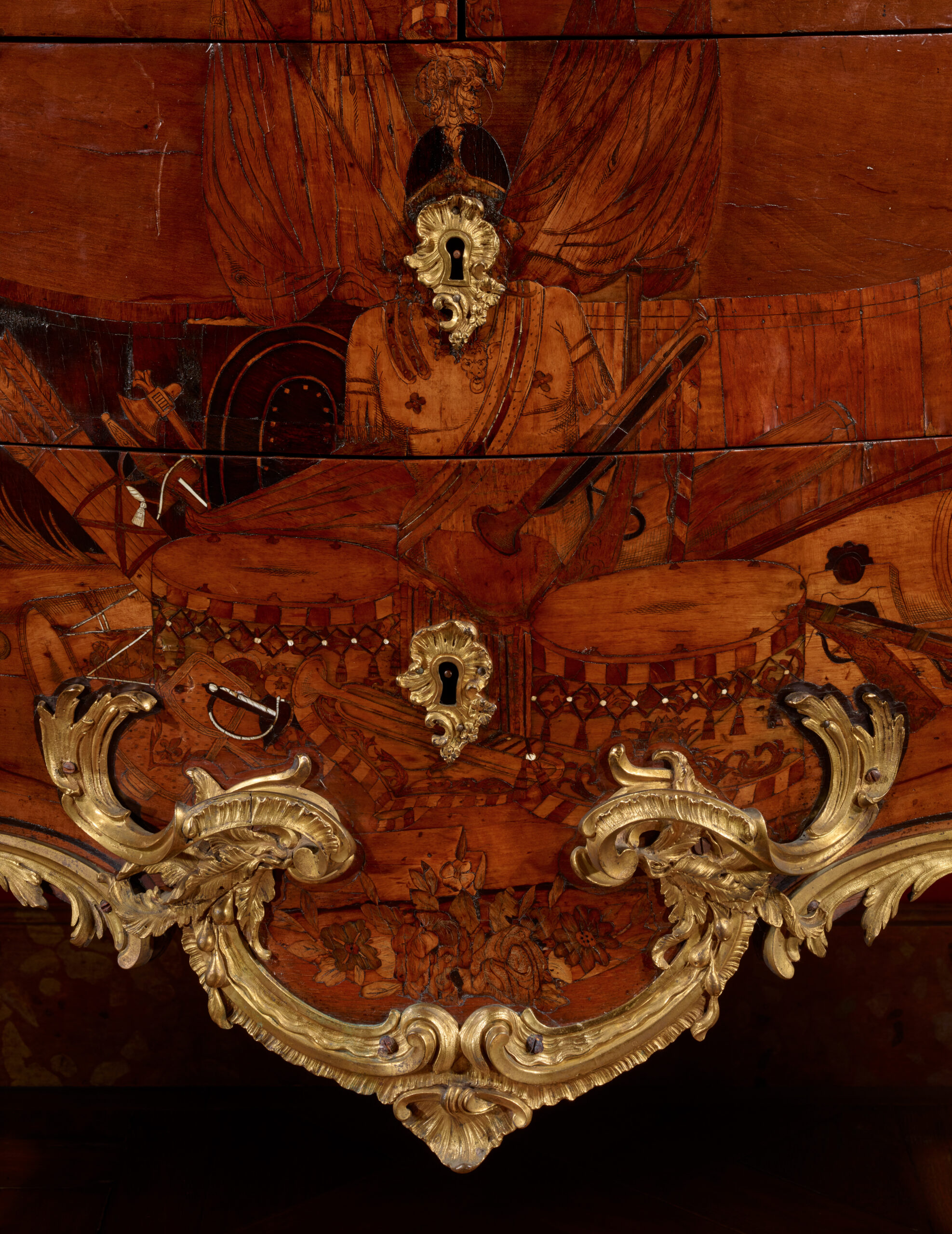
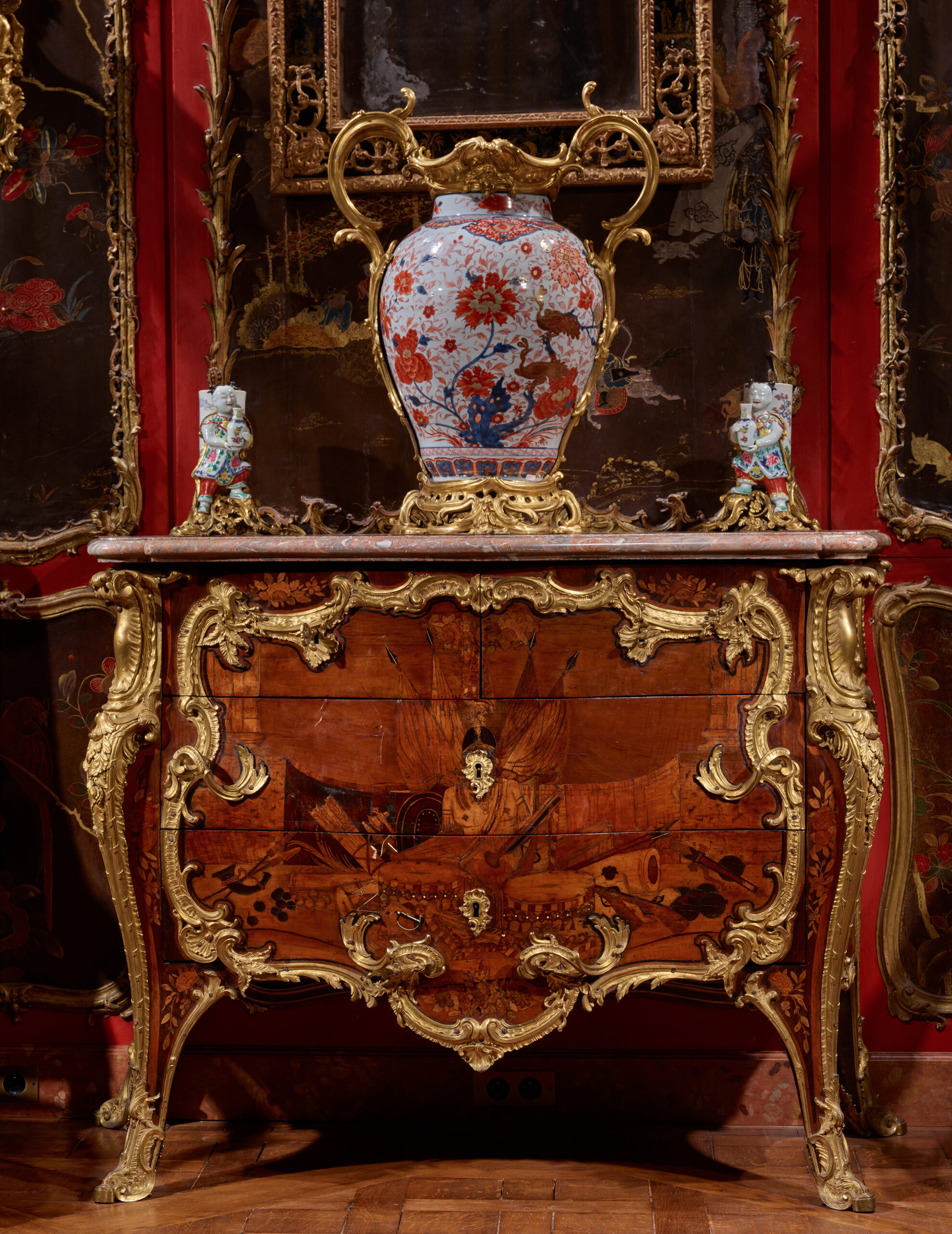
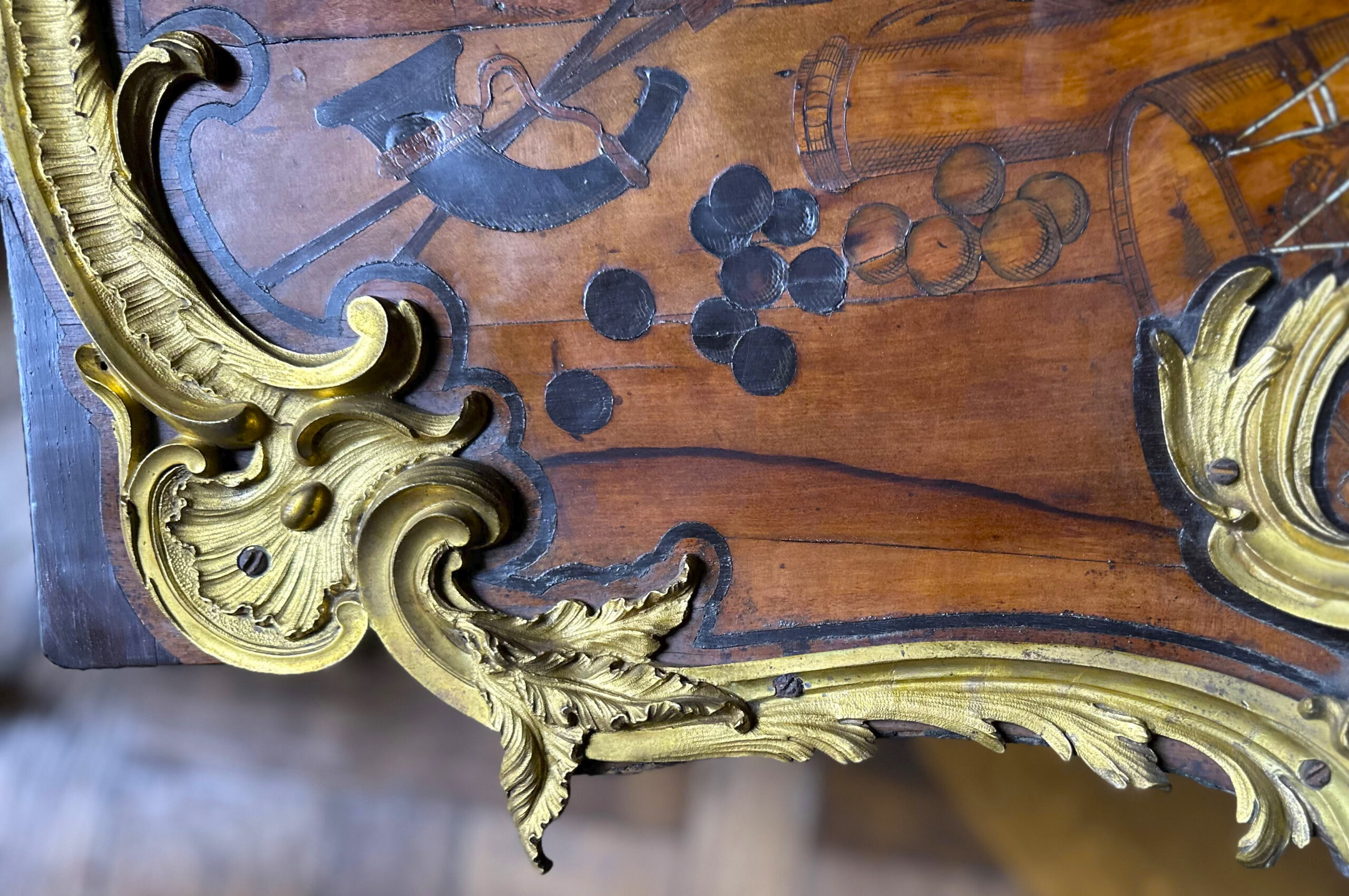
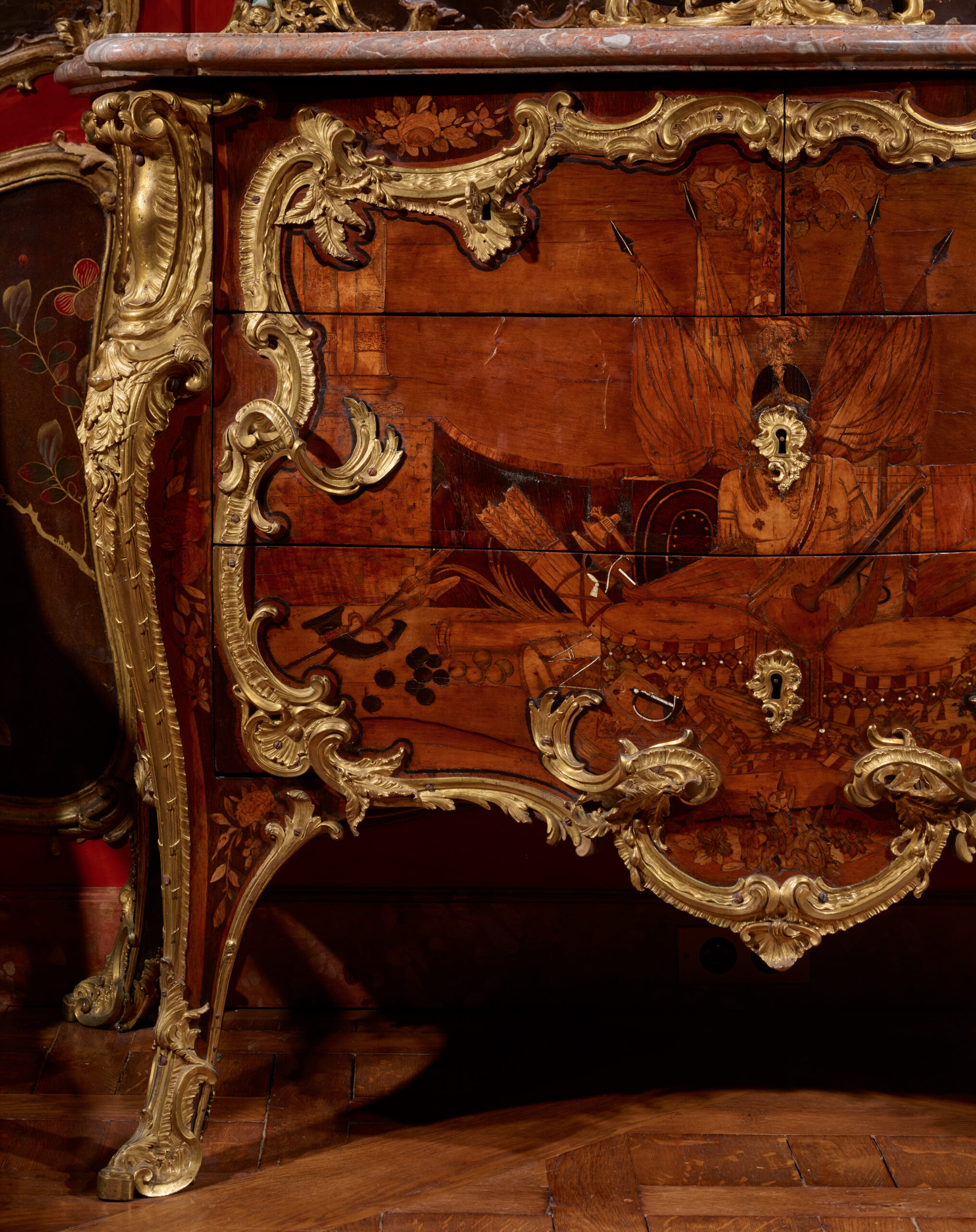
This extraordinary Louis XV period commode, with its impressive carcass height of 102 centimetres, remains a unicum to this day. Adorned in front with a lavish polychrome wood marquetry featuring a military trophy on a circular architectural ground flanked by columns with vermiculated rings, it was executed around 1760 on behalf of King Stanislas Leszczynski (1677-1766) and placed in his apartments at the Château of Lunéville, the seat of the Lorraine court at the time. Of curvilinear and subtly domed form, the commode, whose carcass is made of oak and fir, displays to the front three tiers of drawers of equal height and without dividing rails, which are arranged as two long drawers beneath two shorter upper ones, with their fronts executed in fir and their carcasses in oak. The richly composed military trophy, executed in polychrome wood with delicate white highlights on a principal ground of pearwood, with other areas of the ground in rosewood, occupies the entire large cartouche of the façade. At its centre can be seen the cuirass of a Roman officer, surmounted by a plumed helmet, encircled by a tripartite sash, and crowned by five radiating banners, the central one entirely adorned with fleur‑de‑lis and bearing a lily symbolizing the royal army.
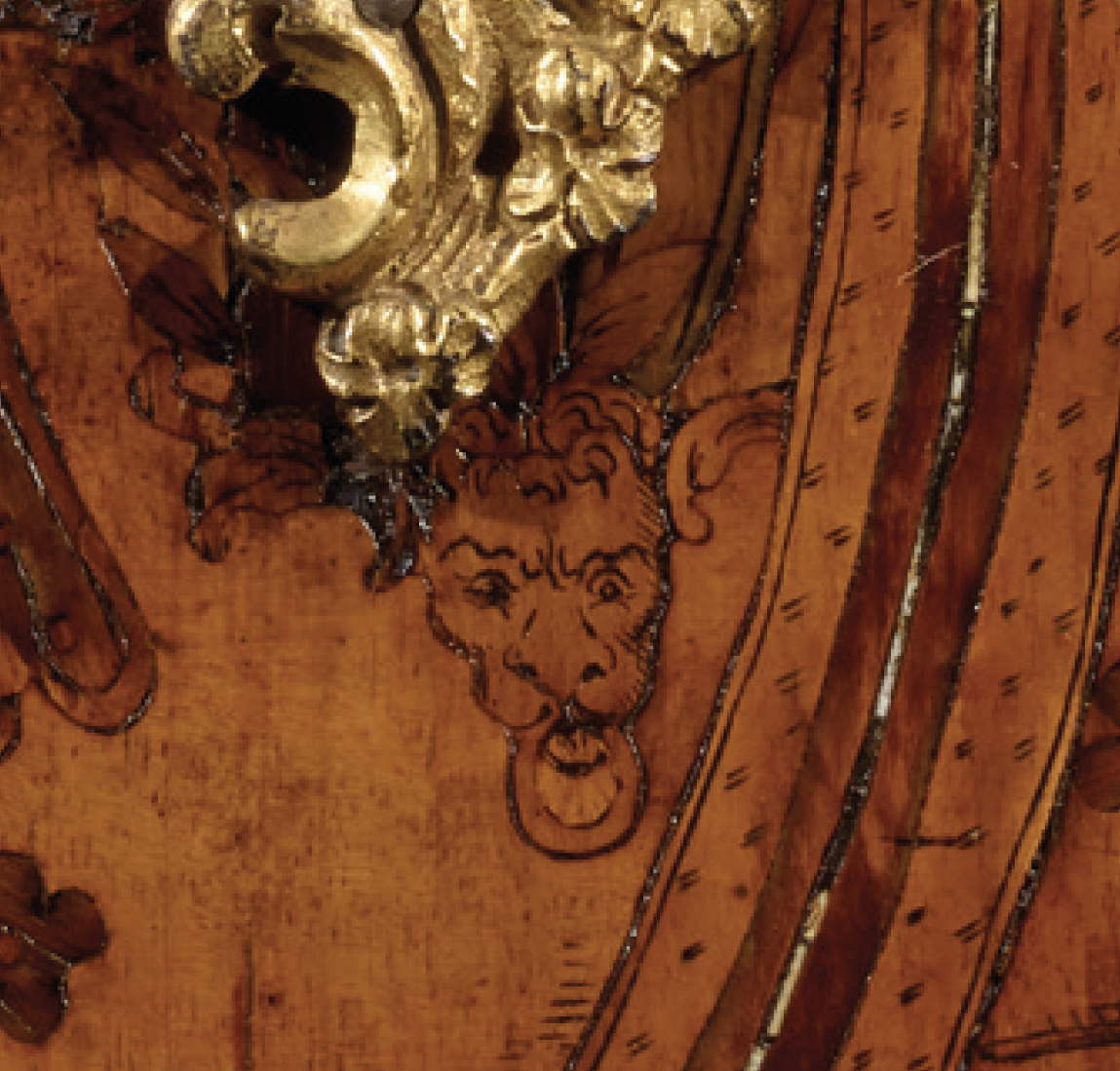
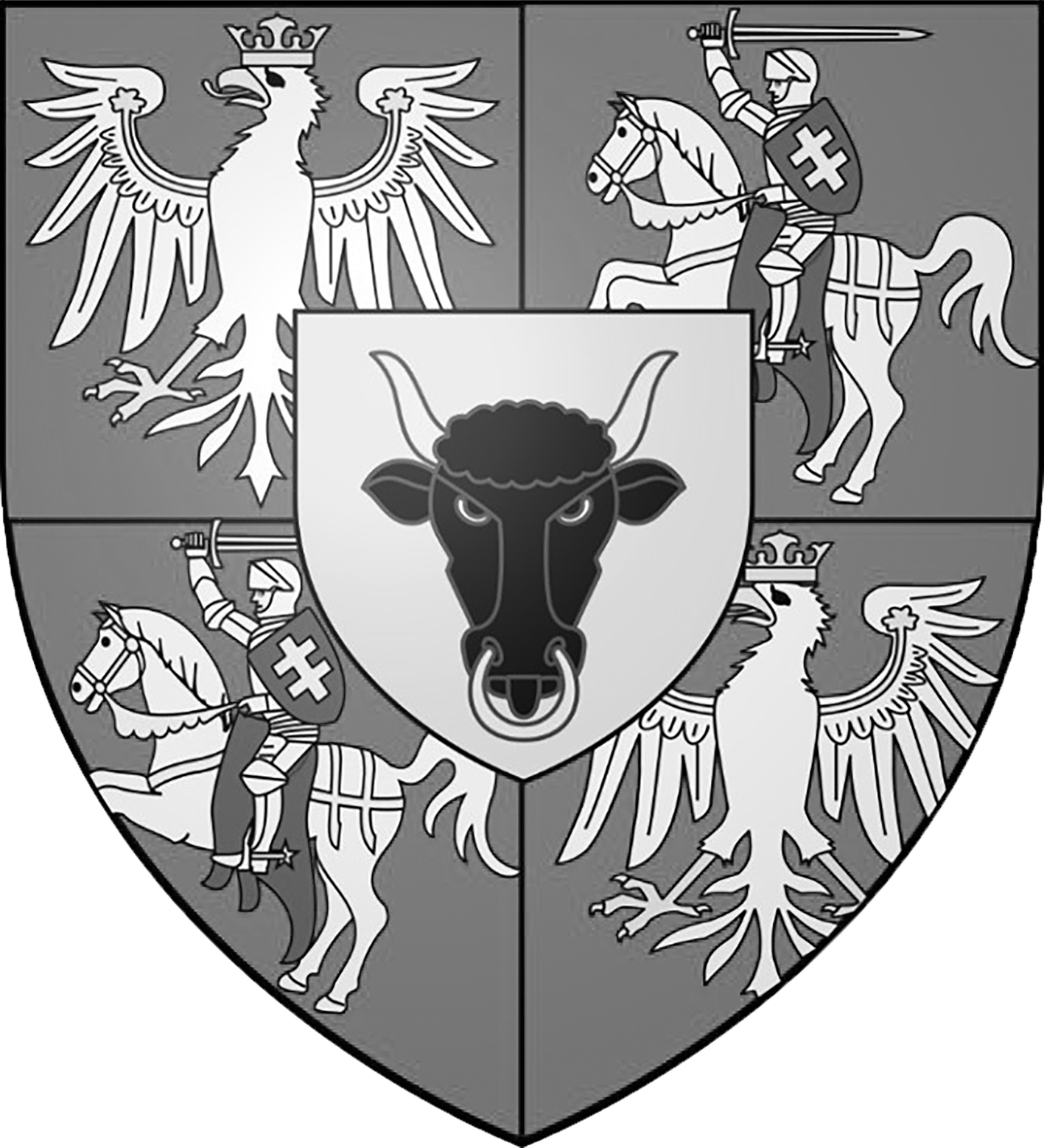
Most finely engraved, the small motif fashioned as a ringed bull’s head, adorning the neckline of the cuirass and discernible just beneath the small festooned and asymmetrical gilt‑bronze cartouche concealing the keyhole of the central drawer, may be regarded as a subtle allusion to the arms of the House of Leszczynski, whose blazon is: “Argent, a bull’s head Sable, armed and ringed Or”. Arranged before the cuirass are two drums with chequered borders accented by small clasps, and a third, visible to the left, all adorned with an oval shield displaying the arms of France, and around them lie all the attributes that characterize an eighteenth‑century military trophy: cannon, mortar, cannonballs, muskets, swords, axe, lances, quivers, shield, bugles, a giberne adorned with fleur‑de‑lis, and a company pennant.
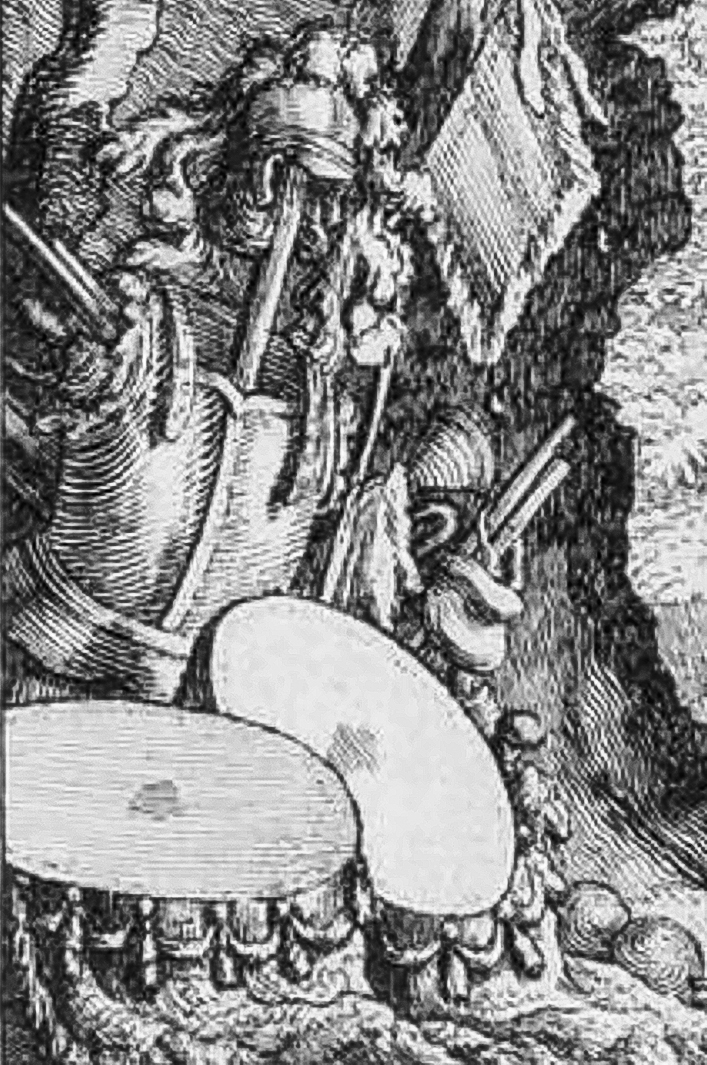
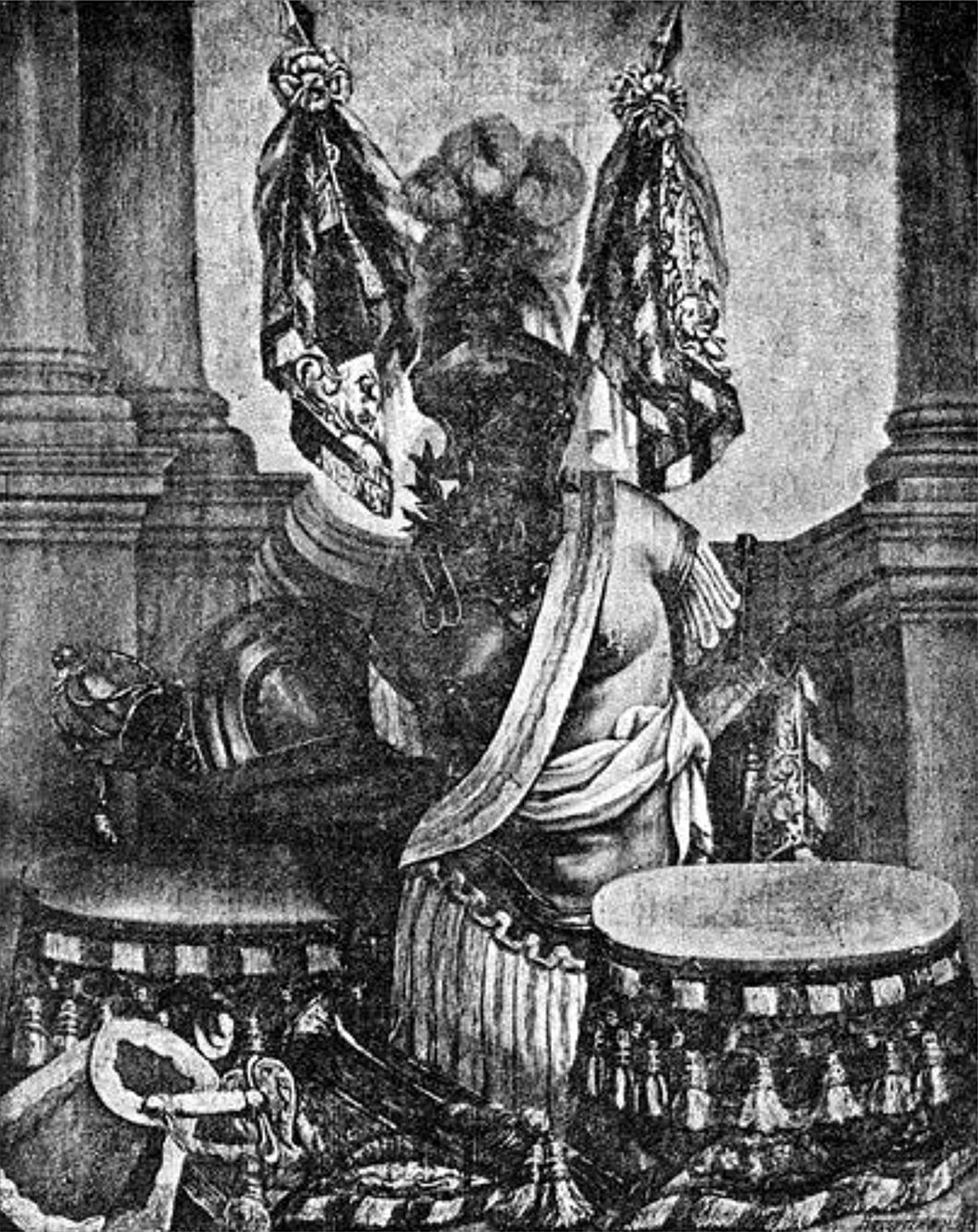
The main military trophy serving as the precise model for the Lorraine marquetry master who executed our commode was that of the 1st Company of the King’s Scots, an elite unit of the Gendarmes rouges (red men-at-arms) attached to the Maison du Roi, heir to the units of gendarmes, i.e. armoured horsemen of the armies of the 15th and 16th centuries. Under Louis XV, the French gendarmerie comprised ten companies whose respective military trophies were painted—after the death of King Stanislas—on large oil canvases adorning the walls of his “salle où le Roy mange” (King’s dining room), i.e. the grand salon initiating, in the axis of the chapel, the palace’s sole wing built on the east garden side, to the right of the main entrance block.”
When the ten companies of Red Gendarmes were all brought together in Lunéville, on the orders of Louis XV, from the end of 1766 onwards, the room became the Salle du Conseil de la Gendarmerie de France (Council Chamber of the French Gendarmerie).
The drawings of these trophies—reproduced on these large canvases—already existed beforehand, which explains why they could serve as precise models for our marquetry master. Their authors were two artists from Châlons-en-Champagne, in the Marne region: the painter and draughtsman Jacques-Ignace de La Touche-Loisy (1694-1781), known as the Chevalier de La Touche, and the draughtsman and engraver Pierre-Quentin Chedel (1705-1762). Several of their drawings illustrating military trophies, emblems of the various companies of the Maison du Roi, including that of the Scottish Gendarmes, were engraved to illustrate Simon Lamoral Le Pippre de Noeufville’s work, Abrégé chronologique et historique de l’origine, du progrès et de l’état actuel de la Maison du Roi et de toutes les troupes de France tant d’infanterie que de cavalerie (Chronological and Historical Summary of the Origin, Progress and Current State of the King’s Household and All the Troops of France, Whether Infantry or Cavalry), Volume Two, containing the light cavalry of the guard, the two companies of musketeers, the mounted grenadiers and the entire gendarmerie, published in three volumes in Liège in 1734.
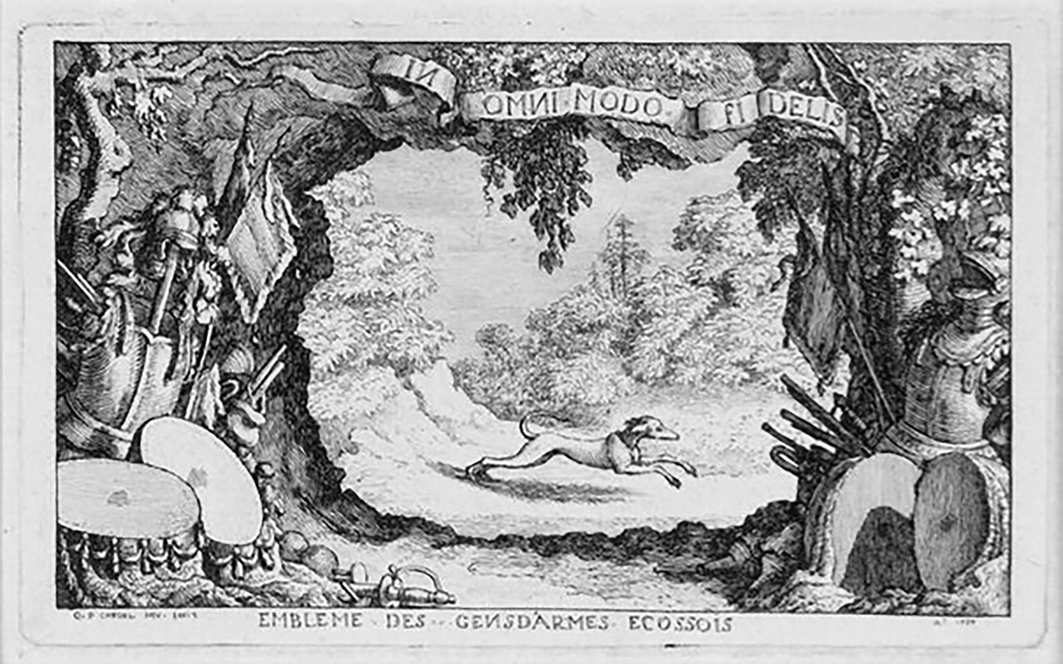
An anonymous series of eight small gouaches, showing the trophies and emblems of eight of the ten companies of the Gendarmes du Roi—most likely executed after drawings by Chevalier de La Touche and Pierre-Quentin Chedel, unless they themselves were the authors—each measuring approximately 37.8 x 34.5 centimetres, with highlights in black chalk and brown ink, was sold by Sotheby’s in New York in 2025. The gouaches, on which the various companies of Gendarmes can be identified by their mottos or coats of arms displayed on their banners or trophy shields, were erroneously dated back to the 17th century by the auction house; however, in view of the engravings mentioned above, it would be more appropriate to date them to the years 1735-1740.
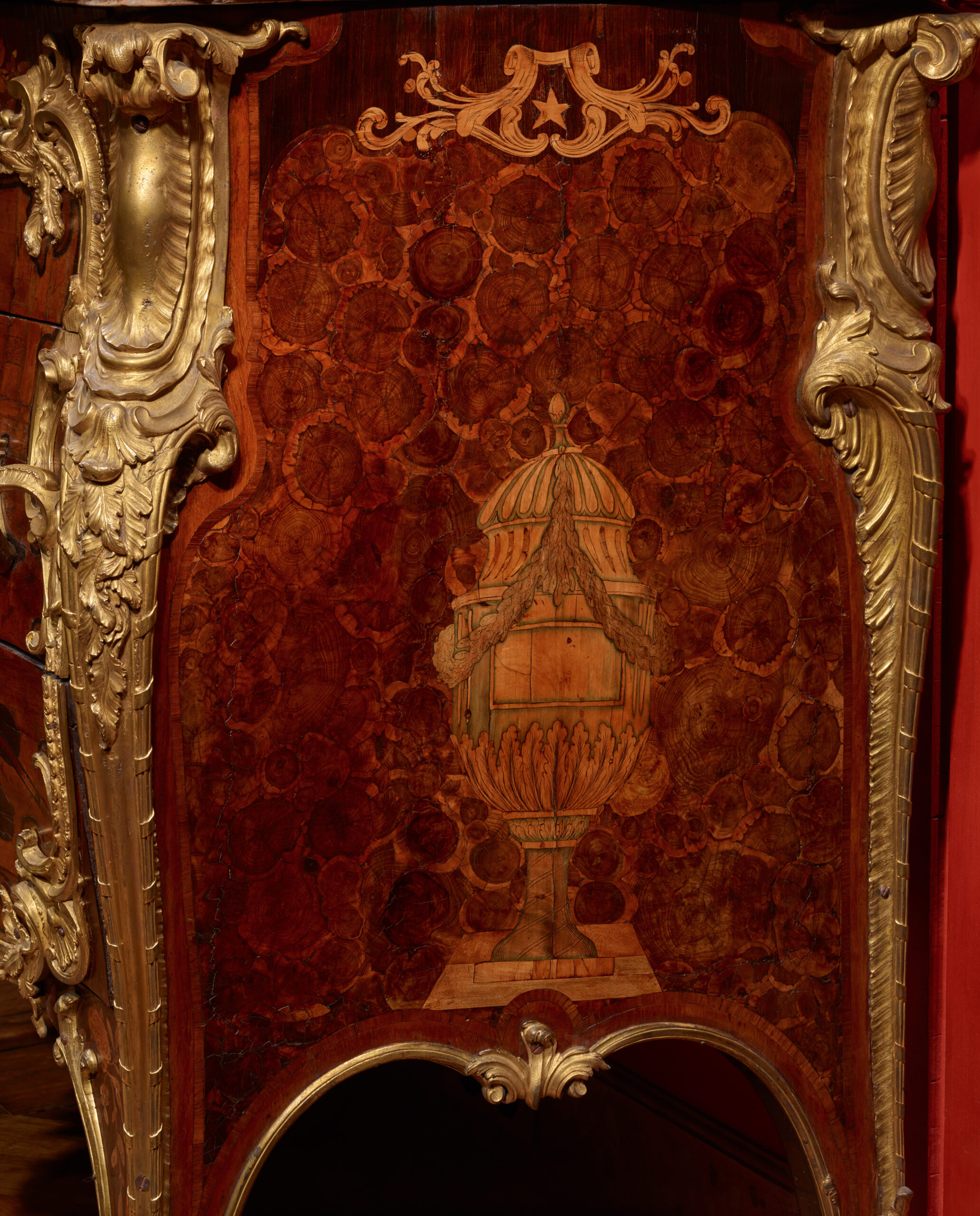
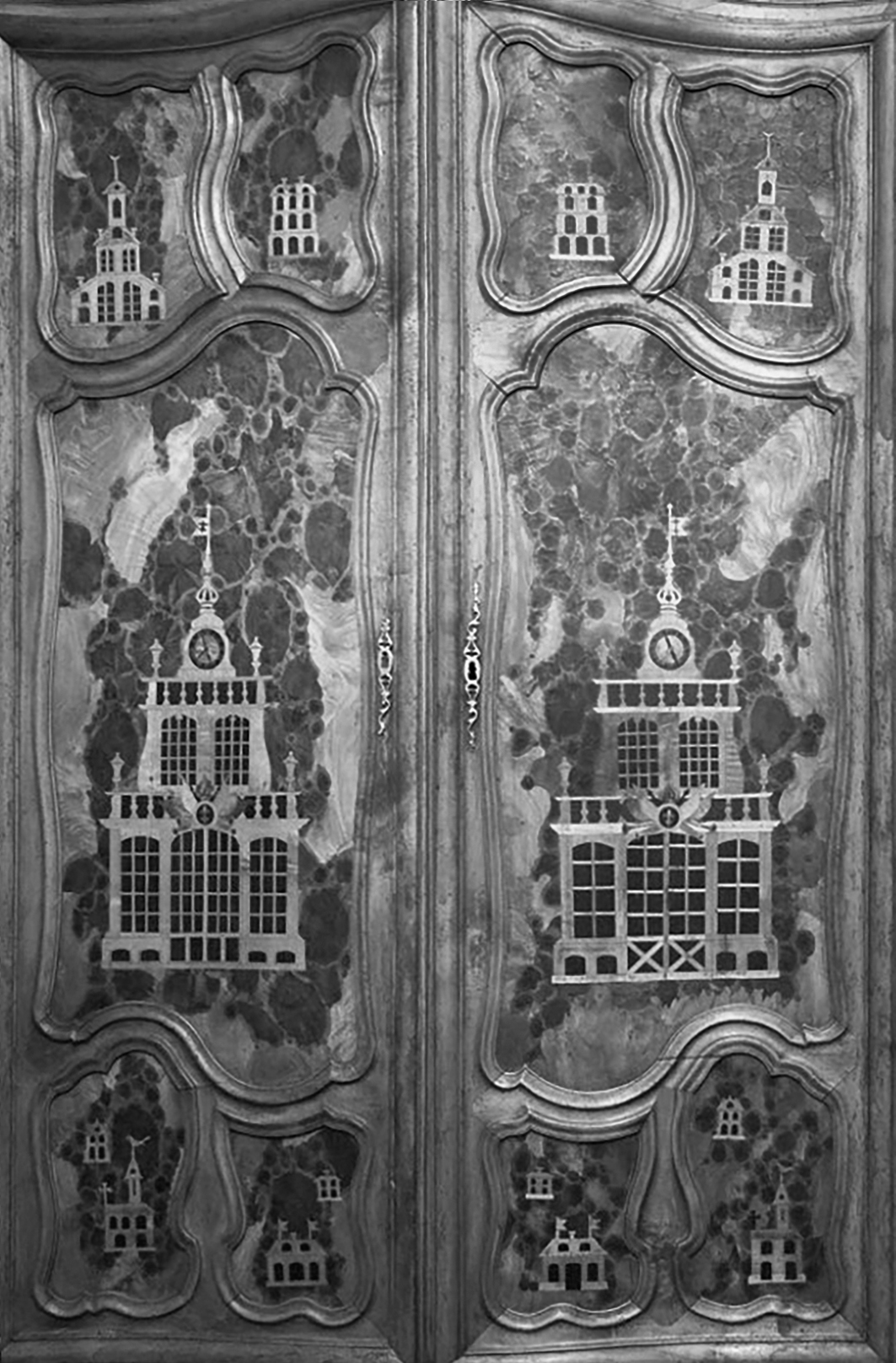
A Lorraine armoire of equally exceptional dimensions, preserved at the Château of Lunéville, displays on its two doors the garden pavilions of the château contrasting against those same singular grounds seen on the small sides of our commode, executed in end-grain yew whose lighter sapwood creates an irregular mosaic verging on the organic. It is signed with the initials M Y, visible on one of its upper marquetry panels. In place of the Lunéville pavilions appears a grand Neo-classical baluster-form covered vase at the bottom centre of each of our panels, partially inlaid in green-stained wood with a rectangular central compartment, fluting, gadrooning, a corolla of acanthus leaves and laurel garlands, all resting on a trapezoidal base. A five-pointed star within a lavish scrolling cartouche flanked by foliate volutes adorns the upper section of both panels.
According to oral tradition, the large armoire in the museum of the Château of Lunéville is said to have come from the collections of King Stanislas Leszczyński. However, while archive documents do indeed mention two armoires in the first antechamber of the ducal apartments, known as the Salle de la Livrée, the lack of more precise descriptions of these in the archives calls for caution. There is no evidence that these armoires have survived to the present day; what is certain, however, is that it was executed in a Lorraine workshop, thereby confirming the same provenance for our commode—perhaps the work of a cabinetmaker of German origin who came to settle in Lorraine, in Nancy or Lunéville, during Stanislas’s time.
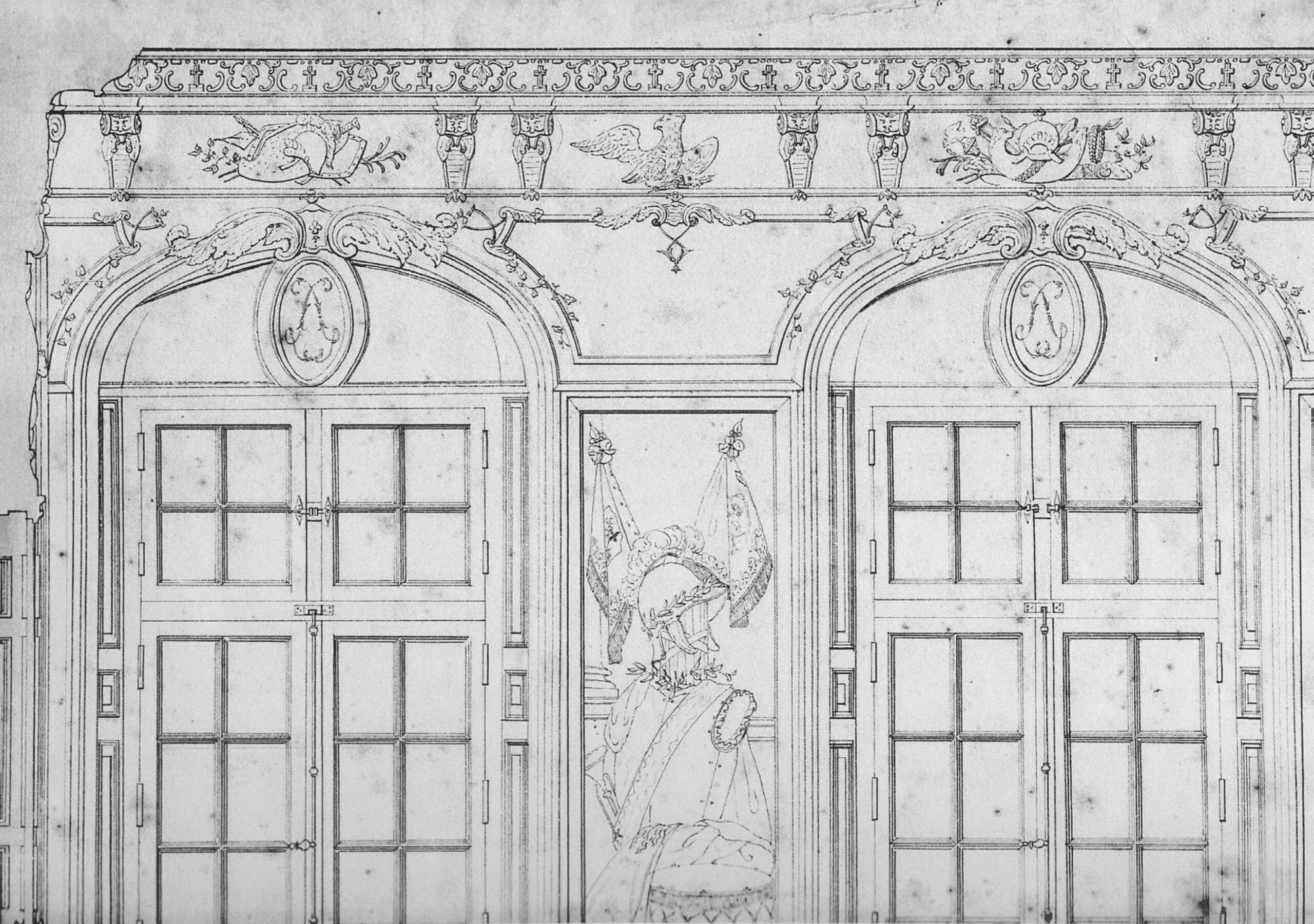
In this regard, it is particularly noteworthy that while the perfectly controlled exuberance of the rocaille curves of the Lunéville armoire is very much in keeping with the Lorraine tradition of large, high-quality furniture, its marquetry decoration—depicting the garden pavilions of the château against end-grain wood grounds identical to those on the short sides of our commode—remains, by contrast, extremely rare, if not unique. It can however be compared to the one preserved at the Palais des Ducs de Lorraine–Musée Lorrain, which belonged to the member of the Convention Merlin de Thionville and is also believed, albeit without precise documentation to confirm it, to come from King Stanislas’s collections at the Château de Lunéville.
The bronzes of our commode: a unique moment of interaction with the workshop of Bernard II Vanrisamburgh (B.V.R.B.)
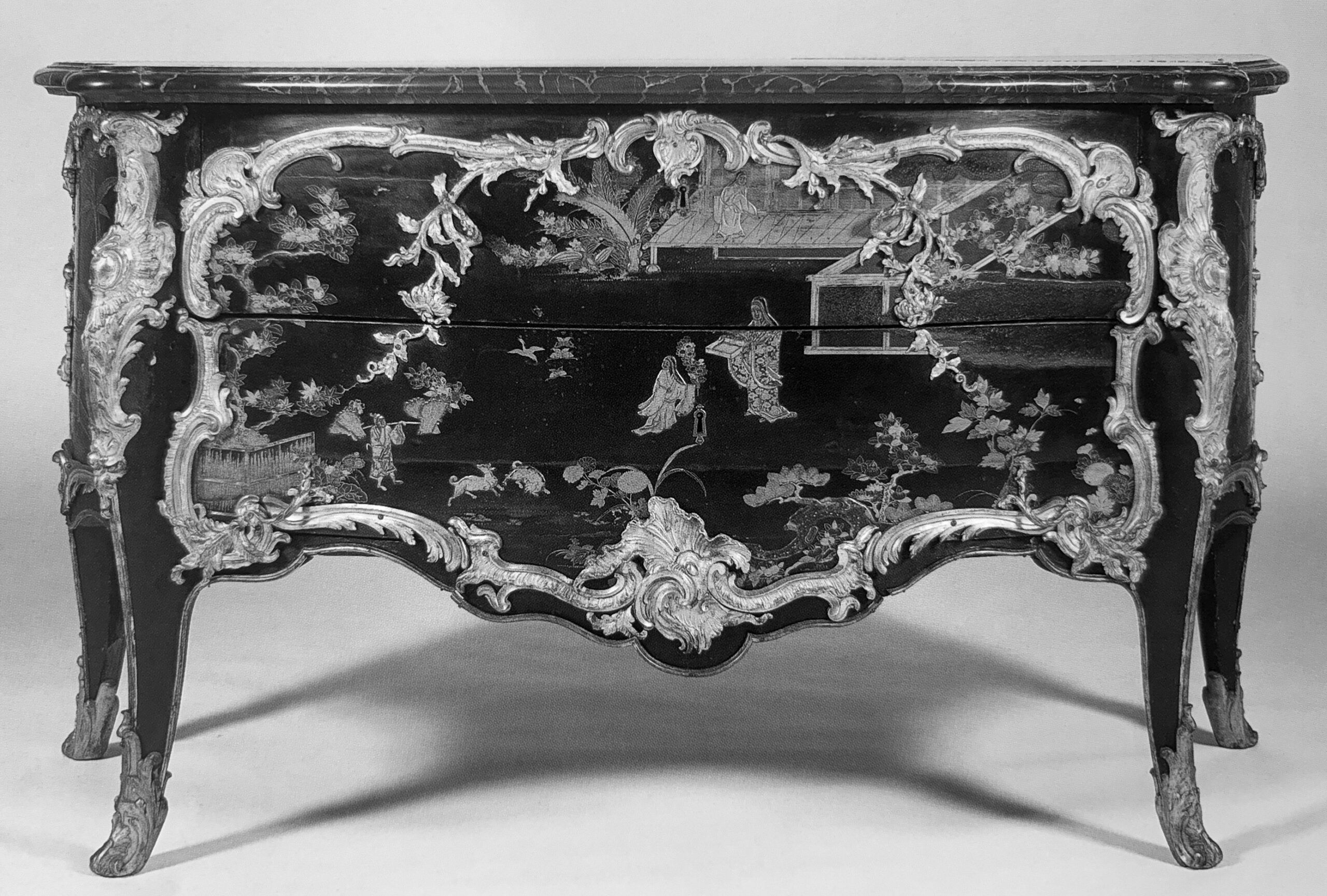
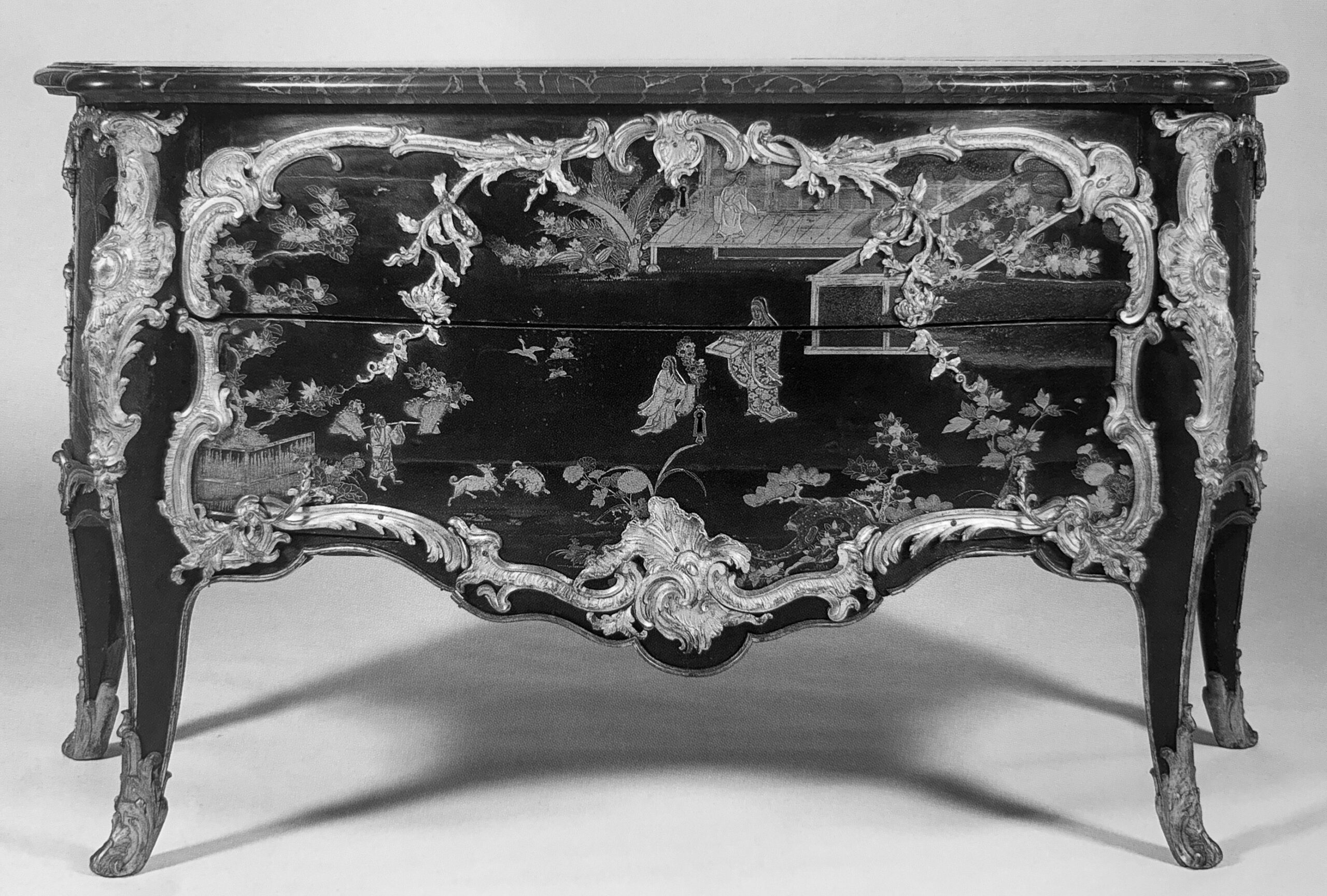
The dazzling bronze ornamentation of our commode bears witness to a unique moment of interaction with the Parisian workshop of B.V.R.B., resulting from the punctual intervention, on site in Lorraine, of artisans from that workshop—and possibly even his son, Bernard III Vanrisamburgh (c. 1731/32–1800), sculptor and author of bronze models in his father’s workshop. Indeed, how else could one explain the presence here on our commode, not only of bronzes identical to those employed by B.V.R.B. circa 1750 on one of the most important commodes in Japanese lacquer he produced, that from the Rodolphe Kann collection in 1907, but also their perfect integration into an ensemble that forms a unicum to this day, with bronzes whose modelling and chasing display absolutely equal quality. Added to this is the evident observation that a single individual must have conceived and organized the perfectly harmonious and fluid overall design of this bronze decor, which here achieves perfect harmony with the commode’s marquetry and exceptional dimensions.
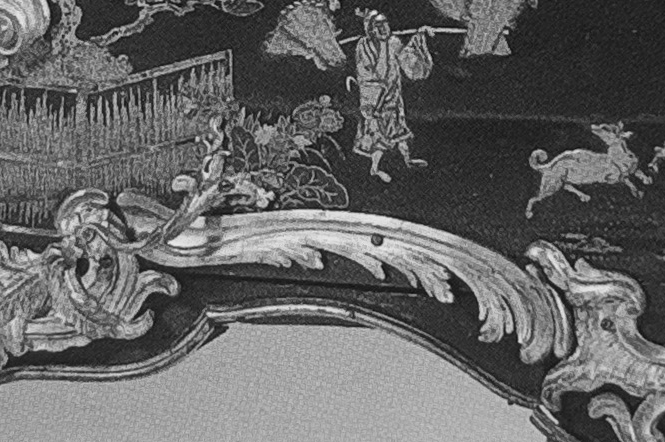
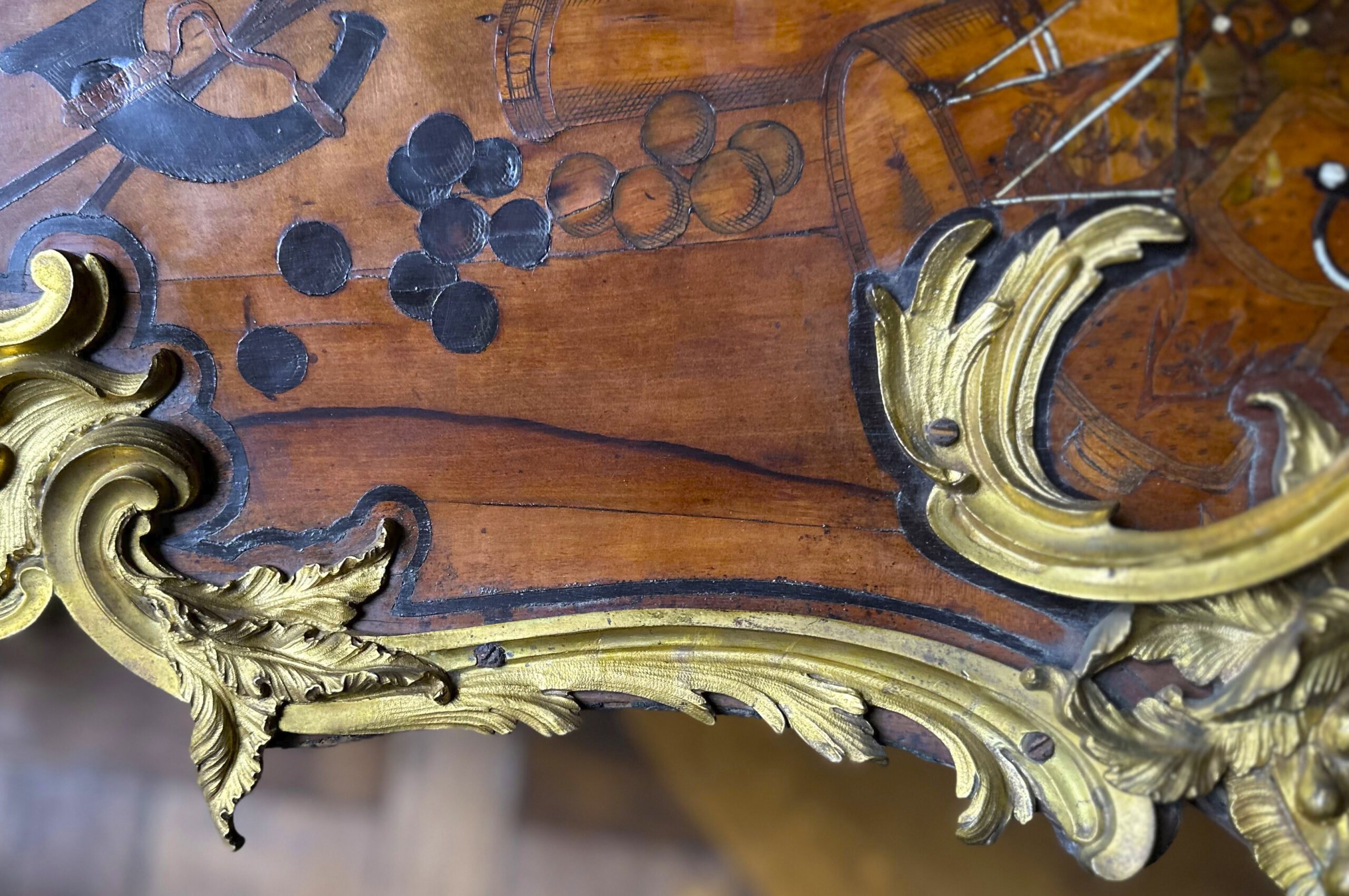
The casting technique and the alloys used—revealing a higher lead content and lower silver and iron contents than those customary at the time in Parisian workshops—confirm regional production, specifically Lorraine in the case at hand; this technical observation is further reinforced by examining the internal surfaces of the commode’s bronzes, which reveal a somewhat more ‘grumous’ texture compared to that usually observed on castings from B.V.R.B.’s Paris workshop; added to this are the very processes used to assemble these different bronze elements, which on the commode were brazed together to form large elements, whereas the method used in B.V.R.B.’s Parisian workshop was to join and adjust independent elements to each other to obtain the overall composition.
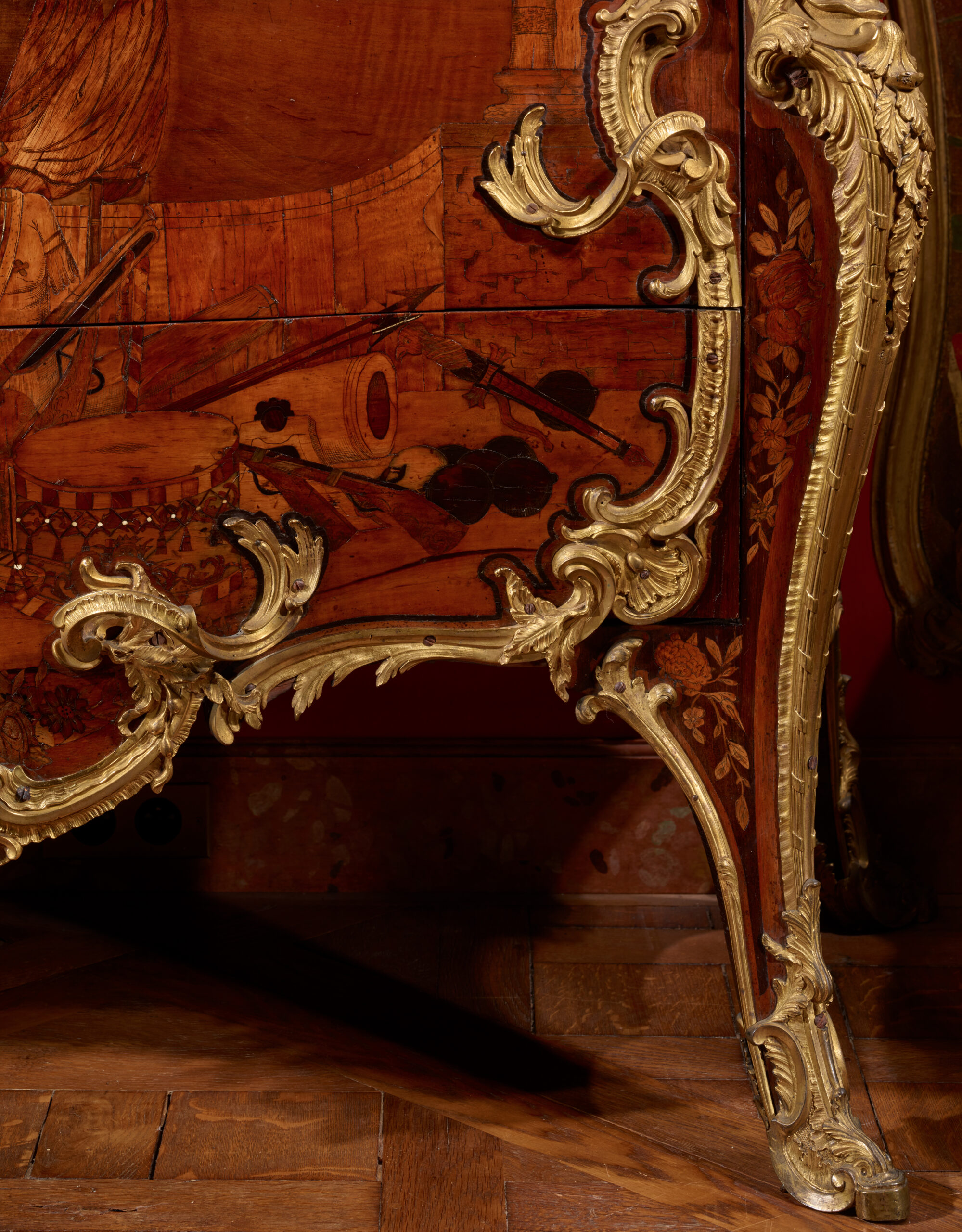
The opulent bronze border framing on the façade the large marquetry panel of the military trophy displays, as mentioned above, the use of several bronze models that B.V.R.B. used on the Rodolphe Kann commode: in particular, acanthus-leaf button clasps, or festooned scalloped shell shapes enclosed at the corners of the borders by similarly festooned scrolling volutes (see the comparison images opposite).
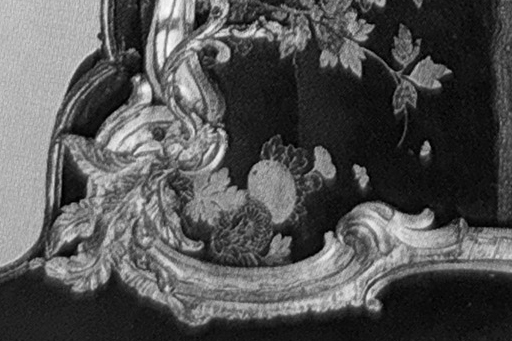
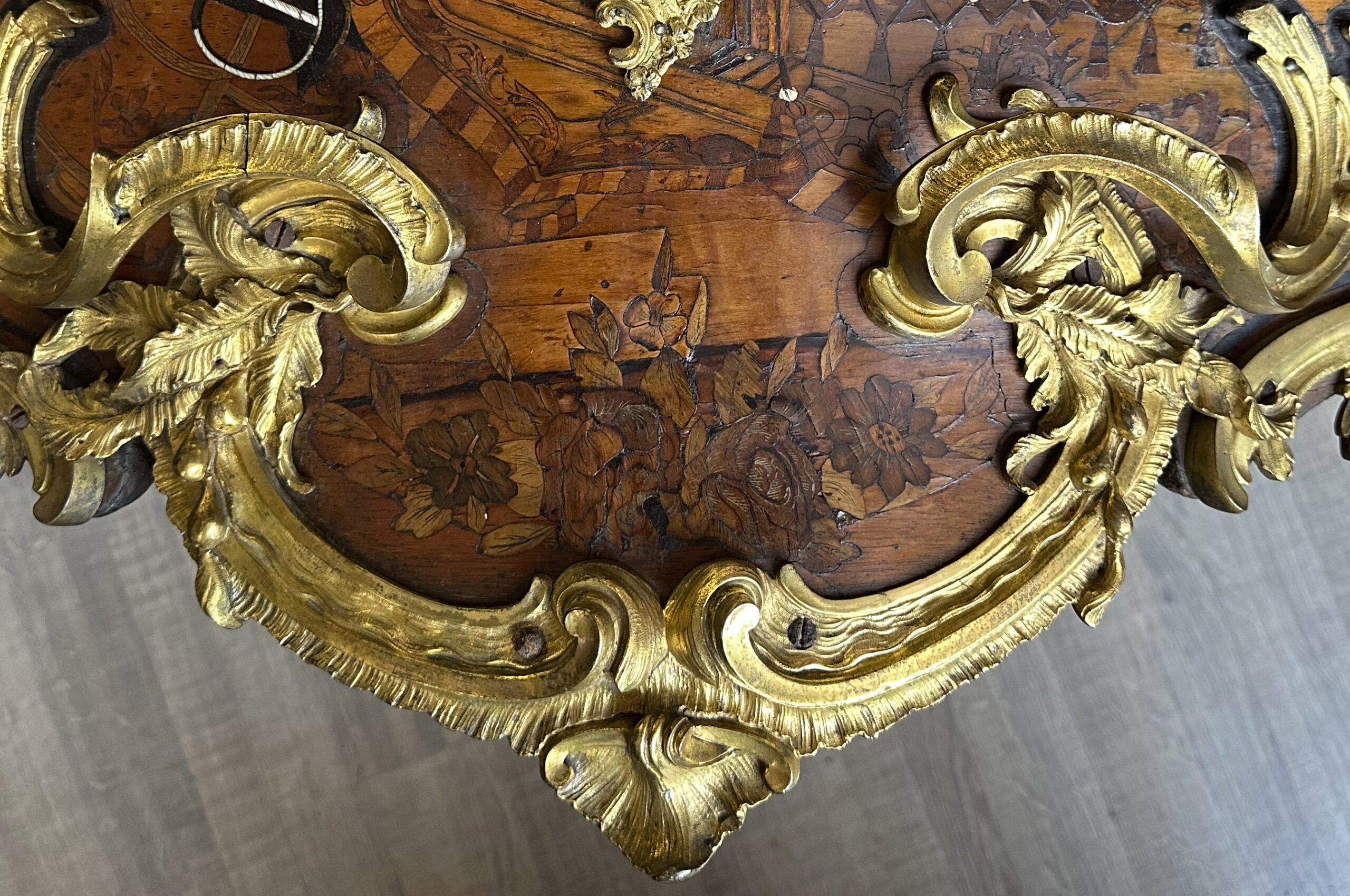
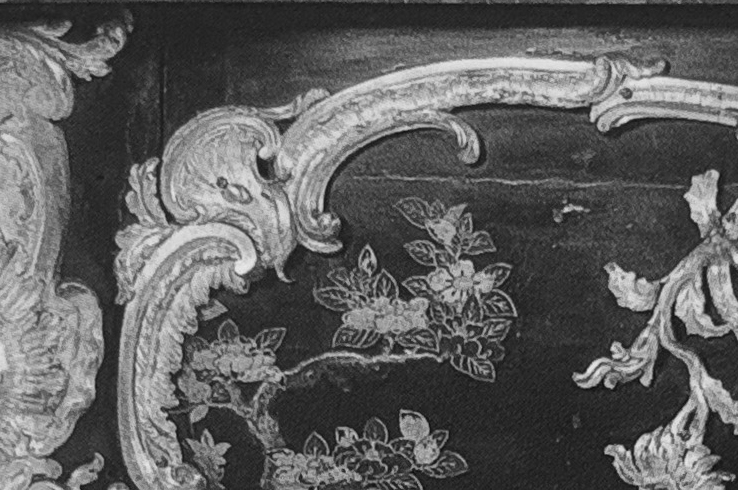
One also notes on several of these framing volutes this same finely chiselled wavy motif with moulded borders, enhanced with festoons arranged either on the outer face or on the inner face. Also characteristic are these long festooned acanthus volutes accentuating the lower cut-out of the piece on either side of the cul-de-lampe; and similarly distinctive, this manner of making the drawer pulls, using foliate volutes emerging from the framing border.
Particularly impressive, the chutes of our commode appear to have been specially conceived to the scale of the furniture’s exceptional carcass, whose height exceeds one metre. Beneath the scrolling mentioned above, they show an imposing oblong and domed cartouche with festooned, moulded and wavy surround, bordered by two scrolls, from which falls a long bouquet of very finely chiselled acanthus leaves, covering the upper part of a bronze quarter-round, tapered and plain band joining the sabots of the commode. This band is flanked, over its full height, by fine ribbon-tied bundles of ‘joncs’ (reeds), enhanced with fluted festoons widening at the top to form a particularly deeply worked concave scroll. The sabots of our commode show a design of convex and concave scrolls, festooned and enriched with acanthus, with lateral surfaces worked in pointillé.
This extraordinary commode constitutes a true discovery, and a testimony to a unique episode of creation in Lorraine—the only one recorded to date during the time of King Stanislas, for whom this as spectacular as it must have been costly piece of furniture was executed.
It re-emerged in the 20th century in the collection of Baron Jean Germain Léon Cassel van Doorn (1882-1952) and Baroness Marij Vincentia Cassel van Doorn (1911-2006), an eminent Belgian collectors who moved to France in the 1930s before emigrating to the United States to escape the Nazi threat. The commode was sold in Paris by the Baroness at Galerie Charpentier under the supervision of Mr. Etienne Ader on 30th May 1956, forming lot n°. 121. It had not then been identified and was simply described as “an important commode in marquetry and gilt bronze from the Louis XV period”. Having remained in private hands since, this commode has never reappeared on the art market to this day.
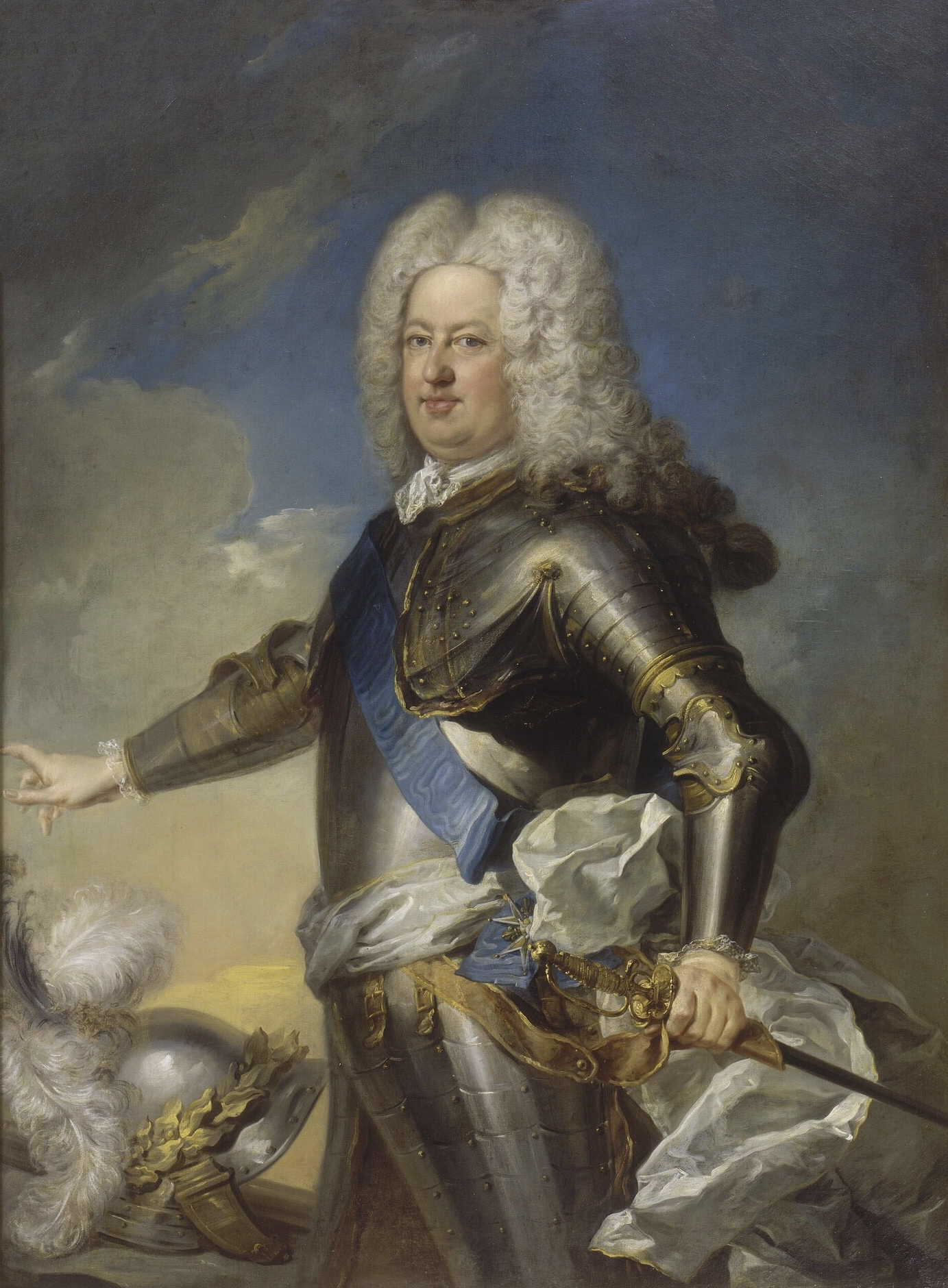
Stanislas Leszczynski, King of Poland and father-in-law of Louis XV
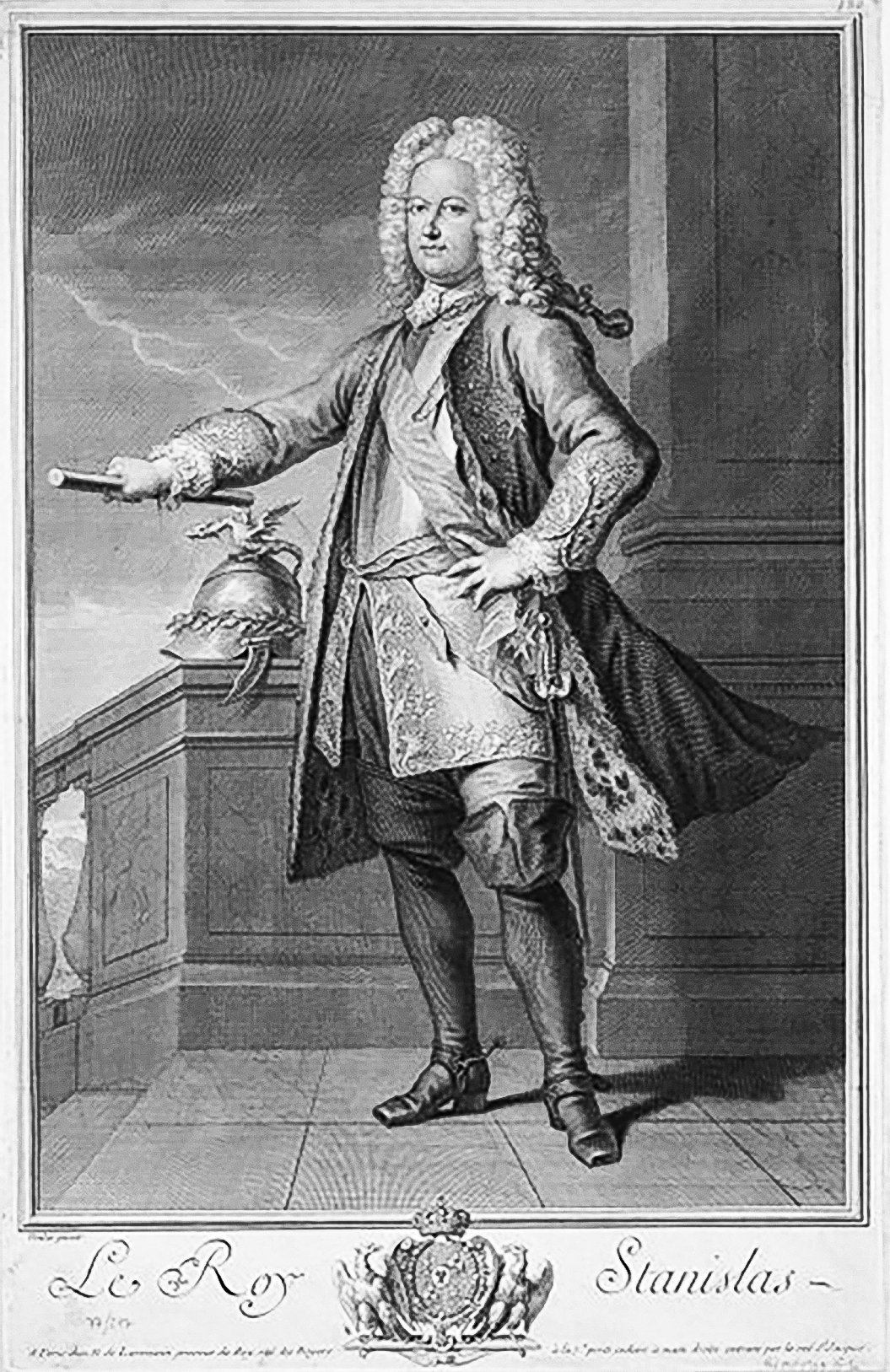
Stanislas Leszczyński was born in 1677 in Lwów to a Polish aristocratic family originally from Leszno in Greater Poland, one of the most important magnate families of the Polish-Lithuanian Commonwealth. He was the son of Rafał Leszczyński, Grand Treasurer of the Crown, and Anna Jabłonowska, with his grandfather, the Hetman Stanisław Jabłonowski, as godfather. Stanislas received a careful education. Trained in literature and the sciences, he mastered several foreign languages, including French of course, and completed his education with a long Grand Tour across Europe. Through his marriage to Katarzyna Opalińska in 1698, he gained access to considerable fortune. The couple had two daughters: Anna Leszczyński, born 25th May 1699 at Trzebnica in Silesia, who died on 20th June 1717 at Zweibrücken in the Rhineland-Palatinate; and Maria Leszczyńska (1703-1768), future wife of Louis XV.
Stanislas was appointed Grand Échanson of the Crown in 1698 and succeeded his father as Voivode and Senator of Poznań. The scene of incessant conflicts, 18th-century Poland fell prey to the ambitions of the neighbouring powers: Russia, Sweden, Prussia, and Saxony, as well as to the method of appointing the sovereign, who was elected by an assembly of nobles. Thus, in 1704, in the context of the Great Northern War, the King of Sweden, Charles XII (1682-1718), invaded the country, drove out the Prince-Elector of Saxony Augustus II (1670-1733), known as “Augustus the Strong,” and ordered a new election to be held. Under Swedish pressure, Stanislas Leszczyński was elected King and crowned the following year. However, he was unable to retain his throne. Indeed, when the Swedes, his protectors, were eventually defeated by the Russians at the Battle of Poltava in 1709, they were forced to withdraw their troops, and Stanislas had no choice but to flee along with them, thus allowing Augustus II to return.
Stanislas and his family took refuge in Sweden. In 1713, determined to regain possession of his states, he undertook an expedition to Poland at the head of a joint Tartar-Turkish-Swedish army, but this campaign failed, and Stanislas was once again forced to flee. In exile, he travelled across Europe to meet Charles XII in Bessarabia but was held prisoner for a year at Bender in Moldavia, an Ottoman possession. Released, he settled in 1714 at Zweibrücken in Germany, a Duchy dependent on Sweden, where he was appointed Duke by delegation. There he built a pleasure residence named Tschifflick in the Turkish style, and in 1717 lost his eldest daughter Anna to pneumonia—a terrible tragedy that plunged her parents into profound despair. Upon Charles XII’s death in 1718, Stanislas and his family finally found refuge with Duke Leopold I of Lorraine, brother-in-law of the Regent of France, Philippe d’Orléans.
They initially lived in Wissembourg, Alsace, where Stanislas learned with astonishment that his daughter Maria had ultimately been chosen as the bride of the young Louis XV. On 4th July 1725, the Leszczyński family travelled to Strasbourg, where, on 15th August, the marriage was celebrated by proxy in the cathedral by Cardinal de Rohan, Grand Almoner of France and bishop of the diocese. Coolly received by the French court because considered by many a mésalliance, this marriage—happy in its early years—was followed by the birth of ten children. Stanislas, now father-in-law to the King, was installed at the Château of Chambord, and Louis XV granted him a modest pension of 400,000 Livres. Throughout his life he maintained a very close relationship with his daughter, attested by abundant correspondence, as well as with his grandchildren, whom he regularly visited at Versailles. In contrast, he was never appreciated by his son-in-law.
In 1733, Augustus II’s death reopened the possibility of reclaiming his crown. With French help, he went to Warsaw where he was re-elected King of Poland. But on that occasion too, the intervention of Russian troops under the orders of Czarina Anna Ivanovna, who supported the candidacy of Augustus II’s son, forced him to flee once more.
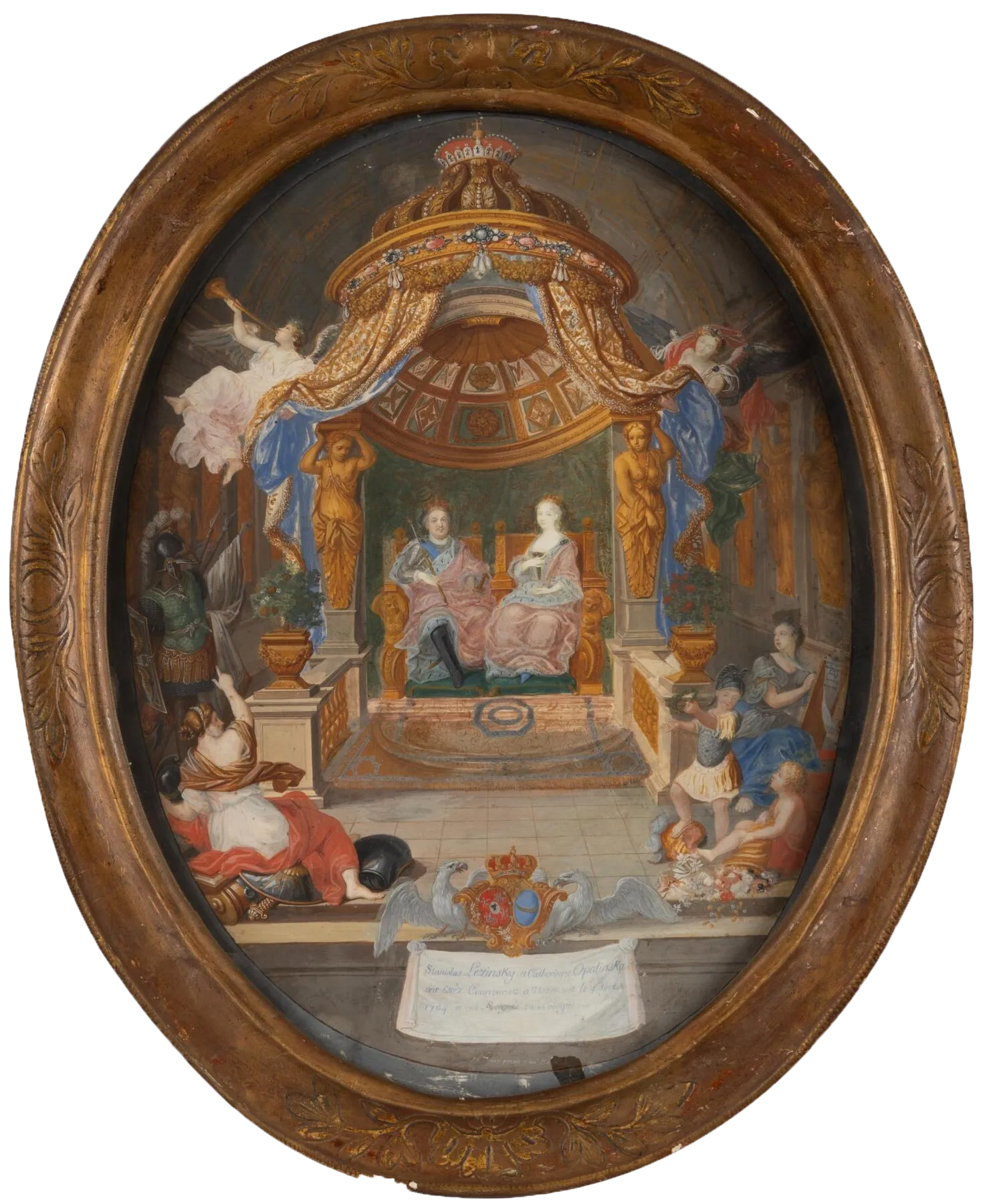
Stanislas returned to France, reaching the Château of Meudon on 4th June 1736. Meanwhile, the preliminaries to the Treaty of Vienna, ending the War of the Polish Succession, ceded the Duchies of Lorraine and Bar to Stanislas, reverting to France upon his death. On 30th September 1736, he permanently renounced the Polish throne while retaining his honorary title. In exchange for an annual pension, he left tax collection and administration to France. Taking possession in early 1737, real power lay with Antoine-Martin Chaumont de La Galaizière, Louis XV’s Chancellor. Excluded from governance, Stanislas devoted himself to arts, architecture, and philanthropy.
Established at the Château of Lunéville, he had secondary residences inherited from Duke Leopold or built for his pleasure fitted up: the Palace of Chanteheux, located near Lunéville and named the Trianon Lorrain; La Malgrange, where he stayed when visiting Nancy; Commercy, whose gardens he laid out in 1744 following the death of the Duchess Elisabeth-Charlotte, wife of Leopold; and Einville. The Place Royale de Nancy—today’s Place Stanislas—was his greatest architectural achievement, a vast urban development project that united the old and new town quarters through an ensemble of three squares: the Place d’Alliance, Place de la Carrière, and Place Royale, built in honour of the King of France.
Under his reign, the court of Lorraine flourished brillianty, his personality being largely responsible. He organized sumptuous concerts, night fêtes, theatrical performances, and balls that gathered numerous distinguished guests, where the Marquise of Boufflers (1711-1786), née Marie-Françoise-Catherine de Beauvau—who had replaced Katarzyna Opalińska in the King’s heart—shone brilliantly, along with Voltaire and Émilie du Châtelet. Stanislas’s court also welcomed Montesquieu, Helvétius, Moncrif, President Hénault, the geometer Maupertuis, Abbé Morellet, as well as notable Lorrainers such as Palissot, François Devaux, the physicists Vayringe and Duval, Saint-Lambert, and the chevalier de Boufflers—not to mention numerous passing foreigners like the Countess of Bentinck, Charles-Édouard Stuart, and many Poles including Stanisław Konarski. Prince philosophe and an accomplished gastronome, Stanislas Leszczyński was severely burned at Lunéville when his dressing gown caught fire near his fireplace on 5th February 1766, and after prolonged agony, he finally succumbed to his injuries at the age of 88 on 23rd February. As per his wishes, his entrails and heart were immediately transported to a cenotaph and placed in the church of Saint-Jacques at Lunéville, where they rested until the Revolution. His sumptuous mausoleum, however, sculpted by Louis-Claude Vassé in the church of Notre-Dame de Bonsecours at Nancy, and his colossal statue by Georges Jacquot, erected in 1831 on the Place Stanislas, survive to this day—two monuments celebrating the memory of the last Duke of Lorraine, which is still very much alive today.
The château of Lunéville, or Lorraine’s Versailles
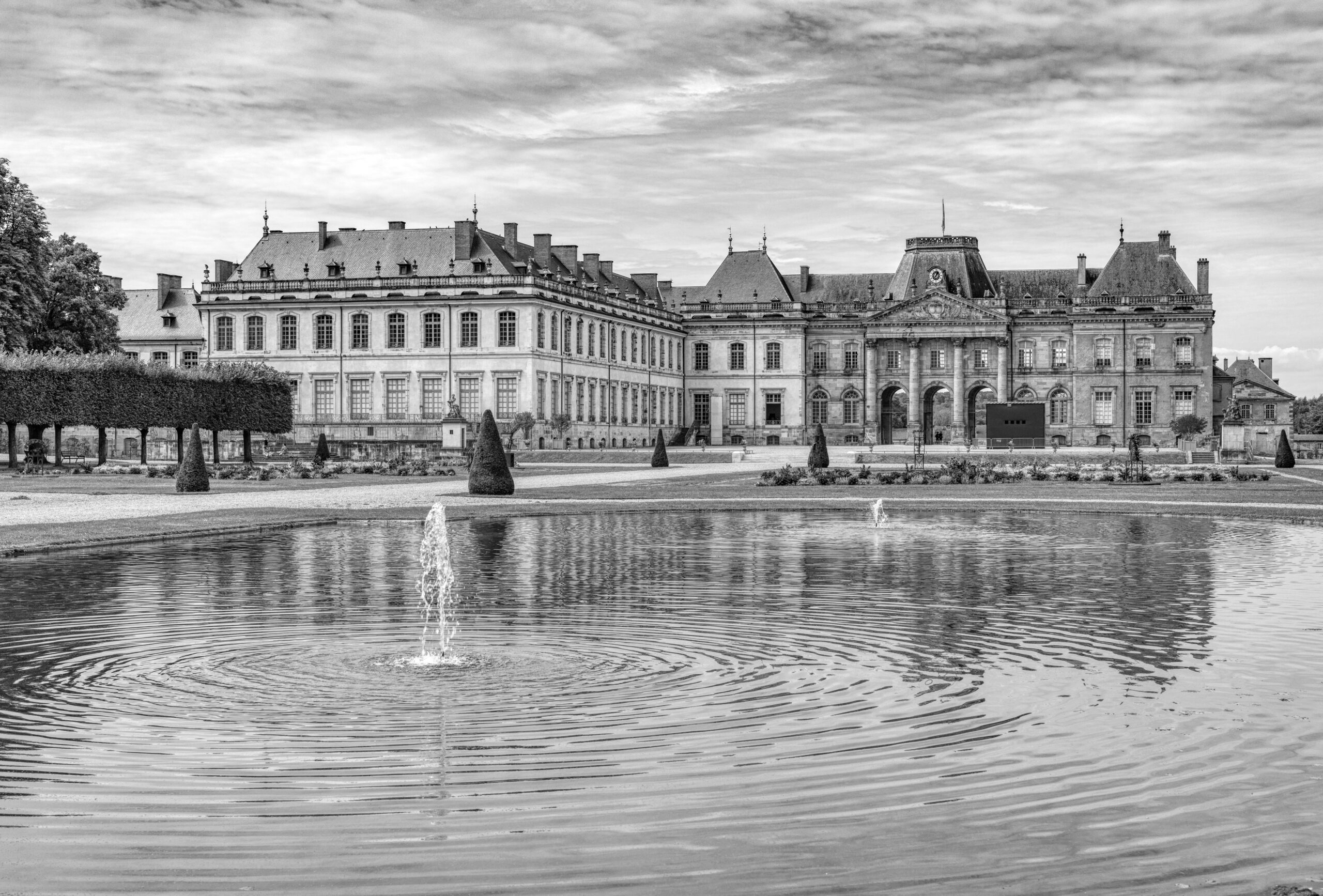
The residence of the Dukes of Lorraine since the 13th century—first occasional, then official from the 18th century—the Château of Lunéville was built for Duke Leopold I between 1703 and 1720 to designs by Pierre Bourdict, Nicolas Dorbay, and Germain Boffrand, without the north wing due to lack of funds, leaving it its current asymmetrical form.”
When Duke Leopold I regained possession of his duchies in 1697, he could not financially assume the renovation of the ducal palace at Nancy. During Louis XIV’s troops’ new occupation of the duchy, he retired to Lunéville and had the château entirely rebuilt, inspired by Versailles. He made it his principal residence and died there in 1729.
His son, Duke François III, was forced to cede his possessions for life to the exiled King of Poland, Stanislas Leszczyński. Upon the latter’s death in 1766, the duchy was annexed by France. Louis XV undertook to destroy many Lorraine châteaux but preserved Lunéville, where he installed his companies of Red Gendarmes.
A masterpiece of 18th-century architecture, the “Versailles lorrain” was classified as a historical monument in 1901 for its chapel and in its entirety in 1998.
The Gendarmes rouges in Lunéville
Under the Ancien Régime, the gendarmerie was heir to the gens d’armes (men-at-arms) units of the 15th and 16th centuries. These cavalrymen were assembled into compagnies d’ordonnance (ordinance companies), created on 26th May 1445, and distinguished from other cavalry—known thereafter as “light cavalry” by extension. These compagnies d’ordonnance combined gendarmes with archers—light cavalrymen tasked with supporting them. During the 17th century, the practical distinction between heavy and light cavalry faded, though their organization remained distinct. The first ordinance concerning the Gendarmerie de France was issued under Louis XIV in 1665, preserving its organization into companies rather than regiments (unlike light cavalry) and exempting these companies from the colonel général de la cavalerie. There were two types: gendarmes proper and chevau-légers, successors to the archers of the compagnies d’ordonnance. The Gendarmerie de France did not strictly belong to the king’s Maison militaire but remained a privileged corps akin to the Gardes-Françaises in the infantry. The privilege of commanding a gendarme company was reserved to the King and the fils et petits-fils de France (sons and grandsons of France), hence the name Gendarmerie du Roi et des Princes.
The number of gendarmerie companies thus depended de facto on royal favour. Only the first four, which formed what was then known as the Grande Gendarmerie, were permanent, the others having been created only for certain princes.
Upon the death of King Stanislas in 1766, the French gendarmerie comprised ten companies:
Grande gendarmerie:
– Gendarmes écossais (1st company – violet).
– Gendarmes anglais (2nd company – jonquille/daffodil).
– Gendarmes bourguignons (3rd company – vert).
– Gendarmes des Flandres (4th company – feuille morte/autumn dead leaf).
Petite gendarmerie:
– Gendarmes de la Reine, created for Queen Marie-Thérèse (5th company – rouge ponceau (poppy red)).
– Gendarmes du Dauphin, created for Louis de France, the Grand Dauphin (6th company – bleu céleste (sky blue)).
– Gendarmes de Bourgogne, created in 1660 (7th company – blue silk standard).
– Gendarmes d’Aquitaine, created in 1690 (8th company – blue silk standard).
– Gendarmes de Berry, created in 1690 for the Duke of Berry (9th company – bleu roi (king’s blue))
– Gendarmes d’Anjou (10th company), created in 1647 – renamed Gendarmes d’Orléans in 1667 – disbanded in 1775.
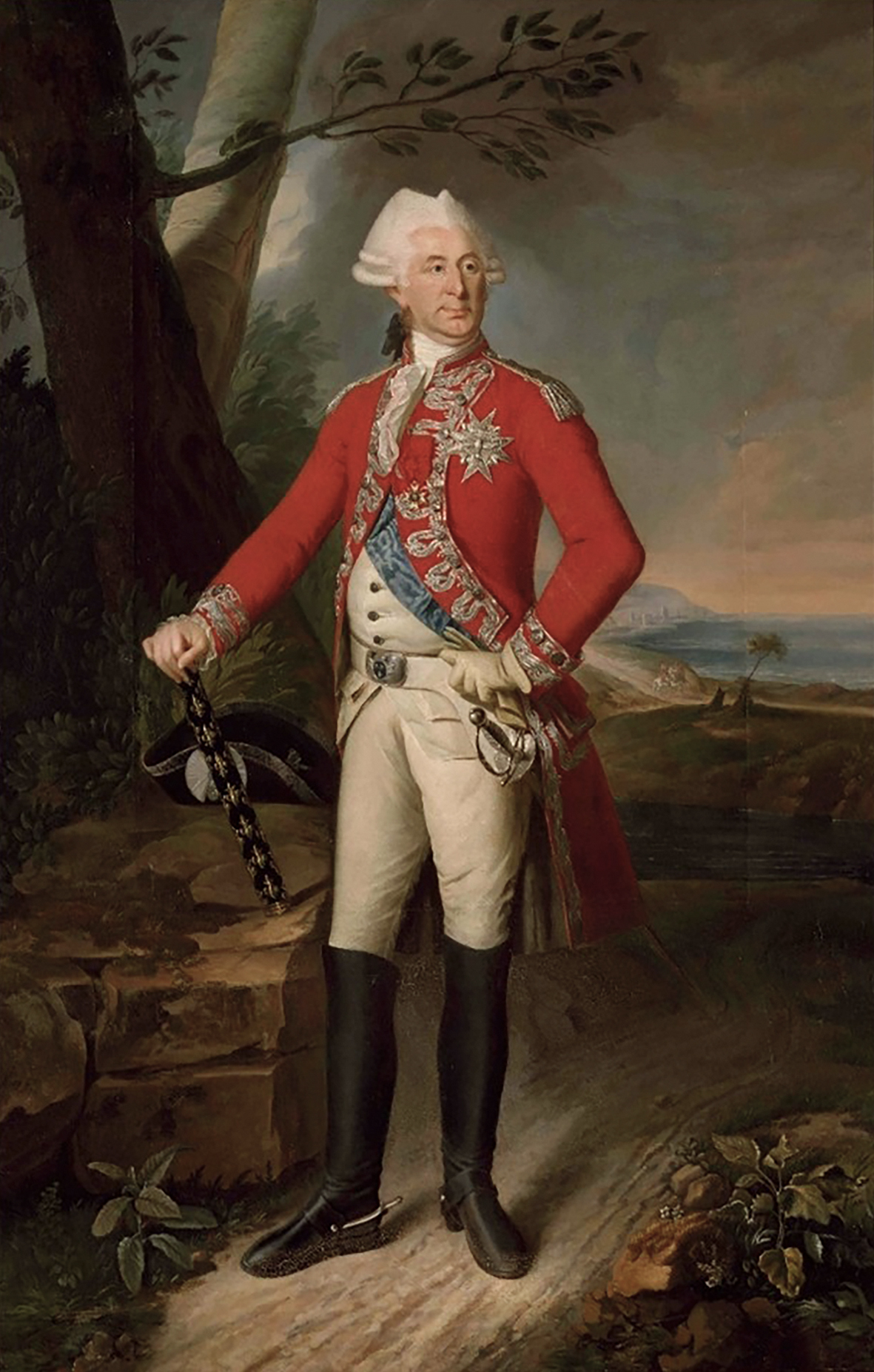
Louis XV placed the petite gendarmerie at the disposal of his father-in-law as early as 1763, and these companies, garrisoned at Lunéville, were henceforth known as the Gendarmerie de Lunéville; in 1766, all ten companies were assembled there under the successive command of two capitaines-lieutenants of the King’s 1st company of gendarmes Ecossais du Roi: from 1766 to 1770, Louis-Marie (1744–1782), Count of Mailly d’Haucourt, later 1st Duke of Mailly; then, from 1770 to 1788, Charles Eugène Gabriel de La Croix (1727–1801), Marquis of Castries and Marshal of France (1783)—both occupying Stanislas’s former apartments at the Château of Lunéville, refurbished for their use.
Of the ten companies, three occupied the château, and the others were distributed between the Orangerie, the Hôtel des Cadets, the Hôtel des Gardes du Corps, and the Vénerie. Their ancillary services requisitioned numerous buildings scattered throughout the town of Lunéville. This presence was to last until 1788, when the entire gendarmerie of France was disbanded. In 1791, the Assemblée Législative also abolished the maréchaussée and replaced it with the gendarmerie nationale, but this name, taken from that of the gendarmerie de France—which oversaw the maréchaussée at the time—had nothing in common with what that Ancien Régime elite corps had been.