

Carved and gilded wood.
H. 46.5 cm. (18 ½ in.).
Legs: L. 73.5 cm. (29 in.); Depth 46 cm. (18 ¼ in.).
Seat: L. 69 cm. (27 ¼ in.); Depth 49.5 cm. (19 ½in.).
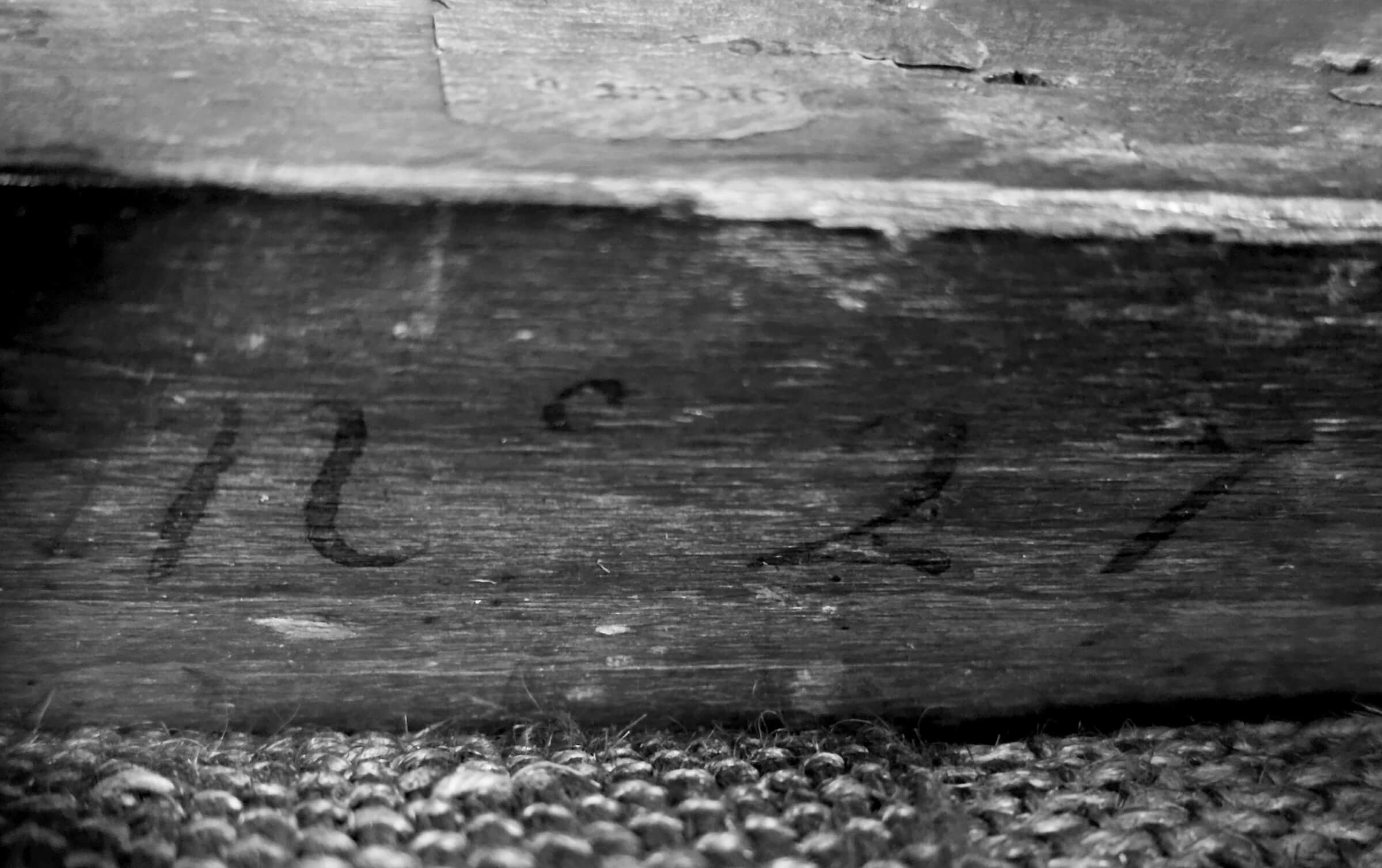
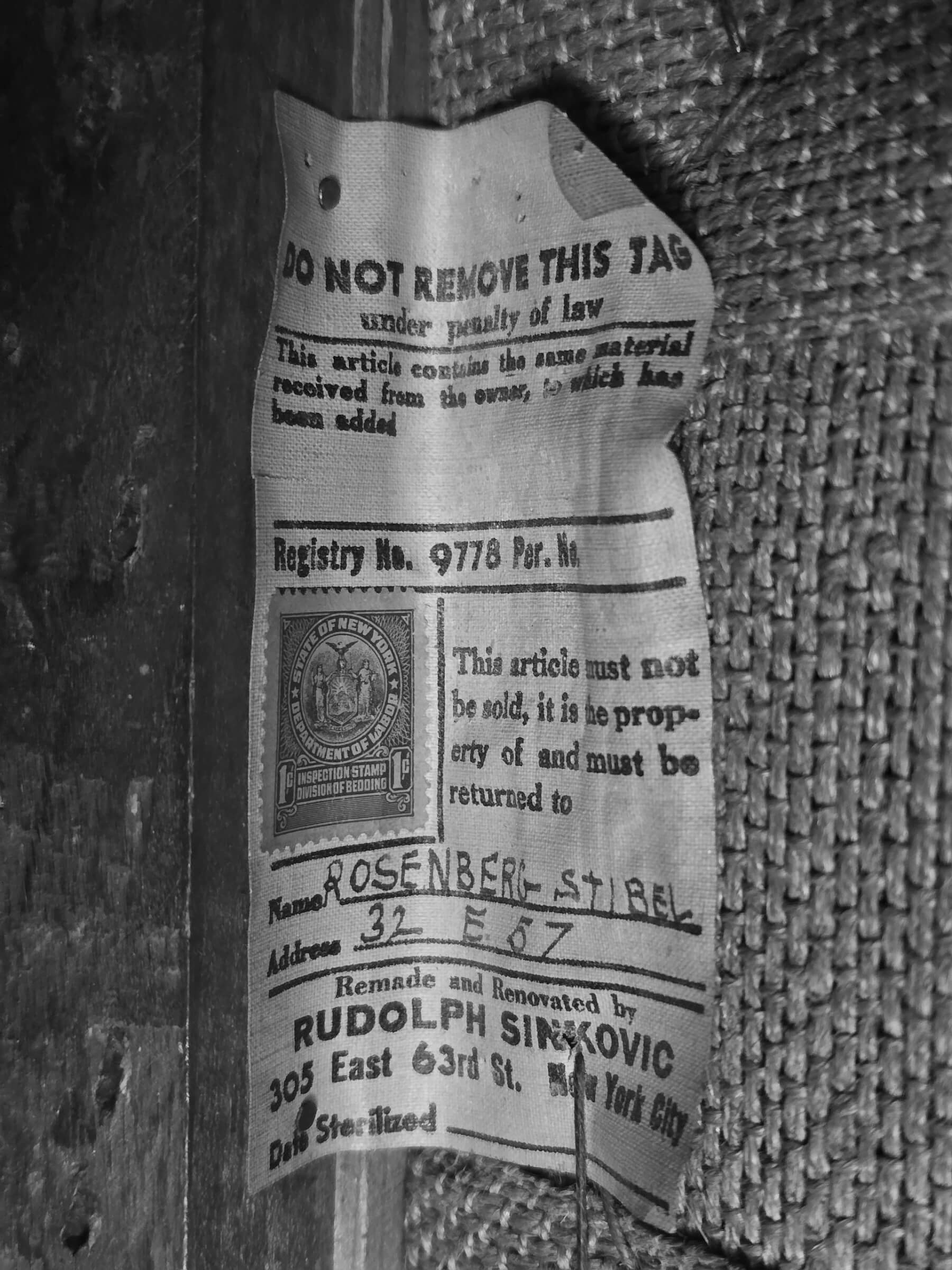
MARKS AND INSCRIPTION: Suivant l’ordre du/CHATARD, Peintre & Doreur/ Fauxbourg Montmartre/à Paris, printed label of the gilder Louis-François Chartard (partially torn) affixed beneath the left side rail of the folding stool’s seat; N° 27, an 18th-century number painted twice in black ink in cursive on the reverse of the side rails of the folding stool’s seat; a rectangular label of beige canvas, printed and stamped, dated to the 1930s, from the upholsterer Rudolph Sinkovic, established at 305 East 63rd Street, New York, bearing the handwritten notation in black ink by the owner at the time—Rosenberg & Stiebel, New York—affixed to the reverse of the rear rail of the folding stool’s seat.
PROVENANCE: executed under the supervision of Jean Hauré, contractor to the Meubles de la Couronne, and delivered in 1786 (first delivery) or in 1787 (second delivery) for the salon des Jeux of Queen Marie-Antoinette at the Château of Compiègne (64 folding stools altogether); René Weiller collection, Paris; Rosenberg & Stiebel collection, New York.Bibliographie : Rodolphe Pfnor, Art industriel, Le mobilier de la Couronne et des gdes collections publiques et particulières du XVIIIe siècle au XIXe siècle, Vol. III, Paris [1875], pl. 34 ; Pierre Verlet, « Les meubles sculptés du XVIIIe siècle ; quelques identifications », Bulletin de la Société de l’Histoire de l’Art français, Paris, 1937, fasc. II, p. 259-263 ; Pierre Verlet, Le mobilier royal français, I, Meubles de la Couronne conservés en France, Paris, 1990 (rééd.), p. 84-87, cat. n° 32, pl. XLVI ; Yves Carlier, notice n° 32 du catalogue de l’exposition Louis XVI et Marie-Antoinette à Compiègne, présentée au musée national du château de Compiègne du 25 octobre 2006 au 29 janvier 2007, Paris, 2006, p. 182-185, cat. n° 32.
LITERATURE: Rodolphe Pfnor, Art industriel, Le mobilier de la Couronne et des gdes collections publiques et particulières du XVIIIe siècle au XIXe siècle, Vol. III, Paris [1875], pl. 34; Pierre Verlet, “Les meubles sculptés du XVIIIe siècle; quelques identifications”, Bulletin de the Société de l’Histoire de l’Art français, Paris, 1937, fasc. II, pp. 259–263; Pierre Verlet, Le mobilier royal français, I, Meubles de la Couronne conservés en France, Paris, 1990 (repr.), p. 84–87, cat. no. 32, pl. XLVI; Yves Carlier, entry no. 32 in the catalogue of the exhibition Louis XVI et Marie-Antoinette à Compiègne, held at the Musée national du château de Compiègne from 25th October 2006 to 29th January 2007, Paris, 2006, pp. 182–185, cat. no. 32.
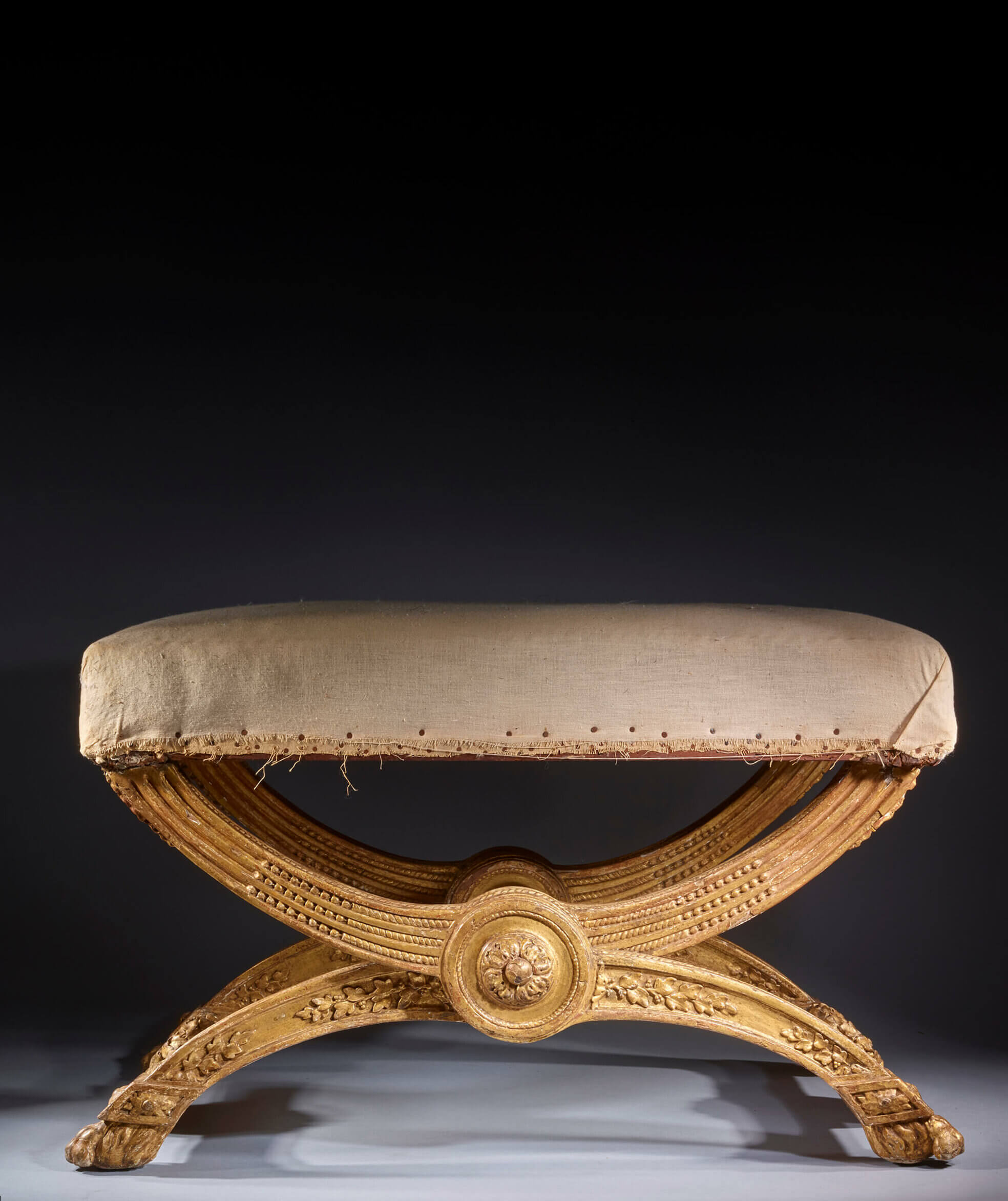
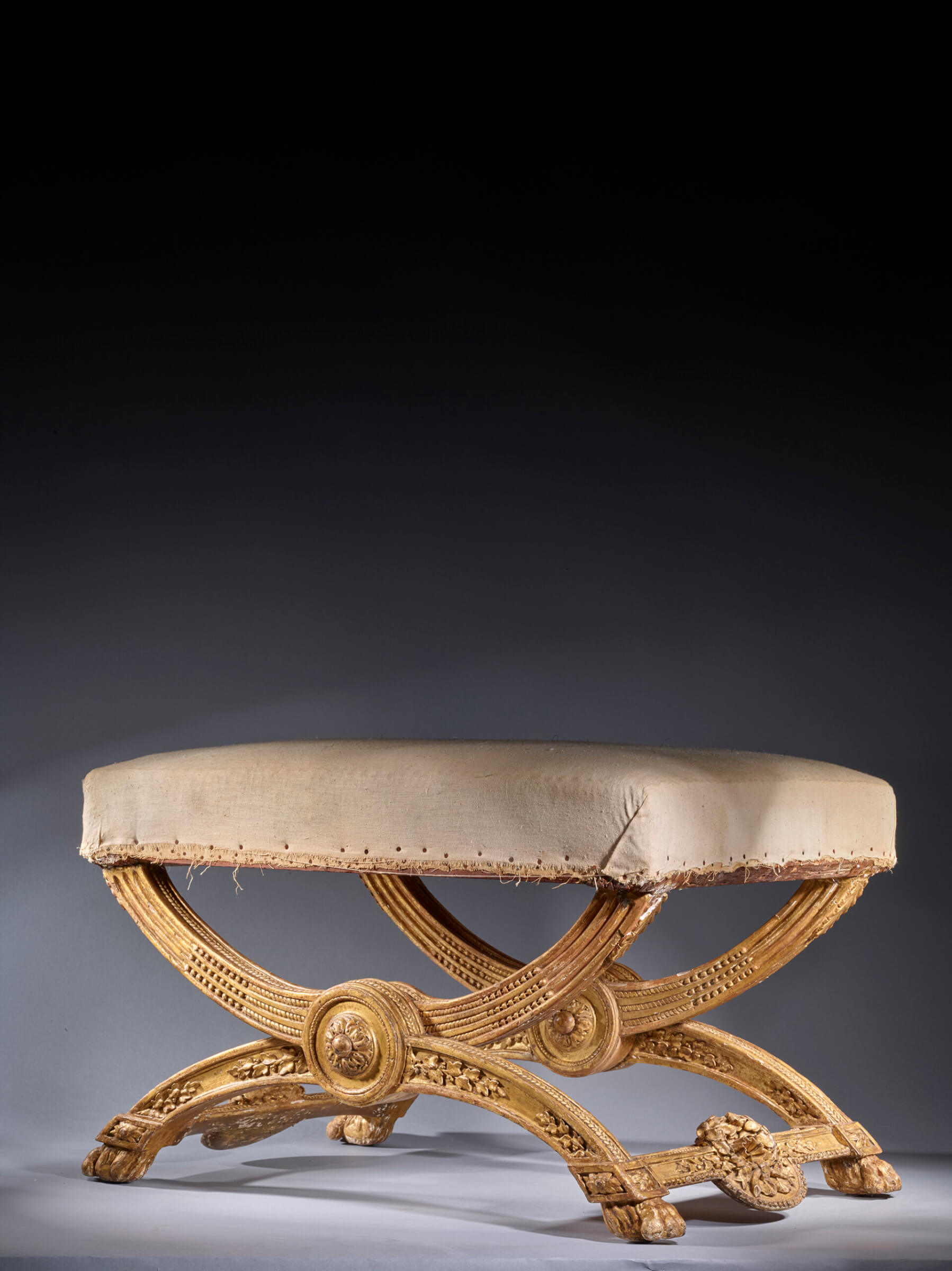
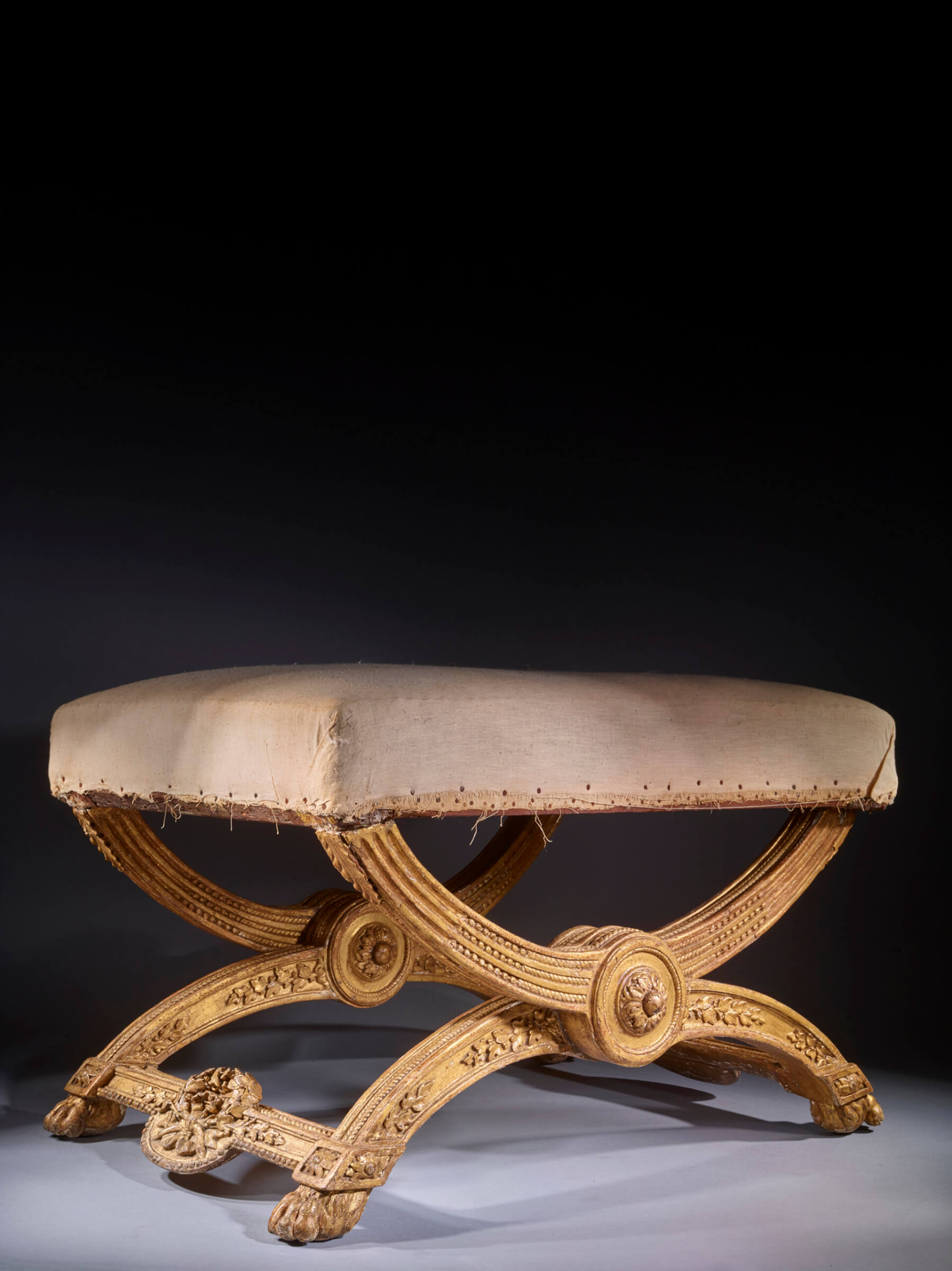
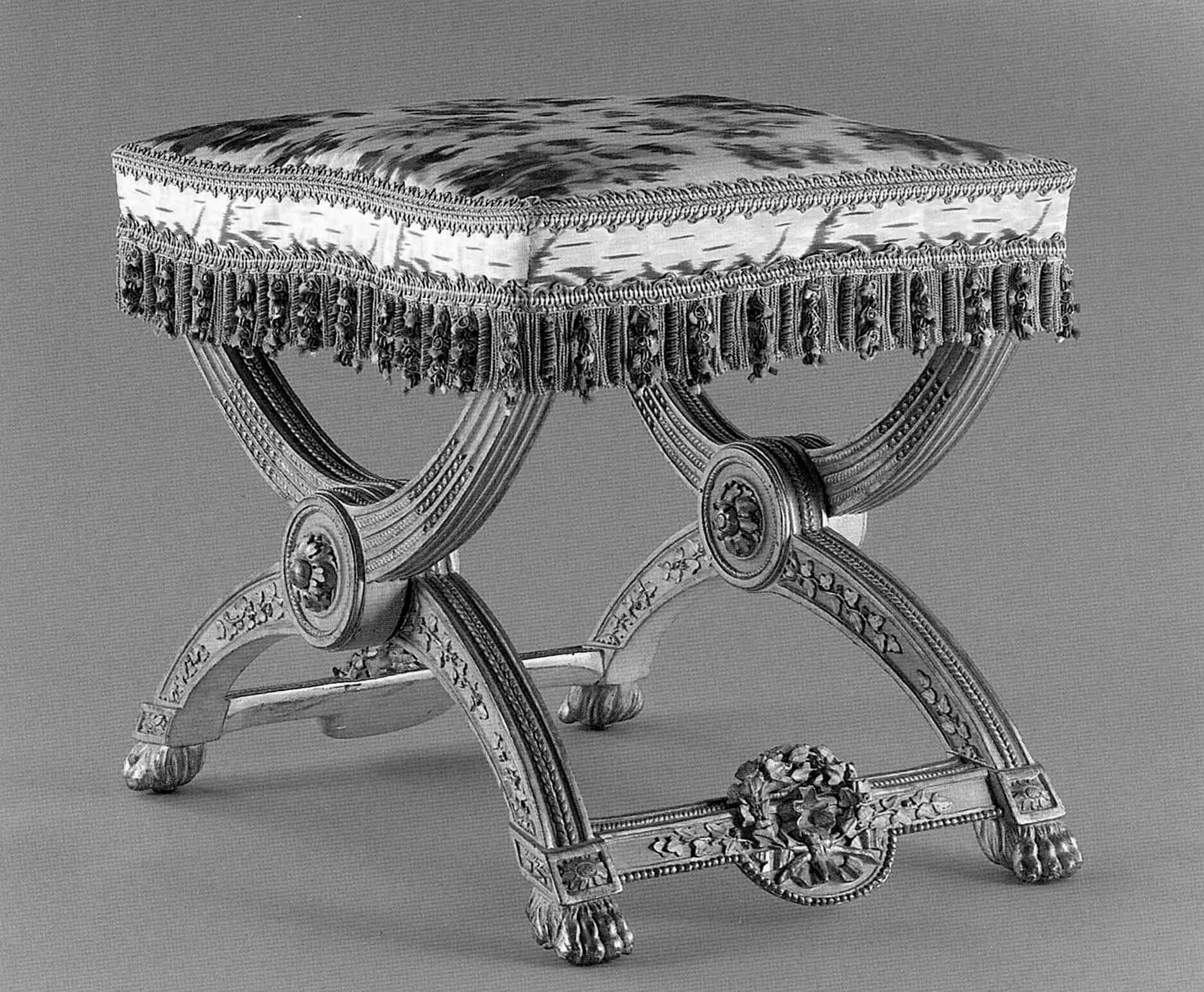
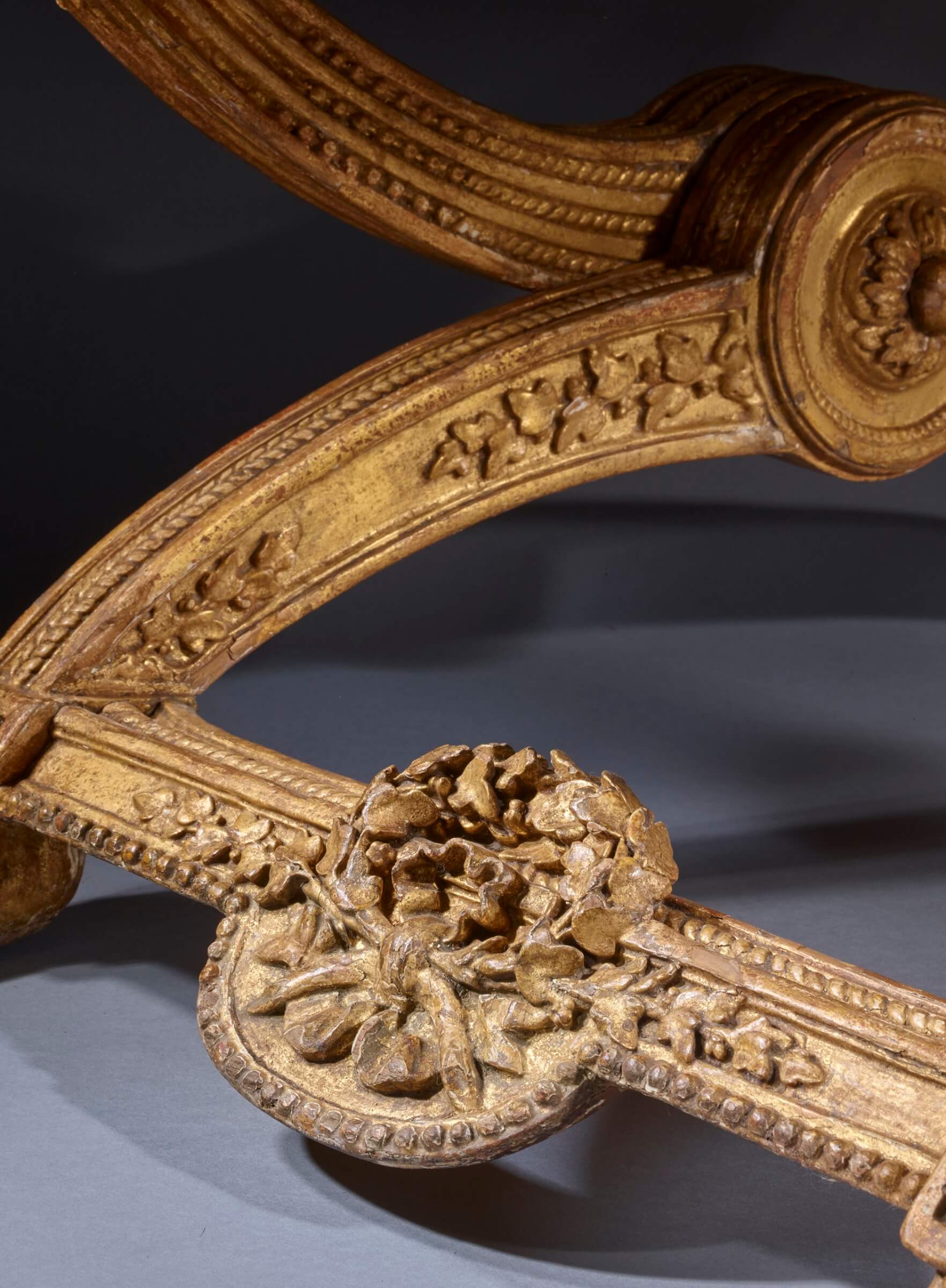
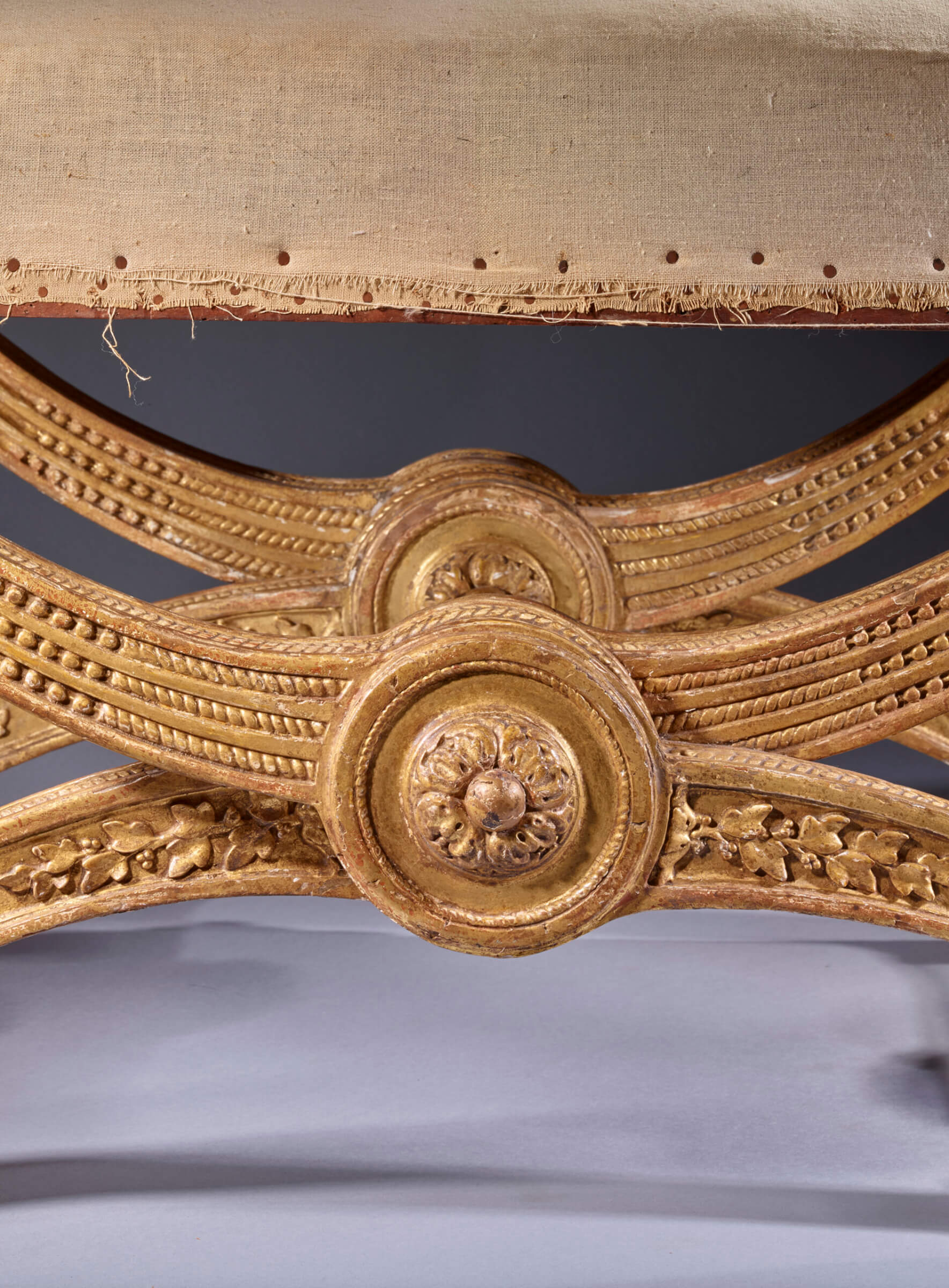
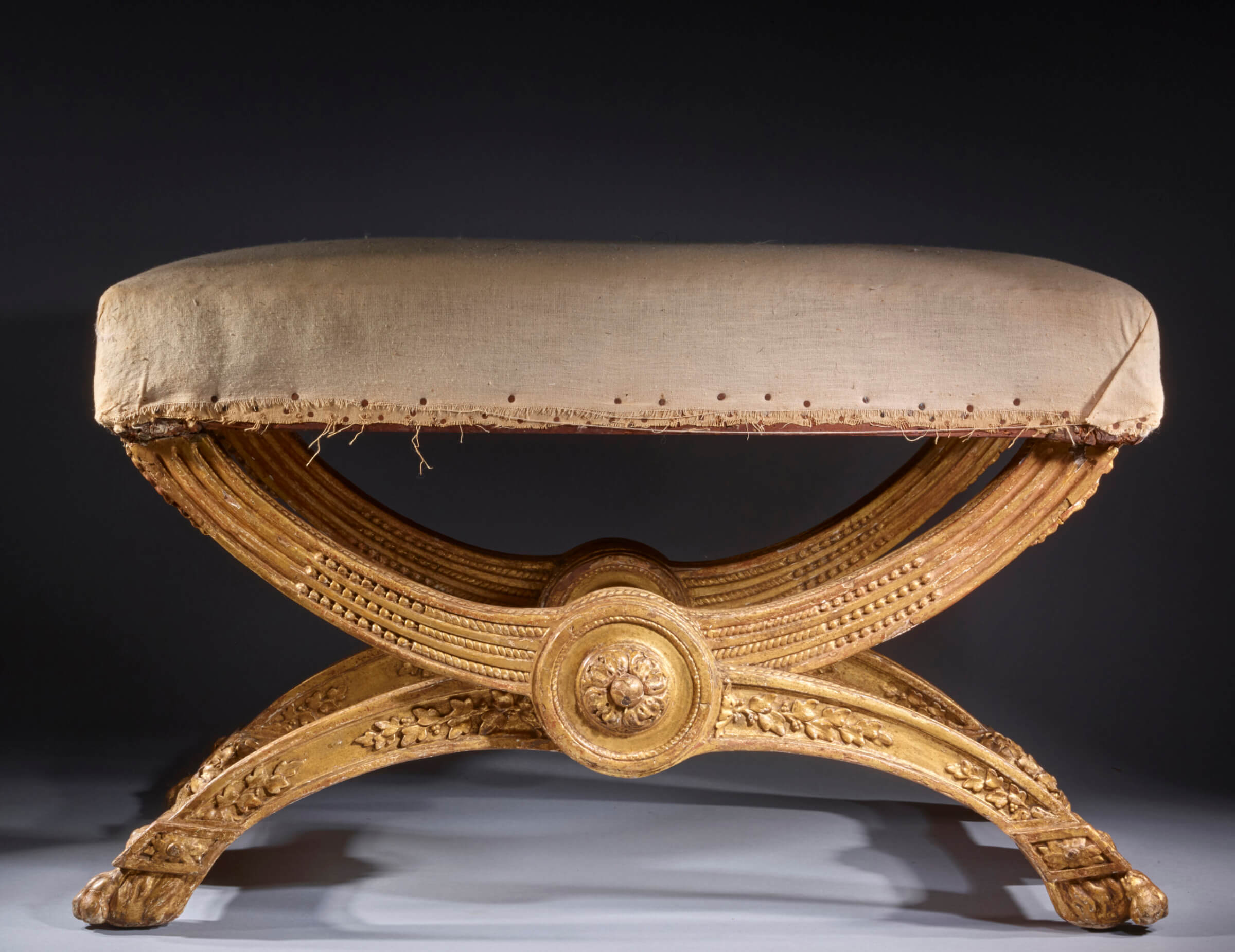
This sumptuous folding stool, in painted, moulded wood, very finely carved and fully gilded, was executed under the supervision of Jean Hauré, contractor to the Meubles de la Couronne, and delivered in 1786 or 1787 for the salon des Jeux (games room) of Queen Marie-Antoinette at the Château of Compiègne. It bears the no. 27, inscribed in cursive script in black ink on the reverse of the two side rails of its seat, and was part of a set of sixty-four folding stools of this model that were intended to furnish the Queen’s games rooms at Compiègne (40) and Fontainebleau (24) respectively. X-shaped and remarkably well-balanced in its design, this folding stool draws its inspiration from the antique repertoires very much in vogue under Louis XVI at the time—acanthus rosettes, cable fluting with corded motifs and beaded mouldings, ear-of-wheat mouldings, rosettes and lion’s claws—whilst retaining a subtly naturalistic vein in the treatment of the branches and ivy-entwined wreaths, the latter adorning the side rails of the seat, a style described by Pierre Verlet as “antique fleuri” (florid antique), which the Queen was so fond of.
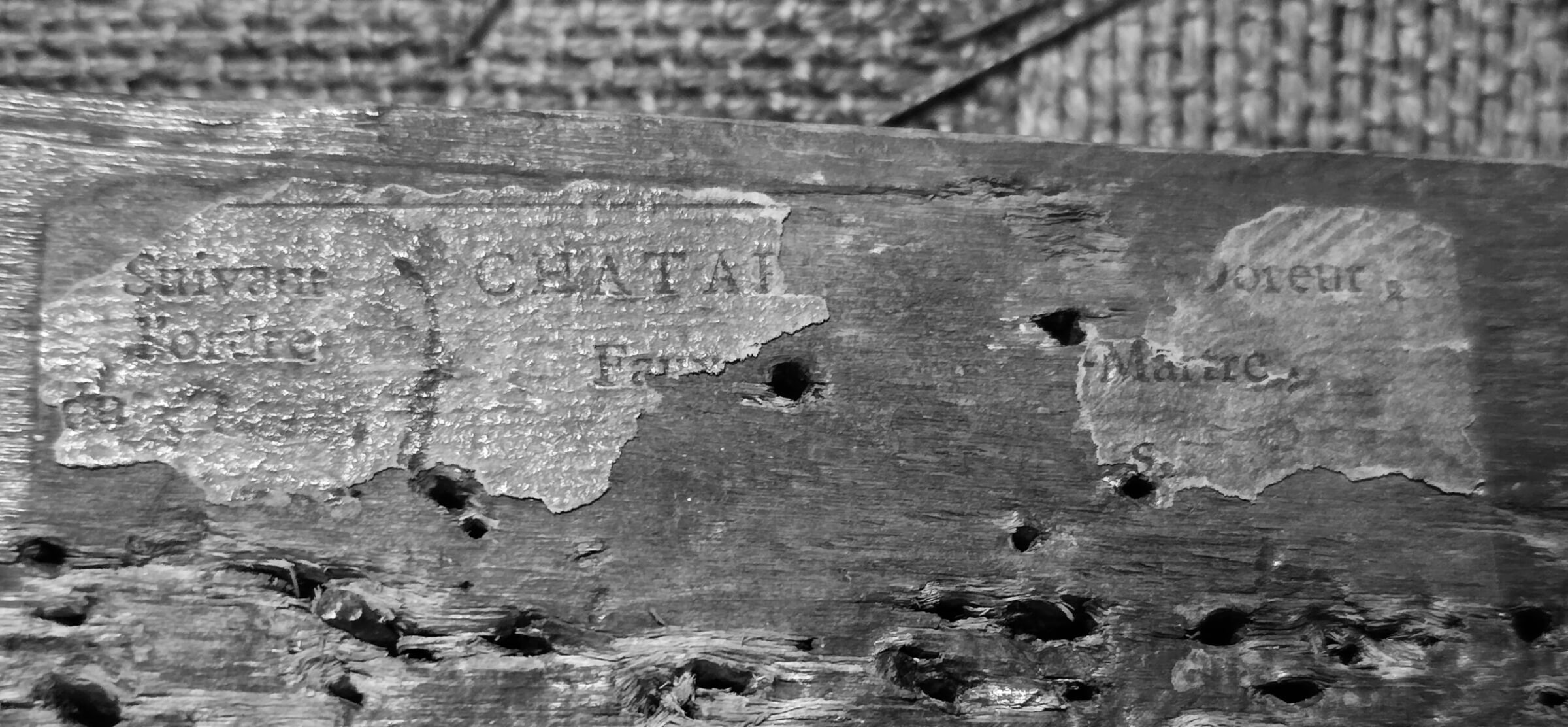
On 1st May 1786, Hauré received, under reference no. 124, an order to execute for the salon des Jeux of the Queen at Compiègne “40 folding stools, 12 tabourets (stools) […] one screen”, as well as a six-leaf screen, the woodwork for which was entrusted to Jean-Baptiste-Claude Sené (1748–1803), the carving of the folding stools and the panel screen to Nicolas-François Vallois (1744–1788), that of the tabourets to Lambert Charny and of the fire screen to Jean Guérin. All the gilding, with a “ground rechampi en blanc (picked out in white) to impart it with a lighter appearance”, was carried out by Louis-François Chatard (1749–1819). Finally, the upholstery chosen for this ensemble was a “taffetas chiné gros de Tours (warp-printed), manufactured by Sr Pernon [a member of a famous dynasty of Lyon-based silk marchands-fabricants]…, featuring a design of trees, arbours and hollyhocks”, which the upholsterer Claude-François Capin (1727–1789), tapissier ordinaire to the King, was commissioned to install.
No sooner had they been executed than twenty-four of the forty folding stools mentioned above, together with the twelve tabourets, the fire screen and panel screen, were sent, on 1st October 1786, to the Château de Fontainebleau to furnish the Queen’s Grand Cabinet, which had just been redecorated and which she had had converted into a games room. The ensemble, which was refitted with new upholstery on this occasion, was to remain there until the Revolution:
“Ist 8ber 1786. Sent from the Crown’s Garde-Meuble to Fontainebleau. Queen’s Games Room. In painted satin, 19 folding stools, 5 tabourets, trimmed with fringing […]
2nd 8ber 1786. Sent from the Crown’s Garde-Meuble to Fontainebleau […] the Queen’s Games Room. 7 tabourets, 5 folding stools, upholstered in white-grounded peckin (striped silk), the woodwork carved and gilded”.
The aim at hand was to respond, as a matter of urgency, to the sovereign’s demands, as she was keen to have her apartments at Fontainebleau furnished in the latest of styles before the Court’s traditional autumn residence: “To ensure greater speed in executing these furnishings, the woodwork for the folding stools, tabourets, folding screen and fire screen is to be taken from the furnishings in the Queen’s Games Room, which will be replaced for the month of June 1787 at Compiègne.” The ensemble was entered in the château’s inventory drawn up that same year, 1786: “24 folding stools/12 tabourets /1 fire screen/1 panel screen/covered in painted satin with a white ground; the folding stools and tabourets trimmed with a 4-inch fringe with cartisane heading, jasmine and twisted shaded silk; the woodwork richly carved, painted white and picked out in gold.”
So as to ensure that the Queen’s Games Room at Compiègne was not left partially unfurnished, Hauré received, on 3rd September 1786, under number 228, an order to replenish the room’s furnishings in kind: “[…] this item should not suffer any reduction. Please refer to the Compiègne item for the second half of 1786, order dated 1st May, no. 124, which is entirely identical.” Hauré’s memorandum, dated to the first half of 1787, lists the same team to that effect as that designated for the first order placed on 1st May 1786, adding to it the name of the gilder Chaudron:
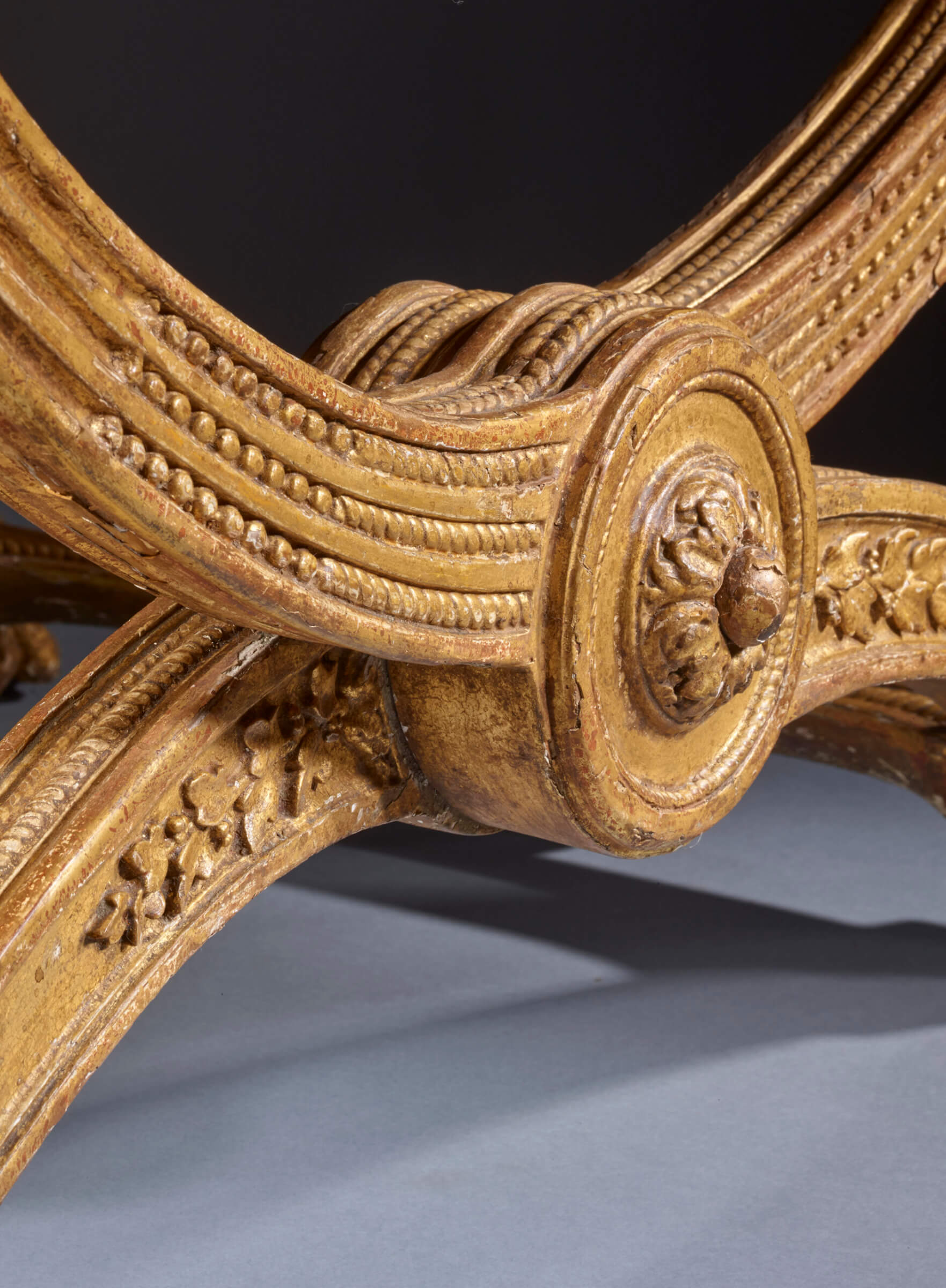
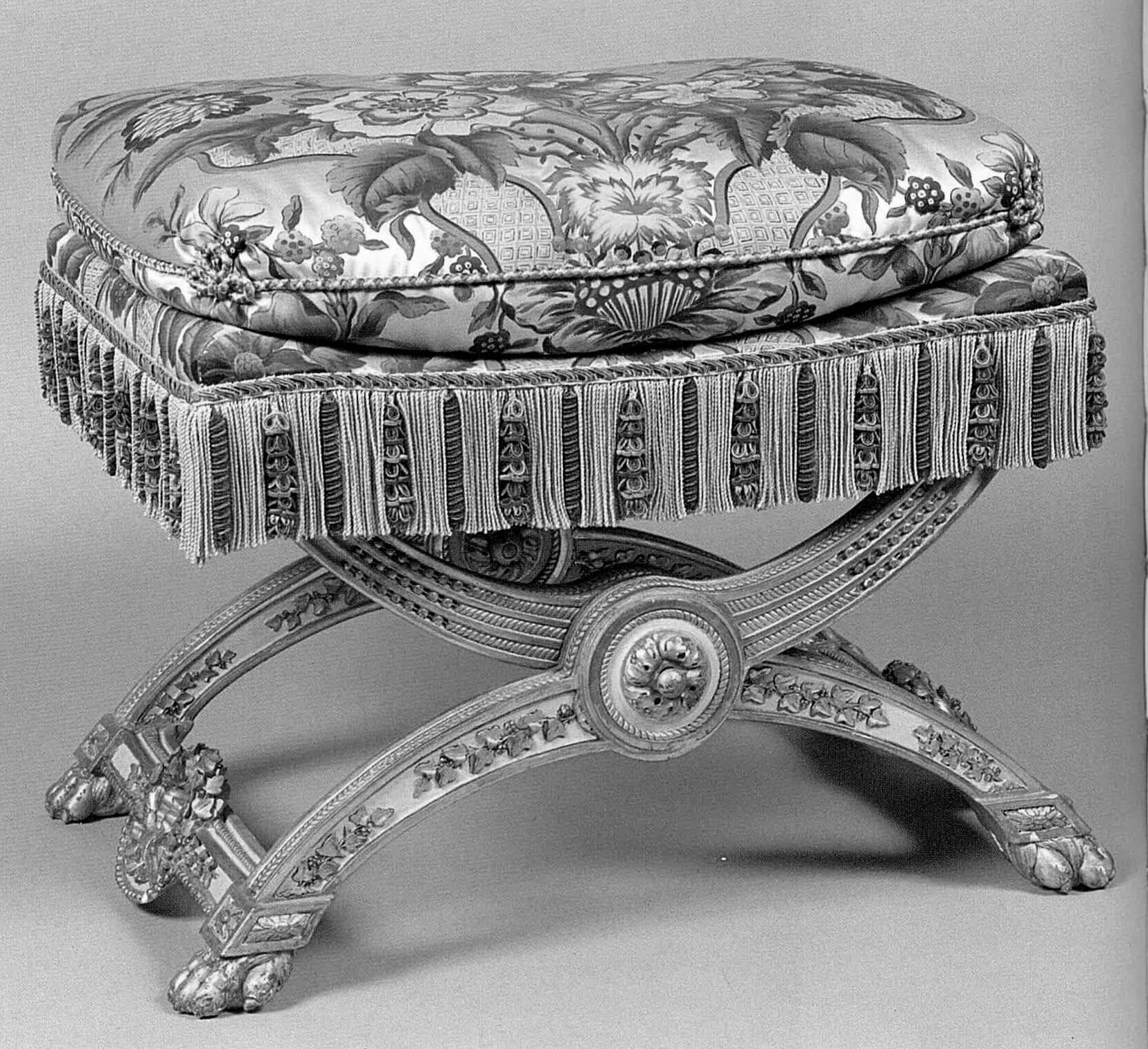
Compiègne. Month of 7ber, the 3rd. No. 228. For the service of the Queen. Games Room/Vallois. – For the carving on 24 folding stools in the so-called X-shape, with a rosette in the centre of the uprights in the reinforced sections, sprigs of ivy leaves, on the runners’ crossbars crowns of ivy leaves and mouldings carved in rope patterns, with the runners supported by lion’s claws, for one folding stool 56¹, the full 24 folding stools………………………………………………………………………………….…..1,344l.
Chaudron – For the gold-leaf gilding executed on the 48 bolts, at 15s per end, making 30s per bolt and 3l per folding stool, the full set of 48 bolts……….………………………………..72l.
Memorandum of Chatard. 1st half of 1787/Compiègne. For the service of the Queen. 3rd Septem. 1786. No. 228. Delivery of the gilding and picked out in white, with great care, of 24 folding stools carved with ivy crowns, the price of which is set at 118l a piece, for the full 24 together amounting herein………………………………………………………………………2,832l.”
“Memorandum of Capin/Compiègne. Queen’s Games Room. Upholstery of twenty-five [sic] folding stools in coutil (ticking) and feathers, covered in gros de Tours chiné (warp-printed) [that delivered by the Maison Pernon], adorned with said border and silk fringe, the woodwork of which gilded and picked out in white, at 12l each………………….……………………………………………………………….…300l.”
If we are to go by the Compiègne inventory of 1788, each of the folding stools was at the time valued at 360 livres. This duly replenished ensemble was also described in the château’s inventory drawn up in 1791: “Queen’s Grand Cabinet or Games Room. 54. – A meuble (furnishing) of gros de Tours chiné (warp-printed), featuring a design of arbours and trees in verdure, at the foot of which are to be seen beds of hollyhock motifs, the border with a matching design of guilloche roses and foliage likewise with a gold-coloured ribbon, edged with cresting and fringe, comprising […] 40 folding stools, 12 tabourets, 1 panel screen […] 1 fire screen, all upholstered in the same warp-printed fabric as the tapestry, with a border of aurora olive leaf and adorned with a shaded fringe matching the furnishing, the woodwork richly carved, gilded and picked out in white.”
During the Directoire (1795–1799), this ensemble was transferred in its entirety to Paris on 12th floréal Year V [1st May 1797], to furnish the Palais Directorial, the present-day Palais du Luxembourg: “12 floréal Year V. Service of the Palais Directorial […] No. 54. A furnishing of gros de Tours chiné (warp-printed), etc…forty folding stools upholstered with their feather cushions, twelve upholstered tabourets, one panel screen […] one fire screen, all covered in the same fabric, etc […]”
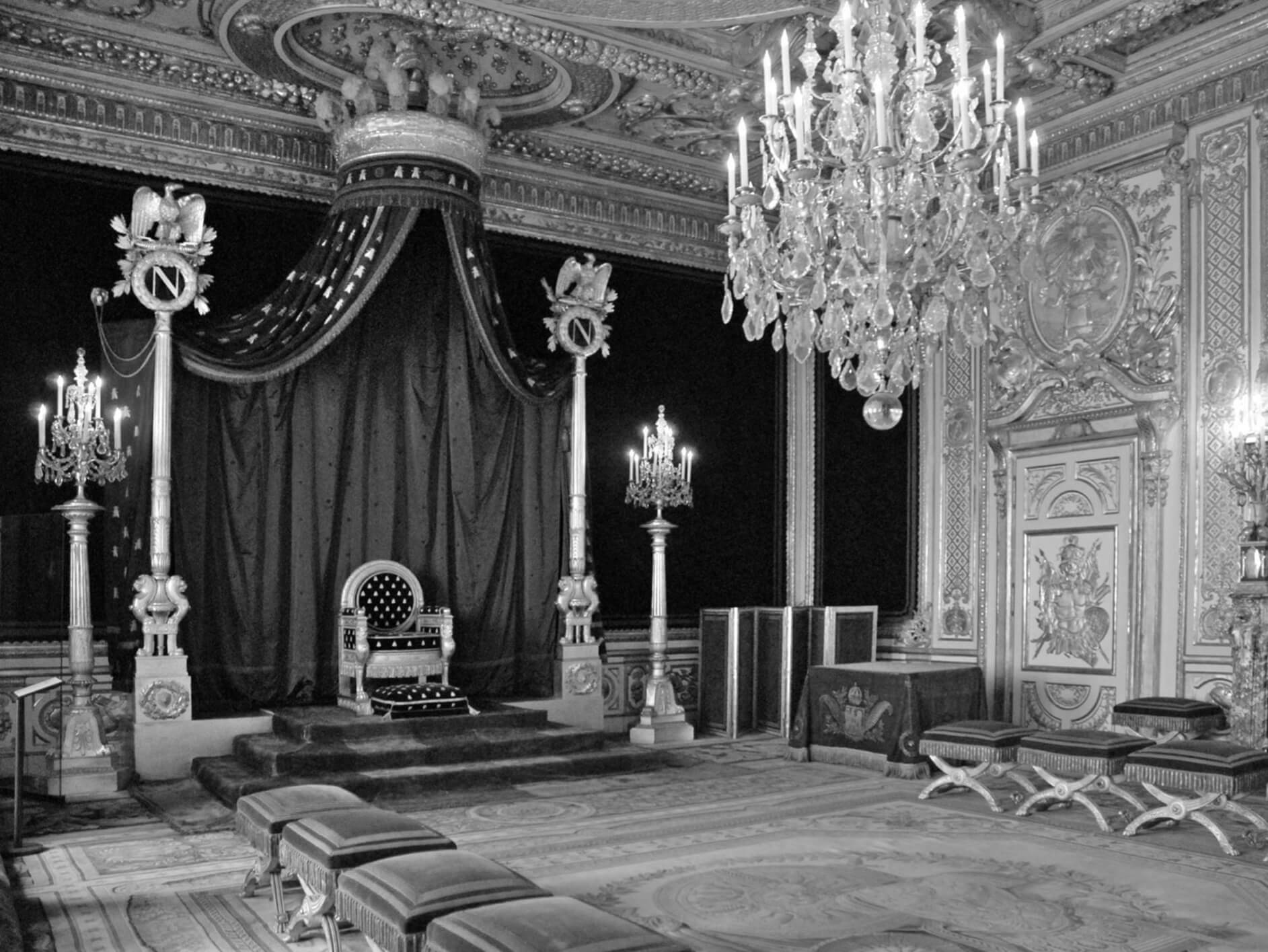
Following this period at the Luxembourg, the ensemble was subsequently placed, as early as from the Directoire, at the Palais des Tuileries—some of the folding stools now catalogued do indeed bear the stamp Pls des TUILes—but afterwards, unfortunately, all trace of them is lost, with the exception of twenty-four folding stools which were sent during the Empire to furnish the apartments of Napoleon I. During this period, the frames of these folding stools—in addition to their original upholstery, which had been replaced by red velvet trimmed with gold braid—lost their white and gold appearance, which was replaced by solid gilding. From April 1806, twelve of these Compiègne folding stools were henceforth placed in Napoleon I’s Bedchamber at Fontainebleau:
“Memorandum of Rode, sculptor, 1806 – Twelve gilded and carved folding stools, composed of fluting and pearls within the aforesaid fluting, and very ornate crossbars consisting of vine wreaths, surrounded by pearls, with lion’s paws supporting the said folding stools. For having reattached many pieces and rejoined them together, for the sum of 50 francs.
Memorandum of Chatard, painter-gilder, for the Emperor’s service at Fontainebleau. Tender – Delivered the restoration of the gilding, fully executed and in accordance with the tender dated 14th March 1806, no. 8, for twelve folding tabourets, which were intended for the Bedchamber of His Majesty the Emperor, the price of which is set at ninety-six francs each………….1,152 fr.
Memorandum of Courtat, upholsterer. Tender of 6th April 1806. – Execution of 12 gilded wood folding stools, covered in crimson silk velvet, adorned with fringe and a double border of fine gold braid, at nine francs each, including incidentals……………………………….108 fr.”
To this initial series of twelve folding stools were soon adjoined a further twelve, bringing the total to twenty-four, which were inventoried as early as 1808 and in all the inventories drawn up throughout the 19th century, in the Throne Room of the Château de Fontainebleau, where they are still held to this day (inv. F. 72, F. 264, F. 303, F. 318, F. 595). The numbers written in ink on the crossbars of the stools indicate that some of them belong to the first delivery, that of 1786, whilst the others belong to that of 1787. In 1966, six of these stools were removed from the Throne Room to be placed in the Queen’s Games Room, whose furnishings were being restored at the time, a reminiscence of some of the twenty-four stools from the original 1786 series, which has since vanished. They were repainted in white and gold and covered with a copy of the white-ground pékin fabric that had originally formed part of the Queen’s furnishings of that room. The fire screen and panel screen that were joined to them did not reappear until later.
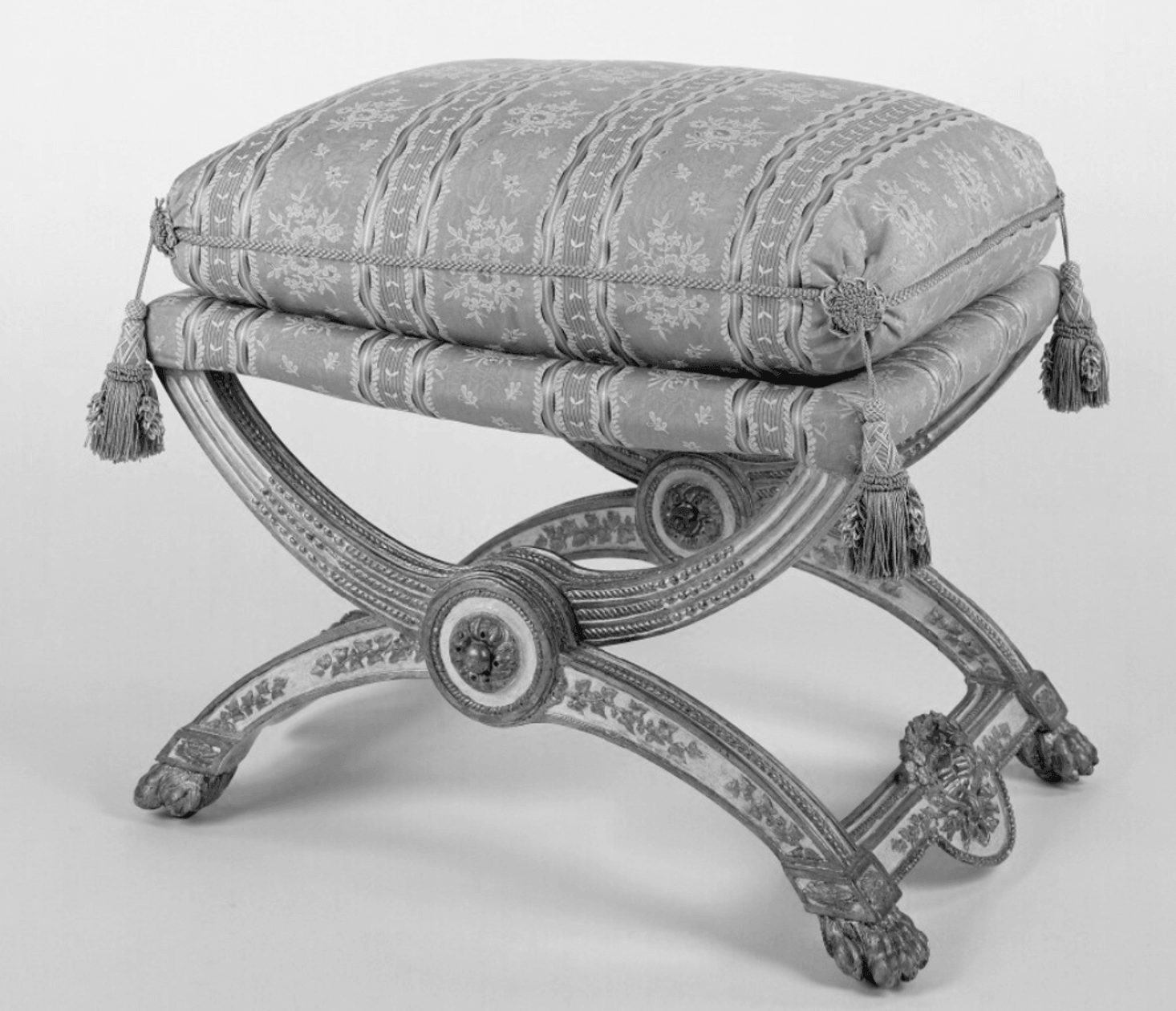
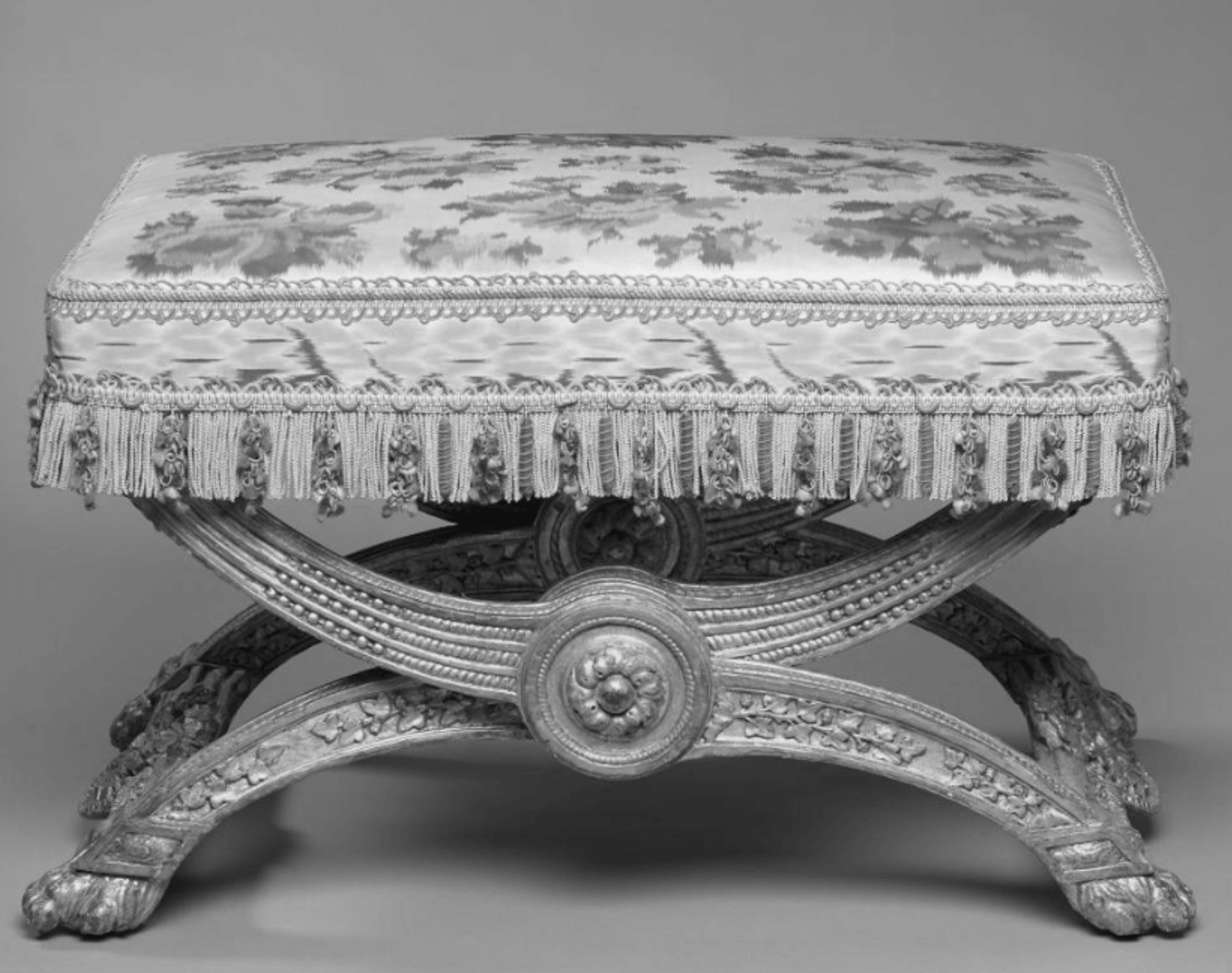
Of the sixty-four folding stools in all executed in 1786 and 1787 under Hauré’s supervision for the Queen’s Games Rooms at Compiègne and Fontainebleau, apart from the twenty-four preserved at the Château de Fontainebleau which have just been mentioned, and N° 27 presented here, others have since come to light. Four folding stools, restored to their original condition, are now held at the Château de Compiègne, having been acquired in 1945 (inv. C. 45.004 and C 45.005), in 1951 (inv. C 51.028) and in 1957 (inv. C 57.002) respectively. They no longer bear any early markings, except for one which bears the Tuileries brand mark used during the Restauration and a figure which is difficult to read: 13 or 19. Two other folding stools, painted in white and gold, belong to the J. Paul Getty Museum in Los Angeles (inv. 71.DA.94), both of which bear the Tuileries brand mark used during the Restauration. Originally from the collection of Charles Michel in Paris, these folding stools were sold by him on 5th August 1933 to Anna Thomson Dodge (1871–1970). Resold as part of Mrs Dodge’s estate by Christie’s in London on 24th June 1971, lot no. 69, they were acquired by the firm French & Company, which subsequently offered them to the museum.
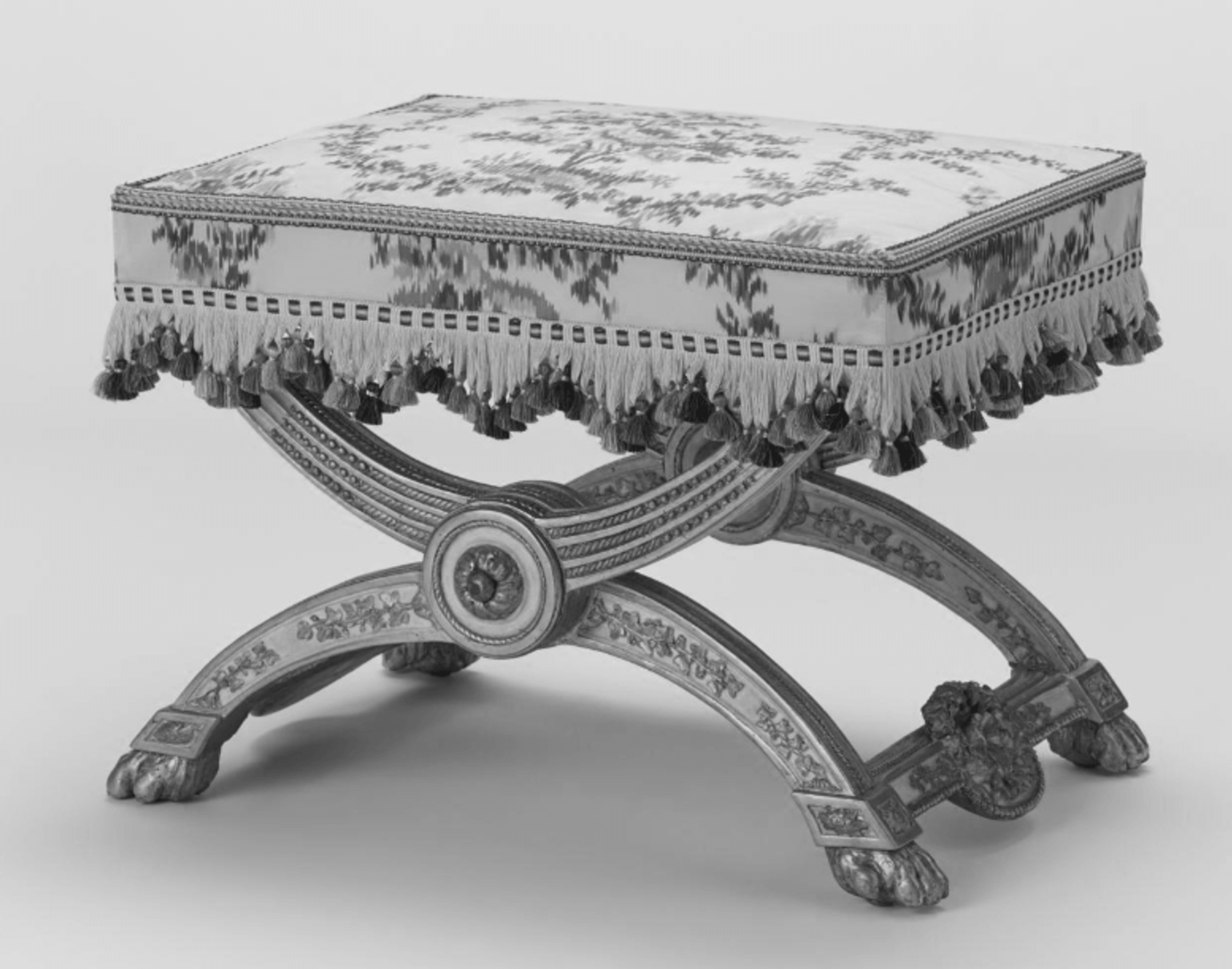
Another pair is held at the Cleveland Museum of Art (John L. Severance Fund 1954.385), after belonging to Rosenberg & Stiebel, Inc., New York. These folding stools no longer bear any markings, with the exception of an illegible number adorning one of them. It is worth noting, however, that they are fully gilded, just like our own, which is evidence enough that it was not only the twenty-four folding stools sent to Fontainebleau in 1806 that underwent this transformation during the Empire. Also worth mentioning is a pair, painted in white and gold, which belongs to the Philadelphia Museum of Art (inv. 1986-26-85) from the Henry P. McIlhenny collection. These were acquired by the museum in 1986 in memory of Frances P. McIlhenny. Other folding stools from the same prestigious royal collection are still held in private collections today, two of which bear the numbers: N° 3 and N° 6.
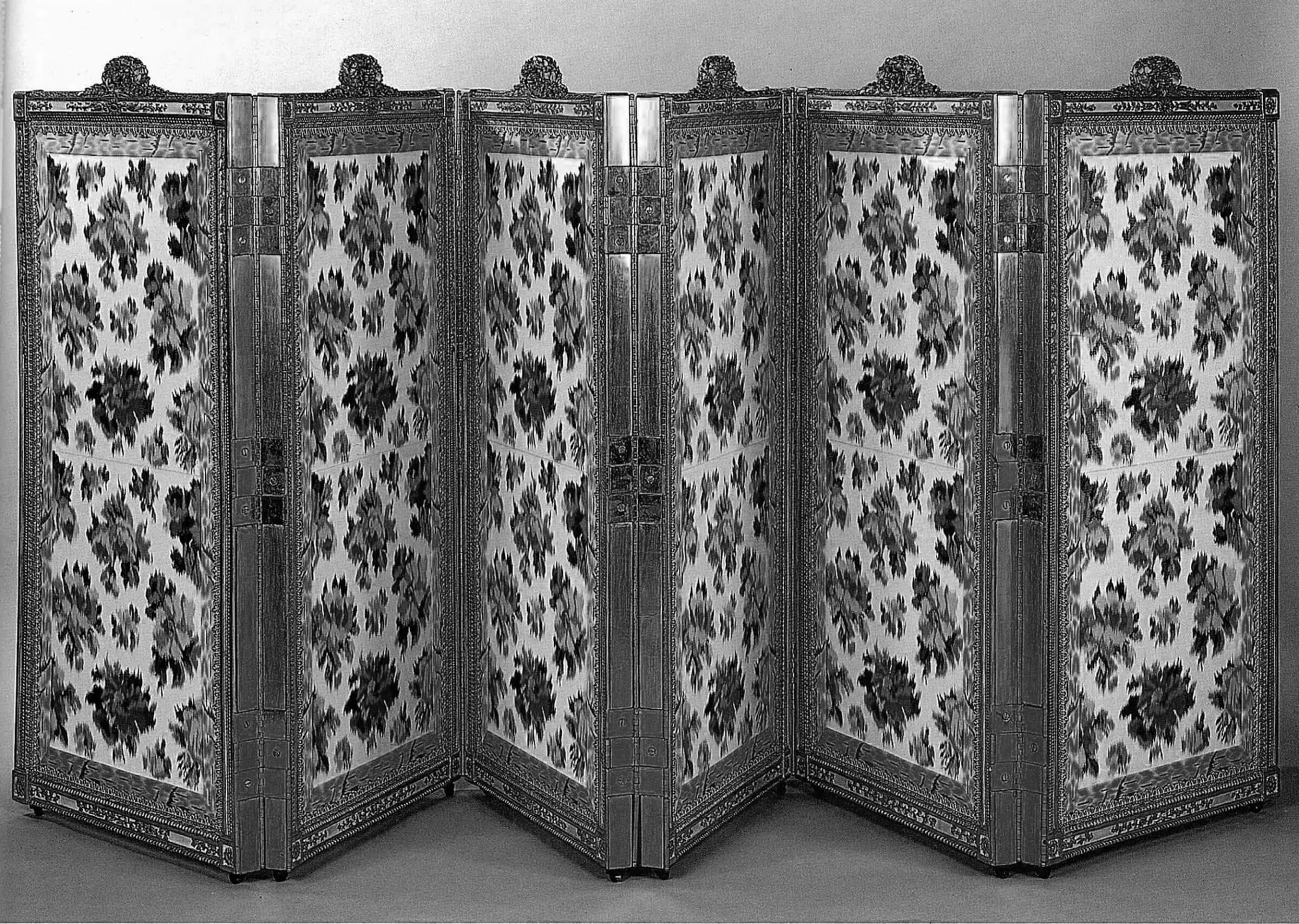
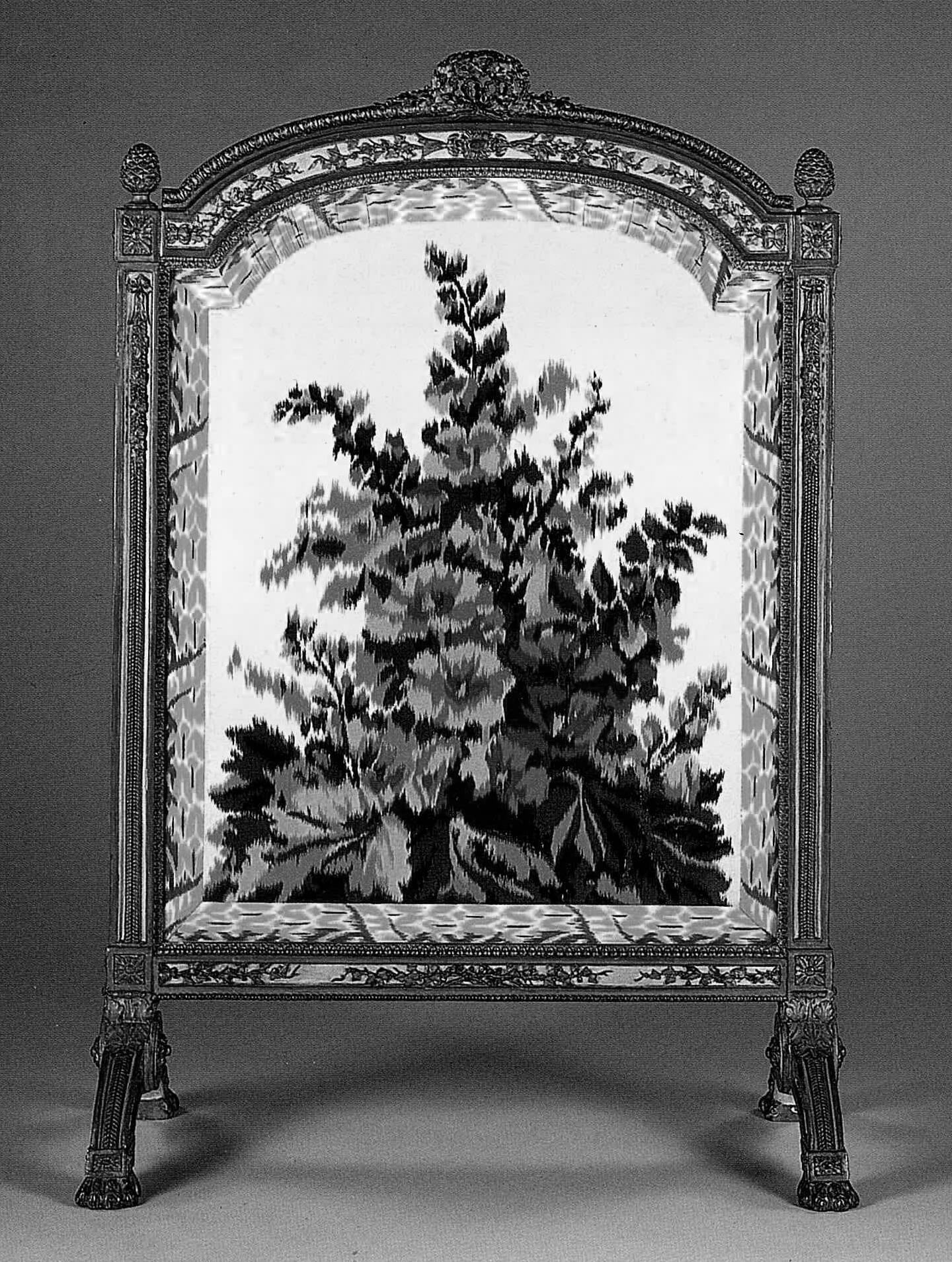
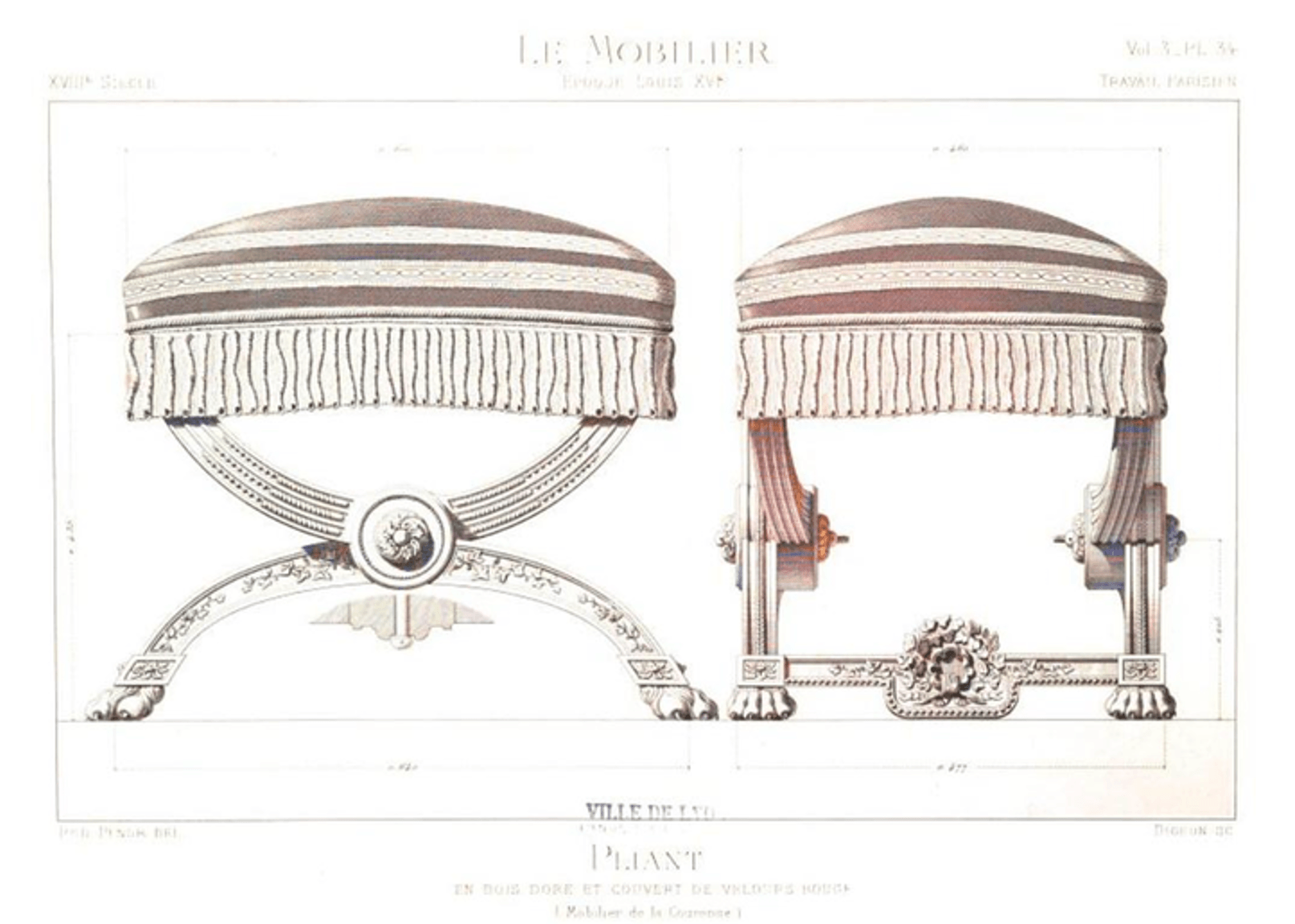
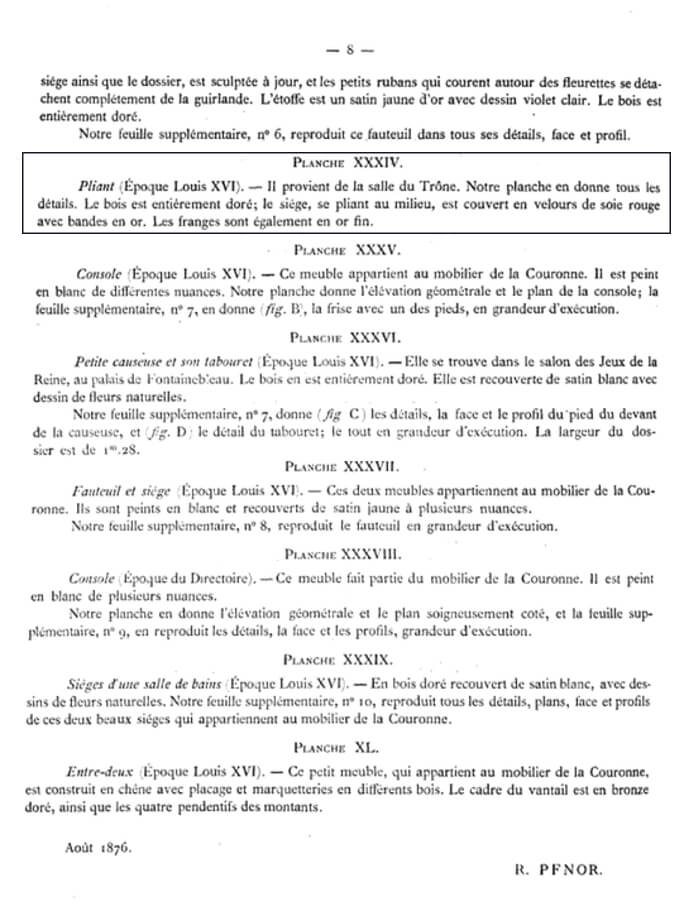
Rodolphe Pfnor, Art industriel, Le mobilier de la Couronne et des gdes collections publiques et particulières du XVIIIe siècle au XIXe siècle, Vol. III, Paris [1875], pl. 34.

