“Pineau provided the designs & worked on all the interior ornamentation”
description of the Château d’Asnières by Antoine-Nicolas
Dezallier d’Argenville, Voyage pittoresque des environs de Paris,
ou Description des maisons royales, chateaux & autre lieux de plaisance,
situés à quinze lieues aux environs de cette ville, Paris, 1755, p. 8. (ill. 2)
Bois sculpté et doré (dorure d’origine) ; marbre Sarrancolin.
H. 66 cm. (26 in.); W. 69 cm. (27 ¼ in.); D. 26.5 cm. (10 ½ in.).
PROVENANCE: most likely executed between 1750 and 1752 by Nicolas Pineau for the gallery of the Château d’Asnières, property of Marc René de Voyer de Paulmy d’Argenson (1722–1782).
LITERATURE: Bruno Pons, Grands décors français, 1650-1800, Dijon, 1995, p. 269-282; Bénédicte Gady, Turner Edwards and François Gilles (eds.), Nicolas Pineau (1684-1754), Un sculpteur rocaille entre Paris et Saint-Pétersbourg, catalogue of the exhibition held at the Musée des Arts Décoratifs in Paris, from 12th March to 18th May 2025, Paris, 2025, p. 66-67 and p. 310-320, fig. 6 (entry by Emmanuel Sarméo).
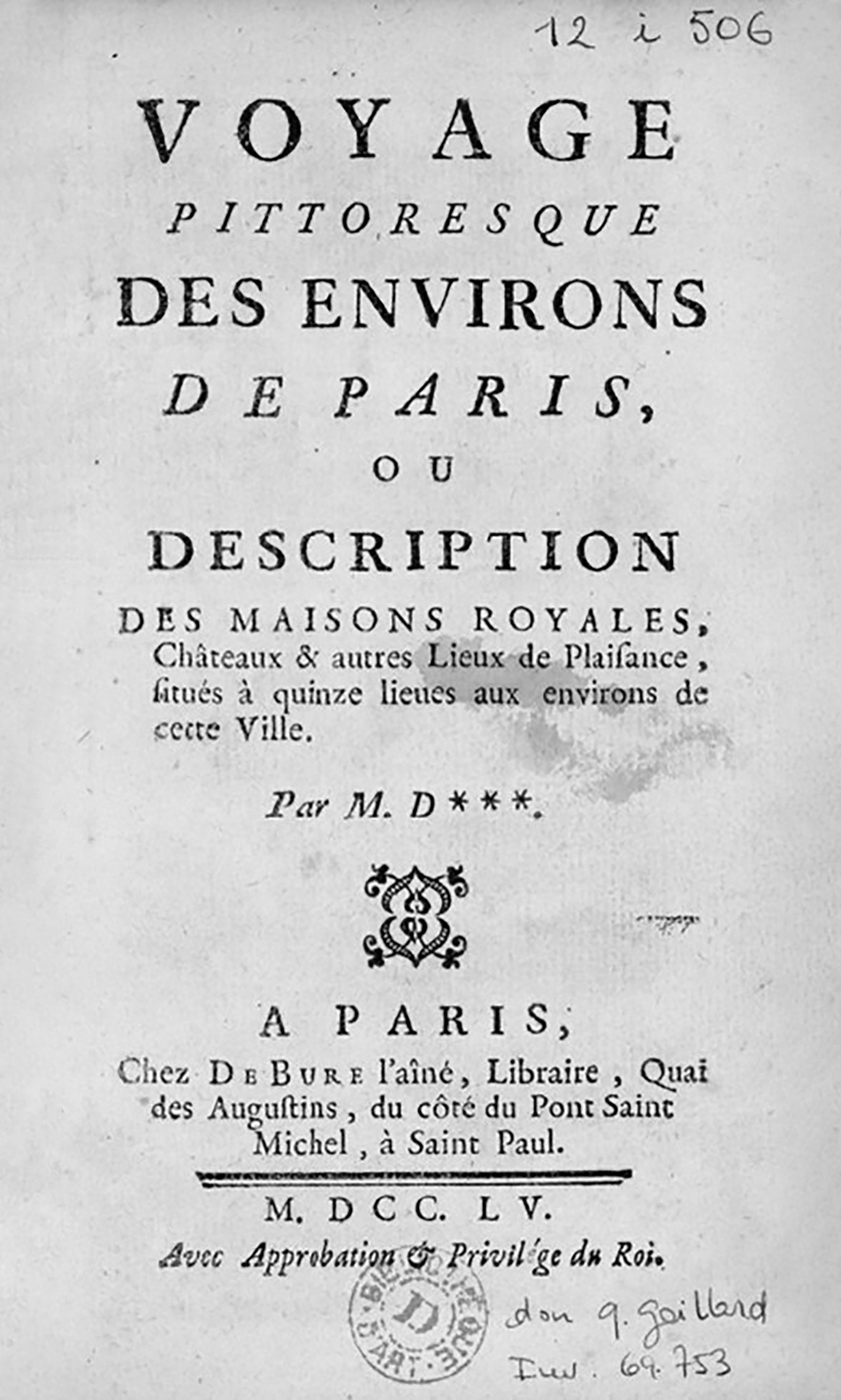
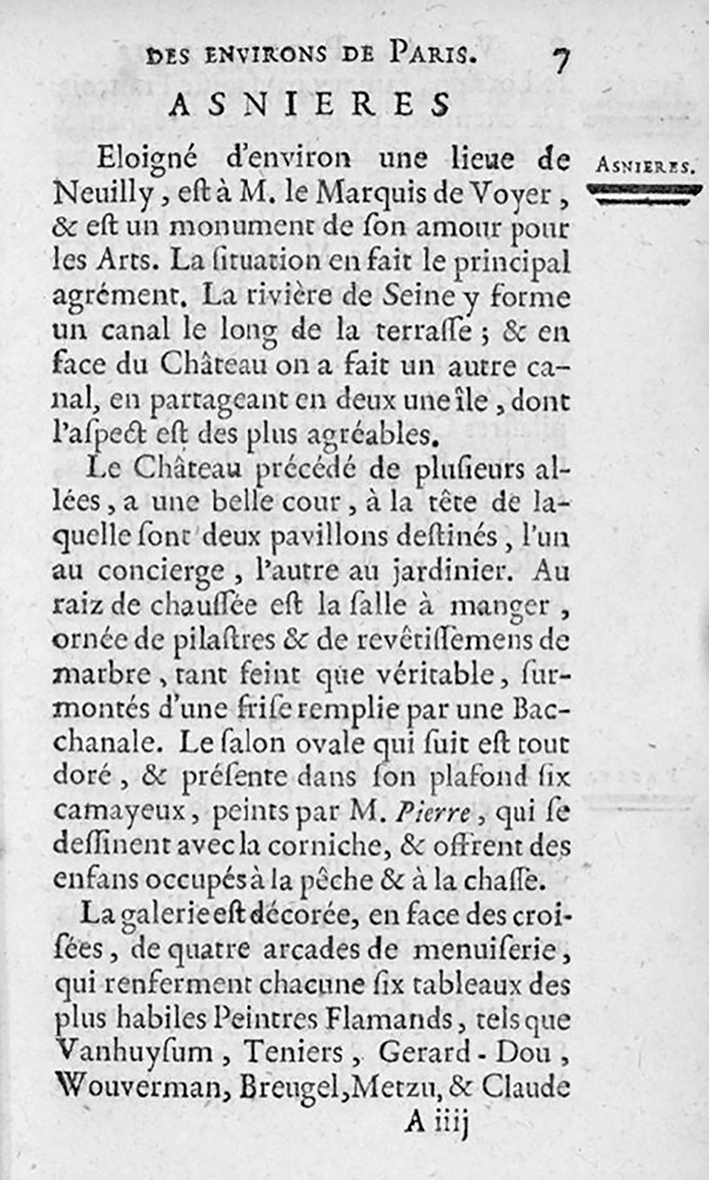
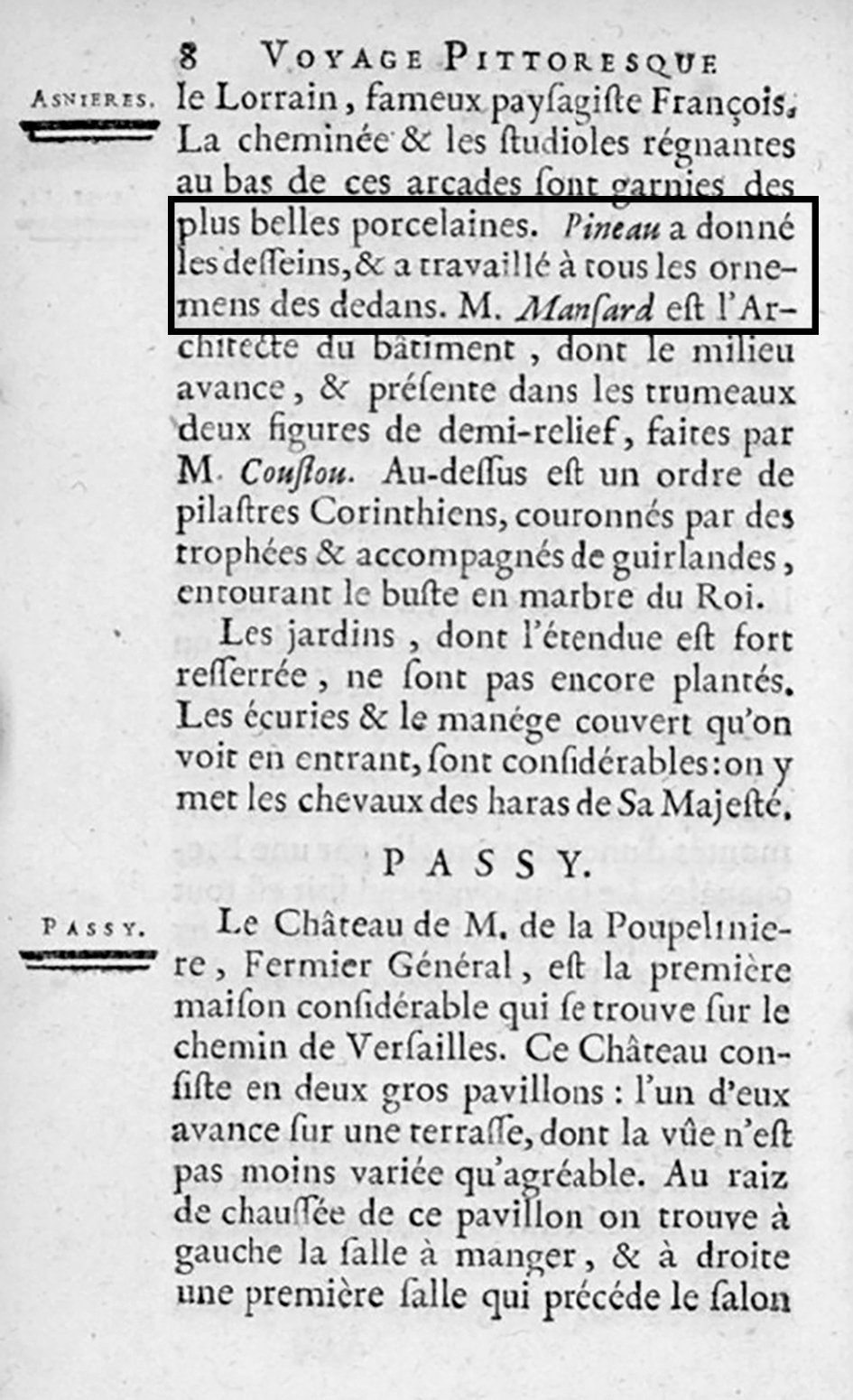
Ill. 2 : Antoine-Nicolas Dezallier d’Argenville, Voyage pittoresque des environs de Paris, ou Description des maisons royales, chateaux & autre lieux de plaisance, situés à quinze lieues aux environs de cette ville, Paris, 1755, p. 7 & 8.
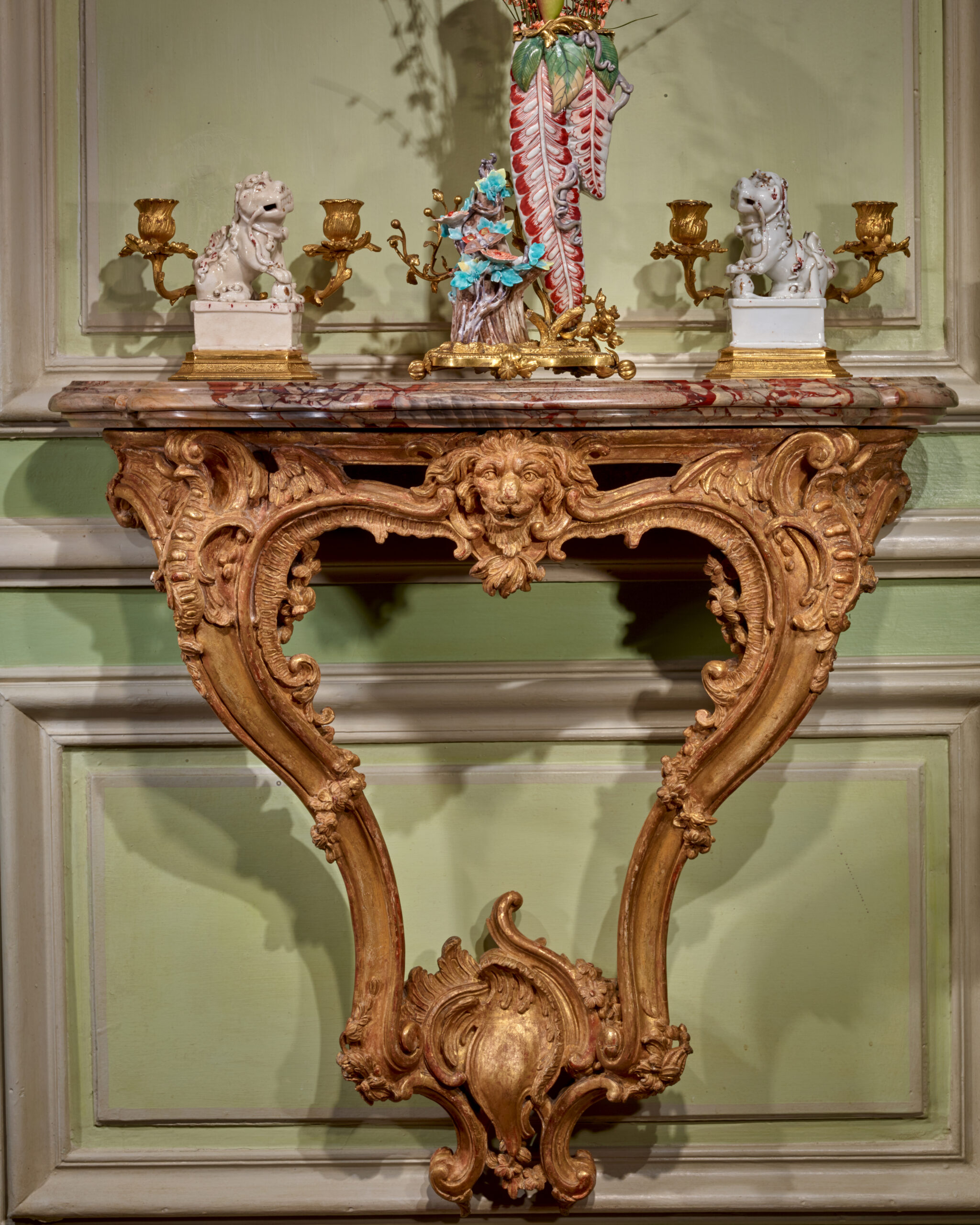
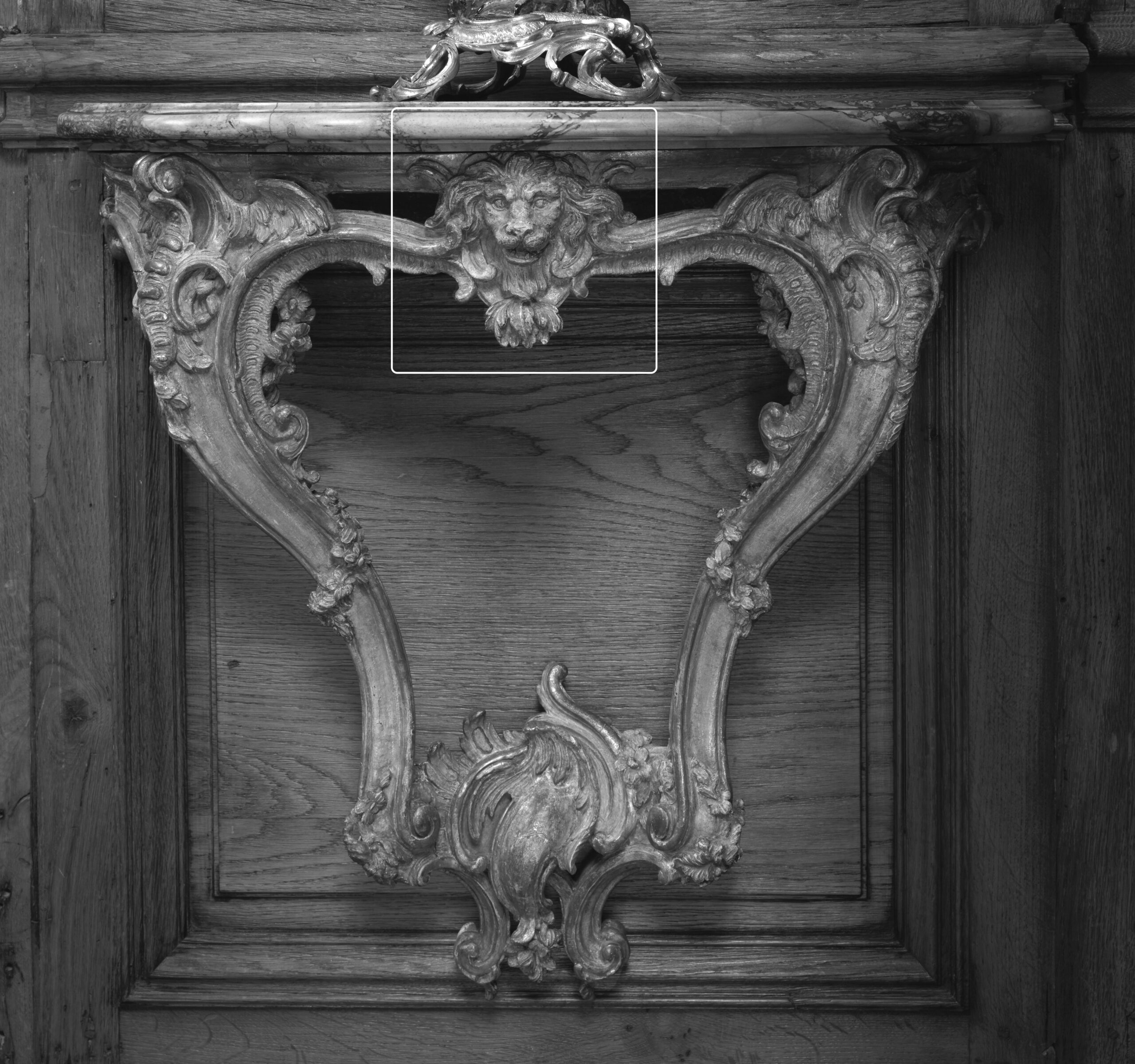
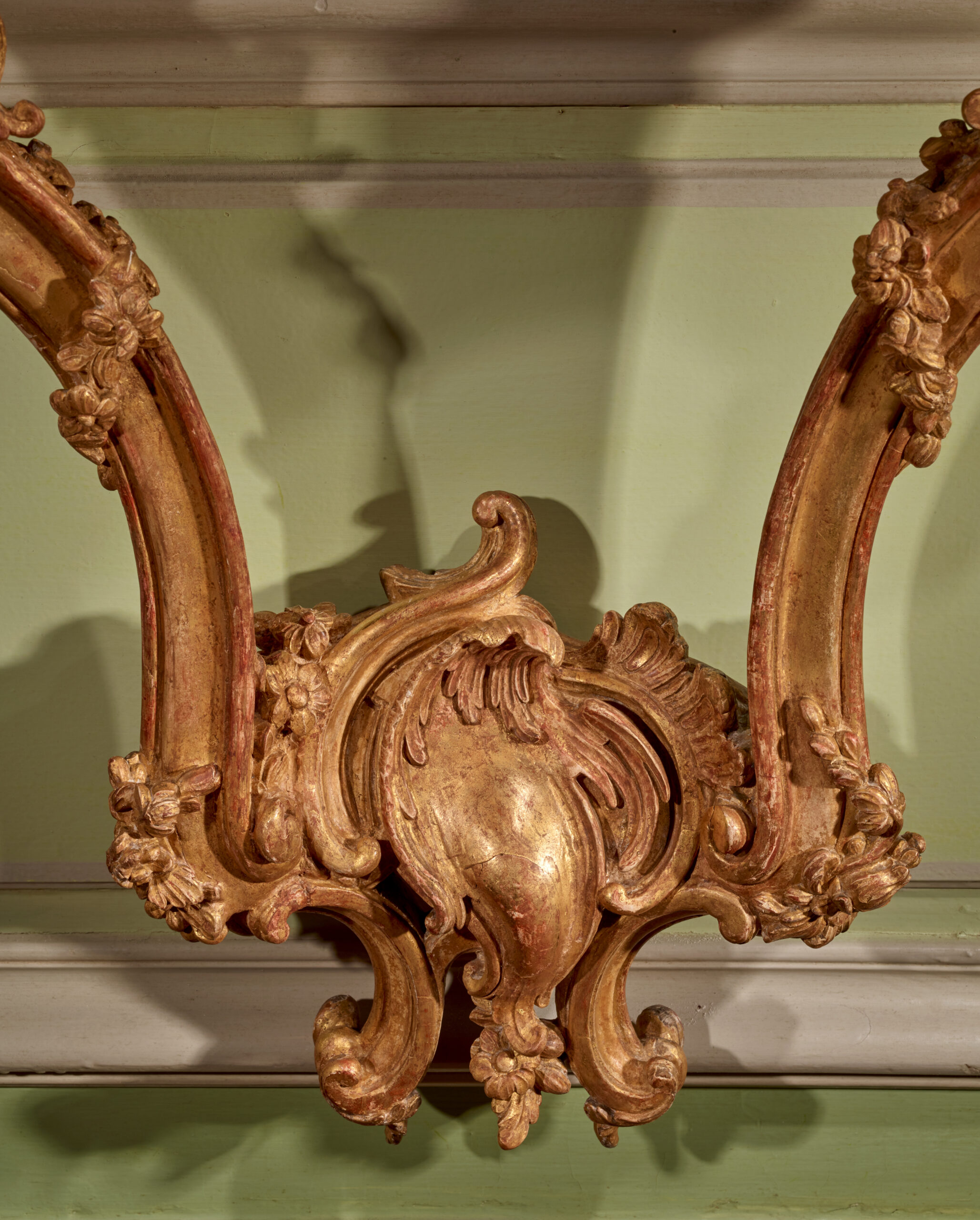
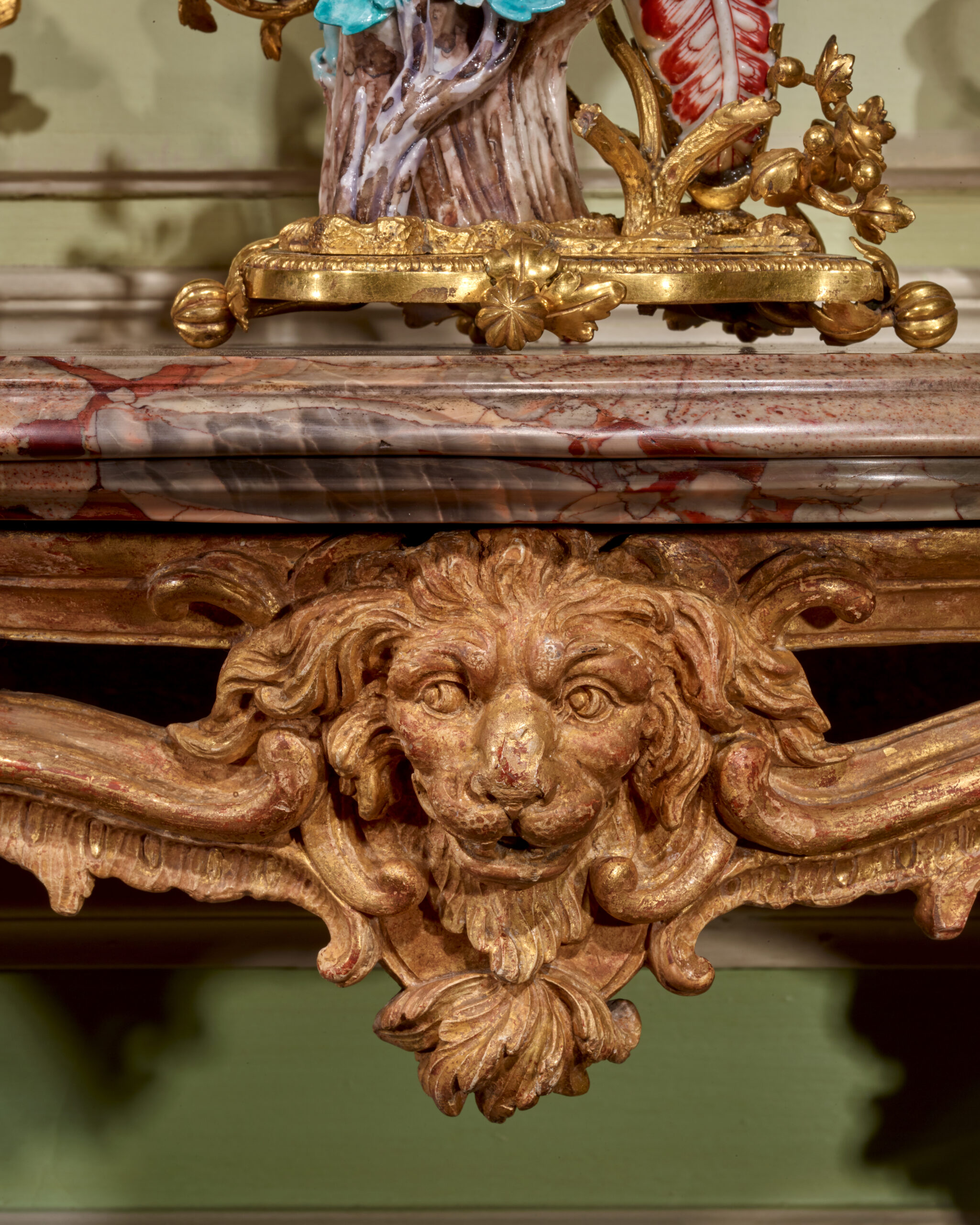
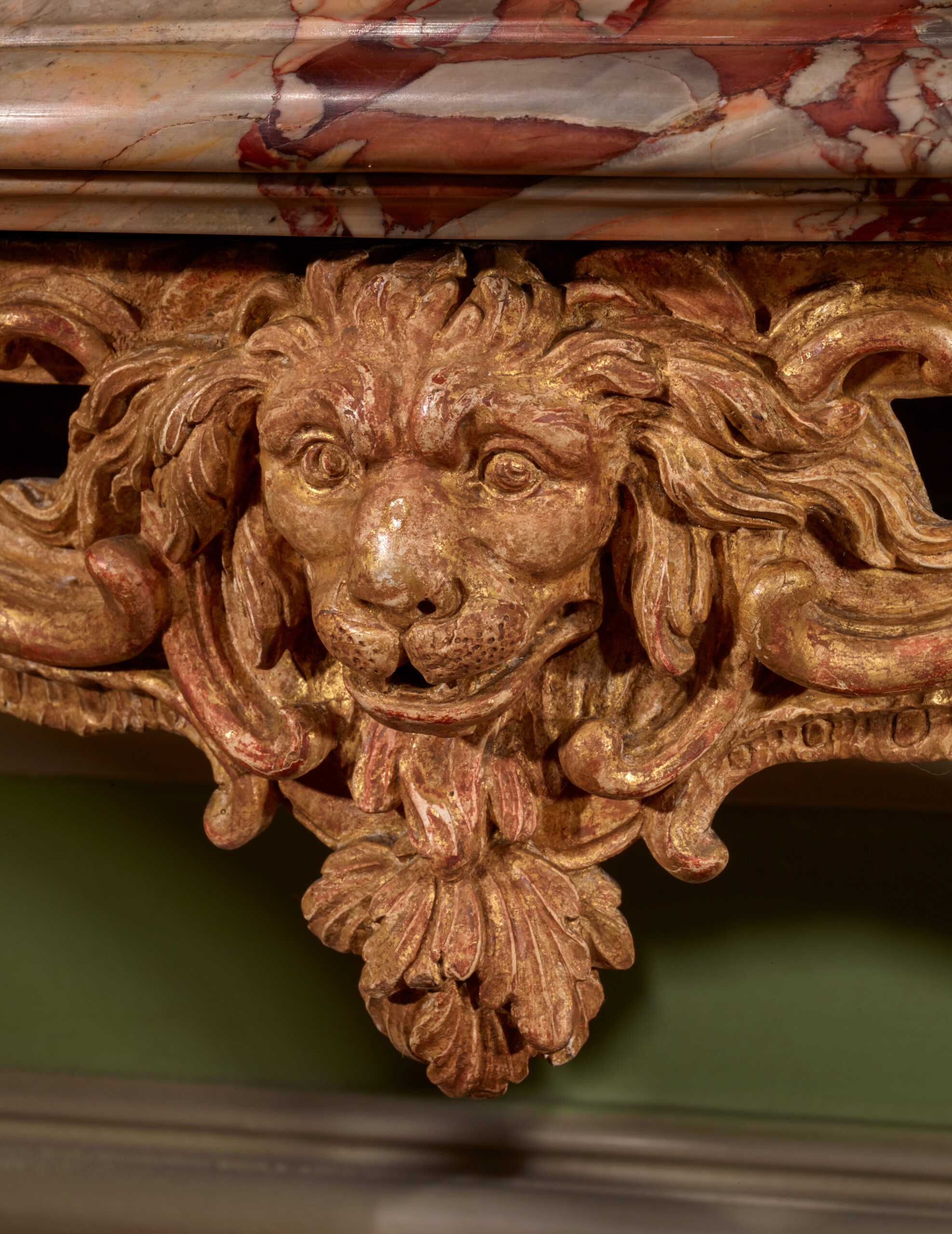
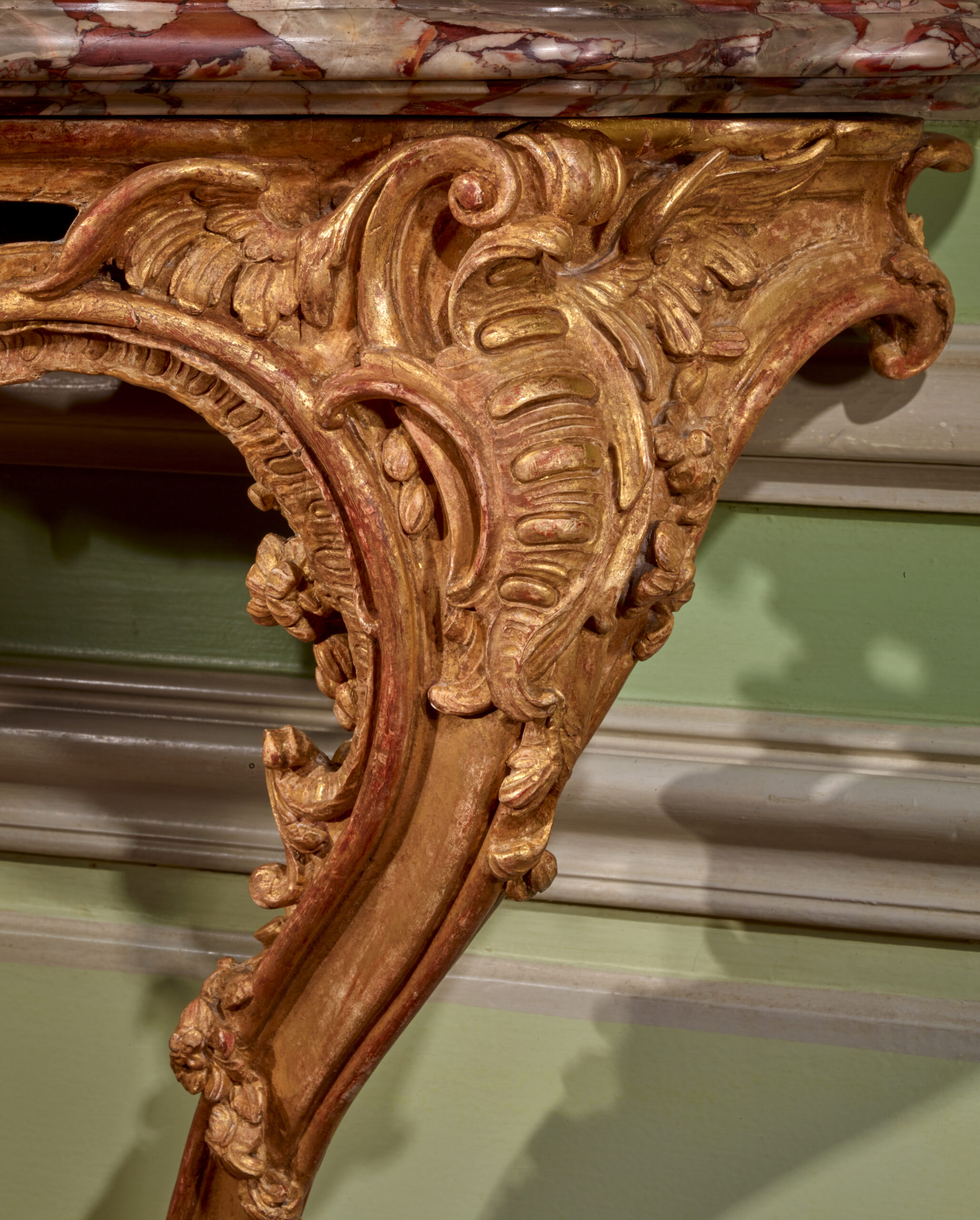
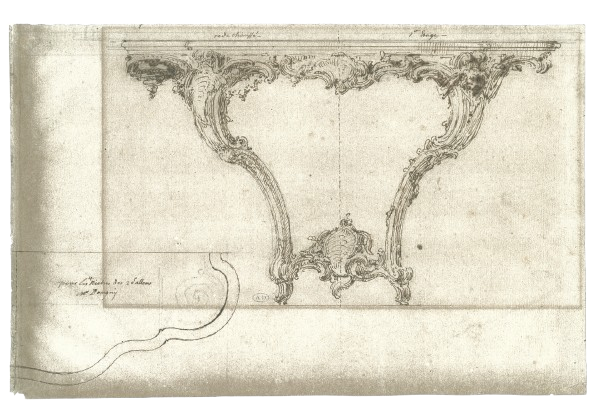
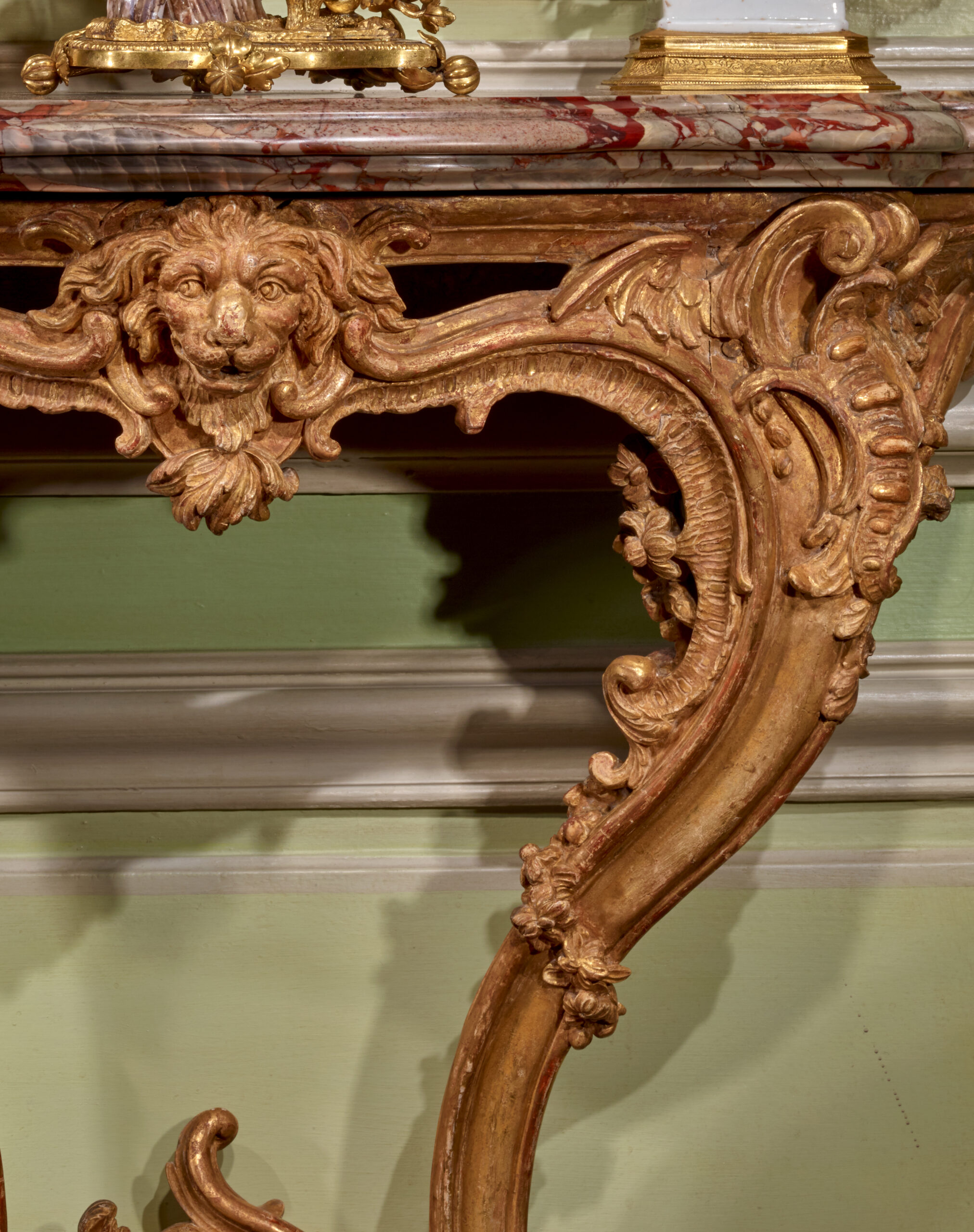
A masterpiece of Rococo cabinetmaking in Paris, this pair of carved and gilt wood consoles was most likely executed between 1750 and 1752 by Nicolas Pineau for the gallery of the Château d’Asnières, property of Marc René de Voyer de Paulmy d’Argenson (1722-1782), Marquis of Voyer. Each console displays an openwork rail with serpentine edges, centred by an imposing lion’s muzzle with open jaws, its mane intertwined with volutes, from which falls a foliate bouquet. It rests on two powerfully moulded console legs, enriched with torus-flower garlands and fluted festoons. Continuing their curved trajectory toward the lion’s muzzle at the rail’s centre, these legs are adorned in their upper section with extremely rich carved ‘rocaille’ ornamentation, with scroll and counter-scroll motifs, asymmetrical gadrooned cartouches and winged volutes. Terminated in a scroll, they flank, at their base, a large asymmetrical S-shaped cartouche with scrolls, fluted festoons, and foliage, upon which each console rests.
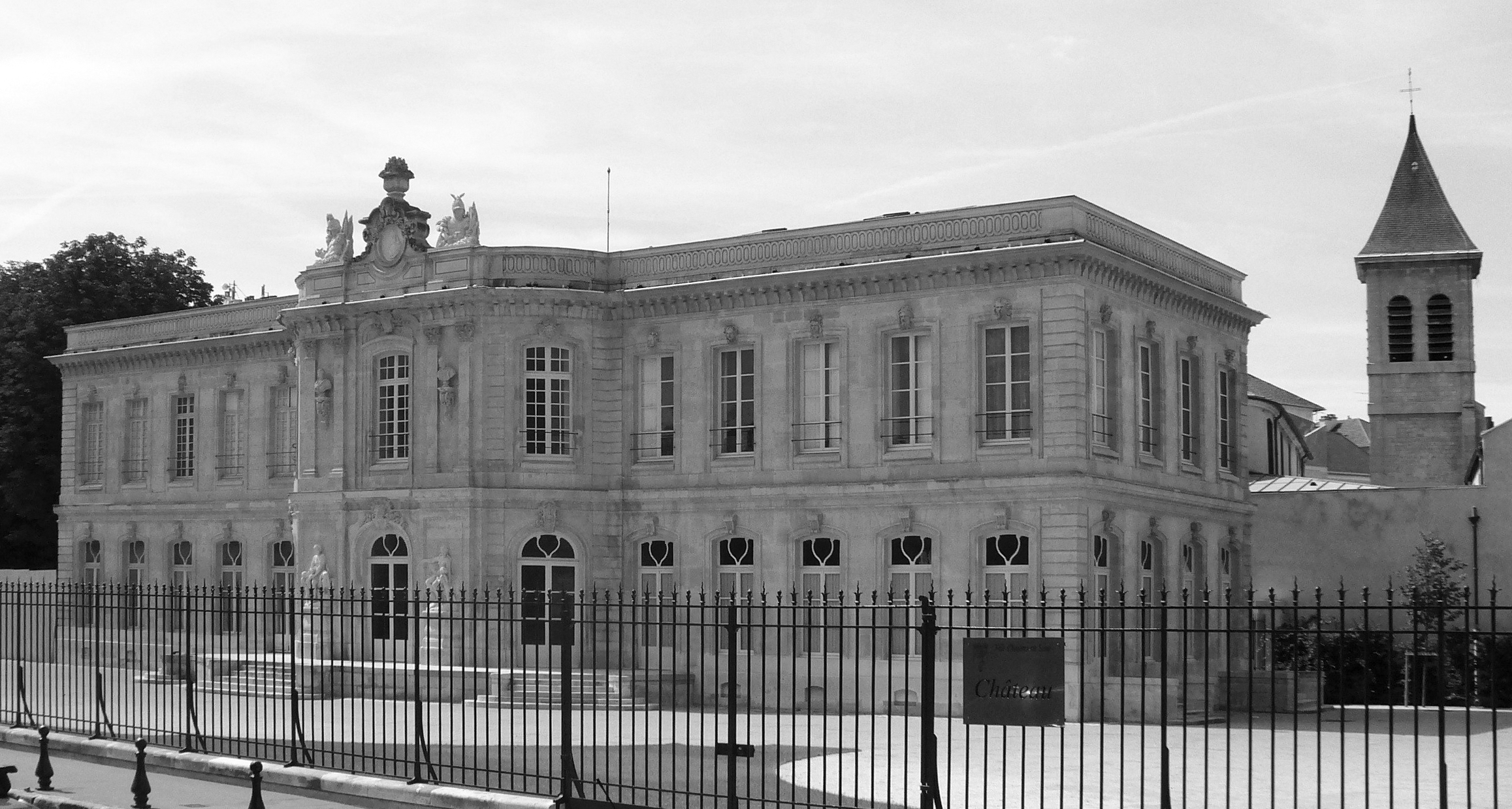
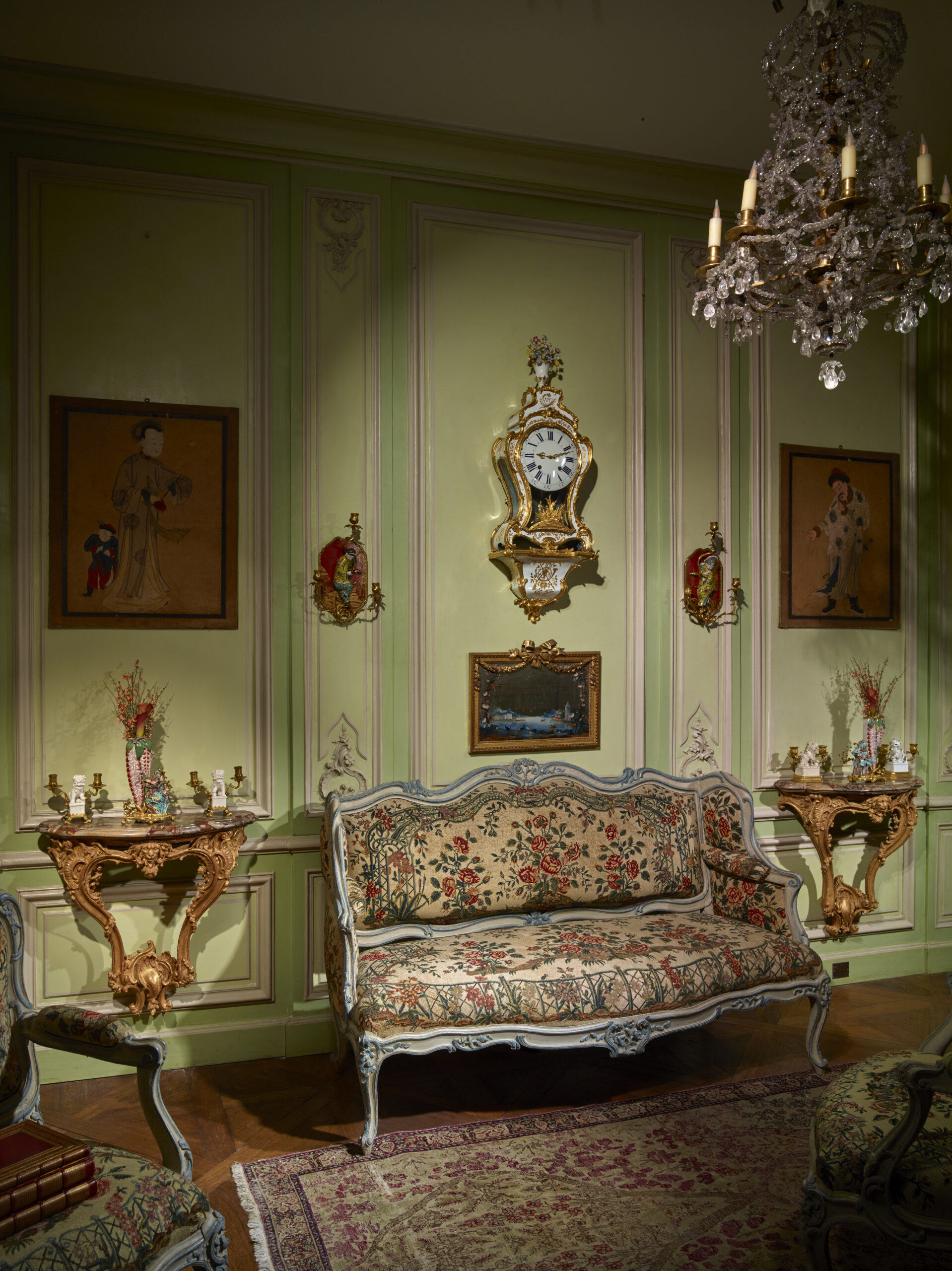
The exterior and interior sculpted decorations of the Château d’Asnières were Nicolas Pineau’s last major project. Desiring to create a pleasure estate on the banks of the Seine, the marquis of Voyer acquired “a large house located in the village of Asnières” on 10th January 1750, and commissioned his architect, Jacques Hardouin-Mansart de Sagonne (1711-1778), grandson of the great Jules Hardouin-Mansart, to bring it up to date with contemporary taste. He promptly decided to partially demolish the house and build in its place a much more imposing château, with a central avant-corps with rounded corners and three wings on the courtyard and garden sides.
To achieve this, he brought together the most talented artists and artisans of his time, commissioning Guillaume II Coustou (1716-1777) for the sculpture, Jean-Baptiste-Marie Pierre (1714-1789)—future First Painter to the King (1770) and director of the Académie—for the painting, Jacques Caffieri (1678-1755) with the bronzes, Gaetano († 1758) and Paolo-Antonio Brunetti (1723?-1783) with the trompe-l’œil decorations, and Nicolas Pineau, his faithful collaborator, with the design and execution of all the ornamental sculpture. Launched in the spring of 1750, the project was carried out swiftly thanks to nearly two hundred workers. Most interior decorations were completed by Pineau in 1752, when the Marquis of Voyer—officially appointed director of the King’s stud farms—commissioned Mansart de Sagonne to build extensive stables west of the estate.
Located on the ground floor to the right of the grand salon occupying the central avant-corps of the château, the grand gallery opens with five south-facing windows and two to the east. It had been stripped of its boiseries in 1897, but the municipality of Asnières repurchased them in 1996; in 2006, they were reinstalled after restoration to their original polychromatic state, thanks to evidence found on the surviving interior shutters.
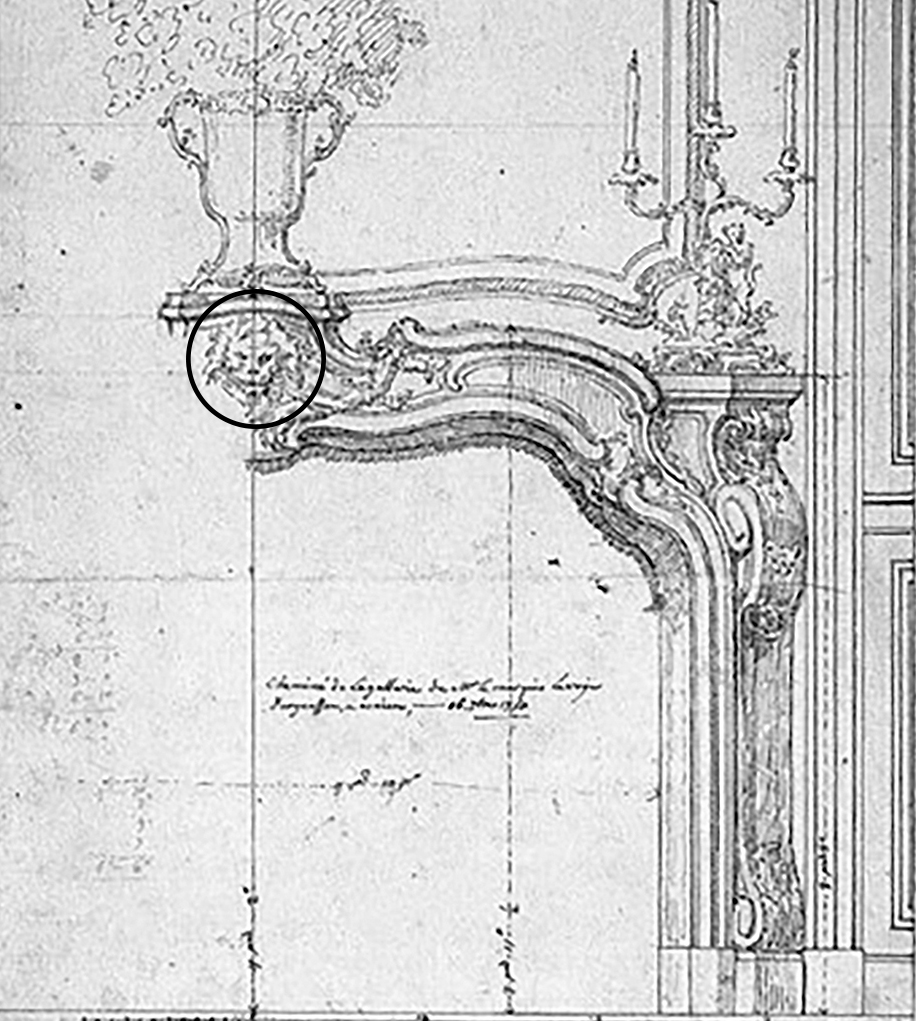
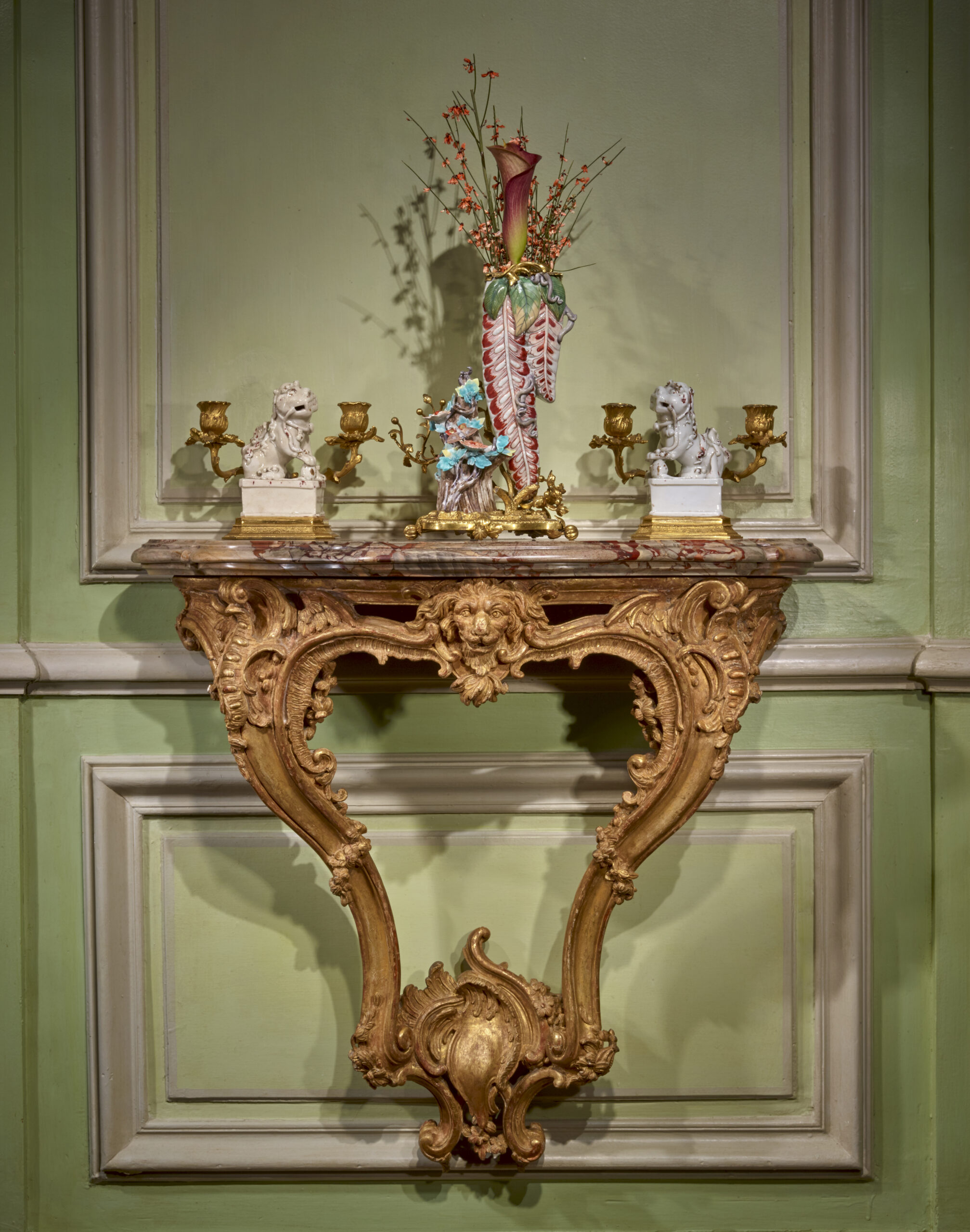
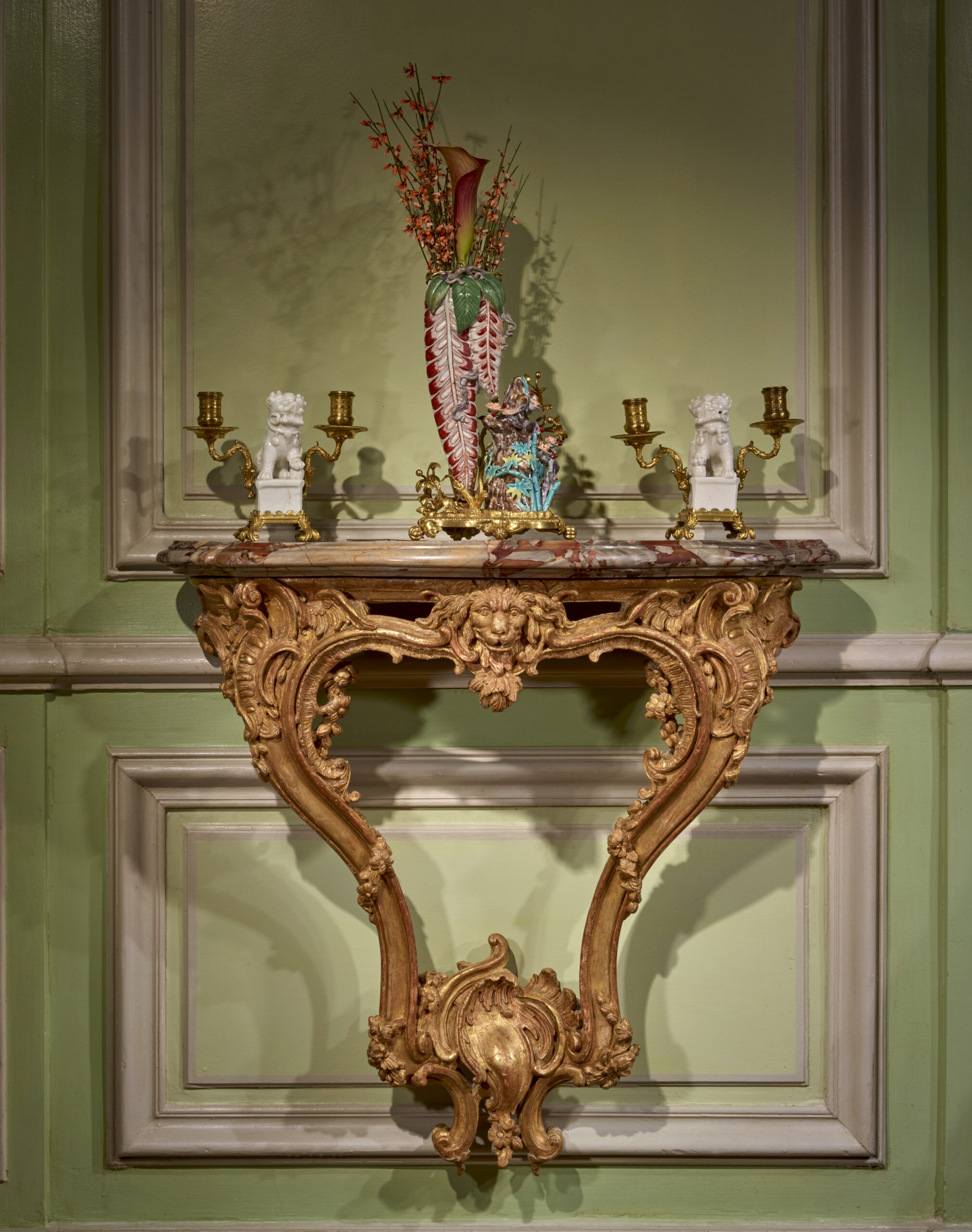
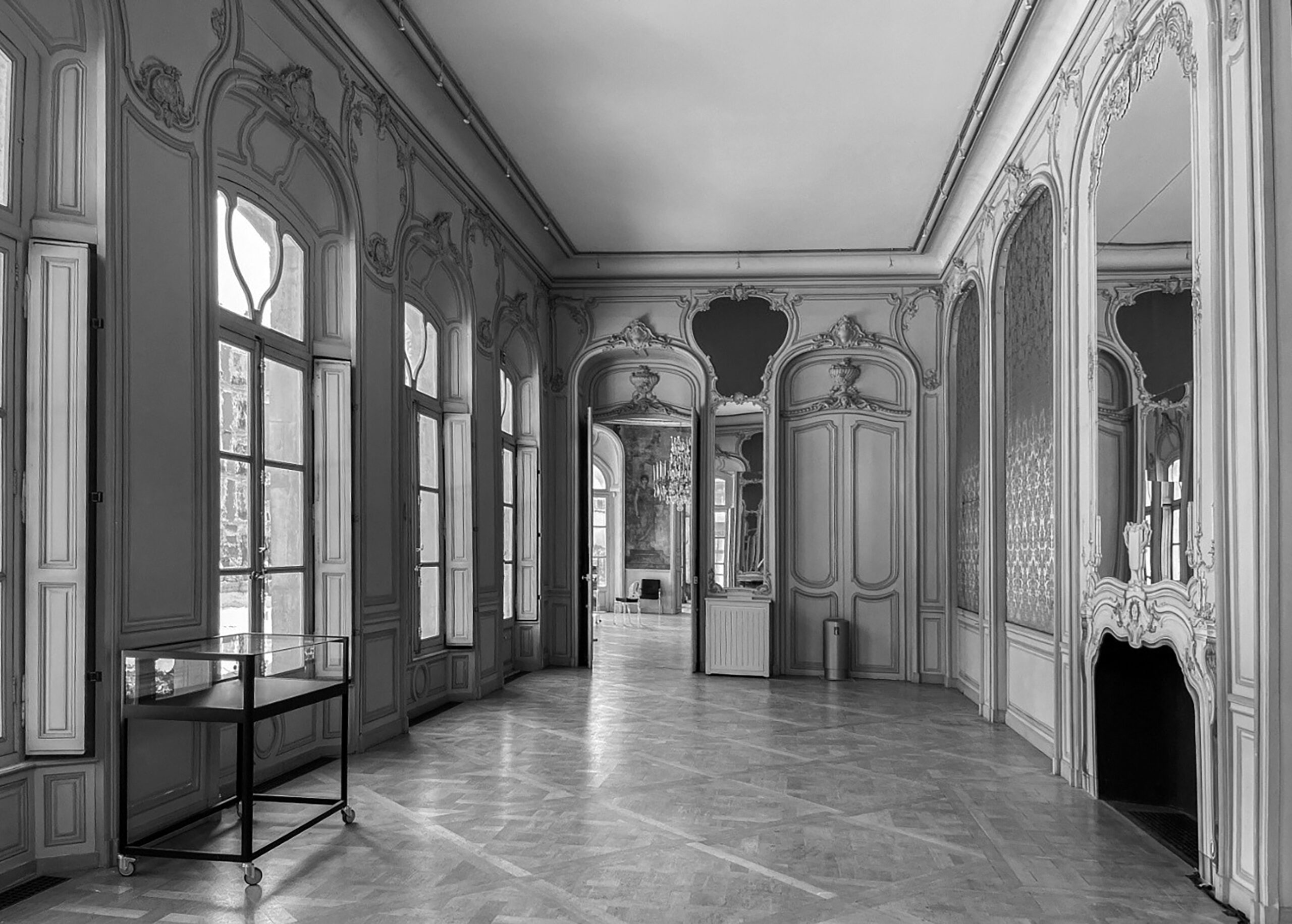
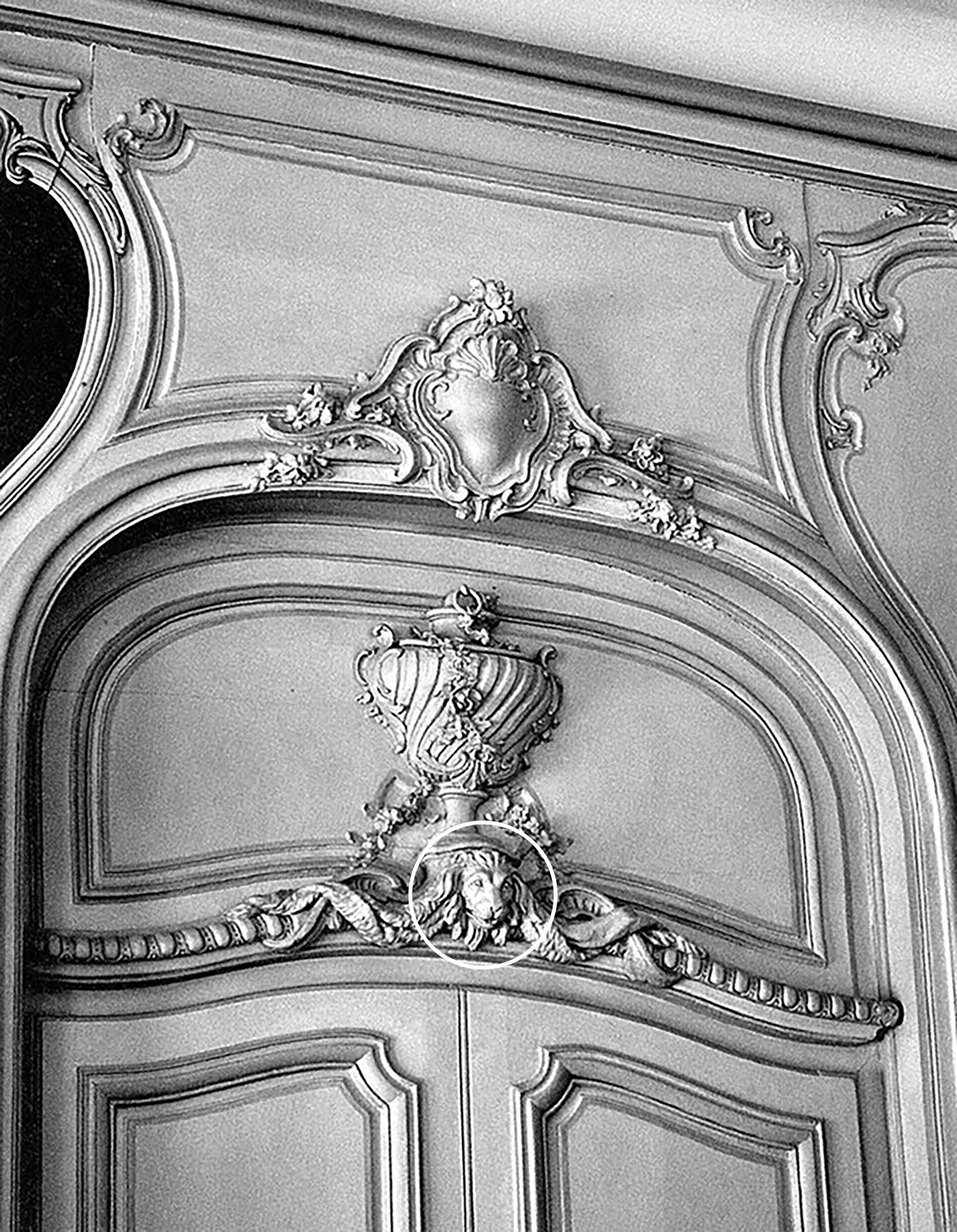
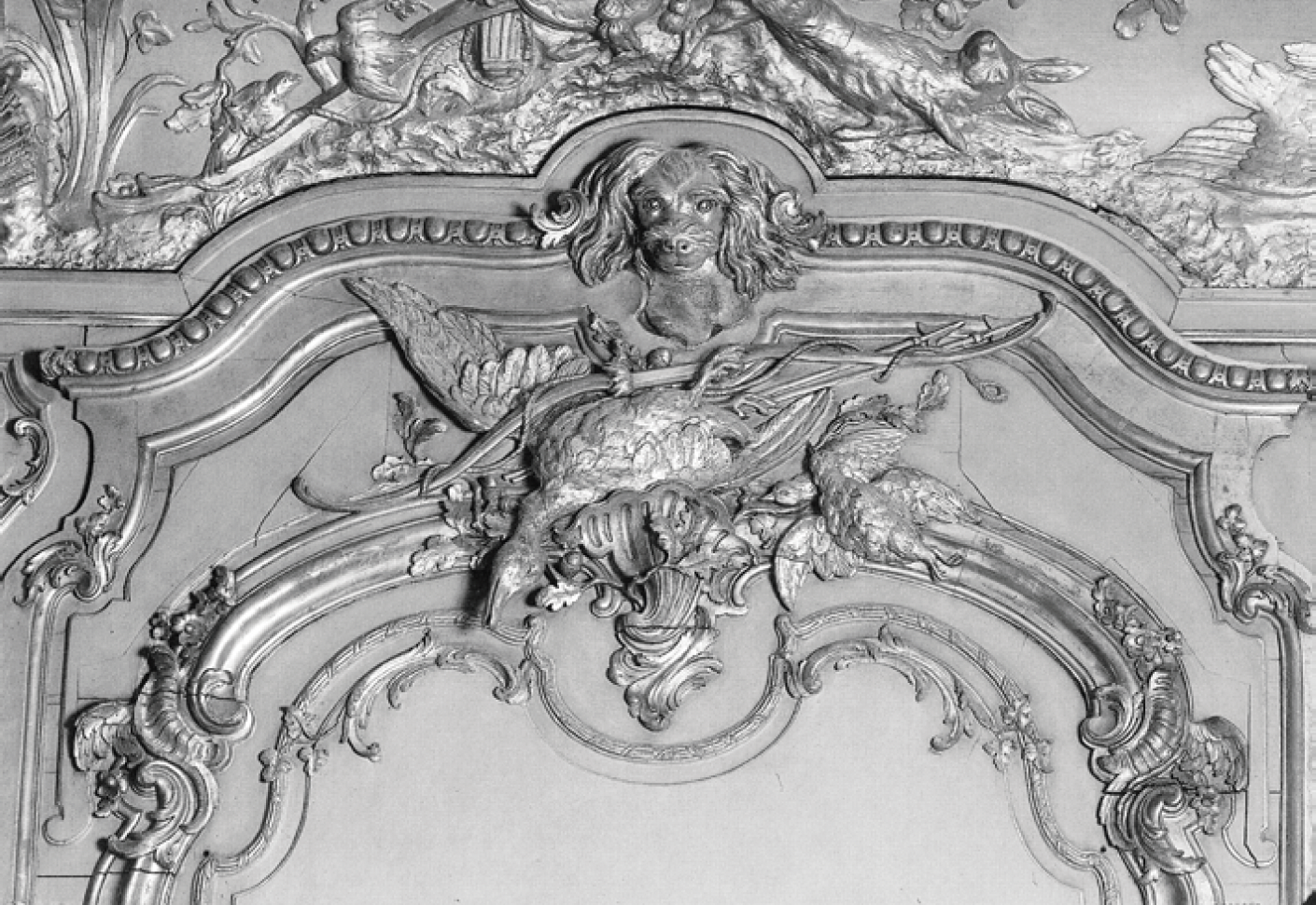
By contrast, the mirror-framed mantelpiece overmantel, adorned “with a cartouche at its centre decorated with a lion’s head with two outstretched wings, the whole carved and gilded”, has disappeared, as have the east and west elevation overmantels surmounted by canvases by Jean-Baptiste-Marie Pierre. Beneath these had stood two giltwood consoles that, according to François Gilles’s study, correspond to those presented here. This provenance identification for our consoles appears all the more plausible given that their dimensions and lion’s muzzle-centered decorative repertoire perfectly match the decor executed by Pineau for the gallery, and also for the Salon.
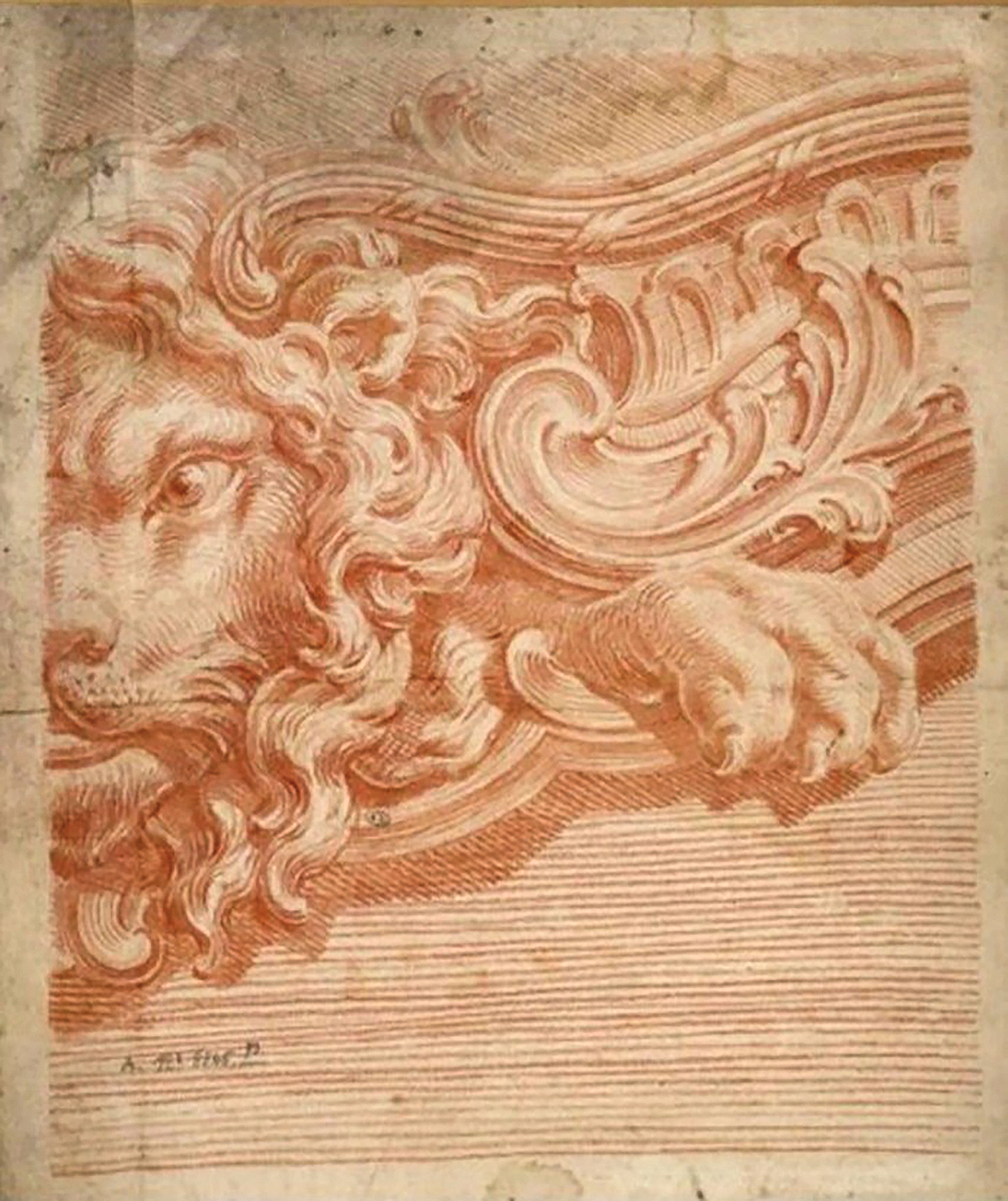
Lion’s muzzles of similar execution are still visible today adorning the overdoors, while others originally decorated the mirror-framed overmantel of the mantelpiece mentioned above and the mantelpiece itself—whose elevation drawing is now preserved at the Academy of Fine Arts Museum, Saint Petersburg (inv. A-9263).
This mantelpiece designed by Pineau was never installed, and a simple provisional marble surround was put in place instead. According to François Gilles, four other consoles identical to ours adorned the gallery’s between-window spaces, bringing the total number of consoles executed for this location to six.
Two of these consoles, from the collection of the Dukes of Doudeauville at the Hôtel de La Rochefoucauld-Doudeauville—now the Italian Embassy at 47 rue de Varenne in Paris—were part of Bernard Steinitz’s collection. Note also a fifth console, though of different dimensions, from the collections of Georges Hoentschel and then J. Pierpont Morgan, now held at the Metropolitan Museum of Art, New York (inv. 07.225.200)
Struck by family reversals at Court, financial troubles, and his judicial separation of property and person from Joséphine Marie Constance de Mailly d’Haucourt (1734-1783), the Marquis of Voyer sought to sell the Château d’Asnières in 1760. An initial negotiation failed in 1761 with the Duke of Bouillon. In 1763, he resigned from his position as director of the Royal stud farms and sold his stables in Asnières back to the King. On 10th June 1769, he finally sold the château, but at a loss, to François Nicolas Vaillant, former councillor of the Parliament of Metz.
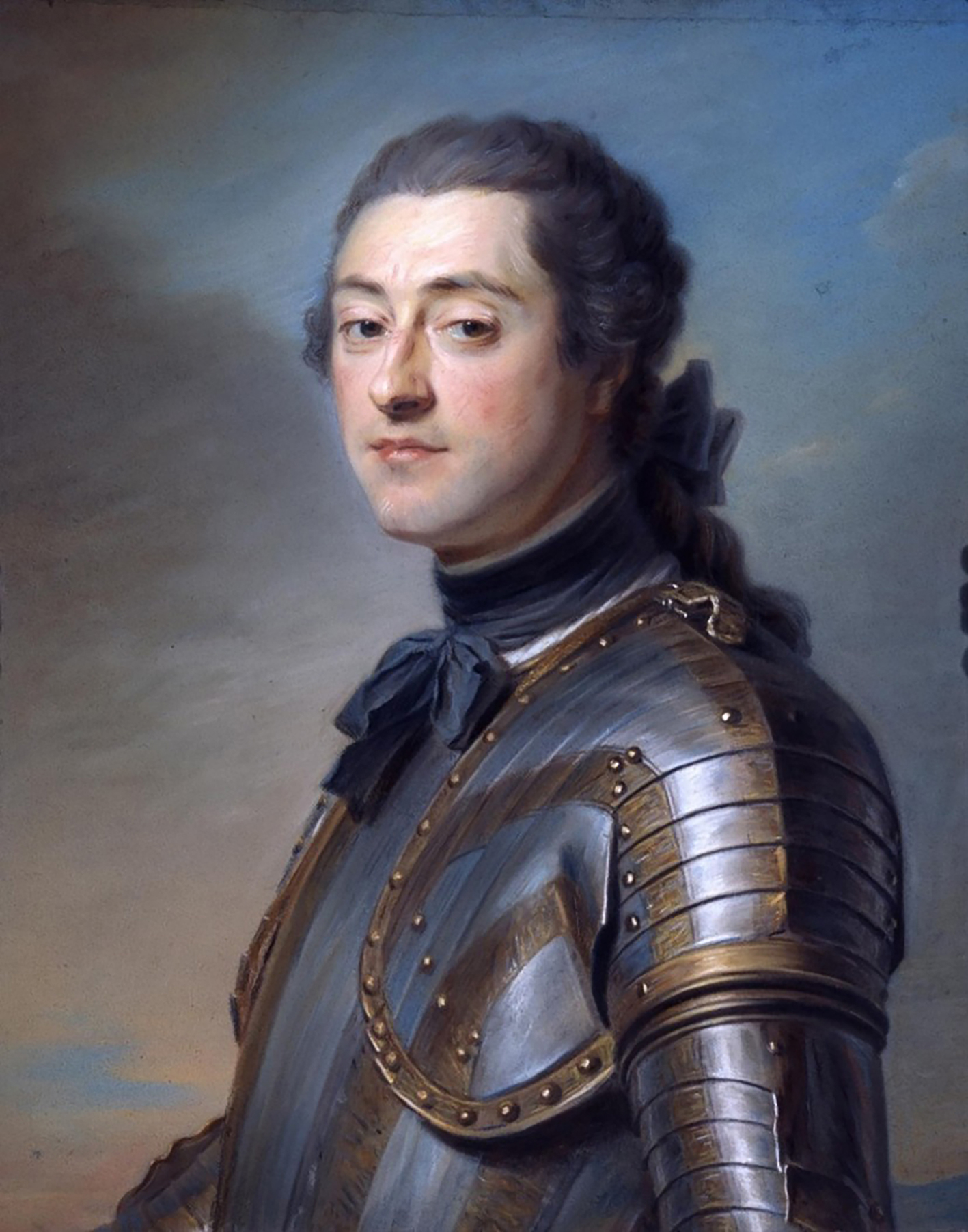
The Marquis of Voyer
Marc-René de Voyer de Paulmy d’Argenson, Marquis of Voyer, Count of Paulmy, Viscount of La Guerche, Baron des Ormes, then Count of Argenson (1764), was born on 20th September 1722 in Paris. He was the eldest son of Marc-Pierre, Count of Argenson (1696-1764), Secretary of State for War under Louis XV from January 1743 to February 1757, friend of Diderot and d’Alembert, and his wife Anne Larcher (1706-1754), who came from a family of Parisian parliamentary figures.
He rose to Lieutenant General of the King’s armies, Director General of the Royal stud farms, and Governor of the Château de Vincennes. He also served actively in several provinces, successively holding the positions of Lieutenant General in Alsace, Grand Bailli in Touraine, then military commander in Saintonge, Poitou, and Aunis, notably overseeing the draining of the Rochefort marshes and the fortifications of the Île d’Aix. He played a decisive role in the monarchy’s equestrian policy during the 18th century. He was particularly instrumental in introducing the English thoroughbred ‘yearling’ to France, thanks to the privileged relationships he had cultivated with British breeders, whose methods he brought to France.
On 10th January 1747, the Marquis of Voyer married Joséphine Marie Constance de Mailly d’Haucourt, daughter of Augustin Joseph de Mailly, Marquis of Haucourt, Lieutenant General of the King’s armies and later Marshal of France, with whom he had four children, including Marc-René de Voyer de Paulmy, Marquis of Argenson (1771-1842), who in 1795 married Sophie de Rosen-Kleinroop, widow of Charles Louis Victor, Prince of Broglie.
A great art collector and friend of Choiseul and Lalive de Jully, he used the gallery of his Château d’Asnières to display the finest pieces of his collection: his Flemish and Dutch master paintings, Boulle furniture, bronzes, and porcelains.
He was the first major patron of architect Charles de Wailly, commissioning him upon his return from Rome in 1754-55 to transform the dining room at Asnières in the new classicizing style. He also charged de Wailly with modernizing his Paris townhouse on rue des Bons-Enfants to contemporary taste (1762-70), and transforming the Château des Ormes in Vienne, inherited from his father in 1764 (1769-78). De Wailly also built for him the vast barn—later stables—before the gates of Château des Ormes along the royal road from Paris to Spain (1766-68), a project entrusted to his young assistant Bernard Poyet.
The Marquis of Voyer became a free associate in 1749, then honorary member of the Académie Royale de Peinture et de Sculpture. He also served as Vice-Protector of the Académie de Saint-Luc (1751-1764) and protector of the utopian philosopher Dom Deschamps (1716-1774), enabling his correspondence with the Philosophes. He also protected Abbé Yvon, the Encyclopédie’s ‘metaphysician’, who became the librarian at his Château des Ormes—where Voyer died on 18th September 1782, aged almost sixty.