

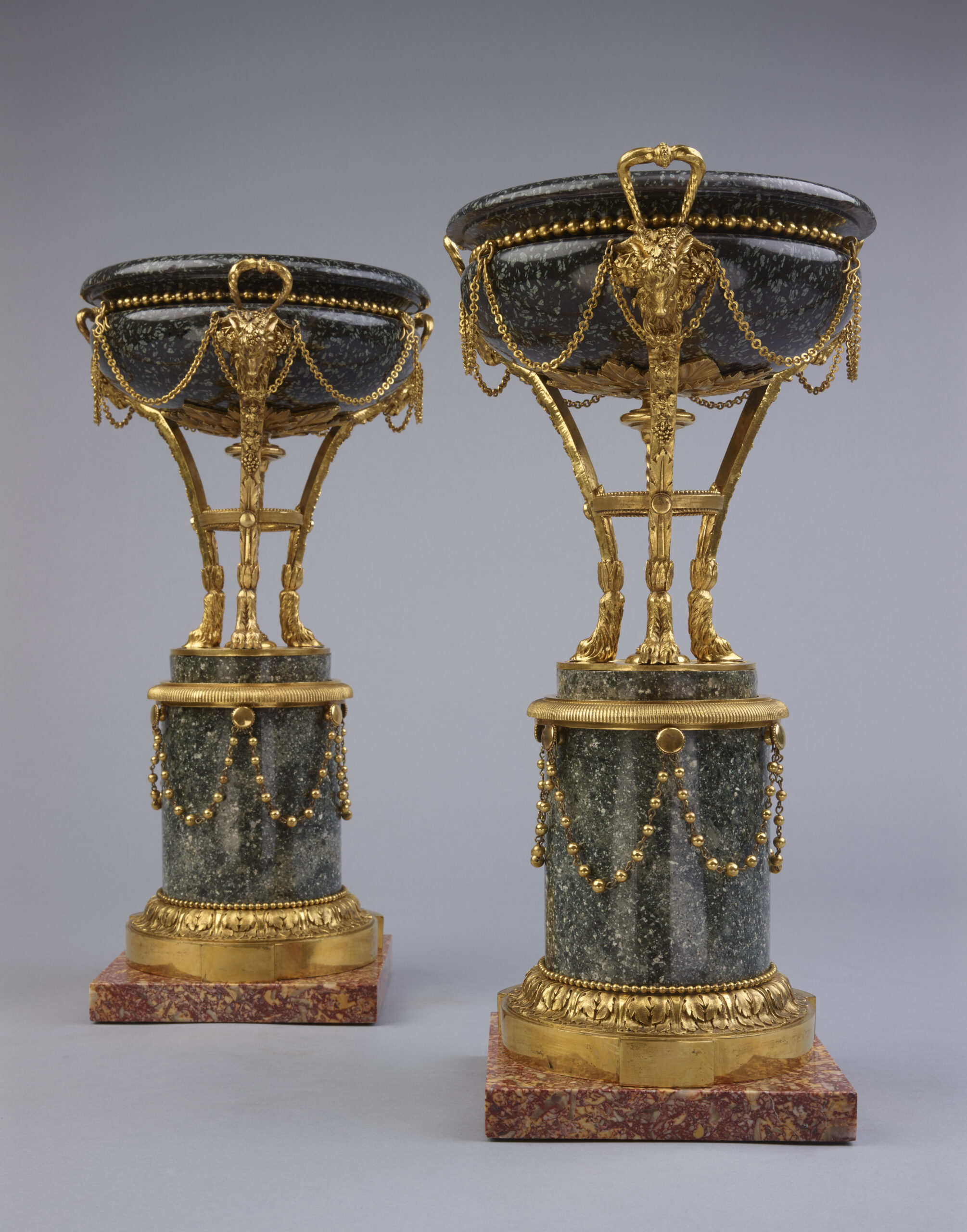
Serpentine marble from the Vosges Mountains; green ‘granite’ ou ‘jasper’ from the Vosges; Spanish brocatelle marble; chiselled and gilt bronze (original gilding).
H. 39 cm. (15 1/2 in.); Total D. with the handles: 23 cm. (9 in.).
DIMENSIONS OF THE CUPS: H. 7.8 and 7.9 cm. (3 x 3 1/8 in.); D. 19.1 and 19.4 cm. (7 ½ x 7 5/8 in.).
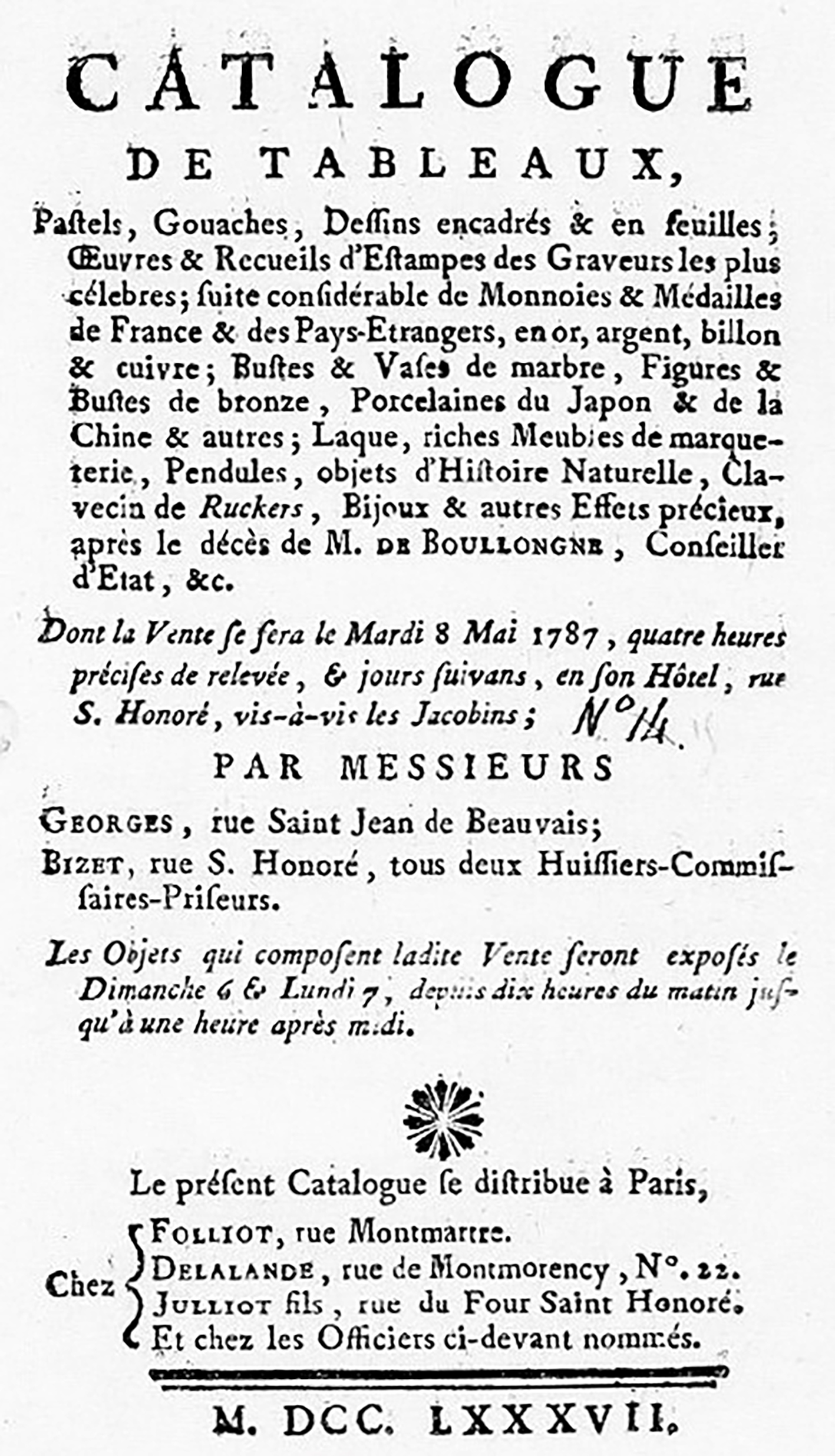
PROVENANCE: collection of Jean-Nicolas de Boullongne (1726-1787), counsellor at the Parliament of Paris, commissioner at the Requêtes du Palais (1745), intendant of Finances of Louis XV (1753), and honorary member of the Académie de Peinture et de Sculpture (1777), in his private mansion, located in rue Saint-Honoré in Paris “vis-à-vis les Jacobins” (destroyed during the 19th century, the location is today’s n° 215), his first post-mortem auction in situ, by Nicolas Georges and Nicolas-Jacinthe-Philippe Bizet, from the 8th to the 12th of May 1787, lot n° 247 (this auction was perhaps postponed) then its second in situ auction, also by Georges and Bizet, from 19th to 24th November 1787, lot n° 231; acquired during the auction by Philippe-François Julliot (1755-1836) for the amount of 460 livres; possibly the collection of Jean-Baptiste-Charrançois de Clermont d’Amboise (1728-1792), chevalier of Clermont-Gallerande, marquis of Renel or Reynel and seigneur of Montglas, French ambassador to Lisbon (1767) and to Naples (1775) – the cups of the marquis of Renel were seized by the revolutionary authorities on 6th-7th and 10th June 1793 in his private mansion in the rue de Montholon in Paris; They were inventoried at the Nesle depot in 1794 and sent to the Museum central des Arts, in other words to the Louvre, on 4th Fructidor of the year II (21st August 1794); collection of the banker Guillaume Sabatier (1730-1808), cousin of Jean-Jacques-Régis de Cambacérès (1753-1824), in his private mansion known under the name of hôtel de Durfort, located at n° 5 of Place Vendôme in Paris, his post-mortem auction, by Bizet, on 20th and 21st March, 1809, lot n° 86 (sold 400 Francs); possibly Cabinet of Mr A…, located at n° 16 rue Saint-Fiacre in Paris, auction in situ by Bonnefond de La Vialle, on 14th and 15th April 1834, lot n° 65.
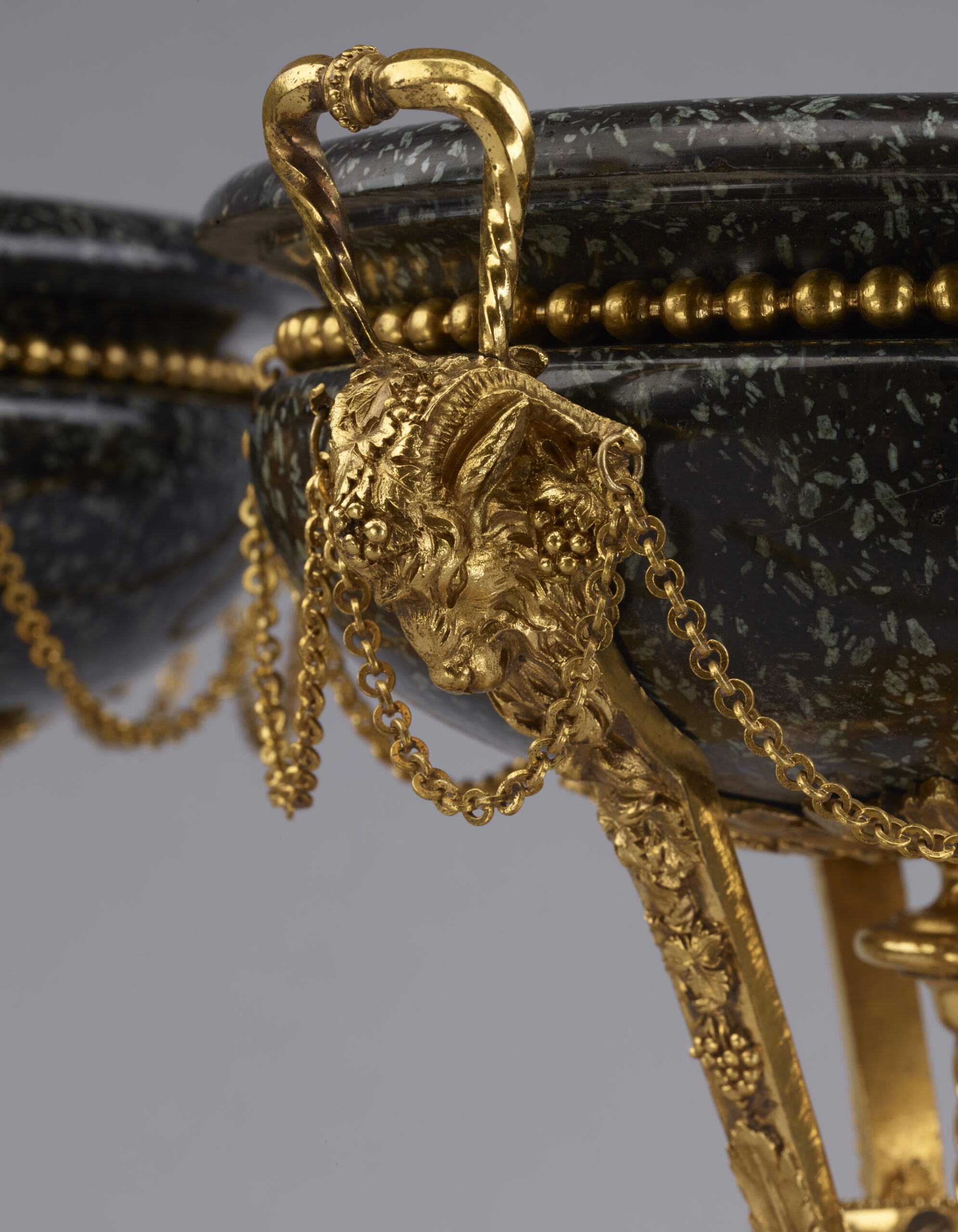
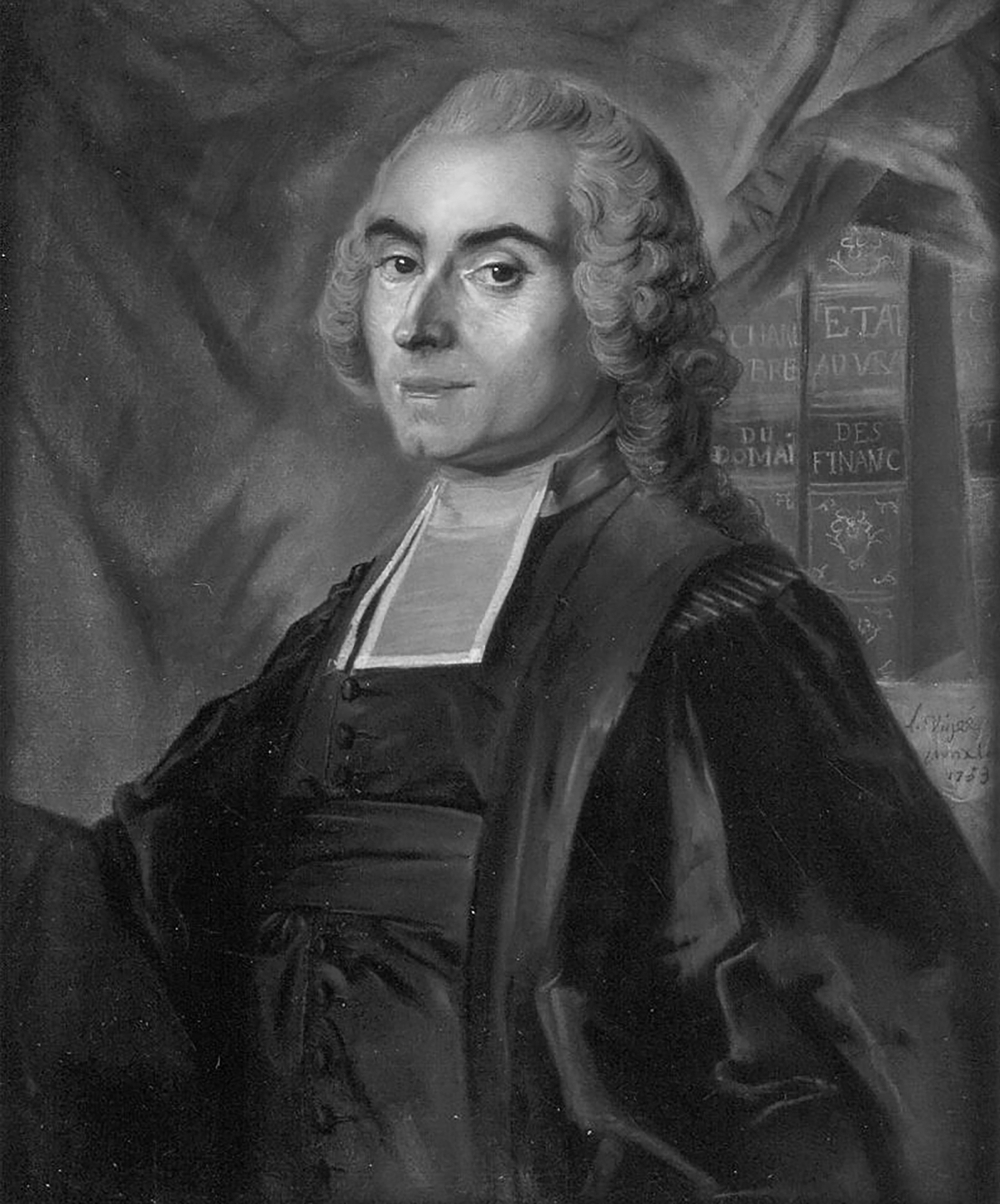
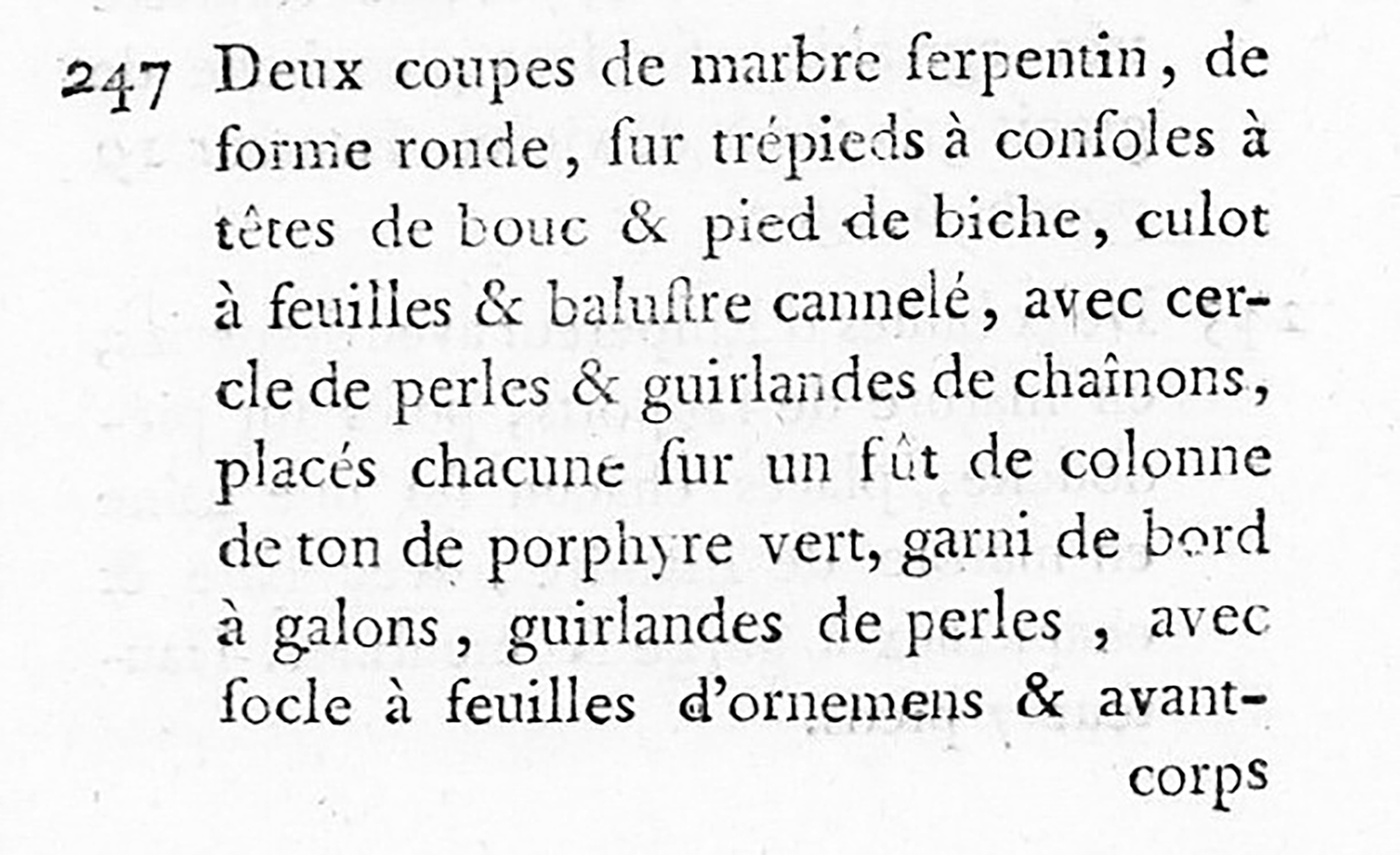
This pair of very richly mounted bowls was part of the collection of Jean-Nicolas de Boullongne (1726-1787), Count of Nogent and Baron of Marigny, councillor at the Parliament of Paris in 1745, and Intendant of Finances of Louis XV from 1753, in his private mansion in the rue Saint-Honoré (now n° 211), “vis-à-vis les Jacobins”. It is described in the catalogue of his first post-mortem auction, which took place in situ in his mansion from 8th to 12th May 1787, under the supervision of the auctioneers Nicolas Georges and Nicolas-Jacinthe-Philippe Bizet, and the appraisal of “Julliot fils”, most certainly Philippe-François (1755-1836), son of Claude-François Julliot (1727-1794), forming lot n° 247 of the auction: “Two serpentine marble bowls, round, on console tripods with goat’s heads & hind’s feet, foliate base & fluted baluster, with circle of pearls & chain garlands, each placed on a column shaft of green porphyry, trimmed with braid border, pearl garlands, with base with ornamental leaves & avant-corps in bronze gilded with matt gold. Height 14 inches 6 lignes [39.24 cm.], diameter 7 inches [19 cm.] These pieces of good taste, are pleasantly mounted”. It is possible that this first auction, for reasons that remain unknown to this day, was finally postponed, because a second auction was held at Monsieur de Boullongne’s, from 19th to 24th November 1787, with a catalogue that was almost identical to the previous one, except for a few lots. The same description was used to illustrate our two cups which formed lot n° 231 of this auction. They were acquired on this occasion by Philippe-François Julliot for the substantial amount of 460 livres.
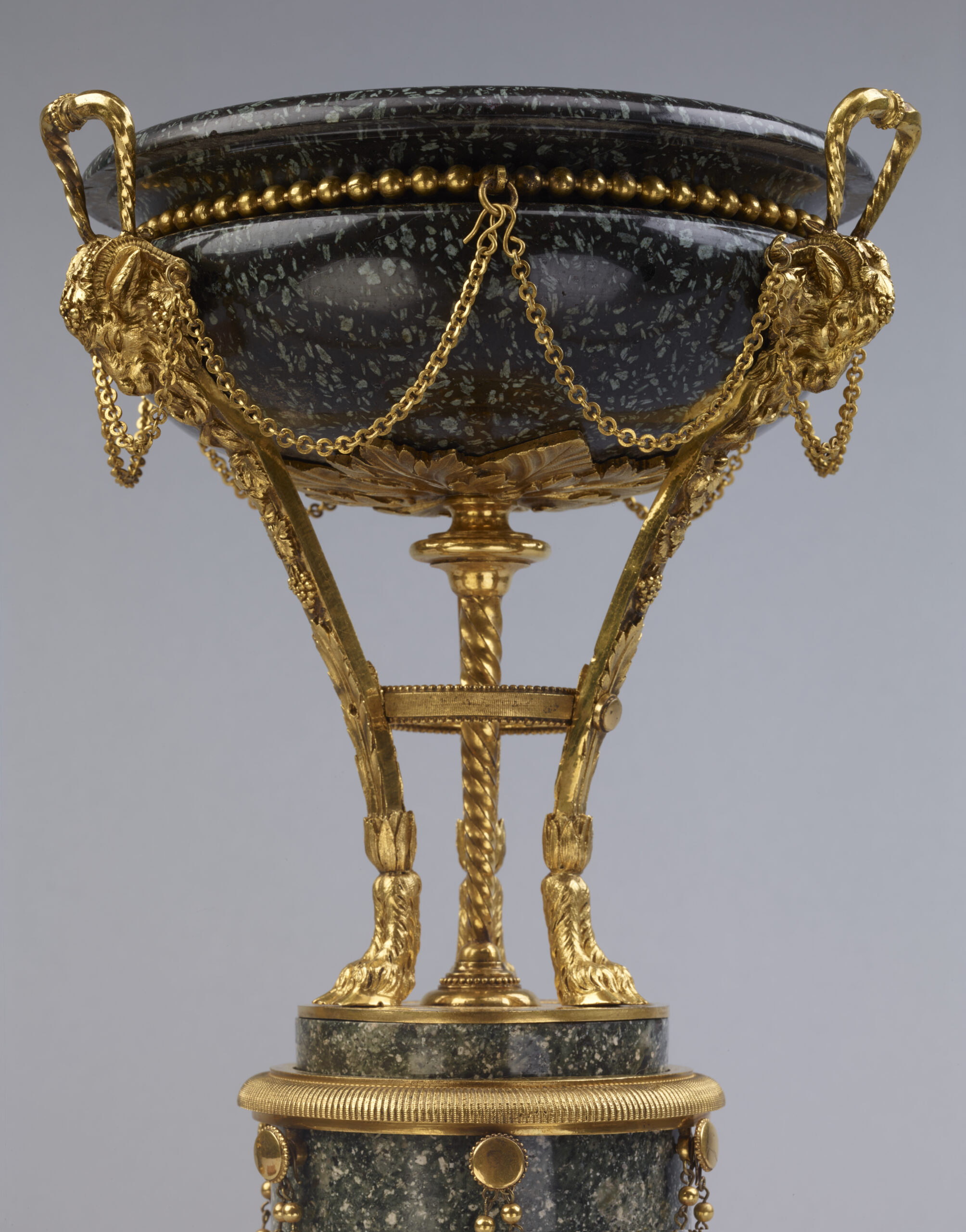
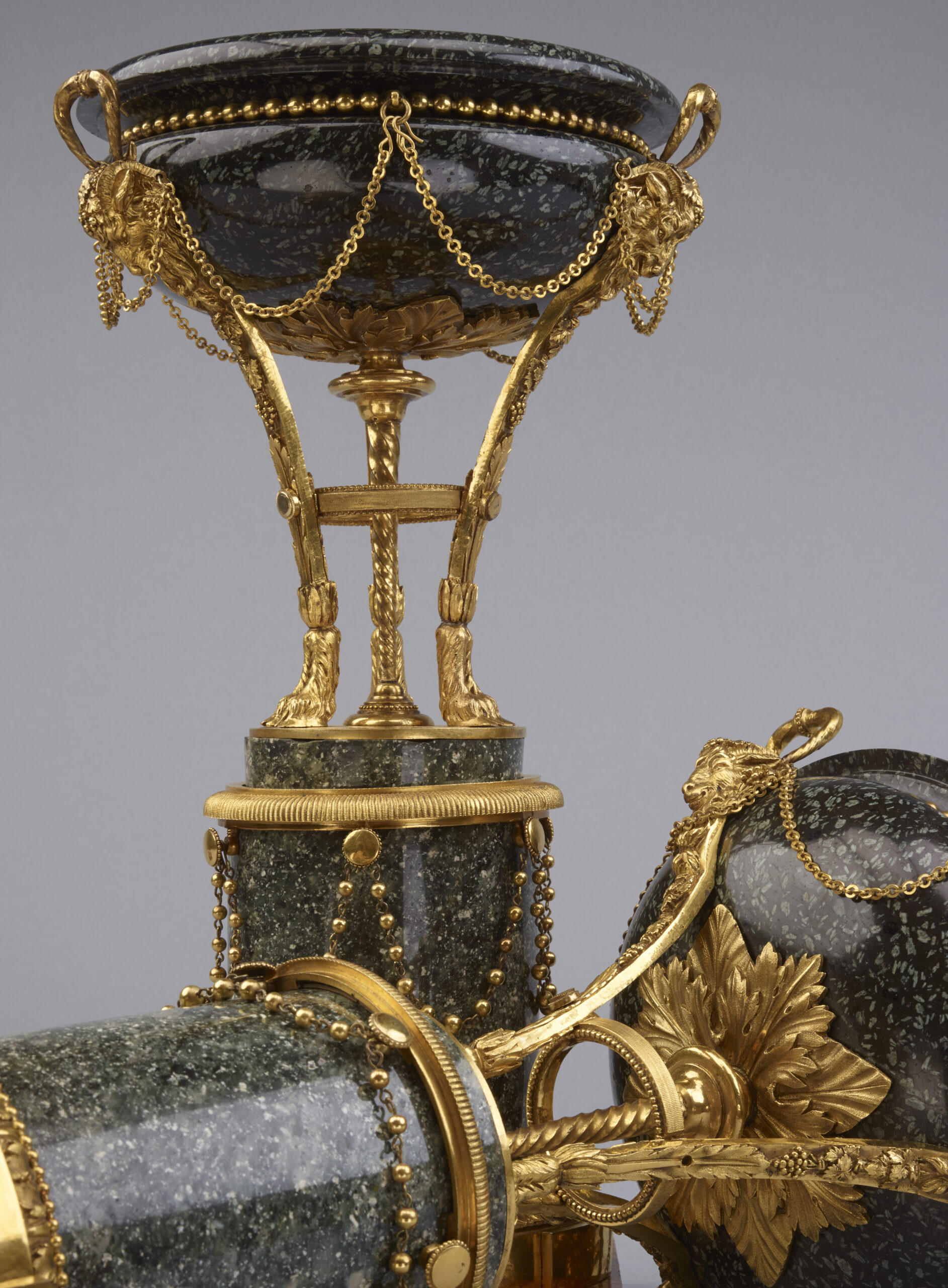
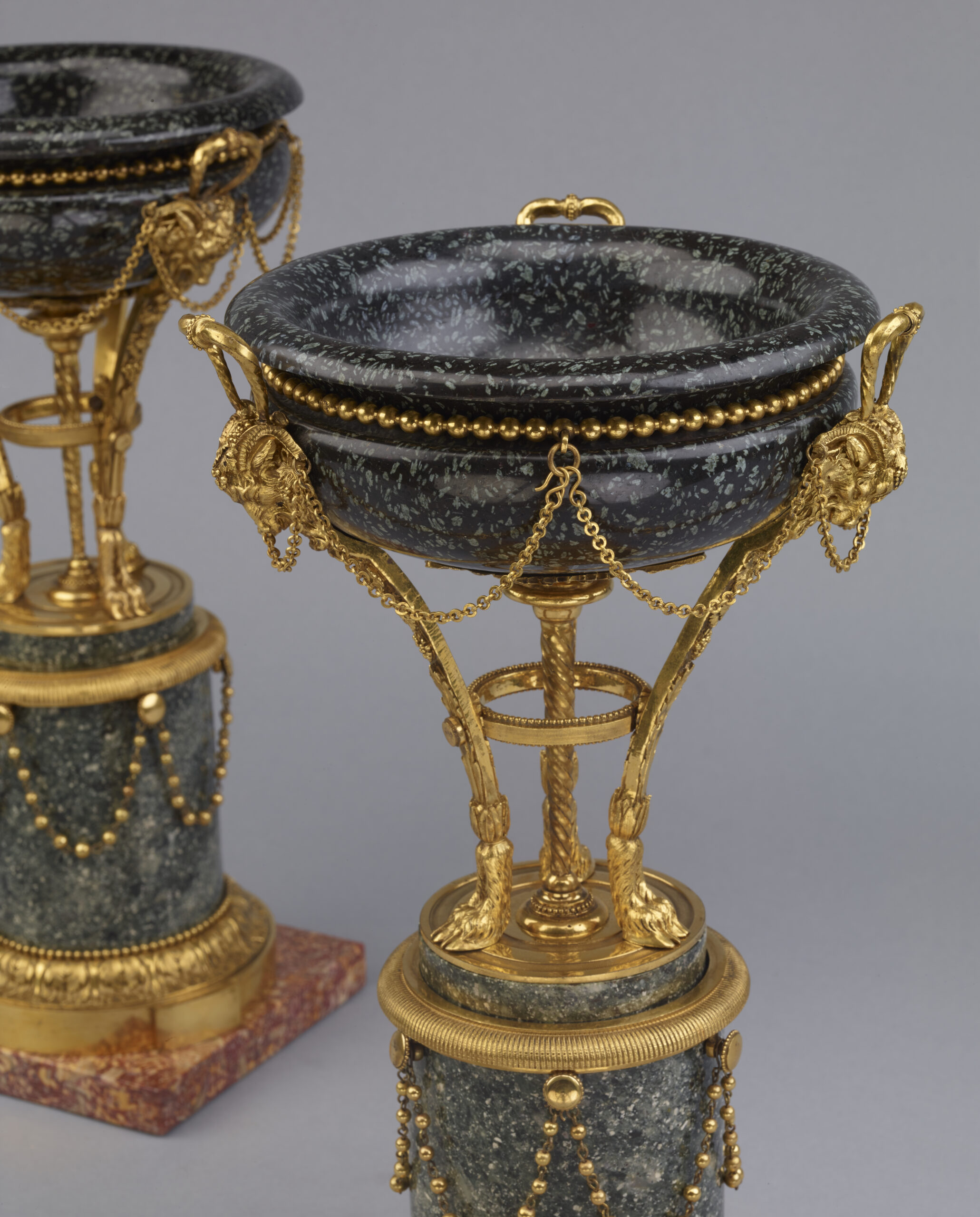
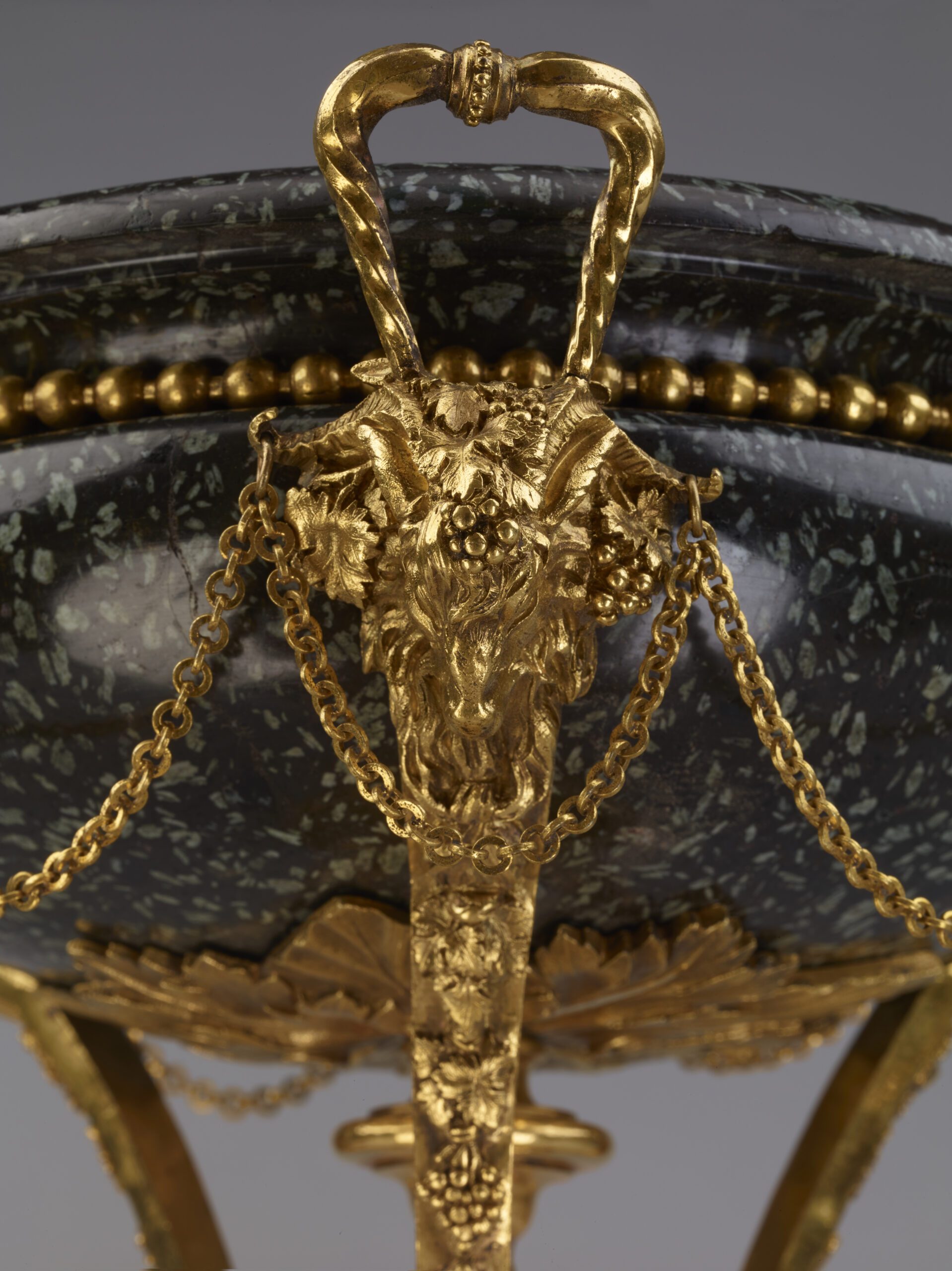
Round in shape and measuring 19.1 and 19.4 cm respectively, or precisely the “7 inches” indicated in the Boullongne auctions mentioned above, these bowls display a moulded profile with a groove crowning a narrow, circular body and underlining a “corbin beak”-shaped neck section. Remarkably polished, they were sculpted in serpentine marble or Vosgean serpentine: “Serpentines are highly sought after and make for splendid decorations. These stones offer all shades of black, green and yellow, and can be perfectly polished. The accidents of colour, veins, nodules, etc., to which they owe their name, make them very pleasing to the eye.”[1] Each bowl, whose neck is enhanced by a fillet of gilt bronze pearls, is lavishly mounted. Underlined by a large corolla alternating acanthus and festooned leaves, it is supported by a tapered and twisted central stem, with a moulded and pearled base and a ring moulded likewise at the top, and is supported by a ‘console’ tripod base with a square cross-section, fitted with a goat’s head surmounted by a short handle with a double foliated baluster, enhanced by vine branches and terminated by a ‘goat’s foot’ and a corolla of lanceolate leaves. A circular bronze band with pearled edges joins these three feet at mid-height, secured with moulded buttons. Chains attached to the goat’s horns underline each of the heads, and connect them in the form of a double accolade held in place by a small ring attached to the beadwork of the neck section.
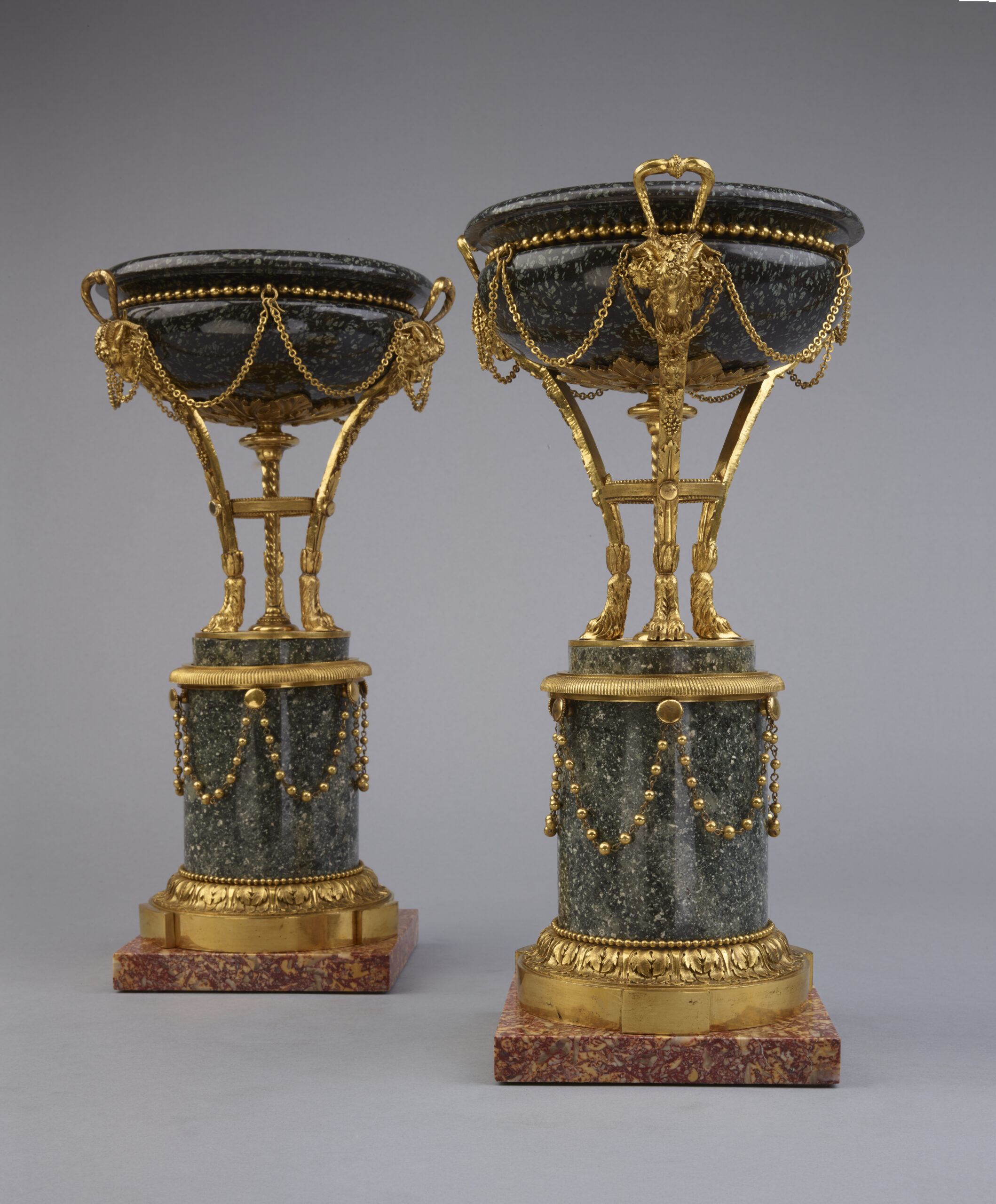
The whole rests on a moulded bronze terrace fixed on a cylindrical shaft of green Vosges ‘jasper’ or ‘granite’, crowned by a projection enriched with a quarter round of finely chiselled gilt bronze adorned with ‘braids’ and underlined by pearled buttons, which are attachment points for garlands of pearls forming accolades around the shaft. The latter is set in a gilded bronze base, punctuated by four ‘avant-corps’, with a doucine of acanthus frieze and pearl fillet, resting on a square-shaped counter-socle of Spanish brocatelle marble.
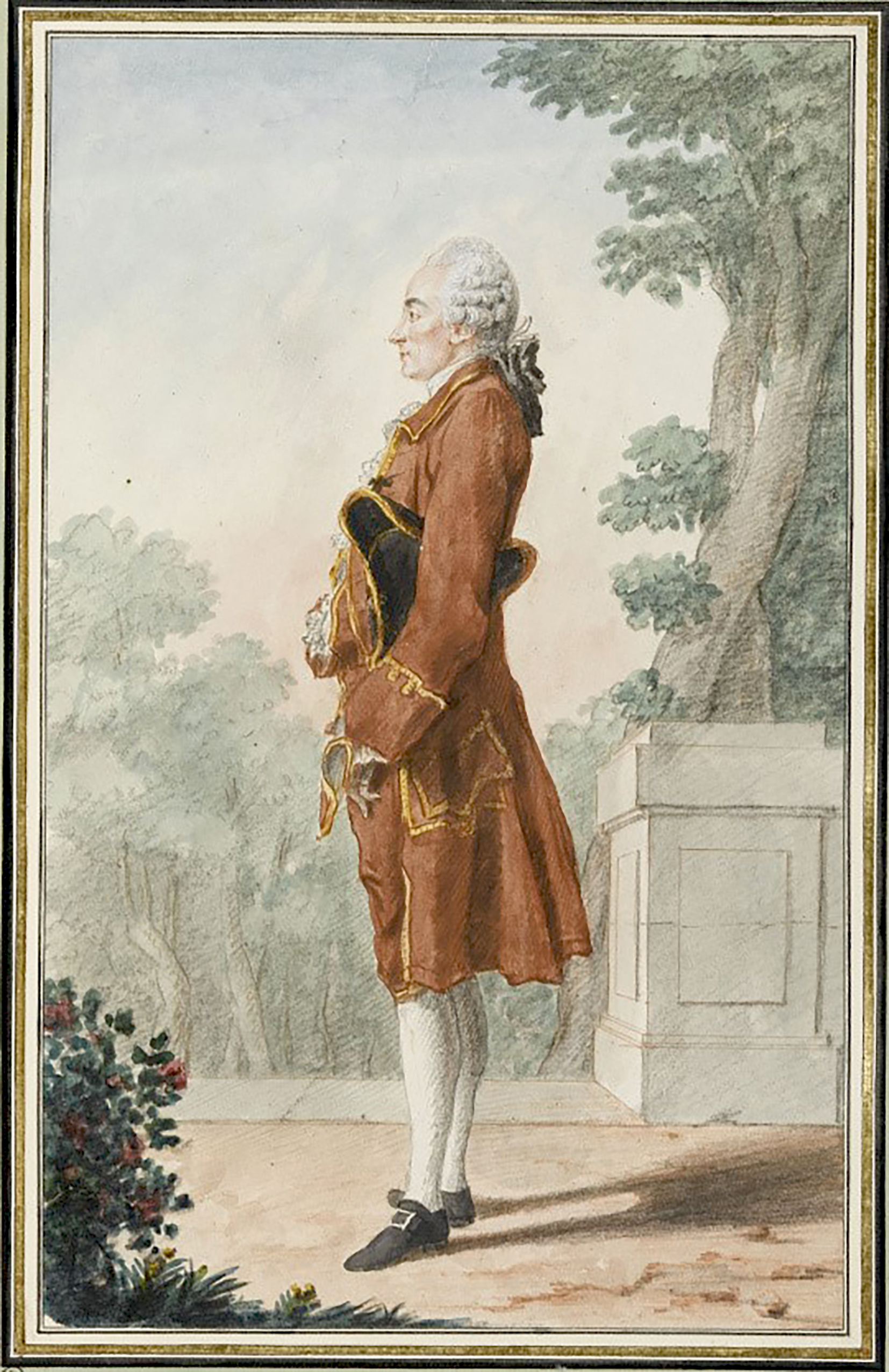
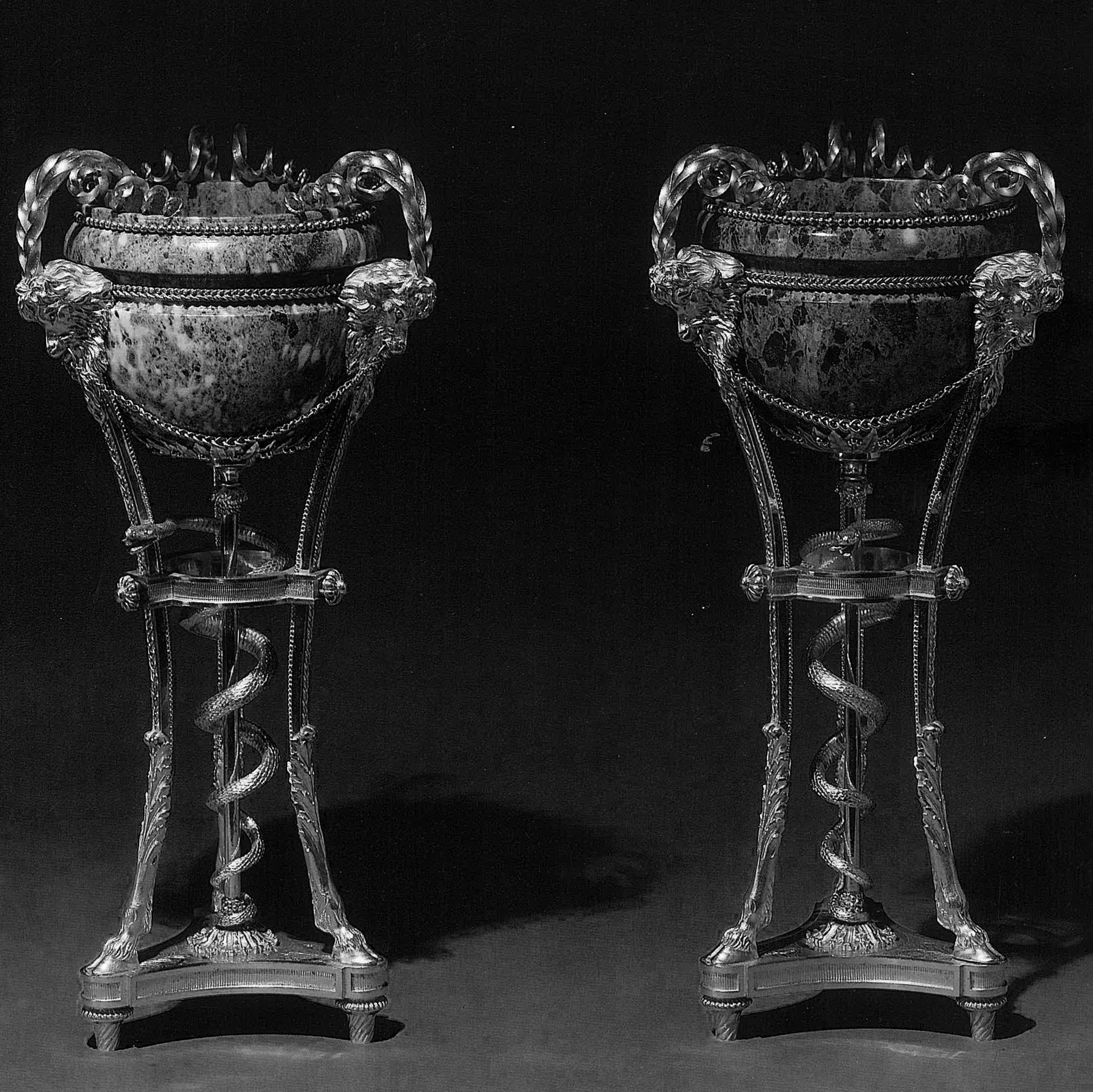
A pair of mounted bowls matching the description of ours belonged to Jean-Baptiste-Charrançois de Clermont d’Amboise (1728-1792), chevalier of Clermont-Gallerande, and marquis of Renel or Reynel, a diplomat who was appointed French ambassador to Portugal in 1767 and to Naples in 1775.
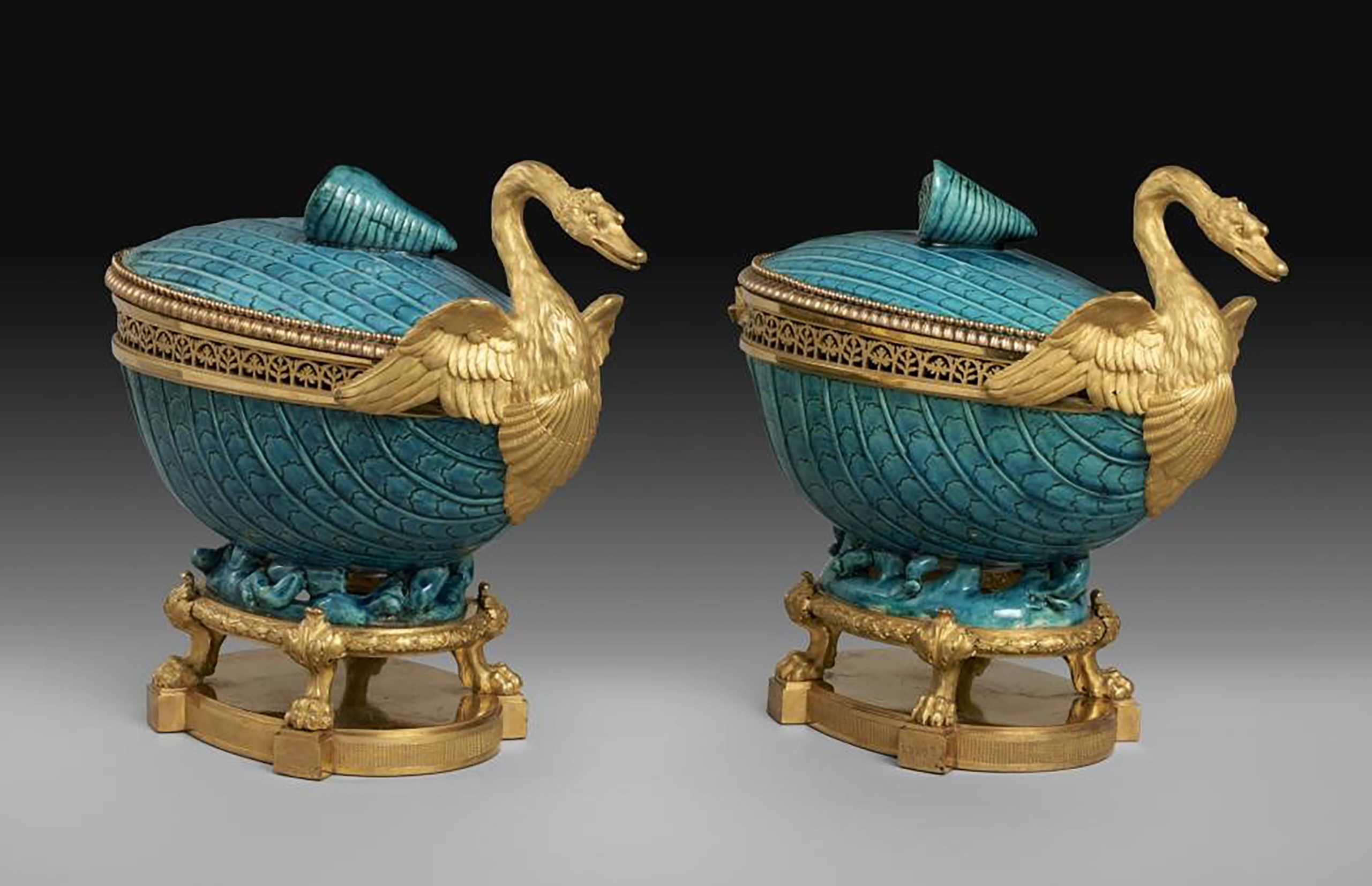
The Marquis of Renel was also the owner of two important mounted pots-pourris in Chinese porcelain with a turquoise blue glaze, now in the Louvre Museum in Paris. The latter had probably commissioned them from Pierre Gouthière (1732-1808) in the early 1770s before his departure to the court of Naples where he was ambassador from 1775 to 1784.
A fairly large quantity of papers, property titles and accounting documents seized during the Revolution from his home after he had most certainly emigrated, now preserved in the Archives nationales, reveal that the marquis lived in his private mansion in the rue Royale, parish of Saint-Roch, until 1789, and tax receipts and patriotic contributions dating from 1790 and 1791 subsequently indicate his residence to be in the rue de Montholon at n° 300 at that time.
It was precisely at this location that a revolutionary seizure took place under the instructions of Lemonnier and Moreau le jeune, who—on 6th-7th and 10th June 1793, i.e. a little less than a year after the death of the marquis, who was massacred at the Tuileries Palace on 10th August 1792—confiscated the two bowls, as well as the two pots-pourris from the Louvre: “No. 69, two serpentine cups with a black background resting on their column shafts of green Vosgean granite decorated with gilt bronze with two socles of Italian griot marble”.
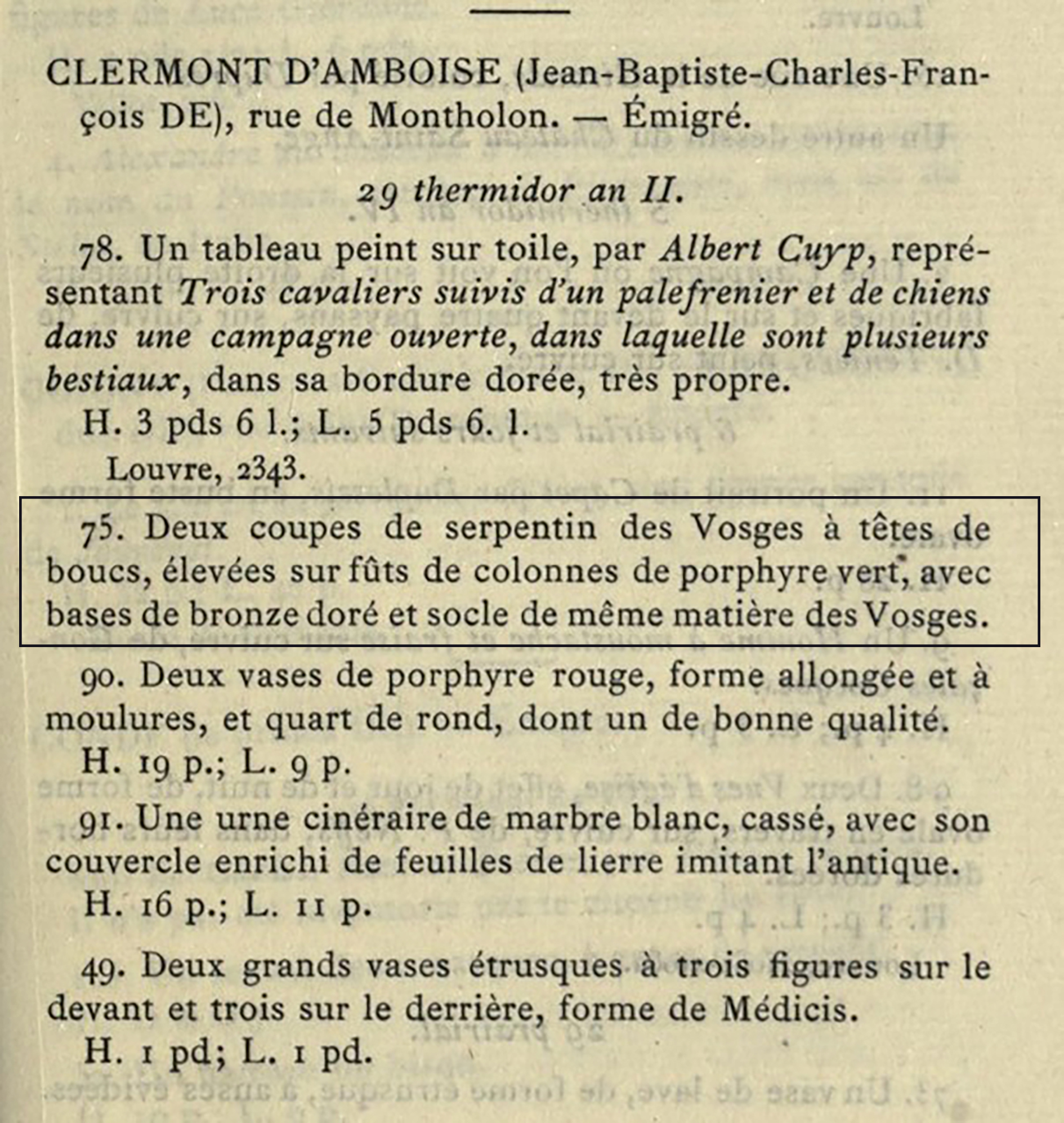
These objects were sent to the Nesle depot, under the supervision of citizen Mulot and under the responsibility of the Commission des Monuments, with a view to serving public instruction, where they were inventoried, during the administration of François-Valentin Mulot, between 27th Germinal and 30th Prairial of the year II (from 16th April to 18th June 1794), by Jean-Baptiste-Pierre Lebrun, then deputy to the Provisional Commission: “Clermont d’Amboise/verified with pieces 64/signed Le Monnier on 6th June 1793 and 130 signed Besson […] Museum [intended to be sent to the Museum central des Arts, in other words the Louvre]/75. Two serpentine cups from the Vosges with goat’s heads, raised on green porphyry column shafts with gilt bronze bases and socles of the same material from the Vosges”. They were sent to the Museum on 4th Fructidor of the year II (21st August 1794).
Could it be that our bowls were those of the Marquis of Clermont d’Amboise that Philippe-François Julliot allegedly sold to him? The question deserves to be asked here. If these bowls were indeed deposited at the Museum in 1794, it should be noted that not all the works of art sent there necessarily remained in the Museum.
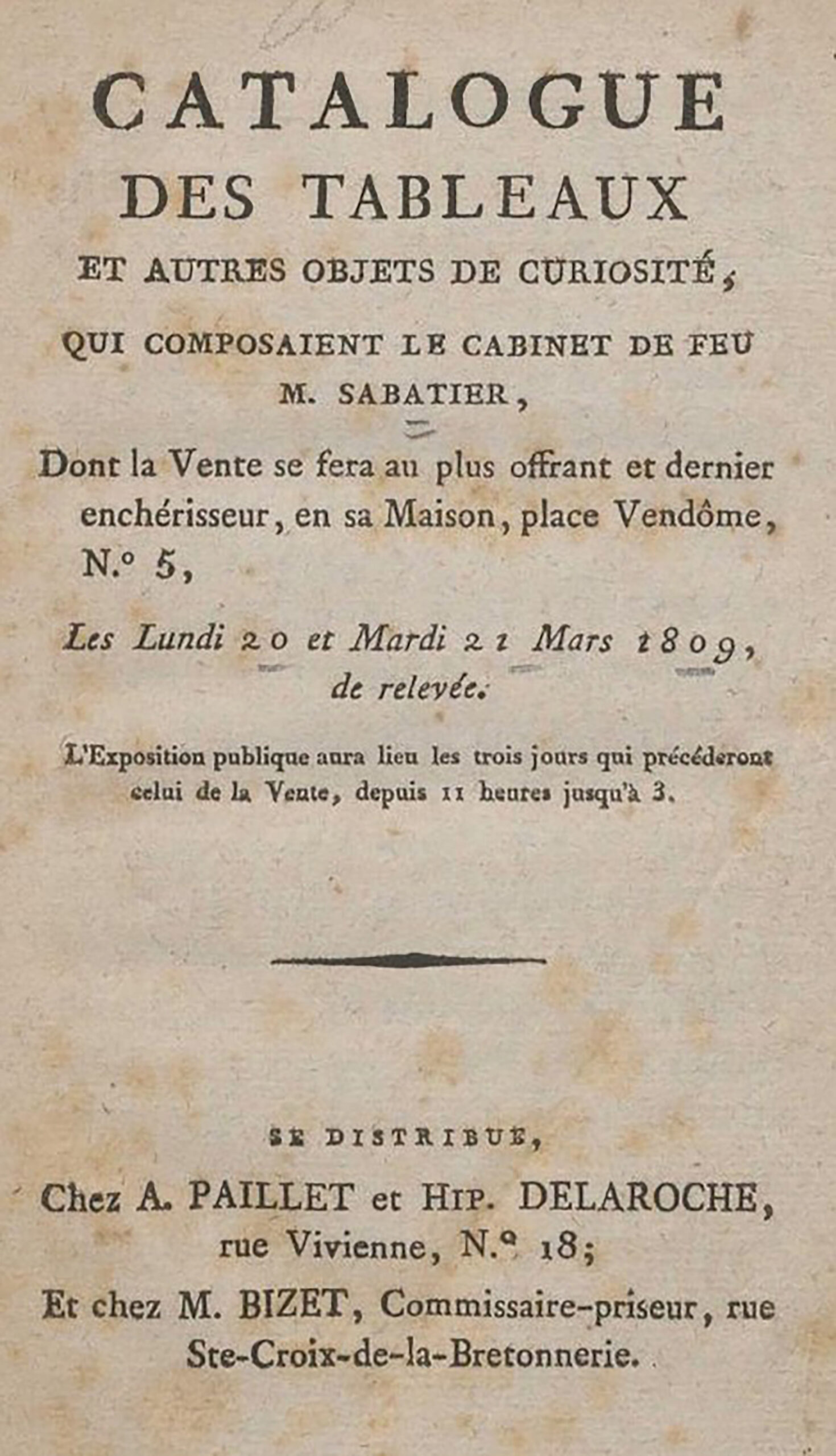
Our bowls were in the collection of the banker Guillaume Sabatier (1730-1808), cousin of Jean-Jacques-Régis de Cambacérès (1753-1824), 2nd consul then archchancellor of the Empire, in his private mansion known as the hôtel de Durfort, located at n° 5 on the place Vendôme in Paris.
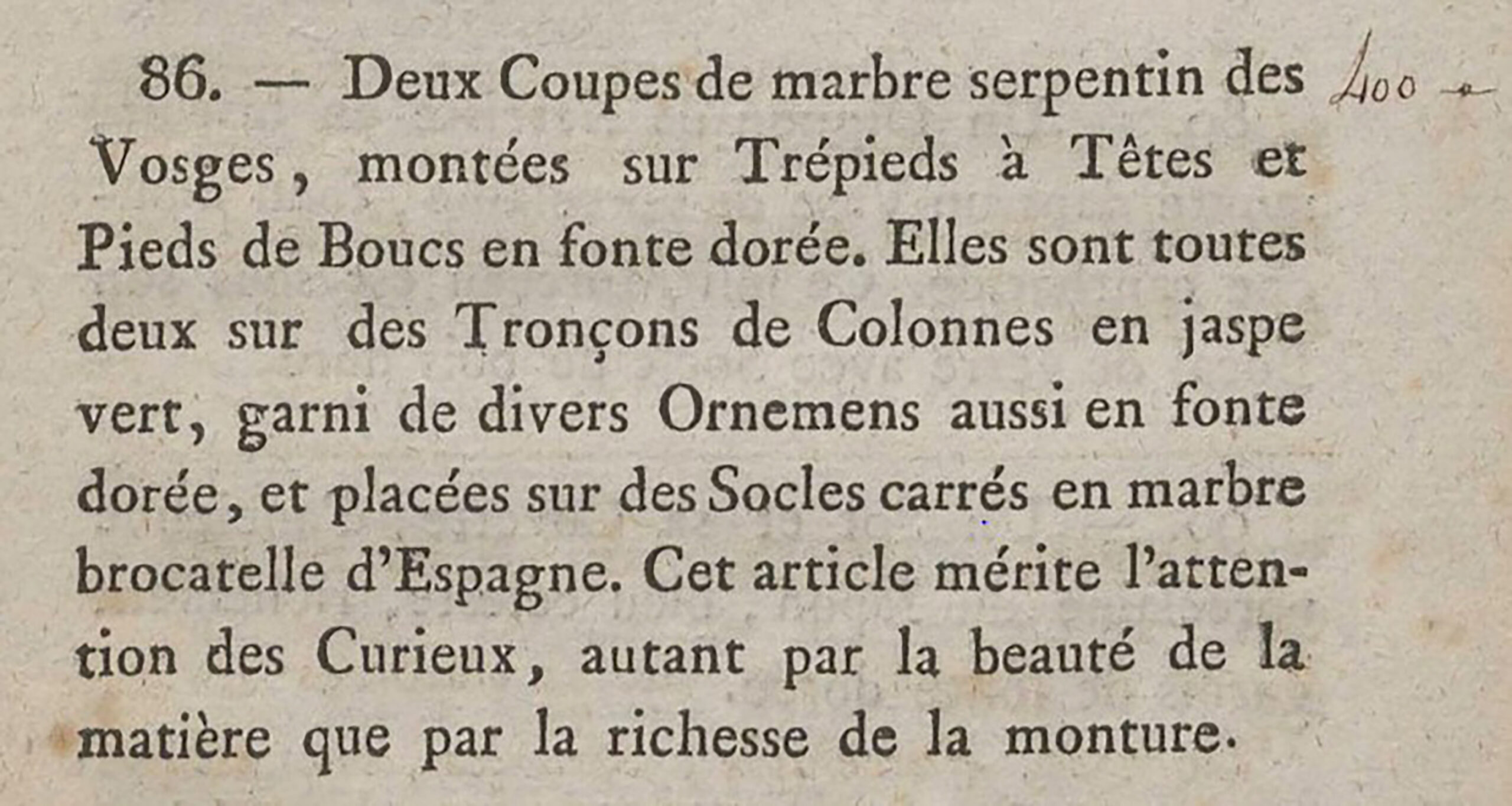
They formed lot n° 86 of his post-mortem auction catalogue, which was held at his home on 20th and 21st March 1809, under the supervision of Bizet: “86. – Two marble cups in serpentine from the Vosges, mounted on Tripods with Heads and Feet of Goats in gilt cast iron. They are both on Columns Shafts in green jasper, adorned with various Ornaments also in gilt cast iron, and placed on square pedestals in Spanish brocatelle marble.
This item deserves the attention of the Curious, as much by the beauty of the material as by the richness of the mounting”. They were sold for 400 francs.
It is possible that our bowls adorned under the July Monarchy the Cabinet of Mr. A…, located at n° 16 of the rue Saint-Fiacre in Paris. Indeed, during the in situ auction of this cabinet by Bonnefond de La Vialle, on 14th and 15th April 1834, two bowls corresponding to ours formed lot n° 65 of the catalogue: “65 – Two bowls, in serpentine marble, surrounded by a circle with gilt bronze handles; they are on a tripod resting on a sea-green socle, terminated by another socle which, as well as the tripods, is in gilt bronze. These bowls, of a precious material and with a rich and perfectly well-groomed mounting, deserve the attention of the connoisseurs”.
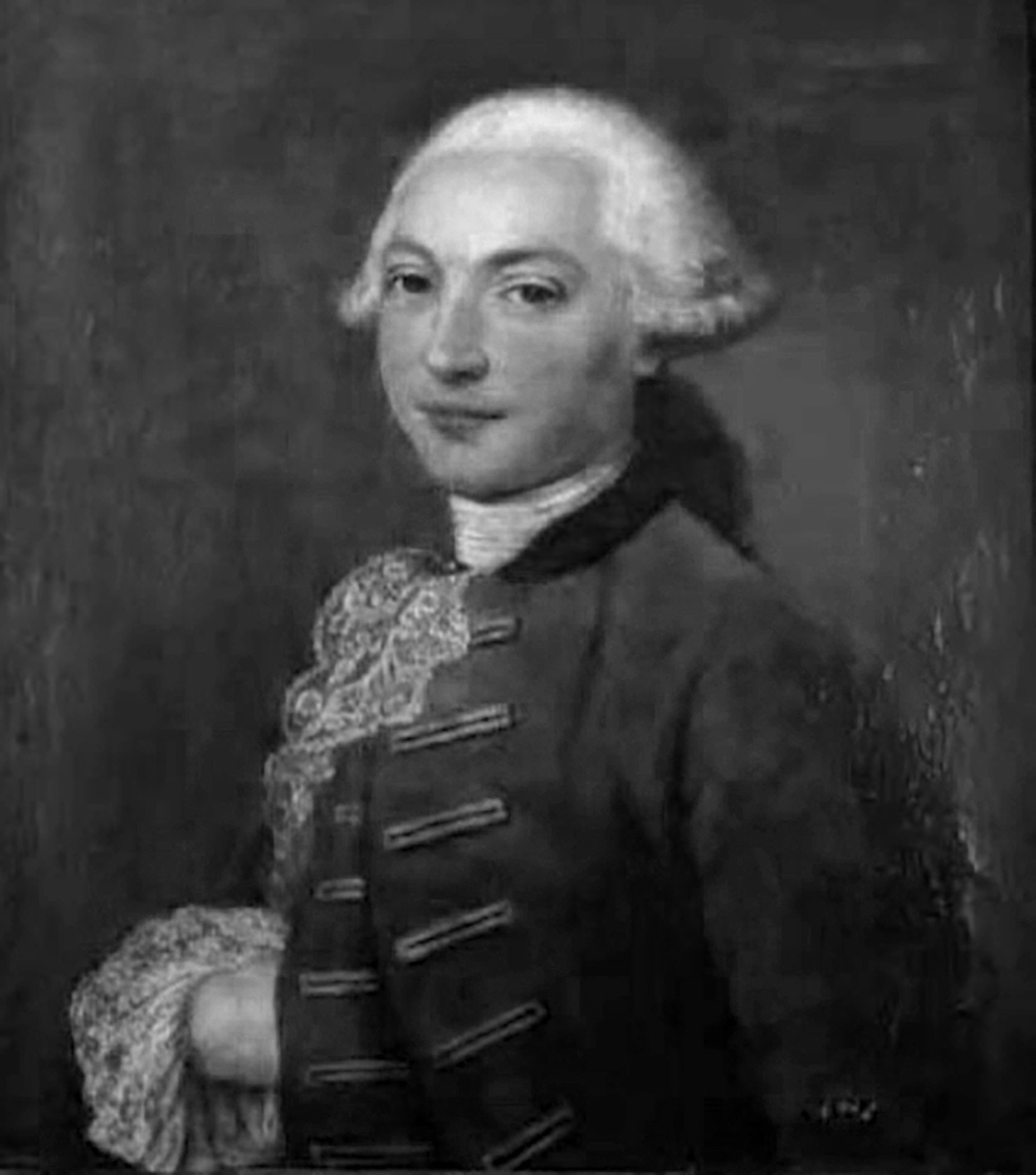
Jean-Nicolas de Boullongne
Born on 11th November 1726 in Versailles, Jean-Nicolas de Boullongne was the son of the minister Jean de Boullongne, Count of Nogent, and the grandson of the farmer general Claude-Pierre de Beaufort. He acquired the county of Nogent and the barony of Marigny by engagement, and was the owner of the château of Chapelle-Godefroy, near Nogent-sur-Seine, in the Aube, which he had decorated by Charles-Joseph Natoire. The estate was seized in 1792, and the castle was burnt down during the campaign of France in 1814.
Jean-Nicolas de Boullongne was appointed councillor of the Parliament of Paris to the first Chambre des Enquêtes, and commissioner of the Requêtes du Palais on 30th July 1745, and became Master of the Requests on 24th January 1750. He became Intendant of Finances for Louis XV, in succession to his father, on 13th April 1753. He was appointed full intendant on 25th August 1757, and remained in office when the number of positions was reduced in 1771. He was the only one to keep his department when the office was abolished in 1777.
A State Councillor in 1765, he was admitted as a member of the Royal Council of Finances and Commerce in 1767. In the same year he was also appointed governor and lieutenant to the King in Montereau. In 1784 he was appointed commissioner of the Compagnie des Indes.
On 9th May 1753, he married Louise-Julie Feydeau de Brou, daughter of the Garde des Sceaux Paul-Esprit Feydeau de Brou, in the church of Saint-Sulpice in Paris. Coming from a family closely associated with the arts, he was received as an honorary free associate in 1760, then as an honorary amateur in 1778 at the Royal Academy of Painting and Sculpture. Jean-Nicolas de Boullongne died in Paris on 7th January 1787.
Jean-Baptiste-Charles-François de Clermont d’Amboise
Jean-Baptiste-Charles-François, Marquis of Renel and seigneur of Montglas, was born in Paris on 6th August 1728, and was baptised the same day at Saint-Roch. Second son of Jean-Baptiste-Louis, Marquis of Reuil, and his first wife, Henriette de Fitz-James, he was first called Chevalier of Clermont-Gallerande and became colonel of the Regiment of Brittany after the death of his elder brother in 1746. Marshal of the King’s camps and armies, governor of Chaumont, he became a diplomat and was appointed French ambassador to Lisbon from 1767 to 1775, then to the court of the king of the Two Sicilies, in Naples, from 1775 to 1786. He obtained, as a reward for his services, by patent of 7th January 1784, a pension of 14,662 livres 10 sous, which was confirmed on 9th August 1791 (new patent, signed: Montmorin). He had married, by virtue of a contract of June 1769, Adélaïde Charlotte de Moustier (1736-1820), canoness-countess of the Chapter of Neuville. He lived successively in his family mansion, known as the hôtel de Cheverny, located in the rue and porte Saint-Honoré, at the corner of the cul-de-sac of the Orangerie des Tuileries, the future rue Saint-Florentin, then resided, on his return from his embassies, in the hôtel de La Vaupalière, then in the rue Royale and finally in the rue de Montholon in the 9th arrondissement. In Naples, the Marquis of Renel had Dominique-Vivant Denon (1747-1825), the future director of the Napoleon Museum, as his embassy counsellor, with whom he established a particularly fruitful artistic relationship.
The Marquis de Clermont d’Amboise was a substitute deputy of the nobility of the bailliage of Provins at the Estates General. Perhaps sensing the events to come, he preventively sold part of his collections on 20th May 1790, and in February of the following year, tried to rent out his mansion with its furniture, certainly with the intention of emigrating. He finally met a tragic end, as he was massacred while defending the royal family in the Tuileries during the terrible day of 10th August 1792. As previously mentioned, his possessions were seized in 1793, along with fifty-one lots that actually belonged to Denon, who occupied a small apartement on the third floor of the mansion in the rue de Montholon. The latter claimed them and recovered them under the Directoire. The sister of the Marquis of Renel, Diane Jacqueline Josèphe Henriette de Clermont d’Amboise (1733-1804), Marquise of La Vaupalière, who had emigrated in 1789, became his sole heir.
Guillaume Sabatier
A native of Montpellier, Guillaume Sabatier became the heir to the oldest bank in Languedoc, the Maison Sabatier, a trading and transaction establishment of Protestant origin. He came to Paris to establish a branch of the family business, which covered several activities between 1770 and 1793, including banking, textile trading, the supply of sheets and weapons to the army, trade with the islands and shares in the Compagnie des Indes. In 1791, at the sale of the Biens Nationaux, he acquired the estate and château of Espeyran in the Gard, previously owned by the abbey of Saint-Gilles, as well as the estate of Maurin and Aresquiers, in the commune of Lattes (Hérault region).
In October 1793, the government of the Terror decided to confiscate the goods of the Compagnie des Indes and arrest its leaders. Sabatier, cousin of Cambacérès, then president of the legislative body, narrowly escaped the guillotine. Released after the 9th Thermidor, he tried with two other directors, Mallet the elder and Louis-Victor Moreau, to obtain the restitution of the seized goods. With only three ships recovered, the shareholders decided to liquidate the Company in July 1795. However, the Revolution had not altered the family’s power and Guillaume Sabatier became one of the most influential Parisian bankers under the Directoire and the Empire. During this period, his assistant was Médard Desprez, the son of his friend Pierre Desprez, who was also a director of the Company. In 1796, still prompted by Cambacérès, he took part in the repurchase of the Compagnie des mines of Anzin, in association with a group of financiers including Claude Perier. He also became the principal associate of the bank Doyen and Cie, of which he bought back part of the debts. In 1800, he was one of the founding shareholders of the Banque de France and obtained a seat as censor on the board, from which he resigned in 1803 for health reasons. He was replaced by Jean-Henry Martin, known as Martin de Puech. Sabatier was also a general councillor of the Seine from 1800 to 1803. He died at his château d’Ors in Châteaufort, Yvelines, on 21st August 1808, leaving his fortune to his wife, Jeanne Baudin d’Alogny, the future Baroness Lavabre, and to his natural son, Auguste, known as Augustin Sabatier (1785-1813), whom he had acknowledged as his son in 1808. Augustin inherited half of his father’s fortune in 1808, but died five years later without issue, leaving his property to his mother. The second half of Guillaume Sabatier’s fortune went to his two younger sisters, Marie, who lived in Montpellier, and Marie-Fortunée, who resided in Paris, who in turn bequeathed it to their three grandnephews Frédéric, Félix and François Sabatier.
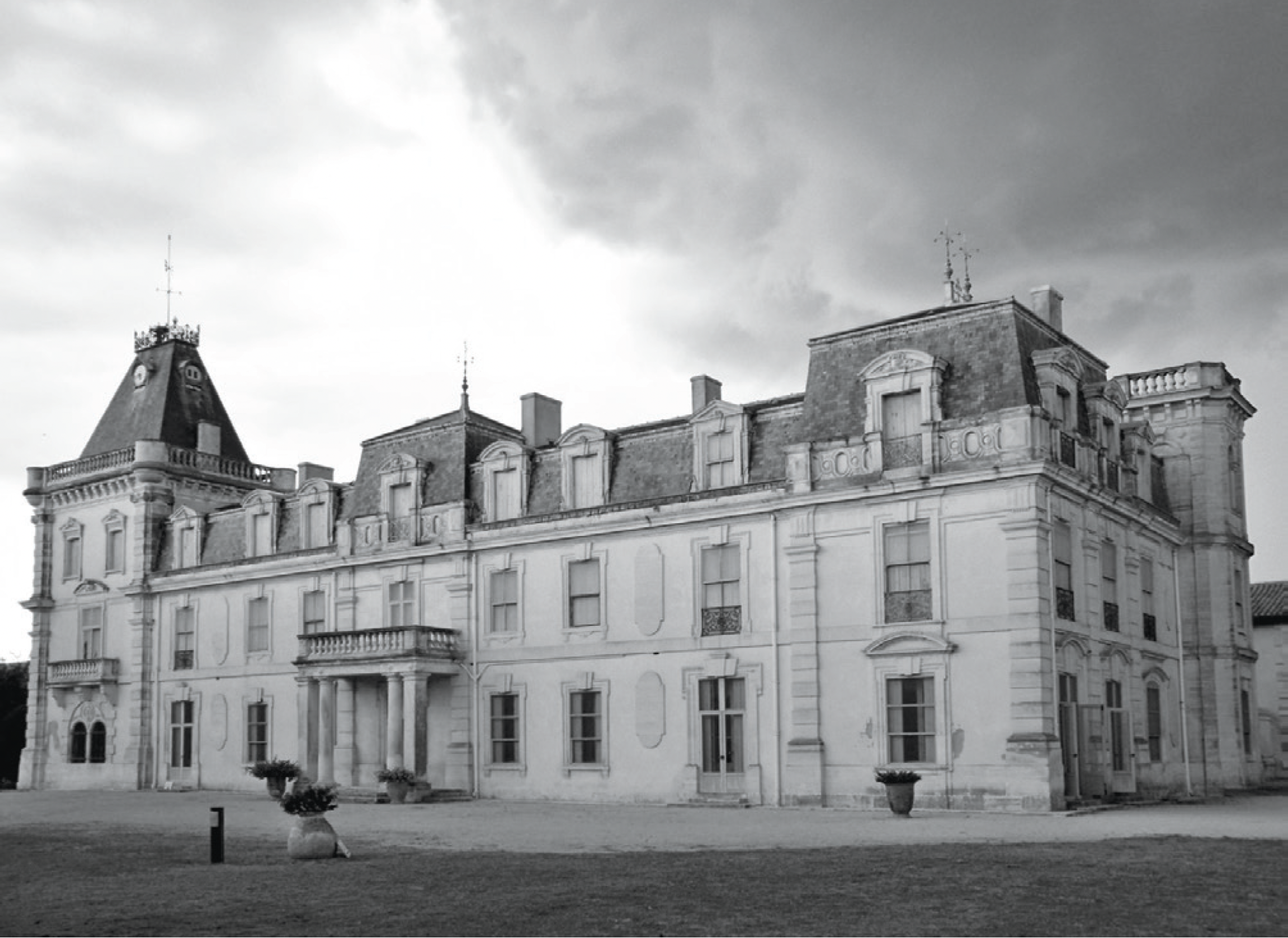
The settlement of Guillaume Sabatier’s estate – the furniture was valued at 40,000 francs – represented net assets of 5,000,000 francs, to which could be added 1,300,000 francs of legacies. The auction took place, as already mentioned, on 20th and 21st March 1809 “in his house” at 5 Place Vendôme, i.e. in the hôtel de Durfort which Sabatier had acquired in 1788 and where he continued to live during the Revolution, as his arrest report reveals. Although he sold the hôtel de Durfort to his associate Desprez in 1798, it seems that Sabatier continued to occupy it, or at least to leave the art objects he owned there.
The expert Alexandre-Joseph Paillet wrote in the preamble to the auction catalogue that Sabatier was a friend of “the late M. Randon de Boisset, one of the great connoisseurs of his time” and that it was through contact with and under the guidance of the latter that he had begun to acquire paintings. It is therefore hardly surprising that, like his mentor’s famous collection, Sabatier’s collection consisted mainly of works by Dutch 17th-century artists, among whom Paillet singled out Nicolaes Berchem, Ludolf Bakhuizen, Willem van Mieris, Adriaen van Ostade, Pieter Neeffs, Philips Wouwerman, and Jan Wijnants. The very first purchase made by the amateur was, again according to Paillet, a pair of “two magnificent Paintings of Flowers and Fruits, by J. van Huysum, [they were auctioned for 14,000 francs, the highest bid in the dispersal of the Sabatier collection] owned by the late Donjeux, the only Merchant where first-class Paintings could be found. It took only a moment to see them, ask for the price and become their owner. This first acquisition brought him all the praise of Amateurs and Artists, and he never left Donjeux, which provided him with a certain number of authentic pieces which had been approved of by all Connoisseurs.”
From the few paintings for which the earlier provenance can be traced, it seems that the bulk of Sabatier’s collection was assembled between 1775 and 1789. Some of them had previously appeared in French cabinets such as that of Nicolas Beaujon, which was dispersed on 25th April 1787, or in that of Montesquieu Fezensac, which was auctioned on 9th December 1788. From the latter cabinet came a Landscape by Philips Wouwerman, now in the Wallace Collection in London. However, a large part of the paintings in the collection was to come directly from Holland, such as this Landscape with an attack on a convoy in the background by Berchem – now in the Koninklijk Museum in Antwerp – from the auction of the cabinet of Johannes Lodewijk Strantwijk in Amsterdam on 10th May 1780.
After this period of important purchases, “this Ensemble was sufficient for the particular enjoyment of Mr. Sabatier, he stopped and bought only a few Paintings from then on, with the intention only of enhancing his Furniture, and to oblige Friends who offered them to him”. One of these later purchases must have been the Milo of Crotone by Jean-François-Léonor Mérimée, painted in Rome in 1790 and exhibited at the Salon of 1791. In addition to this major group of paintings, the collection assembled by Sabatier also included a number of pieces of furniture and art objects, among which two “bas d’armoires” by Boulle as well as our two “bowls in serpentine marble from the Vosges”. were particularly outstanding.

