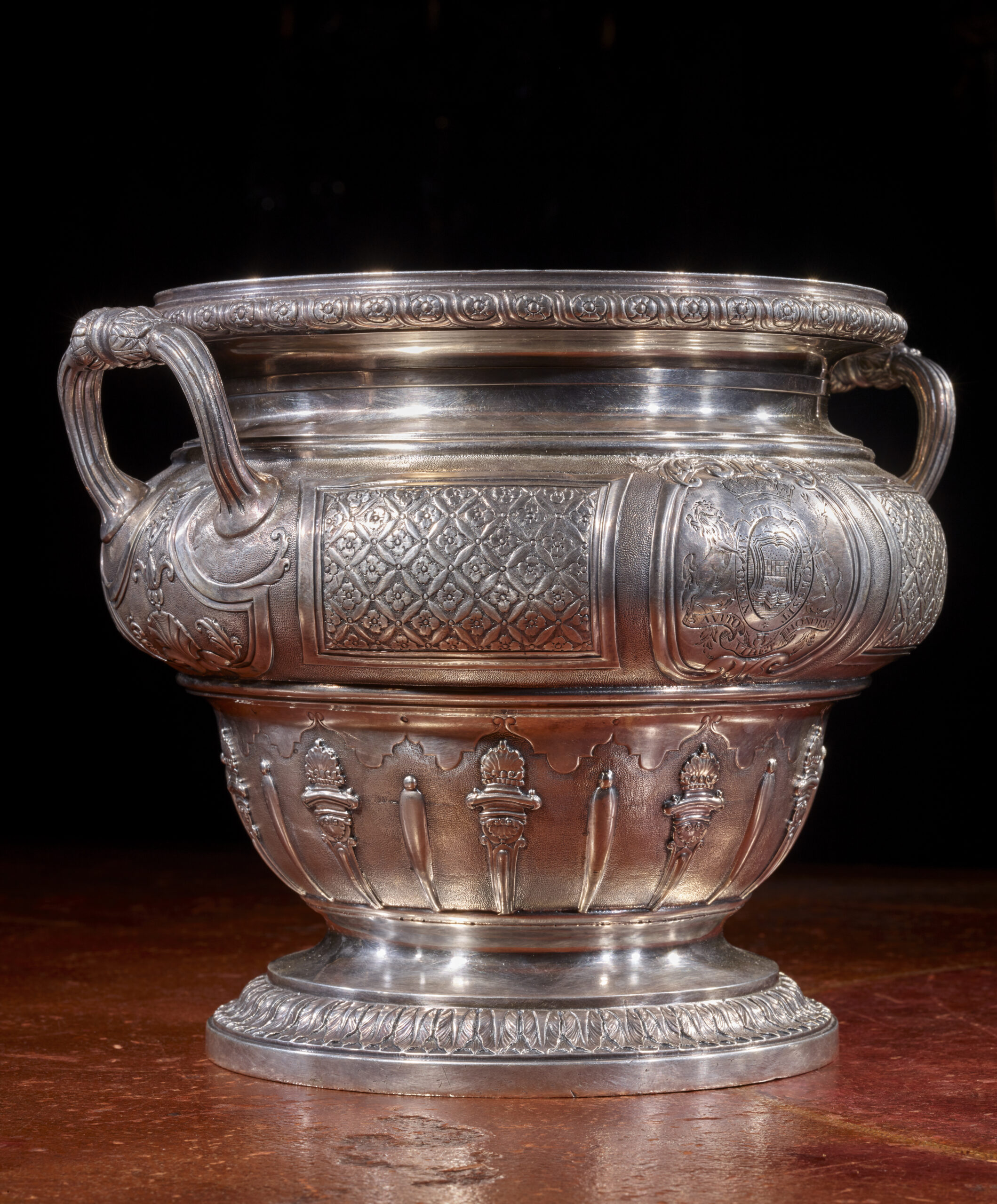
Silver
Weight: 5753.5 gr. (185 oz).
H. 20.2 cm. (7 7/8 in.).
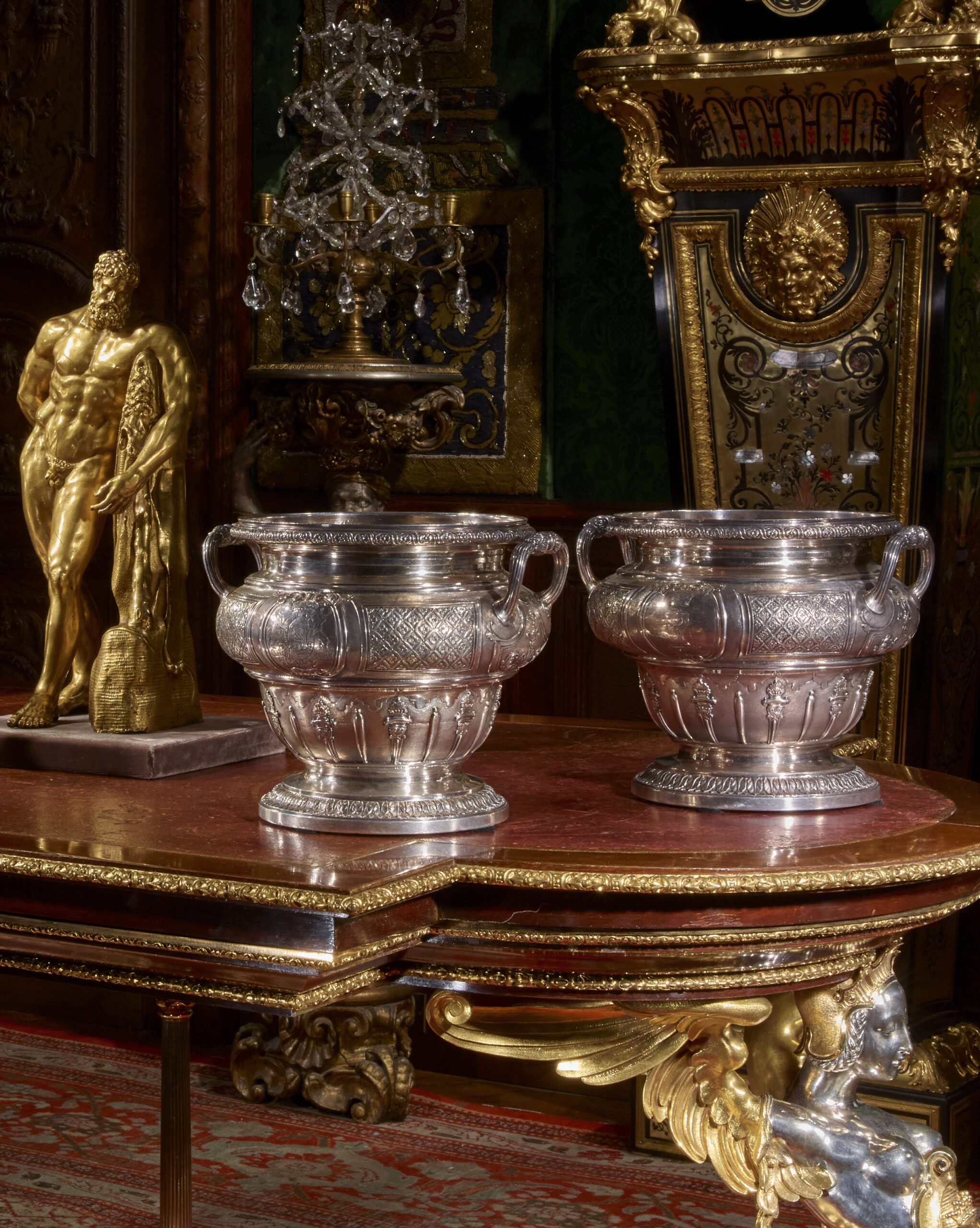
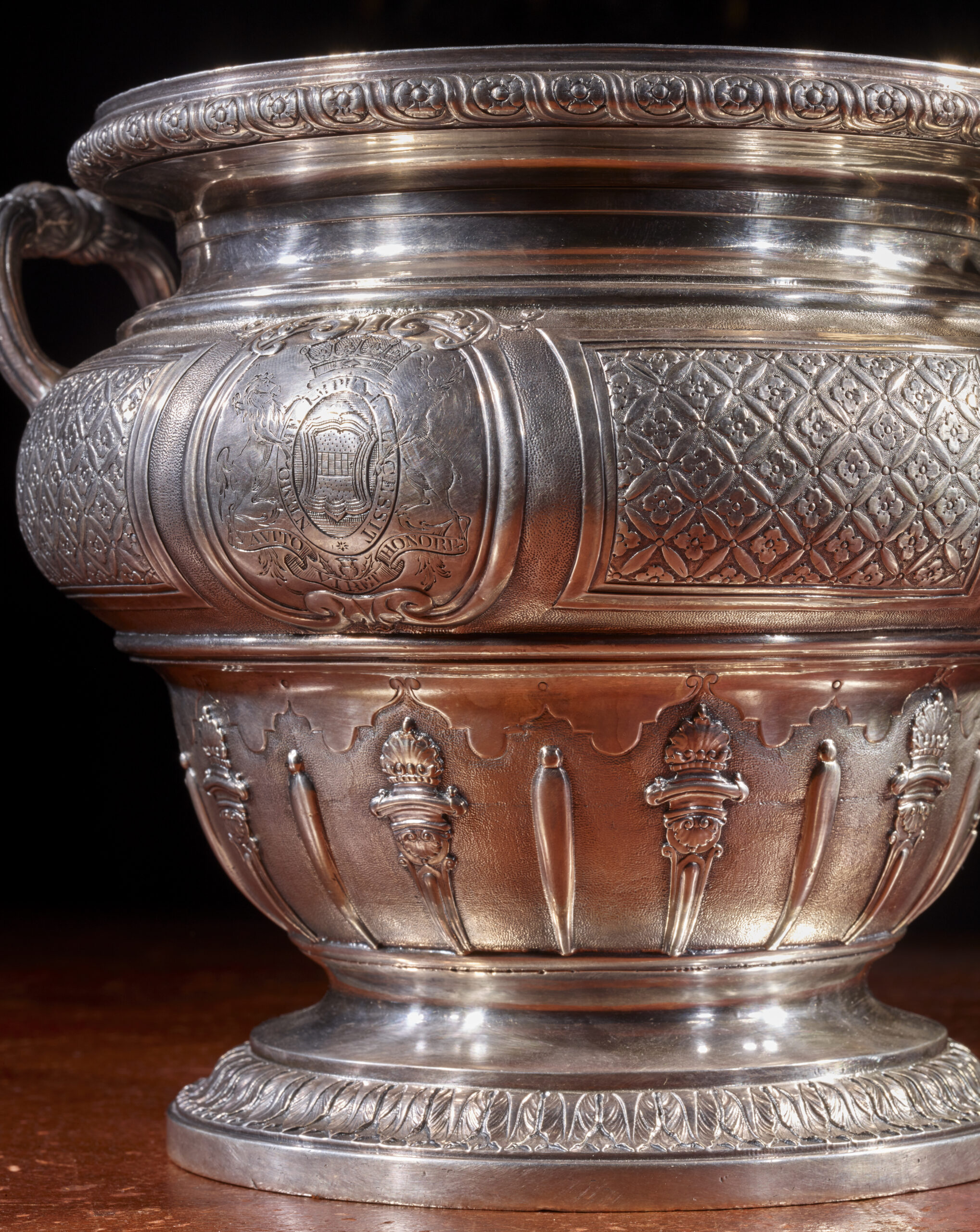
ON THE FRONT OF EACH COOLER: arms of John Stuart (1713-1792), 3rd Earl of Bute:
d’or à la fasce échiquetée d’argent et d’azur, chargée d’une tresse fleuronnée et contre-fleurie de gueules (“or, a fess chequy argent and azure, charged with a tressure flory and counter-flory gule”) surmounted by an Earl’s coronet; encircled by the motto of the Order of the Thistle: Nemo Me Impune Lacessit [No one provokes me with impunity]; with, on the dexter side, a silver horse bridled in gules, and, on the sinister side, a stag au naturel; The whole is underlined by the family motto inscribed on a listel: Avito viret honore [He flourishes through the honour of his ancestors].
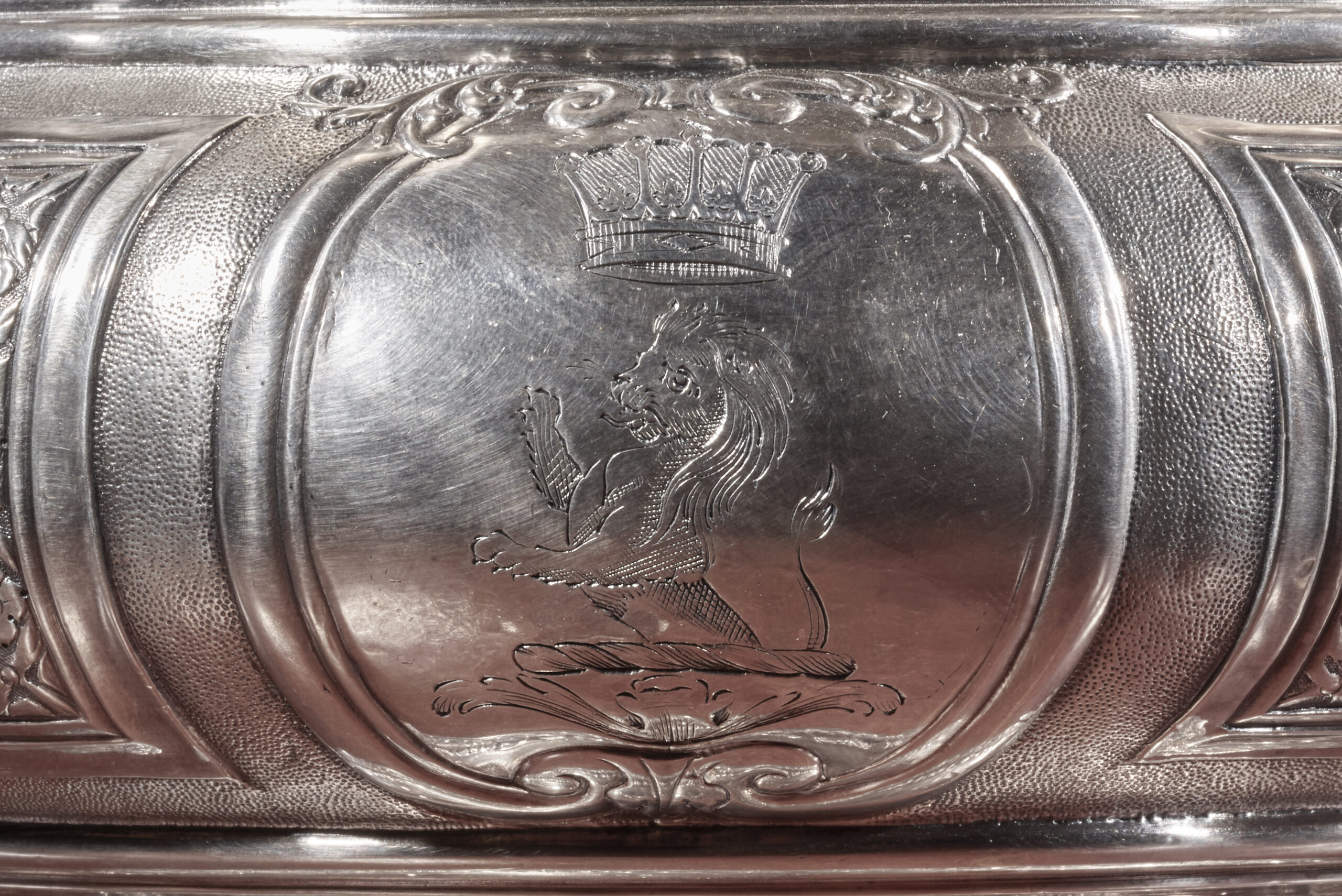
ON THE REVERSE OF EACH COOLER: a coat of arms adorned with a lion rampant gules, armed and langued azure, placed beneath an Earl’s coronet: the crest of the Stuart de Bute family.
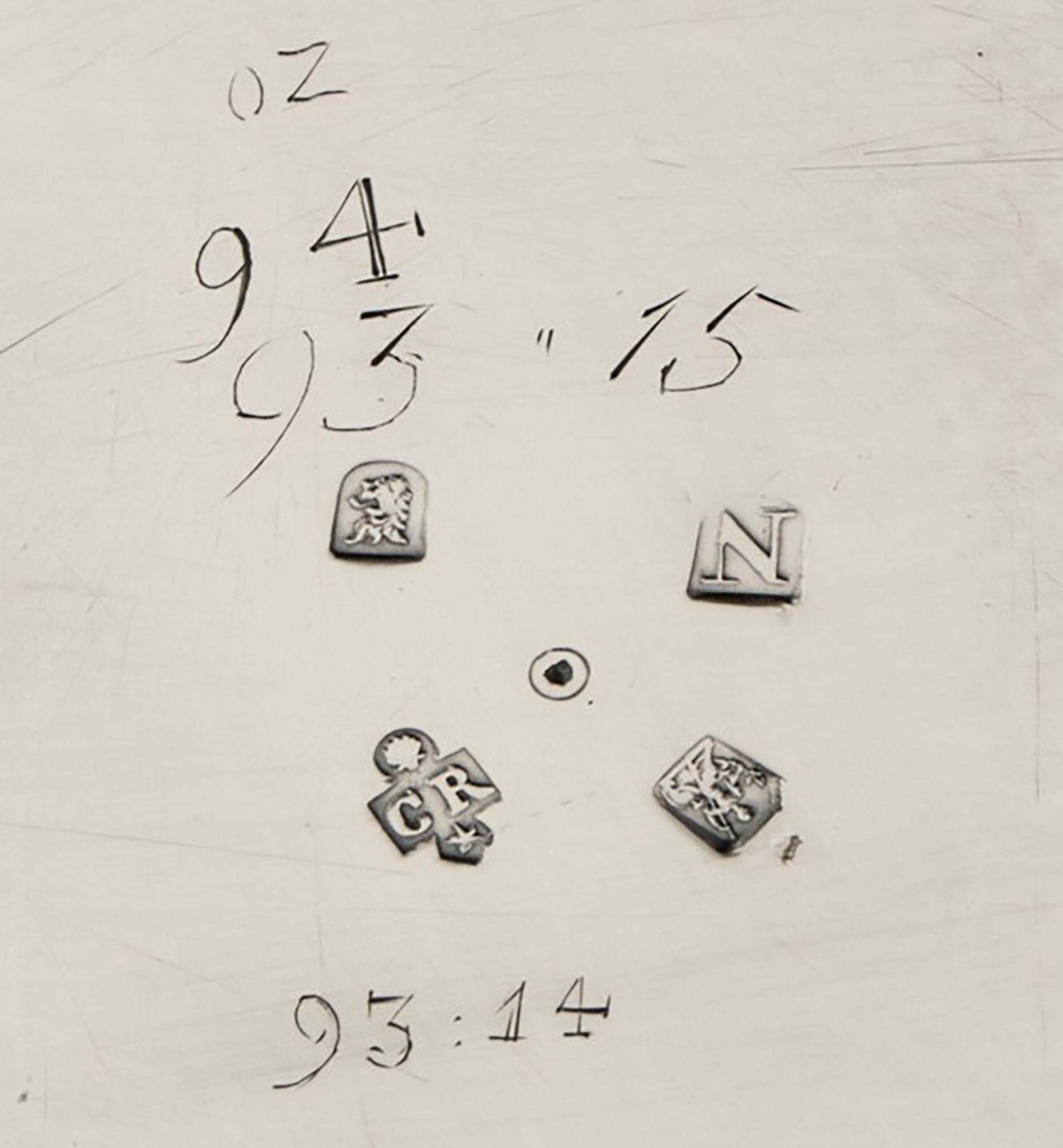
HALLMARKS: master’s hallmark of Paul Crespin (letters CR surmounted by a shell and highlighted by a star) (between 1720 and 1739, the master’s hallmark was required to consist of the first two letters of the silversmith’s surname for items executed to conform to the Britannia Standard, and the initials of the first name and surname for items made of solid silver); Britannia Standard hallmark, the reference hallmark for 95.84% silver (mandatory since 1697); hallmark with lion’s head couped, the London city hallmark associated with the Britannia Standard; N, date letter of the city of London referring to the period 1728-1729 (London Assay Office Letters/Cycle 13/George I and II).
OTHER MARKS: OZ/94’/93”15/9314, inscriptions engraved inscriptions under the base of the two wine coolers.
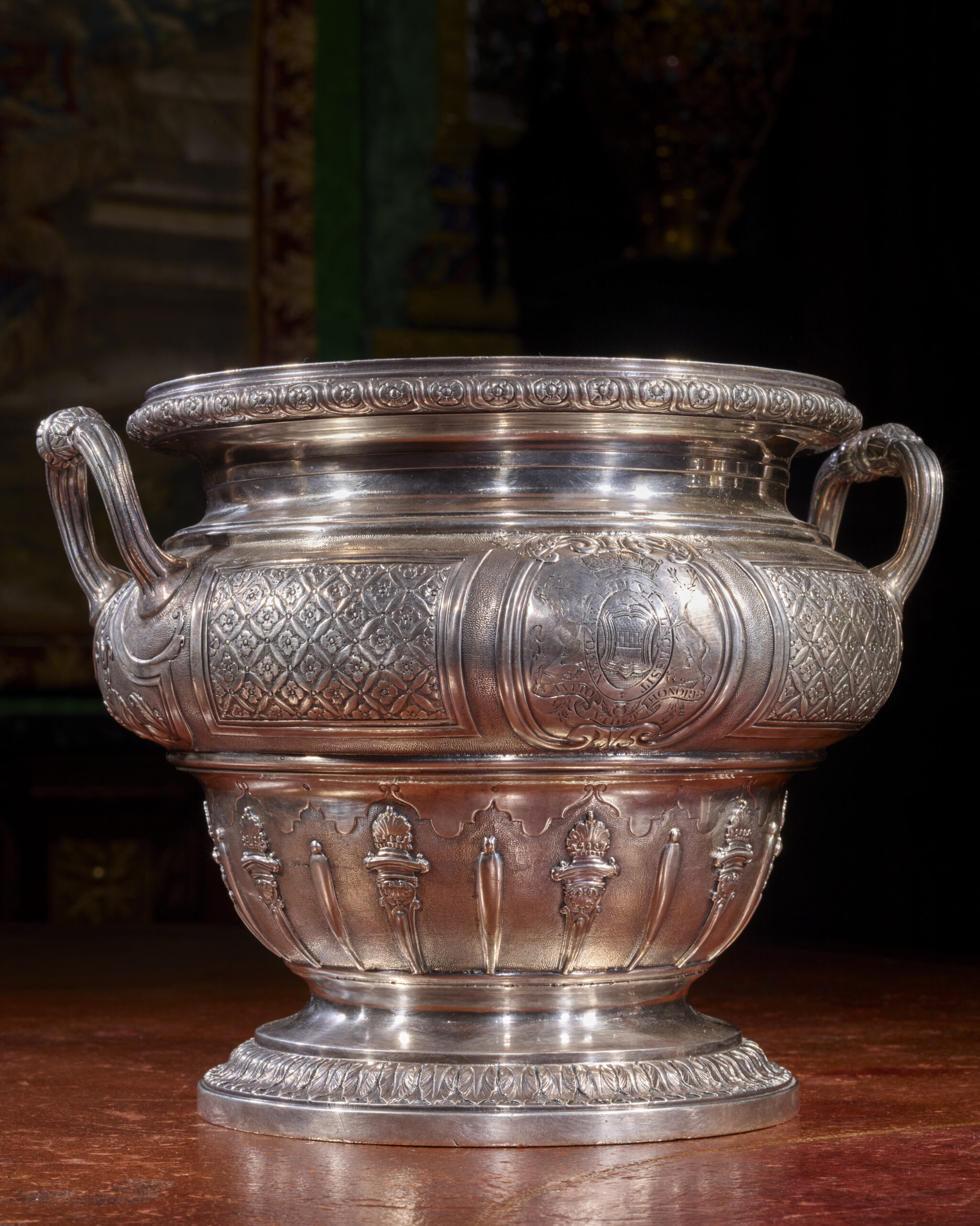
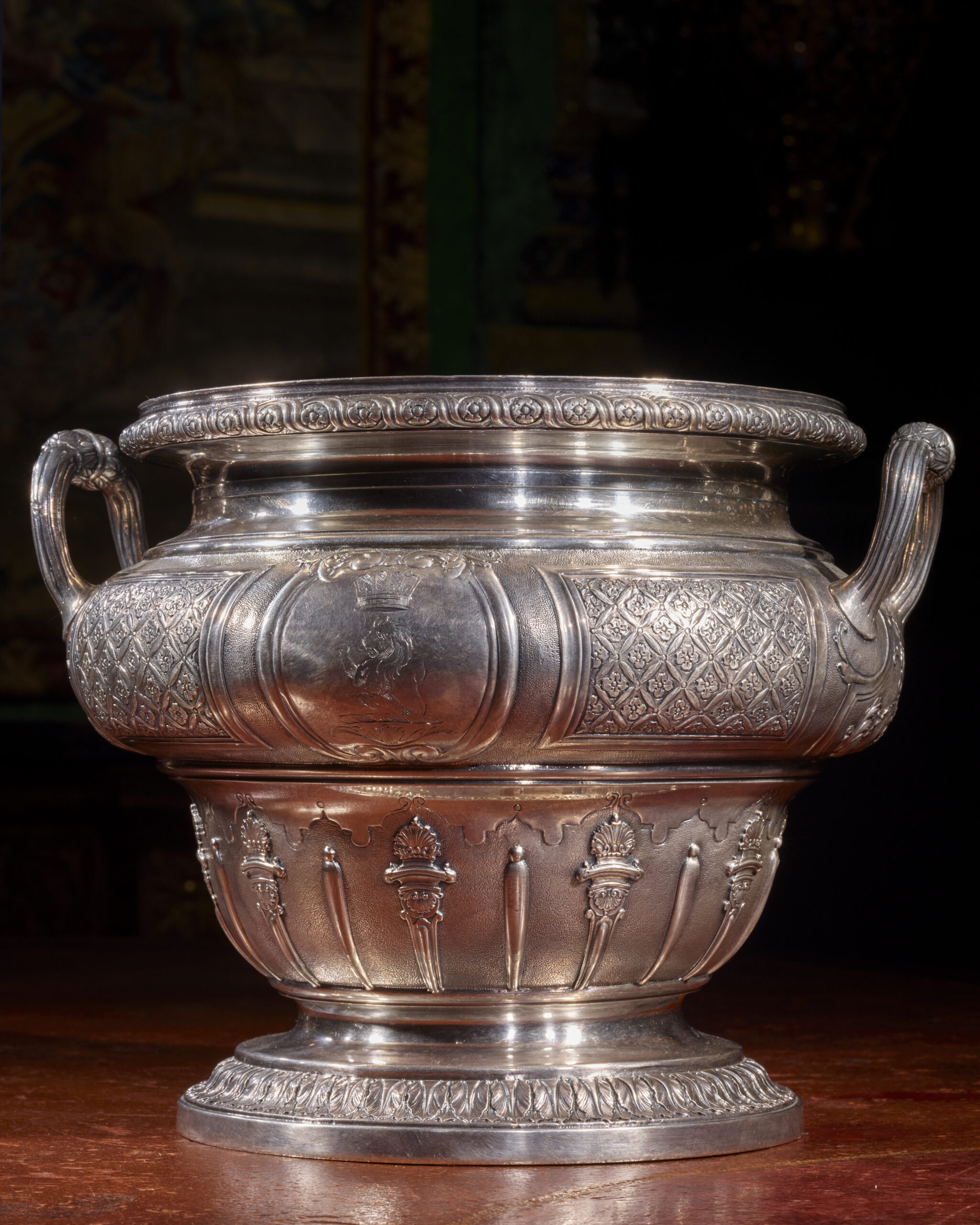
PROVENANCE: collection of John Stuart (1713-1792), 3rd Earl of Bute and Prime Minister of Great Britain from 26th May 1762 to 8th April 1763; then descendants untin 1996; Christie’s auction in London, “Works of Art from the Bute Collection,” 3rd July 1996, lot n°. 100.
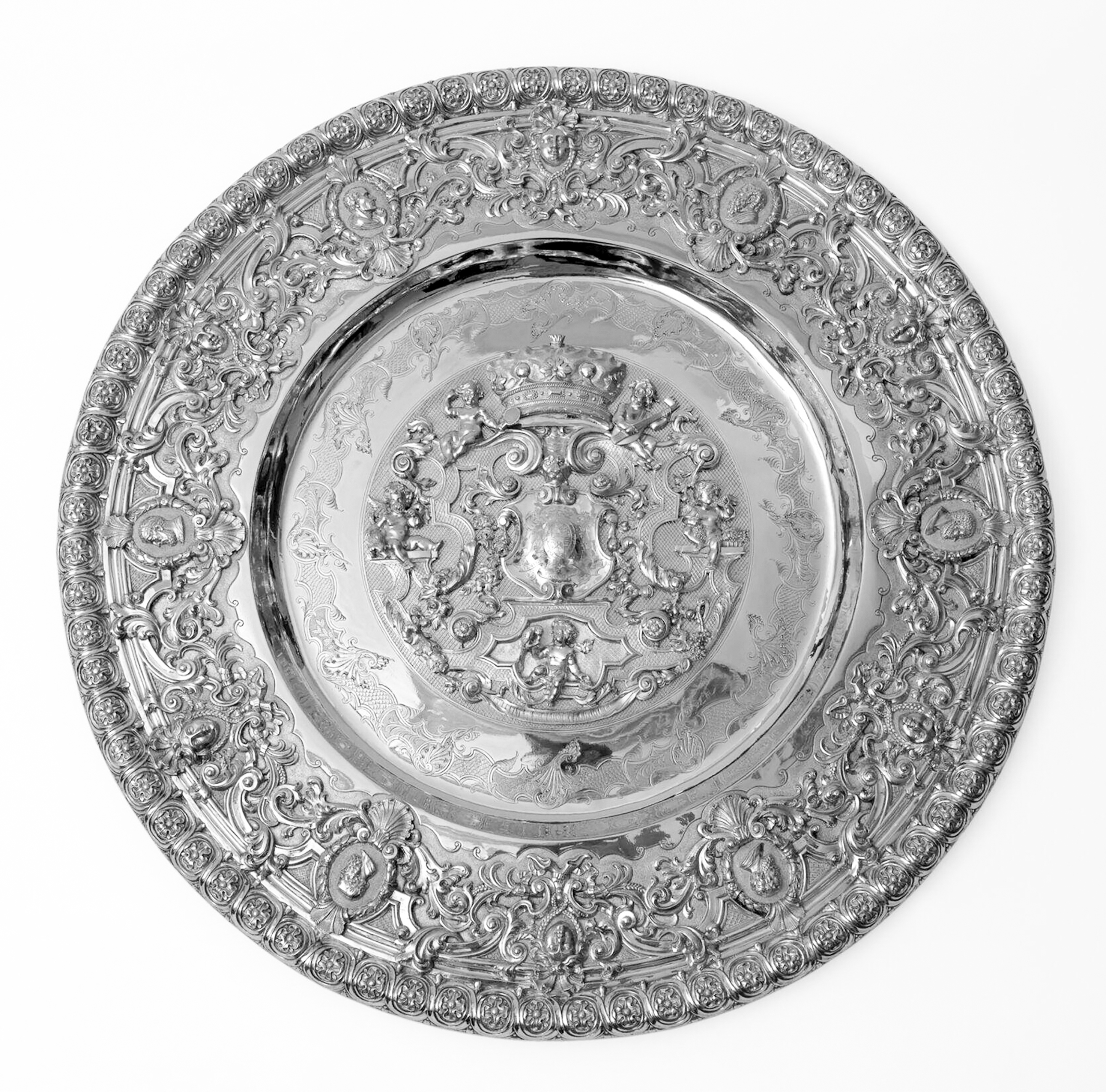
Paul Crespin ranked among the most important silversmiths active in London during the first half of the 18th century, alongside Paul de Lamerie (1688–1751), a fellow Huguenot émigré with whom he collaborated on several occasions and rivalled at the height of his career. His work, always remarkable in its inspiration, was of exceptional quality, allowing Crespin to count among his clients some of the most important figures of his time, notably King John V of Portugal (1689-1750); HRH the Prince of Wales, Frederick (1707-1751), eldest son of King George II and father of the future George III; Sir Robert Walpole (1676-1745), 1st Earl of Orford and Prime Minister of Great Britain from 1721 to 1742; Charles Spencer (1706-1758), 3rd Duke of Marlborough; William Bentinck (1709-1762), 2nd Duke of Portland, who was his landlord and whom he supplied with large quantities of silver tableware for over twenty years; William Cavendish (1698-1755), 3rd Duke of Devonshire; Henry Fiennes Pelham-Clinton (1720-1794), 9th Earl of Lincoln and 2nd Duke of Newcastle-under-Lyne; Philip Dormer Stanhope (1694-1773), 4th Earl of Chesterfield, who was King George II’s ambassador to the court of The Hague from 1728 to 1732; Lionel Tollemache (1708–1770), 4th Earl of Dysart; Richard Temple (1675–1749), 1st Viscount Cobham; Charles Townshend (1700-1764), 3rd Viscount Townshend, of whom a manuscript preserved in the archives of the Goldsmiths’ Company lists all the silverware that Crespin made for him between 1740 and 1759; and John Stuart (1713-1792), 3rd Earl of Bute and future Prime Minister of Great Britain, who owned the pair of wine coolers shown here.
Crespin executed them between 1728 and 1729, i.e. well before the Earl, who was only fifteen or sixteen at the time, had his coat of arms engraved on them, surrounded by the motto of the Order of the Thistle: Nemo Me Impune Lacessit [No one provokes me with impunity], an order in which he was not knighted until 1738.
His father, James Stuart, 2nd Earl of Bute, having died in 1723, it is conceivable that he inherited them from his mother, Lady Anne Campbell (1692-1736), daughter of Archibald Campbell, 1st Duke of Argyll, or from one of his two maternal uncles who raised him after his father’s death: John Campbell (1678-1743), 2nd Duke of Argyll, Earl and afterwards 1st Duke of Greenwich, and Lord Archibald Campbell (1682-1761), 3rd Duke of Argyll and 1st Earl of Ilay.
These wine coolers are characteristic of what is commonly known as the “Huguenot” style in England, which had been in vogue since the late 17th century. Their decoration is particularly reminiscent of the pair of octagonal wine coolers executed in 1716 by William Lukin I (active between 1699 and 1755) for Sir Robert Warlpole (1676-1745), whose coat of arms they bear—this pair, from the Irwin Untermyer collection, is now kept at the Metropolitan Museum of Art in New York —or of the similar wine cooler at the Museum of Fine Arts in Boston, executed in 1718-1719 by David Willaume I (1658–circa 1741) and bearing the coat of arms of the Noel family, Earls of Gainsborough. The “Huguenot” style was strongly influenced by contemporary French models.
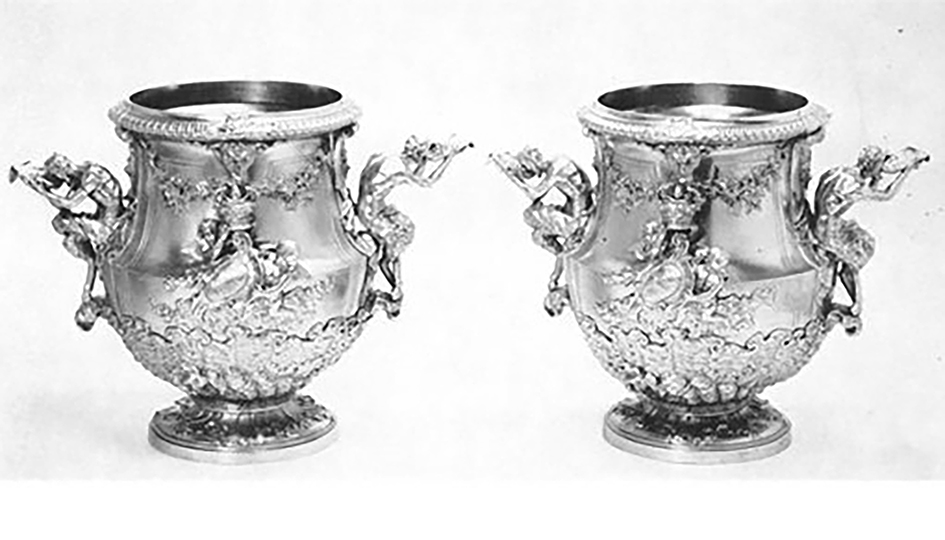
By way of example, the pair of silver wine coolers bearing the Spencer-Churchill coat of arms alongside that of the Trevors, made by Paul Crespin in 1733, most likely for the wedding of Charles Spencer-Churchill, 3rd Duke of Marlborough, and Elizabeth, daughter of Thomas Trevor, 2nd Baron Trevor of Bromham, draws its inspiration directly from a model of a wine cooler crafted in 1723 by Juste-Aurèle Meissonnier (1695-1750) for the Duke of Orléans in Paris, a model that was engraved by Gabriel Huquier (1695-1772) and published in the Neuvieme livre des Œuvres de J. A. Meissonnier. This style used classically inspired forms decorated with moulded rather than repoussé ornamentation, which was most notably characterised by narrow foliage or vertical “bands” applied to the base of the vases, motifs which were known in England as “cut-card work”. Highly prized by Huguenot as well as English silversmiths, this style flourished until around 1740, alongside the Rococo style, which was also to contribute to the renown of Paul Crespin.
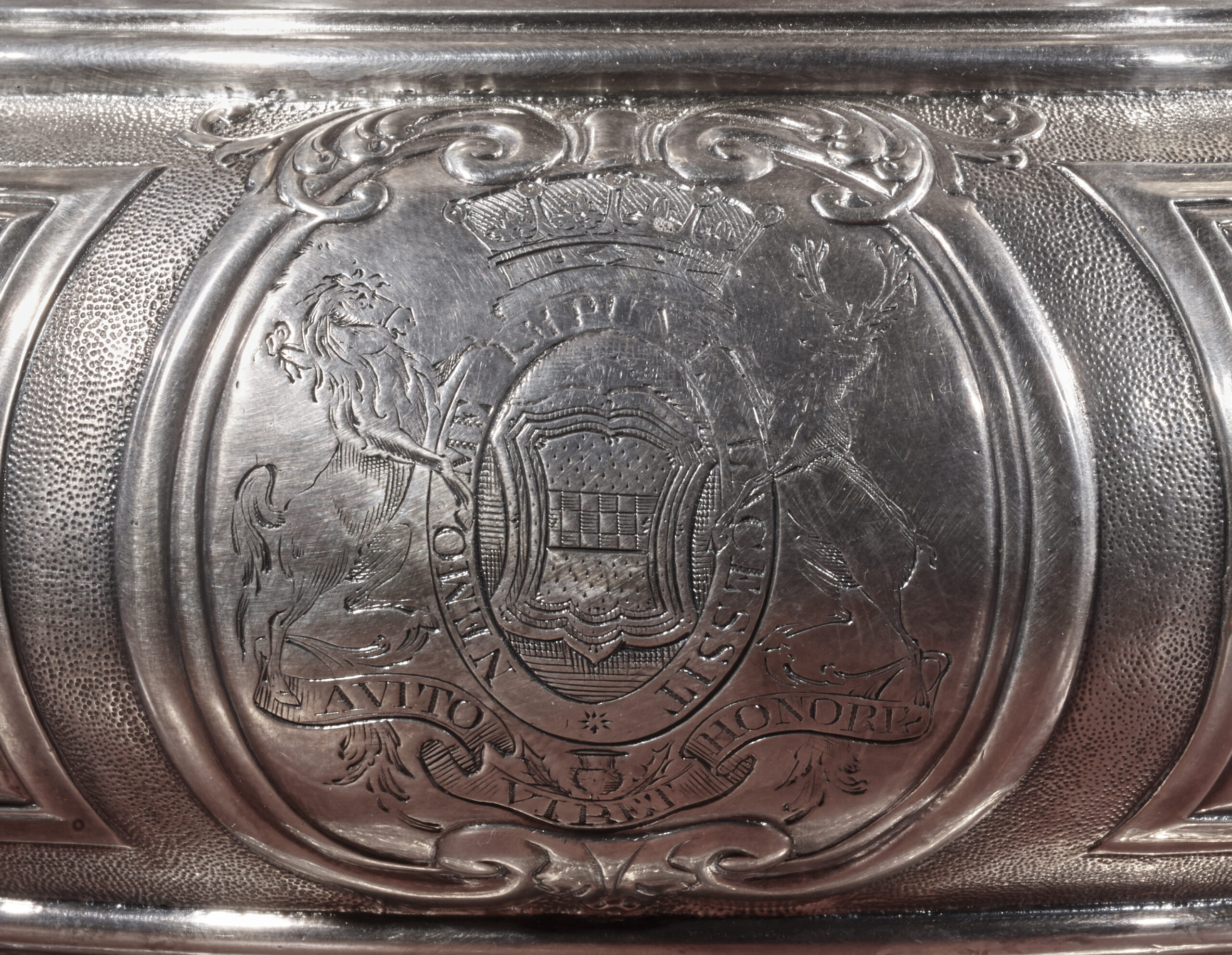
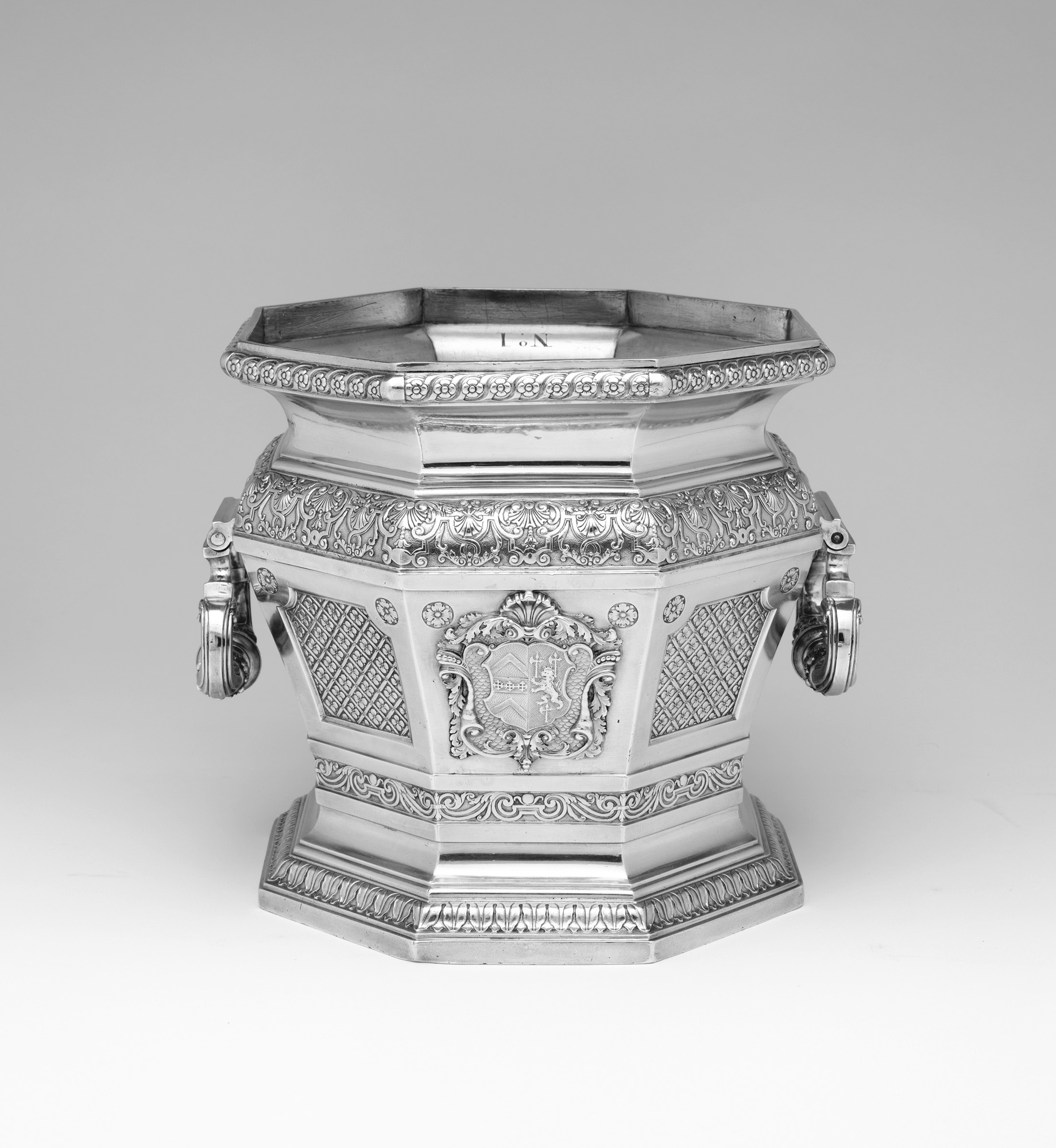
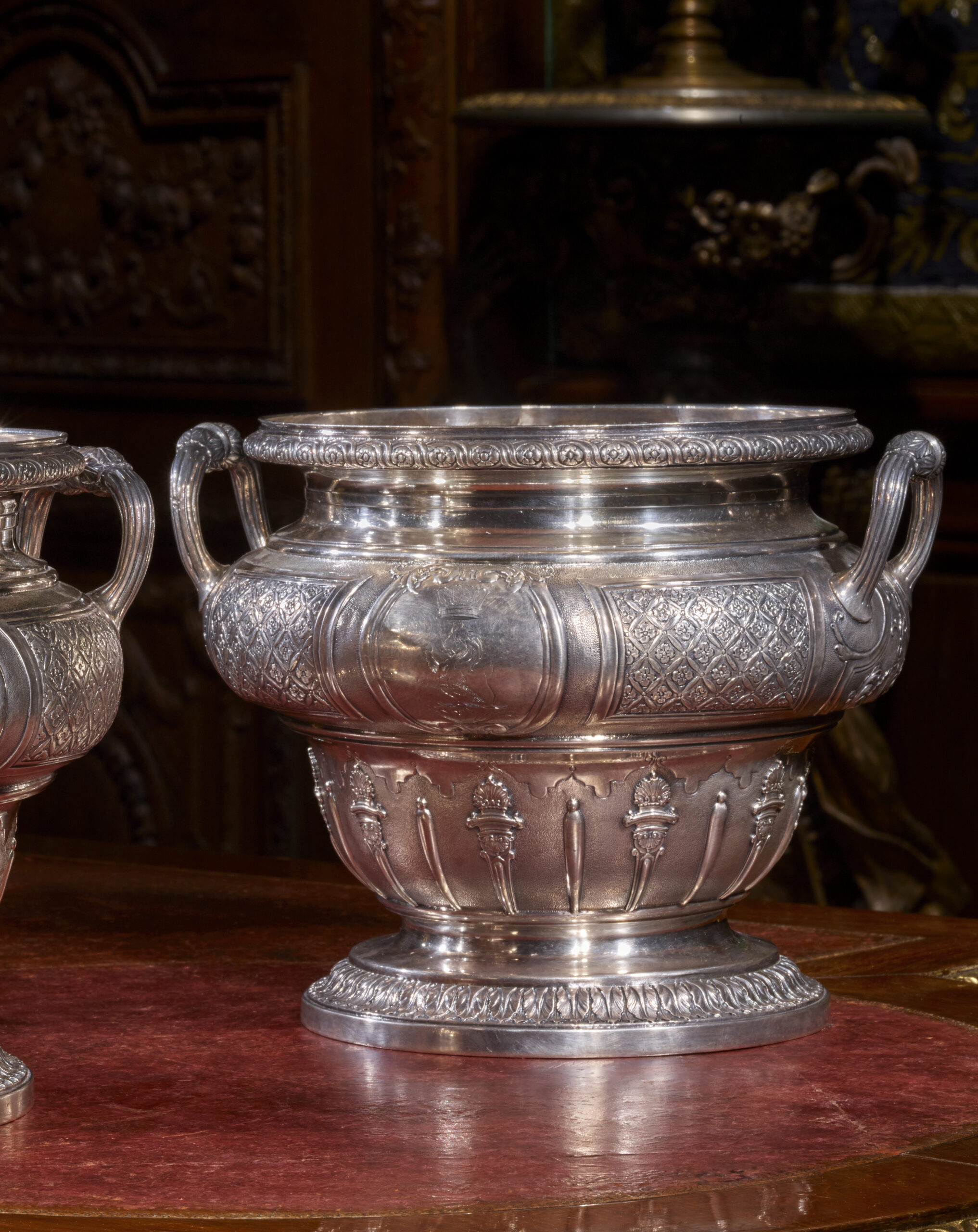
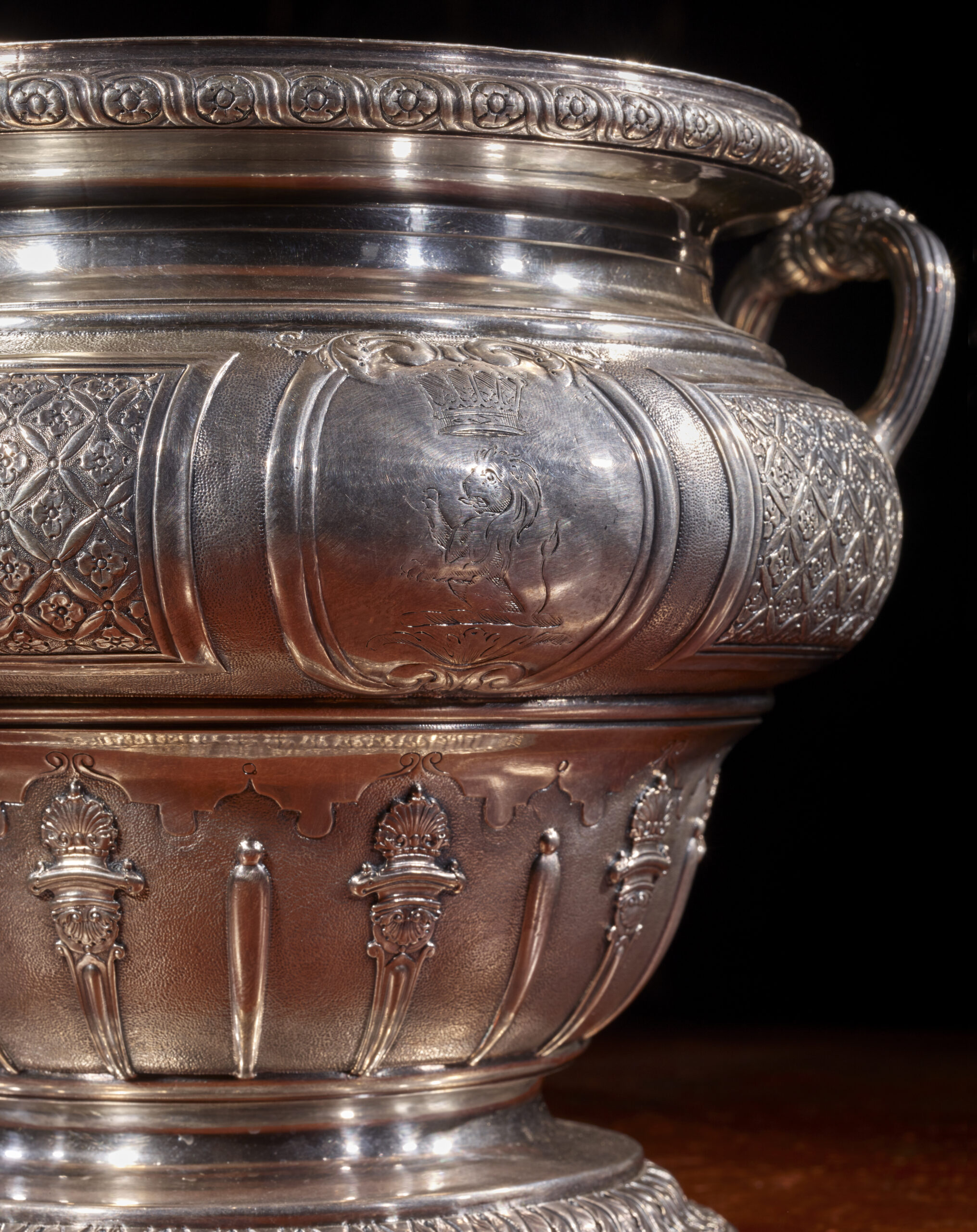
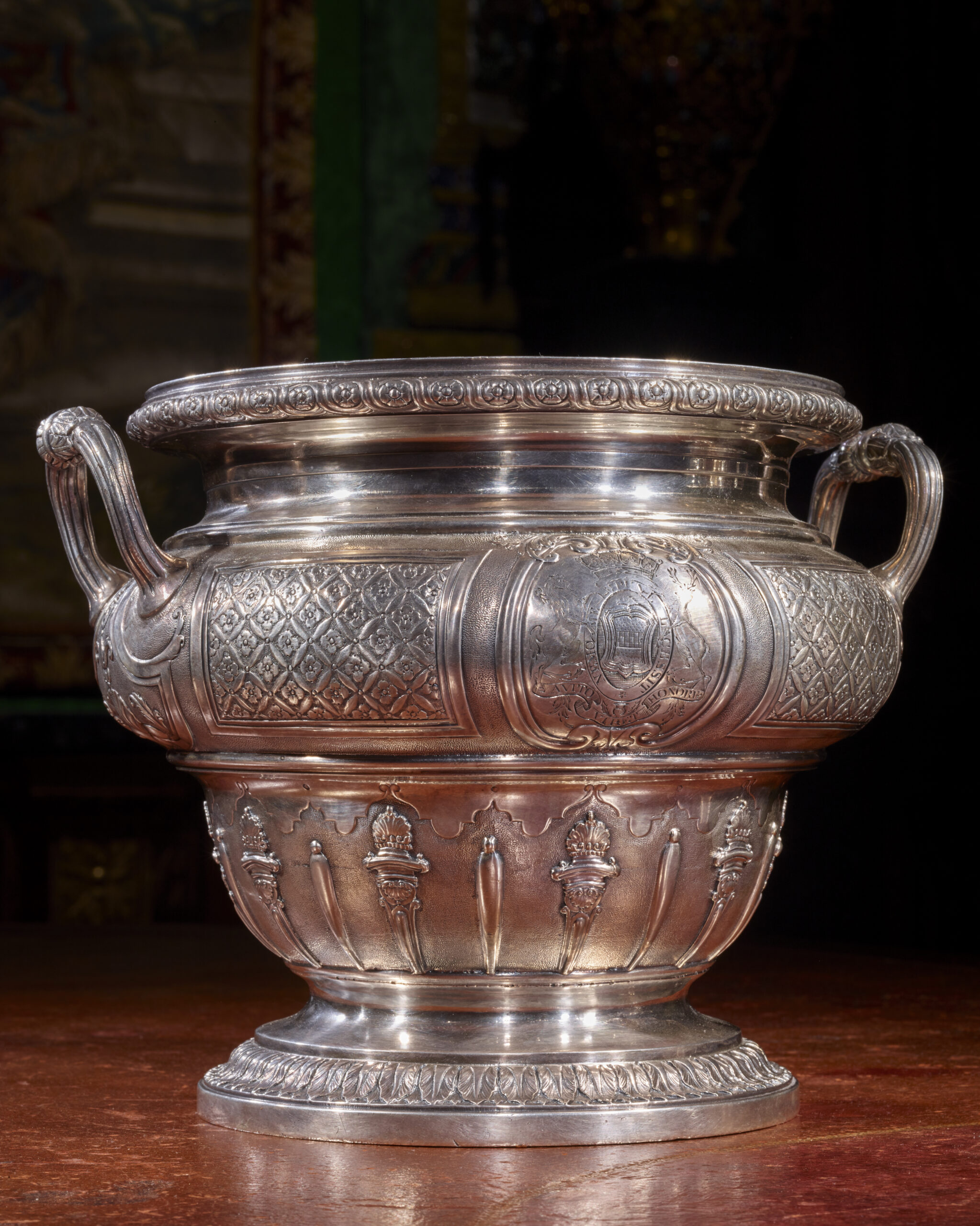
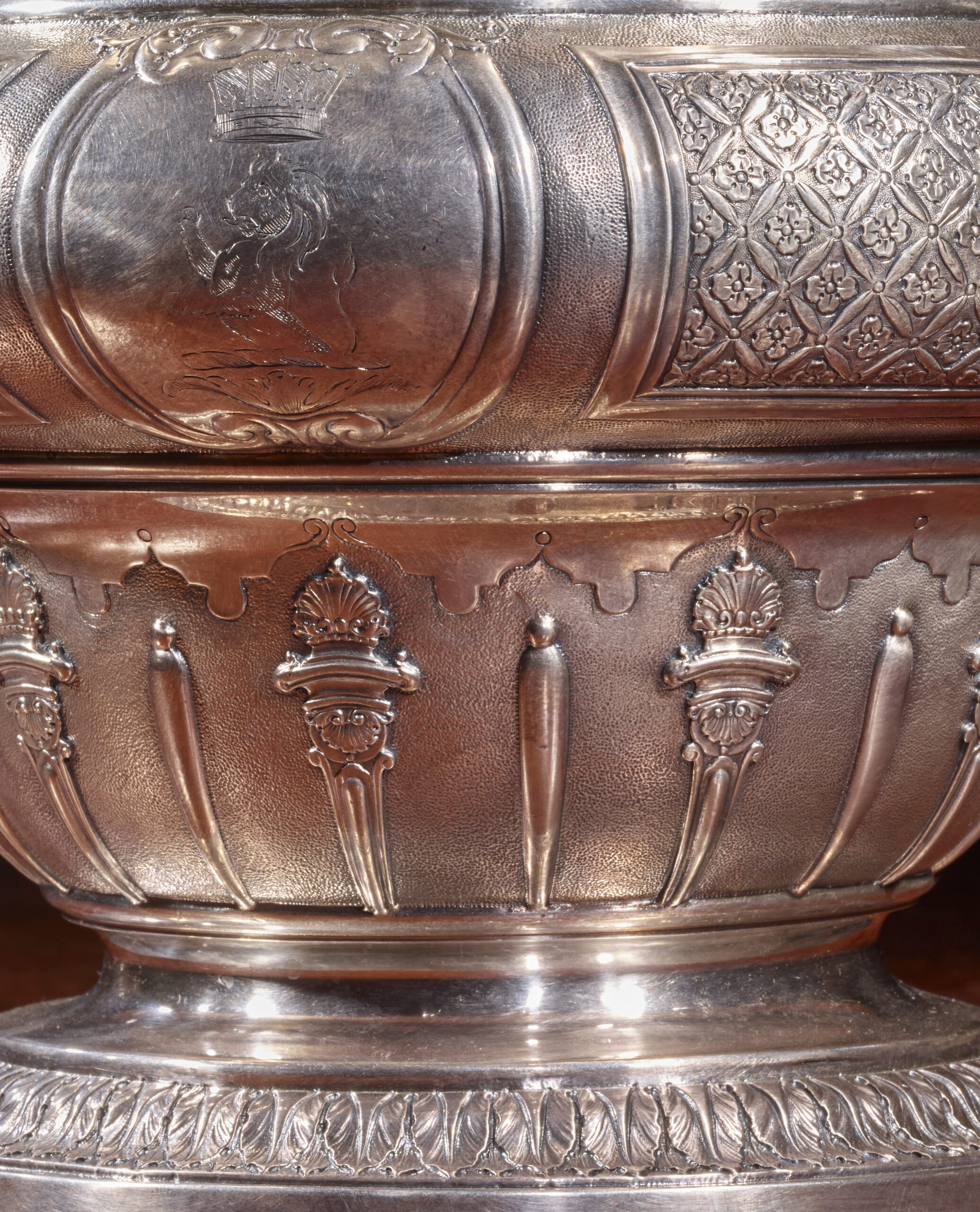
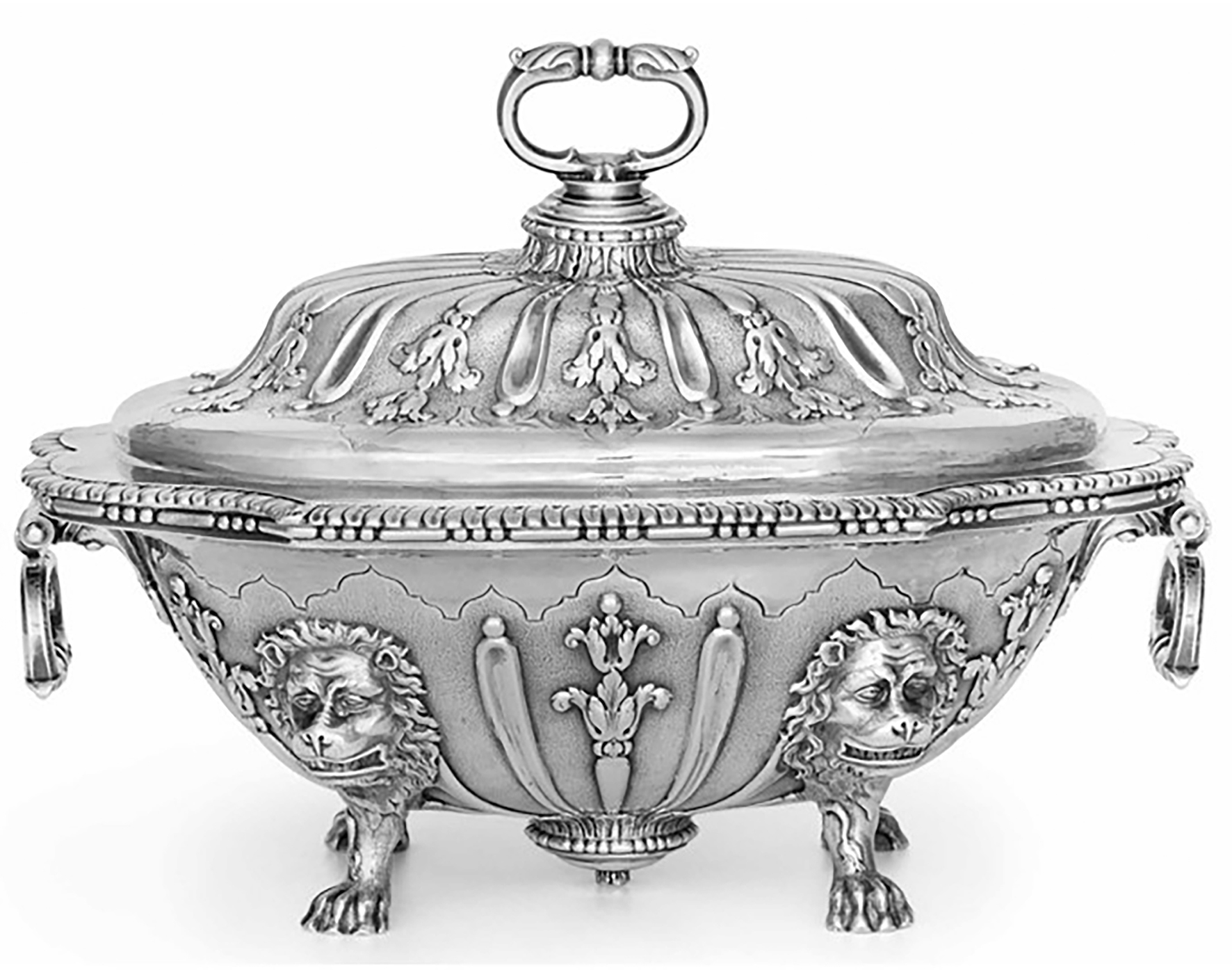
Round in shape, each of the two wine coolers presented here, in their original condition without the gilding that had been applied to them in the course of the 19th century and has since been removed, rests on a wide and short ogee-shaped, circular foot, adorned with a double frieze of short, lanceolate, veined leaves.
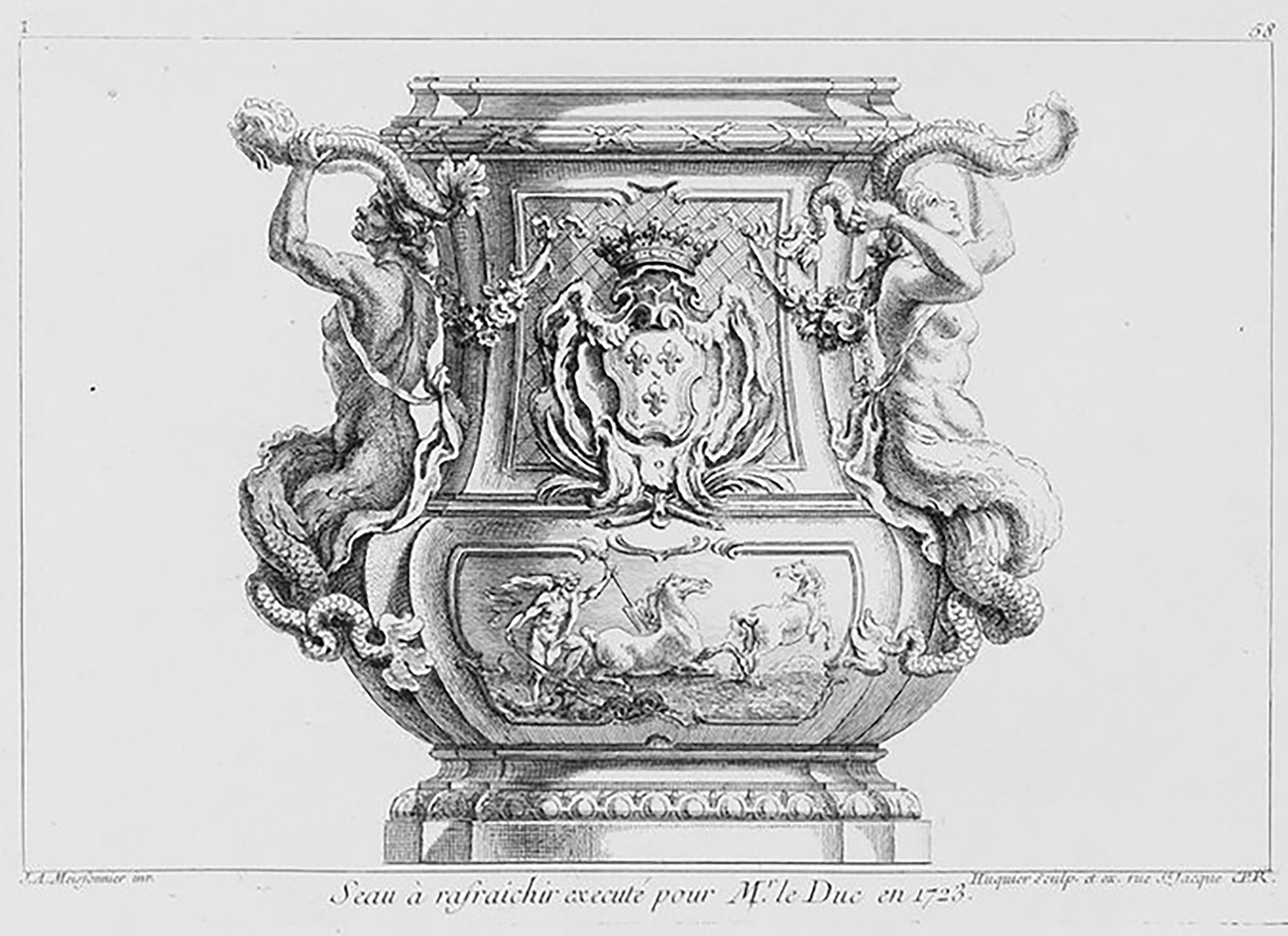
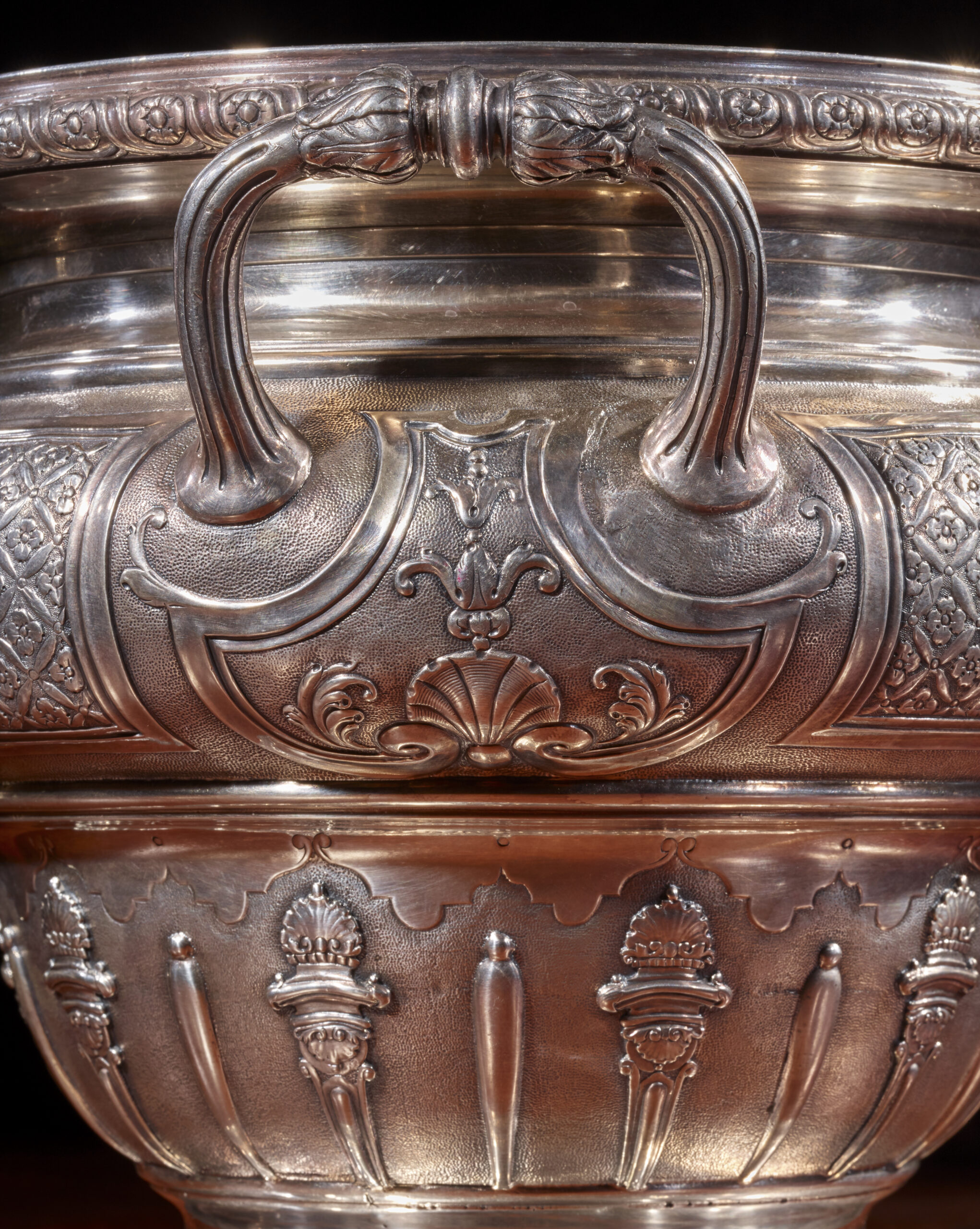
The whole is crowned by a smooth gorge accommodating the flared base of the cooler, the contour decorated in appliqué with a vertical series of narrow, tapering, architecturally styled bands emanating from the base, displaying dart motifs, fine borders with small scrolls and “capitals” underlined and punctuated with button-studded shells, alternating with narrow gadroons, each likewise terminating in a button. Contrasting against a dotted background, these “appliqué bands” become interlocked, at the upper level, in a plain frieze with lambrequins soberly engraved with scrolls and dots.
Forming a wide, bulging median band, the belly of each cooler, flanked by mouldings joining the various constituent elements of the cooler, displays in front a circular central cartouche crowned with acanthus scrolls enclosing the coat of arms of John Stuart, 3rd Earl of Bute, surmounted by an Earl’s coronet and encircled by the motto of the Order of the Thistle; with a rearing horse on the left and a deer rearing up likewise on the right, all underlined by the motto of the Stuarts of Bute inscribed on a listel: Avito viret honore [He flourishes through the honour of his ancestors].
The similar cartouche visible on the reverse is adorned with the family crest showing a half-lion crowned with an Earl’s coronet. Each of these cartouches, contrasting at base level against a dotted background, is flanked by two compartments with moulded borders adorned with trelliswork enclosing small quatrefoils. Two short, chiselled handles with flared bases and punctuated by facing bulbs with corollas of veined leaves arranged on either side of a small moulded disc occupy the sides of the vases’ bellies. These handles are enhanced by a cartouche with a moulded pelta-shaped rim, embellished at the base with a shell bordered by acanthus leaves and surmounted by two fleurons. The neck of the vases, moulded with a gorge profile on a plain background, is terminated by a similarly moulded neck forming a projection, enriched with a narrow frieze with interlacing and rosette motifs.
These wine coolers remained in the possession of the descendants of the 3rd Earl of Bute until 3rd July 1996, when they were auctioned by Christie’s in London.
Paul Crespin
Born in London in 1694, Paul Crespin was a member of a Huguenot family that had been established in the city since at least the mid-17th century. His father, Daniel Crespin, was a member of the parish of St. Giles Westminster.
Apprenticed to Jean Pons on 24th June 1713, Paul Crespin registered his first two master marks—in the Sterling and New Standard registers —between July 1720 and December 1721, when he was described as “free of the Company of Longe bowe String Makers”. At that time, he was established at the corner of Compton Street and Greek Street, in the Soho district of London’s West End. He quickly acquired great renown, even forging a solid reputation for his ability to surprise and innovate, as was revealed on 23rd July 1724 in The Weekly Journal or British Gazetteer: “Last Tuesday, a trial was carried out at Goldsmiths’ Hall on a curious silver bathing vessel, weighing approximately 6,030 ounces, which some said had been crafted for the King of Portugal”; the same newspaper adding, on 15th August: “A few days ago, Mr Crispin, a silversmith in this city, brought the beautiful silver bathing vessel (made for the King of Portugal) to Her Majesty at Kensington, who was much pleased with this piece of such curious workmanship, hardly to be equalled anywhere in Europe”.
Although this piece, which would appear to be quite extraordinary and indicative of the silversmith’s early work, has never been identified, we may see an evocation thereof in the sumptuous circular basin executed by Crespin two years earlier, in 1722–1723, and acquired in 1969 by the British Museum from the collection of Peter Wilding.
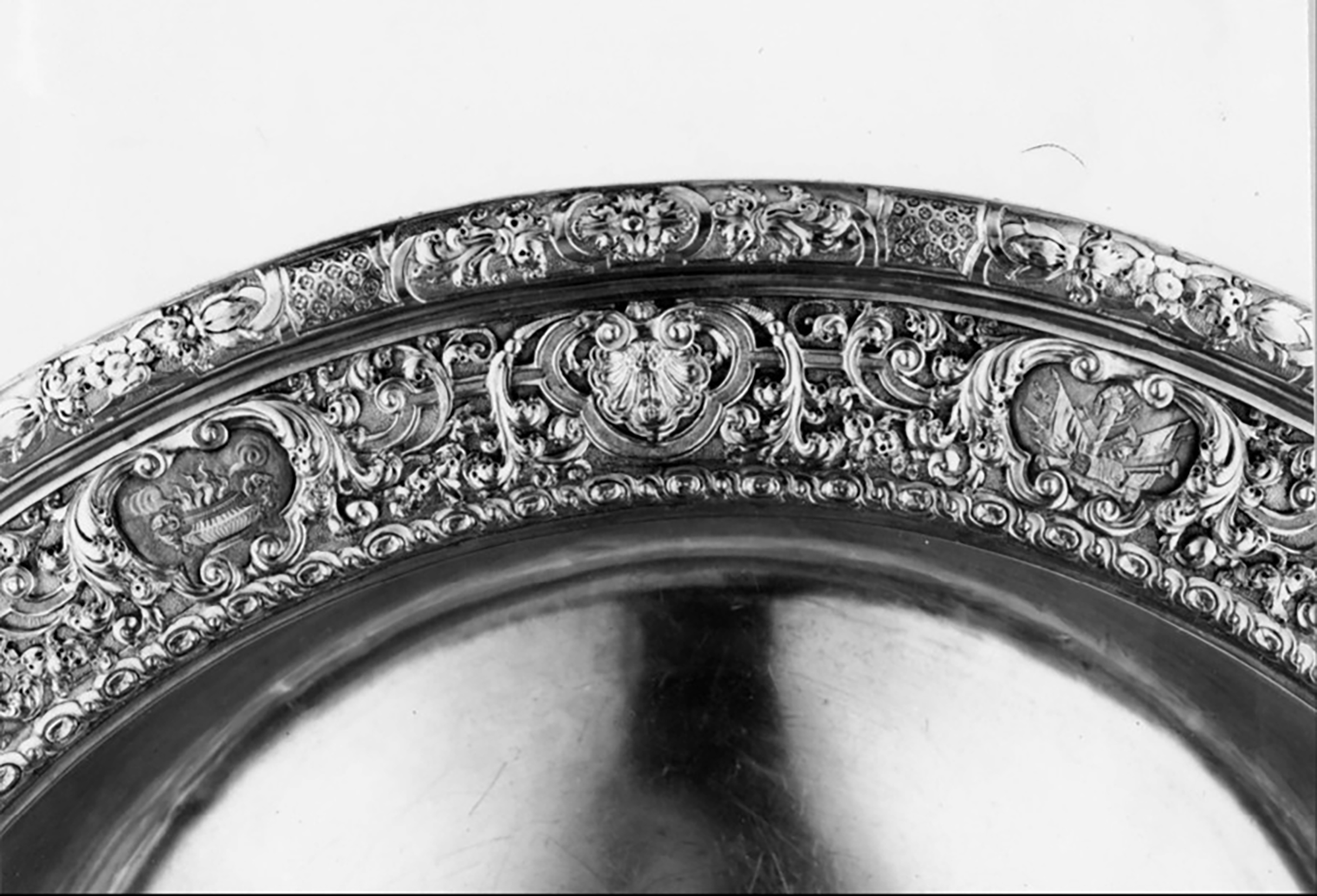
The absolutely unusual use of silver for this type of basin can only serve to emphasise the importance of the commissioner, who unfortunately remains anonymous to this day. worthy of note, however, is that when it first appeared on the London art market at the very beginning of the 20th century, this basin from the British Museum was presented at the time as being of Portuguese origin.
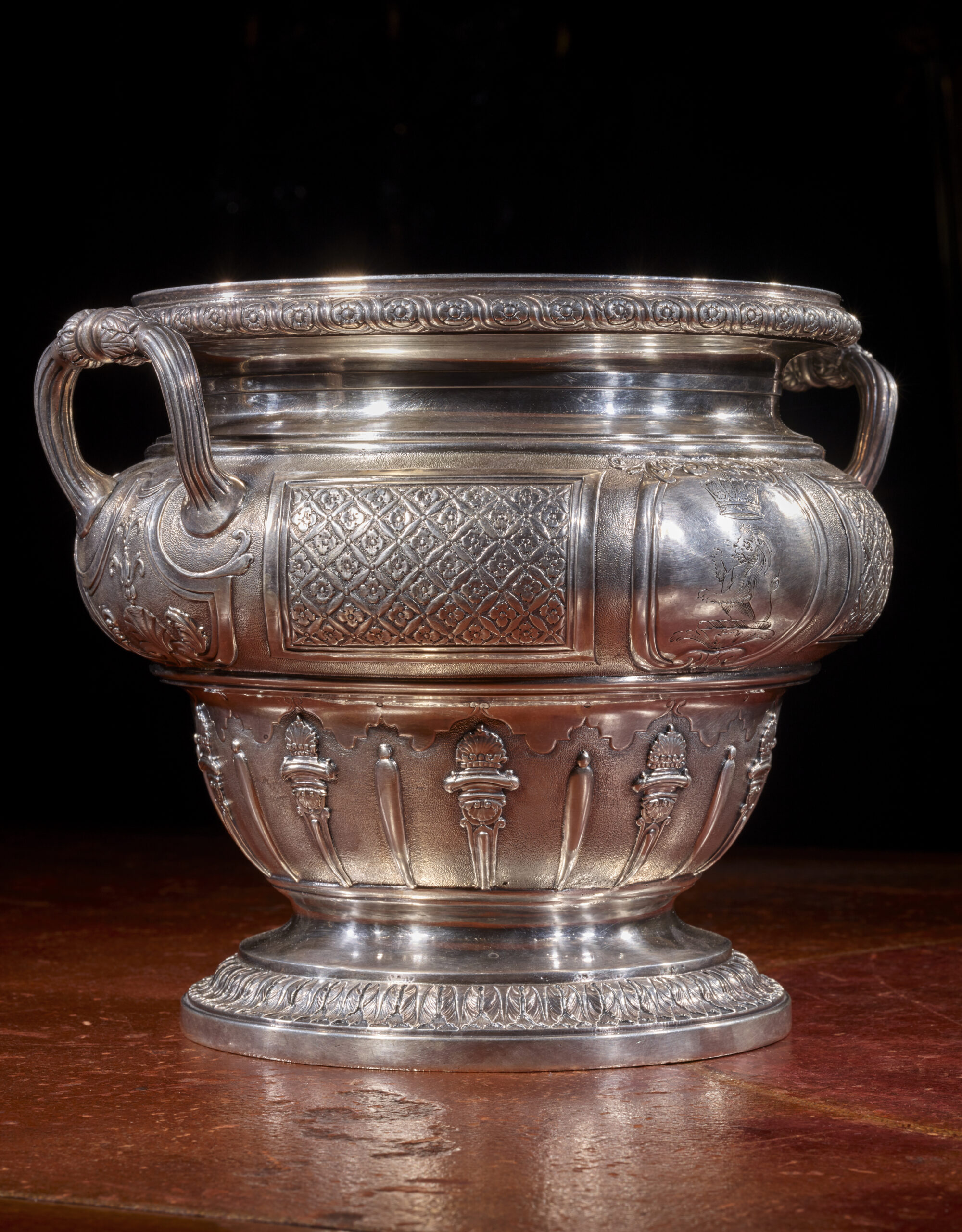
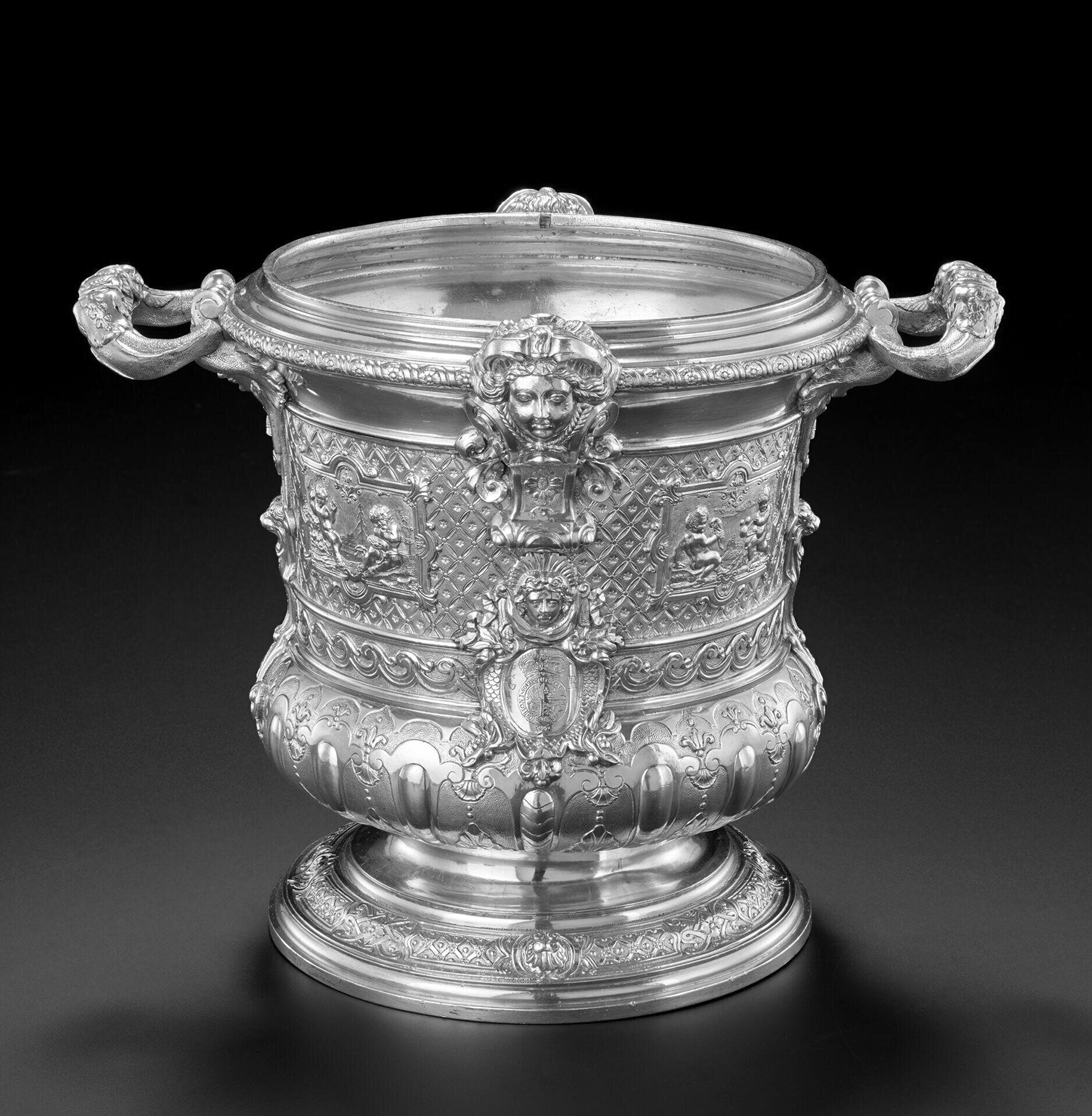
Paul Crespin’s catalogued work, like the two wine coolers under consideration here, always presents a very high level of technical skill and remarkable quality of execution, which, in the words of Arthur Grimwade, enabled him to “rival worthily with that of Paul de Lamerie”, described at the time as “the greatest silversmith working in England in the 18th century”.
The two men maintained a close collaboration, without however entering into an official partnership. Much of the silver service bearing the arms and initials of King George II, commissioned in 1727-1728 for the embassy to the court of The Hague of the 4th Earl of Chesterfield, was thus executed jointly by Crespin and Lamerie, who affixed their respective hallmarks to it. A sumptuous pair of wine coolers from this “Chesterfield” service was presented as part of the exhibition Paul de Lamerie. At the Sign of The Golden Ball at Goldsmiths’ Hall in London in May and June 1990.
One is now kept at the Victoria & Albert Museum in London, and the other at the National Museum of Scotland in Edinburgh.
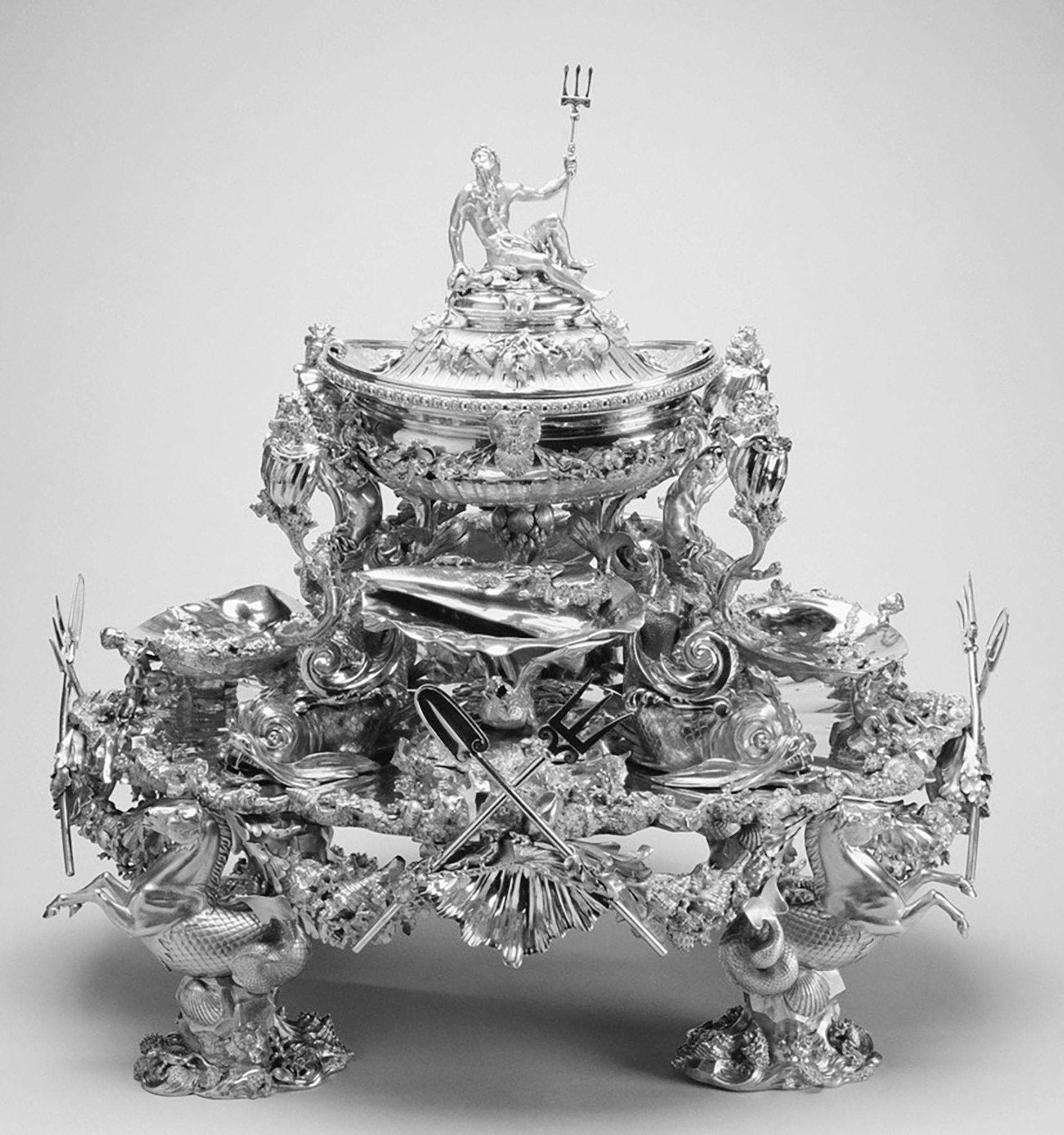
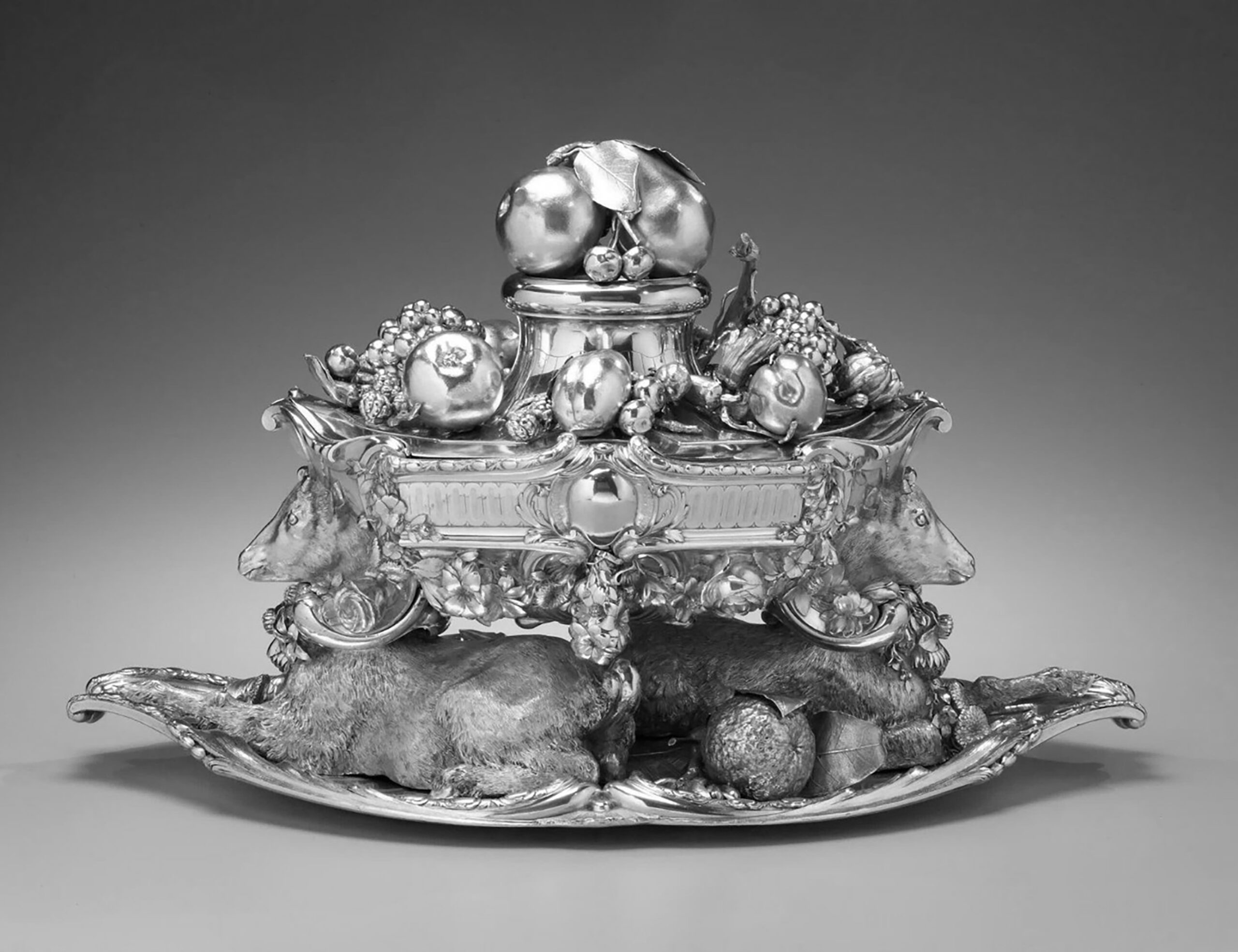
Crespin reached the height of his career in the 1740s, during which time he adopted a refined Rococo style. It was during this prolific period that he created, in gilded silver, in collaboration with his Huguenot colleague Nicholas Sprimont (1716-71), incorporating earlier elements bearing the hallmark of the Turin silversmith Andrea Boucheron (1701-1761), the extraordinary centrepiece crowned with the figure of Neptune, most certainly commissioned by the Prince of Wales and now preserved in the British Royal Collections. From the same period is the tureen with goats executed by Crespin at the behest of Charles Seymour (1662-1748), Duke of Somerset, whose family coat of arms it bears, now in the Toledo Museum of Art in Ohio. These two major works both display a quality of execution that is only matched by the sheer originality of their design.
The silversmith registered a third hallmark on 4th July 1739; a fourth on 7th November 1740; and a fifth, displaying two different sizes, on 22nd January 1757, still indicating the same address. He had married a certain Margaret Branboeuf, with whom he had five children between 1729 and 1743, who were all baptised at St. Anne’s Church in Soho: Magdalen Bennin [sic] in 1729, Lewis Vincent Paul in 1732, Elias David in 1734, Paul in 1739, and Sarah in 1743.
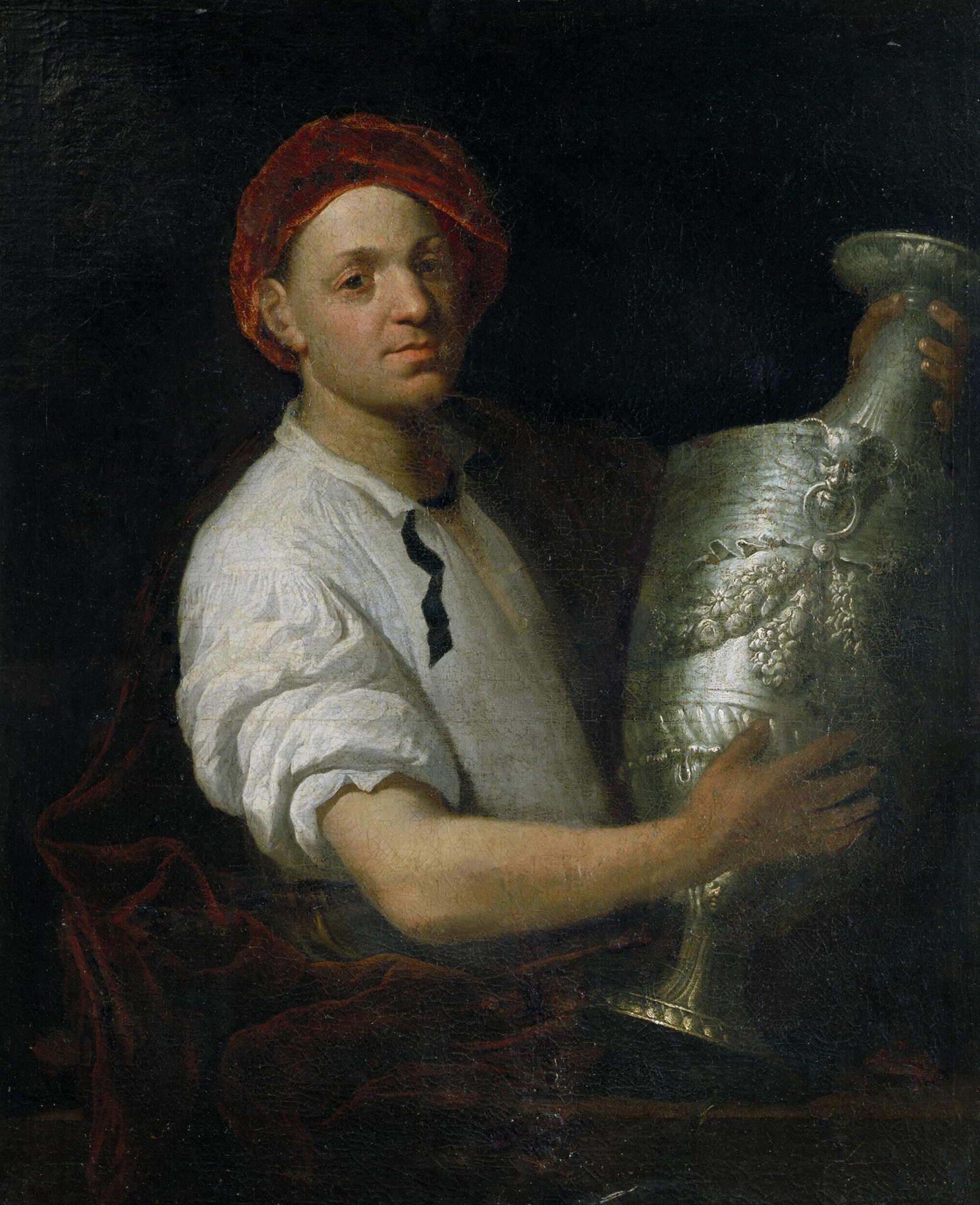
Despite his great repute, Paul Crespin went bankrupt in February 1747 but continued to pay his taxes until 1759. He died at the age of seventy-six on 25th January 1770 in Southampton, where he had been compelled to retire with his wife around 1760. In his will, dated 17th December 1759 and probated on 26th March 1770, he bequeathed all his possessions to his wife, who died in the following year. Their eldest daughter, Magdalen, married a Huguenot clockmaker, Francis-Gabriel Barraud; their union was to give rise to the 19th-century family of artists. It was this family that inherited from Magdalen the anonymous portrait of Paul Crespin showing him half-length, holding a large silver baluster-shaped vase adorned with satyr masks and garlands of flowers, which was acquired in 1985 by the Victoria & Albert Museum.
John Stuart, 3rd Earl of Bute and Prime Minister of Great Britain
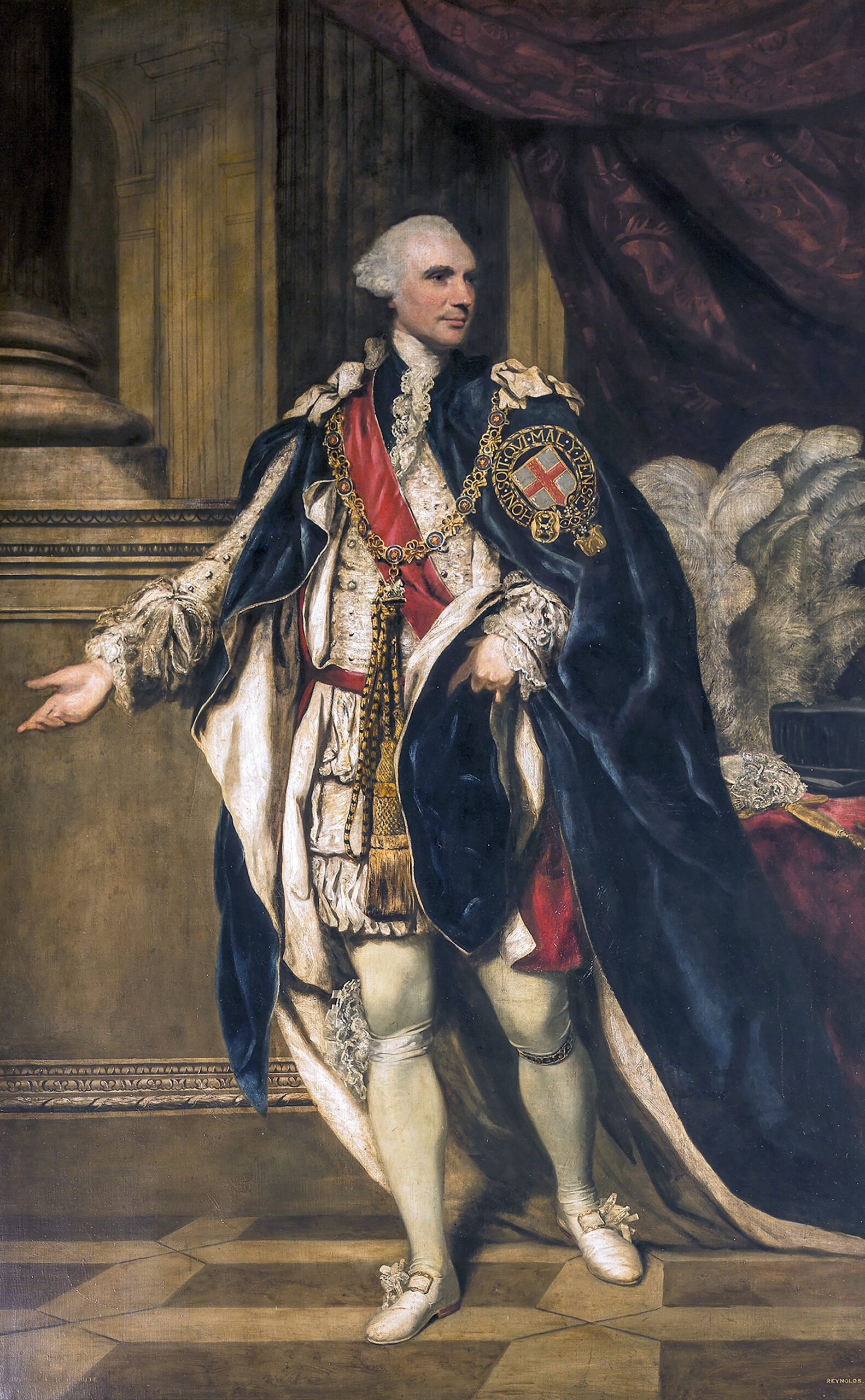
Known as Lord Mount Stuart between 1713 and 1723, John Stuart, 3rd Earl of Bute, was born at Parliament Close, near St Giles’ Cathedral on the Royal Mile in Edinburgh, on 25th May 1713. He was the son of James Stuart (before 1696–1723), 2nd Earl of Bute, and his wife, Lady Anne Campbell (1692–1736), mentioned above. He inherited the title of Earl of Bute—named after the island of Bute in Scotland, about 50 kilometres west of Glasgow—on the death of his father in 1723. Then aged ten, he was raised, as we have seen, by his maternal uncles: the 2nd and 3rd Dukes of Argyll. From 1724 to 1730, he attended Eton College, then began studying civil law at the universities of Groningen (1730-1732) and Leiden (1732-1734) in the Netherlands, where he graduated with a degree in civil law. In August 1735, he eloped with Mary Wortley Montagu (1718-1794) on account of the attitude of her parents, Edward Wortley Montagu (1678-1761) and the famous woman of letters Lady Mary Wortley Montagu (1689-1762), née Pierrepont, who were slow to consent to the union. However, the marriage did eventually take place on 24th August 1736. The couple had eleven children, five boys and six girls.
In 1737, John Stuart was elected a Scottish peer, but although he was in London in December of that year, he did not take part in the deliberations of the House of Lords. Due to his support for John Campbell, 2nd Duke of Argyll, against Robert Walpole, Britain’s first true Prime Minister, he failed to be re-elected in 1741. In the years that followed, he decided to retire to his Scottish estates to manage his affairs and devote himself to his passion for botany.
En 1745, il s’installa à Twickenham, dans le Middlesex. Il fit la connaissance de S.A.R. le prince de Galles en 1747, aux courses d’Egham, et se lia d’une grande amitié avec lui. A la mort du prince en 1751, il fut nommé précepteur de son fils, George William Frederick (1738-1820), le nouveau prince de Galles et futur roi George III.
In 1745, he moved to Twickenham, Middlesex. He became acquainted with HRH the Prince of Wales in 1747 at the Egham races and formed a close friendship with him. Upon the Prince’s death in 1751, he was appointed tutor to his son, George William Frederick (1738–1820), the new Prince of Wales and future King George III. The Earl of Bute saw to it that the latter and his younger brother, Prince Edward of Great Britain (1739-1767), Duke of York and Albany, took courses in natural philosophy from the itinerant lecturer Stephen Demainbray (1710-1782), which awakened the young prince’s interest in natural philosophy and may have been the inspiration for George III’s collection of natural philosophy instruments. John Stuart was also to befriend their mother, Augusta of Saxe-Gotha-Altenburg (1719-1772), Princess Dowager of Wales, a relationship that fuelled rumours of an affair, which were further stoked by a scandalous pamphlet published by a close acquaintance of the late Prince of Wales: John Horne Tooke (1736-1812). But the rumours were most certainly groundless, as the Earl of Bute held sincere religious convictions against adultery and seemed to enjoy a perfect married life.
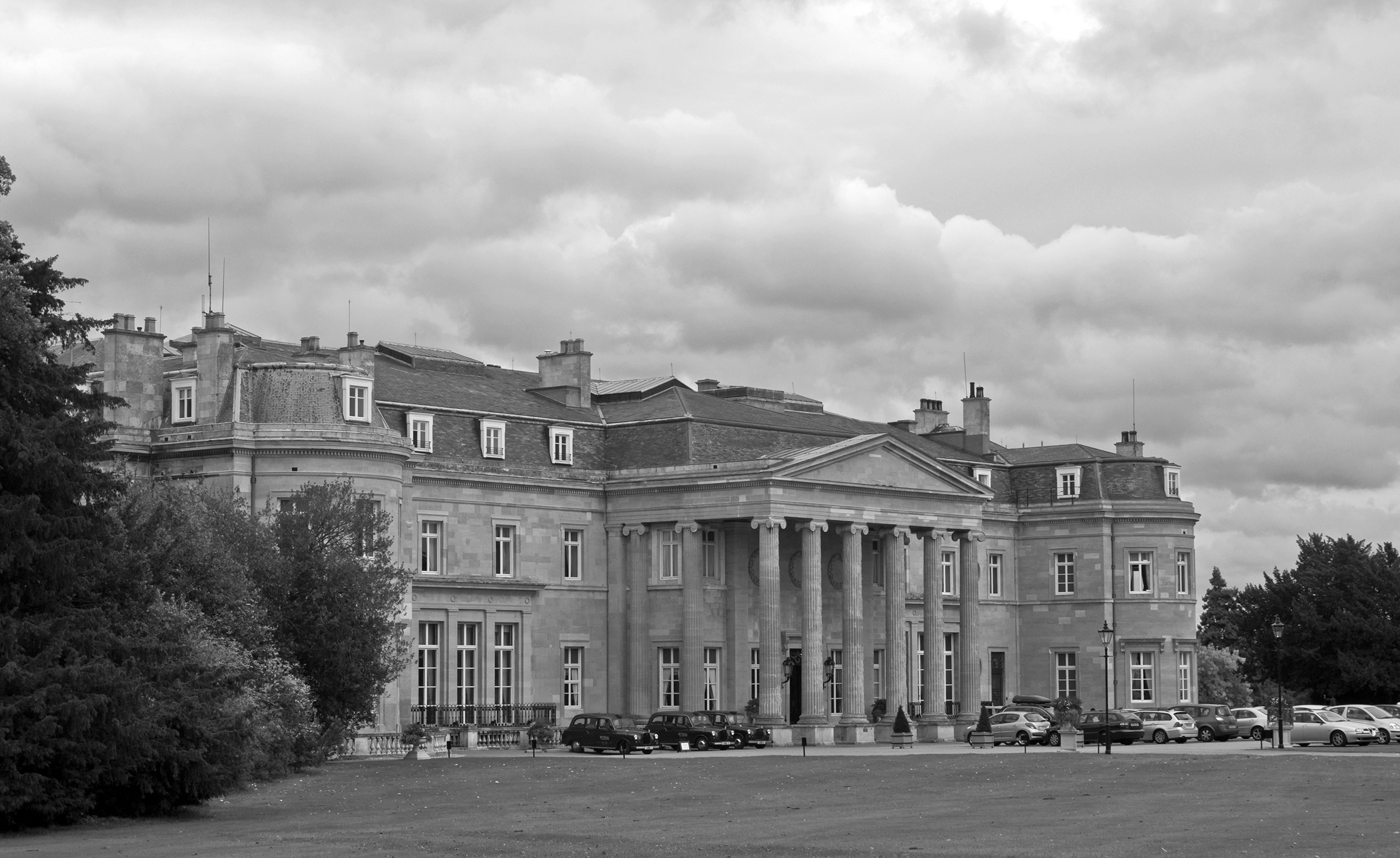
In the aftermath of the accession to the throne of the young George III on 25th October 1760, at the age of twenty-two, the Earl of Bute cherished the hope of swiftly ascending to power, but his plans proved to be overly premature. He would have had to oust the incumbent Prime Minister, Thomas Pelham Holmes (1693-1768), Duke of Newcastle, not to mention the Secretary of State for the Southern Department, William Pitt the Elder (1708-1778), an even more powerful figure. The government in office, emboldened by its recent military successes in the Seven Years’ War, enjoyed great popularity at the time, which enabled it to achieve more than satisfactory results in the 1761 British general election. As custom willed it, the election was held upon the accession of the new sovereign to the throne.
But with the support of George III, John Stuart finally succeeded in seizing power on the following year. At first, He allied himself with the Duke of Newcastle, both taking a stand against William Pitt, who wanted to declare war on Spain. Seeing his plans thwarted, Pitt eventually resigned his post as Secretary of State. Subsequently, the Earl, who had been re-elected as a Scottish peer in 1760, persuaded the King to dismiss Newcastle, who had been placed in a minority within the government, notably on the issue of financing and the direction to be taken in the ongoing war. John Stuart succeeded him on 26th May 1762, thereby putting an end to a long period of dominance by the Whigs, the English liberal party of the time, in favour of the conservative Tories. That same year, the Anglo-Prussian alliance, established in 1756, was dissolved, prompting King Frederick II of Prussia to accuse the new Prime Minister of Great Britain of plotting to destroy his kingdom.
The term of office of the Earl of Bute, which ended on 8th April 1763, was marked by the negotiation of the Treaty of Paris, which brought the Seven Years’ War to an end. The Earl was constrained to soften his previous position with regard to the concessions made to France and had to consent to the restitution of the substantial fishing grounds of Newfoundland to the French, without Britain being granted Guadeloupe in return, as he had hoped. Once peace was concluded, he also decided, in agreement with George III, that British military expenditure should not exceed its pre-war level, while considering, however, that a significant military presence was necessary in America to address the threats from France and Spain. He then made the mistake of imposing the cost of this rise solely on the colonists, thereby stirring up resistance to taxation, which ultimately precipitated the American Revolution. Another unpopular measure was the further introduction of a tax on cider of four shillings per barrel in 1763, still with the aim of financing the disastrous consequences of the Seven Years’ War. Heavily criticised, he eventually resigned from his post shortly afterwards, making way for George Grenville (1712-1770), a member of the Whig party. He nonetheless retained his seat as a peer in the House of Lords until 1780, in which year he was also elected first president of the Society of Antiquaries of Scotland.
The Earl spent the remainder of his life on his estate in Hampshire, where he built himself a mansion named High Cliff near Christchurch. From there, he continued his botanical research and became a major patron of literature and the arts. He notably supported Samuel Johnson, Tobias Smollett, Robert Adam, William Robertson and John Hill. He also made considerable donations to Scottish universities and financed Alberto Fortis’s travels into Dalmatia. His work in botany led to the publication of Botanical Tables Containing the Families of British Plants in 1785. Even after his retirement, the Earl of Bute was accused by many Americans in the years leading up to the American War of Independence of exerting an undue corrupting influence on the British government. He died on 10th March 1792 at his house in South Audley Street, near Grosvenor Square, Westminster, as a result of a fall during a stay at Highcliffe a year and a half previously. He was buried in Rothesay, on the Isle of Bute.