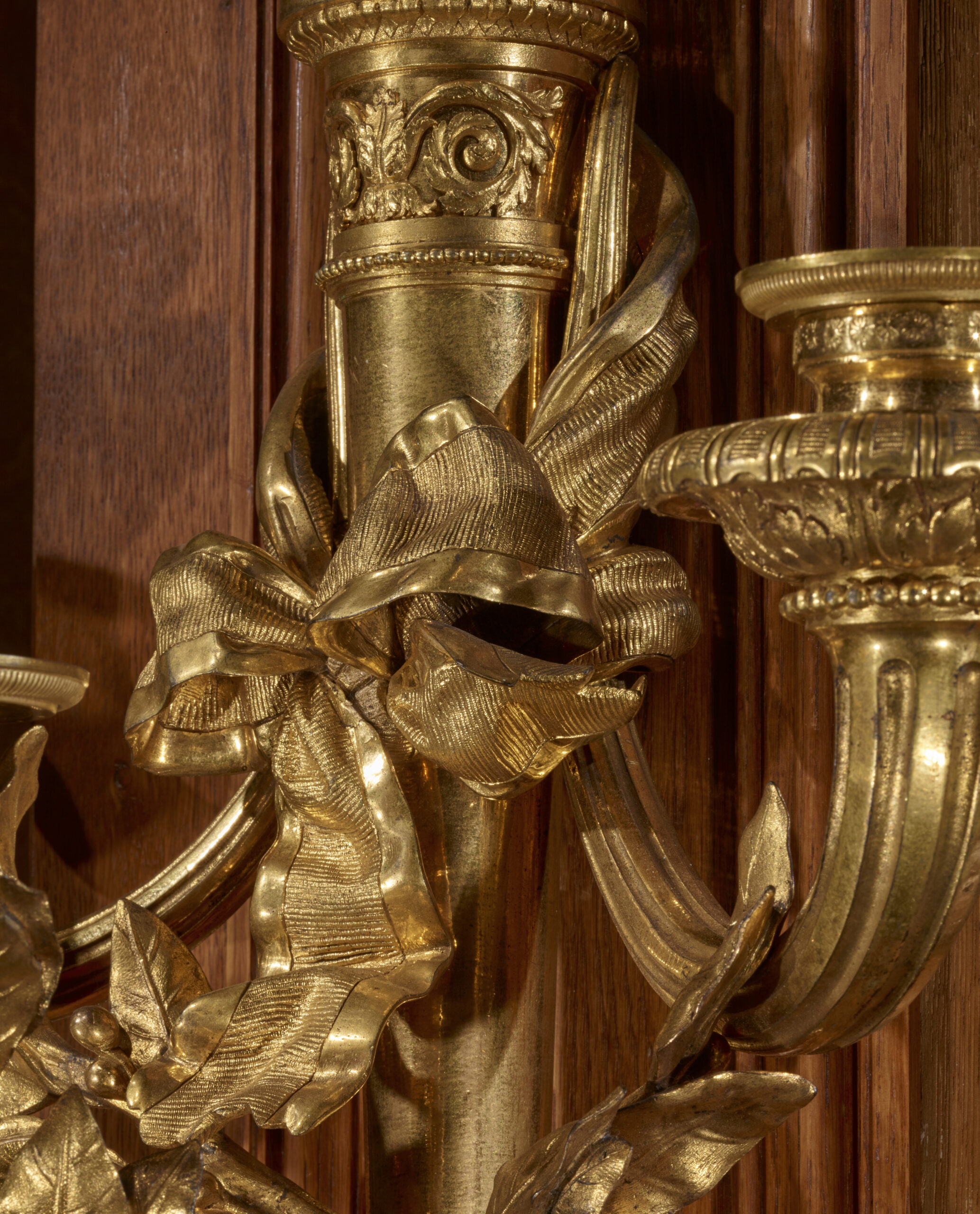
Chiselled and gilt bronze.
H. 62 cm. (24 ½ in.); W. 38 cm. (15 in.); D. 20.5 cm. (8 in.).
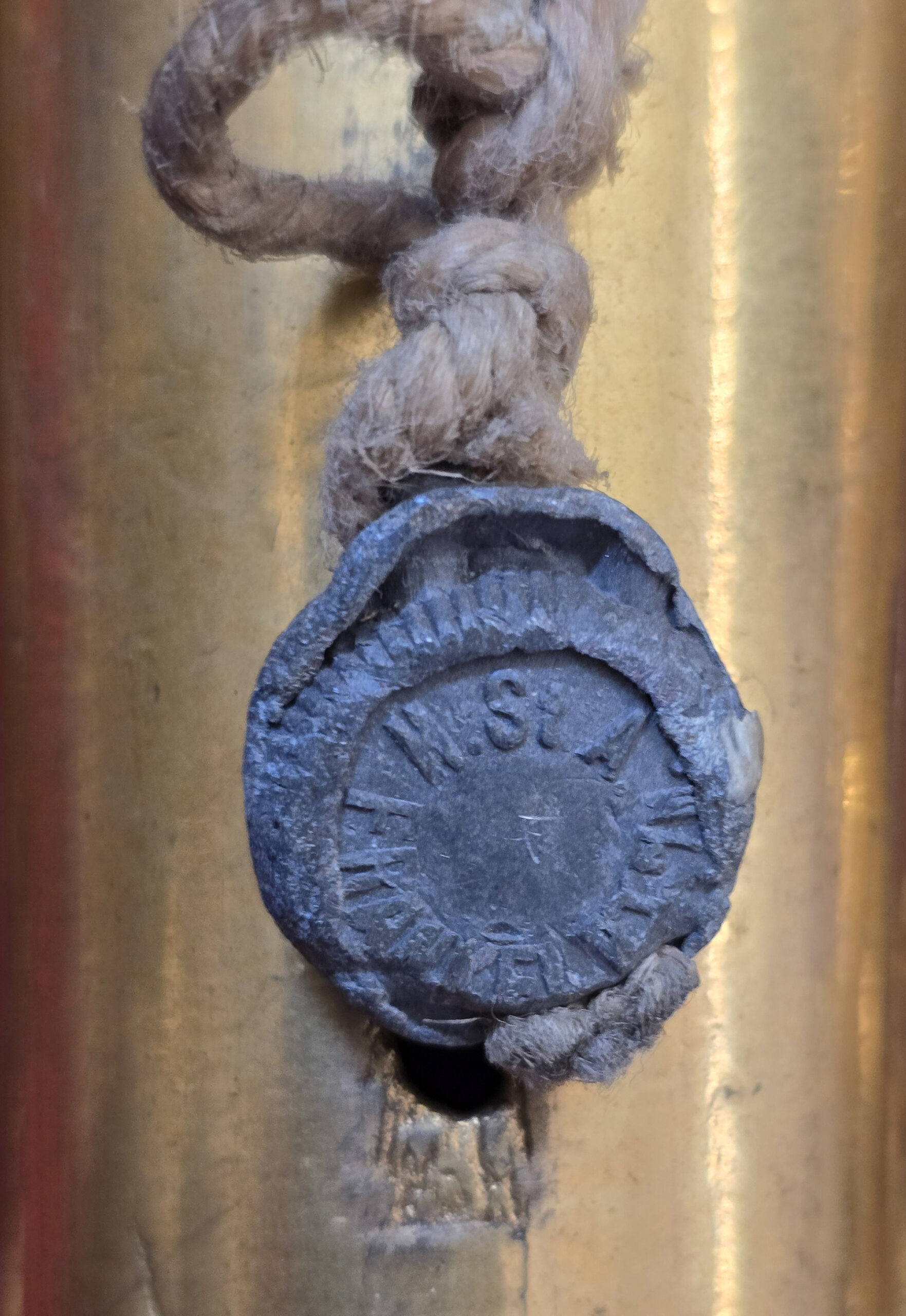
MARKS AND INSCRIPTIONS: H.ST.A/FRANKFURT/M [Hauptstaatsarchiv/Frankfurt-am-Main (Main State Archives/ Frankfurt am Main)], visible on a small circular lead seal, attached by a cord to the back of one of the two sconces, and stamped on the reverse side with the German imperial eagle: customs seal used during the German Empire in the 19th century and early 20th century.
PROVENANCE: delivered before 1785, most certainly during the year 1784, by Claude-Jean Pitoin (1757-before 1806), doreur-argenteur sur métaux du Garde-Meuble du Roi (gilder-silverer on metals to the King’s Garde-Meuble) et supplier to the King from 1778 to 1786, for use in the “Pièce du Billard et Bibliothèque” (Billiard room and Library) of the apartment of Élisabeth of France, known as Madame Élisabeth, sister of Louis XVI, in the Palace of Versailles, at the far end of the South Wing; Rothschild collection in Frankfurt am Main in the 19th and early 20th centuries; then, by descent, Rothschild collection to the present day.
SOURCES: Paris, Archives nationales, O1 3461, Inventaire général des Meubles du Château et Déhors de Versailles en 1785/Ier Volume, f. 565; and Paris, Archives nationales, O1 3463, Inventaire général des Meubles du Château et Déhors de Versailles en 1788/Ier Volume, f. 556.
LIERATURE: M. A. de Beauchesne, La vie de Madame Élisabeth, sœur de Louis XVI, Tome second, Paris, 1870, p. 523-524.
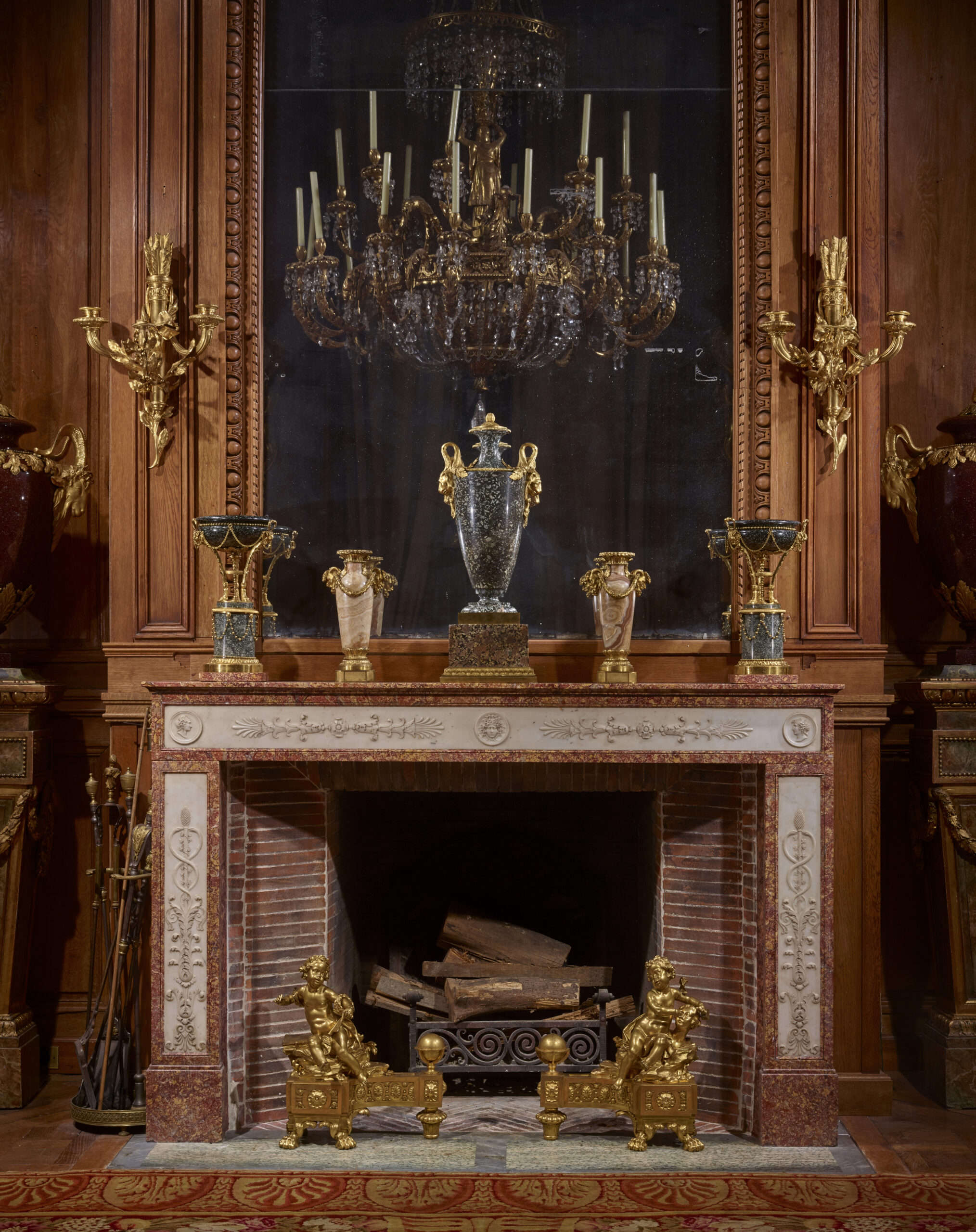
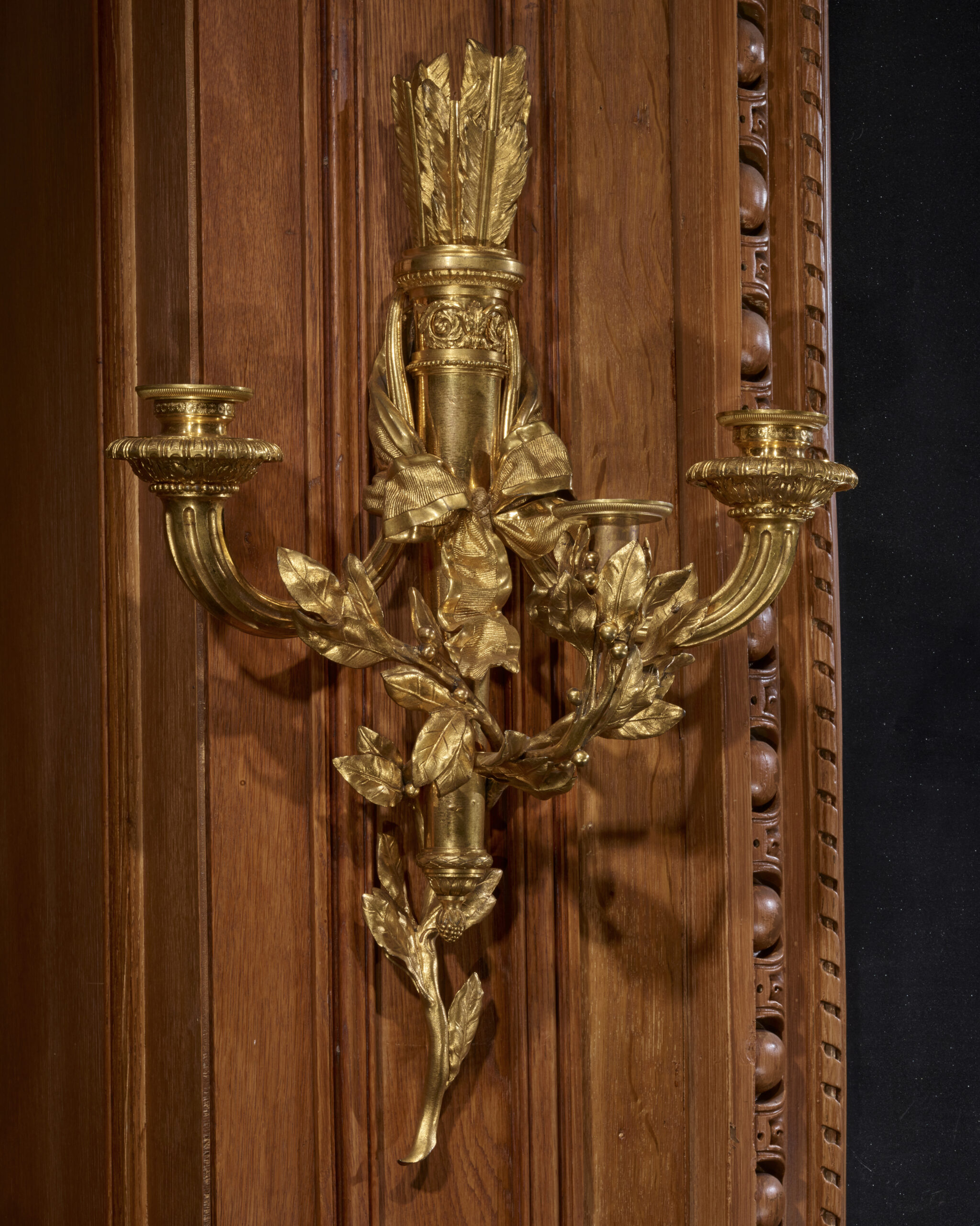
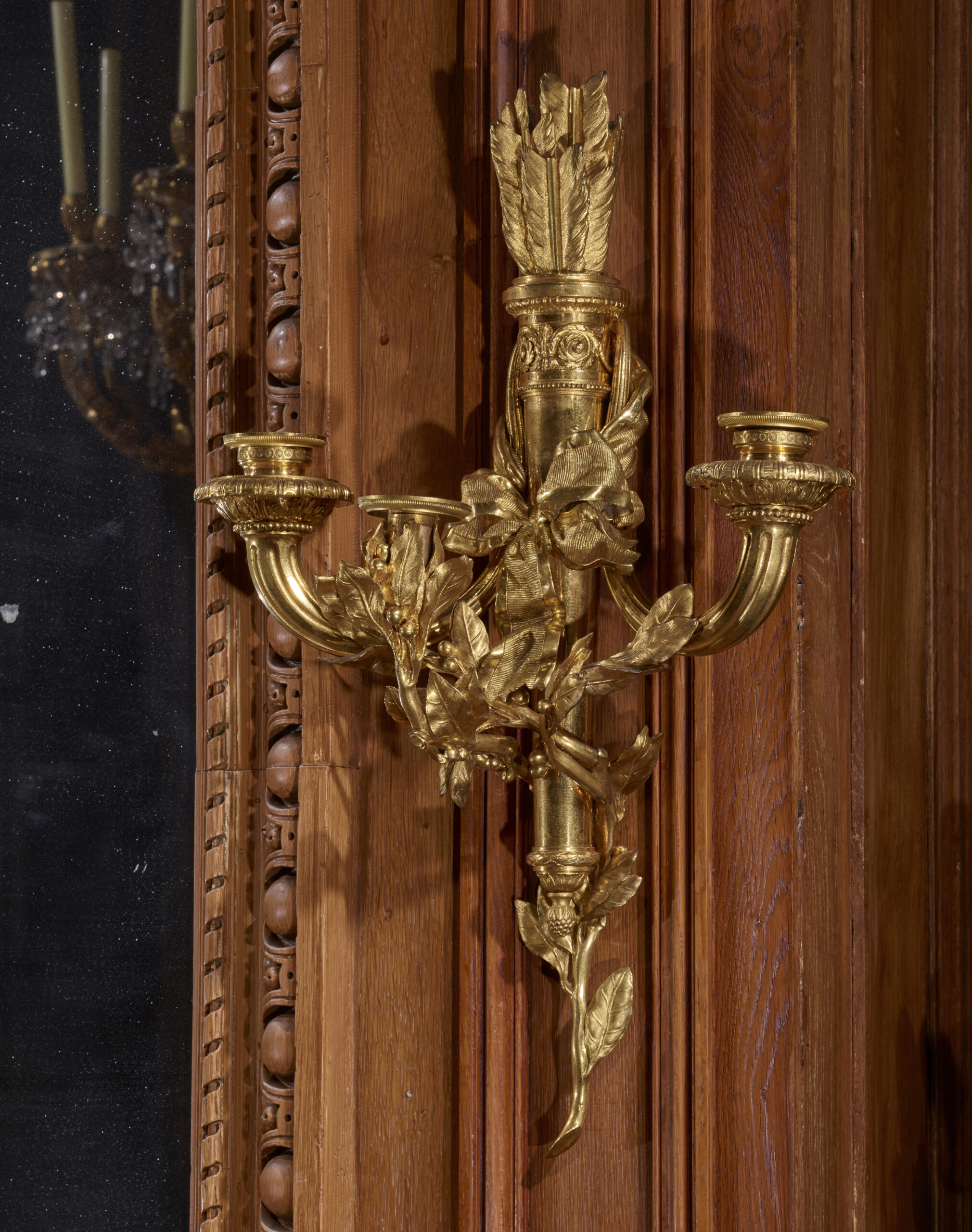
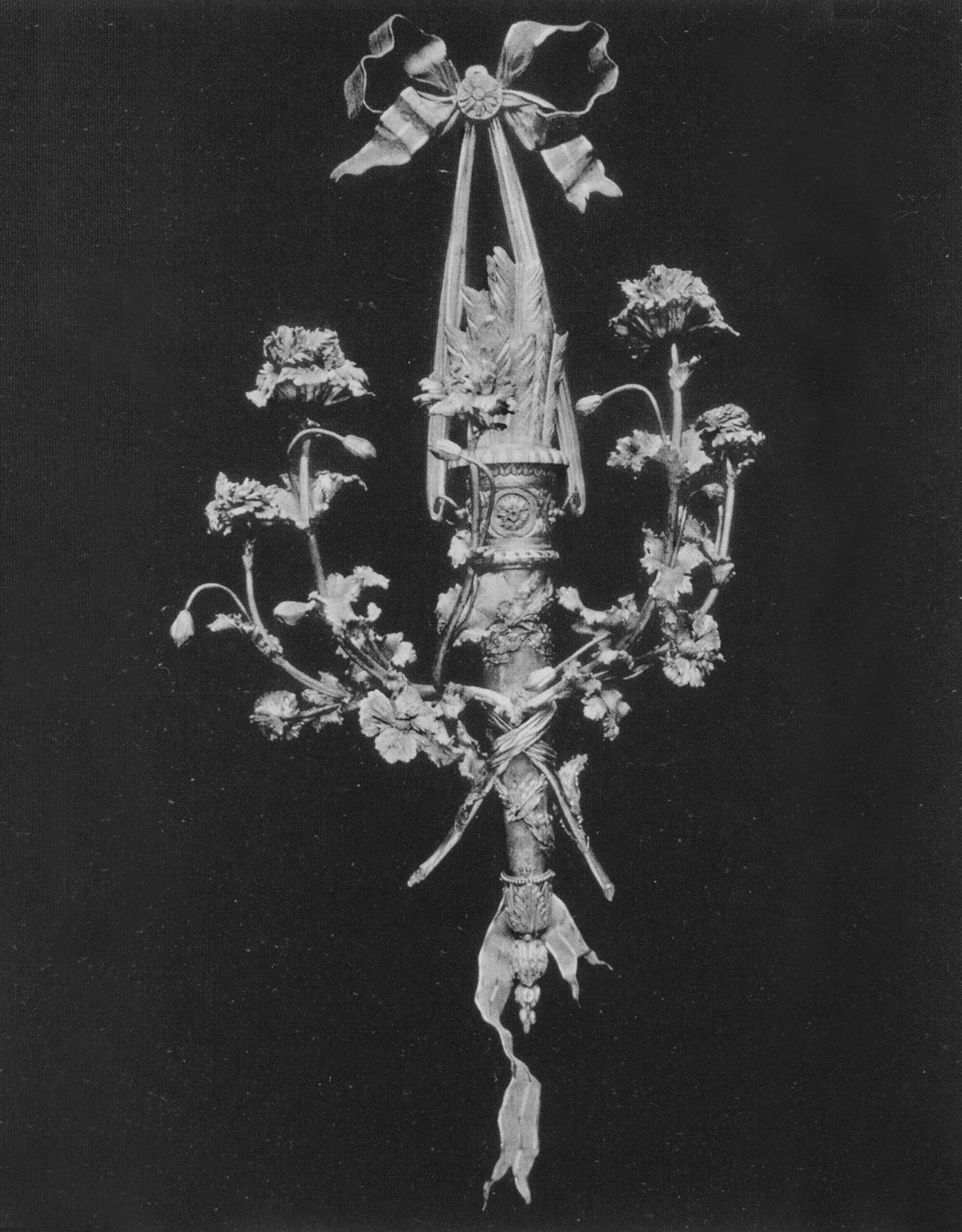
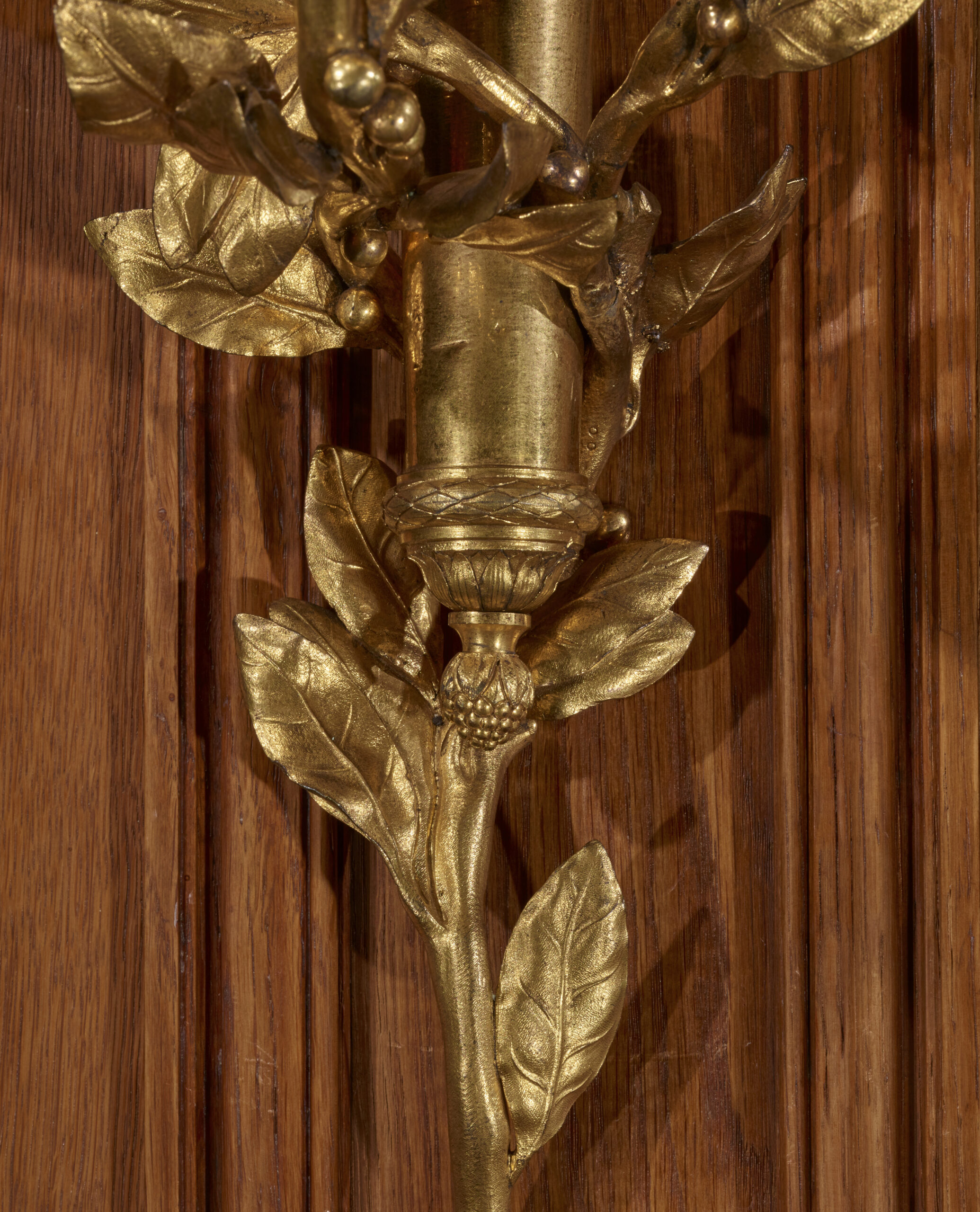
This pair of three-light sconces, with a dazzling quality of chiselling and gilding, was delivered before 1785, most likely during the year 1784, en suite with a second identical pair, by Claude-Jean Pitoin (1757-before 1806), gilder and silverer on metals to the King’s Garde-Meuble and supplier to the King from 1778 to 1786, to be used in the “Billiard Room and Library” of the apartment of Élisabeth of France, known as Madame Élisabeth, sister of Louis XVI, located at the southern far end of the Palace of Versailles, at the end of the South Wing. In the 19th century, they were part of the Rothschild collections in Frankfurt am Main, Germany, as evidenced by the presence on one of the two sconces of a small circular lead seal bearing the inscription H.ST.A/FRANKFURT/M [Hauptstaatsarchiv Frankfurt am Main/State Archives of Frankfurt am Main], and stamped on the reverse side with the German imperial eagle, a customs stamp used during the German Empire in the 19th and early 20th centuries. They have remained in the Rothschild collections through descent to the present day.
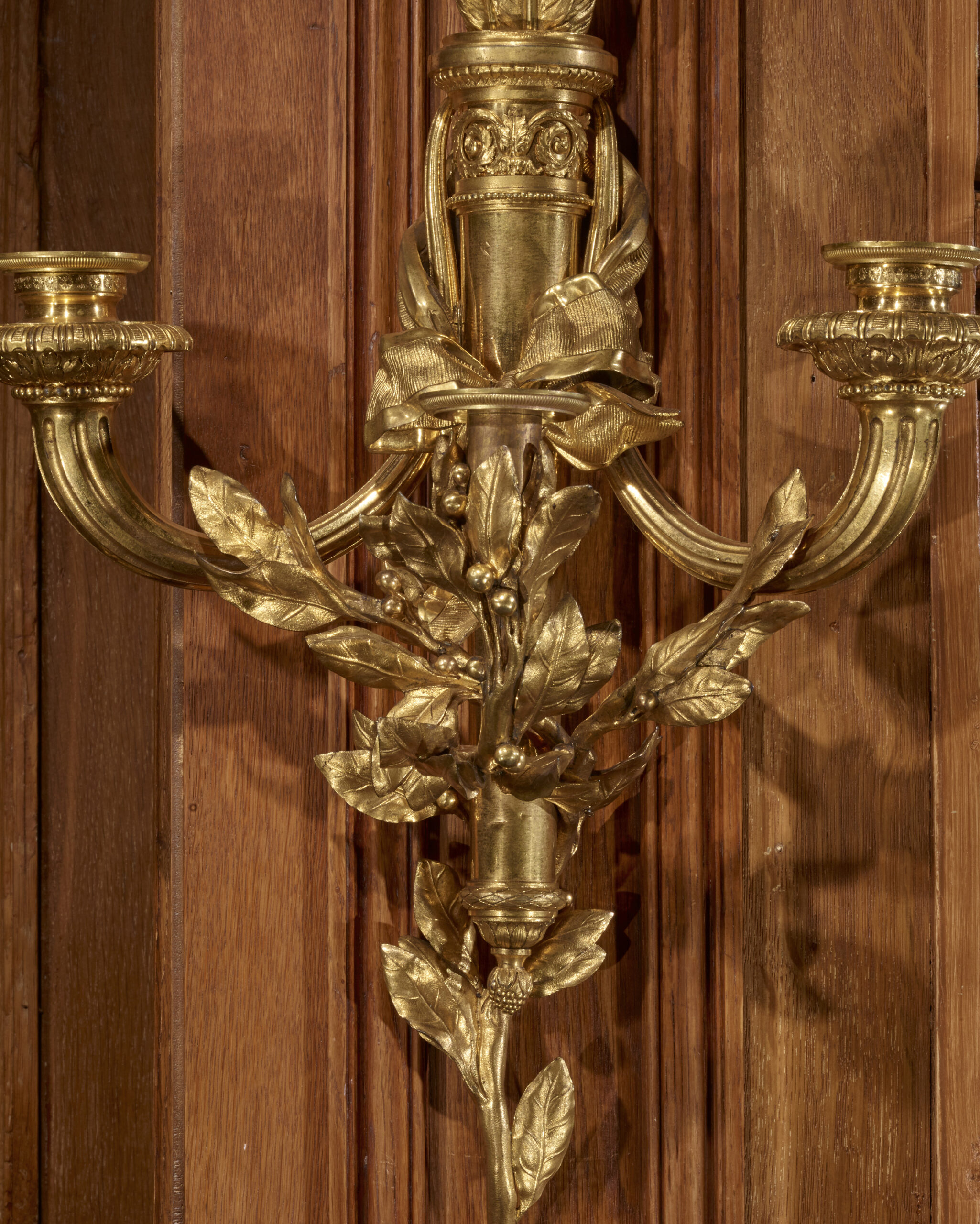
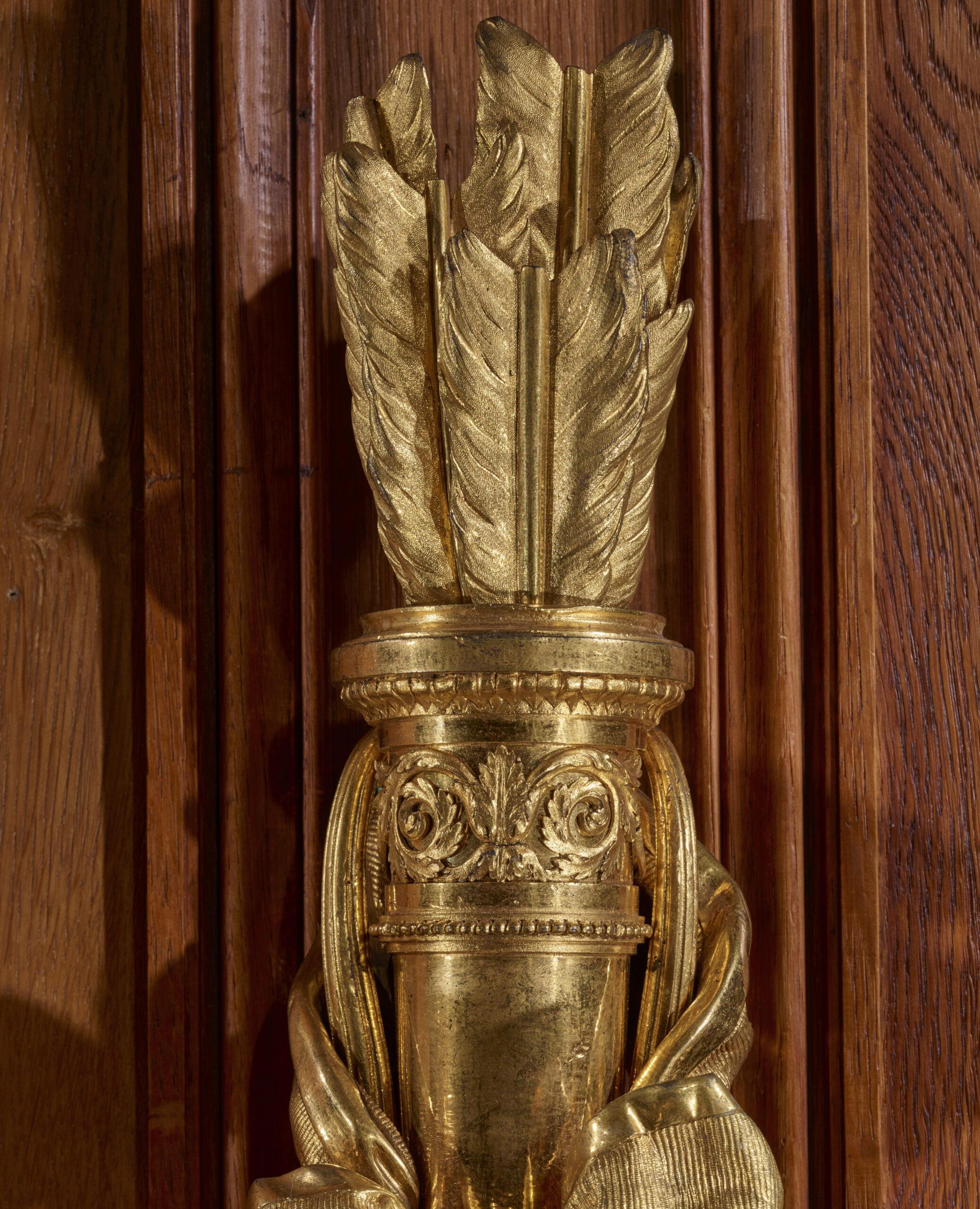
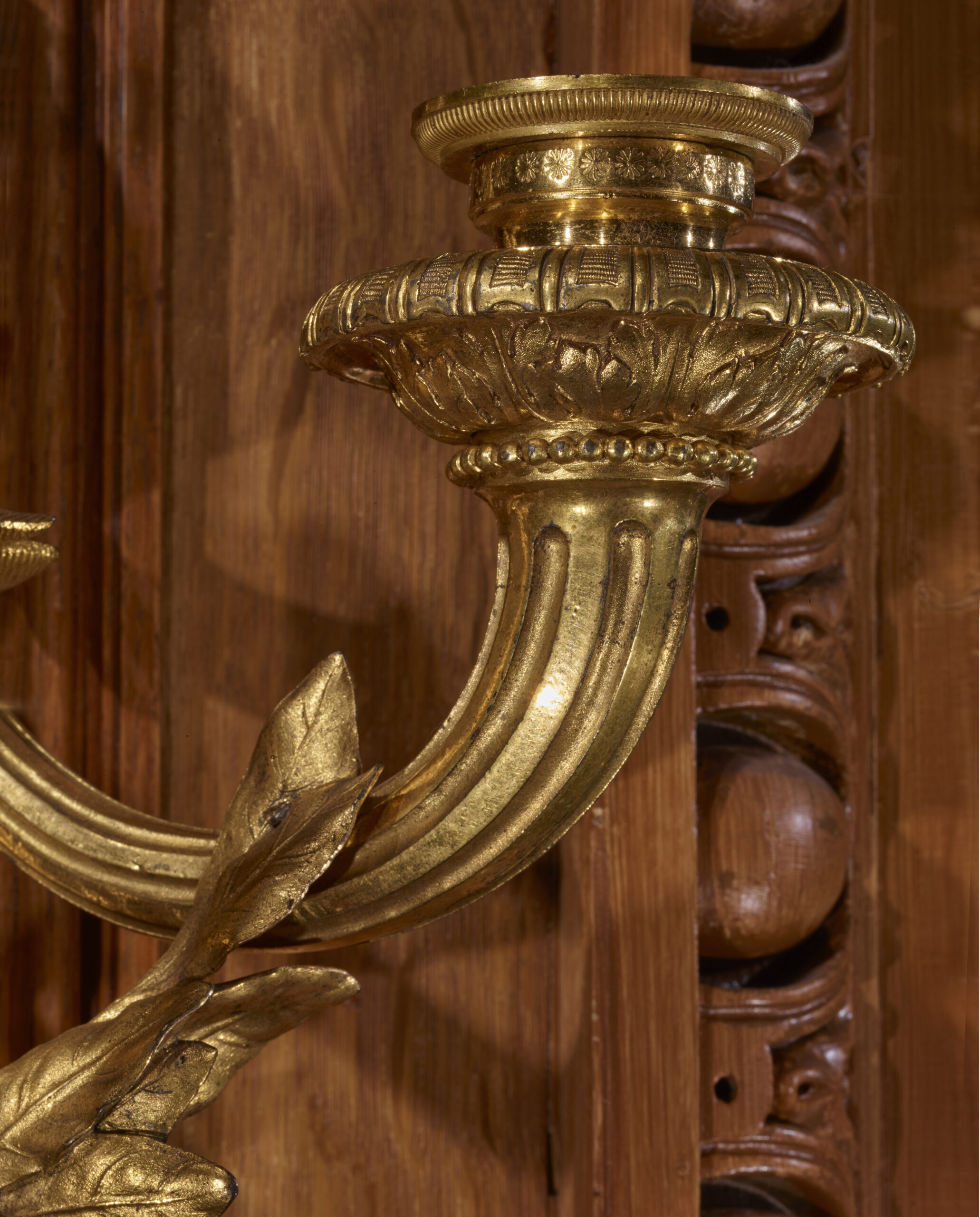
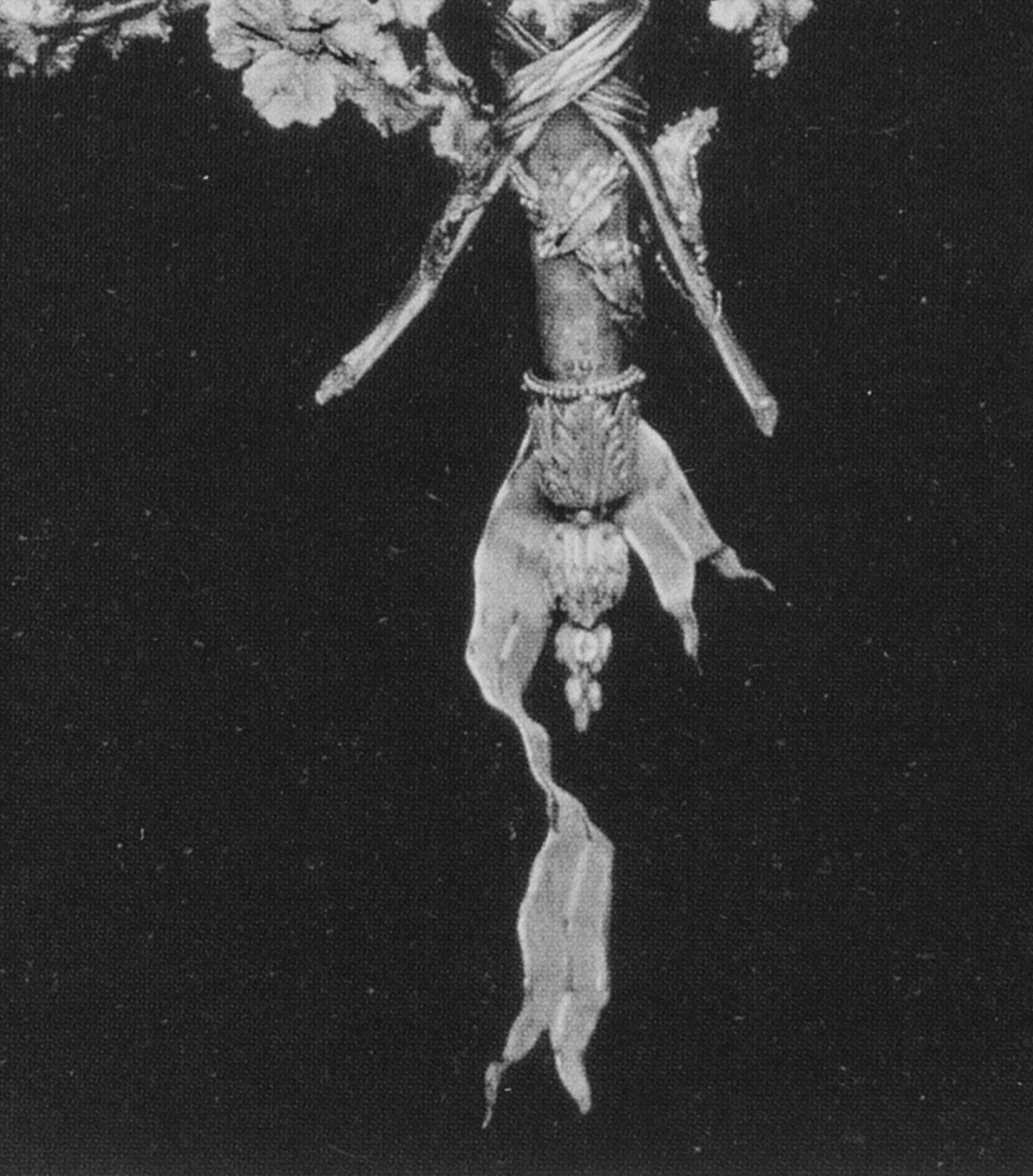
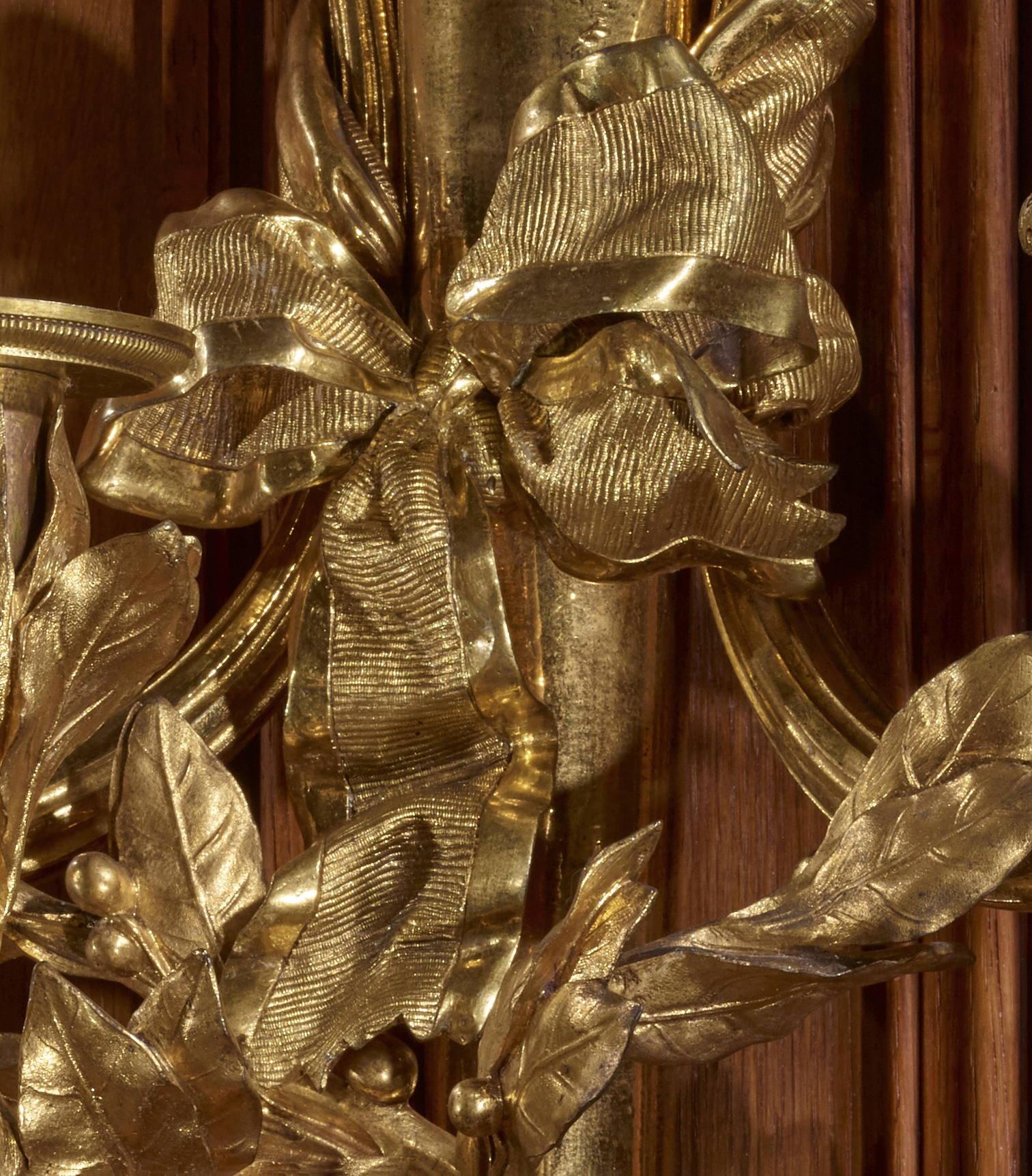
Each of these sconces is composed of a cylindrical, tapered shaft, in the shape of a quiver with a plain ground, crowned with a moulded band and enhanced with friezes of floriated acanthus with heart scrolls and pearls, the whole supporting a “bouquet” of arrow fletchings made of very finely chiselled feathers au naturel. A cavetto foot, adorned with a double row of lanceolate leaves surmounted by a laurel torus with moulded borders, from which falls a foliate seeded bud, terminates the shaft. Two console-shaped arms, tapered with reeded fluting, emerging from the rear of the quiver’s upper band, flank the latter and are bound at the front by an opulent ribbon bow with bretté (ribbed) surfaces, each of these arms punctuated by a circular acanthus-leaved bobèche with reeded flutes, underlined at the base by a fillet of pearls, and housing a short nozzle with a frieze adorned with a rosette-punched band.
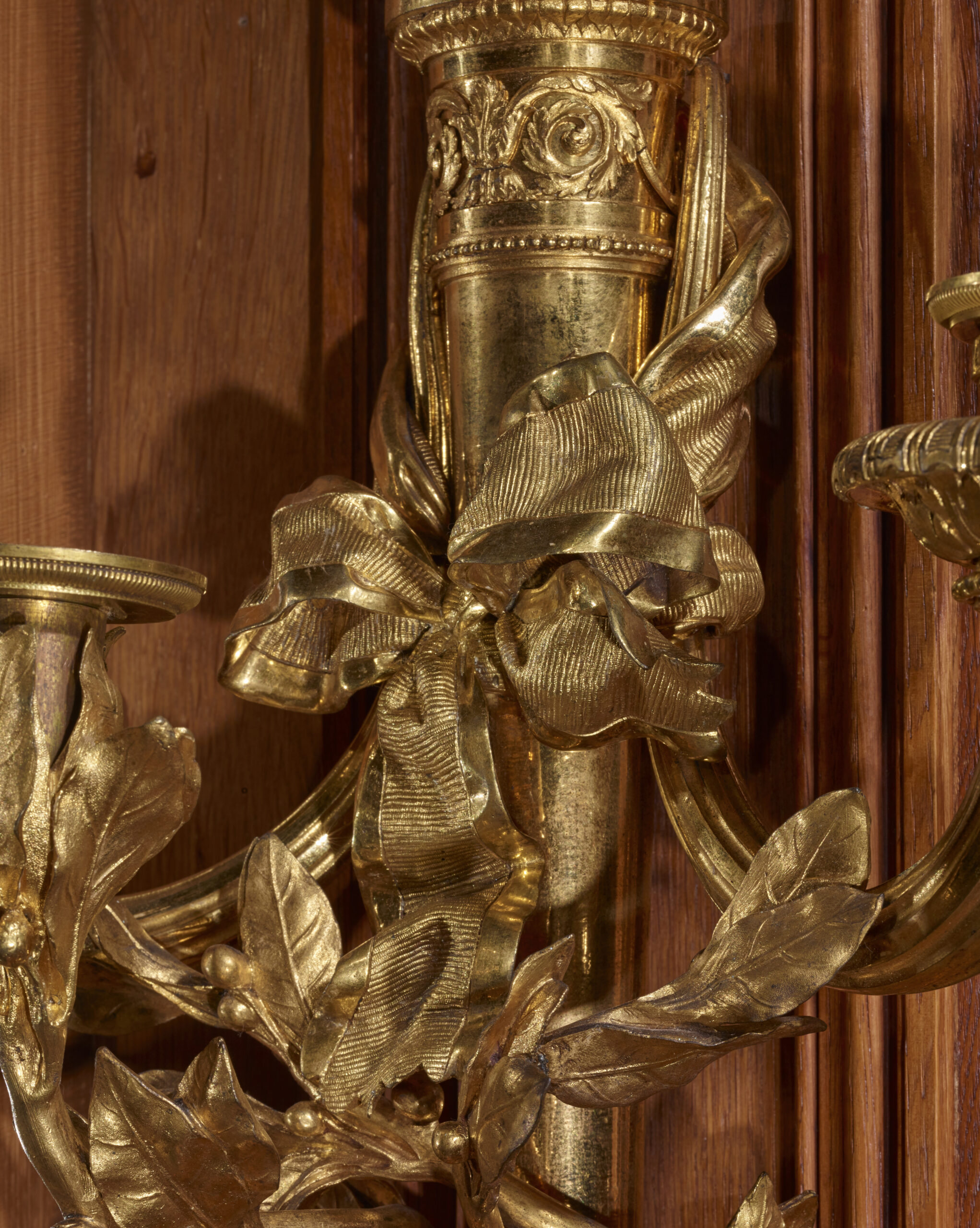
Extending well beyond the lower part of the quiver, a branch of seeded laurel, sculpted au naturel, wraps around it to form a third light arm in the centre, at a slightly lower level than the other two.
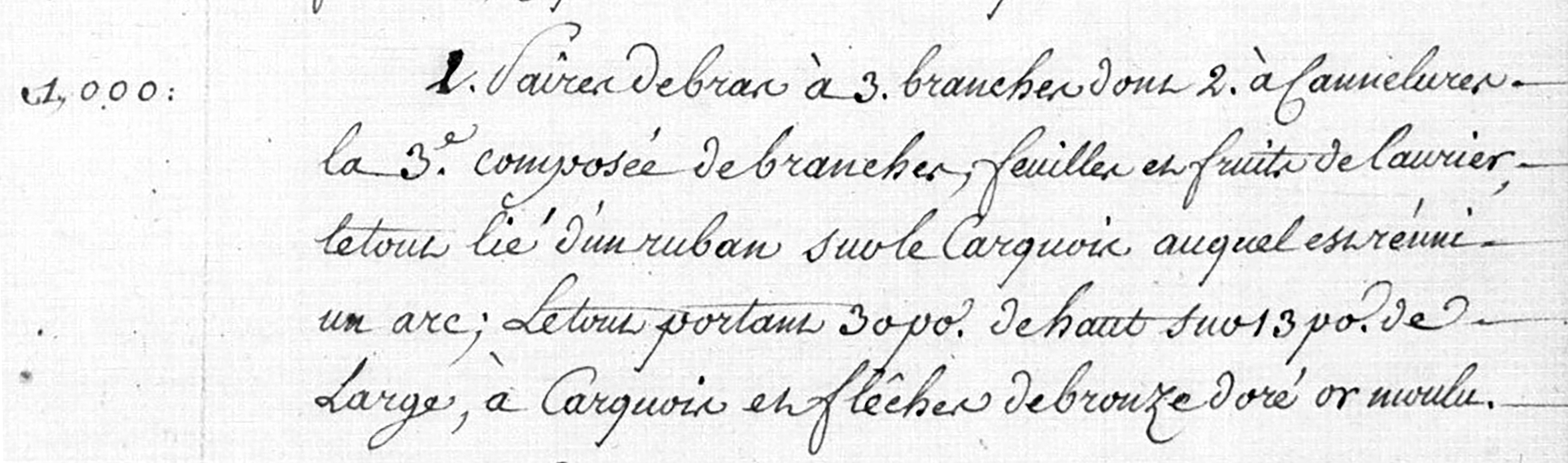
The Inventaire général des Meubles du Château et Déhors de Versailles (General Inventory of Furniture in the Palace and Grounds of Versailles), which was drawn up in 1785, describes these sconces as follows: “Apartment of Madame Élisabeth/ Billiard Room and Library/2 pairs of sconces with 3 arms, 2 of which are fluted, the 3rd composed of branches, leaves and laurel berries, the whole bound with a ribbon on the quiver to which a bow is joined; the whole measuring 30 inches high [81.18 cm] by 13 inches wide [35.18 cm], with quivers and arrows in ormolu gilded bronze.”
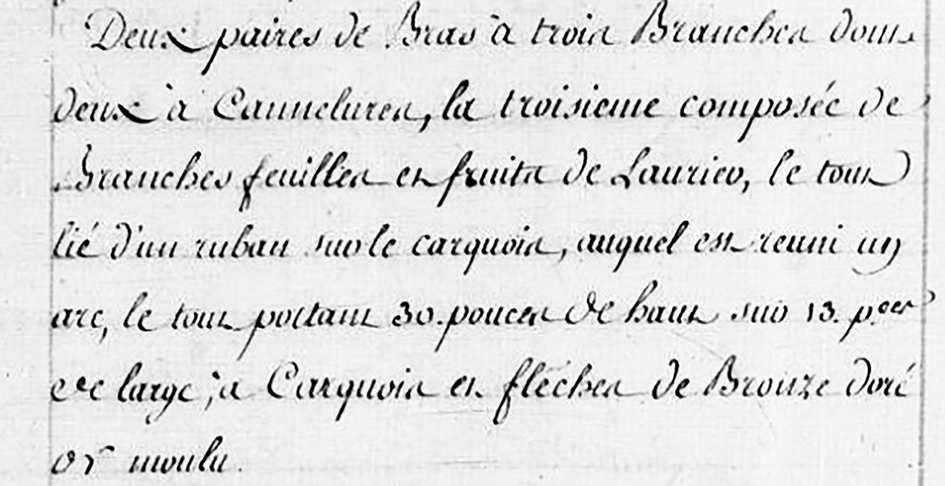
The sconces were also described, in the same terms and in the same location, in the inventory of the Château drawn up three years later, in 1788. At the time, they were adorned with a bronze bow, which has since been lost, but whose mounting holes are clearly to be seen on their reverse sides. The bow, which protruded at the lower and upper ends, bringing the total height of each sconce to approximately 81 centimetres, or nearly 19 centimetres more than their current height, was slightly positioned in a diagonal, thus counterbalancing the sinuosity of the laurel branch and thus subtly balancing the overall design of the sconce.
Madame Élisabeth’s apartment, for which these two pairs of arms were delivered, was located, as previously mentioned, in the South Wing, between the Grand Salon and the Pavillon de la Surintendance, overlooking the South Parterre. The princess resided there from 23rd July 1780 to 6th October 1789. The apartment consisted of a first antechamber furnished with two painted wooden banquettes covered in blue-ground Savonnerie, two gilded wooden tabourets with crimson damask, a four-branch iron chandelier, painted white, a walnut commode, a small table, a toilette mirror and a straw chair, complemented by an eight-panel crimson Alençon canvas screen; a second antechamber followed, adorned with two “Chariot of Gold” [Triumphal Chariot] portière tapestries, and furnished with two tabourets similar to the previous ones, plus a third painted red, a six-panel wool screen with gold galon, two commodes veneered in rosewood and violet wood, a third in walnut, a round folding table in mahogany, a small writing table and a portable lectern; a small gilded chandelier with eight lights “of grenailles and small pears” illuminated the room.
The Cabinet or Pièce des Nobles (Nobles’ Room) en suite was furnished in summer with crimson Genoa damask upholstery, decorated with large and medium galon and gold fringes, and in winter with crimson silk velvet upholstery, lined with gros de Tours and gold galon; six “portière sets”, twelve gilded wood folding stools, a six-panel screen, a sculpted screen, two encoignures veneered in satinwood and amaranth, with marquetry decorations, two six-light gilded chandeliers in Bohemian crystal, four five-light girandoles in bronze and gilt copper, also in Bohemian crystal, each punctuated with a lily, two pairs of three-light sconces, adorned with fluted vases, palmettes, friezes and interlacing, and a light decorated with pilasters and frieze panels, surmounted by twisted fluted vases, cassolettes, shields and crowns, punctuated the layout of this room, where one could also admire, placed on the mantelpiece, a large white marble and gilt bronze clock by Lépine, in the shape of an architectural portico.
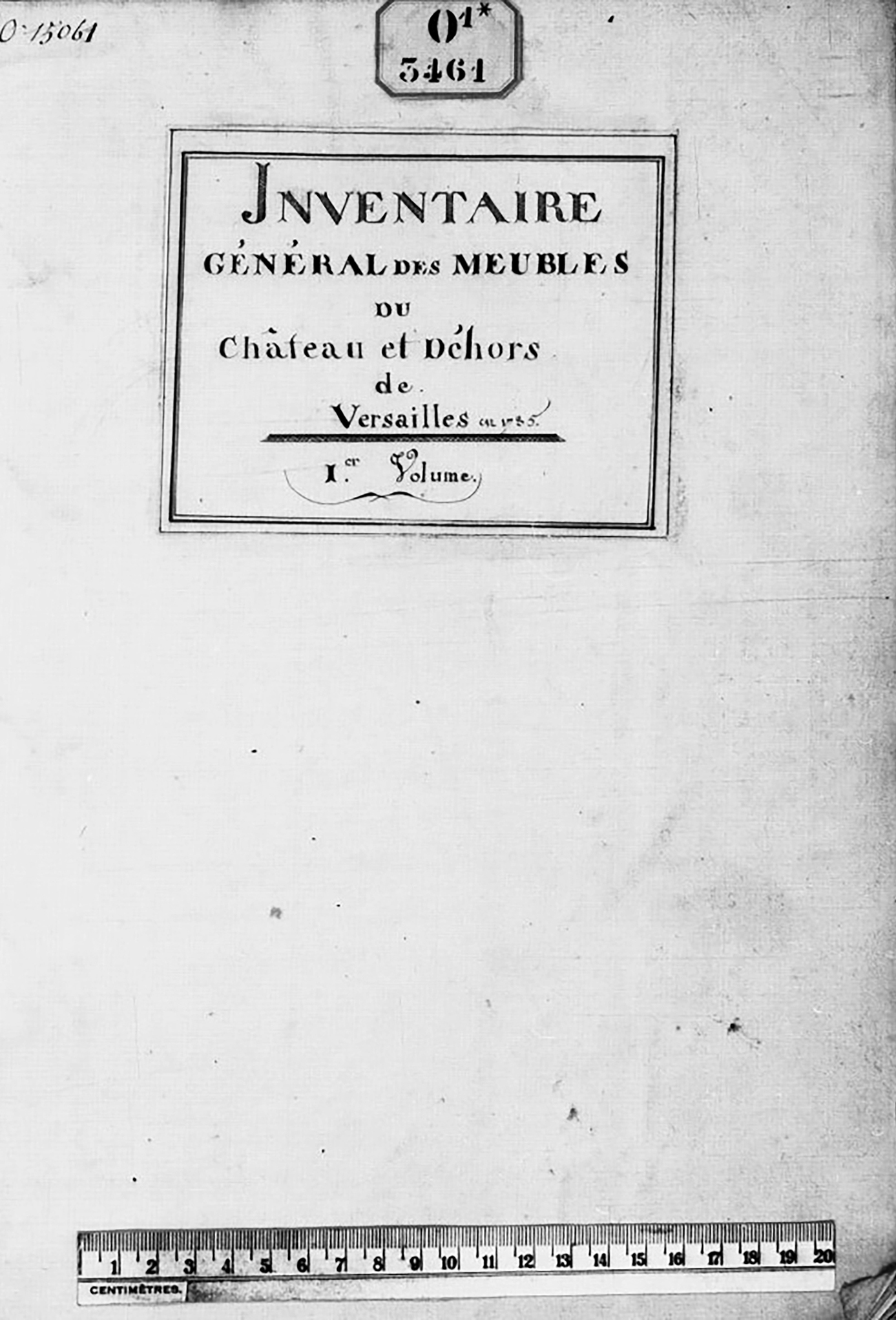
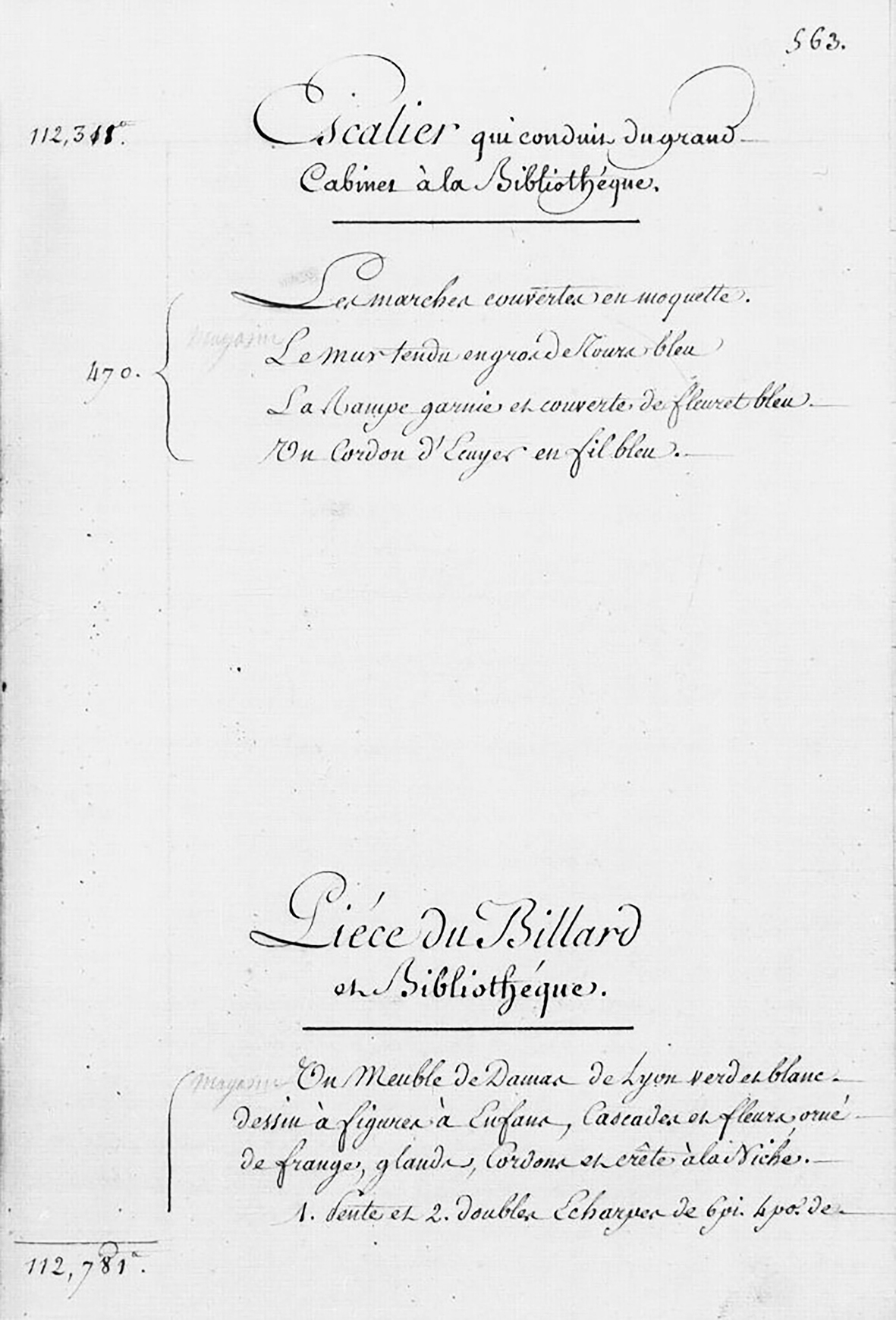
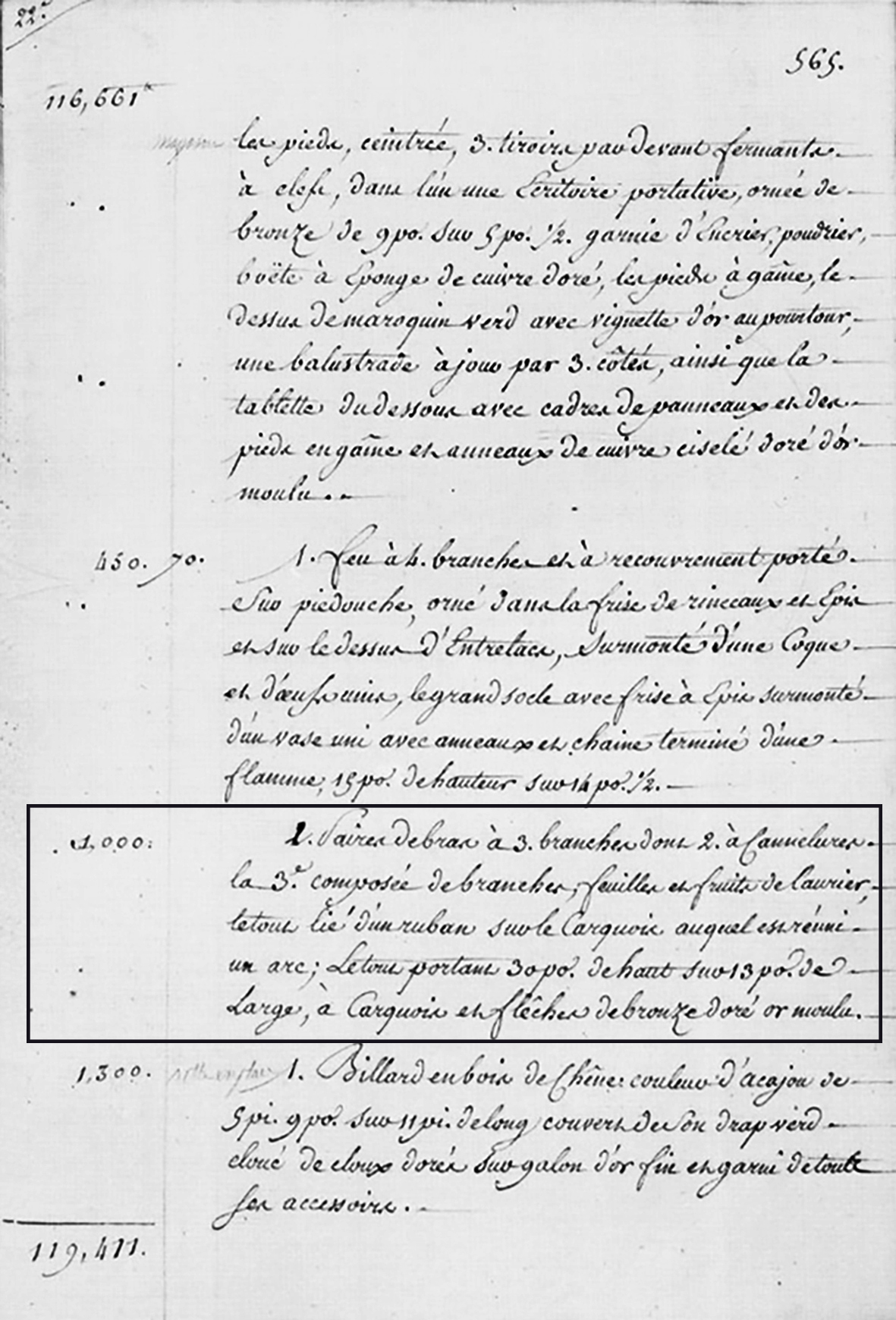
Ill. 3 : Paris, Archives nationales, O1 3461, Inventaire général des Meubles du Château et Déhors de Versailles en 1785 / Ier Volume(General Inventory of the Furniture of the Palace and Grounds of Versailles in 1788/Volume I). See detail ill. 1.
Madame Elisabeth’s bedroom was furnished in summer with green Lyons damask, decorated with palm motifs and adorned with large and small ‘Bourgogne’ galons, and in winter with crimson silk velvet trimmed with gold galons. Three tapestry panels hung around a richly upholstered four-poster bed with double headboards, surmounted by an rounded (en voussure) imperial canopy flanked by a sculpted cornice of acanthus and pearl friezes; two armchairs with twisted fluted legs (three in winter), eight folding stools (twelve in winter), a screen, a six-panel screen, and a two-step footstool accompanied this bed; also in the room were a marquetry commode with two large and three small drawers, with a green Campan marble top, a mahogany screen, a large light ornamented with vases with handles and ram’s heads, a gilded eight-light chandelier in Bohemian crystal, two pairs of three-light sconces, and a beautiful clock in white marble and gilt bronze, graced with two children, one holding a crown, the other a geographical map.
A white-ground gros de Tours upholstery with brocaded blue bouquets and ribbons adorned the Grand Cabinet that followed, which contained a daybed, four wing chairs, eight armchairs, eight chairs and a ‘hat’-shaped screen; three small mahogany screens completed this ensemble, with a six-light gilded chandelier made of rock crystal, a light adorned with a tripod cassolette with satyr marks and two turtledoves, and two pairs of three-light sconces, each surmounted by a vase with handles and twisted flutes. Leading from this Grand Cabinet, a staircase with walls hung in blue gros de Tours gave access to the Billiard Room and Library, where our sconces were placed.
This room was adorned with green and white Lyon damask upholstery, with a “pattern of figures of children, cascades and flowers, trimmed with fringes, tassels, cords and crests à la niche”. A bench, a winged canapé, two bergères, eight armchairs and a screen were arranged in the room, alongside a mahogany-coloured oak billiard table, covered with its green cloth, a satinwood-and-amaranth veneered bureau with writing slide and mounted on casters, a ‘medallion’ foot rug, and a light “surmounted by a plain vase with ring handles and chain, terminating in a flame”.
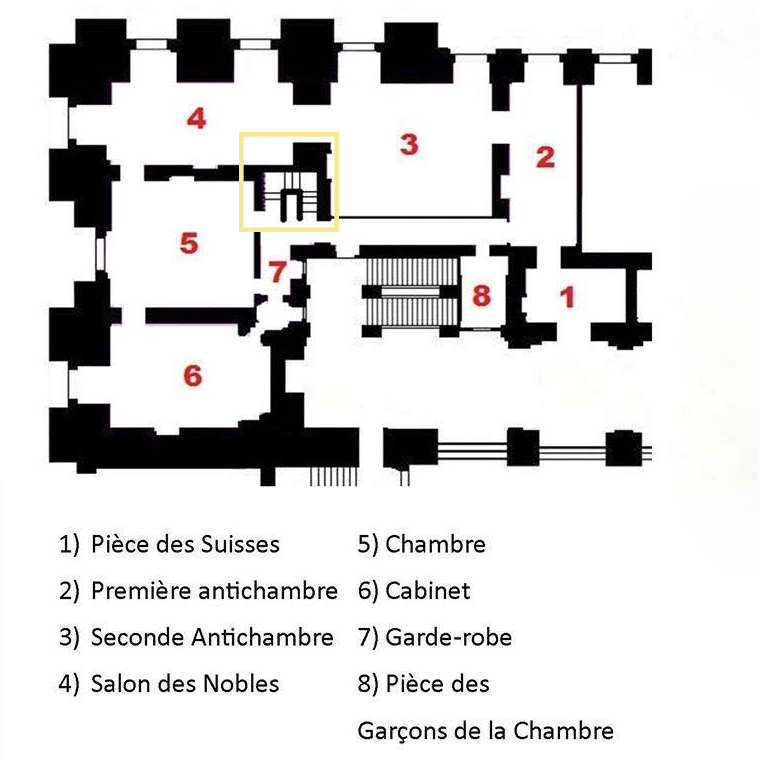
A Cabinet près la pièce des bains (cabinet near the bathroom) and a Boudoir completed the layout of the apartment, both decorated with crimson and white Lyon damask upholstery with a “cartouche pattern of flowers and ribbon; suspended baskets and bouquets in the centre”. Seven tapestries completed the décor of the cabinet, which was furnished with an armchair à la reine, four ‘cabriolet’ armchairs, two chairs à la reine, a rosewood-veneered encoignure with marquetry, a pair of single-light sconces and a light “surmounted by fluted torchère horns, terminating in flames”. Four tapestries graced the boudoir, which also contained a curved daybed “in the window recess”, a bergère, three large armchairs and four chairs, a pair of single-light sconces, and a light adorned with sphinxes.
Elisabeth de France, known as Madame Elisabeth
Born at the Palace of Versailles on 3rd May 1764, Madame Élisabeth was baptised on the same day in the royal chapel by the Archbishop of Reims, Charles Antoine de La Roche-Aymon (1697-1777), in the presence of her grandfather, Louis XV, her grandmother, Queen Marie Leszczynska, and members of the royal family. She was the eighth and last child of the Dauphin Louis of France (1729-1765) and Maria Josepha of Saxony (1731-1767).
Left an orphan at the age of three, she was entrusted to the care of Marie-Louise-Geneviève de Rohan (1720-1803), Countess of Marsan, and was provided with an excellent education, in which she distinguished herself by her talents in mathematics—she studied under the guidance of the mathematician Antoine-René Mauduit (1731-1815) —and science. Marie-Thérèse de La Ferté-Imbault (1715-1791), daughter of Madame Geoffrin, became her philosophy tutor and remained her friend thereafter. A skilled horsewoman, the princess displayed a real talent for drawing—the Palace of Versailles still preserves some of her works—embroidery and the harp, but proved to be a poor singer.
Known for her great piety, she was influenced in that regard by her aunts, Mesdames, daughters of Louis XV, who inculcated in her a great devotion, without however succeeding in altering in her a certain freedom of spirit, sometimes even in the field of religion, as evidenced by her correspondence.
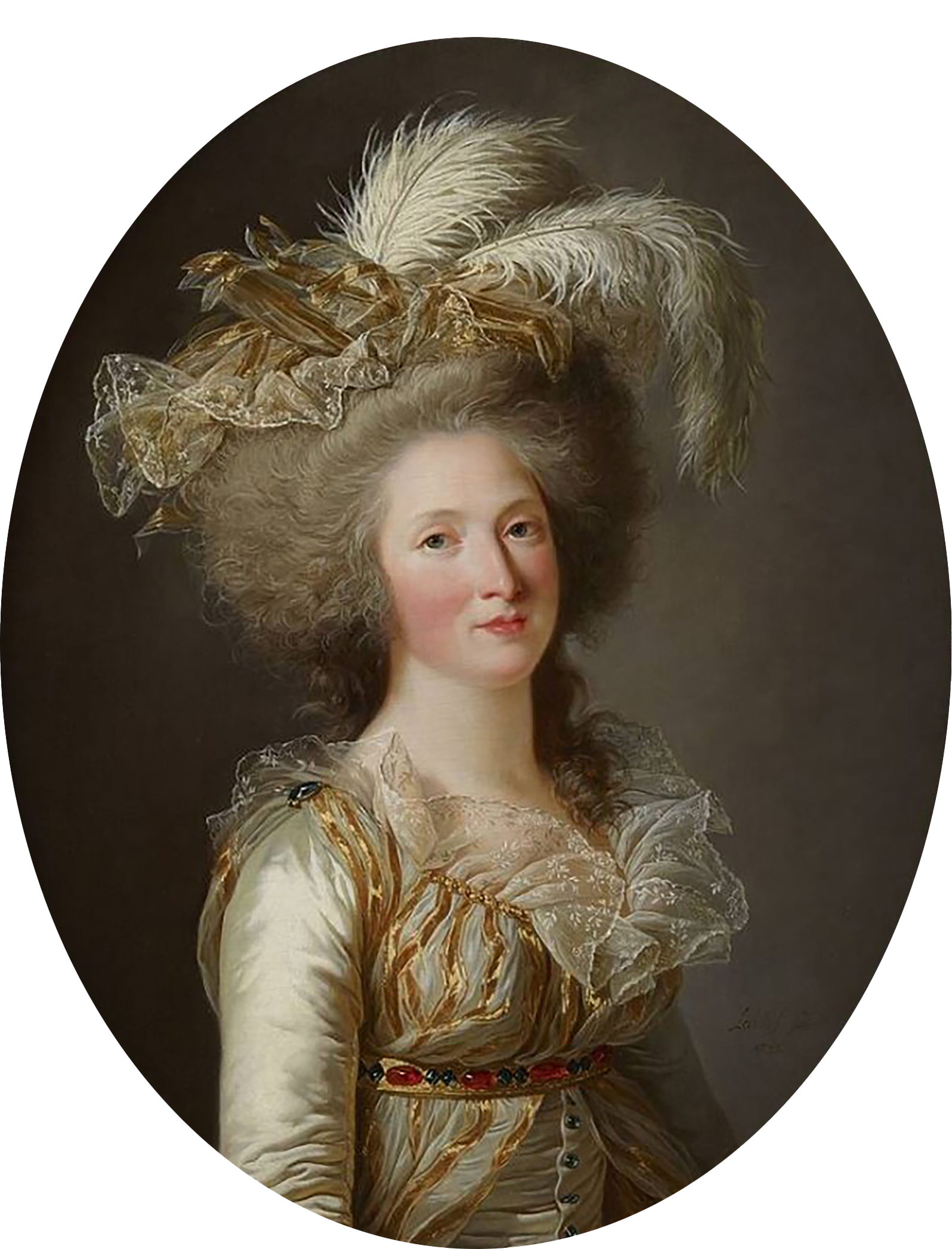
Aged ten when her brother Louis XVI ascended the French throne, she demonstrated a very strong attachment to him and Marie Antoinette from an early age and chose to remain at their side throughout her life, refusing to ever take a husband. A marriage had been contemplated with Joseph of Portugal (1761-1788), eldest son of Queen Maria I of Portugal (1734-1816), but negotiations were brought to an end, and in 1777 she was again considered as a potential match for Marie Antoinette’s brother, Emperor Joseph II of Austria (1741-1790), who was twice widowed, childless and twenty-three years her senior. She eventually managed to persuade Louis XVI to keep her at Versailles. At the same period, she was granted permission to have her own house and income. With the King’s consent, she promptly appointed her playmate Marie-Angélique de Mackau (1762-1800) as her first maid of honour. The latter’s mother, the Baroness de Mackau (1723-1801), had been instrumental in her upbringing.
In 1783, Madame Élisabeth, then aged nineteen, was offered a plot of land and a house in the village of Montreuil by her brother, a property that had been bought from the Rohan-Guéméné family and which still remains today in the Montreuil district of Versailles under the name “Domaine de Madame Élisabeth”. Although she was not allowed to sleep there until reaching the legal age of majority, which was then set at twenty-five, she rode there every day from the nearby Palace of Versailles and led a simpler life than at Court, punctuated by the leisure activities she had grown fond of in her childhood, her acts of piety and her good works, which earned her the nickname “Bonne dame de Montreuil”.
When the French Revolution broke out, she drew even closer to the Queen in her support for the King, and on 6th October 1789, she accompanied them and was forcibly brought back by the people to Paris, where she now disposed of an apartment in the Tuileries Palace. Defying appearances, the Princess sometimes stood up to her brother or sister-in-law. Their clashes revolved around political strategy, with Madame Elisabeth adopting the position of the Ultras, without the slightest concession to the advocates of a constitutional monarchy.
From 1790 onwards, she supported the principle of an alliance of the émigrés with foreign powers, from whom she expected salvation, which, de facto, constituted treason against the government of France at the time. Through the Count of Virieu, among other figures, she maintained regular correspondence with her brother, the Count of Artois, who had emigrated to Turin and then to Koblenz, whose ideas she fully embraced, and even recommended that he should act on his own behalf, urging him to rally the other European sovereigns to their interests, because, she said, “Louis XVI is so weak that he would sign his own death sentence if he were required to do so.” She also opposed the Civil Constitution of the Clergy and any measure that diminished the prerogatives of the monarchy or the Church. In 1791, her aunts invited her to flee with them, but once again she chose to remain at the side of the royal couple. She accompanied them in their attempt to leave Paris for Montmédy on their failed flight to Varennes on 20th June 1791, and on 10th August 1792, the day that sounded the death knell for the French monarchy with the storming of the Tuileries, she courageously confronted the rampaging rioters without even trying to conceal her identity.
Imprisoned on 13th August, along with the royal family, in the Temple Tower, she was greatly affected physically but found solace in religion, taking on the role of comforting angel to the Queen and her children. After the death of Louis XVI on 21st January 1793, followed in the same year by that of Marie-Antoinette on 16th October, Madame Elisabeth shared her cell for more than a year with her fifteen-year-old niece, Marie-Thérèse of France (1778-1851), known as Madame Royale and future Duchess of Angoulême, whom she looked after after the execution of her parents and the separation from her little brother, who would become the short-lived Louis XVII (1785-1795).
The Convention had initially intended to expel Madame Elisabeth from France—Robespierre having repeatedly opposed her execution—but documents cited in October 1793 during the investigation of Marie-Antoinette’s trial ultimately prompted a decree to bring her before the Revolutionary Tribunal, which sentenced her to the death penalty. She was guillotined on 10th May 1794. A medallion depicting her can be found in the Basilica of Saint-Denis.
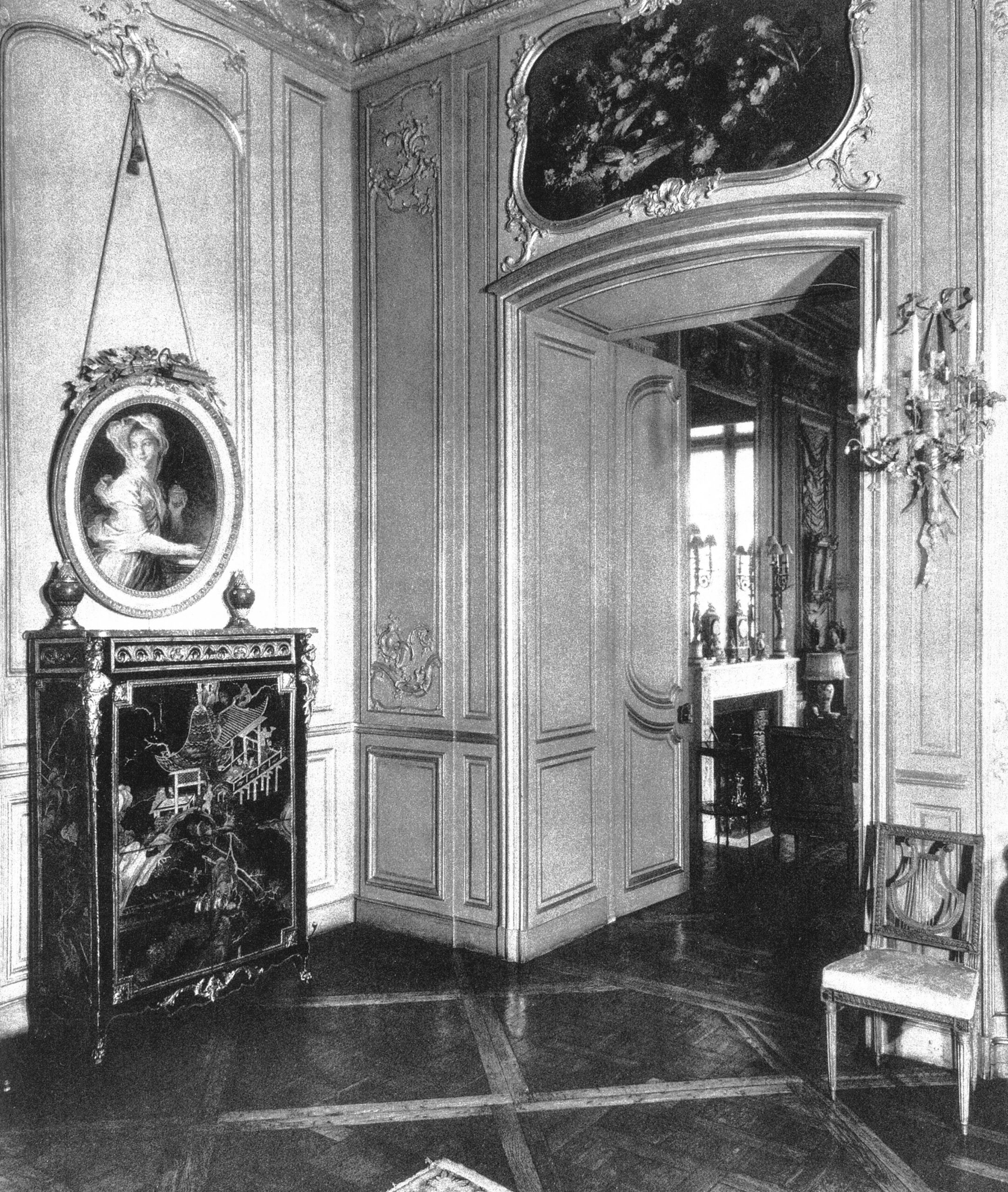
Claude-Jean Pitoin
Son of Quentin-Claude Pitoin (circa 1725–1777) and Élisabeth Lelièvre, herself the daughter of Antoine Lelièvre († 1784), master gilder on metals in 1738 and supplier to the Garde-Meuble of the Crown from 1753 to 1763, Claude-Jean Pitoin was born in 1757. In 1776, his father placed him as an apprentice with Jean Martin, one of the most talented sculptors and modellers of his time and the main collaborator of Pierre Gouthière, Jean Hauré, Jean-Louis Prieur and François Rémond. He was admitted as a master founder-gilder-engraver in 1778 and pursued his father’s business by becoming a supplier to the Garde-Meuble of the Crown until 1786, with the title of Gilder-Silverer on Metals to the King’s Garde-Meuble.
That same year, he was replaced by a team of craftsmen, one of the most significant of whom was the founder Louis-Gabriel Feloix (master in 1754), recruited by Jean Hauré, who was then in charge of the execution of furniture and bronze furnishings for the Garde-Meuble. The first delivery of matte gilt bronze by Claude-Jean Pitoin took place on 30th December 1778, which included “two powerful pairs of three-light sconces” for use in the Queen’s bedroom at the Palace of Versailles. Three years after being dismissed from his position, he went into partnership in 1789 with a certain Foldekey, with whom he founded a “correspondence house with the provinces and abroad”, but this went bankrupt in 1791. Claude-Jean Pitoin nevertheless managed to resume his work as a gilder and was granted admission to the Exhibition of Industrial Products in the year IX (1801), where he was awarded a silver medal for perfecting the art of gilding on crystals. He died in Paris before 1806.
A possible interaction with Pierre Gouthière?
As we have just seen, Claude-Jean Pitoin learned modelling in 1776 in the workshop of the renowned sculptor and modeler Jean Martin, who was also a collaborator of Pierre Gouthière (1732–1813), the King’s chaser and gilder. As Christian Baulez points out, the Pitoins, father and son, were above all sculptors by virtue of their training, “with little connection to the world of metal.” They were ultimately more entrepreneurs than mere executants, and consequently had to subcontract most of their deliveries. Under these circumstances, it is quite conceivable that our sconces were modelled by Quentin-Claude, but cast by an intermediary and chased and gilt by Gouthière. At the time, between the designer and the supplier of such sconces, there was a whole chain of artists and artisans whose names ultimately faded away to the sole benefit of that of the supplier.
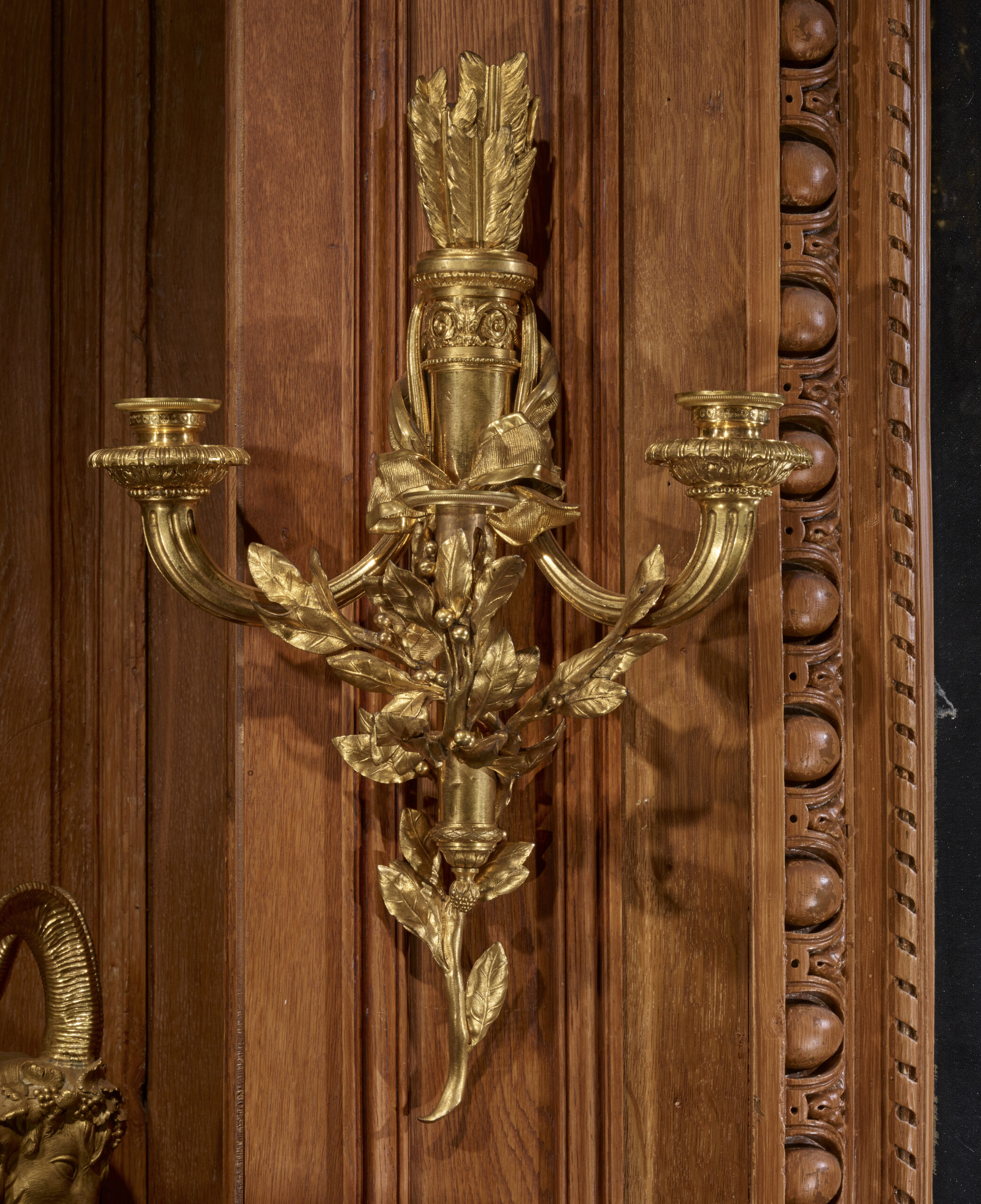
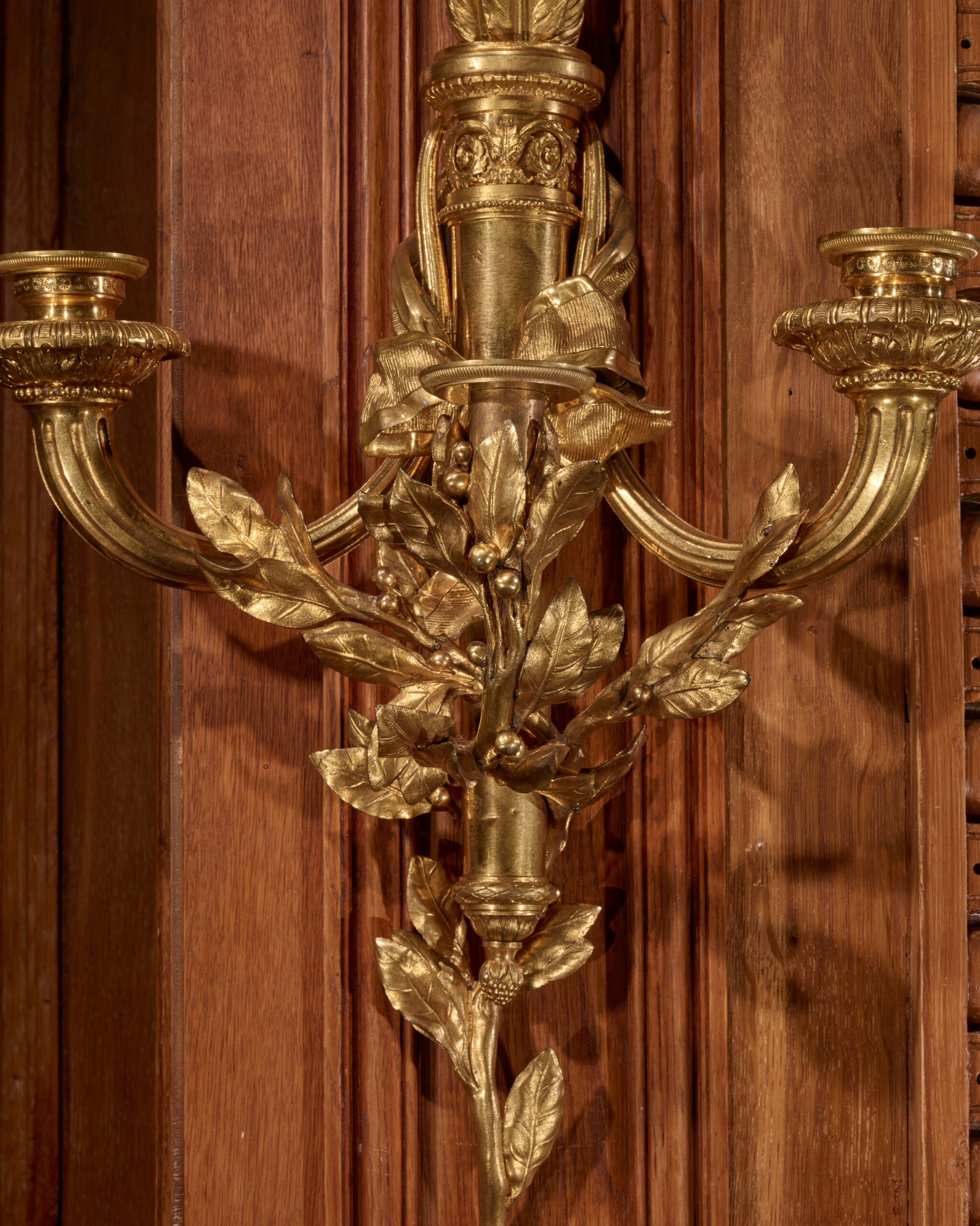
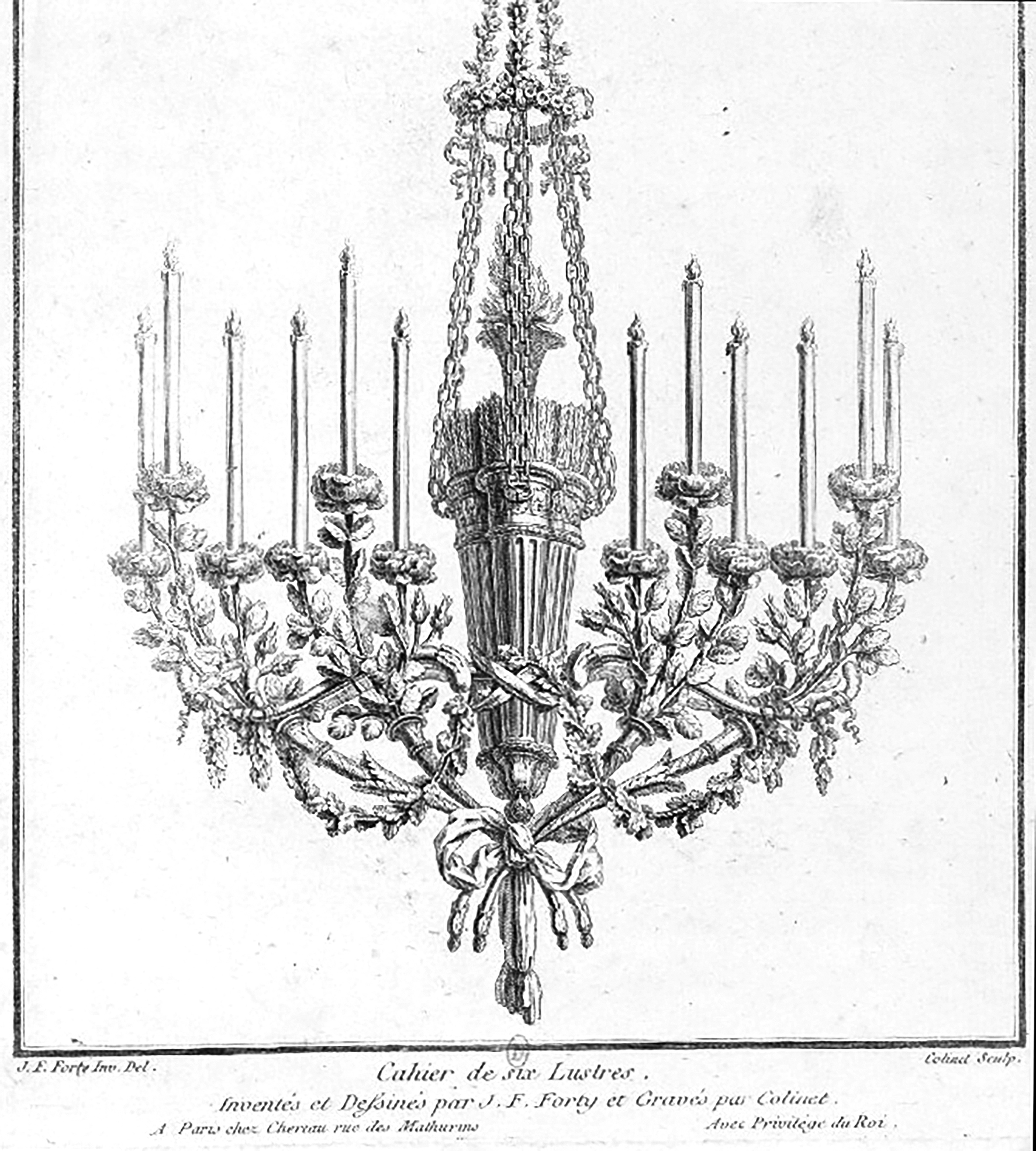
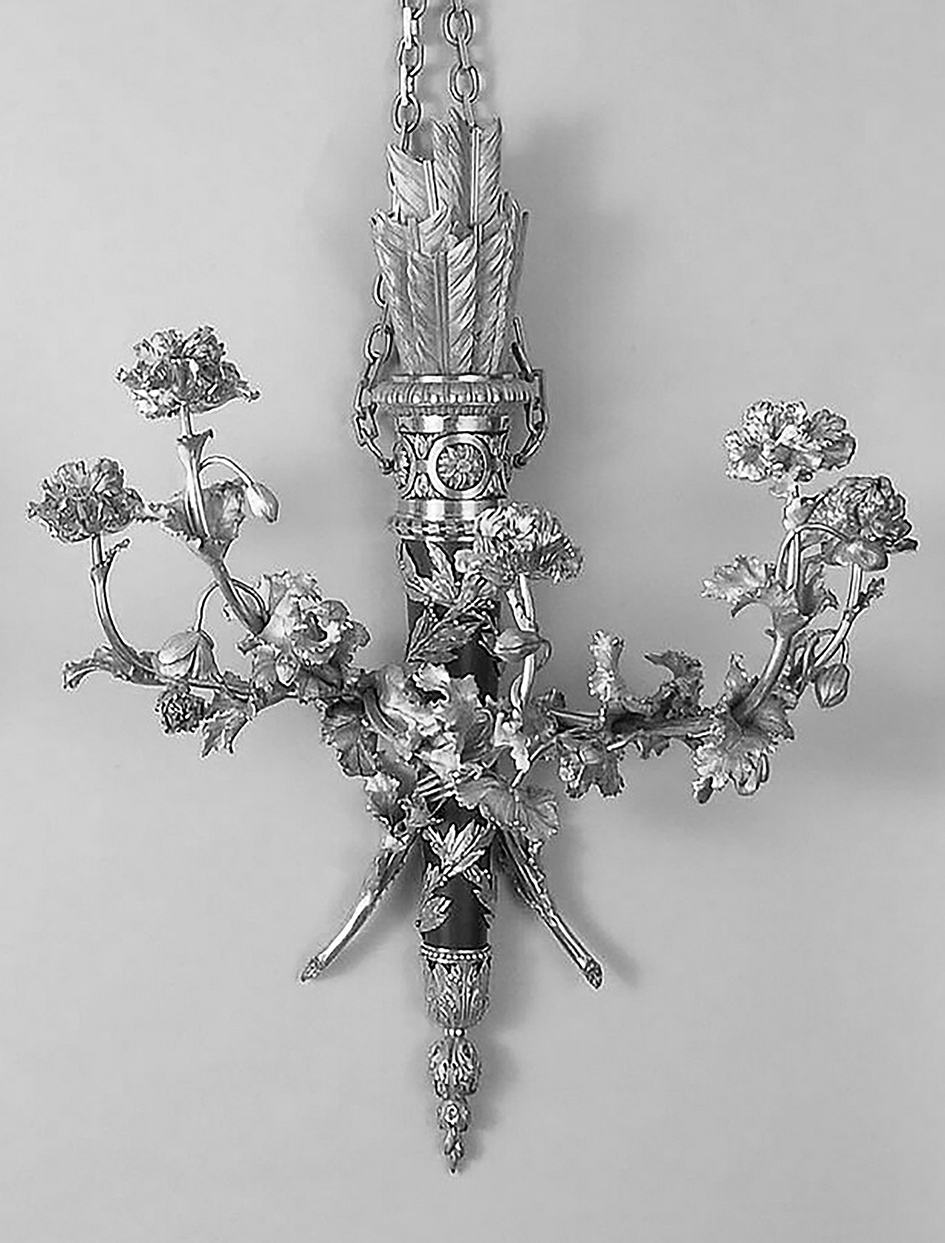
In this regard, it is worth mentioning here the large five-light models, also adorned with quivers and poppy branches chased au naturel and tied with a ribbon, a pair of which was commissioned circa 1780 from Gouthière, most likely designed by the architect François-Joseph Bélanger (1744–1818), by Louise-Jeanne de Durfort de Duras (1735–1781), Duchess of Mazarin, to adorn the grand salon of her townhouse, since demolished, at 11–13 quai Malaquais in Paris. The pair, which most likely formed part of the collections of Baron James de Rothschild (1792–1868) and subsequently remained in his descendants’ possession, was acquired by the Louvre Museum in 2002. Gouthière offered his clientèle sconces with poppy decoration in two different sizes from at least the mid-1770s, and the ornamentalist Jean-François Forty (1721–178?) published a luxurious version circa 1775 in the form of a chandelier, plate 1 of his 8thCahier de l’Oeuvre (Notebook of the Work), with a shaft composed of an assembly of three quivers suspended from chains and surmounted by a torch, decorated with twelve poppy branches forming as many lights and tied together at the base of the shaft with a bow of ribbons, the opulence of which is quite comparable to ours.
The pair of ‘quiver’ model sconces, almost certainly the most elaborate ever supplied by Gouthière, of very large dimensions, was commissioned on behalf of the Duke of Aumont (1709–1782). At the famous post-mortem auction of the latter’s estate, held on 12th December 1782 and subsequent days, it was acquired for the very substantial sum of 9,127 Livres by a certain Quenel, forming lot n°. 343 of the sale:
“A pair of six-foot-high arabesque sconces, the main part of which features a highly elaborated quiver, adorned with four branches of roses intertwined & tied with a ribbon bow, with a bobeche, each formed of a flower related to their species; this quiver is supported by three chain links passing between two branches of ivy twisted into a lyre, surmounted by a wreath of roses tied with the links to an oval cartouche, also with branches of ivy, & terminated by a nail with a ribbon bow; one of these arms is adorned below the quiver with a trophy of arrows held together by a ribbon bow, which garnishes the centre of an oval cartouche figured by two branches of myrtle, one of which descends to form an ornamental chute intertwined with two tasseled ribbons, the other adorned with a thyrsus trophy and faun attributes, & the same ivy ornamental cartouche, with a chute of vine leaves, grapes & ribbons.
This was followed by another pair of sconces “entirely similar to the previous two, except for the genre of the ornaments below the quiver”, which was purchased by the dealer and expert Alexandre-Joseph Paillet (1743–1814) for the equally substantial sum of 9,100 Livres. Like the previous ones, the sconces terminated “in an ornamental chute with two tasseled ribbons”.
These rich ornamentations and ribbon chutes, described in relation to the sconces of the Duke of Aumont, were partly attached to the reverse side of the quivers that made up the main part of these lights, mirroring the bows, now lost, that were originally attached to the reverse side of our sconces.
This type of mounting is distinctly to be seen in Gouthière’s work on a pair of sconces, identical to those belonging to the Duchess of Mazarin, which were part of the collection of Colonel Jacques Balsan (1868–1956) and his second wife, the American billionaire Consuelo Vanderbilt (1877–1964), who was divorced from the 9th Duke of Marlborough, cousin of Winston Churchill. The wide ribbon with bretté edges and double-pointed ends falling from each of these sconces, similar to ours, appears to be attached to the back of the quiver forming their shaft. The same must have been true, originally, of the Duchess of Mazarin’s sconces preserved in the Louvre.
The pair of sconces from the Balsan collection was most likely originally one of the two identical pairs, executed by Gouthière, that belonged to the Count of Vaudreuil (1740–1817), appearing in his auction on 26th November 1787 in Paris, lots nos. 373 and 374, where they were purchased for 1,380 and 1,200 Livres respectively by the marchand-mercier Mala. The latter resold them to the Garde-Meuble of the Crown in January 1788. One pair, which disappeared without a trace in 1794, had been placed in Louis XVI’s Bedchamber at the Château of Saint-Cloud, where it was inventoried on multiple occasions. Ironically, given the history of the provenance of our sconces, the second pair, corresponding to that in the Balsan collection, was placed in 1789, after being entirely regilded by Pierre-Philippe Thomire (1751–1843), in Madame Élisabeth’s grand salon at the Château of Montreuil.