

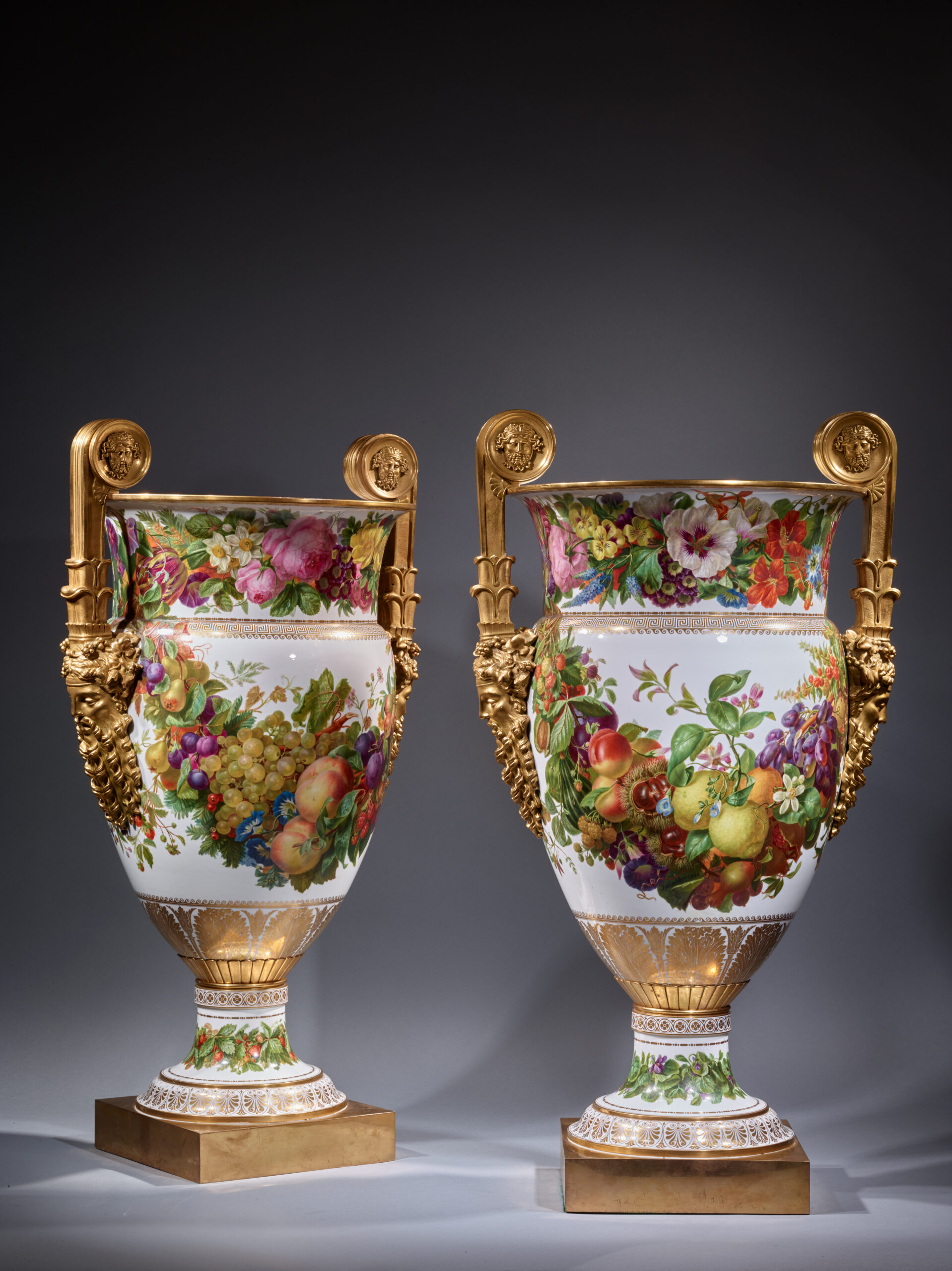
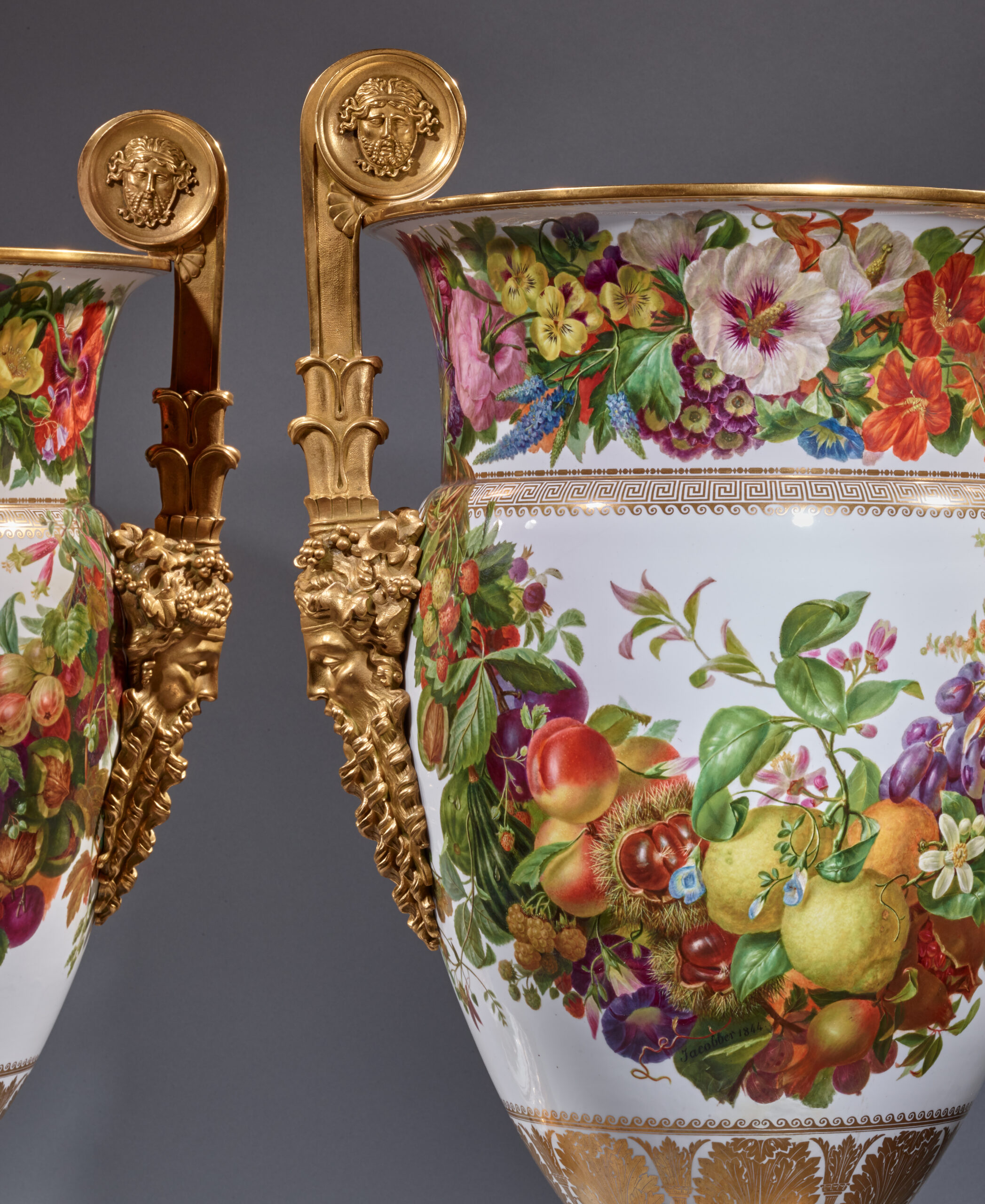
Hard porcelain and chiselled and gilded bronze.
Total height with bronze handles: 82.5 cm. (32 ½ in.).
Total length with bronze handles: 45 cm. (17 ¾ in.).
H. of vases without their bronze mounts: 68 and 67.8 cm. (26 ¾ and 26 5/8 in.).
Widest diameter of the vases without their bronze mounts (at the neck): 38 cm. (15 in.).
Bases in gilded bronze: 24.9 x 24.7 cm. (9 7/8 x 9 ¾ in.).
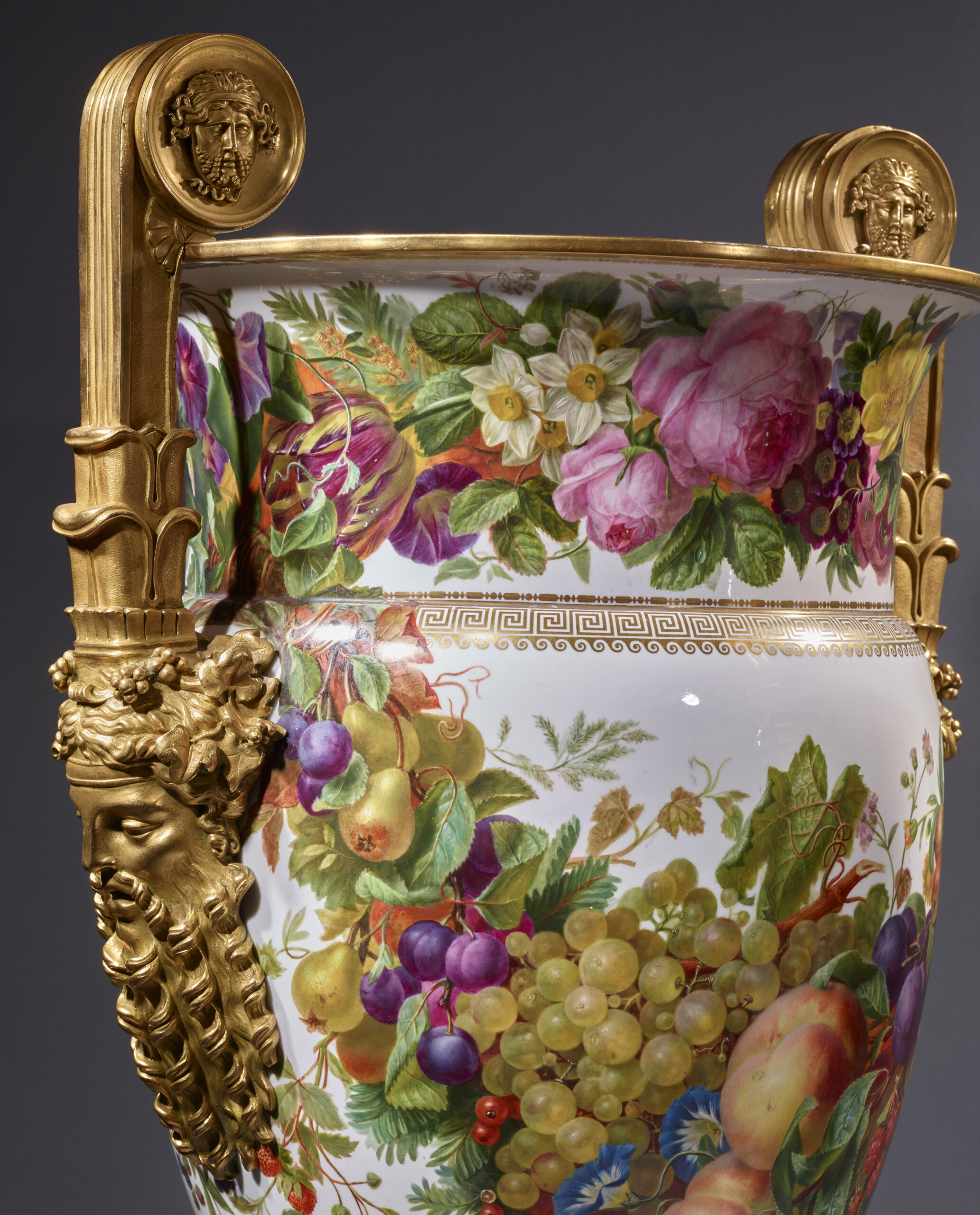
MARKS AND INSCRIPTIONS: signed on the garlands of flowers on one of the main sides of each vase: Jacobber Sèvres/1844; decoration mark in blue print in use by the Royal Manufactory of Sèvres between 1834 and 1845 and visible here inside the neck of each vase: LP in intertwined cursive letters surmounted by a closed crown, flanked on the left by the word Sèvres and on the right by the date 1844, the whole inscribed in a double-lined circle.
PROVENANCE: Presented on 24th December 1845 by Louis-Philippe I (1773-1850), King of the French, to His Highness Abbas Pasha (1813-1854), grandson of His Highness Muhammad Ali (1769-1849) and future Viceroy of Egypt (Khedive) under the name Abbas I Hilmi from 1848 to 1854; collection of antique dealer and decorator Jean Chélo in Paris in the 1950s, located at 5 Rue Lamennais, Paris.
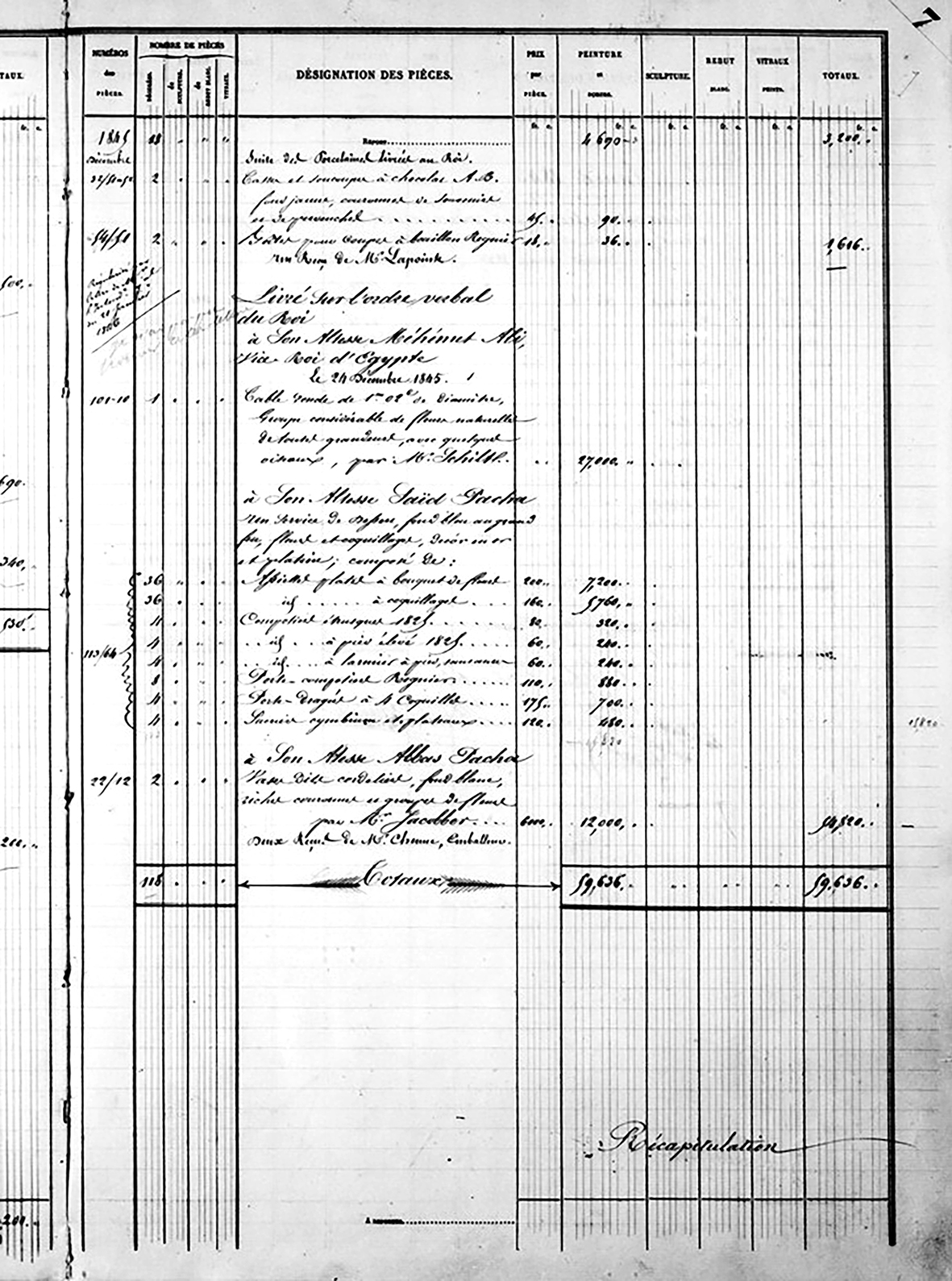
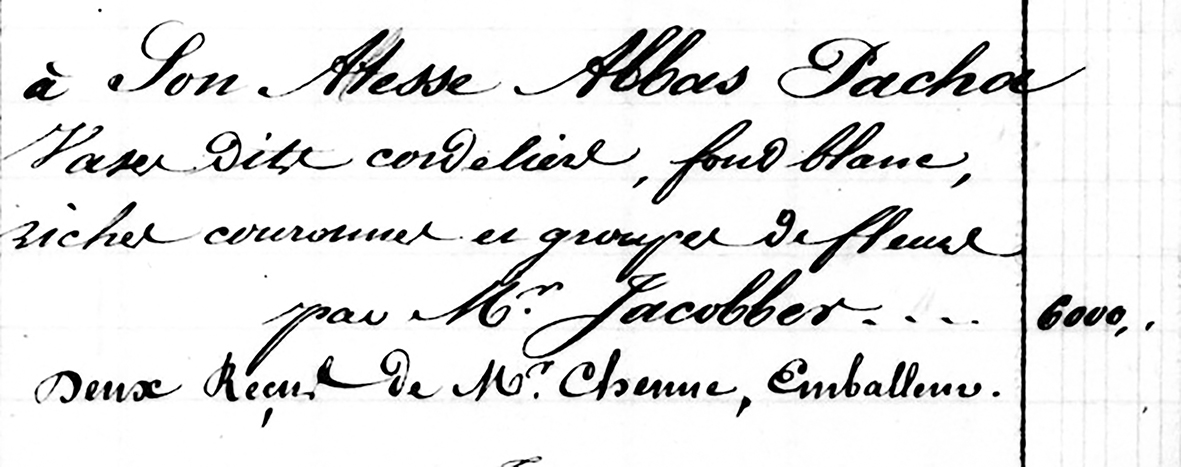
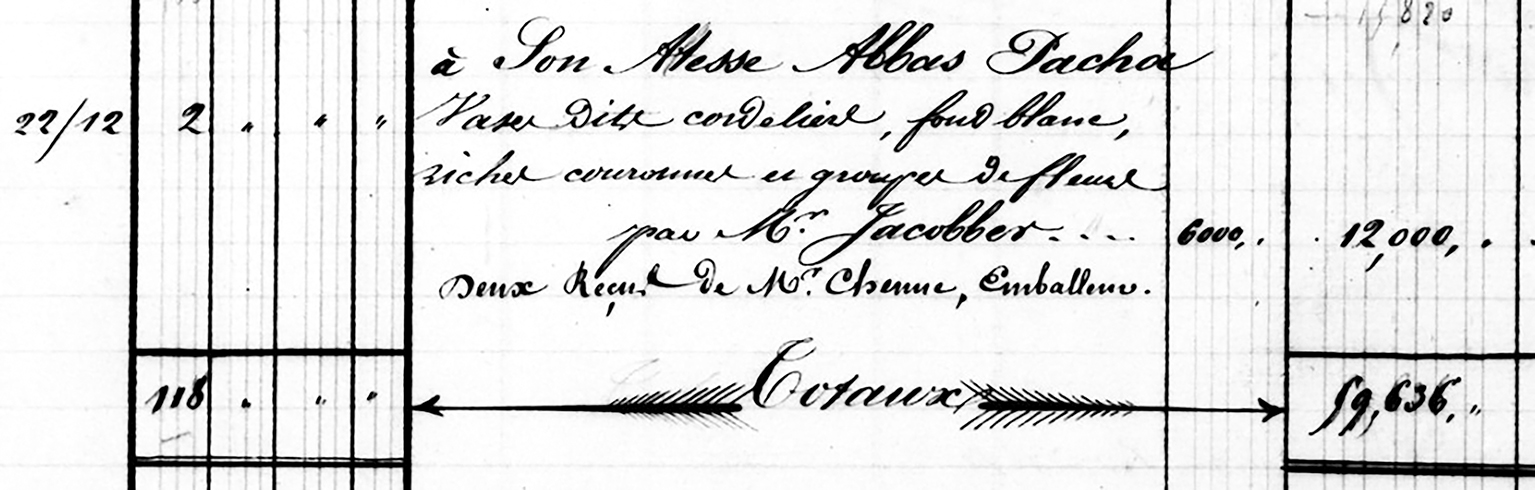
SOURCES: Archives of the Manufacture nationale de Sèvres, Vv 4, Registre des pièces entrées au magasin de vente, pièces décorées et sculptures, vitraux (par ordre pièces portées chronologique des pièces), 1843-1847, folio 22, n°. 12, sale price: 12,000 Francs per pair; Archives of the Manufacture nationale de Sèvres (MNS), Vbb 11, Registre des présents et ventes à crédit (date de livraison), 1845-1854, fol. 7, 24 December 1845.
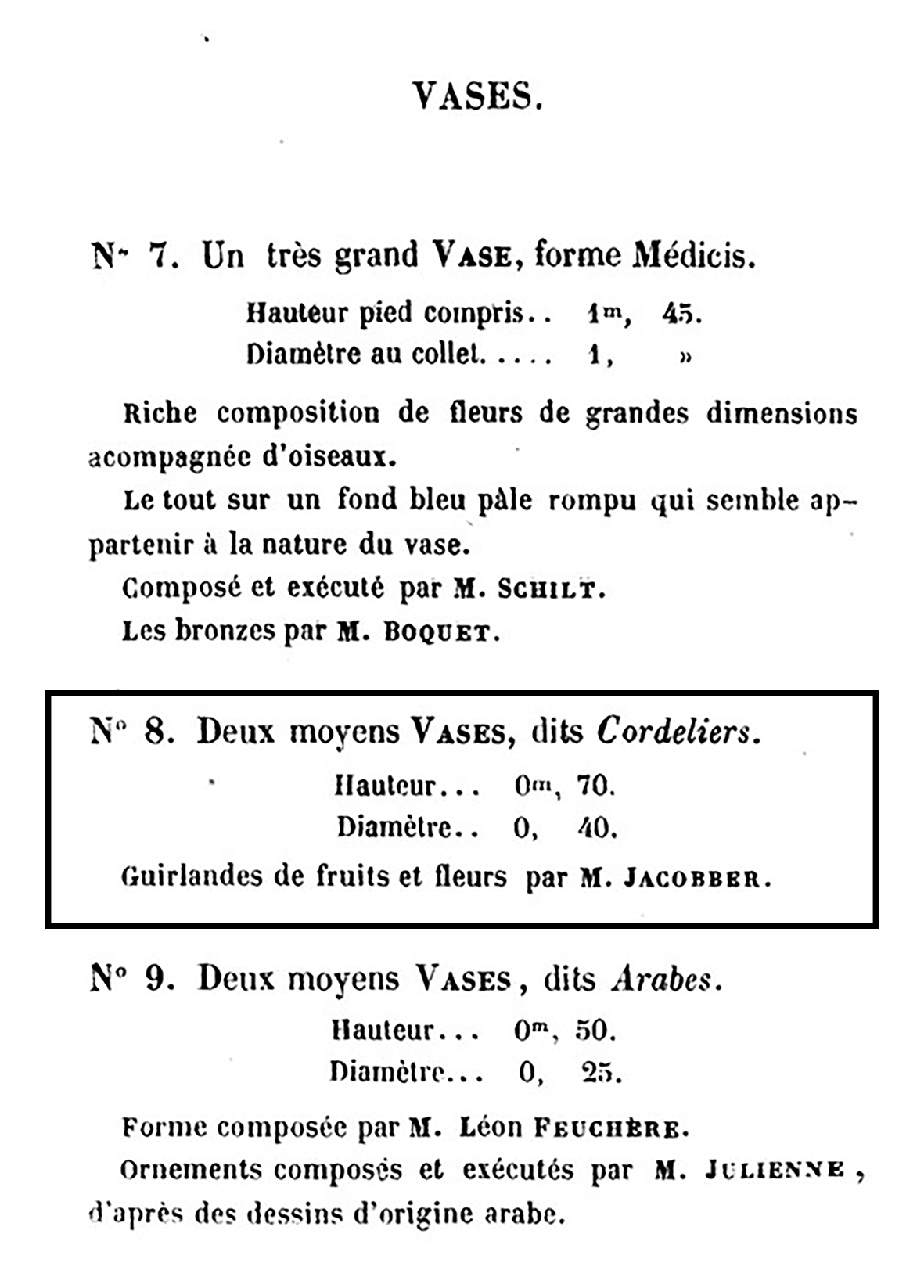
EXHIBITION: presented at the Exhibition of Royal Manufactories at the Louvre Palace, 3 June 1844, cat. n°. 8: “No. 8. Two medium-sized Vases, known as Cordeliers./ Height… 0.70 m./ Diameter… 0.40 m./Garlands of fruit and flowers by Mr Jacobber.”
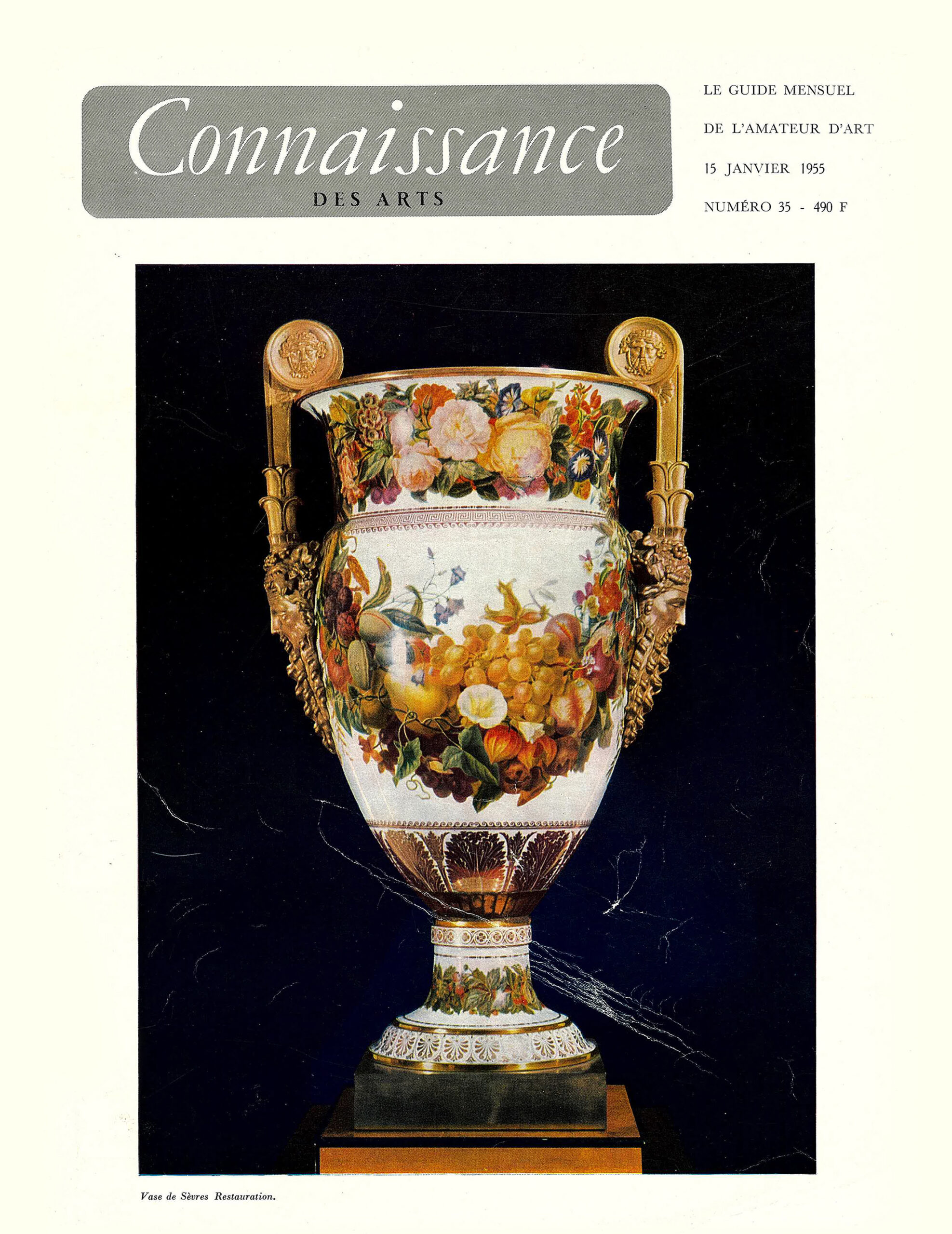
LITERATURE: Notice sur quelques unes des pièces qui entrent dans l’exposition des Manufactures royales de porcelaines et vitraux de Sèvres, de tapisseries et tapis des Gobelins, de tapisseries de Beauvais ; Faite au Palais du Louvre au 3 juin 1844, Paris, Vinchon, Son and Successor of Me Ve Ballard, printer to the Royal Museums, 1844, cat. n°. 8; “Les Sèvres Restauration”, Connaissance des Arts, n° 35, 15th January 1955, p. 50-55, repr. on the cover, with a caption that reads: “collection Jean Chélo, Paris”.d’une légende spécifiant : « collection Jean Chélo, Paris ».
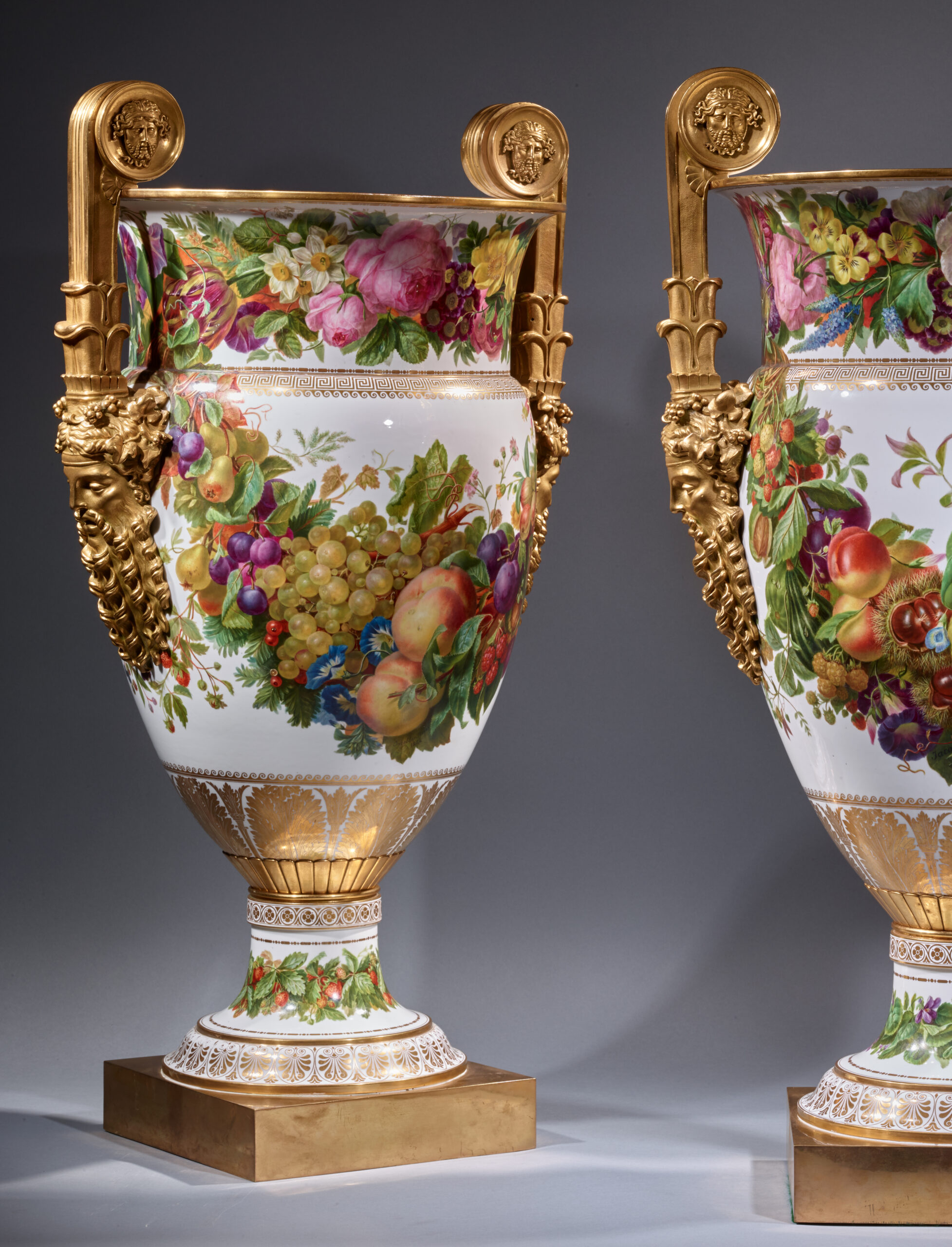
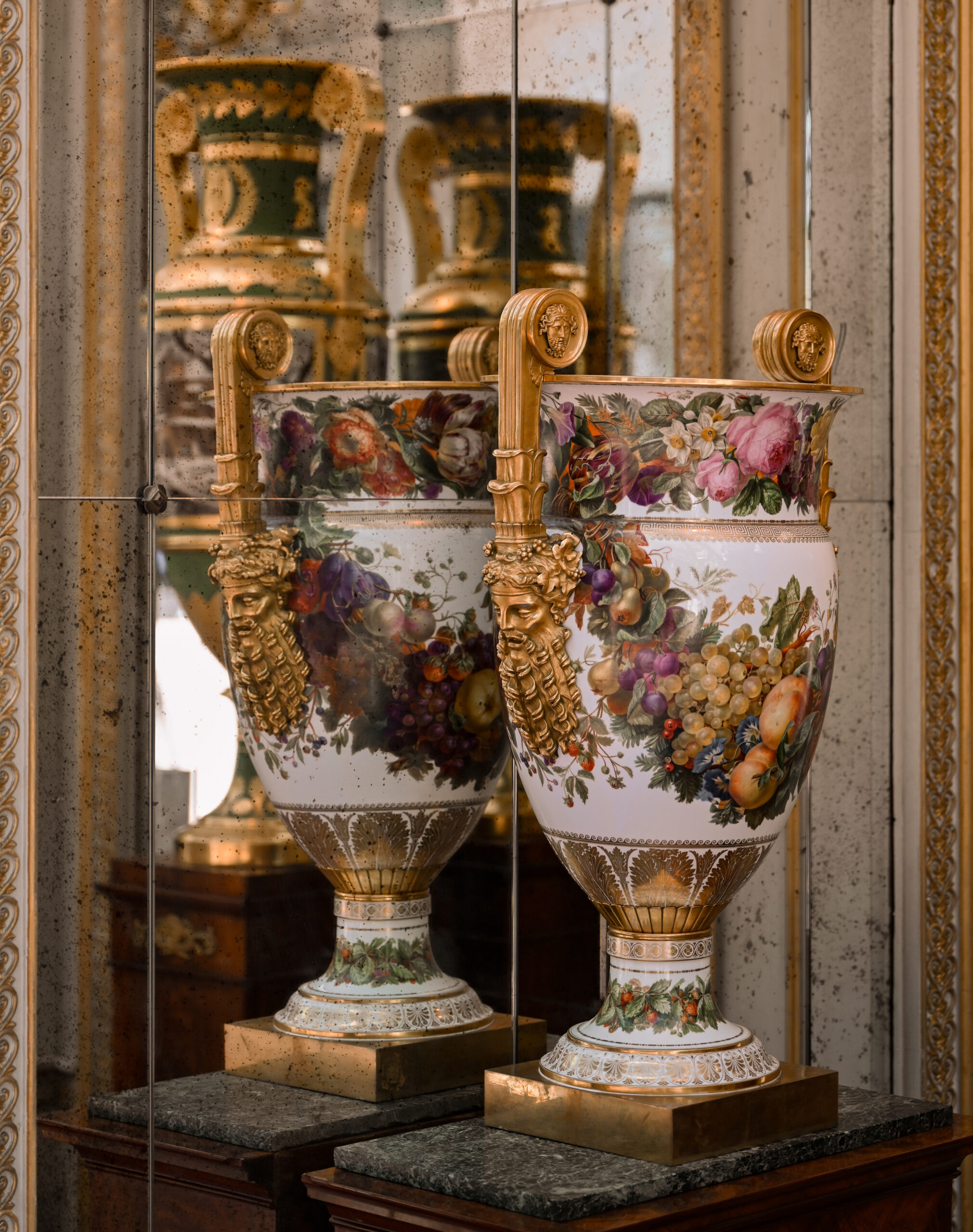
This magnificent pair of vases known as “Cordelier”, 3e grandeur (3rd size), adorned with lavish garlands of flowers and fruit painted by Moïse Jacobber, who signed and dated them, was entered in the Registre des pièces entrées au magasin de vente (Register of items received at the sales store) of the Royal Porcelain Manufactory of Sèvres on 28th May 1844: “Two Cordelier vases, 3rd size, white background and rich garlands of flowers and fruit by M. Jaccobber”.
A week later, on 3rd June, the vases, which had not yet been fitted with their bronze mounts, were exhibited at the Louvre Palace, under catalogue number 8, as part of the Exhibition of the Royal Manufactories of Porcelain and Stained Glass from Sèvres, Tapestries and Carpets from the Gobelins, and Tapestries from Beauvais: “N°. 8. Two medium-sized vases, known as Cordeliers./Height… 0.70 m./Diameter… 0.40 m./Garlands of fruit and flowers by Mr Jacobber”.
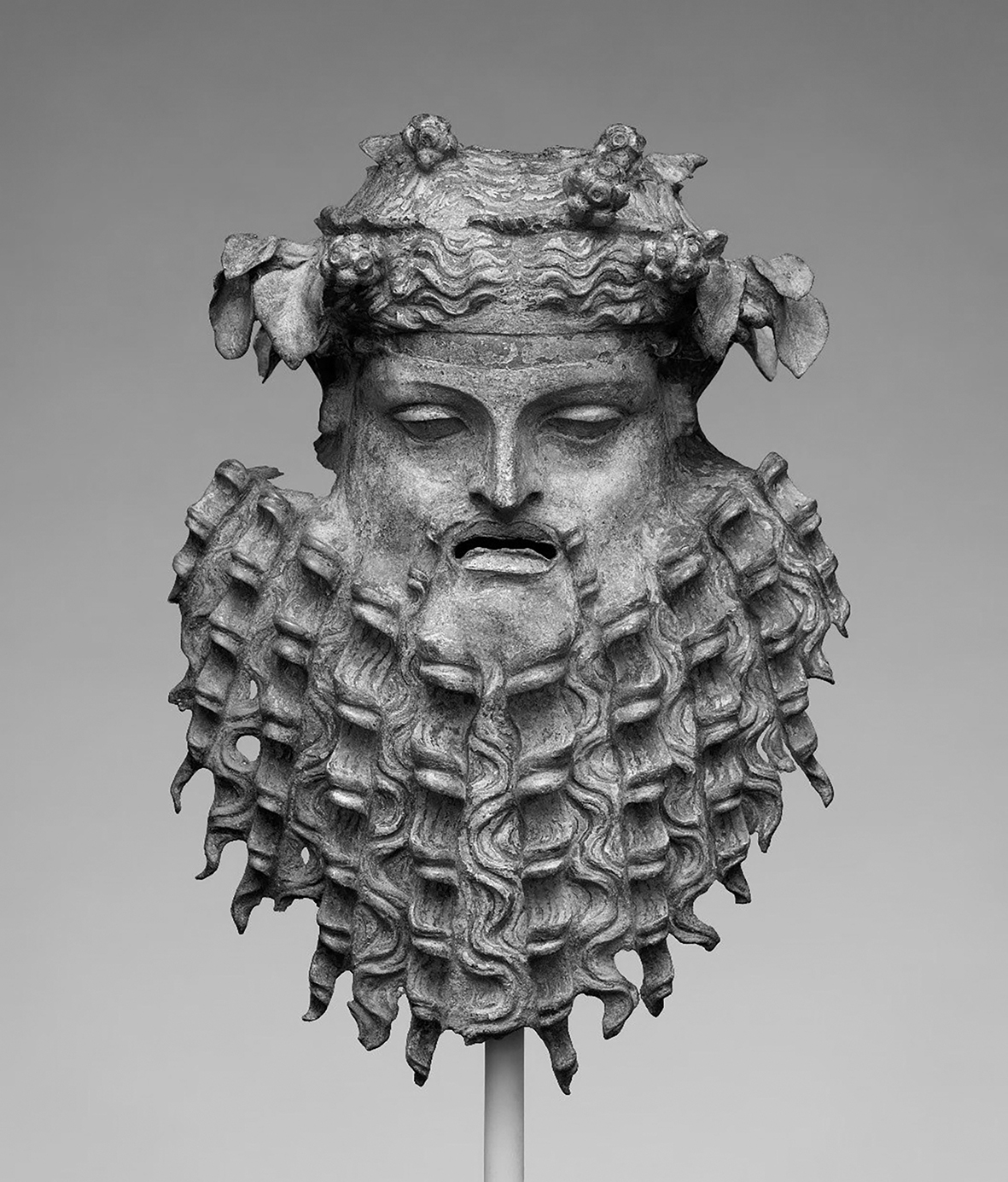
The shape referred to as “Cordelier” of these vases was created in the manufactory in 1805 and was often redesigned throughout the 19th century, in terms of both the profile and the handles, of which we have here, undisputedly, the most spectacular model, displaying two bronze masks of Dionysus or Silenus, which were drawn directly from those dating from Hellenistic or Roman times, and served as supports for the handles of certain situlae, from Latin situla, designating a cylindrical, bucket-shaped bronze container with a handle on the upper part and intended for carrying water or wine.
Examples of striking resemblances are now kept in several major public collections around the world.
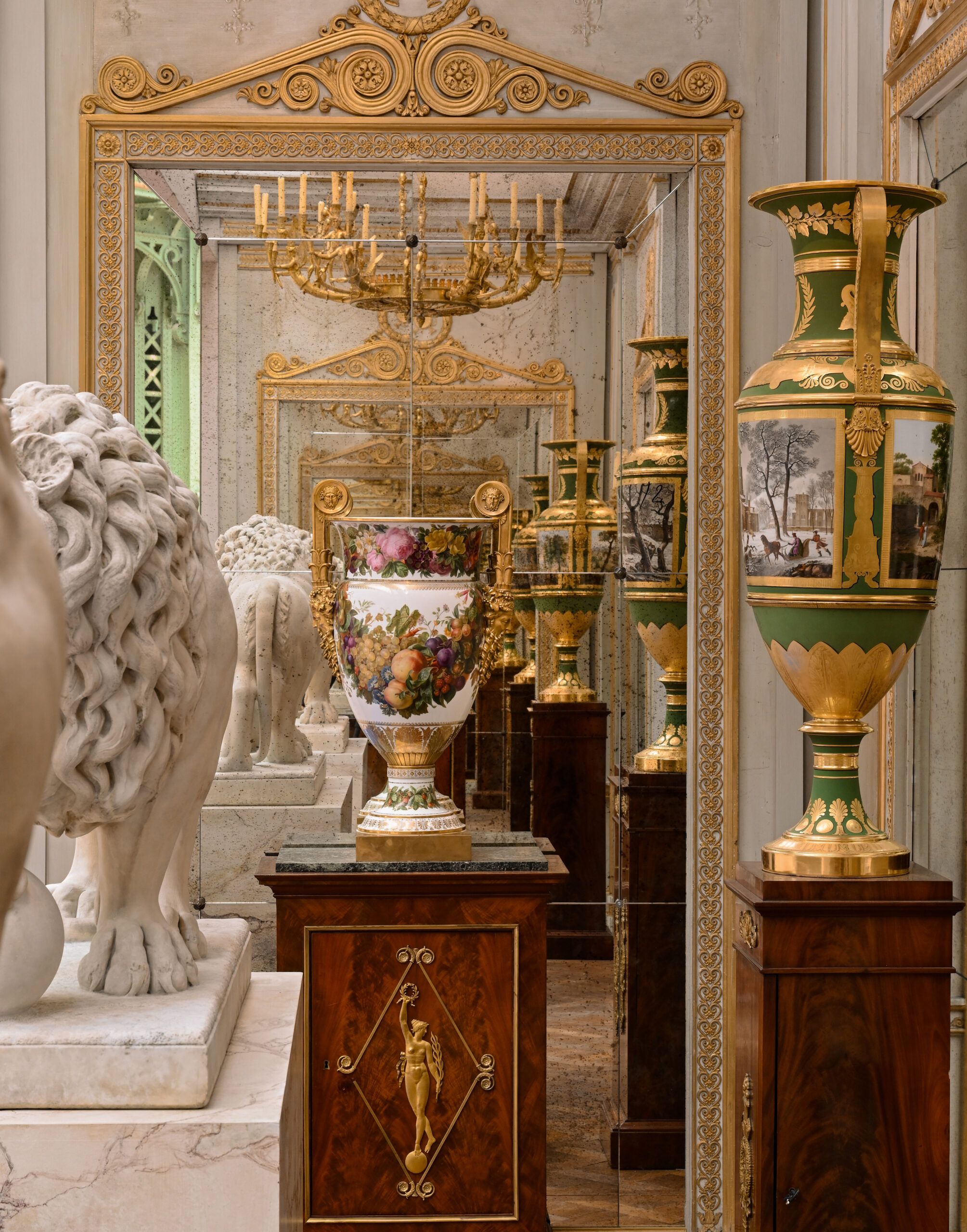
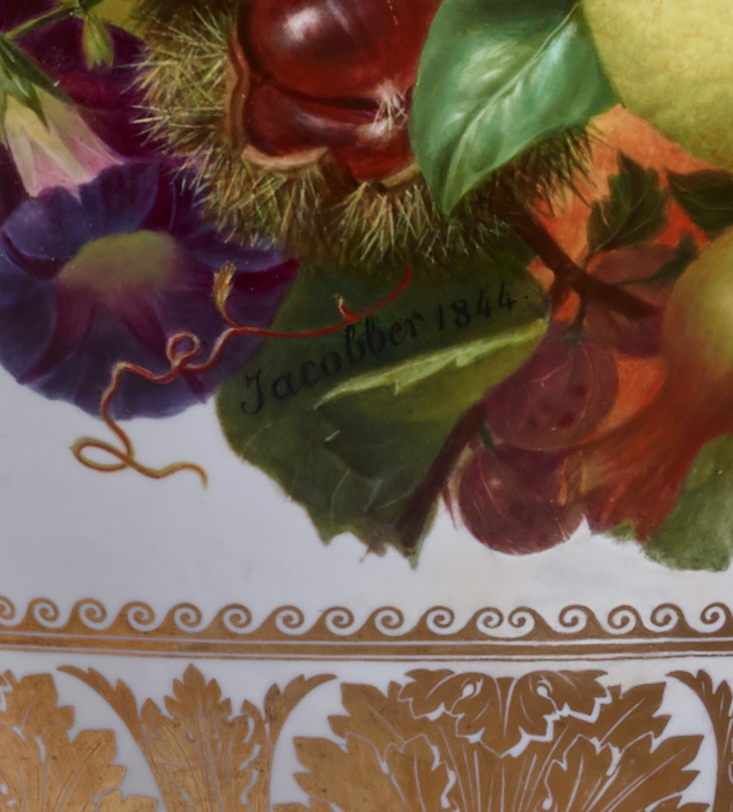
Most likely designed by Jean-Charles-François Leloy (1774–1846) or Alexandre-Evariste Fragonard (1780–1850), the two most fertile creators at the manufactory during that period, these handles with Dionysian motifs appear to be in perfect accordance with the lavish floral and fruit ornamentation executed by Jacobber. Active at Sèvres between 1814/1818 and 1848, Jacobber was one of the manufactory’s most talented painters of floral decoration. Trained by Cornelis van Spaendonck (1756-1839), who was briefly director of the Sèvres Manufactory from 1795 to 1800, Moïse Jacobber, whose real name was Jacob Ber, was born on 6th March 1786 in Blieskastel, in the Saarland region of Germany. After being naturalised as a French citizen, he moved to Paris, where he earned a great reputation for his oil paintings and watercolours depicting flowers and fruit. He was a regular exhibitor at the Salons from 1822 to 1855, as well as at exhibitions in Lille, Douai, Cambrai and London. He was wont to sign his works “Jacob-Ber”.
Several museums have preserved his works: in particular, the Ceramics Museum in Sèvres, which has two paintings on hard porcelain dated between 1834 and 1838, executed from works by Gérard van Spaendonck and Jan van Huysum; the Louvre Museum, which has two oil paintings on canvas and a third one on wood; the National Museum of the Palace of Fontainebleau, which has an oil on wood; and the Museum of Fine Arts in Rouen, which has been exhibiting two oil on copper paintings since 2008: a Still Life with Flowers and a Still Life with Fruit.
His daughter, Élisabeth Sidonie Jaccober, married name Worms, also worked at Sèvres as a floral artist from 1835 to 1839, and in 1840 was granted a lithographic patent, which enabled her to print her own designs. Moïse Jacobber died at his Paris residence at 25 Rue de Buffault on 16th July 1863.
Jaccober adorned two large vases similar to ours but with different bronze mounts, which were presented in 1833 by Louis-Philippe to Leopold I (1790–1852), Grand Duke of Baden from 1830 to 1852. Our vases, mounted in bronze between June 1844 and December 1845, were also presented as a diplomatic gift by the King; On 24th December 1845, he gave orders to the manufactory to deliver them to His Highness Abbas Pasha (1813-1854), grandson of Muhammad Ali (1769-1849), who was to become Viceroy of Egypt (Khedive) under the name Abbas I Hilmi less than three years later. On that occasion, our vases were invoiced to the Maison du Roi for the considerable sum of 12,000 francs, i.e. 6,000 francs each.
His Highness Abbas I Hilmi, known as Abbas Pasha, Viceroy of Egypt from 1848 to 1854
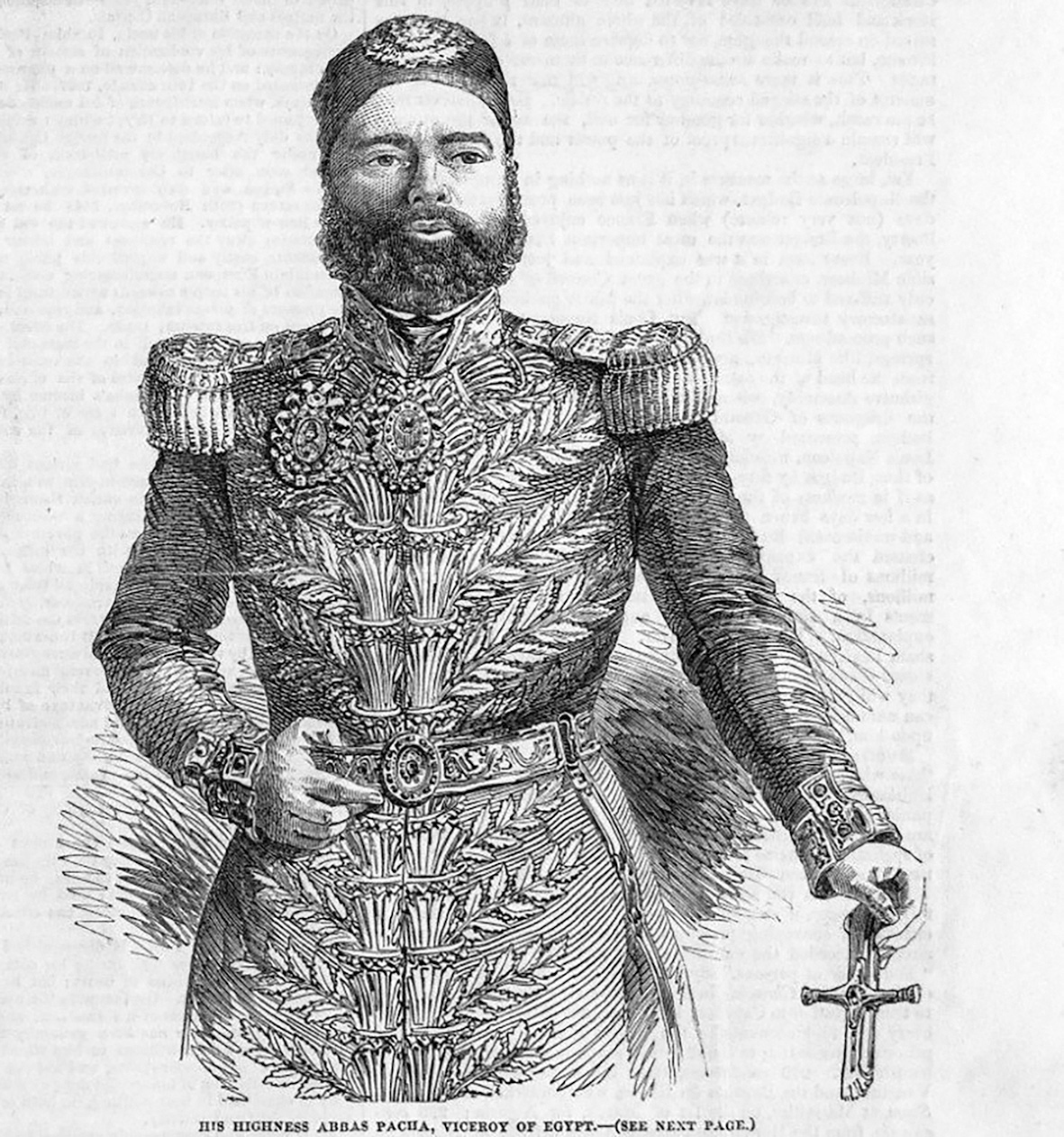
Abbas Pasha was born on 1st July 1813 in Jeddah, Saudi Arabia. He was the son of Tusun Pasha († 1816) and, most importantly, the grandson of Muhammad Ali (1769-1849), the founder of modern Egypt.
His grandfather entrusted him with administrative duties at an early age, namely as director of the Western Province, so that he might gain experience as a governor, then as inspector of the maritime regions (Delta), followed by inspector of all the diwans (ministries). Although he was appointed director of the Khedive’s diwan (Ministry of the Interior), he continued his inspections of the diwans in 1838 and in the same year was also appointed governor of the Khedive (viceroy).
In 1841, he took part in the wars of Cham or the Levant, fighting in Syria under the orders of his uncle, the famous Ibrahim Pasha (1789-1848), and seven years later, thanks to the intercession of the British, he succeeded him on 24th November 1848, thereby becoming the new Khedive (Viceroy) of Egypt. He inherited the title of Pasha upon the death of Muhammad Ali on 2nd August 1849.
During his reign, most of the national reforms for modernization implemented by his grandfather were rolled back. A devout Muslim, Abbas I pursued a policy hostile to Westerners. He expelled the European advisers, abolished trade monopolies, closed down factories and schools, and scaled back the Egyptian army to a more modest force; he opposed the Suez Canal project, but allowed the British to build the railway line between Cairo and Alexandria. He established closer ties with the Sultan of the Ottoman Empire, providing him with support during the Crimean War by dispatching his fleet and an army of 15,000 men.
Abbas Pasha built several palaces during his reign, known as “Saray Al-Abbasiya”, “Qasr Banha”, “Saray Al-Helmeya” and “Saray Al-Ataba Al-khadra”. He encouraged the famous French Egyptologist Auguste Mariette (1821-1881) in his excavation missions and attempts at shedding light on the history of ancient Egypt. Perceived as a sombre, reactionary and taciturn man who rarely left his residences, he was eventually murdered on 13th July 1854 in his palace of Banha, near Cairo, by two of his slaves. He was succeeded by his uncle Said Pasha (1822-1863).

