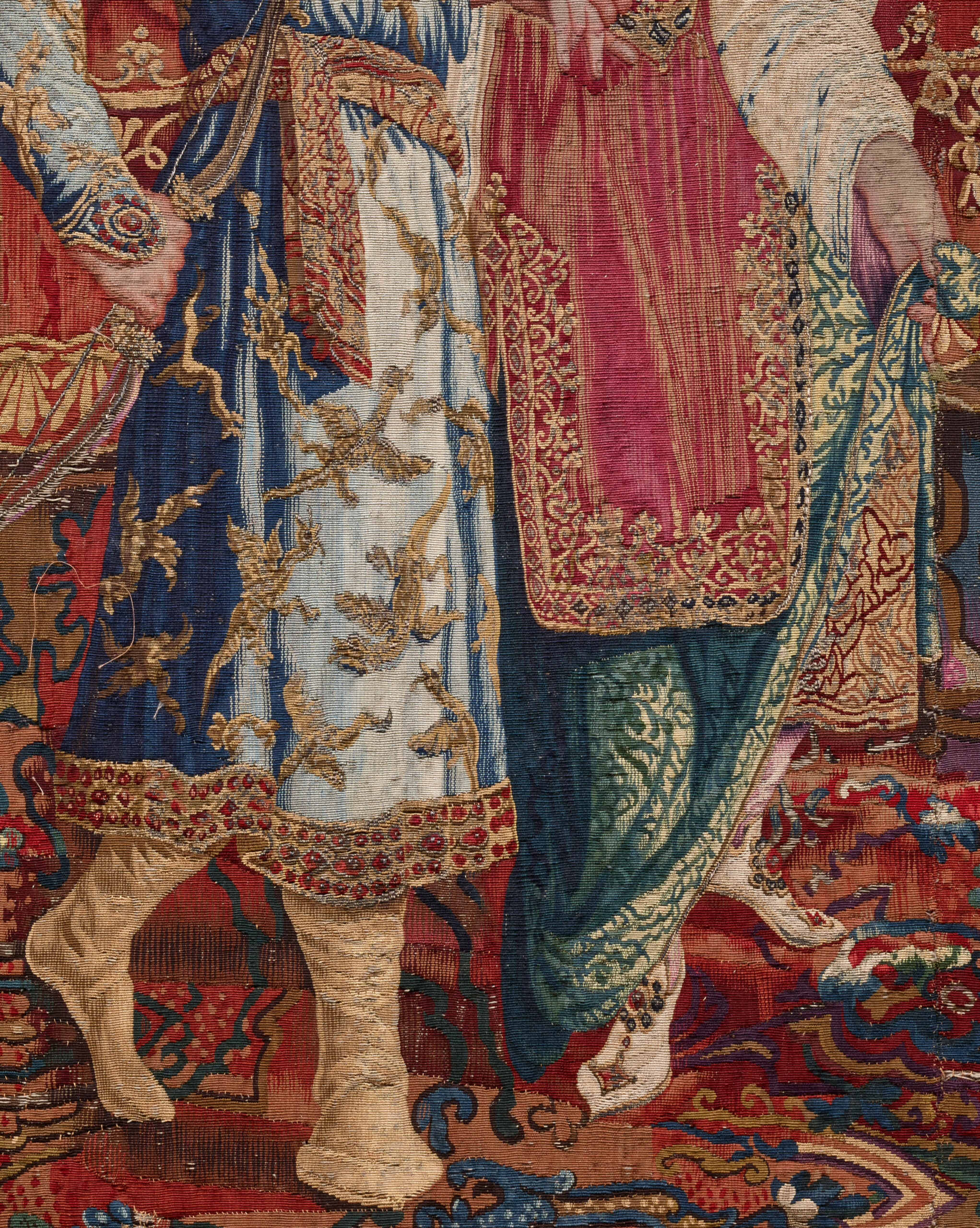
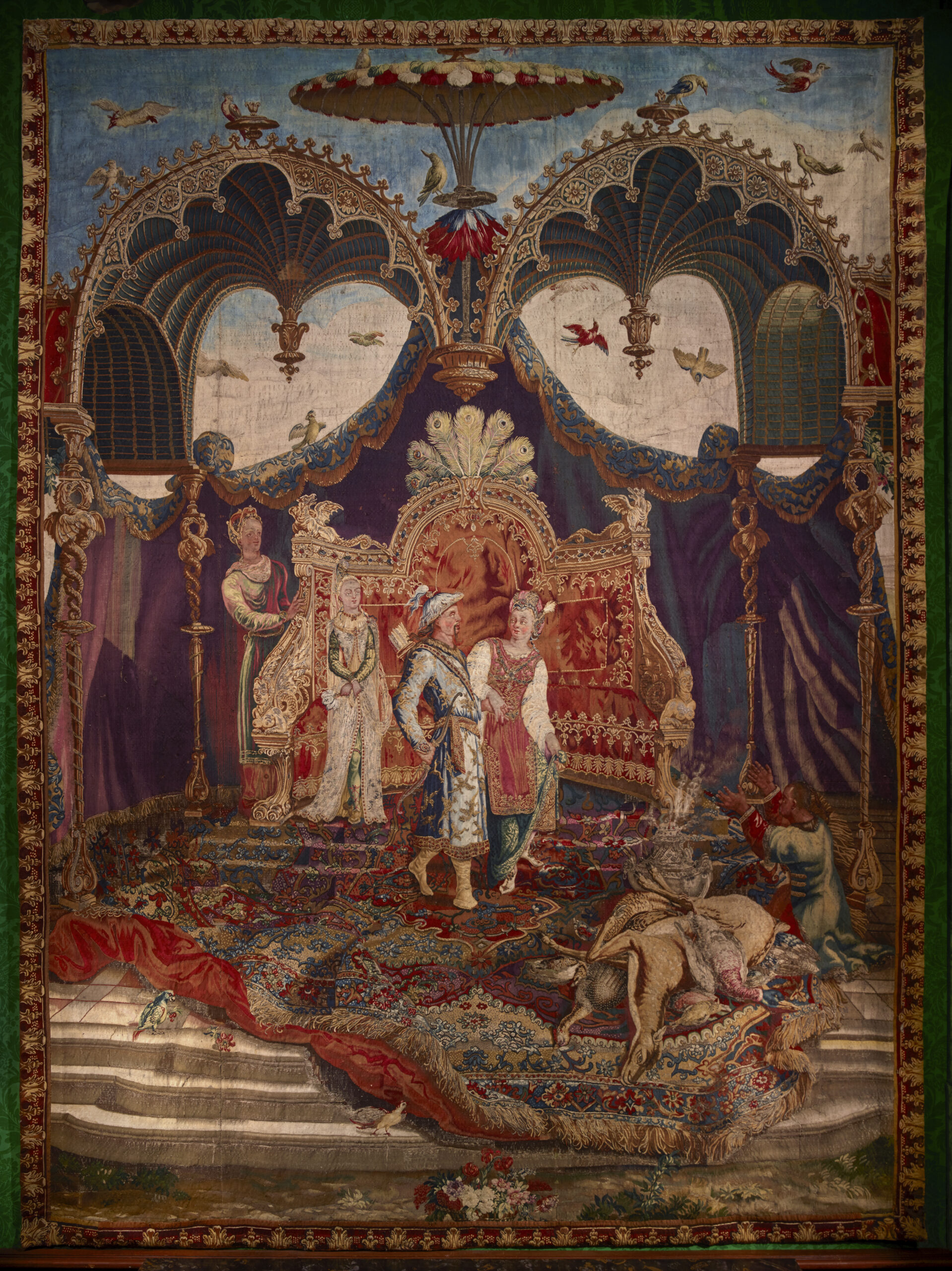
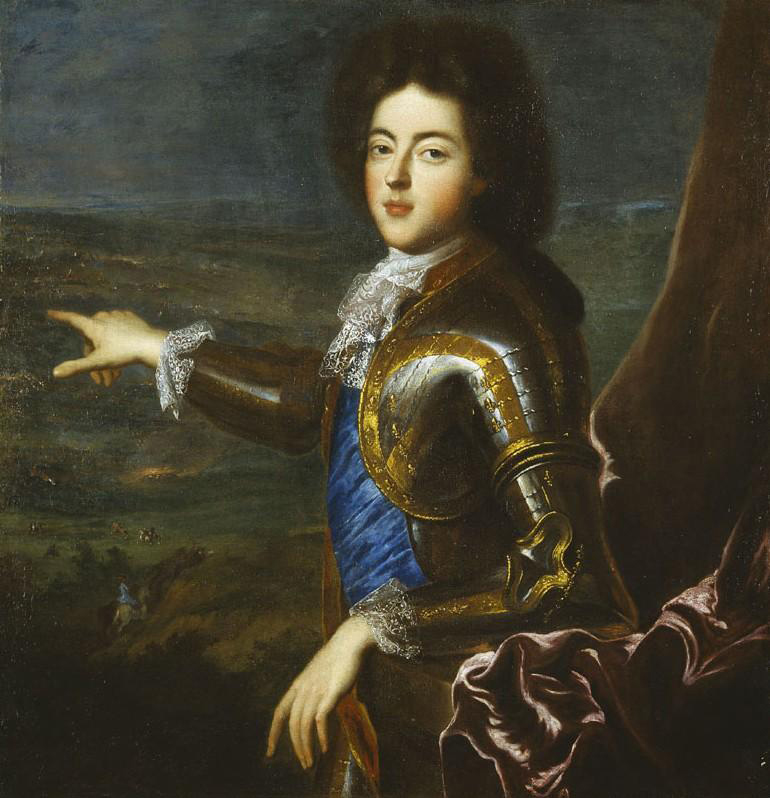
Possibly the first example, now considered lost, woven with gold and silver wefts between 1685 and 1700 under the supervision of Philippe Béhagle (1641–1705), on behalf of Louis Auguste de Bourbon (1670–1736), Duke of Maine, the son of Louis XIV and the Marquise of Montespan, who was legitimised in December 1673.
Wool and silk tapestry, enhanced with gold and silver wefts (with turned‑in and folded sections, and seams).
H. 359 cm. (141 ½ in.); W. 267 cm. (105 in.).
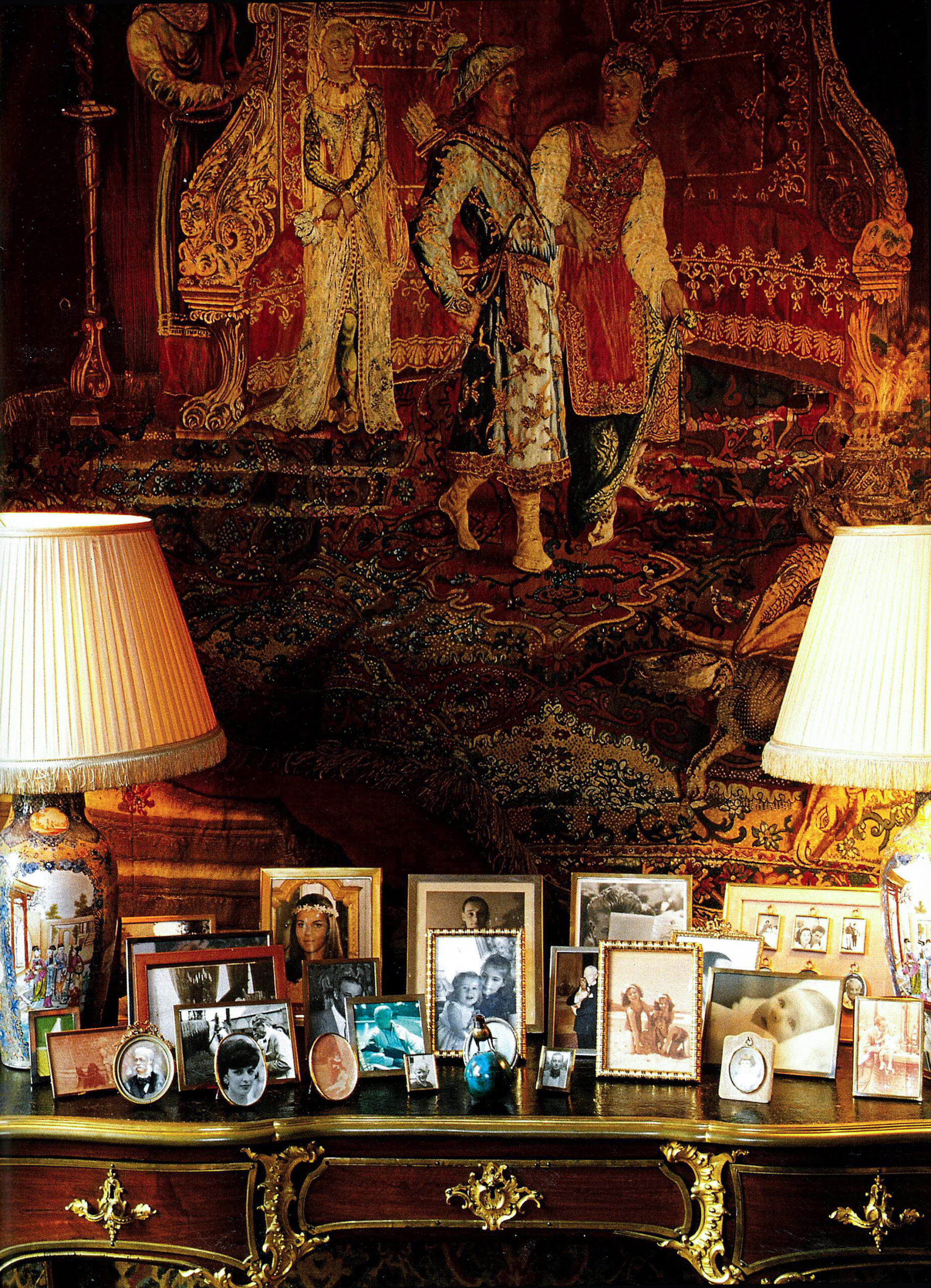
PROVENANCE: former collection of Baron and Baroness Guy de Rothschild at the Hôtel Lambert in Paris.
The First Chinese Hanging
The tapestry ensemble from the Beauvais manufactory, commonly referred to as La Première tenture chinoise (The First Chinese Hanging), is so named because there is a second, woven a few years later after designs by the painter François Boucher (1703–1770).
The first tenture appears in archival sources either under the generic heading Chinoise (Chinese) or under the title Story of the King of China, which echoes earlier commemorative cycles, painted or woven, depicting heroes from antiquity or from more recent times. But unlike these later Histories, which depict the noble deeds of Alexander, Scipio, Constantine and Louis XIV, no specific historical events can be discerned here. The Story of the Emperor of China offers instead a general account of the most significant activities in the life of a Chinese emperor. The various pieces in the tenture depict ceremonies and festivities at the imperial court, as well as activities related to the sciences and the arts.
Although some scholars have identified the figures as the emperors Shunzhi (1638–1661) of the Qing dynasty and his son Kangxi (1654–1722), both contemporaries of Louis XIV, the narrative dispenses with chronology altogether: The Audience of the Emperor, The Emperor on a Journey, The Collation, The Empress’s Tea, The Emperor Sailing, The Empress Sailing, The Return from the Hunt, The Astronomers and The Harvesting of Pineapples. Most of all, they attest to the fascination that the Far East exerted on Europe. They bear witness to how Chinese culture was perceived and assimilated in France at the end of the seventeenth century. The Duke of Maine, the legitimised son of Louis XIV, had a particular interest in it.
In 1685, Louis XIV sent a delegation of French Jesuits to China, headed by Father Jean de Fontenay (1643–1710) and consisting of the mathematicians and astronomers Guy de Tachard (1648–1712), Jean François Gerbillon (1654–1707), Louis Le Comte (1655–1728), Joachim Bouvet (1656–1730) and Claude de Visdelou (1656–1737), with the aim of propagating the Christian faith and, in return, introducing Southeast Asian civilisation to Europe. The king presented them with expensive scientific instruments, and the Duke of Maine, Louis XIV’s legitimised son, then aged fifteen, also donated an astronomical instrument that he had commissioned for his own use.
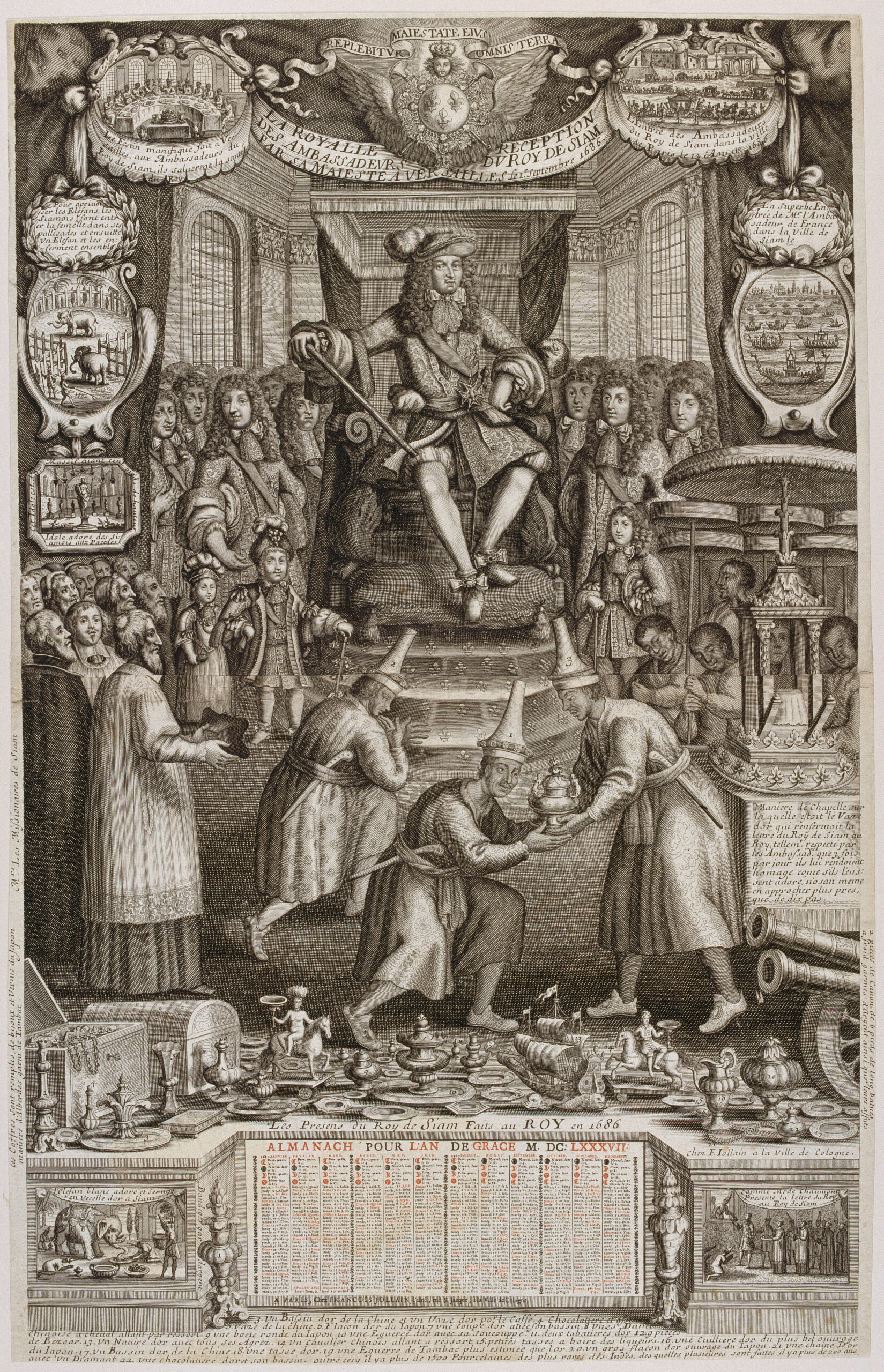
In September 1686, a delegation of ambassadors from Siam (present-day Thailand) was received at Versailles in sumptuous surroundings, with silver furniture installed in the Grande Galerie of the palace (fig. 2). The Duke of Maine was present at this reception.
Knowledge of distant worlds was widely disseminated through the publication of travel accounts. The most famous are The Embassy of the United Provinces to the Emperor of China by explorer Jan Nieuhof (1666) and China Illustrata by Jesuit Athanasius Kircher (1670).
The missionaries sent to China in 1685 extended this work of disseminating Chinese knowledge and thought. Father Le Comte, who had returned in 1691, published letters describing his travels in the Mercure galant before writing his Nouveaux mémoires sur l’état présent de la Chine (New Memoirs on the Present State of China), which appeared in 1696.
In 1700, he published a Lettre à Monseigneur le duc du Maine sur les cérémonies de la Chine (Letter to Monseigneur the Duke of Maine on the Ceremonies of China), which addressed Chinese religion and the role of the Society of Jesus in Asia. This issue was widely debated among Jesuits and Western scholars: Were Chinese festivals and ceremonies religious or secular in nature? Could Christians participate in them?
The Duke of Maine was thus particularly well-informed about Chinese rites and beliefs. It is also known that his wife, Anne Louise Bénédicte de Bourbon (1676–1753), Duchess of Maine, sought out Chinese objects and curiosities, assembling them in a cabinet in her Parisian townhouse. This helps us understand why the Duke of Maine acquired the first edition of the Tenture chinoise (Chinese tapestry set) woven at the Beauvais tapestry manufactory.
This first series was particularly precious, enhanced with gold and silver wefts—a feature of exceptional rarity.
Gobelins tapestries, woven mostly for the king, came in two qualities: the richest embellished with gold and silver wefts, the others made solely of wool and silk. Beauvais tapestries, however—destined for the king’s inner circle and powerful foreign princes sympathetic to France—were very rarely adorned with precious metal wefts. Among the twenty or so known editions of the First Chinese Hanging, only two are known to have been woven with gold and silver wefts: that of the Duke of Maine, known until now only from written accounts, and another woven for François Louis of Palatinate-Neuburg (1664-1732), then Prince-Elector of Trier (1716-1729).
According to an undated memorandum, datable to around 1700, by Philippe Behagle (1641–1705), tapestry maker and director of the Beauvais manufactory, the Duke of Maine’s edition was in gold and measured three and a half aunes (ells) in height by approximately twenty-one aunes in length (4.20 m × 2.52 m).
It was sold by a certain Mr. d’Isrode, an intermediary, for 20,000 Livres. By way of comparison, the suite woven shortly afterward for Louis Alexandre de Bourbon (1678–1737), Count of Toulouse—another legitimized son of Louis XIV—consisting of ten pieces in wool and silk, cost 10,565 Livres, i.e. half as much. (Six pieces are in the J. Paul Getty Museum, two in the Château of Compiègne, and one in a private collection.) The Duke of Maine’s tapestries are subsequently mentioned in his post-mortem inventory: three gold pieces were at the Hôtel du Maine, on Rue Bourbon, and six others in wool and silk only at the Château of Sceaux. The suite then passed to his wife, the Duchess of Maine, before all trace of it was lost.
The second gold and silver suite belonged to the Prince-Elector of Trier, who had acquired it from the Filleul brothers, directors of the Beauvais tapestry manufactory from 1711 to 1722. It appears on a list of tapestries sold in Germany in 1719.
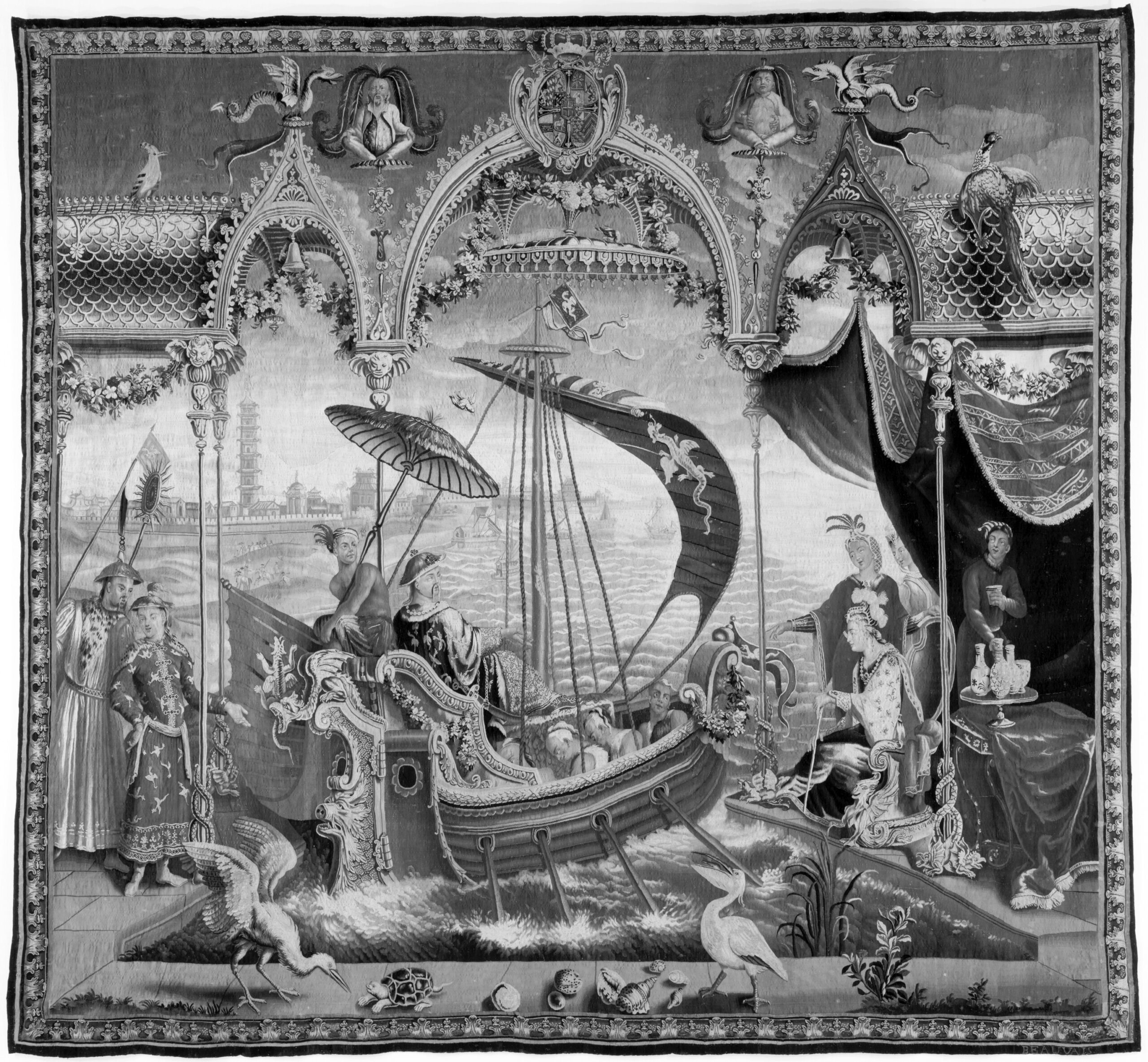
This ensemble comprised at least three tapestries with metal wefts bearing his coat of arms, The Emperor Sailing from the Art Institute of Chicago (fig. 3), and two pieces still in private hands, The Audience of the Emperor and The Emperor on a Journey.
The Return from the Hunt
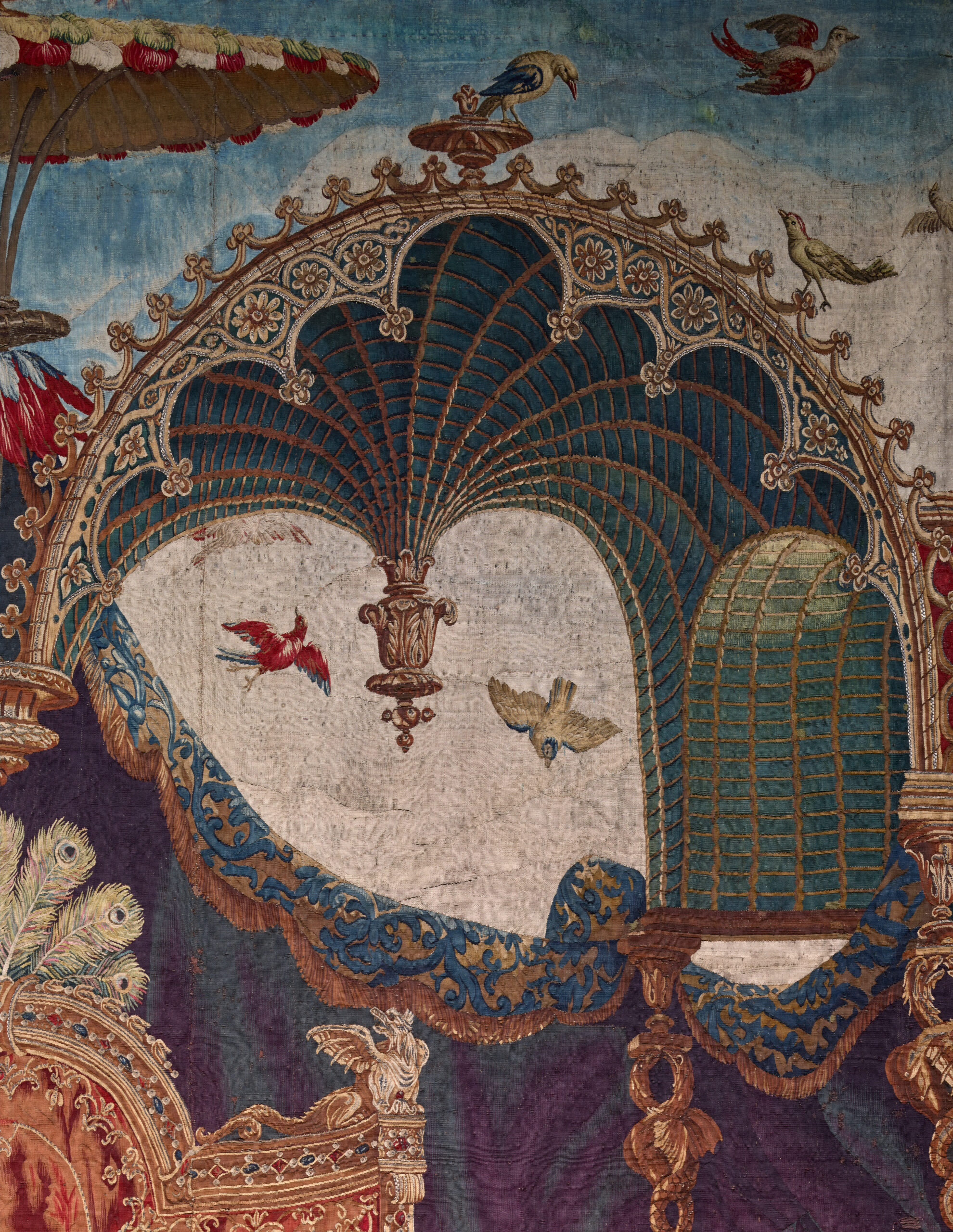
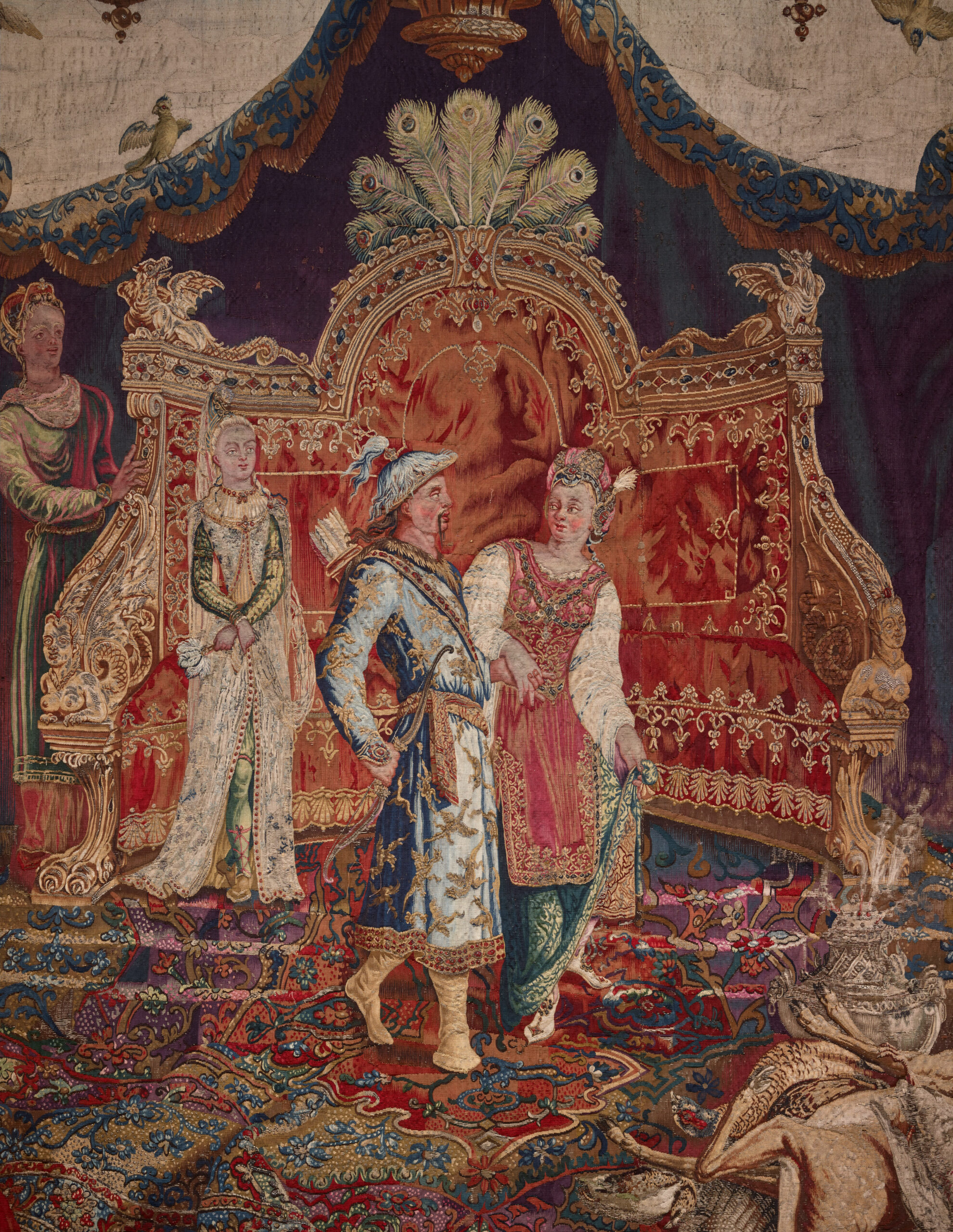
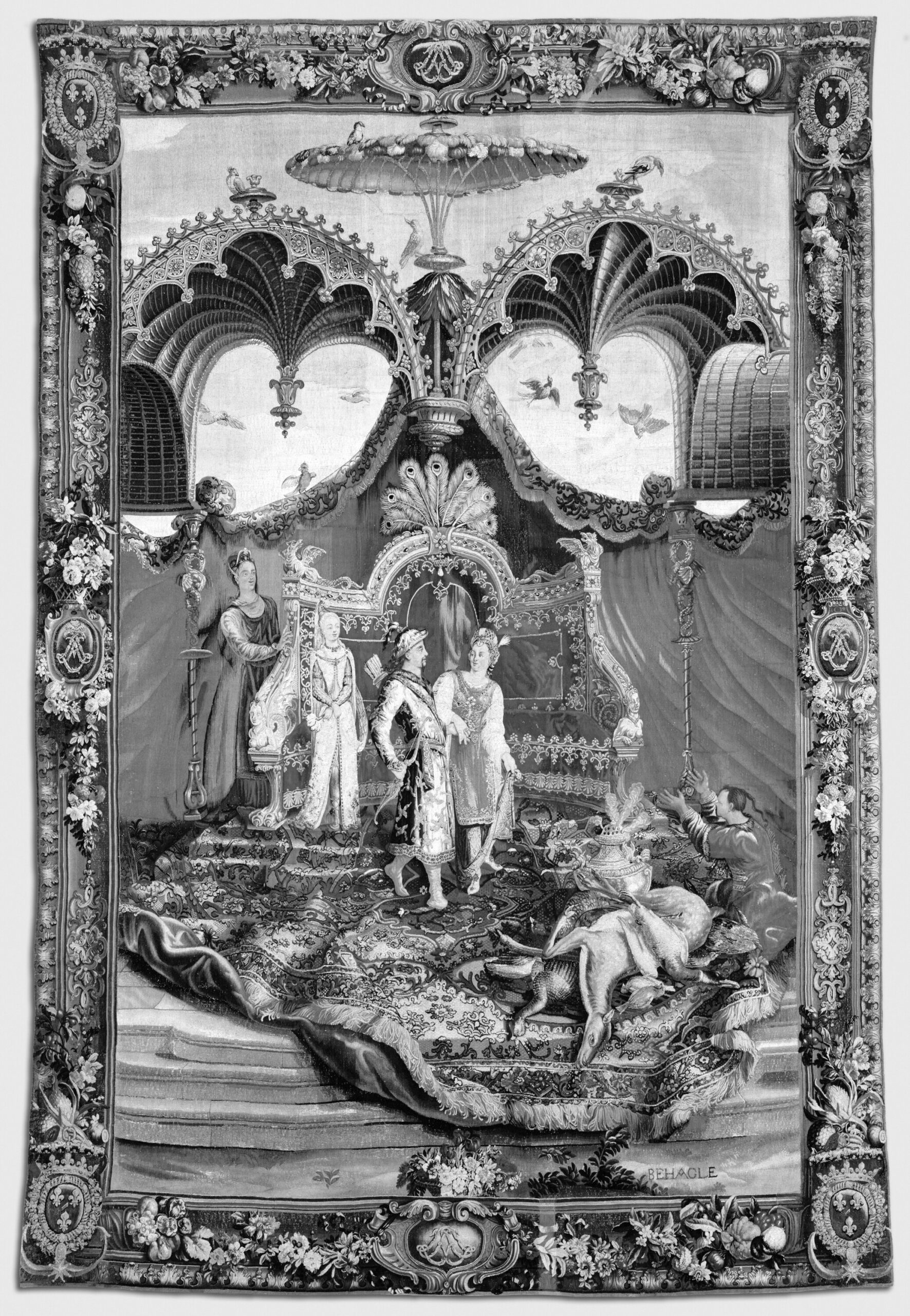
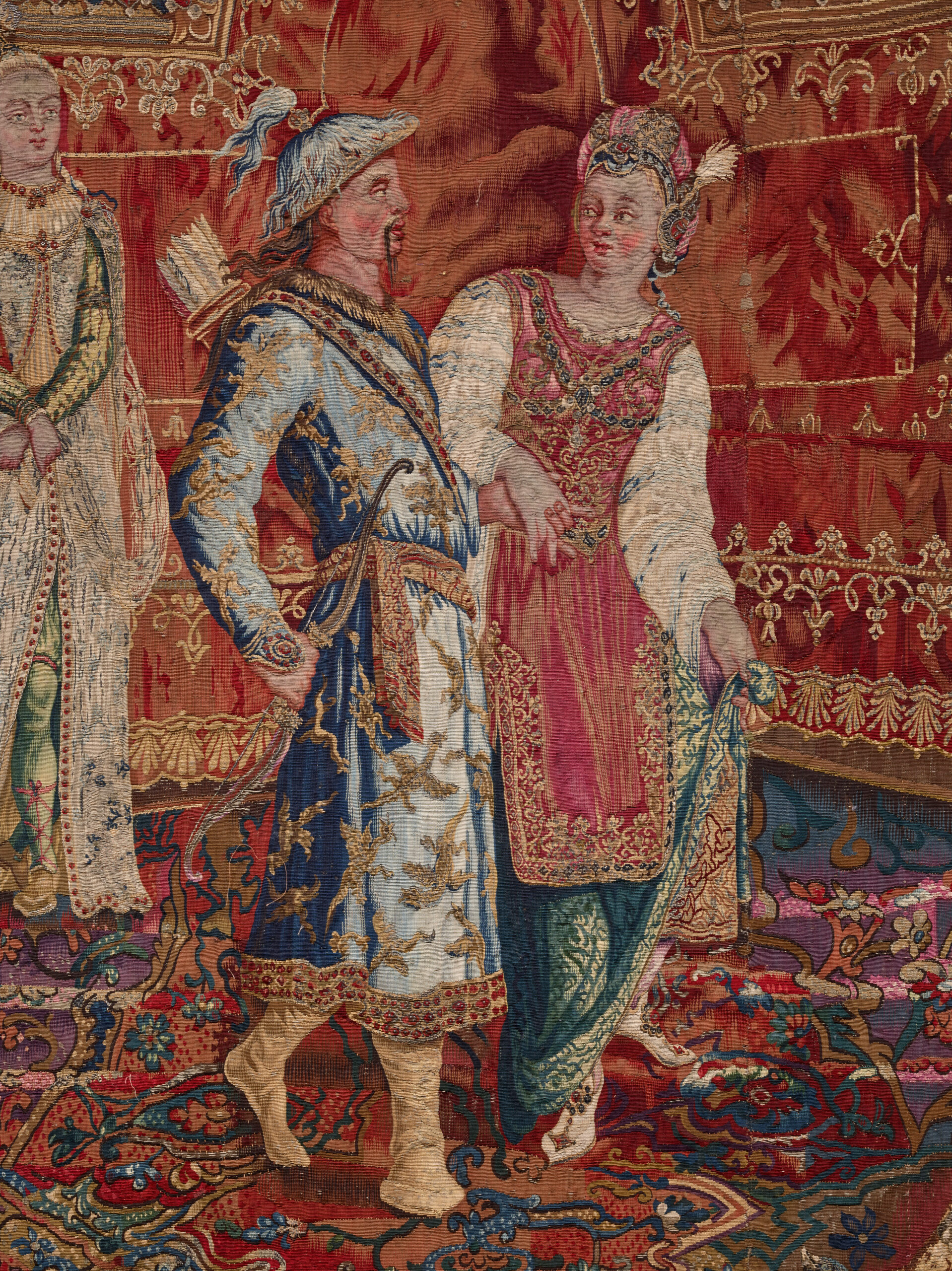
This tapestry is in vertical format. The scene unfolds beneath a vast pavilion that is not even remotely exotic, appearing instead as a compromise between Gothic style and Mughal aesthetics. It depicts the Emperor of China, armed with bow and quiver on his return from the hunt, holding the Empress by the hand as he guides her down the steps of a sumptuous, richly decorated monumental throne.
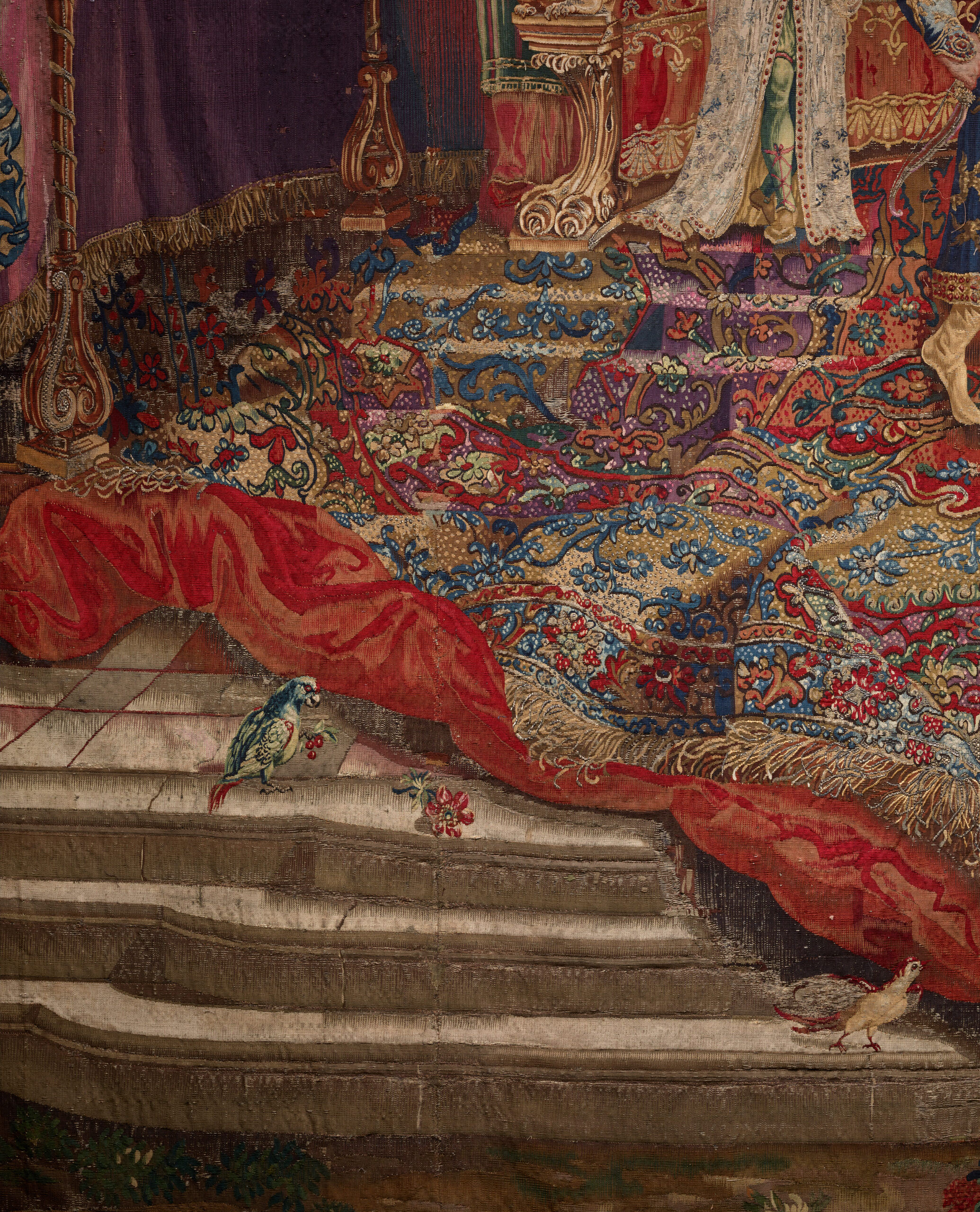
They advance toward an incense burner and a hunting trophy—a doe and birds—placed on a large Middle Eastern carpet.
The scene reprises the central portion of a larger composition known from a few woven examples, one belonging to the City of Paris collections (fig. 4). Two wings have been added to the central pavilion, serving a purely ornamental role: a camel at left and an exotic fruit still life at right.
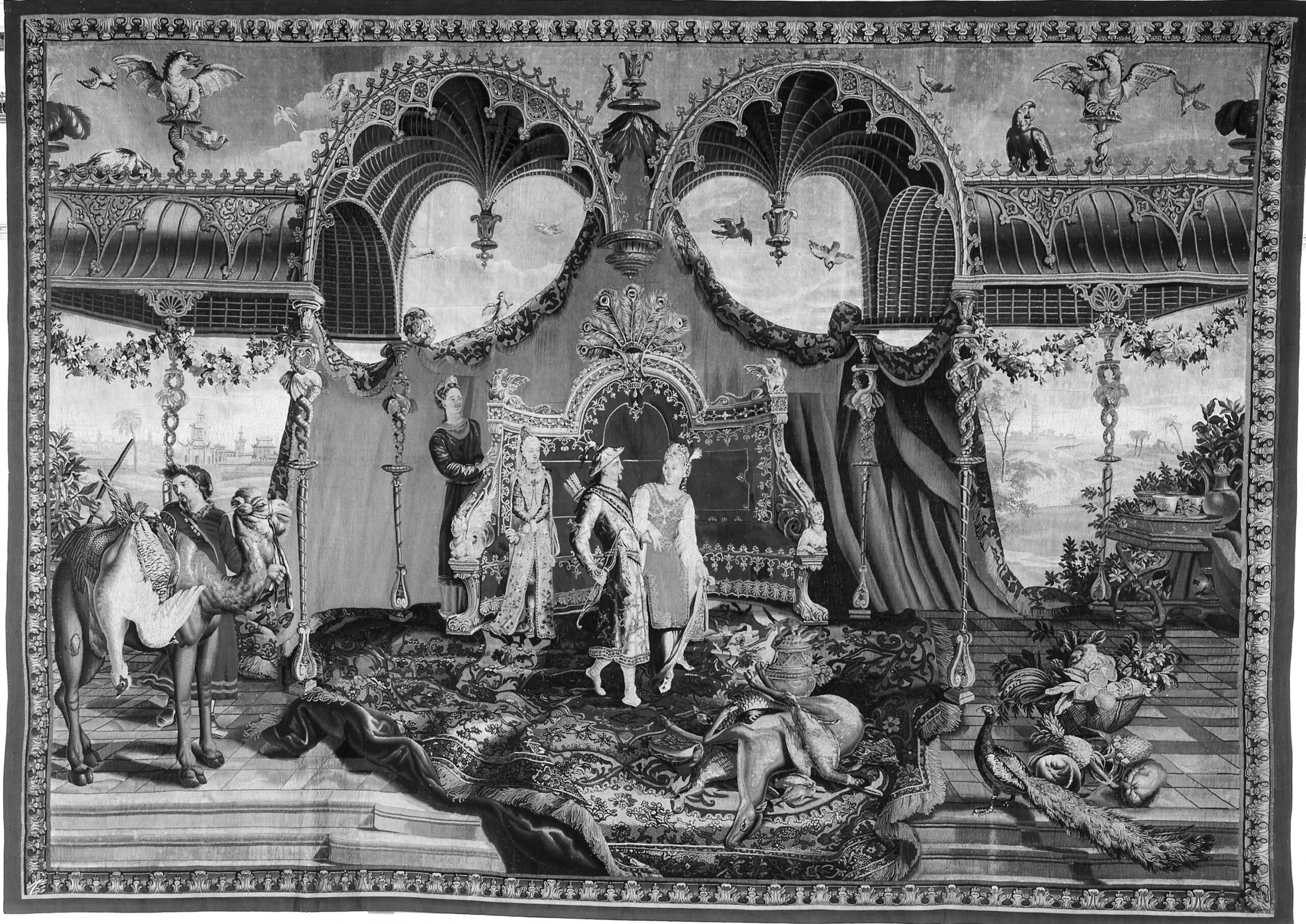
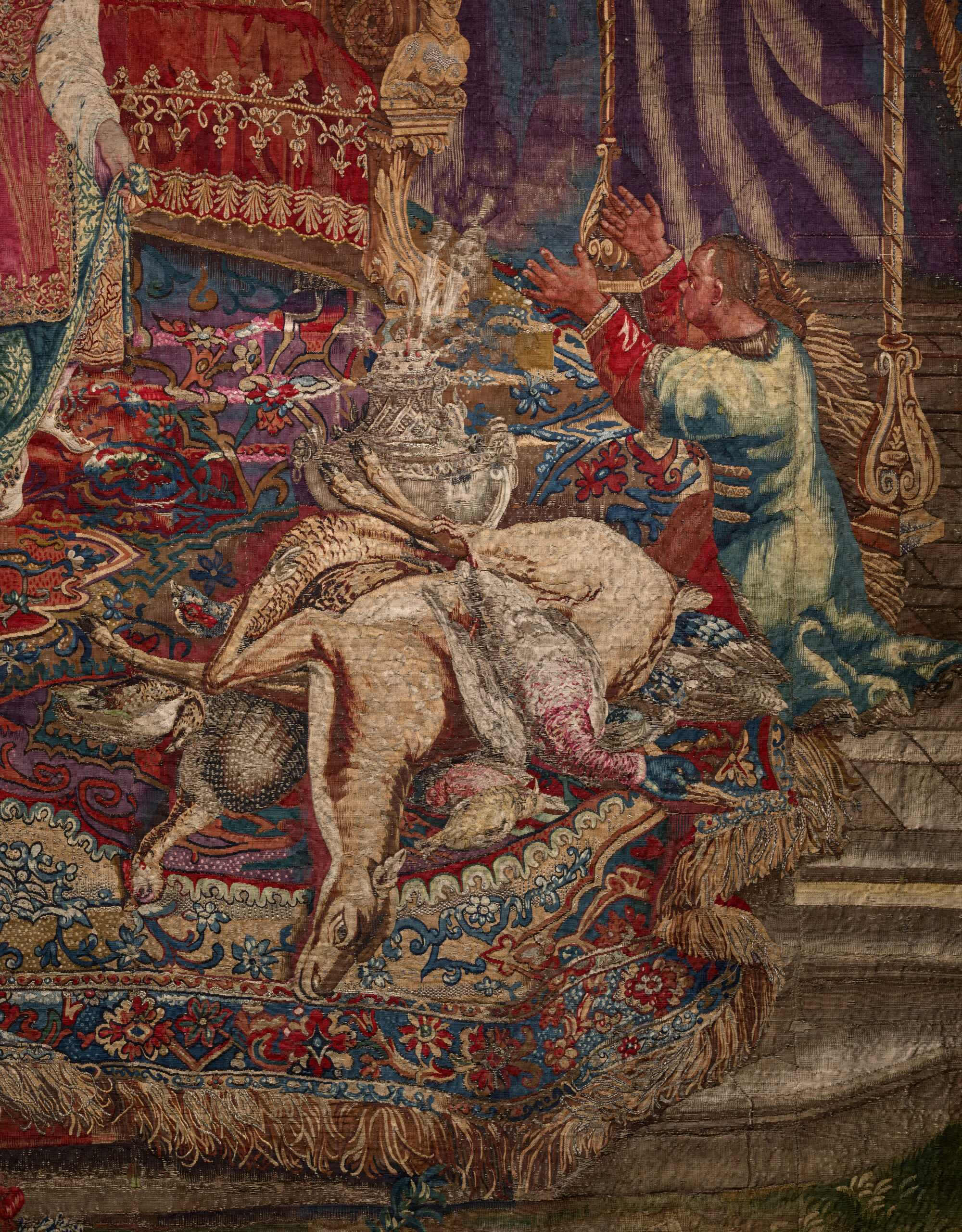
The composition as a whole is a repetition of another composition from the tenture, that of The Audience of the Emperor. It features the vast pavilion with its vaults with hanging keystones, summit parasol of ostrich feathers and two lateral wings. The same sumptuous throne is also to be seen, with its peacock feather ornaments, sphinxes and carved dragons. The main difference lies in the left side, where the princess in her rickshaw has been replaced by a dromedary; the right-hand scene remains identical. Minor variations occur between editions, such as the omission of the peacock on the foreground steps or the kneeling servant beside the incense burner, arms raised in prostration before the Emperor.
The fact that a composition was reprised is not surprising, especially when a piece was popular, such as The Audience of the Emperor, which is one of the most frequently woven tapestries in the series (at least twenty-five examples have been recorded). The principle of composition allowed for great flexibility of choice, multiplying the possible combinations.
However, these observations require clarification. How should we interpret the reprise of the overall composition and the vertical format? The tenture comprises nine subjects. Later editions, woven in the 1720s and 1730s, consist of only six pieces: from widest to narrowest, The Audience of the Emperor, The Emperor on a Journey, The Astronomers, The Collation, The Harvesting of Pineapples, and The Empress’s Tea. The three unwoven subjects are The Return from the Hunt, whose composition is a variant of The Audience, and The Emperor Sailing and The Empress Sailing—two tapestries sharing the same compositional principle: beneath a pavilion, a ceremonial boat carrying the Emperor and Empress departs from a jetty as imperial family members standing on the quay watch their departure.
Do these last three compositions suggest urgency in executing the cartoons, given the various reprises recorded? This seems plausible enough, since minor stylistic differences have been noted with the other six tapestries.
As for whether the tapestry in question was woven in this format, limited to the central part of the cartoon, or whether it was executed at full width and subsequently reduced, there is no telling. The ensemble of the Count of Toulouse includes a tapestry of The Return from the Hunt similarly limited to the central portion (fig. 5). Worthy of note, exception made for the borders, is that the dimensions of the field of the tapestry under examination are practically identical to those of the Count of Toulouse’s suite. Might the Count of Toulouse have adopted the format previously used by his brother, the Duke of Maine?
Note also that the narrow acanthus leaf border is applied, though it may be a remnant of the original wider frame that included cartouches, such as those with the Count of Toulouse’s coat of arms and cipher, or like those in the Chinese border used for certain weavings of the First Chinese Hanging and for tapestries in the Grotesques series, to which we shall return. The cartoons for the series were painted in the late 1680s by three artists, members of the Académie royale de peinture et de sculpture who had worked for the manufactories. Guy Louis Vernansal, a history painter, was the main designer of the cartoons. His signature has been found on several editions of The Collation, identifying him as the inventor and painter. He produced several bozzetti, such as the one that recently came to light.
Jean-Baptiste Monnoyer and his son-in-law Jean-Baptiste Belin de Fontenay specialized in painting flowers, fruit, and other still lifes. Monnoyer is known for painting the cartoons for the Grotesques series, in the style of Bérain, woven contemporaneously at the Beauvais manufactory. As he left France for England in 1690, we can assume the execution of the cartoons for the First Chinese Hanging was well advanced by then. However, painting continued at least into the late 1690s, since elements of the Astronomers tapestry draw inspiration from engravings illustrating Le Comte’s Nouveaux mémoires sur l’état présent de la Chine, published in 1696.
Vernansal and his colleagues drew heavily on the many illustrated works on China and the East, particularly Jan Nieuhof’s previously cited L’Ambassade de la Compagnie orientale des Provinces unies (1665) and Les Ambassades mémorables de la Compagnie des Indes orientales des Provinces unies vers les empereurs du Japon (1680). However, while the representations show a meticulous assimilation of Asian models, there are still some details that do not pertain to the Far East.
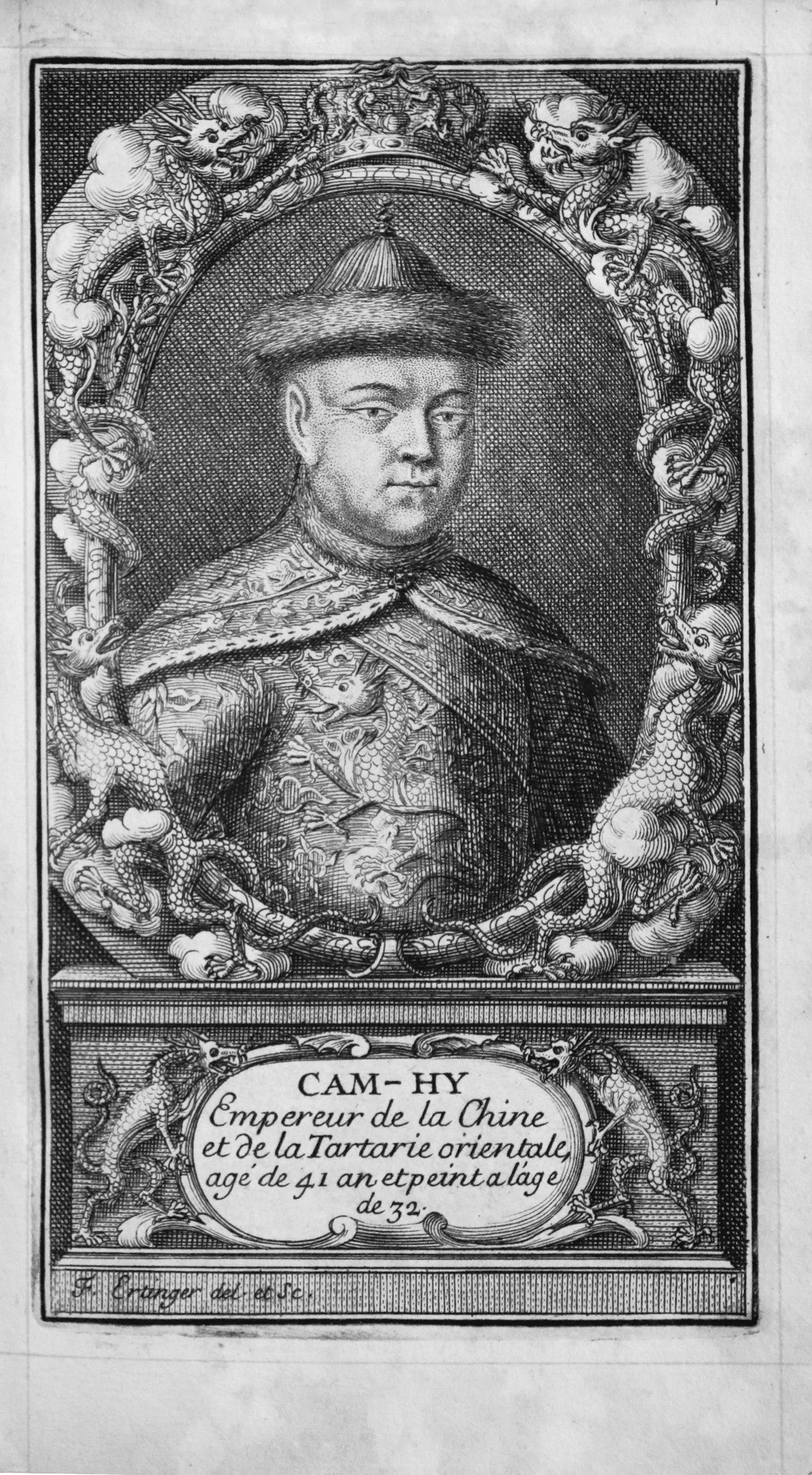
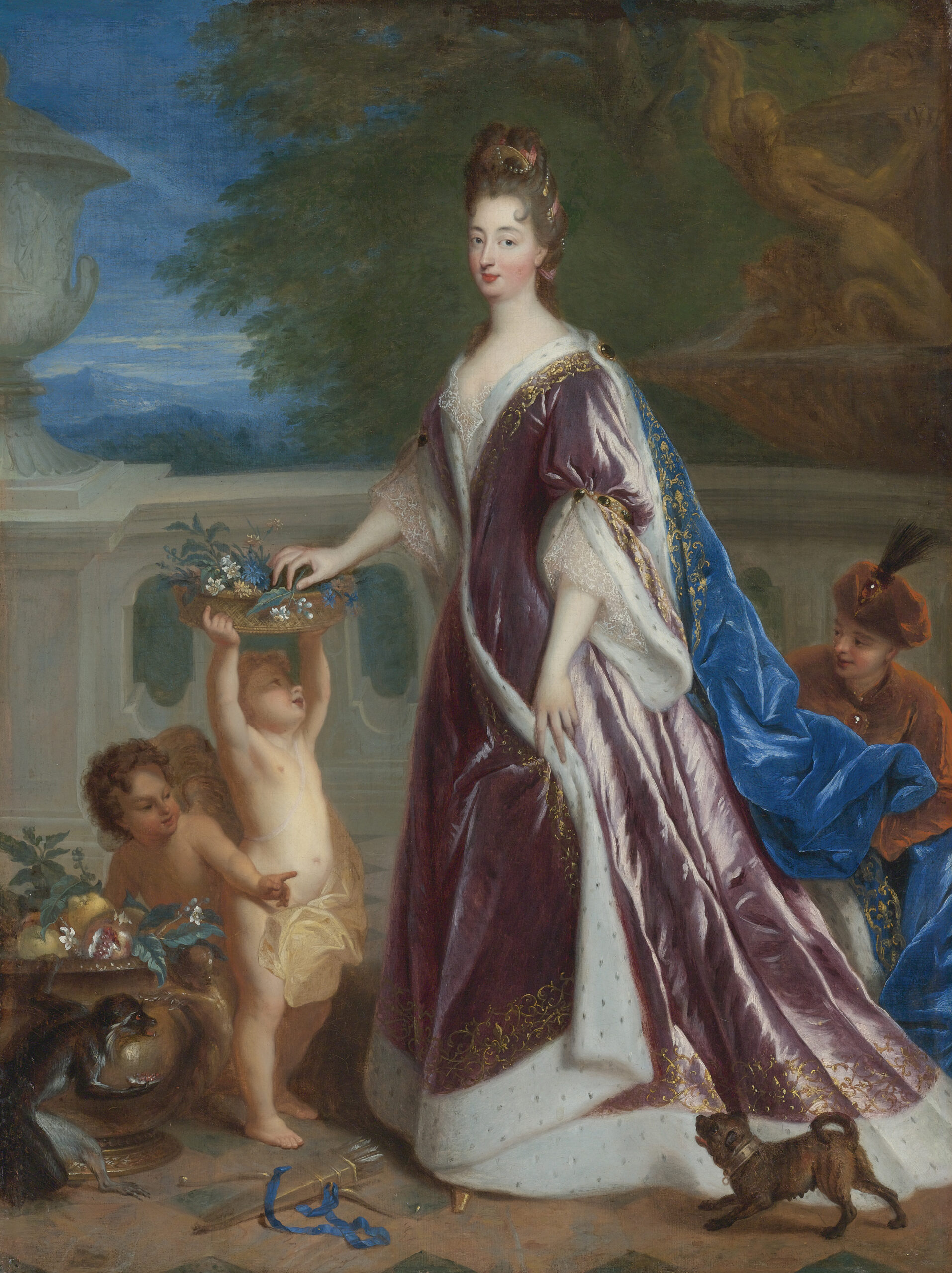
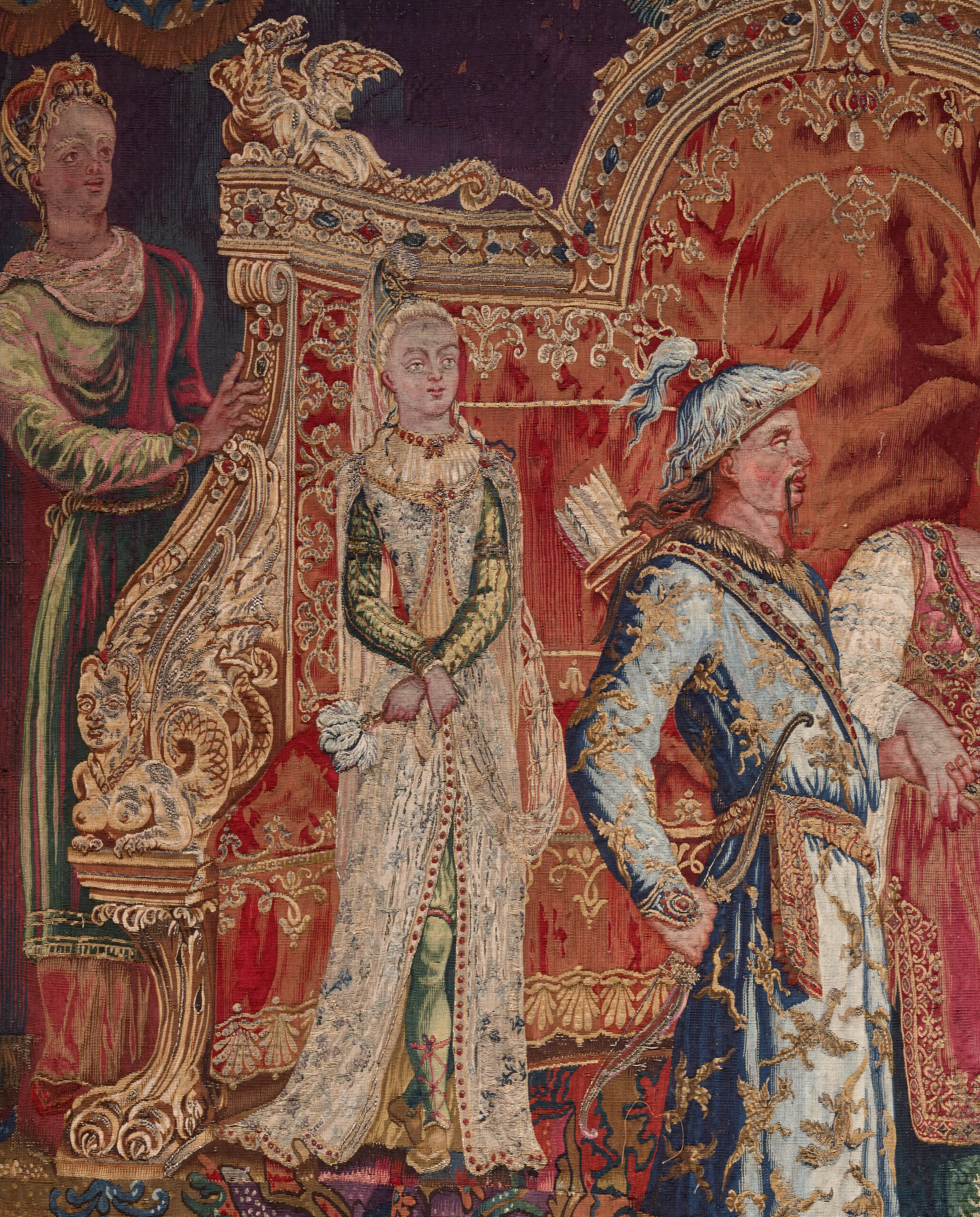
We have already referred to the hybrid architectural pavilions. The faces, particularly those of the Chinese women, bear no distinctive features. It has been noted that the Empress in The Return from the Hunt and The Empress’s Tea is blonde and that her features are reminiscent of those of the Duchess of Maine (fig. 6-7). The question of the resemblance is still open to debate. Historical figures have already been identified in the tapestries of The Audience of the Emperor, The Astronomers, and The Collation. Recognizing the portrait of the Duchess of Maine in the tapestry further highlights the fascination of the Duke of Maine for Chinese civilization and culture.
A prestigious provenance?
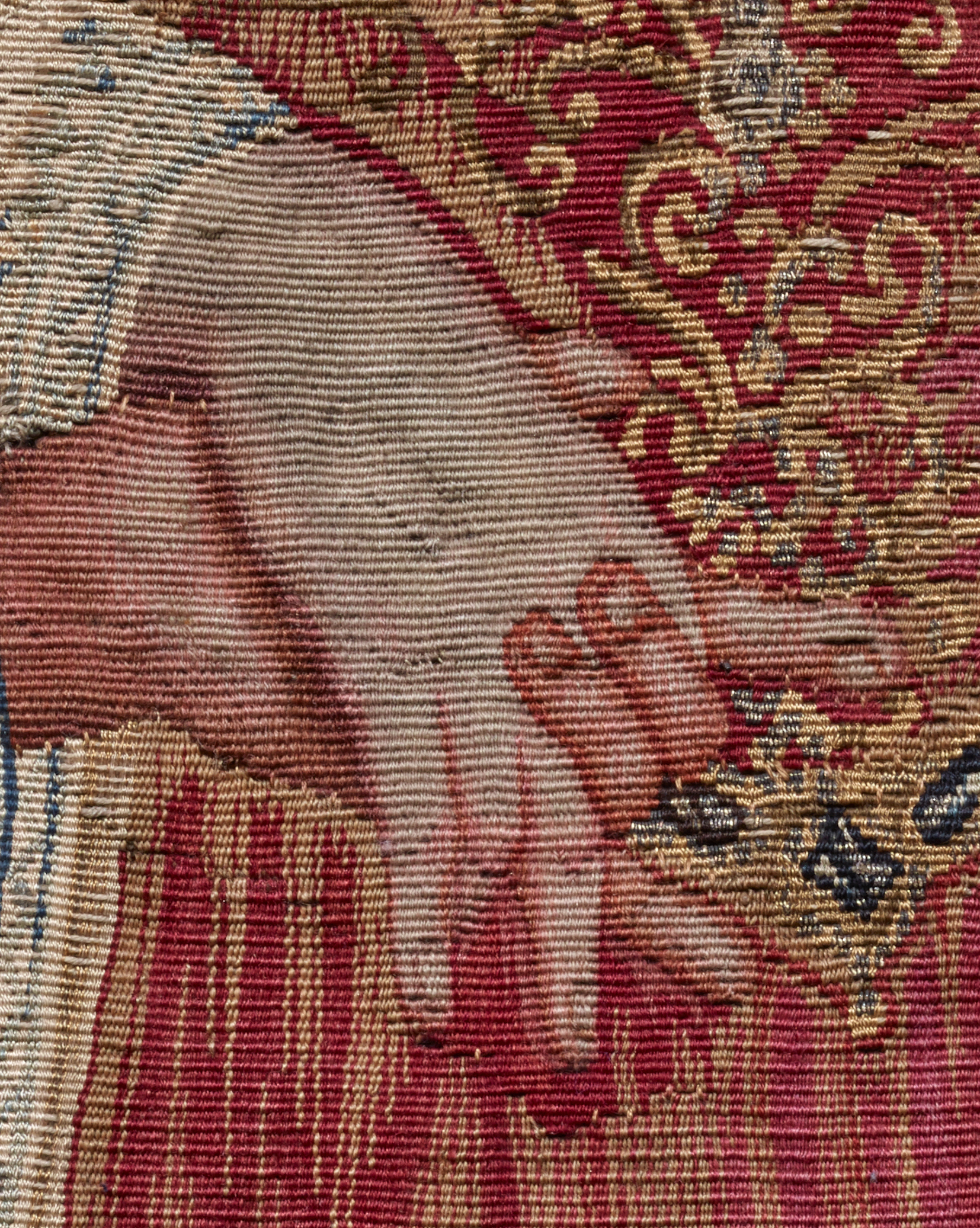
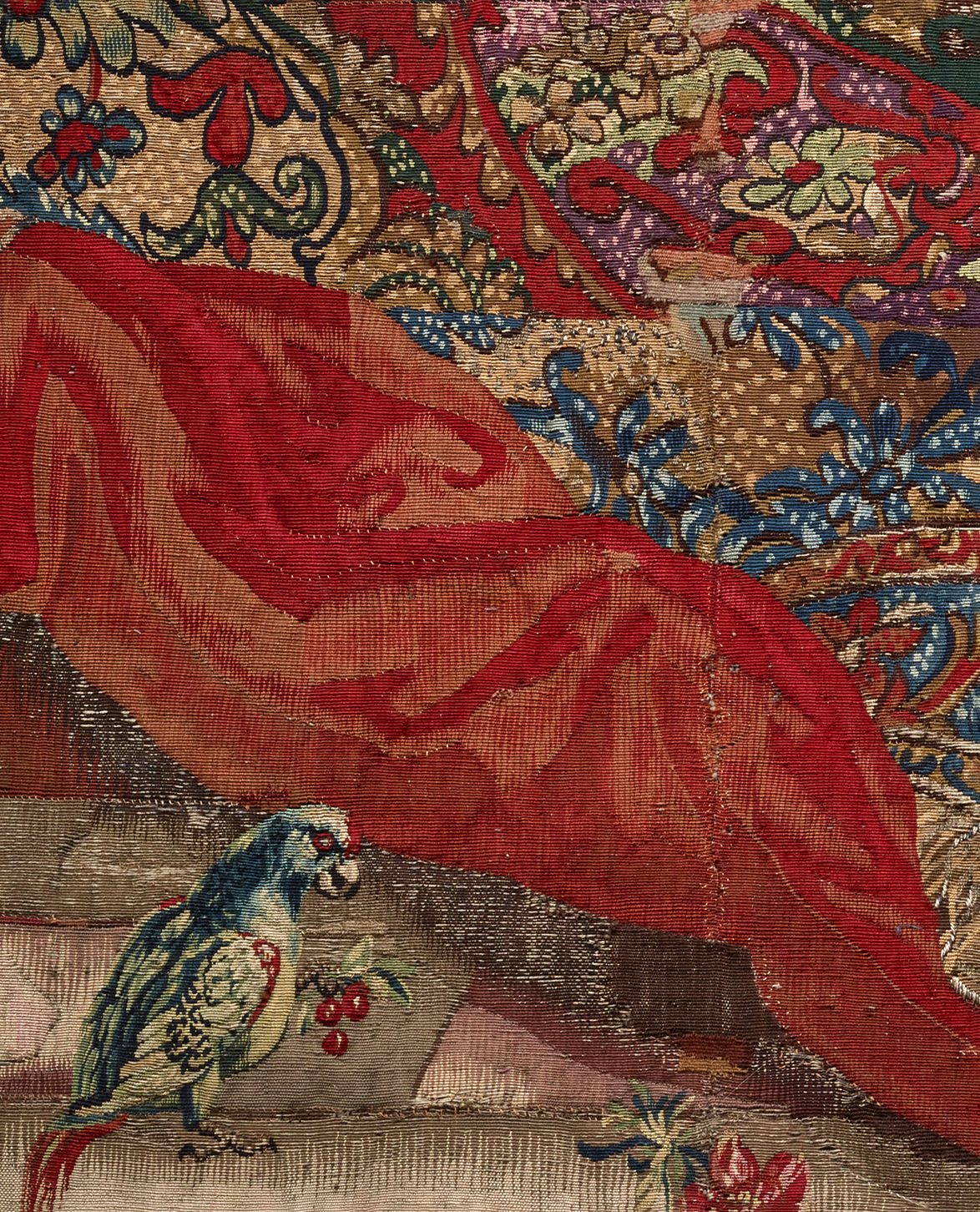
Another feature makes this tapestry truly remarkable: its exceptional quality of execution. According to the king’s historiographer André Félibien, two factors had to be combined in order to produce a beautiful tapestry: meticulous design and weaving by expert hands. Here, the quality of the design is oustanding, particularly the faces of the Emperor and Empress. The weaving is of a very fine gauge. The quality of the materials and dyes is also worthy of note: precious metal wefts appear in great quantity; the red and purple tones, which remain notably saturated, are rarely to be found preserved in such a state of preservation.
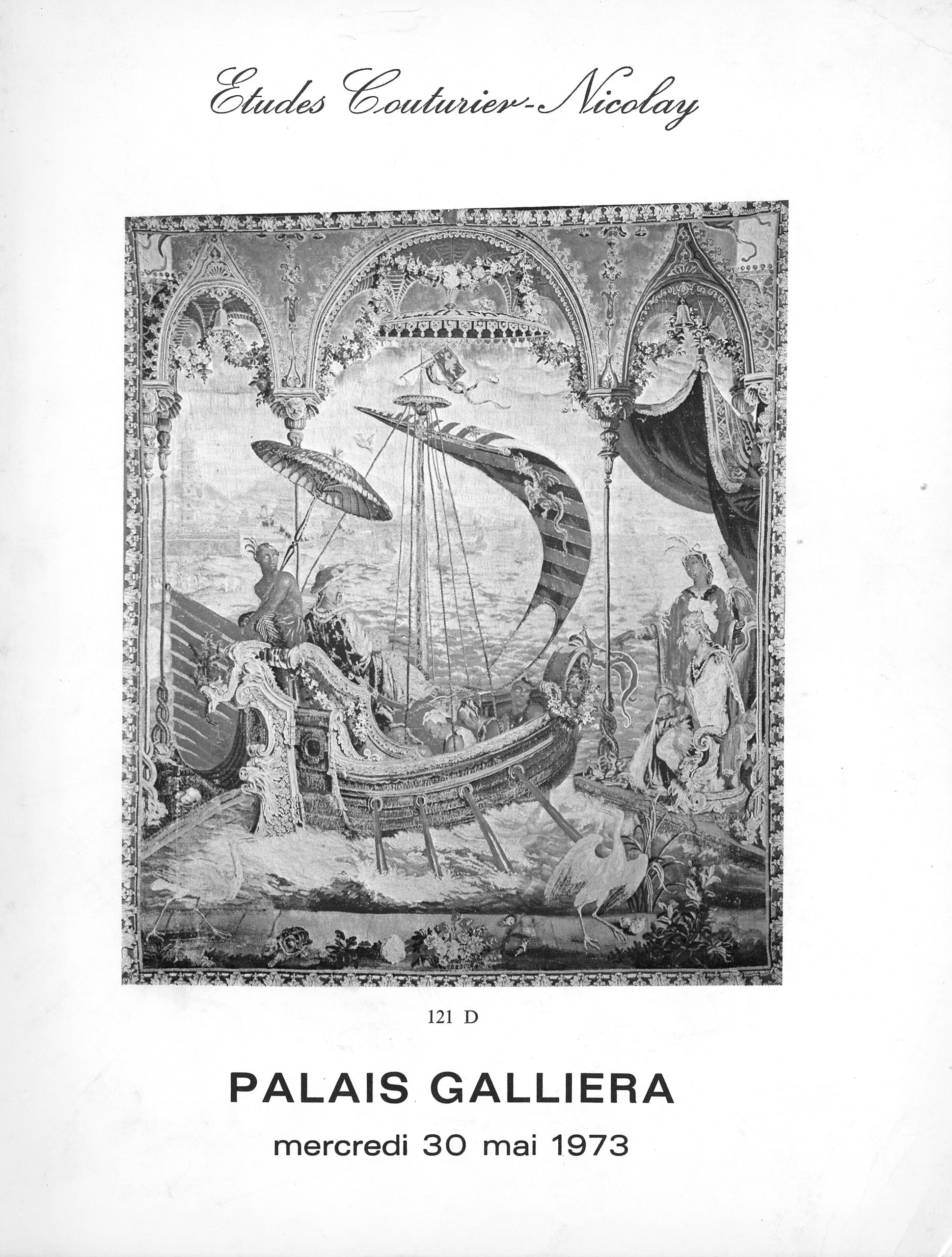
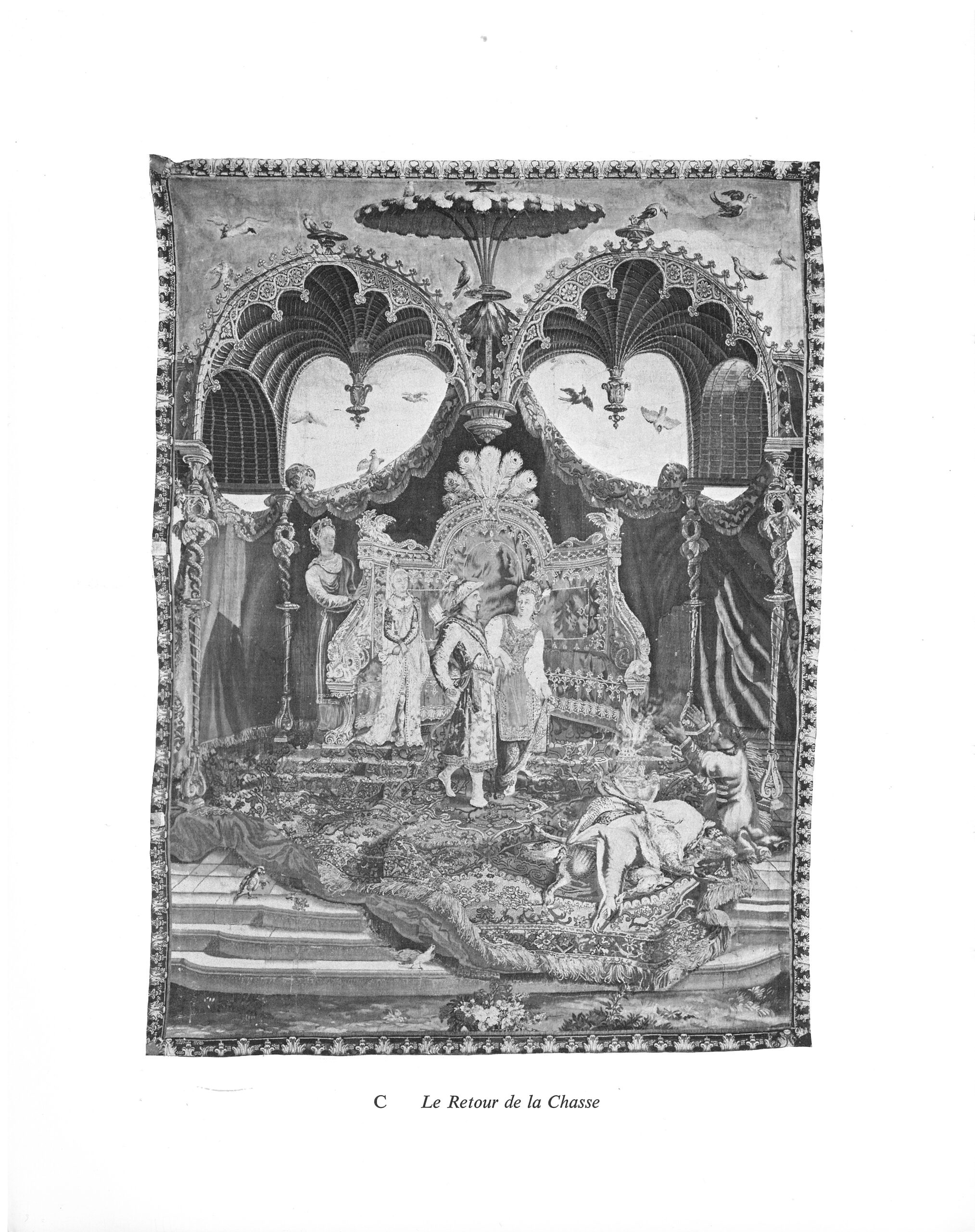
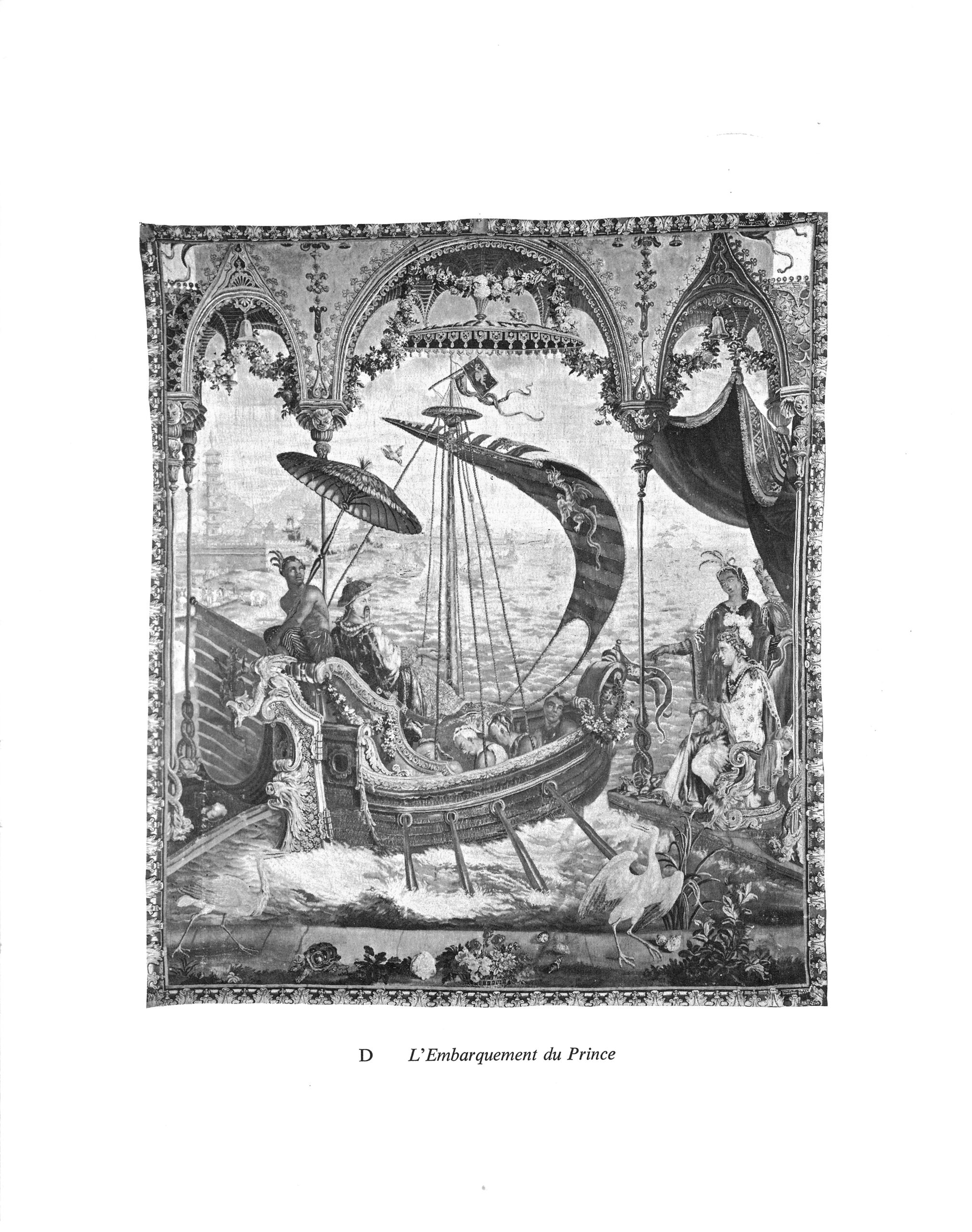
This exceptional weave argues in favor of a prestigious commission. The history of this sumptuous tapestry is highly fragmentary, beginning in 1973 with the auction where it was presented. This piece formed part of a reconstituted set of nine tapestries from diverse provenances. Another from this series, The Emperor Sailing, also featured precious metal wefts (fig. 8).
The quality and preciousness of the fabric allow for a comparison with the gold- and silver-wefted tenture acquired by the Duke of Maine. Tapestries made with precious metal wefts are, as we have seen, very rare among the productions of the Beauvais manufactory. As for the tapestry depicting The History of the Emperor of China, apart from the Duke of Maine’s tenture, which is known from ancient sources, we only know of the three-piece suite woven for the Elector of Trier (and this latter set does not feature the subject of The Return from the Hunt), and the piece depicting The Embarkation of the Emperor, mentioned above. Can we deduce from this that there was only one piece of The Return from the Hunt that was woven with gold and silver threads? There are gaps in the historical evidence, as we do not have the manufacturing records of Behagle, the contractor who wove the Duke of Maine’s series. Nevertheless, based on current knowledge, it is most likely this is one of the tapestries from the suite that belonged to the Duke of Maine.
Pascal-François Bertrand
Professeur émérite des Universités